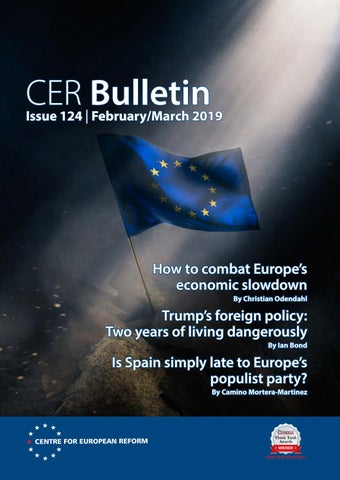
CER Bulletin
Issue 124 | February/March 2019
How to combat Europe’s economic slowdown By Christian Odendahl
Trump’s foreign policy: Two years of living dangerously By Ian Bond
Is Spain simply late to Europe’s populist party? By Camino Mortera-Martinez
WINNER Think Tank of the Year
How to combat Europe’s economic slowdown by Christian Odendahl
Europe is experiencing an economic slowdown at an exceptionally bad time, but has the tools to fight it and should use them soon. After two years of decent growth, all the indicators suggest that the European economy is cooling, though not yet heading towards a recession. The OECD’s composite leading indicator for Europe, which compiles economic data predicting GDP growth, is at its lowest level since the depths of the euro crisis in 2012. The purchasing managers’ index, which measures business activity and conditions, has fallen in both the eurozone and the world economy for most of 2018. Now the International Monetary Fund has revised its economic forecast down for eurozone and global growth. To a large extent, China and the US are driving the slowdown in the world economy. The Chinese government is gradually moving China’s growth model away from exports and credit-fuelled investment towards domestic consumption. This difficult process is bound to reduce growth, which had been remarkably high for a middle-income country. It will reduce Chinese demand for imports. The Trump administration has cut taxes, as promised to voters and the Republican party – a fiscal stimulus that the US economy did not need. The Federal Reserve has therefore continued to raise interest rates, dampening the effect of the
stimulus on the US economy and increasing the dollar’s value. US demand for foreign goods and services, and the trade deficit, have consequently increased. Trump thus provided an economic stimulus to the world which has now largely run its course. For the world, the slowdown is a return to normal. For Europe, that is bad news. Over the last five years, the eurozone has grown 1.9 per cent per year on average. The expansion was mostly driven by stronger domestic demand, fuelled by the collapse in oil prices, which boosted consumers’ real incomes, and by less restrictive fiscal policy and more aggressive monetary easing by the European Central Bank (ECB). But in the five years before that, the eurozone followed Germany’s export-led growth model: between 2008 and 2013, the only meaningful source of European growth was net exports, growing 0.5 per cent a year on average. As a result, the eurozone’s current account surplus grew to more than 4 per cent of GDP – and remained there despite the recent period of strong domestic growth. A slowdown in the world economy, especially in such important trading partners as the US and China, will therefore hit Europe disproportionately hard.
INFO@CER.EU | WWW.CER.EU CER BULLETIN ISSUE 124 | FEBRUARY/MARCH 2019 3
Politically, 2019 promises to be a challenging year for Europe. In France, President Emmanuel Macron’s approval rating has tanked to the low 20s; and the ‘yellow vest’ protest movement is causing economic disruption. If the economic slowdown means that the potential benefits of Macron’s reforms are not immediately felt by voters, there may be serious political resistance to any further reforms he attempts. If Brexit goes ahead as scheduled, it will coincide with an economic slowdown in Europe. The damaging repercussions of Brexit on the UK economy will therefore be more tangible than they have been for the past two years. At the time of writing, any outcome is possible, from a no-deal Brexit to no Brexit at all. The CER’s John Springford calculates the Brexit vote has already taken its toll on the British economy, leaving it more than two per cent smaller than it would have been had the UK voted to remain. But strong growth in Europe and the world masked that economic hit. Germany continued to grow in 2018, but at the slowest pace in years, and buoyed by a large increase in the workforce. On a GDPper-worker basis, it grew by just 0.2 per cent. Optimism in the German manufacturing sector is fading, according to the IFO survey of business sentiment, and growth in industrial production and turnover is weakening. However, of all eurozone members, Germany is best-placed to deal with an economic slowdown, as wages are growing, unemployment is very low and the government is spending its budget surplus on electoral promises. Italy’s populist government, meanwhile, is focusing on redistributive policies, such as lowering the pension age and introducing an embryonic basic income. It is neglecting measures that might help to boost the country’s economy, such as reforms to the justice and education systems, and the bureaucracy; or strengthening Italy’s fragile banks and resolving the bad loans that still weigh on banks’ balance sheets. A downturn in Europe would hit Italy badly, probably causing the government to escalate its anti-EU and anti-migrant rhetoric. Elections to the European Parliament will take place in May 2019. Populists from left and right, who are contemptuous of EU values, are likely to do better than ever. Established parties will win even fewer votes amid an economic slowdown. Despite the economic backdrop, the ECB has ended its quantitative easing programme, under which it has bought €2.6 trillion worth of
assets, mostly government bonds. Its attempt to ‘normalise’ its monetary policy – though there was nothing abnormal about lowering interest rates or buying long-term assets – comes amid declining inflation and a weakening economic outlook.
A slowdown in the world economy will hit “Europe disproportionately hard. And politically, 2019 promises to be a challenging year. ” Europe should start fighting the slowdown now. First, the ECB needs to pre-empt a further fall in inflation. Though it stopped its large-scale asset purchase programme prematurely, restarting it would damage its credibility. Instead, the ECB should commit to keeping interest rates low for longer. The best approach would be to announce a temporary price-level target, which the CER has long argued for. Under such a policy, the ECB would change its inflation target from ‘close to but less than’ two per cent inflation per year, to two per cent inflation on average for, say, five years. If inflation continued to undershoot, the ECB would commit to loosen future monetary policy – mildly overheating the economy in order to overshoot two per cent inflation and make up lost ground. Were such a policy in place, the ECB would not contemplate raising interest rates any time soon: over the last five years, eurozone inflation has averaged less than one per cent. Second, the eurozone should acknowledge the pro-cyclical bias of its fiscal framework, and fix it. Europe’s fiscal rules do not allow enough stimulus in a recession, and allow too much spending during a boom. Moreover, the rules fail to protect investment spending, which is usually the first to be cut in a downturn. And the eurozone’s method for calculating fiscal limits is itself pro-cyclical: temporary downturns are interpreted as permanently lower growth, limiting governments’ freedom to impart a stimulus. An overhaul of the fiscal rules to protect investment spending and prescribe strongly counter-cyclical policies would help to counter the current slowdown. Europe should not be complacent: the wounds inflicted by the last economic crisis have not completely healed, while the tools to fight the looming slowdown are limited. Europe should fight this downturn early and aggressively to avoid further political damage to the European project.
Christian Odendahl
Chief economist, CER @COdendahl
Trump’s foreign policy: Two years of living dangerously by Ian Bond
US President Donald Trump came into office in 2017 with an instinctive approach to foreign policy, and little knowledge. He strongly believed that alliances weakened the US, because allies took more than they gave, and spent less than the US on their defence. He was convinced that free trade enabled America’s trading partners to cheat it, because America imported more than it exported. He disliked international organisations, which he saw as fettering US power, and preferred to deal bilaterally with other nation-states. He respected foreign strongmen (notably Russian President Vladimir Putin, but also Xi Jinping of China and Recep Tayyip Erdoğan of Turkey) more than other democratic leaders, whom he saw as weak. The last two years have not changed Trump’s view of the world, or reassured US allies. A Trump doctrine of sorts has emerged, particularly in Trump’s own speech to the UN General Assembly in September 2018 and in speeches by Secretary of State Mike Pompeo at the German Marshall Fund in Brussels in December 2018 and to the World Economic Forum in Davos on January 22nd 2019.
Image: © NATO
In his UN speech, Trump attacked international organisations, reiterated his opposition to free trade and proclaimed: “We reject the ideology of globalism, and we embrace the doctrine of patriotism”. Pompeo in Brussels attacked the EU, as Trump often does, suggesting that it placed the interests of “bureaucrats in Brussels” before those of member-states and their populations. In Davos he argued that no international
body could stand up for a people as well as their own leaders could. Allies’ anxiety levels increased when media reports in January 2019 claimed that Trump had several times raised the possibility of the US withdrawing from NATO. Trump’s officials say that while some of the principles that have governed international relations in the last 70 years are still valid, others need to be jettisoned. They claim that Trump’s views on international organisations reflect those of ordinary Americans (who do not see how the ‘Western project’ of the postCold War period has helped them) and even ordinary Europeans. Trump is said to be willing to work through international organisations where the US is dominant, but not those where power is distributed among several significant players.
INFO@CER.EU | WWW.CER.EU CER BULLETIN ISSUE 124 | FEBRUARY/MARCH 2019 5
Trump is not alone among American politicians in attaching more importance to bilateral relations between states than to multilateral relationships mediated through international organisations; but he also has an unusually personalised view of international relations, relying on his ability to make deals with foreign leaders. This results in unpredictable lurches in policy, often announced on Twitter, that leave allied countries and his own officials struggling to respond. Before he met North Korean leader Kim Jong-Un, he called him “Little Rocket Man” and threatened him with war; after their summit in 2018 he told a rally in West Virginia: “We fell in love” – even though Kim seems to be continuing North Korea’s nuclear programme. Having met Xi in Florida and Beijing, Trump tweeted that despite US-China trade tensions, “President Xi and I will always be friends”. Coupled with this reliance on personal ties is Trump’s impulsive decision-making: after Erdoğan complained about the US’s Kurdish allies in northern Syria, who are affiliated with the Kurdistan Workers’ Party (PKK), proscribed as a terrorist organisation by the US and others, Trump abruptly announced that he was withdrawing US forces from Syria, without consulting his national security team. The announcement also caught allies fighting alongside US troops unawares. And as part of his rapprochement with Kim he announced the suspension of US-South Korea military exercises – again, without consulting his military advisers. Both the Trump doctrine and Trump’s actions disturb America’s European allies. Despite Brexit, most European countries see multilateralism as the best way to protect their interests and to promote stability and prosperity in the world. At first, allies comforted themselves with the idea that Trump was kept under control by an ‘axis of adults’ in key national security positions around him. But by the end of 2018, all those who could plausibly have claimed to be trying to restrain the president’s worst instincts had left office, the last to go being James Mattis, the Defense Secretary. In his resignation letter, Mattis wrote: “My views on treating allies with respect and also being clear-eyed about both malign actors and strategic competitors are strongly held and informed by over four decades of immersion in these issues”, and made clear that Trump disagreed with him on these points. How should US allies respond, faced with at least two and perhaps six more years of a president who appears to view them with more suspicion than he does adversaries like Putin, and who seeks to undermine organisations fundamental to their security and prosperity? France and Germany have talked up the concept
of European ‘strategic autonomy’ from the US; the Aachen Treaty, signed on January 22nd 2019 by French President Emmanuel Macron and German Chancellor Angela Merkel, includes a mutual defence commitment and provisions on defence co-operation that Merkel described as “contributing to the creation of a European army”. Poland, on the other hand, has tried to strengthen its bilateral defence ties to the US, offering to pay for a so-called ‘Fort Trump’ so that the US could station an armoured division (up to 20,000 troops) there. Poland and the US are also co-hosting a conference in February on Middle East stability and in particular Iran that seems to be part of a US effort to undermine EU support for the 2015 deal to end Tehran’s nuclear weapons programme – an agreement from which the Trump administration withdrew in 2018.
Trump has an unusually personalised view “of international relations, relying on his ability to make deals with foreign leaders. ” Neither the Franco-German nor the Polish approach is likely to mitigate the problems caused by Trump. ‘Strategic autonomy’ and ‘European army’ will remain empty terms as long as European allies continue to under-invest in defence. NATO estimates the average defence spend of European NATO members in 2018 as 1.5 per cent of GDP; only the UK and Latvia met NATO’s two targets of spending 2 per cent of GDP on defence and allocating 20 per cent of defence expenditure to new equipment. For the US to rely on bilateral defence and security relationships, however, would weaken NATO and EU co-operation, and could cause tension with other European partners, who may feel that in a crisis they would be a lower priority for US assistance. The best policy for allied governments is not to respond to Trump’s rhetoric with their own, positive or negative. European governments should instead use NATO’s 70th anniversary celebration in Washington in April to recommit themselves to defending each other; and they should increase defence spending and (whether in the EU or NATO) ensure that resources are used efficiently and effectively on common needs. Finally, they should work with the many military figures, officials and politicians in the US who still see the value of America’s alliances and the danger of Trump’s isolationism leaving a geopolitical vacuum in the world.
Ian Bond
Director of foreign policy, CER @CER_IanBond
Is Spain simply late to Europe’s populist party? by Camino Mortera-Martinez
It is a universally accepted fact that Spaniards love a good party. They are also, perhaps unfairly, said to be always fashionably late – it is not by chance that “mañana” (tomorrow) is one of the best-known Spanish words. Until two months ago, Spain had not joined Europe’s least exclusive party, with illiberal, eurosceptic and anti-migrant forces from Helsinki to Rome as guests. But now Vox, a relatively new far-right party, is in the new governing coalition of Andalusia, Spain’s most populous region. Will Spain follow the populist trend, or will Vox’s success be a one-off? Vox secured 12 out of 109 seats in Andalusia’s regional election in December last year. The Spanish socialist party (PSOE), which had governed the region since 1982, gained the most votes but only secured 33 seats, not enough to form a government. Adelante Andalucia, a coalition party dominated by Podemos, a left-wing populist party, said it would not support a socialist government – nor did it have the numbers to give the socialists a majority. Instead, a coalition between the centrist Ciudadanos (Cs), the conservative Popular Party (PP) and Vox took office. Vox is less eurosceptic than other populist movements in Europe. The party’s most radical suggestion about the EU is to suspend the Schengen passport-free area until the Union passes more laws to prevent criminals travelling unhindered. This point, which Vox included in its manifesto after former Catalan president Carles Puigdemont fled to Belgium to avoid trial, hardly
compares with populist calls elsewhere in Europe to leave the eurozone or the EU altogether. Indeed, Vox’s proposals on the EU, such as a new treaty returning powers to member-states, chime more with moderate critics in Northern and Western Europe than with parties like Italy’s Lega or France’s Rassemblement National. Vox is tougher on immigration than on the EU. It would like to send migrants who commit a crime back to their home countries, even if they lawfully live in Spain; introduce migrant quotas which would prioritise those coming from Latin America; and build a wall along the frontiers of Ceuta and Melilla, Spain’s enclaves in Morocco. But, as with many anti-migration parties in Europe, Vox’s demands lose their force when confronted with reality. In exchange for its support to a PP-Ciudadanos government in Andalusia, Vox signed a ‘memorandum of understanding’ with the PP, making notable compromises on migration: this mainly talks
INFO@CER.EU | WWW.CER.EU CER BULLETIN ISSUE 124 | FEBRUARY/MARCH 2019 7
about reinforcing border controls (though it does not explain how) and doing more to fight migrant smuggling. Vox’s softer position on migration in Andalusia is a rational choice. Although many people vote for Vox because they are upset about Spain’s migration policies, this is far from the only explanation for the party’s sudden popularity. Vox thrived in some Andalusian towns with many migrants, but it did rather poorly in others. And a recent poll shows that many of Vox’s voters are unhappy about differences in the distribution of wealth between Spanish regions, and the inefficient functioning of the Spanish devolved administrations. Vox is doing fairly well in national polls. If national elections were held now, reliable polls estimate it would enter the Spanish Parliament with 12 to 13 per cent of the votes, or up to 45 seats (as a comparison, Ciudadanos has 33). If this is the case, Vox will have an important role in coalition formation. Perhaps the success of Vox both nationally and in Andalusia is that it is not a single-issue party, and it revives issues that Spain’s mainstream parties seem to have forgotten amid the noise of the financial crisis and Catalonia’s independence bid. These range from national identity to taxation to domestic violence. Many of them overlap: for example, part of Vox’s argument about national unity is based on the desire to scrap regional differences on taxation, which mean that people living in, for instance, the western region of Extremadura pay
more taxes than those living in Castilla y León in central Spain. In the long run, Vox’s success will not only be measured by the number of seats it manages to secure in the forthcoming European and regional elections, but by its ability to influence and ultimately dominate Spain’s national debate on issues like migration, security and the economy. And on that, Vox seems to be doing rather well: the PP has toughened its stance on values and national identity, as its new leader Pablo Casado rebrands the party as the “unashamed right”. Vox’s surge is also a major headache for Albert Rivera, Cs leader: his party’s membership of the governing coalition in Andalusia has attracted criticism from Rivera’s European partners. This matters, as Rivera hopes to get good results in the European elections by forging alliances with like-minded parties across the EU. The coalition in Andalusia may put off allies such as French president Emmanuel Macron or Dutch prime minister Mark Rutte, whose parties have long ring-fenced the far right. Vox will probably not take the Spanish or European parliaments by storm, though it will make its presence felt. But if the Andalusian experience is anything to go by, Spain has belatedly joined Europe’s populist party.
Camino Mortera-Martinez
Senior research fellow, CER @CaminoMortera
CER in the press The Sunday Times 20th January The influential CER argues [in ‘After the meaningful vote: What are Theresa May’s options?’ by Sam Lowe and John Springford] that the only option for the prime minister in getting a withdrawal agreement through the Commons will be to further blur her red lines, so pushing Britain towards a softer Brexit. The Financial Times 18th January “In some of the key memberstates, senior officials believe that if the European Council wants to give the British an extension beyond July 1st, the election issue could
be solved in a one-page protocol that could be ratified relatively quickly,” said Charles Grant, director of the CER. “This would mean the British would not have to hold elections themselves.”
As Agata GostyńskaJakubowska of the CER notes, it [an Article 50 extension] would also stop the reallocation of the 27 British seats, screwing up other countries’ polls.
relationship go?’, the much bigger threat to trade from Brexit is to Britain’s services sector, accounting for nearly a half of all UK exports, of which around 40 per cent go to the rest of the EU.
Politico 17th January If the EU cannot agree on a common system for legal migration, it may be more realistic for the Union to support bilateral projects between individual member countries or groups and third countries, said Camino Mortera-Martinez and Beth Oppenheim of the CER.
The Financial Times 12th December The EU is scrambling to respond to US sanctions on Iran for fear of retaliation. Luigi Scazzieri at the CER says it is time for the bloc to buck up its ideas.
The Wall Street Journal 6th December For everyone to trade in dollars, they must be able to store them for future use, explain Adam Tooze and Christian Odendahl in a paper ‘Can the euro rival the dollar?’ for the CER. That means finding safe dollar assets, such as government bonds or other bonds with high credit ratings. Demand for these lowers financing costs for anyone borrowing in dollars.
The Economist 16th January
The Telegraph 8th December As the CER’s Sam Lowe points out in a new analysis ‘Brexit and services: How deep can the UK-EU
INFO@CER.EU | WWW.CER.EU CER BULLETIN ISSUE 124 | FEBRUARY/MARCH 2019
Recent events 22 January Dinner on ‘What does Brexit mean for the City of London?’, London With Jon Cunliffe 16 January CER/Kreab breakfast on ‘The EU’s future post-Brexit’, Brussels With Jeppe TranholmMikkelsen
Jeppe Tranholm-Mikkelsen
Jon Cunliffe 28 November Conference on ‘The future of the EU: Democracy under siege’, Brussels Keynote speaker: Pierre Moscovici Speakers included: Agnès Bénassy-Quéré, Maria Demertzis, Sandro Gozi, Merle Maigre and György Schöpflin
(L to R) Agnès Bénassy-Quéré, Maria Demertzis
Pierre Moscovici
Forthcoming publications The European-Saudi relationship after Khashoggi Beth Oppenheim Has the EU caused economic divergence in Europe? Christian Odendahl, Sam Lowe and John Springford
Reaching a common position: Strengthening European arms export controls Sophia Besch and Beth Oppenheim The rule of law in the EU: No room for complacency Ian Bond and Agata GostyńskaJakubowska
For further information please visit
www.cer.eu
The EU’s Security Union: A bill of health Camino Mortera-Martinez Parliamentary scrutiny after Brexit: Can MPs take back control? Agata Gostyńska-Jakubowska