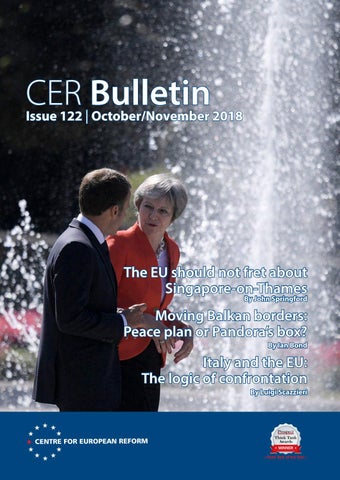
CER Bulletin
Issue 122 | October/November 2018
The EU should not fret about Singapore-on-Thames By John Springford
Moving Balkan borders: Peace plan or Pandora’s box? By Ian Bond
Italy and the EU: The logic of confrontation By Luigi Scazzieri
WINNER Think Tank of the Year
The EU should not fret about Singapore-onThames by John Springford
At the Salzburg EU informal summit on September 20th, EU leaders read the last rites on Theresa May’s Chequers plan. They dismissed May’s proposals for a complicated (and probably unworkable) customs relationship and a ‘common rulebook’ in goods and agriculture. The European Commission argues that such an arrangement, allowing the UK unfettered access to the single market in goods, would give a competitive advantage to UK manufacturing businesses. The EU worries constantly that Britain could slash regulations, taxes and labour market protections after Brexit in order to compete. Should it be so fearful? There are many ways in which policy can be used to try to gain international competitiveness and increase exports. The most obvious way to gain a competitive edge would be to deregulate. This is why the EU says that if the UK wants a Canadastyle agreement, it has to accept stringent ‘level playing field’ provisions, far beyond those normally included within a free trade agreement (FTA). These provisions would prevent the UK government from allowing more pollution, curbing protections for workers, subsidising business, or allowing products for sale that might harm consumers. For its part, the British government argues that it will agree level-playing field provisions if the EU signs up to the Chequers plan, but that such provisions for an FTA would amount to the obligations of Norway for the market access of Canada. Under the Chequers proposals, however,
some manufacturing and agricultural processes might not be covered by the common EU-UK rule book: as long as the end product met EU standards, the process for getting there might be different. Perhaps certain pesticides would be allowed, or noise levels in factories might be louder in Britain than in the EU. There are therefore two disputes. One is whether the UK should agree to the level playing field. The answer is that it should. According to opinion polling, there is no public appetite for loosening environmental laws or workers’ rights. Current rules benefit British citizens, and if agreeing to them leads to tariff-free trade with the EU, all the better. The second question is whether aligning on goods while diverging on services will give British manufacturers a competitive advantage.
INFO@CER.EU | WWW.CER.EU CER BULLETIN ISSUE 122 | OCTOBER/NOVEMBER 2018 3
There are several reasons why this is unlikely. The EU does not regulate most service inputs in the manufacturing and agrifood process. Engineering, design, marketing, cleaning factory floors and servicing machinery are regulated, if at all, largely by national authorities. Any attempt by the UK to subsidise manufacturers, or loosen labour and environmental standards, could be dealt with by level playing field provisions. The UK could in theory slash financial regulation governing lending to business (perhaps by weakening rules on securitisation or lowering capital provisions for business loans). But the Bank of England and the Financial Conduct Authority, which are independent of the government, have no incentive to do so. The European Commission is on firmer ground in arguing that services and goods are becoming less distinct. Take smartphones: the physical product is inseparable from the services provided over the internet. Driverless cars will require regulation to govern how consumer data is used, and who is liable for accidents. However, the UK has signalled that it would prefer to remain aligned with the EU’s data regime. The most likely outcome of Brexit is a trade relationship that is far more comprehensive in goods than services: either a Canada-style FTA, or a customs union with some regulatory bolt-ons. Either would require the UK to sign up to rules preventing regulatory competition. The UK might therefore try three other ways to seek competitive advantage. Brexit makes them more difficult. One way would be to make higher quality products than businesses in the EU, by creating an environment conducive to innovation and foreign investment (so that the world’s best companies make their products in the UK). Brexit will make that harder. Higher trade barriers between Britain and the EU – and political uncertainty about relations with the EU, caused by Britain’s polarised politics – will make multinational companies less willing to invest. And, even if immigration policy remains relatively liberal after Brexit, the UK will probably become less attractive to the European scientists, engineers, designers and computer programmers needed to make cutting-edge products. Britain will also have less fiscal space to invest in research and innovation, since Brexit will raise the government deficit. At the UN on September 26th Theresa May pledged the lowest corporation tax rate in the G20. That would attract some companies to the UK, but would only partially offset the Brexit damage. The second way is to become more productive. Exporters tend to produce more output per hour
worked than companies that serve the domestic market. If Britain’s exporters produce more output per input than companies based in other countries, they will sell more exports. However, Brexit will tend to lower productivity, not raise it: highly productive multinationals will reduce investment in the UK; and the UK will become more closed to foreign competition, because imports from the EU will fall and UK companies will find it harder to participate in European supply chains. Both factors will lead to British companies losing their edge.
The EU need not fear that Britain will “out-compete the rest of the EU after Brexit: the reverse is all but certain. ” Third, Britain could try to compete on price, by holding down wages or devaluing the pound. If businesses could make the same quality products as now, but at lower prices than businesses based in other countries, that should raise exports. However, this chain of events is unlikely to happen. British companies are embedded in international supply chains, which means they combine imported components into new products for export. A cheaper currency makes British exports cheaper, but it also makes imported parts more expensive. Many British exporters invoice in dollars and euros, which means that they do not benefit from a cheaper currency. And even though British workers have gone through an extraordinary period of wage restraint (in real terms, average wages are 2 percentage points lower than their 2008 peak), exports fell as a proportion of GDP between 2011 and 2016. The EU has good political reasons for saying no to partial participation in its internal market. It is right to fear that if it offers this to the UK, others might demand the same, and the web of compromises and bargains that make up the single market might unravel. It is also perfectly reasonable to make Brexit a binary choice between ‘in’ and ‘out’ in order to demonstrate the costs of leaving to europhobes in France, Italy, Poland and Hungary. Brexiters promised a liberal, free-trading, competitive UK after Brexit. This has fed the EU’s fears that Britain will pursue a form of slash-and-burn capitalism that will undermine European markets. But they need not fear that Britain will out-compete the rest of the EU after Brexit: the reverse is all but certain.
John Springford
Deputy director, CER @JohnSpringford
Moving Balkan borders: Peace plan or Pandora’s box? by Ian Bond
A frozen conflict can ‘thaw’ in two ways: through a peaceful resolution, or a return to war. For the first time since Kosovo declared its independence in 2008, some of the Western Balkans’ frozen conflicts seem to be thawing. Can the EU ensure that they end in peace? In June 2018, Prime Ministers Alexis Tsipras of Greece and Zoran Zaev of ‘the former Yugoslav Republic of Macedonia’ (as Macedonia is known internationally) agreed on a compromise formula for the name of the country, after a dispute that began when Macedonia declared independence in 1991. If the Macedonian and Greek populations back the deal in referendums (by no means certain), the country will henceforward be known officially as ‘the Republic of Northern Macedonia’. Greece will then lift its block on Macedonia’s accession to NATO, and on the opening of its accession negotiations with the EU.
President of Serbia, Aleksandar Vučić, appeared together at the ‘European Forum Alpbach’ in Austria. Thaçi said “countries in the region should not be afraid of an agreement … even if it includes border change”. Vučić implied that he agreed with this, saying that nobody had asked Serbs and Albanians about the borders of Kosovo.
European reactions verged on rapture: European Council President Donald Tusk said that “the impossible is becoming possible”; EU High Representative for foreign policy Federica Mogherini and Commissioner for enlargement Johannes Hahn said that it contributed to “the transformation of the entire region”. Russia reacted more negatively: its intelligence services sought to organise opposition to the deal in both Greece and Macedonia.
Thaçi subsequently suggested that he wanted to exchange the northern part of Kosovo (largely inhabited by Serbs and de facto outside Pristina’s control since NATO intervened in the Kosovo conflict in 1999) for the Preševo Valley, a majority-Albanian area in southern Serbia. Vučić has not said so far whether he would agree. Serbia’s main road and rail connections to Greece run through the district, making a transfer of the whole area difficult. But a deal, which would need to be ratified by referendums in both countries, would clear the way for Serbia’s EU accession negotiations to move forward more quickly. It would also allow Kosovo, with full international recognition, to begin its EU application process.
Meanwhile, there is also progress in the dialogue between Kosovo and Serbia. In August, the President of Kosovo, Hashim Thaçi, and the
International views on the nascent Thaçi/Vučić agreement are mixed. After the latest round of talks in Brussels between the two presidents
INFO@CER.EU | WWW.CER.EU CER BULLETIN ISSUE 122 | OCTOBER/NOVEMBER 2018 5
on September 7th, Mogherini did not refer explicitly to the land swap proposal, but said in a statement that any settlement must be in line with international law. The US National Security Adviser, John Bolton, said that the US did not exclude territorial swaps, but that the parties had to sort it out for themselves. German Chancellor Angela Merkel, however, made clear her opposition to redrawing boundaries. A Foreign Office minister, Alan Duncan, told Serbian media on September 20th to be careful about changing borders, for fear of causing “earthquakes and new crises for the people in the region”. Elsewhere, reactions have been more negative than positive. Three former international High Representatives in Bosnia, Paddy Ashdown, Carl Bildt and Christian Schwarz-Schilling, and more than 50 experts on the Western Balkans wrote open letters opposing the deal. Among other things, they were concerned that the Serbs of Republika Srpska (RS – part of Bosnia), would exploit the precedent to justify breaking up the Bosnian state. Edward Joseph, an American former senior international official in the region, also warned of the risk of inflaming the Albanian minority in Macedonia, potentially leading to that country’s partition. On the other hand, former senior US National Security Council official Charles Kupchan, despite calling the deal “peaceful ethnic cleansing”, urged US support for it, as the best chance of achieving lasting peace between Kosovo and Serbia. In private, EU officials stress that they would rather that border changes had not become the central element in a settlement, and are not actively promoting them. They underline that any deal must also be acceptable to EU member-states (including Cyprus, Greece, Romania, Slovakia and Spain, which still do not recognise Kosovo’s independence) and must not destabilise neighbouring countries. And a deal must respect the rights of minorities – most of the Serbs in Kosovo live outside the area that would be transferred to Serbia, and one of the three towns in the Preševo Valley is majority Serb. But the EU would also regard agreement between Thaçi and Vučić as a big step forward, not least because the two would have reached a solution by themselves, rather than having it imposed on them by foreign powers. The EU believes that the prospect of enlargement will be enough to guarantee agreement between Kosovo and Serbia, especially now that Serbia (as well as Montenegro) has been told that it can join the EU by 2025, if it fulfils the EU’s membership requirements. Brussels also seems confident
that Vučić will be able to keep the RS leader Milorad Dodik under control, in the interests of Serbia’s EU membership process. Western officials in the region think that Brussels may be too relaxed on both points (though RS did not break away when Montenegro or Kosovo declared independence from Serbia in 2006 and 2008 respectively).
The EU will need a pro-active information “campaign on how Kosovo and Serbia will benefit from a deal. ” There is already opposition to land swaps from nationalist politicians in Kosovo including Prime Minister Ramush Haradinaj, and from the Serbian Orthodox Church. Neither Thaçi nor Vučić can be sure of winning referendums on any deal. And Russia will be working to prevent its ‘little brother’, Serbia, and neighbouring countries moving towards EU and, in most cases, NATO membership. In Ukraine, Russian disinformation about the EU-Ukraine association agreement played a significant part in creating anti-Western hostility in eastern Ukraine before Moscow’s 2014 intervention. If there is to be a deal, regardless of content, the EU will need a pro-active information campaign showing how Kosovo and Serbia will benefit from settling their differences. Moreover, those who worry that a land swap will set a precedent for Bosnia are not merely being alarmist: Bosnia is fragile, and the Bosnian Croats are as likely as the Bosnian Serbs to try to use any opportunity to undermine the state’s integrity. The EU cannot leave it to Vučić to keep Bosnia in one piece. Despite the risks, however, if Belgrade and Pristina can reach agreement, their progress should not be held hostage by Bosnia’s dysfunction and its unscrupulous politicians. The EU’s focus should be on minimising the risks of negative spill over in other parts of the region; and then on ensuring that Serbia and the other Western Balkans states do what they need to in order to join the EU, thus reducing the importance of the borders between them. The last thing left in Pandora’s box was hope; if Thaçi and Vučić (like Tsipras and Zaev) think they can give some of it to the region, they should be given the chance to try.
Ian Bond
Director of foreign policy, CER @CER_IanBond
Italy and the EU: The logic of confrontation by Luigi Scazzieri
Four months after being sworn in, Italy’s League-Five Star coalition government has set a more confrontational tone in its relations with the European Union. Although Rome has not immediately begun a spending splurge or vetoed EU sanctions on Russia as some feared, it has picked fights with the bloc on migration, on the EU budget and on Italy’s finances. Matteo Salvini, leader of the League, has largely driven the agenda. As interior minister, he has taken ownership of immigration, Italy’s most highly charged political issue. He has claimed credit for a reduction in the number of migrants arriving in Italy, even though this was achieved by the previous government. And by blocking ships arriving in Italy from disembarking migrants, he showed that he can force the EU to make concessions; on several occasions after Italy refused to let ships disembark on its soil, some member-states agreed to distribute migrants among themselves. Along with a strict line on law and order, this has propelled the League from 17 per cent in the general election to over 30 per cent in recent polls. By contrast, Five Star has been left to compete on less headline-grabbing issues, such as tackling corruption, reducing the cost of politics and introducing a universal basic income. Its efforts have been less successful, and it has haemorrhaged votes. In financial terms, Rome seems to be backing away from major confrontation with the EU. The draft 2019 budget, released at the end of September sets Italy’s deficit at 2.4 per cent of GDP. This violates eurozone rules and will create
conflict with the EU, which wants Italy to cut spending and reduce its debt. But in reality, the draft budget represents a massive retreat from the coalition manifesto promises, which implied a deficit of around 7 per cent. The weakness of Italy’s financial position forced Rome to compromise. The League’s promise to lower taxes will be implemented partially and gradually, while increased social spending sought by the Five Star will largely be deferred. Additionally, the draft is an opening shot and the final budget could be lower than 2.4 per cent. As long as both the Five Star and the League can claim victory, the optics of a confrontation with the EU will matter more than the substance of the budget. Although Italy’s coalition government is likely to back down and implement a more conservative budget than many feared, the EU should expect more confrontation on other issues. Criticising ‘Brussels’ is a vote winner for the League and the Five Star. Above all, Italy is likely to clash with the EU on migration. Despite the lower number of arrivals, Salvini will try to keep the migration in the headlines, to highlight the EU’s alleged lack of solidarity. Rome wants other memberstates to take in a share of the people landing in
INFO@CER.EU | WWW.CER.EU CER BULLETIN ISSUE 122 | OCTOBER/NOVEMBER 2018 7
Italy. Other member-states agreed at the June European Council to help by setting up migrant processing centres within the EU and in third countries, but there has been no progress. Italy’s foreign policy could also become increasingly erratic and assertive. Rome is likely to align itself increasingly with Donald Trump’s criticisms of Germany, France and the European Commission. Italy could draw closer to Russia, for instance by striking high profile business deals and signalling a willingness to ease sanctions. Italy is also likely to clash with France, which has openly criticised Rome’s migration policy. Italy blames France for reducing Italy’s clout in Libya and destabilising the country through an ill-advised push for early elections in pursuit of influence and business opportunities. Finally, Italy’s coalition government will continue to be torn in dealing with Hungary. Angered by Prime Minister Viktor Orbán’s refusal to take in migrants from Italy, the Five Star has called for cuts in EU structural funds for Hungary and its MEPs also voted in favour of triggering the Article 7 disciplinary procedure against the country. But Salvini has pledged to work with Orbán to oppose the EU’s ‘open-door’ migration policy, a straw man given the bloc’s increasing efforts to reduce the number of people attempting to reach Europe and deport those whose asylum applications have been rejected.
The rivalry between the Five Star and the League, and the popularity of EU-bashing, will continue to shape Italian politics and generate confrontation with Brussels. While the coalition is unstable, neither a change of government nor new elections is likely until the 2019 European Parliament elections. However, in the coming years, it is possible that Italy will have a Leagueled government. This could result in even greater friction with the EU on migration, foreign policy and economic policy. How relations between Italy and the EU develop depends in part on the EU’s actions. Italians are increasingly disillusioned with the EU, believing it did not show solidarity with Italy during the eurozone and migration crises. There appears to be little chance of eurozone reform, meaning that Italian economic grievances are likely to fester. However, with the migration crisis under control it would be relatively inexpensive for willing member states to set up a mechanism to share asylum-seekers between them. The League and Five Star would claim victory, but ultimately such a visible sign of European solidarity would weaken their anti-EU rhetoric.
Luigi Scazzieri Research fellow, CER @LScazzieri
CER in the press BBC News 11th September 2018 “The only countries that have managed to remove the need for health checks on food being exported to the EU,” says Sam Lowe, a senior research fellow at the CER, “are the European Economic Area members and Switzerland. They have not only implemented EU rules in this area domestically, they also apply EU checks on all imports of animal origin entering from the rest of the world.” The Financial Times 7th September 2018 Camino Mortera-Martinez of the CER says Britain will definitely have to leave the European Arrest Warrant after Brexit. “Many EU states have a constitutional ban on extraditing their own
nationals outside the EU. So to accommodate the British, they would have to change their constitutions and, in some cases, hold a referendum. That isn’t going to happen.”
deal would be of greater danger to the single market and to the European project than the gap in the EU budget itself,” said Agata Gostyńska-Jakubowska from the CER.
The National 31st August 2018 Ian Bond, director of foreign policy at the CER, equated the idea of border changes to “sticking a hand into a hornet’s nest”. “The question is whether you can contain territory swaps between Serbia and Kosovo and say this doesn’t set a precedent for anyone else,” Mr Bond told The National.
The Guardian 16th August 2018 Luigi Scazzieri of the CER, said Salvini’s remarks were clearly “trying to deflect all kinds of responsibility”, but may strike a chord with Italian voters weary of austerity.
The Telegraph 17th August 2018 “The EU-27 believe that the costs of conceding to the UK and giving it a sweetheart
The Economist 2ndAugust 2018 Brexiteers may call this Project Fear 2.0, but the evidence is against them. Market confidence would suffer. John Springford, deputy director of the CER, says a no-deal Brexit would
trigger both a recession and a run on the pound. No deal is not a serious option, even if today’s febrile politics pretends it is. The Times 1st August 2018 Charles Grant, director of the CER, said: “The French have been the toughest on Brexit on a range of issues, including financial services and Galileo (the satellitenavigation system being created by the EU). They are doing this both to grab business and because they genuinely fear how well the Eurosceptic movement will do in the European elections next May, when the National Front could conceivably win more votes [than Macron]. So I think France needs to demonstrate that Brexit doesn’t pay.”
INFO@CER.EU | WWW.CER.EU CER BULLETIN ISSUE 122 | OCTOBER/NOVEMBER 2018
Recent events 25 September CER fringe event at Labour Party Conference on ‘What will be the outcome of Brexit?’, Liverpool With Hilary Benn, Yvette Cooper, Jon Lansman, Keir Starmer and Heather Stewart
(L to R) Yvette Cooper, Heather Stewart and Keir Starmer
25 September CER/Clifford Chance roundtable on ‘Competition policy for the digital age’, Brussels With Massimiliano Kadar and Katrin Schallenberg
Katrin Schallenberg
18 September CER 20th birthday reception, Brussels With a keynote speech by Frans Timmermans Hosted by Microsoft
Frans Timmermans
19 July CER 20th birthday reception, London With a keynote speech by David Lidington Hosted by Ambassador Carlos Bastarreche David Lidington
Forthcoming publications The cost of Brexit to June 2018 John Springford Putin’s last term: A six year plan Ian Bond and Igor Yurgens
Brexit and services trade: How deep can the UK-EU relationship go? Sam Lowe We are hiring: Why Europe needs better legal migration routes Camino Mortera-Martinez and Beth Oppenheim
For further information please visit
www.cer.eu
Reaching a common position: Strengthening European arms export controls Sophia Besch and Beth Oppenheim Defending Europe’s values: The rule of law vs the people Ian Bond and Agata GostyńskaJakubowska