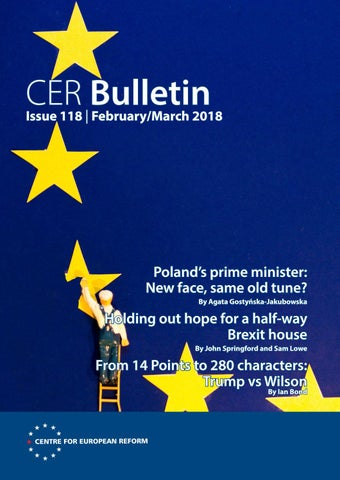
CER Bulletin
Issue 118 | February/March 2018
Poland’s prime minister: New face, same old tune? By Agata Gostyńska-Jakubowska
Holding out hope for a half-way Brexit house By John Springford and Sam Lowe
From 14 Points to 280 characters: Trump vs Wilson By Ian Bond
Poland’s prime minister: New face, same old tune? by Agata Gostyńska-Jakubowska
The new prime minister’s style will be more emollient than his predecessor’s, but he is unlikely to back down on judicial reforms. Mateusz Morawiecki replaced Beata Szydło as Prime Minister of Poland on December 11th 2017. Morawiecki’s appointment has sparked hopes that Poland will change course. Relations between Warsaw and Brussels deteriorated after the electoral victory of the populist Law and Justice party (PiS) in October 2015; PiS has antagonised its EU partners with its attempts to undermine the rule of law and by opposing the EU’s refugee relocation policy.
© European Union, 2018
Morawiecki, who was previously deputy prime minister, and in charge of finance and development policies, is seen as the moderate face of PiS. In an attempt to appeal to more centrist voters and to improve Warsaw’s image abroad, Morawiecki replaced some of the most controversial figures from the last government. He sacked, among others, the environment minister who permitted the logging of the Bialowieza forest, a UNESCO world heritage site, and Foreign Minister Witold Waszczykowski (who made headlines for claiming that the fictional state of ‘San Escobar’ had supported Poland’s bid for a non-permanent seat on the UN Security Council). Morawiecki is a former CEO of one of Poland’s largest banks. He seems to understand that, as in business, reputation and networking skills
help to achieve policy objectives. Unlike his predecessor, Morawiecki does not mind frequent trips to Brussels. On the day he revamped his government, Morawiecki also met the European Commission President Jean-Claude Juncker. The European Commission statement after the dinner said that it took place in a friendly atmosphere. But a government facelift and one successful dinner will not be enough to smooth things out between Warsaw and Brussels. On December 20th, after two years of trying to bring the Polish government to heel, the European Commission proposed triggering Article 7 of the Treaty on the European Union (TEU), which is designed to respond to serious breaches of the EU’s democratic values by memberstates. The European Commission argued that the government had undermined judicial independence and thereby weakened the separation of powers in Poland. The basis of the Commission’s concern is that PiS has pushed through changes to the law governing the Constitutional Court and packed the court with party-friendly figures. This, in turn, has made it easier for PiS to introduce judicial reforms that undermine the Polish constitution. The new legislation increases the
INFO@CER.EU | WWW.CER.EU CER BULLETIN ISSUE 118 | FEBRUARY/MARCH 2018 3
party’s influence over the way in which courts are organised. Among other things, it dismisses the current members of the National Judiciary Council (which selects judges) and gives the Sejm (the lower chamber of the parliament) where PiS and its allies have a majority, the right to appoint new members of that council. The new law also potentially enables PiS to oust around 37 per cent of the current Supreme Court judges, by forcing them into early retirement. New judges will be appointed by the President on the recommendation of the new Judicial Council. The European Commission worries that the actions of PiS will not only weaken democratic checks and balances in Poland but also damage the EU’s single market. As a recent CER policy brief, ‘Can EU funds promote the rule of law in Europe?’ argued, when judicial independence is undermined, investors can no longer be confident that their rights will be adequately protected. Article 7 TEU is a multi-stage process; at least 22 member-states must first agree that there is a clear risk of a serious breach of EU values in Poland. If Warsaw does not change course in response, the European Council can decide unanimously (minus Poland) that Warsaw is seriously and persistently breaching EU values, potentially leading to the suspension of Poland’s voting rights in the Council of Ministers. The European Commission is only asking member-states to support the first stage of the process. But even this could do more harm than good if it leads to increased euroscepticism in Poland. Poles are today highly supportive of their country’s membership in the EU, but many of them might consider judicial reforms to be domestic affairs in which the EU should not meddle. The Commission’s proposal has given the other EU member-states a headache, too. Some German and French officials have signaled that Berlin and Paris would probably back the Commission and vote to launch the first stage of Article 7 TEU. But other EU capitals have been more reluctant to condemn the Polish government openly, either because they object on principle to the idea of sanctioning EU countries for bad domestic behaviour; because they might need Poland’s backing in some other area; or because they have their own problems with the rule of law. Bulgaria, which holds the presidency of the Council of Ministers, has been criticised by the Commission for insufficient progress in reforming its own judiciary. Bulgarian prime minister Boyko Borisov argued that the
Commission’s Article 7 proposal would give the EU “sleepless nights” if it went to a vote. The European Commission recognises that using Article 7 TEU could be a double-edged sword. As a result, the Commission has said that if the Polish government addresses its concerns within three months, it will consider dropping the case. But even under Morawiecki, Warsaw is unlikely to back down. Jarosław Kaczyński, the PiS leader who effectively pulls the strings in the government, thinks Poland’s courts are full of judges who worked under the communist regime and that they should be ousted. Morawiecki, who also belonged to the Polish anti-communist opposition, seems to agree that the reforms will improve the Polish judiciary. Besides, public support for PiS has not budged since the party pushed through the judicial reforms: that allows PiS to argue that Poles have given the party free rein. Morawiecki will try to use the time the European Commission has given him, and Bulgaria’s reluctance to proceed with the Commission’s proposal, to visit member-states and make a positive case for the new legislation. In order to block the Commission, the Polish government needs to convince at least six member-states to oppose the Council decision or to abstain. Morawiecki hopes that his more emollient style will help sway reluctant EU capitals. Morawiecki might be right that he can find six supporters. But he will waste a lot of political capital that his government will need in the next two years. In May the European Commission will put forward its proposal on the multi-annual budget after 2020. With less income postBrexit, the EU is likely to reduce EU funding for net recipients, of which Poland is currently the largest. The Commission has also been under pressure from some of the EU’s net payers, who argue that the best way to ensure member-states respect the rule of law is to make EU funding conditional upon it. Morawiecki should concentrate on mending fences with the European Commission and net payers ahead of the big budget battle. Morawiecki’s charm offensive over Article 7 may buy the prime minister some time, but in the long run it might cost Poland money, as well as friends in Brussels.
Agata Gostyńska-Jakubowska
Senior research fellow, CER @AgataGostynska
Holding out hope for a half-way Brexit house by John Springford and Sam Lowe
Now that the divorce is largely agreed and the negotiations are moving on to trade and the transition, the UK and EU’s positions are becoming clearer. The UK will push for Britain to maintain regulatory alignment with the EU in some sectors, while being free to diverge in others. The EU, led by France and Germany has said that, given Theresa May’s red lines, there can be no half-way house between a free trade agreement and full membership of the single market. Last year, the CER proposed a system of regulatory alignment focussed on goods, with the freedom to diverge in services, pointing out that this would be a sufficient quid pro quo for May’s decision to end the free movement of people, given the UK’s trade advantages in the services sector. For their part, the Institute for Government (IfG) and the Institute for Public Policy Research (IPPR), two British think-tanks, have found a solution in ‘managed divergence’: the UK and EU commit to regulatory alignment in some sectors, while allowing the UK to diverge from new rules in others in the future. The EU would be permitted to curtail market access in those sectors as a result. The British government is considering such a system. There are attractions to such a half-way house for both sides. For the UK, it would soften the economic blow that a free trade agreement (FTA) would entail: even the most ambitious FTAs do not provide the regulatory alignment needed to allow goods and services to flow across borders without checks. Full participation in the single
market through membership of the European Economic Area is too costly politically, since the UK would have to apply the EU’s rules but would have little say on adopting them. By reducing the number of sectors to which that nasty soft Brexit logic applies, the UK could limit the economic damage while regaining the perception of sovereignty over parts of its economy. For the EU’s part, one of its main trade aims has always been to get non-EU countries to align with its rules and standards, rather than those of the US (much to the annoyance of Washington). The more the UK continues to abide by EU rules, the more readily its goods and services will be made available to EU consumers. A free trade agreement would lead to more checks and paperwork on UK imports at the EU’s border – especially in highly regulated sectors like agriculture, medical devices, pharmaceuticals, chemicals and cars, which would no longer be subject to the EU’s rules.
INFO@CER.EU | WWW.CER.EU CER BULLETIN ISSUE 118 | FEBRUARY/MARCH 2018 5
Yet, ‘managed divergence’ along the lines of the IfG and IPPR proposals is unlikely to gain traction among the 27. For one, these proposals amount to cherrypicking, which the EU has made a red line. It is naïve to expect that the EU-27 will agree to a system where the UK converges when deemed to be in its interest, but diverges in those sectors in which it could gain competitive advantage with the rest of the world. The point of the single market is that all its members sign up to all rules, which cover the entire economy; if the UK wins opt-outs, then other countries will seek them too. Second, the process of managed divergence would prove difficult to manage. It would be a political feat for the EU and UK to agree which rules are crucial for maintaining a level playing field, and which matter less. Certain rules matter for the operation of several different markets (chemical regulations have an impact on other markets for products that use those chemicals, as well as on the environment), and some are highly specific to a particular market. The EU would say that all markets are interlinked, and the UK would say that optouts in specific sectors would not provide competitive advantages in others. And, since the economic impact of regulations is very hard to identify objectively, any disputes could prove impossible to manage. If the UK chose to diverge from one part of the EU’s insurance regime, should the EU have the right to curtail market access in the sector as a whole?
The UK would need to agree to follow all of
the rules of the customs union, single market rules for goods and the EU’s VAT regime. All industrial goods and agriculture would have to be covered. Anything less would create a situation where checks on origin and standards, among other things, would still be required at the border.
The UK would have to agree to rules on
state aid, industrial emissions and social and employment laws, to avoid the charge of environmental and social ‘dumping’.
The agreement would need a surveillance
mechanism, to check that the UK is complying with EU rules, and a court to settle disputes between the EU and the UK. Any new court would have to take account of the case law of the European Court of Justice.
The EU would insist upon a financial
contribution to the economic development of Central and Eastern Europe, among other things. The Swiss, for example, contribute around half the UK’s current payments per head. They have a similar level of access to the single market as the proposal outlined here.
The biggest question is whether the EU
would insist upon free movement of EU workers as it stands, or whether it might be possible for the UK to negotiate controls on free movement, in exchange for the obvious damage that this agreement would do to the City of London.
The EU is unlikely to countenance any model which undermines the single market’s political integrity. In that regard neither the IPPR nor IfG proposals look likely to stick. However, a model that may limit the damage and prove politically palatable to the EU-27 exists: the UK remains in a comprehensive customs union with the EU and the single market, but only for goods. Under such an agreement, there would be no process of managed divergence in different sectors over time.
The Jersey option would also, unlike the IfG and IPPR proposals, solve the Irish border issue: there would be no need for border checks of any sort, since all goods shipped across it would be produced according to EU rules, and no tariffs would be payable. But it would require Theresa May to soften many of her red lines, and her party would be likely to defenestrate her if she did so. Perhaps a Labour government would be capable of delivering such a plan, but it would have to force an election – and win it – first.
One could call this ‘the Jersey option’ (because the Crown Dependencies enjoy a similar relationship with the EU). The agreement would need to include the following features:
John Springford
Services access for UK firms would need to
be roughly the same as that of any other third country. The UK, theoretically, could take to the world and try to sign services-only trade deals.
Deputy director, CER @JohnSpringford
Sam Lowe
Research fellow, CER @SamuelMarcLowe
From 14 Points to 280 characters: Trump vs Wilson by Ian Bond
It is a year since President Donald Trump took office, and a century since President Woodrow Wilson set out America’s vision of the world after the Great War, in his so-called ‘Fourteen Points’. The modern international system still bears the imprint of Wilson’s ideas. Trump’s utterances, however, show no respect for Wilsonian principles. Wilson set out not only his war aims (the withdrawal of German forces from France and Belgium, the re-establishment of an independent Poland) but also some general and often innovative principles for the post-war period: no more secret treaties; freedom of navigation; trade liberalisation; arms reductions; due weight to the interests of colonial populations as well as their rulers; and the creation of a League of Nations to guarantee the independence and territorial integrity of states large and small. The victorious allies did not always apply Wilson’s principles strictly, particularly when it came to free trade, arms reductions and the rights of colonised peoples. Wilson himself could not persuade the US Senate to ratify the Covenant of the League of Nations. The inter-war period showed both the wisdom of Wilson’s ideas and the shortcomings in their implementation. Protectionism in the 1930s contributed, at least modestly, to the economic damage caused by the Great Depression, and thus to the decline of democratic powers and the rise of the dictators. The design of the League of Nations, and America’s refusal to join, left it too weak to stand up to Japan’s aggression in Asia or constrain fascism and Nazism in Europe.
After the Second World War, the allies built the new international order in part on Wilson’s foundations, while trying to learn from their predecessors’ mistakes. They created (or tried to create) more effective international institutions, better able to constrain states’ behaviour. The United Nations, and in particular the UN Security Council, had far-reaching powers, including the power to authorise the use of military force. The General Agreement on Tariffs and Trade (GATT), which evolved into the World Trade Organisation (WTO), reduced tariffs through multilateral negotiations and resolved disputes between its members with legally binding decisions. These institutions were (and are) certainly not perfect. For most of the Cold War the UN Security Council was ineffective because the Soviet Union and the United States used their vetoes to keep it that way. But America and its allies benefited from the (relative) stability and prosperity that the UN, GATT/WTO and regional organisations like NATO brought. Successive administrations after 1945, and the US Congress, often called for reform of the institutions, but they also saw them as instruments to consolidate America’s place in the world.
INFO@CER.EU | WWW.CER.EU CER BULLETIN ISSUE 118 | FEBRUARY/MARCH 2018 7
Trump is the first President to regard the post-1945 rules-based system as inimical to US interests. Not for him Wilson’s search for international security and prosperity through institutions: his focus is narrowly national. He speaks of “this beautiful vision – a world of strong, sovereign and independent nations” and “a balance of power that favours the United States, our allies and our partners”. He reportedly told his senior military and political advisers in July 2017 that he wanted to rebuild the US nuclear force to its maximum size in the Cold War – even though the US already has over 5,000 warheads deployed or stockpiled, more than enough to obliterate any enemy. In his first speech to the UN General Assembly, in September 2017, he repeatedly stressed the importance of sovereignty and urged other leaders, like him, to “put your countries first”. As Noah Gordon argued in a CER insight (‘Trump’s trade policy: Separating the normal from the dangerous’), Trump is not the first president to try to reduce the US trade deficit by protectionist steps, but his hostility to free trade and to US partners who run trade surpluses goes further. He has undermined and threatened to ignore the WTO. In the last year, there has often been a gap between the president’s rhetoric – above all his tweets taunting adversaries and threatening conflict – and the actions taken by his administration. For all his reluctance
to restate US commitment to NATO’s mutual defence guarantee, the Pentagon has put more resources into defending Europe. Despite Trump’s bellicose language and personal insults directed at North Korea’s leader, Kim Jong-Un, Secretary of State Rex Tillerson has indicated that the US would be ready to talk to Pyongyang, without preconditions. But, however his officials mitigate the harm, Trump is damaging the international system built by his predecessors. Even before Trump, countries like Russia were giving up on the rules-based order in favour of an older style of balance-of-power politics, and the ability to coerce neighbours in bilateral disputes. If the leader of the nation that designed most of the main international institutions has lost confidence in their ability to protect American interests, then the world is moving into a dangerous period. Perhaps countries like China, Russia and the US can flourish in a world where might is once again right. The EU and its member-states, and other like-minded countries like Canada or Japan, cannot. They must make the case for Wilsonian order, not Trumpian anarchy, even if it takes them more than 280 characters.
Ian Bond
Director of foreign policy, CER @CER_IanBond
CER in the press BuzzFeed News 16th January 2018 “The idea that we would have all 40 or so agreements replicated and ready to go in time for March 30th was always little more than a Ministerial pipe-dream,” said Sam Lowe of the CER. BuzzFeed News 8th January 2018 As Charles Grant of the CER, puts it. “The EU-27 do not take the threat of a UK walk out very seriously, believing that the consequences of no deal, while bad for the EU economy, would be catastrophic for the UK economy”. The Guardian 26th December 2017 “The tortured relationship
that still exists between the Bundeswehr and broader society will keep coming back to haunt them if they don’t address it,” said Sophia Besch of the CER. The Daily Mail 21st December 2017 John Springford, deputy director of the CER, said he had reviewed the ‘aerospace’ analysis [one of the UK government’s 39 sectoral reports on Brexit] and concluded: “It’s entirely descriptive. Zero analysis of Brexit impact.’” Bloomberg 15th December 2017 “It comes down to the fact that countries have different economic models, different sets of existing
ties to the UK, different strategic interests,” said Agata Gostyńska-Jakubowska of the CER. “The second phase of negotiations will be much more challenging for both the UK and the EU and it will be much more difficult for the EU to remain aligned.” The Financial Times 12th December 2018 “The biggest gain for Germany will come if European migrants choose to work there, mitigating its growing shortage of workers, instead of in Britain,” wrote Christian Odendahl and John Springford of the CER. The Independent 11th December 2017 The EU’s chief Brexit negotiator Michel Barnier
made it clear last month that, when the UK leaves the single market, financial services firms based in Britain will lose their “passporting” rights. “On financial services, UK voices suggest that Brexit does not mean Brexit. Brexit means Brexit, everywhere,” Mr Barnier told the CER last month. The Telegraph 8th December 2017 Charles Grant, director of the CER, published his 10 predictions for the whole Brexit process. Within eight days, his first four – on Ireland, money, citizens’ rights and transition – have been proved correct. [On] Mr Grant’s remaining predictions, I see little reason to doubt his prescience.
INFO@CER.EU | WWW.CER.EU CER BULLETIN ISSUE 118 | FEBRUARY/MARCH 2018
Recent events 8 December Launch of ‘A new deal for the eurozone: Remedy or placebo?’, Brussels With José Leandro, João Nogueira Martins and Shahin Vallée
José Leandro
27 November Breakfast on ‘Britain’s relations with Europe after Brexit’, London With Damien Green
Damien Green
22 November Launch of ‘Can EU funds promote the rule of law in Europe?’, Brussels With Carl Dolan, Heather Grabbe, Jasna Šelih and Martin Weber
Carl Dolan and Jasna Šelih
22 November CER/Embassy of Ireland launch of ‘Ulster’s fight, Ulster’s rights?’, London With Edward Burke and Caoilfhionn Gallagher
Edward Burke
Forthcoming publications A European agenda for Germany Sophia Besch & Christian Odendahl
Brexit and the City Mark Boleat
Plugging in the British 1: Foreign policy Ian Bond
The EU-27’s interests on trade with the UK Sam Lowe, Beth Oppenheim and John Springford
For further information please visit
www.cer.eu
Plugging in the British 2: Defence policy Sophia Besch