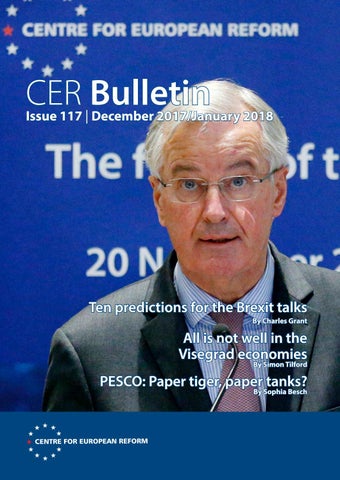
CER Bulletin
Issue 117 | December 2017/January 2018
Ten predictions for the Brexit talks By Charles Grant
All is not well in the Visegrad economies By Simon Tilford
PESCO: Paper tiger, paper tanks? By Sophia Besch
Ten predictions for the Brexit talks by Charles Grant
In the run-up to a crucial meeting of the European Council on December 14th, EU and British negotiators are close to a deal on the UK’s separation from the EU. If they can agree on money, citizens’ rights and the Irish border, talks on future relations – and transitional arrangements – could start early next year. Although the current focus is on the separation, the next phase of the talks could prove much harder and more acrimonious. EU negotiators think the British government is deluded about the kind of future relationship it can achieve. Here are ten predictions: 1) The Irish border will prove the most contentious part of the separation agreement. Ireland is threatening to veto talks on future relations unless the UK promises there will be no controls on trade at the border. But Theresa May could not make such a promise unless Northern Ireland stayed in the EU’s customs union and aligned with many of its regulations. To the unionists who want close ties with Britain, that would look like a step towards a united Ireland. One possible fudge in December would be for the UK to accept unspecified ‘regulatory convergence’ between north and south. But that would merely postpone the difficult question of what that meant. In any case, the unionist DUP, which is propping up May’s government, has ruled out such a compromise. Ireland’s recent
political instability may make the issue harder to resolve. Yet if the EU and the UK have sorted out the rest of the separation agreement, Dublin will face pressure from other capitals to soften. As for the long term, unless the UK suddenly changes course and decides to stay in the customs union, some border controls are unavoidable. 2) There will be a deal on the financial settlement. The UK will agree to pay the EU around €50 billion or slightly more. Both sides will do their best to avoid talking of precise numbers. But the UK will undertake to meet payments under specific headings: the last two years of the EU’s seven-year budget cycle, other outstanding spending commitments, additional promises to pay for structural funds, contingent liabilities (such as loans to Ukraine) and pension liabilities. 3) There will be a deal on citizens’ rights. May will accept that the withdrawal treaty, enshrining the rights of EU citizens, has greater legal force than any subsequent UK legislation. And she will
INFO@CER.EU | WWW.CER.EU CER BULLETIN ISSUE 117 | DECEMBER 2017/JANUARY 2018 3
agree that UK courts may refer cases on rights to the European Court of Justice (ECJ). 4) The UK will agree to a transition on the EU’s terms. Britain will find the transition much like membership – with free movement, ECJ rulings and so on – except that it will be out of the EU’s institutions (and some of the EU’s free trade agreements with other countries). Businesses will probably have to wait until autumn 2018 to see the transition in a legally solid form, since it will form part of the overall separation agreement. The EU and the UK will both pretend that the transition will last for only about two years. In fact it will take much longer for the UK and its partners to build physical infrastructure at borders and for the Home Office to set up the IT systems for registering EU migrants. And it will take many years for the UK to sort out the future economic partnership. 10 Downing Street has been saying that this could be negotiated before Brexit, but the earliest that detailed trade talks will start is early 2019. 5) The UK is likely to ask for a bespoke economic partnership. It wants a deal that provides better market access than the ‘Canada model’ (a free trade agreement or FTA with only limited provisions on services) but less than the ‘Norway model’ (fully in the single market). A system of ‘regulatory alignment’ is widely discussed in London: the UK would start off with the same rules as the EU in many sectors, with something close to single market membership, but accept that if its rules diverged it would lose access. 6) The EU will reject such a bespoke arrangement. It will insist that the UK choose from a menu limited to Norway, Canada or WTO rules. It will say the single market is a package – you are either in all or none of it – and that ‘cherry-picking’ in the sectors that matter to the UK, such as aviation or finance, is out of the question. The stance reflects, in part, the influence of governments like France and Germany, which have little desire to open their services markets to non-EU competition. 7) The best the UK can hope for is ‘Canada Plus’. May’s negotiators hope that the memberstates most dependent on UK trade will push the Commission to offer the British a better deal than the Canadians, that is to say one with more on services. So far the EU shows few signs of softening. But if it did ever grant the UK anything close to single market membership in specific areas, it would demand cash payments, compliance with EU rules and ECJ rulings, and perhaps a liberal UK regime on migration. If
all went smoothly, a generous offer from the UK on security and defence cooperation could encourage the EU to accept Canada Plus. 8) The EU’s top priority in the trade talks will be to prevent the UK undercutting its regulatory standards. It fears the UK will steal investment by eroding social, consumer or environmental standards, slashing corporate taxes or diverging from EU rules on state aid and competition. The EU will insist on provisions that allow it to punish the UK for any kind of ‘dumping’. Michel Barnier, the Commission’s negotiator, told a recent CER event that “the UK needs to decide if it is leaving the European regulatory model. The answer to this question is the key to the future relationship and to our ability to get an FTA ratified in the European and national parliaments.” 9) The City of London will be damaged. So far the British government has not made a priority of defending the City’s interests. It will probably do so eventually. Even so, UK-based firms will lose the right to ‘passport’ into the single market. As second best the City is hoping for a good deal on regulatory equivalence, but even that will be very hard to achieve and is likely to involve the UK being a rule-taker rather than a rule-maker. 10) In the end, some sort of trade agreement is likely. If it looked like the UK would crash out of the EU without an FTA – and without one, the separation agreement would unravel – the EU would face a major headache. Emmanuel Macron and Angela Merkel (if she survives) plan to spend next year redesigning the eurozone and EU defence co-operation. A messy Brexit would be an unwelcome distraction. So they would probably seek to intervene to broker a compromise. Furthermore, if the financial markets believed that the UK was going to leave without an agreement, they would panic. The pound would sink, business and consumer confidence would evaporate and investment would dry up. The British government would come under enormous pressure to return to Brussels to seek a compromise. Whatever they say in public, May and most of her ministers know that any deal, however bad, is better than no deal.
Charles Grant
Director, CER @CER_Grant An earlier version of this article was published in The Guardian on November 9th 2017.
All is not well in the Visegrad economies by Simon Tilford
On the face of it, the Visegrad countries – the Czech Republic, Hungary, Poland and Slovakia – are doing well economically. The data for GDP per head suggest a gradual convergence in living standards with Western Europe. They continue to attract a disproportionate share of inward investment in EU manufacturing, and their integration into EU-wide supply chains helps to explain why they are now collectively Germany’s most important trade partner, ahead of China and the US. But the political situation across the Visegrad is anything but rosy. Voters in all four countries have succumbed to populists. The reasons for this populism are complex, but economics probably provides a bigger part of the explanation than the positive headline numbers suggest. In 2016, GDP per head in the Visegrad four (adjusted for price differences) ranged from 64 per cent of eurozone levels in Poland to 82 per cent in the Czech Republic. The Czech Republic, Slovakia and Poland have experienced significant convergence in GDP per head with the eurozone over the last ten years (though it should be noted that the dire performance of the eurozone economy over that period was a major reason for this). But what matters to the average person is not GDP growth, but personal income growth, and hence living standards. And here the Visegrad picture is less reassuring. In 2016 worker ‘compensation’ (wages and salaries and other benefits) ranged from just 50 per cent of the eurozone’s in Hungary to 59 per cent in the Czech Republic. And the rate of convergence of compensation with the eurozone average has been slower than the rate of convergence of GDP.
Growth in consumption across the Visegrad countries has lagged behind growth in GDP, resulting in a sharp fall in consumption as a share of overall spending. This has happened in nearly all developed economies over the last decade, but the scale of the decline in all four Visegrad economies has been much greater. Average households have not seen enough of the fruits of economic growth. Those rewards have gone disproportionately to the owners of capital, and in these countries, that tends to mean foreigners. In the Czech Republic, Hungary, and Slovakia, the most important sectors are largely or wholly foreign-owned. The Polish economy is much bigger and more diversified than the other three, but the level of foreign ownership is still very high. The IMF expects modest convergence of Slovak GDP per head with the eurozone over the next
INFO@CER.EU | WWW.CER.EU CER BULLETIN ISSUE 117 | DECEMBER 2017/JANUARY 2018 5
five years, but minimal convergence in Czech and Polish levels and none at all in Hungary’s. This is partly because the IMF expects eurozone growth of 1.7 per cent per year over the next five years compared with just 0.8 per cent per year in the proceeding five, but it also reflects disappointing Visegrad economic growth, Slovakia aside. Of course, worker incomes might increase more rapidly than GDP per head over the next five years, reversing the pattern of the previous ten. The Visegrad countries should continue to attract manufacturing investment. After all, with the right investment, productivity levels equal those in the West, but with dramatically lower labour costs. Labour forces are stagnant or shrinking, which could start to push up wages in the manufacturing sector. And as these operations are so profitable and so conveniently placed geographically for their predominately German owners, moderate wage increases are unlikely to prompt firms to relocate operations to cheaper locations in Bulgaria or Romania. But the big question is whether these foreign firms will shift more of the value-added in their production into these economies, boosting demand for professionals as opposed to production line workers. For example, will foreign car firms start doing more of the engineering (as opposed to just assembly) of their cars in the Visegrad? This will partly depend on the success of the Visegrad economies in raising education levels. While their apprenticeship and vocational training systems are strong, levels of advanced technical training, as well as higher education more generally, are less impressive, not least because many highly-skilled workers have opted to migrate to wealthier memberstates. In common with all EU countries, Visegrad governments have cut investment in education and training in recent years as part of a drive to hold down public deficits. More fundamentally, the Visegrad countries need to evolve their growth strategies away from the current preponderant dependence on foreign direct investment. Such investment is important, but will not lead to sustained convergence in living standards, especially in an economy the size of Poland’s. Instead of competing to offer the most favourable tax environment to foreign investors, they need to focus on ensuring that local firms have what they need to flourish – skilled labour, infrastructure, finance, and transparent and predictable business environments. There is nothing unique about the challenge the Visegrad four face – they share it with other peripheral regions of the EU, from much of southern Europe to the poorer parts of the UK and Ireland. In addition to stepping up investment in skills, they need to prioritise
infrastructure in an effort to spread wealth from the capital cities into the surrounding (much poorer) provinces. Such spending will push-up fiscal deficits in the short-term, but because of its strong multiplier effects, investment would not undermine long-term debt sustainability. But there is one area where the Visegrad countries face a particular challenge: demographics. They are not alone in Europe in facing fast ageing populations. For example, Spain, Italy and Germany have similarly low birth rates. But these Western countries have positive net immigration; the Visegrad do not. Over the last 20 years, the Czech and Slovak populations have held their ground, but Polish and Hungarian ones have fallen, the latter sharply. Freedom of movement has no doubt been a boon to the workers from these countries who have chosen to move elsewhere, but it is less clear whether it has been a boon for the Visegrad countries themselves because it has denuded them of many of their young and best-educated workers and entrepreneurs, and made their societies less open. Of course, some may choose to return home at some point, but this is only likely if suitable jobs are available at comparable incomes to those they currently have. The disappointing degree of income convergence between the Visegrad and the eurozone does not explain the racism and xenophobia on display across these economies, or their voters’ readiness to support parties determined to erode the independence of domestic political institutions. But it does make it easier to understand why the popular mood in these countries is unsettled and why voters are prepared to give non-mainstream parties a chance. The Visegrad cannot roll back foreign investment, and would be crazy to try; protectionism is no solution. But it is not hard to understand why workers feel that they are second-class EU citizens when they are paid a fraction of their Western counterparts for doing similar work, or to appreciate how the high degree of foreign ownership could leave people feeling that they have lost any meaningful national control. Unfortunately, the populists in power in the region, like populists everywhere, are good at exploiting resentment and fear, but poor at providing the answers to policy challenges. The most likely outcome is that they will do nothing to strengthen domestic economies while alienating foreign investors through nationalist rhetoric and attacks on the rule of law.
Simon Tilford
Deputy director, CER @SimonTilford
PESCO: Paper tiger, paper tanks? by Sophia Besch
PESCO, or permanent structured co-operation, is a political framework that aims to help EU countries develop military capabilities together and improve their ability to deploy them. In November 2017, 23 member-states signalled their intention to participate in PESCO – the framework will be formally launched at the EU’s Foreign Affairs Council in December. But PESCO will become another European defence paper tiger if governments fail to make use of it to boost investment in much needed capabilities. Conflicting visions in Germany and France shaped PESCO: Berlin emphasised the political dimension of PESCO as an integrationist project and wanted a large number of participants; Paris wanted high entry criteria – 2 per cent of GDP spent on defence, 20 per cent of defence spending in purchases of major equipment and research – that would allow only the top European military powers to join. The compromise that was found emphasises process: a large number of participants agreed to hit the ambitious French targets – eventually. That result partly reflects a fear among some memberstates that EU cohesion could suffer if an avantgarde group of countries moves forward and leaves others behind. The future commitments could still be meaningful if PESCO made it possible for underperforming countries to be kicked out of the club. But a qualified majority is necessary to suspend a PESCO member; thus, accountability will be difficult to achieve. The new framework should not be dismissed completely, however. PESCO can give countries incentives to jointly develop capabilities on a
project-based level – all capabilities developed through PESCO remain under national control – and to improve the ability of Europeans to deploy in military missions. What will PESCO offer for joint capability development? Political considerations will undoubtedly influence which projects are chosen. But the focus should be on new projects that fill Europe’s most urgent capability gaps – otherwise PESCO runs the risk of simply subsidising national industries. For example, the number of European tanks has dropped by almost 70 per cent to just 5,000 over the last 17 years; most modern tanks are based in Western Europe, rather than in Central and Eastern European states that face a threat to their territory; and all European tank fleets are either outdated already or will face obsolescence by 2030. At the same time, while the American military has one main type of tank system, the EU has 17. Jointly developing a European tank should be one PESCO priority. Through PESCO the EU should also invest in innovative technology. Member-states could
INFO@CER.EU | WWW.CER.EU CER BULLETIN ISSUE 117 | DECEMBER 2017/JANUARY 2018 7
develop a European Medium-Altitude Long Endurance (MALE) drone. But given American dominance of that market and the fact that many European forces already have MALE drone fleets, they should instead invest in the development of High-Altitude Long Endurance (HALE) drones. But military hard-power development projects cost money. It is likely that PESCO will primarily be used for projects on the ‘softer’ end of the capability spectrum: a medical command centre, for example, should be easy to agree on. One key job for policy-makers is to make sure PESCO aligns with other EU initiatives as well as with NATO’s defence planning process. The EU is already launching the co-ordinated annual review on defence (CARD) process, which compares national defence spending plans and identifies opportunities for new collaborative initiatives. It has also launched the European Defence Fund (EUDF), through which the European Commission wants to fund co-operative European defence research and capability development. It is crucial that the EU and NATO work closely together to avoid NATO priorities contradicting those of the EU. Could the UK get involved in PESCO after it has left the EU? The framework does allow for third states to participate in projects if they provide “substantial added value”. But third countries will have no say in the choice of projects, and it is unlikely that they would be eligible to receive EU funding. In the future, any joint platform development that includes the UK might instead take place through inter-governmental
organisations, such as through OCCAR, the organisation for joint armament co-operation. Will PESCO make it easier for Europeans to launch military operations and missions together? It is important to note that the PESCO commitment does not cover a standing force, a readiness force, or a stand-by force: in other words, PESCO is no EU army. The hope is that common commitments, increased co-operation, and jointly developed capabilities – in particular joint training centres – will make it easier for EU militaries to deploy together. And PESCO members promise that they will reform the EU’s funding mechanism for joint operations, which places the brunt of an operation’s financial burden on the deploying country. But well-known obstacles to joint missions and operations remain. European countries have different military cultures and lack a shared view of the threat environment. And while PESCO member-states say they want to create a fasttracked political mechanism to generate forces, it will be difficult for some countries to follow through: Germany for example has an extensive parliamentary approval mechanism that makes rapid deployment of forces difficult. And PESCO is not legally binding: there is no guarantee that PESCO member-states will commit forces in a crisis. The launch of PESCO in December is hailed as a political success; but for European defence it is where the work begins.
Sophia Besch
Research fellow, CER @SophiaBesch
CER in the press The Wall Street Journal 24th November 2017 There may be some carve-out allowing Britain not to apply new post-Brexit EU laws, “but only if those bits of legislation have no material impact on the key rules of the EU single market”, said Simon Tilford of the CER.
The New York Times 21st November 2017 “I don’t think it [the lack of a government in Berlin] makes much difference to Brexit in the short term, because the positions of various parties in Berlin are all pretty hard-line on the issues,” said Charles Grant, director of the CER.
The Times 21st November 2017 “The UK and the EU recognise that Ireland poses specific challenges and that it requires a specific solution,” Michel Barnier told a CER conference on ‘The future of the EU’ in Brussels.
The Economist 17th November 2017 France had wanted a smaller group; that Germany’s eastern neighbours are included is an important signal, says Sophia Besch of the CER. But for PESCO to succeed, much more is
needed, including financial commitments which German voters may still be unwilling to accept. The Atlantic 8th November 2017 “If she [May] sacks her [Patel], she’s got a disgruntled Leaver on the backbench who might make it difficult for her in Brexit negotiations,” said John Springford of the CER, noting that recent polling has shown public trust in May’s ability to negotiate a good Brexit deal has fallen to record lows. The Financial Times 17th October 2017
Luigi Scazzieri of the CER, thinks it’s time for some creative thinking on a new EU-Turkey relationship: “The EU should keep the accession process alive to avoid accelerating the negative spiral in bilateral relations.” Reuters 18th September 2017 Another option, first proposed by Christian Odendahl, chief economist at the CER, is a Merkel minority government, relying on support from other parties. The advantage of this arrangement is that the SPD could regroup.
INFO@CER.EU | WWW.CER.EU CER BULLETIN ISSUE 117 | DECEMBER 2017/JANUARY 2018
Recent events 20 November Conference on ‘The future of the EU’, Brussels Keynote speech by Michel Barnier
Michel Barnier
3-4 November Conference on ‘How to save the EU?’, Ditchley Park Speakers included: Barry Eichengreen, Catherine L Mann, Poul Thomsen, Adam Tooze and Adair Turner.
Catherine L Mann
25 October Breakfast on ‘The state of the Brexit negotiations’, London With Ivan Rogers
Ivan Rogers
17 October CER’s 19th birthday party, London Hosted by the Ambassador of Sweden, Torbjörn Sohlström, with a keynote speech by Nick Clegg Nick Clegg
6 October CER/ECFR/EDAM 13th Bodrum Roundtable, Bodrum Speakers included: Mehmet Şimşek, Selim Yenel, Kori Schake, Yaroslav Trofimov, Kati Piri and Nathalie Tocci
22 September CER/Kreab breakfast on ‘The future of Europe’, Brussels With Martin Selmayr Selim Yenel
For further information please visit
www.cer.eu
Martin Selmayr