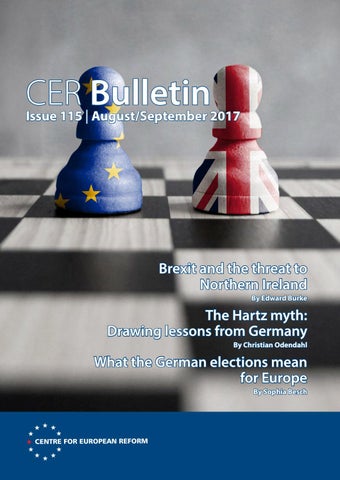
CER Bulletin
Issue 115 | August/September 2017
Brexit and the threat to Northern Ireland By Edward Burke
The Hartz myth: Drawing lessons from Germany By Christian Odendahl
What the German elections mean for Europe By Sophia Besch
Brexit and the threat to Northern Ireland by Edward Burke
The announcement by Prime Minister Theresa May on January 17th 2017 that Britain would leave the EU’s single market and customs union came as a profound shock to Irish nationalists in Northern Ireland. The prospect of a return of border controls on the island of Ireland is a bitter reminder that two fundamental pillars of the Good Friday Agreement are under threat: the significant EU funds spent in Northern Ireland; and ever closer economic and cultural integration with the Republic. The EU drained some of the poison of partition in Ireland. The advent of the customs union and common market erased physical signs of the border, easing tensions that had brought Northern Ireland’s future in the United Kingdom into question. EU programmes helped to rebuild ties between cross-border communities that had been broken by 30 years of conflict. However, the Brexit vote was another hole in a Northern Irish power-sharing executive that was already shaky. The Sinn Féin leader, Gerry Adams, has described Brexit as a “hostile action”, inflicted by London on Northern Ireland with no concern for the political and economic damage it would cause. Democratic Unionist Party (DUP) leader Arlene Foster’s backing of Brexit added to a long list of Sinn Féin grievances over perceived DUP arrogance – even if the ultimate catalyst for the collapse of the executive at Stormont was a
dispute over the mounting costs of a renewable energy scheme. Sinn Féin, the largest nationalist party in Northern Ireland, withdrew from government in January 2017, calling for new elections. This in turn has led to a prolonged deadlock in forming a new executive. The Irish government will work hard to avoid an acrimonious Brexit. But Irish officials say that if Ireland is forced to take sides in a dispute between Brussels and London, then Ireland’s EU’s membership will always take precedence over bilateral relations with the UK. The EU is a much more important trading partner for Ireland. Dublin values the international trade agreements negotiated by Brussels and points out that Ireland’s membership of the single market attracts overseas investment. Speaking in February 2017, the then Taoiseach, Enda Kenny, said: “The foundation of Ireland’s prosperity and the bedrock of our modern society is our membership of the European Union”.
INFO@CER.EU | WWW.CER.EU CER BULLETIN ISSUE 115 | AUGUST/SEPTEMBER 2017 3
Theresa May’s failure to secure a majority in the June general election presents the DUP with a rare opportunity of holding meaningful power in Westminster. Some in the DUP, including leader Arlene Foster, are aware of the threat of a hard Brexit to Northern Ireland’s economy. But the DUP is unlikely to use nuanced, persuasive rhetoric to convince the Conservatives to soften Brexit – the DUP is better known for bluntness in stating its undiluted commitment to maximising British sovereignty, and its unwavering patriotism. The DUP will continue to take a back seat in Westminster when it comes to Britain’s Brexit negotiations. Theresa May’s government will be viewed with increased suspicion by Northern Ireland’s nationalist community as long it is dependent on DUP support. Dublin will also be more circumspect in its relationship with London in future negotiations over Northern Ireland. Before the general election Sinn Féin had criticised British secretary of state for Northern Ireland, James Brokenshire, for being too close to the DUP. It will now be even more difficult for the British government to mediate in political disputes between the two sides. Between 2014 and 2020 Northern Ireland expected to draw more than €3.5 billion from the EU, including approximately €2.5 billion in Common Agricultural Policy (CAP) payments – larger than any other comparably-sized UK region. More than 8 per cent of Northern Ireland’s GDP is dependent upon EU funded programmes.
big migration, counter-terrorism and serious crime challenge for both countries. Much will depend on the UK’s future relationship with the EU, including whether it continues to access EU Justice and Home Affairs (JHA) agencies and instruments. On a visit to Northern Ireland in May 2017, Theresa May called for “as seamless and frictionless a border as possible”. But the EU’s chief negotiator, Michel Barnier, said in July: “A trading relationship with a country that does not belong to the European Union obviously involves friction.” Of all the nations and regions of the UK, Northern Ireland has the most compelling case to establish a separate, privileged relationship with the EU in the post-Brexit era. Northern Ireland has already enjoyed a special status in the EU since the 1998 Good Friday Agreement. And EU citizenship will remain an automatic right for many people born in Northern Ireland after Brexit (under the Irish constitution, reaffirmed by the Good Friday Agreement, citizenship extends to anybody born on the island of Ireland as long as one parent is already an Irish citizen). The EU has at least one near-unilateral option available to it – to maintain funding for special peace programmes in Northern Ireland regardless of future UK contributions to the EU budget. Other proposals will be more difficult to implement, such as allowing Northern Ireland continued access to EU structural and investment funds after Brexit.
After Brexit, EU funds will have to be replaced by funding from London, or a recession in Northern Ireland will be inevitable. The UK government has yet to indicate which EU budget programmes it will replace after 2020 (Chancellor of the Exchequer Phillip Hammond has guaranteed EU levels of funding for one year after 2019, the year Britain will probably leave the EU).
Both the EU and the UK should come up with a damage limitation plan for Northern Ireland if they fail to agree quickly on a comprehensive trade agreement. One suggestion would be the creation of a specific regime for Irish and Northern Irish goods and services (including and beyond agri-food), essentially exempting them from tariffs and most customs checks if they remain on the island of Ireland. A swiftly negotiated joint EU-UK customs agreement would also ease bureaucratic pressures and costs.
Even with common EU membership, North-South trade in goods is surprisingly low for two small jurisdictions sharing the same island. Around a quarter of the North’s goods exports go to the South, but less than 2 per cent of the Republic of Ireland’s goods exports go to Northern Ireland. An exit from the EU without a free trade agreement between the UK and the EU would further depress cross-border trade in goods, as these would be subject to tariffs.
After the collapse of the Northern Irish executive, Belfast lost its voice – a single articulated view of how to mitigate the dangers of Brexit. Meanwhile, post-Brexit relations between Dublin and London are delicately poised. Only a fully engaged British government can successfully diagnose and treat the potentially virulent disease of an Ulster Brexit. So far there are few signs that London is willing to make the difficult compromises required to stabilise its ailing province.
Policing a customs border will not be easy and will require a significant investment in resources north and south of the border. But the future of the Irish border is not only a trade issue. It is also a
Edward Burke
Lecturer in Strategic Studies at the University of Portsmouth
The Hartz myth: Drawing lessons from Germany by Christian Odendahl
The last decade’s most influential economic narrative in Europe has been that countries have struggled because they lost ‘competitiveness’, and that they need to emulate Germany by reforming their labour markets and cutting wages. This story is partial and misleading. Germany has adjusted better than most to globalisation and membership of the euro. But other countries need to be careful about which lessons they draw from the German experience. German politicians tend to evangelise about the ‘Hartz’ labour market reforms pushed through by Gerhard Schröder’s Social Democratic Party (SPD) in the early 2000s. They argue that this reform package is one if not the main reason why Germany – formerly known as the ‘sick man of Europe’ – is now Europe’s export powerhouse and strongest economy. For their part, critics argue that these reforms damaged Germany’s social market economy and pushed millions into insecure, low wage jobs. And by helping to cut German wages, they say, the reforms also encouraged Germany to rely too much on exports, and too little on domestic demand.
the forthcoming general election will in part be fought on the issue of ‘social justice’. SPD leader Martin Schulz is putting change to the Hartz reforms at the centre of his campaign. Without bringing centre-left voters who were alienated by the Hartz reforms back into the SPD fold, Schulz does not stand a chance of replacing Angela Merkel as chancellor.
The election of Emmanuel Macron will test the validity of this narrative, as he is vowing to overhaul France’s labour market. If the narrative turns out to be false, he may fail to deliver growth and employment, opening the way for a populist from either the left or the right of the political spectrum at the next presidential election in 2022. In Germany itself,
Broadly, the Hartz reforms had four elements:
A closer look at the reforms reveals that they were neither the main reason for Germany’s rise from sick man of Europe to economic powerhouse, nor the reason why the country has one of the largest low-wage sectors in Europe.
combining unemployment and social assistance into a single system, to help more people find jobs or retrain; curbing incentives to retire early by preventing people from claiming generous unemployment benefits before reaching
INFO@CER.EU | WWW.CER.EU CER BULLETIN ISSUE 115 | AUGUST/SEPTEMBER 2017 5
retirement age, thus increasing the employment rate among older workers; making training and job centres more effective, which helped to reduce unemployment by an estimated 1.5 percentage points; and providing more incentives to take up work, which increased temporary, part-time and lowpaid employment. These were important changes, but they cannot explain Germany’s economic rebound after 2004. Four other factors were more important. First, the long decline of the German construction sector following the post-reunification boom came to an end just as the Hartz reforms came into force. Between 1994 and 2005, construction output fell from almost 8 per cent of GDP to around 4 per cent, depressing economic growth. Second, German businesses had undergone a long restructuring process – adapting to globalisation by changing management practices and outsourcing production to suppliers both within Germany and abroad. By the time the Hartz reforms were implemented, this transformation was almost complete. Third, since the mid-1990s, unions and works councils agreed to hold down wage growth, helping German businesses adapt to a higher level of international competition. In the light of high unemployment, both agreed to preserve jobs rather than increase wages. The Hartz reforms gave the screw another turn at the bottom of the wage distribution, but most of the wage restraint had happened beforehand. Finally, the worldwide economic boom, led by emerging markets, drove Germany’s post-2004 export success. Lower export prices played a role, but German businesses reduced costs less through wage restraint than by domestic outsourcing, reorganising factories and management, and building supply chains in central and eastern Europe. German wage restraint did have negative effects for Europe as a whole. Lower wages meant lower German consumption and imports. As a result, Germany exported capital – capital that helped to build up debt and property bubbles elsewhere, which burst following the financial crisis and caused widespread economic misery. But there were fewer negative side effects inside Germany than is often claimed. For example, the country’s large low-wage sector – Germany has the largest in the EU after the Baltic States, Poland and Romania – predates the reforms. However, the number of people in insecure jobs
and at risk of poverty did rise after 2004, despite strong growth in employment. The rest of Europe should draw the following lessons from the Hartz reforms: Timing is everything. Germany got lucky by reforming when demand for its exports was growing quickly. But China is slowing, US economic prospects are clouded by Donald Trump, and Germany shows little sign of booming. If other European countries implement sweeping labour reforms, they should be accompanied by expansionary macroeconomic policy. Do not jump to the conclusion that the labour market is responsible for low growth or high unemployment. In Germany’s case, it was only part of the answer, and German reformers ignored the country’s macroeconomic situation. This could have easily backfired. Labour market reforms and benefit cuts can bring social hardship, at least in the short term, and increase economic insecurity. Instead of reforming the entire labour market at once during a slump, as Germany did, countries should first focus on investment in training and payroll tax cuts, and deregulate only when the economy is running at full capacity. More flexible labour markets also do little if anything to boost productivity. Indeed, Germany failed to adopt a productivity agenda for those most affected by the reforms. Germany adapted well to globalisation in part because unions and works councils were willing to sacrifice wage increases in order to maximise employment. But unions need to be strong enough to demand appropriate wage increases. Striking the right balance is not easy, but should be a key concern for policy-makers. Germany has successfully met the challenges of reunification, globalisation and the single currency. With record-low unemployment, fiscal surpluses and good living standards, it is now portrayed as the example to follow. But no economic theory would have predicted that a set of labour market reforms that targeted only parts of the workforce would be the only or even main reason for such a success. The economic impact of these reforms was modest; German businesses and trade unions, as well as the worldwide economic boom, did most of the heavy lifting. The rest of Europe, rather than copying these reforms, should learn more nuanced lessons from the German experience.
Christian Odendahl Chief economist, CER
What the German elections mean for Europe by Sophia Besch
The outcome of Germany’s general election matters for the rest of Europe. Germany’s major political parties are all various shades of pro-European. But they have different views about how to reform the eurozone, and on what kind of foreign policy Germany should pursue. Six parties are set to enter the Bundestag in September: the conservative Christian Democrats (CDU/CSU), the Social Democrat Party (SPD), the liberal Free Democrats (FDP), the Green Party, the far-left party Die Linke and the far-right Alternative for Germany (AfD). None will be able to govern on their own. Chancellor Angela Merkel has ruled out CDU/CSU coalition government with Die Linke and the AfD, but has otherwise kept her options open. Voters prefer a ‘grand coalition’ with the SPD, closely followed by a CDU/CSU-FDP government. But the Green party, standing at a similar level in the polls as the FDP, is also keen to enter power. Based on current surveys, SPD candidate Martin Schulz could become chancellor only if his party went into coalition with the Greens and Die Linke. What would these differing coalition options mean for the prospect of eurozone reform? French President Emmanuel Macron wants a common eurozone budget, a European finance minister and a eurozone parliament, and thinks Germany and the EU should boost investment. The CDU/CSU, however, is highly sceptical of France’s plans. It places a premium on adherence to the eurozone’s fiscal rules and opposes proposals that could usher in debt mutualisation. But Merkel knows that
Germany and France need to work together closely to provide the leadership Europe needs. Her next coalition partner will determine whether she has enough leeway to compromise with the French. If the SPD can swallow its reservations about being the junior partner for another four years, a renewed grand coalition could open the way for some flexibility by the Germans in Merkel’s final term: both Schulz and current foreign minister, Sigmar Gabriel, support much of Macron’s approach. If the CDU/CSU enters into government with the Greens, Merkel might also be able to keep the hardliners in her party at bay by claiming her hands are tied. The Greens have embraced all of Macron’s reform proposals; they want an end to austerity and a European ‘investment offensive’. But they are unlikely to get more than 10 per cent of the vote and might find it difficult to hold their ground in a coalition government. Should the September election lead to a coalition between the CDU/CSU and the FDP, prospects for eurozone reform would be poor. The FDP sees itself as the economic and regulatory conscience of Germany and would push the CDU/CSU to double down on its calls for fiscal discipline. The
INFO@CER.EU | WWW.CER.EU CER BULLETIN ISSUE 115 | AUGUST/SEPTEMBER 2017 7
FDP leader, Christian Lindner, has warned that there should be no “friendly gifts” to Macron that threaten European stability, even accusing the SPD of colluding with Macron to undermine European fiscal rules. What will the election mean for Germany’s foreign and security policy? Under Merkel, Germany has for the first time committed to spending 2 per cent of GDP on defence. She has stood up for sanctions against Russia, overseen the deployment of German soldiers in Lithuania and Mali, and backed initiatives to strengthen EU defence policy. These steps signal a departure from the German abstentionism of the past. But many voters remain sceptical of a greater military role for Germany, and question NATO’s involvement in the conflict with Russia. In a grand coalition, the SPD would probably keep control of the foreign ministry. The Social Democrats are opposed to increasing Germany’s defence budget, which they see as an attempt by Berlin to cosy up to the United States; Schulz and Gabriel instead want more money for development aid. Leading SPD figures have also criticised NATO’s deterrence activities in Central and Eastern Europe; they are in favour of de-escalation and dialogue with Russia. The SPD is using defence as a campaign issue and might well soften its stance after the election, but it will continue to oppose a more muscular German foreign and defence policy. The Greens would be an easier partner for the CDU when it comes to defence and security matters. While the Greens reject calls for more defence spending, they have condemned the SPD for its criticism of NATO, support sanctions against
Russia, and are open to military interventions “as a last resort”. The FDP, much like the CDU/CSU, wants Germany to be an active foreign policy and military power. Lindner would like to see greater German defence engagement in NATO and the EU and supports boosting the defence budget. The liberals are in favour of a tough line on Putin’s Russia and closer co-operation with eastern neighbours like Ukraine. They want a strong transatlantic partnership even under President Donald Trump, and reject the instinctive anti-Americanism of the German left. Finally, what about the possibility of a SPD-GreenDie Linke coalition under a Schulz chancellorship? The Social Democrats and the Greens would be a good match: both have been supportive of Macron’s reform proposals, and both have spoken out against higher German defence spending in favour of boosting development aid. But they are unlikely to win enough votes to govern without a third party, and voters on both the centreright and the centre-left are highly sceptical of the socialist Die Linke. The far-left’s refusal to compromise on its foreign policy programme – it wants to dissolve NATO and scrap all intelligence services, and it refuses to condemn Russia’s annexation of Crimea – makes it a near impossible coalition partner for the Greens or the SPD. Angela Merkel looks set to be re-elected in September. But Europe should look beyond who becomes the next German chancellor – it also matters with whom they enter into coalition.
Sophia Besch Research fellow, CER
CER in the press Prospect 14th July 2017 The winner this year of the best UK international affairs think-tank was the CER, which enlightened anyone interested in Britain’s negotiating position. The Financial Times 11th July 2017 Christian Odendahl of the CER is one of the finest analysts of the German economy writing in English. So it’s worth your time to closely read his review of the country’s labour market reforms of the early 2000s.
The Financial Times 11th July 2017 Camino Mortera-Martinez of the CER says the European Arrest Warrant has made it easier for the UK to extradite criminals but Britain will find it almost impossible to negotiate as good an arrangement after Brexit. The Guardian 3rd July 2017 Charles Grant, director of the CER, revealed the existence of an unpublished Treasury analysis showing that the costs of leaving without a customs union deal far
outweigh any benefits from future overseas trade deals. The Times 15th June 2017 [The Brexit negotiations] are no poker game because, as Simon Tilford of the CER, points out, in poker the power of a hand is that it’s secret. Europe knows exactly how few cards we have to play. And if May’s position was weak a month ago, it is infinitely weaker now. The Washington Post 13th June 2017 “We now have a Parliament
that’s gridlocked,” said John Springford of the CER. “It doesn’t appear that there’s a majority for hard Brexit, a majority for soft Brexit, or certainly not a majority for remain. It’s a very confused picture.” The Financial Times 6th June 2017 “The risk for the British if they ally themselves too closely to Trump is that they will give the impression that Britain and the US are now very much of the same mindset,” says Ian Bond of the CER.
INFO@CER.EU | WWW.CER.EU CER BULLETIN ISSUE 115 | AUGUST/SEPTEMBER 2017
Recent events 14 July Breakfast on ‘The key issues in the Brexit negotiations’, London With Keir Starmer
26 June CER/The Briefing Circle dinner, London With Andrus Ansip
Keir Starmer
Andrus Ansip 26 June Roundtable on ‘Scotland, Brexit and the future of the EU’, London With Michael Russell
15 June Dinner on ‘The strategic challenges facing Europe’, Brussels With Rose Gottemoeller
Michael Russell
Rose Gottemoeller
Forthcoming publications Democratic governance of the eurozone Agata Gostyńska-Jakubowska
How to rescue the EU Charles Grant
Brexit and the energy sector Philip Lowe
To read all of our recent publications please visit our website.
For further information please visit
www.cer.eu