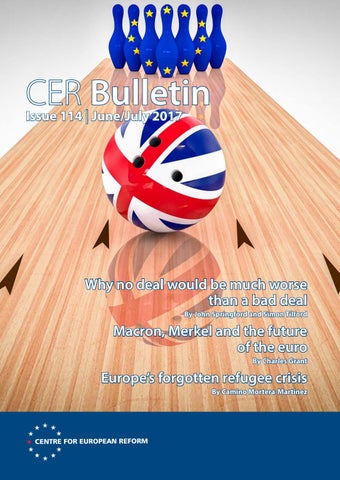
CER Bulletin Issue 114 | June/July 2017
Why no deal would be much worse than a bad deal By John Springford and Simon Tilford
Macron, Merkel and the future of the euro By Charles Grant
Europe’s forgotten refugee crisis By Camino Mortera-Martinez
Why no deal would be much worse than a bad deal by John Springford and Simon Tilford
Theresa May and several of her ministers have claimed that no Brexit deal would be better than a poor deal. They are wrong. The costs to the UK economy of failing to strike a deal would dwarf those of signing up to a bad deal. The likelihood that the Brexit negotiations break down irrevocably and Britain leaves the EU with no deal is slim but certainly not zero. The British government could balk at paying the bill for EU budget commitments (the 27’s recent demands have been costed at up to €100 billion, gross). The two sides could fail to reach agreement over their respective citizens’ rights. Or the UK might refuse to accept a transition deal that includes continued free movement and the jurisdiction of the European Court of Justice. Were the UK to leave without a deal of any kind, EU tariffs would immediately be payable on imports from Britain. These average about 4 per cent, but vary hugely. British food exporters would face average tariffs of 14 per cent. British car exports, which have grown more rapidly than any other category of manufactured goods exports over the last ten years, would face a 10 per cent tariff. The UK would also have to impose tariffs on its imports from the EU: it would only be allowed to reduce tariffs to zero – as some eurosceptics have proposed – if it did so for all countries, not just the EU.
The imposition of tariffs would be massively disruptive, not least for the car industry, which relies heavily on components crossing borders many times before a vehicle is assembled. Car components would face a tariff of 3 per cent, but even that is enough to disrupt supply chains. The local content of a British-built car is just 40 per cent, with most of the rest being imported from the continent. Britain would also exit the EU’s customs union, with the result that rules of origin would immediately come into force. Rules of origin are used to determine the national origin of a product, and hence whether tariffs need to be applied to it and at what level. The UK would face the EU’s common external tariff, so all British exports would face EU tariffs. But rules of origin are also used to determine EU anti-dumping measures, labelling and product standard requirements, and for the collection of trade statistics. The process would be time-consuming and costly, and many firms, especially smaller ones, would be unable to comply and would cease exporting to the EU.
info@cer.org.uk | WWW.CER.ORG.UK CER BULLETIN issue 114 | JUNE/JULY 2017 3
Perhaps the most damaging aspect of ‘no deal’ would be that, outside the EU’s legal framework, many UK products would no longer be accredited for sale across the EU. For example, sales of British pharmaceuticals or chemicals in the EU would not be immediately authorised. Similarly, British-based airlines would no longer be allowed to fly to EU member-states, because the UK’s authorisations of British airlines would no longer be recognised by the EU. British airlines would quickly seek (and probably get) authorisation to fly to and from the EU. But since they would not part of the ‘single European sky’, they would not be able to fly between airports within the Union. British-based financial firms would lose their passporting rights overnight, and mutual recognition of many regulatory standards would end. That would lead to a sharp fall in financial services exports, and acute legal uncertainty over contracts. Crucially it would affect the clearing and settlement of financial trades, especially of derivatives (futures, options and swaps), which are overwhelmingly centred in London. Of course, ‘no deal’ would pose challenges for the EU too, and the largest of these could be financial. There has been a lively debate between central bankers about the financial stability risks to the UK and to the EU-27 from a sudden end to the operation of EU law in the UK. UK officials say that the City of London is essentially the hedging capital of the EU. Continental banks use the City’s services to hedge against risks to their assets. They rely on short-term deposit financing, and lend out, long term, on fixed interest rates. They need hedging instruments to ensure that their shortterm financing needs are met in the event that markets shift suddenly. If EU banks were cut off from the UK market, because the UK had left the EU and its clearing houses were not yet deemed ‘equivalent’ by the EU, derivatives trading would become more expensive and so hit eurozone banks. Yet EU officials say that these fears are overblown. Banks can go to New York to clear derivatives, because the US’s regulation and supervision of clearing houses has been deemed equivalent by the EU. And eurozone banks would not be cut off from the UK market – the use of clearing houses in countries that do not have equivalence simply requires banks to set aside more capital. It would be a bit more expensive, but manageable. Crucially, the EU has the power to contain the negative financial fall-out from the collapse of negotiations with the UK. If the UK walks
away from the talks, the EU could grant the UK temporary equivalence in those forms of transaction that are critical to financial stability. For example, the EU could grant UK-based clearing houses temporary equivalence for a year, so eurozone banks could still clear and settle derivatives contracts in London. Thus the EU can mitigate harm to itself from the failure to reach a deal, and punish Britain in areas where higher barriers are less costly to the EU. In aviation, for example, the EU could grant UK-based airlines a reprieve, allowing them to continue to fly to the EU and even between EU airports. That would allow EU citizens to fly home to see their family and business flights to continue, which is strongly in the interest of both sides. The EU could offer an emergency deal recognising UK approval of new medicines, ensuring that they could continue to be sold in the EU. But where they had other options than British suppliers – meat, cheese and car parts, for example – the EU’s leaders could allow trade barriers to rise. Importers of these products could switch to suppliers within the EU – or to the many countries that have free trade agreements with the Union. What would all this mean for the UK economy? British exports of goods and services would shrink very sharply. The hit to exports and to the attractiveness of the UK as a place to invest would in all likelihood provoke a sharp fall in the value of sterling, which could reach parity against the euro and possibly against the dollar too. Inflation would rise as the weakening of sterling and the imposition of tariffs boosted the prices of goods, in turn eroding disposable incomes and consumption. The result would be a deep recession, which would hit tax revenues and weaken the government’s ability to impart a fiscal stimulus to support the economy. The loss of investor confidence in the UK economy might present the Bank of England with the awful choice of either having to stabilise sterling by raising interest rates, or to stimulate the economy. The EU-27 know all this, which explains why they are dismissive of British threats to walk away with no deal. They may have misjudged the British political climate, but they have not misunderstood the economics.
John Springford Director of research, CER
Simon Tilford Deputy director, CER
Macron, Merkel and the future of the euro by Charles Grant
Emmanuel Macron wants to change the way the eurozone is run. But can he persuade Angela Merkel? Throughout much of the EU’s history, a strong alliance between France and Germany has been a necessary, though not sufficient condition for European integration. They hold fundamentally different views on many issues, which means when they have found a compromise, their partners usually follow. In this century, however, the tandem has lost its force. The EU’s eastern enlargement reduced the relative weight of France and Germany. And then in recent years, the weakness of the French economy – combined with the passivity of President François Hollande – led to an imbalance between Berlin and Paris. The euro was a Franco-German project, but the pair have disagreed on how to resolve the single currency’s problems. Germany has wanted stricter rules on government budgets and new mechanisms to push countries like France and Italy into painful structural reforms; France has sought more active macroeconomic policies, common instruments such as ‘eurobonds’ (which would mutualise debts) and steps towards a ‘transfer union’. But Germany has set the agenda and mostly ignored French ideas. As Hollande’s economy minister, Emmanuel Macron tried hard to change German thinking. He wrote an article with his German opposite number, Sigmar Gabriel of the Social Democratic Party (SPD), calling for a European Monetary
Fund as well as a eurozone budget to stabilise demand across the economic cycle. But Angela Merkel and Wolfgang Schäuble, her finance minister, stuck to a rules-based approach that prioritised fiscal discipline and structural reform. So Macron knows that shifting German policy will be hard. His plan is to impress the Germans by reforming France – for example by cutting the non-wage costs of employment, lowering the state’s share of economic output and introducing Nordic-style active labour market policies. He hopes that success will give him the credibility to go to Berlin and propose a concordat on the euro and much else. Though Germany’s establishment is delighted with Macron’s victory, it is split on how to respond. Those close to Merkel and Schäuble, like many Christian Democrats, doubt that Macron can achieve much reform in the short term. They remain wary of the Keynesian, demand-focused thinking espoused by the French. In the words of one Merkel aide: “The rest of the EU should not pay France to do what is good for France.” But in the foreign ministry and SPD circles, senior figures favour a more enthusiastic response and want Germany to moderate its orthodox line on the euro. One of them is pushing for a new Franco-German treaty (modelled on
info@cer.org.uk | WWW.CER.ORG.UK CER BULLETIN issue 114 | JUNE/JULY 2017 5
the Elysée treaty of 1963) and joint bonds as a stepping stone to eurobonds. He says that in any new coalition agreement with the Christian Democrats, the SPD would insist on ceding to some French requests. Yet the conservatism of Germany’s voters and politicians makes it unlikely that Macron will get very far in redesigning eurozone governance, at least in the short term. The Frankfurter Allgemeine Zeitung recently called Macron a ‘cher ami’, in the sense of both dear and expensive. Der Spiegel quipped that “Macron will save Europe and Germany will pay”. When Macron met Merkel in Berlin on May 15th, Le Monde noted that she was “less lyrical” than he was; over a dozen years she has grown used to meeting new French presidents who promise to reform France and revive the EU. Macron did his best to reassure, saying that he did not want eurobonds to cover past debts. But he said he favoured mutual instruments to cover future investments. Indeed, one of Macron’s priorities seems to be to persuade Germany to boost investment, both at home and in the EU, to stimulate demand. When they were ministers, he and Gabriel commissioned two eminent economists – Jean Pisani-Ferry, now a Macron adviser, and Henrik Enderlein, director of the Jacques Delors Institute Berlin – to write a paper on economic reform in France and Germany. They proposed that EU money should go into new collective instruments to support private and public investment in the eurozone. The big changes to the eurozone that Macron wants would require treaty change. But both Merkel and Hollande – and virtually every other EU leader – have opposed this, because of the near-impossibility of getting every memberstate to ratify the revision. Yet in Berlin, Macron said treaty change was no longer taboo. Merkel responded politely that “if we can say why, what for, what the point is, then we will be ready”. But in fact the chances of a new EU treaty in the foreseeable future remain remote. Merkel’s own advisers dislike the idea and believe that the current treaties can accommodate considerable reform. What is perhaps conceivable, especially if some countries seek to block radical change, is a non-EU treaty among eurozone countries, like the ‘fiscal compact’ of 2012. During Germany’s election campaign, the Christian Democrats will attack the SPD line on the euro as profligate. Merkel looks likely to win in September, and even if the SPD ends up in a stronger position in a new grand coalition, Merkel’s cautious approach to the euro is likely to predominate.
But once the election is out of the way, Merkel will probably want to give Macron a little of what he wants, especially if he achieves reform in France – not because the German financial establishment recognises that its euro policies have been intellectually flawed, but because of the EU’s power politics. The UK’s departure means that Germany needs France more than ever, as a partner in helping it to run the EU. There are no other suitable partners. Merkel knows that if she spurns Macron, eurosceptics in France will profit. Indeed, some of the German politicians most committed to close ties with Paris reckon that the broader the bargaining between the two countries, the better the chances of Germany modifying its stance on the euro. They say that if France made a stronger commitment to German and European security – could it even extend its nuclear umbrella eastward? – Merkel could hardly resist making concessions to Macron. Macron is an enthusiast for European defence co-operation and wants as broad a relationship with Berlin as possible. A stronger Franco-German tandem would be good for the EU. For example, a Macroninfluenced reform of eurozone governance could ease tensions between north and south, by encouraging growth in Italy (which many French and German policy-makers consider the weakest link in the currency union). But there is another fault-line, between east and west, which a FrancoGerman compact could worsen, unless Merkel and Macron are very careful. Poland and Hungary in particular, and the eastern countries in general, have fallen out with Brussels and Berlin over refugee quotas, which the easterners reject. They also worry that in the more ‘flexible’ Europe that France and Germany seem to favour – and which may involve deeper eurozone integration – they will be left behind as ‘second class’ member-states. In addition, Poland and Hungary are in trouble over the rule of law; many member-states accuse them of eroding press freedom and judicial independence. Although Warsaw and Budapest are undoubtedly responsible for some of their current difficulties, Macron and Merkel will have to work hard to prevent this fault-line worsening. They should try and revive the dormant ‘Weimar Triangle’ that brings Poland, France and Germany together. They should make every effort to consult eastern countries on the future of the EU, and ask them for ideas. A more united Europe cannot exclude the east.
Charles Grant Director, CER
Europe’s forgotten refugee crisis by Camino Mortera-Martinez
The EU is far from having solved the problems that led to the refugee crisis. It needs to make its asylum system work and do more to send irregular migrants back. In 2015 and 2016, the refugee crisis and the closure of borders within the Schengen passportfree zone dominated European headlines and even threatened to topple Angela Merkel. After the UK decided to leave the EU and Donald Trump unexpectedly won the US presidential election, attention shifted to other issues. But has Europe at last managed to sort out the refugee crisis? Or have we simply forgotten about it? Official figures seem to suggest that the EU is getting on top of the situation: in March 2016, 36,675 irregular migrants came to the EU by sea; in the same month of 2017, only 13,378 people attempted the crossing. First-time asylum applications have decreased sharply in some member-states, including Austria, Belgium or Sweden. But a closer look at migration numbers tells a different story. As of May 2017, almost 50,000 asylum seekers remain stranded in Greece’s refugee camps. While total sea arrivals in the EU have decreased, more migrants than a year ago are trying to reach Italy by crossing the sea from Libya. EU member-states have only relocated 11.5 per cent of the 160,000 asylum seekers they promised to take from Italy and Greece in May 2015. Europeans may no longer wake up every
morning to breaking news of Europe’s unsolved refugee crisis, but nobody should be under the illusion that the problems of the last two years have vanished. EU officials are working on two issues in particular. The first is the EU’s asylum and refugee scheme (the ‘Dublin system’), which the EU has been trying to fix almost since the scheme’s inception. Its main principle is that the country that an asylum-seeker arrives in first is responsible for processing the application for refuge. Such an arrangement was always bound to create problems. Almost from the beginning, southern European countries complained that they could not cope, while their Western and Northern European counterparts fretted that the lack of proper infrastructure at Europe’s southern borders left them carrying most of the responsibility for welcoming and integrating refugees. The accession of 12 new memberstates with little experience of handling nonEuropean refugees, and the fallout of the Syrian and Libyan wars, have made matters worse. The EU must reform its asylum system to secure the long-term future of the Schengen agreement. And the EU should try to find a solution which works for all its member-states.
info@cer.org.uk | WWW.CER.ORG.UK CER BULLETIN issue 114 | JUNE/JULY 2017 7
For example, it could try to maintain the principle of asylum in country of first entry insofar as numbers remain reasonable for countries to manage. If they do not, then a system of quotas – distributing refugees amongst member-states according to a pre-established formula – could be activated. To convince those countries who are more reluctant to take refugees in, these quotas could be complemented by a ‘buy-out’ scheme: all member-states would have to take in a minimum number of refugees; countries that did not wish to accept more than this minimum could then contribute, in kind or in cash, to the implementation of the EU’s asylum and migration policies (by, for example, sending case officers to refugee processing centres in Greece). The second issue keeping officials busy is the return of rejected asylum seekers and irregular migrants, which is the most difficult part of any migration policy. Sending irregular migrants back to their countries of origin is, however, essential for making asylum policies work: if there is a clear distinction between those who are allowed to stay and who are not, it is easier for governments to take in those in need of protection. But returns are complicated by several factors. First, it is often difficult to verify an irregular migrant’s country of origin. A wide diplomatic network, which smaller member-states often lack, is crucial for this, as it can help in liaising with national authorities. Second, countries are
often reluctant to remove irregular migrants from their territory, as this may have to be done by force, and migrants might sue governments in the courts. Third, to send someone back, EU governments need the agreement of the migrant’s country of origin or transit, which is often not easy to obtain. The EU has been hesitant to negotiate return agreements alongside trade or development deals, in part because such conditionality may hamper economic growth and co-operation, and in part because some member-states have historic and commercial ties with sending or transit countries – such as France’s with many West African countries. But if Europe wants to have an effective asylum policy in place, it will need to be less shy in convincing third countries to take back their own nationals, in exchange for development aid or trade deals. EU institutions are by design much better at slow-moving and highly technical issues than at solving acute crises. In the past two years they have shown a capacity to organise themselves at short notice to deal with the refugee crisis. But the EU has still much more to do if it wants to avoid a collapse of the Schengen area the next time a crisis hits.
Camino Mortera-Martinez
Research fellow and Brussels representative, CER
CER in the press The Telegraph 7th May 2017 “The Commission is trying to make the Brexit bill legally coherent so that, if negotiations fail, it has a defensible case at the International Court of Justice in the Hague,” said John Springford of the CER. Deutsche Welle 4th May 2017 “The Putin approach [is that] unless you actually catch me with my hand in the cookie jar, I haven’t stolen any cookies,” said Ian Bond of the CER. “Is he going to come out and say ‘yes, of course, we interfere in people’s elections’? He’s doing what I would expect him to do, which is deny, deny, deny.”
The Financial Times 2nd May 2017 The UK is deluding itself if it thinks it will prosper outside the EU, writes Simon Tilford, deputy director of the CER. He contends that few countries have ever allowed their sense of exceptionalism to damage their interests in the way Britain is doing. The Guardian 29th April 2017 According to Charles Grant, director of the CER, Emmanuel Macron wants two things from Germany. Firstly, he wants Berlin to agree to reflate its domestic economy, thereby helping not just French exporters but those of other EU countries. Secondly, he wants to
complete the monetary union project by having a eurozone budget managed by a eurozone parliament and a eurozone finance minister. The Wall Street Journal 20th April 2017 “The cost of breaking up the euro is so high that this probably won’t be the consequence of the challenge from populism,” says Christian Odendahl, chief economist at the CER. The Economist 13th March 2017 [As] Camino MorteraMartinez of the CER points out, non-EU countries cannot participate in the European Arrest Warrant.
The Financial Times 24th March 2017 “If Mrs May does not want to further antagonise her partners she should be humble, constructive and flexible,“ says Agata Gostyńska-Jakubowska of the CER. The Financial Times 20th March 2017 Sophia Besch and Christian Odendahl of the CER make the point: “Germany will be neither a hardliner nor particularly accommodating in the Brexit talks . ...Berlin wants to preserve the EU and make sure that the EU-27 stick to a unified position; it considers disintegration of the EU the biggest Brexit risk.”
info@cer.org.uk | WWW.CER.ORG.UK CER BULLETIN issue 114 | JUNE/JULY 2017
Recent events 10 May CER/Kreab breakfast on ‘Digital challenges for transport markets in Europe’, Brussels With Henrik Hololei 4 May Launch of ‘Parliamentarians in Brexit talks: Bulls in a china shop?’, London With John Peet and Joyce Quin
Henrik Hololei
Joyce Quin
25 April CER/Kreab breakfast on ‘How to strengthen the European defence market’, Brussels With Jyrki Katainen 25 April CER/Quilliam roundtable on ‘The future of European counter-terrorism policy: What next after Brexit and Trump?’, London With Sean Arbuthnot, Ghaffar Hussain and Timothy Kirkhope Jyrki Katainen
Timothy Kirkhope and Julia Ebner
11 April CER/Kreab breakfast on ‘The future of EU trade policy’, Brussels With Cecilia Malmström 29 March Breakfast on ‘Has Europe solved its migration crisis or have we just forgotten about it?’ Brussels With Raoul Ueberecken
Cecilia Malmström
For further information please visit
www.cer.org.uk
Raoul Ueberecken