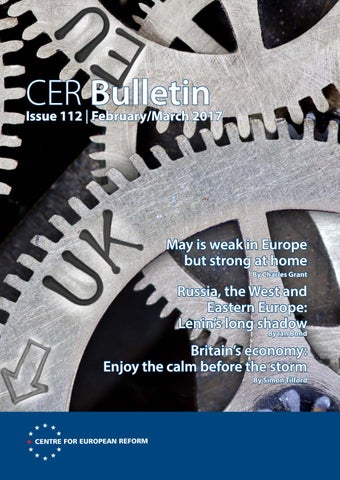
CER Bulletin
Issue 112 | February/March 2017
May is weak in Europe but strong at home By Charles Grant
Russia, the West and Eastern Europe: Lenin’s long shadow By Ian Bond
Britain’s economy: Enjoy the calm before the storm By Simon Tilford
May is weak in Europe but strong at home by Charles Grant
Theresa May doesn’t like the term ‘hard Brexit’. That is because a hard Brexit – meaning a withdrawal that cuts many ties with the EU – will inevitably have negative economic consequences. And when considering key decisions on Brexit, the British prime minister has been unwilling to acknowledge the trade-off between sovereignty and economic growth. But speaking in Lancaster House in January, May was fairly clear about the kind of Brexit she wants, and she edged towards recognising the trade-offs. May wants a hard Brexit: freed of the EU’s rules on free movement and the jurisdiction of its Court of Justice, Britain will leave the single market. And it will pull out of the essentials of the customs union, which means the return of customs posts to the EU-UK border (including the border between Northern Ireland and the Republic), to check for things like rules of origin. She wants “a bold and ambitious free trade agreement” (FTA) to govern the future economic relationship. The prime minister doesn’t want the very hard Brexit favoured by some eurosceptics, according to which the UK would leave the EU and simply rely on World Trade Organisation (WTO) rules. Nevertheless some key officials in Brussels and other capitals fear that Britain may face a much harder Brexit than the version she sketched out: either exiting to WTO rules, or perhaps even falling out of the EU without any Article 50 agreement, leading to legal chaos for companies and individuals.
This pessimism stems from the officials’ reading of UK politics. They note that the domestic political pressures on May are nearly all from the shrill lobbies and newspapers which want a very hard Brexit. The officials worry that these pressures may prevent May from striking the kinds of compromise necessary – for example, over the money Britain is supposed to ‘owe’ the EU – for a deal to be reached. They also fret that the British government is deluded over the strength of its negotiating hand; the reality, they (correctly) surmise, is that once Article 50 is triggered, determining that the UK must leave in two years, London has few cards to play. They fear that UK politics may drive May to storm out of the Article 50 negotiations and seek a bigger parliamentary majority in a general election. Despite such worries, Britain’s partners welcomed much of the Lancaster House speech, notably the clarity over Britain’s intentions, and the warm words about the EU (which contrasted
INFO@CER.ORG.UK | WWW.CER.ORG.UK CER BULLETIN ISSUE 112 | FEBRUARY/MARCH 2017 3
with Donald Trump’s rudeness). What they didn’t like was the suggestion that Britain’s FTA could “take in elements of current single market arrangements” for the car industry and financial services. The 27 considered that idea ‘cherry-picking’, believing that the single market should be all-or-nothing. Nor did they like May’s comment that if the EU offered a punitive deal, the UK would walk away and turn its economic model into something akin to Singapore’s. The most alarming passage in the speech was the pledge to negotiate within two years, not only the Article 50 agreement, but also the FTA and everything else required to govern future relations on security, research, migration, energy and so on. Britain’s partners think that is bonkers. Especially since there will only be about a year for real negotiations, between the formation of a new German government towards the end of this year and the need to start the process of European Parliament ratification of the divorce deal in late 2018. FTAs normally take at least five years to negotiate and several more to ratify. Yet some UK officials say that with “bold ambition” and “political will” anything is possible. They say that because EU and UK rules are already aligned, an FTA can be sorted out quickly. Britain’s partners beg to differ, pointing out that its desire to be able to change the rules, its determination to retain access to services markets, and the need to cover sensitive issues like state aid and competition policy, will make the negotiations fiendishly complex. If all goes well, the 27 believe, two years could allow the completion of both the Article 50 deal and a sketch of the future relationship in a political declaration. The details of the FTA and everything else that will cover future relations could then be negotiated during what May termed the ‘implementation phase’, after Britain has left the EU. But the fact that May proclaimed that everything could be done in two years makes Britain’s partners worry that Downing Street is not fully in touch with reality. They wonder if, following the departure in January of Britain’s gloomy but realistic EU ambassador, Sir Ivan Rogers, there remain enough officials willing to speak uncomfortable truths to power. The British may over-estimate the strength of the cards they hold. The strongest card – repeatedly mentioned by May in her speech – is Britain’s contribution to European security, via co-operation on policing, intelligence, defence and foreign policy. Any attempt by Britain to say “we are helping to defend you, therefore give us a good trade deal” would be viewed as cynical and damage Britain’s reputation. But handled deftly, Britain’s contribution on security could help to generate goodwill.
A related card cited by British officials is Donald Trump. His questionable commitment to European security, and the increasingly dangerous nature of the world, could make partnership with Britain more valuable to continental governments. But the Trump card could easily end up hurting the British. The more that British ministers cosy up to Trump and avoid criticising his worst excesses, and the more the president’s pronouncements on issues such as trade, climate, NATO, Palestine, Iran and Russia reveal a worldview far from that of the Europeans (including the British), the more alien the British appear to other Europeans, and the more their soft power erodes. The British try to play the City of London as another card, claiming that it adds value to the entire European economy. Therefore, they say, the 27 should give the City a special deal, so that its firms can continue to do business across the EU. This British argument has some basis in reality, but few EU governments view the City as a European jewel whose sparkle should be preserved. Some view it as a cesspit of wicked Anglo-Saxon capitalism, while others are keen to pick up the business that could leave the City post-Brexit. May’s threat in Lancaster House to turn Britain into an ultra-liberal economy is a card that lacks credibility, given that in the same speech she spoke in favour of employee rights, workers on boards, industrial strategy and a fairer society. There is no majority in the Conservative Party or the country at large for creating a low-tax, lowregulation economy. Given the weakness of these cards, a half-decent deal will require the goodwill of Britain’s partners. And that means that May and her ministers should conduct the talks in a sober, courteous and modest manner. She will help to foster a positive atmosphere if she seeks a relatively soft Brexit in some key domains, for example by going for modest restrictions on free movement, or intense co-operation on security. Some of the 27 are sceptical that the British political context will permit May to veer in a softer direction. But in fact May’s political position is strong: the Labour Party is weak and divided, while hard-line Tory europhobes have been partially disarmed by her pledges in Lancaster House. However weak May’s hand may be in Europe, in the UK she is probably in a stronger position than she herself realises.
Charles Grant Director, CER
Russia, the West and Eastern Europe: Lenin’s long shadow by Ian Bond
This year, it will be a century since Lenin led the Bolsheviks to power in Russia; and 2016 marked a quarter of a century since the collapse of the Soviet Union that he created. The post-Soviet states have developed in different ways, but they are all dogged by problems born of their history. Russia still feels the phantom limb of its lost empire. And 25 years on, the West has no clear strategy for dealing even with the six former Soviet states that lie in Europe (Armenia, Azerbaijan, Belarus, Georgia, Moldova and Ukraine). In the case of NATO, all six (and Russia) are members of NATO’s Partnership for Peace (PfP) programme, designed to build bilateral ties between NATO and non-members. Georgia and Ukraine want to go further, and to join the alliance. At the Bucharest summit in 2008, NATO leaders agreed that “these countries will become members of NATO”. But after Russia invaded Georgia in 2008 and Ukraine in 2014, the prospect of membership in the foreseeable future vanished. The European Union has dodged the issue of possible EU membership for the six since the 1990s. When the EU launched its Eastern Partnership in 2008, it set out ambitious goals for association agreements with its partners, but without saying whether they were eligible to apply for membership. After the Euromaidan uprising and Russia’s seizure of Crimea, EU foreign ministers got as far as saying that the EU-Ukraine association agreement “did not
constitute the final goal” in co-operation, without suggesting what might come next. Russia has a clearer vision for the region than the West does. It has never treated the six states as fully sovereign, especially in foreign and security policy. Initially, Russia seemed concerned only that its neighbours might integrate with NATO. But after Vladimir Putin became president for the third time, in 2012, he stepped up efforts to keep former Soviet states inside what his predecessor as president, Dmitriy Medvedev, described in 2008 as a “region of privileged interests”. The competition for influence between Russia and the West culminated in the 2014 annexation of Crimea and invasion of eastern Ukraine. The six countries now find themselves in a contested space, between a wary EU and NATO that would like to see them prosperous and stable but will not embrace them fully as members; and an assertive Russia willing to keep
INFO@CER.ORG.UK | WWW.CER.ORG.UK CER BULLETIN ISSUE 112 | FEBRUARY/MARCH 2017 5
them in its orbit by force if necessary, but unable or unwilling to support them economically. This is a bad result for all parties. Russia is by far the largest economic power in the region, and it has the benefit of the region’s lingua franca, and political and economic networks inherited from the Soviet Union. Yet World Bank statistics show that in 2015 the EU was a more important trading partner than Russia for five of the six (Belarus was the exception). Georgia, which has a common border with Russia, did two and a half times more trade with the EU, having re-oriented its trade away from Russia even before their 2008 war. Russia’s willingness to use economic and military coercion in its neighbourhood has often alienated those who might otherwise align themselves with Russia culturally or economically. For the EU and NATO, Russia’s use of every tool of soft and hard power to prevent the countries of Eastern Europe joining Western organisations presents dilemmas. Few Western leaders want to admit that Russia has a veto on its neighbours’ foreign policies; but even fewer want to risk confrontation with Russia. The result is that the EU has to deal with weak, unstable and needy partners, and with a Russia which seeks to frustrate co-operation between the EU and its eastern neighbours. For the six countries themselves, Russia’s determination to keep them out of Western clutches has forced them to choose, unnecessarily, between two economic partners. Some, like Belarus, have gravitated more or less willingly to Russia. In others, including Moldova, a combination of Russian pressure, powerful local business interests and Western apathy has hindered political and economic reform. Publics that wanted their countries to meet European standards of governance have become disillusioned. The election of Donald Trump as American president and the EU’s internal problems make it even less likely that NATO and the EU will take in new members. So, what can Eastern European countries do if they are unwilling to join Russian-led organisations but are unlikely to join Western institutions for the foreseeable future? The top priority, for both the countries concerned and their Western supporters, should be establishing the rule of law. Countries where courts work and laws are stable will be more attractive to foreign investors and less vulnerable to economic pressure. So far, the West has focused on helping civil society organisations
and on institution-building in the countries concerned. But it can also help by making it harder for local elites to launder the profits from corruption and acquire assets in the EU or US. Ensuring that minority ethnic groups are fairly treated is also vital. Disaffected minorities have been fertile soil for Russia to promote separatist conflicts; resolving or preventing tensions will be easier if all communities have a stake in society. China has been active in recruiting some of the Eastern Partnership states to its One Belt, One Road (OBOR) initiative, designed to upgrade infrastructure and increase trade between China and Europe; without becoming clientstates of Beijing, these states should give China a stake in their success as a way of counterbalancing Russian influence. Geography and economics mean that the Eastern Partnership countries would benefit from good political and trade relations with Russia. They should not shy away from this, as long as relations are on the basis of sovereign equality and mutual benefit. Co-operating together economically with each other and with the EU could help them to achieve a more balanced relationship with Moscow. For the West, the challenge is to balance the theoretical right of the Eastern Partnership countries to aspire to join the EU and NATO with the political reality that the West has no desire to confront Russia over them, especially when they are currently far from meeting the conditions for membership. The West should use the coming years to persuade Moscow that, whether or not these countries join Western institutions (and most probably will not), it is in everyone’s interests that they should be prosperous, stable and well-governed. Most of these states enjoyed a brief period of independence after the Bolshevik revolution, before Lenin violently re-asserted Russian control. Putin’s Russia continues to behave as though Russia’s fate depends on controlling its neighbours. Europe’s other imperial powers have realised that it is better to have friendly relations with former possessions, and to create shared economic and other interests, than to rely on coercion. It is time for Russia and its neighbours to escape from Lenin’s shadow. This article is part of a project generously funded by the Open Society Foundations.
Ian Bond
Director of foreign policy, CER
Britain’s economy: Enjoy the calm before the storm by Simon Tilford
The British economy is estimated to have expanded by around 1 per cent over the second half of 2016, and hence at a similar rate to the first half of the year, outpacing the eurozone by a significant margin. Consumers have continued to spend freely – car sales hit an all-time record of 2.7 million, compared to 2 million in similarly-sized France. House prices have risen further. And business sentiment remains strong: manufacturers’ confidence rose to a two-and-a-half year high in January 2017 and that of services sector firms to a 17-month high. On the face of it, the only sign of something amiss is sterling, which was worth 15 per cent less (in tradeweighted terms) in late January compared with mid-June 2016. How can one reconcile the robustness of the UK economy with the angst and foreboding over the economic costs of Brexit? First, the strength of household spending is the easiest to explain: real earnings (wages adjusted for inflation) rose by around 1.7 per cent in 2016, boosting consumer confidence. Second, booming car sales suggest that consumers brought forward purchases of big ticket items, in anticipation that the depreciation of sterling would push up their prices (85 per cent of cars sold last year in the UK were imported). However, the strength of business confidence poses a bigger challenge to economists who warned that Brexit would quickly damage the UK economy. It suggests that firms either do not believe Britain will lose unimpeded access to the EU single market or that they think leaving the single market will not do much damage to their businesses. Alternatively, it could be that
consumer spending is currently buoyant enough to offset the uncertainties created by Brexit, at least for firms with short investment horizons. The truth probably comprises a mix of these factors. For the six months following the referendum, much of the British business community believed the country would either remain in the single market or negotiate a deal with the EU which gave it pretty much unchanged access to it. It could be that it was only with Theresa May’s January 18th speech that firms accepted Britain really was prepared to trade market access and economic security for sovereignty over EU migration and EU law. Moreover, while some economists overstated the immediate economic impact of a Leave vote, most argued that the real damage would come through after Britain had left the EU, as lower
INFO@CER.ORG.UK | WWW.CER.ORG.UK CER BULLETIN ISSUE 112 | FEBRUARY/MARCH 2017 7
trade and investment hit UK productivity and living standards. So what will now happen? The impact on prices and real earnings from the fall in the value of sterling only started to feed through at the end of 2016. Over the course of 2017 real wage growth will stagnate as rising import prices push up inflation. So far, the weakness of sterling has not boosted exports and there are several reasons why the hoped for export boom will not materialise. Over the last 20 years, the composition of British exports has shifted strongly towards services and intermediate manufactured goods, demand for which is less sensitive to changes in the value of sterling. And global trade growth has weakened sharply, as the integration of big emerging markets such as China into the global trading system has run its course, and might weaken further with rising protectionism. The spectre of Brexit will inevitably start having a chilling effect on UK exporters’ investment, especially in services, and for businesses with long investment horizons. Britain is heading out of the single market and the customs union and, in all likelihood, will only succeed in negotiating a free trade agreement (FTA) in goods, but not much beyond that. Financial institutions appear to have taken May’s January speech as confirmation that they will lose so-called passporting rights, which enable them to sell their services unhindered across the EU while being regulated in the UK. A number of banks responded to the speech by announcing that they will now relocate some business out of London and into the eurozone.
Even if Britain manages to negotiate an FTA covering goods, UK-based manufacturers will have to comply with rules of origin. These determine whether tariffs should be charged on goods that have significant content imported from outside the EU. Their imposition will disrupt the complex supply-chains that British firms are as much a part of as other members of the EU. Finally, the British government’s decision to tighten up visa requirements for foreign students in an attempt to cut net immigration will damage the country’s higher education sector, one of its most successful. It will also hit the British economy as a whole by depriving it of large numbers of highly-skilled workers. By placing restrictions on the free flow of labour between the UK and the rest of Europe, the UK will become a less attractive country to European workers, even those who would qualify for whatever regime for skilled immigrants the UK eventually puts in place. The British economy has not weathered the Brexit storm. It is just that the calm before the storm has lasted a bit longer than many had assumed. There is no reason to think Britain will escape serious and permanent damage to its foreign trade and investment and hence living standards. Meanwhile, the Brexit negotiations will be a massive distraction from Britain’s real economic problems: skills, housing, infrastructure, inequality and corporate governance.
Simon Tilford Deputy director, CER
CER in the press Newsweek 17th January 2017 ”The UK”, says Rem Korteweg, a senior research fellow at the CER, “may still fail to remove a major problem for British business after Brexit: checks on UK goods when they cross EU borders.” The Financial Times 16th January 2017 Charles Grant director of the CER said “These comments [by Trump] reinforce the view that transatlantic relations are heading for their rockiest period since World War II. His views on Israel, Iran, climate etc are bound to create a chasm across the Atlantic
and the UK will be left trying to straddle the divide – and perhaps falling in.” The Financial Times 13th January 2017 “There’s no doubt that economic activity has held up better than most economists thought,” Simon Tilford, deputy director of the CER, conceded. Mr Tilford notes that not all pro-EU economists missed the mark, and – like many – remains convinced that the Brexit pain will eventually arrive. CNBC 20th December 2016 Ian Bond, director of foreign
policy at the CER, said that it was still too early to tell how much [the Berlin attack] will impact Merkel’s electoral chances. “There are still months to go before the elections, and she has plenty of time to show that the government is on top of the terrorist threat.” The Guardian 30th November 2016 John Springford, director of research at the CER, argued that it seemed likely that May would consider a preferential system for Europeans because if not they would face getting no more than a “basic free trade deal” from
the EU-27. He also argued that restrictions on skilled workers were also likely if the prime minister wanted to achieve her goal to heavily reduce net migration to the tens of thousands. The Express 25th November 2016 Luigi Scazzieri of the CER wrote: “The impact of a “No” vote on Italy’s political stability is likely to be contained. Renzi’s resignation would not automatically trigger new elections. The Italian president Sergio Mattarella would first explore options for a new government.”
INFO@CER.ORG.UK | WWW.CER.ORG.UK CER BULLETIN ISSUE 112 | FEBRUARY/MARCH 2017
Recent events 24 january 2017 Dinner on ‘What future for Europol?’, London With Rob Wainwright 15 December 2016 Lunch on ‘Whither the Russian economy?’, London With Sergei Guriev
Rob Wainwright
Surgei Guriev
24 November 2016 Roundtable on ‘The Norwegian, Swiss, Canadian and WTO options: Lessons for the UK’, London With Michael Ambühl, Miriam González-Durantez, Wolfgang Münchau and Ulf Sverdrup
(L to R) Miriam GonzálezDurantez and Wolfgang Münchau
23 November 2016 Dinner on ‘How Brexit and the euro’s challenges will affect the UK financial services industries’, London With Pierre Moscovici
Pierre Moscovici
Forthcoming publications Parliamentarians in the Brexit talks: Bulls in a china shop Agata Gostyńska-Jakubowska
The emerging shape of May’s deal on Brexit Charles Grant
Will rows over money block a deal on Brexit? Alex Barker
To read all of our recent publications please visit our website.
For further information please visit
www.cer.org.uk