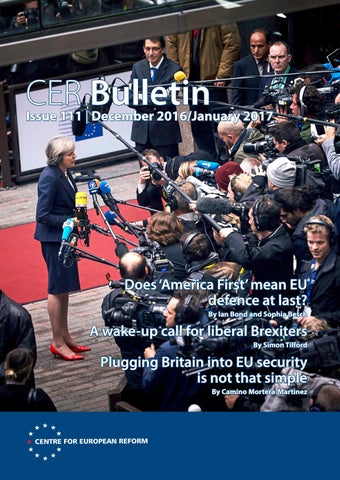
CER Bulletin
Issue 111 | December 2016/January 2017
Does ‘America First’ mean EU defence at last? By Ian Bond and Sophia Besch
A wake-up call for liberal Brexiters By Simon Tilford
Plugging Britain into EU security is not that simple By Camino Mortera-Martinez
AMERICA FIRST
Does ‘America First’ mean EU defence at last? by Ian Bond and Sophia Besch
Foreign policy has not been a priority for the president-elect during his election campaign. Some of his statements on international affairs have been contradictory, and since the election he has denied saying some of the things he said before it. So it is hard to guess exactly what Donald Trump will do. But one consistent theme, which predates the presidential campaign, is that he believes America’s partners and allies around the world are taking advantage of the United States. Trump is likely to re-evaluate America’s commitments to international alliances, based on his assessment of the costs and benefits to the US. Previous US presidents have also wanted other countries and international organisations to take on more responsibility for global problems. The US currently accounts for 70 per cent of defence spending by NATO member-states. President Barack Obama called on European allies to step up their contributions to NATO, and European leaders were expecting Hillary Clinton to re-emphasise the need for Europe to spend at least 2 per cent of GDP on defence. But since the Second World War, no US president has questioned the basic idea that European security, and thus NATO membership, was firmly in America’s national interest. Trump, by contrast, sees relationships with foreign countries as zero-sum, a view he holds in common with Putin and other authoritarian leaders. On the campaign trail he implied that he would decide whether NATO allies were contributing enough to their own defence before
coming to their defence. That would call into question the American security guarantee that has allowed Europeans to integrate peacefully for over half a century. The Alliance’s collective defence clause (Article 5 of the North Atlantic Treaty) commits the United States (and all other allies) to come to the defence of any memberstate that is attacked. The essence of the alliance is that the threats members face are shared and need a joint response. NATO deterrence can only work on the basis of a belief that all allies are ready to intervene when one ally is attacked. Whatever he does in power, Trump’s campaign statements have undermined NATO. They betray a view of the alliance as a purely transactional ‘business’ relationship. From his perspective, an unconditional security guarantee to its allies puts America in a weak bargaining position. Certainty about US commitment is particularly vital to Central European and Baltic member-states
INFO@CER.ORG.UK | WWW.CER.ORG.UK CER BULLETIN ISSUE 111 | DECEMBER 2016/JANUARY 2017 3
that feel threatened by a resurgent, expansionist Russia. They point to the comments of one of Trump’s campaign surrogates, former speaker of the House of Representatives Newt Gingrich, who described Estonia, a NATO ally, as “the suburbs of St Petersburg”, and questioned whether the US should risk nuclear war to defend it. With the election of Trump, Europeans can no longer take America’s security role on their continent for granted. They will have to make the case for European defence to the incoming US government anew. Leaders should formulate a united position while Trump’s policy on Europe is forming. They must show that they are doing more for Europe’s defence, and accept a greater share of the burden within the alliance. One obvious priority must be to further increase defence spending. Europeans should also outline to the presidentelect the value of NATO to the United States. European allies have been America’s most important partners in working for global security. European troops have deployed alongside the Americans in Afghanistan, in Iraq and the Balkans. The only time that NATO invoked Article 5 in its 67-year history was in support of the United States after 9/11. Trump may also find that he needs the support of the alliance. As isolationist as some of his statements have been, he is committed to fighting Daesh. NATO helps with that: all member-states currently take part in the US-led coalition against Daesh, and NATO allies are planning a training and capacity building mission inside Iraq. But Europe also needs mitigation strategies in case Trump really meant what he said during the campaign, and NATO is weakened as the principal security provider on the continent. Long-standing disappointment over the EU’s defence policy has in the past led some to proclaim that only an external shock could convince European leaders to ‘rally around the EU flag’ and get serious about defence. Could the election of Trump give European Union defence policy a new impetus? Russia’s annexation of Ukraine, the refugee crisis and terrorist attacks on European soil have already brought security to the top of Europe’s agenda. In response, the EU this year adopted a new ‘Global Strategy’, outlining its foreign and security policy priorities. The document commits to the controversial concept of ‘strategic autonomy’, the ability to decide and implement EU security policy without relying on the United States. The Union is still far away from this goal. But Trump may make it more urgent for Europe to work towards stronger and better-integrated
defence industries, invest in the development of military capabilities and build effective command and control structures. After the inauguration of President Trump, European strategic autonomy will no longer be just about burden-sharing. It will also be about the EU being strong enough to decide independently not to follow the US at all costs. If a Trump administration decided (for example) that nuclear non-proliferation was no longer a US goal, then the EU would need to part company with Washington and ensure that it had the diplomatic, economic, security and intelligence tools to constrain and ideally prevent proliferation. If Trump rejected the agreement on Iran’s nuclear programme, as he has said he would, then the EU would still need to work with Russia and China to try to prevent Iran from rushing to develop a bomb.
While it would make sense for Europeans to “co-ordinate their response to Trump, unity is by no means predetermined. ” The US election result also reinforces the imperative European leaders have faced since Brexit: they must demonstrate unity, and strengthen the tarnished credibility of the European Union. But while it would make sense for Europeans to co-ordinate their response to a Trump presidency in defence matters, unity is by no means predetermined. European integration has taken place under the watchful but generally supportive eye of the US. One risk is that Europeans start a beauty contest, with individual leaders vying to show that they are on Trump’s side while others are not to be trusted. Populist and nationalist leaders, including Nigel Farage in the UK, Marine Le Pen in France and Prime Minister Viktor Orbán in Hungary, have already openly backed Trump. Instead, the EU must come together and show unity of purpose, particularly on security and defence. European leaders, especially Angela Merkel but in due course the next French president (unless it is Madame Le Pen), must demonstrate their firm commitment to European cohesion and continental security.
Ian Bond
Director of foreign policy, CER
Sophia Besch Research fellow, CER
A wake-up call for liberal Brexiters by Simon Tilford
Brexiters assumed that Britain would face a benign international environment once freed from the EU. They took for granted that the UK would be able to rely on the key global public goods underwritten by the US: the global trading system, the international financial system and international security. They argued that Britain would be able to leave the EU, but take advantage of open markets elsewhere. Britain’s financial services industries would profit from being able to sell into USdominated global financial markets, unencumbered by EU regulation. And their implicit assumption was that the US would continue to provide the security umbrella that makes peace and prosperity possible. The election of Donald Trump has undermined the premises of their argument. Forging as close ties as possible with the EU has never been so important for the UK. There is a possibility that once in power Donald Trump will revert to a traditional Republican agenda of free-trade, and military and diplomatic intervention to address security problems. But this looks unlikely. Trump is no economic liberal and does not appear to understand how global institutions and norms crafted by the US serve its interests. He may only last one term in office but the UK cannot afford to assume that Trump’s presidency is just a temporary hiatus before normal service resumes. Britain cannot rely on the continued openness of the global trading system, because globalisation can only flourish with wholehearted US support. And that is, at the very least, now in doubt.
Some members of the British government have latched on to Trump’s assertion that the UK will be high up the list of countries with which the US will negotiate trade agreements. But a US-UK trade deal will not happen quickly. And it would have to be heavily skewed in favour of the US in order to make it past Congress. In return for a deal, the US would no doubt put the UK under heavy pressure to reform the drug procurement procedures of the National Health Service (NHS): the NHS, as the largest buyer of pharmaceuticals in Europe, essentially sets the prices for many other EU markets, and is thus resented by the US pharmaceutical industry, which sees these prices as unfairly low. The US would also put the UK under fierce pressure to fully open up its
INFO@CER.ORG.UK | WWW.CER.ORG.UK CER BULLETIN ISSUE 111 | DECEMBER 2016/JANUARY 2017 5
agricultural markets to US food exports. These conditions could, in turn, make a trade deal with the US unacceptable to British voters. Finally, the UK cannot be confident that Trump will continue to place much emphasis on close relations with Britain. Trump’s allegiance to Britain seems to rest more on emotion than on a clear-sighted assessment of US interests, and as such might not survive any disagreement between the US and the UK.
UK law where it pertains to the single market, or those parts of the single market the UK remains a part of. Britain also needs to accept a greater role for the EU in providing for European security. Successive British governments have been deeply ambivalent about the EU assuming a bigger defence role, fearing that it would undermine NATO. But with the US’s commitment to NATO in doubt, the very least the UK needs to do is hedge its bets.
Trump’s victory should have brought home to British ministers that the UK cannot rely on the US providing the security needed to keep Europe peaceful and prosperous. While Trump will not call time on NATO as he threatened to do during his campaign, it is clear that the US will be a less reliable partner for Europe. A Trump administration will also take a much softer line with Russia, potentially destabilising Central and Eastern Europe and opening the way for increased Russian meddling in the EU. This is inimical to UK interests, as the country’s foreign minister, Boris Johnson, has made clear. Nor is the UK likely to have much in common with the Trump administration when it comes to the environment; Theresa May’s cabinet may contain a few climate change sceptics, but the government remains committed to reducing the UK’s carbon emissions and to international efforts to combat global warming.
s win demonstrates the importance of the “EUTrump’ in upholding the liberalism many Brexiters claim to support. ”
Trump’s win demonstrates that engagement with the EU is the best way of defending the UK’s interests and upholding the liberalism many Brexiters claim to support. Indeed, it further heightens the case for Britain remaining in the EU. With globalisation under pressure, the benefits of single market membership are even clearer, especially for Britain’s cluster of financial and business services industries, whose success over the last 20 years has to a large extent been driven by EU trade, which they have come to dominate. A US less committed to the multilateral trading system also increases the importance of EU membership as a lever to open up markets around the world. Where might is right, the UK will be a supplicant in any significant trade negotiations. However, as EU membership is off the table, Britain needs to focus on delivering the closest possible relationship with the EU compatible with the referendum result. Britain’s Conservative government should row back from the inflexible positions it has staked out on free movement and the remit of the European Court of Justice. This means accepting a compromise on free movement, if the EU offers one, rather than an end to it. And it means the continued supremacy of European law over
Trump’s victory gives the efforts to strengthen EU defence policy more urgency. The UK has a lot to offer in this field – UK backing for and participation in a strengthened EU defence capability could foster good will in other areas of negotiation. The UK should avoid confrontational haggling over defence and free movement, and maintain a strong commitment to the security of Central and Eastern Europe, regardless of the outcome of the Brexit negotiation. But constructive British engagement on European defence and security – which is in the UK interest in any case – would improve damaged relations with Germany and other member-states. In turn, this would make compromise on market access and free movement easier. So far, the reaction of the British government to the US election result has been short-sighted and simplistic: Trump will be good for the ‘special relationship’ because he likes Britain and what is good for the special relationship is good for Britain. But close ties with the US are only in the UK’s interest if the US is committed to open trade and finance and the provision of a robust US military presence in Europe. There is little to suggest the UK will be able to mould a Trump-led America to its liking, and much to suggest that close ties to the Trump administration would further damage the UK’s standing with the EU. The already weak case for Brexit just got a whole lot weaker. A clear-eyed analysis of UK interest suggests that the government should prioritise rebuilding relations with the EU as a matter of urgency. Liberal Brexiters should acknowledge that the world has changed and that their Brexit vision was predicated on foreign policy assumptions that are now very much in doubt.
Simon Tilford Deputy director, CER
Plugging Britain into EU security is not that simple by Camino Mortera-Martinez
Brexiters seem to think that negotiating a bespoke arrangement with the EU on police and judicial co-operation will be a breeze. Donald Trump’s election has boosted their enthusiasm. Trump’s suggestions on how to fight crime and terrorism (by torturing or deporting suspects) are unpalatable to most European nations. If he implemented them, Europe would need to cut some ties with America; and Leavers think that Brexit talks on law enforcement co-operation would be easier if the EU needed to find a reliable security ally closer to home. But, as often, Brexiters overlook the EU’s legal and political reality: in most cases, the British government should be prepared to accept much less generous terms than it currently enjoys. EU justice and home affairs (JHA) is a highly regulated area. Britain’s partners may be more willing to plug the British into JHA than they may be to offer a special deal on the single market. But the UK should not over-estimate what EU partners can offer: they may not be able to overcome domestic legal barriers to cooperating with a non-EU country. There are three areas of particular importance in the EU’s fight against trans-national crime: extradition, access to databases and police co-operation. Since 2004, extradition procedures between EU countries have been simplified by the European Arrest Warrant (EAW), which has made prosecuting European criminals easier
and faster. There is no extradition treaty in the world allowing for such a degree of cooperation between countries: among other things, the EAW has lifted the constitutional ban some EU countries have on extraditing their own nationals. Britain cannot be part of the EAW, as it is only open to EU countries. If the UK wanted to get a similar deal with the EU, it would need to convince its partners to change their constitutions. In some cases, this would trigger a referendum. It is difficult to see why other EU member-states would go to such pains to accommodate Britain’s demands, especially in the current political environment. Securing access to Schengen databases (like the Schengen Information System, which contains information on lost identity documents and
INFO@CER.ORG.UK | WWW.CER.ORG.UK CER BULLETIN ISSUE 111 | DECEMBER 2016/JANUARY 2017 7
wanted persons) will also be tricky. Norway, Iceland and Switzerland (which, unlike the UK, are outside the EU but inside Schengen) have deals allowing them to participate in Schengen laws and policies. But these agreements come with strings attached: in exchange, Norway, Switzerland and Iceland must make contributions to the EU budget (in 2015 Norway paid €6 million to participate in EU JHA); and they must accept the supremacy of the European Court of Justice (ECJ) over their national courts in matters related to Schengen. ECJ supremacy and budget contributions would be difficult pills for the British parliament to swallow. But without those, it will be hard for the UK to retain the same access it has now to Schengen databases. In any case, if Britain wants to keep accessing EU databases, it will need to retain EU data protection rules. First, the ECJ will invalidate any agreement between the EU and a third country which does not adhere to EU privacy rules. For example, the ECJ stopped the ‘Safe Harbour’ agreement which allowed for data transfers between the US and the EU. Second, the European Parliament will have a say over who can access Europol databases soon – thanks to the new Europol regulation, which the UK has just opted into. The European Parliament will not allow a country with less-than-satisfactory privacy standards to conclude an agreement on data-sharing with the EU. Six years ago, it overturned an EU-US agreement on a Terrorist Financing Tracking Programme because of privacy concerns. Keeping access to EU databases will
be all the more difficult if Theresa May cosies up to Donald Trump. Some of his proposals during the campaign, such as killing terrorists’ families, would be crimes by European standards. As the UK’s intelligence services have a close relationship with the US, EU member-states (and the European Parliament) might be reluctant to share data with the UK if it might also reach the US. The UK will be able to get an agreement with Europol, regardless of any Trump-related complications. Unlike Schengen, or the European Arrest Warrant, there are precedents for close co-operation between Europol and non-EU, nonSchengen countries. In particular, Europol has association agreements with countries such as the US and Australia. The UK should seek a US-like agreement with Europol. This would enable the UK to place a network of liaison officers from key crime and counter-terrorism bodies at Europol. In exchange, Europol should also be allowed to have officers in relevant British departments. JHA is not like trade, which creates winners and losers: the only losers from increased cooperation in law enforcement are the criminals themselves. But British participation in some JHA measures will demand compromises with the EU. It would be better for the security of all Europeans if the UK did not rule these out for purely political reasons.
Camino Mortera-Martinez Research fellow, CER
CER in the press BBC News 17th November 2016 Camino Mortera-Martinez of the CER, said there was “no appetite for treaty change in Brussels at the moment”. The Guardian 14th November 2016 “Even if Hillary Clinton had won, there was always awareness that Europeans would need to do more for their own defence,” said Sophia Besch of the CER. The New York Times 12th November 2016 ”Never before has so much ridden on the Germans,” said Simon Tilford, deputy director of the CER. “We’re very fortunate that Germany is led now by Merkel, because
there is a chance she will step up and do what Europe needs her to do.” The Express 9th November 2016 Ian Bond of the CER, slammed Trump’s comments on foreign policy as “incoherent and sometimes frightening”. Mr Bond said: “The choice of a US President affects not just the people of America, but the rest of the world.” The Financial Times 2nd November 2016 Agata Gostyńska-Jakubowska and Rem Korteweg [of the CER] said some Brexiters believe the US could twist arms in Brussels on behalf of their oldest European ally. “It is an article of faith among
some Brexit supporters that America will ride to Britain’s rescue if relations with the EU get difficult,” they say. The Daily Mail 27th October 2016 A central problem for May’s government is that Article 50 puts the country that is exiting the EU in a position of great weakness, says Charles Grant, director of the CER. EU countries can simply hunker down while the two-year clock ticks away, raising pressure on the leaver. May, therefore, would be wise to avoid an approach that alienates the EU, Grant believes. The Economist 1st October 2016 Christian Odendahl, chief
economist at the CER says that including such a controversial provision [ISDS] in TTIP was probably a mistake; legal systems in America and Europe are developed enough for investors not to need the extra legal certainty. Bloomberg 20th September 2016 As John Springford , director of research at the CER think-tank in London argued in a recent report: ”Free movement is the only way that most such services – in construction, retail and so forth – can be traded. Poland will be unwilling to allow UK services companies to take market share while its citizens are denied equivalent opportunities in the UK.”
INFO@CER.ORG.UK | WWW.CER.ORG.UK CER BULLETIN ISSUE 111 | DECEMBER 2016/JANUARY 2017
Recent events 15 November 2016 Dinner on ‘How the EU-27 should respond to Brexit’ London With Jeroen Dijsselbloem 4-5 November 2016 Ditchley conference on ‘Brexit and the economics of populism’, Oxfordshire Speakers included: Barry Eichengreen, John Kay, Paul Tucker and Martin Wolf
Jeroen Dijsselbloem
(L to R) Agnès Bénassy-Quéré and Paul Tucker 25 October 2016 Lunch on ‘Post-Brexit, what should be the ties between the UK and the EU? Is a ‘continental partnership’ the right model?’, London With Jean Pisani-Ferry, Paul Tucker and Peter Mandelson
(L to R) Peter Mandelson and Jean Pisani-Ferry
19 October 2016 Lunch discussion on ‘The euro and the battle of ideas’, London With Markus Brunnermeier and Harold James
(L to R) Harold James and Markus Burnnermeier
7-9 October 2016 CER/EDAM 12th Bodrum Roundtable, Bodrum Speakers included: Jean-Christophe Belliard, Lütfi Elvan, Espen Barth Eide, Gilles de Kerchove, Alexander Graf Lambsdorff and Ahmet Yıldız
Lütfi Elvan
19 September 2016 CER/DIW dinner on ‘The impact of Brexit on Britain and the EU’, London With Sir Jon Cunliffe and Marcel Fratzscher
For further information please visit
www.cer.org.uk
Jon Cunliffe