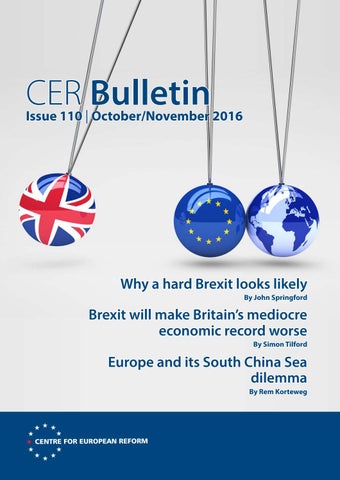
CER Bulletin
Issue 110 | October/November 2016
Why a hard Brexit looks likely By John Springford
Brexit will make Britain’s mediocre economic record worse By Simon Tilford
Europe and its South China Sea dilemma By Rem Korteweg
Why a hard Brexit looks likely by John Springford
Recent data suggests that the Brexit vote will not cause a recession. This, coupled with the fact that British voters rejected two important principles of the EU, makes a single market exit all but certain. Last week, Number 10 repudiated the remarks of David Davis, the Brexit minister, who said that “if a requirement of [single market] membership is giving up control of our borders, I think that makes it very improbable [that the UK will remain in it]”. Theresa May’s spokeswoman said that Davis was merely “setting out his opinion”. But May herself has said that the British people “do not want free movement to continue as it has in the past”, and Number 10 has said that a new immigration system should “ensure that the right to decide who comes to the country resides with the government”. An end to the free movement of labour would force the UK to leave the single market. And economic developments since the Brexit vote suggest that such an exit is politically deliverable. Initial post-referendum data pointed towards a recession. But the August purchasing managers’ indices – surveys of companies’ output, sales, orders and employment levels, which offer speedy (but incomplete) evidence of economic activity – bounced back. The Bank of England has further lowered interest rates and restarted quantitative easing. The Chancellor of the Exchequer, Philip Hammond, told the House of Lords last week that he planned to boost infrastructure spending in order to deliver a
“short-term demand stimulus” in his budget statement in November. This is the right thing to do. The Centre for European Reform has always said that the long-term economic consequences of the vote are what matter – and that they are very likely to be negative. But they will show up in a slower rate of growth both before and after barriers to trade, investment and migration have risen, which may be in 2019. With luck, barriers could rise gradually, if the UK and EU can agree on a way for a trade agreement to come into force as the UK leaves the EU. But if there is no recession, it means that Remainers’ arguments on the economics will be more easily dismissed by the government and proBrexit media. And Brexiters will deploy other arguments to explain the slower rate of growth – an ageing population and a generalised slowdown in the rate of productivity growth across the OECD – or they will say that the British economy is growing faster than country X or country Y, so what is all the fuss about? If the UK ends up with a bilateral trade agreement instead of single market membership, the cost will be significant: Oxford Economics puts the cost between 0.75 and 3 per
INFO@CER.ORG.UK | WWW.CER.ORG.UK CER BULLETIN ISSUE 110 | OCTOBER/NOVEMBER 2016 3
cent of GDP, depending on how comprehensive the trade deal is and how open the UK remains to immigration. These are big numbers in economic policy terms – the only supply-side policy that might achieve an equivalent boost to national income would be radical planning reform. But Brexit is not an event but a process of disintegration. As long as there is no sudden crisis, Brexit voters will believe that its absence justifies their decision. Many Remainers argue that the electorate did not vote for a particular form of Brexit. But they did vote against two fundamental principles of the single market. First, they voted to end the free movement of low-skilled labour. Second, persuaded by Vote Leave’s ‘take back control’ message, they voted to end the supremacy of EU over British law, and the jurisdiction of the European Court of Justice (ECJ). A single market exit will be costly for British services firms. The UK has a comparative advantage in high-value added services, which rely on the single market principles of nondiscrimination and freedom of establishment, enshrined in EU law and enforced by ECJ judgements, to sell across the EU. For their part, Poland and the other newer memberstates have a comparative advantage as a site for manufacturing, largely ‘offshored’ from Germany, and in low-value added services. Free movement is the only way that most such services – in construction, retail and so forth – can be traded, as construction workers and baristas cannot provide their services remotely. Poland will be unwilling to allow UK services companies to take market share while its citizens are denied equivalent opportunities in Britain. Given the vote, UK trade with the EU will probably be governed by a bilateral trade agreement, but there are good reasons to be pessimistic that it will be nearly as comprehensive as the single market. The EU’s institutions provide a political process for updating regulations as markets evolve or market failures are identified, and these regulations minimise the barriers to trade between the member-states. Bilateral trade agreements, on the other hand, are more static, as they mostly deal with traditional barriers to trade, such as tariffs and quotas, and less with regulations or other ‘behind-the-border’ discriminatory measures. New institutions could be created within a trade agreement to allow regulatory co-operation to continue: colleges of regulators in different economic sectors could agree that UK regulations were equivalent to
those of the EU. This is what happens – to a much more limited degree than in the EU – in the NAFTA agreement and in the CanadaEU trade agreement, if it is ratified. And the regulatory preferences of the UK and the EU-27 are not as different as many Brexiters argue.
Without economic pain that is clearly attributable “to Brexit, politicians will find it impossible to defy the demand to ‘take back control’. ” But it would be far from straightforward. Any ‘living’ free trade agreement would require political institutions designed to negotiate compromises between the EU and the UK to ensure that regulations were equivalent, and the EU would insist that it had the final say. If the EU gave UK firms access to the single market on the basis of equivalence, that would be a much bigger concession than the UK giving EU firms similar access to the much smaller UK market. The UK would therefore have to offer something in addition: the EU determining whether the UK’s rules were equivalent, as well as a financial contribution to the EU or free movement of people. Disagreements about financial regulation, transactions taxes, bankers’ pay and incentives, and the City’s role as a bridgehead for non-European banks to access EU markets would become more fraught. And there are differences on chemicals, GMOs, data sharing and more. A new free trade agreement with UK-EU institutions to enforce regulatory equivalence looks remarkably like the Swiss deal with the EU, in which joint committees ensure that Swiss legislation accords with EU law. The Swiss deal only provides goods access, with services largely excluded. And for that, the Swiss have been forced to accept the free movement of people. The EU is unlikely to offer Britain better access to its services markets – and equivalent goods access – than Switzerland without free movement or budget contributions. And without acute economic pain that is clearly attributable to Brexit, Britain’s politicians will find it impossible to defy the electorate’s demand to ‘take back control’, whatever the chronic damage to the economy.
John Springford
Senior research fellow, CER
Brexit will make Britain’s mediocre economic record worse by Simon Tilford
Britain is already an average economic performer by Western European standards. Brexit will further sap its economic dynamism and aggravate startling regional disparities. An observer of Britain’s Brexit campaign would be forgiven for thinking that the country’s economy had been one of the EU’s star performers over the last 15 years or so. Much of the debate focussed on how EU membership was holding back the British economy. Boris Johnson, a leading figure in ‘Vote Leave’ (the official Out campaign), rarely passed up an opportunity to claim that the EU economy was the world’s weak link, and that the UK’s dynamic and flexible economy had little to risk from leaving it. Britain was – explicitly or implicitly – put in the same company as Germany, the Netherlands and the Nordics – reformed, flexible and dynamic. The reality is rather different. And Brexit threatens to make matters worse. The UK’s economic performance relative to the other big EU-15 economies – France, Germany, Italy and Spain – does not stand out as impressive, at least once we adjust for the different prices of goods and services across these countries. UK economic growth between 2000 and 2015 lagged behind Spain and Germany but also France, a country that has become synonymous in Britain with economic weakness. Looking at economic growth per capita further tarnishes the image of the UK as a strong
performer. Germany emerges as by far the best performing big EU-15 economy, with the UK fourth, ahead of only Italy. The British are no richer relative to the EU-15 average than they were 15 years ago. Moreover, the average Briton has to work more hours than the average Frenchman or German to achieve that level of income. Indeed, it is when we turn to productivity that the UK’s status as a strong economic performer is most clearly exposed as wishful thinking. Britain’s GDP per hour worked has fallen to just 90 per cent of the EU-15 average, 25 per cent below French and German levels. Sustainable increases in living standards require economies to combine land, labour, capital and technology in ever more efficient ways; Britain has made a poor job of this, helping to explain why Britons’ wages have risen by much less than their French and German counterparts over the last 15 years. Not only is the UK’s performance mediocre, it is highly skewed by London and its environs. Apart from London, just one British region – the southeast of England – has a GDP per capita in excess of the EU-15 average. And far from catching up with the richer regions of the EU, most poor UK regions have been falling further behind.
INFO@CER.ORG.UK | WWW.CER.ORG.UK CER BULLETIN ISSUE 110 | OCTOBER/NOVEMBER 2016 5
The UK’s poor performance does not seem to be down to poor macroeconomic policies, at least in comparison to the other big EU-15 economies. There is little doubt that the British government overdid austerity in the 2010-12 period, but not by as much as the French, Italian or Spanish. Nor is there any evidence that government borrowing is ‘crowding out’ private sector investment; interest rates are extremely low, pointing to a surfeit of savings over profitable investment opportunities. For its part, the Bank of England has been more aggressive about cutting interest rates and embarking on unconventional monetary policies, such as quantitative easing, than the European Central Bank. That leaves supply-side failures. The UK is generally perceived as a liberalised economy. And in terms of some measures of labour market performance, this is no doubt true: non-wage labour costs are low and it is easy to lay off workers, which together reduces the costs of taking them on in the first place. But labour market performance is about more than the freedom of firms to hire and fire workers easily; it is also determined by the skills of workers, alongside the efficiency of other markets such as housing, and the quality of a country’s infrastructure. Here the UK has some real weaknesses. Partly as a result of this, a significantly higher proportion of British 16-19 year-olds suffer from weak literacy and numeracy than in France, Germany, Italy and Spain. The UK’s housing system is no doubt another major factor behind its poor economic performance. Despite strong population growth and rapid price increases, the UK is building little more than half as many houses as in the 1970s. Moreover, the supply of subsidised (or social) housing has pretty much dried up. As a result, it is hard for many British workers to move to where the jobs are. Another serious supply-side problem is Britain’s infrastructure. The UK has invested less in roads, railways and air travel than the other large EU-15 economies over a prolonged period of time. Infrastructure can increase the productivity of labour and other inputs to the production process, raising the return on investment and boosting foreign trade. It can hence play a major role in addressing regional disparities in productivity. Two further factors help explain the UK’s poor performance. The first is that the UK is one of the most politically centralised democracies in the world. Regions as economically diverse as the north-east of England and London are essentially run as if they have similar economic structures and face the same challenges. Scotland aside,
British regions have scant scope to tailor policies to their own particular needs. The second is corporate governance. Listed British firms are still under too much pressure to maximise their short-term profitability, which can often impair their ability to create value in the long-term. The emphasis on the short-term is reinforced by executive pay being too closely linked to share performance, in particular shortterm share performance. By hitting economic growth and exacerbating regional disparities, could Brexit force the British authorities to address the country’s supply-side problems? The government will no doubt provide some fiscal stimulus to counter the weakening of economic growth caused by Brexit. But it is unlikely to be the kind of longterm investment in infrastructure and skills needed by the UK. The Conservatives have few MPs in the poorer regions that would benefit disproportionately from such spending, while the resulting higher borrowing and/or taxation would be unpopular with their core vote in the wealthier southern English heartlands. And in any case, they are all but guaranteed to win the next election regardless of the policies they pursue, because of the implosion of the opposition Labour Party. Similarly, ideology and political expedience mean the Conservatives are poorly placed to confront the UK’s inefficient housing market. They are opposed to land taxes, which would encourage landowners and construction firms to develop land rather than sit on it (and profit from rising prices). And they are steadfastly against the building of social housing. The government may take most steps to address the short-termism encouraged by Britain’s system of corporate governance. But it is all but certain to shy away from political devolution that would bring an end to the one-size-fits-all labour, tax and industrial policies that have contributed to such a concentration of commercial activity in London. The lesson that the Conservatives have drawn from Scottish devolution is that it encourages the creation of rival centres of power to Westminster. The UK economy was a mediocre performer in an EU-15 context even before Brexit. But quitting the EU’s single market threatens to further erode the country’s economic dynamism and to worsen its striking regional imbalances.
Simon Tilford Deputy director, CER
Europe and its South China Sea dilemma by Rem Korteweg
Few issues in today’s international politics are as thorny as the disputes in the South China Sea. An international court recently ruled against China, complicating matters further. Europe should speak up. On July 12th a tribunal of the Permanent Court of Arbitration in The Hague published its ruling on the claim brought by the Philippines against China, relating to the rights of the two countries in the South China Sea. Manila challenged Beijing’s interpretation of its maritime borders, which overlap with the Philippines’. The fate of the South China Sea matters to the global economy and international security. Onethird of all global trade passes through its fishrich waters, and vast supplies of oil and gas are believed to rest underneath the sea floor. Based on a self-declared zone, known as the ‘nine-dash line’, China claims roughly eighty per cent of the South China Sea – including the islands, rocks and reefs in it. As a way of asserting its position, the Chinese government has in recent years turned some of the reefs it controls into artificial islands and placed military equipment there. Its unilateral steps and the expansive nature of its claim make neighbours like Vietnam and the Philippines nervous. In response, both countries have strengthened security ties with the United States, raising tensions with China.
Beijing sees control over the South China Sea not only as a matter of economic interest or national pride, but as a question of national security. It feels threatened when the US navy operates in the area. And its growing military muscle and economic weight embolden it to challenge the status quo. The US, Japan, the EU and others, however, worry that China may want to restrict the freedom to navigate and fly over the sea. To highlight its concerns, Washington has started to deliberately sail through the disputed waters close to the contested reefs. The tribunal took the Philippine side and ruled that there was no legal basis for China to assert historic rights to resources within its nine-dash line. It also said that the rocks and reefs, many of which are either fully submerged or only visible at low tide, are not features that can generate an exclusive economic zone. China boycotted the tribunal’s proceedings and called the ruling ‘null and void’. It also questioned the impartiality of the tribunal. The United States, supported by Japan and Australia, called on Beijing to respect the decision.
INFO@CER.ORG.UK | WWW.CER.ORG.UK CER BULLETIN ISSUE 110 | OCTOBER/NOVEMBER 2016 7
As for the EU, when the tribunal ruled on the case, it was still shell-shocked by the result of the Brexit vote two weeks earlier. China also successfully leveraged its economic ties to some Central and South-eastern European memberstates – including Hungary and Greece – to block a strong statement in support of the ruling. For its part, the Commission was wary of condemning China, perhaps for fear that this could hit Chinese investment in Europe. The result was a weak statement, in which the EU merely ‘acknowledged’ the ruling. Instead of resolving the issue, the court’s decision complicates matters. Beijing will not accept the verdict; to do so would mean a loss of face. The ruling has handed the Philippines a handsome diplomatic victory, though Manila knows it could never enforce it. It is a military pygmy compared to China. The case was brought by the previous Philippine president, Benigno Aquino III; his successor, Rodrigo Duterte, has struck a more conciliatory tone with the Chinese. And Beijing seemingly hopes to avoid further confrontation on the issue by opening bilateral trade talks with Manila. Through a mixture of buying off and bullying, China may ultimately get its way in the South China Sea. This may avoid conflict for now, but it would set a bad precedent. Where international law takes a step back, great power confrontation comes a step closer.
Because the United States is now the most vocal in calling on Beijing to respect the court’s decision, and the EU has avoided taking sides, the Chinese government could draw the conclusion that international law is an American tool. As a result, China may be even less willing to accept international legal rulings in the future. At stake is the UN Convention on the Law of the Sea (UNCLOS) and, more broadly, the international rule of law. The rule of law is a necessary precondition to avoid a state of anarchy where the ‘strong do what they can, and the weak suffer what they must’. Support for it cannot be voluntary or selective; it should apply equally everywhere. The EU should speak up. In Ukraine, Europe has witnessed the unpicking of international law close to home. If an UNCLOS ruling can be disregarded in Asia, why not also in the Black Sea or the Arctic? Europe must not underestimate its own role: because it is not a party to the South China Sea disputes and does not guarantee the security of any of the states involved, it can put forward the neutral case in favour of international law. Europe should work to convince the Chinese to engage with the case. If Beijing does not like the tribunal’s findings, let it appeal them, not dismiss them.
Rem Korteweg
Senior research fellow, CER
CER in the press The Telegraph 12th September 2016 Charles Grant director of the CER, a pro-EU think-tank, said that the line in Brussels, Paris and Berlin was very clear on free movement and – despite recent remarks suggesting a more pragmatic approach – with Mr Tusk’s office too. The Guardian 10th September 2016 ”In theory UK citizens, as third-country nationals, would certainly be subject to the obligations of the Etias scheme,” said Camino Mortera-Martinez of the CER. “This will have to be part of the Brexit talks. It will all have to be negotiated.”
Le Monde 9th September 2016 On Friday afternoon, Emmanuel Macron is expected at the CER to discuss Brexit. But his entourage carefully point out that “He’s doing that for free”. The Financial Times 9th September 2016 The UK government’s unwillingness or inability to explain its “Brexit” strategy came under withering criticism this week from Nick Clegg and Peter Sutherland, the WTO’s first directorgeneral. The pair shared their extensive experience of EU and global trade issues at an event held by the CER.
The Guardian 2nd September 2016 Charles Grant of the CER says “the British people are living in cloud cuckoo land” about the economic impact. The Telegraph 30th August 2016 Rem Korteweg of the CER, said “[EU elites] dropped the ball and lost control in framing the narrative [about TTIP]”. The Scotsman 21st August 2016 Ian Bond of the CER said border controls would be inevitable if Scotland voted for independence and was readmitted to the EU under standard conditions.
The Daily Express 3rd August 2016 Simon Tilford, deputy director of the CER said: “There is a very real risk that Mr Renzi will come to the conclusion that his only way to hold on to power is to go into the next election on an openly anti-euro platform.” The Wall Street Journal 1st August 2016 “The lower the barriers to trade and investment are, the more of those things you’ll have,” said John Springford [of the CER]. “Over the long term, less trade and investment is going to mean a smaller economy than would otherwise be the case.”
INFO@CER.ORG.UK | WWW.CER.ORG.UK CER BULLETIN ISSUE 110 | OCTOBER/NOVEMBER 2016
Recent events 8 September 2016 Roundtable on ‘Brexit challenge: The future of international trading relationships for the UK’, London With Nick Clegg and Peter Sutherland 9 September 2016 Roundtable on ‘Brexit and the future of the EU’, London With Emmanuel Macron Nick Clegg and Peter Sutherland
Emmanuel Macron
16 September 2016 CER/Kreab breakfast on ‘Protecting tax bases to ensure fair taxation’, Brussels With Stephen Quest 16 September 2016 Lunch discussion on ‘Brexit: The beginning of the end or end of the beginning?’, London With Alexander Stubb
Stephen Quest
Alexander Stubb
Forthcoming publications Brexit will make Britain’s mediocre economic record worse Simon Tilford
Trading up: The foreign policy implications of TTIP Rem Korteweg
Russia and China: True love or strictly business? Ian Bond
To read all of our recent publications please visit our website.
For further information please visit
www.cer.org.uk