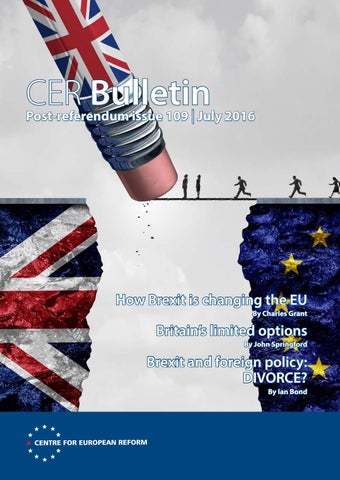
CER Bulletin
Post-referendum issue 109 | July 2016
How Brexit is changing the EU By Charles Grant
Britain’s limited options By John Springford
Brexit and foreign policy: DIVORCE? By Ian Bond
How Brexit is changing the EU by Charles Grant
After the British voted to leave the EU, Marine Le Pen crowed that it was “by far the most important historic event known by our continent since the fall of the Berlin Wall”. She was right. Brexit is a momentous event in the history of Europe and from now on the dominant narrative will be one of disintegration not integration. That does not mean that the EU will fall apart, or even that another country will leave, which is highly unlikely in the foreseeable future. But the centrist politicians who run nearly every EU member-state are now on the defensive against the populists who oppose them and the EU. This will greatly weaken the ‘federalists’ who wish to press for further integration. The European Commission, led by President Jean-Claude Juncker, generally seeks to respond to crises by pressing member-states to accept ‘European’ solutions that involve extra powers for EU institutions. This is not necessarily cynical – the Commission genuinely believes that many problems require ‘more Europe’. And sometimes it is right. But the President of the European Council, Donald Tusk, has warned repeatedly this summer that more centralisation would turn citizens against the EU. “Obsessed with the idea of instant and total integration, we failed to notice that ordinary people, the citizens of Europe, do not share our Euro-enthusiasm,” he said. Similarly, Wolfgang Schäuble, the German finance minister, has said that “this is not the time for visions; if the
Commission doesn’t work with us we ourselves will take things in hand.” Some Social Democrats in France and Germany echo the Commission’s rhetoric. Since the referendum, Jean-Marc Ayrault and Frank-Walter Steinmeier, the foreign ministers of France and Germany, have called for more integrated policies on borders, defence, intelligence, migration, asylum and corporate tax. Sigmar Gabriel, Germany’s economy minister, and Martin Schulz, the president of the European Parliament (also Social Democrats) have demanded a new treaty and a ‘European government’. But Tusk’s pragmatism – backed by Chancellor Angela Merkel and most EU leaders – will prevail over Juncker’s federalism. In recent years Paris and Berlin have discussed a new EU treaty, focused on a more integrated eurozone. But such talk has petered out, because the eurozone, though beset with difficulties, faces no immediate risk of dissolution. France and Germany cannot agree on how to fix the euro’s problems (should there be a transfer union or stricter rules to police budget deficits and structural reform?). And even if they could agree, neither the French nor German
INFO@CER.ORG.UK | WWW.CER.ORG.UK CER BULLETIN POST-REFERENDUM ISSUE 109 | JULY 2016 3
parliaments wants to transfer significant powers to eurozone or EU institutions. In any case, a new EU treaty would require referendums in Denmark, Ireland, the Netherlands and perhaps France – which could easily be lost. So there won’t be a major revision of the EU treaties any time soon. From now on, if European leaders want to reform the EU they will have to pass laws, revise the budget or forge inter-governmental agreements. At some point they may need to adopt new laws to tackle the eurozone’s problems or the refugee situation, and these may give new powers to EU institutions. But the governments will not let the Brussels institutions set the agenda. Since the referendum, the Polish and Czech foreign ministers, as well as senior German Christian Democrats, have called on Juncker to resign. They want to give a clear signal that the Commission and the Parliament will be kept under a tight rein – even though blaming Juncker for Brexit, as some have done, is unfair. A weaker Commission, however, brings economic risks, since it champions the single market. Some politicians now talk as if they can flout EU rules and Commission edicts with impunity – as when the French prime minister threatens to disregard the posted workers directive, unless it is revised so that Central European workers cannot undercut French ones; the Italian prime minister talks of ignoring EU rules that prevent him bailing out shaky banks; or many governments refuse to implement the law that obliges them to take quotas of refugees. The Commission needs to work to restore its credibility in many capitals. That will mean adopting a less imperious tone; countering the perception that it always wants more power for itself; and demonstrating that it has not been captured by the Parliament. And it must reassure the Central Europeans that it pays attention to their concerns (it is currently trying to impose refugee quotas on them, while revising the rules on posted workers against their wishes). In a more inter-governmental EU, Germany will be even more dominant. In recent years France’s weakness, the UK’s semi-detached status and the Commission’s lack of authority have propelled Germany into a solo leadership role. On issues such as the eurozone crisis, refugees and the war in Ukraine, Germany has determined the EU’s response. Fears of even greater German preponderance explain why politicians in Rome, Paris and Warsaw are so disturbed by the prospect of Brexit. The Germans themselves are particularly unhappy about Brexit, and not only because they worry that other EU countries – responding to German
hegemony – may be tempted to form an alliance against them. The Germans have also seen the British as allies for the causes of economic liberalism and smaller EU budgets. Despite German worries, the EU is unlikely to become significantly more protectionist. Many EU governments, including those in the Nordic countries, Central Europe and the Netherlands, share the UK’s free market instincts. But without the British there will be less pressure for completing trade agreements and extending the single market into services. Policy-makers in the US are horrified by the referendum result. They saw the UK as a bridge between themselves and continental Europe. And they knew that on foreign policy questions, the UK tended to steer the EU towards relatively tough or US-friendly positions. The Americans now worry that, without British firmness supporting the hard line of Angela Merkel and other northern European leaders, the EU will be more likely to relax the sanctions it imposed on Russia after its intervention in Ukraine. Although the EU faces many other grave problems, its leaders must now make the time for the Brexit negotiations. On one set of talks, covering co-operation on security issues, the British may find the 27 fairly flexible. This is because the UK can offer valuable assets, such as a seat on the UN Security Council, competent intelligence services, good diplomats, expertise on counter-terrorism and capable armed forces. If it behaves in a constructive and helpful manner, the UK may succeed in feeding its views into EU deliberations on foreign and defence policy, and in taking part in Europol, the European Arrest Warrant and EU criminal databases. But the UK will not write the rules and it will be much less influential than it has been. When it comes to economic ties, the 27 will be much tougher than many Britons expect. European leaders have an interest in ensuring that the EU maintains a close economic relationship with the UK, for everyone’s benefit. But they will not compromise on fundamental principles, such as free movement of labour as the price for single market membership. And they will not want the exit talks to be pain-free, easy or pleasant for the British, since they wish to deter others from following the UK’s example. The opponents of Marine Le Pen and other populists want to be able to say; “Look at the mess the British are in, you don’t want that, do you?”
Charles Grant Director, CER
Britain’s limited options by John Springford
On the face of it, the EU’s deals with Canada, Liechtenstein, Norway and Switzerland appear to lack an underlying principle. Brexiteers have seized on the discrepancies between them, in order to argue that Britain can stay in the single market while imposing quotas on the number of immigrants from the EU. But there is a logic that explains why they are different – and it suggests that the UK is heading for a harder Brexit than many in Britain appear to realise. So what are the deals? If Canada’s trade agreement with the EU is ratified, the vast majority of goods trade will be tariff-free, although it does not cover services. The agreement also includes some measures to ensure that each side recognises each other’s goods standards. But Canada does not have to allow free movement of workers with the EU. Switzerland is more closely integrated into the EU’s goods market, signing up to EU rules and standards in order to ensure tariff-free trade in manufactures. Its access to EU financial markets is limited, however, since it only has a services agreement on non-life insurance. In return, it must sign up to free movement – and, though the Swiss voted in a 2014 referendum to impose quotas on immigration from the EU, the Commission has given the country until February 2017 to think again, or it will take retaliatory measures. For their part, Norway and Liechtenstein are full members of the single market, signing up to
all rules and standards in goods, services and capital, as they are members of the European Economic Area (EEA). But they have different rules governing the free movement of workers. The EEA agreement allows Norway and Liechtenstein to restrict the flows of people if “serious economic, societal or environmental difficulties of a sectoral or regional nature arise”. Norway has never used this ‘safeguard clause’, because, under the agreement the EU may retaliate by restricting imports of goods or services from Norway. Yet Liechtenstein has been allowed to restrict free movement since 1998 by imposing quotas on the number of EEA nationals who could live and work in the country. The deals with the four countries are different because of their population sizes, their distance from the EU, and the volume of trade they conduct with the EU. Liechtenstein is tiny, with a population of 37,000. It is easy for the EU to tolerate Liechtenstein’s quotas: it is politically and economically insignificant, and its curbs on free movement do not threaten the integrity of the
INFO@CER.ORG.UK | WWW.CER.ORG.UK CER BULLETIN POST-REFERENDUM ISSUE 109 | JULY 2016 5
EU. Canada only sells 8 per cent of its exports to the EU, is on the other side of the Atlantic, and it will never be an EU member, for obvious reasons, unlike the other three countries. Thus the EU has been willing to grant limited market access without free movement strings attached. But 74 per cent of Norway’s exports, and 58 per cent of Switzerland’s, go to the EU. They are therefore forced by the EU to accept largely unfettered migration flows. What does this mean for Britain’s forthcoming negotiation? Influential Conservatives hope that the EU will agree to limited curbs to free movement in exchange for small restrictions to UK services exports to the EU. Rupert Harrison, an advisor to former Chancellor George Osborne, has floated the idea of an ‘EEA minus’, with “a bit more immigration control and a bit less single market”. The British press seized on remarks by the head of France’s central bank, François Villeroy de Galhau, who said that UK banks could lose their “passporting” rights if Britain does not sign up to EU rules, including free movement. (Passporting means that banks headquartered in the UK can set up branches elsewhere in the EU, and be regulated and supervised by the British authorities.) The British press assumed that Villeroy de Galhau was suggesting that only a small price, limited to the financial sector, would need to be paid if the UK insisted on restricting free movement. Yet the EU’s relationships with these four countries do not suggest that the bloc will accept such a small price. The UK buys 17 per cent of the EU’s exports (excluding trade within the club), while the EU receives 44 per cent of the UK’s. Britain is also leaving the EU; by contrast, when the political elites in Norway, Liechtenstein and Switzerland negotiated their agreements with the EU, they hoped to join the union one day. The UK’s tight economic integration with the EU suggests that even tariff-free access to EU goods markets may be hard to negotiate if Britain does not sign up to free movement and EU regulations. That, after all, is what Switzerland has been forced to accept. For their part, Britain’s politicians would find it difficult to accept only minor curbs to free movement – such as the right to stop people moving to the UK unless they have a job offer. Between 2014 and the referendum, Britons told pollsters that the number one issue facing the country was immigration. And the Leave campaign pulled ahead in the polls in the runup to the vote, when they shifted their focus onto immigration from the economy. Britain’s new prime minister, Theresa May, has said that the UK “must regain more control of the
numbers of people who come here from Europe”, limiting her wiggle room – and the only way to significantly reduce the numbers is to impose quotas, which the EU might tolerate in the case of Liechtenstein, but not Britain.
The EU might tolerate Liechtenstein’s free “movement restrictions, but would not allow Britain to follow suit. ” This suggests that the UK will have to put all of its diplomatic effort into a two-pronged strategy: maximising market access in goods, and ensuring that there is no damaging hiatus between leaving the EU and the start of the bespoke trade agreement. For a tariff-free goods trade agreement without free movement, the UK could agree to match the EU’s goods market regulations. But such an agreement would severely curtail UK services companies’ right to operate in the EU. This does not mean simply giving up the EU banking passport; the UK might have to swallow restrictions on public procurement, airlines, tourism and other services. The UK has a stronger comparative advantage in services than any other medium-sized country: over 40 per cent of its exports are in services. So such a deal would be a serious blow. Article 50 of the Treaty on European Union gives the EU and Britain two years to negotiate a withdrawal treaty, a deadline that may only be extended by unanimity. The agreement on the future relationship would ideally be negotiated in parallel (though the Commission has so far said that it should be negotiated only after the UK has left the EU), but is likely to take longer and may have to be ratified by all 27 remaining states. The UK could therefore fall out of the single market before a long term deal is done, causing severe disruption to UK trade with the EU. Goods exporters would face tariffs, and services exporters would face the same legal barriers to sales in EU member-states as any other country outside the EU. So the second prong of the UK’s strategy must be to try to convince the EU to give enough time for a comprehensive agreement to be negotiated, perhaps by being a member of the EEA until the trade deal is agreed. But, if there is one thing that the Norwegian, Swiss and Canadian ‘options’ tell you, it is that Britain does not have a lot of options.
John Springford
Senior research fellow, CER
Brexit and foreign policy: DIVORCE? by Ian Bond
Since Britain voted on June 23rd to leave the European Union, British ministers have been telling their international colleagues that the UK is not turning its back on them. As the then prime minister, David Cameron, said at the NATO summit in Warsaw on July 9th, “while Britain may be leaving the European Union, we are not withdrawing from the world”. To underline his point, Cameron promised 650 British troops for NATO’s new deterrent forces in Poland and the Baltic states. The new prime minister, Theresa May, has promised “to forge a bold, new, positive role” for the UK in the world. That will be hard. Negotiations on the terms of the UK’s exit from the EU and its future relationship with the Union will take years and tie up many government departments, including the Foreign Office and the new Brexit and International Trade departments. Meanwhile, as Christian Odendahl and John Springford wrote recently in ‘Long day’s journey into economic night’, economic developments since the vote suggest that Britain will face a recession and a prolonged period of weak economic growth. Add to that the possibility of Scottish independence, and it seems very unlikely that the UK will be able to carry on punching above its weight internationally. Many people who voted for Leave may even see a reduced British role abroad as a good thing after failed interventions in Iraq and elsewhere.
Image © FCO
Even temporary isolationism would be a bad choice for Britain, however. It needs to stay
engaged with the rest of the world for three main reasons:
to ensure that it gets the best possible
economic deal out of the EU, and retains as much access as it can to EU law enforcement and foreign policy co-operation;
to show potential foreign investors that it is a serious country where they should put their money;
to remain part of a common Western effort to defend the liberal international order, and avoid being exploited by others who perceive Brexit as a chance to weaken that order.
Britain’s diplomatic service has shrunk in recent years, with embassies in Europe suffering most. Many UK-based policy officers have been replaced by local staff. As long as much of the
INFO@CER.ORG.UK | WWW.CER.ORG.UK CER BULLETIN POST-REFERENDUM ISSUE 109 | JULY 2016 7
substantive business with EU member-states could be done through their representatives at the EU, or at monthly meetings of EU foreign ministers, these cuts did not matter much. For the next few years, however, the UK will need to do much more networking in EU capitals to protect its interests. As it loses influence in Brussels, it will have to work harder with national governments to defend British interests in areas from aviation security to agricultural trade. It will need nimble and wellconnected embassies to spot when a bilateral deal could create a valuable ally; or when a UK demand that makes perfect sense domestically could turn a potential friend into an enemy. The ‘divorce settlement’ with the EU will be approved by a qualified majority of the 27 EU member-states; but an agreement on the future relationship requires unanimity, so even one offended former partner could derail it. David Davis, the new Brexit secretary, has spent years fighting the EU (including as Europe minister under Prime Minister John Major); now he and his ministerial colleagues will have to put all their efforts into mollifying their EU partners. The new government will also need to preserve what it can of its role in EU law enforcement and judicial co-operation, and in foreign policy co-ordination. This may be easier than getting access to the European single market: there is clear benefit to both sides from minimising changes in the security field, and there are fewer special interest groups (apart from international criminals and terrorists, perhaps) lobbying for the Commission to drive a hard bargain with the UK. Cameron and May were right during the referendum campaign to stress how EU membership boosted British security. The threat to the UK from terrorism and from conflicts on Europe’s periphery will be no less after Brexit. At the same time, the rest of the EU will want to continue to benefit from Britain’s police and intelligence capabilities, and from its diplomatic network. While it is sorting out its relations with the EU, the UK will also have to work hard to mitigate the economic damage caused by leaving the EU. The new international trade secretary, Liam Fox, will have to persuade investors and key trading partners that Britain is a big enough and stable enough economy to make cooperation worth their while – though he will be hamstrung initially by the fact that the UK will not have the right to strike independent trade deals until it has left the EU. Most investors will be wary of promising Britain anything until there is clarity on the UK’s access to the single market and its position in the WTO, but
Fox and his officials cannot wait until then before starting to woo foreign companies and sovereign wealth funds. Finally, the UK will need to keep the closest possible relations with like-minded countries, inside and outside the EU, in order to prevent less friendly countries exploiting its weakness and isolation. Russia has already signalled its expectation of more flexibility from the UK. Putin’s press spokesman said after the referendum: “We hope that in the new reality, an understanding of the necessity of building good relations with our country will prevail”.
UK will need to do much more networking “in EUThecapitals to protect its interests. ” After Brexit, the foreign secretary will not attend Foreign Affairs Council meetings when the EU discusses how to respond to Russian assertiveness in Eastern Europe, or Chinese territorial claims in the South China Sea; the Foreign Office will not have staff seconded to the European External Action Service, able to influence EU foreign policy priorities. As countries like Norway or Canada could testify, even third countries with very similar values and perspectives to those of EU members have to work very hard to have any impact on EU policy. But the UK will still have assets (including a permanent seat in the UN Security Council) of use to Western partners, and interests it shares with EU members. It has every reason to show that it is not a weak link in the Western consensus. The new foreign secretary, Boris Johnson, implied during the referendum campaign that the EU was to blame for Russia’s invasion of Ukraine. He needs to dispel quickly any idea that he will now part company with like-minded democracies on foreign policy issues. He should throw himself enthusiastically into working with other Western foreign ministers to solve international problems. Brexit will damage both Britain’s international standing and the ability of the EU to influence the world around it. But its impact on both parties will be a lot worse if the UK gratuitously distances itself from its partners. Britain and the EU do not have to love each other, but they must still work together.
Ian Bond
Director of foreign policy, CER
INFO@CER.ORG.UK | WWW.CER.ORG.UK CER BULLETIN POST-REFERENDUM ISSUE 109 | JULY 2016
Recent events 6 July 2016 Conference on ‘Brexit: Britain’s European future after the referendum’, London Speakers included: Ludger Schuknecht, Douglas Carswell, Nick Clegg, Malcolm Rifkind, Bernard Jenkin, Nathalie Tocci and George Robertson
Nick Clegg
5 July 2016 The CER 18th birthday party, London With speeches from Helle Thorning-Schmidt and David Miliband
Helle Thorning-Schmidt
4 July 2016 CER/Kreab breakfast on ‘The US and EU approaches towards multilateralism’, Brussels With João Vale de Almeida 28 June 2016 Speech by Yvette Cooper MP on ‘What the UK should do next following the EU referendum result’, London
João Vale de Almeida
Yvette Cooper
CER in the press Financial Times 14th July 2016 “Some 45 per cent of UK exports go to the EU and, on average, about 8 per cent of the exports of each memberstate go to the UK. So there is far more at risk for Britain in conducting a hard ball trade strategy with the EU,” says John Springford of the CER. The Guardian 14th July 2016 Agata Gostyńska-Jakubowska of the CER warns the EU
institutions and other member-states against trying to punish Britain for the referendum outcome and alienating the UK before it has left the EU. The New York Times 14th July 2016 “Theresa May needed to bring some Brexiteers into the government in order to protect herself and to counter the charge that she is a closet remainer,” said Simon Tilford of the CER.
For further information please visit
www.cer.org.uk
The Wall Street Journal 13th July 2016 Charles Grant of the CER, said time would allow the UK to better gauge its adversaries’ interests and develop a negotiating strategy. “But delay too long and you could lose their goodwill, and if you lose their goodwill you won’t get a good deal,” he said. The Independent 13th July 2016 “The stimulative effect of such tax cuts in the short run
is weak, as with monetary policy. Companies will be unlikely to invest their extra earnings while they face uncertainty” said Christian Odendahl of the CER. The Daily Mail 7th July 2016 ”The NATO summit was not supposed to be about Britain,” said Ian Bond of the CER. “But NATO leaders will not be able to ignore the security implications of Britain’s vote to leave the EU,” he said.