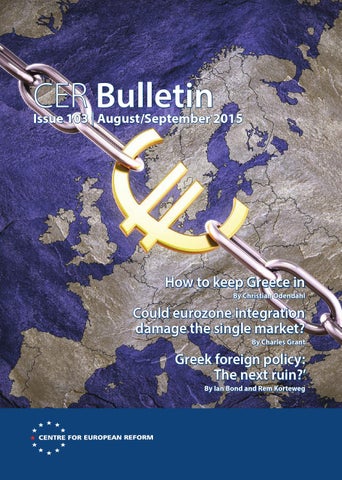
CER Bulletin
Issue 103 | August/September 2015
How to keep Greece in By Christian Odendahl
Could eurozone integration damage the single market? By Charles Grant
Greek foreign policy: The next ruin?’ By Ian Bond and Rem Korteweg
info@cer.org.uk | WWW.CER.ORG.UK CER BULLETIN issue 103 | AUGUST/SEPTEMBER 2015 3
Secondly, the threat of exit from the eurozone must end. In order to resume investment, firms, consumers and investors need to be sure that Greece will remain a member of the eurozone. A lingering threat of eurozone exit will kill any recovery, and could make the threat of exit self-fulfilling. But the very public suggestion by German finance minister Wolfgang Schäuble that Greece should leave the euro will not be forgotten – especially since he repeated it after creditors had reached a deal with Greece early on July 13th, apparently oblivious to the fact that he was seriously undermining it.
How to keep Greece in by Christian Odendahl
Greece’s economy is in dire straits after months of political mismanagement and brinkmanship, which culminated in the closure of the country’s banks, the imposition of capital controls and the threat of expulsion from the eurozone. Such limbo would be toxic for any economy, but especially for a highly indebted one caught in an economic depression and in urgent need of reform. What Greece needs, however, might not be politically feasible, on the part of the Greeks or the rest of the eurozone – in which case it is worth considering whether it is in Greece’s interest to leave the eurozone. The first essential condition for continued Greek membership of the eurozone is a functioning banking system. The banks, deemed solvent by the new single European supervisor in its balance sheet screening exercise in October, are dependent on emergency liquidity assistance (ELA) from the ECB. The reason is that Greek banks cannot sell illiquid assets such as corporate loans as fast as Greek customers currently want to withdraw money from their accounts. The ELA is intended to stop such bank runs, by providing liquidity against banks’ illiquid collateral – something that is at the heart of any central bank’s mandate. The problem is that Greek banks’ collateral depends in part on the solvency of the Greek government: some assets are tax credits, others state-guaranteed. The ECB took the political decision before the Greek referendum to stop increasing the ELA,
which forced the banking system to shut down. This has undermined confidence in the banking system, damaged consumption and investment, and made another recapitalisation of up to €25 billion necessary. Capping ELA was a very costly political threat that failed to impress: Greeks voted ‘Oxi’ to the creditors’ offer in any case. The longer the recapitalisation is drawn out because of lack of an agreement, the greater the damage to the Greek economy. What is more, it is still unclear what bank liabilities will be bailed in, apart from equity and unsecured bond-holders. If unsecured deposits are converted into bank capital, the Greek economy will take another blow. Unsecured deposits in banks are largely non-financial companies’ working capital. The recapitalisation must be done swiftly, and needs to spare deposits of any kind, to preserve what little confidence remains in the Greek banking system.
To kill the exit threat, the creditors need to double the size of the EU’s proposed investment plan for Greece. The EU aims to frontload and accelerate the disbursement of already agreed structural funds. While a good idea in principle, it will not amount to a stimulus, because structural fund investment was above average in both 2013 and 2014. Furthermore, there was no Greek austerity in 2014. The combination of above-average EU funds and the pause in austerity largely explains why the Greek economy stopped shrinking in 2014. The best outcome from frontloading EU funds would be a similar amount of investment as last year, which would not amount to additional stimulus, and would certainly not be enough to compensate for the fiscal tightening that the forthcoming memorandum of understanding (MoU) is likely to entail. To offset this renewed austerity, the eurozone needs to increase the funds for investment from €35 to €70 billion over 7 years. Politically, EU leaders need to pledge more strongly that the eurozone is irreversible unless a member-state asks to withdraw. Angela Merkel would surely be criticised for such a pledge, since many in Germany see the threat of exit as a means to enforce discipline. But that argument risks take moral hazard too far, potentially making the threat self-fulfilling in a severe crisis. Another condition for Greece staying in the euro is political ownership by Greece of the reforms that are needed to unleash the growth potential of the country. The eurozone, knowing that the Greek political class is hostile to reform, is trying to micromanage the process and insisting that measures be taken before bail-out funds are disbursed (‘prior actions’). The problem, of course, is that Greeks cannot be forced to take ownership of reform. Moreover, the sort of institutional reforms that Greece needs will take a long time, and will not be sustainable unless they change the way the political system works. What is needed to reform the country is a Greekled, cross-party plan on the key areas of reform
– the justice system, land rights and registry, the public bureaucracy, tax collection, privatisation and deregulation of product markets. This plan would need the backing of a large proportion of civil society and ideally monitored by Greek experts, not the troika. Tsipras needs to be the leader of this broad reform consensus, and finally start delivering on the reforms he has promised. Such a Greek plan could then be supported by the rest of Europe through both financial and technical help. Relying on a Greekled and Greek-monitored reform plan would of course ultimately be a leap of faith for the creditors, but after years of largely unsuccessful reform efforts in these key areas, such a leap is one worth taking.
A supported exit might be less painful than yet “another unworkable programme, operating under the shadow of the risk of exit. ” Debt relief is the final item on the list of Greek needs. Although Greek debt is mostly to official lenders and can be serviced on the current concessional terms, debt restructuring is still necessary. Greece cannot refinance its debt burden on the markets, so unless it is reduced to a level that investors believe is sustainable, the country will remain dependent on concessional funding by the creditors and the threat of Grexit will remain. Greece needs a clear, realistic and conditional debt restructuring plan so that its people have an incentive to implement the tough institutional reforms needed, and investors can be confident that Greece’s future lies in the eurozone. If growth stayed low despite Greek reform efforts, the plan would need to include provisions that automatically increased the debt relief. If these measures prove politically impossible, for either side, Greece may be better off outside the euro. After all, immediately before the bailout agreement was struck, Germany seemed to offer relatively generous terms, including debt relief, technical assistance and humanitarian aid, if Greece agreed to leave. While such generosity reflects poorly on the motives of German negotiators, a managed and supported exit might be less painful for Greece than yet another unworkable programme, operating under the shadow of the risk of exit. For the eurozone, Grexit would be a political failure of epic proportions, and a large economic risk to take. It would surely be better to keep Greece in, with no ifs or buts.
Christian Odendahl Chief economist, CER
info@cer.org.uk | WWW.CER.ORG.UK CER BULLETIN issue 103 | AUGUST/SEPTEMBER 2015 5
untroubled about the possibility of the eurozone acting in ways that harm the market. And in Berlin, the capital which matters most, few figures sympathise with the British position.
Could eurozone integration damage the single market? by Charles Grant
Can Britain be at ease in a European Union that is increasingly focused on the euro and its troubles? Britain’s eurosceptics think not. The eurozone’s many problems require it to integrate more closely, and that will be bad for Britain, they say, since the euro countries will start to act as a bloc and manipulate EU institutions for their own benefit. Therefore Britain should quit this euro-centric club and negotiate a new and looser bilateral relationship with the EU. David Cameron’s government has begun technical talks with its partners on reforms to the EU, prior to an in-or-out referendum. His officials say that though arguments over EU migrants’ access to benefits will generate more political heat, the relationship between the eurozone and the wider EU is the most important substantive problem. Both George Osborne, the chancellor, and many business leaders see this issue as a priority. Their worry is that the 19 euro countries could caucus and impose their wishes on the 28-country single market. The euro countries can do so since new voting rules – introduced by the Lisbon treaty – came into force last year: their votes combined make a ‘qualified majority’ in the Council of Ministers. British ministers are particularly concerned about the City of London: other EU countries that know little about finance – or which seek to favour their own financial centres – could vote for rules that harm its competitiveness.
The recent furore over the European Financial Stability Mechanism (EFSM) has reinforced British worries. The eurozone wanted this fund, to which Britain has contributed, to make an urgent loan to Greece, to prevent it defaulting on payments due to the IMF and the ECB. Britain tried to stop the loan, reminding its partners of an earlier European Council decision that the EFSM should not be used for the eurozone bail-outs. But eurozone governments had a qualified majority in favour and pushed ahead. Since Britain could not block the loan, it decided to vote in favour, in return for guarantees against potential losses. To British officials, this is a clear example of eurozone putting the currency’s needs ahead of legal niceties or the interests of the euro-outs. Therefore one of David Cameron’s key demands in the renegotiation is ‘safeguards’ for the single market. Unfortunately for Britain, however, few EU governments show much understanding for British concerns. Even a country such as Poland, which is many years away from joining the euro, is
When the British ask for safeguards, German officials respond that eurozone countries do not caucus; how can they, when their disagreements on economic policy are so great? The British sometimes cite the ECB’s declared policy of making clearing houses for euro securities locate within the eurozone as an example of the problem they face: EU institutions want to privilege the eurozone in ways that may damage the City. But this policy did not result from caucusing in the Council of Ministers, and when the British complained about it to the European Court of Justice, they won their case, last March. When the EU drew up rules on banking supervision in 2012, it found a way of alleviating British concerns: in the European Banking Authority, decisions require a majority of both euro and non-euro countries. But the Germans insist that such ‘double-majority’ voting should not apply to financial regulation more broadly, because as more countries joined the euro, the system would evolve towards a British veto. And for one country to enjoy such a privileged position, they say, would be contrary to the fundamental principles of the EU. Many Germans suspect that the safeguard Cameron really wants is a veto for the City on financial rules. In fact he will not ask for that. But German paranoia about British intentions is fuelled by memories of the debacle of the European Council of December 2011: Cameron said he would not sign the ‘fiscal compact’ that Germany wanted without an agreement to change certain voting rules affecting the City. The Germans blocked the changes, he did not sign and the fiscal compact became a non-EU treaty. German officials are still bitter about this episode. Might the EFSF affair be a harbinger of eurozone caucusing in other areas? At one point it looked as though the euro countries might unite behind a ‘financial transactions tax’ (FTT), which if applied to financial centres in the EU but not elsewhere in the world, could damage the City. But many member-states opposed the tax, including euro members such as the Netherlands and Ireland. So in 2012 a smaller group of 11 euro countries announced plans to proceed with an FTT of their own, which still had the potential to harm the City. However, the 11 failed to agree on the FTT’s design and it is now effectively dead. The Commission’s plans for a capital markets union (CMU) – led by Jonathan Hill, the British
commissioner – will generate a series of new financial regulations. But most euro countries agree with the British that CMU is an excellent idea, so eurozone caucusing is unlikely to be a problem.
Cameron needs a deal that protects the single “market and the City from the risks of eurozone integration. ” One other issue, however, could perhaps prove problematic. The Single Supervisory Mechanism, which supervises eurozone banks, worries about the ‘doom loop’ through which banks lend to governments that are in turn responsible for back-stopping them; the deterioration of a sovereign’s credit risk may weaken that country’s financial system. In the eurozone there is a case for tackling this problem through the imposition of limits on how much a bank can lend to its own government. In Britain and other member-states with their own central banks, where the case is weaker, there may be resistance to proposals for EU-wide rules. In truth, there is unlikely to be much eurozone caucusing in the foreseeable future. The British government’s point, however, is that the eurozone will integrate further, increasing the risk of caucusing. What safeguards could it ask for that might be acceptable to other governments? There could be a promise of a future treaty article stating that nothing done by the eurozone may damage the single market. Non-euro countries could gain the right to observe meetings of eurozone ministers. They could also be allowed to press an ‘emergency brake’: if one of them thought a eurozone decision would damage the market, the decision would be postponed for, say, a year, while the European Council reviewed it. The British government has not convinced many of its partners that its concerns about the relationship between the euro and the single market are justified. The Treasury, in particular, needs to do a better job of getting its message across, if it is to win credible safeguards. But the other EU governments, too, need to make an effort to help the British on this issue. Cameron needs to be able to argue that the deal he has won will protect the single market and the City from the risks of eurozone integration. Otherwise British voters may conclude that the EU is driven by the interests of the eurozone, and the referendum may be lost.
Charles Grant Director, CER
info@cer.org.uk | WWW.CER.ORG.UK CER BULLETIN issue 103 | AUGUST/SEPTEMBER 2015 7
The third issue, and closely related to the second, is Cyprus. Syriza is ideologically remote from the current centre-right Cypriot government, but supports a Cyprus settlement including the withdrawal of Turkish forces. As a guarantor power, Greek support is essential for any agreement. Should relations with Turkey deteriorate, the prospects for a deal would recede.
Greek foreign policy: The next ruin? by Ian Bond and Rem Korteweg
The economic consequences of Greece leaving the eurozone would be serious for the Greek people and the rest of the EU. The foreign policy implications could be equally bad. Russia policy aside, the Syriza-led coalition has been part of the European mainstream. If a post-Grexit Greece lurched from left-wing populist to right-wing nationalist government, its foreign policy could be an even bigger problem for Europe. The EU and Greece have finally agreed on a bailout deal. But, as Christian Odendahl and John Springford have written recently (‘The Greek bailout deal resolves nothing’, July 13th), its flaws are so serious that it is likely to fail eventually. Before EU leaders steel themselves to expel Greece from the eurozone, they should think about Greece’s geopolitical importance (and not just its flirtation with Russia). According to Thanos Dokos, of the ELIAMEP thinktank, the last few Greek governments ignored foreign policy because they were overwhelmed by the economic crisis; the current government, by contrast, has re-engaged in a number of important areas. As long as Greece stays in the eurozone, Dokos sees Prime Minister Alexis Tsipras as the politician most likely to lead Greece, in a continued coalition with the right-wing populist Independent Greeks. Opinion polls show that support for Independent Greeks and the extreme right ‘Golden Dawn’ combined is currently around 10 per cent. But if Greece leaves the eurozone, people might
conclude that having tried mainstream parties and left-wing populists, their last hope lay with a coalition involving the extreme right ‘Golden Dawn’. Foreign as well as domestic policy would be affected. Here are seven issues to watch. The first is migration. In the first six months of 2015, more than 70,000 refugees arrived in Greece. The country is struggling to cope. The Greek defence minister (and founder of the Independent Greeks), Panos Kammenos, threatened in March that Greece would “flood Europe with migrants” if its EU partners forced it out of the euro. If his position were strengthened post-Grexit, he would be better placed to carry out his threat. The second issue is Turkey. Syriza has cautiously tried to improve relations with Ankara. While Kammenos’ rhetoric has been strongly antiTurkish, he has not interfered with overall policy towards Turkey. But a successor government could involve both Independent Greeks and other extreme rightists. They might see confrontation with Turkey as a way to consolidate their popular support.
The fourth is energy security. Greece could become an important transit country for gas reaching Europe via Turkey. The transAnatolian pipeline (TANAP) from Azerbaijan to the Greek-Turkish border and the trans-Adriatic pipeline (TAP) from there to Italy are already under construction. Syriza also supports the planned ‘Turk Stream’ pipeline from Russia via Turkey to Greece and the Balkans. ‘Turk Stream’ could challenge the viability of TAP, and would increase Gazprom’s already large share of South-Eastern European markets. After Grexit, a cash-strapped Greek government could be torn between the economic attraction of transit fees from Gazprom and the political fear of increasing its dependence on gas imports via Turkey. The fifth concerns the Western Balkans. Greek banks are active in places like Albania and Serbia, and although their status as separate legal entities there should shield them from the worst impact of Greece’s financial woes, their fragility could still cause economic problems. Politically, if Syriza fell from power, the slow normalisation of relations between Greece and Kosovo could be derailed by a more nationalist, pro-Orthodox government. Such a government would be even less likely than the present one to make progress on the issue of Macedonia’s
name, which is the main obstacle to that country joining the EU and NATO. The sixth issue involves security and defence. Greece has traditionally spent a higher percentage of its GDP on defence than any other European ally, primarily to protect itself from Turkey rather than to join EU or NATO missions. Whether it stays in the eurozone or not, it will have to cut defence spending. But a more nationalist government may care less about NATO’s defence priorities, and more about standing up to Turkey – and prioritise accordingly. The seventh issue is Greece’s relationship with Russia. Both Syriza and Independent Greeks have unhealthily close relations with Putin’s Russia – contributing to Athens’ poor relations with Central Europeans who feel threatened by Moscow. So far, despite public objections to EU sanctions, Greece has approved their renewal; but that might change if Greece were pushed out of the eurozone and offered a financial lifeline by Russia. The problem for the Central Europeans is that the most likely alternative to Syriza is no better: both Independent Greeks and Golden Dawn are Russophile. The EU may not be able to prevent Greece from falling out of the euro. But its leaders should think hard about the foreign policy consequences of a weak and alienated Greece. The Syriza government may be an annoying negotiating partner, but its foreign policy may be the best on offer.
Ian Bond
Director of foreign policy, CER
Rem Korteweg
Senior research fellow, CER
CER in the press Channel 4 News 20th July 2015 Camino Mortera from the CER told us: “There is a sense of people getting scared about what is happening in Greece happening in Spain as well. People see the banks closing and they think that Podemos will do the same in Spain.” The Financial Times 14th July 2015 “Greece’s third bailout is bound to fail for the same reasons that the last two programmes did,” said
Christian Odendahl of the CER. “A government who... claimed to be ending austerity will now be forced to do the opposite.” The Telegraph 14th July 2015 Christian Odendahl and John Springford said the new bail-out “resolves nothing” and is likely to fall apart even if it gets through the Greek parliament. It repeats the errors of previous packages that imposed self-defeating levels of fiscal contraction. “A fresh round of
consolidation will raise the Greek debt-GDP ratio, not lower it,” they said The New York Times 13th July 2015 “The four horsemen threaten the EU precisely because they raise issues that can only be solved if governments prioritise a European solution over narrow national agendas,” said Rem Korteweg of the CER. The Washington Post 6th July 2015 “Merkel does accept that
Greece may leave the euro, but she doesn’t want to be blamed for it,” said Charles Grant of the CER. “She has to try and go the extra mile to make a compromise feasible.” The Washington Post 29th June 2015 “Around the world, there’s a growing incomprehension that the Europeans have allowed something like this [the Greek crisis] to spin out of control,” said Simon Tilford of the CER. “It could be very damaging to European credibility.”
info@cer.org.uk | WWW.CER.ORG.UK CER BULLETIN issue 103 | AUGUST/SEPTEMBER 2015
Recent events 23 July 2015 Breakfast on ‘Reforming the EU’, Brussels With Ivan Rogers 16 July 2015 Launch of ‘A ten-point plan to strengthen Westminster’s oversight of EU policy’, London With Chris Heaton-Harris MP and John Kerr
Ivan Rogers
Chris Heaton-Harris MP
7 July 2015 Roundtable on ‘The EU-Russia energy relationship: From addiction to rehab?’, Brussels With a keynote speech by Gunnar Wiegand 3 July 2015 Lunch on ‘Banks and the capital markets union’’, London With Richard Hopkin, Martin Merlin and Richard Portes Gunnar Wiegand
Martin Merlin
29 June 2015 CER 17th birthday party, London With a keynote speech by Joschka Fischer, hosted by Ambassador HE Witold Sobkow 10 June 2015 Dinner on ‘Challenges to the global order: China, Russia and the Middle East’ , London With Sir John Sawers Joschka Fischer
For further information please visit
www.cer.org.uk
Sir John Sawers