THE CENTRAL SYNAGOGUE
JOURNAL PESACH 5782 / 2022 A LITTLE NOSH FOR THE SOUL
[
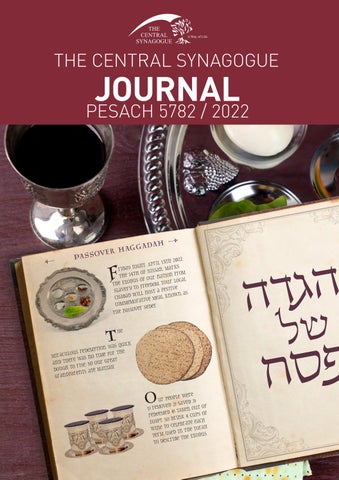
h ] gada g a h ver passo th 2022, April 15
ight, riday n f Nissan, marks o om the 14th our nation fr f l o c s o u d ur l a the Exo edom. Yo e r f o t e a festiv as slavery ill host w own d a b a Ch meal kn e iv t a r o commem r. ver Sede o s s the Pa
F
t
he
quick ion was t p m e d e r the ous r miracul was no time fo re at and the ise, so our gre r o t h tza . dough s ate ma t n e r a p grand
O
le were ur peop ved 3) ed 2) sa 1) remov ) taken out of d4 redeeme rink 4 cups of d o S each Egypt. elebrate rah c o t T wine e o ed in th odus. term us Ex ibe the to descr
ה ג דה של
פ ס ח
PESACH CALENDAR
The Central Synagogue Pesach Journal 5782/2022
CONTENTS COMMUNITY Message from our President
3
Message from Rabbi Levi Wolff
4
Message from Rabbi David Freedman
6
Message from Rabbi Tzuri Avila
8
Central Social
9
Central Clubhouse
10
Rabbi Mendel Treitel
11
Rabbi Mendel Wolff - One 0n One Study
12
ARTICLES 15 Steps of a Passover Seder
14
How to Plate your Seder Plate
16
The Freedom of Obligation
17
Purim Pics
18
Central Spotlight - Olympian Jessica Fox OAM
20
President Pesach
22
Leaving the Enemy Behind
32
NEWS & UPDATES Bar Mitzvah Academy Highlights
25
Celebrating Bar Mitzvahs
26
Celebrating Bat Mitzvahs
28
Celebrating Weddings
29
Celebrating Births
30
Recipes
34
Pesach Quiz
36
Sponsors
38
Condolences
39
FRIDAY 15 APRIL Fast of the First Born Erev Yomtov - 1st night seder Public holiday Fast starts:................................................................4.59am Shacharit & Siyum..................................................8.30am Latest time for eating Chametz...............................10.01am Latest time for burning Chametz............................10.58am Shabbat/Yomtov and Candelighting ........................5.13pm Mincha & Kabbalat Shabbat...................................5.45pm Yomtov.....................................................................6.00pm
SATURDAY 16 APRIL Pesach 1st day- 2nd night seder Public Holiday Shacharit:.................................................................8.45am Mincha ...................................................................5.30pm Maariv ....................................................................6.00pm Candlelighting & start Seder after: ..........................6.10pm Family Seder at Shule SUNDAY 17 APRIL Pesach 2nd day Public holiday Shacharit..................................................................9.00am Mincha foll. by Maariv ...........................................5.15pm Yomtov ends.............................................................6.09pm
MONDAY 18 - Public holiday & TUESDAY 19 –WEDNESDAY 20 APRIL Shacharit..................................................................8.30am Mincha foll. by Maariv............................................5.15pm THURSDAY 21 APRIL Erev Yomtov - Eiruv Tavshillin Shacharit: ...............................................................8.30am Candlelighting ........................................................5.08pm Mincha ...................................................................5.15pm Maariv ...................................................................6.00pm FRIDAY 22 APRIL Pesach Day 7th day Shacharit: ...............................................................8.45am Candlelighting ........................................................5.06pm Mincha: ..................................................................5.15pm Maariv: ...................................................................6.00pm
15 Bon Accord Avenue Bondi Junction 2022 Sydney Australia | +61 (02) 9355 4000 www.centralsynagogue.com.au
2
CENTRAL SYNAGOGUE Passover 5782/2022
SATURDAY 23 APRIL Pesach Day 8th day Shacharit: ................................................................8.45am Yizkor:....................................................................10.30am Mincha: ..................................................................4.40pm Moshiach Seuda: .....................................................5.00pm Maariv & Yomtov ends: ..........................................6.02pm
MESSAGE FROM THE PRESIDENT
I
begin by extending a warm welcome back to each and every Central member. This upcoming Yom Tov is shaping up to be one we can collectively celebrate without Covid-19 restrictions, on both the home and shule front – the first in two challenging years.
After serving on The Central Synagogue’s Board of Management since 2005, and humbly stepping into an executive role in 2009, I will be completing my current term as president at the upcoming Annual General Meeting, scheduled in June. A new chapter awaits and I sincerely thank all at the shule for their constant, unwavering support over the years. I extend my heartfelt gratitude to our Board of Management, anchored with excellent procedural governance in place. I also thank Mr. Michael Rothner, who will also be completing his board tenure. His tireless efforts and commitment to our shule have been invaluable. Michael has worked closely with me for the past nine years, ably assisting to navigate all that has come our way – pandemic and otherwise. I am pleased to advise that our shule has recovered from the challenging Covid lockdowns and is currently in a healthy financial position, with credit to our treasurer, Simon Klimt, who has a perceptive manner, with a fine-tuned financial acumen and comprehensive communal grasp. On a personal note, I have appreciated being involved for so long with such a special and cohesive Central community. It has been one of the great honours of my life thus far. However, this is not ‘goodbye’ as I am a proud, regular shul-goer, delighting in all aspects of what our spiritual home has to offer. I thank our dedicated office team – our Central HQ. Our clergy are so committed in the most soulful way. I am in awe of Rabbi Levi and Chanie Wolff and family for all they achieve daily. Rabbi David Freedman continues to complement the roles of others so seamlessly – from shiurim to hospital visits to so much more. Our world-class chazzanim have needed to pivot throughout the pandemic and yet have continued to thrive, along with our loyal and terrific choir members. Toda Raba to our Youth director Tzuri Avila and his team of indefatigable leaders who run multiple children’s services and programs. Having Hineni Youth on the scene keeps us smiling and their connection to Israel and roll-out of activities makes us so proud. We’ve been wading through unchartered waters with this pandemic, and I pause to also thank Central members who buoyed me when we were truly tested. Thank you to my wife, Dannielle, along with my children, who have all generously given me the space and support to contribute to our Central community in this active way over such a wide span of time. Many days were long, but the years suddenly seem so short. Wishing all a Chag Sameach, a Happy Passover and I can’t wait to come together for Pesach, when we revisit this timeless tale taking us from slavery to freedom and ultimately, to the Promised Land. Danny Taibel CENTRAL SYNAGOGUE Passover 5782/2022
3
MESSAGE FROM RABBI LEVI WOLFF
WHAT A YEAR...IF IT TASTES BITTER, DAYENU!
O
ver the past year, whether our physical doors have been open or closed, whether services have been held inside or outside, whether we’ve been masked or unmasked, our Central Family has remained united, vibrant and connected.
Post-lockdown, we have a renewed and deep appreciation for the opportunity to attend programs, pray and yes, party too! With each week that passes, our shule numbers continue to rise and we are privileged to host a variety of in-house initiatives and events. From Kiddushim and family simchas to inspirational speakers, Young Adult soirees, such as our recently soldout dinner with Olympian, Jessica Fox. Purim was sensational with a superhero carnival, followed by spirited Megillah readings and the on-point costume wonder of our Purim in the Middle East extravaganza. We have also recently concluded our busy Bar Mitzvah Academy and a Shabbat graduation Dinner with Israeli Ambassador to Australia, Amir Maimon. Chanie can’t wait to welcome the new Central Bat Mitzvah girls after Pesach and is putting the final touches on the jam-packed weekly program. Our hearts have been with our Jewish brothers and sisters in Ukraine, along with the wider Ukrainian population. We quickly transformed into actions and have recently adopted a ‘sister community’ in Odessa, specifically raising much needed funds to help Jewish orphans displaced by war. Together, we weave a rich shule tapestry, always drawing on the most anchored spiritual base, our holy Torah! The fact is that in too many homes over Pesach, the maror is not the most bitter thing at the Seder table. There are people who suffer from chronic negativity, inevitably dragging others down around them. Interactions become unpleasant, sometimes confrontational, and almost always pessimistic. 4
CENTRAL SYNAGOGUE Passover 5782/2022
New research has emerged identifying how people who inhabit ‘maror’ lives can cultivate more positive emotions and attitudes. A psychologist at the University of North Carolina, Barbara Fredrickson, has developed a theory about accumulating what she coins, “micro-moments of positivity”. She demonstrates that more than a sudden burst of good fortune, it is repeated brief moments of positive feelings that can provide a buffer against stress and depression and foster both physical and mental health. If we consciously collate positive experiences, studies show, it will organically eclipse the negative feelings. In other words, have so much charoset that you can’t even taste the marror! One almost didn’t need the research to know we benefit mentally and physically from focusing on positive thoughts.
MESSAGE FROM RABBI LEVI WOLFF However, the halacha comes to a different conclusion and with it, a great insight into transforming ourselves from negative, to positive people. Yes, we dip the marror in charoset, but we don’t overwhelm or overpower the taste of marror, we specifically eat it to invoke its bitterness. Almost every Hagaddah is bothered by the presence of marror at the seder. After all, it is a night of freedom, joy and celebration, why harp on the negative? Why not celebrate with sweet treats, why with bitter marror? Rabbi Lord Sacks z”l explains why we eat maror,: “Within freedom, we are commanded each year never to forget the taste of slavery, so that we should not take liberty for granted, nor forget those who are still afflicted.” Others say we eat maror to remember that even post-matzah, post-freedom, there are sour moments in life and they too are part of the tapestry of our world.
WE DON’T EAT THE MAROR TO DELIBERATELY INVOKE BITTERNESS, RATHER, WE INGEST IT TO AFFIRM OUR FREEDOM. SADLY, WHEN A SLAVE IS ONLY EXPOSED TO BITTER FOODS, THE HARSH SUSTENANCE BECOMES THE DEFAULT TASTE. Rav Kook wisely explained that we don’t eat the maror to deliberately invoke bitterness, rather, we ingest it to affirm our freedom. Sadly, when a slave is only exposed to bitter foods, the harsh sustenance becomes the default taste. Yet in our own lives, when we bite into something awful, a mental alarm sounds and we recoil from its bitterness. We are incredibly fortunate because this indicates that we are not accustomed to that taste, we have not adapted to that as our ongoing reality. Rav Kook reveals that the mere fact we can taste something so bitter is an affirmation of how sweet our lives generally are. For us Jews in Australia when we sit down this year at our Seder, we will think back to our last Yom Tov, a Rosh Hashana and Yom Kippur spent celebrating and praying alone, isolated from our community, and often
times family. Shule doors were closed, we blew shofar in the park and davened Neilah in our backyards or on our streets longing for the Yom Tov we have been accustomed to. While our lives have been significantly altered and major adjustments were needed throughout this pandemic, they are palpable reminders of how blessed and sweet our universe typically is and just how much we subconsciously take for granted.
FOR US JEWS IN AUSTRALIA WHEN WE SIT DOWN THIS YEAR AT OUR SEDER, WE WILL THINK BACK TO OUR LAST YOM TOV, A ROSH HASHANA AND YOM KIPPUR SPENT CELEBRATING AND PRAYING ALONE, ISOLATED FROM OUR COMMUNITY. The great American football coach Lou Holtz once said, "Life is 10 percent what happens to you and ninety percent how you respond to it." The (sometimes prolonged) moments of hurt and inconsequential frustration not only alert us that something is momentarily wrong, but they are also a healthy reminder about just how much is right. We are commanded to eat maror to recall that the horseradish, should be the only negative thing at our table. If our palate has a sensitivity to this harsh taste, it highlights that we have (on the whole) blessed lives. For this, we should not only be profoundly grateful, but eternally positive people. So, on Seder night if the maror tastes bitter … say Dayenu! Chanie and I look forward to seeing you in shule. We can’t wait to welcome many of you to our Second Night Seder at Central. With blessings for a Chag Pesach Kasher V’Samaich! RABBI LEVI, CHANIE AND THE WOLFF FAMILY CENTRAL SYNAGOGUE Passover 5782/2022
5
MESSAGE FROM RABBI DAVID FREEDMAN
PESACH – A Tutorial on the Meaning of Life
A
s we sit down at our respective Sedarim this year, it is with relief and happiness that we can enjoy this Yom Tov together with family and friends.
In truth, the last two years have been exceptionally challenging. We have endured a long battle with Covid that has at different times seen synagogue services and family celebrations curtailed. But beyond personal and communal difficulties, in more recent months we have seen war in Europe, terrorism in Israel, growing antiZionism and anti-Israel propaganda spread throughout the world and here at home dreadful natural disasters that have brought untold pain and suffering to many. Sometimes through no fault of our own, we tend to look inwards. We see only our own struggles and find it hard to think of ‘the other’. Pesach is known as Zeman Cherutaynu – the Season of Our Freedom. Yet its message is far from particular. It is in many ways the most universal of all our chaggim. The fundamental message of Pesach is found in a number of different places in the Torah. One quote will suffice to make the point: Do not ill-treat a stranger or oppress him, for you were strangers in Egypt. (Exodus 22:20) Rabbi Lord Jonathan Sacks z”l explains: According to the Ramban (Moses Nachmanides 1194– 1270) this command has two dimensions. The first is the relative powerlessness of the stranger. He or she is not surrounded by family, friends, neighbours; a community of those ready to come to their defence. Therefore the Torah warns against wronging them because God has made Himself protector of those who have no one else to protect them. This is the political dimension of the command. The second reason is the psychological vulnerability of the stranger (we recall Moses’ own words at the birth of his first son, while he was living among the Midianites: “I am a stranger in a strange land,” Ex. 2:22). The stranger is one who lives outside the normal securities of home and 6
CENTRAL SYNAGOGUE Passover 5782/2022
belonging. He or she is, or feels, alone – and, throughout the Torah, God is especially sensitive to the sigh of the oppressed, the feelings of the rejected, the cry of the unheard. That is the emotive dimension of the command. Rabbi Chayim ibn Attar (Ohr HaChayim) adds a further fascinating insight. It may be, he says, that the very sanctity that Israelites feel as children of the covenant may lead them to look down on those who lack a similar lineage. Therefore they are commanded not to feel superior to the ger, but instead to remember the degradation their ancestors experienced in Egypt. As such, it becomes a command of humility in the face of strangers. Whichever way we look at it, there is something striking about this almost endlessly iterated concern for the stranger – together with the historical reminder that “you yourselves were slaves in Egypt.” It is as if, in celebrating Pesach and appreciating its eternal message that we are nearing the core of the mystery of Jewish existence itself. I might sum it up by quoting Mark Twain, who although not Jewish, often wrote with an almost Jewish neshama or soul. He once asked - what are the two major moments in a person’s life. Many might answer – the day you were born and the day you die, others might respond – the
MESSAGE FROM RABBI DAVID FREEDMAN
day you were born and the day you were married. Mark Twain, however, gives a deeply insightful and spiritual answer: The day you were born and the day you find out why. This is of fundamental importance – it is not enough for example, to be redeemed from slavery – we also need to know why. For what purpose were we chosen to be saved? What does God want of the Jews, what does the Almighty want of each of us individually? To be saved is like being born – to save others gives meaning to that experience. When we fulfil our destiny, when we are able to complete our tasks before God and our fellow humans – we can take stock and with humility feel that we have accomplished our mission or at least part of it. Sadly, we humans often fail and then we are forced to live with the trauma and the tragedy of a flawed life and a hollow existence. One of the most chilling examples of this is taken from the well-known television series, The World at War. In Episode 16, entitled Inside the Reich, an interview takes place with a British woman, married to a German, both of whom were living in Germany during the World War 2. In the interview, this woman relates how it became known to the general population that Jews were being deported and sent to concentration camps and worse. Interviewed on camera, she says the following: One day a friend of ours came to me accompanied by another woman with dyed blond hair. This woman, obviously Jewish, asked me if she could come and serve ‘as a maid in the house, her husband too, but he would never need to go out; perhaps he could just live in the cellar’.
trusted neighbour, her husband’s co-conspirator. He told her firmly that the risk to herself, to her family and to the conspiracy was too great. “I was astonished,” she said, “at the response that I got from my neighbour. I can remember going out into the road immediately afterwards and out of the darkness came a man’s voice saying, ‘Have you decided?’ I simply couldn’t say no, so I just said, well I can’t for longer than two days. And I let him into the cellar.” “They stayed for two days and on the second day in the evening they must have left because she was gone, the cellar was empty, and the bed I had put up was tidily arranged. I heard later that they had been caught at the railway station purchasing tickets and that they were transported to Auschwitz.” Reflecting on these events, and with resignation, she turned to the camera and said, “The reason why I say this is the most painful and terrible story for me to tell, is because after they left I realised that Hitler had turned me into a murderer.” She was born before the war, but then during the war – she found out why – and sadly for her – she could not respond to the challenge. Pesach speaks to each one of us and reminds us that whatever the plight of another – never look away, never say – it’s not my problem, but remember that you were once in their shoes and God redeemed you – so never ignore the call of sorrow and loss, of hunger and distress, of tears and pain – for there but for the grace of God, go you or I. Chag Kasher ve-Sameach RABBI DAVID FREEDMAN
This British woman’s German husband was away at the time, involved in a plot to overthrow Hitler. Not being able to consult him, she discussed the matter with her CENTRAL SYNAGOGUE Passover 5782/2022
7
H
MESSAGE FROM THE YOUTH MINISTER & HINENI ineni has started on a great note. A new Va'ad has been appointed. The new Rosh is Laila Harrity, Gemma Kessler is Gizbar, Jaime Taitz is Sgan, Liat Ziegler is MWOP (member without portfolio), and Tyla Aronson is Rosh Chinuch!
Thanks to our previous Va'ad Aaron Klimt (Rosh), Bailey Joffee(Sgan), Gabe Joseph (Gizbar), and Tamara (Chinuch) for all of your wisdom and efforts during what was a challenging 2021. Our focus this year is to re-establish relationships, run engaging programs, and camps. Thus far, we have had some great events. However, what we are more excited about are the upcoming events such as Junior Adventure Camp, MasterChef program for Years 7 & 8, and winter camp. By far though, the most fun and memorable events this year have been the Friday night Youth Minyan and Purim Event. At the Friday night Youth Minyan we were pleased to host Olympian Gold medallist, Jessica Fox. Jessica displayed some incredible humility and generosity by letting some of us hold and even wear her Gold Medal. The annual Purim carnival put on by Central and Hineni was an event that allowed many, approximately 150 kids plus adults to come out and have fun, see each other, and provide Mishloach Manot for children in Hospital. The year has just started, and we are very excited about all the great events that we have planned. In the meantime, we hope you enjoy a Happy and Kosher Pesach, and we look forward to seeing you at our events this year. Hineni would like to extend a huge thank you to Rabbi and Rebbetzin Wolff, the Executive, the Board of Management and all the staff of the Central Synagogue. We are extremely grateful for the continued support and encouragement we have received over the years. We love being part of The Central community and are honoured to be the official Youth Movement of The Central Synagogue. Rabbi Tzuri Avila Stay up to date with what Hineni has planned this year on our website: www.hineni.org.au Upcoming Winter Camp: Seniors: 3rd July - 10th July Juniors: 10th July - 13th July
8
CENTRAL SYNAGOGUE Passover 5782/2022
CENTRAL
SOCIAL
L
ast year, The Central Synagogue launched ‘Central Social’ a novel on-going initiative for valued members within our dynamic young adults demographic. Central Social offers the chance to experience Jewish life in a fresh, modern way, yet all-thewhile grounded in our Torah-true Judaism.
Each event has a cool vibe, and is simultaneously both inspirational and meaningful. From social to cultural to spiritual to educational, each is warm and welcoming. Frequently situated on our shule campus in an open-plan environment, seamlessly allows all attendees to explore Jewish life and connect in a relaxed way. Central Social hosts regular Shabbat dinners and stylish L’Chaim’s in the Art Garden & Youth Centre, always accompanied by delicious kosher fare, beverages and replete with a great ambiance. Our events are typically sold out, early last month we featured engaging speaker, Olympian Jessica Fox OAM. The Purim in the Middle East theme was happily embraced and all looked sensational in their authentic costumes. Each was a magnificent success. Networking is also high on the agenda within this energised, youthful set. Professional relationship building is also facilitated via a rich array of round-table events, panels, conferences, mentorships, and exclusive soirées. Central Social offers unique learning opportunities and invaluable resources for our young professionals. They are given the space to learn, be inspired, and gain valuable insights from respected professionals across a plethora of fields. A wide range of innovative and engaging programming is planned for this year including off-campus events such as parties, festivals, an August ski trip, and so much more. We look forward to new friendships developing, collaborations emerging and seeing many fresh faces this year.
CENTRAL SYNAGOGUE Passover 5782/2022
9
CENTRAL
CLUBHOUSE
T
he last couple of years have been a challenge, and we missed out on so much time with the children during the months our doors were closed. I'm proud to say that our children's programs are back in full swing, and we are making up for lost time. Thankfully, despite the lockdowns, we were still able to enjoy a number of our special events throughout the year. We have truly cherished the times we were able to be at shul, and the looks on the kid's faces when we welcomed them back was priceless.
Shul was closed over Rosh Hashanah and Yom Kippur for the second year in a row, but I find it interesting that Purim has never been cancelled during the course of the pandemic. This indicates how much our children are treasured and how important it is to experience happiness. As Pesach approaches, we are again reminded of the importance of the children, with the Pesach Seder designed to evoke questions. We want the children to ask and learn. We tell them stories of Hashem's greatness to ensure Jewish continuity. The goal of Central Clubhouse is to teach Yiddishkeit and Jewish values in a fun environment. It's amazing to see so many parents who attended our programs as children, bringing in their own children to make new Central memories. Our shul is a second home for many of the children and their families. It is a place of happiness, friendship and fond memories. I'm thrilled to have our children's services back to normal and am pleased to say that our weekly games, food craft and parsha quizzes are once again a highlight of our week. I would like to take this opportunity to wish everyone a Happy and Kosher Pesach. May your children continue to bring you naches and joy! Ellie Nagel
10
CENTRAL SYNAGOGUE Passover 5782/2022
RABBI MENDEL TREITEL Spotlight on The Central Synagogue Academy of Jewish Education (CSAJE)
W
elcome to your Central Beit Midrash – a dynamic Torah-true space situated right here within our main campus. CSAJE was an exciting project in the planning stages through the pandemic and officially opened early February.
It has been warmly embraced from the get-go with Rabbi Mendel Trietel at the helm. He brings a youthful enthusiasm, interpersonal skills and of course, extensive learning to the table. Open to both men and women, from the young to not-so-young and everyone in between, this offers all the opportunity to experience authentic Judaic learning and simultaneously be inspired and grow spiritually. Open Monday-Thursday weekly, this is an energised environment in which Central members and all from our wider community are warmly invited to learn on a deep and unique level. There are no prerequisites, there are no expectations, there is simply a mission to embrace all-things-Torah in a positive and personal way. Beyond the Beit Midrash, Rabbi Mendel’s wife, Goldie, is also on hand to enhance your shule experience in an interactive way – think Shabbat meals, connection and so much more. Loved the recent Purim in the Middle East event? That received the ‘Goldie’ touch, so to speak! Oh, and their toddler, Yishaya, is such a blessing too! Call 0434 733 188 for more information. Thank you to Mrs. Tami Beck for supporting and making this initiative possible.
CENTRAL SYNAGOGUE Passover 5782/2022
11
Contact Mendel: 0413 508 394 E: mendelwolff@centralsynagogue.com.au Experience Torah Study at your leisure at your level! With respected rabbinic ordination and years of concentrated Torah learning already behind him, Rabbi Mendel Wolff brings not only the knowledge but also the ability to communicate Torah-true teaching to our Central Family. As we shift from one life stage to another, we may not be exposed to the same degree of Yiddishkeit (or lack thereof) from our youth. To grow spiritually we need to nourish our souls, and Mendel’s Menu delivers a seamless, authentic, two-way experience. After all, knowledge is power! The choice is yours: from one-on-one sessions available day or night, to speaking to groups within homes or offices, this is an emergent Torah learning style at its finest, giving students of any age or stage autonomy over their chosen Torah pathway. From the elementary to enriched textual learning, explore Jewish practice; philosophy; prayer; psychology, Kabbalah; lifecycle events and so much more in a peaceful yet productive way. 12
CENTRAL SYNAGOGUE Passover 5782/2022
PASSOVER in NUMBERS
By Ben Sherman, CPA (Certified Passover Accountant)
We asked our CPA the numbers for our Passover issue and this is what he gave us... Enjoy!
>
G-d told Abraham his children would be slaves for 400 years. / The Jews went down to Egypt
190 years after the birth of Abraham son Isaac. / The Jews were in Egypt for 210 years. / The Jews suffered under Pharaoh’s harsh decrees for 80 years. / Moses was 80 at the time of the Exodus. / only
G-d sent 10 plagues upon Egypt. / Originally
70 Jews came down to Egypt. / At the exodus 600,000 Jewish men between the ages of 20-
60 left Egypt. /
It is estimated that over 2,000,000,00 Jews
left Egypt. / Pharaoh’s army caught up with the Jews 7 days after they left Egypt. / The
7th day of Passover commemorates the splitting of the Red Sea. / The Red Sea was
12 tunnels, one for each of the 12 tribes. / In the Torah’s narrative of the exodus, G-d uses 4 To celebrate the redemption we drink 4 cups of terms of redemption. / wine at the seder. / G-d commanded the Jews to count 7 weeks from the Exodus till the giving of the Torah. / Jews still count the 49 days of the omer each year in preparation of receiving split into
the Torah. /
There are 7 basic human emotions that can and should be refined.
/ The 7 basic emotions contain aspects of each other thus creating
49 human emotions. / The Torah
was given in the 3rd month of Sivan. / Moses was a Levite, from the 3rd tribe of Israel, and he was born the 3rd child. / The Torah includes 3 parts: Bible, Prophets and Scripture. / There are
We use 3
types of Jews, Israelites, Levites, and Kohanim. /
3
matzot at the
Passover seder. / The Jews have 3 patriarchs, Abraham, Isaac and Jacob. / The Jews have 4 matriarchs, Sarah, Rebecca, Leah and Rachel. /
A Torah scroll has
600,000
characters corresponding to the 600,000 root souls that left Egypt. / The Jews who were unable to partake of the original Passover sacrifice were given a second chance by G-d to celebrate Passover 30 days later. / The festival of Shavuot comes
49 days after Passover. /
The Jews
received 10 commandments at Mount Sinai. / In Genesis G-d
Passover has 3 other names: Festival of Matzah, Season of our Freedom, The Springtime Festival. / uses 10 utterances to create the world. /
CENTRAL SYNAGOGUE Passover 5782/2022
13
15 STEPS OF A
PASSOVER SEDER
1. KADESH (Sanctify) The Seder begins with a blessing over the first cup of wine. This is when we declare that this is “The Season of Our Freedom.” To stress this point, we recline to the left when drinking, as only free people did in ancient times.
2. URCHATZ (Wash) Wash the hands (in the ritual manner but without reciting a blessing). We will be touching a wet vegetable in the next step and rabbinic law requires washing of the hands. The Kabbalah teaches that hands represent expressions and attributes, while water epitomizes intellect and purity. Washing refines our attributes with intellect, enabling restrictions to turn into benevolence, hate into love, and personal slavery into freedom. The observance, one of many during the Seder intended to pique the interest of children, awakens the innocence within each of us.
3. KARPAS (Vegetables) Recite the appropriate blessing for vegetables, then dip the Karpas vegetable in saltwater before eating it. In the saltwater, we can taste the tears of anguish and despair our ancestors shed as their spirits were crushed in Egypt. When rearranged, the letters of Karpas כרפסallude to the word Perech פרך, or “crushing labor.” Our people were forced to perform senseless tasks in Egypt, endless drudgery without meaning, purpose or goal. Why, some 3,000 years later, do mindless routines and habits, or careers driven by the need for status, still dominate our lives so often?
4. YACHATZ (Breaking) The middle matzah (of the 3) is broken in two pieces. The larger piece, designated as the Afikoman, is wrapped and hidden away for the children 14
CENTRAL SYNAGOGUE Passover 5782/2022
to discover. The smaller broken piece, the “bread of poverty,” takes center stage while retelling the story of the exodus. It personifies the spiritual and material destitution our people endured in Egypt once they no longer grasped the meaning of true freedom. By relating to their plight, we feel what is broken in our own humanity. At the same time, when the children hide the Afikoman we sense the larger dimension of our being, the part of our soul never touched by slavery that waits to be discovered.
5. MAGGID (Telling) “Tell your children G-d took you out of Egypt.” Fill the second cup of wine, then retell the story of our rise from the depths of bondage to the heights of redemption. Maggid begins with the children asking, “Why is this night different from all other nights?” The question can put us in touch with the innocence of children as we contemplate the dynamics of liberation. Are we eating the matzah out of habit, or because we are ready to embrace its significance? Are we observing these rituals to assuage guilt, or to actualize the desire to live a more meaningful life? When we allow the events in Maggid to touch us to the core, we reveal the candor that children hold dear. At the conclusion of Maggid, we savor the second glass.
6. RACHTZA (Washing) Wash the hands and recite the blessing, Al Netilat Yadayim (on the lifting of the hands). We prepare to internalize the humble nature of matzah by uplifting our extremities and expressions. In its literal sense, the word netila means to move something from one place to another. With this blessing, we remove the physicality and vulgarity that may dwell in and around the hands, raising them up for what is to follow.
7. MOTZI (Blessing Over Bread) Hold the broken half-matzah and two whole ones while reciting the appropriate blessing for bread, Hamotzie Leh-Chem Min Ha-Aretz. The word lechem (bread) contains the same letters as lochem (war). Food is raw energy that holds the potential for either good or evil. Thus, a spiritual battle ensues every time it is consumed. If the purpose in eating is solely to gratify physical cravings, evil prevails. However, when eating to gain energy with which to better serve G-d, good prevails.
8. MATZAH (Blessing Over Matzah) Return the bottom matzah to the Seder plate. Holding the remaining one and one-half matzot, recite the blessing for eating matzah, Al Ah-Chilat matzah. Our ancestors fled Egypt with inconceivable haste, leaving no time for the dough that would nourish them to rise. Once free, their first taste was the “bread of poverty,” matzah. From a mystical viewpoint, matzah exemplifies a selfless ego. It was with this trait, rather than arrogance, that they accepted G-dgiven freedom. Humility allowed them to appreciate the gifts of life. After the blessing, recline to the left and eat at least one ounce of matzah.
9. MAROR (Bitter Herbs) Take at least 3/4 ounce of bitter herbs and dip it in the charoset, shake off the excess, and recite the blessing Al Ah-Chilat Maror before eating. Having meditated on the bitterness of exile during Maggid, we now physically experience its force. The impact further clarifies the significance of our exile. Before we can experience true freedom we have to internalize the might of our hardship – and accept that when we make the right choices, hardship exists only to make us stronger.
10. KORECH (Sandwich) Break off two pieces of the bottom matzah (at least one ounce). Take 3/4 ounce of maror, dip it in charoset and shake off the excess. Place the maror between the two pieces of matzah and say, “Thus did Hillel do in the time of the Holy Temple...” Recline while eating. Maror alludes to the wicked, while matzah refers to the righteous. Hillel, the great Jewish sage known for his compassion, instructed the righteous to reach out and draw the wicked closer. Likewise, now that we have felt what it means to break free of slavery on a personal level, it is our obligation to share the experience with others.
11. SHULCHAN ORECH (Festive Meal) Traditionally, the meal begins by dipping the hard-boiled egg from the Seder plate in saltwater to symbolize our constant
mourning for the destruction of the Holy Temple, and to allude to G-d’s desire to redeem His people. “Ess, mein khind!” Across the community and throughout the world, we are together at the Seder table. The wise, the wicked, the simple and the innocent, all equal in the eyes of each other and the eyes of G-d. And we remember the fifth son – he who has not yet experienced the freedom of Passover. We are united as one in the common goal of redemption.
12. TZAFUN (Hidden) At the conclusion of the Passover meal, children return the Afikoman. Eat at least one ounce of this matzah. Nothing else except the remaining two cups of wine is consumed thereafter. It was necessary to partake in every step, every ritual, every taste and every thought before the Afikoman is revealed; then, we can become one with its Divine potential. We eat it only when completely satiated because it fulfills a need higher than the hunger for freedom, and we eat nothing afterward so that its taste remains with us. In the Seder, as with everyday life, there are no shortcuts to the greater dimension. Yet we are always aware that it is present and yearns to reveal itself when we seek with a pure heart.
13. BEIRACH (Grace After Meals) Recite Grace After Meals. Then say the blessing over the third cup of wine, and drink while reclining. In anticipation of our ultimate Redemption, we now fill a special goblet, the Cup of Elijah. We then open the door to the house and, holding a lit candle, recite the passage inviting the Prophet Elijah to appear. Imagine all of creation in a state of spiritual and material freedom. Think about a world free of pain and suffering, war and struggles. Imagine all of existence at this level. Imagine yourself, the light of a single candle, ushering in the era of our redemption.
14. HALLEL (Songs of Praise) We offer praise to G-d for his mercy and compassion in redeeming our people from Egypt, and in anticipation of our own ultimate redemption. Why does G-d need us to praise Him? He doesn’t; we do. As the Kabbalah explains, when we praise His kindness we reveal His compassion. When praying for our needs, we evoke His desire to give.
15. NIRTZAH (Accepted) The Seder concludes with the wish, L’shana Ha- ba-ah Bi-Yerushalayim. We hope for each other that which our forefathers prayed for while enslaved in Egypt, “Next Year in Jerusalem!” Rabbi Schneur Zalman of Liadi omitted the passage, “The order of Passover is concluded,” from his Haggadah because the Seder’s message remains timeless. Every day, one leaves Egypt by transcending his or her limitations, to reach higher levels of holiness. l CENTRAL SYNAGOGUE Passover 5782/2022
15
How to Plate Your
SEDER PLATE MAROR BEITZAH A hard-boiled egg to commemorate the chagiga-holiday sacrifice. Prep: Boil one egg per Seder plate, and possibly more for use during the shulchan orech meal. Use: The egg is dipped into saltwater and eaten right before the meal starts.
Maror or bitter herbs to remind us of the slavery. Most use fresh grated horseradish on romaine lettuce. Prep: Buy fresh horseradish root and grate it. Use: During the blessing over the bitter herbs hold the maror and then dip it lightly into the charoset before eating it. See Seder step 9.
ZROAH Shank Bone to commemorate the Pesach sacrifice. Many use a roasted chicken neck. Prep: Roast the neck over an open flame. Afterwards, remove most of the meat to reveal the bone. Use: The shank bone is symbolic and not eaten. You can re-use it the following Seder night.
See Seder step 11.
3
1 2
6
4
5 KARPAS Karpas vegetable for dipping. The traditional potato or onion is dipped into saltwater at step 3 in the seder to provoke questions. Prep: Peel an onion or boiled potato and place slice on seder plate. Also prepare a small bowl of saltwater. Use: At karpas the vegetable is dipped into saltwater, the Borei Peri Ha’adama blessing is recited, before it is eaten. See Seder step 3.
16
CHAROSET
CHAZERET Used with the maror that reminds us of the slavery. Prep: Wash romaine lettuce and check for bugs. Pat dry. Use: During the korech sandwich of matzah and maror use these bitter herbs. Dip it lightly into the charoset before using it. See Seder step 10.
CENTRAL SYNAGOGUE Passover 5782/2022
Charoset (the apple, nut, wine puree) to remind us of the mortar and brick made by our ancestors in Egypt. Prep: Shell walnuts and peel apples and chop finely, mix well and add red wine for color. Use: The charoset is used as a symbolic dip. Before eating the maror, dip it lightly into the charoset. See Seder steps 9 & 10.
The Freedom Of Obligation By David Suissa
E
very morning we wake up to the set taste of freedom. The freedom to be miserable, angry, depressed, inactive, and self-absorbed. The freedom to be hurtful and gossipy and petty and sad. The freedom to pick a poison, any poison. History teaches us to revere our freedom, the one that millions have died for or emigrated to. But who teaches us how to approach this freedom, how to nurture it, respect it, honor it, and ultimately, make it work for a higher good? Sometimes, we don't enjoy our freedom as much as we consume it. Instead of savoring it like fine wine, we inhale it like junk food. As a result, a Divine privilege has become an all-youcan-eat entitlement: I will do exactly what I want when I want, how I want, even if it makes me miserable. It's remarkable how the instinct to dictate our terms can override life's greatest motivator: self-interest. It's one thing to trample on others as we exercise our various freedoms, but to trample on ourselves? To use our freedom in a way that can make us miserable? That's radioactive. And also understandable. If there is no higher presence in our life, we must somehow fill the vacuum, so we play G-d. And what can be more intoxication than that? Who cares if I'm miserable as long as I'm calling the shots. This unbridled and unholy freedom deadens the soul. As we drown in choices, we lose the ability to make the right ones. As our mind spins, our soul is silenced. It makes one wonder: If all
this freedom of choice is killing us, why don't we put it in it's place? Oddly enough, we do, when it suits us. Consider: You have an appointment at 2:30 tomorrow with someone who can offer you the job of your dreams. Is there any doubt that you will absolutely, positively be there? The freedom to miss that appointment is the freedom to be miserable. So you have rejected freedom of choice in favor of the freedom that wins: the freedom of obligation. Why can't we handle other appointments the same way? Why should joy, for instance, be a choice rather than an appointment that can't be missed? Why do we even need to ponder the option of not doing mitzvot (good deeds)? The highest virtues need no analyses. But all too often, we confuse issues that require scrutiny with others that require none. Deciding which car to buy, choosing where to live, picking one day camp over another, those are lovely subjects for pro and con analyses. Kindness isn't. Neither is joy nor doing good deeds. This universal no-brainer-and G-d knows there is plenty of themthrive not under freedom of choice, but under the more profound freedom of obligation. The noble force of Divine duty moves us to action, elevates the soul, and makes us feel alive. l
As we drown in choices, we lose the ability to make the right ones.
>>David Suissa is Publisher & Editor-in-Chief of Tribe Media/Jewish Journal and was founder and CEO of Suissa Miller Advertising, a marketing firm named “Agency of the Year” by USA Today. He grew up in Montreal and now lives in Los Angeles with his five children.
CENTRAL SYNAGOGUE Passover 5782/2022
17
PURIM PICS
18
CENTRAL SYNAGOGUE Passover 5782/2022
PURIM PICS
CENTRAL SYNAGOGUE Passover 5782/2022
19
CENTRAL SPOTLIGHT
20
CENTRAL SPOTLIGHT – OLYMPIAN JESSICA FOX OAM Every individual comprising our extended Central Family is special and valued – within this Pesach journal, we are so excited to shine a gold-hued spotlight on a proud member of our mishpachah - Australian world and Olympic champion slalom canoeist, Jessica Fox. Earlier this year, she was also honoured for her service to sport with a Medal of the Order of Australia.
OLYMPIAN JESSICA FOX OAM
E
The mazel tovs keep rolling in for good reason!
by Ramona Freedman
very individual comprising our extended Central Family is special and valued – within this Pesach journal, are so excited to shine (who a gold-hued spotlight on a proudhat member our mishpachah - Australian world Early last month,we Jessica and her mother also wears a separate as herofcoach), and Olympic champion slalomhome, canoeist, Jessica Fox. Earlier this year, she was alsoby honoured for her service Myriam Fox-Jerusalmi, visited our spiritual attending a Shabbat service followed a to sport with a Medal of the Order of Australia. sold-out dinner with our excited young adults.
She remarked, “Rabbi welcomed The mazel tovs keep Wolff rollingwarmly in for good reason! us, as did everyone we met – there was just a great vibe that Shabbat, it was such fun with a fantastic atmosphere too.” At the Tokyo Summer 2020,and Jessica inspired allalso Central guests sharing heart-toEarlyOlympics last month,inJessica her mother (who wearsdinner a separate hat asbyher coach),aMyriam Fox-Jerusalmi, visited our heartspiritual experience all were mesmerised by followed her story. home,- attending a Shabbat service by a sold-out dinner with our excited young adults. She recalled that she had just won the Bronze medal for the K1 event and was really tested She remarked, “Rabbi Wolff warmly welcomed us, as did everyone we met – there was just a great vibe that Shabbat, it over the following 48 hours prior to her next medal race, the C1 canoe slalom final within was such fun with a fantastic atmosphere too.” At the Tokyo Summer Olympics in 2020, Jessica inspired all Central dinwhich she was in medal contention. She had felt a gamut of emotions – frustration and ner guests by sharing a heart-to-heart experience - all were mesmerised by her story. sadness at not performing her best, all layered with positivity and happiness at having won a medal. needed to feel it all, process andand refocus so she could SheShe recalled that to shedigest; had justshe wonneeded the Bronze medal for the K1 event was really tested over the following 48 hours approach the with and confidence. prior to herfinal nextrace medal race,strength the C1 canoe slalom final within which she was in medal contention. She had felt a gamut emotions – frustration and raw sadness at not performing heroneself best, allthat layered How of does one channel all that emotion and remind youwith do,positivity indeed, and happiness at having won a medal. She needed to digest; she needed to feel it all, process and refocus so she could approach the final race with possess the skills and mental capacity to achieve gold medal greatness? After all, she strength and confidence. acknowledged just how challenging it was for athletes to be expected to perform their absolute best on one particular day every four years!
How does one channel all that raw emotion and remind oneself that you do, indeed, possess the skills and mental capacity to achieve goldrace, medal greatness? all,the she Olympic acknowledged justpast howachallenging The morning of her she walkedAfter within village memorialittowas thefor athletes to be expected to their absolute best on one particular every four years! Israeliperform athletes murdered at the 1972 Gamesday in Munich and registered its profound
significance. She paused and had been thinking of her maternal grandfather, who had Theaway morning of her race, shehad walked Olympic villageback pastin a memorial Israeli athletes passed years prior and alsowithin been the a coach himself the day. to Hethe had been her murdered at the 1972supporter. Games in Munich and registered profound She you’re paused and thinking greatest She closed her eyesitsand spokesignificance. to him, “Papi, withhad mebeen today for of her maternal grandfather, who had passed away years prior and had also been a coach himself back in the day. He had been her greatest this big moment.” supporter. She closed her eyes and spoke to him, “Papi, you’re with me today for this big moment.” She trusted, “Whatever She trusted, “Whateverwill willbe, be,will willbe” be” –– in in Hebrew Hebrew: יהיה, מה שיהיה. This age-old biblical sentiment was initially explored was by the great Torah by sage, Rashbam, reference This age-old biblical sentiment initially explored the great Torah in sage, Rashbam,toinJacob reference to Jacob sending his son his Benjamin to Egypt, to onEgypt, a mission foodto supplies the family. sending son Benjamin ontoa attempt missiontotosecure attempt secureforfood supplies for the
family.
With the whole of Australia (along with her Central Family) cheering wildly Jessica did win gold. Triumph. After the race,
Withher themother wholemust of Australia Central Family)because cheering didopened win her hand and revealed have been(along on the with same her familial wavelength, she wildly saw herJessica daughter, gold.little Triumph. After the herbeen mother must have been the same familial white pebbles thatrace, she had holding onto, taken fromonhaving also visited thewavelength, Israeli memorial that day – she had because she saw her daughter, opened hand and revealed little white pebbles that she also been thinking of her father, Jessica’sher ‘Papi’. had been holding onto, taken from having also visited the Israeli memorial that day – she had also been thinking of that her prior father, Jessica’s ‘Papi’. In fact, Jessica revealed to the Olympics she had visited Israel with her sister, mother and maternal grandmother and described the Kotel as, “a very powerful place”. She was deeply impacted upon witnessing her grandmother’s reaction
In fact, Jessica revealed that prior to the Olympics she had visited Israel with her sister, to frequenting such a holy site in Jerusalem. It truly resonated - L’Dor VaDor – from generation to generation. mother and maternal grandmother and described the Kotel as, “a very powerful place”. She
Jessica said that for the last few years her family has shared Seder with family friends within our Central community. She wishes our entire community “a wonderful Passover”. Jessica is considered the greatest individual paddler of all time. She is currently in France and we can’t wait to welcome her back – we schep so much naches from her achievements both in and out of the water! CENTRAL SYNAGOGUE Passover 5782/2022
21
President Pesach By Binyomin Smith
A
s you walk around from Central Synagogue’s Triguboff Family Foyer to the new Lederer Youth Campus, it’s easy to miss the ‘rogues’ gallery’ which adorns the wall to your right - the display of photographs of the many past presidents of the shule, over more than a century of its operation.
Yet each one shows a person who dedicated many days, and often years, to ensure the continued existence and development of this Synagogue. Each one represents a life, and a story. As we approach the festival of Passover, let's have a look at one such gentleman with a seasonally-appropriate name. One with whom, I’ve recently discovered, I have a personal connection, and whose impact on NSW Jewry, even if unknown and unrecognised, is still being felt today. Top row, third from the left. Serving in 1918 as the third president of the Central Synagogue, he was originally named Pesach Ciegelnitski, but was known in this country as Peter Solomon. Peter Solomon In 1888, just one hundred years after Captain Arthur Phillip sailed into Sydney Harbour, Peter Solomon did the same thing. Except that he wasn’t commanding a fleet. Peter was then a 20-year-old lone Jewish passenger from Lida, south of Vilna, seeking a new life away from the persecutions of Eastern Europe. 22
CENTRAL SYNAGOGUE Passover 5782/2022
The following year, he married a girl called Freide-Pesa (Fanny) in Sydney. While most Eastern Suburbs Jews today could not imagine living more than a five-minute drive from Jesse’s or the Bagel Co., in the 19th century, up to 40% of Jews in NSW lived in rural areas, and Peter and Fanny were about to join them. After briefly owning a store in the Kangaroo Valley, young Peter and Fanny, settled in the southern Monaro town of Bombala, some 480km south-west of Sydney and 80km south of Cooma, where they operated a General Store. In July 2020, Chabad of RARA (Rural and Regional Australia) found just one Jew living in Bombala, but back in the day things were quite different. In fact, there were so many Jewish families living there that one old history of the area reported that “the Jews were so strong in Bombala in those early days that the town was called ‘the modern Jerusalem’”. Even the mayor, Hyam M Joseph, was Jewish. And according to newspaper notices, Peter Solomon’s shop was closed on Yom Tov. He also made efforts to interest his local co-religionists in being more involved in Jewish affairs. And his communal interests weren’t limited to the Jewish community – he also served on the board of the local hospital. Over the next few years, many of Peter’s siblings, nieces and nephews left Lida and Vilna, and joined the new Aussie trailblazer they dubbed ‘Captain Cook’. Many came first to Bombala, but then, some with help from
Peter, moved out and opened their own General Stores in towns as diverse as Dalgety, Delegate, Bungendore, Bega, Cobargo, Cooma, Jindabyne, Walcha, Tamworth and Newcastle. In the 1890s, Peter Solomon also went into partnership with a nephew, Sam Solomon, opening a General Store in Gundagai – as in five miles from the Dog on the Tucker Box. Sam soon took over the store himself, becoming a renowned retailer in the town. He and his wife Miriam (May) brought up their Gundagai-born Jewish children there for many years. But as the new generation of Aussie-born children grew up, their Yiddish-speaking parents, who were mostly born into a shtetl environment, wanted them to get a good Jewish education and to ensure that they marry within the Tribe. So Peter Solomon and most of his extended family slowly gravitated from the country towards the big smoke of Sydney.
The Shule Peter Solomon of Bombala was always a leader. After returning to Sydney, he became one of the founders of the Central Synagogue, established in 1912 by those who favoured a more traditional East European flavour
of Judaism compared to the English style of the Great Synagogue. In 1913, Peter was appointed as one of four members of the Land Selection Committee which chose the site for the new synagogue, on the corner of Napier and Dowling (now South Dowling) Streets in Paddington. And for Peter, the shule was a family affair. The first Ladies Committee, formed in 1916 to raise funds for the synagogue, consisted of six women who included Peter’s wife Fanny, sister-in-law Sarah Lazarus, and possibly another sister-in-law, Beckie Solomon. 1916 also saw the new shule’s first Bar Mitzvah – Peter’s great-nephew Jack Rosenberg. Peter was a board member at various times between 1912 and 1928, including his stint as president in 1918. One of the tasks he was given that year was to find a way to enlarge the shule to better accommodate the ladies. The shule building was a renovated house with seating for only 70 people, and accommodation for the women was woefully inadequate. It appears that no solution was forthcoming, as by the end of 1920, the decision had been made to move the congregation to a new site in Bondi Junction. (continued next page) CENTRAL SYNAGOGUE Passover 5782/2022
23
President Pesach The Family Peter was not the only member of his country clan to take a leading role in Synagogue development. His nephew, Sam Solomon of Gundagai, served as president of the Newtown Synagogue in the 1920s. One of Peter’s great nephews, Philip Goldman of Cobargo was a founder and president of the Parramatta Synagogue in the early 1950s. Peter Solomon’s son, Phillip Solomon, was also a respected Jewish community leader, and was president of the Great Synagogue in 1972-75 (as was Phillip’s grandson, Peter C Solomon, just a few years ago). He was also a life member and honorary life vice president of the NSW Board of Jewish Education. Yet the Solomon family’s connection with the Central Synagogue didn’t stop with Peter. Perhaps it was because of Peter’s ties to the Shule that when his nephew, Asher Solomon of Newcastle wed Hetty Freedman in 1931, the ceremony took place in the ‘new’ Central Synagogue, on the corner of Grosvenor and Grafton Streets, Bondi Junction. And today, if you come to Central on any Shabbos, you’re likely to run into one of Asher and Hetty Solomon’s daughters, my mother Sylvia Smith, and in the back row, her husband, my dad, Asher Smith. Peter Solomon passed away at the age of 80 in 1948, and Fanny in 1941. May the memory of my great-great-uncle and aunt, Pesach ben Aryeh Leib and Freida Pesa bas Yitzchock be an inspiration to us all.
Main Sources: My Grandfather – Peter Solomon, A Country Tale, Dennis Leonard, The Kosher Koala, Newsletter of the Australian Jewish Genealogical Society, Inc., in three parts: Vol 10, No. 1, March 2003, No. 2, June 2003, and No. 3, September 2003. Jews in Rural New South Wales, Helen Bersten, AJHS 13-4-1997 pp596-634. The Early Years of the Central Synagogue, David J Benjamin, AJHS Vol 02 Part 10, December 1948. Orach Chaim: a Way of Life, Melinda Jones & Ilana Lutman, 2000.
AWARDS Prof. Ron Grunstein AM
of The Woolcock Institute of Medical Research has been named a 2021 Fellow of Australian Academy of Health and Medical Services. His work has explored the respiratory, cardiovascular, neurological, hormonal and behavioural consequences of sleep disorders, as well as the effectiveness of various modes of therapy.
Prof. Tony Weiss AM
for receiving an award in the 2021 Prime Minister’s Prizes for Science for innovation. He leads Tissue Engineering and Regenerative Medicine at the Charles Perkins Centre at the University of Sydney.
Gina Cass-Gottlieb
on her appointment as the first female chair of the Australian Competition and Consumer Commission.
24
CENTRAL SYNAGOGUE Passover 5782/2022
BAR MITZVAH ACADEMY
HIGHLIGHTS
Dylan Moses I found it really interesting and engaging when we got to discuss the moral dilemmas of how to make choice.
Jacob Tintner I really enjoyed learning about the process of making Kosher meat since it’s a unique method.
Joseph Moshal The highlight of the program for me was learning so many new things about Judaism, as well as meeting so many inspirational figures. I also really enjoyed praying as a group, every single week, and you can’t find that everywhere around the world. It was also very special spending the morning with my dad, and at times with my uncle, grandfather, and mom. I really enjoyed having fun and learning with them.
Joshua Machlin My highlight of the Bar Mitzvah Program were the speakers that came in to talk each week, every time a different and interesting topic. I particularly liked the Kashrut session when we learnt about the laws of Kashrut. And I also liked the delicious breakfast. (especially the hot chocolates)
Kobi Anger The highlight of the Bar mitzvah program for me was the tefillin workshop because it was an interesting experience for me and my peers. Another highlight was the Shule tours and getting to stand up on the Bimah. I also loved the food and hot chocolates every Sunday morning! Ethan Green My highlight was spending time with my dad each Sunday. Learning about different Jewish parts of life and praying with everyone. Mikey Fridman One of my highlights of the Bar Mitzvah program was learning more about the history and geography of Israel and its relationship with Australia. I also really enjoyed spending time with my friends and my dad, and Justin’s delicious hot chocolates.
Jeremy Groll What a special experience for me. I really didn’t think I would enjoy the Bar mitzvah Academy as much as I have. Some of the highlights for me was learning how to put onto Teffilin, seeing Yehuda’s knives, learning about how kosher meat is prepared and overall learning about how our religion guides us in life. I think my favourite session was the last one for two reasons. Mendel’s art was brilliant. His story about being a religious Jew and an artist was inspiring. It was also the only session that I got to bring my mum, and that was pretty cool. Thank you to Rabbi Wolf and Tzuri for making this such a wonderful experience. Shaun Lieb My highlight of the Bar Mitzvah program was when Yehuda came and taught us about being a shochet. I learned so much about the process and materials needed to make kosher meat. CENTRAL SYNAGOGUE Passover 5782/2022
25
BAR MITZVAHS Avi Niasoff Ori Farkas Yossi Lederman Jonah Filler Ben Edri Aden Tabak Lee Michel Jesse Sharon-Zipser Harry Golovsky Ashton Weinberg Ryan Cohen Daniel Zipser Oliver Elias Jared Lenga
Jonah Lyons Ari Smaller Ariel Perlman Rafi Bowdre Joshua Pozniak Joel Mizrachi Jonah Wolpert Brandon Shevelev Jack Kessell Sam Pillemer Rafael Wunsh Ethan Reid William Barouch
Ori Farkas
Oliver Elias Lee Michel
Jesse Sharon-Zipser
Jonah Wolpert
Ryan Cohen
Ben Edri
Joel Mizrachi
Ashton Weinberg 26
CENTRAL SYNAGOGUE Passover 5782/2022
Jonah Filler
Ariel Perlman
Daniel Zipser
Jonah Lyons
Rafael Wunsh
Jack Kessell
Ari Smaller
Harry Golovsky
Rafi Bowdre
Aden Tabak
Joshua Pozniak
Jared Lenga
Sam Pillemer
Avi Niasoff CENTRAL SYNAGOGUE Passover 5782/2022
27
BAT MITZVAHS Zara Hemphill Shannon Michel Claudia Hasson Simma Moss Maya Pasternak Isabella Aron Missy Topper Leudica Topper
Shannon Michel
Leudica & Missy Topper Zara Hemphill
Simma Moss
Claudia Hasson 28
CENTRAL SYNAGOGUE Passover 5782/2022
Maya Pasternak
WEDDINGS Joshua Gottlieb and Julianna Swarzman Daniel Yisgar and Atara Tatarka Aaron Kangisser and Layla Toocaram Michael Sherman and Monique Heller Daniel Wolman and Jessica Gordoun Ryan Lewis and Cassie Goldstein Sam Lipton and Emily Heckelman Steven Hofman and Ariel Mekler-Peled Steve Gluckman and Talia Vidor Nadav Losky and Valentina Blandon
Steve Gluckman & Talia Vidor
Jess Gordoun & Daniel Wolman
Emily Heckelman & Sam Lipton
Monique Heller & Mikey Sherman
Steven Hofman & Ariel Mekler-Peled CENTRAL SYNAGOGUE Passover 5782/2022
29
BIRTHS
Anaelle Avila
Dovy Shanowitz
30
Bear Schneider
Isla Kangisser
Lenni Fainsinger
Zoe Phillips Leiblich
Harry Joseph Sztolcman
CENTRAL SYNAGOGUE Passover 5782/2022
Eli Gutnick
Jacob Graj
David Neustein and Grace Mortlock on the birth of a son, and to the grandparents, Michael and Janet Neustein and Richard and Marion Mortlock. Alan and Bianca Hedges on the birth of a daughter, and to the grandparents, Ann Hedges and Dr George Hedges and Lolly and Errol Goott. Josh and Rivka Susskind on the birth of a daughter, and to the grandparents, Warwick Susskind and Jonathan Ziff. Jason and Paloma Levin on the birth of a son, and to the parents, Nadine Levin and David Levin OBM and Yehuda and Gillian Kemelman and grandparents, Rabbi Dr Yehoshua OBM and Rebbetzen Zahava Kemelman and Maurice Alter OBM and Helen Alter and Prof. Albert Solomon OBM and Daphne Solomon. Dr Ronny and Samantha Schneider on the birth of a son, and to the grandparents, Ben and Raveena Marks and David and Renee Schneider and great-grandparents, Lily Marks and Stan Marks OB’M and Fay and Julian Marco and Harold Levy OBM and Alice Loeb and Harry Loeb OB’M, and Yola Schneider and Alfie Schneider OBM. Tzuri and Fiona Avila on the birth of a daughter, and to the grandparents, Moshe and Chana Avila and David Lindner. Ron and Carla Green on the birth of daughter, and to the grandparents, Yvonne and David Spiegel OBM and Stephen and Sharon Green. Daniel and Tash Fainsinger on the birth of a daughter, and to the grandparents, Brian and Vicy Fainsinger and Tony and Nicky Ryba, and great-grandparents, Peter and Edith Ryba and Susie Israel and Rhona Fainsinger. Rabbi Mendel and Faigy Gutnick on the birth of a son, and to the grandparents, Rabbi Yehuda and Devorah Niasoff and Rabbi Moshe and Esty Gutnick, and great-grandparents, Sofia Niasoff, Yankel and Dina Sziewicz and Rivka Sharfstein. Evan and Gabriela Lancman on the birth of a daughter, and to the grandparents, Manny and Yafa Goldschmidt and Mark and Fay Lancman. Yoni and Tarryn Hersh on the birth of a son, and to the grandparents, Peter and Leonie Hersh and Allen and Tessa Gnesin. Daniel and Talia Dinte on the birth of a daughter, and to the grandparents, David and Judy Dinte and Tony and Esther Diamond, and great-grandparents, Meryl Dinte, and Viv and Naomi Diamond. Mendy and Mimi Shanowitz on the birth of a son, and to the grandparents, Rabbi Yehuda and Devorah Niasoff and Rabbi Zalman and Chanie Shanowitz, and great-grandparents, Yankel and Dina Sziewicz and Mrs Sofia Niasoff, Rabbi Zalman and Raizel Shmukler and Esther Shanowitz. Ian Lieblich and Daniella Phillips on the birth of a daughter, and to the grandparents, Robert and Judy Phillips and Sam and Yvonne Lieblich, and great-grandmother, Clara Zipser. Ian and Samantha Stein on the birth of a baby son and to the grandparents, Sybil Stein and Morrie Stein OBM and Alan and Lynn Crown. Errol and Tali Sandler on the birth of a daughter and to the grandparents, Jonny and Michelle Shein and Denis and Inez Sandler and great-grandmother, Miriam Rosenberg. Josh and Bianca Kangisser on the birth of a daughter and to the grandparents, Colin and Michele Kangisser and Neil and Melanie Silver and great-grandparents, Myrna Kangisser, Jackie and Rudi Sevcik . Dovi and Dahlia Graj on the birth of a son and to the grandparents, David and Sonya Gorney and Tzvi and Estie Graj. Daniel and Maisie Sztolcman on the birth of a sonand to the grandparents, Dr Paul and Sandra Sztolcman and Michael and Kitty Chung. Andrew and Lindsay Goldberg on the birth of a daughter and to the grandparents, Danny Goldberg OAM and Lisa Goldberg and Stephen and Mandy Meltz, and great-grandparents, Dr David Goldberg, Paula Hansky and Ruth Shapiro. CENTRAL SYNAGOGUE Passover 5782/2022
31
LEAVING THE
ENEMY BEHIND
I
hate injustice. I always have. And when faced with it, I will fight till the bitter end to redeem the victim. But there are situations when fighting the negativity is not the way to go. And time and time again, I fail to remember that. The Torah recounts how the Jews ran from Egypt, with the Egyptians following right behind. Here they had finally escaped from slavery, they were finally on their way to freedom, and then, bam... they hit the sea. Can you imagine? You run from your enemy and then hit the stumbling block of all stumbling blocks?
By Sara Esther Crispe The Jews disagreed on how to proceed. There were four major opinions. The first group had had enough. There was no way they would return to Egypt, but they saw no other way out. So figuring they had reached their end, they gave up, and instead of letting the Egyptians kill them, they would do it themselves by drowning. I know I wouldn't have gone along with this group. For one, drowning is one of the most miserable deaths, and there would be no way I would volunteer for that. But more so, I wouldn't want to give my enemy the pleasure of fulfilling their mission for them. The second group wanted to go
back and surrender. Now, that is so not me. No way in the world would I go back to slavery when freedom was close enough to taste. But that group felt they were better off alive and enslaved than free and dead. The third group refused to give up. They would head straight for the enemy and battle for their freedom. If they were going to die, they would die fighting. Now, here is the group I would have joined. I always find myself fighting. Someone did something wrong. Something happened that was unfair. And I can't rest until I have fought and fought to the right that wrong. The thing is,
>>Sara Esther Crispe in an international speaker, author and relationships coach. She is also the co-director of Interinclusion.org, celebrating the convergence between contemporary arts and sciences and timeless Jewish wisdom, and the creator and former editor of www.TheJewishWoman.org of Chabad.org. She lives with her family in Danby, Vermont where they run Jewish educational retreats and programming. 32
CENTRAL SYNAGOGUE Passover 5782/2022
The most amazing of miracles is waiting to take place, waiting for those who are willing to face their future head-on. sometimes fighting isn't the way to change the situation. Sometimes, the right thing to do is to walk away. Not face the negative, but turn one's back on it. Disarm it, not through battle, but through refusing to engage. Usually, I figure this out a bit too late. And then there was the fourth group. With nowhere to go and nothing to do, the only option left is to stop and pray? I mean, it sounds like the right thing to do, certainly a holy option. Yet there is a time and place for everything. And when your enemy is on your tail, stopping is not the right choice, even if it is to pray. G‑d wants to hear from us, but not in place of action. Not in place of us doing what we gotta do. Now, all of these groups had a logic to their approach. Perhaps, not the healthiest or appropriate logic, but logic nonetheless. And maybe that was part of the problem. When faced with the seemingly impossible, we need to look beyond reason, beyond nature. You have to move. You have to know where you need to get to and refuse to let anything stop that. Moses took charge, unified the four factions, and made it clear that there was no time to waste and only one direction to go, and that was forward. Yes, the Egyptians were on their tail, and the sea was in front of them. The difference was he didn't view the sea as an obstacle. He didn't focus on the water before him but on the end goal of getting as far away as possible from Egypt. And no, it wasn't easy. It's not like we put our toes in the water, and the sea split for us. But, then again, is the answer to any major dilemma in life simple? If it is, it wasn't a real dilemma. It took Nachshon ben Aminadav, the first brave soul leading the group, to enter the water up until his neck before those waters parted way. Up to his neck! We
all know the expression "to stick your neck out there"—well, it is true. If we want something badly enough and if we believe it needs to happen, we better act on it. If we give up hope, all is over. If we surrender, we will never have the strength to leave again. If we are busy fighting, we will turn our backs to where we need to be heading. And if we stop and pray, we will relinquish the G‑d-given strength and power that He bestowed upon us to do the right thing through our actions. And that is really why this hits home so deeply for me. I know I would have been back there fighting. And it is not a question of whether or not I believe that there is a direction I should head and that I should keep going at all costs. It is more that I sometimes am so busy fighting what is behind me that I forget to look ahead. When I am busy dealing with darkness, it is impossible to bring in more light. Of course, there are times when the enemy must be dealt with head-on. But that's only when that enemy stands in the way of our getting where we need to go. When it is behind us, we need to leave it there when it is in the past. Even if we are sure it is chasing us, we have to keep going with our goal and destination in mind. It is tempting to turn around and see how close the enemy is getting, but every time we do so, we slow ourselves down and risk falling for the trap of engaging rather than ignoring. Fortunately, a group of Jews just kept moving forward straight into the water, and as the water reached their necks, the sea split. The most amazing of miracles is waiting to take place, waiting for those who are willing to face their future head-on. l
Rollin Lyrics by 8th Day Water's on my mind and I just can't swim The only way to win is to jump right in Some say turn around Turn around and fight 'em Some say close your eyes and pray Some wave a big white flag screaming we'd surrender Some quit calling it a day Just keep on moving rolling on Don't stop for the ocean Keep on moving waters fade away Just keep on moving rolling on Don't stop for the ocean Keep on moving till you find your way Some look away, there's just nothing but survival Some say, it doesn't really pay Some hold on tight, screaming Can't change my nature Some say, we just can't find our way Just keep on moving rolling on Don't stop for the ocean Keep on moving waters fade away Just keep on moving rolling on Don't stop for the ocean Keep on moving till you find your way Water's on my mind and I just can't swim The only way to win is to jump right in Staring down the barrel but I trust in Him Waves are crashing but I'm coming in Got my eye on the prize Won't stop for the lies I'll be running down this path Till He opens my eyes Clouds so dark, I can't see a thing But I wait to see the light that my faith will bring Hear the song at www.My8thDay.com
33
Recipes
charoset TRADITIONAL APPLE-WALNUT CHAROSET
ISRAELI CHAROSET WITH MIXED NUTS
DRIED FRUIT CHAROSET WITH GINGER AND CORIANDER
Ingredients
Ingredients
Ingredients
3 medium Gala or Fuji apples, peeled, cored, and finely diced 1 1/2 cups walnut halves, lightly toasted, cooled, and coarsely chopped 1/2 cup sweet red wine 1 1/2 teaspoons ground cinnamon 1 tablespoon packed brown sugar
4 to 5 medium apples (green Granny Smith, peeled and cored) 2 bananas 1/2 cup sultanas 1/4 cup almonds 1/4 cup pistachios 1/4 cup pecans 2-4 tablespoons red wine 2 tablespoons orange juice 1/2 teaspoon cinnamon Optional: 1/2 teaspoon sugar
1 cup chopped dried figs 1/2 cup chopped dates 1/2 cup chopped dried apricots 1/2 cup sultanas 1 teaspoon finely chopped fresh ginger 1/4 teaspoon ground coriander (nutmeg, cinnamon) 1/3 cup apricot preserves 4-5 tablespoons sweet red Passover wine 1 tablespoon lightly toasted sesame seeds
Method In large bowl, stir together all ingredients. Store, covered, at room temperature until ready to serve. Notes: For the most even texture, we recommend dicing the apples by hand. However, to save time, they can be chopped in the food processor — just be careful not to overprocess.
34
CENTRAL SYNAGOGUE Passover 5782/2022
Method In the work bowl of a food processor fitted with an “S” blade, combine the apples, bananas, sultanas and nuts. Pulse several times, scraping down the sides of the work bowl if necessary, until the charoset reaches a lumpylike paster, or until your desired consistency. Transfer the fruit-nut mixture to a bowl. Add 2 tablespoons of wine, the orange juice, and cinnamon, and stir well to combine. Taste the mixture, and add sugar if desired to sweeten the charoset. Add more wine, a tablespoon at a time, if you’d like to moisten the mixture and intensify the wine flavor. Cover and refrigerate until ready to serve.
Method Combine the figs, dates, apricots and sultanas in a bowl. Add the ginger, coriander, preserves and wine and mix until the ingredients are evenly distributed. Let the mixture stand for at least one hour before serving. Sprinkle with sesame seeds and serve. Makes about 2-1/2 cups
Method CAKE
chocolate macaroon cake Ingredients - 10 servings CAKE 1 cup Extra Virgin Coconut Oil, melted, cooled, plus more to grease pan ¼ cup unsweetened cocoa powder, plus more for pan 1 cup skin-on almonds 200g semisweet or bittersweet chocolate, chopped 1 teaspoon kosher salt ½ cup unsweetened desiccated coconut 6 large eggs, room temperature ½ cup granulated sugar ½ cup (packed) brown sugar 2 teaspoons vanilla essence
GANACHE AND ASSEMBLY 100g semisweet chocolate, chopped 1 Tablespoon plus 1 Teaspoon light agave nectar Pinch of kosher salt ½ cup unsweetened coconut milk (from a very well shaken can) 2 Tablespoons unsweetened coconut flakes 1 tablespoon sliced almonds 1 teaspoon granulated sugar
roasted salmon with
citrus salsa verde
(Gluten free, Dairy free, yields four portions)
Place a rack in centre of oven and preheat to 180°. Lightly brush a 25cm-diameter cake tin with oil. Line the bottom with a round of baking paper, brush baking paper with oil. Dust sides of pan with cocoa powder; tap out excess. Toast almonds until fragrant and slightly darkened, 8–10 minutes. Allow to cool. Reduce oven temperature to 160°. Meanwhile, heat chocolate and 1 cup oil in a medium heatproof bowl set over a saucepan of barely simmering water (don’t let bowl touch the water), stirring often, until mixture is smooth. Remove from heat. Pulse almonds, salt, and ¼ cup cocoa in food processor until nuts are finely ground. Add shredded coconut and pulse a couple of times to combine. Beat eggs on medium speed in the bowl of a stand mixer fitted with the whisk attachment until no longer streaky, about 20 seconds. Add both sugars and vanilla, increase speed to high, and beat until mixture is pale, thick, and starts to hold the marks of the whisk, about 2 minutes (it should fall off the whisk and immediately sink back into itself ). Switch to the paddle attachment and with mixer on low speed, gradually add chocolate mixture. Beat to incorporate, then mix in almond mixture. Fold batter several times with a rubber spatula, making sure to scrape the bottom and sides. Scrape batter into prepared pan; smooth top. Bake cake until firm to the touch and a tester inserted into the centre can be removed clean but greasy, 35–45 minutes. Transfer pan to a wire rack and let cake cool 15–20 minutes in pan (cake might fall slightly in the centre; that’s okay). Run a paring knife or small offset spatula around edges of cake, invert onto rack. Carefully peel away baking paper; let cool completely. Cake can be baked one day ahead. Store tightly covered at room temperature until ready to serve
GANACHE AND ASSEMBLY
Preheat oven to 180°. Combine chocolate, 1 Tbsp. agave nectar, and salt in a medium bowl. Bring coconut milk to a simmer in a small saucepan over low heat; pour over chocolate mixture. Let it sit until chocolate is melted, about 5 minutes. Meanwhile, toss coconut flakes, almonds, sugar, and remaining 1 tsp. agave nectar on a tray lined with baking paper and toast until golden, about 4 minutes. Let almond-coconut mixture cool, then break into smaller clusters. Using an electric mixer on medium speed, beat chocolate mixture until it has lost its sheen and is thick enough to hold very soft peaks, 6–8 minutes (ganache won’t be quite as thick as icing, but close).
Ingredients - 4 servings
1 shallot, very thinly sliced into rings Finely grated zest from 1 orange, divided into two Finely grated zest from 1 lemon, divided into two ½ cup Extra Virgin Olive Oil + 1 Tbspn 500g salmon Kosher salt ½ cup chopped coriander ½ cup chopped parsley 1 small garlic clove, finely grated ½ tsp. paprika (e.g. KA-certified Solomon’s Paprika) Fresh juice from 1 orange, Fresh juice from 1 lemon
Method
Preheat the oven to 180°. Combine sliced shallots, half of the orange zest, half of the lemon zest, and 1 Tbsp. oil in a small baking dish just large enough to fit salmon. Season salmon with salt and coat with zest mixture. Bake fish until fillet is just opaque in the centre and flakes with a fork (approx. 15 minutes). Meanwhile, mix coriander, parsley, garlic, paprika, remaining zests, and ½ cup oil in a medium bowl. Stir in fresh orange and lemon juice and season with salt just before spooning the citrus salsa verde over fish CENTRAL SYNAGOGUE Passover 5782/2022
35
Passover celebrates the biblical exodus from Egypt, but its focus on freedom in general has earned it a special place on the Jewish calendar. More Jews participate in a seder than any other Jewish ritual. How much do you know about Passover history and rituals?
QUESTION 1
Which of the following is not one of the four sons mentioned in the Haggadah? a) The stupid child b) The wise child c) The wicked child d) The child who cannot ask questions
QUESTION 2
Matzah must be made in how many minutes or less? a) 75 b) 36 c) 18 d) 10
QUESTION 3
Which of the following generally are not considered kitniyot a) Beans b) Rice c) Bananas d) Corn e) Peanuts
QUESTION 4
Searching for leaven is also known as a) Spring cleaning b) Seder c) Bedikat Hametz d) Motzi e) Matzah
QUESTION 5
What is the name for matzah that has been made from wheat that has been watched from the time of harvesting until the final baking to ensure that no water, heat, or other natural processes cause it to begin fermentation? a) Shemurah matzah b) Spelt matzah c) Streit's matzah d) Safety matzah 36
CENTRAL SYNAGOGUE Passover 5782/2022
QUESTION 6
What service is recited on the last day of Passover? a) Tal b) Piyyutim c) Shir Ha-Shirim d) Yizkor
QUESTION 7
Many contemporary Jews add additional items to the seder plate to symbolize struggles for liberation. What is a common new item the celebrates women? a) A lemon b) An orange c) An egg d) Parsley e) An olive
QUESTION 8
On the first day of Passover we say a special prayer asking for a) Sustenance in the year to come b) Abundant bread in the year to come c) The messiah to come and end Passover d) Dew to fall in Israel over the dry summer months
QUESTION 9
Which of the following is not one of 10 plagues a) Blood b) Frogs c) Death of the Firstborn d) Dinosaurs e) Darkness
QUESTION 10
The word seder means a) Really long meal b) Freedom c) Exodus d) Story e) Order ANSWERS 1. (a) The Stupid Child 6. (d) Yizkor
2. (c) 18 7. (e) An olive
CENTRAL SYNAGOGUE Passover 5782/2022
37
3. (c) Bananas 8. (d) Dew to fall in Israel
4. (c) Bedikot Hametz 9. (d) Dinosaurs
5. (a) Shemura Matzah 10. (e) Order
This Journal has been generously sponsored by these donors. Wishing The Central Family a Chag Pesach Kasher V'Sameach Danny and Dannielle Taibel and Family Simon and Julie Klimt and Family Joey and Miri Fridman and Family From the Team at Buy & Sell at Auction! Chag Sameach Wishing All My Clients A Happy Passover.
GIA Diamonds
Swiss Watches
Gemstone Jewellery
Branded Jewellery
Call us: 1300 650 072 | www.firststateauctions.com.au Suite 1, Level 12, 155 Castlereagh Street, Sydney
38
CENTRAL SYNAGOGUE Passover 5782/2022
Elliott Placks Ray White Double Bay 0402 149 917 | eplacks@raywhite.com
CONDOLENCES The Central Synagogue community extends sincere condolences to the families who have lost loved ones
Paul Sulcas Agi Kiss Phillip Simons Eddie Jaku OAM Annie Giesser John Moshal Rodney Adler Ricci Lyons Joan Horwitz Jozef Vissel Ilana Glaser Rose Paula Bersten
Milly Green Lana Taylor Maish Taibel Basil Weinberg David Mane Gersh Gershkovich Mary Bauer David Emanuel Dovra Gavrilova Bart Doff Robbie Treger Rosina Benjamin
CENTRAL SYNAGOGUE Passover 5782/2022
39