SUMMER 2026
Doug Taylor, co-owner and herd manager at Hanke Farms in Sheboygan Falls, Wis., and CentralStar Genetic Consultant Joe Schuh discuss how CowManager® has helped the dairy detect ketosis earlier, reducing DAs and improving transition cow health.
What happened when we started acting on
transiti on alerts transition
Area Sales Manager and CowManager Specialist Sawyer Johnson
One of the things I enjoy most about working with CowManager® is helping producers turn data into decisions that improve cow performance. I began working with a 4,000-cow dairy that was already using CowManager but was not yet using the Transition Monitor feature of the system. I talked with the herd about activating this feature, because it can help identify transition cows with early, subclinical health issues before calving. By treating these cows sooner, it minimizes clinical sickness after calving. This winter, we began using CowManager’s Transition Monitor to watch dry cows for changes in eating and rumination behavior. The system identifies underperforming cows compared to their pen mates.
The dairy was already locking up dry cows twice a week for routine vaccinations and movement to the close-up calving pen. Rather than creating additional work, we decided to build a treatment protocol for cows with transition alerts directly into their existing process. The practice we agreed on included any cow that triggered a transition alert within the previous seven days was treated during those routine lockups. We excluded cows with obvious lameness issues and focused on supporting rumen health and encouraging feed intake before calving. For the treatment, the farm team administered two Tri-Start Bolus. We chose this direct-fed microbial, because it supports rumen function and feed intake, giving cows extra support before calving and helping them maintain the intake needed for a successful start to their lactation.
Continued on page 4
Table 1. Average monthly health events with and without transition-alert-driven treatment protocols Health event Milk fever Retained placenta Metritis Ketosis DA
Without transition-alert treatments*
With transition-alert treatments**
Change in cases
% Reduction
3 19 18 11 4 55
3 16 16 4 3 42
0 -3 -2 -7 -1 -13
0% 15% 11% 63% 25% 24%
*Monthly average-incidence rate during six months prior to implementing CowManager transition and nutrition alerts. **Monthly average-incidence rate during the first four months of acting on transition and nutrition alerts.
"The impact becomes even more meaningful when the results are projected across an entire year. For this dairy, the reduction equates to approximately 156 fewer health events annually, a 3.9% decrease."
2
mycentralstar.com • 800.631.3510
Run for the board! New district boundaries and a phased election plan support continued member representation as the cooperative expands nationwide. CentralStar is taking the next step in implementing the bylaw changes approved by member-stockowners at the 2026 annual meeting. Those bylaw amendments expanded membership eligibility across the continental United States and reduced the number of director positions from 14 to 12. Now, the board of directors has finalized the new district boundaries and developed a transition plan to ensure continued member representation and strong governance.
District 9 will represent member-stockowners in all states outside CentralStar's exclusive Select Sires distribution area. Members interested in serving in this role must apply by Nov. 1, 2026, for consideration on the ballot.
Under the new structure, member-stockowners will elect one director from each of the nine districts. In addition, members will elect two at-large directors from CentralStar's Select Sires exclusive area (Michigan, Indiana, and Wisconsin).
Looking ahead to 2027 elections The first elections under the new district structure will take place in early 2027, with member-stockowners in Districts 3, 6, and 9 electing directors. Election results will be confirmed at the 2027 annual meeting. This phased approach supports a smooth transition while maintaining continuity in board leadership and representation.
To support a smooth transition, the board of directors assigned current directors to the following roles. u
District 1: Lee Jensen, Elk Mound, Wis.
u
District 2: Andy Wolf, Oconto Falls, Wis.
u
District 3: Tim Servais, Stoddard, Wis.
u
District 4: Patrick Crave, Waterloo, Wis.
u
District 5: Andy Paulus, Belgium, Wis.
u
District 6: Paul Trierweiler, Pewamo, Mich.
u
District 7: Mark Ziel, Port Austin, Mich.
u
District 8: Ken Carnahan, Butler, Ind.
At-large directors: u
Larry Voigts, Platteville, Wis.
u
Dan Mielke, Colby, Wis.
Additionally, the bylaws allow for one outside director to provide additional expertise in areas identified as important to the cooperative’s future. Steve Maier of Security Financial Bank, Jim Falls, Wis., currently serves as CentralStar’s outside director.
As part of this process, directors Jeff Horning, Manchester, Mich., Rick Adams, Elkhorn, Wis., and Lyle Ott, Brillion, Wis., will conclude their board service as the new governance structure is fully implemented. Membership matters CentralStar's new district structure reflects its growing membership across the United States, while creating additional opportunities for member involvement. Whether you are a long-time member-stockowner or considering membership for the first time, your involvement helps shape the future of the cooperative and industry solutions provided to your farm. To learn more about becoming a CentralStar memberstockowner or to request a membership packet, visit mycentralstar.com/member-stockowners/.
Enhancing producer profitability through integrated solutions for mutual benefit.
3
What happened when we started acting on Continued from page 1
transiti on alerts transition
What I liked most about this approach was its simplicity. There was no additional labor required at the farm and no disruption to cow comfort. The protocol was easy for employees to follow and helped maintain consistency over time.
healthier cows are more likely to maintain milk production, breed back efficiently, and remain productive in the herd longer, creating additional value that extends well beyond the fresh period.
Once implemented, we quickly saw results. Within the first month, postpartum-health events decreased compared to the months prior with no transition alerts being acted on. The first month’s trend was encouraging and reinforced what we often see with CowManager monitoring: When we identify at-risk cows sooner, farms have a better chance of preventing problems before they become costly health events.
During the treatment-protocol trial, what really stood out to me wasn't how the technology performed, but how the dairy used the information and implemented a near labor-free plan, leading to healthier cows. By combining CowManager’s behavioral data with a simple, repeatable protocol, they were able to take action earlier and improve fresh-cow outcomes, without adding an additional lockup.
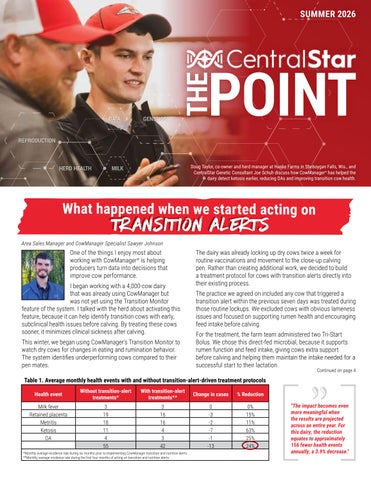
Four months of acting on transition alerts pre-calving resulted in a 24% reduction in health events in the first 40 days post-calving, with the largest improvements seen in ketosis, retained placenta, and metritis cases. Table 1 summarizes the average monthly incidence rates before and after implementing transition-alertdriven treatment protocol.
With four months under their belt, the dairy is invested in continuing to use CowManager’s Transition Monitor, and I'm excited to see what long-term improvements emerge.
The impact becomes even more meaningful when the results are projected across an entire year. For this dairy, the reduction equates to approximately 156 fewer health events annually, a 3.9% decrease. Fewer sick cows mean less time spent treating animals and fewer disruptions to production and reproduction This ultimately adds real dollars to the dairy’s bottom line.
Table 2.
Using industry estimates for the cost of common transition disorders (Table 2), the reduction in ketosis, retained placenta, metritis, and other health events represent thousands of dollars in potential annual savings. Beyond direct treatment costs,
If you are interested in learning more, reach out to your local CentralStar team.
Disease Milk fever (clinical and subclinical hypocalcemia)
$150
Retained placenta (RP) Metritis Ketosis Displaced abomasum (DA) Mastitis
$232 $218 $289 $700 $376
Source: University of Minnesota Extension
4
Cost per case
mycentralstar.com • 800.631.3510
BOVINE ACCELLYTE II WHAT IT DOES: Promotes feed and water intake which helps restore electrolyte functions and water retention to prevent losses due to dehydration. HOW TO USE: Mix in feed or water and feed continuously through the summer or start two days before extreme heat and continue as long as needed. RESEARCH: In a 2023 Texas trial, cows given Bovine Accellyte II required two fewer services per conception compared to the prior summer.
"Our cows recover faster from signs of heat stress and, in turn, breed back better all summer compared to before feeding Accellyte." - Chase Harmsen, B&B Dairy, Waupun, Wis.
Enhancing producer profitability through integrated solutions for mutual benefit.
5
SEE THE CH
Every calf has its own normal. CowManager Specialist Nicole Pralle-Nepermann
Raising healthy calves requires a balance of observation, experience, and timing. The challenge being calves instinctively hide signs of illness, because showing weakness as prey animals can make them appear vulnerable. By the time a calf shows the slightest clinical sign, the disease or infection may already be affecting health and performance. The goal of electronic calf monitoring is not to treat more calves, but to identify behavioral changes earlier, understand what those changes mean, and make better decisions when intervention is needed. This is where technology and the skill of the caregiver come together.
On many farms, direct observation may total only 10–15 minutes per calf per day. CowManager® monitoring technology helps fill the gaps between those observations by tracking behavior around the clock.
6
We cannot have eyes on calves 24 hours a day. In many operations, the amount of direct observation each calf receives may only be 10–15 minutes per day. Within that short window, caregivers are managing feeding, cleaning, treatments, and many other responsibilities. Catching subtle behavioral changes consistently can be difficult, especially as herd sizes continue to grow.
HANGES BEFORE YOU SEE THE SIGNS Monitoring behavior around the clock helps identify when something changes.
Every calf has its own normal. Activity patterns, resting behavior, drinking behavior, and rumination development change as calves grow. For example, calves naturally spend a large portion of their day lying down, often 70–80%, but what matters is when there is a change from that individual calf’s normal behavior.
Calf monitoring and early detection can be especially valuable during weaning transition. Calves that experience health challenges during this period may struggle to maintain growth and performance. Having insight into individual calf progress allows caregivers to make more informed decisions and provide support when needed.
CowManager helps bridge the gap between visual observations by continuously monitoring calf behavior, identifying changes that may otherwise be missed, and notifying you of changes with a health alert. Instead of relying only on visual observations during scheduled checks, CowManager gives caregivers additional information to help prioritize which calves need attention. The value is not simply in receiving an alert. The value comes from asking: Why is this calf behaving differently, and what action should we take?
Ultimately, calf monitoring is about combining experience with data to better understand each calf as an individual. That understanding helps producers become better caregivers by making more informed decisions about calf health, growth, and development. By improving visibility into calf behavior, farms can spend less time searching for problems and more time focusing on improving health, growth, and future performance.
By identifying changes earlier, farms can focus their time and resources where they matter most. This can improve labor efficiency, help identify subclinical disease before it becomes a larger issue, improve treatment success, and support better calf outcomes.
The future of herd profitability starts with the next generation. Better calf monitoring with CowManager, today, helps build stronger cows for tomorrow. LEARN MORE ABOUT CALF MONITORING
Rumination provides a valuable window into rumen development. If calves consistently show dips in rumination at the same age, it may indicate a transition bottleneck that deserves attention. Identifying these patterns early can help improve management decisions and support healthier calf development.
Enhancing producer profitability through integrated solutions for mutual benefit.
7
Daily Milk Production
Percentage of Cows Pregnant 80
120 % Pregnant (Number of Cows)
gain +5.3 lbs
Milk Yield (lb/d)
115
110
105
100
40
20
0
Days in Milk Control
60
Preg at 1st Service Control
Cow Start Complete
% Preg at 100 DIM Cow Start Complete
Learn more and order from CentralStar today! Cow Start™ Complete is a trademark and manufactured product of Anchor Life Sciences, Ltd. All claims made above are based on studies conducted by Anchor, summaries of which are available at agrariansolutions.com/ product/cow-start-complete-bolus/.
8
mycentralstar.com • 800.631.3510
Focus on what matters most "Genetics are so important because when you breed for healthier, fertile, longerlasting cows, that's going to give you a better ROI for the dairy in the future." Craig Gerrits, Country Aire Farms, Greenleaf, Wis.
Every dairy has traits that matter more than others. At Country Aire Farms, those priorities include health, fertility, longevity, and components. Their breeding program is built around producing cows that stay healthy, breed back efficiently, work well in their rotary parlor, and remain productive for multiple lactations.
rewards traits related to health, fertility, and longevity. The impact can be seen throughout the herd. A comparison of secondlactation cows (Table 1) showed those ranking in the highest HHP$ quartile had lower mastitis incidence, fewer abortions, higher pregnancy rates, and greater energy-corrected milk production than cows in the lowest quartile.
That focus has helped build a herd where 34% of cows are in their third lactation or greater, despite ongoing herd growth. Those mature cows are often the most productive and profitable animals in the herd.
These results reinforce a simple principle. Identify the traits that create value in your operation and make them a priority in every mating decision.
Country Aire Farms uses genomic testing and places a strong emphasis on Herd Health Profit Dollars® (HHP$®), an index that
Scan the QR code to read the full Country Aire Farms story and watch the video.
The sick pen doesn't lie!
Table 1. HHP$ 2nd Lactation Cows Quartile
HHP$ Avg
Avg Milk
ECM
SCC
Preg. Rate
Days Open
Total Fresh
Abort
DNB
Sold
Died
Turnover %
Lame
Mastitis
Lowest
112
94
105
98
32
110
211
11
0
0
0
0
21
24
Highest
414
98
109
92
37
94
231
7
2
0
0
0
6
12
A quartile analysis of second-lactation cows revealed that animals in the highest HHP$ group had significantly lower mastitis incidence, fewer abortions, higher pregnancy rates and superior energy-corrected milk production. The farm’s commitment to health-focused genetic selection is reflected not just in records, but in real-world results: fewer treatments, healthier cows and better profit margins.
HHP$
PROTEIN
FORMULATED TO SUPPORT YOUR HERD'S ECONOMIC GOALS
UDDER HEALTH
Genetic progress equates to greater economic sustainability.
LONGEVITY
Herd Health Profit Dollars (HHP$) is the premier index to achieve your dairy's profit goals. It is designed to create healthier, longer-living cows to support your herd's inventory strategy without sacrificing genetic gains.
Enhancing producer profitability through integrated solutions for mutual benefit.
DTR. FERTILITY
9
Your herd’s performance is more than what meets the eye. Without complete data, problems go unnoticed, and opportunities are missed. DHI data fills the gaps, giving you a complete picture of each cow’s performance. Get the insights you need to make smarter, more profitable decisions with routine DHI testing.
u
Early-lactation monitoring
Spotting ketosis & transition troubles u Reproductive performance u Reduce labor, improve performance u Culling decisions, inventory management u
10
Genetic potential u Keep rations on point u Early mastitis detection u Keep data fresh u Late-lactation insights u
mycentralstar.com • 800.631.3510
Better information before dry-off leads to
better decisions
Customer Solutions Advisor Michelle Kaufmann
Dry-off marks the end of one lactation, but it's also a chance to gather information that can improve management in the next. The more you know about each cow before she freshens, the better prepared you'll be to manage colostrum, fresh-cow protocol, breeding decisions, and future culling. Johne's disease and leukosis (BLV) are two diseases that often spread through a herd long before infected cows show clinical signs. By the time a cow appears sick, she may have already exposed other animals or contaminated colostrum and waste milk. Testing cows before dry-off helps identify infected animals early, giving you time to adjust management before they enter the next lactation. Those results can help determine whether a cow's colostrum should be fed to calves, identify cows that need special attention after calving, and support future culling decisions. If you use DHI, adding Johne's or BLV ELISA testing is straightforward. The milk sample is already being collected during your regular test day, so no additional cow handling is required. Your DHI Specialist can coordinate the testing, and results are typically available within five days of the lab receiving the sample. Those results can also be uploaded into herdmanagement software, including DART, where they become part of the reports you already use. For producers who are not using DHI, these diagnostic tests are still available. However, incorporating them into a DHI-testing program eliminates the need for separate sample collection while keeping production records and diagnostic results together. Having both in one place makes it easier to identify cows that need additional management before calving.
No two herds manage disease the same way, but every herd benefits from timely information. Whether you're already testing through DHI or looking for ways to gather more information from your herd, combining production records with diagnostic testing gives you another tool to make informed decisions before the next lactation begins. Because when it comes to managing your dairy herd, the question is not just what information you have, it’s what information you may be missing. DHI paired with diagnostic testing gives you a more complete picture of your cows and the decisions that can impact their next lactation.
ONE SAMPLE. MORE INSIGHT. BETTER DECISIONS. Last DHI sample before dry-off Add Johne's and leukosis ELISA testing Results integrated into management software Use results to: Identify cows before they show clinical signs Flag cows before calving Protect colostrum and waste-milk programs Support culling and breeding decisions Reduce disease transmission to calves
FLAT $5 SHIPPING ON FLY CONTROL PRODUCTS, INCLUDING 55‑GALLON DRUMS. Talk to your CentralStar team or order online.
11
P.O. Box 23157, Lansing, MI 48909-3157 800.631.3510 • mycentralstar.com Return Service Requested
Presorted Standard Class U.S. Postage PAID Lansing, MI Permit #505
MASTITIS
CentralStar, its agents or employees cannot and do not guarantee the conception rate, gender, quality or productivity to be obtained in connection with the use of its products or recommended techniques. It makes no warranties of any kind whatsoever, expressed or implied, which extend beyond the description of its products and hereby disclaims all warranties of merchantability and fitness for a particular purpose. In the unlikely event that any of our products shall be proven to be defective, damages resulting from their use shall exclude consequential damages and be limited to the purchase price of the product. Find complete trademark and warranty statement at https://mycentralstar.com/legal-notices/. ®Herd Health Profit Dollars and HHP$ are registered trademarks of Select Sires. ®CowManager is a registered trademark of Agis Automatisering. BIOFRESH® Microbial Bolus is a trademark of Select Sires Inc. and manufactured by Agrarian Solutions®.
Connect with us at:
When you identify at-risk cows, BIOFRESH® Microbial Bolus helps: Support recovery of sick and off-feed cows flagged by activity systems Faster bounce-back for fresh cows Restore feed intake and ruminal fermentation for off-feed cows Enhance immune function for challenged and high SCC cows
Cows given BioFresh® Microbial Bolus at calving return quickly to normal eating and rumination patterns and exceed the group average.
Order BIOFRESH from your CentralStar team.