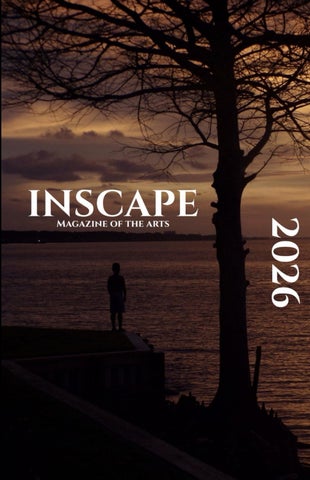
Inscape Celebrating the Arts at Central Methodist University
Inscape © 2026 by Inscape, Central Methodist University’s Magazine of the Arts. Inscape is one of the creative endeavors of the students, faculty, and staff at CMU. This unique publishing opportunity is one of the many educational experiences that CMU’s Department of English, along with Sigma Tau Delta, provides. They have a distinguished record of placing students in graduate and professional studies as well as in education and other professional fields. The Mu Lambda Chapter of Sigma Tau Delta is an opportunity for students to share their love of English with one another while participating in campus activities, conferences, and publishing of Inscape. If you would like more information about Sigma Tau Delta, please contact: Dr. Kavita Hatwalkar Associate Professor of English 411 Central Methodist Square Fayette, Missouri 65248-1192 khatwalk@centralmethodist.edu 660-248-6308 …or visit www.centralmethodist.edu/academics/english for more information about the Department of English. The Inscape staff and Sigma Tau Delta wish to thank the staff at Modern Litho in Jefferson City, Missouri, for their assistance in producing and printing this issue. All CMU students, faculty, and staff are invited to submit their creative work for possible publication in Inscape. Please contact the editors at inscape@centralmethodist.edu if you have any questions or are interested in submitting for the next issue, which will be released in the spring of 2027.
Inscape Central Methodist University’s Magazine of the Arts A project of CMU’s Mu Lambda chapter of Sigma Tau Delta.
Issue 51/2026
Editors Jessica Alverson Freese Nyxia (Alexandria) Sauer Faculty Advisor Dr. Ryan Woldruff
Inscape was founded in 1975 by Central’s Tau Tau Tau honorary fraternity, Mu Lamba chapter of Sigma Tau Delta (the International English Honor Society), and the legendary Scribblers and Scrawlers.
Table of Contents Mina Himmel ........................................................ Cover Waiting for Tomorrow Note from the Editors ................................................... i Inscape Definition ....................................................... iii Creative Non-Fiction: 1st Place: Kaelyn Johnson ........................................... 02 Raised on Hardwood and Her Hand in Mine Elzie Umstattd ............................................................ 06 Decision Trees Ruth Francis ............................................................... 11 The Hill Yusneiry Agrazal ......................................................... 13 I never imagined I would feel at home Drama: 1st Place: Harmony Andrews ..................................... 18 Iced Out Emeline DeLapp ......................................................... 30 The Forest Remembers Harmony Andrews ..................................................... 48 We Weren’t Meant for this World Walker Lapinski .......................................................... 61 Being a Vampire Bites
Fiction: 1st Place: Colin Lawrie ................................................ 80 Architect of Absence Jessica Alverson Freese .............................................. 96 Forgotten Yusneiry Agrazal ....................................................... 101 The Passenger Without a Suitcase Poetry: 1st Place: Caleb Raley ............................................... 108 Sirius Ella Green ................................................................. 109 Blue Eyes LadyLike Not So, Alone Touched-Out Jessica Alverson Freese ............................................ 118 My Campfire Soft and Sweet Joe Burks .................................................................. 120 Lights Above the Lake Nyxia Sauer .............................................................. 121 Ahead and Behind caged for comfort Family Ties
Visual Art: 1st Place: Donovan West .......................................... 128 Moment in Time Donovan West ......................................................... 129 Fly Eagles Fly Recille Dennis ........................................................... 131 Another Stop on the Line Jessica Alverson Freese ............................................ 132 Fated Felines The Anatomy of a Story Mina Himmel ........................................................... 134 Echoes in the Bark Waiting for Tomorrow Caleb Raley............................................................... 136 A Quiet Evening Zy’Keriyah Napier ..................................................... 137 The Power of Perspective Young Writer’s Day Excerpts, 2025: Katie Pefferman ....................................................... 140 Sisters by Chance, Enemies by Choice Lilly Kaullen .............................................................. 142 The City as a Mother Zy’Keriyah Napier ..................................................... 144 The Power of Perspective Jackson Siebrandt .................................................... 145 No. 378 Heaven or Hell
Contributor Bios ....................................................... 147 Staff Bios ................................................................. 150 Acknowledgements ................................................. 152
Note from the Editors After achieving such a large milestone last year, our team was looking for a way to re-invent Inscape in its 51st edition. We expected some setbacks along the way, but our response from students and faculty was more than enough to make that dream a reality. That is why we’re pleased to introduce Contributor’s Notes—a new feature that allows our contributors to share their creative inspirations and personal insights into their work. This space gives readers the opportunity to connect with each piece on a deeper, more personal level. As we were putting together this magazine, we noticed that so many of the pieces came straight from the heart, grappling with difficult topics, living with uncertainty, and overcoming fear of the unknown, standing together, undivided. Whether you’re traveling away from home for the very first time, lamenting on the fallacies of past relationships, or sitting in quiet introspection of your own life, each story runs head-first into uncertainty, embracing the growth that comes from stepping outside of your comfort zone. It is through art and literature that we begin to see the world through each other’s eyes. The walls dividing us begin to crumble and are replaced by a feeling of true understanding and belonging. We’d like to thank Dr. Ryan Woldruff, this year's faculty advisor, as well as the rest of our staff, Piper and Joe, for all their hard work on this magazine. We appreciate the faith you had in us and are so grateful for the opportunity to be i
the editors this year. Looking forward, we hope that Inscape will continue to honor its roots while also evolving to match the ever-changing modern world. As always, we’d like to say a final thank you to our readers and contributors for your never-ending support. This magazine would not be what it is today without you guys’ engagement. We hope you’ll love this edition just as much as we do! Jessie and Nyxia
ii
in•scape / in-skeip / n. Word coined by British poet Gerard Manley Hopkins for the individual or essential quality of a thing; the uniqueness of an observed object, scene, event, etc.
iii
iv
Creative
Non-Fiction
1
1st Place: Raised on Hardwood and Her Hand in Mine Kaelyn Johnson
Since I was around six years old, basketball has been a part of my life. I still remember how big it felt in my little hands, the way my small fingers had to stretch weirdly across the ball, and the thumping sound it made against the court when it bounced, to the point where it almost sounded like a heartbeat I could feel up through my arms and body. Back then, everything about the game felt surreal. Every shot was a small miracle; every dribble was a reminder that the world made the most sense when I was with the ball and on the court. I didn’t think about competition or failure, or expectations being held on me. I played because something inside me told me to and it would light me up in a way nothing else ever had when I was that young. At that same time, my mom was becoming the priority and backbone of my life. She has always been my best friend, the person I talk to about everything no matter the topic, and the one whose reactions and feelings mean most to me. People always tell me I’m just like her and that our laughs sound pretty much the exact same, that our hard headedness shows at the same times, and even in our sarcastic times we still seem to link up perfectly. Getting older, I didn’t just appreciate and look up to her; we both had the same personality and the same way of going about specific things that we do, and it makes me feel like a true reflection of my mom. I pay attention to the way she dealt with stress, how she turned hard days into jokes, how she stayed relaxed even when things didn’t go the way she wanted. Being like my mom has
2
always felt like something I should live up to and something that I should always protect and work towards. As time went on when growing up, they way I’d admire her started to slowly add fears into my head that was a struggle to deal with at times. Since I have looked up to my mom for so long for everything that I do in life it is hard to even think about the idea of disappointing them. I never want to let her down and I don’t want to let myself down as well. I started worrying not just about losing in a game or doing poorly in school but about failing in life and letting her down. Sometimes these thoughts pop up during practice or late at night when I’m trying to sleep, what if everything I’m working for disappears? Basketball started to get more serious as years went on. Practices would be longer, competition got more tough, as well as the expectations. Both mine and the people surrounding me, tightened like a pair of shoelaces being pulled a little too hard. The court stopped being just a place where I felt carefree and started becoming a place where I felt responsible and in charge of things. I could always feel 100 eyes on me in the bleachers, could hear the cheers that followed the makes and the silence and disappointing sounds that came with the misses. Basketball had become more than a hobby. It was the main part of my identity, something that felt tied to myself worth. Meanwhile, my mom has always been there by my side through every season, every win, and every loss. She has never put pressure on me the way I would put pressure on myself. After hard games, she never brought up the score. Instead, she would ask if I was doing alright or what I wanted to eat for dinner to keep me from getting to down on myself. When I would be pissed or cry over mistakes and 3
bad plays, she would tell me that I am more than what had happened in that moment. I am more than just a game. More than every stat. I wish it would have been enough to silence my fears. And sometimes it was. But most times, a small part of me would think if the only reason I spark at all is because of basketball and would wonder what would happen to that spark of mine if I ever lost that. The fear isn’t constant, but it’s always close. It shows up in the gym when I’m the last one doing something in the gym, trying to prove something to myself. It pops back up in school when I feel myself falling behind or doubting my academic abilities. It yells at me during late-night thoughts, the ones that spiral too quickly and keep me up at night: What if you fail? What if you let your mom down? What if you let yourself down? That fear feels like full-court pressure tight, persistent, loud and always in my face. But then I think back to the little girl who just loved the feel of the ball bouncing beneath her hand. She wasn’t afraid of failure. She didn’t know what disappointment felt like yet. She only knew that the game made her feel alive and made her feel like herself. I try to remind myself of that little girl in the past. I try to remember that even before basketball became something I felt I needed to be good at, it was something that brought me happiness and comfort. Sometimes that reminder is enough to loosen the pressure but never enough to get rid of it all. I also try to think about my mom, not as the person I’m worried to disappoint, but at the woman who showed me how to be strong. She showed me that self-worth isn’t earned by everything being perfect. It’s made little by little, through trying, and getting back up after each downfall. I want to be like her not because she’s never made mistake and perfect, 4
but because she keeps going no matter what. And if I truly am like her, then even if I fail sometimes, I’ll keep pushing myself to keep moving forward too. Maybe that’s the point I’ve been missing, the fear of failure means I care too much. But caring deeply doesn’t make me weak, it just makes me the person that I am. Basketball has been teaching me how to move with a purpose. My mom has taught me how to stand with strength and keep moving forward. And my fear has taught me what I seem to value most, living a life that means something no matter what the end of it looks like.
Contributor’s Note: I wanted to show how basketball is more than just a game to me. It’s something that has always connected me to my mom in a really special way. Growing up, a lot of our relationship was built through basketball, and that’s where I started to understand her and see how much we are alike. She has shaped me into the person that I am today, not just by what she has taught me, but by how she’s always pushed me to be better and never give up. Writing this made me realize how much those moments actually mean to me. It’s not just about the gameit’s about the memories, the lessons, and the bond we have because of it. Basketball is part of who I am, and so is my mom. This piece really shows how both of those things are connected and how they’ve helped make me who I am today. - Kaelyn Johnson
5
Decision Trees Elzie Umstattd
Once I was hunting with my grandpa. It was an incredibly cold day, and we were about 15 minutes outside Harrisburg, Missouri. We were on a farm owned by one of my grandpa’s friends. The owner let many local people hunt off his property; he had quite a bit of land, so there was a lot of room to hunt. Certain areas were set up for hunting, and we were in a little hut built on top of a trailer so it could be easily moved. The hut was set up in a field. I remember how cold it was, and there was a small propane heater in the hut, but we didn’t use it. The metal on the barrel and receiver of the gun I was holding was cold, and I made an effort to only touch the wood parts of the gun, because it wasn’t quite as cold. Since I was still pretty young, I wasn’t all that tall yet. I had to really sit up straight to see out the window in front of us, to observe the field and look for deer. I can distinctly remember the scene out the window. The field was open ahead of us, lined by forest on both sides with a fence way, way down at the end. It’s been years since I have been there, I bet it would feel a lot smaller now. That is something I noticed when I went to Bass Pro Shops recently. When I was younger, I used to go there with my parents all the time. I really liked looking at the fish tank and all the decor around the store. It has probably been more than 10 years since I was last there, until recently. When I went back not too long ago with my fiancé, I was very happy to see that the store had barely changed. The truck was still up on the wall, the fish tank was still there, everything was 6
basically the same, it all felt smaller though. I probably looked like an idiot smiling and pointing at everything. The nostalgia of it all was very real. Some things don’t feel real. There are things I used to do that I think about every now and then that just don’t seem like they ever happened, but they did. My parents built the house that we live in now, but it is less than half the size of the house we used to live in. To make things work, we had to get rid of a ton of stuff. There was a point where we just didn’t have time or enough energy to donate or rehome stuff, so we just threw it away or burned it. I still remember, one of the last things I did at our old house was burning my childhood guitar that I got as a gift. It was a black and red electric guitar, but I really abused it, and it eventually got to a point where it was missing most of its parts and had no strings. I also could not play it at all. I used to just randomly play strings and pretend I was playing something coherent. Still, throwing it into the fire and watching it burn upset me. We lived at that house for a while; it was longer than we lived at most other places. Still, despite that, living there feels more like a dream than reality. Burning all that stuff doesn’t feel like it really happened. Despite not being able to play guitar, it seems to have a huge influence on my life. I own a guitar again, but I haven’t made a solid effort to learn it beyond very slowly picking the Star Spangled Banner. When I was younger, I liked music, but I really liked rock music. My dad would play it sometimes and I would love to listen to it. The most influential music for me when I was younger was “Crazy Train” by Ozzy Osbourne and the album “Master of Puppets” by Metallica. I had Crazy Train on my iPod Shuffle and would listen to it over and over. I still listen to metal and rock music. 7
I am listening to it as I type this sentence. The variance and energy that the music contains is why I listen to it. The slow chugging of a distorted electric guitar can convey anger or sadness. The fast solos that are played represent craftsmanship and skill. Sometimes the rhythm guitar in the background actually has more presence than the lead guitar. No other genre matches the sheer amount of emotion and variety that metal has. Of course, you don’t really think about all that when you’re 10 and listening to Master of Puppets or Sanitarium, you just think it sounds cool. My dad took classes at Moberly Area Community College in his thirties. He was working toward an Associates of General Studies degree. Some of the classes he took were computer science related, like programming and Linux. I remember, right as he started one of his programming classes, he was showing me a language called “Visual Basic”, which is a “basic” programming language, nothing more and nothing less. I watched as he followed along with a YouTube video that showed how to write the famous line “Hello World!” using Visual Basic. It’s a rite of passage for programmers to write that line. It’s a test to see if your computer is properly set up for coding. Then I watched the video show him how to do some basic math and logic operations. It was like something clicked in my brain. A major new obsession had been discovered; it was something that would change my entire life. It's the reason I am writing this, and the reason you are reading this. Through middle and high school, I used resources like YouTube to learn about coding and gained a basic understanding of how it worked. I made a last-minute decision to go to college and pursue coding as a career. I went to MACC, the same place my dad did, and had the
8
same professors he did. I decided to go further than an associate's degree and get a bachelor's degree, so I enrolled at CMU. A decision tree is a computer algorithm that is built to make a decision based on given conditions. Imagine a tree, each branch is a condition, and each leaf is a decision. Ultimately, the outcome is the culmination of all the branching paths that were taken based on the conditions at hand. I don’t really hunt anymore. The experiences I had when I was younger didn't necessarily “ruin” it for me, but I just don’t have the same motivation to hunt as I once did. I was never a super outdoorsy person. Multiple, “less than ideal” experiences are enough to make someone not want to continue to do something. When I shot a deer out of that little hut on that cold morning, the bullet landed, but it was not a good shot. We had to go and finish it. Another time, with my dad, it was the same. I shot, but it was bad and just severely injured the deer, but that time we never found it. The idea of the deer dying slowly is uncomfortable and sad. It was frustrating, too. I was good at shooting, why did I keep messing up? Sometimes strong emotions or adrenaline can cause you to have some sort of bias in your decisions. You might make a bad decision because you felt some sort of emotion, which clouded your judgement. You might just have adrenaline under extreme stress, which can either make you super aware, or maybe you sort of shut down. Now, I am pursuing a degree in computer science and hope to get a job so I can move on to the next chapter of my life. How do I know what branches I am supposed to go down? Will I have a bad experience which will cause me to 9
give up and settle for less? It seems as we get older things get duller, but the stakes get higher. We must decide what parts of our past continue and what gets left behind. It would seem that with every branch some sort of action is required and doing nothing is an action and will take you down a branch. Although, you can’t go down every branch, and you don’t always know which ones will have the leaves you want. Sometimes decisions are made for you. Whether it’s by someone else, or the environment, you don’t have control. To see a branch wither and die is like losing an opportunity, it was a potential route. Cold and frosty mornings remind me of hunting. Crazy Train reminds me of my iPod. Master of Puppets reminds me of headbanging in our old Ford Taraus with no AC. Coding makes me reflect on how much I’ve learned. I started knowing nothing, and now I understand how much I don’t know. We differ from an algorithm. Emotions influence our decisions and can cloud our judgment. Many times, we face more than two choices in a situation. Despite that our lives aren’t simply algorithms; the inputs still shape the outputs. You should look back on the past; it’s important context to understand who you are today.
10
The Hill Ruth Francis
It’s an unusually quiet night, as I stand at the base of the hill behind the press box. Although there is a cool breeze blowing, I can still feel the heat of the sun beating down on me as it had been just a few hours ago, when I was standing in this same position, sweat beading on my face. By now, I’ve showered and eaten but standing here makes it feel like I’ve never left. I can still feel the burn in my legs, though they are not moving. I can still hear the labored breathing of my teammates mixing with my own as we try to encourage each other to keep going. I am not sure why I am standing at the bottom of the hill; I should be at the apartment by now with my friends. I’m not sure what led me to stop here, looking up at it as if it weren’t the same hill that I’ve seen nearly every day for two years now. The size of the hill seems to change depending on the time of day. When I was a freshman, brand new to college softball, at the bottom of this hill it seemed to go on forever. Although over time the hill has seemed to shrink, it never fails to feel insurmountable. Yet, somehow, every time I manage to climb it. I think about how many freshmen have stood exactly where I am, terrified to climb this hill. The hill is about 50 yards, and it is very steep, probably a 30-degree angle. To make things worse, the hill is riddled with potholes including a ditch that you can’t see until you’re about to step in it. I consider how many times the returning players have encouraged them to keep pushing. I wonder how many players have been discouraged from joining the program because of the horror stories they’ve heard about this hill. It is hard to 11
believe that a mound of dirt and grass can be so terrifying, yet it is something that every player learns to dread. At the top of the hill is a green box. I’m not really sure what the box is or why it is at the top of the hill, perhaps it’s a generator. The only thing I know about that box is that we have to go around it before our trek up the hill is complete. The box is insignificant, yet it holds the power of freedom somehow. I suppose it’s the power that we give it, letting it mark the emotion we feel. It’s hard not to, knowing that we won’t be allowed to leave the field until the circuit is complete. The entire workout is hard, but the hill is the toughest part. Knowing that every player has to finish helps us encourage each other. I guess it is some odd form of team bonding, like the kind you see in movies. I take a deep breath, and I smell the fresh cut grass. I remember what it was like to run up this hill with the seniors from last year. The girls who were my friends, the girls who have moved on, past this hill, on to the rest of their lives. I think about the fact that in two years I will move past this hill. Someday, I’ll be a physical therapist, a parent, a wife. How many more times will I have to climb this hill before that happens? Who knows? All I know is, no matter how hard it may be, I will climb this hill every time.
Contributor’s Note: My inspiration for this work was my softball program. This piece is about the reality of being a college softball player, it is tough but rewarding. - Ruth Francis
12
I never imagined I would feel at home Yusneiry Agrazal
Thousands of kilometers away from my home, in a country where people seemed harsh and distant, where the language sounded like a jumble of meaningless sounds, and even the food felt strange to me. Russia was supposed to be a challenge, and without a doubt, it was one of the greatest of my athletic career, a test of my discipline as an athlete. But it became something much deeper. The first days, in fact, the first two weeks were overwhelming, because I was with a small team from Panama: two guys, two girls, and the coach. Practically all of us looked very Latin, and it was super uncomfortable when we went out on the streets and were stared at. I was there in the summer, and the heat was unbearable; it pierced through my sweater as I walked to the gym every morning. At that wrestling training camp, far from my home, I discovered what it meant to belong to a place not because of my passport, my language, or even my culture, but because of the passion I carried inside. Wrestling has its own language, one that requires no words. The first time I stepped onto the mat there, surrounded by iconic Russian and world figures, trembling with nerves and with my heart racing, I realized I could speak fluently here. Every hold, every fall, every recovery was understood by everyone in the room. I didn't need Russian to express who I was. My body, my technique, and my determination
13
said it all. Wrestling became my translation, my introduction, and my bridge into their world. Little by little, the barriers between us began to disappear. Improving every day and even surpassing the Russian athletes, they noticed my effort and began treating me as one of their own. They taught me exercises, corrected my posture with quick gestures. The gym, with its sharp whistles, the air drenched in sweat, and the relentless routines morning and afternoon, became my new space of belonging. A moment that stands out in my memory and heart: after an especially exhausting practice, I sat on the bench, drained, drenched in sweat, struggling to catch my breath. A coach offered me his hand (over there, men don't usually shake hands with women as a sign of respect and said to me, in broken English: "You are strong and good, keep going." His words, though simple, meant everything. In that instant, I realized I was no longer just a visitor. Days later, I found out they wanted me to stay at their university. Honored and grateful as I was, I didn't accept, but that offer showed me something I had never fully seen in myself: that I could grow, that I could shine, even in a place where I once felt lost. Leaving Russia wasn’t just returning home. It felt like leaving a version of myself that was unsure and coming back as someone braver, more focused, and more confident. That camp didn’t just make me a better athlete, it made me grow in ways I never expected. And now I know that no matter how far I go, or how hard things get, I can always keep going… and keep shining. That camp remains one of the most unforgettable experiences of my life. It taught me that wrestling will always be 14
my home, no matter where in the world I am. Whether in Panama, Russia, or anywhere else, as long as I have wrestling, I will never be a stranger.
Contributor’s Note: My Creative Writing class taught me a lot and motivated me to explore my creativity. I just went with the flow. - Yusneiry Agrazal
15
16
Drama
17
1st Place: Iced out Harmony Andrews
Cast of Characters RON - Mid 40s conservative white male in midwest America. He wears a Christian t-shirt, dirty jeans, and work boots. Has a light country or midwestern accent but isn’t necessarily needed. ALANA - Early to mid 20s liberal college student in the Midwest America. She wears a hospital gown and a hospital bracelet. Time period - Set in present time, February 2026. Setting - A hospital in the urban Midwest of America. Tools - // is a tool to signify actors to interrupt the current actor speaking with their dialogue.
The scene opens in a hospital room. Monitors are beeping, but no one is in the hospital bed. Instead, a young woman, Alana, is standing by the window, staring outside as she watches fresh snowfall. There are flowers on the windowsill, fresh and pretty with a little get well soon card still attached. Ron enters from the stage right door, holding To Kill a Mockingbird. He walks softly, as if not to disturb Alana.
18
RON Hey kiddo...back again. Ron pulls up a hospital chair. It’s old with an uncomfortable plush. He sits facing the foot of the hospital bed; his head is hung as he fidgets with the book in his hand. Alana speaks, but doesn’t turn to him. ALANA You didn't have to come. I'm fine being alone. Always have been. I’m the “independent” one, remember? Alana sounds bitter but Ron doesn’t seem to mind it. RON Brought back that book. The history one with that Finch guy. You used to eat this kind of thing up when you were younger, dystopian worlds, I couldn't get you to shut up about it. Sure your sister has beauty but she’s dumb as a box of rocks compared to you, Al. ALANA (Sarcastically.) Oh yeah, go ahead, compare us like you always do. There is a long pause. Neither party looks at each other. RON You're probably hella embarrassed that your dad comes and reads to you // ALANA (Scoffs.) //probably? 19
RON //but the doctors said it would help. Something about cognitive functions…I don’t know. I don’t know what to say. What can I say? After a beat, Alana sighs and moves to sit on the hospital bed facing her father. ALANA Just…read your book, dad. Ron takes a long pause before taking a deep breath and opening the book, setting his bookmark down on the bed beside Alana. RON “Did she die free?” asked Jem. “As the mountain air” said Atticus. ”She was conscious to the last, almost. Conscious,” he smiled, “and can… can tan?” Ron scoffs and closes the book. He takes a long pause before speaking again. What can I do? Is this punishment? // Is this you lashing out? // One of your rebellious phases, because I get enough of that from your sister // at home. ALANA // No, dad, // this is bigger than just me! // really?! Do you know what this is, Ron? This is the bomb of your horrible parenting finally blowing up in your face. You did everything that you could to protect me, to shield me from the outside world. Guess what? The world won. Instead of standing beside me and helping me navigate // it you just20
RON Three shots. You were shot three times, Alana. There is a long deafening pause. Neither speaks until Ron takes in a shaky breath. The doctors still don’t know how you survived that. Two to the chest and one in the back. They said you would be on a ventilator for the rest of your life. They said you’d be lucky to last a week, but I told them you were strong. Strong and stubborn headed. RON AND ALANA (Simultaneously.) Just like your old man. The two chuckle while sniffling. Both wipe their nose or eyes in a similar way. For fucks sake, Al…of all the places you could be, why were you there? ALANA It was a protest! RON How could be so fucking stupid? Christ, help me… ALANA Why are you getting angry at me?! I’m not the one who was shooting at innocent people! I held a sign and sang! Once again another long pause of tense silence. You used to love my singing…
21
She gets in bed, on her side facing the audience as she holds her pillow. Ron after a beat finally speaks once again. RON “She still disapproved heartily of my doings, and said I’d probably spend the rest of my life bailing you out of jail. She had Jessie fix you this box. Atticus reached down and picked up the candy box. He handed it to Jem. Jem opened the box. Inside, surrounded by wads of damp cotton, was a white, waxy, perfect camellia. It was a Snow-on-the-Mountain. Ron takes a moment to think. Do you remember that candy store in Tennessee? We went on vacation and you were bouncing off the walls to try their candy apples. Ron laughs softly, Alana doesn’t respond. Then that song played… the one that goes “Lord help me hallelujah HOOOO!” Ron laughs and Alana chuckles. ALANA It was Uptown Funk // by Bruno Mars RON Funk… something // anyways, I remember you dancing. Your sisters behind you in a conga line and you held that apple up like you were the Statue of Liberty. A beat as Ron’s smile slowly fades. 22
Now look at you…bandaged and broken and for what? Some illegals? Alana speaks, moving to sit at the foot of her bed, trying to move her body so her father looks at her, but he keeps his head low. She is almost pleading with him to understand. ALANA I did it for people. Human beings who deserve the right to live. You're a Baptist man, a preacher. You taught me the teachings of Christ. Love your neighbor, remember? Dad…dad look at me. Ron doesn’t. He slowly lifts his book. RON “Jem’s eyes nearly popped out of his head. “Old helldevil, old hell-devil!” he screamed, flinging it down. “Why can’t she leave me alone?” In a flash Atticus was up and standing over him. Jem buried his face in Atticus’s shirt front. “Sh-h,” he said. “think that was her way of telling you everything's all right now, Jem, everything's all right.” A beat. Ron’s hands shake as he gets angry. Your mother is down the hall. She is a good woman. A godly woman. You know her cancer came back and you still left. // You still went to that God damn riot! ALANA // I had to! Ron slams the book down on the table, it is loud and makes Alana jump. He is standing now, head up, covering his eyes with his arm as he cries silently. Alana is hanging her 23
head. Ron speaks again with hurt and anger aching in his voice. RON She’s back on that chemo. She can’t even walk in here to see you. But that’s probably for the best. I don’t think she’d want to see what you’ve become. Alana lifts her head slowly, anger and hurt start to boil to her upfront emotions. ALANA Are you fucking kidding me? Are you seriously trying to guilt trip me like I’m the bad guy? I got shot. For protecting my peace, for my friends who are here legally and still get taken. For the children being used as bait. For our own veterans to be sent back to their “home countries” because their eyes are more slanted than the average “red blooded American man”. And you are gonna stand there and not even look at me? Ron doesn’t speak. Look at me! He doesn’t. Are you really that ashamed of me? That upset that I would go against our idiotic president that you can’t even look at me? Ron is quiet. He sniffles and wipes his nose. He comes over and sits back in his chair, head low, as to not look at her.
24
RON Why? I just want to know, why? ALANA Because it’s the right thing to do. RON Was it worth it? ALANA Yes. RON No. No it wasn’t. It’s not worth the heartache you caused this family. // It wasn’t worth the pain. ALANA More like the embarrassment. // I’m in pain! Alana shouts, tears start to form. Our country is in pain. We are losing ourselves, our lives and for what? For you to feel some control because we’re red instead of blue? This whole country is red from the blood YOU spilt. Your generation. You were supposed to guide us. To help us make a difference in the world since your parents and your parents’ parents fucked it up. But you’re just standing there. RON You can’t keep doing this. This isn’t a way to live.
25
ALANA Well maybe it’s the way to die. A beat. Alana stares down her father, he doesn’t look at her. He picks up the book, flipping through the pages. RON I lost my damn page. ALANA Screw you! Alana stands up, furious. Are you kidding me? I'm living in a war without any justice. Where people are getting killed daily just for standing up for basic human decency. Men, women and children are getting kidnapped, and you’re worried about your shitty fucking book? Lady Liberty is bleeding out in the streets after getting shot in the face and called a fucking bitch. They wear masks to protect their identity but if we do the same, we're a threat. An unknown assailant. I watched a man get shot 10 times for having a gun that they had already removed from his body, and he was called a terrorist. I'm terrified to even say anything because when people do they are arrested, are killed or just fucking disappear. You wanna read? Read the news. Or better yet? Read a history book, circa 1933 German. Or a play, try Marlowe’s The Massacre at Paris, real good stuff. RON Did she die free?
26
ALANA No one is free! Not you, not me. People are being taken due to their race and shoved into camps. Treated sub human. Propaganda is pushed so the American people think it's ok and that they are to blame for our troubles! You said he wasn’t Hitler, and you're right. Hitler was popular. You always told me how history was so important, how we should be careful and pay attention so we don't repeat it and we are! Right now. Right here in this room. And I need you to listen. RON Everything’s all right. ALANA No shut up! You are gonna sit there and listen to me for once in my life. What if it was me, dad? What if I had the little hand gun you gave me for my 21st? The one you said to keep on me at all times because the world gets crazy? What if I was shot multiple times, shoved to the cold asphalt road, begging them not to kill me, saying I want my dad as they shot me twice in the chest and once in the back. What if they kick my body, call me a bitch or cow or terrorist. Would you say something? Is that what it would take for you to fix this? To do...something? Anything. Ron and Alana are silent except for Alana’s heavy breathing and sniffles from crying. I’m dying dad. I’m dying and I need you to care. I need to know that if I go, that I mattered. That I won’t just be a news story or a footnote in history. I need to know I meant something. That I mattered. Dad, I need you to listen. 27
Ron finally finds his page and reads. RON “You know, she was a great lady.” “A lady?” Jem raised his head. His face was scarlet. “After all those things she said about you, a lady?” Alana lays back in bed. “She was. She had her own views about things, a lot different from mine, maybe . . . son, I told you that if you hadn’t lost your head I’d have made you go read to her. I wanted you to see something about her—I wanted you to see what real courage is, instead of getting the idea that courage is a man with a gun in his hand. Ron stops for a minute, really listening to that passage. Alana gets up and fixes the bed, waters flowers, tidies the room. She finally puts a small blanket on her father and lays on the bed, looking at her father. It’s when you know you’re licked before you begin but you begin anyway, and you see it through no matter what. You rarely win, but sometimes you do. Mrs. Dubose won, all ninety-eight pounds of her. According to her views, she died beholden to nothing and nobody. She was the bravest person I ever knew.” Ron finally lifts his head and for the first, last, and only time through the play, he looks at her. He sees her. The lights fade to black, and you hear the beeping on the monitor until it holds its final deafening note. End of play
28
Contributor’s Note: The world has been very crazy lately and it has scared me. I was scared of losing the people I cared about. Scared of dying if I spoke out. Scared I wasn’t doing enough. So, I did the one thing I knew how to; write. I wrote my experiences, my thoughts, my feelings. I also, at the time I wrote this, was struggling on how to talk to people, to express that fear without backlash. The world is so divided, I didn’t want to be divided with the people I loved. So, this is how I expressed it. I would like to dedicate Iced Out to my parents. Thank you for always loving me and supporting my goals, even when you didn’t fully understand. I love you. - Harmony Andrews
29
The Forest Remembers Emeline DeLapp
Cast of Characters NARRATOR - Any age, Black male*. Voice of the forest, observer of all. MARCUS - 50s, White male. Experienced hunter, pristine property owner. DALE - 30s, White male. Newer resident of the area, eager to prove himself. ROY - 40s, White male. Local hunter who has never bagged anything impressive. ELLEN - 40s, Any race Female. Neighboring property owner, nature lover. *If unattainable, any actor who is a person of color fits within this play’s themes for the character of the NARRATOR. Setting - A rural community at dawn, edged by a dense forest. A deer trail cuts diagonally across the stage.
(Lights rise on MARCUS in his hunting blind, DALE at his cornfield examining damaged crops, ROY on his porch. All have binoculars.)
30
NARRATOR In the forest, time has its own rhythm. Some paths grow deep from endless use, others appear and vanish like the mist. MARCUS (To himself.) There. Right on time. DALE (Calling up toward MARCUS.) Marcus! You seeing him too? MARCUS Every damn morning. Hell of a buck. DALE Biggest thing I've seen out here. Thought I moved for peace and quiet, turns out I'm running a buffet. (Laughs, then stops, kicking at broken stalks.) Half my corn's trampled flat. Look at this. MARCUS That's the country, son. It feeds you and it robs you all in the same breath. ROY (Handing them over with his phone.) Y'all talking about that monster buck? Look here.
31
DALE (Leans in.) Jesus. Look at him. MARCUS Twelve points easy. Maybe more. ROY I been filming him for weeks. Same time, same trail. Like he's got a wristwatch tucked under his hide. Deer don't act like that. Not unless they've been trained. DALE Trained? It's a deer, Roy. ROY Government's done stranger shit— strap a tracker on a crow, you got yourself an army. Same with deer. (Lowers voice.) And he don't belong here anyway. This is a good neighborhood. Quiet. Safe. Then he shows up every morning like he owns the place. NARRATOR Three pairs of eyes. One creature, three ways of seeing. Fear sees a threat. Greed sees a prize. Suspicion sees conspiracy. But none see what is plain— a living thing, following the path worn smooth by those who came before. (Enter ELLEN on her property, carrying a basket of tomatoes from her garden.) ELLEN Morning, boys. 32
MARCUS Hey Ellen. Seen any deer out your way? ELLEN Oh yeah. Big one, comes through every morning. Walks the old trail down to the spring. (Slight smile.) I leave some apples out for him sometimes. DALE That don't bother you? Having him trample through your land? I mean, I just lost half my corn to that thing. ELLEN I know it's hard, Dale. I do. But he just wants water. ROY Some might call that trespassing. ELLEN Animals don't read property lines, Roy. (She notices their expressions.) Well, I better get going. Y'all take care, now. (She exits.) MARCUS She don't see it like we do. ROY Not everyone's got something to lose.
33
MARCUS (Quiet, looking at his land.) That's the trouble, though. You don't guard what's yours, somebody— or something— will take it from you. (Pause.) My daddy lost this land once. Took me years to get it back. I ain't losing it again. DALE It's just a deer, Marcus. Animals don't plan things out. MARCUS Then explain it, Dale. Same time, same path across three properties. That's not nature, that's intent. ROY Maybe he's a spy! Like one of them drones dressed up in fur. DALE You can't be serious. ROY World's full of watchers. Cameras, satellites, people listening in your phone. (Raps his temple.) They took my cousin's phone records without a warrant. Tracked everywhere he went for six months. They wouldn’t draw the line at deer. MARCUS Exactly. He's up to something. Testing us. Mapping our movements same as we're tracking his.
34
DALE Or maybe he's just thirsty. Same trail, same spring— maybe he just likes how that water tastes. MARCUS No, son. Survival means changing when danger's near. This buck? He don't change. He keeps coming back. He's bold. (Pause.) That kind of boldness spreads. ROY (Quieter, almost to himself.) My dad used to say— you see something out of place, you deal with it before it becomes a problem. (Looks to Marcus.) Wish I'd listened to him more often. NARRATOR So watching hardens into study. What was once wonder turns into measure and record. The eye that observes becomes the eye that judges. The hand that points becomes the hand that condemns. And in the space between seeing and understanding, something dangerous takes root. (Evening. The three men meet center stage.) MARCUS We got ourselves a problem. DALE What's he up to now?
35
MARCUS He's gotta be casing us. He knows our routines, where we are, when we ain't. ROY So what's the move? DALE I mean— what if we just blocked the trail? Fence it off, reroute him somewhere else? MARCUS You think a fence is gonna stop him? Nah. This is about keeping order. ROY (Eager) And shit, it's one hell of a trophy. Been hunting twenty years, never bagged anything close to that. MARCUS This ain't about trophies. Once one breaks the line, others follow. You let this slide, and the whole community changes. Property values drop. People start moving out. DALE But it's not hunting season— MARCUS This ain't hunting. It's pest control. Protecting our way of life.
36
DALE Feels like we're talking about more than a deer. MARCUS We are. We're talking about what we built. What belongs here. DALE (Hesitant) When would we even—I mean, how would this work? MARCUS Tomorrow morning. (Looks at Dale) You don't have to shoot. Just be there with us. That's all. DALE (After a long pause) Just watching? MARCUS Just watching. ROY (Claps Dale on the shoulder) That's right. We're in this together. Neighbors looking out for each other. NARRATOR How quickly greed wears the mask of duty. How easily fear becomes permission. How readily the watcher becomes the hunter. Three men stand at the edge of a choice. One will pull the trigger. One will record. One will bear witness. 37
All will carry the weight. MARCUS We'll do it on Ellen’s land tomorrow. We'll have a clear line of sight from the ridge. ROY (Hesitant for the first time) On Ellen's land? (Pause.) She don't need to know about this. MARCUS She'll be at work. Won't hear a thing. ROY (Nods, convincing himself.) Right. Right. I'll film the whole thing. For documentation. DALE This don't sit right with me. MARCUS That don't matter now. It's time. NARRATOR The old trail holds his prints. The deer follows it without care, while three rewrite his fate in their own hands. Morning comes as it always does. The forest wakes. The trail waits. But this dawn carries something new— intent, quiet and cold as steel.
38
(Dawn. The men are in position on ELLEN's property, whispering. MARCUS holds a rifle.) MARCUS Everyone set? DALE (Shaky, looking through binoculars.) I can see him... MARCUS There it is. ROY (Whispers, almost reverent.) Beautiful bastard. DALE He's just...walking. Same as always. MARCUS (Raising rifle.) Twelve-pointer. Clean shot. DALE Marcus, he ain't doing nothing wrong. Just walking the trail like always. Like he's got a right to be here. MARCUS He don't have a damn right. That's the whole point. This is our land and that arrogant son of a bitch keeps trespassing like he owns it. DALE But he's just— 39
MARCUS He's been doing wrong for weeks. Strutting around, marking territory that ain't his. This ends it. (He lowers the rifle and moves toward DALE.) You're taking the shot. DALE What? No— you said I'd just be watching. You promised. MARCUS Plans change. Stop whining. (Shoves the rifle into DALE's hands.) You're part of this whether you like it or not. DALE (Trying to hand it back.) Marcus, please— MARCUS (Refusing to take it, harsh.) Hold the damn thing steady and quit being a coward. ROY (Voice shaking slightly.) C'mon, Dale. Don't think. Just squeeze the trigger. Make history. Do what needs doing. DALE I don't want to do what needs doing. I never wanted— MARCUS You're here, aren't you? That means you're in. No backing out now, Dale. I'm done listening to you cry about it. 40
DALE This isn't right. He's not— MARCUS (Standing behind DALE, gripping the rifle and DALE's shoulders forcefully.) He's on our property! He doesn't belong here! DALE Marcus, I can't— MARCUS (Suddenly shouting.) SHOOT HIM! (DALE jerks in shock. The rifle fires. Birds scatter. Long silence.) DALE (Voice breaking.) Oh god... NARRATOR And so the day begins, not as it was meant, but as it was made. A choice becomes an action. An action becomes a wound. And in that wound, the truth blooms red and undeniable. ROY (Barely breathing.) Got it. Every second on camera. MARCUS (Taking the rifle, exhaling.) Well. Problem solved. 41
DALE (Staring at his hands, voice hollow.) That... Jesus, Marcus... MARCUS (Not looking at Dale.) Had to be done. ROY (Forcing enthusiasm.) And look at that rack. Jesus. Biggest I ever saw. (ELLEN enters from the house, having heard the gunshot. She stops when she sees the three men, their postures, the stillness. She looks toward where they're staring.) ELLEN What was that? What did you— (She sees the fallen deer. Her hand goes to her mouth. The pail she's carrying slips from her grip. Water spills across the stage.) ELLEN (Barely a whisper) No... MARCUS Ellen, go back inside. ELLEN (Moving toward the deer, her voice rising.) What did you do? What did you—
42
MARCUS (Firmer.) I said go back inside. ELLEN (Ignoring him, reaching where the deer fell, her voice breaking.) He was just drinking. He just wanted water. DALE (Voice cracking.) Ellen, I— ELLEN (Heartbroken and angry.) You shot him? For what? For walking here? ROY (Defensive.) He was on your property, Ellen. Every morning, damaging— ELLEN Damaging what, Roy? The grass? (Her voice cracks.) He wasn't hurting anyone. DALE It wasn't supposed to— I didn't mean to— ELLEN But you did. (Looking at Dale, devastated.) You did it anyway.
43
MARCUS We had a right to protect what's ours. ELLEN (Sharp, angry tears in her voice.) Protect? From what? From an animal drinking water? (Beat.) You didn't protect anything. You just... you just decided he didn't belong here. ROY (Uncertain now, looking at the camera in his hands.) We were... it was trespassing. We documented everything— DALE (Suddenly crossing to ROY.) Give me that. ROY What? DALE (Snatching the camera.) Give it to me. (DALE looks at the camera in his hands for a moment, then hurls it to the ground. It breaks.) ROY (Stunned.) What the hell, Dale?! DALE (Voice breaking, staring at the broken camera.) There's no proof. There's nothing to prove. There was just... (He looks 44
toward where the deer fell.)…him. And us deciding that was enough. MARCUS (Quiet, controlled.) We did what needed doing. ELLEN (Turning away from them, her voice thick.) Get off my property. MARCUS Ellen— ELLEN (Louder, not looking at them.) Get. Off. My. Property. (MARCUS stares at her for a moment, then exits. ROY looks between Ellen and Dale, then follows Marcus.) (DALE remains, looking at Ellen's back, then at where the deer fell. He opens his mouth as if to speak, then closes it. He exits slowly, shoulders bent. ELLEN remains alone, standing over the fallen deer.) NARRATOR The forest does not cry out, yet something is broken. One life taken, and the silence spreads wider than the sound of any gun. Four men walked into the morning. Three men walk away. But what they carry now is heavier than what they brought.
45
The trail remains, but it is altered. The earth will hold the weight of this choice, and the creatures who walk here will carry its shadow. Not in days, but in years. Not in memory alone, but in the very soil. (A spotlight finds the trail. A shadow— the shape of the deer— crosses slowly, then fades.) NARRATOR (In ELLEN's voice.) He just wanted water. Her words fall, not only hers now, but the forest's refrain. What was balance is now fracture. What was ordinary is now marked. The forest remembers— and it will not be the same. (ELLEN slowly places wildflowers on the trail. The lights fade on her there, still kneeling, as a man’s [NARRATOR] shadow crosses one final time.) (Blackout.) End of play
46
Contributor’s Note: This piece is a commentary play on vigilante justice and how it causes significant damage to minority communities. The plot is inspired by the murder of Ahmaud Arbery, a black man who was murdered by three white men in a racially motivated hate crime in Brunswick, Georgia in February of 2020. – Emeline DeLapp
47
We Weren’t Meant for this World Harmony Andrews
Cast of Characters LEIRE (lair) - A black woman from the ages of 18 to 20. She is dressed as a college student but always looks put together. JASON - A white man from the ages of 18 to 20. He is dressed as a college student. More shy but definitely the stereotype for a pretty white boy. Setting - A college, astronomy tower, and a seaside.
The scene opens on a spotlight on Jason, he’s holding a paper. The paper is always with him. He is facing the audience. JASON My dearest Leire. I will never forget the first time I saw your heavenly face. I should have known from that single moment that you were too good for me. It was August. I was still getting lost in my class schedule. I had no friends. No family here. I was awkward and new like a Christmas gift from your estranged uncle. Lights slowly fade up. Jason is looking at his paper in his hand and the row of seats. Up and down and back up again. 228…228…ah! 228! 48
Jason finds his seat by Leire and sits beside her. She is wearing a shirt with simple text that says “tell your dog I say hi”. She is on her phone, not looking up, possibly chewing on gum. Jason turns to her, notices the shirt, and turns away. He leans slightly over to her. I will. Leire looks up and gives him a confused look up and down. LEIRE Excuse me? JASON Oh, your uh, your shirt? Leire looks down at her shirt and chuckles as she connects what he said prior. I’m sure Argo would like that. LEIRE Argo, is that your dog? JASON Dorkie. A beat. Leire gives him a hard stare. LEIRE What did you call me? JASON What? Oh! No, no, no. Argo he’s a dachshund and yorkie mix. A dorkie. 49
Jason awkwardly laughs. Leire doesn’t. Jason turns to the audience as Leire freezes. God help me. Jason turns back to Leire, allowing her to be free to move again. What about you? LEIRE I’m black. And human. JASON No, uh, do you have a dog? LEIRE No. I bought this shirt from this organization that feeds and pays for the medical bills of shelter dogs. JASON Oh, cool. He turns to the audience once more. God, I love this woman. I mean, she was funny and sassy and kind. You were…amazing. You made my first day feel bearable. And I knew from that exact moment that I needed to get to know you more. Jason turns back to Leire, unfreezing the moment again. Do you like dogs? LEIRE Well, I would hope so. 50
JASON I just mean, would you like to meet my dog? Like for coffee? LEIRE Argo really shouldn’t drink coffee, I heard it’s bad for the heart. JASON Me. Would you like to get coffee with me. Sometime. Argo or Argo…less. Leire laughs. LEIRE You're funny. I like that. A beat as she considers it. How’s Friday? Lights down and scene shifts to the top of an astronomy tower. The backdrop is concrete and both Leire and Jason are in poses as if they were laying down while standing up. They are slightly turned to the side, “propped up” by an arm. JASON Really? Star of the sea? LEIRE I know, it’s super cheesy.
51
JASON No no, I think it’s beautiful. LEIRE Come on. Leire nudges him and lays flat on her back. JASON I’m serious! It suits you. A beat. Leire is flustered but still speaks with confidence. LEIRE (Teasing.) What about you? Where did Jason come from? Jason turns now, lying flat on his back too. JASON My mom was a hardcore thespian, named me after some guy in some Ancient Greek play from a million years ago. LERIE What, like the Argonauts? JASON I wish. He was like a husband or something. I don’t know. LEIRE Huh. A beat. They say nothing but stare up at the starry sky. So many stars. 52
JASON Yep. Oh look! The Pisces constellation. LEIRE Where? JASON There. Jason points at the sky which is the audience. LEIRE Oh, I see it. JASON Yeah? LEIRE No. No clue what you’re pointing at. JASON There. Jason took Leire’s hand and moved it around to connect the stars for the constellation. Down here, and round. That’s Pisces. LEIRE Ok Mr. Astronomer, no wonder you spend so much time here.
53
JASON What can I say, it’s like a second home. It helps that the astronomy tower is like, home base for my major. LEIRE I wish our marine biology department looked this pretty. We only get pictures of the oceans and small tanks. JASON It can’t be all bad. LEIRE Half the time I’m not even allowed near the tanks. They say that it’s cause I’m an underclassman but that doesn’t stop David O’Dongle. JASON David? Again? LEIRE Listen! He always gets to do everything! Feed the tanks, scuba lessons. Leire sits up and turns to look at him. Today, Dr. Karnage offered to take him on a trip that only upperclassmen get. JASON Maybe he’s just needing some hands-on experience. LEIRE Maybe he is just a rich little white boy. 54
Silence. Jason turns to the audience, freezing the frame once more. JASON We didn’t always see eye to eye when it came to…race. You were vice president for the honor society, but you swore it was because you were the only person of color there. I invited you to my fraternity party after I was initiated, and you denied it because all anyone would see you as was the “black girlfriend”. I never understood why it mattered so much to you. Jason turns back, unfreezing the scene. That’s not fair. David is good at what he does. LEIRE He is. I never said he isn’t. But ever since he got here, my sophomore year has been overshadowed by the great David O’Dongle, child prodigy. I just… She sighs. I just wish that people would give me the benefit of the doubt. I work so hard and for what? I know that maybe I’m not as good as him, but I can do anything he can do. I deserve a shot, at least. They owe me that much. A beat. Jason gently takes Leire’s hand in his. JASON You’ll get your chance. LEIRE Yeah, right. You don’t know that. 55
JASON I do. You know how I know that? Because no one believes in you more than I do. And I know once Professors catch even a glimpse of what I see? They’ll kick O’Dongle to the curb. They gently laugh and slowly lean in for a kiss. The scene shifts as it goes dark with only a spotlight on Jason as he turns to the audience. I will never love anyone more than you. But I’ll never forgive myself for that night. For ruining the one thing in this world that made me feel like a real person. The backdrop is now a starry night sky on top of the astronomy tower. Leire, come on! It wasn’t that bad! LEIRE Not that bad? Did you see how your dad looked at me? Did you hear what he said? JASON He didn’t mean it like that. LEIRE Yes, he fucking did. JASON He said you were promising.
56
LEIRE Yeah, for a black woman. That’s what he said, and that’s what he meant, like black women have a place where we should sit and stay like dogs. JASON Leire. LEIRE And what was that? You are supposed to be on my side. JASON There is no side! Leire, baby. Jason reaches for her, but she slaps his hand away. LEIRE Don’t touch me. Don’t you dare touch me. A beat. Jason starts to get angry. JASON This was my dinner. My celebration for getting into the astronaut program. Why did you make it about you? LEIRE Your parents made it about me! You brought a black woman from a poor neighborhood to their rich upper-class home and expected them to be cool? You think I didn’t hear your mother tell the maid to hide the good silver ware? You think I didn’t feel their gaze as they stared me down, waiting for a mistake?
57
JASON Leire. LEIRE And you laughed. JASON It was a joke. LEIRE It was an attack. JASON How?! LEIRE Your mom said I should change careers because my people don’t know how to swim. Your dad said I’d be fine because cops aren’t usually on the water. But worst of all? Your dad said I need to be careful because my job does random drug testing. A beat. And you laughed. She pushes his chest. That was an attack on my heritage. She pushes him again, getting more emotional. My family. Again, another push, and Jason is getting frustrated. 58
My skin! Another push, Jason is boiling over. You’re supposed to stand up for me, where were you?! JASON Not everything is about you! Jason pushes her back, she stumbles and starts to fall back. Blackout. A gasp then the sound of something heavy, like a body hitting pavement. Spotlight up on Jason as he is crying, shaking, shocked. He turns to the audience. I’m here now, by the seaside. Those photos in your department doesn’t do it justice. It’s beautiful. Or at least it was when the sun was setting. In the dark it’s cold and sad and lonely. I just want you to know how sorry I am. How much I truly loved you. How if I could go back, I would have told my father off, I would have supported you better, how I would never haveHe takes a moment, not able to admit what he’d done. He scratches on the paper with a pencil. You know, my mother said that we were never meant for each other. Because we lived in different worlds. I thought she meant the skies and sea but now I know what she meant. Leire, I would have been poor for you, rich for you. Sick or healthy, alive or… or dead. If it meant being with you, I would have done it. It’s not that we were meant for each other, but we weren’t meant for this world. I love you, Leire. I can’t wait to see you again and maybe…maybe then you’ll forgive the idiot you loved.
59
He folds the paper and lights fade to black. You hear something plunge into the water and then silence. End of play
Contributor’s Note: I have many friends who are people of color, and as a white woman, I never could understand what they go through. Why my brother was so worried about getting pulled over. Why my brother in-law got weird looks when we invited him to Thanksgiving. Why my friend was always picked second for everything. There are so many that, even people who consider themselves allies, do not understand. I wanted to show my ignorance and their reality. Things are not black and white, but things have not progressed as much as we like to believe. This is still a reality for a lot of people of color and we needed to see it. I would like to dedicate We Weren’t Meant for this World to my friends and family, namely Trinity, Trenton, Melody, and Jay. Thank you for sharing your experiences and letting me make it real. I couldn’t have written this without your help. - Harmony Andrews
60
Being a Vampire Bites Walker Lapinski
Cast of Characters THE NARRATOR - Male. Early 40s. Brown hair. A bit odd. Likes to describe what other people are doing as if they exist outside their reality. He wears a fancy suit. COLLIN SERLING - Male. Late 20s. Blonde hair. A shortsighted man who became a vampire unaware of the consequences. Thinks he’s funny. He wears normal clothing. RODRICK - Male. Mid 30s. Black hair. A man who turned into a vampire several decades ago. Meek. He wears a cape over 80s style clothing. JENNIFER RICE - Female. Late 20s. Black hair. A vampire hunter. Somewhat self-righteous. She wears normal clothing. ANNE HERTZ - Female. Mid 20s. Dirty blonde hair. A vampire hunter. In it for the thrill, possibly an adrenaline junkie. She wears normal clothing. Setting - The city of New Orleans, Louisiana. Present day. *Any character, especially THE NARRATOR, can be gender-swapped. COLLIN becomes NICOLE, RODRICK becomes REBECCA, JENNIFER becomes JAMES, and ANNE becomes ANDY. Characters can also be androgynous. COLLIN becomes COLE, RODRICK becomes REN, JENNIFER becomes RIVER, and ANNE becomes ARTEMIS. THE NARRATOR is always THE NARRATOR, regardless of gender. 61
(Lights rise on NARRATOR, who walks to CENTER STAGE from STAGE LEFT. Behind him, in the dark, COLLIN and RODRICK are engaged in a ritual. COLLIN is kneeling while biting RODRICK’s arm. Candles surround them, and COLLIN is shaking in pain. RODRICK in turn winces.) THE NARRATOR What would you do for immortality? Give up your freedom? Your life? The ability to consume garlic bread? Tonight, someone gives his answer. (NARRATOR steps aside, gesturing to the ritual occurring behind him) One man desperate for power. Another man desperate for friendship. A third man desperate for someone to notice him. That’s me. Is it working? RODRICK (RODRICK pulls his arm away and COLLIN releases his teeth. RODRICK wipes the blood off his bitten arm using his cape.) It is finished. You have drunk my blood. You are now Vampire too. THE NARRATOR But does he truly want to be a vampire? It’s not a pleasant life, as he’ll soon learn— RODRICK (Turning towards THE NARRATOR, looking confused.)
62
Who the heck are you?! THE NARRATOR I am but a humble observer of your tale. I simply seek to— RODRICK Bug off dude! You’re wrecking the vibe! (THE NARRATOR flees out STAGE LEFT. RODRICK turns back towards COLLIN.) Sorry about that. You okay? (He helps COLLIN to his feet.) COLLIN (Shaking himself off.) I’m fine. (Smiling enthusiastically.) No, I’m better than fine! I’m a vampire! I have super strength! (COLLIN strikes a power pose. The actor can decide what the pose looks like.) Super Speed! (COLLIN dashes back and forth across the stage.) Fangs! (COLLIN bares his teeth and licks them.) I can detach my own limbs and control them telepathically!
63
NARRATOR (Briefly peeking his head out from STAGE LEFT.) That’s an actual vampire power! Look it up. (He disappears backstage again.) RODRICK Yeah, let's not test that one out right now. COLLIN (Putting his hands on the sides of his head and smiling ever brighter.) You know man, when I put out that ad on Craigslist, I didn’t expect anyone to respond! But no, I met an actual vampire! This is amazing! RODRICK (RODRICK’s face is growing increasingly unsettled.) It’s cool, I guess. I don’t know about amazing… COLLIN Oh you don’t get it! All my life I’ve wanted power like this. To be the strongest, the fastest, the most seductive! I’ll be a god amongst men! My family told me I was crazy. They said things like Vampires were just folklore, but I showed them! I found a real one, got myself turned, and now look at me! (COLLIN’s smile falters.) Wait… look at me…
64
(Suddenly growing excited again.) Is there a mirror somewhere? RODRICK Yeah, right over there. (RODRICK points to STAGE RIGHT.) COLLIN (COLLIN runs to the mirror and is shocked to see his reflection in it.) Yo! What the heck is this?! (He gestures at his reflection.) RODRICK (Confused.) What? What’s wrong? COLLIN What’s wrong?! I can see my freaking reflection! You didn’t turn me into a Vampire at all! RODRICK Ohhhh. You don’t know… COLLIN Don’t know what?
65
RODRICK So that’s a myth. It’s actually a composition thing. Old mirrors used to have a silver lining, and the uh silver prevented the older vampires— (COLLIN is no longer paying attention, instead digging in his pocket and pulling out his phone.) —from showing up. Now because mirrors aren’t made with silver—Wait don’t touch that! COLLIN (Dropping his phone and pulling his hand back in pain.) Ow! What the flip?! RODRICK Yeah, now it’s phones that have silver in them. COLLIN You mean I can’t touch my phone?! How am I supposed to play clash?! RODRICK Yes, you can’t touch it, and I don’t know what that means. COLLIN You didn’t tell me I was going to lose access to my Fantasy league! RODRICK Your ad said you knew about and accepted Vampire weaknesses! 66
COLLIN I was talking about garlic and wooden stakes! That didn’t bother me! It’s not like I’m a fence maker who’s really into Italian food! I am a Gen Z’er though, and I need my phone! RODRICK (RODRICK shrugs.) I don’t know what to tell you dude. Whole thing is bogus. I lost my antique coin collection when I turned, if it makes you feel any better. COLLIN I don’t care about your stupid coin collection! Also, “dude?” “Bogus?” What kind of vampire talks like that? I thought you guys were supposed to speak old English or something. RODRICK I was bitten in 86’. COLLIN Like 1786? 1886? That still doesn’t explain— RODRICK No, 1986. COLLIN (Dumbfounded and also very annoyed.) You were bitten… in the eighties.
67
RODRICK Yeah, a few times actually, but only one was the Vampire. COLLIN Is that why you’re dressed… (Gesturing to RODRICK’s weird attire.) …like that? RODRICK Yeah, I’m an 80s Vampire. So what? COLLIN (Enraged.) “So what” is I have literal grandparents who are older than you! RODRICK There’s no need to be rude. I still have knowledge that can be valuable to you. I’ve still been a vampire for four decades. COLLIN Yeah, I can’t wait to have a mentor who dresses like he’s about to do the electric slide. (Composing himself.) You know what? It’s okay. This is fine. I can work with this. My powers will make it all worth it. Now are there any other vampire weaknesses I need to know about?
68
RODRICK There are a few, but the only one we really need to worry about is sunlight. And about that—we need to get you a coffin, quickly. COLLIN A coffin? RODRICK (Now it is RODRICK’s turn to become annoyed.) You really didn’t do any research beyond “Vampire Superpowers,” did you? COLLIN It seemed like that was all that mattered. RODRICK (RODRICK rolls his eyes.) We don’t technically need them, but they’re dark, comfortable enough, and most importantly easy to transport. Which is a big plus, because we can’t drive cars. COLLIN We can’t drive cars?! RODRICK Silver man. It’s everywhere. (Turning away.) Now come on. There’s a funeral home nearby and I know the owner. He’s one of us. 69
(COLLIN and RODRICK start to walk in place, acting as if they are traveling to the funeral home. The NARRATOR comes back on stage.) THE NARRATOR And so, our protagonist continues his journey. Already it seems that the seeds of doubt are beginning to seep in. There’s no doubt that in time— RODRICK (Turning and glaring at THE NARRATOR.) Bro shut up! And stop following us! (NARRATOR flees again. RODRICK looks at COLLIN.) I swear, I genuinely have no idea who that guy is. (RODRICK and COLLIN stop walking. They’ve reached their destination. JENNIFER and ANNE enter from STAGE RIGHT. Both are smiling just a bit too wide.) JENNIFER (Run-on.) Hi, welcome to the funeral home, how can we help you? RODRICK (Gestures towards COLLIN.) My friend here is… terminally ill. We’re looking for a coffin for him. Preferably soon. ANNE (ANNE walks over, giving COLLIN a once over.) 70
You don’t look sick. Are you sure he’s ill? RODRICK Uh… quite. May we enter? JENNIFER Of course. (RODRICK and COLLIN both take a few steps forward.) You know… we don’t often get customers this late. COLLIN (Trying to help RODRICK.) This was all very sudden. I only just found out— ANNE (ANNE interrupts COLLIN, moving behind RODRICK and looking at his cape.) Wow! This is a nice cape! What is it…18th century, Victorian? (She lifts up one of the corners to get a better look. RODRICK skirts away.) RODRICK (Nervous.) I don’t see how that’s important. (RODRICK glances at COLLIN as if asking “Do they know?”) And it’s not nearly that old. It’s younger than I am. 71
JENNIFER Oh, I bet it is. COLLIN (Clearly weirded out by JENNIFER and ANNE.) Where is the owner of this place? ANNE (Cheery.) We’re the owners! RODRICK (Shocked.) What? What happened to Al? JENNIFER Oooh, he’s not around anymore. RODRICK What happened to him? ANNE (With a mischievous smile.) I heard he got a really bad sunb— JENNIFER (Giving ANNE a “shut up” sort of glare.)
72
That’s beside the point. What matters is that you need a coffin. We’ll happily supply you with some photos of our options, if you just give us a second. (ANNE and JENNIFER both walk off STAGE RIGHT.) RODRICK (Turning towards COLLIN, looking quite disturbed.) There’s something really off about those two. COLLIN Nah, I think one of them was trying to flirt with me. RODRICK Are you being serious?! They were acting like they knew we were vampires! COLLIN What? That’s impossible. RODRICK No, I remember—Al had a security camera on the premises. If it caught us… we wouldn't have shown up on the tape. And when we suddenly appear here, completely out of nowhere, one of them might have come to the conclusion that… COLLIN You’re being paranoid. If they knew we were vampires they’d be running and screaming.
73
RODRICK Yeah, except they sussed us out way too quickly. Their behavior, the way they caught us trippin’, the fact that we’re in a store for coffins… No man. I think these betties might be… (He gets close and whispers.) Vampire hunters. COLLIN Vampire hunters?! Those are real?! RODRICK (RODRICK grabs COLLIN by the shoulders and shakes him.) If Vampires are real, of course Vampire hunters are real! COLLIN This vampire business keeps getting worse and worse! You told me— RODRICK I told you nothing! You wanted to be a vampire! I made it happen! And now— (He suddenly stops talking. Sprinklers can be heard in the distance. RODRICK and COLLIN both scrunch up their noses.) COLLIN What is that awful smell? And do you hear a “chk-chk-chkchk” sound? 74
RODRICK (Eyes wide.) Those are sprinklers. Oh heck, they put holy water in the sprinkler system! We’re trapped! ANNE (ANNE and JENNIFER both re-enter from STAGE RIGHT. JENNIFER is holding a crucifix. ANNE has something in her enclosed fist.) That’s right you are… Vampires! JENNIFER Gosh you rats are so easy to lure here. Every time one of you converts a new abomination in this city, sooner or later you’ll visit us. (JENNIFER turns and smiles at ANNE.) And that’s when we get you. ANNE (Smiling back at JENNIFER.) Sure, it’s spawn-camping, but we don’t mind. You’re our prey, after all. COLLIN (Standing confidently, ready to fight.) Prey? No, I am the hunter! And with my immeasurable power, I will kill you both and drain you of your blood. I’m not trapped in here with you, you’re trapped in here with me! 75
ANNE (ANNE reveals what’s in her hand, a little pile of grains of rice. She chucks it against the ground. COLLIN and RODRICK both suddenly drop to their knees and start counting the rice.) All too easy. COLLIN 1! 2! What’s happening? 3! RODRICK 4! It’s another 5! Vampire weakness! 6! 7! We have an uncontrollable urge to 8! count things! JENNIFER And now we rid the world of you monsters. COLLIN 9! I don’t want to be a vampire anymore! 10! How do I undo this? 11! RODRICK You 12! can’t undo this man! 13! You made your choice. 14! COLLIN 15! 16! I don’t like this! 17! I wanted control! I wanted power! 18! (JENNIFER and ANNE start laughing.)
76
RODRICK (Looking around frantically while he continues counting the rice.) Narrator 19! guy! I know you’re still around somewhere! 20! Help 21! us! (The lights dim everywhere, except for CENTER STAGE, where the NARRATOR has returned again.) THE NARRATOR And so our story comes to an end. For Collin, this is a lesson about hubris and the desire for strength. Maybe something about being careful what you wish for. Though… he doesn’t seem to have accepted that this is all his own fault. Hmmm… Oh! With Rodrick, it’s an end to a life of power, a lesson in what happens when… no that’s not it either. I know! The hunters, Jennifer and Anne—they… get away with everything. Well, that might be a good thing, but still… (NARRATOR sighs. RODRICK and COLLIN scream for his help again.) Maybe I should do something. But I’m just an observer. This isn’t my story. My life will be the same regardless of who wins, right? Except it’s not just about my life, is it? (NARRATOR turns his head towards the events going on behind him.) Should I do something? Is it up to any of us to do something?
77
(NARRATOR seems to be contemplating his options. He looks deep in thought, but ultimately seems to come to a conclusion.) I’ve made my decision. (NARRATOR is about to start walking, but before the audience can see whether it’s away or towards the suffering Vampires, it all fades to black. With no narrator, it’s now up to the audience to decide what happens next.) End of Play
Contributor’s Note: I wrote this play in honor of a close friend of mine at CMU who passed away last year: Emalinn Hartley. The plot was inspired by her favorite book, Interview with the Vampire by Anne Rice, one of her favorite shows, The Twilight Zone, and her favorite movies, anime with cheesy dialogue. I would also like to give a shoutout to my best friend for helping me come up with the title, it was absolutely perfect. – Walker Lapinski
78
Fiction
79
1st Place: Architect of Absence Colin Lawrie
The morning sunlight, usually a buttery embrace, felt like a spotlight on a crime scene. It filtered through the bedroom window, illuminating dust motes dancing in the still air, each particle a tiny, fleeting universe. Geoff’s eyes, still gritty with the last wisps of sleep, focused on the digital alarm clock, its red numbers glowing 7:03. Alyce, a warm divot in the mattress beside him, was still lost in the quiet hum of her dreams, a gentle rise and fall of the duvet his only reassurance of her peaceful presence. He had been on the verge of reaching for the newspaper, an ingrained Saturday morning ritual, the tactile comfort of the newsprint a small, grounding pleasure. But it started with the tips of his fingers then and there all the same, they had just grazed the clock. It wasn’t a jolt, not an electric shock, not even a tingling sensation. It was… a sudden, absolute nothingness. The clock, solid moments before, simply wasn't. It didn't explode, didn't shatter into pieces. It simply ceased to be, its vibrant red numbers winking out as if swallowed by a void. A faint whisper of fine, grey dust, like the ghost of a sigh, rose from the bedside table, shimmering in the thin slant of light, then settling. Where the clock had been, there was only a clean, dark ring on the polished wood, a stark silhouette of absence. Geoff blinked. His brain, usually a well-ordered filing cabinet of facts and figures from his predictable, comfortable life as a technical editor, stuttered, then stalled. He rubbed his eyes, then pinched himself hard on the arm, a 80
sharp, familiar pain that should have snapped him awake from any nightmare. But the alarm clock was still gone, the dark ring on the table mocking his rational mind. He pressed his palm flat on the table, feeling the cool, smooth surface. It remained intact. He lifted his hand, then cautiously, tentatively, extended a single index finger towards the table’s edge. The wood, a sturdy antique his grandmother had cherished, instantly blackened beneath his touch. A small, ragged section, no bigger than his thumbprint, puckered, then dissolved into a fine, dark silt that smelled faintly of damp earth and neglect, like the breath of an open grave. The polished surface lost its sheen, turning to a dull, crumbling husk. His breath hitched, a panicked gasp that caught in his throat, raw and painful. His hand, outstretched, seemed normal. Unremarkable. The same hand that had tied his shoes, typed out edits and notes for countless documents, smoothed Alyce’s hair from her face, held her hand during their quiet evening walks. But the sight of the ruined wood, the vanished clock, screamed a different, monstrous truth. His hands, his own hands, were the instruments of this quiet, instantaneous annihilation. They were no longer tools for creation, for comfort, for connection. They were merely points of dissolution. He scrambled out of bed, a frantic, awkward ballet of avoidance. He didn't want to brush against the duvet, the delicate lace curtains, or God forbid, Alyce's sleeping form. His mind, still reeling, demanded proof, a logical explanation, an escape from this impossible reality. He needed to get to the bathroom, to splash cold water on his face, to prove this was a hallucination, a particularly cruel trick of the light and his sleep-deprived brain. 81
He reached for the doorknob, its familiar brass cool beneath his palm. It felt oddly gritty, then suddenly, terrifyingly, it was just a heap of verdigris-stained powder on the floor, leaving a gaping, empty hole in the wood. A portal to nothingness. A cold, oxidized scent of accelerated corrosion hung in the air, sharp and acrid, burning his nostrils. He snatched his hand back as if were engulfed in flame. But there was no heat, only an unsettling chill radiating from the void where the solid brass had been. His heart hammered against his ribs like a trapped bird, desperate for escape, its frantic beat echoing in his ears. From the kitchen, Alyce’s bright voice cut through the terrifying silence, a cheerful melody that now sounded like a death knell, a cruel counterpoint to the entropy unfolding around him. "Geoff? Toast's ready! Mostly. Don't touch it, it's still hot." Don’t touch it. The words, meant as a playful warning about burnt fingers, resonated with a chilling, new horror. He couldn’t touch anything. Not the coffee mug, not the crisp newspaper, not the very floor he stood on, not the woman he loved. He spent the next hour trapped in the house, a terrifying involuntary scientific experiment. He tried his toothbrush; its plastic handle instantly liquefied into a sticky, pungent goo, the bristles turning to brittle ash. His leather belt, once supple and strong, crumbled to a thin, brittle powder, leaving a faint, acrid smell of ancient decay, like something dredged from a tomb. He watched, transfixed and horrified, as a perfectly ripe orange, sitting innocent on the counter, shriveled into a moldy, putrid mass the instant his finger grazed its peel, its 82
vibrant color draining away as if pulled into a vacuum. A single, perfect rose in a slender vase, a gift from Alyce just yesterday, its velvety petals turning black and crisp, its stem snapping like dry twigs, its vibrant life extinguished in a blink, leaving only a brittle, desiccated husk. It wasn't just rot. It wasn't just rust. It was an immediate, absolute unmaking. Anything that could erode, decay, rot, rust, crumble, oxidize, or otherwise be reduced by time, sometimes over eons, was now reduced by him. In mere seconds. His touch was an accelerated apocalypse for the mundane, an instant erasure of solidity and form. His hands were truly things of death. They were no longer the instruments of a craftsman, of a lover, of a man building a life. They were simply points of dissolution, conduits of chaos. And then there was Alyce. He heard her humming a tune from a forgotten movie, the gentle clink of ceramic against ceramic as she poured coffee. He stood frozen in the hallway, pressed against the cool, neutral wall, utterly motionless, barely breathing, trying to make himself invisible, incorporeal. His breath hitched, a raw, painful sound caught in his constricted throat. He couldn't go to her. He couldn't touch her hair, still tousled from sleep, or the soft curve of her cheek. He couldn't wrap his arm around her waist, couldn't even brush a stray crumb from her lips. The thought of what his touch might do to her—the warmth of her skin, the life in her eyes, the very essence of her—made him feel physically ill, a nausea that clawed at his throat, a cold sweat breaking out on his forehead. "Geoff? Are you alright? You're being awfully quiet," she called, her voice laced with the gentle concern that usually melted the edges of his stress, but now only amplified 83
his horror, turning where once he found comfort into a practice of existential despair. "Fine!" he croaked, his voice a strained, unfamiliar rasp. "Just... uh... feeling a bit under the weather. I think I'll head out for a walk. Clear my head." He avoided her gaze, the keen, perceptive gaze that always saw through his carefully constructed facades, the one he could no longer bear to meet, for fear of what she might see, or what he might betray. He edged past the kitchen doorway, grabbing his keys with two fingers, barely touching the cold metal, a small, desperate victory that felt like a profound defeat. He walked out into the crisp morning air, leaving her confused and hurt, leaving the home that had, in a single terrifying morning, transformed into a lethal minefield, a prison of untouchable objects. As he looked down to shut the door the knob turned to a rusted dust in his fist just the same as his keys clenched in his other hand. His new life was an abysmal absence. Every day was a delicate, agonizing dance around the inevitable. The first few days were a blur of frantic, futile attempts. He tried every glove imaginable: thick leather, industrial-strength rubber, even medical-grade latex. The leather turned brittle, then flaked away in greasy pieces. The rubber softened, then dissolved into a black, oily sludge that coated his hands, leaving them strangely cold, like a cadaver's. The latex became sticky, then shredded. The decay, he discovered, wasn't about the material of the object; it was about the very idea of erosion, accelerated. It was about his hands themselves, becoming instruments of entropy. A living, breathing paradox. The cost of new gloves, a minor detail in his old life, became a recurring, infuriating, incredibly impossible to explain, increased expense. 84
He started hoarding them, treating each fresh pair like a precious, fleeting shield, knowing their protection was only temporary. He would wear three, four, five layers, hoping to buy himself a few extra seconds before the inevitable. He learned to use his elbows for light switches, his shoulder to nudge open doors. The simple act of living became a meticulously rehearsed nightmare. Food became a terrifying ordeal. He ate with plastic cutlery, which softened and warped mid-meal, forcing him to eat quickly, gulping down cold, unappetizing sustenance. He drank from paper cups, which sagged and grew damp, threatening to collapse before he emptied them. He developed a permanent tremor in his hands, not from weakness, but from the constant, desperate effort to prevent accidental contact, a ceaseless mental checklist of what not to touch, what to avoid. His entire physical being became a ghost molded from avoidance. A (barely) living, breathing exercise in restraint. Every waking moment was a negotiation with himself, a battle against his own innate destructive capacity. His job, once a source of quiet satisfaction and routine, became an unbearable torment. As a technical editor, his work involved meticulous handling of documents and devices. Paper turned to fine dust beneath his gloves, the ink blurring, then vanishing as if erased by an invisible hand. The sleek aluminum of his laptop keyboard pitted and corroded beneath his straining, gloved fingers, leaving behind a faint scent not unlike a chemical burn in the air. Colleagues started to notice. The strange, accelerated wear and tear around his desk, the faint, inexplicable smell of rust and damp earth that seemed to cling to him, subtle at 85
first, then more pronounced. The way he flinched if anyone accidentally brushed his arm, a desperate, uncontrolled recoil. Some reeled in turn, a barely perceptible shudder, a widening of eyes, a quick step back. They didn't know what it was, but they knew it emanated from him. The fear was a quiet, insidious thing, spreading like a rumor, an unspoken chill in the office. "Geoff, are you… are you okay?" his office neighbor, Mark, asked one afternoon, eyes wide as a stack of new reports he’d just handed Geoff began to yellow and crisp at the edges, the printed words fading into illegibility, like ancient scrolls dissolving. Mark edged his chair back, just an inch, then two, then three, an unspoken statement made in his posture, a visible manifestation of a rapidly growing apprehension shared by an expanding pool of coworkers around the water cooler with each passing day. Geoff mumbled something about a "highly contagious allergic reaction," a lie that felt as brittle as the decaying paper, as corrosive as the rust on his laptop. He resigned the next day, a vague, empty excuse about a "personal crisis" echoing in the cold, formal HR office. He left behind a desk littered with the phantom remains of objects he had unintentionally annihilated, a silent monument to his affliction, a wreckage only he could truly see. Quickly replaced and buried down in the collective memories of his former employer. The feeling of utter helplessness was a heavy shroud, suffocating him. His hands, once capable of crafting precise edits and organizing complex information, playing chords on his old six string in his free time, scrawling out volumes of beautiful prose and poetry in his journals as he sat under the ancient oak tree out back with Alyce, were now capable only of dismantling and unmaking. 86
Alyce. That was the gaping wound that refused to heal, festering beneath the surface of his forced calm, an ever-present throb of pain. She called him, at first, every hour, her voice thick with worry, then confusion, then a raw edge of hurt. He answered, but his words were brittle, evasive. He had to learn how to hold the phone, to press it against his ear without his fingers touching the plastic casing, a precarious balance act that often ended with the device warming ominously, a faint smell of burning circuits. The fear of disconnecting from her voice entirely, of severing that last fragile thread, spurred his desperate caution. He couldn't risk losing even her voice, the last vestige of his former existence. "Geoff, please, just tell me what's wrong," she pleaded one night, her voice barely a whisper through the phone, ragged with unshed tears. "I miss you. Our home feels… empty without you. I worry. I can't sleep. It feels like you're disappearing, and I don't know how to stop it." "I'm fine, Alyce. Just going through a lot. I need space." The lie tasted like ash in his mouth, dry and bitter, a lie he repeated until it felt like his own personal mantra of selfannihilation. Space. He was space. He was the void between life and death. A sentient black hole forever cursed to utterly devour the world and eviscerate all the atoms of anything or anyone foolish enough to approach his orbit. He agreed to meet for coffee, choosing an outdoor cafe where the tables were widely spaced, a desperate attempt to maintain a safe, physical distance, to pretend a semblance of normalcy. She sat across from him, her eyes, usually warm and bright with laughter, now shadowed with a fragile sadness that mirrored his own, a mirror of shared grief.
87
She wore the blue dress he loved, the one that brought out the flecks of gold in her hair, now seeming a vibrant testament to a life he could no longer inhabit, a life she still clung to. Every fiber of his being shrieked to reach across the small table, to take her hand, to brush a stray strand from her face. The yearning was a physical ache, a phantom limb pain for a touch he could no longer give, a love he could no longer express through the simplest human gestures. He watched her bring the ceramic mug to her lips. The smooth curve of the cup, the warmth of the steam rising, the delicate line of her thumb against the handle. He saw the tiny, almost imperceptible lines of worry etched around her eyes, the faint hint of a tired slump to her shoulders. He remembered her laughter, a cascade of pure joy, now replaced by a quiet, questioning sigh that pierced his soul, a sound that spoke of loss and uncertainty. He could see her suffering, the silent, slow erosion of her spirit, a subtle decay far more agonizing than the instant destruction his hands wrought on inanimate objects. There was no fear in her eyes for him, only for them. Only for what they were losing, what he was forcing them to lose, the future that was crumbling before their eyes. "Geoff," she began, her voice soft, barely audible over the distant city hum, "you're like a stranger. You won't even let me hug you. Or… or hold your hand." Her gaze dropped to his hands, resting on the table, still clad in fresh, thick work gloves that would surely not last the hour, their fabric already subtly darkening. "What are those for? Are you doing something with chemicals? Is it… contagious?" The question was hesitant, laced with a fear he recognized, not for herself, but for the unknown, for the mysterious barrier that had risen between them. 88
He gripped the edge of the flimsy plastic table, its surface already starting to dull and cloud under his touch, unseen by her, a secret act of destruction. "It's… complicated, Alyce. Something I have to deal with alone." He couldn't articulate the raging macabre horror of his existence. How do you tell someone you love that you are, irrevocably, a walking ruin, a harbinger of rot, a threat to everything they hold dear? "Alone? Why alone? We’re a team, Geoff. Always have been. My whole life, it’s been us." Her voice cracked, a tiny fissure appearing in the dam she had built against her pain. Tears welled in her eyes, blurring the gold flecks, tracing clean paths down her cheeks. "There's a chasm between us. I can feel it. I feel like I'm losing you, and I don't know how to stop it." She lifted a hand, almost reaching for him, then slowly, agonizingly, let it fall. He saw her struggle, the deep, internal battle between her love and his impenetrable distance. He saw the hurt blooming in her eyes, fresh and raw, an undeniable flicker of the inner turmoil his existence now created. And in that moment, with a certainty that pulled his remaining soul asunder, shredding away its tattered remains down to his very core, he understood. His very being was disintegrating the love of his life. Not her flesh, but her unbreakable spirit, now almost imperceptibly crumbling away bit by bit, along with the very trust, hope, and passionate love she was filled with for the world and her husband. He was the silent, invisible fungus rotting away the very foundation of the life she had known until this curse awoke. He was black mold buried under the walls, the lead coating its pipes. A force of nature strangling essence itself like a creeping kudzu. 89
He couldn't wipe away her tears; his very touch was now enough to melt her flesh from the very bone, a human incinerator, a conscious nuclear reactor that would slough her perfect smile into a puddled rot if he dared the tender act of wiping tears away from her angelic cheeks. Something he’d done so many times over the years of their shared adventure now made impossible. The very act of his loving her meant he must wound her. Was it a selfish act staying and putting her through this? If he truly loved her should he leave her be? Let her finally begin to heal and slowly move past the agony he alone caused, dragging it out because he couldn’t face his own fears of a life without her there. He moved out that week. He couldn't watch her suffer in silent sobs because of him. He found a small, sterile apartment on the outskirts of the city, chosen for its absolute minimalism and its abundance of inert, "decay-proof" materials –concrete floors, steel-framed windows, sparse, unvarnished wooden furniture he barely touched. No plants, for they would wilt. No cherished trinkets, for they would crumble. No old photographs in frames, for the paper would dust and the glass would pit. His life became an exercise in careful detachment, a monastic existence devoid of warmth, of any object that could connect him to a past life. His furniture was chosen for function, cold and impersonal, and he cleaned it constantly, wiping away the faint traces of decay. A Sisyphean task. A desperate attempt to erase the evidence of his curse, to pretend it wasn't real. There was no beauty he could create with these hands; no clay to mold, no canvas to paint, no wood to carve. No soft fabric to weave, no intricate knot to tie. His hands now only existed to erode and immolate. The creative impulse, once a
90
quiet joy, was now a constant taunting reminder of his inability. The silence in the apartment was deafening, amplified by the absence of life, of things that could age gracefully, of things that simply were. It hummed with the shadowy memories of what he had lost. The echoes of Alyce's laughter, the quiet comfort of her presence. He learned to love the world from a distance, through the un-decaying glass of his window. He'd watch the vibrant colors of a sunset he couldn't touch, the intricate details of a building he dared not lean against, the distant laughter of children playing in the park, a sound that brought a sharp, lonely stab through his heart, a faded echo of a joy he once knew. He would see a child's brightly colored toy dropped on the sidewalk, or a vibrant flower pushing through a crack in the pavement, and he would wonder if it would one day crumble under his mere glance, if just his very presence would hasten the entropy around him. The world, once a place of invitation, became a museum he could only observe from behind glass. Though his life seemed devoid of almost all luxuries and joys he did have one magnificent treasure he laid handsomely to have installed in the wall of his sparse living room. A HUGE smart board designed for paraplegic accessibility. Through eye tracking and voice commands he now had a second window with an all-encompassing view. Not just a view of the outer world using the internet. But a world where, despite the WMDs that were his hands now, he could create SOMETHING. He could open a window and shine a floodlight within to reveal his inner universe. He now spent hours sketching the fleeting beauty he saw: the arc of a bird in
91
flight, the intricate patterns of light and shadow on a brick wall, the transient, unguarded smiling faces of strangers. These ephemeral drawings, created with immense patience and strain, were now his only connection to the world. A desperate attempt to capture beauty instead of his hands peeling it asunder. These drawings however existed in the digital world alone. He couldn’t destroy them with his touch. But nor could they be held by the human race outside who would then see he wasn’t a monster to be reviled, but a man desperately trying to hold on to his humanity just trying to keep from ruining existence for the rest of Earth. His walks became longer, more meandering, a pilgrimage into solitude. He found himself drawn to places where decay was already a given, where time had already laid its heavy hand. Abandoned buildings, their brickwork crumbling gracefully, wild vines reclaiming broken windows, the slow creep of rust across discarded metal, painting patterns of orange and brown. Forests where fallen logs slowly turned to rich, dark earth, feeding new life, a vibrant green moss crawling over their surfaces, a natural, elegant cycle of blight and renewal. He would stand for hours, just watching, observing the slow, deliberate work of nature's decay. It was methodical, quiet, and strangely beautiful in its inevitability. His deteriorating touch was violent, instant, an affront, a desecration. Yet, in these places, a strange, morbid fascination began to bloom. He started to see a different kind of beauty, a romantic process of return, of transformation. Not the vibrant, fleeting attractiveness of life, but the quiet, solemn beauty of its passing, its cyclical return to dust. A beauty he, in his own terrible way, now embodied, a living testament to entropy, a walking, breathing acceleration of 92
the natural order. This morbid understanding was not wholly comforting, but it was, at least, something. A framework for his new reality. This fragile shift in perspective did not bring true joy of any kind, but a numb sort of understanding, a nihilistic clarity. He was an accelerant, a catalyst. His hands, though agents of swift destruction, were part of a larger, slower, constant process. He saw a dead leaf on the pavement, brown and brittle, already half-eaten by fungi, and he saw its inherent destiny. His touch would simply hasten the journey. He was a force of nature, albeit a tiny, personal, violently powerful one, irrevocably part of a cycle of creation and destruction, only stuck on the destructive side. A little sister to tornadoes and hurricanes in the grand scheme of devastation. This didn't make him less alone. Not really. But it gave his loneliness a horrifying, cosmic purpose, a quiet quasi-dignity he hadn't known he needed. A storm was forced raging under Geoff’s mute surface. A battling storm and a raging sea slamming and crashing about as he alone was left in his self-sentenced isolation. Of course, he was filled with anger and resentment at whatever it was in the universe that did this to him. That flipped a switch and made him a neutron bomb in slacks. Confusion mixed with desperation time to time for an answer to this. Even if the answer was void of any cures to it. He also thought about Alyce every other thought. He struggled with the internal debates he’d work through in his head for hours sometimes. Was he selfish to want more than anything to stay with her? Even if it meant they’d both be living a strange partnered celibate life devoid of all touch, squeeze, brush, hug, and so much more missing due to whatever he now was. Alyce wouldn’t have said anything to the 93
world about his secret. Nobody would be coming to knock over the door and incarcerate him into a cage like a human test rat. What right did he have to saddle his burden upon her though? Does she not deserve better than death hand Geoff? Someone that could hold her close when she’s scared? Brush her hair from her eyes and tell her things will get better? To squeeze her hand reassuringly? The silence of a self-imposed exile, or the torturous silence of constant, heartbreaking proximity, a love suffocated by its own preservation? Any of these choices were ultimately acts of profound cruelty, surely. Each one a no-win scenario crafted by his cursed existence. He could not create with his worthless hands. He could not comfort. He could only unmake. And observe. And in this way, even love became a thing to protect from him. A fragile bloom that withered under his very shadow. A casualty of his touch. He was a living paradox, craving connection, yet never able to truly risk genuine human contact. At least not physically. He grew to be the architecture of absence, forever building walls, preserving the world by keeping himself apart from it. He understood, with a profoundly solemn clarity, that some curses were not meant to be broken, only endured. There would be no magical cure, no moment of redemption where slaying a dragon or saving a fairy princess would wash away the rot from his fists. This was his reality, stark and unyielding, etched into his very being.
94
His only path forward, the only sliver of peace was grasping a hard life truth that he only slowly began to comprehend. Happiness will only be found in acceptance. Not acceptance of the decay, not in a celebration of destruction, but acceptance of his own unchanging, immolating state. Acceptance that this was who he was now. A man whose love is a threat. Whose very touch was a goodbye. Whose very existence was a constant, moving elegy to everything he could never hold on to dearly again And in that desolate, final acceptance, a sobering, solitary truth settled in his bones, colder than any ruin his hands could fester. It was the acceptance that some feelings, like a profound loneliness, like the creeping sensation that one is only making things worse, will always be there. They are not truths about one's worth or impact, but they are persistent, insidious feelings, a part of the human condition, amplified to a horrifying degree in his own. But to acknowledge them, to look them squarely in the eye and say, "Yes, you are here. This is me," was the closest he could get to 'ok.' It was not peace, not joy, but a cessation of the internal war. He was broken, irrevocably so, but he was. And in the quiet hum of his stark, empty apartment, surrounded by things that could not decay, Geoff, the man whose hands were death, learned to exist within the abyss if abstract abandonment he designed, forever apart from society. Yet, forever connected to humanity through the universal truth that some burdens are simply to be carried, and in their acceptance, one might just find a profoundly tragic sense of grace. A modicum of dignity. And for the rest of Geoffrey’s existence, a sobering, saddening, solitary sacrifice he silently swore to spare the suffering of any soul silly enough to try to save him. 95
Forgotten Jessica Alverson Freese
In the back of my mind, I heard my mother’s voice, faint, like a whisper in the dark. People used to tell stories by reading the secret language of the black letters, she said. The page in front of me, scarcely lit by the fire, was covered in these same thick, black lines. Engrossed in the mysterious meaning of the letters, I began drawing them with my fingers as my mind began to wander. Once upon a time, there was a little mouse. She was walking with her family in the forest until suddenly, she became lost. For hours, she wandered, frightened and alone, until at last, her mother found her, guiding her back to safety. From that moment on, the mouse and her family were never apart, but the little mouse knew, no matter how far she wandered, her mother would always find her. Unsatisfied, I shut the book and slid it away. Mother was always better at telling stories. Memories flash across my eyes as I’m forced to relive my last weeks with her. When she first got sick, it was just a cough and a raspy voice. Then it grew, and by the next week she was bedridden. Every night before bed, I begged her to tell me a story. I’m sorry Kate, I don’t think I have the strength today. As her condition worsened, her responses grew shorter, until one day all she could do was shake her head as a coughing fit seized her scrawny frame. *****************
96
Slowly, the crackling of the fire grew as steady as her heartbeat. The orange-tinted bookshelves were filled to the brim with more books than anyone could hope to read. Each one jumped up and down with excitement, begging Kate to notice them. They remembered a time when they got to go places, houses, cars, and coffee shops. Their lives used to be filled with so much adventure, but now they just sat, collecting dust. It had been centuries since they’d felt the comforting warmth of someone opening their spines and tracing their fingers across its surface as they read page after page. Unseen, Kate’s mom lingered in the room, watching over her child as she dreamed of adventure. The carpet under her felt the comforting weight of Kate’s body on its rough bristles, remembering a time when two bodies used to slumber peacefully on it. Outside, the wind howled with an eerie, mournful cry, like a beast trying to tear through the walls. In its rage, one violent gust shattered the window. The wind pushed inside, cold and relentless. Below, shards of a hand-carved pot lay scattered on the floor, their edges scraped together like voices whispering in the wind. The tatters of curtains fluttered in the breeze, their fabric flapping like ghostly wings, reaching, grasping for something to hold onto as the darkness seeped in. Rebelling, the house fought back. The walls groaned, the floorboards creaked, and the broken shards trembled. The crack in the window began to heal. Slowly, the glass pulled itself together, as if the house itself was sealing the darkness out. *****************
97
I woke to the pitch dark, shivering. The fire had gone out in my sleep. Sitting up, my hands groped for the lighter. My fingers were numb. Without a fire, we’ll freeze to death, I heard my mother say. At last, I felt the cold smooth metal of the lighter and clutched it to my chest. I managed to spark a flame, but the warmth it brought was fleeting. After rekindling the fire, I got up to check the wood supply. Low. I’d have to get some in the morning, otherwise we wouldn’t make it through the night. I wouldn’t make it through the night, I corrected myself. Sitting back down by the fire, I couldn’t help but stare at the empty spot where my mother used to sleep. The carpet, busy with blue and green circles, was trying to forget her. Everything here was forgotten, slowly falling into disuse. Below the window, the remains of a hand-carved pot lay scattered across the floor, its edges, sharp and dangerous. I frowned, blinking against the flickering firelight. I don’t remember knocking it over... Maybe the pot was so old, it fell off the bookshelf in my sleep. It’s not the first time something like this has happened. Apart from the fire, everything else here looked like it was dying. I knew the broken shards made this room dangerous. It was only a matter of time before the walls started caving in on themselves. This place would become inhospitable, but even then, I don’t think I could ever bring myself to leave it. Not when it meant so much to my mother. As I sat there, in the quiet, I felt a strange shift. The light from the fire seemed to grow stronger, casting long shadows that stretched across the room. I stood, drawn to the window. The sun was rising, spilling light across the once-darkened room. The dust seemed to float in the beams of sunlight, suspended, as if the room was alive again. 98
The broken things stirred and shifted. Even in its decay, the house seemed to be breathing, sighing with the wind, creaking with the weight of forgotten memories. The broken shards of pottery were trembling, as though they remembered their former beauty, their former purpose. The walls groaned with the weight of their own loneliness; their cracks widening ever so slightly, as if longing to speak, to tell their own stories. For the first time in what felt like forever, I looked around and saw the beauty of the space. The curtains, thick and red, hung elegantly, no longer faded but glowing with a quiet vibrancy. The pot, now whole, sat proudly on a shelf, depicting a scene of mice dancing under the moonlight. The broken pieces of the room, of my life, somehow fit back together, even if only for a moment. She was gone. But the stories she left behind, the ones we lived together, remained. They were still here - in the emptiness of the carpet, the quiet whispers of the room. The books, though forgotten by the world, still held her story my story. The yellow pages still carry the warmth of her voice, the rhythm of her words. I won’t forget them. And they won’t forget me. Even in the silence, they will keep telling our stories, long after I am gone.
99
Contributor’s Note: This piece was inspired by the ancient power of memory and storytelling. The Greeks believed that through stories, one could achieve immortality. History books preserve heroic conquests and failed policies, but the traces we leave in the lives of our loved ones prove to be far more meaningful. I would like to dedicate Forgotten to my mom. Your support has meant more to me than you’ll ever know. Thank you for always being there to listen to my stories. One day, I hope to know your stories so well they feel like my own. I love you, forever. – Jessica Alverson Freese
100
The Passenger Without a Suitcase Yusneiry Agrazal
I don't remember feeling so peaceful in a long time. The warm evening air brushed the garden, and my wife laughed as she told a work anecdote. I work at the airport, in the security area. My task is simple but crucial: checking that no one is carrying weapons, suspicious liquids, or anything dangerous. I do it every day, with the same mechanical concentration. Nothing should be out of the ordinary. That afternoon, while breaking bread and pouring some more wine, I told my wife about my shift: "Something strange happened today," I told her. She looked up, curious, and I told her that a man without a suitcase had appeared in the security line. He was neatly dressed, wearing a blue shirt, clean hands, and a calm expression. He said he'd missed his flight, that he just wanted to step outside for a smoke and that he'd be back later. He had no luggage, just a folded ticket in his pocket. Up to that point, everything seemed normal, but there was something about him. I couldn't explain it. A drop of sweat trickled down his forehead and stopped right at the corner of his mouth. It wasn't hot; in fact, the air conditioning was so strong that other passengers were wearing coats.
101
I pressed my lips together, waiting for a reaction from him, but he just stared at me, as if he knew what I was going to think before I did. "Anything to declare?" I asked. "No," he replied, his voice so low it was barely audible. He had no luggage, no foreign documents, nothing. But when he went through the metal detector, the device emitted a long beep, as if something invisible was accompanying him. I checked his belt, his pockets, his shoes. Nothing. I asked him to come through again. This time, total silence. I gave him a forced smile. He returned it, but it was a smile... awkward. As if he'd practiced it in front of a mirror, but I didn't give it much thought. I came to with the next passenger. The man had already left. "And you didn't ask where he was going?" my wife said. "No. I guess I called it a day," I replied, trying to sound calm. She went upstairs, poured more wine, and changed the subject. That's when we heard the sirens. Two police cars and an ambulance sped past the house. The red and blue light reflected in the windows, and for a second, it seemed as if the entire yard breathed with the flickering.
102
We looked at each other, uneasy. "Could something have happened nearby?" she asked. "Definitely an accident," he replied, trying not to think too much. However, as the night wore on and the radio remained on, a news report interrupted the music: "Breaking News: An emergency has been reported at the airport. A flight to Denver was evacuated minutes before takeoff. Authorities are investigating the possible presence of an unknown substance found in the departure area." I froze. That was my airport. My turn. My wife looked at me, waiting for me to say something, but all I could hear was the static buzz of the radio, which seemed to intensify. I turned off the radio, tried to laugh and restore its importance. But inside me, something had opened. That night I couldn't sleep. I lay staring at the ceiling, listening to my wife's calm breathing, wondering if everything had really happened the way I remembered. The airport, the man, the impossible drop of sweat, the alarm, the evacuated flight. It all raced through my head, as if my own memories were jumbled together. 103
The next morning, I went to work earlier than usual. I needed to check. There was an eerie silence in the airport, as if something heavy hung in the air. I went straight to the monitoring room, where the security recordings are stored. No one stopped me; no one even seemed to notice me. I looked for the file with the exact time the man went through security. I rewound. I fast-forwarded. I paused. I fast-forwarded again. The line of passengers was there, exact, continuous… But he wasn't there. The detector did go off. The electronic record showed the beep, marked with a red code. But in the video, there was no reason for it to beep. No one had passed through the archway at that moment. There was an empty space. A void. I felt a chill run down my spine. I checked the news again on my phone: flight evacuated, unknown substance, investigation underway. But now… it was gone.
104
It wasn't appearing on any website. Not on the radio. Not on social media. As if that report had never existed. I went home with my heart racing. When I walked in, my wife was having breakfast, calm. “Did you hear anything more about the airport incident?” she asked, without looking up from her coffee. I swallowed. “About last night… do you remember the news? The evacuation, the substance…” I said, my voice trembling. She frowned, confused, and set her cup down on the table. “What news? Honey, the radio was just playing music. They didn’t say anything strange.” I looked at her. And for a second, the silence between us was so absolute I could hear my heart pounding in my temples. Maybe I was tired. Maybe I made it up. Maybe it was my mind, worn out from endless shifts. Maybe…
105
106
Poetry
107
1st Place: Sirius Caleb Raley I used to watch you waiting for the bus each cold winter morning. You glistened and twinkled on your velvety canvas lighting the night. Sometimes I’d sing to you as the crickets fell silent in the wake of dawn. You made me feel a little less alone.
108
Blue Eyes Ella Green Blue is the color of our eyes It is the tear I wipe from your cheek It’s the water you fear Only water is clear And blue is just sadness at its peak I fear the water too But only the very deep blue I fear what lies beneath Things with scales and teeth For what I can’t see Can surely see me What I don’t know Will be the way I go This is the blue of my eye In this blue I often die But in the blue of your eye I see the beautiful bright sky Where stars alike us dance The moon hangs perfectly by chance The clouds clear away And behold the words you wish to say Those words that mean so much 109
Much more than any touch But those words could be my demise For if I got lost in those eyes The world would never see us again But guess in that case love would win
110
LadyLike Ella Green You look so slim! You’re so light and so skinny! Is that how they define pretty? That color looks so good on you, it really brings out your eyes. O how they tell them lies... This face I put on, this makeup I wear. The trendy clothes and the products in my hair. You should smile more, a lady is always joyful! But have you considered that the weight of this world is often stressful? Don’t show too much skin, For you know it is a sin. That is a war without end, Do you remember who prompted it to begin? Why wear baggy clothes? You should show off your figure! But what if this is what it takes for me to look in the mirror... I be-dazzle myself to prove that I am in fact a woman. They’d be astonished at what hides behind this lovely little curtain. A heart so empty no one would take it, 111
With a spirit so strong how else could she fake it? The smile the laugh and that bullet proof skin. For she is extremely careful as to who she lets in. They all fail to see past that lovely little curtain, And now there is something more of which she’s certain.
112
Not So, Alone Ella Green Pacing, my heart is racing. My head a giant swirl. O please take me back to a time when I was that young, innocent, little girl. She was young and free, with a heart as pure as fresh snow... O where did she go? Perhaps she decided this life was too much. Or perhaps we are just out of touch... They took her from me years ago, and now I am someone that I don’t know. I see the world through a foggy lens and struggle to make any friends. But at least I have my thoughts, and this little voice in my head. This voice is friendly company, until I go to bed. It screams at night and dims each light as the shadows leave the walls. It gets even louder when I leave my room to roam these empty halls. It grips me tight and pulls me down. The weight is almost as frightening as the sound. 113
But when I close my eyes and become like stone. For just a moment, it leaves me alone. As I drift off to dream my mind runs wild. As these corrupt thoughts and this terrible voice destroy my inner child. 3 times a night it wakes me up in a sweat filled fright, as I rush to turn on every light. Those things will not have my soul tonight. I cry as it screams and I pray for peaceful dreams. Awaking the next morning, the night passed without warning. The shadows return to the walls and blissful light illuminates the halls. Alone once more, just my thoughts and me. Knowing that soon again the voices will be free.
114
Touched-Out Ella Green What even is this love language? Just an excuse to let your flesh win? I don’t need it and you apparently do, But this is how it’s always been... I’m selfish and you’re not, I’m emotionless and you’re not, I’m uncomfortable and, you’re not. You’re loving... And I’m not? It’s the same worn out line Like clockwork you whine “You feel so distant” “why are you doing this” As I stand right beside you You beg and you plea and I cave It’s consensual but not without pressure Not without persuasion Not without urging Not without... Silence slows time to a drowning speed You sit there empty, All because of HIS need. 115
You think I’d get stronger You think I’d learn how to fight But if that’s his definition of love then... I guess he’s right: I’m emotionless And selfish And maybe even heartless But I’m not unlovable No not even a little Because love is all he gives me Love with no room in the middle No room for the guilt I carry every day No room for the sorrow I hold No room for the voice and choice So the story proceeds to be told: I’m all touched-out I don’t care about his “need” But I never learned to fight, And for that I bleed.
116
Contributor’s Note: Poetry is a form of an outlet for me… Blue Eyes - how I see myself as opposed to how I see my current boyfriend, using things that can be associated with the color blue. LadyLike - some of the struggles of being a woman; I wrote it for me and my sister. Not So, Alone - this was about my fears, nightmares, and the sleep paralysis demon that use to visit me frequently. Touched-Out - this is about sexual manipulation. Something I have dealt with first-hand. I hope other young women who read this poem feel seen.
– Ella Green
117
My Campfire Jessica Alverson Freese There is a campfire in my mind. When the sun sets, its light keeps the darkness at bay. The campfire is always hungry. Every night I feed it sticks and twigs, but its appetite grows. One day as I was feeding it, it licked my fingers. The warm, steady heat inviting. When I pulled my hand away, it felt hallow. Empty. The next night, I whispered it a secret. I felt the warmth rise in me once again as I scooted closer. My campfire keeps me warm. It whispers secrets and as the flames dance along the tips of my fingers, I plunge my hands in, deeper. The warmth spreads down my chest and I think for a second, I might be free. But my fire remembers more than I tell it. When I close my eyes, I can’t tell if the darkness is outside, or inside of me.
118
Soft and Sweet Jessica Alverson Freese Sourdough, kneaded thickly between my palms. Each pore, impressionable. It bends and molds to my will. I teach it how to long, how to wait, until it’s exactly what I seek. Pure and complete. Residue licks my fingers as it whispers promises, soft and sweet. As I place it into the oven, it sighs with relief. The fleshy surface rises, and the honeyed roots will harden. But until then, it stretches. Longer and longer, tearing itself apart. Its wounds blister in the open air. Grabbing my mitts, I coddle it. “There. There. You’re safe with me.” But there is no reply. It only lies sour and beat.
119
Lights Above the Lake Joe Burks There were lights above the lake Weaving in and out of existence, red, green, blue, purple I steadied my breath and looked above at something I’d never seen Something I may never see again Captured through a phone, the lights looked brighter, neon in hue Using the device enhanced the picture But I found I quite liked seeing them with the naked eye Knowing that every piece of what I was seeing was truly real I don’t take many pictures, but the human soul has a way of saving snapshots Moments of profound impact, stuck in time to be called on forever by our minds When we sit on our deathbeds, what will play before us as we die? A screen will be there no longer, and all that will remain are the memories we lived in the moment for.
120
Ahead and Behind Nyxia Sauer Tick Tock Tick Tock Tick Tock Tick Tock Tick Tock Tick Tock Tick Tock TickTockTickTockTickTock The clicks of the old clock Is five minutes ahead To make sure we’re on time Always five minutes ahead Beep Beep Beep Beep Beep Beep Beep Beep Beep Beep Beep Beep Beep BeeeeeeeeeeeeThe beat of the heart Is five minutes behind Afraid of the next moment Always five minutes behind Thud Clash Thud Clash Thud Clash Thud Clash Thud Clash Thud Clash Thud 121
SMASH The sounds of hate Is five minutes ahead The words of love and forgiveness Always five minutes behind
122
caged for comfort Nyxia Sauer a dark room a hard floor a heavy chain a cold draft i close my eyes and there it is a bright meadow a soft bed of grass a gentle, warm breeze a peaceful, calming melody a distant past a possible future but how do i stand, when the chain weighs me down? how do i escape, when i find comfort in the pitch black? i long for the sun, but have grown use to shadows. i wish for the birds' song, yet the quiet soothes my mind. is it better, locked in my own head? 123
or have I merely forgotten how to be free?
Contributor’s Note: I don’t write poetry—it’s my best friend’s favorite genre, but personally, I prefer my paragraphs. However, recently, I’ve started to find myself drawn to poems. I wrote this one night when I was trying to figure out how to explain my experience with healing. I’ve always been honest about my mental health, but putting the way it makes me feel hasn’t been easy. When I submitted my poems, I wasn’t expecting anything to be accepted, let alone three. - Nyxia Sauer
124
Family Ties Nyxia Sauer Here, in the house I grew up in, the space familiar yet not. I close my eyes and hear the breaking of dishes and hearts. I love you like the blind loves art. I know you exist but you are never there. I feel alone even when we’re in the same room. A daughter who isn’t there. I often tell people “I’m a rainbow sheep in a family of black sheep.” Which makes them laugh. But it always makes my chest tighten. How can one love someone who hurts them? Simple. The same way we love the rose even with its thorns. Completely.
125
It hurts to love you, but it hurts more to hate you. Still, worse of all, it hurts to want to need you.
126
Visual Art
127
1st Place: Moment in Time Donovan West
128
Fly Eagles Fly Donovan West
129
Contributor’s Note: Moment in Time - I tried to capture a slow shutter photo that got a player to move from left to right. The effect kind of shows the past, present, and the future all in one picture. Fly Eagles Fly - I captured a wide angle shot at a basketball warm up. I tried to shoot from a downward angle to give the player a sort of hero complex and give the subject more strength. - Donovan West
Contributor’s Note: While I was crossing the bridge over the Amtrack line, I observed passengers waiting to board the train, as well as individuals gathered to greet arrived loved ones, or to share a final wave before its departure. I found myself wondering, how many of those passengers were just beginning their journeys or bringing their days’ travels to an end at this station. - Recille Dennis
130
Another Stop on the Line Recille Dennis
131
Fated Felines Jessica Alverson Freese
132
The Anatomy of a Story Jessica Alverson Freese
This piece of art was inspired by books ability to bring stories to life. More than just ink on paper, the stories books tell are only bound by your imagination. The text in the background is an excerpt from the book The Midnight Library by Matt Haig.
133
Echoes in the Bark Mina Himmel
This was a picture of a bat named Vesper that I rescued right after releasing onto a tree.
134
Waiting for Tomorrow Mina Himmel
This was a picture I took on vacation in Florida, taking in the calm while waiting for the next days of fun.
135
A Quiet Evening Caleb Raley
One evening, my brother’s cat, Shadow, decided to elegantly loaf on a hay bale in our field. This photo really captured the peacefulness of the evening.
136
The Power of Perspective Zy’Keriyah Napier, Marshall High School
(see poem on page 144)
137
138
Young Writer ’s Day
139
1st Place: Flash Fiction Sisters by Chance, Enemies by Choice Katie Pefferman, Boonville High School Katya’s twin sister died when they were very young. Her murder went unsolved until the case became cold and dead, not unlike her sister. Ever since, Katya has devoted her life to being a detective. Now, she stands at the scene of a crime, drained from restless sleep due to her insomnia, a side effect of trauma from her sister’s murder. She poured over the crime scene, analyzing every detail intently. Something within her, like a vague memory, guided her investigation. She examined her surroundings until her gaze landed on a security camera with a blinking red dot. “Excuse me,” she grabbed the attention of a nearby officer, “do we have that footage?” “No, ma’am. We couldn’t locate where it was being recorded to.” Katya entered the house, searching for clues as to where the security room could be. Her attention was drawn to scratch marks on the floor in front of a bookcase. She felt along the spines of the books until she reached “A History of Cameras”. She smirked and pulled the book, the secret door coming unlatched. She quickly sat in front of the grey-lit monitors and wound back the footage to the time of death. The victim, a twin sister like Katya, stumbled out of the house, limping 140
and trailing blood. Her murder was in hot pursuit, tackling the victim and plunging the knife into her twenty-seven times. Katya winced, and covered her mouth, but kept watching. The murderer stood, and turned slowly, smiling wickedly at the camera before walking out of frame. Katya reversed the footage and paused it on the culprit’s face. It was hers. She didn’t even have time to panic before a familiar voice spoke from behind her. “Don’t you see now, sister? It was you all along.” Katya whipped around, meeting the eyes of Anya, her dead twin sister. “But... you’re dead. You... You were murdered.” “Yes, I was. By you.”
This is an excerpt of the Flash Fiction first place winner from Young Writer’s Day held in the fall of 2025.
141
1st Place: Poetry & Art The City as a Mother Lilly Kaullen, New Franklin High School A halfhearted breeze blew through the alleys and streets of a city packed to bursting. It felt and sounded like the sighing breath of exasperation not unlike a parent “We aren’t mad, we are just disappointed.” Her breath tousled the hair of all her children that seem to endlessly walk her streets, Eyes turned down in defeat or upward, in a search of someone to save them. Or straightforward in a resigned regret “There’s no going back now.” The city is tired. It’s true what they say about her, She never sleeps. Her ever-watchful, weary eyes endlessly gaze upon her kin. The anonymous bodies slumped over on the subway, the ubiquitous businessmen clad in their suits, the neon club goers painted in glitter, 142
the addicts with agony behind their eyes, she adores every one of them. Smashed dreams and regrets aside “A mother shouldn’t choose favorites.” Her eyes well with tears. Her heart swells with pride and loss and like at a high school graduation or a funeral she starts to cry “It’s raining downtown.”
143
1st Place: Poetry & Collage The Power of Perspective Zy’Keriyah Napier, Marshall High School (see collage on page 137) The shock of a person is based on perspective. Left or right versus right or wrong the way you see it becomes your song. Glass half empty or glass half full. Are you a human or are you a fool? Scrambling to survive through the use of AI Yet fail to see that grass is still green When the sun shines its light. Choosing to see black becomes the attack From the ghost who haunts the goodness in your soul. When you look at things positively, we begin turning back to the world we once knew, the world that made us whole. The beginning of the end? One may never know Moving forward is a choice. Perspective is how we grow.
144
1st Place: Worldbuilding No. 378 Heaven or Hell Jackson Siebrandt, New Franklin High School
Ringing. That was the first thing that Serling noticed. Then the light. He appeared to be in an alleyway of some sort. A whistle blew. The line moved forward. Something shoved Serling forward, startled, he put his hand on the brick wall. The hanging lights above him hummed and whined. The whistle blew again. The line moved. Serling moved too. He adapted to the rhythm of the line. Whistle, forward. When he got to the front of the line he was met by a man sitting at a table. “Number?” the man at the table asked. “I-uhh... I didn't get a number,” Serling responded with confusion in his voice. “What is the number on the ticket in your hand,” the man stated, annoyed at the sheer incompetence of the man in front of him. Serling looked down at his hand, not previously realizing that he was holding a little white ticket in his left hand. “Oh! I'm sorry, I didn't realize I was holding something in-,” the man cut Serling off with a raise of his hand. “Number.” Serling looked down again and examined the ticket. On one side was the number 387. ”I’m number 387,” Serling stated with a monotone voice.
145
“Okay number 387, time for the ultimate question. Heaven or Hell?” Serling was taken aback. He was dead?! No, this couldn't be it. He couldn't believe he was dead, what happened? How did he die? It all flashed back to him. He knew how he died. He knew what he had done. He thought for a moment about the question. He decided that he would try to make up for what he had done in Heaven, because who wanted to go to Hell?! “Heaven,” Serling finally said. The man put his hand under the table and pressed a button. Serling became locked in place and he held his forearm out to the man. The table opened up and a hot piece of iron with the word “Heaven” branded Serling’s arm.
This is an excerpt of the Worldbuilding first place winner from Young Writer’s Day held in the fall of 2025.
146
Contributor Bios: Caleb Raley is a senior Instrumental Music Education major. They are a member of Phi Mu Alpha Sinfonia (President), World Tree (Vice President), and ALLiance. They play clarinet in Concert Band, Woodwind Ensemble, and the Sound of Central Color Guard. In their free time, they enjoy reading, making art, keeping houseplants, and annoying my cat. Colin Lawrie is a sophomore English major. Their hobbies and interests include reading, writing, and learning new things. Their recent pursuits include podcasting, drawing, and getting a teaching certification. Donovan West is a sophomore Marine Biology major. He is on the soccer team. In his free time, he enjoys going scuba diving and taking photography. Ella Green is a freshman Marine Biology major. Elzie Umstattd is a senior Computer Science major. He loves learning about how things are made… from aviation, automotive and energy, to making my own 3D-printed functional parts. In Elzie’s free time, he plays videogames, takes digital and film photography, and enjoys fishing. Emeline DeLapp is a sophomore Music Education major from Savannah, Missouri. She is a member of Chorale, 147
Theatre, Sigma Alpha Iota (Sergeant in Arms), ALLiance (President), and Game Geeks. In her free time, she enjoys singing, acting, crocheting, reading, and writing. Harmony Andrews is a junior double-majoring in Theatre and Education. She is a member of Theatre, Sigma Alpha Iota, and Choir. In her free time, she enjoys writing, drawing, cross stitching, making memes, and playing videos games & Dungeons and Dragons. Her favorite band is ABBA. Kaelyn Johnson is a junior Elementary Education major. She plays basketball and in her free time, she enjoys hiking, walking her dogs, looking at cars, drawing, and playing with Legos. Growing up, Kaelyn has always been a picky eater. Mina Himmel is a sophomore majoring in Biology, with a minor in Chemistry. She is a member of the women’s wrestling team and Upsilon Beta. Her hobbies include everything from crafting, sewing, crocheting, and scrap booking, to hanging out with her cats and dogs. She can also juggle. Recille Dennis is a CMU staff member. Ruth Francis is a junior Biology major. She plays softball and is a member of Delta Pi Omega. In her free time, Ruth enjoys camping, river days, and reading.
148
Walker Lapinski is a sophomore majoring in Marine Biology, with a minor in Digital Writing & Publication. He is a member of Theatre, Game Geeks, and Marine Biology Club. In his free time, he enjoys playing Dungeons & Dragons, drawing, and writing. He also enjoys playing Minecraft and has every achievement in Bedrock. Yusneiry Agrazal is a freshman English major. She is a member of the wrestling team and enjoys training, cooking, and traveling. This is Yusneiry’s first year in the U.S., and she loves going to the beach.
149
Staff Bios: Jessica Alverson Freese is a junior Marketing & Advertising major from Columbia, Missouri. She is a member of the volleyball team, Sigma Tau Delta, and Alpha Chi. In her free time, Jessie enjoys curling up with her cats and a good book. This is Jessie’s second year on the Inscape team, and her first year as an editor. Joe Burks is a sophomore majoring in both Education and Professional Writing from Macon, Missouri. He is the vice president of Delta Beta Tau, a member of the Center for Faith & Service Leadership Team, and Inscape. In his free time, he enjoys reading his Bible, playing the drum set and guitar, watching sports, playing video games, and writing. Nyxia (Alexandria) Sauer is a junior English major and Theatre minor from Sedalia, Missouri who hopes to become and author and editor. She is a member of ALLiance (Vice President), World Tree (President), Game Geeks, and Sigma Tau Delta. In their free time, Nyx enjoys playing video games, reading, drawing, writing, playing TTRPG’s with her friends, and changing her hair without telling anyone. This is her first year on the Inscape team and as an editor.
150
Piper Merrill is a freshman Communications major from Bolivar, Missouri. She is a member of the CMU Chorale, Conservatory Singers, and Sigma Alpha Iota. In her free time, she enjoys playing video games, watching racing events, reading, and dyeing her hair fun colors. This is Piper’s first year on the Inscape team.
151
Acknowledgements: The Inscape team would like to take a second to thank those who have helped make Inscape possible. Firstly, we would like to thank the entire English Faculty for their help supporting us through the process of creating the magazine. Another thanks goes out to our chapter of Sigma Tau Delta and the Student Government Association for supporting the magazine financially. A huge thanks is given to all of the contributors of Inscape 51. We would not be able to create the magazine without you, so we send our deepest gratitude. To everyone else, thank you for reading!
152