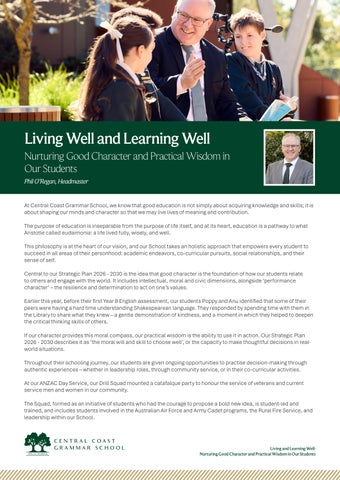
Living Well and Learning Well Nurturing Good Character and Practical Wisdom in Our Students Phil O’Regan, Headmaster At Central Coast Grammar School, we know that good education is not simply about acquiring knowledge and skills; it is about shaping our minds and character so that we may live lives of meaning and contribution. The purpose of education is inseparable from the purpose of life itself, and at its heart, education is a pathway to what Aristotle called eudaimonia: a life lived fully, wisely, and well. This philosophy is at the heart of our vision, and our School takes an holistic approach that empowers every student to succeed in all areas of their personhood: academic endeavors, co-curricular pursuits, social relationships, and their sense of self. Central to our Strategic Plan 2026 - 2030 is the idea that good character is the foundation of how our students relate to others and engage with the world. It includes intellectual, moral and civic dimensions, alongside ‘performance character’ – the resilience and determination to act on one’s values. Earlier this year, before their first Year 8 English assessment, our students Poppy and Anu identified that some of their peers were having a hard time understanding Shakespearean language. They responded by spending time with them in the Library to share what they knew – a gentle demonstration of kindness, and a moment in which they helped to deepen the critical thinking skills of others. If our character provides this moral compass, our practical wisdom is the ability to use it in action. Our Strategic Plan 2026 - 2030 describes it as ‘the moral will and skill to choose well’, or the capacity to make thoughtful decisions in realworld situations. Throughout their schooling journey, our students are given ongoing opportunities to practise decision-making through authentic experiences – whether in leadership roles, through community service, or in their co-curricular activities. At our ANZAC Day Service, our Drill Squad mounted a catafalque party to honour the service of veterans and current service men and women in our community. The Squad, formed as an initiative of students who had the courage to propose a bold new idea, is student-led and trained, and includes students involved in the Australian Air Force and Army Cadet programs, the Rural Fire Service, and leadership within our School.
Living and Learning Well: Nurturing Good Character and Practical Wisdom in Our Students
Our Drill Squad is now supported as a co-curricular activity, making citizenship, service and respect visible to our whole community. These moments – driven by the good character of our students – don’t happen by accident. While each example rises organically from a moment of character in action, we intentionally shape programs and opportunities that nurture the character and wisdom of our students. In Year 6, for example, every student builds a relationship with a buddy from Kindergarten, and in doing so, they learn about the importance of kindness and inclusion. Our Year 6 Friendship Ninjas also lead with these same character strengths on the playground, making sure that every child has someone to sit with and play with, and no one is left out. In Year 8, our students are explicitly taught citizenship in practice as they explore the way their words and actions can advocate for those who are displaced, disempowered or de-voiced, and see how they can do what they can to make the world a little better, safer or kinder. Ultimately, our goal is to produce not only academic high achievers, but graduates who can contribute meaningfully and holistically to society. For our students, it’s these lived experiences and real-time choices that shape who they are and who they will become. Therein, our vision truly comes to life: young people who live and learn well, and are equipped not just with knowledge, but with the character and wisdom to know how to use it well.
Living and Learning Well: Nurturing Good Character and Practical Wisdom in Our Students
Learning Through Every Experience Acknowledgements, Redirections and Everyday Opportunities for Personal Development James Bowles, Deputy Head and Head of Senior School Every day, our students are presented with choices. Some are significant, while others are common: whether to persevere with a challenging task, include a classmate, encourage a teammate, own a mistake, or speak up when something isn’t right. Yet it is often these seemingly small moments that shape the kind of person our students become. Good character is not something that is developed only during dedicated lessons or special programs – it is shaped in the countless moments that make up everyday life. At Central Coast Grammar School, every lesson, every sporting match, every friendship and every leadership opportunity presents our students with a choice as to how they will respond and as educators, our role is to help them to recognise those moments, understand their significance and intentionally grow as a result. In their successes, disappointments, conflicts and service – and yes, even their mistakes – our students begin to shape the kind of person they are becoming and this understanding sits right at the very heart of our Character Framework. Rather than viewing character development as something separate from academic learning or student wellbeing, we recognise that this process is already happening each and every day. As teachers, it is vitally important that we make this learning visible and turn what is often inherently implicit into something explicit. Educational researchers have long recognised that character is developed through repeated experiences, reflection and intentional guidance, rather than through pure instruction alone. Psychologist Albert Bandura’s work on social learning reminds us that young people learn not only through instruction, but by observing the behaviours, attitudes and responses of the adults around them.[1] Similarly, Professor James Arthur argues that character is ‘caught, taught and sought’ – developed not only through instruction, but also through the culture, relationships and everyday experiences within a School.[2] Our School’s Character Framework reflects this understanding by making visible the learning that is already taking place in our classrooms, on our sporting fields, on our stages and throughout our community. Here, teachers, coaches, mentors and parents all notice good character when it is on display and, just as importantly, they name it. A student who persists through a difficult mathematics problem demonstrates resilience. A teammate who congratulates an opponent after losing a match displays respect and integrity. A friend who makes a mistake and seeks to repair the relationship exemplifies kindness and courage.
Learning Through Every Experience: Acknowledgements, Redirections and Everyday Opportunities for Personal Development
When these moments are made tangible via an ‘acknowledgement’, our students begin to recognise that these choices and behaviours are not accidental – indeed, they are a core part of the person they are becoming. Acknowledgements recognise positive contributions, effort, leadership, kindness, improvement and other behaviours that reflect our School values, and can be viewed by parents through the Daily Digest email delivered each day, or on their child’s MyCCGS profile. Our unique Character Framework gives us a common language for these conversations and helps our students to connect their everyday decisions with the broader qualities we hope they will develop throughout their education and beyond. This same philosophy also shapes the way we respond when our students make less wise choices. Rather than focusing solely on consequences or correction, our approach emphasises ‘redirection’ and this choice of word is deliberate. Redirections remind us that, while each of us may occasionally drift from our intended path, repair is always possible after rupture. A redirection is not simply about pointing out what went wrong; it is an intentional invitation for our students to realign themselves with both their own values, and the expectations of our School. Research in developmental psychology consistently suggests that reflection following mistakes is one of the most effective ways for young people to develop empathy and sound judgement and in this way, these moments can become opportunities for growth, rather than simply moments of correction. In their work on the subject, researchers Hattie and Yates identified the significant importance of feedback, error correction and reflection in learning, explaining that mistakes become most valuable when our learners are given opportunities to reflect on them and adjust their future behaviour accordingly.[3] When students are supported to understand the impact of their choices, repair their relationships where necessary and consider what they might do differently next time, they are able to build the good habits that underpin strong character. In this way, acknowledgements and redirections work together and over time, these seemingly minor or everyday interactions will accumulate. We know the impact of these interactions can be profound. This is because character is not formed in a single Character Assembly, academic lesson, or co-curricular opportunity: it is shaped through thousands of conversations and decisions, and guided by caring, expert educators who intentionally help our young people to make sense of these experiences and positively shape the person they are becoming. At Central Coast Grammar School, every day presents new opportunities for our students to reflect, realign, repair and grow, and become young people of good character and practical wisdom who are well-equipped to make a positive contribution to the world around them. Ultimately, our hope is that at the end of their schooling, every student leaves Central Coast Grammar School with the judgement to make wise decisions, the courage to act with integrity and the commitment to make a positive contribution to the community.
References [1] Bandura, A. (1977). Social Learning Theory. [2] Arthur, J. (2021). The Formation of Character in Education: From Aristotle to the 21st Century. Routledge. [3] Hattie, J., & Yates, G. (2014). Visible Learning and the Science of How We Learn. Routledge.
Learning Through Every Experience: Acknowledgements, Redirections and Everyday Opportunities for Personal Development
Where Courage Becomes Character Why Personal Growth Begins Outside Our Comfort Zone Kirsty Watson, Head of Academics and Staffing Years 7 to 12 When we speak about Performance Character at Central Coast Grammar School, we are not only referring to what happens under the spotlight. Rather, we are describing the qualities that enable our young people to embrace challenge, persevere through setbacks, and continue striving towards meaningful goals. Performance Character is one of the four dimensions of our Character Framework, and it encompasses the strengths of courage, resilience and self-awareness: qualities that not only support achievement at our School, but also equip our students to navigate the complexities of life with confidence and practical wisdom. These are the characteristics that help us to persist when something feels difficult, summon the courage to step outside our comfort zones, and learn from our mistakes – rather than fear them. They remind us that growth rarely comes from comfort and certainty; instead, it’s borne from a willingness to try, reflect, and then try again. While these qualities are invaluable for students performing on stage or competing on the sporting field, they are equally important in everyday academic learning. Whether they are fostering a new skill or facing a challenge, Performance Character is evident every time a student chooses growth over comfort, and at our School, we see examples of this every day. It is the Year 3 student who has never spent a night away from home, and yet boards the bus for their first School camp with equal measures of excitement and apprehension. It is the student who once dreaded speaking in front of others, but volunteers to represent their House in a Debating Competition and delivers a rousing, three-minute speech. It is the Language student who refuses to give up on a challenging concept, and instead seeks extra support from their teacher until understanding finally clicks into place. These moments may not attract applause, but they are powerful examples of our character in action. They demonstrate that success is often built long before the final performance or assessment: it is forged through the decisions we make when things become difficult. Importantly, our students are surrounded by expert educators who model these same qualities.
Where Courage Becomes Character: Why Personal Growth Begins Outside Our Comfort Zone
During a recent school holiday break, more than a dozen staff members led students on immersive learning experiences to the Great Barrier Reef and the Daintree, and further afield to Japan and Cambodia. These experiences required careful planning, adaptability and a willingness to embrace the unexpected, while creating opportunities for our students to do the same. When these students returned, they spoke not only of the places they had visited, but of the personal growth they had experienced. They described moments of awe and curiosity, unfamiliar situations that tested their resilience, and experiences that broadened their understanding of the world and themselves. These are the moments where character is strengthened – not through comfort, but through meaningful challenge. Our recent Character in Action Assembly celebrated students who have been intentionally developing dimensions of our Character Framework within themselves, and when reflecting on Performance Character, our Performing Arts Captain Eloise captured its essence beautifully: “As Performing Arts Captain, whether in Dance, Music or Drama, I see these traits of determination, perseverance and self-awareness being fostered in performances, rehearsals and classes – but these qualities only truly develop when we put them into action. “Whether it’s by having the courage to audition for a role, perform in front of an audience, or share an idea even when we fear making mistakes; being resilient enough to accept criticism, learn from setbacks, and return to rehearsals after a disappointing performance or result; or having the self-awareness to recognise our strengths and weaknesses, reflect on our contributions, and understand how our actions affect those around us – these experiences remind us not to judge ourselves solely on whether we win or lose, but to appreciate the journey of living and learning.” Eloise’s wise words reminded us that we should never define ourselves by isolated moments of success or failure; instead, we should value the ongoing journey of learning, growing and becoming. This perspective reflects what educational research has long suggested: that students flourish in environments where expectations are high, challenges are embraced, and mistakes are viewed as opportunities to learn, rather than reasons to stop trying.[1] This philosophy has always been central to life at Central Coast Grammar School. Our mission – ‘Striving for excellence in all endeavours in a happy, caring and supportive environment’ – recognises that excellence is not measured by outcomes, but cultivated through character. Every day, we observe young people as they are imagining ambitious futures for themselves, and then, we are lucky enough to watch on as they find the courage to go out and pursue their dreams. This is why I love being part of Central Coast Grammar School, and it is what makes our community so special. In this way – whether they are on the stage, in the classroom, on a global expedition, or in service to others – I am proud that our students will learn that practical wisdom is developed not by avoiding challenges, but by meeting them head on with humility, heart and hope.
References [1] Martin, A. J., Kennett, R. K., & Pearson, J. (2021). Challenge and threat appraisals in high school science: Investigating the roles of psychological and physiological factors. Educational Psychology, 41(5), 569–590.
Where Courage Becomes Character: Why Personal Growth Begins Outside Our Comfort Zone
Innovating With Wisdom What STEM Teaches Us About Perseverance and Human Potential Hannah Sherer, Head of Science As Head of Science, I often watch students in the classroom stare at a design or investigation that has just failed. For a few moments, there’s silence. Then someone says, “What if we try...” Suddenly, ideas start flying. Problem-solving and critical thinking fills the void left by disappointment. Students test possibilities and work collaboratively to solve the problem before them. As an educator, those are the moments I’m most interested in. Perseverance isn’t necessarily forged when something works, but instead, it’s revealed when students decide to try again. We often tell children to persevere, but STEM [Science, Technology, Engineering and Mathematics] gives them the physical space and permission to practise it. Every redesign is resilience in action. Every test is simply evidence that learning is in motion. Recognising its power to shape character as well as capability, it’s why Central Coast Grammar School has deliberately invested in STEM co-curricular opportunities that will inspire students to take their learning beyond the classroom. Here, every challenge becomes an opportunity for students to develop what our Character Framework describes as ‘practical wisdom’: the moral skill and will to navigate complexity and act well in moments of uncertainty. When a student sits with a failed idea or prototype, they begin to develop a comfort with ambiguity. They learn to emotionally regulate that initial feeling of initial frustration, analyse what went wrong, and use good judgement to determine what to try next. They discover the difference between giving up and knowing when to rethink an idea, and in doing so, they learn that perseverance is not simply about ‘working harder’ – it is about working more wisely. One of the clearest examples of this was showcased during a recent Year 9 Sydney Science Park STEM Challenge. At this event, students were presented with a problem that required far more than scientific knowledge alone: they needed to listen to different perspectives from experts in a given field, weigh competing ideas in their group, adapt their thinking when their initial solutions need to be redesigned, and present a solution that balanced innovation with realworld impact.
Innovating With Wisdom: What STEM Teaches Us About Perseverance and Human Potential
Watching our students grow in confidence as they navigated this uncertainty reminded me that the most valuable outcome isn’t simply the solution they present; it’s the character that’s developed throughout the process. The experience also reminded our students that innovation is not defined by having the perfect answer, but by forming the wisdom to listen, question, adapt, and persist in pursuit of solutions that genuinely improve the world around them. From the natural curiosity we celebrate in our youngest Junior School students, to the complex, real-world challenges we tackle in Senior School, our students aren’t just building models. They are learning to innovate with wisdom. Ultimately, the students who change the future won’t be the ones who never fail; they’ll be the ones who possess the self-awareness and determination to keep improving. In that same way, we don’t create STEM experiences because we hope every student becomes an engineer, mathematician or scientist. We create them because every student deserves the opportunity to discover what they are capable of. In the end, the measure of their education will not simply be the number of models our students built, or the sustainability of the solutions they designed. It will be reflected in the people they become. Human potential is rarely revealed when everything goes to plan. More often, it emerges in the moments when a student chooses to persist, adapt and believe they are capable of more than they first imagined. The careers our graduates will eventually pursue may not even exist today, and if that’s true, then our responsibility as educators isn’t simply to teach them what we already know. It is to help them become people who can approach uncertainty with curiosity rather than fear, who can think critically, collaborate compassionately, and exercise sound judgement when faced with problems nobody has solved before. As Head of Science, my ambition isn’t that every student goes on to have a career in the field. My hope is that every individual leaves Central Coast Grammar School with the potential to embrace challenges, the resilience to persevere through setbacks, and the wisdom to use their knowledge in ways that positively contribute to the lives of others. Perhaps that’s the greatest lesson we can all learn from STEM. It has very little to do with building the strongest bridge or creating the fastest wind turbine; those are simply the vehicles through which something far more important is developed. Instead, it teaches character.
Innovating With Wisdom: What STEM Teaches Us About Perseverance and Human Potential