Does Your Vehicle Need an MOT Test in Nuneaton?
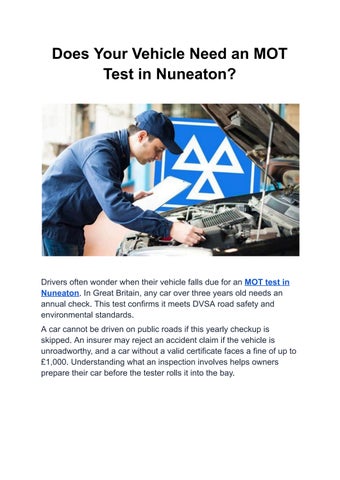
Drivers often wonder when their vehicle falls due for an MOT test in Nuneaton. In Great Britain, any car over three years old needs an annual check. This test confirms it meets DVSA road safety and environmental standards. A car cannot be driven on public roads if this yearly checkup is skipped. An insurer may reject an accident claim if the vehicle is unroadworthy, and a car without a valid certificate faces a fine of up to £1,000. Understanding what an inspection involves helps owners prepare their car before the tester rolls it into the bay.
The Age Rules and MOT Classes for Passenger Cars Standard passenger cars fall under MOT Class 4. The majority of private vehicles, light commercial vehicles, and taxis designed to safely transport people on public roadways fall under this category. Testing is not necessary for a brand-new passenger car until three years after it was first registered. The vehicle must pass an annual assessment every twelve months after that date. If the owner hasn't made significant structural or mechanical changes, vehicles manufactured more than 40 years ago may qualify for a historic vehicle exemption.
How the Car MOT Test Works in the Service Bay A passenger car MOT focuses heavily on structural integrity, tyre safety, braking performance, and vehicle controls. Broken or excessively worn components endanger driver and passenger safety, so examiners closely inspect every critical system.
The examiner positions the car on a vehicle lift. Next, the tester carries out a thorough walk-around and underside inspection. Testers check steering joints and suspension linkages for wear, inspect chassis components for severe corrosion, and examine each wheel and bearing for play or distortion.
Lighting, Signals, and Electrical Systems Many test failures are caused by defective wiring. Most of these problems are discovered early by quick home inspections. To assess headlight aim and ensure the dipped beam does not dazzle oncoming vehicles, the examiner employs an optical beam aligner. Direction indications, brake lights, and auxiliary lamps must all consistently illuminate and display the appropriate output color. Cars must also have a functional horn that emits a continuous tone, secure seatbelts for all passenger seats, and operational windscreen wipers and washers. Standard passenger cars must have every fitted exterior lamp working properly.
Wheels, Car Tyres, and Road Contact Car tyres rely on proper tread and inflation to maintain road grip and water dispersion during rainy weather. The tyre contact patch is crucial for effective braking and cornering stability. Technicians inspect the full circumference of each tyre, hunting for deep cuts, sidewall bulges, or internal cords poking through worn casing rubber. The legal minimum tread depth for passenger car tyres in Nuneaton is 1.6 mm across the central three-quarters of the breadth of the tread and around the entire outer circumference. Examiners also reject tyres fitted with reverse directional tread, damaged sidewalls, or tyres that rub against wheel arches and suspension struts.
Brake Efficiency and Mechanical Wear Car brakes operate through hydraulic lines serving all four wheels. In order to determine the actual stopping effort, the technician puts the car on an automatic roller brake tester. The technology ensures equal stopping force across all axles by measuring overall braking efficiency and balance.
Testers keep a watchful eye out for worn-out or damaged brake disks, degraded flexible hoses, and hydraulic fluid leaks along brake lines. The vehicle fails the test if the brake pads become too thin. To make sure the vehicle satisfies the necessary stopping criteria, drivers who need to replace their brakes should install new parts prior to the test.
The Pre-Test Inspection Checklist A sensible driver runs through these simple checks before taking their car to the MOT test in Nuneaton: ● Switch on the lights and test headlights, full beams, brake lights, and indicators. ● Examine both brake discs for deep ridges, blue heat spots, or loose mounting bobbins. ● Check windscreen wiper blades for splits and top up windscreen washer fluid levels. ● Measure car tyre pressures when cold and verify tread depth meets the 1.6 mm legal limit across all four tyres. ● Ensure all seatbelts fasten and retract smoothly and the horn operates correctly. Addressing these minor maintenance tasks at home prevents avoidable failures at the MOT. Replacing a blown bulb or arranging tyre replacements in Nuneaton, if needed, saves the driver the hassle of a formal re-test.
Conclusion Passing the car MOT test proves that a passenger vehicle satisfies essential safety and environmental standards on the day of inspection. The assessment verifies that the brakes grip, the steering tracks true, and the tyres hold the road securely. Routine home inspections between annual tests keep a car safe, reliable, and compliant with DVSA road standards. Drivers can check centralavenuemot.co.uk in Nuneaton to keep their vehicle on the road legally.