

Contents
2
3
7
9
16-17
18
19
20
21
22
23
25
26
28
29
Inside
Back

FRONT COVER
Juelz Trinidad (11) competes in an event at a track and field meet. Photo by Emma Gugliotta.

EDITORIAL POLICY
The Central High Times is a student-produced publication of the Central High School journalism department. The staff and adviser strive to create an open forum for students and teachers. We take responsibility for accuracy and fairness and for work to be unbiased and responsive to the needs of readers in order to encourage the submission of readers’ ideas. We promise to practice honesty, to run the paper as a business and to avoid printing material that is legally considered obscene, libelous or private.
LETTER TO THE EDITOR POLICY
The Central High Times encourages the submission of ideas or comments from readers. Letters to the Editor must contain no more than 150 words. Letter to the Editor submissions should be typed, printed, signed and delivered to Central High School’s journalism office (room 024) or sent to keodell@spsmail.org with the subject line “Letter to the CHT Editor.” The Central High Times reserves the right to edit submissions for grammatical and spelling errors and for space limitations.
ADVERTISING AND SPONSORSHIP POLICY
The Central High Times has the right to accept, reject or cancel any advertisement at any time. Advertising will not contain any statements, illustrations or implications offensive to good taste or public decency based on the opinion of the Central High Times staff (i.e. any content containing anything racist, sexist or illegal for high school students or violates journalistic principles). Advertisements accepted by the Central High Times staff are not an endorsement from the staff, adviser, administration or Springfield Public Schools District. Advertisements should refrain from attacking competitors unfairly or disparaging their products, services or methods of doing business. If your organization would like to advertise in the Central High Times, or if you would like to provide a financial sponsorship for the Central High Times, please contact the adviser, Kori O’Dell, at keodell@spsmail.org. Sponsorships begins at $25 per year, advertising pricing begins at $50 per issue, and all money raised goes toward our printing budget.
ADVISER Kori O’Dell
CO-EDITOR-IN-CHIEF
Jack Herr & Reese Wood
PAGE DESIGNERS
Emma Lewis & Sarah Greene
ASSISTANT PAGE DESIGNERS
Abbott Schmidt, Avery Rapp
COPY EDITORS
Sarah Greene, Jack Herr, Reese Wood, Emma Lewis, & Ari Abbott
SENIOR REPORTERS Ari Abbott, Lucy
Caplinger, Chloe Wootton
REPORTERS
Maggie Moore, Todd Gao, Abbott Schmidt, Dane Scholz, Reese Wood, Avery Rapp, Olive Eck, Emily Huggins
THE CHT Volume 112 Issue 4 CENTRAL HIGH SCHOOL
423 E. Central St., Springfield, MO 65802 CONTACT keodell@spsmail.org FONT FAMILIES Function, Century PUBLISHER PrintGroup
COMIC
Comic by Avery Rapp.
JACK HERR
CO-EDITOR-IN-CHIEF

SIGNING ON REESE GREETINGS FROM JACK
All my life, the people who have surrounded me—in true bulldog fashion—have exhibited excellence. My parents are some of the most intelligent people I’ve met, my extended family the most genuine, my friends and acquaintances the most colorful and interesting.
They have pushed me to be better in so many ways; for one, the only reason I tried journalism in the first place was because my mom thought it would be a good choice for me— and it was. If a young mind is like a sponge, as they say, then the sponge of my young mind has been saturated with all manner of thoughts, jokes, kindnesses, and inspirations. Perhaps no place has been more essential to my mental saturation than Central.
Through all the activities I have participated in, and currently participate in, I have been guided by the excellence of those older and more experienced than me. Particularly, the senior class of 2026 has done a lot for me in the way of self-improvement. In school and beyond, I’ve learned dedication, humility, confidence, and so many other lessons that are not so easily articulated. I want to express my undying gratitude to not only the class of 2026, but to the seniors who came and graduated before them—I would not be half the person I am today without all of you.
Starting my senior year, I will be stepping into the role of co-editor-in-chief with my peer and friend: Reese Wood. In this editorship, and in my day-to-day life, I want to do my part to try to emulate the excellence of the seniors that will be leaving Central and going off to do great things.
As co-editor-in-chief, my goal for the magazine is to create a timely, enjoyable, and informative publication that the school can be proud of; hopefully doing my part to make the freshmen, sophomores, and juniors behind me laugh a little, pat themselves on the back, or maybe even learn something. I could not be more excited to pursue this goal with the staff that will be joining me next year, writing about a school filled with excellence in academics, athletics, and activities. Reese and I both know that we have big shoes to fill, but as they say, pressure makes diamonds.
“When’s the magazine coming out, Reese?” is a question my best friend, Owen Gray asks me at least once or twice a week. Well, Owen… here you are. The incessant nagging from the likes of Owen Gray, Sam Ferber, Eli Thomas, Ben Garrett, Grant Hudson, and many others has dug deep into my skin. I believe subconsciously, they have pushed me to be better.
My years at Central, starting in sixth grade as a middler, have taught me many things and grown my creativity so much. Some of the things I’ve learned are naturally more useful than others, such as when, in eighth grade, some friends and I created the plot to launch a giant bath bomb with my friend RJ strapped to it into the sun to dye it green. In a broader sense, Central has challenged me in ways I don’t think I could ever be challenged by any other school in the district.
I attribute my education to my parents, as both of them are eternal learners, and both love gaining knowledge. My mom is one of the most quick-witted, sharp people I have ever met; her humor and wisdom are needed to deal with my father. My father, with a degree in philosophy, is the lead for Influence magazine and is genuinely terrifying to argue with because he always knows more than I and will always have another point. They have always pushed me to do better and never shudder or shut me down when I’m pursuing some archaic and weird information, such as the monitor class of warship, or memorizing useless poems and speeches. It would be a shame not to mention my coaches, who have pushed me so much. Joseph “Joe” Price of Central Swim is a great mentor to me. His obsession with history is only matched by mine. Although he isn’t a teacher here at Central, John Collins, the golf coach, has made me laugh harder than just about anyone while teaching me about my favorite sport.
This is my first issue as Co-Editor-in-Chief with my friend, colleague, and peer, Jack Herr. Jack and I have been together for all of our years in Journalism. Starting back in eighth grade, we’ve grown together to not only be better journalists, but more rounded people. Both of us will shine bright like a diamond.
REESE WOOD
CO-EDITOR-IN-CHIEF


Jack Herr and his senior peers on the tennis team. Photo courtesy of Jack Herr.
Reese Wood playing his great-grandma’s accordion. Photo courtesy of Reese Wood.
HISTORY TO STAGE:
RADIUM GIRLS
Central’s theatre troupe performed the historical and educational story of Radium Girls in April of 2026.
“Every time we get ready to show a play, it’s never the same feeling,” Ollie Harden (10) said. “But this one felt amazing. I was so excited to share this with all of our viewers, and I really hope that they enjoyed it.”
Central’s theater presented their play starting April 10th and going through the 13th, with the final day being the student matinee. The play “Radium Girls” was written to inform of events that are often overlooked in history, but have impacted real people.
“These plays are fun to produce, and you pick up what we are putting down, you know?” theatre director Amanda Boes said. “So why not make it informational? This is not something that you just learn in your history class; this is a lesson you would have dove deep into the books to learn about. That’s what we should be showing you.”
During World War One, the need for visible watches increased because of the dark trenches. More than 4,000 women were hired as painters for glowing watch faces using “Self-Luminescent” paint.
“Nobody thinks of the immediate danger this has progressed into,” Boes said. “These women affected were kind of just pushed under the rug by everything else going on in the war.”

REPORTER
In the modern era, Radium is considered a danger rather than a miracle. In the early 1900s, nobody knew the risks. Radium was seen as a cure-all; people thought it could make one look younger, cure cancer, and be used to make paint glow.
“The importance of the play, I think, goes further than just a performance or entertainment,” Grace Meyer (12) said. “The story of these girls is so covered and unheard of. I’m glad I get the chance to be a stage manager and immerse myself in history.”
The adhesive and radium mixture causing these watch faces to glow was extremely toxic, creating effects like “radium jaw” or, scientifically, bone necrosis– rotting of the bone, infection, sores, tumors, spontaneous fractures, and many more symptoms.
“I was the makeup manager, and I had put together all of the prosthetics and everything,” Ash Downer (10) said. “I wanted to make sure everything was perfect. I knew that the audience wouldn’t see all of the details, like in Act 2, Paige [Kathryn Schaub] had to wear a prosthetic, and it was made to look like decay caused a wound capable of seeing her teeth could be seen through her cheek. That’s the detail that matters.”
“Lip, Dip, Paint” was the method taught to these young women while working for the United States Radium Corporation. This encouraged them to put their brushes in their mouths when painting, meaning they would directly ingest the radium. This essentially guaranteed the effects of radium poisoning.
“I can’t believe the depth of this story,
we have read so far into this, and as a stage manager, I myself feel so in doubt with the situation,” Meyer said. “There are some sad scenes to watch, and some really interactive ones too, but no matter what, there is still this deep and hollow feeling provided by the history involved.”
Grace Fryer and Kathryn Schaub are both names that come up often while speaking of the radium girls. Both women’s names have made their mark in history along with many others. Grace Fryer, portrayed by Sylvie Hudson (12), is the leader of an entire movement towards workplace regulations, safety, and women’s rights.
“Taking on this role was very interesting, but in a good way,” Hudson said. “Grace Fryer was a flexible character. I was able to connect with myself and my morals. It’s always awesome to be able to do that, to feel fully involved with someone you are portraying.”
The radium movement, led by Fryer, led to many rights being installed in the workplace. Occupational disease laws, safety agencies and standards, corporate accountability and ethics all came out of the movement, forcing companies to be more responsible for employees.
“I’m so grateful knowing now that there are rules put in place to prevent this, but I put myself in Grace Fryer’s shoes,” Hudson said. “I’ve made her my own character for the last couple of months working on this place. It’s horrible that anyone would ever have to suffer like this, to have their death lied about, and to settle for compensation. Grace Fryer, along with the other women, was a fighter. They deserved better.”
MAGGIE MOORE
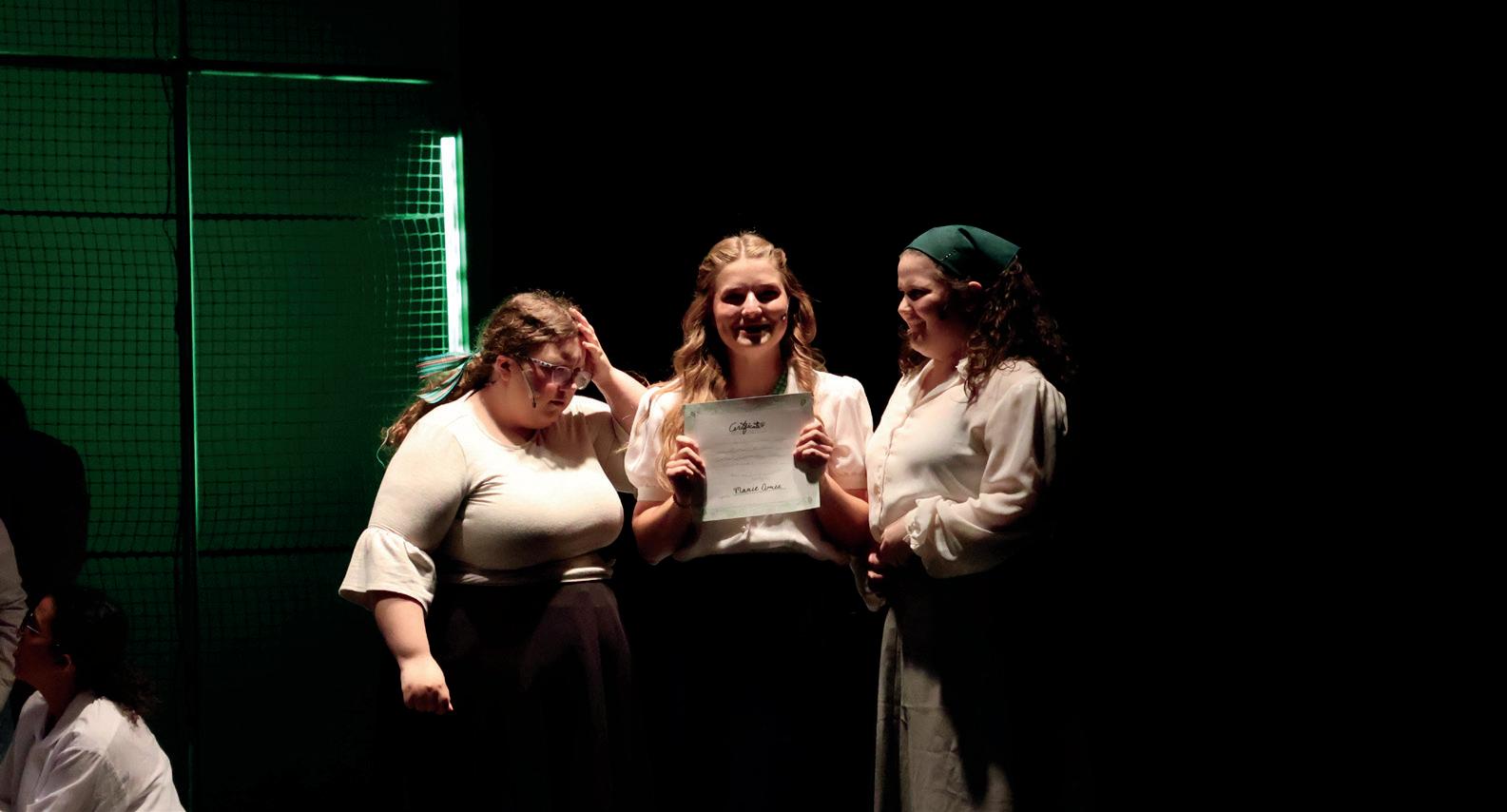
Sylvie Hudson (12), Paige Conner (10), and Kat Seaton (12) perform as Grace Fryer, Kathryn Schaub, and Irene Rudolph.
Sylvie Hudson (11) and Deon Tichner (12) perform a tense argument. Photo by Julia Matson.
WELCOME TO NEW YORK
Springfield Youth Symphony (SYS), a musical ensemble based in Springfield, will be going on a five-day trip to New York City, including an opportunity to perform at Carnegie Hall. Out of the 80 students who participate in SYS, 20% attend Central. For many, this trip offers a chance to improve as a musician and performer.
“Going to any clinic you are going to learn things about being in an ensemble and meet people who have been doing things much longer than you have,” Rylan Thompson (11), SYS trombonist, said. “You learn from being around people who know more than you and asking them questions.”
Thompson has played in SYS since her freshman year. For many, music is a field that requires commitment and time management. Colin Andrews (12) is a bass principal— equivalent to a captain for the bassists at SYS— yet participates in a host of other extracurricular activities. For Andrews, commitment to music is something that extends beyond high school.
“I participate in Central’s HOSA chapter, I’m on Central’s tennis team, and I participate in other community ensembles in and around Springfield,” Andrews said. “I’m definitely interested in a career in music, I’m not 100% sure that’s what I’ll do but it’s definitely an option I’m open to.”
A trip to Carnegie Hall allows performers to see a profession in music as it is actually lived.
“This trip specifically is very good for broadening your perspective—seeing what the real world of music looks like,” Andrews said.
The trip will culminate with a performance at Carnegie Hall, but there is much to be done before that.
“It’s like a clinic,” Thompson said. “We go there on day one and we play for the other groups and the people who are going to be doing masterclasses for us. After that, the next few days, we do clinics so they can help us get better at our pieces and learn things. Also, we are going to be doing sightseeing—we’re going to go watch Hadestown on Broadway which is pretty cool.”
To some, such an opportunity came as a shocking, pleasant, surprise.
“I was amazed,” Andrews said. “She didn’t tell us about this. I wasn’t waiting for a ‘Yes,
we’re going’ or a ‘No, we’re not.’ All I got was a ‘We’re going.’ That was very surprising.”
SYS was selected to perform because of an exhibited level of excellence by the group. In order to learn enough to achieve this level of excellence, Andrews feels that one must step out of their comfort zone. Andrew feels that attending Central helped him to embrace new ideas.
“I think Central has taught me to be very open-minded, which I think is huge in music,” Andrews said. “I think some people—especially in music—have grown up with one specific thing, taking lessons in one specific way, and they think that everything is just that one way. I think Central has really taught me to not think like that.”
Thompson enjoys participating in SYS and seeing what others have to bring to the table.
“I think my favorite part about [SYS] is playing with people I normally wouldn’t get to play with,” Thompson said.
Thompson points to SYS teaching her lessons about life, especially in the avenue of interpersonal communication.
JACK HERR
CO-EDITOR-IN-CHIEF
“I’ve definitely learned about teamwork— working together with other people to create this beautiful, amazing, sound,” Thompson said.
Collaboration between classmates and across schools alike produces a nationallyrecognized final product.
“We submitted a recording of our concert last year to this competition, and we were one of the ensembles chosen to perform,” Andrews said. “I feel very proud. It’s exciting to bring a group from the middle of Missouri, which you might not expect for this sort of thing, and go and play on one of the biggest stages in the entire world.”
Thompson echoes Andrews’ sentiment that this trip is special, in part, just because of the stage that one gets to perform on.
“It does feel awesome to just be able to go there,” Thompson said. “Unless you’re Brayden Miao, you can’t really say you’ve gotten to play at Carnegie Hall. Just being able to go there and have a program from Carnegie Hall with my name on it is just going to be so awesome. That will be a keepsake I’ll keep forever.”

The New York Skyline. Photo courtesy of Colin Andrews.
THE ROAD TO NATIONALS
REPORTER ABBOTT SCHMIDT
In 2026, numerous activities at Central have qualified to participate in national competitions. This year features many national competitors for Central, including Scholar Bowl, Future Business Leaders of America, Family Career and Community Leaders of America, debate, Health Occupations Students of America, and DECA. These national qualifiers have won their events to qualify for competition at the national level against other national qualifiers students from all over the United States.
“Being a national qualifier, I think first and foremost for everyone, it’s a very exciting feeling,” Zain Saquer, national qualifier in FBLA and junior president of the Central chapter of FBLA, said. “But I think with that thrill comes a level of intimidation to it.”
National competitions are a medium for competitors to show off their skills and talents to a large audience. The International Career Development Conference is a national competition for DECA students.
“For most students, the goal is not to just qualify for ICDC; the goal is to get on stage at ICDC,” Kevin Buening, Central DECA advisor, said. “Being a finalist or a top test/role-play/presentation is an extremely impressive accomplishment as these students are competing against the best students from around the world. To do this, students need to be diligent in preparation, have a positive mindset, and be willing to do more than their fellow competitors!”
Many national competitions require students to study and prepare before the event. Beyond the time and dedication required to succeed at the state level, being a national competitor requires the skills to stand out from the crowd.
“Presentation and speaking skills, being able to talk in front of a judge,” Michelle Harrison, Central FBLA advisor, said. “A lot of what gets judged is, what does it look like? What’s the showmanship? How professional does it look? Does it have any extra special bells and whistles that you added to your presentation? How do you stand out? Because the topics are the same for every kid, and so you have to make sure that the judge notices you.”
One strategy that Saquer recommends is sticking to one’s strengths and interests on the national stage.
“I THINK WHAT SEPARATED ME IN THE PAST IS MY GENUINE PASSION FOR THE EVENTS THAT I CHOOSE,” SAQUER SAID....
“So I never choose events that are something that I haven’t worked with before. I always choose something that’s related to programming and I’ve been into this for so long and I have such like a deep skill for it that people who just randomly choose it and decide they want to learn a new thing, it’s like it’s good for them, but I feel like I have the clear leg up because I chose something that I have a strength in and I chose something that really fits me, something that I enjoy doing, something that I have expertise in.”
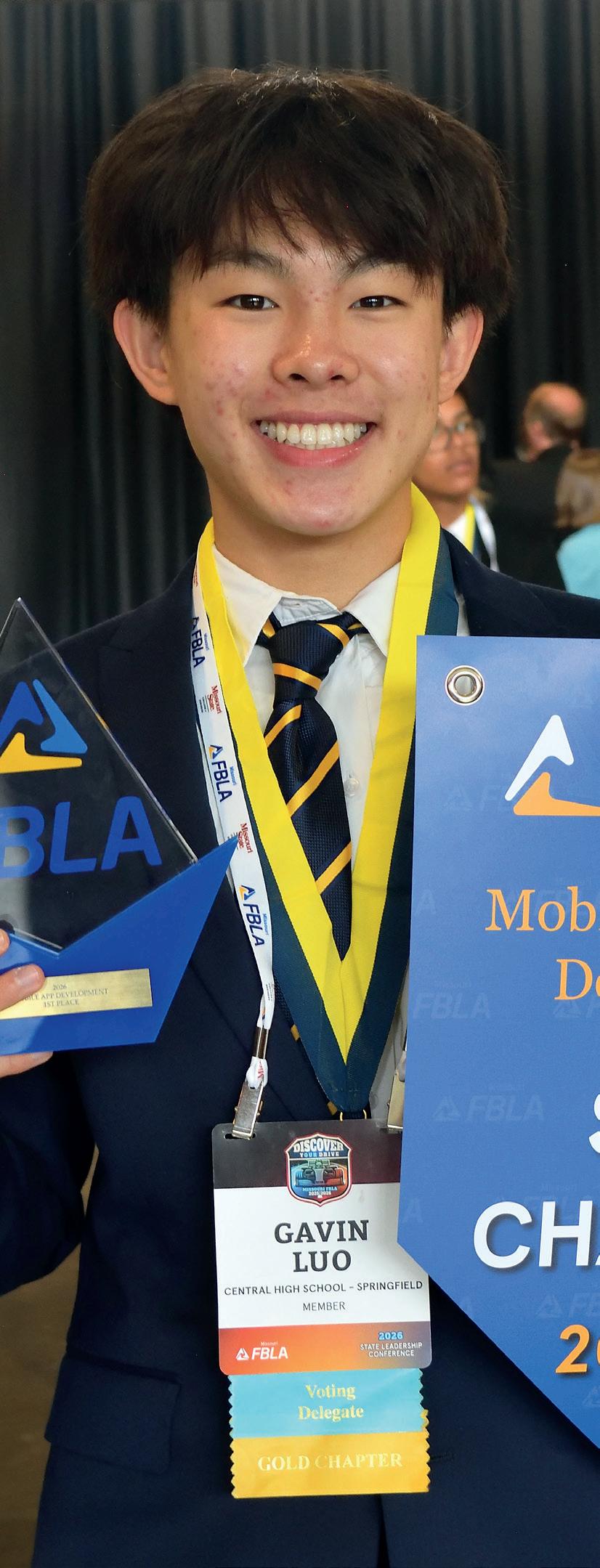

Gavin Luo (11) at the FBLA State Competition. Photo by Bijayesh Pradhan.
SPEECH AND DEBATE
SARAYU BANDARU
LUKE DOUGLAS
ERICA FERNANDEZ
GRANT HUDSON
AUGUST KLEIBOEKER
EMMA LEWIS
SOPHIA TOTH
RJ VANANTWERP
DECA
JESICAH ALLEN
TRISTAN ARMSTRONG
KWAKU ASARE-BAWUAH
MAX BROWN
NAOMI CRUZ
BACH DAO
SYLVIE HUDSON
CARMEN KHAUL
GAVIN LUO
IMANI LWALI
WILL MUSGRAVE
YOHANN OGHLAKIAN
ZAIN SAQUER
OWEN SMITH
SOPHIA TOTH
MOHAMED WELAYA
RYAN WINSTEAD
DAVID WOODMAN
ISEF
YOHANN OGHLAKIAN
SUMEDH REDDY
FBLA
KWAKU ASARE-BAWUAH
DHRUTI BANDARU
JATHIN BANDE
IVY DANG
ANDREW DAVIDSON
NADIA FINAN
MILLIE HAWKINS
GRANT HUDSON
ETHAN JOHNSON
CARMEN KHAUL
EMMA LEWIS
PHOEBE LIN
FINLEY LOETHEN
GAVIN LUO
IMANI LWALI
JOSHUA LWALI
DAVID MCDOWELL
YOHANN OGHLAKIAN
TONY PHAM
BIJAYESH PRADHAN
SUMEDH REDDY
SANIA REHMAN
ZAIN REHMAN
ZAIN SAQUER
AJ STANFIELD
MOHAMED WELAYA
HOSA
AUDREY GAO
MADISON GONG
SUMEDH REDDY
ZAIN REHMAN
AIME
LANIE DENG
SUMEDH REDDY
MATH LEAGUE
BRANDON APARICIO
JATHIN BANDE
KRITI BANDE
LAURALEIGH BOWSER
ANDREW DAVIDSON
LANIE DENG
ETHAN ETHRIDGE
AUDREY GAO
TODD GAO
ANGELO GARCIA
EZEKIEL HITCHCOCK
KAEL HITCHCOCK
BRAYDEN MIAO
JJ MYERS
GIANNA OGHLAKIAN
BIJAYESH PRADHAN
NOAH SCHOOLCRAFT
TIGERLILY WANG
JACK WEGRZYN
FCCLA
LYDIA DAVIS
MAYA MURDAUGH
EMILY NEAL
SAGE THIEMAN
ALEX TRIEU
RYAN WINSTEAD
USABO
SUMEDH REDDY
National competitions allow talented students to compete against similarly capable students. This can be daunting but also exciting for students.
“Obviously, it’s very difficult to have to go up against the top people from every state, 50 states, and top people from other countries like China and Canada having to compete against them,” Saquer said. “It’s going to be this really fun challenge for everyone to put their skills up against everyone else, see who can make finals, and see who can really get up on this national stage and be the best in the world at what they do.”
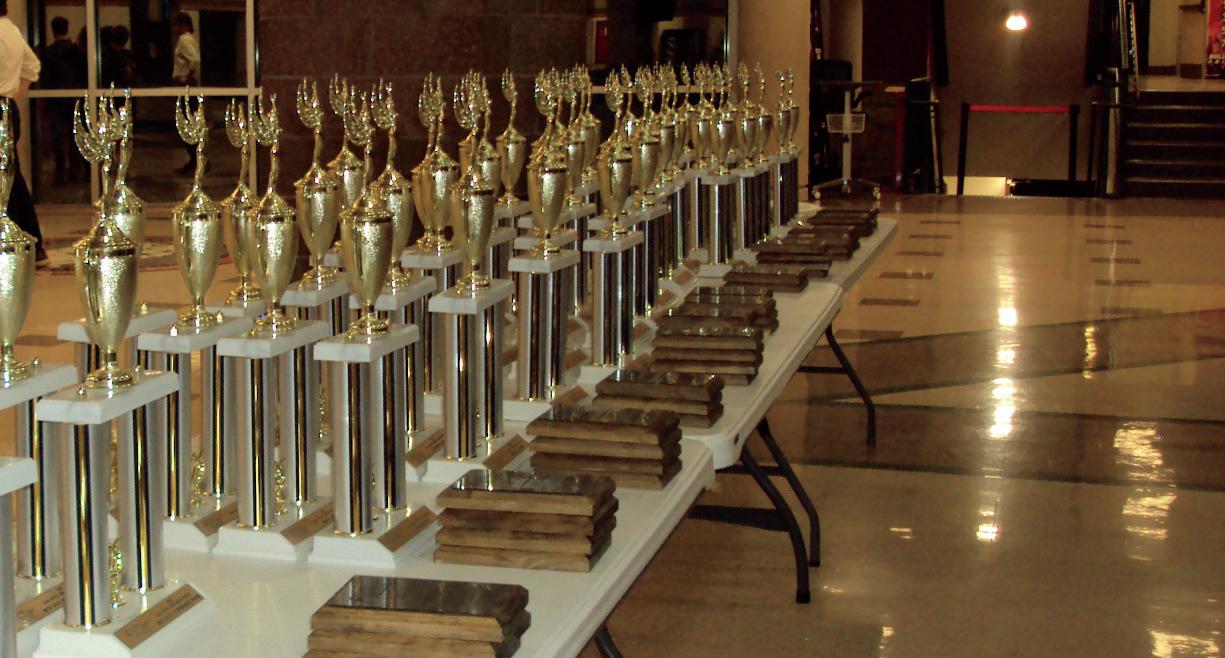
Trophies at the Speech and Debate Ozark District Tournament. Photo by Emma Lewis. by
DANE SCHOLZ
REPORTER
REPORTER
ARTIFICIAL INTELLIGENCE IN 2026 SORA AI INSTAGRAM LAWSUIT SURVEILLANCE
Open AI, one of the biggest Artificial Intelligence companies, shut down their video generation platform, Sora AI, on April 26, 2026. Those who know about Open AI may have seen how much hype was generated around the 2.0 version of the platform by Open AI when it launched on September 30 of 2025. Despite the excitement, the platform also generated significant controversy for its potential to generate incriminating footage of any person, and its use of training data from public recordings.
“I don’t support Open AI’s technology because I believe that it is harmful for artists as well as the environment,” Lee Bowser (10) said.
The platform’s shutdown has been predicted by some to create large ripples in the AI industry. There has been more and more discussion around the popping of the AI bubble due to the increased financial strain of server costs and new innovation. It has also made waves in other companies like Disney, with them and OpenAI making a billion dollar deal shortly before the announcement of the shutdown, and backing out of all relations after the shutdown was announced.
“Ultimately I think that the shutdown is a good thing, because it removes purpose from the creative process of human created art,” Bowser said.
Even though the shutdown of Sora AI has created a massive impact, OpenAI has insisted that it is not the end of their creative endeavors. There have also been many platforms popping up that have similar video generation functions like Sora AI.
“I think that people who use AI will still find other platforms to use for this type of content,” Bowser said.
On March 25th, 2026, Facebook and Instagram’s parent company Meta was ruled guilty for negligence in their moderation in a New Mexico state court. The court decided that the content pushed by Meta’s algorithm on apps like Instagram are harmful to underage users of the app, due to the addictive feedback loop of dopamine that short form content creates.
“Social media definitely contributes to some mental disorders within teens,” James Spaur (10) said. “It’s designed in a way to give a quick dopamine hit in a way that keeps you addicted to their services. In the past the issue wasn’t as bad, but in the current day it’s almost certainly designed to keep kids using the platform so companies can make more money from advertising.”
The result of the trial against meta lawsuit was a 4.2 million dollar fine for meta, combined with a 1.8 dollar fine for Google due to similar problems with YouTube’s algorithm. Additionally, the company was found liable for the compensation of 75,000 individuals, the cost of this for Meta totaling around 375 million dollars.
“Social media companies aren’t implementing solutions that work in actually effective ways. Guidelines aren’t enforced in a way that helps,” Spaur said. “For example, I see a lot of hateful content being made that goes against guidelines that still isn’t taken down by platforms. This contributes to the way that social media platforms affect teens, and social media platforms should be held accountable for it.”
Artificial Intelligence has been a point of contention for many people for the last several years. Generative AI has made many people think differently about art and worry about the future of some mediums. In recent discussion aboutAI, focus has shifted to a discussion over the use of AI in surveillance.
“I think that AI surveillance will be harmful for general life based on the ways that surveillance has already been used in places like China to spy on citizens,” Eli Johnson (11) said. “As well as the way their government has used it to oppress their minority population.”
Many people in the US have had concerns on the potential for AI surveillance use on the Internet. Other governments like the United Kingdom have already placed laws around monitoring Internet activity, and AI has the potential to do the same on a greater scale.
“I don’t think that AI surveillance will impact me right now, but it has the capacity to impact me and others in the future,” Johnson said.
Some groups have claimed that AI surveillance is a net positive due to its potential to minimize online crime and the spread of misinformation. Other groups like the Department of Homeland Security have argued that the positives offered by AI surveillance over the Internet are not worth the trade-off of the freedom of privacy, online and offline.
“I care about this issue because I believe that everybody has a right to privacy,” Johnson said. “And if AI surveillance becomes prevalent in the United States it would fundamentally go against our rights to privacy.”
VOTING RIGHTS GUTTED?
GUTTED?

On April 29th, the U.S. Supreme Court issued a 6-3 ruling in Louisiana v. Callais, changing judicial application of the Voting Rights Act. The case, which ruled on the constitutionality of Louisiana’s redistricting process, will hold impacts far beyond one state; the precedent may shape Missouri’s current redistricting controversy.
“Regarded as the legislative crown jewel of the civil rights era, the Voting Rights Act was enacted as a comprehensive tool to undo the political hold of Jim Crow policies in the South,” Harvard Alumni and political scientist Kareem Crayton said. “The law fundamentally opened opportunities for Black and brown communities to participate in all aspects of the political system on an equal basis.”
Though passed over 70 years ago, the Voting Rights Act remains the subject of great examination. In 2022, for instance, Louisiana was divided into six voting districts, with only one being majority black. In the case of Robinson v. Ardoin, plaintiffs argued that this limited representation for Black voters, who made up a third of the state; Section 2 of the Voting Rights Act was the foundation for their claim, which the circuit court voted in favor of.
“The map that Louisiana drew in 2024 created a second majority-Black district,” Founder and Reporter for SCOTUSBlog Amy Howe said. “A group of ‘non-African American’ voters contended that the 2024 map violated the Constitution’s equal protection clause by sorting voters based on race.”
The federal court agreed with the plaintiffs, rendering the 2024 map unconstitutional and halting its use in elections: a move that protected the seats of Louisiana Congressman and Republican Speaker of the House Mike Johnson, as well as Republican member of the House Appropriations Committee Julia Letlow.
This year, the Supreme Court affirmed the previous decision, ruling the drawing of two majority black districts unconstitutional.
“Allowing race to play any part in government decision-making represents a departure from the constitutional rule that applies in almost every other context,” Justice Samuel Alito said in the majority opinion. “The time has come to resolve whether compliance with the Voting Rights Act can indeed provide a compelling reason for race-based districting. We now answer that question.”
Critics argue that the decision ignores the lasting legacy of racial discrimination in the United States. To dissidents like Justice Elena Kagan, the decision was based on securing Republican seats in Congress rather than genuine concern for discrimination toward non-African American voters.
“The same districting practice – really, hinging only on the partisan ambitions of state legislatures – could destroy most of the majority/minority districts that in the past 40 years the Voting Rights Act created,” Kagan said in the dissenting opinion. “The Callais requirements have thus laid the groundwork for the largest reduction in minority representation since the era following Reconstruction.”
While some believe that the new ruling makes it difficult to advocate for proportional representation of minority groups, Missouri Sen. Josh Hawley argues that the case only means more justification is needed.
“I think today’s ruling makes it pretty clear that if you’re drawing congressional districts on the basis of race, you better have the tightest of justification,” Hawley said. “It better be absolutely directly necessary. It needs to have a remedial effect. The court really tightened up the criteria by which you could use race or the circumstances in which you can use race.”
EMMA LEWIS REPORTER
IMPACTS ON MISSOURI
The decision’s shifted scope of Voting Rights Act protections could fundamentally change redistricting processes throughout the country, including Missouri. The case is especially relevant to the state’s 1st Congressional District, whose 2022 lines were called unconstitutional racial gerrymandering by Attorney General Catherine Hanaway’s office.
“Racial discrimination has no place in drawing congressional maps,” Hanaway said. “We filed a brief in support of Louisiana’s case to fight for equal treatment under the law. [The Supreme Court] made the right call.”
Denise Lieberman of the Missouri Voter Protection Coalition believes the ruling makes it easier for politically motivated decisions based on race to survive without meaningful opposition.
“It’s unlikely that those district lines can change before this year’s elections, but that doesn’t mean that the rights of these voters are not impacted going forward,” Lieberman said. “And what today’s decision does is green light gerrymandering and splitting up of those districts, diluting the ability of communities of color to elect candidates of their choice.”
Congressman Wesley Bell, the current representative of Missouri’s 1st District, hopes to prevent the legislature from challenging the 2022 map.
“The more I read today’s decision, the more concerned I am for how this could severely impact the American people’s fundamental right to vote and have a voice in our democracy,” Bell said. “Our civil rights leaders fought and continue to fight tirelessly to ensure this country’s past sins do not define our future. And now we’ve taken a huge step backwards.”
In the face of the decision, civil rights activists throughout the country say the situation is not hopeless. In an emergency statement, NAACP President and CEO Derrick Johnson called upon voters to continue efforts to preserve democracy.
“The Supreme Court betrayed Black voters, they betrayed America, and they betrayed our democracy,” Johnson said. “But the people still can fight back. Our best defense and offense is the ballot box, and we’re going to turn out voters for the midterm elections to make sure we can elect representatives who look out for us.”
Justices of the U.S. Supreme Court on October 7, 2022 in Washington, D.C. Photo courtesy of MS Now.
TODAY. STEP INTO TOMORROW

Your
first choice for college starts here!
AFFORDABLE EDUCATION
STEADY SUPPORT FLEXIBLE OPTIONS REAL RESULTS

to explore our programs, find out more information and to apply! Scan the QR Code

TENNIS
SPOTLIGHT
TODD GAO REPORTER
BULLDOGS ON THE COURT
LUCY CAPLINGER
SENIOR REPORTER
Sumedh Reddy (10) is a member of the boys’ tennis team, demonstrating consistent determination from a young age and achieving awards on the varsity tennis team.
“Sumedh Reddy is an amazing leader, with amazing skills,” Madan Katangur (10), a member of the team, said. “His serve, forehand, backhand, volley, slice, dropshot, and even his returns are all perfect, and he strives to help others.”
Reddy started playing tennis at a young age and has continued to pursue his tennis career in high school.
“I first started playing tennis when I was given a racket for my seventh birthday, and I have been playing ever since,” Reddy said.
Reddy believes that tennis is a place where he can fulfill his ambitions in an environment that is separated from the usual schoolwork.
“In my opinion, tennis is a lot more than an extracurricular. It’s something unique from school work, and is something that I poured my heart into.” Reddy said. “I hope that I can assist others to be ambitious in tennis as well.”
Reddy believes that one of the most important traits in life is perseverance, and it is one of the aspects that has helped his tennis career.
“I think perseverance is an important trait for tennis players because nobody is perfect, and wins every single match they play,” Reddy said. “I think learning from those losses helps you become a better player.”
This year’s boys tennis team has had a tightknit community which has served as inspiration for the players to do their best.
“The Central Tennis Team is unique, especially this year more than last year in that we are more of a team.” Cruz Rahmeyer (9) said. “Yes individual results matter, but this year we encourage each other more and put every match at high importance, not just your own individual match,”
The team has made a valiant effort to show up and show out to support their teammates.
“We’re always yelling encouragement to each other and supporting each other’s courts,” Rahmeyer said.
The team has not only gotten closer as players, but also connected deeper off the court. “A way we always like to connect as a team is our Panda Express runs,” Yohann Oghlakian (10) said. “It’s always a good time to go and eat while laughing and talking and just enjoying the team. On the court it’s much of the same.”
Oghlakian sees tennis as a personal passion of his, where he pushes himself to work harder to be a better player; the sport gives him an ambition that school can not.
“Being academically driven sometimes feels like it’s not your own goal, but one you have to do to make or break your life,” Oghlakian said. Tennis is a personal goal that I want to improve, get better, and eventually win which makes it more fun and enjoyable.”
As an underclassman, Rahmeyer has made a special effort to connect with his teammates outside of tennis.
“I have connected with my fellow teammates by hanging out with them outside of school, playing tennis with them, and with other number one tennis kids from other schools,” Rahmeyer said.
Being on varsity as a sophomore has given Oghlakian room to grow with the older players, and has given him challenges that make him better at the sport.
“Being an underclassman on Varsity is always fun because you get to grow as a player really quickly as you can challenge yourself against the older kids.” Oghlakian said. “You always learn more from losing, and as an
underclassman that happens a lot, so it’s nice to be able to progress quickly.”
Being on the tennis team inspires unique emotions within the players, because the sport can be both fun and difficult.
“I take tennis very seriously for my personal goals but I always try to be as lighthearted and fun on the court.” Oghlakian said.
“I’m generally a serious player so in a match I won’t be too vocal or obvious about what I’m thinking, but outside of matches I try to bring up the environment.”
While tennis offers both singles and doubles matches, having a team that supports each other positively impacts the players, and encourages them to do better.
“Tennis is at its roots an individual sport while you’re on the court, but having a team when you’re off the court compliments your play in a way that you alone probably can’t do,” Oghlakian said.

Sumedh Reddy (10) runs around to his forehand. Photo by Lucy Caplinger.
BOYS ON THE MOVE
This year, track and field starts the season with a new head coach and a new approach to competition. This season has seen an increase in the number of athletes on the team, which leads to new possibilities and unique challenges.
“It’s kind of a fresh start,” Ronald Timm, varsity track and field athlete, said. “We have a very young coaching staff. I think the oldest coach we have is 32. So it’s a lot of new talent and a lot of just getting into a routine and understanding how things work.”
The track and field team also has a group of new team members to match the young coaching staff.
“A main difference I see this season is the youth movement we have going on, particularly on the girls team,” Jake Burch, head coach of the track and field team, said. “We have more underclassmen out for track this year than at any point in the last 4 years, and the team as a whole is the largest it has been in that time. Additionally, we took a 40 athlete team overnight trip right after spring break, which hasn’t been done with the track program in at least 15 years.”
This track season has brought in more members than previous seasons, which makes for a larger team and a more competitive

varsity, but can lead to unique challenges.
“I think a major component is just our size,” Timm said. “We’re so much bigger than we were last year. So our JV is always winning. And we have a very competitive varsity. But really, I think the big achievement is how big we are. It’s actually become an issue that we can’t take everyone to some of the JV meets.”
The large team size isn’t the only difficulty for track athletes, though. Managing sports and school is especially difficult this season.
“The main difficulty with track is the meet

schedule,” Burch said. “It’s not nearly as structured and rigid as cross country, so one week you could have a meet on Tuesday and Friday, and the next week you have a meet on Monday and Wednesday.”
The sporadic scheduling can make it difficult to juggle grades with track and field meets. Members have to leave class for meets often.
“One thing our athletes struggle with is missing class for meets,” Burch said. “Oftentimes, their last block class is the one that is missed for the bus. Keeping up with school work can be a stressor.”
School assignments aren’t the only challenge for athletes. Different track and field events require different skills and mindsets.
ABBOTT SCHMIDT
REPORTER

Knowing your event beforehand can change how you prepare.
“I think the big thing, especially for distance running, is paying attention to pacing,” Timm said. “It’s a lot different than cross country because cross country is always an all-out effort. You go, it’s always the same distance. But with track, it’s obviously different distances. So I’m running from eight to two laps. So you have to kind of figure that out ahead of time. I think it’s the same with sprints. But it’s a lot of that. It’s a lot of paying attention to call times. The way you eat, you have to pay attention to that a lot because if you eat at the wrong time, getting cramps or being hungry during your event, that’s not good. Hydration is a big thing. But really, it’s all about timing more than anything.”
Although track and field can be difficult or complicated to get into, Burch recommends trying the sport, no matter your current skill level.
“I would recommend that anyone new to track be open to trying different things and to do their best,” Burch said. “People rarely are ‘good’ at track naturally with no practice. Virtually anyone that has succeeded on our teams has done so because they have a positive mindset, work hard, and have the discipline to show up consistently.”
Logan Canada (12) runs with baton in hand. Photo by Emma Gugliotta.
Tre Green (12) and Logan Canada (12) begin a race.
Photo by Emma Gugliotta.
Trey Thomas (10) races. Photo by Emma Gugliotta.
TRACK
SPOTLIGHT
EMILY HUGGINS REPORTER
Jesi Allen (12) joined the Central track team her freshman year of high school. She participates in multiple events: 100 meter, 4x100, 4x200, and long jump. Allen continued to run track after her freshman year because she was determined to get better and succeed in her events.
“What motivates me to do track is the passion I’ve gathered for the sport over the years and the coaches and teammates around me, supporting me,” Allen said.
Allen thinks that doing track requires a lot of dedication and self-discipline.
“I’d say the hardest part of girls’ track is trying to develop better self-discipline to work hard even when I don’t feel like it,” Allen said.
For Allen, doing track requires practice and hard work to do well. This work pays off in the form of personal accomplishments.
“My greatest accomplishment would be finally getting a personal record in long jump and getting first place at open house,” Allen said.
Track isn’t just an individual sport, but also a team sport that has a community.
“One thing I love about track is how supportive and kind the track community as a whole is,” Allen said. “I’ve made so many friends at track meets.”
Allen says that track is about running, but also about helping each other improve.
“The easiest part of track for me is being a leader and supporting my teammates when they succeed,” Allen said.
The track team brings chances to meet new people. For Allen, a lot of joy comes from participating.
“I think that track is such a fun sport that anyone can do,” Allen said.”and I’ve gained so much from being in the program for the last four years!”
GIRLS ON THE RUN
EMILY HUGGINS
REPORTER
The girls track team enters the 2026 season following a 2025 season where the team broke four different school records.
“We have continued to grow in numbers on the girls’ side and are a very young team with a lot of raw talent,” Katie Miller, assistant coach of the girls track team, said. “Returning runners Victoria Li and Rachel Lee have continued to lead this team to the start and finish line.”
The track team travels for competitions and sometimes has time for other fun activities.
“During our travel day, we squeezed in a visit to the St. Louis Zoo and a pre-meet run through the WashU campus,” Miller said. “Our team also got to watch one of our Central track alums compete on the collegiate level. This was a great experience for the entire team because they got to see where commitment and hard work in athletics lead to after high school.”
For Miller, success at meets and tournaments takes a backseat to the importance of the process—practice and sacrifice for the sport.
“Our team trains so hard throughout the year and sacrifices much of their time because they love the sport,” Miller said. “I personally see race day as a celebration of that hard work, regardless of the outcome”
The track girls team works hard to be better, they practice a lot and always try to improve. But the team also has a lot of fun.
“My favorite memory so far this season is the conversation and laughs shared on the bus
ride back from the overnight meet,” Coach Burch, head girls track coach, said. “Including breaking down in Cuba and being stranded for about an hour after a long weekend at the track.”
The girls’ track team’s biggest competitors are other local schools such as Kickapoo, Glendale, Ozark, and Lebanon. They are dedicated to beating the other schools.
“There is always great competition in running, no matter where you go,” Miller said, “Though I think we have one of the most competitive programs right now, when it comes to middle- and long-distance running, there will always be fast runners.”
In track, there will always be competition in the form of the other runners. Competition can bring anxiety.
“Though I understand the nerves and pain that are to come,” Miller said. “When putting yourself out on the line and giving it your all on the track, there always remains a feeling of joy.”
For Burch, a great joy comes from watching the athletes he coaches improve.
“It feels fantastic watching our athletes continue to get better every week,” Burch said. “Winning, breaking school records and getting medals are very nice, but there’s nothing like watching an athlete become a runner and push past barriers that they previously thought were impossible.”

Jesi Allen (12) in flight while competing in the long jump. Photo by Emma Gugliotta.
GIRLS MAKING GOALS
OLIVE ECK
REPORTER
Central’s girls’ soccer team has worked hard this season, and winning each game is very exciting for each teammate.
“It is so exhilarating,” Leah Squibb (9) said. “I’ve ended a couple of the games, and just being able to end and run off, and all the people like, come run towards you and jump in a circle. It’s like the movies, it’s so fun!”
Maisie Rockne (9), another varsity team member, agrees that it feels amazing to win a game.
“Everyone is screaming and hugging,” Rockne said. “Knowing that we accomplished something as a team and all of our hard work paid off is amazing.”
Squibb describes the team as a focused community that is always there for each other.
“When we’re serious, we’re serious,” Squibb said. “But when it’s fun, it’s so fun. Everybody’s so nice to each other and supportive. And if somebody messes up, we all make sure they don’t feel bad.”
Squibb also describes soccer as a sport that you don’t need natural talent for.
“You don’t have to be good, you just have to put in effort,” Squibb said. “Just a little bit of practice, knowing the basics, and then you’re set for knowing how to play.”
According to Nathan Cardoza, the coach of the girls soccer team, Soccer doesn’t have to be a student’s center for them to be on the

soccer team.
“We actually don’t have that many true soccer players,” Nathan Cardoza said. “Only a few play outside of high school. Most of our girls are just hard-working young ladies who are giving it their best for their teammates.”
Compared to previous seasons, the team has reached new highs. Cardoza feels optimistic about the future with the team’s young core.
“We have a lot of freshmen this year who have really stepped up and helped push us to the W side of a lot of tough games,” Cardoza said. “It’s been a fun year, and I look forward to what this group can do in the Post-Season.”
Many of the girls are close friends on and off the field.
“My favorite part of the soccer team is the people,” Rockne said. “Everyone is really supportive and inviting. It is just a great sense of community, and you know these girls have your back.”
Cardoza agrees that the girls are always there for each other.
“I think this group as a whole is special and they all have been working hard together to make it a true team effort,” Cardoza said. “This group is close. They care about each other as individuals first, both on and off the field. They have been super supportive and positive to each other in every game and training session we have had.”
SOCCER
OLIVE ECK REPORTER
Stella Green (11) has been playing soccer since her freshman year at Central.
“Going into my freshman year, I was so scared,” Green said. “As a freshman, there were a lot of really, really good seniors and juniors who were on the team who were intimidating to me, because I hadn’t played soccer before.”
However, Green feels that the soccer community was happy to assist her in her journey both in soccer and in high school.
“My favorite part about being on the soccer team is the people and the atmosphere,” Green said. “I think through these last couple years we’ve managed to build this really good environment. It’s always a very positive and uplifting place. We have a really good time no matter if we’re winning or losing.”
Green wants to take the things she’s learned from soccer and apply them as she enters youth ministry as her career.
“A lot of soccer is adaptability and being able to make a mistake or have something go wrong and bounce back,” Green said. “I think that applies in any career: to just have that ability to have something go wrong and keep on going with the same amount of passion and drive as before.”
Green encourages students to come out and support the Lady Bulldogs.
“This year, we have a really wellrounded team in terms of skill,” Green said. “That’s carried us to win against teams that we haven’t won against before. Come to our home games!”
London Wilmoth-Woodruff (10) competes for the ball.
Photo by Owen Smith.
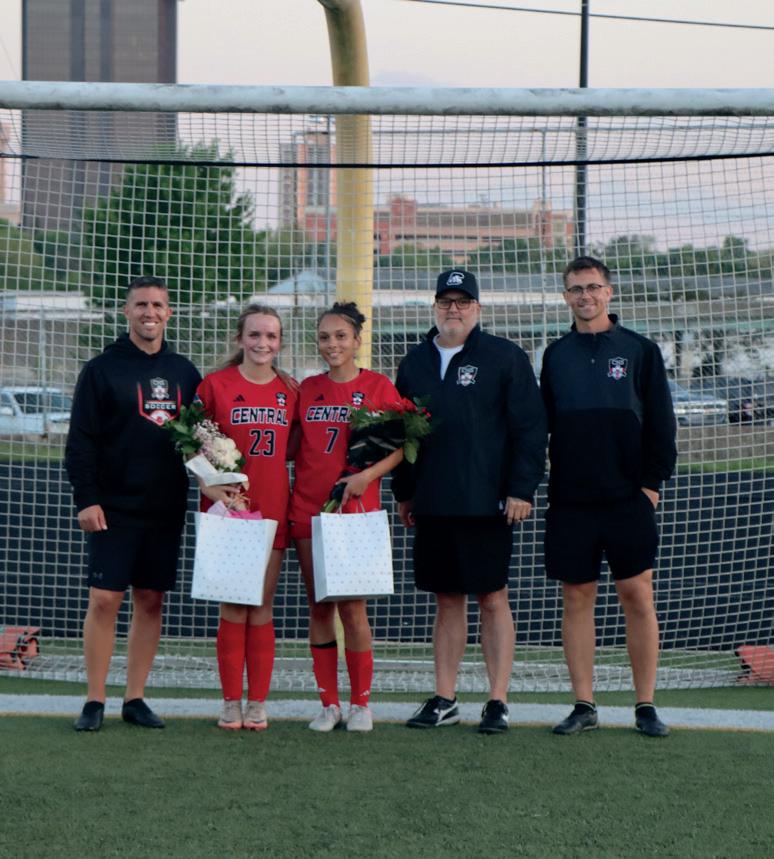
Finley Loethen (12) and Annalise Freeman (12) stand with coaches on Senior Night. Photo by Dane Scholz.
SPOTLIGHT
TODD GAO REPORTER
Caleb Lundgren (11) is a leading member of the boys’ golf team and serves as the team’s co-captain. He wants the team to achieve strong results in the upcoming spring season.
“Caleb is a Co-captain for the team because of his leadership skills.” John Collins, the coach of the boys’ golf team, said. “He is always at practice, works hard on his golf game, and always strives to improve. He is a very busy student athlete, but he does a great job of balancing his priorities.”
Lundgren’s actions follow his philosophy of helping others that need it.
“Caleb is a kind, motivated, and supportive individual,” Neil Lu (10) said.
“He assists freshmen in all aspects.” As a leader, Caleb aims to support the golf team through demonstrations, hard work, and integrity.
“The main character trait that I believe is used in golf is integrity,” Lundgren said. “As a leader, I want to become better at showing the other players on the team, especially the newer ones, that it takes a lot of dedication and focus to get better at golf. I want to demonstrate to them how to have integrity within the game and also how to handle the pressure of competition.”
As Caleb supports the golf team, he believes they can achieve major success in tournaments by bridging the gap between their current skill level and their potential.
“We have a lot of experienced players, as well as some who are just getting started, but have a lot of natural ability.” Lundgren said. “We are also working in practice to be more consistent in our shots and focusing on the processes that will ultimately lead to better scores in matches and tournaments later in the season and beyond.”
SWINGING INTO SEASON
TODD GAO
REPORTER
The upcoming spring season of the Central boys’ golf team starts with tense mindsets and frequent practices aimed at improvement.
“We practice almost every day throughout the season,” John Collins, coach of the boys’ golf team, said. “Some days we are playing nine holes for qualifying or working on our short game, which means we are practicing putting, chipping, or pitching.”
Collins plans ahead in terms of practices and competitions to make the most of what he feels is a short season.
“Our golf season started on March 2nd and is only 10 weeks,” Collins said. “So we put a lot of work into our season, and we hope to be playing our best when we enter May for our conference and district tournaments”.
Neil Lu (10), a member of the golf team, enjoys playing and improving.
“The golf team has been a wonderful experience and I truly appreciate it,” Lu said. “It’s been something that is more than a hobby. It’s an opportunity that is the result of cooperation, dedication, and joy. It is an experience I hope to continue throughout my high school journey, and I truly enjoy fostering a cooperative community.”
Collins thinks that despite the team’s youth, they can still make a splash against tough competition at Conference and Districts.
“We have a young team with only one senior, so we are working hard so that we peak
right at Conference and Districts,” Collins said. “We have some really strong teams in our Conference and District, so we hope to make a strong showing at both of the tournaments.”
The team plans to make a strong showing at their tournaments and play exceptionally well in their final COC tournament: it is the conference based tournament.
“This is the last year that we will be in the COC tournament, we are hoping for a strong finish in that tournament as well,” Collins said. “Our goal for the team in the COC tournament is to break 360. Only the top five varsity golfers qualify for this tournament.”
The team’s performance at districts will directly impact whether or not they are eligible to compete in later competitions.
“The district tournament is the chance to qualify as a team for the State tournament or to qualify as an individual for the State tournament.” Collins said. “We have some really strong teams in our district, and only the top two teams qualify for the State tournament, and the top 13 individuals qualify.”
The team is confident in their skills in the upcoming tournament. With top varsity players, Collins believes that they have a solid chance to hit their goals this season.
“Our team goals are to finish in the top half in the District tournament on May 11th.” Collins said. “To do this would require a lot of practice, but I think our top five varsity players can do it.”
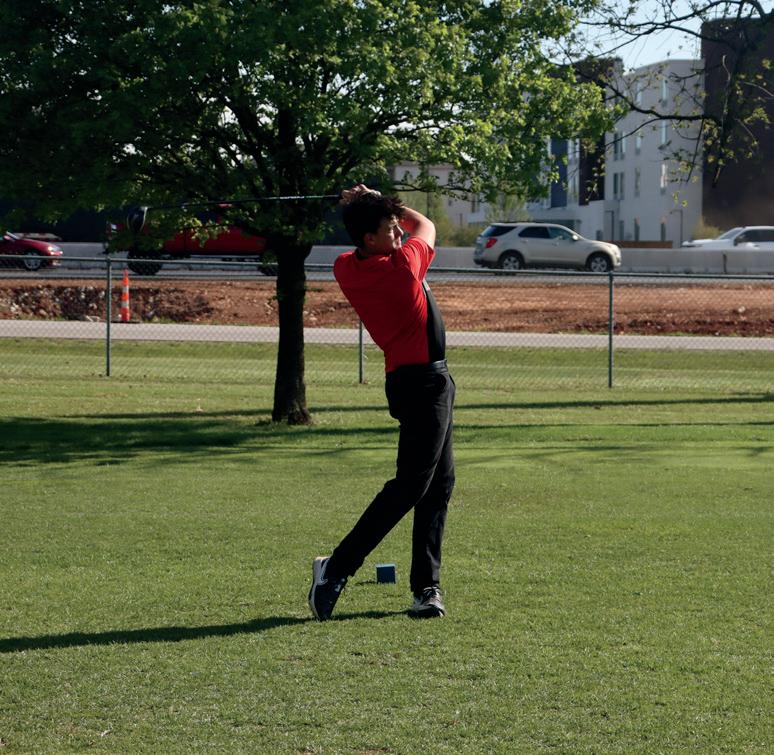
Caleb Lundgren (11) swings his golf club. Photo by Landon White.
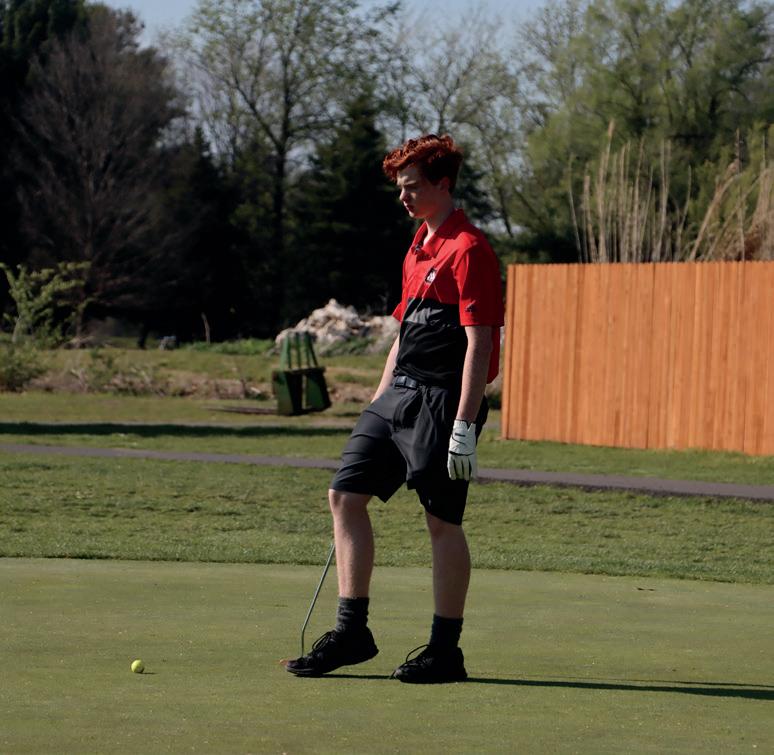
Cole Stephenson (10) stands on a golf green during competition. Photo by Landon White.
MORE THAN A HOME RUN
MAGGIE MOORE
REPORTER
Baseball at Central means more than home runs and a bat; it means family, a goal, and a plan.
“If you develop players, you will win. They go hand in hand, “Jerrod White, head coach, said. “You can’t develop without the support, and support on a team comes from the team. It all starts with the players and a bond.”
Baseball dates back to 1846 in Hoboken, New Jersey, and from there, more and more household names have emerged. Babe Ruth, Willie Mays, Barry Bonds, and Jackie Robinson had risen to fame, along with many others.
“Everyone has to look up to something or someone,” Truman Heider (9) said. “I have been playing baseball for about eight years now, and I know I have definitely had role models and influences involved with the sport.”
Central’s best baseball season came in 2024. White wants to emulate that success by fostering a positive team culture.
“I had three seniors from the season go on to play college baseball,” White said. “Baseball can be a negative sport. Players and teams experience failure every day. I am very intentional in demanding a positive culture. If you can’t have fun playing baseball, you’re doing it wrong. That harbors success.”
Exercise, bus rides, and even simple discussions bring the boys closer together.
“The bus rides are very important to us, to and from the games,” Heider said. “ We have the opportunity to all be involved with discussion and conversation. But also just
getting to see each other, and learn from one another, is crucial.”
Many players plan to continue playing baseball through college, and some want to take it even further.
“Many of us play outside of just this team; we are busy, and we make it work because we love this game,” Heider said.
Every year, new players are introduced to the team, and with this comes opportunities to grow.
“We currently have a young, inexperienced team, and that can be a big challenge,” White said. I’m often asked why or how I coach a team that is not currently at a competitive 5A level. I love teaching the game. That’s why I do it. And I take great pride in providing opportunities for young men to learn a game they otherwise wouldn’t have access to.”
A bond on a team isn’t the only necessity; these players have skill and have developed. Sure, participants throw a ball and swing a bat, but skills don’t build in a day or a week. It takes a lot of time and passion.
“Baseball is a skill developed over many years,” White said. “The best players sometimes start really young, typically around family.” Going on to say, “When I first started coaching, I found myself being very intense and critical. I was overly competitive, and I wanted to win at all costs; I didn’t care what it took. Central has taught me to enjoy the game. Teach these young men and see things from a new perspective.”

BASEBALL
MAGGIE MOORE REPORTER
AJ Stanfield, 11, has been playing Baseball for about 12 years and has competed for Central High School since his freshman year.
“I do love playing baseball; it has always been a comfort for me,” Stanfield said.
Ensuring future success relies on new, younger players on the team. One of Stanfield’s roles is to support underclassmen teammates.
“AJ has helped me a lot; well, he helps us all. He knows what he’s doing,” said Truman Heider, 9.
With Stanfield’s senior year quickly approaching, the possibility of playing college baseball has crossed his mind, and he has received encouragement from his coach, Jerrod White.
“I played baseball my whole life, eventually playing at the University of Arkansas and Missouri State University,” White said. “After my playing career ended, I started coaching. It’s my life’s passion, I hope to see amazing things come from my boys.”
Stanfield has found many teaching opportunities with his fellow teammates. Whether he is assisting brand-new players who enjoy the sport or offering advice to his more experienced teammates, he knows coaching well.
“I’ve been playing a long time,” Stanfield said, “ and I’ve played for a lot of pretty amazing teams. The last few years I have been playing for Central have been pretty amazing. It has set me up for a pretty bright future.”
From the many years of baseball experience Stanfield has endured, he feels a good portion of what he has learned has come from fellow players, coaches, and supporters.
“I think everyone needs that support and the motivation from others.” Stanfield said. “It’s not only the performance or the game, but it’s not the outcome. It’s about the game and the love of the game.”
A.J. Stanfield (11) pitches at full speed. Photo by Emma Gugliotta.

IB PORTFOLIO ART SHOWCASE
BETHANY MINCKS
For students in International Baccalaureate Visual Arts, the pinnacle of the class isn’t an exam, but an exhibition they spend two years working towards. While it may seem like plenty of time, the long and intricate affair of generating ideas, creating and revising artwork and finding the motivation to do so amidst other schoolwork makes the process more complex than one might imagine, especially since the result doesn’t often begin taking shape until senior year.
“The IB Art Exhibition is the culminating event of two years of work for IB Portfolio students,” Bethany Mincks, IB Visual Arts teacher, said. “So, they spend two years making art under some sort of unifying theme, usually that they’ve self-selected, then they display those pieces. During junior year, we’re building up skills and they usually have ideas for what they want [their exhibition theme] to be, so they’ve started to make art under that sort of thread… they end up making eight pieces during senior year that they can use for the show.”
One of the most distinct aspects of the Exhibition is the immense variety of all the artwork, both between comparing the work of all students and within different pieces of the same exhibition. This year’s April 3rd Exhibition was no exception, and the only major similarity between topics is the process that students undergo to choose one.
“We have a lot of conversations about questions they’re trying to answer with their art and what methods would be best to go about that,” Mincks said. “The goal with IB [Art] is that they are answering some sort of personal, internal question with the art they make—or it could also be a global issue they find some sort of connection to.”
While diversity is a characteristic of every year’s Exhibition, the Class of 2026 will be leaving its mark in more ways than one. Not only did students leave a mark on the canvas, but they made an impact on each other.
“I feel like this was a really strong group in terms of technical skill and idea generation,” Mincks said. “And not that that doesn’t happen every year, but that the whole group seems to pull each other up… they like challenging each other in really interesting ways.”
Three students who exemplify these qualities are seniors Lindsay Nel, Keren Ding, and Emily Neal—while their art speaks for itself, they do too.
EMILY NEAL
Art is a way to represent perspectives, emotions, and experiences that the artist has witnessed or encountered, and Neal chose to direct her theme inward, highlighting her viewpoints surrounding her creation of art itself. “I tried to replicate feeling self-conscious when I’m making art. That’s what I wanted to tackle in the project—making things that would make me happy and not thinking too hard about the perfectionism of it.”
A key quality of Neal’s exhibition was how the internal theme and external presentation were interlinked, with the physically large size of the canvases capturing how exposing it can feel when subjected to the observation of others.
“I’m stressed about the idea of my art being perceived, and my project was about trying to find a way to represent that,” Neal said. “I decided to work really large because it was out of my comfort zone. I wanted to make the first [piece] big just to get it out there, and I was like ‘okay’, and I ended up making another.”
Part of accepting the judgment of others is accepting human imperfection first, which is another way Neal integrated her theme into every step of the process.
“Honestly, no [I wouldn’t change anything],” Neal said. “I think that’s the point, that even though it’s not the best thing I’ve ever created, I think the process of each work is unique, and I would’ve put in the same piece if I’d taken a week on it compared to like one day, and that doesn’t necessarily mean it’s better or worse, it’s just what it ended up being like.”


Carl Tamm’s exhibition. Photo by Chloe Wootton.
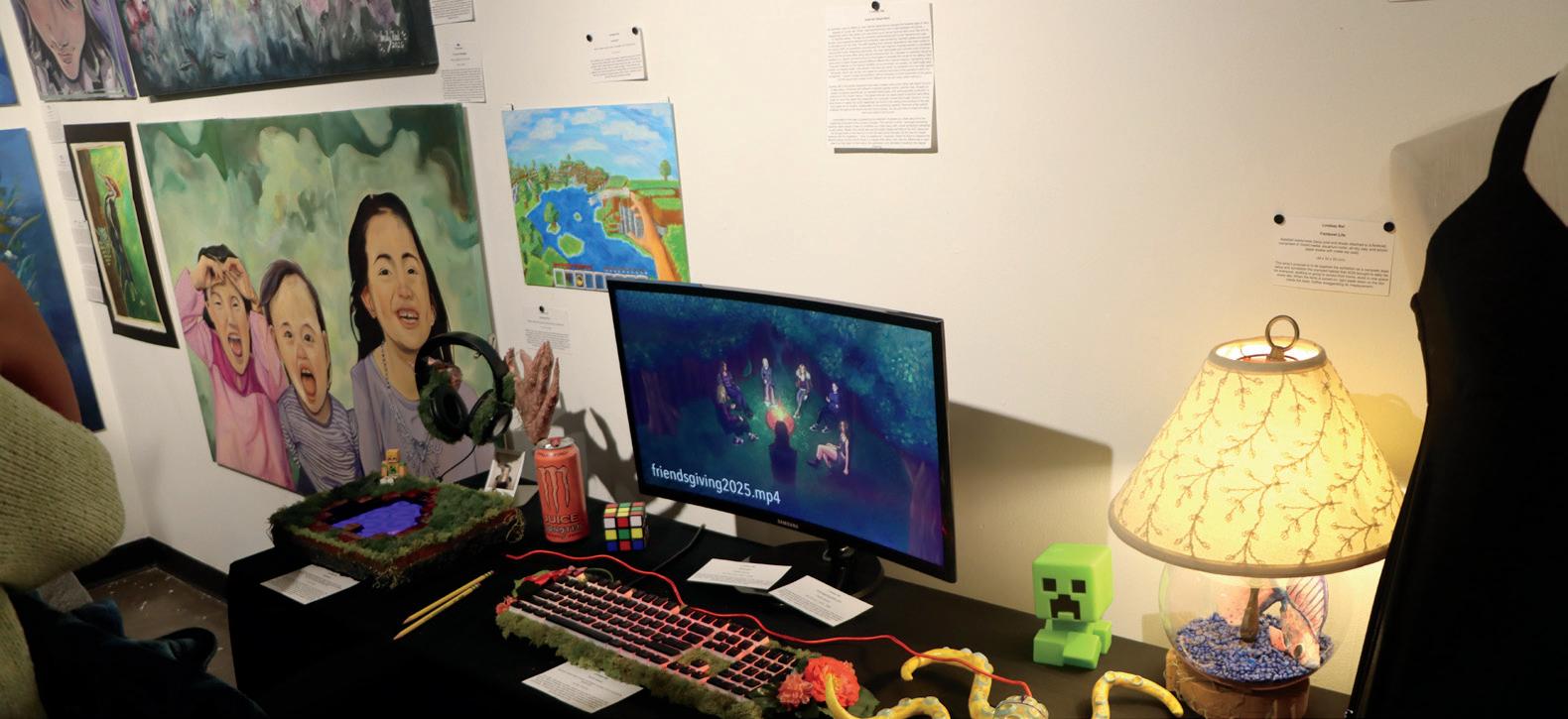
Lindsay Nel’s exhibition. Photo by Chloe Wootton.
Chelsea Miller’s House plushie. Photo by Chloe Wootton.

KEREN DING
IB Visual Arts students often alter the goals of their artwork to stay true to their exhibition’s theme, but in some cases, the theme changes as art is produced and follows a different direction than originally intended.
“My theme is internal struggle,” Ding said. “In the initial stages of my project, it was confusion, but in the end, I felt like they all tied into some sort of internal social anxiety, impostor syndrome, fearing what other people think about me, and being confused on what choices to make.”
Another unique attribute of Ding’s process
was how her theme continuously expanded as time went on, rather than becoming more concise or focused, mirroring how long-term projects often sway in either direction—and to her, those changes weren’t a bad thing.
“In the beginning, I thought about making it more concrete, but when I make pieces, I have a habit of just kinda making whatever,” Ding said. “I love the freedom of that, so I like the way it all just tied together at the end. My process mimics the same kind of confusion within internal struggle, not knowing what to do and then being unsure of what the future will be like.”
When choosing an exhibition theme, many students choose to take a common experience and illustrate how they encountered it, and there are few topics more relatable to audiences today than the COVID-19 pandemic. In particular, Nel zoned in on how she was affected by the pandemic from the perspective of a child.
“[In my exhibition,] I was attempting to recall the feeling of being a child going through quarantine and being stuck in lockdown, and so all of my pieces are centered around the emotion that draws,” Nel said. “I wanted to reflect it through an actual desk setup, so all of my pieces are mixed media and they’re made to represent the object they look like.”
Regardless of topic, students gleaned inspiration from endless sources, illustrating the interconnectedness of artwork as a whole.
“Subconsciously, I think I drew a lot of inspiration from when I went to Meow Wolf in Colorado over the summer, because they have a bunch of mixed media art pieces that look very otherworldly and almost like they’ve come from a different universe—I wanted to recreate that and make my own little world.”
Perhaps the most unique aspect of Nel’s exhibition was the format, diverting from traditional canvases and opting to create an immersive experience for the audience instead. Her pieces are organized around a desk with a monitor, with every inch of the space thoughtfully planned.
“I wanted to make a cohesive environment with the desk space, one cohesive setting that would display all of my pieces in a way where they make sense existing together.”
CHLOE WOOTTON
SENIOR REPORTER
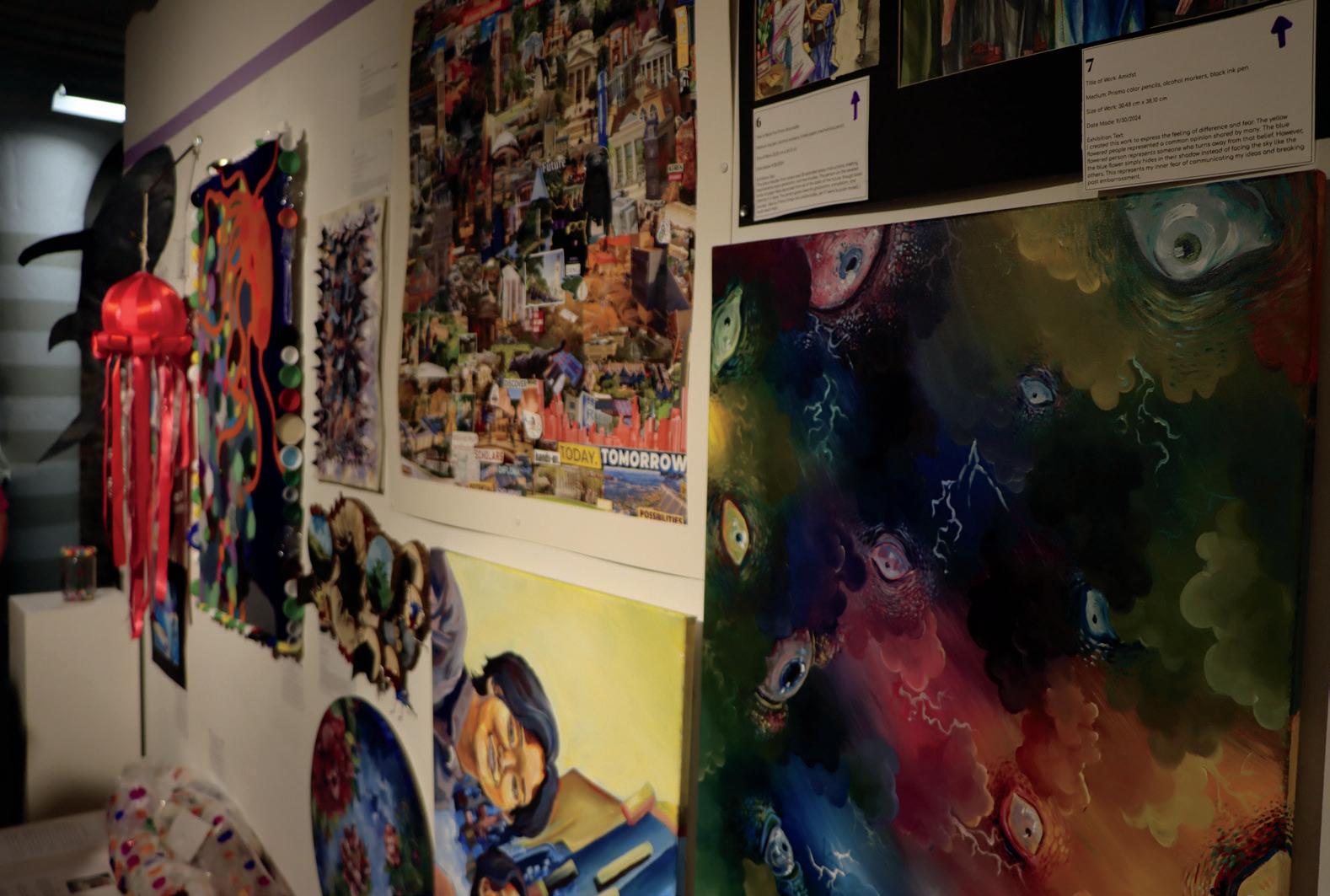
On the same note, Ding’s variety of mediums within her pieces are another testament to the varied nature of creation. Her exhibition featured paintings, a collage, a 3-D mask, tree stumps, and more.
“I did a lot of acrylic paints, and then the collage was just a bunch of college ads I taped on, then I used rocks for one of them, and I just used air dry clay for the mask and wire to make the eyelashes,” Ding said. “I wanted to have some type of freedom to try different things. I really like acrylic paints, that’s my main medium, so I wanted to expand my practice but not too much.”
Emily Neal’s exhibition. Photo by Chloe Wootton.
Keren Ding’s exhibition. Photo by Chloe Wootton.

MASTERFUL MATH MURAL
IB Portfolio seniors & Cabinet Art Commissioners Emily Neal and Keren Ding are painting a new mural at Central, breaking the 5 year mural hiatus. The Asian-inspired lake scene will be in the math hallway by the entrance doors.
“I feel like this is Keren’s and my idea in general, because we saw that they have murals on the hallway with the stairs,” Neal said. “[The mural] said Cabinet… I think it was 2021 or something. And we were like, whoa, so Cabinet used to do murals, and the art design commissioners used to do them. So we asked about it.”
The project began at the start of the second semester, with Ding and Neal planning out ideas and figuring out the logistics of painting a new mural.
“We first chose a wall,” Ding said. “Then we decided that since it was kind of the math hallway area, but also kind of near the science hallway, but also kinda history, we wanted a combination of.. natural and cultural things.”
The artists themselves weren’t the only people involved in pre-production. Admin approval and teacher sponsorship were
required, and they wanted the rest of Cabinet’s input.
“Keren and I took pictures of everything,” Neal said. “We put them all in this slideshow, we were super indecisive about it… we showed them to Cabinet, like, ‘hey, which [wall] do you think could most benefit from it?’ We narrowed it down to three or four, and then we basically just took the whole class period to weigh the pros and cons.”
The surrounding areas also played a large part in deciding the mural’s location. Other murals, wall textures, and even subjects were considered.
“We decided to do it in the math hallway first, because there’s not a single mural in the entire hallway actually,” Neal said. “And both me and Keren don’t like math very much. So, like, we thought it would be a nice pop of color to add some joy and whimsy to this sad hallway.”
Ding shared a similar sentiment to Neal. For them, the unpainted walls and neutral color palette added to the stress of the subject.
“Math is depressing and sad,” Ding said. “So we need some … color [and] nature, to reduce
SARAH GREENE
REPORTER
stress levels and just get some more stuff up in the hallways. It’s like, bland.”
Once Jeremy Brown, the principal, signed off, Bethany Mincks provided the project’s resources, and the hallway itself was decided on, Neal and Ding began the painting process.
“We got a bunch of screenshots of things we liked, they’d basically be like concept sketches, and... I don’t want to say we went in blind, but we kind of went in blind,” Neal said. “We’re required to get a sketch signed off by a teacher beforehand, so we had a sketch down, but we basically sketched it just so that we could get approved, and then we weren’t even looking at anything. You just start painting on the wall with ideas.”
The mural’s design is inspired by the artists’ shared backgrounds, with both having experience painting landscapes and both being of Asian descent.
“I’m Filipino and [Ding is] Chinese and we’re like, ‘hey, that’d be really cool if we can add some… Asian inspiration into the things that we do up here,” Neal said. “Especially since there isn’t really anything in the school, so, might as well make our mark on the school like that.”
The new mural in the math hallway, designed by Emily Neal (12) and Keren Ding (12). Photo by Avery Rapp.
A LASTING LEGACY
Sheila Austin is retiring after 29 years of working as the administrative secretary. She came to Central starting as the financial secretary, looking for a job as a single mom to support her family, not knowing that Central would make such a big impact on her life.
“What made me stay so long was that I fell in love with the building and the kids and the people,” Austin said. “I just stayed because it became home.”
Austin described that her job was student and family-focused, which made her love her job as she helped students and families transition to high school.
“I like watching the students when they first get here as a freshman, and they have no idea what they’re doing, where they’re going… how their life is going to change,” Austin said. “I like watching… that transition from being afraid in such a big building to mastering it and getting ready to go out in the world… There are times that parents will come in, and they’re just at a complete loss. They don’t know what to do, where to find what… To be able to simplify what they think might seem like a mountain… I enjoy that.”
Austin has also been able to form close relationships with students, and she said that her ability to bond with students who might be going through a hard time has been one of the most special memories she has made
“We had a student who struggled with her home life, great athlete, played basketball, did volleyball, ran track, great kid, but she struggled with her home life, and she used to come down and see me every day, and she calls me her Vanilla Mama,” Austin said. “It’s memories like that that I’ll take with me.”
School spirit has also been another reason why Austin stayed at Central for so long, noting how students have supported each other through sports and activities. She specifically
mentioned a moment when a girl was recruited to play on the football team in the early 2000s.
“There was a time [when] we had one of our girls on the soccer team, and they recruited her for football,” Austin said. “She was an amazing kicker… and she [became] our kicker for football that year, and we were undefeated… The way…the student body reacted to that and the way the staff reacted to that… It really helped our self-esteem as a whole.”
Since Austin has been at Central for almost three decades, she has been able to see how the building has changed over the years. One major difference between the building that stands today and the building Austin began her career in is the absence of the Kraft Administrative building. According to Austin, when the Kraft Administrative Building was removed, so were the ghosts of Central.
“When I first started, I was here on a Saturday, nobody was here in this building,” Austin said. “This was when Kraft Administrative Center was in our back green space… and I was in here and walking down this hall when the office used to be down there, I could hear somebody walking on the second floor, and it was just one of the ghosts of Central. [The Kraft Administrative Center] used to be someone’s home, and they died in that home, and their ghosts were still there. They used to move things around on people’s desks at night.”
Although she is sad to be leaving, Austin knows that retirement is the best thing for her and her family and hopes that students and staff will continue to be kind to one another and support each other. “I’m excited about retirement … just [to] be able to spend more time with all of my grandbabies and my kids, but I’m going to miss this place,” Austin said.
ARI ABBOTT
SENIOR REPORTER
FELLOW RETIREES
DONITA COX A+ COORDINATOR, TENNIS COACH
MICHELLE BOWE SPECIAL EDUCATION PARAPROFESSIONAL DANNY MARSHALL CREDIT RECOVERY TEACHER, COACH ACROSS MULTIPLE SPORTS
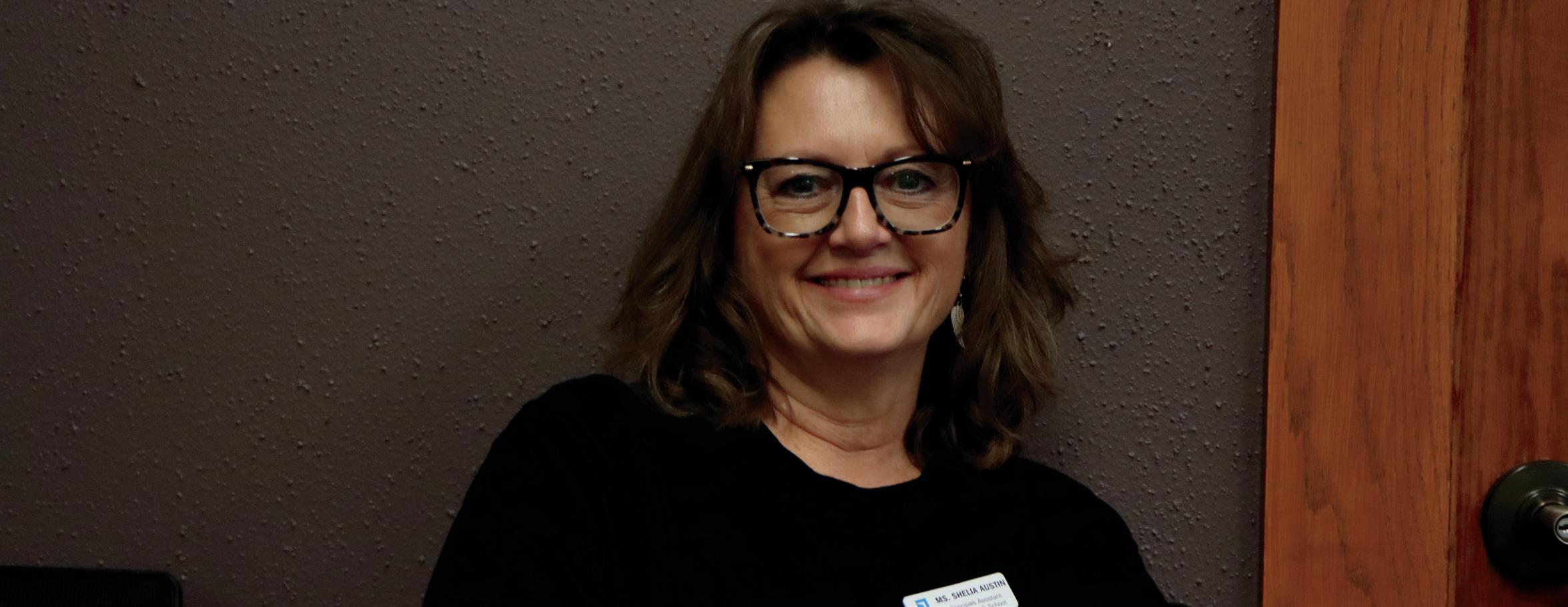
Sheila Austin poses for a photo in her office. Photo by Jack Herr.
KEEPING CONNECTED
The summertime for most students is a time for relaxation, having fun in the sun, and for some, a time of isolation. During the school year, students are provided easy opportunities to interact with their friends inside and outside class. Summer takes many of such opportunities away. So, how does one increase the chances of connection during the summer?
During the summer, it becomes the job of the individual to reach out to plan events, hangouts, and the like. A crucial step to this is reaching out. A simple “hey” or “how are you?” sent to a friend is often enough to get the ball rolling.
“Some friendships are like succulents and others are like orchids; they either need very little attention or constant nurture.” Emily Schmidt, writer for The Stanford Daily, said.
How one connects to one’s friends over the summer is as important as connecting with them at all.
“I play sports, I play tennis a lot.” Ethan Dang (12) said, “Afterwards, go out to eat, or just eat without doing all of that. Just keep in touch, like talking on the phone, texting, and calling, etc.”
REESE WOOD, CO-EDITOR IN CHIEF
Athletics isn’t the only way to stay connected with friends over the summer. One can also just hang out.
“I use my smartphone a lot, I text them to hang out and meet somewhere.” Madan Katangur (10) said, “I drive my car a lot to hang out with them.”
A common concern about the lack of connection with one’s friends over the summer is estrangement. Losing connection with friends for the upcoming school year is a good concern.
“Yes, staying connected over the summer is important because if you don’t stay connected with your friends over the summer, then it can be awkward next year unless you’re really close.” Ava Locke (9) said, “You need people over the summer, you can’t just be by yourself.”
Those who stay connected over the summer are more likely to be connected over the coming school year. The communication and camaraderie one gets over the summer can be very important to maintain friendships.
“Honestly, it’s just to have more fun over the summer.” Katangur said, “I guess to hang out with them more and be more connected during the school year as well.”
SUMMER ACTIVITY GUIDE
Looking for a fun, creative, and relaxing way to spend an afternoon? Firehouse Pottery is the perfect place! Located in the beautiful Galloway Village, this pottery studio has the largest variety of pieces, glazes and tools in the area, accompanied by a flat-rate fee that allows guests to pay for their piece (average cost ≈$25) and nothing else. The helpful staff and lively atmosphere makes for the perfect place to talk with friends and family while you work or enjoy the serenity (and fabulous music) of solo painting.
Whether you’re taking your dog on a walk, catching up with friends over the summer or remembering what grass feels like, Springfield is overflowing with beautiful parks and green spaces to enjoy for free. Springfield Conservation Nature Center is situated in the thick of an oak-hickory forest, with over 3 miles of hiking trails and the chance to observe a variety of landscapes and wildlife. For something less intense, Lost Hill Park and Lake Springfield are perfect for long, relaxing walks through both forests and fields. Finally, the 100+ acre park widely considered the best in Springfield, Nathanael Greene has it all—trails, playgrounds, wildlife, the Mizumoto Japanese Stroll Garden ($6 admission), and the best possible environment for a photoshoot!
Amidst the sweltering summer sun, it’s hard to find physical activities that don’t first require a healthy layer of sunscreen—but if you want to stay active yet beat the heat, go skating! Springfield’s Skateland features typical prices of $7-10 per person (with a basic skate rental included) while Brightspeed Ice Park costs $6 for student admission with a $3 skate rental fee. If you want to learn a new skill, hang out with friends or have a playful date, skating might be the perfect activity for you.
Golfing is an activity that any age and any skill level can enjoy, especially when it takes the form of a lively putt-putt course. Springfield has a variety of options for minigolf, with Fun Acre being a classic, budget friendly choice with $4 tickets for ages 12+, and Getaway Golf offering a diverse, interactive course for the standard price of $11 adult tickets and a 50% student discount on Thursdays. If putting isn’t your style, the driving range at BigShots Golf is a fantastic group activity for special occasions. Prices range from $36-53/hour depending on the day and time of your visit, and each tee box hosts up to six people at a time!
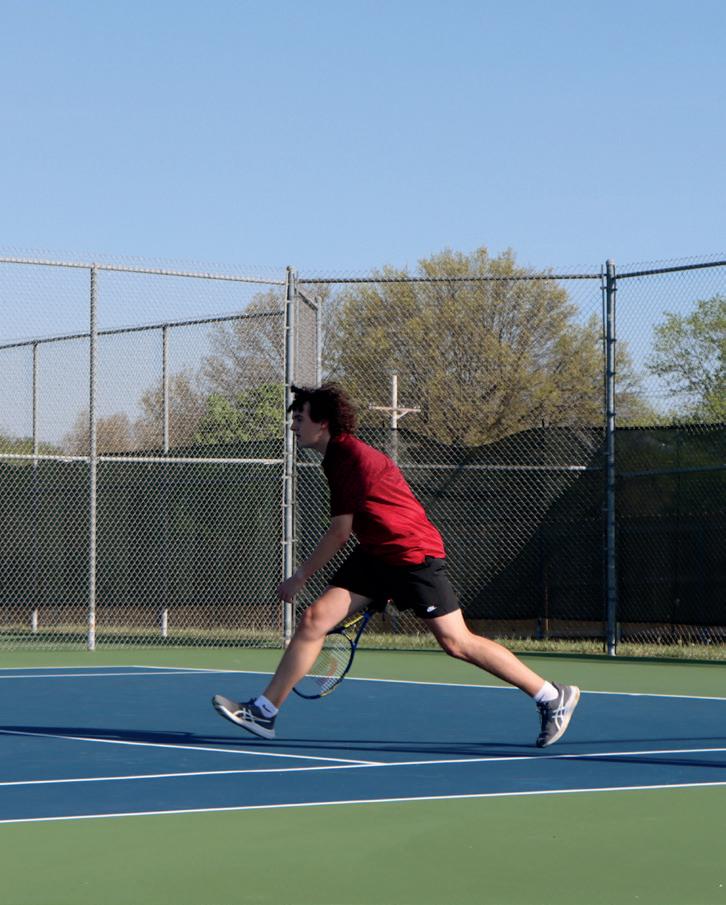

CHLOE WOOTTON, SENIOR REPORTER
The Lake Springfield Boathouse on a peaceful summer evening. Photo courtesy of City of Springfield.
Owen Rinker (12), friend of Ethan Dang, plays tennis. Photo by Lucy Caplinger.
TEACHER + STUDENT DREAM VACATIONS
DALTON SLY
“I have two options, I guess. If time travel is also involved, in time not being an option, if it’s not an option i kinda wanna go to that completely silent room where it’s like you can hear your organs gurgle and stuff like that, because I kinda just need like five minutes of pure silence just in general at this point. If time travel or anything is allowed, I’d kinda just like to go to Montana or Appalachia with my friends so I can hang out with them one last time.”
ASHLEY FELTON
“I would go to the Maldives because the water is absolutely beautiful, and so I would just want to hang out on a beach and do absolutely nothing but read a book, and probably have a nice strawberry lemonade in my hand.”
JESSE MILLER
“I’m going to the moon, I’m checking that out, and I’m hanging out in zero gravity.”
QUINTEN PLUTE
“Deep into the mountains where nobody can find me, just away from civilization, away from everybody else.”
ELICIA LIGON
“I would go to the Galapagos Islands to see them before they get in worse condition than they are now.”


GABRIELLE WOLFE
“Puerto Rico, because I’ve heard it’s really beautiful and there’s like a lot of animals there, and it’s also where my dad’s from, and I really wanna see it.”
SARAH GUGLIOTTA
“Italy, and the Mediterranean, my husband’s family is from Italy. So it would be fun to visit where they came from and explore all the Mediterranean places, Croatia for sure. I’d love to go for 3 months and just time and explore all the good stuff.”
CLAIRE MOORE
“Canada, because it’s not the U.S.”
SAM SHELTON
“New Zealand would probably have to be the place, New Zealand’s got this kinda strange ecology, where there’s some really high mountains and snow and skiing and things like that, then it just tapers right down into the ocean with beautiful beach fronts. Compared to its neighbor Australia, New Zealand has nothing natural that can kill you, none of the snakes that Australia has, none of the wild animals, no spiders, like none of those things Australia is so well known for, New Zealand has none of it.”
The Appalachian Mountains. Photo courtesy of Peak Visor.
The Mediterranean Coast in Italy. Photo courtesy of Best Western.
SENIOR SPOTLIGHT
Carolina Kessinger (12) has recently committed to University of Central Missouri’s dance team to continue her athletic and academic journey.
Kessinger has been doing competitive dance since the sixth grade, and in her freshman year joined Central’s dance team, the Pomdogs. Kessinger believes being a Pomdog is what motivated her to go to school.
“All of the girls were so sweet, we could always go to each other for everything,” Kessinger said. “Going to practice motivated me to be at school– you can’t go to games without going to practice and you can’t go to practice if you miss school.”
Kessinger not only found a place to hone her athletic skill; she also found a team that fostered a unique community she could not have found elsewhere.
“The girls on my team can talk to me about things that not everyone else can understand,” Kessinger said. “It’s a different level of support.”
Having spent so much of her life around other dancers, Kessinger has found that sharing such a deep passion for the sport has served as a vehicle for connection with the other girls.
“Dance teams have given me the closest relationships I have,” Kessinger said.
Abigail Edwards participated in the Ozarks Tech Middle College program starting as a junior.
“I started dual-cred at 14, my freshman year, went full-time at 16 with OTC Middle College, and I graduated at 17 with my Certificate and half-AA,” Edwards said.
During her time at Ozarks Tech, Edwards pursued the Early Childhood Development (ECD) pathway.
“I chose Early Childhood Development because I’ve always wanted to work with children and teach, and ECD got me my Certificate and halfway through my Associates in Elementary Ed,” Edwards said.
Ozarks Tech provided her with an environment where she could learn at a more comfortable expedited rate, and graduate early.
“OTC gave me the freedom and range I needed while still getting my classes completed,” Edwards said.
Not only did Edwards get to experience a unique atmosphere at Ozarks Tech, she was
As she begins to think about her future, Kessinger sees dance being a part of her life forever.
“I hope to go into physical therapy and could even see myself specializing in dance
CAROLINA KESSINGER
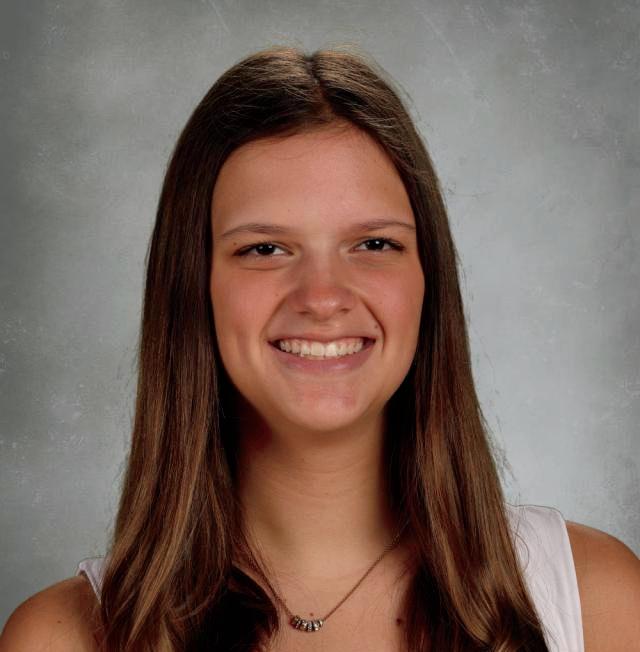
afforded opportunities that she could not have had anywhere else.

LUCY CAPLINGER
SENIOR REPORTER
to help other artists,” Kessinger said. “I would love to focus on helping younger dancers or athletes in high school.”
Kessinger believes that being a part of the dance community has influenced her mental health positively as well.
“The structure of dance teams, and going into college already knowing so many of the girls is affecting me positively,” Kessinger said. “I think having that structure in college will help me.”
Kessinger hopes that in the future, she can be the change that she has wanted to see– recently her mom broke a bone in her ankle, but the medical professionals that she saw believed that she was fine. After an MRI this was proven false.
“It helped me realize that a lot of people face injury challenges and doctors who don’t necessarily take the time to look into what’s actually happening,” Kessinger said.
This has inspired and shown Kessinger that the world needs more people who care about health. Kessinger is excited for what is next in both her athletic and academic future, and while she may be nervous, she is thankful for the dance team.
“I feel so much more comfortable knowing I’ll have a community when I get to college.”
“Opportunities are practically endless at OTC,” Edwards said. “I am a part of the Honors Society, Phi Theta Kappa, so I got to graduate with Honors and got a stole and tassel to wear. They have endless clubs for everything,”
Edwards has a lot of memories from her time at Ozarks Tech, but she most fondly remembers the class-wide activities hosted by the school.
“[My favorite memory is] The fall and spring picnics.” Edwards said. “You get to go outside, usually classes are canceled or out way earlier, and it’s like a market, you get to go dance and have fun and ‘shop’ and there is free food and activities.”
Ozarks Tech has provided Edwards with more than just an early diploma, but also positively impacted her academic future.
“It has given me offers for more scholarships, getting my foot in the door with job positions, and it will put me almost two years ahead of my peers,” Edwards said.
Photo by Jostens.
Photo by Jostens.
WHAT’S IN A NAME?
When one thinks of “living history,” they might conjure up images of palaces, museums, reenactments, and the like. However, history lives in places much more mundane, so much more so that it may go completely unnoticed. In Springfield, one of the places where history lives is in the names of the streets.
BENTON
Benton Avenue runs north to south, along Central High School.
Thomas Hart Benton—the politician—was one of Missouri’s two inaugural senators, serving five terms from 1821 to 1851. Benton was a proponent of westward expansion, advocating for the annexation of the Republic of Texas and authoring the first Homestead Act.
Benton was a democrat and ally of Andrew Jackson—specifically on the issue of “hard money.” In Benton’s time, a debate raged over whether or not purchases should be backed by a gold or silver standard—the government holding an equivalent amount of gold or silver for each bill they printed. The goal of a gold standard was to combat inflation, among other things. Benton inspired Jackson’s Specie Circular executive order, which issued that all public lands had to be purchased with hard money. The concept of a gold standard would remain in the United States up until around the Great Depression. For his contributions to the movement, Benton earned the nickname “Old Bullion.”—a bullion referring to precious metals refined and stored in bars, coins, etc.
The younger Thomas Hart Benton—the painter—lived from 1889 to 1975. He was named after his aforementioned Granduncle. He was a leader in the regionalist movement, which arose in the 1930s, depicting scenes of small-town America, particularly in the Midwest.
Benton is best known for his murals, covering issues such as racism and the urbanrural divide. His most famous work, the tenpart mural “America Today,” depicts different parts of the continental United States, such as “Deep South and Changing West”, as well as industries like “Coal” and “Steel.”
JACK HERR
CO-EDITOR-IN-CHIEF
In 1936, Benton was commissioned to create a mural for the Missouri Capitol building. His work, A Social History of Missouri, still stands today. Benton depicted such figures as Jesse James, Tom Pendergast, and controversially explored the unsavory history of slavery within the state.
CAMPBELL
Campbell Avenue runs north to south throughout Springfield.
John Polk Campbell is considered to be the founder of Springfield, Missouri. Campbell was originally born in Tennessee, but traveled with his brother to expand westward and find land for themselves. According to Campbell’s granddaughter Louisa Sheppard, The brothers were given the tract of land that would become Springfield after helping to cure a Kickapoo boy of his illness. On this land, Campbell would legendarily carve his initials into a tree and later build a cabin. Campbell later donated 50 acres of his land for the construction of a town, which became Springfield. Although there are conflicting theories as to why Springfield was named Springfield, some believe that Campbell named the town after his hometown in Tennessee.
DIVISION
Division Street runs east to west, north of Central.
Division Street marked the line—the division—that splits North Springfield from Springfield proper. North Springfield is cropped up as a boom-town around the construction of a section of the St.LouisSan Francisco line railroad in 1871. Springfield and North Springfield formed a sort of rivalry, with the competition between the two cities driving construction. In 1887, the two cities voted to combine into one, keeping the name of Springfield.
Had North Springfield never existed, however, it would be doubtful that Springfield would be as developed as it turned out to be.
FREMONT
Fremont Avenue runs north to south throughout the city.
Fremont Avenue likely owes its name to John C Fremont, a United States Army officer and republican politician.
Fremont married the elder Benton’s daughter. The patronage he received from this marriage would allow him to climb the social ladder and receive patronage for expeditions throughout the Louisiana Purchase.
In the Mexican-American war, Fremont took control of a portion of modern California. He was court-martialed for vying for the interim military governorship of California, and although he was pardoned, he quit the army. Fremont ran on the republican ticket in the election of 1856, campaigning against the expansion of slavery and the violence that had erupted in “Bleeding Kansas.” Ultimately, Fremont would lose out to James Buchanan. Fremont returned to military life upon the advent of the Civil War. Fighting for the Union, he was given command of a force in the west by Abraham Lincoln. Fremont led a campaign into southern Missouri, and members of his bodyguard engaged in, and won, the battle of Springfield.
The streets of Springfield give voice to the local history that has shaped the city’s growth, development, and character.

A miscolored Springfield High School overlooking Benton Ave., circa 1925. Photo courtesy of Springfield Library District.
POLITICAL BURNOUT
EMMA LEWIS
REPORTER
For many Americans, the effort to remain up-to-date on the current administration has been akin to information overload. In January alone, Immigration and Customs Enforcement officers stormed the streets of Minneapolis, punishing those exercising their First Amendment rights with death, absent due process. All the while, Trump published threats to invade Iran via Truth Social, a move many attribute to a means of distracting from the release of the Epstein Files. As Trump’s illegal intervention toward Tehran has made promises of lower gas prices seem anachronous, many citizens don’t just feel overwhelmed; they feel apathetic. Unfortunately, this phenomenon -aptly described as political burnout -- is exactly what the people in power desire from us. In the face of this phenomenon, the average citizen must find ways to avoid anxiety, without turning a blind eye to the issues that shape their day-to-day lives.
THE BASICS OF
BURNOUT
According to the Center for Disease Control, burnout refers to a “serious exhaustion that goes beyond typical daily fatigue or low energy levels.” While often associated with the compounding responsibilities of school or work, today’s conceptions of burnout have evolved into an area that impacts all of us: politics. Whether someone is an Instagram-reposts advocate or claims to “not do politics,” the inner workings of America’s three government branches inevitably impact our wallets, health, and even exercise of civil liberties. With the rise of digital communication that spreads news in seconds and algorithms that seek to facilitate outrage, it’s become increasingly challenging to discern what politics looks like in practice.
The Pew Research Center found that, in 2023, nearly two-thirds of adults often feel exhausted when thinking about politics. It tracks that, the next year, sixty-five percent of adults felt the need to limit their media consumption about the government. This data reveals an incredibly pervasive yet dangerous trend: when we feel overwhelmed by the actions of the government, the response is to shut down rather than initiate the fight for change.
THE IMPACTS
In 2007, author and journalist Naomi Klein coined the term “shock doctrine,” arguing that elites use the public’s disorientation after a major crisis to push radical policies. Almost two decades later, Klein’s commentary has become more relevant than ever; the Trump administration’s current chaos is not an accident. It’s meant to prevent American citizens from resisting policies that prioritize profits over people, leaving those in power more powerful and the weak all the weaker. It’s been established that political burnout is no mistake. But how do we actually go about combating it, for both ourselves and those around us?
MEDIA CONSUMPTION
Beyond sustained attention from consumers, modern media companies profit from serving a particular political agenda. Now, more than ever, the media is designed to create inflammatory narratives that favor one side. While these tactics play off of stress and fear to get our brains hooked on content, this enjoyment quickly fades; what is on our screens eventually contributes to a sense of dread. Thus, in order to combat political burnout, one must first take power over their stream of information consumption. It is imperative that voters reflect on where they receive information, eventually researching the potential biases or inflammatory strategies associated with such organizations. The pursuit of politically neutral news is not impossible; many platforms are dedicated to aiding that very effort. Ground News, for example, provides objective breakdowns on headlines, discussing what biases are being used to cover the information. With the use of such tools, the average citizen can access a stream of information that is informative rather than overwhelming.

or local grassroots efforts are just as, if not more, impactful. Despite what the headlines want Americans to believe, the governments closest to them often have the most impact on their day-to-day lives. In the fight against political burnout, citizens must remember that they are not powerless; by simply getting organized in one’s community, anybody can begin to witness tangible changes toward the issues that once felt out of reach. Instagram accounts like @springfieldprotest share information on local protests surrounding topics at multiple levels of government, from the war in Iran to Josh Hawley’s votes in the Senate. By looking to such resources, Springfield citizens can translate their stress over politics into action rather than stagnancy.
The federal government can often feel out of reach, practically impossible to engage with or change at an individual level. Fortunately, state
While political burnout is a pervasive problem in modern America, it is certainly not inevitable. Considering the aforementioned rates of political burnout, citizens are certainly not alone in this fight. So, lean on one another; the societal norm that talking about politics is taboo can be overcome by the words spoken in households, schools, and city streets. All in all, citizens mustn’t let their discomfort translate into inaction; it is this erosion that threatens the very foundation of our democracy.
No Kings Protests in Springfield, Missouri, a way to get organized locally. Photo by Randall Lewis.
TOMODACHI LIFE REVIEW:
LIVING THE DREAM
On April 16, 2026, Nintendo Co. released “Tomodachi Life: Living The Dream” for both editions of the Nintendo Switch. The game is a long awaited sequel to “Tomodachi Life”, released on the Nintendo Dual Screen in 2013.
The game has the same premise as its predecessor, where the player creates and takes care of “Miis”, Nintendo’s personalizable characters, on a cute little island. One key difference is that the player is limited to having 70 Miis who live in their own homes in “Living the Dream,” where the maximum for “Tomodachi Life” was 100, each with their own room in one apartment building. While this feature limits possibilities, there are a lot of new possibilities with features like face paint, allowing the player to shape the Mii anyway they like.
Customization isn’t limited to the Miis. A building called “Pallet House” allows the player to create their own custom pets, clothes, food, house exteriors, and buildings to decorate the island. The player is also able to customize their island’s terrain to look however they want. These features make the gameplay feel a lot more personal, and it’s a touch I really like. As far as the gameplay goes, the game does a good job of integrating the customization features and increasing player interactions without making the Miis feel like lifeless puppets. The Miis are able to request things from players such as changing their hairstyle, clothes, housing, playing a game, or becoming friends with another Mii. They will frequently ask the players things, where they can type their own response which becomes island lingo used by all the Miis. They also do things on their own, such as play with the items they are gifted, talk to each other, and have dreams the player can drop into. The player is still able to control things like what they give to the Miis, and dragging them together to interact, but they can not determine the outcome of these interactions, which is where the same
quirkiness as the original “Tomodachi Life” can be seen.
A unique feature of “Living The Dream” is the “warm fuzzies” received by the player when the Miis’ happiness increases. Warm fuzzies are used to fill the “Wishing Fountain,” when full, the island’s level increases and the player is allowed to unlock a new feature to add to their island, like a new gift they can give to their Miis once they level up. Some of these gifts are “little quirks”, which are different ways Miis perform actions such as standing, walking, eating, and waving, another feature that adds personalization and life to the Miis. Some objects of the wishing fountain are locked behind higher levels, which gives the player incentive to level up.
The downside of this is that it’s really easy to level up. After playing for maybe four hours, my island was already on level 14 with only 10 of the 70 available Miis. By the first week, I was on level 58 with all of the level up gifts unlocked, including quirks and the items available to make in The Pallette House. With progression being so easy, I’m worried about the longevity of the game if the player can unlock everything in just a month or even a few weeks of playing.
“Living the Dream” is a super fun and addictive game, where something is always happening with one mii or another. While this sounds great on paper, this is my main worry. While I haven’t already experienced every interaction there is in the game, I’ve had several repeats. I’ve had at least half my miis fall over, some multiple times, requiring another mii or myself to help them, and the cutscene gets boring really quickly, especially when there are better things to do in the game.
The good news is that Nintendo has taken steps to help keep the player entertained. Like its predecessor, “Living the Dream” runs on a real world clock. Everyday items in the shops like food and clothes will get swapped
AVERY RAPP
REPORTER
out, meaning players would need to play for a long time in order to collect everything. Unlike games such as “Animal Crossing: New Horizons” where the system’s clock can be changed to skip days and get new items, “Living the Dream” doesn’t allow this. While the ingame time and date will change as adjusted, the items in the shops will remain the same, and not change for an additional 24 hours since the day before.
Overall, “Living the Dream” has been an amazing game, and I’ve had a blast playing it. I can only give it 4 stars because while I enjoy the amount of gameplay centered around customization, it is lacking in other areas that may be preferred by different players.

RESTAURANT REVIEW: HAWAIIAN BROS
OLIVE ECK
REPORTER
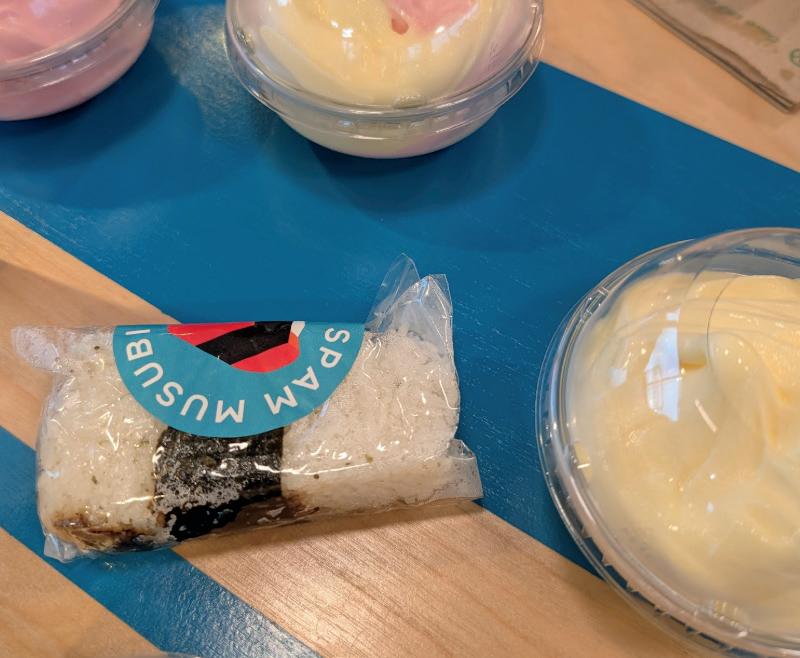

Looking for a new restaurant to try in Springfield?
I recently went to Springfield’s debut Hawaiian Bros Island Grill, a chain known for bringing Hawaiian plate lunches to cities across America, from Portland to Corpus Christi. Located at 1272 E Battlefield, it inhabits what was formerly a Wendy’s. Personally, I had heard several conversations about our new Hawaiian Bros, some saying that they were super excited to have it locally, others saying it wasn’t worth the hype, or that it was just okay. Determined to settle it for myself, I went on a Wednesday evening to check it out.
So, what does it offer, and what makes it different from other chains? Hawaiian Bros offers plate lunch meals that include meat, two scoops of rice, and macaroni salad. Along with the plate lunches, they offer wraps, sliders, and salads, so you have a wide selection based on what sounds good. It is different from other chains because it doesn’t have what seems like a billion different meals and combinations. It is pretty straightforward, and you don’t need to prepare a script in order to order. If you are planning on going,
expect to spend $10 to $25 dollars, depending on whether you are ordering just a meal or if you are also getting drinks and dessert. First up: I tried the Huli Huli Chicken. It had sweet teriyaki sauce with green onions and rice. I really liked it because it had a lot of flavor, and there wasn’t too much or too little sauce.
Next, I ordered the Luau Pork. This was the only thing that I didn’t like on its own. It didn’t really have much flavor, and it definitely needed a sauce to pair with. To solve this problem, I dipped it in the pineapple-infused barbecue sauce. I really enjoyed that sauce! It was similar to most barbecue sauces, but it was very sweet and tangy, while the teriyaki was salty and sweet.
I also got rice and macaroni salad with my meal. There isn’t much to say about the rice: it was just rice. The macaroni salad, however, was not what I expected. Compared to the macaroni salad I have eaten, you could taste the mayonnaise more, and it was saltier.
I also ordered the SPAM musubi. Originally, I doubted this and didn’t think I would like it, but I was wrong. The flavors went
well together, and it was salty and sweet. I tried both kinds of Dole Whip that were offered: pineapple and strawberry. The Dole Whip tasted fine, but I felt like I could taste the artificial ingredients. I liked the pineapple more than the strawberry. (However, I recommend supporting your local small businesses and trying Pineapple Whip instead!)
Now that I’ve covered the food aspect of the restaurant, let’s talk about Hawaiian Bros.’ overall vibe. When I went, it was really busy, with in-person and drive-thru traffic peaking around 7 o’clock. Part of this might be since I went to the first month of operation in Springfield, so there were a lot of new customers coming to check it out. The wait time wasn’t bad, even though it was really busy. The restaurant offers drive-thru, dine-in, pickup and delivery options, so you can get food from home or on the go. Another nice option that they offer is the ability to order meat or veggies in bulk in case you are having lots of company. Whichever way you choose, I recommend Hawaiian Bros as a tasty, new fast food option for you to try!
Luau Pork. Photo by Olive Eck.
SPAM Musubi. Photo by Olive Eck.
THE BOOK ISN’T ALWAYS BETTER THAN THE MOVIE
When their favorite books were adapted into movies, readers-turned-movie critics have been lying for years; the book is not always better. Most of the time, they are correct. Because there is no maximum page count for a book, authors can spend endless time emphasizing details that a two-hour adaptation cannot. However, sometimes a book is adapted, and the executive producers make edits and cuts that are necessary, making the film way more enjoyable.
The most blatant example of a movie adaptation that made drastic changes to the characters and plot is the “To All The Boys I’ve Loved Before” trilogy. The story follows high school student Lara Jean after the love letters she has written to all of her past crushes are mysteriously sent out. This trilogy was originally written by author Jenny Han, and her novels were adapted by Netflix in 2018. I did the criminal act of watching the movies before I read the books, and I loved them. I read the books later, and they were horrible. The plot is generally the same, but all of the fun banter and awkward moments in the movie that make it so comforting were not in the book. The love interest, Peter Kavinsky, is the most kind-hearted golden retriever in the movies, but in the books, he’s incredibly rude to everyone and dull. There is nothing special about him, and I was actively rooting against him. All three movies are, in every way, better than the books.
Another reason why some movies are better than the books is that sometimes a book is ruined by the author’s writing style, such as the “Hunger Games” by Suzanne Collins. This story follows Katniss Everdeen participating in the Hunger Games, a series of trials designed to propagandize division and suffering to idealize the corrupt President Coriolanus Snow. As much as I love the “Hunger Games” series, I
don’t love Collins’ writing. I love descriptive writing, and Collins’ tends to be a bit bland and uninspired for me. While the movie adaptations for the original trilogy are far less superior than the books, the adaptation for the prequel following the origin of Snow, “The Ballad of Songbirds and Snakes,” was so much better than the book that I recommend that people skip reading it and just watch the movie adaptation if they want to read the second prequel, “Sunrise on the Reaping.” The movie followed the plot perfectly, and the transition from Snow’s morally grey character into plain evil was so smooth and seamless, whereas in the book, it was a bit choppy. It also heavily focuses on music, and the movie incorporates the most beautiful soundtrack for the story. I highly recommend the film adaptation over the book.
A more recent example of how sometimes the movie adaptation can go above and beyond the book is Andy Weir’s “Project Hail Mary.” This story follows a middle school science teacher who is sent to space to find a solution to save the sun from a virus. During his mission, he meets Rocky, an alien trying to save his planet from the same problem. I don’t read science fiction too often, and I definitely don’t read space books, so the novel was a bit challenging for me to get through, even though I adored the main characters. The movie, on the other hand, might be one of my favorite releases from the last few years. The casting was just how I pictured the characters, the humor was hilarious, and the bromance between Grace and Rocky was so touching. I love the visual aspects of the film because I had such a hard time envisioning what spaceships looked like while reading, and the movie literally brought the story to life for me. The adaptation also follows the plot perfectly, but it also drew a more emotional reaction out of
ARI ABBOTT
REPORTER
me than the book did. My opinion of “Project Hail Mary” might be an unpopular one, as the book is so well-loved by many readers, but in my opinion, the movie is perfect.
Lastly, I have to point out that every adaptation of romance author Nicholas Sparks’ books is infinitely better than his books. “The Notebook” follows a couple falling in love for the first time, then being separated by different life circumstances, and then meeting again later in life. It is widely considered a movie classic for its beautifully touching romance, but the book, however, is a boring, dry, infuriating mess that is one of the worst books I have ever read. The whole story of how the characters first met and fell in love before being torn apart is not in the novel at all, and it makes the characters insufferable because you’re just expected to care about them without actually having a reason to. His novels “A Walk to Remember” and “Dear John” have also been adapted, and those books are fine at best, but the movies are really tear-jerking. “A Walk to Remember” is a cancer tragedy that made me sob while watching the movie, but left me straight-faced in the book.“Dear John,” is a military romance about a soldier finding love after deployment, but in the book, I cared more about John’s relationship with his father than his love interest because the romance was bland, but the love story in the movie left me in shambles. Long story short, if it’s a Nicholas Sparks adaptation, assume the book sucks, but the movie will make you cry.
No matter what genre, the book is not always better than the movie. Sometimes the author doesn’t always get their own story right, and directors and film-writers can do it better. It’s time we stop lying to ourselves that we need to spend eight hours reading a book when we could get the same story, but better, in a two-hour movie adaptation.