Central High Times - Volume 112, Issue 3 - Spring 2026
THE SPRING ISSUE
2
FRONT COVER
Shamaya Lewis (11) performs with the Step Team at the Loyalty assembly.
Photo by Julia Matson
EDITORIAL POLICY
The Central High Times is a student-produced publication of the Central High School journalism department. The staff and adviser strive to create an open forum for students and teachers. We take responsibility for accuracy and fairness and for work to be unbiased and responsive to the needs of readers in order to encourage the submission of readers’ ideas. We promise to practice honesty, to run the paper as a business and to avoid printing material that is legally considered obscene, libelous or private.
LETTER TO THE EDITOR POLICY
The Central High Times encourages the submission of ideas or comments from readers. Letters to the Editor must contain no more than 150 words. Letter to the Editor submissions should be typed, printed, signed and delivered to Central High School’s journalism office (room 024) or sent to keodell@spsmail.org with the subject line “Letter to the CHT Editor.” The Central High Times reserves the right to edit submissions for grammatical and spelling errors and for space limitations.
ADVERTISING AND SPONSORSHIP POLICY
The Central High Times has the right to accept, reject or cancel any advertisement at any time. Advertising will not contain any statements, illustrations or implications offensive to good taste or public decency based on the opinion of the Central High Times staff (i.e. any content containing anything racist, sexist or illegal for high school students or violates journalistic principles). Advertisements accepted by the Central High Times staff are not an endorsement from the staff, adviser, administration or Springfield Public Schools District. Advertisements should refrain from attacking competitors unfairly or disparaging their products, services or methods of doing business. If your organization would like to advertise in the Central High Times, or if you would like to provide a financial sponsorship for the Central High Times, please contact the adviser, Kori O’Dell, at keodell@spsmail.org. Sponsorships begins at $25 per year, advertising pricing begins at $50 per issue, and all money raised goes toward our printing budget.
ADVISER Kori O’Dell
EDITOR-IN-CHIEF Lucy Caplinger
PAGE DESIGNERS
Reese Wood & Emma Lewis
ASSISTANT PAGE DESIGNERS
Abbott Schmidt, Sarah Greene, Jack Herr
COPY EDITORS
Sarah Greene, Jack Herr, Reese Wood, Emma Lewis, & Ari Abbott
SENIOR REPORTERS Ari Abbott, Chloe Wootton REPORTERS
FONT FAMILIES Function, Century PUBLISHER PrintGroup
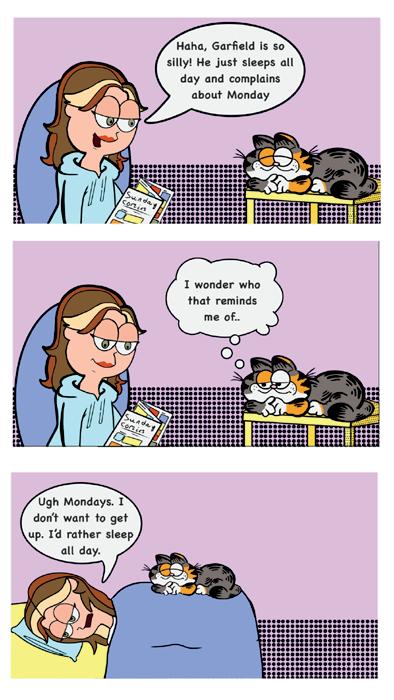
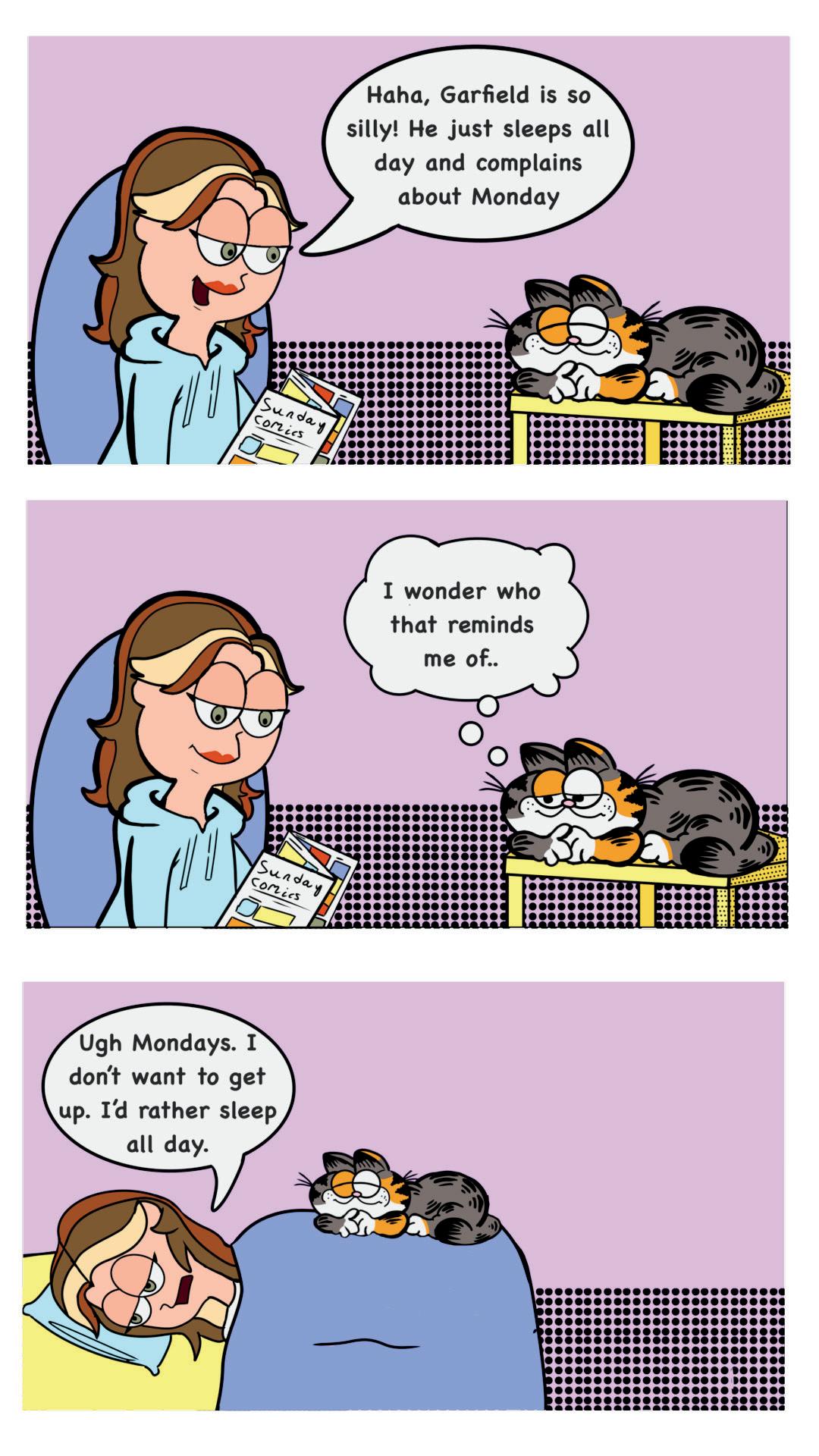
COMIC
Comic by Avery Rapp.
LEDDITOR: THE LAST
LUCY CAPLINGER
EDITOR-IN-CHIEF
There is no way to truly or accurately sum up all four of my years at Central, but writing it out for the magazine seems like the right way to do it. I have been the Central High Times’s Editor-in-Chief (EIC) for almost two full years, and this is my last true Ledditor (or letter from the editor).
To be honest, I am incredibly scared to graduate and dreadfully sad that I will not be a part of this writing community come next year. Being a part of the magazine has truly shaped my high school career and continues to be one of the best parts of my experience at Central. Writing anything is such an intimate act, even if it is a news article about Speech and Debate or a feature about “The Best Restaurants in Springfield To Get Chinese Food.” Putting pen to paper, or finger to keyboard, takes intention and care that cannot be recreated holistically in any form of media. Choosing to put your name behind something is brave, regardless of what the product is. Sharing your thoughts is, in my opinion, one of the most important parts of being a human. While in high school there is always a reason to write, because for the most part, if you don’t, you will get a bad test grade or suffer from late points or let your peers down. I am scared that after my academic education is over, and I am out of school, my feverish passion for writing will dwindle, and I will lose this part of myself that feels so necessary. This magazine, regardless of statistics and readership, acts as an outlet for both me and my staff, and that is incredibly important.
Joining Journalism 1 (J1), the prerequisite for being a part of the magazine, was a choice I made with no true thought. The outcome ended up being some of my closest friendships and best memories. This taught me that trying new things is almost never a bad idea, and what you are best at is out there; it’s just a matter of trial and error. Sometimes a random decision is the best one you will make.
Continuing on in Journalism 2 (J2) as a magazine reporter for my sophomore year was another good decision, in a year where I
unfortunately did not make a lot of those. This was an incredibly difficult year for me, both academically and socially, but being a part of the magazine gave me the community that I needed. This taught me the importance of foundfamily and that experiencing inconvenience is the backbone of fostering relationships. I also obviously learned a lot about writing, and who I am in a literary capacity. This self-discovery has been incredibly beneficial in deciding where I want to go next.
Junior year was my first year as the EIC, and also my first year without the seniors who graduated when I was a sophomore, who truly impacted me in unexplainable ways.
Instead of simply being a peer who participated in writing and reporting, I was in a leadership position where I had to direct my fellow staffers on what to do next. This year taught me a lot; I learned the importance of finding a balance between complimenting and criticizing someone’s work, as well as how important tone is. Having the ability to tell someone what and how to do something is a big responsibility and can be uncomfortable, but I feel like I have gotten so much better at my communication skills because of it.
My classes got harder junior year and balancing everything was hard but delightfully challenging. Continuing to have a community was important to my success, so for my staff I am thankful. Senior year has been so hard in many ways. This difficulty for me has mostly to do with another big change coming into my life with graduation and college. I can’t help but feel like I am losing a community that has played such a crucial part in my academic and social evolution as a student.
I am so lucky to have had such a positive experience in high school, because I know that most people are excited to graduate because they didn’t have the same experience. As I feel so connected to this magazine and this staff, there is nothing that I would change. Missing you guys is such a privilege. Senior year has taught me that having closure is a choice you have to make, and that the journey is truly the important part. I am glad that I have been so ardently living in the now that moving on to the next chapter feels so scary.
One thing keeping me optimistic is how excited I am to see what happens next year, as the staff will only continue to grow and flourish. There are so many talented minds associated with Central’s journalism program, and having the opportunity to share a page and a classroom with them remains my favorite part of the last four years. Thank you for having me, and I am rich in life for my time on the CHT.
FOOD STAMP
EMMA LEWIS DESIGN EDITOR
changes Supplemental Nutrition Assistance Program
Despite the lack of national attention, changes to Supplemental Nutrition Assistance Program (SNAP) benefits persist far beyond the recent government shutdown. For Missouri, certain foods are no longer regarded as SNAP eligible in what Gov. Mike Kehoe calls an effort to “Make America Healthy Again.”
“Missouri is proud to partner with the Trump administration on the Make America Healthy Again movement as we refocus SNAP to maximize nutritional health for families while also supporting the abundant agricultural output of our state,” Kehoe said.
In spring of last year, Missouri’s General Assembly passed legislation that initiated a waiver request process. Three months ago, the U.S. Department of Agriculture (USDA) approved Missouri’s waiver that disqualifies certain “unhealthy” foods from being eligible for SNAP benefits.
“With these new waivers, we are empowering states to lead, protecting our children from the dangers of highly-processed foods,” Secretary of Agriculture Brooke Rollins said.
SNAP users will no longer be able to purchase candy, prepared desserts or soft drinks. Drinks, beverage mixes and concentrates with 50% or less natural fruit or vegetable juice will be restricted as well.
Meanwhile, Kehoe’s corresponding executive order claimed to “incentivize the purchase of fresh fruits, vegetables, and Missouri-produced meats and dairy products,” but did not provide a specific mechanism by which the state department would achieve this goal.
The decision to restrict such items has its merits and limitations, with experts from both sides projecting the policy’s potential impacts. With respect to its benefits, advocates argue that over-reliance on processed foods is a direct contributor to Missouri’s high rates of obesity and disease.
“Healthy and nutritionally secure families
are critical to supporting a path to selfsufficiency,” the state’s application for the waiver said. “Nutrition-sensitive chronic diseases are a significant public health concern in Missouri.”
Simultaneously, Kehoe hopes that the order will uplift the state’s agricultural sector, what he calls “the bedrock of Missouri’s economy.”
“The state stepping up to help support
“You bring a whole cart of groceries, and you put them on there,” Woody said.
“Then, they’re like, ‘You can’t have that,’ or
‘You can’t have that.’”
that further would be incredible,” President of Missouri Farmers Market Association Karissa Kary said. “It allows opportunities for both farmers and people on food assistance to get the freshest, most local food that is in the area.”
While dissidents appreciate the focus on health and support of local farmers, some argue
that restricting what foods individuals are able to purchase is not an impactful solution.
“The issue with using a stick instead of a carrot when it comes to this approach of healthy eating is that we are doing nothing, nothing at all, to actually help get healthy food into the household of Missourians,” State Sen. Maggie Nurrenbern said.
Beyond questions of the premise’s effectiveness, consumers may face confusion regarding what particular products are restricted. For candy, in particular, some rules are considered counter-intuitive, based on ingredients as opposed to sugar content.
“One would think, ‘It’s got peanuts in it, so it’s got to be the food,’” Executive Director of Missouri Grocers Association Dan Shaul said. “[Snickers] is absolutely the candy. The Twix is considered food because it has flour in it.”
Shaul believes the policy would harm all ends of the supply chain.
“There’s going to be administrative costs, training costs,” Shaul said. “I an industry that normally [has] a 1% [profit] margin, any cost is going to be felt at the end, at the consumer,” Shaul said. “We’ll do everything we can to minimize it, but there’s truly going to be issues.”
Christine Woody, food security policy manager at Empower Missouri, worries that the process will lead to “headaches and complications” for SNAP users.
In spite of concerns, the USDA promises to collaborate with Missouri in addressing the waiver’s complications.
“Due to the novel design of the project, the Food and Nutrition Service (FNS) is committed to carefully and comprehensively evaluating how waiving the state’s definition of food in this way impacts SNAP participants and retailers,” Rollins said. “FNS will carefully review the results of the project, based on the evaluation data provided by the state and other available information.”
Escape Evade Defend
MAGGIE MOORE REPORTER
In the most recent town hall meeting,, a new video appeared in the slideshow presentation, introducing the new Evade, Evacuate, Defend (EED) policy.“Bringing the video into the school as a first step to ensuring our safety is important, but I need to have more steps put in place to feel safe,” Cassidy Bowman (11) said.
The video lists the three steps and instructions: Evade, students should escape or avoid in any way possible. Evacuate, get as far away and as fast as possible. Defend, protect from harm and danger. And the only way students will know how is through this training.
“I’m grateful we have the video, but I feel like we may need it to be more extensive,” Bowman said. “I feel safe here, but even in the safest places, stuff can happen, and that’s scary.”
Evade, Evacuate, Defend teaches students awareness, along with the necessary
WN S E
knowledge. Important drills are put into place, and expectations are high to build the muscle memory of the event.
“We can be proactive with our safety precautions in our building, which means we have the opportunity to save lives,” Jeremy Brown, principal, said. “ I think we make a huge mistake when we’re very reactive, especially in that moment, due to the body shutting down- at any time you’re in crisis.¨
Springfield Public Schools provided the video and reenacted situations for students and resources to navigate them. The EED video is the version of what was once ALICE training, standing for Alert, Lockdown, Inform, Counter, Evacuate.
“Preparing our kids for all safety precautions and how to act when a serious situation arises allows our students not only to know the expectation, but also to improve our survival
rate in our building,” Brown said.
According to Sandy Hook Promise, an organization focused on the prevention of school intruders, violence, and student safety, 12 students are killed by gun violence every day in the United States, and another 32 students are injured.
“It’s so important that everybody knows our expectations and our drill, the expectation of our drills,” Brown said, “especially in a building of this size and this magnitude.”
To remember this information is vital, and to understand it can be life-changing.
‘It’s always great just to be proactive, ‘cause you just never, ever know,” Brown said. “And if we give you guys the skills to be prepared for that, we save several lives in our building, and beyond here, we want you to be successful, we want you to be aware and prepared.”
Sunshine Development
In the past few years, West Sunshine has undergone extensive construction and development. The area will soon be home to a Target and several new restaurants. The Sunshine Street Bridge is also finished after a five-month project to replace the aging bridge that needed safety updates, which makes it even easier to access the new developments.
The new Target, which is 148,000 sq. ft., will hopefully prevent the East Primrose Target’s parking lot from filling up, as customers often claim. While not technically considered a “Super Target”, the Target location is almost 25,000 sq. ft. larger than the other location.
One of the most noticeable differences is that the store features two entrances instead
of just one. It is also in proximity to a Walmart, which will likely make the area very convenient for those wanting to get lots of shopping done at once. It could also affect locals because of its new offerings. The new Target is significantly larger than the old one, and it will include an Apple-in-Target shop, which is new to Springfield, as well as a CVS pharmacy and a Starbucks like the existing store. The grand opening is set for Sunday, March 15, 2026. Those who have been excited to visit the Target since its announcement in the summer of 2023 are likely to visit on the ides of March or in the days afterward.
Another highlight of the West Sunshine development is the new restaurants.
Springfield’s second Olive Garden is now open, along with its first Dutch Bros Coffee location, one of sixteen in Missouri. There is also a Whataburger and a new Chick-fil-A in the area. Similar to Target, more chain locations will likely decrease the number of people packed into each restaurant.
Alongside the businesses, more buildings are being built in the area. An apartment complex has recently been proposed, and there is a building just east of the Target being built, but its purpose hasn’t been announced. As is with many areas in and around Springfield, West Sunshine is still developing, and it likely will continue to grow for years to come.
OLIVE ECK REPORTER
GOODBYE, RED KINGDOM
JACK HERR REPORTER
Missouri
On December 22, 2025, the Kansas City Chiefs announced their departure from Kansas City, Missouri to Kansas City, Kansas. The controversial decision was motivated primarily by financial interests and has ramifications for all of Missouri, no matter the distance from Kansas City proper.
This decision comes in anticipation of the Chiefs’ lease with Arrowhead Stadium – the stadium they have played in since 1972 – expiring in 2031. Then, the team will move to the new, domed stadium to be built in Wyandotte County. This came after residents of Jackson County, Missouri – the constituency directly around Kansas City – voted to reject Jackson County Question 1, which, if enacted, would renew a 0.375% sales tax financing improvements to Arrowhead stadium and a new stadium for the Kansas City Royals. 58.16% of voters balloted “no” to the resolution.
Thus, the state of Kansas won a “bidding war” against the state of Missouri for rights to the Chiefs’ new stadium; committing $1.8 billion in public funding to the stadium, estimated to be a three-billion-dollar venture.
The agreement between Chiefs owner Clark Hunt and the state of Kansas is a 60-40 agreement. The state of Kansas will contribute
60% of the total funds of the project, and Hunt will contribute the other 40% – $1.2 billion dollars of the Clark family’s $24 billion estimated fortune. The public funding for the stadium will come from diverted public funds over the next 30 years rather than a direct tax increase. These diverted public funds come out of the same pool that funds schools, roads, and other public works in Kansas.
Kansas agreed to this deal for multiple reasons. First is a belief that it will change perceptions about the state.
“For the rest of the nation, I say take heed,” Laura Kelly, Kansas Gov., said in her 2026 state of the state address. “We are not a flyover state, we are a touchdown state.”
Second, Kansas aims to capitalize on the tourism revenue associated with an NFL franchise. Kansas City’s conventions and visitors bureau, Visit KC, estimated that a home playoff game would produce $16 million in economic activity around the city. In a year, the Chiefs are estimated to generate $990 million in economic activity for their home city – and support around 5,800 jobs in the area. With the Chiefs winning their division nine times in a row before the 2025-2026 season, this moves to show what Missouri is losing out on with the Chiefs moving away.
Arrowhead Stadium holds 76,416 people. Many Chiefs fans don’t live in Kansas City, meaning that travel from other parts of Missouri, Arkansas, Oklahoma, and other
Kansas
states generates economic activity for the state of Missouri at hotels, restaurants, gas stations, and other amenities on the road to Kansas City.
Purely through taxes, the Chiefs provide $22.8 million in state revenue – approximately 0.1% of the whole state’s tax revenue. This tax revenue goes into the same public works, roads, and schools that the average person pays into.
With the move to Kansas, the Chiefs can be expected to take some of their philanthropic efforts with them. The Chiefs sponsor flag football across Missouri to promote health and well-being at a young age. Additionally, the Chiefs are also heavily involved with blood drives and banks in Missouri, holding a “Chiefs Week” blood drive at Arrowhead Stadium and collaborating with such organizations as the Community Blood Center of the Ozarks to provide Chiefs apparel and raffle tickets as incentives for donors. As well, the Chiefs sponsor food drives, teaming up with organizations such as harvesters to help combat hunger across the state.
Thus, the Chief’s move to Kansas has implications beyond where the home of the Red Kingdom can be said to be.
EVOLVING FANDOM
With the Chiefs’ recent decision, local fans share their opinions on the move, for the future of Missouri, Springfield, and beyond.
“My mom is from Kansas City, and my parents used to live there, so KC has always been important to me,” Jodi Pitts, English teacher and Chiefs fan, said. “My first time attending a Chiefs game at Arrowhead was in the 1990s.”
For Missouri, Pitts thinks the Chiefs act as a unifying force, as opposed to states like Texas or New York.
“Since the Chiefs is Missouri’s only NFL team, it seems the one thing everyone in Springfield can agree on,” Pitts said.
Reilly Green (11) is a student at Central and a devout Chiefs fan. He echoes Pitts’ sentiment of love towards the Chiefs, holding fond memories of the team’s success with his family.
“In the past 7 years, the Chiefs have won the Super Bowl 3 times, so this contributed to my overall happiness a fair amount,” Green said. “When the Chiefs won in 2019-20, it was the happiest I’ve been in a while because I got to share the moment with my Mom, Dad, and sister at our house. It’s a really special memory for me.”
In his youth, Green supported the formerly St. Louis Rams, but didn’t feel strong enough of a regional connection to continue supporting the team in Los Angeles.
“When the Rams moved to LA, I had no choice but to become a part of the Chiefs Kingdom,” Green said. Despite the move away, Pitts and Green will stay loyal to the Chiefs.
JACK HERR REPORTER
“I will always be a Chiefs fan,” Pitts said. “I was a fan way before we had Travis, Patrick, and the Super Bowl wins. I will be a Chiefs fan after.”
This is not to say that Pitts is not unhappy with the maneuver, but she notes the practicality from the perspective of the Chiefs’ owners.
“I was really disappointed,” Pitts said. “Arrowhead is special. I have a lot of memories there. I don’t personally feel betrayed by the Hunt family, who are billionaires who don’t even think about me or any other fan, most likely. I’m pragmatic enough to realize a billionaire will make decisions based solely on money.”
Green agrees with the idea that the decision to move towards a new, domed stadium doesn’t necessarily reflect the interests of everyday fans.
“I don’t think Chiefs Kingdom really cares,” Green said. “Chiefs fans have enjoyed Arrowhead for over 50 years and show up even in the worst conditions (-4 degrees in 2024). The main loss when thinking about a domed stadium is the culture and how fans will have to adjust to that change.”
Domed stadiums are often seen by owners as more profitable and comfortable, leading to
the recent rise in the number of enclosed NFL stadiums. As of today, 10 of the 32 NFL teams play in a stadium with some sort of dome or roof, with at least four new enclosed stadiums cropping up in the last ten years (definitions vary).
“I understand the draw of a domed stadium, but I’ve been inside one, and the outdoor stadium is just so much better,” Pitts said. “The atmosphere is more enjoyable without a dome. It’s hard to pinpoint what exactly is lost, but the vibes are just different.”
One of the biggest complaints about the move towards domed stadiums is a rejection of tradition.
“I know the people who are upset by the move are worried about a loss of tradition and the legacy of Arrowhead,” Pitts said.
Despite the relatively short distance, much is left up in the air for Missouri as the Chiefs shift across state lines.
“I know the new stadium will only be minutes away from Arrowhead, but it might impact Missouri’s economy, specifically fans who come and stay in KC to go to games,” Pitts said. “Will the hotels/restaurants/shopping be impacted? I hope not.”
It seems, despite the move away, Missouri Chiefs fans have accepted the decision and hope to enjoy the years as the Chiefs’ home state they have left.
“I realized the move isn’t till 2031,” Green said. “I still have some years to watch some games in the coming seasons.”
Reilly Green (11) proudly sports his Patrick Mahomes jersey. Photo by Jack Herr.
FIFA
For the first time in many years, the FIFA World Cup, one of the most anticipated and most-watched sports events in the world, is taking place in the U.S. For the first time ever, Kansas City, Missouri, will host six games, including one quarterfinal.
“I first became interested in soccer during the 2022 FIFA World Cup,” Brianna Cheuk (9) said. “It was really popular on social media, and my family were already fans of soccer, so I watched it with them.”
In short, the FIFA World Cup is a 39-day-long soccer tournament featuring 48 teams from across the world. The matches are located in a variety of cities in North America, from Mexico City to Vancouver. Each match can change the overall tournament, and eventually, there will only be one winner. The Cup only occurs every four years, typically taking place during the summer following the Winter Olympics. The Cup is not only a sports event; it also attracts many tourists to the host cities throughout the 104-game tournament.
“I think that Kansas City is definitely going to become a more popular city,” said Cheuk. “It has become more prevalent because of its sports.”
Locally, Springfield will likely be impacted by the enormous number of fans flocking from around the world to Kansas City. Whether visitors from around the
world are en route to KC or local Kansas Citians seeking to escape the chaos of the globally recognized sporting event, Springfield and the surrounding area are likely to be impacted. Kansas City was also selected by Argentina, the reigning World Cup champions, as their Team Base Camp during the World Cup due to its amenities and proximity to other cities hosting the matches.
“I am really excited about Missouri hosting games because that means that I may have a chance to go see it in person,” Emma Munoz (9) said. “I do think that the World Cup will increase Missouri’s tourism because it tends to be a pretty popular event that will bring people from all over the world to this state.”
Last time, in the 2022 Cup, the host country Qatar received about three million soccer fans, and it earned almost $7.6 billion from the tourism. However, FIFA has been under pressure this year after its ticket prices were considered too high for many people to attend. After the scrutiny, FIFA eventually adjusted its prices, and the tickets now range from $60 Supporter Entry Tier tickets to $8,680 for a ticket to the final match. However, fans can watch matches on Fox, YouTube TV, and FIFA+ and avoid spending hundreds or even thousands of dollars to attend a match.
OLIVE ECK
REPORTER
“I think that [tickets] are way too expensive,” Cheuk said, “and it is hard to find tickets to buy.”
Many famous soccer figures around the world are calling for a boycott of the FIFA World Cup against President Trump’s policies on immigration and his expansionist views on Greenland. People who have called for the boycott include Sepp Blatter, the former FIFA president, and Mark Pieth, a Swiss attorney. However, such a boycott seems unlikely, as one of the very few sports boycotts in history was the 1980 Summer Olympics Boycott, which was against the Soviet Union’s invasion of Afghanistan, not one country’s policies.
Overall, the major sports event is likely to affect many people throughout the region, even those not interested in soccer. Since Kansas City is close to Springfield, it is likely that tourists may stop by to check out Springfield’s many attractions. Many people may take the opportunity to learn more about soccer and FIFA, and the summer’s events are sure to leave a lasting impression on fans, no matter the outcome.
EMMA LEWIS
REPORTER
Walkout: CHS
In response to recent actions from the Immigration and Customs Enforcement Agency (ICE), hundreds of Central students gathered to signify their opposition to violence and hope for change from the status quo.
“The original inspiration for the walkout was my father, mentioning the nationwide walkout, saying that he planned on participating,” walkout coordinator Jessie Miller (10) said. “The Central Walkout began when I messaged a large group of my Central friends, asking who would be interested in protesting alongside me.”
As Miller and her peers began to make posters and send out Google Forms, what began as an idea among friends quickly grew into something more.
“The process of organizing a walkout looked like putting hours of time and effort into making this idea into a reality, along with scouring the handbook and trying to get into contact with administrators,” Vivian Donnell (10), friend of Miller and fellow coordinator, said. “At first, we were worried about what the response would be from the admin. Eventually, we got into contact with Mr. Brown through asking the office and held a formal meeting between us, Brown, and Mr. Patterson.”
Principal Jeremy Brown and the broader Central administration hoped to provide necessary support without impeding on the student-led nature of the protest. Eventually, the walkout involved supervision from administration along its path and security resource officers in case of emergency.
“We want to ensure that our students feel safe and have the opportunity to voice their opinion on any subject matter that pertains to them,” Brown said. “As they’re getting older, we want them to know that they have their amendment rights as well. Providing that opportunity and space for that freedom of speech is very important to us.”
With everything in order, the protest occurred at 2:30 PM on Tuesday, January 20th. According to estimates from Miller, at least 200 students were present.
“The turnout of the protest was way more than we expected,” Donnell said. “We originally had 90 signatures on our sign-up form, but when everyone started showing up, we realized this was way more. This goes to show just how many people wanted to address injustice within our community. The shocking thing was, most everyone there was there to get involved and show our immigrant neighbors that we’re here to help.”
A range of students across different backgrounds gathered to support the protest, their reasoning for involvement varying.
“The walkout was a lot more effective than I thought it would be,” Ollie Nickle (11) said. “It just showed how much Central students care about this. It’s hard because, just yesterday, when the walk-out happened, ICE was spotted at Reed Middle School. It’s definitely a dangerous environment, but I decided to join because I wanted to show my support of immigrants. As the organizers said, I wanted to show that I was a safe-space for people. I want to
show that we want change, students can accomplish change peacefully, and that we can be a force for good.”
Other students supported the cause, but were hesitant to get directly involved with the protests.
“Regardless of what you believe about ICE, I think these kinds of protests are pretty unimpactful,” Grant Hudson (11) said. “Central High School had a school-sanctioned walk-out for thirty minutes at the end of the day; it’s not very impactful. It’s certainly a noble thing for people to be protesting and politically engaged, especially at a young age, I think that’s very important for our civic system to exist. But I think that’s kind of a pretty insignificant way to do it and I’d rather just work on stuff.”
Despite concerns surrounding the protest’s effectiveness, the actions of Central students garnered city-wide attention. Reports from KY3 News, the Springfield Daily Citizen, Ozarks First, and a Facebook post with over 4,000 reactions suggest that adults are taking note of the younger generation.
“I feel the next step towards student impact is student engagement,” Miller said. “I know so many people and friends who were scared to come to the protest whether it was because they were scared of what might happen to them or worried about what people would think. That just goes to show the impact of the treatment towards our immigrant community. We need people out there who aren’t scared to stand up and fight for what they think is right. We need to show those who are fearful that we will go with them and that we’ve got their back.”
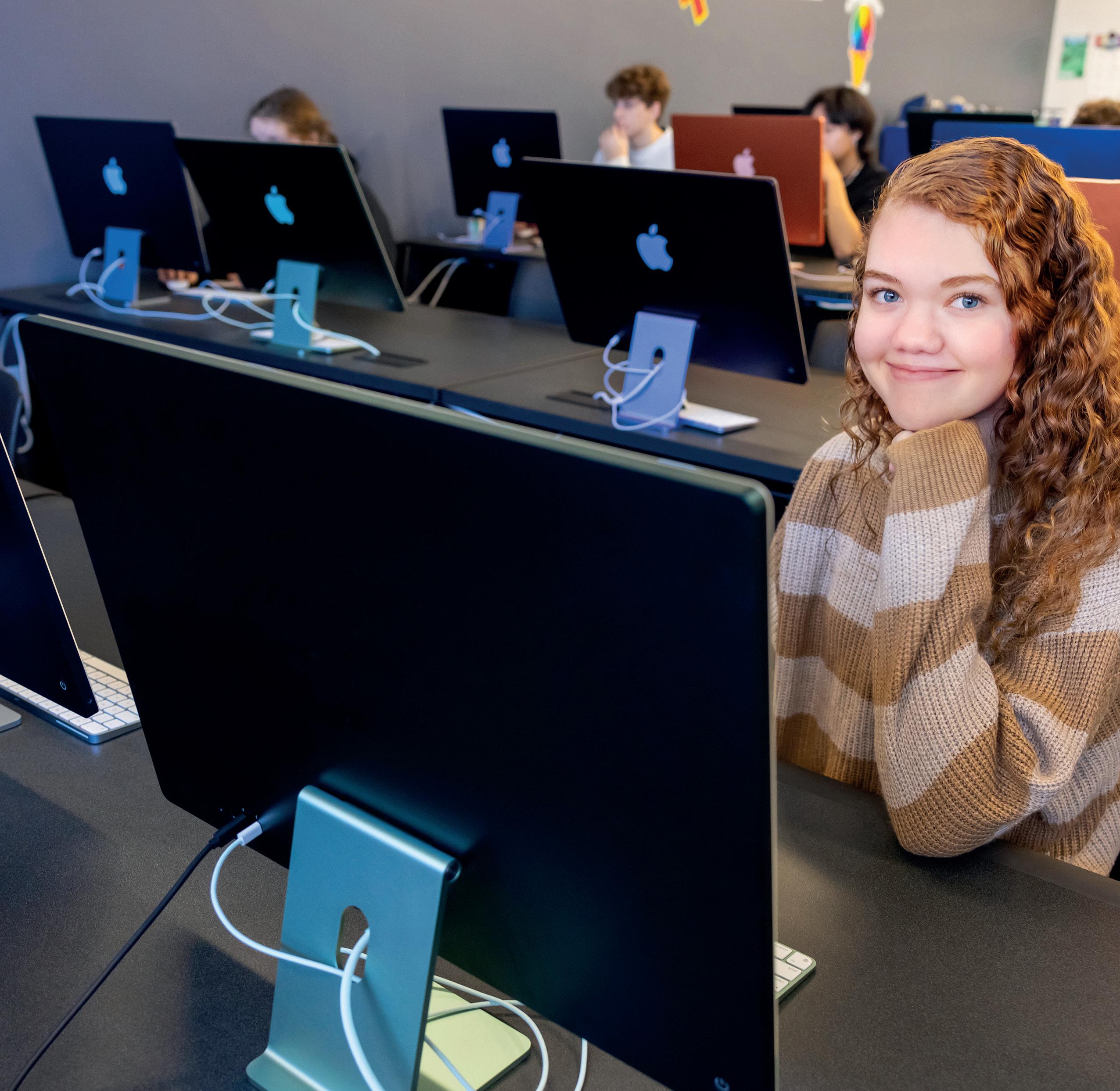
TODAY. STEP INTO TOMORROW
Your
first choice for college starts here!
AFFORDABLE EDUCATION
STEADY SUPPORT FLEXIBLE OPTIONS REAL RESULTS
to explore our programs, find out more information and to apply! Scan the QR Code
ARCHERY SPOTLIGHT
EMILY HUGGINS REPORTER
ARCHERY THE SEASON
EMILY HUGGINS
REPORTER
Aleyse Goodfriend (12) has been on the Central archery team since her freshman year. When she originally joined the team, she had friends and knew the coaches; but she stayed because of other reasons.
“I really liked the environment,” Goodfriend said. “I had gotten the hang of self regulation so the idea of learning to adjust all of the little aspects needed to excel at archery was exciting rather than daunting.”
Archery can seem like an individual sport, because they spend a lot of time working on themselves but they are still part of a team.
“If I had to describe the team in one word I would say... superstitious,”Goodfriend said. “Archery gives you some strange habits for sure but it’s all in good fun. We joke around with each other a lot, brush off bad rounds, give pointers, and encourage each other.”
The competitions at state are held in Branson, but all of the other competitions are held at Ozark Fair Grounds. While the competitions may seem scary, they can be a lot of fun for the archers.
“You make fast friends with the people in the lanes next to you,” Goodfriend said. “Tell them they did well with their cluster or make jokes about arrow chasing. Overall it’s pretty high energy and very supportive.”
Goodfriend is looking for colleges to have dedicated groups or clubs of archery allowing her to continue her archery journey.
Central bulldogs shooting into the season with high scores and placing in state and AllCity tournaments. The archery team has been working to compete and win tournaments. The coach is a teacher at Central named Audra Uzzell who has been coaching archery for about 15 years.
“We coach both high school and middle school (Scholars), so that is an hour for HS [high school] and an hour for MS[middle school],¨ Coach Uzzell said. ¨We practice in the auxiliary gym as it has the archery curtain in it which allows us to safely practice.”
The archery team’s tournaments are held at the Ozark Empire Fair grounds. They only travel outside of the district to Branson for the state tournaments. A state tournament is a higher-level competition, shooting in the tournament are the top scoring students from across the state. An all-city tournament is a local competition that brings in students from the same district or city.
“Every year we have had archery, we have had state qualifiers!,” Uzzell said. ¨So over time we have had lots of individual participants. Last year we also had a state qualifying team score and were able to take a HS team to the state tournament. Our state tournament is held in Branson, Missouri during our spring break.”
Even though they placed well in state, the state tournament isn’t the only tournament the
archery team has placed well in.
“Last year we were 2nd place at the All-City tournament!¨ Uzzell said.
¨Likewise we have had several students in the top placements for All-City tournament over time.”
Archery might seem more like an individual sport than a team sport. But it is a team sport, they all try to help each other get better. Brionna Spray (10) has been doing archery for four years, since sixth grade.
¨The team is like a roller coaster of emotions, because we’re a competitive but loving group.¨ Spray said. ¨Just like the other day, all of us grouped up and talked about the adjustments we need to make, and what we could do better. We also have the good laughs because we are all just trying to become friends and grow a larger community.¨
The archery team has a great community, everyone is really supportive and ready to help each other. But that does not only apply to the players but also the coaches. The coaches are there to help the archers grow and improve.
¨It is always fun to see how archers score and perform differently at tournaments versus practices,¨ Coach Uzzell said. ¨The environment at tournaments is different and it can change how an archer scores as archery is also a mental sport.¨
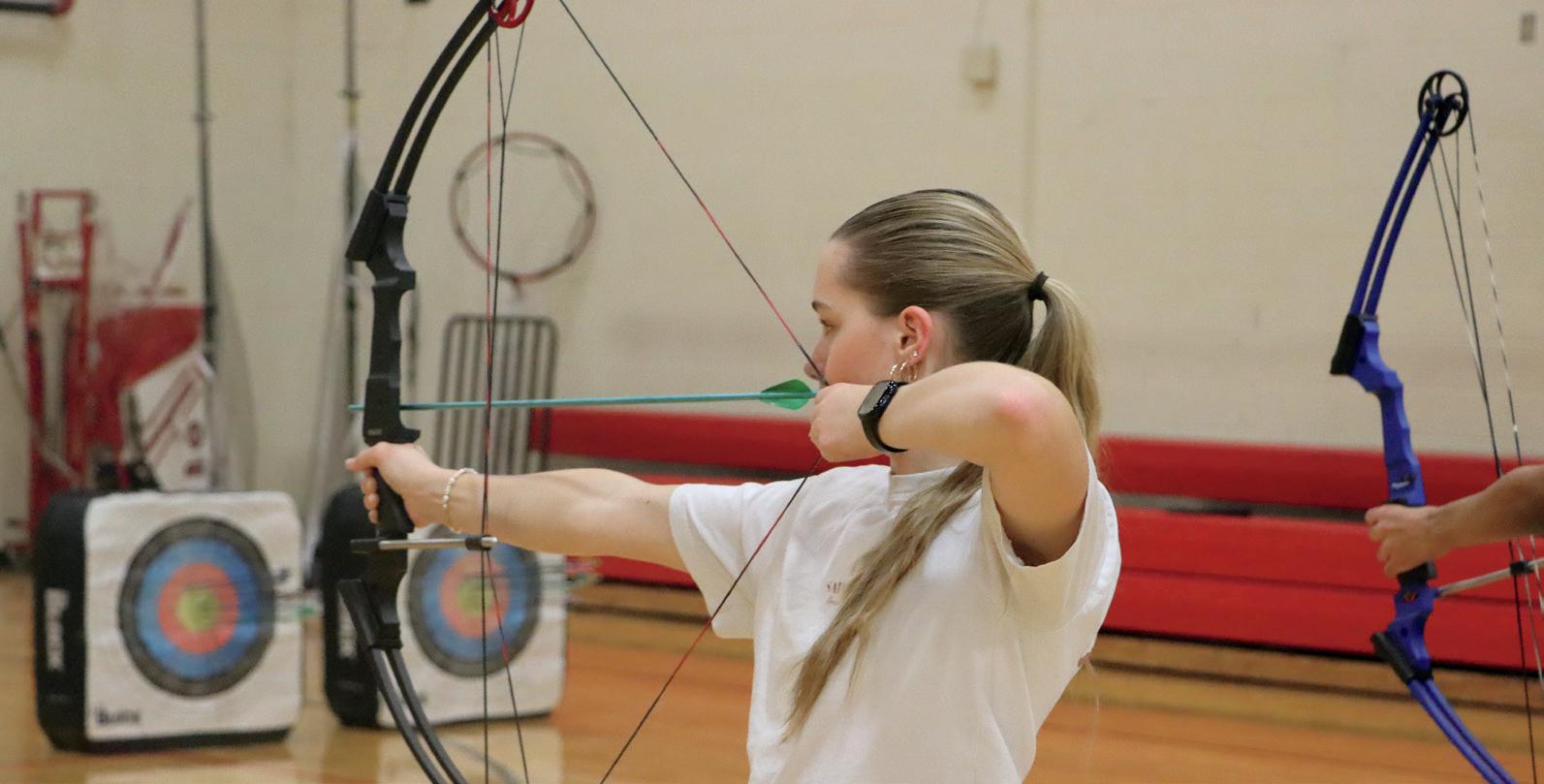
Sarah Kullin (12) aiming for a high score. Photo by Des Simmons.
BLUE BLOOD
BALLERS
TODD GAO
REPORTER
The Central boys basketball team began the 2025-2026 season with consistent daily practices; ready to represent Central high school at home and on the road.
“Our practices are pretty intense and fast paced,” Jordan Epps, the coach of the boys basketball team, said. “It depends, but we will usually practice every day Monday through Friday. During the season we will practice at least 4 times a week because we will start playing two nights a week. So some of our practices will be moved to Sunday instead. But generally we practice four to six times a week.”
The team strives for improvement as they face opportunities for growth. The team cooperates to get through challenges during the season.
“This season has been a bit of a roller coaster ride, up and down,” Epps said. “We had a lot of new guys with no experience, so we have been struggling to kind of win some games early on, but we are slowly figuring it out.
While initial hurdles of the season could have easily dampened the team’s spirits, the players have maintained a remarkably positive perspective on their early-season. By understanding the team and fostering cooperation, the team directs their efforts to achieve unmatched results in tournaments.
“This year, we struggled earlier on because we had to take on a new team identity. Last year, we had a large group of seniors, and so we were able to rely on them a lot more. This year, our success has come from working together
and playing as a team,“ Nathaniel Green (10) said.
This season the team wants to focus on their skills in order to qualify for the state tournament hosted by the Missouri High School Athletics Association (MSHSAA).
“In order to go to state for boys basketball,” Epps said. “You have to first win your district tournament and then you also have to win what’s called a quarterfinals game, and then after you win those things then you get to go to state and be in the top four teams for basketball.”
Despite numerous setbacks, the team demonstrated resilience without loss of enthusiasm. This year, they have high goals and high hopes for MSHSAA state.
“We went to state two years ago and got third place and that was the first time Central has been to state for boys basketball since I believe 64,” Epps said. It has been a very long time, so trying to build that and keep that condition in standard.”
SPOTLIGHT
TODD GAO
REPORTER
Francesco Farfaglia (12), is a distinguished player on the boys basketball team. Originally from Italy, Francesco has faced hurdles in his growth in both basketball and life. Still, Francesco demonstrates an unwavering commitment for growth.
“I fell in love with basketball in 2020 during the lockdown when Covid struck,” Francesco said. “We got locked down in our house, and I started to play basketball in my bedroom, and I just fell in love with that sport.”
Francesco discusses the challenges and differences he overcame after his arrival to the United States.
“When I arrived here, it was pretty difficult because I didn’t know anybody. I told myself that I don’t have to fear anything; I can just go and talk even if my English isn’t that good. I just have to try,” Francesco said. “Playing basketball in the USA was something crazy, something different, and it was really something that I loved,” Francesco said. I think that I can always do better and improve. That is what they taught me here. And there is no leniency in that. You just have to practice, that’s the mentality that they have here. You always have to try.”
Francesco reminisces about his journey and the differences that only encouraged him further.
“The atmosphere, the beep, the attention, the focus that we need to play, and the competition that we get here in the USA is something different.” Francesco said. “[the atmosphere] motivates me even more to play.”
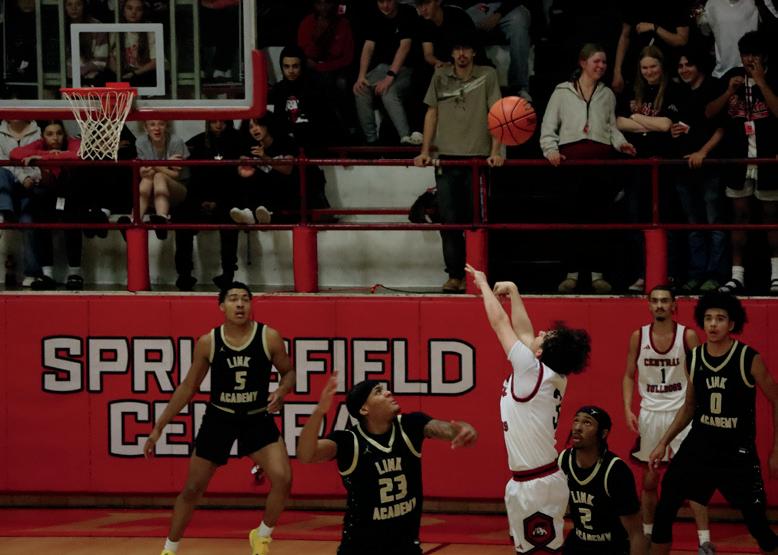
Donovan Martin tips off against Link Academy.
Photo by Jack Herr.
Cainan Studtman shoots a three.
Photo by Jack Herr
SPOTLIGHT
GEORGE WOOD DESIGN EDITOR
Melany Hinch is a sophomore on the Central High School Girls Basketball team. Besides participating in her sport, she likes to hang out with friends, listen to music, and watch TikTok.
“I’m a guard and I like it but I wouldn’t say it’s my favorite. I think it would be really cool to post,” Melany Hinch (10) said. “My favorite moment from basketball is probably winning the Galena game. I started and we got up super early. It was a moment where I really recognized my team and I’s growth and I feel like it really set the mood for the rest of our season.”
The Girls Basketball team is relatively green, meaning much training, practicing, and work is needed for the coming years.
“An odd fact about the team is that we have so many freshmen, over half of our team is freshman.” Hinch said, “It takes so so so much work to get good at basketball in a long term way and a short term way to get better at basketball.” Hinch doesn’t just play basketball, She also plays softball.
“Softball is my other sport and my favorite moment of that is the open field practices with Kylie (Woodson, a senior in Softball). Also just throwing with Kylie every practice or game. Another one of my favorite moments in softball was pitching a no hitter on my summer team!,” Hinch said. “Ideally I don’t want to play basketball in college but I want to play softball. However, It would be super cool to play both sports in college.”
DAWGS
ON DEFENSE
TODD GAO
REPORTER
The 2025 to 2026 girls basketball season starts with daily practices for the girls basketball team. The girls basketball team faces mounting pressure from the expectations that require them to uphold an impressive winning streak.
“In 2021 we were District Champions with a set of 6 Seniors that led the charge,” Caitlin Lamberth, the coach of the Central girls basketball team, said. “Since then we have been rebuilding with the previous years having held records with 2 or 3 wins.” As the season begins to unfurl and expectations rise, the girls basketball team continues to practice daily. The coaching staff provides the girls with individual skill work as well as team drills.
“Practices are every day after school when we do not have a game,” Lamberth said. “We divide the girls into teams and each team will have a goal for that practice.”
The team understands the requirements for districts. This season, through daily practices and cooperation, they aim for outstanding results as they continuously progress in the Missouri State High School Activities Association’s (MSHSAA) rigorous tournament system.
“The MSHSAA district tournament is a postseason event where teams compete after the regular season ends,” Lamberth said, “To become district champions, a team must win every game in its district tournament, usually two or three games in a row. Our goal each year is to have our players prepared and confident when those high-pressure games arrive.”
This season, the girls basketball team has set incredibly high goals. They aim to achieve these goals not only through consistent, rigorous training, but also through fostering a cooperative and welcoming community. Through consistent improvement, the team aims to foster a caring community.
“Our goals this season, as well as in previous years, have centered on building a strong culture first—one rooted in accountability, effort, and togetherness—while continuing to develop our players both on and off the court.” Lamberth said. “We have emphasized growth over results, focusing on consistent
improvement, strong fundamentals, and competing with confidence every night. This team has responded exceptionally well. They have bought into the process, held each other to high standards, and shown a willingness to learn and adjust. “
The girls basketball team understands and appreciates the qualities of a team beyond individual abilities. The coaches encourage and support all the players to understand that a true team is found in the synergy and unity of the team.
“Our coaching staff really values the TEAM aspect of our program,” Lamberth said. “We are a family that holds core values such as: respect, integrity, discipline, accountability, responsibility, and a WE mentality. Their commitment to teamwork and resilience has been evident in the way they prepare, compete, and support one another, and that has translated into steady progress and success throughout the season. Everything we do is to make ourselves a better individual that is focused on the team first and foremost.”
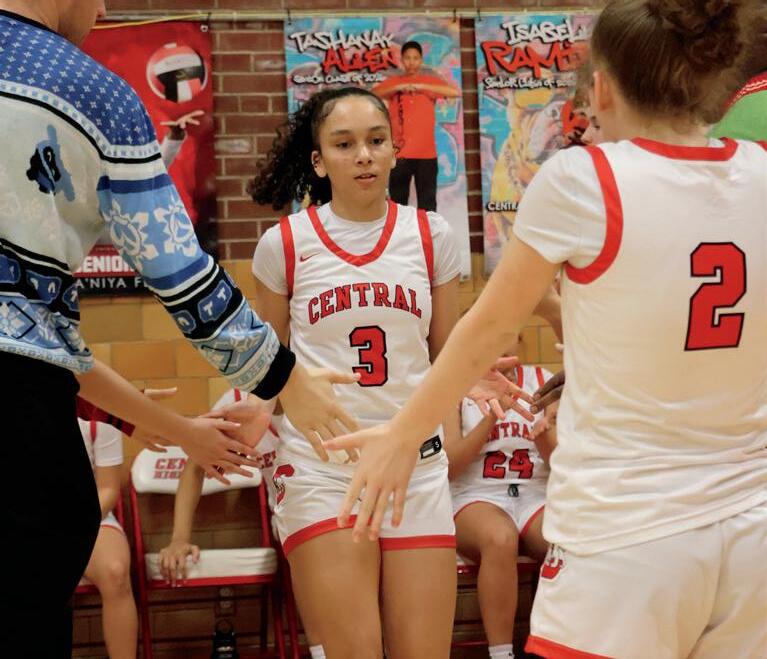
Annalise Freeman (12) by Emma Gugliotta.
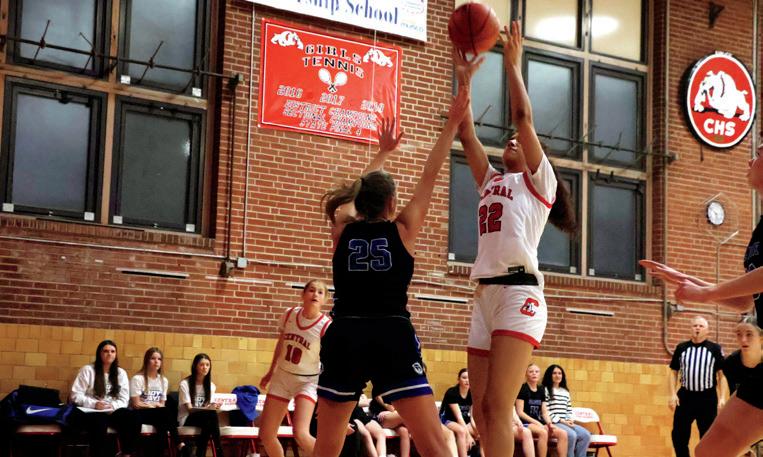
NeheMiah Rady (11) shoots the ball. Photo by Emma Gugliotta.
BOYS WRESTLING: MAT KINGS
SARAH GREENE
REPORTER
After years of the team being led by Michael Dalangin, the boys’ wrestling coach Hayden Puckett has assumed the role of head coach. Puckett, coach for the past four seasons, is a paraprofessional teacher in the special education department at Central, and has worked at Central for four years. He wrestled for five years at Republic, as well as coaching wrestling for the past nine years at Team Fusion Jiu Jitsu and MMA.
“I love wrestling and love competing,” Puckett said. “When I was offered the opportunity to coach on the wrestling team, it was a no brainer for me. I got to do what I love and surround myself with people who also have a passion for the sport.”
This recent season has continued Central’s wrestling winning streak, with the wrestlers fighting through obstacles along the way.
“This season has been challenging yet rewarding,” Puckett said. “We have a rather small roster for both the boys and girls teams, yet each one of our wrestlers is giving 100 percent every match… Injuries have been a difficult challenge for us this season. With us already having a smaller team, when someone gets injured it also takes away a practice partner for another wrestler. Everyone has been flexible with working with other wrestlers and being true team players.”
Because of how involved wrestling is, with daily practices and both physical and mental demands, it can have a significant impact on the wrestler. It requires conditioning, mental fortitude, and dedication to best perform throughout the season, which can be applied to academics and jobs.
“Wrestling has made me more disciplined in my everyday life,” Puckett said. “From being punctual on time commitments to being
initiative on things that need to be done. Leading by example is huge for me, so showing our wrestlers that the discipline to handle the little things and big things is a huge part of why I love being a wrestling coach.”
Despite the challenges and the dedication required, for Puckett, wrestling is still a rewarding experience for everyone involved, both for current players and the past wrestlers coaching them.
“My favorite part of the job is watching our athletes handle challenges and fight through adversity, both on and off the mat,” Puckett said. “Wrestling is one of those sports that teaches you many life lessons and sets you up for success for the rest of your life.”
EMMA LEWIS DESIGN EDITOR
Serving as the captain of the Boys Wrestling team, Rogue Wilson (12) has completed his final season of high school competition. As Wilson considers where he will continue his wrestling career and education, he reflects upon the impact Central’s team has made on his life.
“What inspired me to join the wrestling team was the fact I had always felt very out of place,” Wilson said. “I never knew what I wanted and had no direction or outlet for my problems. I met the captain at the time and he changed my entire life; I decided this sport was everything to me.”
Since then, Wilson has enjoyed an incredibly successful wrestling career. Whether it’s winning the all-city duals as a sophomore or beating two state qualifiers for gold at the Bolivar Invitational, teammates say Wilson is known for his hard work and humility.
“The defining factor to my skills and growth is relative to the amount of work I put in constantly,” Wilson said. “I like to think I have one gear for wrestling, and I’m just constantly looking to improve and learn.”
Wilson is incredibly close with his twin brother Xander, another senior member of the team. Both twins won their respective weight classes in the aforementioned Bolivar tournament, a memory Wilson says he cherishes.
“What inspires me to put in the work is definitely my mom, my brother, and my best friends – my teammates,” Wilson said. “I can always bet that someone is looking up to me and watching me, so I want to hold myself to the same standard I hold my teammates to. My mom is a workhorse who never bets against herself, just like my brother. I owe it to the people who never gave up on me to not give up on myself now.”
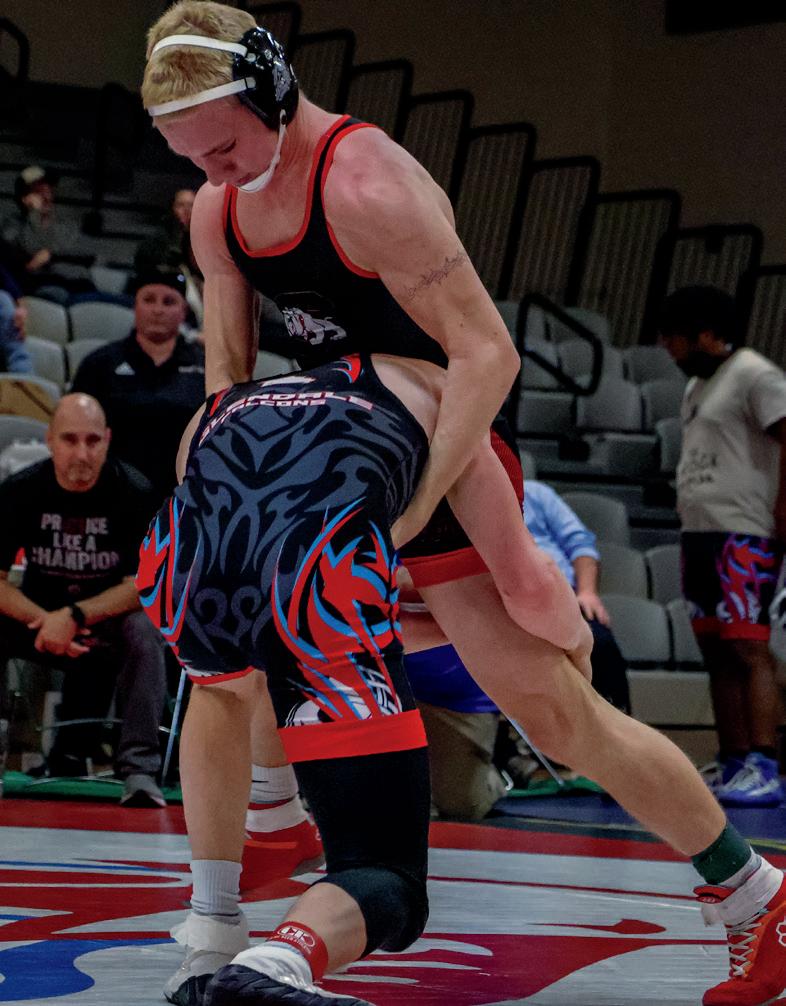
Justin Applegate (10) tackles opponent.
Photo by Emma Gugliotta
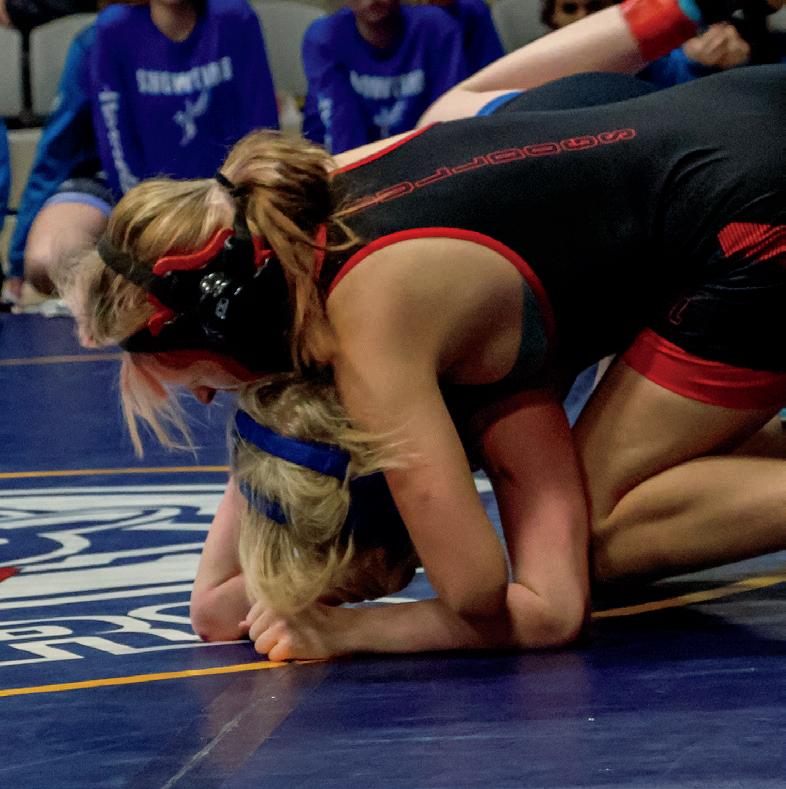
Paydyn Christy (11) takes down another wrestler. Photo by Emma Gugliotta.
SPOTLIGHT
MAGGIE MOORE REPORTER
Hannah Ballard (11) and Catalina Arteaga (11) have been members of Central’s Girls Wrestling Team for the past three years. This season, both girls have been promoted to team captains and are determined to lead the team to victory.
“They have both grown so much; this season has definitely been our best performance by far.” Hayden Puckett, head coach, said.
Arteaga and Ballard have both made sure their team is heard. Allowing support of all forms has set them aside in the spotlight.
“Cat and Hannah are both amazing people.” Chloe Stout (10) said. “Whether I’m on the mat or in the hallways, they are the two I will look for if I need anything. Having them as captains was a very good decision, and I hope to follow in their footsteps.¨
Central has faced some of its toughest competition this season, along with “remarkable performances.” Stout said.
Puckett has ensured that the team participates in more match time than in previous years, effectively doubling the average number of matches.
“Wrestling is a mentally tough sport, and the improvement we’ve seen from not only the new girls but also our returning members is significant,” Ballard said.“It’s not all about strength.”
The mutual goal for both girls is to qualify for the state competition this year. However, the physical demands aren’t the only obstacles that stand between them and a gold medal; the determination, awareness, and maintenance of a specific mindset are crucial to any match.
“For me, support, whether it be from my family, my friends, or my team, is one of the most important things during my wrestling season,” Arteaga said. “Knowing I have people who will support me whether I win or lose honestly just makes the time go by easier and takes some pressure off my shoulders.”
GIRLS WRESTLING: MAT QUEENS
AVERY RAPP
REPORTER
Wrestling is one of the various sports offered at Central. The team meets every school day in the wrestling gym where they prepare for their matches. “We do the warm up and then we start drilling take downs and what we would do in the match and then it’s pretty basic,” Catalina Arteaga (11), a team captain, said. “Like for me, it’s just stuff we need to work on, or what coaching will be better for us. And then we just condition it.” In addition to physical drills at practice, the wrestling team hosts a “circle of inspiration” with their coach.
“It’s a choice thing, but, everybody kind of does it less because of, I feel like less of a religious thing and more because I feel like it’s like a bonding thing for the team.” Carl Tamm (12), manager for the team, said. “It’s like a pep talk. That’s kind of how he says it. It feels like he’s just getting them hyped up. He’s like, “...and let us win this thing” and then we’re all like, ‘yeah!’”
At matches, the Central’s wrestling cohort competes against rival schools in a timed match to score points for themselves. This can be done through pinning an opponent for three seconds, or trying a variety of other moves to stall the timer.
“So whenever, like, the whistle does blow, you guys usually just tie up unless somebody tries to score off the whistle,” Amayia Tamayo (10) said. “Just like, preparing for a match, you have to obviously, like, fuel your body correctly. So no fast food.”
Wrestling can be physically taxing, being a contact sport and requiring attention towards weight classes.
“Wrestling is a sport that involves a lot of time
and commitment, and so it’s been hard to stay on top of all of the activities I am in, and school –
But I manage to make it happen,” Tamayo said.
Despite the possible downsides, many members of the team would still make the case that wrestling is worth it.
“I feel like even though it’s technically an individual sport, it’s very much a team sport,”
Tamm said “Like the way that they react and help each other out whenever they are sad or the way that they support each other when they’re happy. I feel like I don’t see that a lot with other sports that are supposed to be team sports.”
If a student is interested in joining wrestling, they can talk to any of the team members or see Coach Puckett to get involved.
“I just love wrestling. Like the people, the community, the coaches. I love being a captain with Hannah.” Arteaga said.
Tension Parker (10) pins opponent. Photo by Emma Gugliotta.
Tension Parker (10) tying up with an opponent.
Photo by Emma Gugliotta.
SWIMMING SUCCESS
OLIVE ECK
REPORTER
GIRLS SWIM SPOTLIGHT
EMILY HUGGINS
REPORTER
Edie Ferguson (11) has stuck with swimming since first participating at age four. Her parents put her in swimming lessons to ensure her safety around water; causing her to fall in love with the sport. Edie practices six days a week for hours –dedicated to being a good swimmer.
“I wouldn’t really say there’s an easy part of swimming, but if I had to say something it would probably be building relationships with your teammates.” Ferguson said.”Your teammates are people that you become super close with super fast cause I mean you see them five to six times a week for two/ hours a day.”
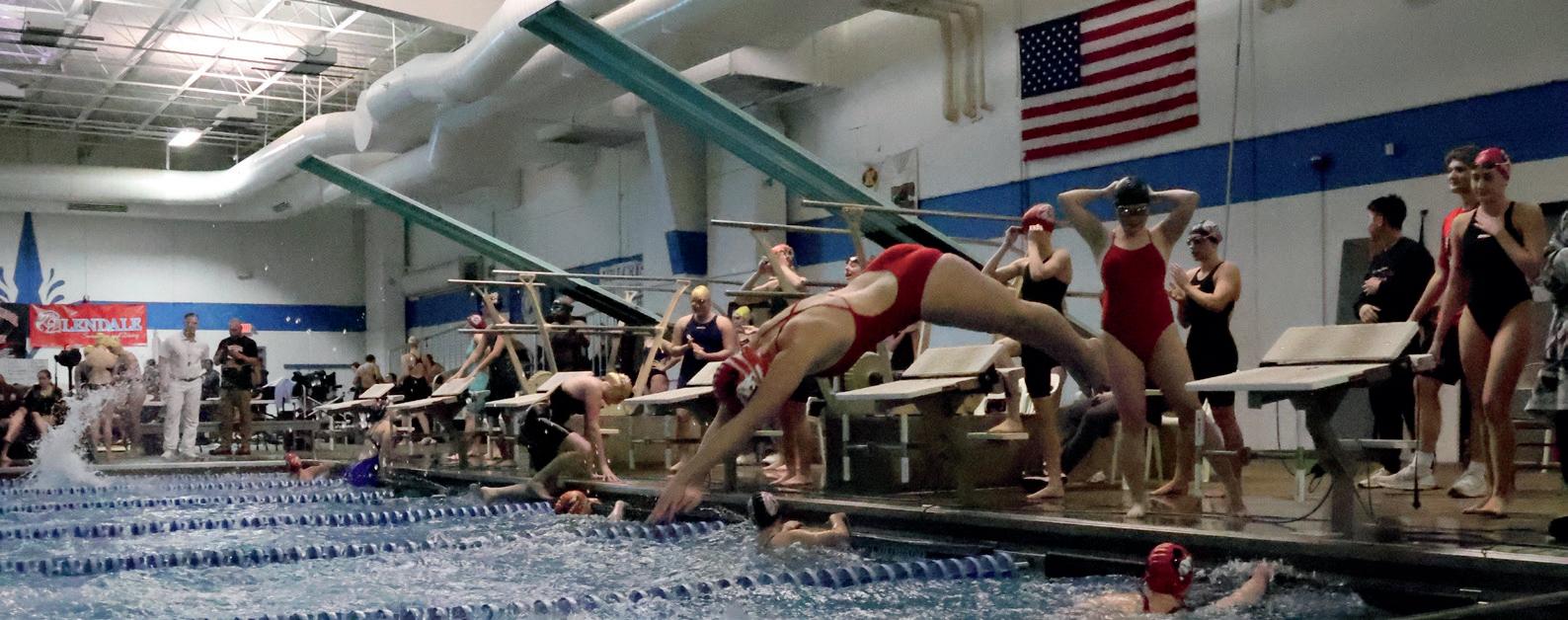
Central’s Girls Swim & Dive team has been working to perform well at each of their meets this year.
“We go to a lot of meets,” Ridhima Suthar (9) said. “We have really good opportunities, we get to go swim at one of the fastest pools in Missouri!”
Whether it is on the bus or after practice, the team enjoys hanging out and spending time together, contributing to a sense of camaraderie that translates to competition.
“My favorite part about being on the swim team is getting to be with all my teammates and hang out with all my friends,” Suthar said. “I feel like it’s a totally different connection when you swim with all these people and when you see them after school every day, and you compete with them.”
The team’s environment is both exciting and enjoyable, but the team also spends a lot of time swimming and working hard.
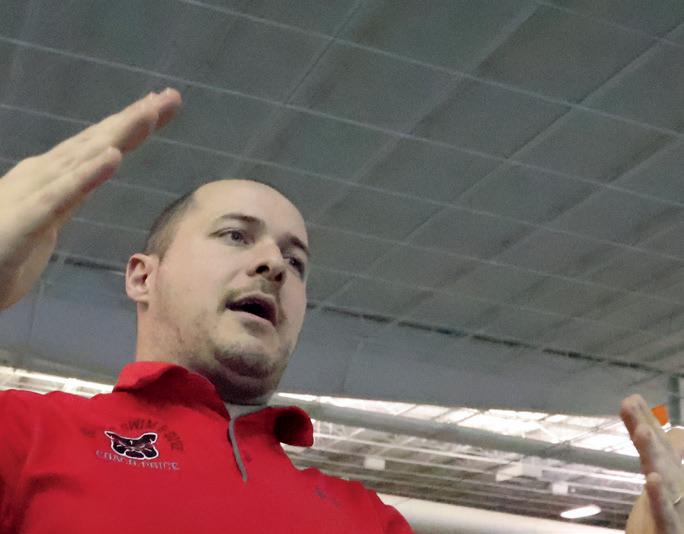
“I think obviously our coach, Coach Price, has contributed a lot to the environment,” Suthar said. “He puts in a lot of effort to make sure everyone’s having fun and having a good time. He also tries to make sure we work hard and keeps us determined and hardworking.”
Watching the team’s growth & development is one of the many reasons the coaches are passionate about the team.
“I love being able to support my students,” Joseph Price, Girls’ Swim & Dive coach, said. “Nothing really fulfills you as a person as [much as] watching someone succeed and watching them go through all the hardship, and then
come out the other side a better person.”
Members of the swim team have joined for various reasons, ranging from the desire for community to cross-training for another sport in the off-season. Regardless of why they join, the benefits are clear.
“It’s a great sport,” Price said. “It will make you better at pretty much any other sport that you do. We have great teammates, and I think it’s a lot of fun whenever you really commit.”
Community is a big part of any sport, not just sports where the whole team plays at the same time. When a team is supportive and works together, that is when they flourish. The swim team members support each other by cheering them on and working to get better.
“I think it’s very uplifting,” Suthar said. “Not everyone has their best days when they go to a competition. They [might] have a good time or a bad time, but I feel like the girls on the team are there for you no matter what.”
Swim meets can be long and may not have the same “thrill factor” as other sports, except for during close matches, so the attendance of a swim meet isn’t as high as something like a basketball game or a tournament. However, there’s a lot of behind-the-scenes work that goes into each meet.
“Swim is not a boring sport,” Suthar said. “I know everyone seems to think swim is a boring sport because you [just] swim back and forth, but I feel like there’s just so much that goes into just that fast swim for 30 seconds. So many people don’t see behind the scenes.”
Swimming is a journey of learning important life lessons, and making lifetime friendships.
“I have learned many valuable skills and life lessons through swimming, especially perseverance and dedication. This sport has taught me to never give up and to always work hard toward my goals, even when others doubt me or tell me I can’t succeed.” Ferguson said. “The perseverance and dedication I have gained from swimming do not only apply in the water but also carry over into my everyday life.”
Swim’s impact has set important life skills for a journey beyond high school.
“The two main things that motivate me are my teammates pushing me to be better each and every day, and setting goals for myself. For example one of my goals is to place top eight at state in at least one of my events!” Ferguson said.
Phillipa Broekhoven (9) diving at a meet.
Photo by Thomas Klepper.
Joe Price coaches the team. Photo by Thomas Klepper.
BLOOD
shortage
CHLOE WOOTTON
SENIOR REPORTER
The more we learn about the world, the more helpless we can feel. With so many crises commanding our focus, it’s easy to get lost in the noise—assuming we don’t have the money, time, skills or resources to make a difference on big issues. But in truth, real change can emerge from both loud, collective measures and quiet, individual actions. And for anyone interested in implementing the latter, the answer might be flowing through your veins at this very moment.
“I think people don’t truly know how many people need blood,” Andrea Johnson, Blood Drive Consultant for the Community Blood Center for the Ozarks (CBCO) said. “I think if people don’t personally know someone who’s had a blood transfusion, they feel removed from it.”
The United States has been in the midst of a blood shortage for months, but only recently has the situation worsened. Between December 2025 and January 2026, blood donations dropped 35%, causing the American Red Cross to declare a “severe blood shortage.” While donations haven’t been this low in two decades, the blood supply often takes a hit during the winter months as holiday plans, illnesses, and inclement weather prevent donors from making their much-needed contributions.
“Donors are very different now than they were twenty years ago; they were much more giving,” Johnson said. “Only 3% of the population donates blood; it used to be five, and when I started in 2005, it was seven. 60%
of the population is eligible, and if we could get back to five, or really seven percent of the population donating, we’d never have a shortage.”
Johnson has been a blood drive consultant for 21 years, working with the CBCO for the past six. The organization is responsible for supplying blood to over 40 healthcare facilities and hospitals across Southwest Missouri, Northwest Arkansas, and Southeast Kansas. While the American Red Cross is the largest organization contributing to the nation’s blood supply, comprising 35% of the total, independent blood centers like the CBCO make up the rest.
“There’s a lot of confusion about the Red Cross,” Johnson said. “It collects blood, but not here in the Ozarks. Even though they have a blood center here, if you donate with the Red Cross, it goes somewhere else in the U.S. Are you helping someone? Yes, but you’re not helping your neighbor. And if you’re donating with them and not with [the CBCO], then that’s a unit less that could be for a patient here.”
All blood collection organizations in the U.S. are governed under the Food and Drug Administration, but differ in governing agencies as well as things like prizes and customer service. Regardless of where someone donates blood, the medical side of the donation remains consistent. Hailey Owens has been a donor specialist for the CBCO for a year and a half, one of countless individuals trained to perform
blood draws.
“We’re called donor specialists, and it takes about six to eight weeks for us to get trained,” Owens said. “The difference between us and a phlebotomist is that a phlebotomist is fully trained and has a certificate whereas we only stick a sixteen-gauge needle in the AC space of the arm. Some of us have both these qualifications, but it depends on the person.”
In addition to the training that CBCO donor specialists must complete before starting, they are often expected to travel and work long hours. On top of that, these professionals must stay alert to patient needs and ensure their comfort. “Jokes tend to calm patients down; they pretty much always work. Before I stick someone, I’ll tell them to turn their head the other way and then I’ll pull out a dad joke. I just love taking care of people and having fun with it,” Owens said.
The CBCO organizes blood drives in various places throughout the Ozarks, with several of their biggest locations being businesses like Bass Pro Shops, Convoy of Hope, and O’Reilly’s, as well as local high schools. To maintain a sustainable three-day blood supply, the CBCO tries to collect two hundred units daily, and high school blood drives can offer an instrumental contribution to that objective—for more than one reason.
“The reason high school blood drives are so important is that if we can get you to donate in high school, you’ll donate later in life. Convincing a thirty-year-old who has never
“The reason high school blood drives are so important is that if we can get you to donate in high school, you’ll donate later in life,”
- Johnson
donated is really hard. Even if they know someone that uses blood, unless it’s in their immediate family and they think someone is dying, they may not even consider it,” Johnson said.
Not only are high schools a high-density location for potential donors, but exposing teenagers and young adults to blood donation allows the process to become a habit. Regular blood donors are essential because in the face of disaster, the easiest way to save lives is through consistent, preventative action.
“You never know when you need blood, and that’s the issue, because it has to be on the shelf,” Johnson said. “I use 9/11 as a great example—people came out of the woodworks to donate blood on 9/11, 9/12, and 9/13. But it was the people [who] donated on 9/8, 9/9, and 9/10 who had no idea it was going to happen. Their blood was on the shelf, it was tested, and it was ready to go. That’s what makes a difference.”
Out of the five SPS high schools, Central’s blood drives total the second-most units, closely behind Kickapoo, with donations concluding at 324 units last year, and this year’s numbers have reached 205 units following the third blood drive in January. As for how CHS manages such numbers, there are two reasons: the fact that Central has four annual blood drives while most other schools have two or three, and the
devoted leadership of the students who run it. From start to finish, Zella Schopp-Gosnell (12), Community Service Commissioner, leads Cabinet in organizing, preparing, and managing each blood drive.
“Everyone has a specific job throughout the day,” Schopp-Gosnell said. “Some people are supposed to sit with donors while they donate, that’s called a blood buddy. Other people are responsible for checking people in, others are responsible for getting people from class and walking them back, others time people while they’re eating their snack and make sure they stay long enough.”
On the day of the blood drive, Cabinet members begin their days bright and early, arriving at school by 6:45 a.m. to begin setting up and helping CBCO workers with anything they need. While an abundance of work is funneled into running the blood drive day of, it takes weeks of preparation to get there. In addition to securing prizes, coupons, and other incentives from local businesses and disseminating information about the event, a wealth of effort is consumed by recruiting alone.
“There are a lot of people who are interested who are too scared to come and sign up on their own, and it’s nice if you go to their table and sit down with them and have a conversation,” Schopp-Gosnell said. “And if they’re like, ‘I’m hesitant’, talk about why, talk about what they’re scared of, and talk about how we can handle that. It’s a good thing to go around and have those personal interactions because it makes them feel more comfortable and more safe.”
When it comes to blood drives, working with people is as important as managing the logistics. Due to the personal nature of donating blood, there’s a variety of fears surrounding the process, which is partially why blood shortages exist. After all, when eligible donors don’t have the information or the confidence to feel comfortable with giving blood, the entire blood supply staggers.
“A lot of people are scared of needles,” Schopp-Gosnell said. “Most people I sit with when they donate tell me the needle doesn’t hurt, that they don’t even feel it… but many are just scared. Other times, it’s just a weird concept to them, which is fair. Some people are just scared of seeing the blood—you don’t have
to look at it, just look at your blood buddy and talk to them, you won’t even notice the blood coming out of your arm. And also, if someone does get dizzy or something like that, they will take care of you. You will be okay.”
Regardless of what fears may prevent someone from donating, individuals become first-time blood donors every day with the help of internal and external motivations. There are many theories as to why overcoming mental blocks can be so difficult, but overcoming feelings of anxiety, alarm, or hesitation surrounding something new isn’t always preceded by total understanding of why. Sometimes all it takes is accepting the fear, taking a leap of faith and leaning on another reason to get through it.
“The pandemic hit when [seniors] were in the sixth grade. That’s like, a major time for socialization and building a personality. We were all isolated for so long, and now, I think we just have a culture of sorta being on our own. We’re very digital and we’re not going out as much, and I think that the lowering of face-to-face connection, of personal time, of just being with other people, generally makes us less inclined to go out and help strangers,” Schopp-Gosnell said.
“I think it’s important that we generally try to be more willing to help our neighbor without necessarily getting something in return from it,”
- Schopp-Gosnell
HUMANS OF CENTRAL: STUDENT JANITORS
Humans of Central: Student Janitors
Every morning, you walk into class with shining tables, fresh floors, and empty trash cans, but who makes this happen? Dakota Southard (12) and Kyler West (11) are two student janitors who have been hired to help clean and reset the school for the next day.
“It’s pretty easy,” West said. “We have a meeting after school to talk about what’s going on and what we have to do, and then we go to our own sections … We take out the trash, sweep it, mop it if needed, clean the tables, and make sure that it’s up to conditions for how they want it to look.”
Southard and West became student janitors because of the ease and convenience of the job. With the position being at school, they are able to work flexible hours and keep their education and extracurriculars as a priority.
“Keith, aka Mr. Fry, is very forgiving, especially if you have a sport,” West said. “He will let you take off that day to go do that sport, and you just have to make up the hours another day … It’s easy and not as exhausting on your body as other jobs would [be because] you get off at a decent time.”
Not only has being a student janitor been a reliable and flexible job, but it has also taught Southard and West to be more mindful about messes around the school. They have built an appreciation and understanding for head janitor Keith Fry as well as other custodians.
“It’s impacted the way I think a lot,” West said. “Students just leave their trash on the floor, and that makes our lives a lot harder. Students tend to not want to pick up after themselves, and it just makes our life a lot harder … It makes it to where we have to [clean it up], which makes our jobs harder, [and] that means we might not get done on time.”
Beyond Southard and West’s newfound respect and empathy for other janitors, they have also learned some key skills that might prepare them for future jobs.
“You [learn a lot] actually, things like heavy machinery and replacing wax on floors,” Southard said. “It’s also a big way to learn responsibility, because you’re responsible for
ARI ABBOTT EDITOR
cleaning an entire hallway or section of the school you go to.”
Being a janitor comes with hard work and dedication to not only the job but also learning new skills. Despite all the work that goes into cleaning and maintaining the school, janitors are often left feeling unnoticed and disrespected.
“We’re definitely appreciated overall, but as individual people who clean teachers’ rooms and stuff, probably not,” Southard said. “I say that mainly because some teachers expect more than what we can give, without realizing that we’re just students with a small amount of time to clean more than just [their] room, usually [for] three to four hours. But that’s just for like student workers, custodians in general, I’d say [are] under-appreciated.”
One of the biggest struggles that janitors face is having to pick up trash that students have left behind. It disrupts their workflow and makes it even more difficult to do the necessary deep cleaning.
“I feel like [the students] should just clean the school more and not leave their trash on the floor,” West said. “We have a bunch of trash cans in every classroom, everywhere, and they still choose to just leave it on the classroom
[and] the Commons tables. They just choose to leave it on there and have Mr. Fry… and us [clean] it, and it’s just not fun.”
Even though they have to do a lot of cleaning, Southard and West have found ways to enjoy being janitors.
“[It] can be a really fun job if you have fun coworkers,” Southard said. “ [The] best memorable moment is when me and some coworkers made a train out of trash cans to clean a hallway in one go, and one of my coworkers jumped in a trashcan and crashed it.”
Despite the messes and lack of respect from students, both Southard and West think the job could be beneficial to other students.
“I would recommend it for a lot of people,” West said. “It’s easier than working at say, McDonald’s, because they have you work longer hours, [and] you get easy hours here [and] it’s a really easy job.”
Students interested in becoming a janitor should talk to Fry or look on the school website for open positions and other details.
“This job is not for everyone, can be messy, but it can be a rewarding job if you let it,” Southard said.
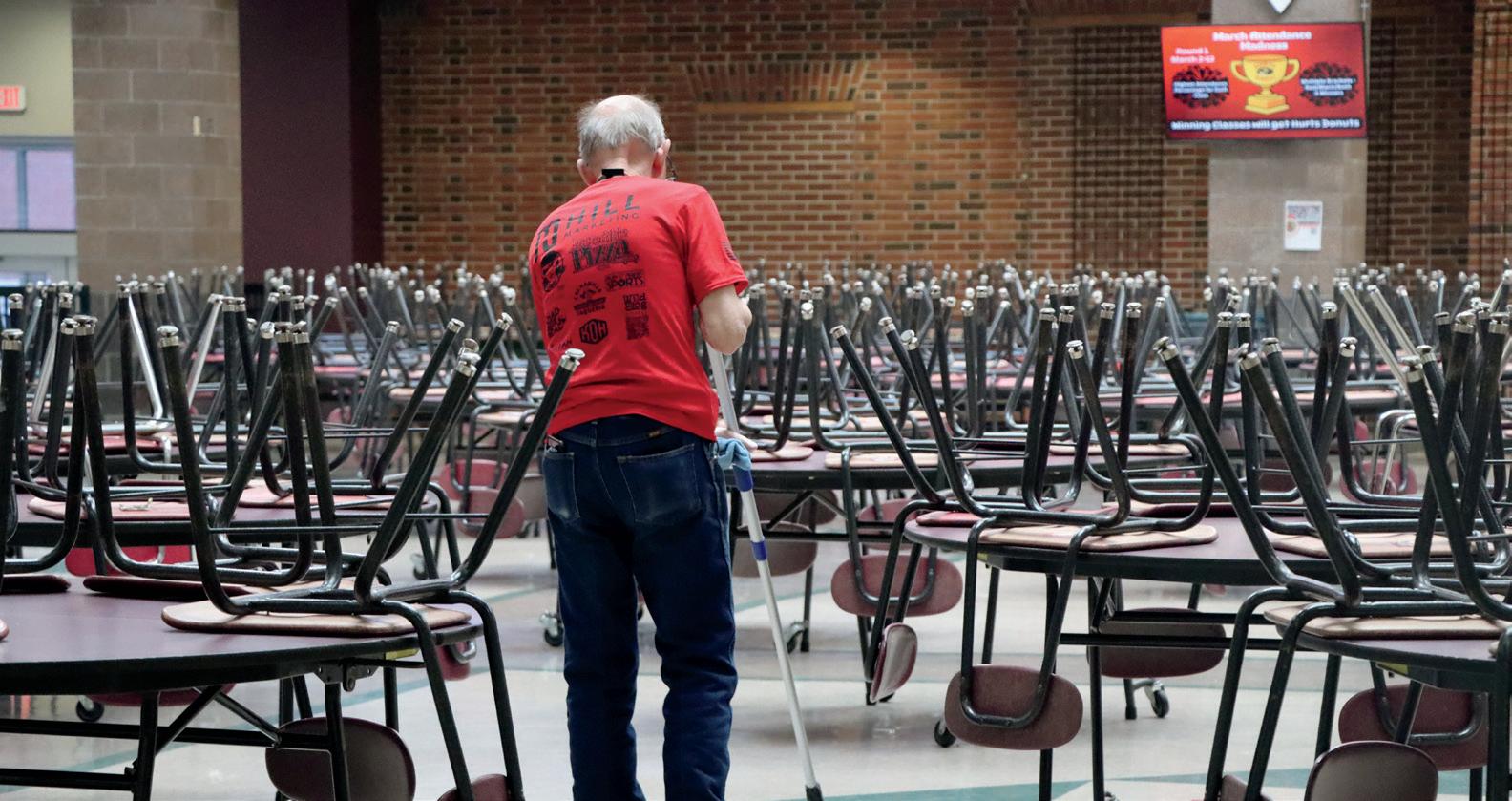
Keith Fry, custodian, cleans the commons following lunch. Photo by Maggie Moore.
HO S A
CLUBS HIGHLIGHTS
ABBOTT SCHMIDT REPORTER
The Health Occupations Students of America (HOSA) provides health students opportunities to learn, compete, and meet professionals in the medical field.
“HOSA is a competitive service organization for students who are interested in pursuing a career in the medical field,” Madison Cochran, HOSA Chapter Advisor, said. “It provides them with a variety of service opportunities focused on medicine, being exposed to a variety of medical careers, having a leadership position, and competing on the international level which all look great on college applications.”
Students can also compete in various medical science events against other schools. They are also given the opportunity to volunteer at events to help people nationwide.
“We often go to more health oriented volunteering events such as walk to end Alzheimer’s, but also just volunteering in general,” Johnson said. “And we have good ties with Key Club and other clubs that are more volunteer focused and we try to coordinate events with them as much as possible.”
You can join by talking to Cochran or an officer of HOSA for further information. Although HOSA is complex at first, members can help each other
“For a new member, the number one thing is just come to the meetings and we can help you out. You know, it can be a little bit confusing at first,” Johnson said. “From the competitive side, you can meet with one of our officers and even talk to some of your friends about events that they’ve done in the past or that they think might be a good fit for you.”
The Central Math team is a group that represents Central in math competitions throughout the year. The Central Math team has competed and placed at the national level, and has been the state champion four out of the last five years.
“Until we get to the state nationals contest in the spring, anybody can sign on and participate any time,” Ellen Hunter, math teacher and team coach, said. “So I love for students to be able to come to practices, which currently we’re meeting Mondays after school, but I am also happy for a student to sign up to go to a contest, even if they’re not always available for our practice times either.”
Math team practices through guided math problems and mock competitions that include nonstandard math problems. “The problems are very different from school math, it’s like a different genre,” Lanie Deng (10), math team member, said. “It’s more about thinking and not memorizing.”
These problems reflect the kind of problems that will appear in nationwide math competitions. But it also helps students improve their overall math skills.
“I think it’s really beneficial to students because it just builds your problem-solving ability and outside-of-the-box thinking, because a lot of these math contest problems are a little bit different than just ordinary math homework problems,” Hunter said.
Math team is available for students at all levels and grades, even Scholars. Many students start out very early and become some of the strongest competitors.
“I think it’s great for students of all different math levels to start participating in math team, because usually my best upperclassmen participants in math team are ones that started out doing math team when they were a freshman or a scholar student and have continued to do it all the way through,” Hunter said.
FB L A
M A T H
For students interested in a career in the business field or want to volunteer and help their local community, the Future Business Leaders of America (FBLA) can be a good place to start.
“FBLA is one of the oldest student organizations in the United States, and we are here to teach students leadership skills and responsibility skills and also offer community service engagement and competition opportunities for students,” Michelle Harrison, FBLA chapter advisor, said. “As a student you have the opportunity to help volunteer in your community and also compete in a lot of different events.”
Students can compete in business related competitions at the regional, state and national levels as well as support the community through FBLA.
“Basically, we have one monthly meeting that you’re required to attend, and then whenever we do school events, we do monthly meetings or volunteer events, you are not necessarily required but very strongly encouraged to participate in all of those as a group,” Harrison said.
In previous years, FBLA has participated in many community events like Toys for Tots to compete in FBLA competitions and aid the community through community partners. This year, FBLA is working on a new community service project. “Our community service project is to go into elementary schools and promote learning for kids who may not have it as well, like at home, whatever you call that, like impoverished kids,” Will Musgrave (11) VP of Community relations, said.
Podcasts are one of many ways for anyone to create or share their personal stories, and can be listened to while doing anything. With podcasts being such a popular form of modern media, it makes sense that students would want to start their own. Two examples are “Mics and Mischief” and “Gent&Cam.”
“I love talking to people and hearing what they have to say and how their perspectives are different from my own,” Hannah Skinner (11), “Mics And Mischief” cohost said. “And so that’s really what inspired this podcast, to talk to as many people as possible about a really wide range of topics that might not be discussed.”
Skinner and her cohost, Aubrey Severn (11), started their podcast in November of 2024, and currently have 35 episodes, the average number of listeners per episode being 200.
“We mainly talk about issues that face Gen Z. You see so many millennial podcasts, and they’re so few for Gen Z,” Skinner said.
Skinner and Severn like to host a variety of guests on their podcast. Each topic requires a different personality to speak on it.
“If you have something to say, whether a unique perspective or an experience, maybe more relevant in society, we want to talk to you,” Skinner said. “I would say Emma Lewis because, like, we sat down and talked about The Summer I Turned Pretty for 30 minutes. She had a lot of takes that I actually hadn’t considered before.”
“Mics and Mischief” is a public podcast on Spotify, and has a promotional Instagram with around 130 followers. This opens them up to a world of commentary from listeners.
“Some people just don’t like the podcast because it’s two basic white girls talking,” Skinner said, “Most of the time, for people like yourself or others that listen, they have some criticism, but it’s constructive. Like, “I’d for this or, like, this,” and we try to listen to those comments.”
With their publicity, the podcast is able to reach international audiences.
“I actually kind of looked at our
STUDENT PODCASTS
AVERY RAPP REPORTER
statistics, and we have listeners in Germany. It’s actually really interesting. About 20% of our audience is abroad,” Skinner said.
“Mics and Mischief” is not the only podcast run by Central students that was able to reach people.
“Our podcast name is “Gent&Cam Podcast.” It’s the extension of our regular Gent&Cam shenanigans. We have “King of the Hall,” we have other weekly vlogs and Gent&Cam vlogs,” Luis Tamayo (12), one of the Gent&Cam cohosts said.
Gent&Cam is cohosted by Isiah White (12) and Holton Carson (12), and the podcast is headlined by Reese Smith (12) and Millie Hawkins (11).
“We usually do a rotating cast, Reese and Millie, you know they’re the headline of this program cause they’re the podcast experts and we usually pass it off to them. And we’re usually the King of the Hall experts,” Tamayo said. “So we just have a rotating cast, a rotating schedule of guests. A lot of them that’s in the film program here, because they’re close in it with us, and people we hang out with, but we wanna try to get other people on, just from the other reaches of Central.”
Similar to “Mics and Mischief,” “Gent&Cam” has listeners from outside of Central.
“On our “Gent&Cam” account we have a lot of comments from people outside of Springfield Public Schools and from within Springfield Public Schools, not even at Central. So I think just being able to post on Instagram openly has been a big part of getting those people,” White said.
The “Gent&Cam” Instagram account
has around 70 followers, where the group posts vlogs and short episodes of their “King of the Hall” series, where the trio and their friends are seen getting up to their silly antics usually in Central, or around downtown.
“It was the summer before- what was it, junior year? We got together. Us film geeks were like
“Dang we gotta do something for the people and get our names out there and start networking. If we started a little student, you know, we felt like it could grow into a bigger organization,” Said White. In the podcast world, the “Gent&Cam Podcast” has one episode, while a second one is in production.
“Our one episode was really about Lunchley and what was going on at the moment. Like Logan Paul beef and what was going on around school. I think going forward we want to focus on school outreach. We want to get more people involved, more stuff about Central, more stuff around central, and just hosting other students from Central seeing their point of view getting them on along with the trends,” said White.
The podcast focuses more on trends and personality, rather than social issues.
“From my personal views of the “Gent&Cam Podcast” you don’t come to that just to get educated on the political times cause they’re too fast, they’re too changing, you’re more there just to see the entertaining personalities and to see what they do with the trends see what funny stuff they’re up to and just really show their character,” Tamayo said. Overall, the podcast is a combination of the creators’ ideas and banter.
“My favorite part about the podcast is that we’re just getting our ideas out there, we’re sharing our love and our passion with the rest of Central high school,” Carson said.
“Mics and Mischief” is a podcast focused on social issues of gen z, while “Gent&Cam” is a more lighthearted listen. Both are available for anyone to listen to for free on Spotify.
STUDENT PODCAST
RECOMMENDATIONS
“Music Student 101” is a podcast hosted by Jeremy Burns and Matthew Scott Philips, recommended by Luke Hammock (12). This podcast covers the basics of music theory. The podcast specifically covers topics useful for students in a music related program or class. The podcast covers useful and essential information such as harmonies, training tips, scales, and even episodes on musical career options.
“My favorite episode is probably episode 24, which talks about the musical language of MIDI instruments, which are often used to compose and record music on electronics,” Hammock said. “During middle school and into high school, I made a decent amount of music using free websites off of my Chromebook and phone that used MIDI instruments, so the contents of
DANE SCHOLZ REPORTER
National Public Radio’s (NPR) “Throughline” is a podcast recommended by Joel Slingerland, a history teacher. The series covers historical topics and is hosted by Rund Adbelfatah and Ramtin Arablouei. Unlike many historical podcasts, “Throughline” links their topics to modern happenings and the biggest current events. They cover current major figures and their similarities to historical figures who shaped the world we live in now, important events in wars that contributed to their outcome, and the way current events parallel the past.
“The cliche teacher response of being a lifelong teacher is actually why I like this podcast so much,” Slingerland said. “Each podcast is an opportunity to learn something new and make a new connection. I mostly listen to them due to not having a lot of time to read.”
this episode were very helpful to me.” Hammock recommends this podcast for anyone who is in a music class or wants to learn more and become more skilled in the topic. The podcast can be a valuable resource for anyone who wants to become knowledgeable on a specific musical topic or music theory in general.
“I like this podcast because they handle the topics like a regular conversation, so it’s easy to understand and familiar for me,” Hammock said. “Additionally, they provide examples whenever talking about more complex topics.”
“The Magnus Archives” is a podcast recommended by Bayta Hemphill. “The Magnus Archives” is a horror audio drama podcast hosted by Jonathan Sims. The stories are presented in an anthology format that
DANE SCHOLZ REPORTER
slowly connects the stories together over the series run of 200 episodes.
“Episode 171 (The Gardener) is my favorite episode of The Magnus Archives, and it sticks out to me for its metaphors about body dysmorphia that I really connect with, but it’s presented in a cool, creepy way,” Hemphill said.
Hemphill recommends this podcast for people who want to experience an interesting horror narrative with strong themes. The podcast has a gripping narrative that is perfect for anyone who is a fan of horror or storytelling through an audio medium.
“I am usually drawn to audio dramas due to all of the lore and storytelling that I can connect to, normal podcasts just aren’t all that interesting to me,” Hemphill said. “I particularly like ‘The Magnus Archives.’”
STAFF PODCAST RECOMMENDATIONS
Slingerland recommends this podcast for anyone who wants to see multiple, in-depth perspectives on a historical topic. He says that listening to the podcast is a good way to look at the world differently and gain new information.
“Any time I am presented with information that makes me see a different perspective, or think about the world differently, I feel like I’ve gained something valuable,” Slingerland said.
“Good Hang” is a podcast hosted by Amy Poehler recommended by Shawnna Wilson, an English teacher. “Good Hang” doesn’t have a typical subject matter; the podcast centers around Amy Poehler bringing on different celebrities and having lighthearted conversations with them without a strict direction to them. She has brought on guests such as Jennifer Lawrence, Gweneth Paltrow, Jonathan
Groff, and many other actors or artists that listeners may know of.
“What I love about this podcast is that the conversations feel informal, raw, and often about menial moments/ topics that each of us have probably experienced before,” Wilson said.
Wilson recommends this podcast for those who want to relax to something with a more chilled-out, conversational tone. Additionally, it gives listeners some insight into how celebrities may think outside of the work that they do.
“Celebrities are certainly not like us; however, they are human. Additionally, Amy Poehler and Tina Fey are two of my favorite people whom I will probably never meet. Their work on “SNL” and “Parks and Rec” made me respect pretty much any art they produce,” Wilson said.
Originally proposed on April 30, 1926, Route 66 was not finalized until November 11, 1926. A new road was decided on a pivotal telegram at the Colonial Hotel in Springfield, Missouri. Route 66 made travel fast, convenient, and full of adventure.
“Well to think of this, Route 66 was such a convenient asset,” John Sellars, History Museum on the Square director emeritus, said. “And in theory is was proposed and finalized in a quick time span for such. The route has attracted businesses, travelers, and has really just tremendously grown the population.¨
Cyrus Avery, an Oklahoma businessman, and John T. Woodruff, a Missouri businessman, both of whom are now better known as the “fathers of Route 66”, had created and proposed the idea of a newer and longer highway
“Route 66 is a huge part of Springfield’s identity,” Matthew Brunner, a history teacher, said. “Just think of it, we wouldn’t have ever been a big city if we never had the Mother Road. Route 66 made Springfield a mark on the map.”
have since been replaced by Interstate 55 in Missouri, Interstate 44 in parts of Oklahoma, and the rest of Route 66 is now known as Interstate 40.
“As everything does, the Route 66 had grown old,” Sellars said “ Everyone had different ways of getting to and from, and better things to do so, due to the road no longer being necessary is had to grow with us. Unfortunately this meant not only did other roads change and had been built, but Route 66 had to go.”
Even though 66 may not be the same as it once was, it is still an eye-catcher. Hundreds of miles are covered by many attractions specific to the route. Some of the most visited attractions that are still active are: the Gateway Arch in st. Louis, Missouri, Cadillac Ranch in Amarillo, Texas, and the Santa Monica Pier on the very end of the journey.
“Route 66 had opened up so many
the celebration, and the entire museum can say we’re excited for this years centennial kick off,”
Even though home for the mother road is here, it is celebrated everywhere. The Route 66 Centennial Great Race lasts nine days, going from Illinois to California, to celebrate the Mother Road.
“Really, it’s just so interesting how much of an impact something that seems so simple has caused, so much recognition, and celebration.”
Sellars said. “In theory, we celebrate our birthdays the same way we are celebrating a interstate. That’s really just historical, maybe even monumental.”
Once before the bright lights, driveins, and hotels, the mother road led many away from misery. In terms of historical legacy, Route 66 carried heavy trucks carrying materials during World War II, as well as soldiers, weapons, and families.
100 Years of Route 66
MAGGIE MOORE | REPORTER
The year 2026 will mark several significant historical anniversaries. The United States will celebrate its 250th birthday, and Route 66 will reach its centennial. For many residents of Springfield, the birthplace of the Mother Road, this is a momentous occasion worth celebrating.
“I remember streets just being filled with these awesome cars,” Brunner said. “I loved the feeling, knowing the history and the impacts. I’m truly honored to be a part of Route 66 even if I’m just a resident.”
After 59 years of travel and exploration, Route 66 was decommissioned on June 27, 1985. However, about 85% of the highway remains drivable. Portions
business opportunities, many of which were family-owned, including motels and truck stops,” Sellars said. “Bright lights had filled the sky, and everyone knew what road took you anywhere your heart desired.”
Annually, Springfield hosts a Route 66 festival in August; this year, a celebratory festival will be held downtown as part of the 66 in April. Running from April 30 to May 3, 2026, attendees can make sure to see live music, old cars, the smell of food trucks, and thousands of people filling the streets of downtown.
“Springfield has been doing the festival since 2011, and it has brought countless number of people.” Sellars said. “I’m truly honored to be a part of
“The route was vital to the operation of our country, really,” Brunner said. “Everything goes to and from in a simple manner.”
Route 66 also became a critical westward lifeline for over 200,000 “Dust Bowl” refugees escaping the 1930s environmental and economic collapse in the Great Plains. With the route, many could leave at once and be far from the danger faster.
“ So much history is held, but many just see pavement and dirt,” Brunner said, “Or a lot of cars and long traffic blocks, but we get this chance to look into the history. We find all of these amazing stories and legacies. We are lucky to have this knowledge.”
DOG SHELTERS of SPRINGFIELD
In Springfield, people view the protection and lives of animals as vital. There have been strong conservation efforts for the plant life and natural environment of Springfield in the past, such as park services like Sequiota and Nathaniel Greene Park. One of the most important issues to care for when it comes to animals in Springfield is the animals on our streets.
“The protection of animals is essential because they depend on us to be their voice,” Rebekah Redwing, an employee at Missouri Rescue One said.
There are 70 million stray animals in the U.S. as a whole, and as many as 5,000 animal shelters across the country. In this regard, the Springfield community has put in a great deal of effort. There are multiple animal shelters in Springfield that have rescued thousands of stray animals. “Overpopulation, suffering, illness, and injury are all able to be prevented by shelters,” Redwing said.
Watching Over Whiskers is a cat rescue run in Springfield that was started in 2014. Their goal is to take any cats that have been mistreated or left without a home and nurse them back to health along with rehoming them.
“I founded Watching Over Whiskers after volunteering with another local rescue that served dogs and cats, but mostly dogs,” Marci Bowling, the founder of Watching Over Whiskers, said. “At the time, there was no rescue dedicated to serving just felines in need. The need is off the charts, and we lack so many necessary resources in southwest Missouri, even with Watching Over Whiskers and another dedicated rescue.”
Watching Over Whiskers mission statement is to prevent the largest number of animal euthanizations that they can, and they do this by providing both adoption and fostering options, as well as volunteer hours for anybody who wishes to take care of an animal, and community events to help support them and their mission. Watching Over Whiskers additionally offers veterinary services for adopted pets.
“Since our founding in 2014, Watching Over Whiskers has assisted more than 10,000 felines in southwest Missouri through routine vet care, forever home placement, Trap Neuter Return of community cats, and ER owner assistance,” Bowling said. “Once I was made aware of the need and saw the benefits of having a dedicated cat rescue, it became apparent what I needed to tackle on behalf of our community. We did a lot, but we still have a long way to go yet.”
Missouri Rescue One is another animal shelter in southwest Missouri that takes in animals found on the street, in danger of euthanization or given by owners who can no longer take care of them. Many animals placed in their care are found malnourished or with severe injuries and are given the medical attention they need by Rescue One. Rescue One also collaborates with law enforcement to take in and care for animals involved in legal situations or found by law enforcement.
“Rescue One has a wide range of employee positions that work together to support our mission,” Redwing said. “Our directors oversee the organization and its finances, while our adoption coordinator ensures each applicant and animal is the right fit. Our
DANE SCHOLZ REPORTER
animal caretakers and trainers provide daily care and behavioral support for animals in boarding. We also have office and clinic managers, admin staff, veterinarians, and veterinary technicians at our clinic who perform surgeries and medical procedures to keep our animals healthy and thriving.”
After nursing any animals in need back to health, Rescue One sends the animals to foster homes until they are adopted. Rescue One does not use any kennels to house animals in their care in order to give animals the most amount of comfort in their transition into a forever home. Anyone can apply for animal fostering by filling out an application on the Rescue One website, and they offer volunteer positions as well.
“Beyond rescue, our goal is to reduce the number of animals in need in the first place,” Redwing said. “Through our outreach program, we offer spay/ neuter services, vaccinations, and food assistance to support families in need and keep pets safe, healthy, and at home.”
STAFF BOOKS RECOMMENDATIONS
SCHALL
ARI ABBOTT
EDITOR
Sara Schall, a foreign language teacher, recommends “The Kite Runner” by Khaled Hosseini. It’s a historical fiction novel that takes place in Afghanistan in the 1970s and follows Amir, a boy from a wellto-do family, and his best friend Hassan, the son of his family’s servant.
“Hassan is a successful kite runner for Amir… and he knows where the kite is going to land when they go fly kites,” Schall said.
“Hassan goes and gets it for Amir… but then… something happens to Hassan that really changes their relationship… and Amir’s family has to leave. They have to flee as refugees. And so he doesn’t see Hassan after that, but he always carries a lot of guilt for something that happened. And so then it kind of goes through Amir’s life as he gets older, and he goes back to Afghanistan later to try, and I guess I would say seek redemption for some things that happened.”
Schall recommends this novel because there is a lot that students can learn from Amir and Hassan’s relationship. “I feel like people that read it can see and understand tensions that there are and have compassion… for people that are different than them,” Schall said. “This idea of… ethnic and societal divides that are created within all of the societies in the world… And it shows how if you can see the person as a fellow human, you can find humanity, and you can find love and compassion. And I think that’s really important for people to learn, especially in this day and age.”
PITTS
Malala Yousafzai is a feminist and activist known for standing up against the Taliban in Pakistan. Jodi Pitts, an IB Literature teacher, recommends her second memoir, “Finding My Way.”
“It’s about when she goes to college,” Pitts said. “I think it could be… something a lot of students could relate to… She’s very naive in a lot of ways… She just doesn’t know a lot about how to be a part of… regular friend groups, but she joins all these different clubs. She just wants to be a part of everything; she wants to experience everything.”
A large aspect of Yousafzai’s memoir is her recounting and reflecting on her traumatic experiences while trying to live a normal life. She learns that she has PTSD and struggles to find her identity outside of being an activist.
“You’d think she was like, one of those people who already knew exactly who she was, but I think she really explores all the ways that you might identify yourself,” Pitts said.
Beth McIntyre, an English teacher, recommends “The Great Gatsby” by F. Scott Fitzgerald. “The Great Gatsby”, commonly shortened to just Gatsby, is recognized worldwide as one of the best pieces of American literature.
“Gatsby is about money, and power, and fame and corruption,” McIntyre said. “It’s set in the 1920s, and it’s still relevant today.”
The novel follows Nick Carraway, a young man who moves to New York with the dream of becoming a bond salesman. Carraway narrates his story as he becomes infatuated with Jay Gatsby, a rich man who throws lavish parties. Through Gatsby’s obsessive passion for his former lover, Daisy Buchanan, Fitzgerald explores the themes of the toxicity of the American Dream during the Jazz Age.
“I think it’s remarkably efficient, and I know it’s a book that’s taught in a lot of international schools as an example of American literature, and I’ve always thought it’s interesting that that may be the piece of fiction that forms people’s opinions about this country… at a time in our history when it was about greed… criminality… selfishness, and self indulgence,” McIntyre said.
“The Academy” is a mystery novel set at Tiffin Academy, a boarding school in New England. It’s one of the best-ranked in the nation, but tragedy strikes when a student is found dead. While the death is ruled a suicide, other factors, such as a student-led gossip app, might suggest otherwise. Sarah Gugliotta, a librarian and media specialist, recommends that students attempt to solve this mystery.
“The book is about this boarding school,” Gugliotta said. “[Charley Hicks] ends up getting into the school… because a student died, supposedly by suicide. So it kind of gets into like, how did she die?”
The mystery of what really happens continues to unfold as secrets revealed on a gossip app stir chaos at the Academy.
“[There’s this] app that is called Zip Zap, [and] it’s basically putting out people’s secrets,” Gugliotta said. “So they’re trying to find out who’s behind Zip Zap, and then all of those story lines kind of culminate to one.”
Though Gugliotta recommends this story as it has elements that may resonate or pique the interest of many readers, students may want to check out trigger warnings for sensitive content.
“It’s pretty much got everything a teenager would like to read,” Gugliotta said. “It’s got relationships, it’s got murder, it’s got different types of struggles like eating disorders and bullying.”
GAME STORES OF SGF
GEORGE WOOD
DESIGN EDITOR
After the end of the pandemic, tabletop games have risen in popularity. The pandemic pushed many people to look for hobbies. After the pandemic, people wanted connection.
”We thought the pandemic was going to be really rough for us as a business... and it was, BUT after we were able to re-open after being mandatorily closed for a month everything kinda worked out,” Jeremy Bates, employee at Meta Games for 20 years, said. “Everyone was stuck at home, and it turns out that was an amazing time for hobby gaming. It has come back way stronger since the pandemic, for sure!”
People from all walks of life can come and play games with each other, finding the game stores as a third space, other
MAGGIE MOORE
REPORTER
Streaming platforms like Netflix, Hulu, and MAX swap movies, and songs “disappear” on Spotify. Software issues and licensing deals create a chasm between modern teenagers and the entertainment industry. For Central students and staff alike, physical media is the solution.
“I love my portable CD player; my music plays on my terms, and I don’t have to worry about my internet connection not working,” Vivian Donnell (10) said. “The only reason I would not be able to listen to a certain song is that I may not own it, or [if] I lost my CD.”
Wi-Fi blockers, poor connection, or a lack of internet also stand in the way of enjoying basic entertainment. Using a Walkman, CD player, or magazine doesn’t require the internet; you can go anywhere and won’t need Wi-Fi.
than their home and their work/school. I use tabletop games to get closer with my friends and have fun with them.
“I definitely think game stores are great for socializing,” Bates said. “There aren’t as many ‘third spaces’ as there used to be and we’ve been providing one of those for the community for nearly 30 years. Collectively we (gamers) are not always the most social group, at least not at first, but when you know you’re going to a place with likeminded people, it can help overcome a lot of the anxieties that someone might have.”
A common experience one can hope for when going to Metagames is having a niche question; asking a worker just for them to answer with no problem.
This happens to me fairly often with different paints for my Warhammer minis
The wide variety of games that are available at the store means that most people can find something they like. If someone enjoys art they can paint miniatures from Dungeons and Dragons, or they can paint Warhammer miniatures like I do.
Recently I painted a Space Marine Apothecary for my Dark Angels army, I did a smidge of modifying the model with mixing parts from other models I have in order to make him look cooler. I also experimented with blood effects and I think it looks really good.
PHYSICAL MEDIA
“I grew up in the prime of these unique devices,” Patrick Burns, a digital arts teacher, said. “There was convenience, and they just made you feel really awesome walking around with your CD player or getting a new track. Now I do believe our phones are more convenient, but there is still that nostalgia.”
Physical media was considered a relic for years, overshadowed by the capabilities of smartphones that surpassed those of cassettes, records, and Walkmans. The truth is, just about everything can be found in physical media.
“I personally love my CDs,” Donnell said ¨While I may not have been alive when they were most used, they are a very cool thing to own.”
Since the state-wide phone ban was implemented this school year, students
are finding ways to disconnect from their screens and continue enjoying listening to music, playing games, and reading materials.
“I don’t think that these forms of physical media [ modern phones, tablets, etc.] should be banned,” Burns said ¨As a kid, everyone kinda had them, so why should that change now?”
Not only are these devices perfectly legal, but they are also sustainable. They can be bought or reused secondhand or new for good prices.
“My phone is a crazy useful device, but I love using my CD players and my DVD player just because, while it may be harder to work, it makes the effort feel more worthwhile,” Donnell said. “I’m not breaking any rules or laws, I’m just getting through my day.”
A fact that has shocked the internet is that 2016 was ten years ago. This revelation is currently inflicting a vast sense of nostalgia throughout all of the internet, specifically for Gen-Z and Millennials.
On the popular social media platform, Instagram, celebrities and average users alike are posting photos, reminiscing over 2016.
This has inspired the following question: why is 2016 so nostalgic? I personally would not have expected a year so recent to be pined over quite like this one.
This has led me to stalking these posts, reading Substack articles and watching every TikTok with the hashtag 2016issoback.
From my own experience, 2016 seems to be the last year that my generation has felt so ‘care free,’ concerning politics and media alike. I also think that the music in 2016 is unmatched. Seriously, if you look at how many of our favorite and most popular artists released music that year, it is sort of crazy.
Embarrassingly enough, my favorite album in that year was Panic at the Disco’s Death of a Bachelor which played a key role in what music I like (and dislike). The most notable artists who released albums that year are: Frank Ocean, Kanye West, Beyonce, The Weekend, Childish Gambino, Ariana Grande, and Bruno Mars.
Not only did all of these artists release albums, they also house some of their most popular or even best songs. Frank Ocean has not released music in ten years. That alone deserves some nostalgia. Also, Starboy from The Weekend has played at every single school dance I have ever attended, so that has to say something about its popularity. Now that I have listed the objectively good music (excluding Panic at the Disco), I can get into what is remembered as 2016’s top hits: Closer by the Chainsmokers, Cheap Thrills by Sia, and Never Be Like You by Flume.
The pop songs of 2016 are the blueprint for current pop music, and I think that plays into the nostalgia. When I was listening to “2016 vibes”
2016
2026
LUCY CAPLINGER EDITOR-IN-CHIEF
playlists on Spotify, none of the songs felt repetitive in their nature, and I never felt like any song was copying another. Sure, art imitates art, but for the most part, these songs feel very singular. I also think that 2016 pop was such a unique pop-culture experience that now it is considered nostalgic because of what the artists were singing about.
Alongside the typical romance and heartbreak, a lot of 2016 music focuses on hope. I notice a lot of these pop anthems have to do with partying and community or how important hope is to get you through the present. Lean On by Major Lazer is an incredibly popular song from 2016 that makes listeners feel like they should be out with their friends. The lyrics have to do with needing someone to lean on, or in other words the importance of community.
The collective and cohesive vibes play a major role in 2016’s popularity. Listening back, it feels like all of these songs give the vibe of being at a party or with friends, and the artists talk about how they are going through something, and their friends or peers are helping them achieve this. 2016 pop inspires listeners to get up and dance or go out and party.
2016 was an election year and, regardless of party, this should matter to all American citizens. For younger generations like Gen Z, it seems that 2016 was a turning point politically.
I think it has to do with the fact that everyone in my generation was getting old enough to think about politics more critically; that election being such a rocky one because president Trump lost the popular vote but still claimed the victory makes the previous era all the more memorable.
I have also personally noticed that, after 2016, social media and politics have become intertwined in a way that can never be undone. Especially because of COVID-19 and the quarantine forcing everyone to get their news digitally, online went from a place of solace to another facet of the real world.
After the pandemic, the world changed significantly and that especially affected Gen-Z and our childhood/ young adulthoods.
Teenagers and young adults in 2016 were, based off of the music they were listening to, going out and experiencing the world. Post-covid kids now look back at 2016 pop and see everything they are missing out on.
For example, I feel like covid really affected third-spaces and the ability to hang with friends and meet new people outside of both home and school. Listening to 2016 pop inspires this nostalgia within me for a time I never experienced, because I can’t help but think about the what-ifs. What if the pandemic hadn’t begun a multi-year quarantine and I hadn’t been forced to stay inside for so long? What would my friendships and relationships look like in this alternate reality?
Nostalgia and reflection are very powerful tools that allow us to look back fondly on times, and even relate to other people’s pasts that we did not experience. In this case, I think it’s good to have a time to look back on and smile and say “I wish I was a teenager in 2016.”
I also think that living in the now is super important. I experience FOMO often, but it isn’t scientifically possible for me to be 16 in 2016, so I am choosing to just be happy I actually get a graduation.
Don’t get stuck in the past, even if the music is good.