The 2026 Educational Research Symposium is sponsored by Trinity University’s Department of Education and the Center for Educational Leadership. This year, we are showcasing 17 presentations conducted by graduate students from across the Department’s three graduate programs - the Master of Arts in School Psychology, the Master of Arts in Teaching and the Master of Education in School Leadership programs. Also included in the program are 3 presentations by undergraduate students who have conducted research during the academic year.
This special evening will celebrate our graduating students and recognize them for their hard work and scholarly accomplishments as Trinity researchers.
5:00pm
5:15pm
5:45pm
6:15pm
6:45pm
7pm
Program Agenda
Introduction and Welcome
Group 1 Presentations
Group 2 Presentations
Group 3 Presentations
Reconvening
Close
MAY 13, 2026
TRINITY UNIVERSITY
THE CENTER FOR THE SCIENCES AND INNOVATION
CSI 282
Group 1 Presentations
5:15-5:45 PM
Aaron Sherwood, Jon Derrick Alvarez, & Shayna Kropa Accountability for Every Dollar Every Student
Scott Lebo
The Pedagogy of Soccer Education: A Coach’s Guidebook
Explicitly Teaching Reflective Practices and Routines to Create a More Focused, Student-Centered Learning Environment
Chris Medeiros
Building Relationships to Encourage Students Asking Questions
Tiffany Gruszecki On the Importance and Benefits of Small Group Instruction
Group 2 Presentations
5:45-6:15 PM
Robin Bowen
Promoting Literacy in Secondary Science Classrooms
Emily Saether
Bridging the Gap: Connecting History Curriculum to Student Identity
Lauren Gonzales & Natalie Laia
Graduate Students’ Motivations for Pursuing a Master’s Degree in School Psychology
Madeline Baker
The Impacts of Senate Bill 12 on Texas Theatre Programs
Chelsea Edge, Stacy Lauby, & Lisa Murphy
Transparency in School Vouchers: Increasing Access to Special Education Services Information
William Walker
Racialized Organizations and School Discipline: A QuantCrit Analysis of Student Racial Composition, Teacher Diversity, and In-School Suspensions in Texas
Cielo Bocanegra
Using My “Buddy” to Keep Me Focused and On Task
Group 3 Presentations
6:15-6:45 PM
M. Nayeli Alemán & Kaleigh Cansino
Burdens of Choice and Closure: Oral Histories of San Antonio Schooling
Victor De La Cerda, Claudia Fidencio-Estrada, Maricela Garza, & Ruben Amezcua
Disrupting the Cycle: Addressing DAEP, Exclusionary Discipline, and Funding SEL for Student Success
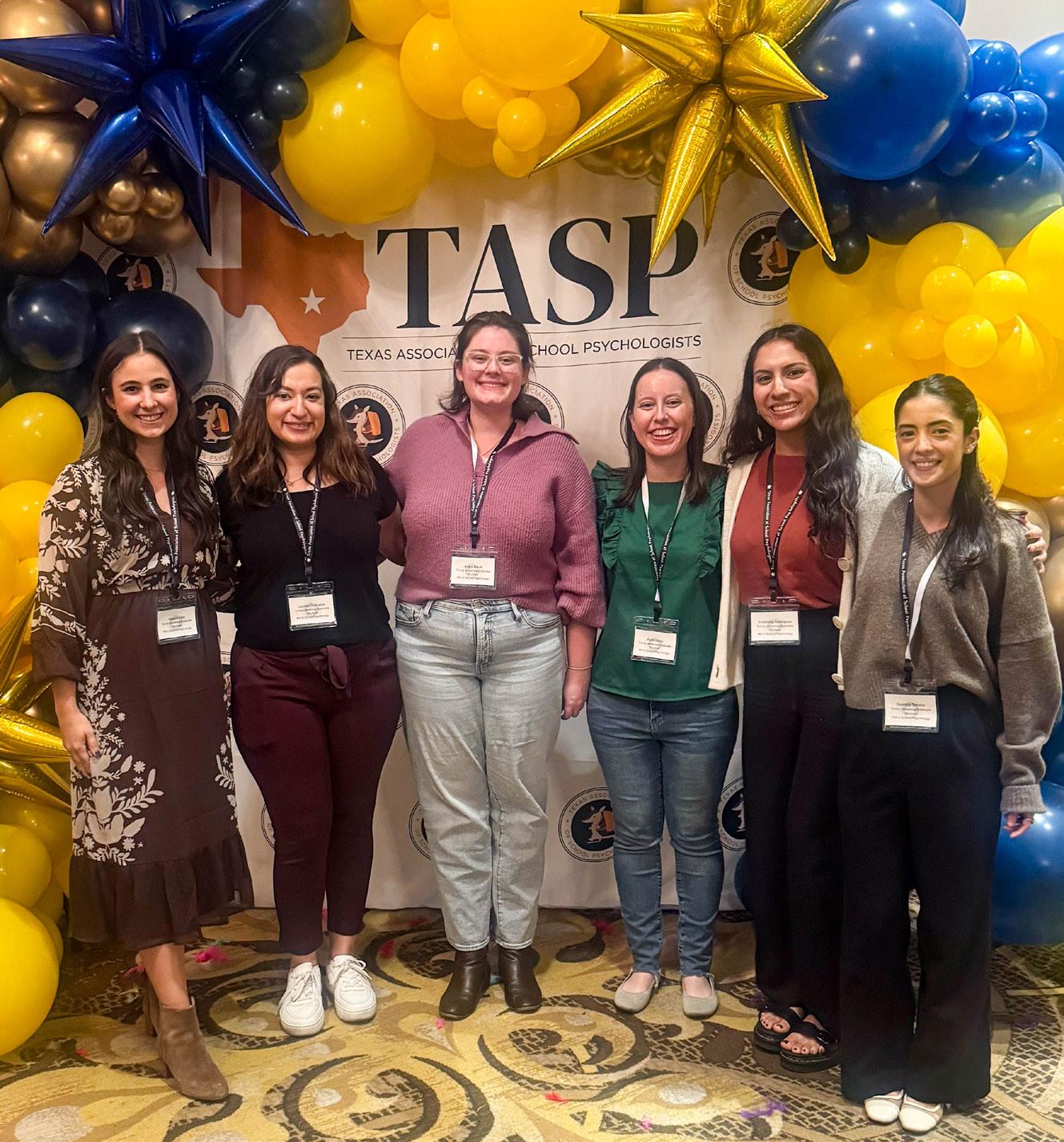
Angie Black & Faith Perry
Graduate Student Perceptions of the Role of School Psychologists
Peyton Silvius
Classroom Libraries: Promoting Exploration and Belonging in Social Studies
Abbie Wietstruck
Teacher Advocacy: How Teachers Can Find Hope and Ways to Passionately Resist in Their Classrooms
Sam Carr
Getting Students to, “I Got This!”
Graduate Student Perceptions of the Role of School Psychologists
ANGIE BLACK & FAITH PERRY
The role of a school psychologist is incredibly diverse. Ideas of the role of school psychologists are mixed. This descriptive study surveyed 15 graduate students in a Master’s School Psychology program about their perceptions of the role of school psychologists in schools. Selected outcomes revealed that most participants agreed across various role dimensions.
Graduate Students’ Motivations for Pursuing a Master’s Degree in School Psychology
LAUREN GONZALES & NATALIE LAIA
There is limited research regarding graduate students’ motivations for pursuing school psychology. The present study surveyed seventeen graduate students enrolled in a master’s school psychology program in a Southern State regarding their motivations for pursuing a master’s degree in school psychology. The fifteen-item survey was distributed via email. Results yielded motivations including understanding self, program length and requirements, job opportunities, and financial opportunities.
School Psychologists’ Attitudes Toward AI-assisted
Clinical Tools
AMORETTE RODRIGUEZ & DIANDRA TREVIÑO
Artificial Intelligence (AI) is a new and growing technology transforming professional roles. Little is known about attitudes towards AI among graduate students and practicing school psychologists. This descriptive study surveyed 36 school psychologists and graduate students in master’s programs in a Southern state about their attitudes toward the use of AI in clinical practice. Results revealed mostly positive perceptions of AI use, with notable exceptions.
The Impacts of Senate Bill 12 on Texas Theatre Programs
MADELINE BAKER
What happens to theatre programs when restrictions are placed on identity and expression? How can theatre teachers in Texas continue to support students of all identities when the law forbids it? A look into the impact of Senate Bill 12 on Texas Theatre programs, the students, and their art.
Using My “Buddy” to Keep Me Focused and On Task
CIELO BOCANEGRA
Students in my fourth/fifth dual language classroom get easily distracted and have trouble staying on task while working independently. To encourage them to stay on task and increase their focus during independent work, I introduced the incentive of having them work with a buddy. My research explores whether students having access to these buddies actually helps them or not.
Promoting Literacy in Secondary Science Classrooms
ROBIN BOWEN
Biology and the sciences often require students to build on their academic vocabulary and engage in a variety of literacy tasks. This research explores how implementing literacy strategies in secondary science classes allows for student success not only in the classroom but in their adult lives as well.
Getting Students to, “I Got This!”
SAM CARR
My sixth graders are fully capable of many things, but frequently cannot perform mathematical tasks on their own on an exam. Many have lost confidence in themselves as they have been told that they are wrong over and over again. They would rather not say anything than be wrong. This research explores strategies to build students’ confidence in themselves and belief in their math skills.
Making Time for a Morning Meeting
JULIANA DOLD
Schools are institutions capable of providing young people with the tools and resources they need to be successful in both academic and social competencies. However, with an increased focus on standardized testing and a strict emphasis on academics, social and emotional learning (SEL) can often be overlooked/ignored in classrooms. In this presentation, I describe how I incorporated SEL practices into an academically rigorous curriculum.
On the Importance and Benefits of Small Group Instruction TIFFANY GRUSZECKI
As I learned about my students’ reading levels, I noticed that some of them had fallen behind due to factors such as them having excessive absences, leaving school early, or struggling with focus. In this research project, I provide targeted instruction to specific students and explore how their learning in a small group setting helps them grow in decoding and phonics skills.
Explicitly Teaching Reflective Practices and Routines to Create a
More
Focused, Student-Centered Learning Environment
SHELBY KOEHLER
This research examines how teaching reflective practices impacts classroom disruptions in a 4th-grade rotational classroom setting. The session will describe how explicitly teaching and implementing daily reflection prompts, verbal check-ins, and structured opportunities for students to reflect after disruption) encourages students to think critically about their actions, understand the consequences of their behavior, and develop a sense of personal accountability.
Building Relationships to Encourage Students Asking Questions
CHRIS MEDEIROS
My sixth-graders do not feel comfortable asking questions when they struggle with a math problem. In order for students to ask questions, they must feel comfortable and supported in the classroom. Building relationships is essential for making this happen. My research focuses on implementing strategies to connect and build relationships with students so that they will feel more comfortable seeking help when struggling in math.
Bridging the Gap: Connecting History Curriculum to Student Identity
EMILY SAETHER
History helps explain the current world around us and who we are. However, students may struggle to connect history curriculum content to their lived experiences and identities. This research seeks to bridge the gap so students feel seen and connected to history content beyond surface level comprehension.
Classroom Libraries: Promoting Exploration and Belonging in Social Studies
PEYTON SILVIUS
Using classroom libraries in Social Studies, teachers can increase student engagement with class material and foster genuine curiosity and exploration. In making visible a student’s cultures in an academic setting, students gain greater ownership of their learning and an increased sense of belonging.
Teacher Advocacy: How Teachers Can Find Hope and Ways to Passionately Resist in Their Classrooms
ABBIE WIETSTRUCK
This research seeks to provide resources and approaches for teachers to advocate for equity and inclusion and to resist challenging laws in their own classrooms. How can teachers, myself included, feel ready to step into the classroom with hope and confidence in our ability to make a difference, even in the face of restrictive laws?
Disrupting the Cycle: Addressing DAEP, Exclusionary Discipline, and Funding SEL for Student Success
VICTOR DE LA CERDA, CLAUDIA FIDENCIO-ESTRADA,
MARICELA GARZA, & RUBEN AMEZCUA
Our group’s project focuses on shortening students’ time in DAEPs and securing funding for SEL curriculum and/or teacher training to reduce student discipline incidents and, in turn, DAEP enrollments.
Transparency in School Vouchers: Increasing Access to Special Education Services Information
CHELSEA EDGE, STACY LAUBY & LISA MURPHY
In the state of Texas, students qualifying for special education services make up approximately 14% of learners in public schools. This project details current challenges and future recommendations to allow families of these students to make informed decisions about utilizing the new Texas Education Freedom Accounts (vouchers) in the context of private and charter schools.
Accountability for Every Dollar Every Student
AARON SHERWOOD, JON DERRICK ALVAREZ & SHAYNA KROPA
This presentation outlines our policy advocacy for accountability in Texas school voucher programs. With $1 billion in taxpayer funds proposed for Education Freedom Accounts, we argue that participating private schools must meet comparable standards as public schools. We recommend mandatory statewide assessments, public reporting, and equitable accommodations. Our research promotes transparency, informed family decision-making, and stewardship of public funds while ensuring student outcomes remain central.
Burdens of Choice and Closure: Oral Histories of San Antonio Schooling
M. NAYELI ALEMÁN & KALEIGH CANSINO
This research is situated within the Spring 2024 school closures that affected school districts across San Antonio. Using oral history methodology, it analyzes the contributions made by its nineteen narrators speaking on the loss of schools, and the burdens of ever-growing school choice models. The findings highlight the manners in which neo-liberal reforms reinforced structural and historical inequality in San Antonio, Texas.
The Pedagogy of Soccer
Education:
A Coach’s Guidebook
SCOTT LEBO
This project applies education theory and pedagogy to soccer, presenting a teaching-centered framework that integrates structure, team culture, tactics, and player development. Tailored to high school coaching, it positions the coach as an educator translating theory into practice. It also serves as a living document, an evolving personal coaching philosophy that adapts over time to support holistic learning and development.
Racialized Organizations and School Discipline: A QuantCrit Analysis of Student
Racial Composition, Teacher Diversity, and In-School Suspensions
in Texas
WILLIAM WALKER
Utilizing school-level data from Texas, I investigate the role of student and teacher racial composition in shaping racial inequality in in-school suspensions (ISS). I find severe racial inequality for Black students. Regression analysis reveals that Black student enrollment has a significant and negative effect on inequality in ISS incidences for Black students. Teacher diversity is insignificant and does not mediate the Black enrollment coefficient.
Department and Program Leadership
Angela Breidenstein, Ed.D. Professor of Education Chair, Department of Education
Secondary Director, Master of Arts in Teaching
Enrique Alemán, Jr., Ph.D.
Lillian Radford Endowed Professor of Education Director, Center for Educational Leadership
Program Director, Master of Education in School Leadership
Vangie Aguilera, Ed.D.
Assistant Director, Center for Educational Leadership
Assistant Program Director, Master of Education in School Leadership
Rocío Delgado, Ph.D. Professor of Education
Elementary Director, Master of Arts in Teaching
Jorge Gonzalez, Ph.D.
Murchison Endowed Professor of Education
Program Director, Master of Arts in School Psychology
Diana Kenney, M.A. Lecturer
Training Director, Master of Arts in School Psychology