2026 Ballroom Summit
Evaluation & Impact Summary | DC Black Pride 2026 | May 22, 2026 | Washington, D.C.
A Collaboration of Center for Black Equity • NMAC • Us Helping Us, People Into Living, Inc. • Destination Tomorrow
Overview
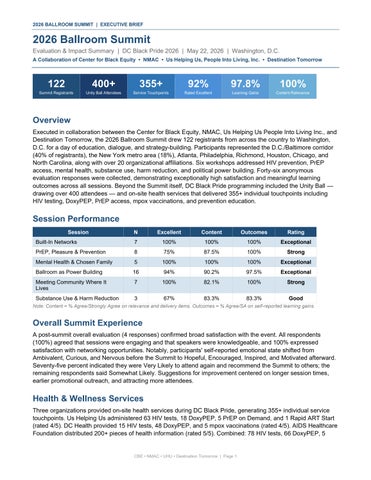
Executed in collaboration between the Center for Black Equity, NMAC, Us Helping Us People Into Living Inc., and Destination Tomorrow, the 2026 Ballroom Summit drew 122 registrants from across the country to Washington, D.C. for a day of education, dialogue, and strategy-building. Participants represented the D.C./Baltimore corridor (40% of registrants), the New York metro area (18%), Atlanta, Philadelphia, Richmond, Houston, Chicago, and North Carolina, along with over 20 organizational affiliations. Six workshops addressed HIV prevention, PrEP access, mental health, substance use, harm reduction, and political power building. Forty-six anonymous evaluation responses were collected, demonstrating exceptionally high satisfaction and meaningful learning outcomes across all sessions. Beyond the Summit itself, DC Black Pride programming included the Unity Ball drawing over 400 attendees and on-site health services that delivered 355+ individual touchpoints including HIV testing, DoxyPEP, PrEP access, mpox vaccinations, and prevention education.
Session Performance
Note: Content = % Agree/Strongly Agree on relevance and delivery items. Outcomes = % Agree/SA on self-reported learning gains.
Overall Summit Experience
A post-summit overall evaluation (4 responses) confirmed broad satisfaction with the event. All respondents (100%) agreed that sessions were engaging and that speakers were knowledgeable, and 100% expressed satisfaction with networking opportunities. Notably, participants' self-reported emotional state shifted from Ambivalent, Curious, and Nervous before the Summit to Hopeful, Encouraged, Inspired, and Motivated afterward. Seventy-five percent indicated they were Very Likely to attend again and recommend the Summit to others; the remaining respondents said Somewhat Likely. Suggestions for improvement centered on longer session times, earlier promotional outreach, and attracting more attendees.
Health & Wellness Services
Three organizations provided on-site health services during DC Black Pride, generating 355+ individual service touchpoints. Us Helping Us administered 63 HIV tests, 18 DoxyPEP, 5 PrEP on Demand, and 1 Rapid ART Start (rated 4/5). DC Health provided 15 HIV tests, 48 DoxyPEP, and 5 mpox vaccinations (rated 4/5). AIDS Healthcare Foundation distributed 200+ pieces of health information (rated 5/5). Combined: 78 HIV tests, 66 DoxyPEP, 5
PrEP, 1 Rapid ART Start, 5 mpox vaccines, and 200 information distributions embedding prevention and care directly into the Pride experience.
DC Black Pride Unity Ball
The DC Black Pride Unity Ball drew over 400 attendees, with competitive categories celebrating diverse identities across age, ability, and gender. The event embedded HIV prevention education into the competition itself: cash prize categories required contestants to correctly answer HIV-related questions, with 15 questions covering PrEP, PEP, DoxyPEP, U=U, testing, and treatment. Questions were shared on social media beforehand and posted around the venue to encourage learning prior to competition. Incorrect answers were corrected by judges in real time, creating peer-led learning moments that reinforced accurate prevention knowledge in a culturally resonant setting.
Who Attended
Of the 122 registrants, the largest contingent came from the Washington, D.C. metro area (40 registrants), followed by the New York metro area (21), Baltimore (8), Atlanta (5), and Philadelphia (5), with additional participants from Richmond, Houston, Chicago, and North Carolina. Registrants included staff from over 20 organizations alongside community members registering with personal email addresses (75%). Among evaluation respondents, 43% identified as ballroom community members, 33% as CBO staff, 13% as public health professionals, 13% as advocates/activists, and 13% as house parents/leaders.
Key Themes from Participant Feedback
1. Trust and safe spaces participants valued open dialogue, transparency, and facilitation that made all voices feel heard.
2. Community self-reliance a strong belief that ballroom communities have the cultural infrastructure to lead their own health and wellness initiatives.
3. Trauma as a root cause connections between trauma and substance use, sexual health, and mental wellness surfaced across multiple sessions.
4. Political urgency participants expressed heightened concern about policy threats and a strong desire for civic engagement training and coalition-building.
5. Hunger for more requests for longer sessions, ongoing connection (monthly Zoom calls), and deeper dives into leadership, funding, technology, and the kiki scene.
Participant Voices
"The idea around what trust means and capacity building"
"How I can take my skills, professional role, and ballroom influence to build civic coalitions" "Community can take care of community as we always have."
Priority Recommendations
• Extend session length for high-demand topics (PrEP/sex positivity, substance use) to 90-minute or doublesession formats.
• Establish year-round touchpoints monthly virtual check-ins, resource sharing, or community of practice calls to sustain momentum.
• Launch a multi-session civic engagement and policy training series, building on the strong demand from the Power Building session.
• Add new sessions on participant-identified priorities: funding/grant-writing, technology in prevention, the kiki scene, and gender inclusivity.
• Increase evaluation response rates through dedicated completion time and incentives; add a 30-day followup survey to measure behavior change.
Bottom Line
The 2026 Ballroom Summit and broader DC Black Pride programming delivered a high-quality, high-impact experience across education, health services, and cultural celebration. The Summit's near-universal satisfaction and learning gains, combined with 355+ health service touchpoints from three provider organizations and a Unity Ball that embedded HIV prevention knowledge into a 400+ person cultural event, demonstrate the power of meeting communities where they are. Participants' calls for more, deeper, and ongoing engagement confirm that this integrated model works and the community is ready to scale it.