LEXICON — VOL. 1
Morphology X History
Mythological Migrations
Networks of Care=Critique
@CRITICALDÍAS
Orality
Knowledge
Pre-Colonial Pre-Colonial
GABRIEL PEREIRA
GABRIEL PEREIRA
BENTLY SPANG
MUZIWANDILE GIGABA
TAMARA AL-MASHOUK
BRUNO MORESCHI
Algorithmic Remembering
@CRITICALDÍAS
@CRITICALDÍAS
colaboración y red de afecto
Authorship
MORESCHI GABRIEL PEREIRA
Cannibal fugue –sexile
afecto. Proceso Crítica Institucional
Archivo,
@CRITICALDÍAS
Colaboración y red de
Emergent Mythologies Emerging Epigenetics of Place Errors Experimentacão
GABRIEL PEREIRA
YORNEL MARTÍNEZ ELÍAS LAINE RETTMER
BRUNO
GABRIEL PEREIRA
TAMARA AL-MASHOUK
BRUNO MORESCHI
Indigenous Knowledge Systems
@CRITICALDÍAS
Morphology X History Mythological Migrations
Networks of Care=Critique
@CRITICALDÍAS
Orality
Knowledge
Pre-Colonial Pre-Colonial
MUZIWANDILE GIGABA
MUZIWANDILE GIGABA
Queer Utopias Reconciliation
Repair
Repetition Resistance Ritual
Sufi Speculations The List
Where are you from?
SYOWIA KYAMBI
SYOWIA KYAMBI
SYOWIA KYAMBI
SYOWIA KYAMBI
SYOWIA KYAMBI
SYOWIA KYAMBI
ABDULLAH QURESHI
TAMARA AL-MASHOUK
TAMARA AL-MASHOUK

PALABRAS POROSAS (Porous Words)
Dalida María Benfield
Lexicon/lexicon
Christopher Bratton
CANNIBAL FUGUE – SEXILE
@criticaldías
AUTHORSHIP
Bruno Moreschi
MYTHOLOGICAL MIGRATIONS
Abdullah Quereshi WHERE ARE YOU FROM?
Tamara Al-Mashouk QUEER UTOPIAS
Abdullah Quereshi
CRÍTICA INSTITUCIONAL
Yornel Martinez Elias RESISTANCE
Syowia Kyambi
ALGORITHMIC REMEMBERING
Gabriel Pereira
PRE-COLONIAL KNOWLEDGE
Bently Spang ORALITY
Muziwandile Gigaba ERRORS
Bruno Moreschi
NETWORKS OF CARE=CRITIQUE
@criticaldías
Syowia Kyambi
Yornel Martinez Elias INDIGENOUS KNOWLEDGE SYSTEMS
Muziwandile Gigaba EXPERIMENTACÃO
Gabriel Pereira PROP
Laine Rettmer
EPIGENETICS OF PLACE
Tamara Al-Mashouk EMERGING
Gabriel Pereira COLABORACIÓN Y RED DE AFECTO
Yornel Martinez Elias PROCESO
Bently Spang
Syowia Kyambi
Moreschi
Palabras Porosas (Porous Words)
Dalida María Benfield
Language changes. Over time and across space. As languages travel across times and spaces, they are re-languaged: adapted to new conditions. Interrupted and redirected. New sounds are produced in different acoustic environments that impact pronunciations of existing words. New sounds are produced that create new words. For those of us who do not use our mouth to speak or whose ears are deaf, language requires movement. We must see each other. For those of us who are blind, our reading fingers may touch meanings. Or we may listen deeply, only. These movements and forms of listening change as well. The grammars, movements, listening, and pronunciations of old echo across new vocabularies. Those of us whose language practices preserve a past or produce a future moment, we must change or modify them to be understood in a contemporary community. Or, these language practices may be documented and practiced by constructed communities of archaic or future tense pronunciators and grammarians.
Those of us who carry a language to another time and space where it is not practiced learn a form of linguistic dysphoria, a sentimental attachment for a both past and future language time–space that is nested in the “present.” The social and epistemic necessity of linguistic adaptation and creating new languages is unavoidable for some of us. We find ourselves always
at a point of fronterización; of traversing linguistic frontiers. In a vortex of multiple linguistic genealogies, we are in a position of negotiation, displacement, and replacement of any sense of a mother tongue. In this frisson of language, we beg, borrow, and steal from what’s available, hoping that our choices don’t damage our credibility as interlocutors. I await your response, pensively.
I grew up witnessing my mother’s languaging of English as an immigrant in the racist linguistic matrix of the rural United States in the 1970s. This witnessing evidenced a consistent fact: A differently pronounced and grammatically divergent past/future English was not socially tolerated and resulted in numerous instances of negative consequences: jeers, derisive and sarcastic responses, and deliberate ignorance of attempts at communication. The steadfast allegiance of the settler state to a belief in its language as obsolete (playing dead) with its archaic form of pronunciation and grammar posing as the “present” was a form of othering, denying the humanity of the actual contemporary producer of English. This firstperson witnessing of the dehumanizing potential of linguistic puritans disposed me, permanently, with an affinity for impure grammar and novel pronunciations and movements. Of the body and mouth. In all languages. I love my mother’s tongue.
Mi lengua es su lengua y es la lengua de nosotras. Estamos construyendo una comunidad nueva a través de las fronteras de disciplinas y de fronteras nacionales. Necesitamos construir un archivo de nuestras palabras y sus definiciones. Para nosotras, la pronunciación no es importante. Es el concepto que tiene valor, y vamos a tratar de comunicarlo usando cualquier forma linguística que tenemos: el lenguaje verbal, un dibujo, una forma escrita experimental, una forma sónica abstracta, el cine, tocarnos, danzar, veer, cantar. Hay una infinidad de formas, y estamos dispuestos a encontrarnos con esa infinidad.
The intermixing, invention, and the contamination of languages produces cross-border understandings. These are concepts and ideas that did not exist before we began to language them across languages. These cross-border understandings produce new connections between people across geographic, national, and philosophical borders. These are novel words, grammars, pronunciations, and heuristics. With these, we might begin to understand, pronounce, share, and
imagine other ways of not only communicating, but structuring the situations of our communication.
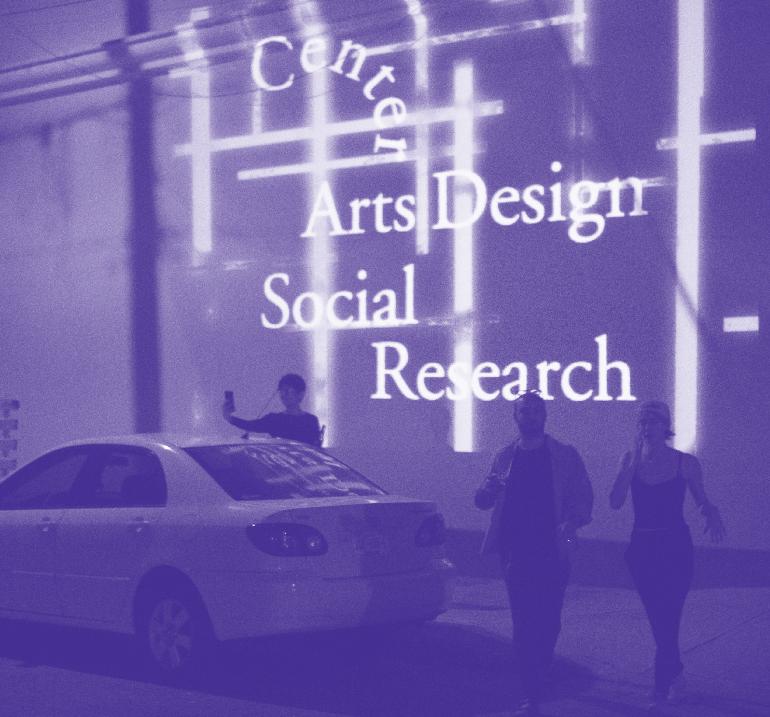
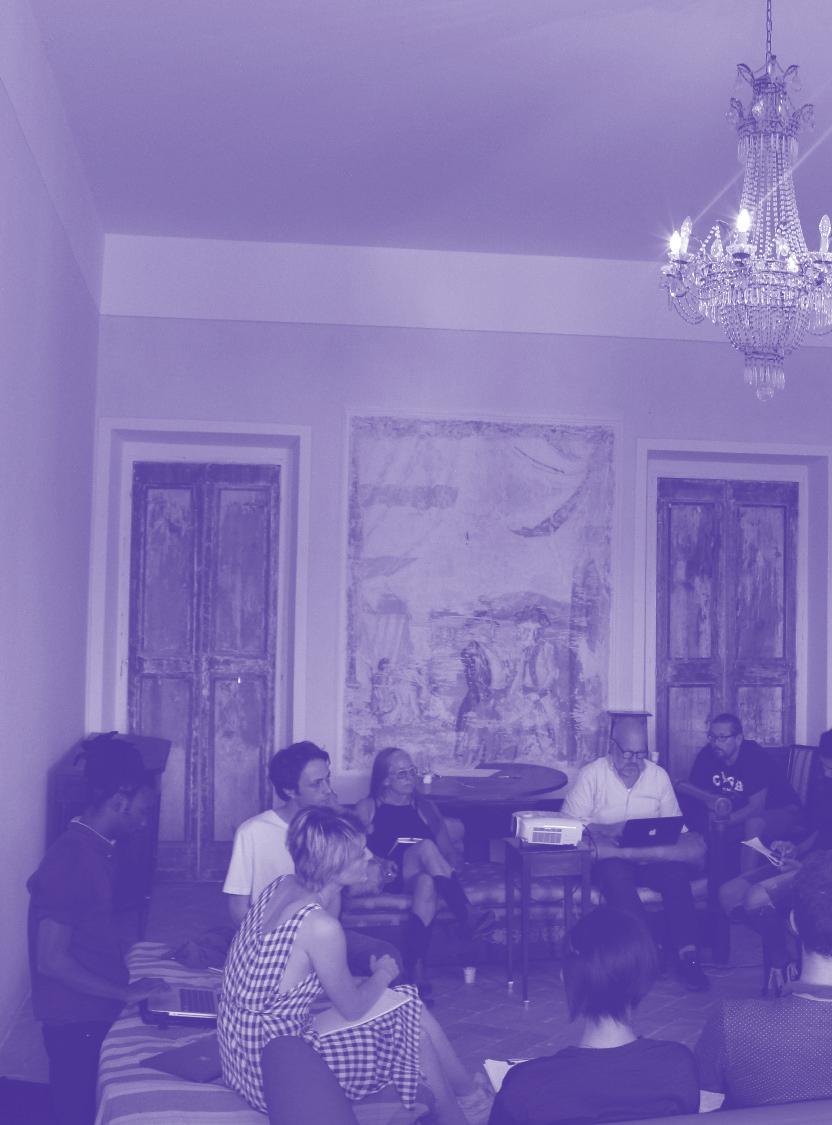
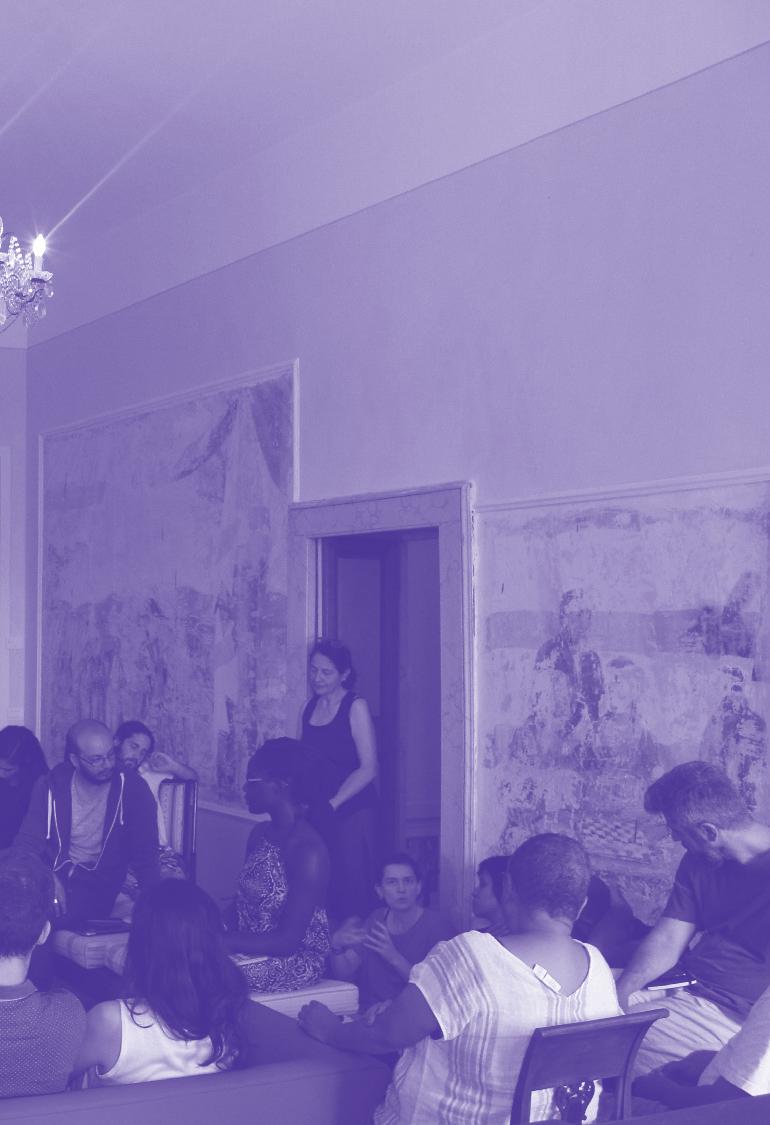
In Lexicon — Volume 1, the artists and scholars who are the authors of this text, all members of the inaugural Center for Arts, Design, and Social Research (CAD+SR) Fellows program, begin to write the collective lexicon – polyglot and impure –that is made possible by the situation of communication that we have all lovingly, as a community, produced.
LEXICON/ LEXICON
Christopher Bratton
The supposedly finished statement is instantly overridden by that which it cannot say, that which it has not said … Stuart Hall 1
NOTES
1 Stuart Hall. “Modernity and Difference: A Conversation between Stuart Hall and Sarat Marharaj,” in Modernity and Difference, eds. Sarah Campbell and Gillian Tawadros (London: Institute of International Visual Arts, 2001), p. 43.
2 Chantal Mouffe. “America in Populist Times: An Interview with Chantal Mouffe, ” by Waleed Shahid, The Nation, December 15, 2016.
Consider this, a book, any book, or this book: it is eminently transportable. It can be handed from one person to another, thought in language and images, read or spoken, a recitation or a recounting, that is always and at the same time a partial “supposedly finished statement”, one to hold.
A Lexicon, as a form, relies on procedures of cataloguing and classification to fix the meaning of things, which, when compiled, appear as a coherent and complete, world where everything is “said.” Or to put it another way, it marks the limits of knowing by circumscribing what is properly spoken and thought. But even so lexicon is “instantly overridden by that which it cannot say”: on its surface, it appears authoritative, fundamentally univocal. In practice, however, it is slippery and equivocal, moving between meaning in its broadest most generalized to meaning in its most idiosyncratic. The lexicon of a certain knowledge, of a profession or a religion, for example, or a personal lexicon, from the world to the experience of personhood and the self. Lexicon then is both culture and subjectivity, integrally bound together by difference and the production of meaning. It is this paradox, then, that animates this lexicon, not to represent what is essentially elusive, the movement of thought in individual reflection and collective exchange, but to notate it in its incompleteness
But language is not only word and sound, but image and material, too.
Lexicon is imagined as a structure of these instances, these many things, and the communicating threads they make, develop and/or drop. For it is always also the things between, the unsaid, the aporias and gaps, that themselves are meaningful. Together, these all create a third space of possibility, one where the vital capacity of dialogue to propose, echo, and revise generates new and living forms.
Imagine then “different people coming together for common cause and aspirations” to expressly “establish a collective will.” Are these “the right tools and language to think about this project?” 2
Lexicon was first conceived last year, and now as we bring it to a conclusion, we are in the midst of a global pandemic, all of us variously locked down or out, whether in China, Africa, Europe, the Caribbean, or most everywhere really, each day a cacophony of varied and contradictory responses, and each day, a starker picture of a world social order founded and maintained by economic and racialized violence. Lexicon proposes a new world, and a word, past the universalizing term “global” — instead it suggests a new universal that is a yet-to-be imagined shared horizon, a lexicon of new space, and the politics that make this possible.
18 Cannibal fugue — sexile19
Authorship22
Mythological Migrations24
Where are you from?26
Queer Utopias30
Crítica Institucional30
CANNIBAL FUGUE – SEXILE / FUGA CANNIBAL – SEXILIO
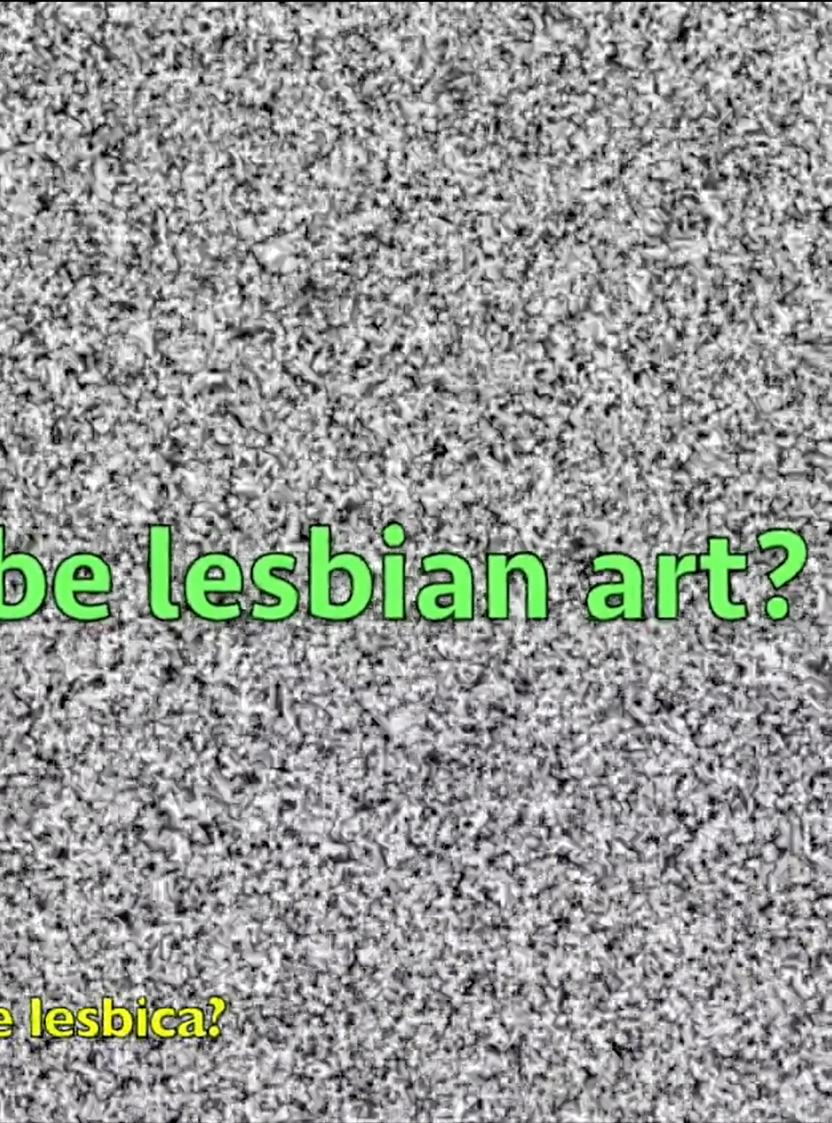
The fuga occurs in the error between cannibal, Caliban, and Carribean. The cannibal fugue is one of lesbian art’s recurring strategies. Rooted in Viveiros de Castro’s Cannibal Metaphysics and Gloria Anzaldua’s Movimientos de rebeldía y las culturas que traicionan, it exercises the freedom to “betray those who have betrayed you”: to respond to systems of representation that claim to speak for or on one’s behalf. The cannibal fugue responds to both absence and excess, silence and amplification. It permits a movement through the gap that exists between the lack of a history and memory of trans and lesbian art in the Global South and the tropicalized overrepresentation of the sensual heterosexual woman and other figures of alegría (happiness). In the cannibal’s fugue, the forms of sexualization of the woman in the tropics are revealed, exposing them as a variation in a wider genealogy of exoticized sexual and racial fictions promoted by nineteenth-century visuality, evidenced in the work of Paul Gauguin and the surrealist dream. The cannibal devours and eats everything in their path, to the extent that consuming allows for the (self- and collective) production of a desiring subject in flight.
@criticaldías
@criticaldías —1/3
During the first residency, we shared a recent publication project entitled Reinscriptions (Miquel Casablancas Prize), a collection of poetry and essays that draw on archival research that speculates on the intersection of technologies of vision and systems of management of the body. Our proposal for the fellowship was to continue developing research around the notion of ‘technoaffectivity’, specifically through combining exercises in collective performance-readings of poetry and manifestos with multimedia elements to generate complicity between performers and audiences, whether in the space of a workshop, publication, or public intervention.
During the first residency, it was a luxury to participate in the presentations of works and works in progress of other fellows, the research meetings (such as
@CRITICALDÍAS
Cannibal Fugue / Fuga Caníbal , 2017
Single-channel video
Cannibal Fugue / Fuga Caníbal considers the representational gap between the (lack of) history of “lesbian art” in the “tropics” and the hyper-representation of the “sensual tropical woman.” The voice of Fuga Caníbal references the voice of the “sexilios”, an inscription of experiences of exile and immigration across South and Central America during the decades of dictatorships and the AIDS crisis. Fuga Caníbal consumes the work of the trans-sexile poets and activists as a tactic for reinscribing a Caribbean lesbian sexuality in a space defined by intense erasure of histories and practices of lesbian critique and dissidence.
the Migratory Times project) and other encounters such as the “Queer Meeting” organised by Abdullah Qureshi and later developed into the summit project Queering Space by Tamara Al-Mashouk.
Across these spaces we co-constructed questions that are transversal to many of the fellows’ practices: How can we develop meaningful social artistic research practices (understood as the production and sharing of knowledge and tactics across academic, artistic, and activist spaces) that depart from and contribute to feminist and antiracist thinking? Hearing about the ongoing work of the Migratory Times project (coordinated by Dr. Dalida María Benfield and Dr. Annie Fukushima) and the research of Dr. Annie Fukushima and Dr. Lisa Brock, as well as many of the other fellows, was inspiring and motivating.
AUTHORSHIP
Adam, the first man in the world, sat next to a tree and scratched something in the clay with a small twig. It was the first rough drawing the world has ever seen and a jubilation for the vigorous heart of this man. That is until the devil appears, walks up and whispers behind the foliage: “It’s beautiful, Adam, but ... is this yours?” (Adapted version of the story written by Rudyard Kipling — in his version the devil asked, “It’s beautiful, Adam, but... is this art?”)
Here I establish a direct link between the notion of art and the idea of ownership (authorship)— and I constantly reflect how much Western society has always lost by relating these two concepts rather than allowing the artistic notion to go beyond the “initiator.”
In several texts, the Argentine writer Jorge Luis Borges also seemed preoccupied in searching for that which is common to all the things, complicating the issue of signature. In History of Eternity, for example, he argues that “individuals and things exist in so far as they participate in the species that includes them, which is their permanent reality.”1 In this argument of there being groups, types, and grouping of peers, the author reminds us (or does he make this up?) that poet John Keats “could believe that the nightingale enchanting him was the same one Ruth heard
amid the alien corn of Bethlehem in Judah”2. According to him, “the generic can be more intense than the concrete. There is no lack of examples to illustrate this. During the boyhood summers I spent in the north of the province of Buenos Aires, I was intrigued by the rounded plain and the men who were butchering in the kitchen, but awful indeed was my delight when I learned that the circular space was the pampa and those men gauchos.”3
— BRUNO MORESCHI
1. Jorge Luis Borges, História da eternidade [History of Eternity] (São Paulo: Editora Globo, 1997), p. 43. 2. Ibid, p. 127. 3. Ibid, p. 129.
BRUNO MORESCHI
Another 33rd São Paulo Biennial , 2018
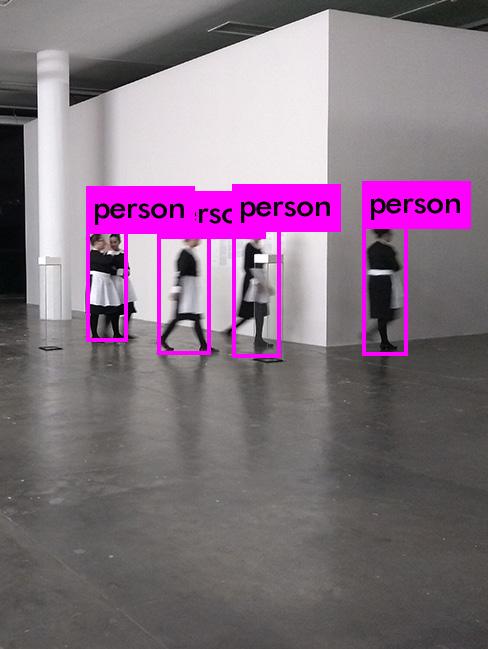
Moreschi conducted a series of interrelated investigations under the title, Another 33rd Biennial, for his contribution to the 33rd São Paulo Biennial. Intending to create a platform for interrogating the Biennial as a signifying and social system, he carried out numerous actions that dwelled in its liminalities and illuminated its borders. Amongst other interventions, he used AI to produce new “readings” of the exhibition.
Action “Decoded records: the amateur present” is a set of images of 33rd São Paulo Biennial produced by the public in general and interpreted by a set of commercial AIs. As these technologies for the reading of images are not totally trained to understand the art system, many of the results offer new modes of understanding what was recorded there – expanding or flattening their meanings.
Bruno Moreschi — 1/3
In the second residency I realized how our network was created not only of professional partnerships, but also of friendship and affection. At that time, I was finishing my doctoral thesis and had to write the final part during the residency. It was quite important for me to see how everyone there sympathized with me and helped me with the academic deadlines. That may seem like a detail, but it shows that CAD+SR is a much larger network than one of joint projects, it’s also a human aid architecture—and that is rare and special.
MYTHOLOGICAL MIGRATIONS
— journey
past. present. future.
to exist outside time; in the realm of imagination.
to not be bound by logic. living cycle traveling to unknown destination.
— ABDULLAH QUERESHI
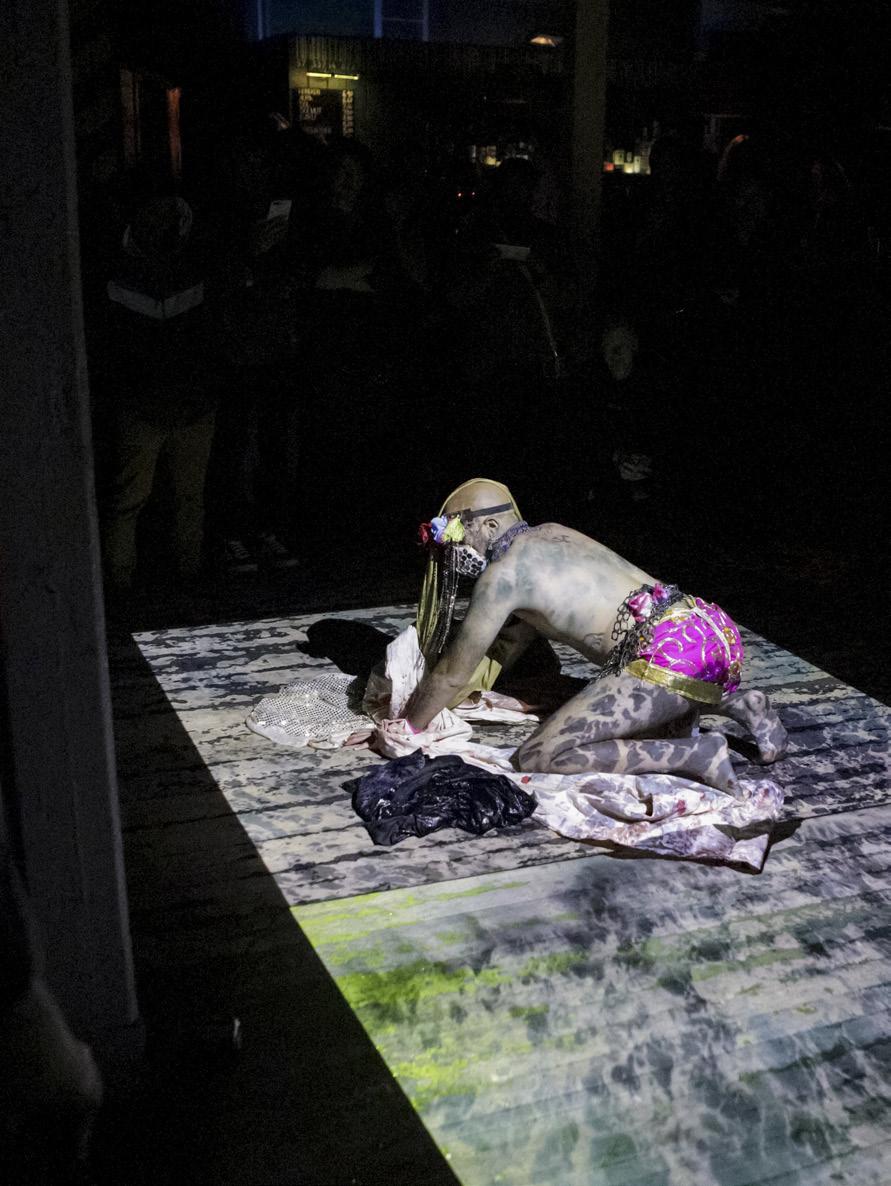
Zulfikar Ali Bhutto, Alif is for Awakening, 2019, multimedia performance and installation, 26 minutes.
Presented as part of Chapter 1: The Nightclub, an artistic component of Abdullah Qureshi’s doctoral project, Mythological Migrations: Imagining Queer Muslim Utopias— Artistic and Curatorial Strategies of Collaboration, Collective Resistance, and Coalition-Building (Aalto University, 2025), at the Today Is Our Tomorrow Festival by PUBLICS, Club Kaiku, Helsinki, on September 13, 2019. Photograph courtesy Joni Korhonen and PUBLICS.
WHERE ARE YOU FROM?
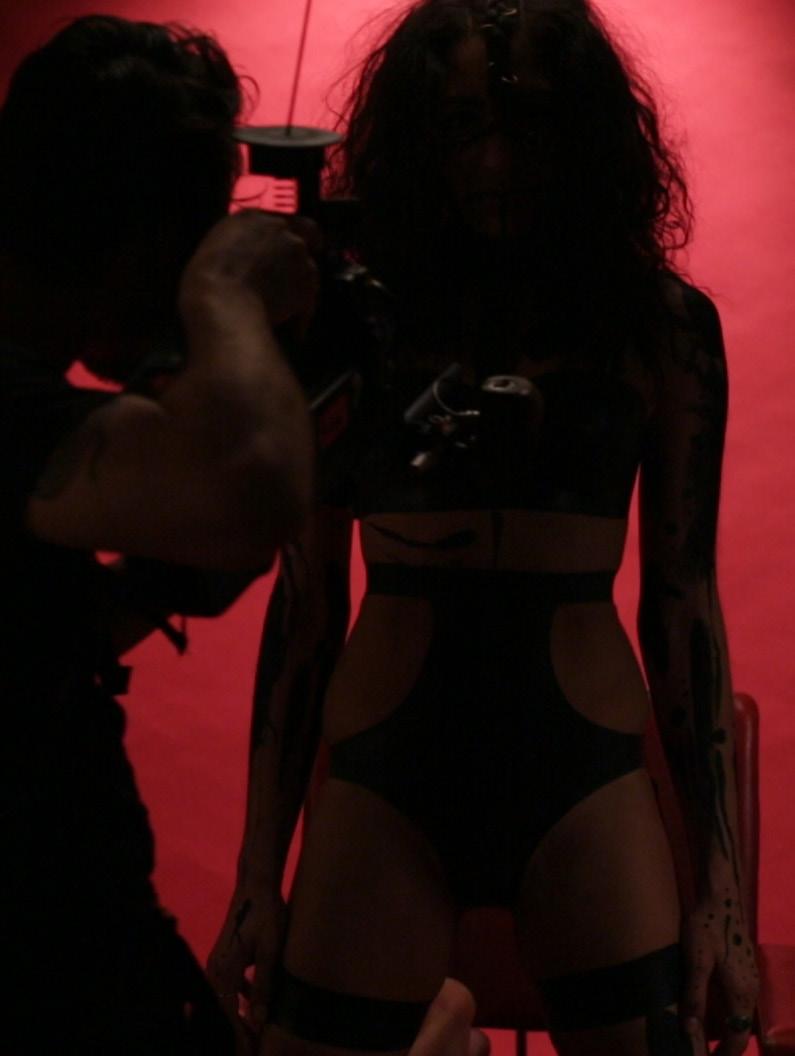
An othering question, followed by a series of systematically choreographed questions used to place a well spoken Arab woman sociologically, politically, and geographically. To establish her, and her Western influenced excellence, as an opposition to the questioner’s (Western) constructed version of her.
— TAMARA AL-MASHOUK
TAMARA AL-MASHOUK, WHERE ARE YOU FROM?, 2019
Al-Mashouk’s video WHERE ARE YOU FROM? uses the context of a fashion shoot, depicting various people moving and shaping the artist’s body, exposing and reversing the gaze, which often views Arab women through the lens of their oppression. Power is reclaimed through a lyrical voice over, which amplifies and extends the complex relationship between an “I” and “You”—a speaker and the public.

Tamara Al-Mashouk — 1/3
The first residency came at the culmination of almost two years of travelling and navigating immigration systems in order to find a permanent residence outside of the Middle East. As a queer woman with a Saudi passport settling in the Gulf Cooperation Council (GCC) was not an option. Immigration systems are emotionally taxing, and though my practice is heavily centered on the movement of people across borders, my work had suffered.
CAD+SR came when I needed it the most, having just received an Exceptional Talent Visa to live and work in the UK (as a result of a lot of work and support from CAD+SR), the first residency created space for me to catapult back into a rigorous practice.
A residency that creates space for dialogue and time for creating is invaluable; paired with a cohort of thoughtful artists and academics created an experience that undoubtedly shaped the trajectory of my work over the year.
I came to the first CAD+SR residency with video content that had travelled with me for two years. The content swirled around me and never landed. I shared drafts of several videos throughout the residency; during presentations and one-on-one critiques. By the end of my time in Spoleto, the work had found a home, a voice, a tone. This exemplifies the magic of CAD+SR.
Qureshi
In 2012, almost five years after I had come out and moved to London, I remember going to bed thinking about how far I had come. Sexuality and religion, in my mind, didn’t seem like an issue anymore. Growing up as a queer man in Pakistan, I was conditioned to believe that queerness and being Muslim were not compatible; that to be one, I had to let go of the other. On that evening, somehow it seemed that I had reconciled the two. At night though, I had an odd dream. I found myself at an airport in an electronics store. I was alone, and across the counter, there were lots of men sniggering—as if they were in on a secret. I was trying to buy something, and they were cheating me by overcharging. I was trying to speak but couldn’t. I woke up wondering what it meant. Thinking about the transitory location, and the fear and humiliation I felt around the men cheating me. Out of curiosity, I called a spiritual guide in Pakistan to help me interpret the dream. As he began to offer an interpretation, he stopped midway, as if he had an epiphany. Changing the course of his words, he says: “I’ve never asked you this before, but I must seek Shahada (translation: to testify) from you. Have you ever slept with a man consensually?”
I have specifically been looking at questions of being queer and Muslim, and how through making and studying contem-
porary art from non-Western contexts, notions of “queerness” and “Islam” can be challenged. I arrived in Spoleto with an open mind, and very much to hear and learn from others. Over three weeks, I found the residency to be an incredibly enriching experience, where I was not only able to engage with a range of creative and academic practitioners but especially those who were already dealing with queerness and its many intersections. For this reason, the organization of a dedicated queer conversation was particularly crucial for me, as it brought forward diverse perspectives on queerness from a cross-generational, racial, interfaith, and kinship point of views. I have been reflecting on many of the conversations had and thinking about the various modalities of artistic approaches employed by the CAD+SR community at large. As a result, I have been developing multiple practice-based investigations that respond, as well as challenge, many of my specific questions. I am thinking about furthering existing feminist and queer collaborations with practitioners from Pakistan, forming new Queer Circles within Muslim cultural communities, as well as working toward a three-year research project, titled Mythological Migrations: Imagining Queer Muslim Utopias Through Contemporary Art.
QUEER UTOPIAS
An extension of ideas already presented in Cruising Utopia: The Then and There of Queer Futurity, by José Esteban Muñoz, 2009
Queerness is not yet here. Queerness is an ideality. Put another way, we are not yet queer, but we can feel it as the warm illumination of a horizon imbued with potentiality. We have never been queer, yet queerness exists for us as an ideality that can be distilled from the past and used to imagine a future. The future is queerness domain.
— ABDULLAH QURESHI
ESTO NO ES UN MUSE0, 2008
El museo como la policía es de esas instituciones modernas sin las cuales no sabríamos vivir. — Michel Foucault
Esta serie de dibujos constituye una reflexión sobre la noción tradicional de museo y nos estimula a pensar sobre las narrativas museísticas. Los museos imaginarios que se advierten aquí introducen un comentario crítico y humorístico sobre el paisaje urbano, al tiempo que funcionan como un modelo de institución donde su puesta en escena en el espacio público genera en sí nuevos sentidos.1
— YORNEL MARTÍNEZ ELÍAS
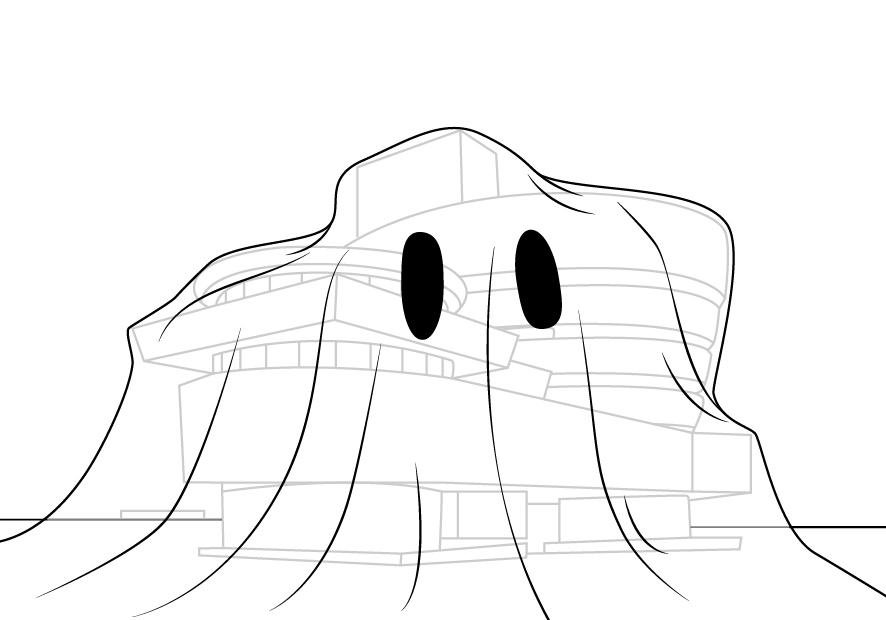
El museo fantasma
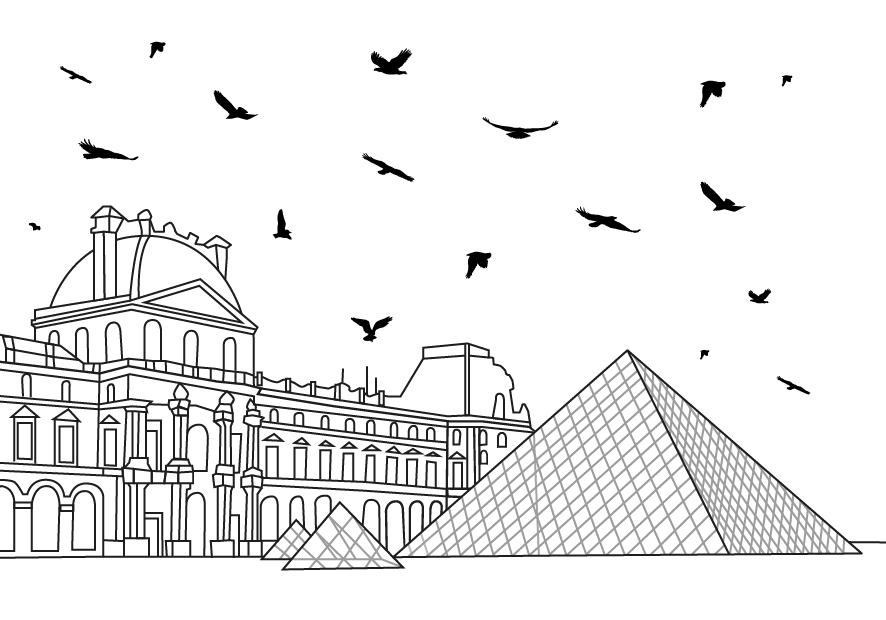
El museo de los Muertos
El museo de la Élite
Algorithmic Remembering41
Pre-Colonial Knowledge44
Orality46
Errors50
Networks of Care=Critique53
The List59
RESISTANCE
…resistance at root, must mean more than resistance against war. It is a resistance against all kinds of things that are like war… So perhaps, resistance means opposite to being invaded, occupied, assaulted and destroyed by the system. The purpose of resistance, here, is to seek the healing of yourself in order to be able to see clearly … I think that communities of resistance should be places where people can return to themselves more easily, where the conditions are such that they can heal themselves and recover their wholeness. — Thich Nhat Hahn
— SYOWIA KYAMBI
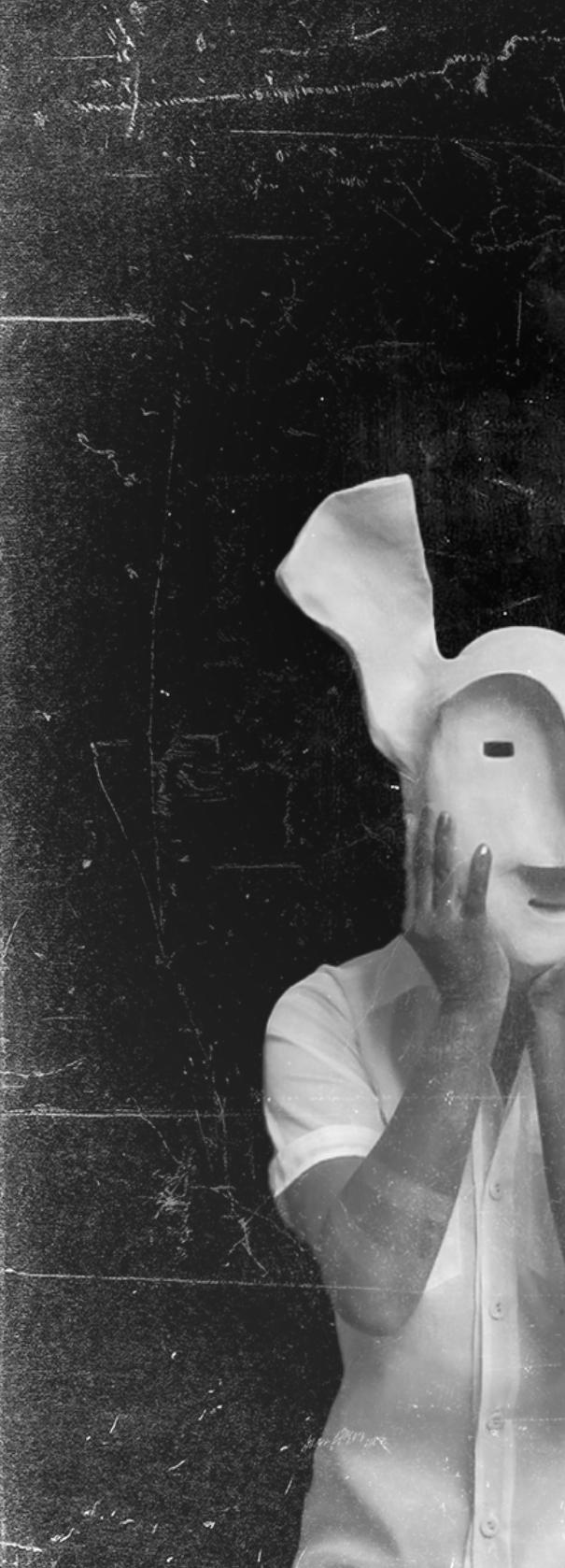
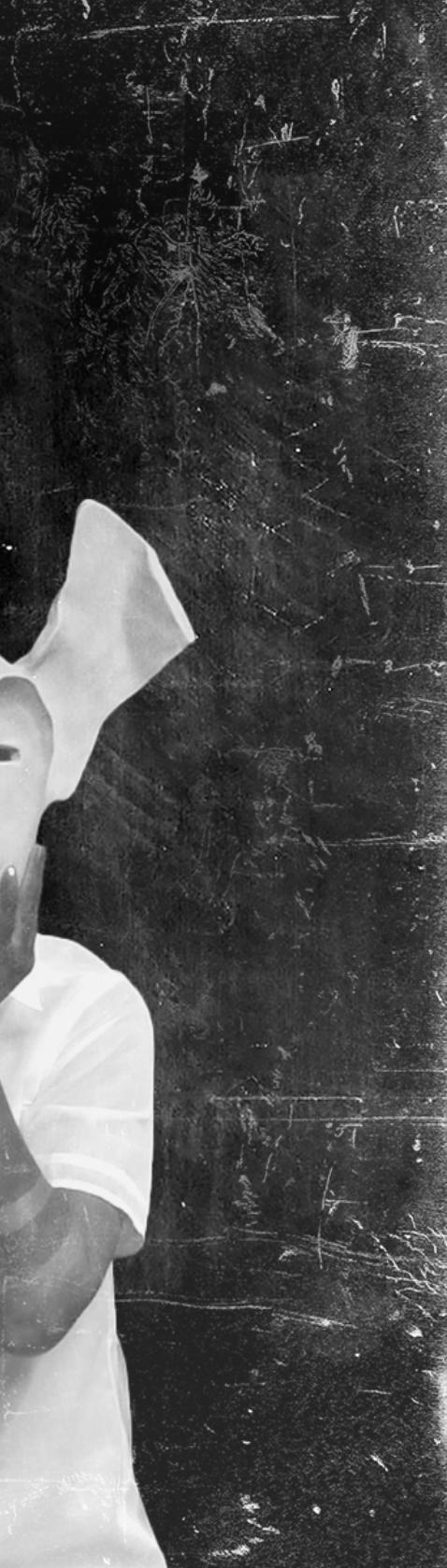
Syowia Kyambi — 1/3
Past
& Future
My artistic practice and my research don’t run parallel to each other. They run in tandem, feeding each other and holding space for creative outlets to be connected in order to pinpoint moments in history, rebuilding new stories within already shared narratives. My research practice is twofold. The research for my studio practice is my left arm and my right arm is a writing project that looks at the representation of women artists in the international art market, and how I can gain a better understanding of how to position myself as a female artist coming from a multicultural background and using a multimedia approach. Together these practices hold a space where elements overlap and interweave.
The history of where your body comes from is a crucial element to my making process. Through my current research, I found out that investigating the nuances of identity by using the methodology of ‘autohistoria,’ a term coined
SYOWIA KYAMBI
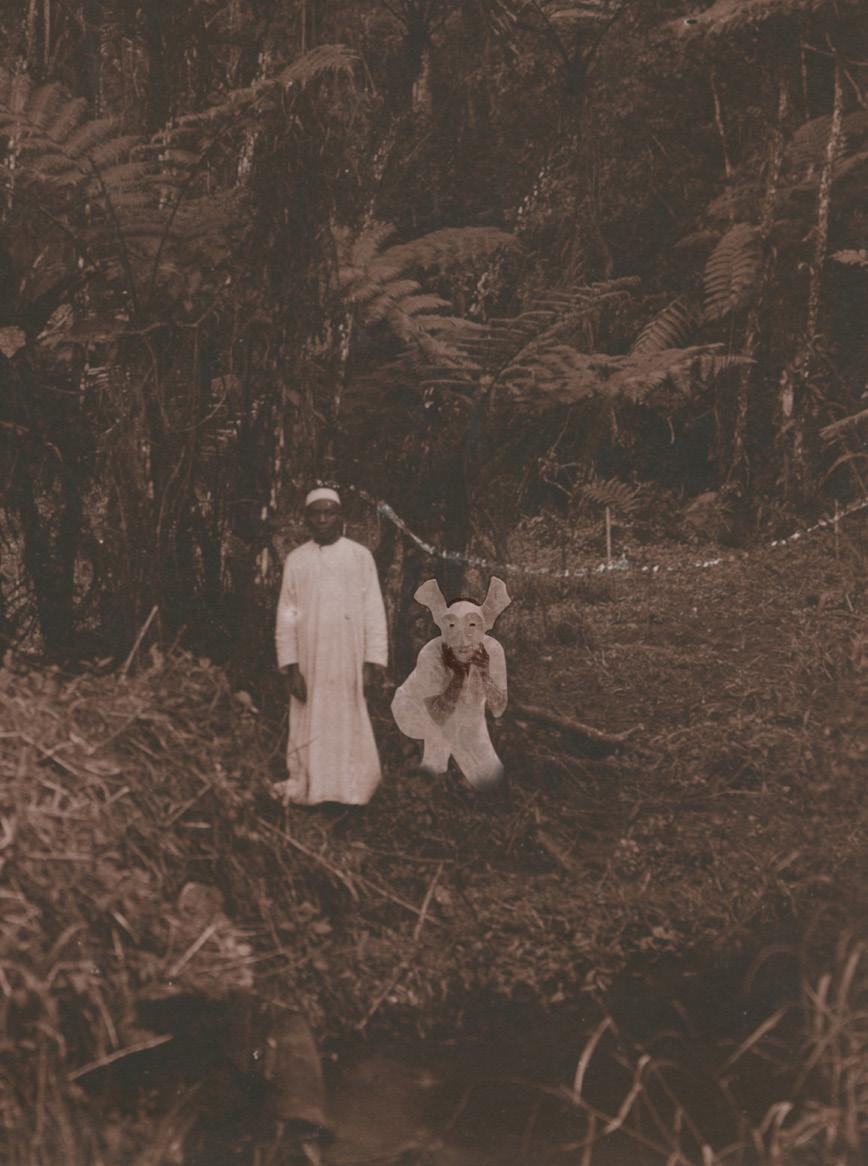
Kaspale’s Archive Intrusion / The Vortex I, 2019. Digital Photo printed on Fine Art Rag Paper 310 grams, 122cm by 78cm, Edition of 3
Kaspale’s Archive Intrusion series features Kaspale, a character that Syowia Kyambi devised to intervene in spaces charged with colonial histories/activities. The Kaspales are playful tricksters who engage in social mischief and satire. They have the task and ability to call out authority when needed. They speak up when others can’t.
by Gloria Anzaldúa “[which is] about outlining the potential of plural, ambivalent, unstable, and performative expressions of the self, so as to allow for the dissemination of personal, depolarized narratives,”1 is a process that creates a foundation on which I can build. The tools of repeating, reusing, rewriting, and layering, create rituals of resistance to the normative narrative around imperialism, capitalism, authority, and the position of patriarchy in white power structures, and drive a large part of my practice.
The works and artists I have been researching in connection to my own processes between 2018 and 2019, namely Berry Bickel, Lubaina Himid, Adrian Piper, Berni Searle, Lorna Simpson, Ana Mendieta, Coco Fusco, and Jane Alexander, ask their audience to bear witness; by displaying a truth that can be made visible, with the power of vulnerability, in using the body in relation to its histories, and in relation to the artists’ positions as women artists working in Black cultural contexts. They utilize historical archives and the archive of their bodies, within the context of their positions as women artists of colour operating in a Westerncentric world. During the process of my research, I gained a deeper understanding of how I relate to these artists. I look to them not only for refuge but also for methods on how to navigate the terrain of the globalized postcolonial post-industrial art market. As a result, I have gained a
deeper understanding of where I consciously position myself in relation to the canon of art history as a biracial female artist working with colonial history, power structures, economic hierarchies, and class systems.
I struggle with being positioned solely in relation to my geographic location. I also feel the need to address and sometimes counter the historical spaces that exhibit my work. As an artist, I have already been positioned in the category of “Other” and like the artists I research, all of us have to navigate the space of being thus categorized and marginalized. I am interested in creating a tool kit to help navigate my positioning within the “Black Art” cannon. Looking to women of colour in contemporary art that work with themes of history and identity in ways where there is no ceiling is assisting me in developing my tool kit.
The themes in works that stretch beyond personal experience and connect with public issues are of interest to me, and I am particularly drawn to Coco Fusco’s approach to creating. I most recently explored this in my work at the MARKK Museum by developing the character Kaspale, a performative intervention within a lecture room that was the first space where ethnographic teaching took place in Hamburg, Germany, in the late 1800s. I have gained a more conscious awareness of how creating interventions is a new form of generating dialogue and highlighting alterna-
tive narratives within the existing narratives of identity, colonialism and power structures.
The connection between the psyche and history and the entanglement that exists within non-stagnant identities is ever present in my creative process. I am pushing beyond simple categorization and looking for acknowledgement and healing. As the Vietnamese Buddhist monk Thich Nhat Hahn says, “…resistance means opposite to being invaded, occupied, assaulted and destroyed by the system. The purpose of resistance here is to seek true healing of yourself in order to be able to see clearly… where the conditions are such that they can heal themselves and recover their wholeness.”2 I would like to continue with this train of thought and expression. A thread I picked up in 2019 but haven’t managed to cover in depth yet deals with the interconnection of archives and identity. In my research, I have dealt extensively with the concept of identity, but I would like to bring into my discussion concepts around archives, the use of archives in my practice, and also the phenomenon of contemporary artists using archival material. I will continue to focus on the ‘othered body’ and its repositioning within art history. The Black art history canon cannot continue to sustain itself within its first realized form. It’s reached or is reaching a point of metamorphosis. The Black experience has become more varied. Real life indicators show people move,
marry, and, even through the push and influx of extremist movements, Black identity is a melting pot and is mixing more and more. Monocultural violence is present, and I feel a need to continue to develop political strategies to contest singular narratives around identity, creating dynamic unities of difference. Exploring the use of archives, the relationship between colonial and postcolonial history, and their effects on the body, I will continue to use my performance practice as a main form of expression.
1 Gloria Anzaldúa, “now let us shift...the path of conocimiento...inner work, public acts,” in this bridge we call home: radical visions for transformation, eds. Gloria Anzaldúa and AnaLouise Keating. (New York: Routledge, 2002), 540-78.
2 Thich Nhat Hanh and Daniel Berrigan S.J., The Raft Is Not The Shore: Conversations toward a Buddhist-Christian Awareness, (New York: Orbis Books, 1975/2001), 129, quoted in bell hooks, Yearning: Race, Gender, and Cultural Politics (Boston: South End Press, 1990), 43.
BIBLIOGRAPHY
Gloria Anzaldúa, “now let us shift...the path of conocimiento...inner work, public acts.” In this bridge we call home: radical visions for transformation, edited by Gloria Anzaldúa and AnaLouise Keating. New York: Routledge, 2002. 540-78.
hooks, bell. Yearning: Race, Gender, and Cultural Politics. Boston: South End Press, 1990.
Thich Nhat Hanh and Daniel Berrigan S.J., The Raft Is Not The Shore: Conversations toward a Buddhist-Christian Awareness, (New York: Orbis Books, 1975/2001), 129.
ALGORITHMIC
REMEMBERING
The way we remember in contemporary society is interwoven with algorithmic processes that help shape what gets found and what gets lost, what is forgotten and what is remembered.
Greedy, Disgust, Neutral, Scream, Smiling, Surprise, Suspicious
Hacked from the innards of Apple Memories by developer Kenny Yin, these seven emotions, alongside other 5,417 words, serve as the underlying taxonomy that the computer vision and machine learning algorithms use to curate, sort, and organize a person’s personal archive of pictures and videos in their iPhone. As a predictive system, these classes are predetermined. The scholar Adrian Mackenzie states that “prediction depends on classification, and classification itself presumes the existence of classes, and attributes that define membership of classes.” These classes, according to him, may be “rather arbitrary or highly artificial, but they must be relatively stable.” Classes operate as a core infrastructure of the operationalization of prediction, and thus a crucial way for enacting algorithmic memory-making. These classes are defined through socio-technical processes to which users have no participation or general understanding, and that to a large extent are hidden in the code and never explicitly stated.
Week in history, Weekend, Year summary, Last week, Last weekend
During the CAD+SR residency in Mérida (MX), I experimented exhibiting them as an in-process piece, printed across seventeen pages of transparent plastic sheets. Printed in transparencies, the words were distanced from the trope of algorithms as black boxes. It made visible the idea that although algorithms for memory-making work predictively, their categories are weird, static, pre-made, and arbitrary—far from the magic being promised in the application’s advertising. The words point to the limits of what the algorithmic system can recognize in images, while also highlighting how their concepts can never be fully understood or disentangled (i.e. when looking at the transparencies there is never only one word, but a cloud of words).
Keys, Kickboxing, Kielbasa, Kilt, Kilts, Kimchi, Kimchis, Kimono, Kimonos, Kitchen
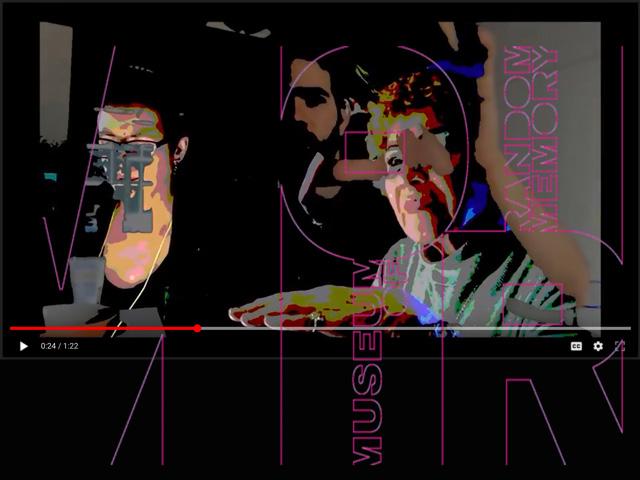
I see that experiment in Mérida as a continuation of the conversations being generated in the Museum of Random Memory, where we have been investigating the politics of archives through different collaborative creative practices. We have focused on research questions such as: “How is memory-making influenced by platforms like Google, Facebook, or basic photo management soft-
ware on our computers or smartphones sort and organize our images?” Most important in that collective process was disputing some of the ideas of memory as data (and data as memory) being pushed by the mainstream technological discourse, which often centers around remembering everything by constructing ever-comprehensive archives of the (surveilled) self.
Rifle, Rifles, Rink, Rinks, Skating Rink, Skating Rinks, Risotto, Risottos
The question then becomes: What are the possible ways to account for these taxonomies and classifications in our contemporary memory-making? How can we investigate and resist their totalizing politics? Why were these words chosen and not others, and to whom do they matter? Is greedy really one of the seven only possible human emotions?
Strawflowers, Corsage, Corsages, Corset, Corsets, Girdle, Cougar — GABRIEL PEREIRA
GABRIEL PEREIRA
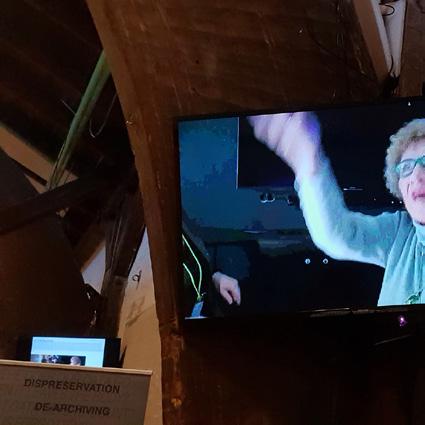
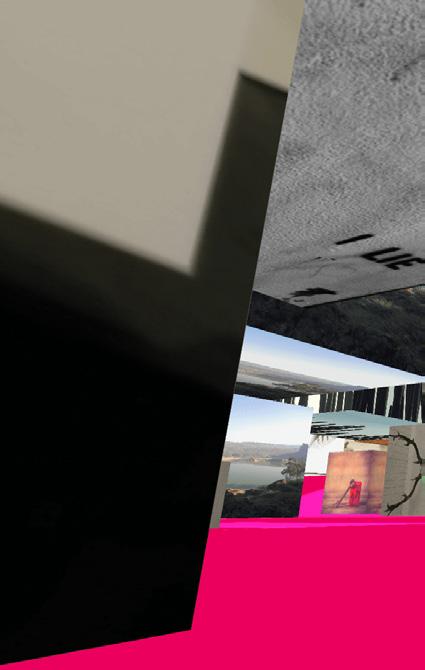
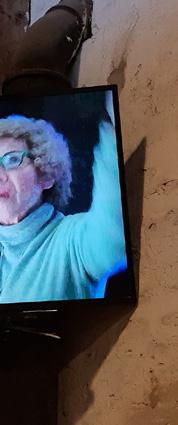
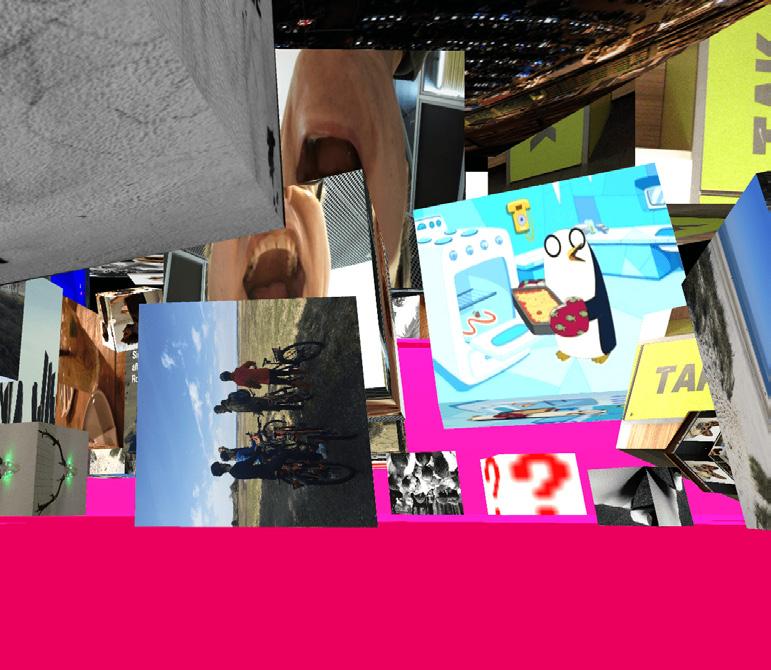
Museum of Random Memory: Memory Glitch, 2018. Video stills
An installation collaboratively created by the Museum of Random Memory for the Affects, Interfaces, Events exhibition at Godsbanen (Aarhus, DK). The screens represent multiple renderings of a woman’s memory as seen-understood-remixed from/by an algorithmic perspective.
PRE-COLONIAL KNOWLEDGE
Knowledge gathered by Native intellectuals over thousands of years prior to the arrival of Western European countries. This is comprehensive knowledge of the natural world, psychology, the spiritual, the political, philosophy, mathematics, science, and survival methodologies that ensured the survival of Indigenous peoples was by design, not by chance. Much of this knowledge is either intact or fully accessible in most Indigenous communities.
— BENTLY SPANG
Bently Spang — 1/3
I came into the first residency with both a local and national focus to my work: a recent major multichannel video addition to a long-term sculptural series, The Modern Warrior Series, focused on the power of place, specifically my Tsitsistas/Suhtai (aka Northern Cheyenne) homeland in Montana; and a photography series, The Photo Reclamation Project, that re-staged and deconstructed photos from Edward S. Curtis’ The North American Indian series.
The first Spoleto residency took some getting used to at first rupturing my creative flow a bit with the geographic change, separation from the local culture in the beautiful villa we were housed in and scheduled interactions with a new group of people—all things that were certainly navigable, but that took me out of my creative zone and reminded me how truly place-specific I am as a North American Indigenous person. It wasn’t long before the global nature of the group and the diverse and engaging dialogue generated by the residency structure began to fill this rupture. Personal and public conversations lead me to a deeper awareness of the unique, yet similar challenges faced by communities geographically distant from each other. It helped me to see how not alone my people were in our seemingly endless struggle against power and to take notes on how others had achieved success.
And with the focus of the residency on decolonialism and Indigeneity, it forced me to take a big step back
and interrogate the origin of these words to clarify what those terms meant to me and I continue to interrogate them today. I had to question whether these words that formed the foundation of our discussions were, in and of themselves, colonial in origin and what implications that had for the resulting dialogue? The colonial residue is so pervasive and deeply embedded in society that I feel these questions are critical to establishing meaningful solutions to these challenges.
I also became aware that I was only a hundred or so miles from the Vatican, a place where the Doctrine of Discovery, a series of documents that had a tremendous negative impact on Indigenous people around the world, was created. I was already aware of this document but my knowledge of it was rudimentary, so the residency gave me time to update my understanding of this horrific document. It’s still difficult for me to grasp the enormity of the impact this document has had, and continues to have, on the world as we know it. It was a series of papal decrees in the 1400’s from two different popes that gave certain European countries the right to steal land and inflict mass genocide in the name of Christianity. And, it’s still impacting Indigenous people today in the US, having been cited in recent court rulings. This was one of the most difficult and impactful parts of the residency for me and I’m not sure I will ever truly process it completely or if that is even possible.
I was able to continue my work while in residence in Spoleto, creating a number of staged photographs
similar to my photo reclamation series placing cowboy and Indian dolls in various settings within the villa. I was also grateful to hear some of the history of the area from Italian scholar Laura Fantone. She helped me see how struggles for power have shaped this part of the world. It helped put in perspective the news we all heard early on about Napoleon being a guest at the villa and perhaps occupying the room I slept in throughout the residency.
ORALITY
This is the verbal expression that develops and explains a language and gives birth to the philosophy, culture, and history of a society. It is a term that may be paired with lore, in the context of dissemination of bodies of knowledges and traditions held by a particular group through verbal articulations. Orality may be considered a means to encourage and sustain unique languages and thinking and to capture the essence in a purist manner through word of mouth. Historical facts, legends, and stories that teach local knowledges and traditions are methods of sustaining the language.
In some Indigenous societies, such knowledge is mostly passed on verbally, instead of being transcribed into written records.
— MUZIWANDILE GIGABA
MUZIWANDILE GIGABA
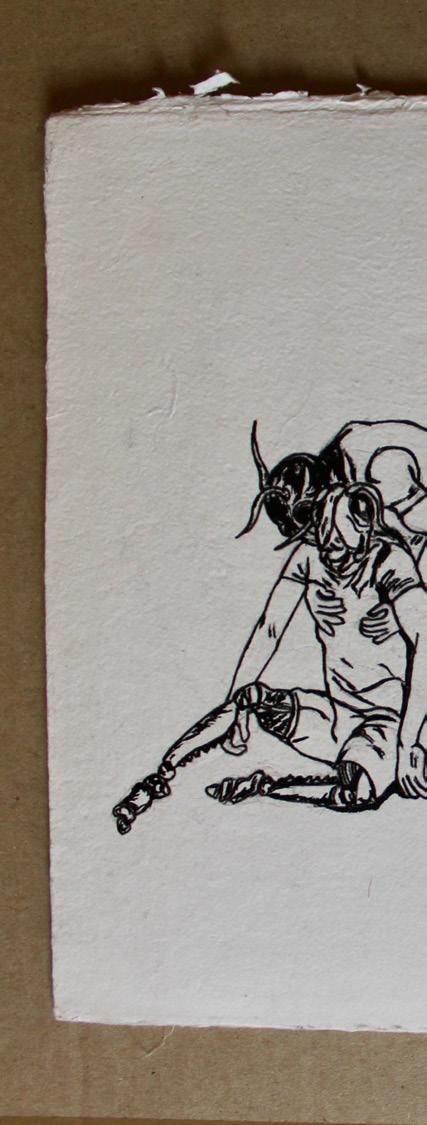
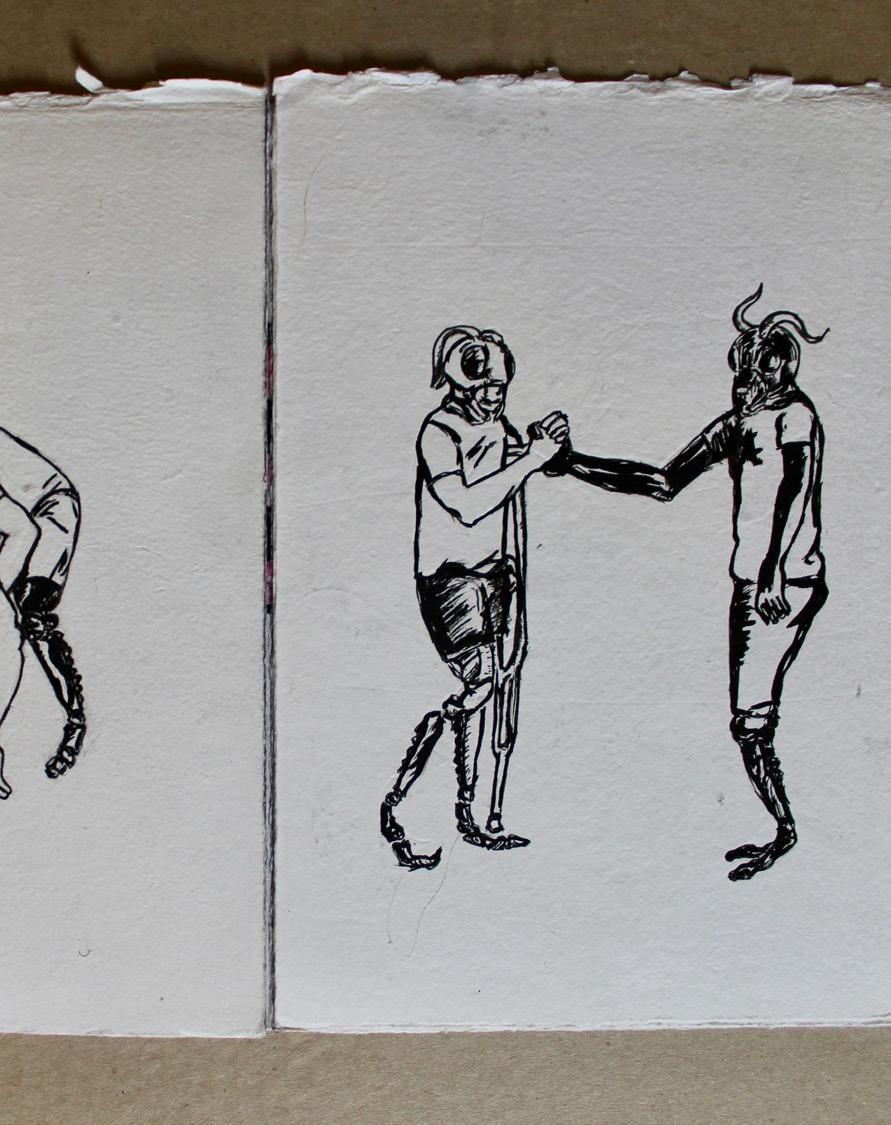
#Holinipha Ulimi lwakho/ # Mind Your language, 2019. Ink drawing on handmade paper
Gigaba’s ink illustration of the tale of Sontethe and Cavaletta hop up Gubbio is part of an ongoing book project workshop. Gigaba inspires workshop participants to explore the significance of home languages and oral knowledge systems through ink drawings on handmade paper. In this diptych, Gigaba fuses insect characters with that of man, a borrowed technique in oral teachings to instil moral lessons through the use of animal species or unknown people. The drawing portrays scenes where two para-athletes meet and motivate each other to train for a big race.
Muziwandile Gigaba — 1/2
My name is Muziwandile (Muzi) Gigaba from South Africa. I am an artist who works with various media, but I mostly explore printmaking and ceramics. I came to the CAD+SR with a vision of expanding my artistic practice from a single approach practice into a collaborative one. In the past, I have facilitated projects to pass on a skill, whereas in the project with the CAD+SR, I came intending to initiate a cross-cultural exchange through art book workshops, using art as a vehicle to create home language awareness by working with indigenous communities.
Initiating a project that would be collaborative during the CAD+SR fellowship program was a challenge, but a healthy one. The fellowship program provoked me to ponder what it means to expand my thinking of what constitutes art so the open-ended social role it entails as well. I feel honoured and privileged to have met and worked with the Research Fellows who are artists, designers, and art historians from different continents at the CAD+SR. The wonderful experience shaped different thinking about a collaborative practice, working with communities after the program. My outlook on art became even broader, beyond the limitations of my cultural background and my geographical location.
The fluid-structure of the fellowship program is not binding. Fellows can meet regularly or not;
one can work on their own. Digital communication platforms and an exchange of emails are an integral part of the experience. Our periodic meetings empowered me even more. The program advocates for learning by doing, and you may consult with others to interrogate your progress. One can share and gain knowledge in both direct and indirect contributions. For me, the CAD+SR fellowship has been an open-ended academic initiative that does not only enhance approaches to conducting research but a refreshing one as well, in a sense that I left feeling more liberated. As a fellow in the program, I began to seek new ways of exploring research with magnificent companionship.
Initially, my art-making approach was limited to conveying my ideas through art objects and in an art gallery context. The exhibition space would serve as a platform to display and invite the audience to engage with the concepts imbued in the artworks. Within this context, my work serves to stimulate a dialogue about reimagining, package, archiving and as an alternative to restore oral knowledge systems through art-making. During the fellowship program, my work continued grappling with such ideas, particularly how to expose, approve, and encourage oral knowledge systems even further. Transcribing oral knowledge into art objects is one aspect of the interrogations. The object plays a significant role as a subject to contain and capture fleeting memories and as tangible reference material. The function-
ality of the object becomes the subject of interrogation as well as a canvas or/and as a custodian of memory that serves a crucial role in reminding us of history and collective memory.
Reiterating the significance of history that has been shared through knowledge systems is a common thread in my art practice. In my art book project, this theme is straightforwardly apparent. It is indicated clearly through obvious symbolism that my art book project references my home language, IsiZulu. The CAD+SR fellowship program, however, has inspired me to extend my investigations on the language and oral knowledge system investigations beyond the parameters of my comfort. Since the program, a new chapter of cross-exchange of knowledge from diverse societies has been opened. I now facilitate workshops that initiate an organic and healthy exchange to expose points of relatedness and difference between people. This dialogue creates different links, between the past and the present, and those things we may consider to be foreign. The project encourages a path into acquiring new knowledge and the initiation of collaborations. If I were to sum up my gains from the fellowship program, the extension of my art book project into an open-ended practice and to be a means of disseminating knowledge across different cultures would be the foremost benefit.
The introductory phase of the program was in Italy. This is where the CAD+SR Directorate and the
Research Fellows engaged in a series of presentations and workshops. We all took turns making presentations of our past projects and shared ideas about future ones. To me this was a healthy interaction; everyone would contribute with suggestions towards the development of everyone’s work.
After the residency in Italy, I returned to South Africa and approached Phumani Paper Mill in Johannesburg on making paper for my book art project. Dumisani Dlamini taught me how to make recycled paper at the mill. I created the first bunch and transformed it into a simple accordion-shaped template. I chose to make booklets in this shape because the book can be displayed in an upright position as well; this adds a sculptural element on the book. The viewers can see all aspects of the book as well. The accordion shape format is simple yet it gives more room for creativity.
ERRORS
—
There is a moment in artistic research that interests me a lot: the moment that we come across a problem, but cannot solve it. At this point, I like to remember a set of cards called Oblique Strategies, designed by Peter Schmidt and Brian Eno, in 1975, to aid in the artistic process. Basically, they suggest choosing one of the cards in the deck and reflecting on the phrase contained therein. The interesting thing is to use them not to arrive at an answer (there is no answer, because there is no problem, Duchamp said), but to broaden the momentary doubt in which I find myself and, thus, potentiate the options of creation.
Some of these questions from the deck of Eno and Schmidt, as well as others invented by me (authorship doesn’t matter):
What would your best friend do?
What can I increase? And what can I reduce?
Try to imitate.
It’s not by making a wall that you build things, it’s by making a brick. Take sudden, destructive, unpredictable action, but don’t make it a pattern.
My favorite phrase from this set of letters is not about finding solutions, but about valuing the unexpected. It suggests:
Honor your error as a hidden intention.
It was with this mantra that Gabriel Pereira and I have so far faced the behavior of computer vision systems against images of works of art–a museum wall was once read as a vast horizon; framed works are interpreted as windows (passages in time and space); etc. And it is from this error as a valuable element that since 2012 I have been collecting nails with manufacturing defects and exhibited as small sculptures. These nails have also been sent to various agents of the art world, such as artists, curators, and producers, to be used in exhibitions with their original purpose–to hang or set artworks in place. In addition to that, in all of my shows, some of the works are installed using nails from this series. The oscillation of the status of these objects, at times regarded as sculptures, at others as mere tools, questions what concerns a work of art, pointing to a non-ontological interpretation of the artistic object. And invariably I am always showing errors to the public, viewed here as expansions.
— BRUNO MORESCHI
Gabriel Pereira — 1/3
I wanted to share some of the discussion I’ve been having with colleagues on how everyday maintenance is enacted. Our discussions considered how digital architecture enables and/or constrains these maintenance practices. As these forms of labor are taken for granted, I was also considering how they are not particularly visible, and thus may reinforce the invisibility of such labor (and their oppressive conditions). I wanted to bring this to something we talked about in CAD+SR Spoleto, which is the labor of Amazon Mechanical Turk workers (known as Mechanical Turkers). These people who do microwork (often for very meager pay), remain “behind” the machines and artificial intelligences, but are not recognized for their labor. They are paid, for example, to describe images that are later fed into the machine learning algorithms as data. At the same time, their labor is intentionally obscured, to sell the image of “smart” machines. I wanted to ac-
tually share, in this vein, the article Justice for “Data Janitors” by Lilly Irani. I think that it can generate very interesting questions for our community, as it engages in questions about labor practices, technology, power relations, and... how to resist. Anyway, I hope this is provoking and that we can chat about it, and how it may (or may not) intersect with things that you’re considering in your practice.
I see that work in progress in Mérida as a continuation of the conversations being generated in the work of the Museum of Random Memory, where we have been investigating the politics of archives through different creative practices. We have focused on research questions such as: “How is memory-making influenced by platforms like Google, Facebook, or basic photo management software on our computers or smartphones sort and organize our images? How do companies track us and create memories on our behalf?” These have led us to expand the work into installations such as the Museum of Random
Memory, and later, Affects/Interfaces/Events, where we used different algorithms to interpret memories from Trine, a participant in our installation, in different ways. As I wrote in a later article, these algorithms used “their own pre-made (limited) categories, the lived experience of Trine was flattened (and/or expanded)—retrofitted into the logic outlined by the data models.”
The question then becomes: What are the possible ways to account for these indexes, taxonomies, and classifications in our contemporary memory-making? And then, how can we investigate and resist their politics? Printed in transparencies, the words were distanced from the trope of algorithms as black boxes. They point to the limits of what the algorithmic system can recognize in the images, but also highlight the incomprehensibility of classification clouds, whereby it is impossible to really see a single one. In a future essay, I would like to continue critically and creatively investigating how words be-
come keys to our collective and personal memories, archives, and data. Why these words and not others, and why words at all? On the other hand, I keep thinking: What are the taxonomies for memorymaking that are being built by Big Tech, and why? What are the histories of these taxonomies? Why do memories of dustpans, pancakes, and tapiocas matter (at all)? And, finally, is greed really one of the seven only possible human emotions?
NETWORKS OF CARE=CRITIQUE
REDES DE CUIDADO=CRÍTICA
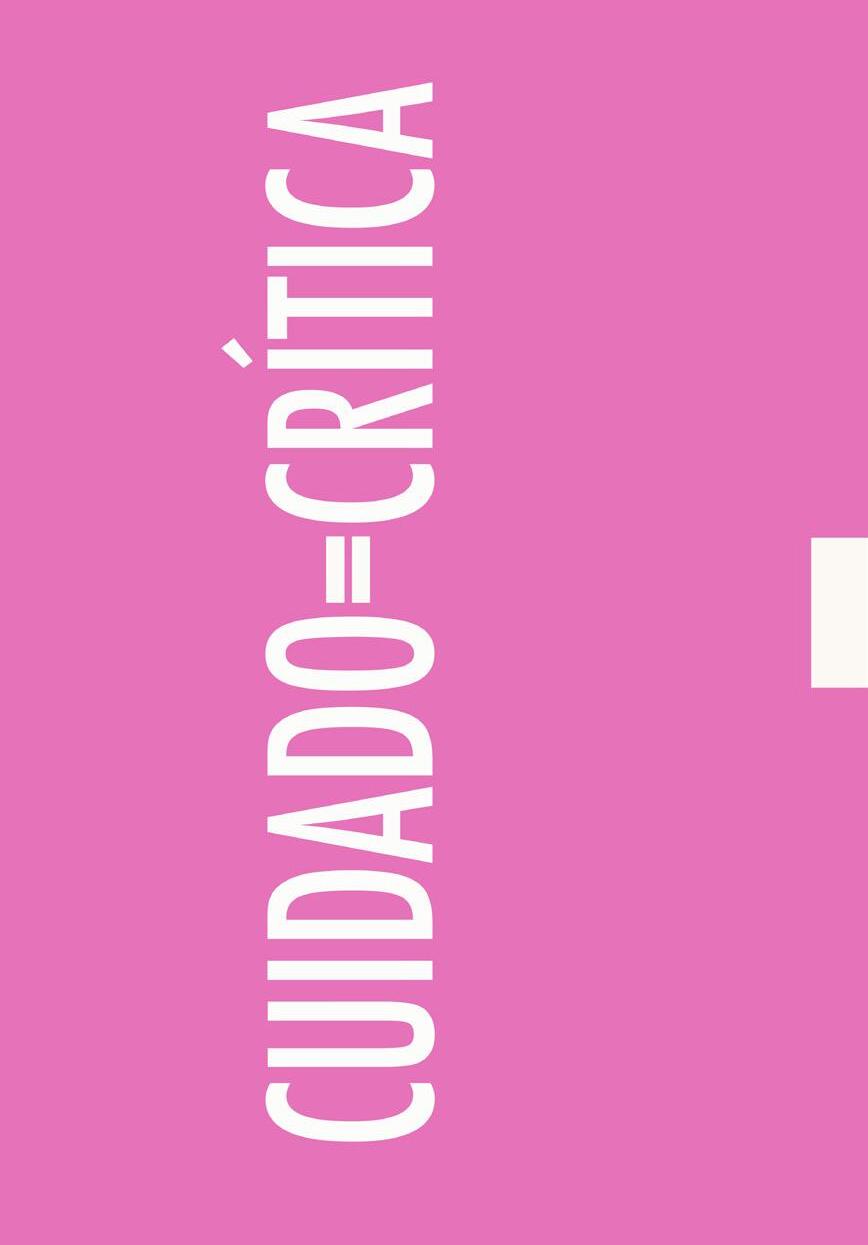
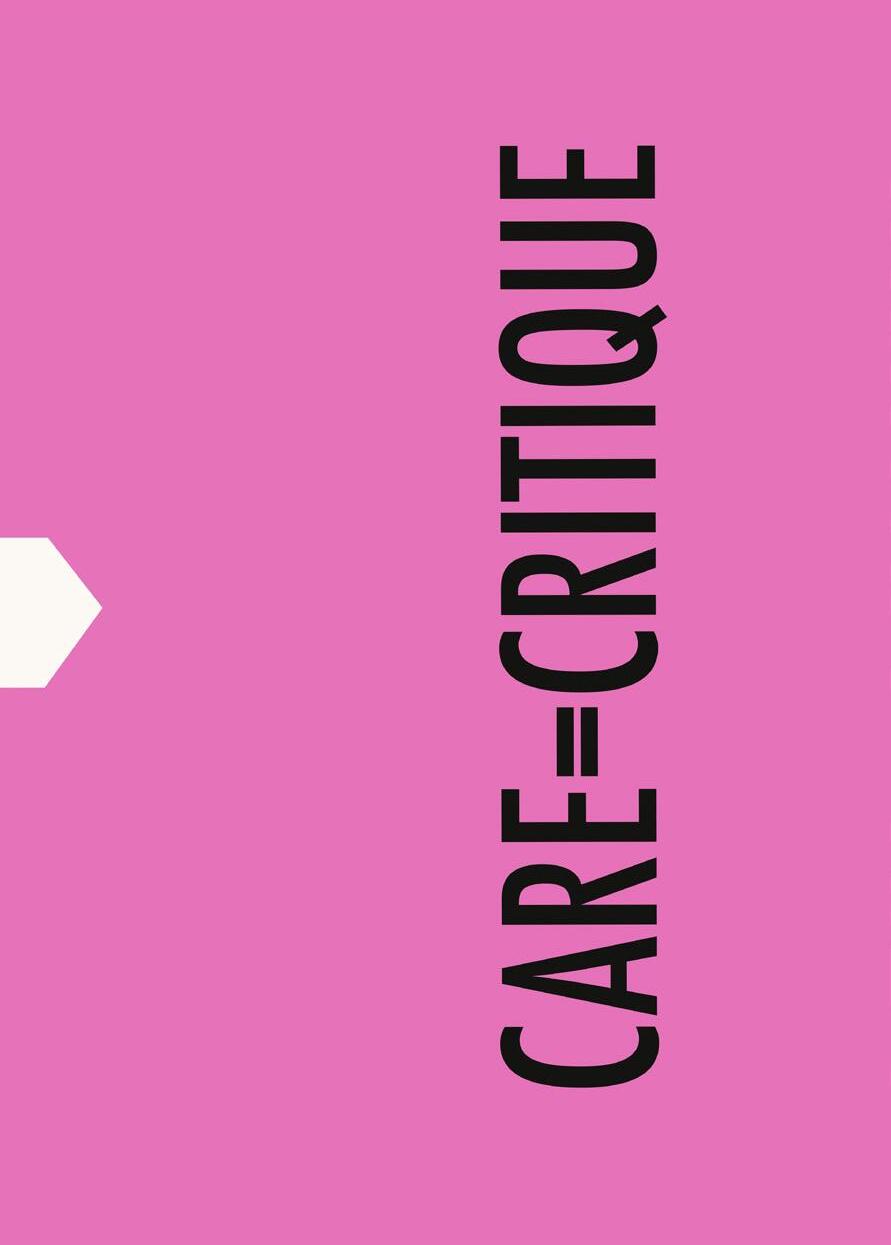
Networks of care=critique is a counter-technology of reproduction. Friends, activists, and colleagues engaged in transfeminist and anti-racist organizing were asked to reconstruct their networks of care=critique, noting down a range of forms of support–from family, poetry, and party to theory and protest–and to arrange the information across a traditional genealogical tree format, either chronologically or according to another chosen logic. This information (which may have included the names of collectives, alternative housing projects, collective actions, protest, spaces of learning, manifestos read or written, poems, books, theorists, activists, family members, etc.) was anonymized if necessary and inscribed in clay. Networks of care=critique intends to celebrate the reproductive role of informal or community-based networks of space and knowledge-making in times of crisis and is inspired by the range of poetic and political practices that emerged during the 1980s and 1990s as a response to the global AIDS crisis. Networks of care=critique protests the academic and commercial enclosing of queerness as (only) a theory or (only) a codified counter-culture, emphasizing the vital connection between knowledge and shelter. Care without critique is patriarchy. Critique without care is really not that clever.
— @criticaldías
CRITICALDÍAS
Patrimony of Gestures (Networks of Care and Critique, 2019. Poster, screen print.
Patrimony of Gestures is a series of foldout publication-posters that intervene in the sites where reproductive control intersects with the “reproduction” of dominant culture. The poster Networks of care=critique, documents an ongoing project: friends, activists, and colleagues engaged in transfeminist and anti-racist organizing and alternative family building are asked to reconstruct their networks of care=critique, noting down a range of forms of support–from family, poetry, and party to theory and protest–and arranging the information across a traditional genealogical tree format, either chronologically or according to another chosen logic.
Over the year we developed the project Patrimony of Gestures. The project culminated in a series of foldout publication-posters that document six gesture-actions staged throughout the year, each one pinpointing what we have observed as a site where the regulation of reproductive technologies crosses with the “reproduction” of dominant culture.
(1) The Logic of Assistance was an audio installation that honed in on the repetition of certain gestures in the cinematic representation of the fertility clinic, signalling an ideological reproduction of certain narratives around scientific and medical assistance. In the audio, a voice recounts details relating to the institutional, legislative, and commercial forces that in the 1990s and early 2000s gave rise to the narratives of assistance that ultimately support the neoliberalised and highly regulated fertility clinic of today. The quality, rhythm, volume, and tone of the voice shifts as it addresses four different publics (a media audience, a class of students, a mother, and a lover), speculating on more located and implicated logics of assistance. The exhibition of the installation was held at the Casa de Velázquez in Madrid–a French cultural institution, significant as a site of intervention due to the fact that in France LGBTQ access to ARTs (Antiretroviral Therapy) remains prohibited. The poster-publication documents the audio’s script.
(2) Networks of care and critique was conceived as a
counter-gesture-action. Friends, activists and colleagues were asked to reconstruct their networks of “care and critique.” Asked to include a range of forms of support—from family to poetry and protest—the exercise reflects on how intellectual production can be a form of care and how forms of socially reproductive labour (traditionally associated with the notion of “care”) may be read as a form of institutional critique. The poster documents the ceramic pieces.
(3) The Procedure of a Feeling is a long poem that charts a character as they engage various forms self- and collective production (including intellectual study, martial arts, sex, poetry, and protest) as a technique to resist alienation as well as connect with and transform their environment. The poem was published by transfeminist literary and arts journal Canal.
(4) Ways of Feeling is a cannibalised version of John Berger’s Ways of Seeing (1972), which takes the reader through a few cases in which cyberfeminist, queer, and anti-racist artistic interventions have been misunderstood, silenced or edited out due to the “reproduction” of art historical frames of analysis that serve only to affirm the affectivities (or ways of feeling) of the dominant classes. The poster-publication reflects on the intersection of art criticism, art production, and the politics of the body and affect.
The fifth gesture was a collective performance-reading staged in Mérida (MX) during the second CAD+SR residency. We
invited fellows and artists to join us in a reading of sections of texts, poems, and manifestos written by various collectives whose work names, analyses and resists multiple and diverse forms of reproductive control—from forced sterilisation to the neoliberalisation of bioeconomies.
(5) Poster documents the script and its bibliography, entitled Do Not Reproduce! (¡No Reproducir!)
(6) Gesture-action is a letter that bio-economy workers (donors and patients) in Europe can use to file data-access requests to ART industry clinics and biobanks. The letter was developed in April 2019 in correspondence with PaulOlivier Dehaye of personaldata. io—a Switzerland based non-profit organization that offers free legal advice on filing data access requests to social media-related companies like Tinder, Twitter, Facebook, and agencies like Cambridge Analytica, according to the guidelines introduced by the 2018 General Data Protection Regulation (DPRG) legislation. The letter sets out an argument for protecting biological matter under the same privacy rights legislation that currently protects personal data— not because privacy rights are an adequate model for articulating and protecting our rights, but because it offers the only legal precedent at this moment in time for requesting key information necessary to pinpoint the exact moments where access to individual data (whether personal or biological) is directly traded for money. This information would be needed to calculate
the redistribution of both big data and bioeconomy profits—which we suggest is one means of empowerment in the age of data capitalism. The second residency arrived at a key moment in our research process. It was also a time in which the alliances, contagious, and connections that began during the first residency multiplied. We presented a few of the gesture-actions from Patrimony of Gestures project, which were in progress in a talk with Syowia Kyambi. Having the opportunity to present together opened up a conversation around methodologies of research that has continued into the present. Inviting the fellows and Mérida artists to read our collective manifesto “Do Not Reproduce” (No Reproducir) remains for us a demonstration of their generosity, and a stamp of the impact of their words, actions, and ways of thinking on our practice. With many of the artists based in Mérida and a number of fellows not speaking English, working in a Spanish-speaking country shifted the power relations across the group, and produced a critical distance to English as the lingua-franca of art practice and the art world. As we work mainly in castellano and were also informally responsible for the work of translating between castellano-english throughout the residencies, this shifting between dominant languages was very welcome and also productive for us.
This second residency was also particularly satisfying in terms of the coordination of moments of collective production that served
to respectfully close the program. The collective exhibition, curated by Raul Moarquech Ferrera-Balanquet and Dalida María Benfield, visibilised collaborations between fellows initiated during the first residency as well as new connections with artists based in Mérida. A final round-table debate generated from a series of keywords selected by fellows also helped to honour and extend the critical discussions taking place throughout the residency, particularly regarding the question of the relationship between art practice, feminisms, and decoloniality.
Bruno Moreschi — 2/3
Now I’m on an island where I control the flow of water entering into it. Poetic? Yes, but also a way of staying strong in the face of a political situation in Brazil that radically changed since the first residency—from a young but pulsating democracy to an authoritarian and misogynist government, full of corrupt militiamen who assassinated the activist and deputy Marielle Franco. Being part of CAD+SR now does not only mean strengthening professional partnerships and friendships, but also a way to strengthen myself to produce projects that are increasingly related to the idea of resistance.
THE LIST
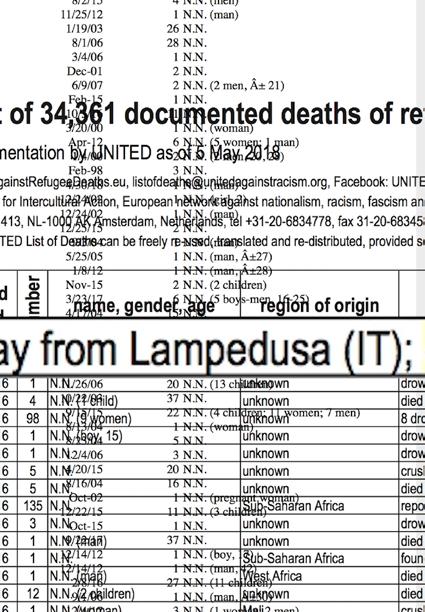
A list of 34,361 women children and men who died on their journey to Europe to claim asylum. The List was published by The Guardian in May 2018, and was compiled by UNITED for Intercultural Action.
Most of The List is anonymous. Top causes of death are drowning, hypothermia, and shot by border guards. Shot by border guards.
As of June 2019 The List contains 36,570 names and no names.
— TAMARA AL-MASHOUK
TAMARA AL-MASHOUK
We Exist/Existimos, 2019. Performance (Mérida, MX)
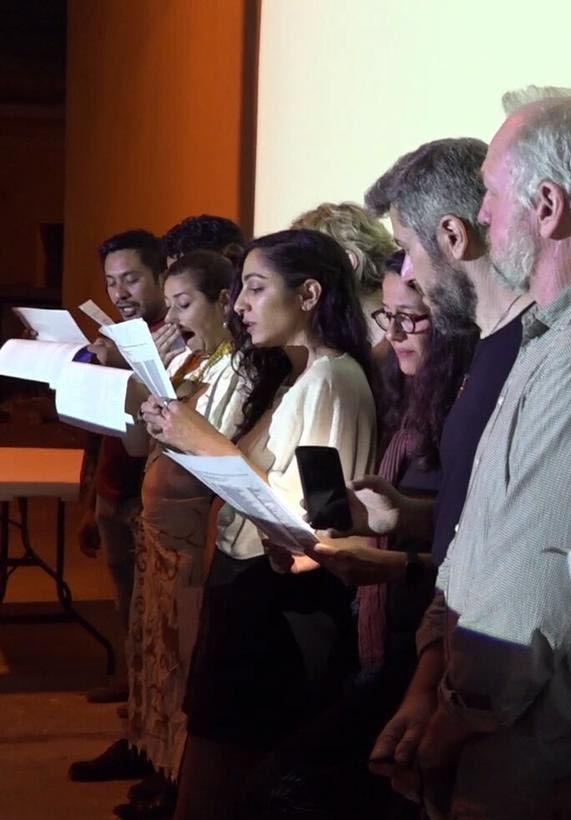
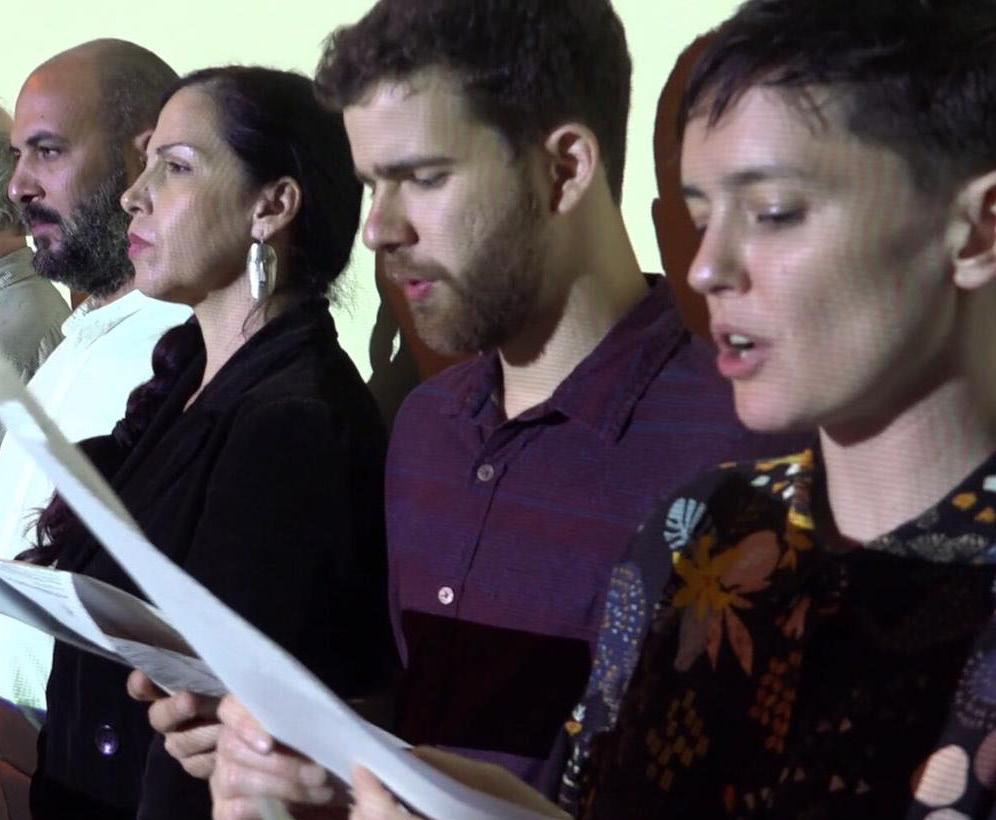
Performers read a of list of people who died attempting to cross the USMexico border. The work was performed in Spanish and English by CAD+SR researchers and artists from Mexico, Panama, Venezeula, Cuba, Brazil, Kenya, USA, UK, Saudi Arabia/Palestine.
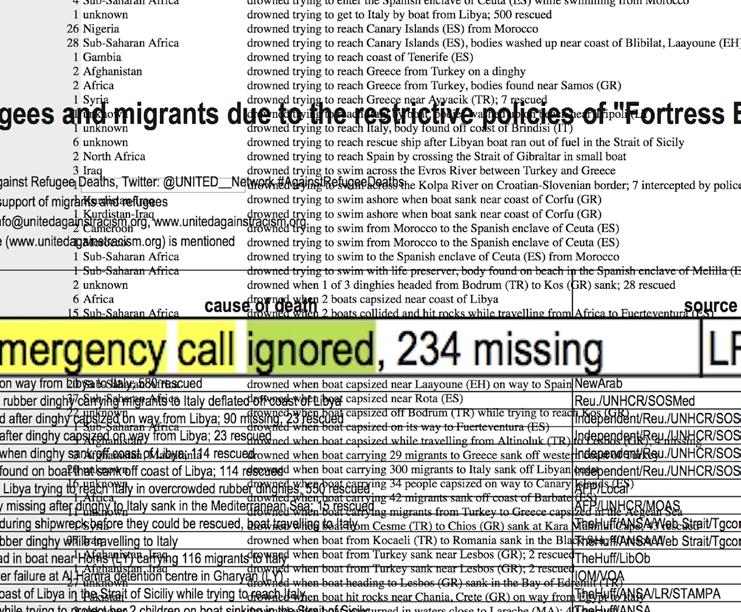
Can You Die If You Don’t Exist, 2018. Slide from video projection for durational performance
Can You Die If You Don’t Exist? was a tenand-a-half-hour durational performance. Al-Mashouk read every name and no name of 34,361 refugees who died trying to get to Europe. The list of names, causes of death, and locations was compiled by UNITED for Intercultural Action and published in The Guardian in May 2018. Most of The List is anonymous. Top causes of death are drowning, hypothermia, and shot by border guards.
Al-Mashouk — 2/3
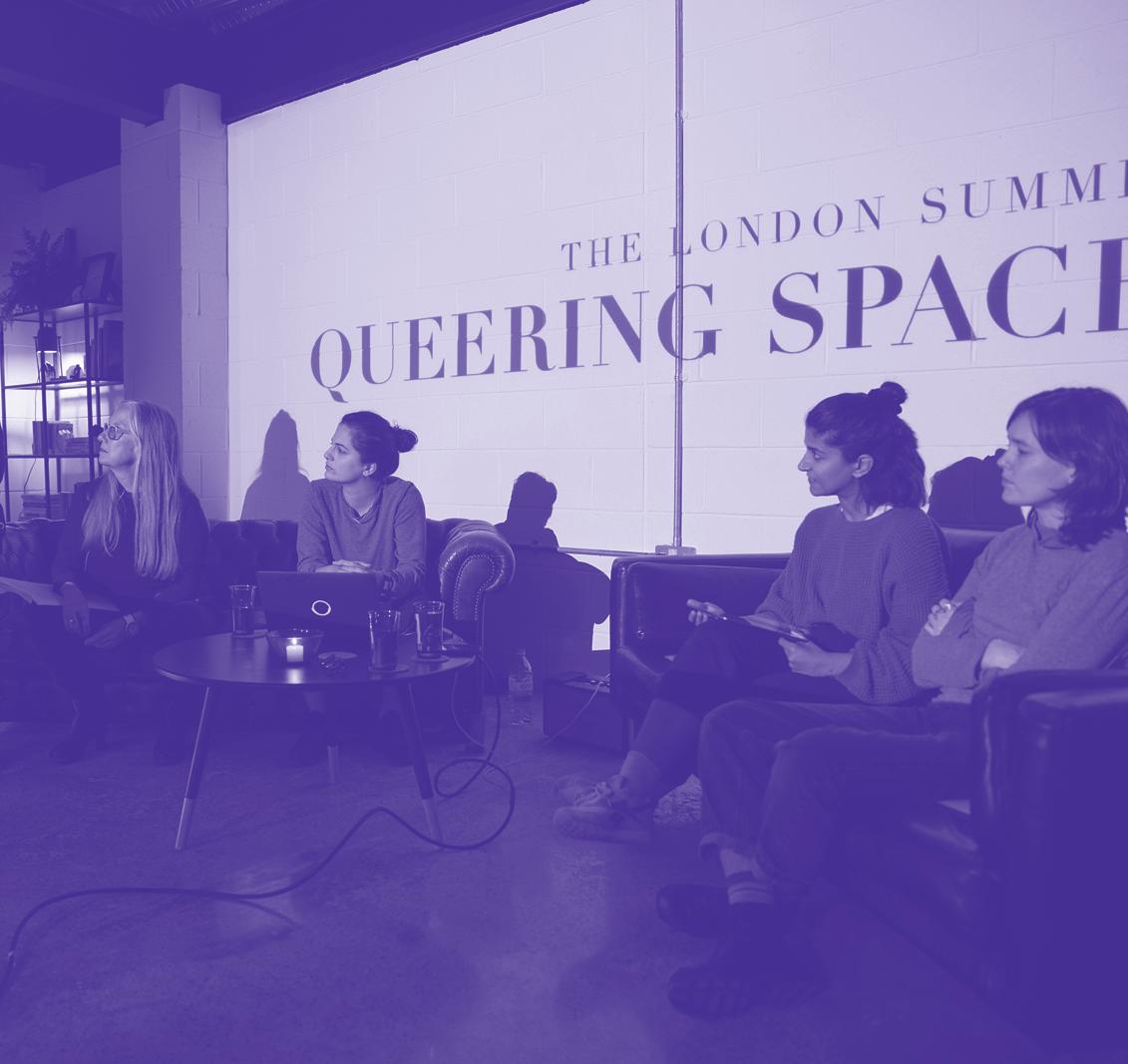
Between the first CAD+SR residency in Spoleto, and the second in Mérida, I partnered with CAD+SR to present a threeartist residency called the The London Summit: Queering Space, a dialogue featuring five international, queer, female, and gender non-conforming researchers, activists, and artists of color from Saudi Arabia, Bahrain, United Kingdom/Spain, Iran/Germany, and Colombia. Topics included: the refugee crisis and the value of the queer, brown body; the importance of private and public queer spaces in locations where queerness is illegal; the Iranian Internet; epigenetics of space; and the ways the mediated image desensitizes or masks understandings of queerness. The London Summit: Queering Space addressed sexuality and space, decolonial feminism(s), borders: both geographic and societal, and explored the word queer and queerness itself as a site of resistance and potential. The summit was comprised of daily work in progress presentations for the artists, panel discussions open to the public and a performance by the SPIT! Collective.
Outside of CAD+SR, I participated in another residency as a member of Deeplab; a group of all female academics, artists, designers, activists, cyberfeminists, and hackers. The work I produced, commissioned by the York Mediale, was Can You Die If You Don’t Exist?
(presented in York, UK, 2018). It was a durational ten-and-a-halfhour performance during which I read every name and no name of 34,361 refugees who died trying to get to Europe. The list of names, causes of death, and locations was compiled by The Guardian and released in May 2018. Can You Die If You Don’t Exist? remained with me when I traveled to Mérida (MX) for the second residency in January 2019. The project was viscerally received when I presented it to the CAD+SR community.
This created space for a second iteration of the work to be created that was localized and made relevant to Mexico. In collaboration with Dalida María Benfield, I produced and publicly performed We Exist/Existimos in Mérida. This iteration of the work contained data Benfield gathered of the deaths that occurred crossing the US-Mexico border. The work was performed in English and Spanish by seventeen CAD+SR artists and researchers from Mexico, Panama, Venezuela, Cuba, Brazil, Kenya/Germany, US, UK, and Saudi/Palestine.
Tamara
Lesbian Art65
Sufi Speculations70
Reconciliation72
Archivo, colaboración y red de afecto74
Indigenous Knowledge Systems77
Experimentacão80
LESBIAN ART —
Just as the lesbian—the geeky, the hot, the butch, the femme, the thieves, the artists, the loud, the quiet, the passing, the outspoken, the outrageous— fragmented and multiplied, the lesbian art movement suddenly disappeared. Nowadays, it sounds nostalgic to speak of lesbians. Even so, we can’t tell you exactly when the golden age was. What we know for sure is that lesbian art is absolutely impossible and yet it is happening right now. Thinking about how to fix “lesbian art,” we had to consider lesbians, the history of art, and something that may have emerged throughout the twentieth and twenty-first century as a kind of established aesthetic or cultural expression. Following the poet Eileen Myles discussing “The Lesbian Poet” in 1997, “[We] drew a figure in our notebook: three circles that joined at a point and lunged at it”. All we know is that we weren’t artists before making lesbian art. Being an artist has something to do with being a lesbian, which has something to do with the materiality and flexibility of sexuality. This materiality extends far beyond the individual body or subjectivity, towards medical theories and practices, visuality, coloniality, the media and national imaginaries. We drew a few more circles and headed straight for them.
Lesbian art celebrates the role of dissident sexualities and sex in knowledge production, the arts, poetry, literature, and their intersections. It is a highly contagious tactic for forging infinite epistemic connections. It makes cartographies of how the body has been disciplined, pathologized or racialized, so as to resist those processes. It contests the use of any category of identification to reinscribe normative ways of being or to reproduce exclusion. Lesbian art acknowledges its location in Western culture and its mythologies (the word comes from the name of an island in Greece)—but it points to this coloniality as a site of contestation and intervention. Lesbian art is diasporic, anti-racist and fronterizo. It digs out escape routes, entire paths of desire, traverses the vampire journeys of Jewelle Gomez’s Gilda character of the Gilda Stories; the wild seeds of Octavia Butler; the Queer Looks and Khush of Pratibha Parmar and Shaheen Haq; Barbara Hammer’s Dyketactics; Gloria Anzaldua’s pensamiento fronterizo; Cheryl Clarke’s manifesto; and la pensée of Monique Wittig.
— @criticaldías
criticaldías —3/3
Towards the end of the year we began research for the production of an online data-visualisation experiment, whose working title is Classic Gold Premium. This project deals more specifically with how racial and sexual surveillance techniques have proliferated across the online platforms of the attention or “promise” based economies, such as the assisted reproductive technology industry. The first prototype of the interface-site, which we are developing with data visualisation expert and coder Dr. Kerry Rodden, consists of two URLS. The first features words reaped from across the highly normative ART industry clinic websites and biobanks, which can be interacted with. A second page features a live data visualisation of this interaction. The project experiments with widely available data-surveillance technology as self-reflective aid in considering how dominant cultures are repro-
CRITICALDÍAS
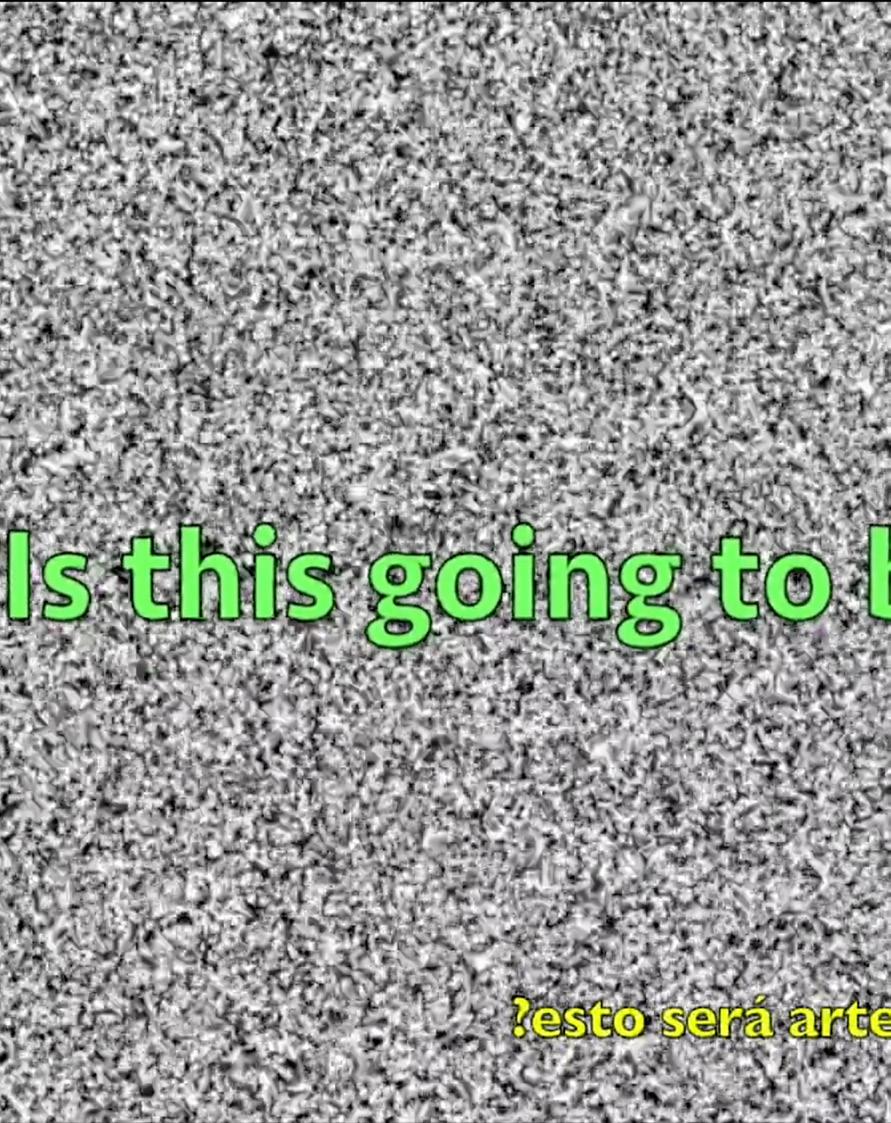
Llamando al mago / Calling the Magician, 2017. Performance and video
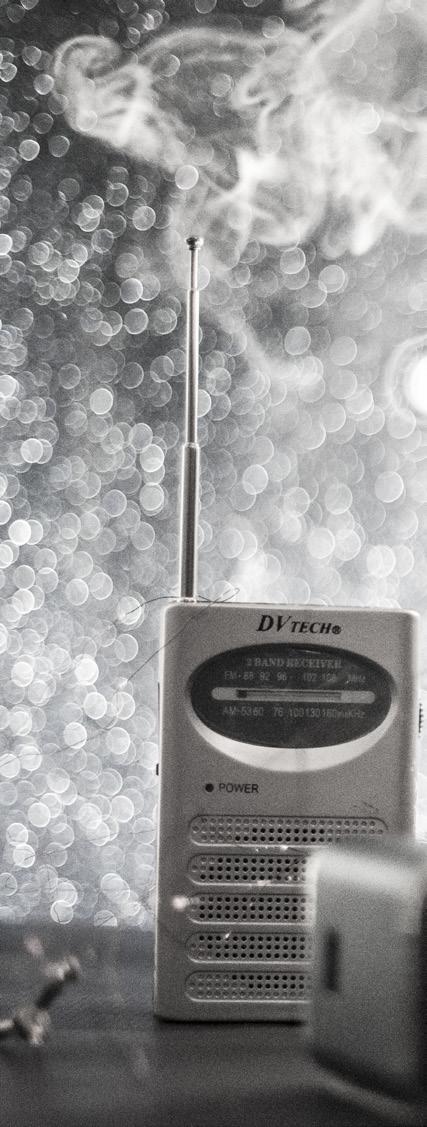
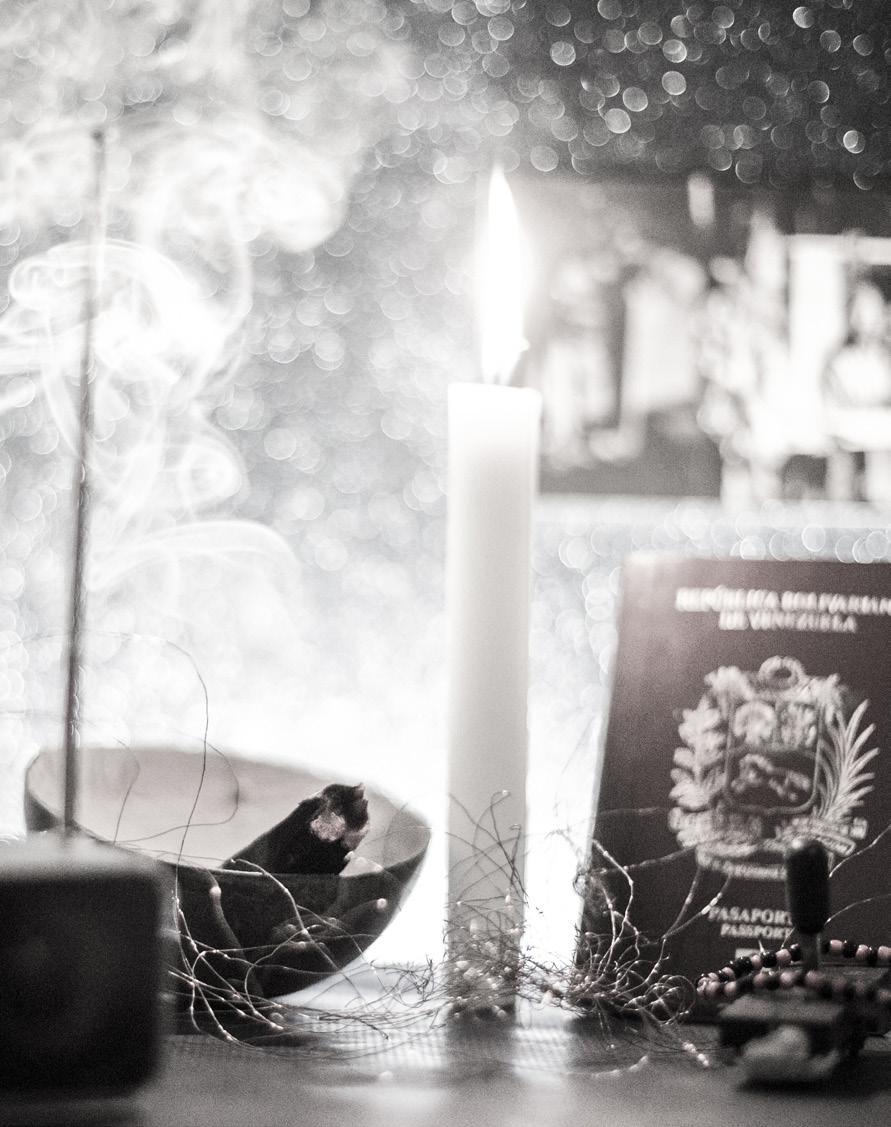
Calling the magician is a performance involving multiple short pre-recorded videos presented with videos that were generated live (such as Internet calls and “image sonifications”—images turned into sound using processing). The immediate context of the work is the Venezuelan passport crisis (effecting Venezuelans since 2016), which interrupted the working process of Criticaldías, Rebecca Close, and Anyely Marin. No longer just a matter of a crisis of representation, this work names and intervenes in a “crisis of presentation,” reflecting on the contradictions of the hypercirculation of images where freedom of movement is increasingly restricted.
duced digitally and online. The project explores a key question in our work: in what way does the interface function as a body technology? How can it be intervened/ reconfigured/ redirected? The interface-site will become an element in a collective performance we hope to stage in the future.
We met Kerry during the “Disaffected Technologists” meeting in the first residency. In this sense, the CAD+SR network and the people we have met during the residencies have been key for imagining new directions and developing new work, as well as providing a network to discuss, share, and develop practice.
We are currently thinking about love, attention, family, networks, personal data, processes of inscription, self-narrating, and queer resistance to data capitalism.
Abdullah Qureshi —
A lot happened between Spoleto and Mérida. My Canadian immigration came through—something I had been working on since 2015. Upon its approval, however, I realized that I hadn’t thought about what would happen after that. In my absolute desire to leave Pakistan to find global mobility as well as imagined freedom. I recall memories of my childhood where my family is huddling together to apply for passports or a visa. My father holds my hand to put my thumbprint on the paper application. My finger is stained blue from the ink. Using this moment to reflect, I started thinking about migration and movement by going through all the passports of my grandparents, which almost date as far back as the creation of Pakistan in 1947.
...Memories of trauma continue to haunt and occupy me. I continue to think about how to work with the pain—how to talk about it, how to deal with it, how to accept it. Conceptually, still thinking about religion and sexuality—Islam and queerness, reconciliation, reinterpretation, and re-imagination. Mythologies, spirituality, and utopias. Using some of the drawings I had done in Spoleto—inspired by nature around the villa that resulted in various studies of plants—I started developing a new work, Charbagh which translates as four gardens in Persian, is an
idea derived from a chapter in the Q’uran that has influenced Islamic art and architecture through the ages. The text narrates visual accounts of the creation of man, the universe, and in particular, four gardens with abundant fruit, flowing waters, and lounging virgins. In an attempt to queer these ideas, within this installation I mimicked the hierarchical composition of earth, heaven, and hell—and through the voice of a gay Iraqi refugee, question the place of gay suffering within this narrative. The installation includes mixed-media paintings, watercolor studies of plants, video: an interview with an Iraqi refugee: gay narrations of home, digital photographs, and black thread.
...wrong hole
stealth surprise just watched it go in from one hole to another the piercing shriek painful... ecstasy? tears. *muffled* are you mad? some of them stopped, some of them didn’t mine didn’t was it rape?
SUFI SPECULATIONS
A Sufi is someone who identifies with the philosophies of Sufism— someone who opposes the mainstream and institutionalization of Islam and other hegemonic structures. Historically, ideas of Sufism emerged from the margins of society, in particular by those who had nothing to lose as a form of resistance to oppressive systems of society. One of the fundamentals of Sufi thought is to seek the truth—and often this manifests in the form of divine love. To speculate, within the traditional sense, involves the process of mediation, or to ponder over a subject, to reflect. Within the context of contemporary art, this is often associated with ideas of imaginations—in particular, the future or utopias. Together with Sufism then, the process involves imagining a true future that emerges out of resistance, in search of divine love.
— ABDULLAH QURESHI
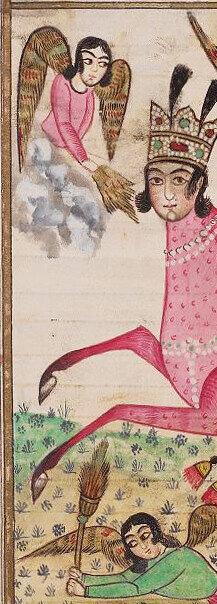
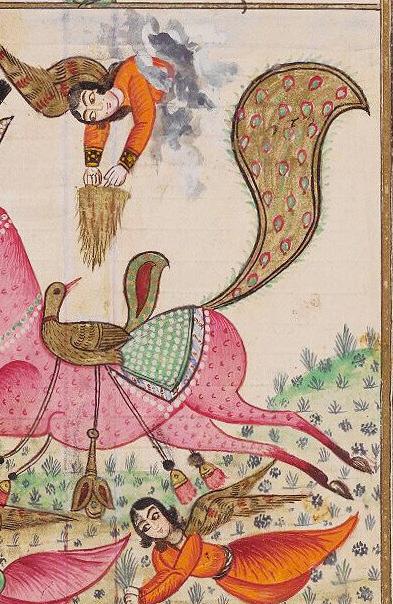
Illustration in Jami (1414–1492), Yusuf va Zulaykha. Eliyahu ben Nisan ben Eliyahu’ Gorgi, scribe. Judeo-Persian Manuscript, 1853. Image provided by The Library of The Jewish Theological Seminary.
RECONCILIATION
The art of the society whose material foundation is laid on the exploitation of other people cannot be at the same time an expression of exploited people. —
Rasheed Araeen.
— SYOWIA KYAMBI
SYOWIA KYAMBI
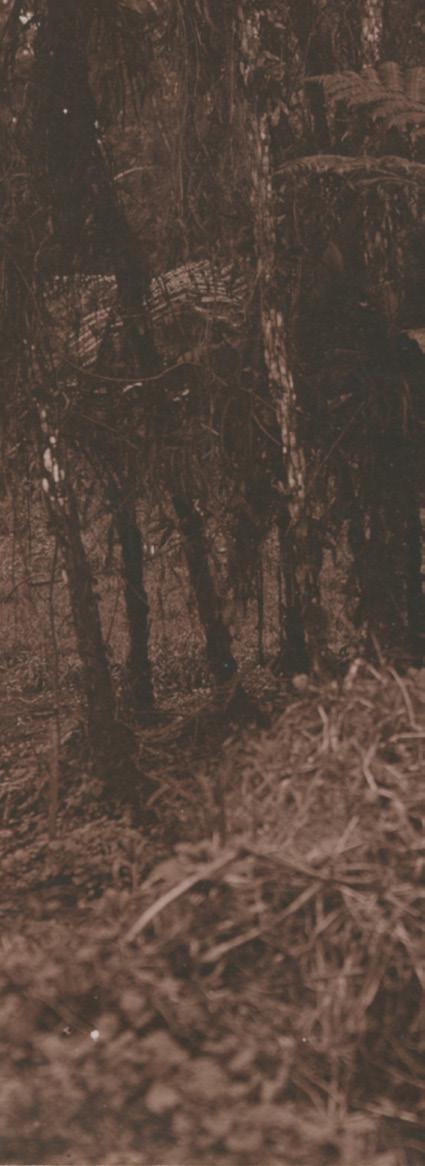
The Archive Intrusion I. Digital Collage (original image by the zoologists Vossler and Stuhlmann collection 1902-1907 in MARKK Museum). 10.2 cm by 15.2 cm. Edition of 10, 2019. Supported by ESRC Grant Memorial & Remains and MARKK Museum
In Syowia Kyambi’s photo series, Kaspale’s Archive Intrusion, the character’s name Kaspale originates from a mix of both German and Kiswahili language, creating a multitude. “Kasper” is a word from the German language, and “pale” is influenced by Sheng. Sheng is a powerful fluid language which has new words made up on a daily basis. “Pale” in Kiswahili means “over there”. It is a very specific “there”. A “there” that is nearby, visible, just around, at close proximity. The “pale” in “Kaspale” is no longer “pale” in Kiswahili but in Sheng, a mix between English and Kiswahili.
LÓGICAS PARA INTERVENIR UN ARCHIVO, 2016
Obra en colaboración con varios escritores para generar historias de ficción a partir del archivo del Museo Nacional.
Este trabajo en colaboración con varios escritores intenta, a partir de un relato de ficción literaria, crear una narración sobre el corpus archivístico, proponiendo otras relaciones de temporalidad y movimiento entre el documento y la ficción.
Esta metodología de aproximación formal y discursiva al archivo busca nuevos modelos de escritura del relato histórico e intenta rehabilitar el diálogo entre pasado-presente, desde una perspectiva de diacronía temporal generada por las historias de ficción.2
Escritores: Margarita Mateo/ Daniel Díaz Mantilla/ Jamila Medina/ Ernesto Santana/Raúl Flores Iriarte/ Amel Echavarría.
— YORNEL MARTÍNEZ ELÍAS
2. ARCHIVO, COLABORACIÓN Y RED DE AFECTO.
YORNEL MARTINEZ ELIAS
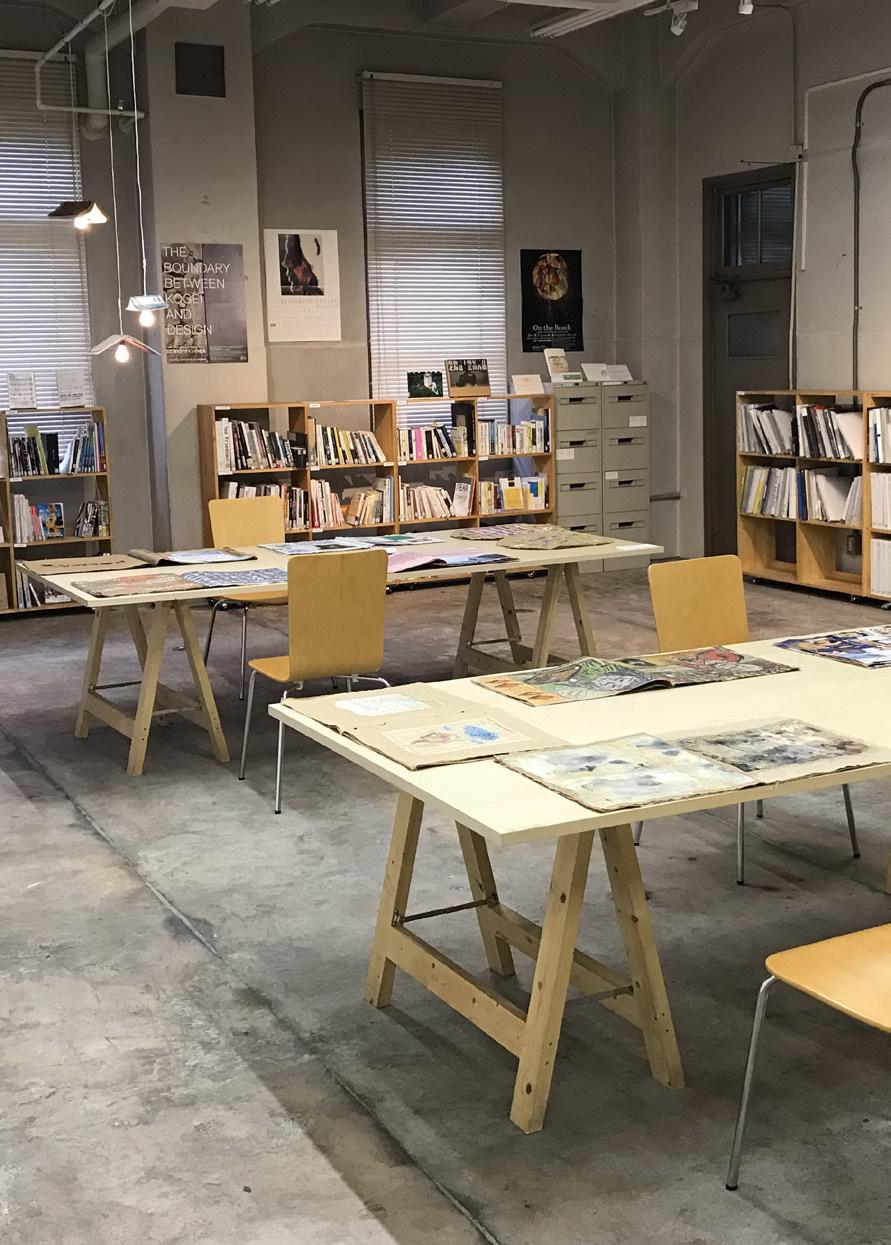
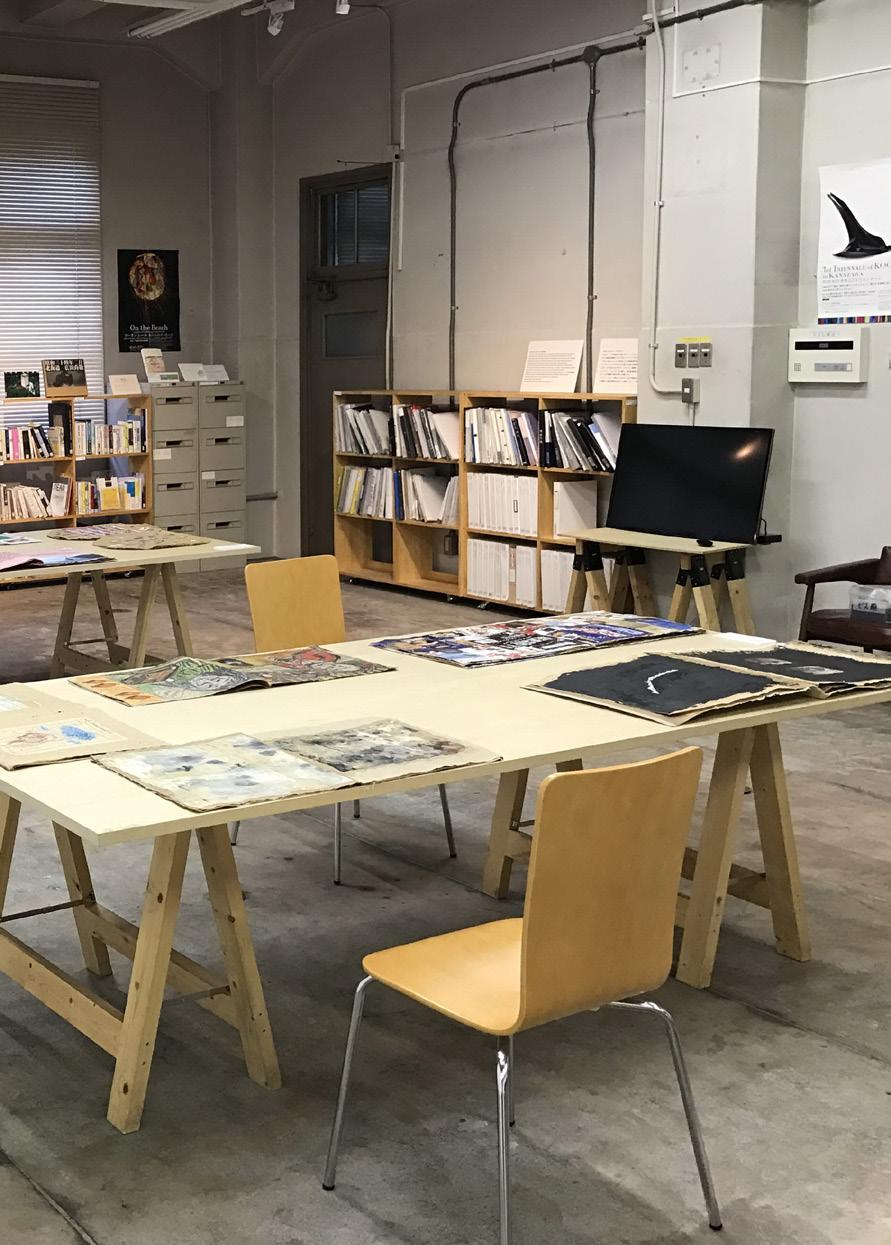
P-350, 2009-2016. An independent book publication.
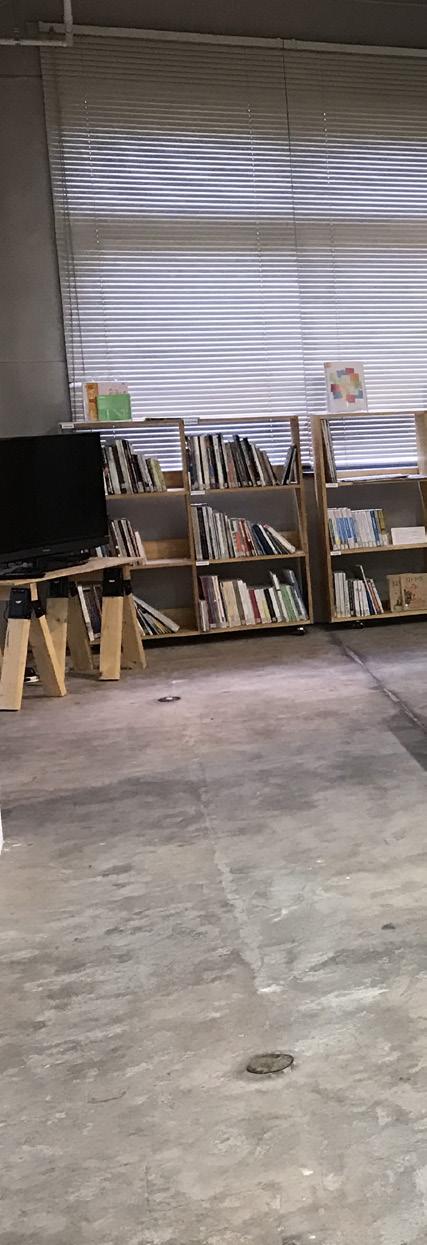
P-350, a self-managed publication, is solved by recycling paper from cement bags. The project is a platform to make visible the proposals of graffiti artists, tattoo artists, designers, visual artists, spontaneous creators, and unpublished poets.
P-350, 2009-2016. Un proyecto de publicación independiente.
Descripción: P-350, publicación autogestionada se solventa con el reciclaje del papel de los sacos de cemento y constituye una plataforma para visibilizar las propuestas de grafiteros, tatuadores, diseñadores, artistas visuales, creadores espontáneos y poetas inéditos.
INDIGENOUS KNOWLEDGE SYSTEMS
Refers to local knowledges that are unique to a specific society or culture. Even so, local knowledges are dynamic in the sense that they can be shaped by any conditions and outside influences. The concept describes knowledge systems within specific communities that become carried on or conserved in various modes and gradually become modified over time. Folklore, myths, stories, clan-names praises, sayings and proverbs are some of the methods in which the knowledges may be preserved and be put to use.
— MUZIWANDILE GIGABA
Muziwandile Gigaba — 2/2
organized a residency in Mexico as well; this is where I conducted the first art book workshop, with the Mayan community and the support of an artist-colleague from Mérida, Gema Ríos, who invited the youth participants, encouraged them, and assisted with further translation.
Dalida María Benfield also assisted me with translation from English to Spanish and this enabled a smooth cross-cultural exchange, while Chris Bratton helped with handing out the art supplies that I had brought for the participants to use. In the end, the workshop became a success. The participants were happy to lend me their books to start to share their stories with different communities.
When I returned to South Africa, Galería El Caimito, where we held an exhibition during the residency, sent me an email in which they propose that I return to Mérida for an art exhibition and facilitate another art book workshop with the Mayan community. This invitation was inspired by the reception of my project and the potential for the project to grow further.
MUZI GIGABA
MADUBE, 2015. Ceramics sculpture.
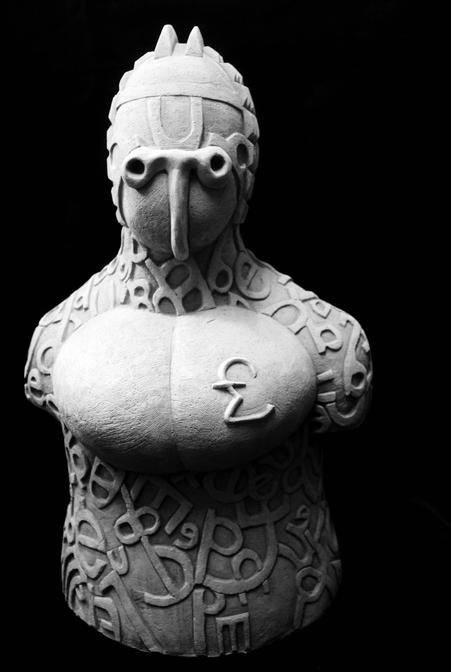
MADUBE is part of the AMABUTHO / WARRIOR SERIES, an ongoing project that commemorates home languages. The artwork’s title MADUBE comes from the people of the Zebra clan called Dube, which means “zebra”. The artwork is both a sculpture and an archival photograph of the sculpture. Through this project, the artist seeks ways to document and archive oral knowledge through fine arts media.
The Mayan linguist Felipe Castillo Tzec facilitated a presentation during the residency in Mexico highlighting the significance of corn in Mayan culture. When I randomly took walks in Mérida, I became aware of corn as a staple food in the sense that it is featured in all kinds of snacks and meals. Felipe’s talk further demonstrated how corn is an integral part of the philosophies of the Mayans. I hope to return to Mexico to continue the art book project in tribute to the philosophies around the corn. Dumisani, my papermaker in South Africa confirmed that the cob could be used to make hard paper while the leaves can be used for soft paper, although it would require specialized machinery to process. The corn project would explore relationships in different narratives centred on the corn. It also may provide an opportunity to create a cheap local paper of corn waste that would be useful. In this regard, the art book project extends oral knowledge as a discourse in which various ideas of empowering Indigenous communities can flourish. By looking deeply into our languages and oral knowledge we may tap into inventions that speak to our local communities, as well.
When I returned to South Africa from Mexico, I conducted a workshop with students from the University of Pretoria. The university workshop was quite different from that of Mexico. The Mayan community participants were quite young and their artworks were focused on local legends and
folklore. On the other hand, at the university, the project had to be directly related to the curriculum. This limited the project themes and dictated an outcome within the scope of expressive drawing. Most students avoided looking deeply into their home languages and oral knowledge; instead, they explored a more general theme of random memories. I was left to assume that the difference between the two groups is that the Mayan communities are in a context that emphasized Indigenous culture and oral knowledge while the South African university students were not.
The highlight of the project, however, was the art book, Empire Falls, created by Natasha Kudita, an international student from Zimbabwe. She created an oral tale that looked at the state of Zimbabwe between 2016-2019. Natasha used her work to inspire a dialogue between Zimbabweans and her South African friends by posting her work on social media. The book trended for at least two weeks with people sharing their experiences about how they sought refuge in other countries due to the unsettling leadership in Zimbabwe. Natasha’s South African colleagues were exposed for the first time to the difficulties of the situation and started engaging more with her on the topic. The irony in the title of her book is that a few months later the former president of Zimbabwe Robert Mugabe passed on. Indeed, the empire had fallen.
EXPERIMENTAÇÃO1
Experimentar é testar, ajustar, avaliar, alterar, testar de novo. É também demonstrar, intervir, especular, imaginar alternativas. Desde o seu uso na ciência, como um dos pilares do método científico, até seu uso nas ciências sociais, pedagogia, artes, e design, é impossível ignorar a noção de experimentação. Mais do que impossível, ignorá-la seria uma burrice – embora, ao mesmo tempo, um possível experimento.
Mas o que significa adotar a ideia de experimentação dentro de uma prática transdisciplinar? Embora alguns cientistas acreditem que experimentos devem ser controlados sistematicamente – e isso faz até algum sentido –, os artistas estão no mundo para mostrar que talvez esse controle seja apenas um dos caminhos. John Cage, por exemplo, propôs um entendimento diferente do que é um experimento: “Não descrito como um ato a ser julgado posteriormente em termos de sucesso e fracasso, mas simplesmente como um ato cujo resultado é desconhecido”. Em outras palavras: ele e tantas outras artistas se concentram na experimentação como uma prática anárquica e aberta.
Em Recoding Art, pesquisa em conjunto com Bruno Moreschi para o Van Abbemuseum, tudo começou a partir de uma simples indagação a mim mesmo em uma conferência acadêmica: como um sistema de
visão computacional lê obras de arte como a Fonte, de Duchamp? Testei isso no mesmo instante, sem esperar muita coisa. Porém, ao ver os resultados, me surpreendi com a leitura da obra como “design de produtos”, e decidi enviar uma captura de tela para Moreschi. Juntos, em sucessivas trocas de mensagens, vimos que aquela experiência sem grandes intenções oferecia valiosas ampliações. Existia ali a possibilidade de se experimentar com a visão computacional como mais um modo possível de ver o mundo. Mais do que algo que está certo e concreto, experimentos sempre carregam em si mais e mais testes, experiências e interpretações. Vale também ressaltar que esse movimento de novas indagações jamais teria acontecido sem a ideia de compartilhamento – no caso, enviar um e-mail para Moreschi – o que me leva a pensar que experimentação é prima próxima da colaboração.
Quando encaramos o que fazemos como experimentos, abraçamos a processualidade, e também a necessidade de constantes ajustes, um olhar ora cuidadoso ora displicente para como as coisas se desenvolvem, mudam e reagem. Mais do que buscar a falsa ideia de que se é capaz de controlar todas as variáveis, ou de que podemos ser completamente surpreendidos, realizar experimentos é uma maneira de “ficar com os problemas” (“stay with the trouble”), para usar a expressão da professora
Donna Haraway. Experimentos não devem ser encarados como ferramentas inertes, mas sim como experiências férteis.
— GABRIEL PEREIRA
1 Esta breve reflexão está mais desenvolvida e teorizada no projeto Museum of Random Memory, que culminou em artigo escrito em parceria com Annette Markham, prestes a ser publicado. Para esta reflexão, destaco também as contribuições de Bruno Moreschi, Sarah Schorr, Dalida María Benfield e Winnie Soon.
Epigenetics of Place90
Emerging91
Colaboración y red de afecto93
Proceso93
Emergent Mythologies98
Repair101
Though sculpture opened up, like so many disciplines, into the now familiar confines of an expanded field, it seems to have never shaken off the necessity of material truth. Bronze is bronze. Wood is wood, even a monitor is generally a monitor. In sculpture, catsup rarely becomes blood and a poorly aged teapot is never mistaken for antiquity. The process of deduction and interest in construction take over in a hierarchy of material authenticity. A prop brought into the gallery becomes only what it is, never an allusion to reality. Rather than pointing to a better, more-whole, functional and, authentic version of itself, it now only refers to the lack of that state. The illusion is no longer a bridge but a dead end.
— LAINE RETTMER
LAINE RETTMER
La Boheme by Giacomo Puccini, 2016. Directed for Loft Opera, New York, NY.
Example of a backstage hand prop table. Each object, or prop, carried on stage by actors or singers is accessible, labeled, and described, for easy identification during the run of a production.
Production still from The Rape of Lucretia by Benjamin Britten, directed by Laine Rettmer, 2016. Produced by LoftOpera, NYC. Photo: Robert Altman.
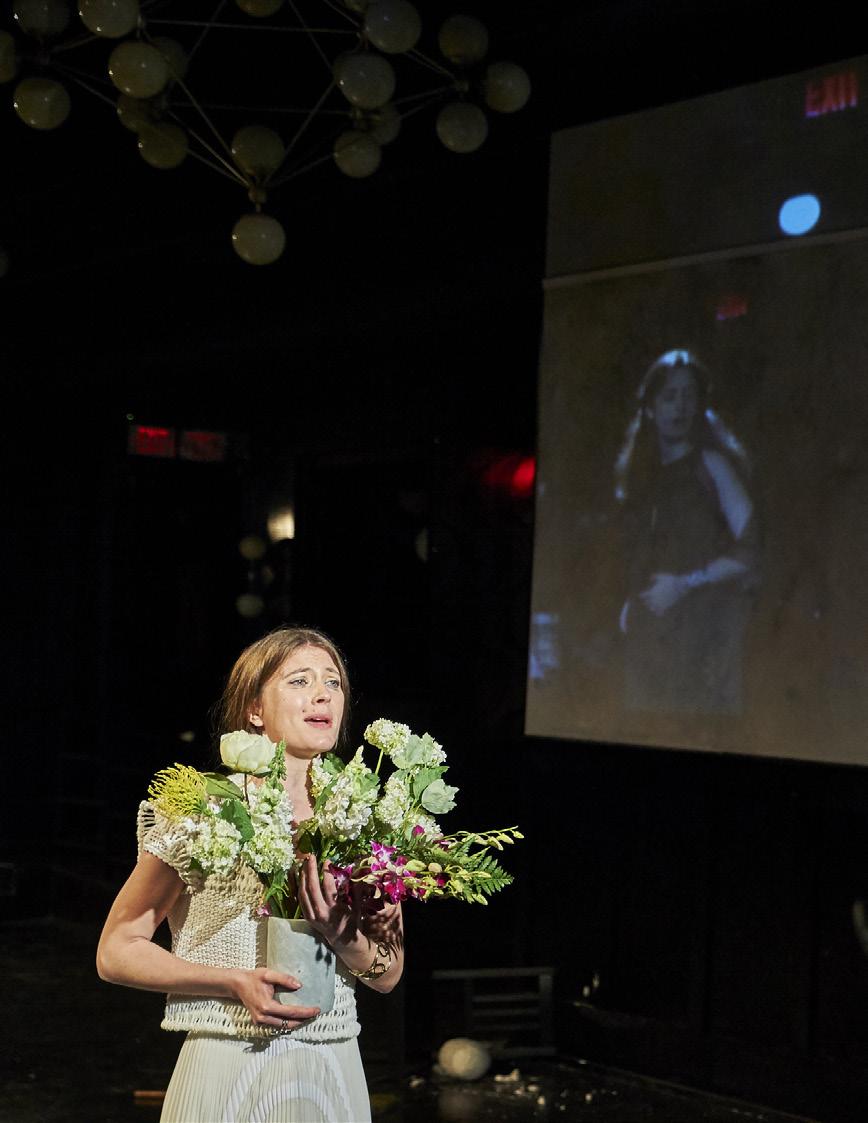
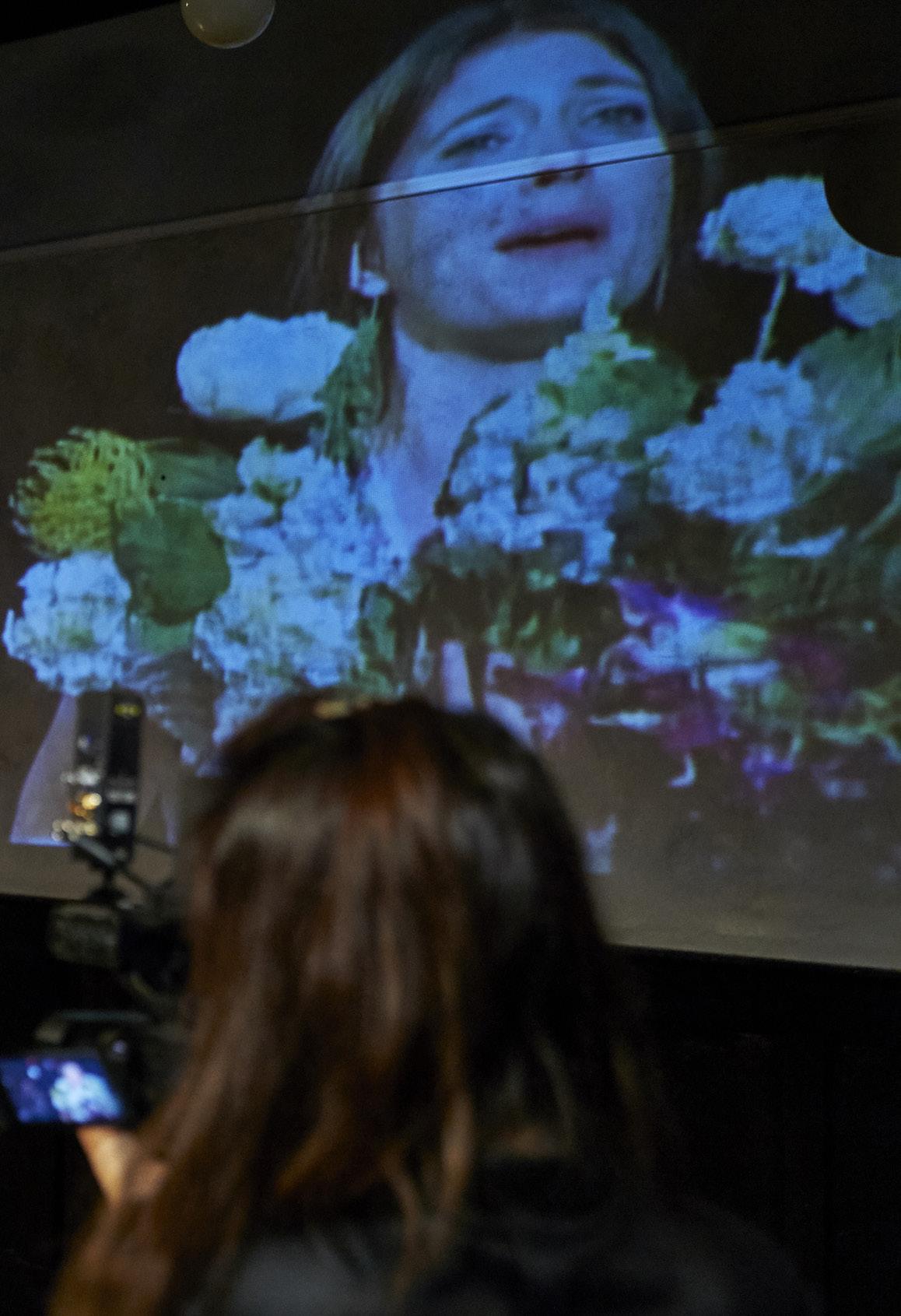
Laine Rettmer
— 1/2
In each hand I was holding a heavy cool glass pitcher, full to the brim with water. Walking slowly, I let the water run out in steady streams which were immediately soaked up by the summer-baked dirt. The soundtrack to this action was an interview with a rancher from Montana, named Al Lien. Al spoke about the impact of changing climate, water rights, and how collaboration is the key to sustainable futures. I brought the streams pouring from the two twin pitchers together as the water ran out and nearly cried with relief. In this workshop presentation, I was getting to a practice where purpose and method align. I was being challenged to examine the ethics of a work of art. The first residency I attended with the Center for Arts, Design, and Social Research put me on a path to synthesize three discrete steps: art production, intent, process and outcome.
My artwork mines historical dramatic forms, in particular European opera, as a means to reconsider politically salient concepts of gender, race, and subjectivity. Discursive methodologies, disruptive techniques and technologies, and interrogative approaches are all parts of my practice that have been supported and strengthened through CAD+SR’s Research Fellowship. During the tenure of the fellowship, I produced work for two solo exhibitions and completed research and development for STANDBY SNOW: Chronicles of a Heatwave, a large-scale multimedia production made in collaboration with Mary Ellen Strom and Indigenous scholar, Dr. Shane Doyle. These two concurrent strains of research and
art practice include writing, performance, video, augmented reality, and sculpture.
STANDBY SNOW: Chronicles of a Heatwave, which I began work on during the first residency, is a researchbased multimedia production that premiered in Bozeman, Montana. The production questions the domination of Western logics that cause systemic discrimination of Indigenous peoples and ecological crisis in the Rocky Mountain West region, specifically through drought and fire. The collaborative team questions Western knowledge systems and privileges Indigenous ways of knowing. Performance, political activism, and community concerns are completely intertwined in the aesthetic practice, production, and ethics of this project.
In the reexamination of Western classical mythologies I developed a body of work titled White Rush, allusion to the poem “Leda and the Swan,” by W. B. Yeats. The work re-examined the mythological tale of Leda and the Swan, as well as the insidious, pervasive, and unexamined eroticization of sexual violence in classical art. I framed the Greek myth in relationship to the contemporary mythos of Kurt Cobain, probing the gendered constructs under which “celebrity” figures become crystallized in history. This research resulted in a suite of video and photographic works, sculpture, a one act opera, as well as an augmented reality experience for the Microsoft HoloLens developed in Spoleto with CAD+SR fellow, Robert Ochshorn and Evelyn Eastmond, participants in the “Disaffected Technologists’” convening
EPIGENETICS OF PLACE
An expansion on epigenetics. Epigenetics of Place is the theory that if trauma can change human DNA, then a trauma that occurs in a specific place has the capacity to change the DNA of the matter that inhabits that place; the soil, the ocean water, the river water, the ground, the stone, and the more than human beings.
— TAMARA AL-MASHOUK
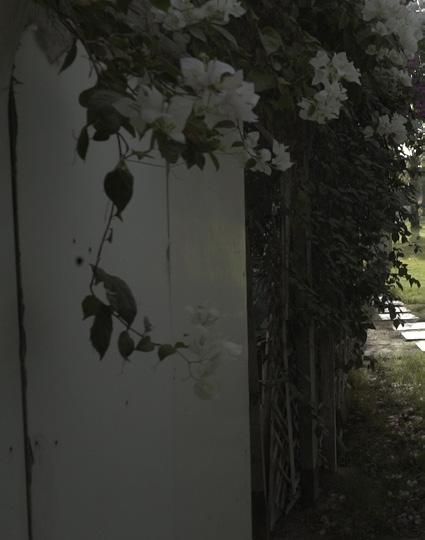
TAMARA AL MASHOUK
Epigenetics of Place, 2018. Video.
The location of Mashouk’s video is her family’s compound in Bahrain. The artist explores the paths that she walked and the structures she inhabited while uncovering the trauma contained in her body and the spaces of her home.
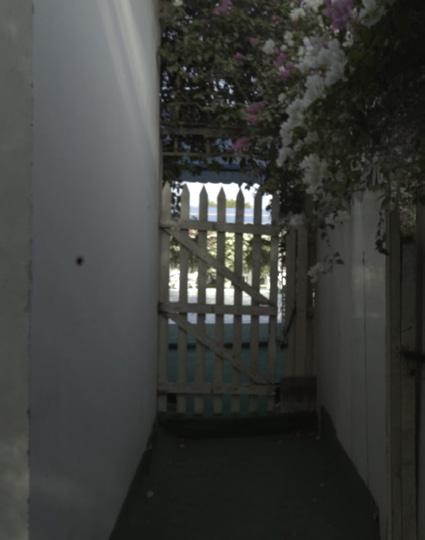
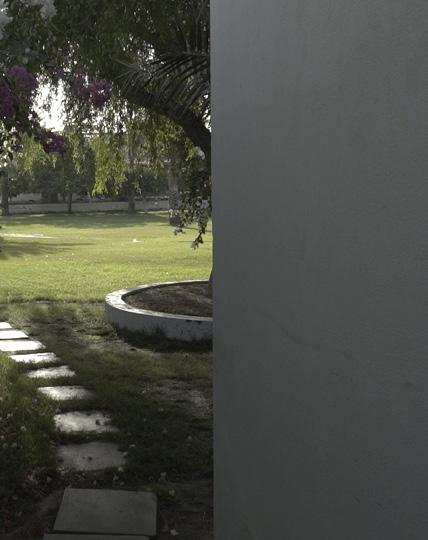
EMERGING
Emerging is a process. It comes from a Latin word I don’t happen to know, to mean when something hits you in the face when you least expect it. You can use it in a sentence by saying, for example: “That ball just emerged from the water to hit me in the face.”
As a verb, it helps us consider how things, ideas, and concepts materialize, turn up, develop, or appear. They might not be there at first, but once you see them… they can’t leave you—or un-hit you, if that’s a thing. I like the idea that research, art, and design are things that should be let to emerge, in the sense of allowing them to be exploratory, inductive, and processual—which might also mean convincing yourself that you have no control over it. This can hopefully also mean not focusing on the things that are, but the things that should or will be. Emerging things should give us hope—but also fear.
Emergency is when the seas are rising, global temperature is peaking, and socioeconomic inequalities are being embedded in all forms of surveillant technologies. More than a noun that means that something urgent is going on, it is a call to urgent action. An example phrase would be: “Bolsonaro has been elected Brazilian president. This is an emergency. Act now or this country will become a dictatorship again.”
Emergent is an adjective that relates to the insurgency/resurgence of the Global South, such as the expression: “The emergent Brazil.” It probably came into English quite recently, with the rise of globalization and the need not to call these “third-world countries.”
Rather than focusing on understanding technology only from a Global North perspective and ontology, focusing on the emergent means connecting to “the people with broken smartphone screens using WhatsApp to share stickers,” to borrow a friend’s words. Pronouncing emergent is the same as pronouncing emergency but with a bit more haste, the smell of home, and usually more hope that we can make a difference.
Emergence is a concept from systems theory, physics, and other fancy, overly complicated disciplines. It relates to the idea that the most interesting behaviors happen when things are in interaction, not when they are alone, and that when things interact they are more complex than when separated. As everyone already knows:
“The whole is greater than the sum of its parts.” This is obviously true, but sometimes it is easy to forget emergence in emergencies; or even to spot the emergence of emergent emergencies.
Beyond the obvious puns and off-beat writing style, I hope we all keep emergence in mind when we do whatever we do.
— GABRIEL PEREIRA
Bruno Moreschi — 3/3
The first residency in Spoleto was the beginning of the understanding of some values that seem fundamental to CAD+SR. The first of these is the idea of global partnerships, which began in this first residence with the fellows getting to know each other, exchanging ideas, and creating common points of work and empathy. It was interesting to note that, in the early days, people were already very integrated and willing to understand each other’s projects and interests. I introduced the project The History of _rt, which was then something very focused on a single first edition. After this first experience, the project became something bigger, a process that was no longer only coordinated by me, but by everyone from CAD+SR –and that was great. I must also confess that this first residency happened at a time when I was tired of working in an individual way, and I was looking for more collaborative and multidisciplinary approaches. The residency and all the fellows there, people from the most different places in the world, showed me that this was possible. The place of the residency in Spoleto was indeed big, but the network of exchanges that was beginning to be created was even bigger.
DECLARATORIA EDITORIAL
En algunas conversaciones que sostuvimos el poeta Omar Pérez y yo alrededor del año 2009, surgió la idea de fomentar un proyecto editorial que dialogara con nuestro contexto: flexible, mutante, independiente de la industria editorial. Un proyecto que desde la horizontalidad reuniera un caudal de información que lograra amplificar otras voces, evitando la jerarquización del discurso y que pretendiera además abrir un espacio desde lo creativo, con el fin de conseguir una autonomía cultural.1
Así se creó P-350, publicación autogestionada que se solventa con el reciclaje del papel de los sacos de cemento y que constituye una plataforma capaz de visibilizar las propuestas de grafiteros, tatuadores, diseñadores, artistas visuales, creadores espontáneos, poetas inéditos, etc.
P-350 recibe su nombre básicamente del soporte donde se asienta. Es el nombre de los sacos donde viene el cemento, sacos que por fuera dicen Portland P350 y esto es parte importante de la conceptualización del proyecto. Cuando normalmente en Cuba se usa el cemento se bota el cartucho. Nosotros comenzamos a reciclar el cartucho y lo reutilizamos como soporte para construir este block.
Desde el principio evitamos enmarcarnos en cualquier perfil editorial que no fuese la expresión libre y la
articulación de procesos creativos capaces de posibilitar renovadas formas de experimentación simbólica. Teníamos la voluntad de que todos los temas fuesen abordados desde infinitas posibilidades, la única condición, si en algún momento existió alguna, fue que no hubiera exclusiones.
P-350, como edición de arte, trabaja al margen de los imperativos comerciales y surge como un espacio de publicación —en el concepto más amplio, expandiendo al máximo las posibilidades gráficas y artísticas del formato físico— concebido como una zona de encuentro y yuxtaposición azarosa de miradas, y de interconexión entre las diversas prácticas artísticas y literarias. 2
En el sentido estricto, P-350 no es una revista ni un fanzine, sino un terreno de libertad creativa que cuestiona el protagonismo de la gestión editorial, una plataforma horizontal que analiza el hecho mismo de la revista como la entendemos tradicionalmente —consejo editorial, serialidad, redes de producción y distribución—y que, por ejemplo, no paga ISBN y se declara anti-copyright.
Antes que proyecto editorial, se trata de un gesto que se consolida a partir de las interacciones que suscitan las presentaciones del proyecto, las cuales devienen espacio para sociabilizar, donde se propicia el diálogo sobre temas variados y la interacción con la publicación, creando redes de
relaciones e intercambio. Organizamos presentaciones, intervenciones, exposiciones, lecturas, talleres, que funcionan como resortes para provocar el debate y la movilidad del pensamiento, una excusa para juntarse a compartir algo y recuperar los espacios de construcción común.3
La variedad de números que conforman ya la colección, permite ver la diversidad de intereses y la creatividad de las personas que colaboran con este proyecto.4 Los números no se venden, circulan de mano en mano y los modos de realización son disímiles: esténcil, poesía visual, caligrafía, collage, garabatos…, lo que la convierte en un objeto atractivo en sí mismo. Puedes encontrar en sus páginas desde un poema de Antonin Artaud hasta un ticket de ómnibus. Es una publicación con cierta propensión al collage y al corto circuito.
Colaboran con P-350 Omar Pérez/ Amílcar Feria/ Ítalo Esposito/ Luis Eligio Pérez (de OMni)/ Elvia Rosa Castro/ Tamara Venereo/ Sandra Ramy/ Ailer/ Yaque-Mati/ Andrés Pérez/ Yerande González/ Rito Ramón Aroche/ Irving Vera/ Felipe Gaspar Calafell/ Danilo Maldonado (el sexto)/ Paco Myfriend/ Dojo Zen de Artemisa/ Julio Cesar Llópiz/ Maikel Iglesias/ Sergio Suarez/ Tamara Díaz/ Duhamel Xolot/ Carlos Garaicoa/ Amalia Iduate/ Alberto Ferrer/ Ana lyen/ Ricardo Ezquijarosa/ Orestes Hernández/ Raquel Cruz/ Lester Álvarez/ Irving Alfaro/ Luis Enrique ( Chinito)/ Odey Curbelo/ Ezequiel Suárez/
Mario Castillo/ Dimitri Prieto/ Ricardo Alberto Pérez/ Orlando Hernández/ Carlos Bunga/ Víctor Méndez/ Frency Fernández/ Solveit Fong / Abel González / Luis Trápaga/ Lía Villares/Reynier Leyva (Novo)/ Gabriel Calaforra/ Laura Espinosa / Amed Aroche / Mira Kongstein /Erika Flores y Periódica (Revista de arte contemporáneo en Colombia) / Marc Roig y Rogier Decfos con WERKER Magazine / Jamila Medina/ David Beltrán/ José Manuel Mesías/Héctor Antón Castillo/ Jorge & Larry/ Ernesto Santana/ Yornel J. Martínez Elías y el grupo de teatro “El ciervo encantado.”
— YORNEL MARTÍNEZ ELÍAS
1 Colaboración.
2 Red de afecto.
3 Colaboración y red de afecto.
4 Proceso.
BRUNO MORESCHI
Another 33rd São Paulo Biennial , 2018.
Two collaborative interventions unfolded as public workshops co-organized with CAD+SR. “São Paulo-Boston,” with Dalida María Benfield, Christopher Bratton, Evelyn Eastmond, and Gabriel Pereira, took place in Cambridge, Massachusetts, at MIT and a local Brazilian café. Using Microsoft HoloLens, 3-D scans, and other materials, participants reworked the digital traces of the Biennial. “Vislumbres Potencialmente Libertadores no Sistema da 33ª Bienal de São Paulo,” with Dalida María Benfield, Christopher Bratton, and Bernardo Fontes, occurred at Itaú Cultural and the Biennial, exploring experimental forms of presence, creativity, and engagement. Both workshops produced collaborative transcriptions, translations, reinterpretations, and mutations of artworks and architectures, opening new paths for learning, teaching, and collective experience. —
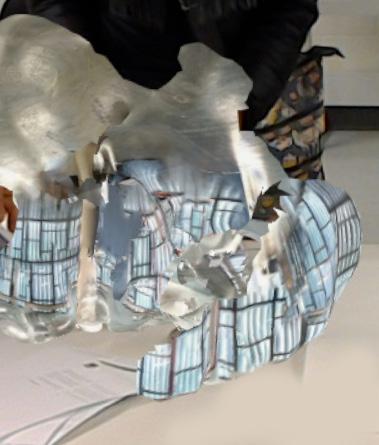
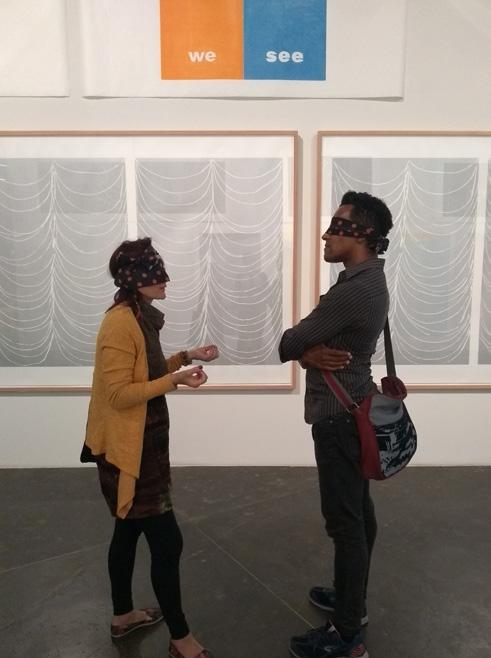

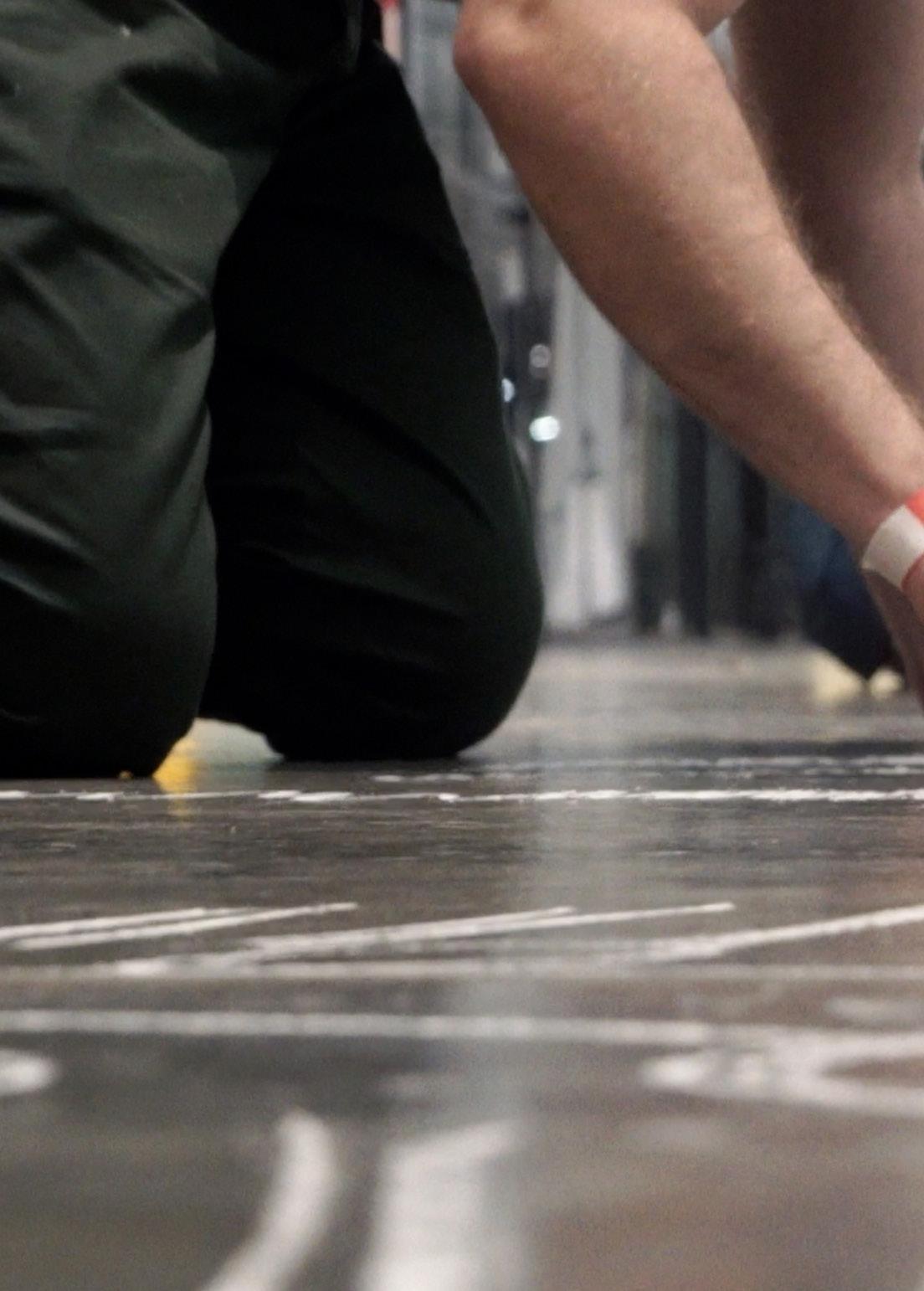
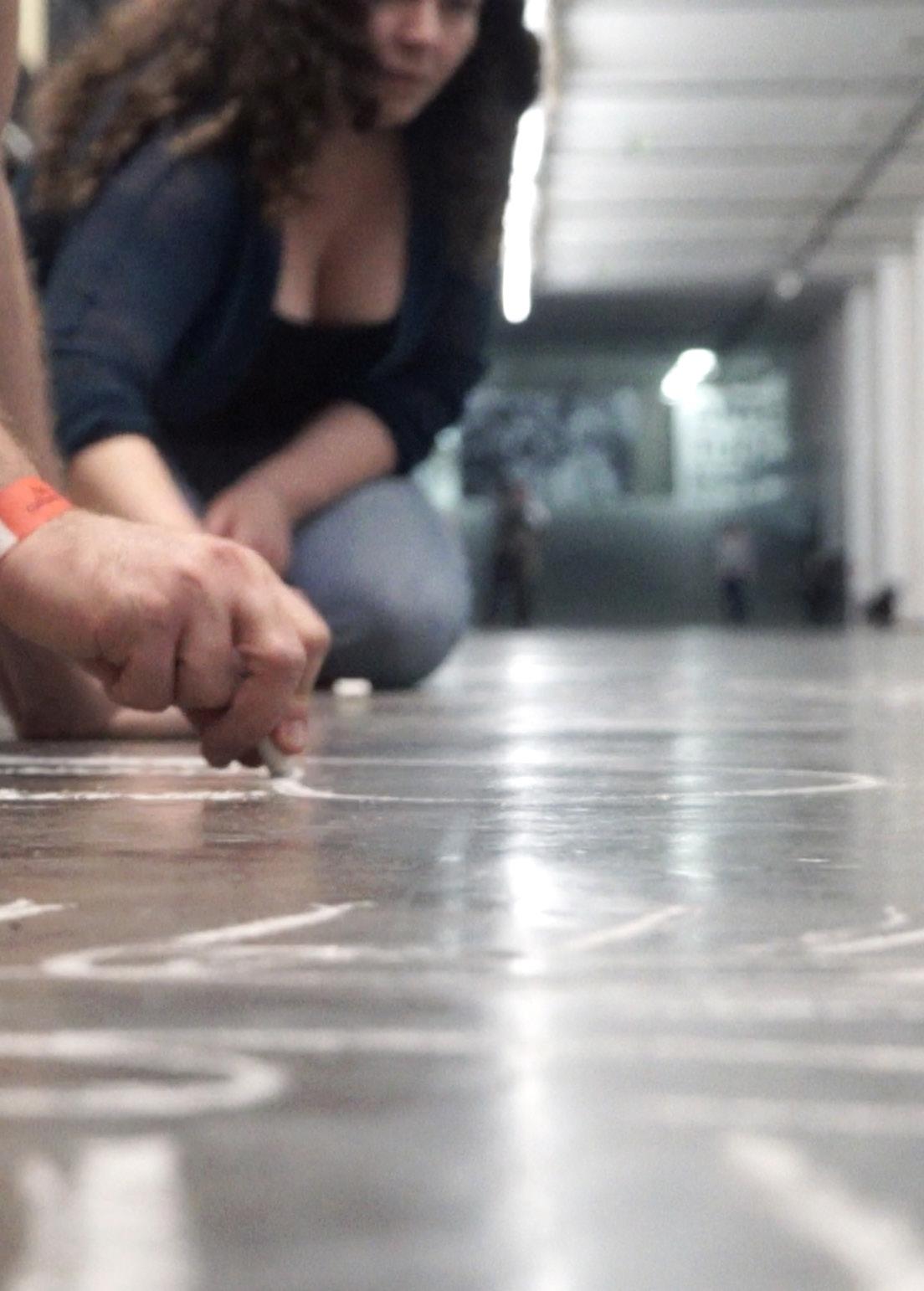
EMERGENT MYTHOLOGIES
Mythologies are collections. A mythology circumscribes a whole, a body, a weight, the limbs of which are fabricated from the diaphanous and flexible material of narrative.
-Leda and the Swan
Timotheus - Prado
-The Rape of Proserpina
Bernini - Galleria Borghese
-Apollo and Daphne
Bernini - Galleria Borghese
-The Rape of the Sabine Women
Giambologna - Galleria dell’Accademia
-Tarquinius and Lucretia
Hubert Gerhard - Walters Art Museum
The solidity of broad cultural mythologies, I find, breaks down on contact with messiness and inclinations of my internal systems. I wonder how anything based on fictions could not be predisposed to. The nuances of meaning, the calamity of character as concept, the fist sized holes I accidentally punched through stories in an attempt to understand their importance, all incline me towards practices of building up temporary, malleable, and open structures. Myths turn ever inward towards their name.
— LAINE RETTMER
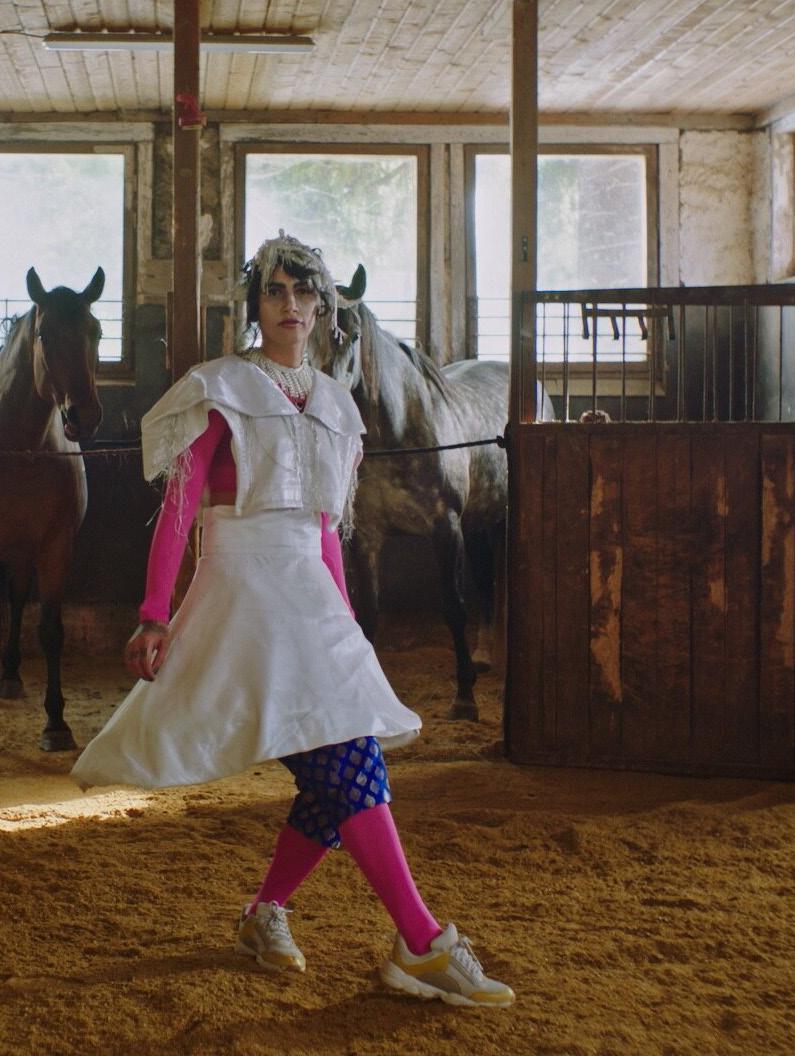
Laine Rettmer — 2/2
My inquiry progressed into an examination of ways in which museums contextualize artworks in their collections that depict sexual violence. For my upcoming project, Abundance, I am specifically looking at Bernini’s monumental sculpture, The Rape of Proserpina and conducting site-based research at the Borghese Gallery and Museum in Rome, including interviews with curators and docents, an analysis of guided tours and an examination of the sculpture and the museum’s architecture using video and photography. Abundance will look at the ways sexual violence is monumentalized, reproduced, and normalized in cultural institutions. As a queer, female identifying, victim of sexual violence, this work is deeply personal to me and in the past has seemed nearly impossible to bring into my artistic framework. Being supported at CAD+SR and having continued, extended, contact with other artists and scholars who are delving into complicated and uncomfortable source materials has
ABDULLAH QURESHI
Journey to the CharBagh, 2019
Drawing upon Sufi traditions of interpreting Islamic sacred texts, where love and equality are celebrated, Journey to the CharBagh is a poetic and experimental exploration of queerness from a Muslim perspective. The narrative of the film focuses on the figure of Buraq, a winged mythological creature with the ability to travel to heaven, encountering terrestrial and celestial beings, moving toward a spiritual and queer awakening.
Producer: Danai Anagnostou / Directors of Photography: Hadi Rehman (Pakistan) & Kerttu Hakkarainen (Finland)
created a community that made me feel that these challenging conversations are necessary to instigate inside of institutions.
I have been participating in something I could term, radical collaboration and radical inquiry, through CAD+SR. The trajectory of these projects and their development and support while being a Research Fellow, has continually opened a space to question all steps in the asymmetrical lines of art production. What or who is the work serving? Who is it not serving? How is it operating formally? Do the formal methodologies match the intent? These discourses have been wildly broadened in my own lexicon as CAD+SR changed what constitutes my own personal epistemes.
Abdullah Qureshi
The Mythological Migrations project responds to an urgent need to recognize queer Muslim voices and challenge endemic Islamophobia in Europe by contextualizing narratives of Muslim LGBTIQ+ refugees and asylum seekers in Islamic histories, mythologies, and contemporary art. Taking the format of three multidisciplinary artistic productions and a publication, the project proposes a new way to think about Islamic history and recognize ongoing queer resistance through art within Muslim contexts—and pave a path for queer Muslims to reconcile their identity and sexuality within their cultural heritage. As I complete my CAD+SR fellowship, I feel it has been a tremendous artistic and conceptual incubator, where within a community of like-minded practitioners, I have been able to share and further develop many of my ideas. Out of this experience, of course, many collaborations have been born, and many that will continue to emerge in the coming years.
REPAIR
The point I am often exploring visà-vis the Black experience is that of being so very visible and different in the white Western everyday yet so very invisible and disregarded in cultural, historical, political, or economic record or history. — Lubaina Hamid.
— SYOWIA KYAMBI
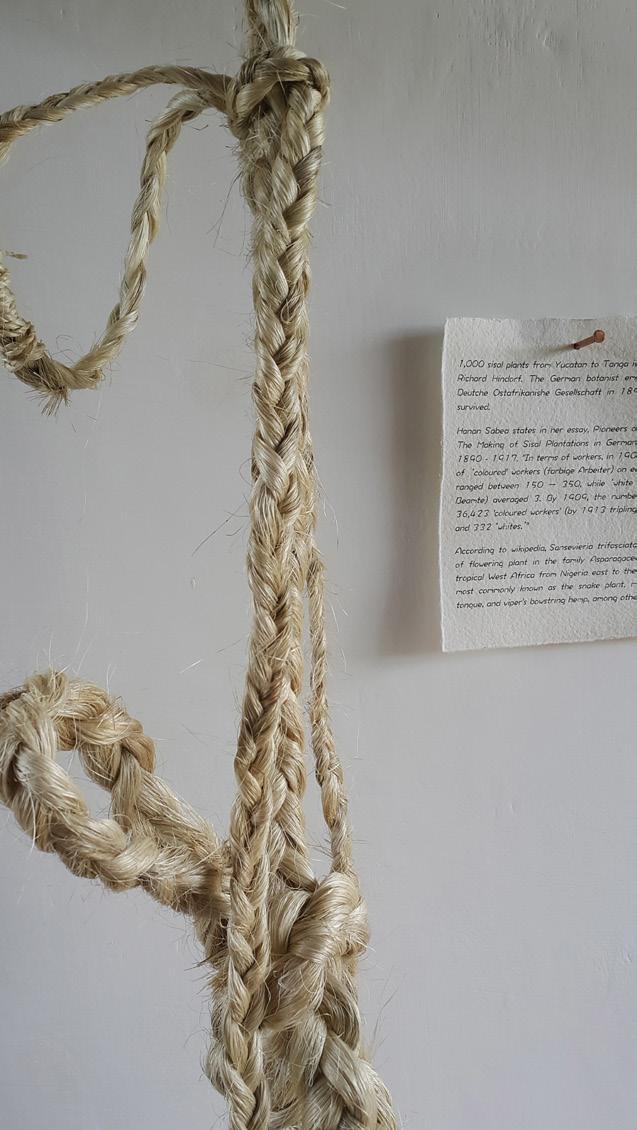

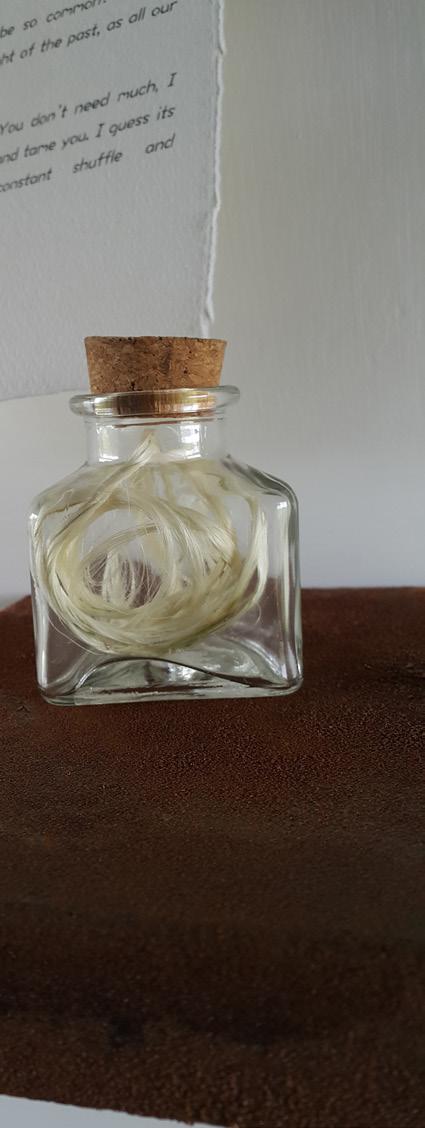
Syowia Kyambi — 2/3
Who Once Spoke? Who Speaks Now? An Artist Statement
This past year I have tasked myself with answering what it means to be part of the 20192020 exhibition, AMANI. Auf den Spuren einer Kolonialen Foschungsstation/ (AMANI, On the Trail of the Spectre of a Colonial Research Station). What does it mean for me as a contemporary African artist with a German heritage to work within ethnographic museums in Europe? How do I engage with the material from the Amani Research Station, built in 1902 during German Imperial rule over Tanzania, and the ethnographic MARKK Museum archive, without inadvertently behaving like colonizers?
The exhibition project concept centres around exploring, tracing, and partially romanticising the semi-abandoned research station in Tanzania which has seen a gradual yet increasing decline in its ability to function post-independence. The MARKK Museum in Hamburg, Germany, facilitated one of the first spaces of ethnographic education in the late 1800s in Germany.
SYOWIA KYAMBI
The Green Gold. Mixed media installation with rusted mild steel, sisal, paper, ink, glass bottle, nails, video, headphones. Dimensions variable. MARKK Museum Hamburg, 2019.
Supported by ESRC Grant Memorial & Remains and CAD+SR fellowship, Yucatán, Mexico, 2019. Photo courtesy of the artist.
The artistic research methodology I adopted to explore these questions, known as ‘cruising utopia’, a phrase coined by José Muñoz,1 allowed me to navigate uncomfortable spaces, thoughts and bodily responses to the site-specificities of the Amani Research Station, and the MARKK Museum, as well as to literature about Southern Africa’s history in relation to Germany’s colonial imprints. The theoretical frameworks that have come to the fore during this process now both inform and act as an armature for my artistic practice. The works I present include an installation, The Green Gold, and a performance, Kaspale. The Green Gold, an installation, uses rusted steel, sisal, paper, ink, glass bottle, nails, video projection, and sound. The installation features a fragmented narration highlighting the role of the plant and material sisal, and the initial plantations introduced by the Germans to East Africa from the Yucatán area of Mexico in the early 1900s.
Hanan Sabea states in her essay “Pioneers of Empire? The Making of Sisal Plantations in German East Africa, 1890–1917”: “since its inception, sisal was […] synonymous with power, capital, and progress, all ideals of the colonial project that was seeking not only economic profit but also visible signs of dominating presence.”2 By braiding the sisal in my work, I am relating to the personhood of the laboured Black body used to build Europe’s economy. The absence of this body echoes
the violence of the eradication of Black personhood in the colonial project. The sisal in a glass container in The Green Gold is fibre from the Sansevieria Trifasciata (Mother-in-Law’s Tongue) plant, which is indigenous to Africa and an antecedent of the sisal of colonial times. Sansevieria Trifasciata has now become a common houseplant around the world. The short strand of braided sisal in The Green Gold is from Yucatán, Mexico. It is the same variety of sisal that Dr. Richard Hindorf, a German botanist employed by the Deutsche Ostafrikanishe Gesellschaft, brought to Tanga, Tanzania in 1890. The longer sisal is from East Africa, which is the remnant of the original variety of sisal.
The second work, Kaspale, is an open-ended performance project with various material outputs. Kaspale is a character I have devised to intervene in spaces charged with colonial activities. The Kaspars are generally playful tricksters who engage themselves in social and satire. They have the task and ability to call out authority when needed. They speak up when others can’t. Kaspale intervenes by engaging in the old lecture rooms within the MARRK Museum: laying about, waiting, walking on top of the rails and tables, and hopping about the basement corridors where the first practical lessons of race classification took place. Kaspale also finds themselves inside of photographs produced by zoologists, Julius Vossler and Dr. Franz Ludwig Stuhlmann in the early late 1800
and early 1900 during their time in Tanzania, which are now part of the museum archive. Kaspale disturbs these images, disrupting the urge for the audience to be nostalgic over this period.
While relistening to Fred Moten’s An Ecology of (Eloquent) Things, the use of the term “monocultural violence” returns to me as if on an infinite conveyor belt.3 I felt I could not engage with the history of the Amani Research Station without engaging with the colonial history in the region. I could not participate in the project without unearthing the sum of the material in the MARKK Museum as a historic site and its archive. This manifested in my reluctance to export material from Tanzania to showcase in Germany. When I travelled to the Amani Research Station in September 2018, I related to Maiju Loukola’s argument for artistic research, in which she “lean(s) on Walter Benjamin’s critique on the universalism of knowledge, which he challenges by emphasising the connectedness of intuition and understanding through temporality that appears as a singular occurrence, but which are inevitably bound to correspondence with historical events.”4 I sought to investigate this position by creating on-site intuitive performance responses. The Kaspale character, who first appeared in the MARKK Museum, has been devised in response to those previous performances.
Kaspale wears a Kaunda suit made of mosquito netting. The
design is based on the garment made famous by former Zambian President Kenneth Kaunda and worn by African presidents during the Independence era. It consists of a short-sleeved tie-less suit; an African take-on-thewestern-business suit. Over time, the Kaunda suit has changed from being a symbol of prestige and political resistance to an employees’ uniform with inherent connotations of servitude. This version of the suit becomes indexical of the mosquito, symbol of the ineffectual prevention of the penetration of the colonizers across the African continent; allowing solutions for colonial penetration yet also an object of protection for humanity.
The red finger paint colour featuring on Kaspale’s arms and feet is an intuitive act to generate an energy of power. This is about reclaiming armor, as in traditional East African ritual, the use of red ochre symbolises power and knowledge. Being the main points of energy exiting and entering the body, the fingers and toes were highlighted with golden nail polish and a golden mouth symbolizing the speaker; holding the space for truth telling. With the face paint and the mask in combination, there is an essence of a double mask, as both are revealed in the process of the performance. The original Makonde mask that inspired this process is part of the MARKK Museum archive donated by Hans Himmelheber in the 1920s, most likely originating from southern Tanzania. In using
this I was searching for a symbol of connecting to an ancestral truth, a connection to a higher being and an imagined space, open to the possibilities of an alternative narrative, an intervention into the Western gaze.
NOTES
1 Jose Muñoz, Cruising Utopia: The Then and There of Queer Futurity, (New York: NYU Press, 2009).
2 Hanan Sabea, “Pioneers of empire?: The making of sisal plantations in German East Africa, 1890–1917,” in German Colonialism Revisited: African, Asian, and Oceanic Experiences, edited by Nina Berman and Klaus Muehlhahn, (Ann Arbor: University of Michigan Press, 2014), 114.
3 Fred Moten, “The Ecology of (Eloquent) Things,” videotape of lecture, https://www. youtube.com/watch?v=1oRKOhlMmKQ, retrieved May 6, 2020.
4 Maiju Loukula, “Flying backwards into the future,” in Futures of Artistic Research: At the Intersection of Utopia, Academia and Power, edited by Jan Kaila, Anita Seppä, and Henk Slager (Helsinki : Academy of Fine Arts at the University of the Arts Helsinki, 2017), pp. 32-33.
BIBLIOGRAPHY
Loukula, Maiju. “Flying backwards into the future.” In Futures of Artistic Research: At the Intersection of Utopia, Academia and Power, edited by Jan Kaila, Anita Seppä, and Henk Slager. Helsinki: Academy of Fine Arts at the University of the Arts Helsinki, 2017.
Moten, Fred. “The Ecology of (Eloquent) Things.” Videotape of lecture available at https://www.youtube.com/ watch?v=1oRKOhlMmKQ, accessed May 6, 2020.
Muñoz, José Esteban. Cruising Utopia: The Then and There of Queer Futurity. NYU Press, 2009.
Sabea, Hanan. “Pioneers of empire?: The making of sisal plantations in German East Africa, 1890–1917.” In German Colonialism Revisited: African, Asian, and Oceanic Experiences, edited by Berman, Nina, and Klaus Muehlhahn. Ann Arbor: University of Michigan Press, 2014, 114 -129.
Pre-Colonial111
Ritual115
Morphology X History116
Repetition118
Language Exchange120
A state of being that all Indigenous people still possess today that precedes the arrival of western European colonizers. Its continued existence is evidenced by the survival of millions of Indigenous persons and their cultural identities, despite the onslaught of colonialism. It’s a term that challenges the notion that Indigenous people were fully colonized and therefore in need of external/internal decolonization efforts today.
— BENTLY SPANG
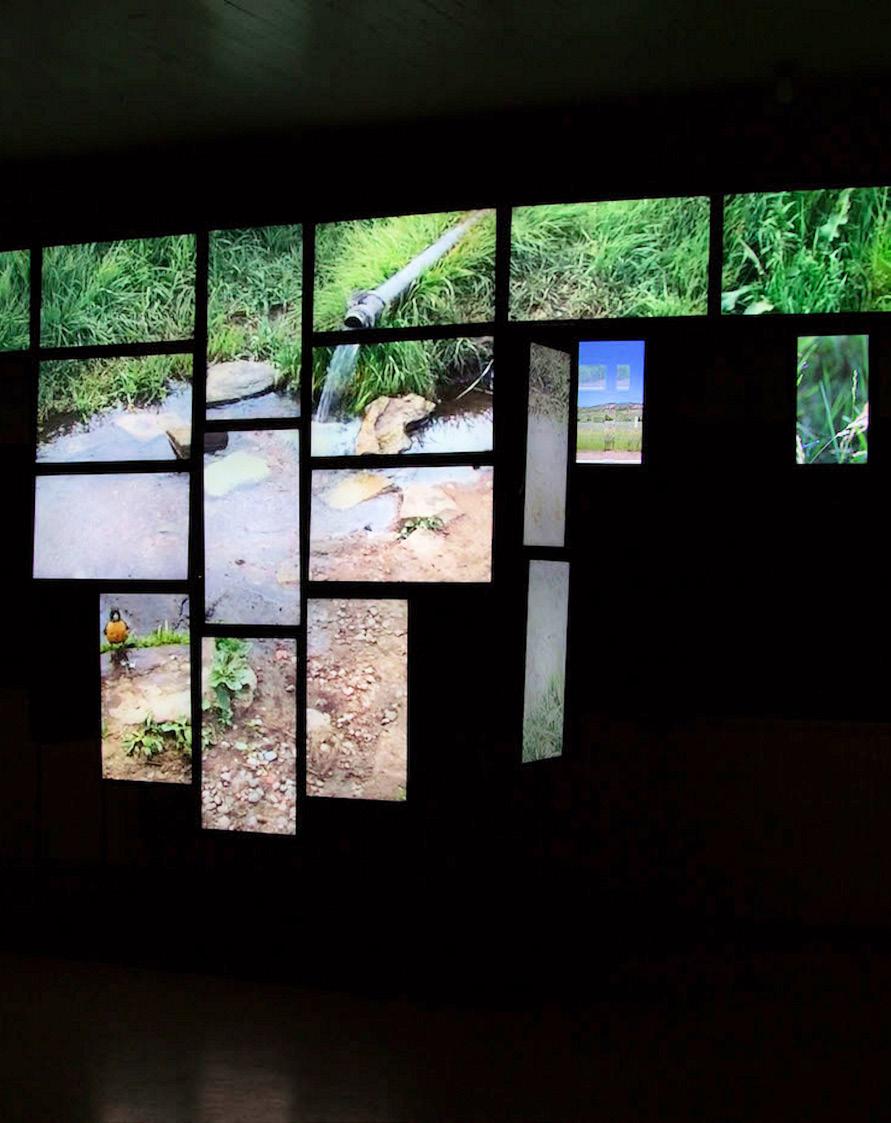
Bently Spang — 2/2
The residencies have helped deepen my awareness of the current state of global Indigenous dialogues and expanded my network to include more of the global Indigenous community. It has also helped me to see how much work we all have left to do to confront the effects of colonialism and how important it is that we all clarify our parts in that process.
One of the terms that has emerged for me in looking closely at colonialism and the process of undoing it is pre-colonialism. I may be coining a new phrase. The term describes a core element of the philosophy of my people as I have been taught. I believe we are actually pre-colonial, having never surrendered the ways of thinking and being that were present prior to the arrival of colonial forces on the North American continent.
The concept of the seventh generation, a core element in many Native communities across North America whereby difficult decisions were made (and still are for some leaders in our communities) with
BENTLY SPANG
Modern Warrior Series: War Shirt #6-Waterways. 21 flat screen televisions, 6 digital still frames, 19 minute cycle, steel and wood, 22’-0”W x 9’-0”H x 4’-0”D, 2017.
This 21-channel video and 6-channel digital still screen sculpture is situated in a historic one-room schoolhouse in Southwestern Montana and was commissioned by Mountain Time Arts. The work deals with the artist’s personal relationship to water in his homeland, the Northern Cheyenne Reservation, and challenges the viewer to do the same with their water so it can be protected.
the welfare of seven generations in the future in mind, is central to how we survived and in and of itself a pre-colonial structure. That, combined with powerful intellect, a deep, thousands-of-years-oldand-maybe-older knowledge of and relationship with the natural world, undying love for community, strong medicine and a clear concept of identity ensured our survival against perhaps the worst odds in history. It is by brilliant design that we are still here, not by accident.
I would say that each birth of an Indigenous person today is an act of resisting colonization. The fact that we are still here, with a strong cultural foundation beneath us, is evidence of a clear, pre-colonial thought process in action—and an honoring of the incredible sacrifices made by our relatives in the past.
So, I am trying out this term pre-colonial at this time and seeing that my life and my work has always been focused on advancing precolonial thought, this intellectual gift that was handed forward to me through the oral history, the art and the philosophy of my people. Thanks to this residency, I can now see a bit clearer the global Indigenous puzzle and how the pieces fit together and the challenges we face as humans in general and Indigenous peoples in particular as we work together to break the bonds of colonialism.
Gabriel Pereira — 3/3
Speak to the impact ... and expect unfinished business. I just picked up and leafed through the notebook I used during the first residency. It starts with the ground rule: Speak to the impact... and expect unfinished business. I have notes on the speculative concept of unknowable biographies that we discussed as part of our collective conversation. “Start from the disappearing...” seems like a good prompt, methodology, and maybe even way to live. Especially when it contains other thoughts on orality, material power and permanence...
“A história familiar cai sobre nós.” Materiality, time, memory, technology, art, history, cracks, objects, orality, language. That talk made me look into the colonial history of my grandfather, and the gaps that permeate it. It also connected to another note I took of Dr. Lisa Brock’s insistence that the enslaved “can be remembered in the history through the cracks of documents.”
Interestingly, my writing of my grandfather’s story gets rushed as it progresses and never ends. I was late to start saying it to you all, and now the notebook has that imprinted in it: “And I really don’t know his name, or why no one has talked about all of this” (it ends there). Muzi: “Everyone owns history.” There are also notes on Bently’s discussion of the repatriation of ceremonial objects for the Cheyenne. This poses, he said, a challenge to conventional (white) museology and ways of knowing. I wonder in my notes:...How do objects exist in the world? ... How do people know things? ... Look at self as a primary source.
RITUAL
“To
want to be assimilated is to forget that nothing can change animal nature. It is to misunderstand ‘otherness’ which is a law of Nature.” Aimé Césaire —
SYOWIA KYAMBI
SYOWIA KYAMBI
The Archive Intrusion VII. Digital Collage (original image by the zoologists Vossler and Stuhl, collection 1902-1907 in MARKK Museum). 10.2 cm x 15.2 cm. Edition of 10. 2019. Supported by ESRC Grant “Memorial & Remains” and MARKK Museum.
There is a constant simulacrum of a battle between Morphology and History that shapes a considerable part of the hegemonic theories and discourses of the white, European, and normative West. Faced with an object of analysis, Morphology wants to observe its elements in isolation, explaining in detail what each of them is made of. Then comes the History and says that doing this is not the most prudent: we must understand the whole in the context in which it is inserted. Morphology refutes History by categorically stating that there is no point in observing the general functioning of the object if we do not know its parts. The eye then looks back at the specific until History again claims that nothing is isolated from the world – which allows it to make some generalizations, of course.
Morphology spends a long time on something very specific, analyzing, creating names and sub-names for things that the eyes do not see. History continues to speak of context, widening its analysis more and more until it forgets the object and speaks about the sky above all things in the world. Morphology and History are two idiots, each blinded by a specific eye.
But the fight goes on, because it is the fuel of vanity castles. Entire laboratories (and their highly paid specialists) were built in the name of morphological processes.
Newspapers, books, and almost all mass culture were grounded in the logic of understanding the general, in almost always superficial historical analyzes. When Morphology is tired of its microscopic look, it consumes something of History to relax and criticize. History, when exhausted from the whole, consumes something in a morphological way, not to be completely lost – and also to criticize.
Meanwhile the object is there, standing still – with its specific elements and its generic wholeness at the same time. The object is also anxious. It waits for someone who can talk about it with its parts and context concomitantly. But it also knows that this may no longer be possible. One-eyed on one side and one-eyed on the other already have their own dictionaries and can no longer share their perspectives with others outside their groups. It is a lucrative battle for both, but sad for the intermediate space that makes the object and claims to be occupied.
Perhaps Art can be the two-eyed clown who walks the Morphology plain and the plateau of History, stealing what interests it, but also mocking them both and wondering why they take themselves so seriously.
Question: Morphology of objects vs. morphology of language (Saussure and Structuralism)?
— BRUNO MORESCHI
REPETITION
“We carry our histories on our backs, hunched over and barely heard, constantly swimming against the stream. The body is the site of trauma. The body holds, codes and recodes, sharing a multitude of layered stories. Body memory expresses itself in a non-linear timeline, presenting the pasts beyond our experienced past resulting in repeated onslaught of distress.”
— SYOWIA KYAMBI
BRUNO MORESCHI
After–Depois–Según, Exercise 1, 2016. With the artist Cristina Garrido and the curator Marta Ramos-Yzquierdo.
The exercise occurred at the Salón space during the 2016 ARCOmadrid art fair, Spain. When does an artwork begin? When does it end? When is it formalized? When does it materialize itself? When does it circulate? When is it distributed? When is it redistributed? To discuss and problematize the work of artists and curators in creating a work of art, Moreschi, Garrido, and Ramos-Yzquierdo decided to work together, using various appropriation strategies. In April 2015, they began exchanging objects, digital files, and excerpts from texts. In the experiment performed at Salón, all exchanged material, and a photocopy machine, were placed at the disposal of visitors who were able to make copies and interventions. Photos were published on the Internet by visitors using the #afterdepoissegun hashtag.
Syowia Kyambi — 3/3
Carrying Histo -
ries: I enter the world as this, how will I leave it? We carry our histories on our backs, hunched over and barely heard, constantly swimming against the stream. The body is a site of trauma. The body holds, codes, and re-codes, sharing a multitude of layered stories. Can Kaspale intervene? If so, will the pressure be released? Will Kaspale’s stories be heard?
For the next year, I plan to continue the development of the character, Kaspale. I would like to further explore makonde masks and the meanings behind these masks and the performances they were used in. I would also like to explore using Kaspale as a tool for intervening in postcolonial historical sites in East Africa. Developing a second character who is also a Kaspale but with further developments on the type of mask and actions used and used specifically for post-colonial territories/spaces. The first Kaspale is mainly for use in colonial spaces outside of the African continent.
I aim to create an artist’s book as this is a platform where I can combine the written elements, my research and my creative production into a succinct form. I plan on exploring performative interventions in colonial spaces in Europe and post-colonial spaces in East Africa. These will be documented in various forms including, texts, sketches, video and photography outputs.
There are three main methodologies I would like to develop further and continue to apply to my overall research methods:
Saidiya Hartman and her idea of ‘critical fabulation,’1 as discussed by Kobena Mercer, is a writing method that combines historical and archival research with critical theory and fiction narrative, inspire me. It is a tool she uses to make productive sense of the gaps and silences in the archive of trans-Atlantic slavery and the absent voices of enslaved women. I would like to adopt this approach and push it further in my own context.
José Muñoz use of ‘cruising utopia’ as an approach to artistic research is also a method I wish to use further.2 This is the process of cruising instead of following a predefined path: Using associative modes of analysis, surprising encounters, following a line of desire instead of the rationality of a work plan. Artistic research is desire-based research.
I also plan to continue with the approach of ‘autohistorias’ a process that outlines the potential of plural, ambivalent, unstable, and performative expressions of the self, so as to allow for the dissemination of personal, depolarized narratives, developed by Gloria Anzaldúa.3
FOOTNOTES
1 Kobena Mercer, “Art History & The Dialogics of Diaspora,” in Small Axe, Volume 16, Number 2, July 2012 (No. 38), (Durham: Duke University Press. 2012), 213-227.
2 Jose Muñoz, Cruising Utopia: The Then and There of Queer Futurity.
3 Gloria Anzaldúa, “now let us shift...the path of conocimiento...inner work, public acts,” 540-78.
BIBLIOGRAPHY
Gloria Anzaldúa, “now let us shift...the path of conocimiento...inner work, public acts.” In this bridge we call home: radical visions for transformation, edited by Gloria Anzaldúa and AnaLouise Keating. New York: Routledge, 2002. 540-78.
Mercer, Kobena. “Art History & The Dialogics of Diaspora.” In Small Axe, Volume 16, Number 2, July 2012 (No. 38) pp. 213-227. Duke University Press. 2012.
Muñoz, José Esteban. Cruising Utopia: The Then and There of Queer Futurity. NYU Press, 2009.
LANGUAGE EXCHANGE
A language swap between people who speak different languages in order to learn and practice each other’s languages. The concept may not only inspire learning a new language, but it can lead one to acquire new knowledge and wisdom as well. In addition to this, the participants may realize similarities and be inspired to further develop their home languages. During the process of language exchange, languages become sustained and disseminated to other societies leading people in different societies to have a better understanding of one another.
— MUZIWANDILE GIGABA
Samke Ndwalane, #Holinipha Ulimi lwakho/#Mind Your Language, mixed media on hand-made paper, 2019. #Holinipha Ulimi lwakho/#Mind Your Language is an ongoing workshop series conducted by Muzi Gigaba. The workshop’s focus is home language awareness through art and bookmaking. In this image, Samke Ndwalane creates a narrative and drawing at Ngqabaka Zulu high school in KwaMashu Township near Durban in South Africa. Photo courtesy Muzi Gigaba.
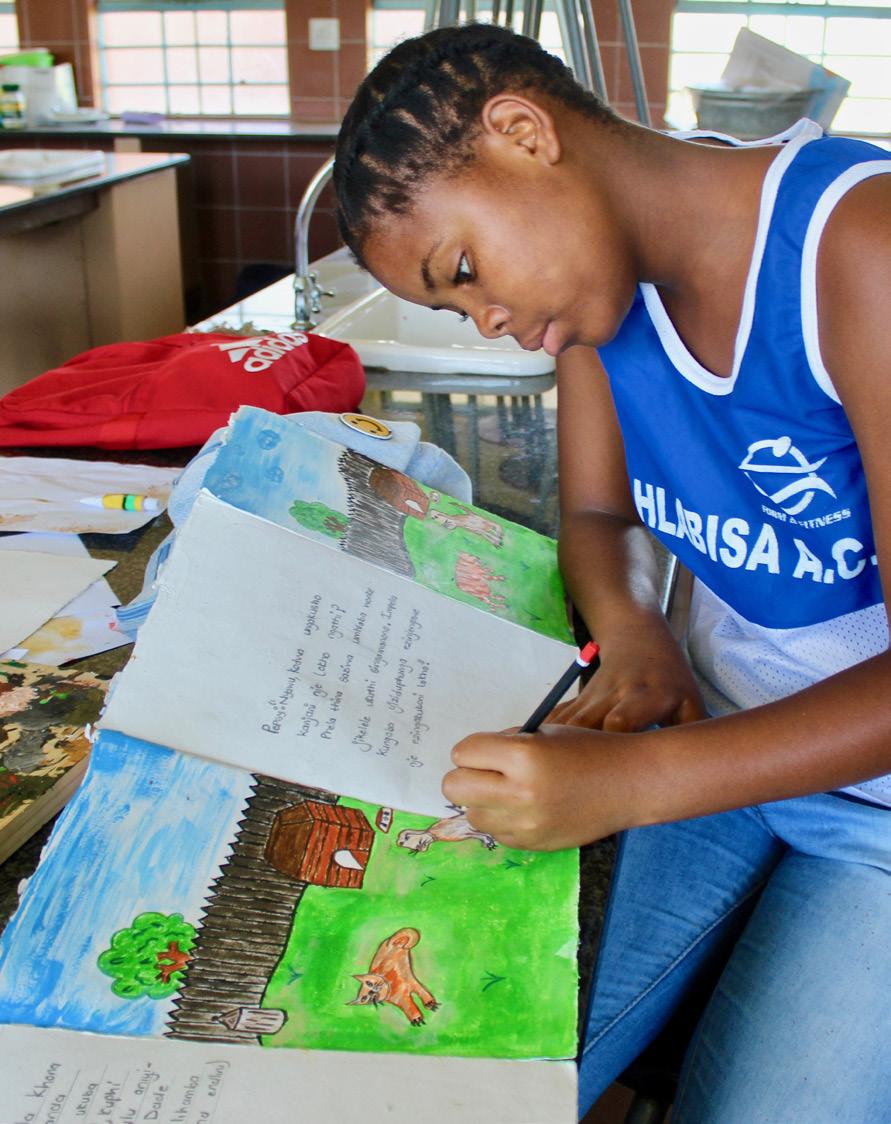
Muziwandile Gigaba — 2/2
Next, I conducted a workshop at NqabakaZulu high school in KwaMashu Township, KwaZulu- Natal in South Africa. The students that I worked with were from grade eight to nine. The school does not offer art classes but Zama Dunywa, a teacher from the school, had a small group of students to whom she occasionally teaches art. I worked with Zama’s group and had a successful workshop. The experience here was different from the other projects because I ran the entire project in the isiZulu language. The project aimed to encourage students to think creatively by looking at their cultural aspects and oral knowledge. I gave the students a brief presentation of my work then they worked on their artbooks. I then taught them how to write the artist statement as well. In the end, the teachers from the school were also captivated by the project.
The art book project is sort of a “bring and share” initiative of oral knowledge through stories that are articulated and written in home languages. All participants transcribe their stories into artbooks. These may be exhibited in a traditional sense and through photographic documentation on digital platforms. At the moment I am in a phase of doing workshops and collecting stories from different communities.
In the project, each participant gets to keep the original book but I ask to get permission to document the books so that in the future all
participants will be able to access stories on a website. The participants may also be asked to lend me the original books for crosscultural travelling exhibitions. The website project is in the planning. Participants whose books are featured on the website project will be translated in different languages, but only in the languages of those communities that have contributed. I intend to have documentation in audio as well to encourage learning of different languages.
As it now stands, I have secured a residency in Zambia where I will be conducting a workshop and exhibit with local artists from the Modzi Arts community project in Lusaka. I continue to collect stories and conduct workshops while I am preparing for a show of the collected stories and new work at the Durban Art gallery. The show will feature a body of my work in a dialogue with selected books made by participants of the art book project. It will also include a screening about the project accompanied by audio recordings that narrate the selected collected stories. I am grateful to have been a CAD+SR fellow for the 2018 - 2019 program. The CAD+SR has not only provided platforms to share ideas but has ignited the idea of independent thinking and motivated me to take charge of my project explorations. The best part is that through the fellowship program I am now part of a community of researchers from all over the world with whom I can share ideas and collaborate in other artful activities.
126 FELLOWS’ BIOGRAPHIES
ABDULLAH QURESHI
is a Pakistani born artist, educator, and cultural producer. Within his artistic practice, he is interested in using painting and collaborative methodologies to address personal histories, traumatic pasts, and childhood memories. Through his on-going doctoral project, entitled Mythological Migrations: Imagining Queer Muslim Utopias, he examines formations of queer identity and resistance in Muslim migratory contexts. Qureshi’s work has been exhibited internationally, and he has held numerous positions at cultural and educational institutions including the British Council and the National College of Arts, Lahore. In 2017, Qureshi received the Art and International Cooperation fellowship at Zurich University of the Arts, and in 2018, a research fellowship at the Center for Arts, Design, and Social Research, Boston. In 2019, he joined the Center for Feminist Research, York University, Toronto as a visiting researcher, and is currently a Doctoral Candidate, supported by Kone Foundation, at Aalto University in Finland.
BENTLY SPANG
is a mixed-media artist, educator, writer and curator and an enrolled member of the Tsitsistas/Suhtai Nation(a.k.a. Northern Cheyenne). Working in mixed media sculpture, video, performance, photography and installation, his work has been exhibited at the Metropolitan Museum of Art, the Brooklyn Museum, the National Museum of the American Indian, and the Nelson-Atkins Museum to name a few. His work is in numerous museum collections in the USA and Europe. He has a Bachelor of Science Double Major in Art and Business Administration from Eastern Montana College in Billings, Montana, and a Masters of Fine Arts degree in Sculpture from the University of Wisconsin-Madison. He taught at Bard College in the 2016 Summer MFA program and was a FullTime Visiting Professor in Video at the School of the Museum of Fine Arts/Tufts University, Boston, Massachusetts from 2007–2009. He is a 2018 recipient of the Native Arts and Cultures Foundation National Artist Fellowship and a 2017 recipient of a Montana Arts Council Artist’s Innovation Award.
BRUNO MORESCHI
was born in Maringá, Brasil in 1982. He currently lives and works in São Paulo. He is a researcher and visual artist with projects that approach the system of visual arts itself, especially its physical and virtual spaces of legitimization, focusing on decoding the field, and revealing its hidden procedures. As a PhD researcher (Unicamp, BR) with exchange at Helsinki Art Academy, Moreschi has Art History teaching experience, with postcolonial classes, and projects recognized by grants and exhibitions such as 33ª São Paulo Biennial, Rumos Prize, Brazilian Advanced Post-Graduate Agency, and Deviant Practice 2018–2019 Van Abbemuseum. São Paulo Museum of Contemporary Art, Colombia National Museum, and CA2M are some institutions with Moreschi’s works, usually in a way that problematizes their collections.
@CRITICALDÍAS
is arts research duo Rebecca Close (UK) and Anyely Marin Cisneros (Venezuela). They have produced numerous funded curatorial, artistic and research projects on the intersections of the feminisms, sexual dissidence, anti-racism, contemporary art and new media. Between 2015-2017 they were resident researchers at the University of the Arts, Guayaquil, Ecuador and were recipients of the Hangar Center for Art and Technology and Casa Velazquez artistic research grants. They won the Miquel Casablancas Prize for Visual Arts for “Reinscriptions”: a publication on the intersections of politics of the body and history of science that maps emergent racist logics across machine learning and AI. Their current work considers resistance to ‘reproductive control’ in the digital age.
GABRIEL PEREIRA
is a a PhD Fellow in Information Studies at Aarhus University (Denmark). He is interested in practices that bring together science and technology studies with software and artistic practice. His main research focus is around critical studies of data, algorithms, and digital infrastructures, especially for computer vision. In 20182019, he was a visiting Graduate Student at MIT’s Global Media Technologies and Cultures Lab, collaborating with research projects of the center. Projects with Gabriel have been exhibited in the 33rd Sao Paulo Art Biennial, the Van Abbemuseum, IDFA DocLab, Itaú Cultural, aarea.co, and academic journals/ conferences. He is a Researcher in Residence at the Center for Arts, Design, and Social Research, and previously was a Research Fellow.
LAINE RETTMER
is a visual artist and opera director whose work explores performance, gender and methods of social control. Her visual art has been presented at the Vizcaya Museum, Institute of Contemporary Art, Massachusetts Institute of the Art Museum, Manifesta, the Museum of Fine Art Boston, the Yuan Art Museum, Yve Yang Gallery, Perkins and Ping, Present Company, NADA NY, NADA Presents. Her opera productions have been called “wickedly smart” and “devastatingly funny” by The New York Times, and “profound and shattering” by the Observer. Recent awards include a MAP Fund grant for the collaborative opera Standby Snow, a Fellowship from HFBK Hamburg, and residencies at Skaftfell Center for Visual Arts in Iceland and the Watermill Center on Long Island . Rettmer currently teaches media and sculpture at the Rhode Island School of Design. She holds a BFA from NYU and an MFA from the School of the Museum of Fine Arts at Tufts.
MUZIWANDILE (MUZI) GIGABA is from Kwa Mashu Township in the province of KwaZulu- Natal, South Africa. Received his Masters in Arts at the University of Johannesburg, which he completed cum laude honors in February 2018. He is the CAD+SR research Fellow 2018-2019. Since then he is running a book art project, #HLONIPHA ULIMI LWAKHO/ #MIND YOUR LANGUAGE which is an ongoing indigenous language awareness and exchange project in which he uses his own art work as a catalyst to facilitate art book making in indigenious communities. The project was initiated in Spoletto, Italy in 2018 and it has traveled to Merida/ Mexico, South Africa. Apart from the project,Gigaba works as a sculptor and a printmaker. He has worked in numerous projects and exhibtited in Serbia, Egypt,Portugal,Romania and USA. Muzi Gigaba is also incoporates his dj skills in his art practice as a way of exploring his interests in language preservation.
SYOWIA KYAMBI is a mixed media artist, who enacts characters within her performance installations to tell stories, which are alternative layered narratives that disrupt the mono-cultural violence of colonial histories and their shaping of our societies. The connection between the psyche, history and the entanglement that exists within active and transmuting identities is ever-present in her creative process. Her practice probes issues of race, perception, hierarchical systems, gender studies and body memory. Syowia’s practice examines how the past is affecting our present, influencing our future possibilities.
Syowia is based in Nairobi and of Kenyan/German origin. She is an alumnus of the School of the Art Institute of Chicago. Her works include a permanent commission ‘Infinity: Flashes of the Past’ for the Nairobi National Museum (2007), and an ephemeral performance installation ‘What’s Wrong Dear Jane’ for the Kenyan Art Fair (2014). She is the recipient of the CAD+SR research fellowship (2018-2020 cycle), the UniArts Helsinki fellowship (2018), the Smithsonian Artist Research Fellowship (2017) and the Art in Global Health grant from the Wellcome Trust Fund in the United Kingdom (2013). She has been made a senior fellow with Centre for Arts, Design and Social Research. Her work has been exhibited in museums and galleries in Senegal, Belgium, Finland, Kenya, Mali, Sweden and elsewhere.
TAMARA AL-MASHOUK
was born in Saudi Arabia in 1988. She graduated from Wellesley College with a major in architecture (2010) and holds a Master of Fine Arts degree from the School of the Museum of Fine Art at Tufts University (2016). Through video, performance, and architectural installation, Al-Mashouk examines the movement of people across societal and national borders with specific focus on the intersectional body and conversely this body’s relationship to institutional systems. She has founded an all female fine art gallery at a music and arts festival in upstate New York. She produces single and multi channel video works for the gallery and public sphere- a five channel video installation for a solo show in Boston, a two channel video installation in Beijing, and a three hour multi channel live video performance in London. She is currently based in Bahrain and is in production of her next two video works.
YORNEL MARTÍNEZ
is a graduate of the Instituto Superior de Arte (ISA) in 2007, La Habana, Cuba. He is part of a generation of Cuban artists interested in the gesture and conceptual methodologies. He is interested in expanding his artistic practice to other contexts and creating dialogues with other reference points in the visual arts, including with curators, critics, other artists and researchers from other disciplines, with the proposition of enriching and stimulating my uncertainties and questions as much in the artistic and intellectual areas. He is joining the Center’s programs because of its programmatic objectives as a space where different disciplines encounter the conditions of contemporary creativity with a spirit of collaboration between different disciplines and multiple perspectives.
ACKNOWLEDGEMENTS
The Center for Arts, Design, and Social Research (CAD+SR) is an international nonprofit based in Boston, US and Helsinki, FI. Founded in 2017, on the principle of supporting and centering multiple and heterogeneous ways of knowing in contemporary research, the Center was conceptualized as a project outside of and in between existing educational institutions. It is archipelagic, after Édouard Glissant; a research program distributed across different places and forms to host people from diverse global locations, creating transitory spaces to gather, share, and learn.
This publication documents the inaugural year, 2018-2019, of our annual Research Fellows program. Designed around three 10-day research residencies over the course of the year, the program also provided a monetary fellowship. Support for the program was generously provided by philanthropic individuals and organizations whose visions aligned with the idea of an international, transdisciplinary community of artists and researchers. We are deeply grateful for their support, as well as that of many other collaborators and comrades, including the Board of Directors and Advisory Board. Our Board of Directors is essential to our work. They include: Alan Strassman (Founding Chair, 2017-2018); Joseph Freeman (Chair, 2018-present); Dr. Lisa Brock, (2017-present); Dr. Annie Fukushima (2025-present); Dr. Gaïta Leboisettier (2017-2023); María Luisa “Papusa” Molina (2020-present); Gunalan Nadarajan (2023-2025); Dr. Gabriel Pereira (2024-present); and Espi Sanjana (2017-2025). Our international Advisory Board is a source of ongoing inspiration and support. This group includes: Marguerite Avery (2017-present); Dr. Juan Carlos di Martin (2017-present); Evelyne Jouanno (2017-2023); Dr. Mira Kallio-Tavin (2017-present); Hou Hanru (2017-2023); Gunalan Nadarajan (2025-present); Dr. Dava Newman (2017-present); Shady El-Noshokaty (2017-present); Dr. Rodrigo Ochigame (2023-present); Yvonne Adhiambo Owuor (2019-present); Dr. Ellen Poss (2017-2024); Dr. Kevin Tavin (2017-present); Guillermo Trotti (2017-present); Jodi Rave Spotted Bear (2017-present); and the Raqs Media Collective (2017-present).
We want to especially thank Lexicon’s designer Guilherme Falcão whose open, caring, and meticulous design sensibility gives powerful form to the community’s many differences and continuities. The project weathered the COVID-19 pandemic and the delays caused by its long shadow. In deference to the authors’ voice and intention at a particular historical juncture, the content remains as it was during the
submission and revision process. This is a living document intended to reflect one moment in an ongoing dialogue, again amply reflected in Falcão’s design.
We are grateful to all of the Research Fellows for their close attention to charting and sharing their transformations with the readers/viewers of this text; as well as to their commitment to the radical proposals of the program, as is documented here. In addition to the CAD+SR 20182019 Research Fellows included in Lexicon, the research residencies, Commonplaces & Entanglements, held in Spoleto, Italy (July 2018 and July 2019) and Mérida, Mexico (January 2019) were attended by many visitors, including scholars, scientists, and artists. Many of them are present in the photographs of the residencies included here. We thank each of them for their generous and lively contributions to those gatherings. The Visiting Artists, Researchers, and Faculty Fellows in 2018 included Adwoa Boakye; Dr. Lisa Brock; Otis Cunningham; Evelyn Eastmond; Dr. Annie Fukushima; Dr. Laura Fantone; Josh Gordonson; Liz Hickock; Robert Ochsorn; Katherine Lee; Sebastian Lütgert; Isabelle Massu; Dr. Kerry Rodden; and Kai Ye. Next, the residency in Mérida, Mexico, Constelación Eek’O’Ob, was co-organized with Faculty Fellow Dr. Raul Moarquech Ferrera-Balanquet. This residency included Research Fellows from Mérida, Yucatan: Luis Dinaldy, Germán Pech Echeverría, Ainox/Eduardo Ojeda García, Ilsee Irasema Morfín German, Analie Gómez, Miguel Cetina Muñoz, Gema Ríos, José Luis Rumbo, and Miguel Ángel Vázquez Tapia. Faculty Fellows included Marguerite Avery; Jodi Rave Spotted Bear; Dyelsi Jimenez; Dr. María Luisa “Papusa” Molina; Dr. Dava Newman; Dr. Fidencio Briseño-Chel; Guillermo Trotti; and Dr. Felipe Castillo-Tzec. The residency’s public exhibition and performance events were hosted by Galería El Caimito, directed by Jose Luis Rumbo. The final residency of the cohort was held in July 2019 in Spoleto, Italy, with visitors Dr. Lisa Brock; Otis Cunningham; Dr. Annie Fukushima; Dr. Annette Markham; Isabelle Massu; and Chien-Ying Wu. CAD+SR staff for the residencies included Isabel Beavers; Ea DomkeChase; Sybille Gorneille; Sopheak Sam; and Mary Ellen Strom.
Our sincerest thanks to you for making this impossible community possible.
Dalida María Benfield and Christopher Bratton Helsinki & Boston, March 2026
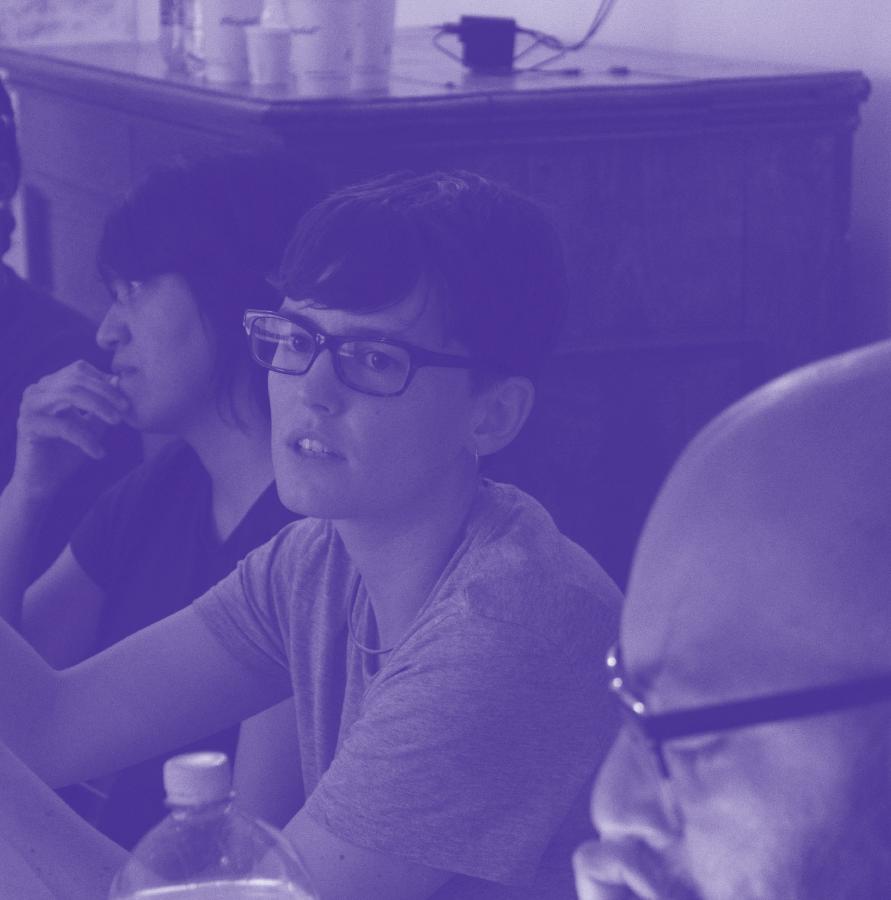
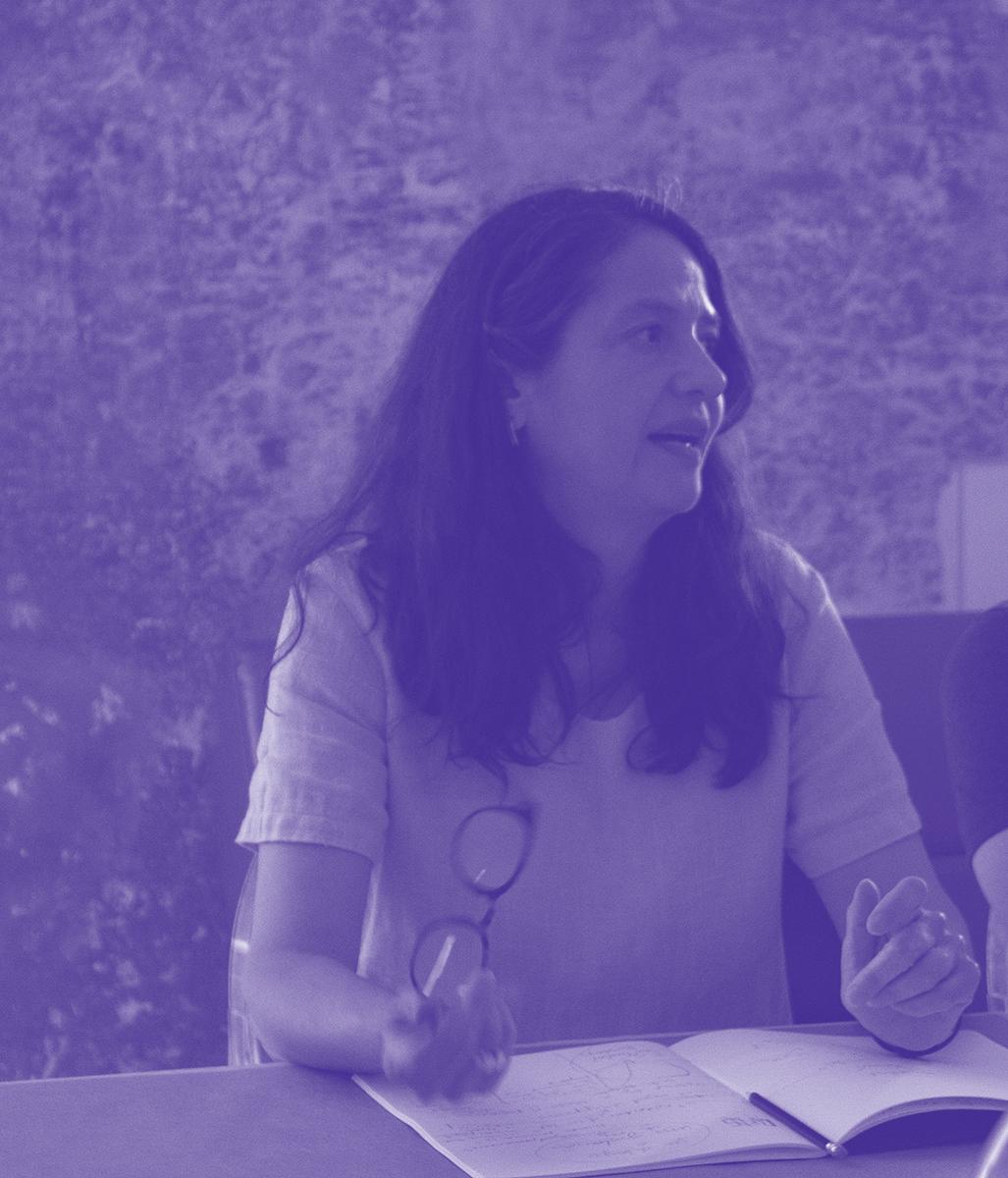



Introductory texts — Dalida María Benfield and Christopher Bratton
Editors — Dalida María Benfield and Christopher Bratton
Design — Guilherme Falcão
Copyediting — Bruna Wagner
Photography — CAD+SR staff, except where otherwise noted
This book is set in Akkurat by Lineto/Laurenz Brunner; Freight Text by Joshua Darden; Galaxie Copernicus by Village; IBM Plex by Mike Abbink + IBM BX&D; Mercury Text by Hoefler&Co; National by Klim/ Kris Sowersby; Replica by Lineto/ Norm; Silva and BLK Grotesk by Blackletra/ Daniel Sabino.
ISBN 978-1-7356981-2-0
This collective work is licensed CC BY-NC-ND 4.0 All authors retain full rights to their texts.
This book is published by Center for Arts, Design, and Social Research (CAD+SR). First Published March 2026.
Center for Arts, Design, and Social Research
75 Lincoln Road
Wayland, MA 01778 United States + 1 508 785 5218 www.centerartsdesign.org