M-Sand vs River Sand: Impact on Concrete & Cement Choice
M-Sand vs River Sand: Choosing the Best Concrete & Cement
Introduction: A Shift in the Foundations of Modern Construction
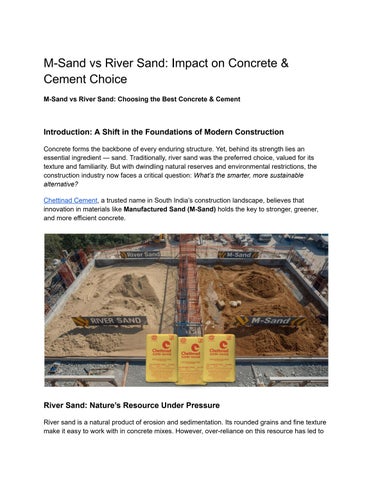
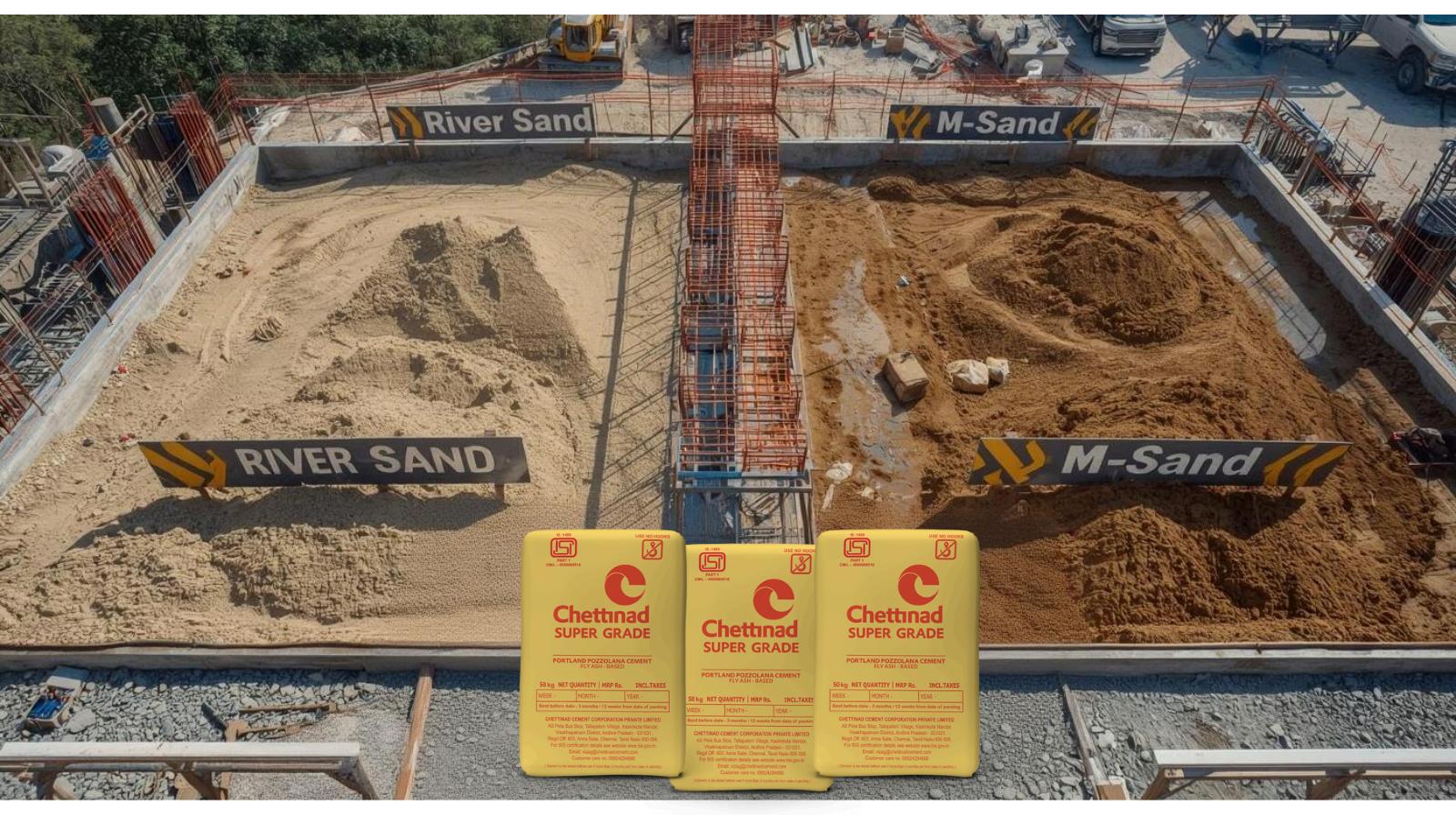
Concrete forms the backbone of every enduring structure. Yet, behind its strength lies an essential ingredient sand. Traditionally, river sand was the preferred choice, valued for its texture and familiarity But with dwindling natural reserves and environmental restrictions, the construction industry now faces a critical question: What’s the smarter, more sustainable alternative?
Chettinad Cement, a trusted name in South India’s construction landscape, believes that innovation in materials like Manufactured Sand (M-Sand) holds the key to stronger, greener, and more efficient concrete
River Sand: Nature’s Resource Under Pressure
River sand is a natural product of erosion and sedimentation Its rounded grains and fine texture make it easy to work with in concrete mixes However, over-reliance on this resource has led to
severe ecological imbalance eroded riverbanks, loss of biodiversity, and restricted mining in many regions.
The quality of river sand also varies widely Impurities like silt, clay, and organic matter can weaken concrete and increase cement consumption. With inconsistent supply and rising costs, river sand is no longer the dependable material it once was
The Rise of M-Sand: Engineered Precision for Modern Construction
M-Sand, short for manufactured sand, is produced by crushing durable rocks usually granite into fine aggregates that meet specific standards Unlike river sand, its production is controlled, ensuring consistency in grain size and quality.
Chettinad Cement recognizes that M-Sand’s angular particles enhance bonding within concrete, leading to higher compressive strength and durability. When combined with Chettinad’s premium cement formulations, M-Sand performs exceptionally well, creating dense, cohesive concrete mixes ideal for modern construction needs
River Sand vs M-Sand: A Detailed Comparison
Property River Sand M-Sand
(Manufactured Sand)
Source
Natural river deposits Crushed granite or hard stone
Grain Shape Rounded and smooth Angular, cubical
Texture Soft, fine Rough, consistent
Silt/Clay Content Up to 10% <2%, minimal impurities
Moisture Variation
High, inconsistent Controlled and stable
Availability Seasonal, limited Readily available year-round
Workability Good Excellent with admixtures
Strength Contribution Moderate
Environmental Impact
High (river mining)
High with proper cement mix
Low (quarry-based production
When combined with Chettinad PPC or OPC cements, M-Sand ensures superior strength, minimal shrinkage, and better durability, particularly in high-rise or infrastructure projects.
How Sand Choice Affects Concrete Strength and Workability
In any concrete mix, sand acts as a filler and bonding agent for cement. M-Sand’s angular particles interlock tightly, improving the mechanical bond with cement paste. This enhances compressive strength while reducing voids in the mix
Chettinad Cement’s precise formulation complements M-Sand by maintaining optimal hydration and workability While river sand’s smoothness makes it easier to handle, it often demands more cement to reach equivalent strength increasing costs and carbon footprint
By contrast, concrete made with Chettinad Cement and M-Sand achieves higher strength with less cement usage, offering both economic and environmental advantages
Environmental and Economic Impact
Sustainability is central to Chettinad Cement’s philosophy. River sand mining disrupts ecosystems and drains groundwater, whereas M-Sand is manufactured from readily available quarry dust an industrial byproduct that would otherwise go to waste.
By encouraging the use of M-Sand, Chettinad Cement supports responsible construction practices that lower environmental impact and reduce dependence on natural resources Additionally, the consistent availability of M-Sand ensures cost stability and project continuity, even when natural sand supply fluctuates
Influence on Cement Consumption and Mix Design
The type of sand significantly affects the quantity of cement required in concrete. M-Sand’s controlled gradation reduces voids, ensuring a denser matrix that requires less cement for the same strength target
Chettinad Cement’s advanced binding technology works seamlessly with M-Sand to create cohesive, low-permeability concrete that resists cracking, moisture ingress, and long-term deterioration. Builders using this combination report measurable savings in cement volume and improved lifecycle performance of concrete structures
Quality Control and Standardization in M-Sand
For M-Sand to deliver its potential, strict manufacturing control is vital High-quality M-Sand is produced using Vertical Shaft Impact (VSI) crushers followed by washing and grading, ensuring compliance with IS:383 standards for fine aggregates
Chettinad Cement collaborates with certified M-Sand suppliers to maintain consistency in mix design and quality This partnership approach ensures that every batch of concrete made with Chettinad cement and approved M-Sand meets the highest standards of strength, durability, and performance.
Challenges and Misconceptions
Some still perceive M-Sand as inferior due to earlier misuse of unwashed or low-grade products Chettinad Cement actively addresses this misconception through technical workshops and site support, educating builders and engineers about proper material selection and mix design optimization
When sourced and handled correctly, M-Sand is not a compromise it’s an improvement. Chettinad’s R&D teams continuously test sand-cement combinations to ensure reliability across varied climatic and construction conditions
The Way Forward: Sustainable Construction with Chettinad Cement
As India’s construction demand accelerates, the transition to engineered materials like M-Sand is not optional it’s essential Chettinad Cement advocates for eco-efficient construction practices that merge strength with sustainability.
Through consistent product innovation and partnerships with certified M-Sand producers, Chettinad Cement is redefining how concrete is made stronger, greener, and smarter Whether it’s residential, commercial, or infrastructure development, Chettinad Cement provides the foundation for long-term structural integrity
Conclusion: Building the Future, Responsibly
The debate between M-Sand and river sand is more than a material choice it’s a choice between depletion and sustainability With Chettinad Cement’s high-performance cement and engineered M-Sand, builders can achieve durable concrete without compromising environmental ethics
This combination embodies the future of construction efficient, resilient, and eco-conscious By embracing M-Sand and Chettinad Cement together, builders lay not just concrete foundations but also a commitment to responsible growth and enduring quality
Final Note:
For superior performance and sustainability in every pour, choose Chettinad Cement engineered for strength, trusted for generations