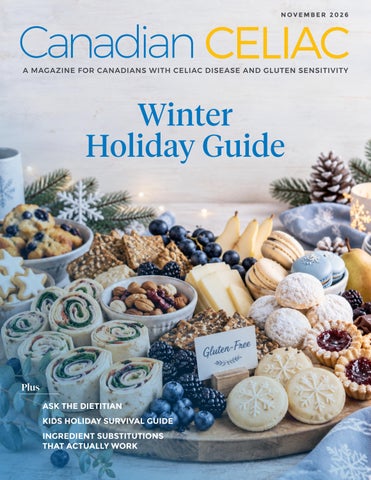
Canadian CELIAC Insert up to two lines here
NOVEMBER 2026
— Name of person
A MAGAZINE FOR CANADIANS WITH CELIAC DISEASE AND GLUTEN SENSITIVITY
Winter Holiday Guide
Plus ASK THE DIETITIAN KIDS HOLIDAY SURVIVAL GUIDE INGREDIENT SUBSTITUTIONS THAT ACTUALLY WORK 1 | Canadian CELIAC
Board of Directors Insert up to two lines here
— Name of person
BOARD OF DIRECTORS Chair: Doris Foster Vice Chair: Rumi Jasavala Past President: Lizbeth Wall Treasurer: Don Leslie Secretary: Raman Sehmbi National Executive Director: Melissa Secord, CAE
Eyobe Amberber Stephen Ashworth Stu Guttman Roberta Kramchynsky Seán Murphy Steven Poirier Talia Zenlea
CONTACT US: CELIAC CANADA 6733 Mississauga Rd., Suite 700 Mississauga, ON L5N 6J5 Canada Phone: 905.507.6208 or 800.363.7296 Fax: 905.507.4673 | Email: info@celiac.ca www.celiac.ca
Canadian CELIAC A MAGAZINE FOR CANADIANS WITH CELIAC DISEASE AND GLUTEN SENSITIVITY EDITORIAL BOARD National Executive Director: Melissa Secord, CAE Director of Marketing: Lindsay George Dietitian: Caleigh McAulay, BSc M.AN RD Marketing Coordinator: Leah Vlasic Contributing Editors: Mervyn Dean (NL), Kirsten Millar (NS), RonniLyn Pustil (ON), Lizbeth Wall (BC) Design/Layout: Deborah Doucette, CPACC epubsupport.com STORY CONTRIBUTORS Patricia Chuey Anna Cowan Mervyn Dean Lindsay George
Steven Hubley Chelsea Lukawy Caleigh McAulay Kirsten Millar
Alyssa Ramuscak Melissa Secord Leah Vlasic
COVER IMAGE DEB DOUCETTE Copyright © 2026 by Celiac Canada Publication Agreement #40787580 Canadian Celiac is published for Celiac Canada, Coelique Canada. Reproduction of this magazine in whole or in part is prohibited without the express written consent of the publisher.
2 | Canadian CELIAC
A magazine for Canadians with celiac disease and gluten sensitivity
INSIDE THIS ISSUE
4
14
Melissa's Message
ADVOCACY
5 7 9 11 12
From Canadian Advocacy to Global Action
Natalie's Hope: Helping Others Receive the Support They Need
14
Research Roundup
Is "Dr. AI" Ready for Patients with Celiac Disease? Ask the Dietitian: Cross-Contact My Diagnosis Story
TOOLS AND RESEARCH
16
Meet the 2026 J.A. Campbell Research Award Recipients
18
Catching Up with the 2020 J.A. Campbell Research Award Winners
T H E H O L I D AY G U I D E
22 23
Gluten-Free Getaways
24 26 28 30 32 34
Hosting the Holidays
24
Navigating Religious Practices and Celebrations with Celiac Disease A Kids Holiday Survival Guide Keeping the Holidays Safe and Joyful in Care Great Gluten-Free Gifts for Everyone on Your List Keeping Holiday Baking Delicious and Gluten Free Tasty Treats for Holiday Gatherings
COMMUNITY
35 38 39
Making the Gluten-Free Diet Accessible Celebrating Volunteers A Community of Support
39 Canadian CELIAC | 3
Melissa's Message Insert up to two lines here — Name of person
A YEAR OF
PROGRESS A Future of Possibility
As 2026 draws to a close, I find myself reflecting not only on what Celiac Canada has accomplished this year, but on what is becoming possible for our community. This has been one of our strongest years of progress. Together, we have advanced efforts to make the medically required gluten-free diet more affordable by engaging federal decision-makers, advocated for safer food and better access, invested in Canadian research, and delivered trusted education and support to people across the country. At the heart of this work is our mission: Find. Treat. Cure. We need to find the many Canadians who remain undiagnosed. We need to improve how we treat celiac disease today—through safer food, better support, increased access, and new treatment options. And ultimately, we want a cure. There is good reason for optimism. As this issue reaches you, we are about to bring our community together for Celiac Canada’s Virtual Research Conference to hear about emerging science and new discoveries. Our National Board is also looking 4 | Canadian CELIAC
ahead, shaping our priorities for the next three years. And soon, I will be heading to Melbourne, Australia, for the International Celiac Disease Symposium, where researchers and clinicians from around the world will share the latest advances in celiac disease. We are learning, connecting and bringing that knowledge home to Canada. None of this happens without you. Your stories strengthen our advocacy. Your participation advances research. And your donations make this work possible. As we enter the holiday season, thank you for believing in what we can accomplish together. There is much more work ahead—but also tremendous possibility. u Melissa Secord National Executive Director P.S. At this time of year, I also think about those in our community who may be struggling to afford safe gluten-free food. If you are able, please consider adding a few gluten-free items to your holiday giving through our Save Me for Gluten Free initiative. Every contribution, no matter how small, can help get safe food in the hands of someone who needs it.
Advocacy Growing up celiac MOMENTUM BUILDING
FROM
CANADIAN
ADVOCACY to
GLOBAL ACTION Whether we are at the table with Canadian decision makers or alongside celiac organizations from around the world, Celiac Canada’s role is the same: to bring the needs, experiences and voices of Canadians with celiac disease to the people and places where change happens.
PHOTO CREDIT: MELISSA SECORD
Our current advocacy efforts focus on several key priorities:
Left to right: Melissa Secord, Executive Director at Celiac Canada, The Honourable Marjorie Michel, Minister of Health, and Sonia Sidhu, MP for Brampton South.
❚ Making precautionary labelling more meaningful International efforts to advance riskbased precautionary allergen labelling present an important opportunity to make “may contain” statements more consistent and meaningful. We are working with Health Canada and Continued on next page Canadian CELIAC | 5
Greater Canadian capacity means more choice and resilience at home.
international partners as Canada explores next steps. Our goal: a science-based approach that helps Canadians with celiac disease make safer, more confident food choices.
Through the Global Celiac Advocacy Alliance (GCAA), we are working with organizations worldwide to share expertise, align priorities, and strengthen the collective voice of people living with celiac disease.
❚ Reducing the burden of the Medical Expense Tax Credit The cost of maintaining a gluten-free diet continues to put financial pressure on Canadians with celiac disease. We are raising awareness among parliamentarians and decision-makers about the limitations of the current Medical Expense Tax Credit process and advocating for a simpler, more accessible approach that recognizes the additional cost of glutenfree food without requiring people to track individual products and receipts.
This November, members are meeting in Melbourne, Australia, to discuss precautionary labelling, glutenfree standards, gluten detection devices, clinical guidelines for people with celiac disease, and ways to build greater global awareness.
❚ Modernizing Canada’s gluten-free regulations Science, food production and international standards continue to evolve, and Canada’s glutenfree regulations need to evolve with them. We are advocating for clear, modern regulations that protect people with celiac disease, provide greater consistency for food producers, and make gluten-free labelling easier for consumers to understand and trust. ❚ Building a stronger Canadian gluten-free agri-food sector We are exploring opportunities to collaborate with Canada’s agriculture and food sectors to strengthen domestic production, processing and innovation in gluten-free ingredients and foods. Building Canadian capacity could mean greater choice and a more resilient supply of gluten-free products at home, while creating new opportunities for Canadian producers in global markets. ❚ Sharing Canada’s voice with the world Our advocacy doesn’t end at Canada’s borders. 6 | Canadian CELIAC
Celiac Canada also convened a new Global Food Policy Table to help patient organizations break down silos, share expertise and work toward greater alignment on food policy and gluten-free standards. u
Growing up celiac Online Tools
IS “DR. AI”
Ready for Patients
with Celiac Disease? ALYSSA RAMUSCAK, RD
The 1990s and early 2000s changed how many people looked for health information. Search engines made answers easier to find, but they also made it harder to know which information was accurate and trustworthy. Today, another shift is underway with artificial intelligence, or AI: computer systems that process large amounts of data, identify patterns, and follow instructions to perform tasks. Many people already encounter simple forms of AI in everyday life, such as online advertisements based on browsing or purchasing history.(1) More recently, generative AI, which creates new content that can resemble human-produced text, images or code, has gained widespread attention. ChatGPT
launched publicly in November 2022 and reached more than 100 million users within two months.(2) These tools can summarize information quickly, but they raise a familiar question: How accurate and trustworthy are the answers? A recent study by JanssonKnodell and colleagues (3) put that question to the test by evaluating How well AI chatbots provide information about celiac disease and the gluten-free diet.
Four widely used AI chatbots— Google Bard, OpenAI's ChatGPT-4, Microsoft Bing Chat in Precise Mode, and Microsoft Bing Chat in Creative Conversation Mode—were accessed through their free tiers and asked 10 basic questions about celiac disease. Two gastroenterologists and two dietitians with expertise in celiac disease and the glutenfree diet reviewed the answers for missing information, inaccuracies and clarity. Continued on next page Canadian CELIAC | 7
PHOTO CREDIT: VECTEEZY
F R O M S E A R C H I N G TO C H AT T I N G
Your healthcare team and trusted organizations, such as Celiac Canada, remain the best source for accurate, personalized guidance.
The results were mixed. Some responses were accurate and helpful, but quality varied widely. ChatGPT performed highest for usefulness, clarity, lack of missing information, and lack of inaccuracies, while Google Bard performed poorest. In some cases, the chatbots gave incomplete, confusing or incorrect information. For example, ChatGPT provided harmful advice suggesting that a child with celiac disease should gradually reintroduce glutencontaining foods. For a one-week gluten-free meal plan, ChatGPT listed all 75 items as gluten free, but the authors noted that responses could be vague, repetitive and missing practical details such as full ingredient lists, brands, recipes and total cost. These findings suggest that AI chatbots are not yet reliable as standalone health information sources. They may become helpful supplementary tools, but they cannot replace healthcare professionals, including registered dietitians, who provide personalized guidance for managing celiac disease. Important Considerations When Using Generative AI Generative AI responses are only 8 | Canadian CELIAC
as good as the prompts provided. Being specific and including relevant details may improve the quality of the answers. AI draws from information across the Internet. AI-generated answers may not always apply to your location. For example, a product considered gluten free in one country may not meet gluten-free standards in Canada.
To read the full paper: https:// www.cghjournal.org/article/S15423565(24)00986-8/abstract
EVERYTHING YOU NEED TO KNOW IN 3 MONTHS
AI is also prone to "hallucinations," where it produces confidentsounding information that is actually incorrect.( 4) This can make it difficult to know whether an answer is accurate.
Label reading
Bottom Line
Kids
While generative AI chatbots like ChatGPT can provide quick access to information, they may not yet be reliable sources for accurate guidance on celiac disease and the gluten-free diet. As in the early days of the Internet, it is important to approach online health information with caution. When managing celiac disease, your healthcare team and trusted organizations, such as Celiac Canada, remain the best sources for accurate, personalized guidance. u
Dining out Cross - Contact
Travel
Grocery shopping
SIGN UP HERE LOOKING FOR MORE INFORMATION? www.celiac.ca
Growing up celiac Q &A C R O S S - C O N TA C T
ASK THE
PHOTO CREDIT: CALEIGH MCAULAY
DIETITIAN C A L E I G H M C AU L AY , R D
Question: Do I really need separate kitchen utensils, cookware and equipment? Answer: The good news is no— you don’t need two of everything!
of the item and how well you clean it matters more. If you have a cutting board with deep grooves and food gets stuck, it’s going to be much harder to clean than one with a smooth surface.
Recent research has been reassuring. Many kitchen items can be safely shared as long as they’re thoroughly cleaned. Just because a pot or spoon has touched gluten before doesn’t mean it’s permanently ‘contaminated’! The question is: Can you clean it well enough to remove any crumbs or food residue?
Newer research on shared toasters has also been reassuring too, but Celiac Canada still recommends using a separate toaster or toaster bags. Toasters are difficult to clean thoroughly, and having a separate toaster or toaster bags are easy, lowcost precautions against crosscontact.
For pots, pans and utensils, A few other things to keep in mind: a thorough wash with soap ❚ cook gluten-free pasta in and water or a trip through the fresh water and use a dishwasher is generally enough. separate strainer That includes wooden utensils and cutting boards! Wood itself Canadians are diagnosed differently isn't the problem—the condition across the country.
❚ avoid using shared fryer oil that has been used for glutencontaining foods ❚ watch for crumbs getting into shared butter, peanut butter or jam ❚ for equipment like air fryers, waffle irons or colanders, consider how thoroughly they can be cleaned. If crumbs or food residue are difficult to remove, a dedicated glutenfree appliance may be the easiest and safest option. Remember, every kitchen is different, and so is everyone’s comfort level. You may not want to share everything, but you don’t need a second kitchen either. Good cleaning goes a long way, and you can take extra precautions wherever they make sense for you. u Canadian CELIAC | 9
Growing up celiac
AVAILABLE IN RETAILERS NATIONWIDE HIGH FIBRE
VEGAN
LOW SUGAR
PROMISEGLUTENFREE.CA PROUD SUPPORTERS OF CANADA CELIAC ASSOCIATION
10 | Canadian CELIAC
Lived Experience
MY DIAGNOSIS PHOTO CREDIT: MERVYN DEEAN
STORY MERVYN DEAN
When I read other people's chaotic diagnosis stories, I wonder if I should feel ashamed. No abdominal cramps and frequent runs to the bathroom for me. I was in my 50s, eating well and feeling well. Then I started having intermittent heart palpitations. Yet, when the doctor examined me, I had a regular heart rate and normal blood pressure. “Let’s check your blood,” my doctor said. As a physician myself, I agreed, but I don’t think either of us expected it to show anything abnormal. A week later, he told me my iron levels were low. There were two possible reasons for this: either I wasn’t absorbing iron or I was losing iron. The latter seemed more likely, and the source of the loss would almost certainly be from my bowel. But my colonoscopy was normal. The gastroenterologist did more tests, none of which showed any
abnormality. “Well, it’s a long shot,” he said, “but we’ll screen you for celiac.” The result came back positive. Then I had an endoscopy, and the biopsy showed mild to moderate celiac disease. In medical school, I had learned that celiac disease was something to consider when a baby failed to thrive; you wouldn’t get it later in life. Now we know better. It took me a week to accept the diagnosis and start eating gluten free. I’d heard of people who felt better on the gluten-free diet—if I
already felt well, how much better would I feel now? I waited in vain, wondering ‘do I really have celiac disease?’ The answer, when it came, was emphatic. I had ordered a glutenfree pizza that ended up not being gluten free and I had my first celiac-associated bad night. My experience shows that, as with many diseases and conditions, celiac can present with a broad spectrum of severity, and even mild symptoms warrant a check with your healthcare provider. u Canadian CELIAC | 11
Festive Campaign N ATA L I E ' S H O P E
FROM DELAYED
Diagnosis
TO HELPING OTHERS RECEIVE THE SUPPORT THEY NEED Like many Canadians with celiac disease, Natalie Bédard experienced a long road before learning what was affecting her health. She spent nearly four decades on a journey toward answers, understanding, and hope. Natalie’s symptoms went far beyond stomach problems. She experienced exhaustion, infections, skin issues, delayed puberty, weight loss, and other health concerns. “I learned to live with being sick, but at a serious cost to my mental health,” she says. “I always knew something was wrong, yet I was repeatedly told nothing was wrong.”
PHOTO CREDIT: NATALIE BÉDARD
Natalie’s experience reinforces the urgent need for greater awareness and testing, well-labelled foods, and research for a cure. And it has given Natalie a clear purpose: to help 12 | Canadian CELIAC
create a future in which every Canadian living with celiac disease can receive an earlier diagnosis and the support they need. Celiac Canada plays a vital role in changing stories like Natalie’s. “I am forever grateful to Celiac Canada,” Natalie says. “They’ve been a lifeline to me, a trusted, evidence-based community that truly understands this disease and supported me through my recovery.” Natalie’s story highlights the fact that delayed diagnosis has lasting consequences, and that progress depends on sustained investment. More Continued on next page
I'm sharing my story because I know there are Canadians still searching for answers like I was. — Natalie Bédard
“I’m sharing my story because I know there are Canadians still searching for answers like I was. Supporting Celiac Canada helps improve awareness, education, advocacy and research so others can get diagnosed and supported sooner,” Natalie says. “For years I felt isolated and misunderstood. Celiac Canada helped me realize that there is an entire community of people who understand exactly what we’re going through.” This festive season, Celiac Canada is working to raise $175,000 for its Research and Advocacy Funds. Your gift can help ensure that fewer
2 0 2 6
PHOTO CREDIT: NATALIE BÉDARD
research can lead to better knowledge and care. Stronger advocacy can raise awareness, encourage earlier testing, and help address barriers to safe, affordable food.
Natalie Bédard with her daughters.
Canadians have their lives defined by delayed diagnosis and that families affected by celiac disease are seen, heard and supported. Together, we can build a healthier, more hopeful future for ourselves, our loved ones and thousands of Canadians living with celiac disease. Please donate to Celiac Canada’s year-end campaign today. u
F E S T I V E
C A M P A I G N
Natalie’s Hope
Less Waiting. More Living.
Help end the long road to diagnosis Join Natalie this festive season to help reach our $175,000 goal for the 2026 Festive Campaign to advance celiac research and advocate for more affordable gluten-free food. Watch the video “Natalie’s Hope” HERE. DONATE ONLINE HERE. Prefer to use your Donor-Advised Fund or donate securities? Contact us at giving@celiac.ca
Research
RESEARCH ROUNDUP There’s always something new happening in celiac research. From learning more about how the body responds to tiny amounts of gluten to investigating treatments beyond the gluten-free diet, here are three recent studies that caught our attention. How much gluten can trigger an immune response? How much gluten is too much? A recent randomized, double-blind study looked at how 51 adults with treated celiac disease responded to different amounts of gluten, ranging from 1 to 1,000 mg. Researchers measured interleukin-2 (IL-2), a marker of immune activation, following gluten exposure.
Could treatments beyond the gluten-free diet be getting closer? In September, early results were announced for TEV 408, an investigational treatment that blocks IL-15, a protein involved in the immune response to gluten. In the Phase 2a study, 50 adults with celiac disease received either TEV 408 or placebo before completing a six-week gluten challenge. Those
PHOTO CREDIT: VECTEEZY
Responses varied from person to person, but some participants had an immune response at doses as low as 3 mg. Interestingly, symptoms didn’t reliably reflect gluten exposure, which is another reminder that symptoms alone don’t tell the full story.
There is an important caveat. We don’t yet know whether these short-term immune responses to very small amounts of gluten lead to intestinal damage over time. More research is needed before these findings could inform any changes to current gluten-free standards.
Continued on next page 14 | Canadian CELIAC
Celiac research is becoming broader—from understanding gluten exposure to exploring potential new treatments.
who received TEV 408 experienced less gluteninduced intestinal damage and inflammation and reported lower gastrointestinal symptom scores than those who received placebo. It’s an exciting area of research, but TEV 408 is still investigational. Larger and longer studies are needed to better understand its safety and effectiveness. The real-life challenges of eating gluten free A recent study of 101 adults with celiac disease looked at the everyday challenges of following a
gluten-free diet. Eating away from home, higher food costs and limited availability of gluten-free products were among the challenges participants reported. These findings echo what Canadians told us in Celiac Canada’s 2022 State of Celiac in Canada Survey, where affordability and access to safe gluten-free food were also major concerns. Together, these studies show just how broad celiac research has become—from understanding what happens after gluten exposure to exploring potential new treatments to recognizing the everyday realities of living gluten free. u
Celiac disease is challenging. Access to safe food shouldn't be. Donate gluten-free foods. Label them “Save Me for Gluten-Free.” Encourage food banks to set them aside
Learn more
Canadian CELIAC | 15
Growing up celiac Research Award WINNER ANNOUNCEMENT
MEET THE 2026 J.A. CAMPBELL
Research Award Recipients Dr. Mark Wulczynski, from McMaster University, received the main JAC Research Award, valued at $35,000. His research will explore interleukin-2 (IL-2) as a potential biomarker for celiac disease, looking at whether it could help identify the body’s immune response to gluten. This could ultimately contribute to better ways of detecting and monitoring celiac disease. Dr. Wulczynski is a previous recipient of Celiac Canada’s Young Investigator Award, making it especially exciting
to see his continued contributions to celiac disease research. Katie Thai, an MSc candidate at the University Alberta, was one of two recipients of the Young Investigator J. A. Campbell Research Grant. Her work will explore how food insecurity affects adolescents with celiac disease. Her research will look at whether difficulty accessing affordable gluten-free food impacts mental health, quality of life and the ability to follow a gluten-free diet, helping us better understand the barriers young people with celiac disease face. Continued on next page
16 | Canadian CELIAC
PHOTO CREDIT: KATIE THAI
PHOTO CREDIT: MARK WULCZYNSKI
Celiac Canada is proud to announce the recipients of the 2026 J.A. Campbell Research Awards, supporting Canadian researchers working to improve our understanding of celiac disease and the lives of those affected by it.
This year marks the 26th anniversary of the J.A. Campbell Research Fund.
PHOTO CREDIT: ALEX FUNG
About the J.A. Campbell Research Fund Alex Fung, a medical student at the University of British Columbia, was the second recipient of the Young Investigator J. A. Campbell Research Grant. He will study food insecurity in children and youth living with both celiac disease and type 1 diabetes— two conditions that can make eating and managing health especially complex. His research will explore how food insecurity affects the ability to follow a gluten-free diet, quality of life, blood glucose control and overall health, with the goal of helping healthcare teams better support families. Research like this is made possible thanks to the generosity of our donors and supporters. Your support helps fund the next generation of celiac disease research and brings us closer to better care, better understanding and a better future for people living with celiac disease. Congratulations to all of the 2026 recipients! We’re excited to follow these projects and share what the researchers discover along the way. u
CELIAC CANADA
virtual
CONFERENCE
The fund honours the memory of Dr. James A. Campbell, a pioneer in nutrition science and a dedicated volunteer for Celiac Canada. Dr. Campbell played a key role in establishing Canada’s gluten-free labelling standards and was instrumental in advancing treatment approaches for celiac disease. Over the past 26 years, the J.A. Campbell Research Fund has supported more than 40 research projects and provided over half a million dollars in funding, fostering innovation and improving the quality of life for those with celiac disease.
Discover What's Next in Celiac Disease Research November 7, 2026
Virtual Event
Hear from leading experts on the latest advances in gluten-free science, treatment developments, and evidence-based care. Attend from anywhere Learn from top researchers and clinicians Stay informed about the future of celiac disease management
Register Now celiac.ca/nationalconference/
Canadian CELIAC | 17
GrowingAward up celiac Reseach
J.A. Campbell Research Award WINNERS
In 2020, Dr. Jenna K. Dowhaniuk and Dr. Catharine Walsh won the J.A. Campbell Research Award for their work on a patientreported outcome measure (PROM) for young people with celiac disease. Celiac Canada recently caught up with them to find out how the project has evolved. Q: Tell us about CELIAC-Q Kids. A: CELIAC-Q Kids is a PROM
designed for children and teens living with celiac disease. A PROM is a questionnaire that asks patients how they feel, 18 | Canadian CELIAC
function and experience their health and healthcare. The project gives young people a chance to tell their healthcare team, in their own words, how celiac disease affects their daily lives.
Our goal was to create a tool that captures the issues that matter most to young people and their families—from symptoms and food-related challenges to school, friendships and emotional Continued on next page
PHOTO CREDIT: CATHARINE WALSH
CATCHING UP WITH THE 2020
PHOTO CREDIT: JENNA K DOWHANIUK
CELIAC-Q KIDS
Growing up celiac personalized care. In research, it will allow us to measure outcomes that matter directly to patients and families when evaluating new treatments and interventions.
Q: What are the next steps? A: The next step is international
well-being. We hope it will help improve care and support future research for children living with celiac disease.
Q: What did you hear from young people?
A: One of the strongest
messages was that celiac disease affects much more than physical symptoms. Children and teens described how managing a strict gluten-free diet influences social activities, eating with friends, family gatherings, school experiences, and how they feel about themselves. Many spoke about constantly having to think ahead, ask questions about food, or explain their condition to others. What stood out was how interconnected these experiences were. Dietary restrictions could affect social participation, confidence, emotional
well-being, and family life.
Q: Why was it important for
the tool to address life beyond physical symptoms?
A: If we only measure
symptoms, we miss a big part of the story. We wanted CELIAC-Q Kids to capture the full experience of living with celiac disease so that healthcare providers and researchers can better understand what children and families are going through.
Q: How do you see CELIAC-Q Kids being used in the future?
A: In clinic, it could help
healthcare teams identify challenges that might otherwise go unnoticed, such as social difficulties, dietary concerns, or emotional struggles. Over time, it could help track how children are doing and support more
testing of Celiac-Q PROM with young people from multiple countries. This will help us refine the tool and ensure it works well across different healthcare settings and cultures. Our hope is to give young people a stronger voice in their care. If we can better understand what matters most to young people living with celiac disease, we can provide more patientcentred care and improve outcomes for children and families around the world. u Dr. Jenna K. Dowhaniuk, MD, MSc, FRCPC is an Associate Professor in the Division of Pediatric Gastroenterology and Nutrition at McMaster Children’s Hospital, McMaster University. Dr. Catharine Walsh, MD, MEd, PhD, FAAP, FRCPC is a staff gastroenterologist in the Division of Gastroenterology, Hepatology and Nutrition, an Educational Researcher in the Learning Institute and a Scientist at SickKids Research Institute in Toronto, and a Scientist at the Wilson Centre for research in education. Canadian CELIAC | 19
Holiday Guide
HERE’S TO A HAPPY,
HEALTHY GLUTEN-FREE
Holiday Season!
Bring on the cozy gatherings, festive flavours and gluten-free cheer! In this special holiday section, we’re serving up practical advice and fresh ideas to help make the season joyful, safe and delicious for everyone. Inside, you’ll find smart tips for winter travel, holiday hosting, gift giving, ingredient swaps for your favourite festive dishes, and much more. Grab a mug of festive glutenfree hot chocolate or cider, cue up the holiday playlist, and settle in for a great read. However you gather, give, cook, or celebrate this holiday season, we hope this guide helps you savour more of the good stuff: more health, more confidence, more flavour, and of course, more holiday joy.
Canadian CELIAC | 21
Growing up celiac W I N T E R E D I T I O N T R AV E L S U RV I VA L T I P S
GLUTEN-FREE GETAWAYS Winter travel offers endless choices—from snow-covered hills, cozy cafés and festive markets to sunny beaches, patio drinks, and historic sites. A gluten-free getaway takes extra planning, but with research and smart packing, you can escape the winter blahs with confidence. Your Destination: ❚ Research and bookmark grocery stores, pharmacies and gluten-free restaurants. ❚ Learn a few key phrases in the local language, or carry a restaurant card explaining your gluten-free needs to make dining out and communicating with food-service staff easier. ❚ Reach out to the local celiac community for tips and recommendations through the country’s celiac association or online networks like Celiac Canada’s Facebook Support Group. Your Accommodation: ❚ At a hotel or resort: Ask about gluten-free menu options before you arrive and try to book a room with a fridge or kitchenette. ❚ When eating onsite: Ask about ingredients and food preparation practices to help reduce the risk of cross-contact. Be mindful of shared utensils and toasters, serving trays and buffet areas. 22 | Canadian CELIAC
❚ At a rental or family home: Consider packing toaster bags, grill mats and a few essential utensils or pans to help you prepare food more confidently in a shared kitchen. Your Travel: ❚ Driving? Bring gluten-free favourites for your destination, plus a bag or cooler for road-trip or emergency snacks. ❚ Flying? Request a gluten-free meal when booking and pack a just-in-case kit with snacks and easy-to-prepare options such as protein bars, crackers, cookies, instant noodles, or gluten-free oatmeal. ❚ Crossing a border with food? Check your destination’s food import rules in advance. Fresh produce, meat, dairy products, eggs and some nuts may be restricted or prohibited. Download Celiac Canada’s Gluten-Free Travel Guide before your trip and head out ready to explore and celebrate every safe bite. u
Celebrations G U I D E TO R E L I G I O U S P R A C T I C E S AT T H E H O L I DAY S
NAVIGATING RELIGIOUS PRACTICES AND CELEBRATIONS
with Celiac Disease Religious traditions can bring up some unexpected questions when you have celiac disease. Can you take Communion? Does the host contain gluten? What happens when traditional foods are prepared in a shared kitchen? For Christians who take Communion, the options depend on the denomination. In the Catholic Church, completely gluten-free hosts cannot be used for the Eucharist because the host must contain wheat. However, specially produced lowgluten hosts are available. If you cannot consume a low-gluten host, receiving Communion under the species of wine alone may also be an option. Many Protestant churches have different requirements and may be able to provide glutenfree bread or wafers. And it’s not just about the food itself! Think about how Communion is stored, prepared and served. A gluten-free or low-gluten host could come into contact with regular bread through shared plates,
containers or hands. If you are unsure, talk to your priest or minister ahead of time about what options are available and how they are handled. Not every religious celebration has a specific glutenrelated requirement. For many faiths and cultures, the bigger consideration is navigating traditional foods and communal meals. During Hanukkah, for example, recipes for traditional foods such as latkes vary between families. Check the ingredients and, if the latkes were fried, whether the oil was also used for gluten-containing foods. Religious and cultural traditions vary widely between faiths, communities and families, and these are just a few examples. If food or drink is part of a religious practice or celebration, ask about ingredients, preparation and crosscontact, and connect with your faith leader or community if you have questions about possible accommodations. u For more information, visit celiac.ca. Canadian CELIAC | 23
Hosting GrowingTips up celiac TIPS FOR HOSTS AND ALLIES
HOSTING THE
HOLIDAYS KIRSTEN MILLAR
The holidays are about gathering with good company and good food. When your guest list includes someone with celiac disease, a little extra planning can help ensure everyone feels safe, included and able to enjoy the celebration. Menu planning doesn’t have to be complicated. Many holiday favourites are naturally gluten free, such as roasted vegetables, salads, potatoes, turkey and unprocessed meats (avoid cooking gluten stuffing inside the bird!) Other dishes can be easily adjusted to make them gluten free. Some simple swaps include making the gravy with corn starch or gluten-free flour and making the stuffing with gluten-free bread. Be sure to read labels carefully, as gluten can be added to seasonings, sauces and packaged items. Try making your dessert gluten free or buy a glutenfree dessert at the grocery store or a local glutenfree bakery.
24 | Canadian CELIAC
Avoiding gluten ingredients is only part of the equation. Cross-contact can occur when gluten-free foods come into contact with gluten through crumbs or shared utensils, fryers, cutting boards or serving dishes. Use clean equipment, dedicate one serving utensil to each dish, and keep glutenfree foods separate from gluten-containing items whenever possible. For mixed gatherings, serving gluten-free dishes first or creating a dedicated gluten-free section on the buffet reduces the risk of mix-ups. Consider labelling dishes so guests can confidently identify gluten-free options. Continued on next page
Consider labelling dishes so guests can confidently identify gluten-free options.
Don’t be afraid to communicate. Hosts should ask about their guests' needs and let them know that they are committed to creating a safe experience—especially if the dinner or event is at a location that isn't typically gluten free. Guests should feel empowered to reach out to ask (and answer) questions, offer support, or contribute a gluten-free dish to the meal. At its heart, holiday hosting is about making people feel cared for. When hosts and guests work together, everyone can relax and focus on enjoying the holiday and creating lasting memories around the table. For more meal ideas, check out this edition’s holiday recipes or visit celiac.ca. u
2 0 2 6
F E S T I V E
C A M PA I G N
Natalie’s Hope
Looking for inspiration
this holiday season? Challenge yourself to build a gluten-free charcuterie board appetizer with a few easy swaps—use gluten-free crackers and cured meats served alongside naturally gluten-free items like nuts, olives, fruit and cheese. Keeping the whole board gluten free removes the risk of crosscontact.
Less Waiting. More Living.
Help end the long road to diagnosis
Join Natalie this festive season to help reach our $175,000 goal for the 2026 Festive Campaign to advance celiac research and advocate for more affordable gluten-free food. Watch the video “Natalie’s Hope” HERE. DONATE ONLINE HERE. Prefer to use your Donor-Advised Fund or donate securities? Contact us at giving@celiac.ca
Canadian CELIAC | 25
Growing For Kids up celiac SELF-ADVOCACY TIPS FOR CHILDREN
A Kids Holiday
SURVIVAL GUIDE A N N A CO WA N
The holiday season is full of excitement! From family dinners and school parties to cookie decorating and holiday treats, lots of time is spent with friends and family. But if you have celiac disease, the holidays can feel a little more complicated. The good news? With some planning and some help from the adults around you, you can enjoy the season while staying safe with a few simple tips. is safe means you won't have to worry about going hungry or feeling left out. ❚ Be a Food Detective Holiday celebrations can include foods that you may not eat every day, so always check
PHOTO CREDIT: VECTEEZY
❚ Plan Ahead If you are invited to a party, dinner or school event, find out (or ask an adult to find out) what food will be available. If there aren't many gluten-free options, bring some of your favourite treats from home. Having something you know
Continued on next page 26 | Canadian CELIAC
Start your own gluten-free holiday traditions!
before trying something new. Look for foods that are labelled gluten free and ask a trusted adult if you aren't sure about an ingredient. Remember: Wheat, barley and rye contain gluten. Some foods may contain gluten even when it isn't obvious, so don't be afraid or shy to ask! ❚ Watch Out for Cross-Contact Be careful with shared serving spoons, cutting boards, butter, jam, and other spreads. Crumbs from regular bread or cookies can easily get into foods that are supposed to be gluten free. ❚ Speak Up It can feel uncomfortable telling people that you can't eat certain foods, but your health comes
ive, r h t s g kid n i p l e H ve. i v r u s st not ju
first! You can simply say, “I have celiac disease, so I need to make sure my food is gluten free.” You don't need to feel embarrassed or apologize for taking care of yourself. ❚ Focus on Fun Food is only one part of the holidays! There are so many other ways to celebrate. Watch holiday movies, play games with friends or family, go skating, build a snowman, and spend time with the people you love. You can even start your own gluten-free holiday traditions! The best parts of the holidays aren't found on a plate—they're found in the memories you make, the traditions you share, and the people you spend them with. u
Growing Up Celiac helps children and families navigate life with confidence. With trusted resources, practical tools, and expert guidance, we're supporting every stage of the gluten-free journey, from the classroom to adulthood. Free resources for kids, parents, caregivers, and educators. Learn more at celiac.ca
Canadian CELIAC | 27
Growing Food Service up celiac Guide H O L I DAY S I N C A R E
KEEPING THE HOLIDAYS
safe and joyful IN CARE
Imagine this: It’s December at your father’s longterm care home. The halls are decorated, music is playing, visitors are coming and going, and everywhere you look there is food—cookies in the lounge, trays of sweets, festive buffets and resident celebrations planned throughout the month. For most people, these holiday moments feel joyful and fun, but when your loved one has celiac disease and needs a strict gluten-free diet, they can also bring extra worry. If you have a loved one in a hospital, in a rehabilitation unit, in a long-term care or retirement home, or receiving respite care, the holidays often mean disrupted routines, more frequent visitors, and busy (sometimes different) staff. That’s one reason why it’s important to check in with the care team early about glutenfree food service over the holiday season. Ensuring you and your loved ones know what to expect when it comes to ordering holiday meals, safe snacks between meals, the protocol for holiday trays and donated treats on the
floor/unit, or who to speak with about special celebrations is important. And reinforcing with everyone involved in your loved one's care that gluten-free food is medically necessary, not a preference, can make even a short stay over the holidays feel easier. Tips for Safe Food Service Over the Holidays ❚ Start the conversation early. Talk with the care team before the holiday season is in full swing and menus and event calendars are locked in. Remind them that your loved one needs celiac-safe food, and ask to review the holiday menu with food service and nursing staff. Ask about glutenfree substitutions for holiday meals and how your loved one’s meals will be prepared, labelled and served, and about any special celebrations or events happening over the holidays. Discuss what steps can be taken so that your loved one is not left out when sweets, stuffing, gravy or other glutencontaining festive foods are served. Continued on next page
28 | Canadian CELIAC
Consider bringing a favourite celiac-safe treat your loved one enjoys and offer to bring enough to share!
❚ Have a plan to prevent cross-contact. Preventing cross-contact is especially important during the holidays, when outside food may appear in shared spaces. A friendly reminder to your loved one and their care team can make a big difference: Keep glutenfree treats sealed and clearly labelled, use separate serving utensils and keep glutenfree options in a separate serving area when possible, read ingredient labels, and avoid shared butter or spreads. You can also ask that homemade baked goods not be placed beside gluten-free snacks. Staff may also be able to post a simple reminder for visitors and/or stay aware if food is being shared.
Free Download
Celiac Canada’s Food Service in Health Care Guide Tips and tools to support access to safe, gluten-free food in hospitals and long-term care.
❚ Find non-food ways to make the holidays bright. The holidays can feel very food-focused, so look for ways to make the season feel festive and inclusive rather than limited. Ask staff about planning non-food activities like music, crafts, cards or storytelling. And when food is involved ask them to ensure there’s a safe gluten-free option available so that everyone can be included. Consider bringing a favourite celiacsafe treat your loved one enjoys and offer to bring enough to share! Tools to Help You Talk with Food Service Teams The Celiac Canada Food Service in Health Care guide is a helpful tool for families during this busy season. Sponsored by Conagra Foodservice in Canada and developed by Celiac Canada to support safe gluten-free meals for those in care, the guide offers practical recommendations on menu planning, food sourcing, preparation, service and delivery, as well as tips for avoiding cross-contact. Families can share it as a conversation starter with care teams and food service teams before their loved one moves into a residence or at the start of hospital stay. It can also be shared as a friendly reminder when there are special meals, events and celebrations. Advocating for a loved one in care is not about being difficult. It is about ensuring everyone receives the safe, healthy food they need to live well and helping the team protect patient/resident health while reducing the healthcare burden by avoiding gluten-triggered illness. Download the Food Service in Health Care guide today and use it to start a supportive conversation with your loved one’s care team. u Canadian CELIAC | 29
Growing Cheer Holiday up celiac Gluten-Free
Gift Guide
Finding the perfect gluten-free gift this holiday season doesn’t have to be a challenge! Make it a fun holiday adventure by exploring local shops, bakeries and small businesses in your community. With a little creativity and care, you can discover thoughtful gifts that celebrate your loved one while supporting local businesses along the way.
Board Games
Looking for a fun new tradition or an activity to enjoy together over the holidays? Board games are a great way to bring people together for some friendly competition and lots of laughs. Pair it with gluten-free snacks for a festive game night.
PHOTO CREDIT: AMAZON, VECTEEZY
Cooler Bag A high-quality insulated cooler bag makes it easy for anyone following a gluten-free diet to bring safe gluten-free meals and snacks wherever they go. Choose one with plenty of storage and durable construction for everyday use.
30 | Canadian CELIAC
Gift Card for a Gluten-Free Restaurant Give the gift of a delicious dining experience! A gift card to a glutenfree restaurant lets your loved one enjoy a meal out with greater peace of mind. It’s a thoughtful way to celebrate the season while supporting a local business that understands gluten-free dining.
Grocery Store Gift Card This flexible gift allows your loved one to stock up on their favourite gluten-free staples, specialty products, and treats, while helping to ease the cost of glutenfree groceries.
Gluten-Free Baking Mixes Taking the time to prepare your own mix by following a recipe online (be sure to properly prepare your cooking area - learn about crosscontact) or shopping locally to find fun and unique mixes can be a great way to show your love. When shopping, be sure to look at the ingredients! Learn how to read labels here.
Shop local and support unique artists and owners in your community.
Perfect for reheating leftovers or making a quick, easy meal, air fryers deliver crispy results with minimal effort. People with celiac disease may prefer to keep a dedicated gluten-free air fryer to reduce the risk of cross-contact. This practical gift can make everyday meal preparation faster, easier and safer.
Gluten-Free Labels Do you share a kitchen with others? Gluten-free labels are a great way to identify pantry items, leftovers, and dedicated gluten-free ingredients. This thoughtful little gift can help everyone stay organized and reduce the risk of cross-contact.
Celiac Canada Merch
DIY Gift Basket A curated gluten-free basket is a thoughtful way to create a personalized gift. All you need is a festive basket and a little time to shop! Look for products bearing a gluten-free certification mark or browse Celiac Canada’s GlutenFree Product Finder for trusted options. Round out your basket with non-food items like kitchen gadgets, candles, self-care items, and more.
A meaningful gift that gives back! Celiac Canada merchandise —including apparel, drinkware, and accessories—helps raise awareness about celiac disease while letting your recipient show their gluten-free pride.
PHOTO CREDIT: VECTEEZY
PHOTO CREDIT: AMAZON
Air Fryer
PHOTO CREDIT: ETSY
Monogrammed Apron A personalized apron is a thoughtful gift for the glutenfree baker or home cook in your life. Add their initials or name to make it extra special and create a keepsake they’ll enjoy wearing while preparing safe and delicious meals. (It's also an easy and fun DIY gift idea!)
Whether your loved one is newly diagnosed or has been gluten free for years, a cooking class is a fun way to discover new recipes, techniques, and ingredients while building confidence in the kitchen. With inperson and online options available, it’s easy to fit a class into any schedule.
Canadian CELIAC | 31
PHOTO CREDIT: NISY RIPOLL
Gluten-Free Cooking/Baking Classes
Baking
Insert up to two lines here — Name of person
INGREDIENT SUBSTITUTIONS
KEEPING HOLIDAY
BAKING DELICIOUS
and Gluten Free PAT R I C I A C H U E Y
The days of gluten-free holiday treats being obviously different are over. With a few simple adjustments, guests won’t even notice they’re enjoying a gluten-free version. for best results choose a blend that contains a binder like xanthan gum or guar gum. Measuring flour by weight is more reliable than measuring by volume.
Since gluten-free baking can result in less structure, recipes with natural binders such as eggs, chia seeds, flaxseeds or psyllium husk tend to produce
PHOTO CREDIT: VECTEEZY
For cookies, muffins, loaves and cakes, many traditional recipes can be adapted by simply substituting an all-purpose gluten-free flour blend for wheat flour at a 1:1 ratio;
Continued on next page 32 | Canadian CELIAC
With a few simple adjustments, guests won’t even notice they’re enjoying a gluten-free version.
less crumbly results. To help prevent dryness, allow the batter or dough to hydrate by placing it in the refrigerator for about 30 minutes before shaping cookies or pouring it into a pan. Recipes that include yogurt, sour cream, cream cheese, applesauce, puréed pumpkin, overripe bananas or extra egg yolks are more likely to produce moist results. Brown sugar and honey can add moisture too. To boost flavour, try real butter, pure vanilla or almond extract, toasted nuts and seeds, extra cinnamon and ginger, cocoa or espresso powder, or a little citrus zest.
In cooking, cornstarch or potato starch produce gravy just as classic and satisfying as gravy made with wheat flour. For homemade stuffing, keep a bag of leftover ends and dry pieces of
gluten-free bread in the freezer. When needed, thaw, cube, and combine with sautéed onions, celery, butter and herbs. Adding chicken or other broth helps keep the stuffing from drying out. Cranberry sauce, mashed potatoes, yams, and many other holiday vegetables and salads are naturally gluten free. If a crispy coating is needed, gluten-free rice cereal, crackers or even potato chips can be crumbled in a blender to create a tasty alternative to traditional breadcrumbs. u Patricia Chuey, MSc, FDC, is a food communications expert, member of the Registered Dietitians Working Group at Celiac Canada, and regular recipe contributor to Celiac.ca.
PHOTO CREDIT: VECTEEZY
Keep a close eye on baking time to prevent dryness, as some
recipes made with gluten-free flour bake more quickly than their traditional counterparts. Recipes that are especially easy to adapt include pumpkin pie, pecan pie, butter tarts and tourtière made with gluten-free crust, Nanaimo bars, peanut butter marshmallow squares, sugar cookies, gingerbread cookies, chocolate crinkle cookies, coconut macaroons, macarons, gluten-free oatmeal lace cookies, chocolate-nut clusters, meringues and more.
Canadian CELIAC | 33
Growing up celiac Recipes D E L I C I O U S D I S H E S F O R YO U R H O L I DAY F E A S T
TASTY TREATS FOR
HOLIDAY GATHERINGS Gluten-Free West African-Inspired Peanut and Sweet Potato Stew This hearty, nourishing stew is naturally gluten free and packed with comforting flavours. It’s perfect for sharing with family and friends during Kwanzaa celebrations.
Gluten-Free Apple Kugel A comforting baked dish featuring tender apples, warm cinnamon and gluten-free noodles, this Apple Kugel is a crowd-pleasing dessert that’s perfect for sharing with family and friends. Serve it warm with a cup of tea or coffee for a cozy Hanukkah treat. Recipe from Sarah Cohen (First published in Celiac Canada's Winter 1992 Newsletter) 34 | Canadian CELIAC
Recipe from Nia Robinson (First published in Celiac Canada's 2018 Holiday Guide)
Crustless Pumpkin Pie A holiday favourite made simple, this crustless pumpkin pie is naturally gluten free and packed with warm seasonal spices. With a creamy texture and rich pumpkin flavour, it’s an easy dessert that’s perfect for Thanksgiving, Christmas or any festive gathering. Recipe from Lynn Long (First published in Celiac Canada’s 2018 Holiday Guide)
Community MORE THAN A HAMPER
MAKING THE
Gluten-Free Diet ACCESSIBLE
CHELSEA LUKAWY, PRESIDENT, CELIAC CANADA MANITOBA CHAPTER
For someone living with celiac disease, gluten-free food isn’t a preference—it is the only treatment option. But accessing safe food can be expensive, difficult and, for those experiencing food insecurity, sometimes impossible.
PHOTO CREDIT: CHELSEA LUKAWY
Continued on next page
Canadian CELIAC | 35
Celiac disease can be socially exhausting, financially burdensome and incredibly limiting. — Chelsea Lukawy
Celiac Canada’s Manitoba Chapter has worked with Harvest Manitoba for many years, originally collecting gluten-free food at chapter meetings for distribution through the food bank network. When the pandemic changed Harvest Manitoba's operations and gluten-free products could no longer be sorted separately, an important gap became clear: Manitobans with celiac disease still needed access to food they could safely eat. That need became the Harvest/Manitoba Celiac Hamper Initiative What began with fundraising, food drives, supplier outreach and volunteer packing events has grown tremendously. Our first packing events produced 120 gluten-free hampers at a time. Today, nearly 6,000 hampers have been packed, helping provide safe gluten-free food to Manitobans who need it. The success of the initiative has always depended on community. Volunteers give their time, companies donate products, retailers help us stretch our dollars, and organizations such as Second Harvest help connect usable food with people who need it. Every donation matters. It doesn’t need to fill an entire hamper to make a difference.
We’ve also learned along the way. Best-before dates are not expiry dates, and in Canada, a gluten-free product does not necessarily need a certification logo to be safe. Understanding glutenfree labelling helps prevent suitable food from being unnecessarily excluded. But perhaps our biggest lesson is simply to ask. Ask manufacturers. Ask retailers. Ask community partners. Build relationships with people who understand the need and want to help. Our early efforts did exactly that—connecting with suppliers, volunteers and retailers, and establishing a budget for each hamper.
PHOTO CREDIT: CHELSEA LUKAWY
Celiac disease can be socially exhausting, financially burdensome and incredibly limiting. Everyone deserves to eat and everyone deserves food that is safe for them to eat. If providing a hamper can make living with celiac disease easier for someone already struggling financially, mentally or socially, that is exactly the kind of support we want our chapter to provide. u 36 | Canadian CELIAC
Want to Start Something Similar in Your Community?
➊ Start with the need.
➋ Ask, ask, ask!
Connect with your local food bank to understand how many clients require gluten-free food and what products are most needed.
Reach out to gluten-free manufacturers, grocery stores, distributors and local businesses. You may be surprised by how many companies are willing to donate products, provide discounts or otherwise help once they understand the need.
➌ Build partnerships. Organizations such as Second Harvest can be valuable partners in connecting surplus food with communities that need it. Look for like-minded organizations in your own region.
Make every ➎ donation count. Watch for sales, bulk purchases and opportunities to stretch donated dollars. The Manitoba Chapter has used community networks to identify discounted gluten-free products and developed relationships with retailers and suppliers.
➍ Know what is safe. Educate volunteers and food-bank staff about gluten-free labelling. A product does not need to carry a third-party certification logo to be labelled gluten-free in Canada, and a best-before date is not the same as an expiry date.
why ➏ itRemember matters. Everyone deserves access to food they can safely eat. Every act of generosity matters, no matter how small. Helping even one person access the food they need to stay healthy can make a meaningful difference.
Canadian CELIAC | 37
CELEBRATING VOLUNTEERS Volunteers are at the heart of Celiac Canada’s work, supporting the community in many ways. That spirit of service shines through in Spencer Sandor, whose advocacy work helps influence change and strengthen support for Canadians living with celiac disease. Celiac Canada (CC): What inspired your advocacy focus? Spencer Sandor (SS): I’ve spent my career in public service and have seen firsthand the positive outcomes that grassroots advocacy can have on government policy. It was a natural fit to bring this experience to support people with celiac disease.
Spencer is a tireless advocate for Canadians with celiac disease,” says Melissa Secord, Executive Director at Celiac Canada. “His lived experience and public service expertise help ensure we’re making a real impact.”
CC: What issues matter most to you?
CC: Name a moment when you felt your work made a difference.
SS: I care deeply about affordability and access to the gluten-free food that people living with celiac disease need. I want to see a Canada where nobody has to choose between putting food on the table or sticking to their medically necessary diet.
SS: At our Parliament lobby day, I got to see MPs and senators learning about the challenges that our community faces. It was very rewarding to hear how many of them had heard from members of our community about our efforts... That day gave me hope that we’re making
38 | Canadian CELIAC
real progress towards change that will improve people’s lives. CC: What keeps you motivated? SS: I feel a renewed sense of motivation every time I see people on social media supporting each other and coming together to support Celiac Canada’s advocacy, or hear about people sharing our message. There is a tremendous sense of community and momentum to make progress around celiac disease. CC: Having celiac disease has taught me… SS: To be more deliberate about making sure people with dietary restrictions are included in meals and events. u
PHOTO CREDIT: SPENCER SANDOR
Volunteer Profile
Chapters & Support Groups
A COMMUNITY
OF SUPPORT Celiac Canada’s chapters and support groups offer welcoming spaces to learn, share experiences, find practical support, and connect through local events. Read on to learn more and discover how you can get involved. British Columbia The BC Chapter is a volunteer-run charity that supports people who are affected by celiac disease, dermatitis herpetiformis, and other gluten-related conditions across the province. We all live with celiac disease and understand the challenges that come with this life-changing diagnosis. We’re hosting our annual Holiday Cookie Exchanges in Nanaimo and the Lower Mainland later this year and have many exciting community events coming up in 2027. Find out how you can get involved.
Calgary It’s been another exciting year for the Calgary Chapter, bringing our community together through education, support and memorable gluten-free experiences. This summer, we proudly hosted Canada’s largest gluten-free Stampede Breakfast, welcoming 1,000 guests to celebrate safely during one of Calgary’s signature traditions. We also continued creating opportunities for connection through volunteer appreciation, education, peer support and family programming. Looking ahead, Oktoberfest returns this fall with great food and community spirit, followed by our much-loved
Family Holiday Party at Calgary Zoo’s ZOOLIGHTS. Together, we’re building a stronger, more connected community for everyone living gluten free across Calgary and surrounding communities. Get involved.
Edmonton With approximately 600 members, the Edmonton Chapter connects and supports the gluten-free community through educational, fundraising, and community-building events. Its largest event, Beyond Wheat: A Gluten-Free Market and Symposium, will take place on May 15, 2027, with 600 expected attendees. In July, the Chapter will host its Gluten-Free Pancake Breakfast, featuring gluten-free pancakes, sausage, and back bacon, with 350 attendees. In September, the Ride, Walk & Run event
will invite participants to raise funds while completing 2.5, 5, or 10 km routes. Followed by a light gluten-free meal, with 200 expected attendees. Find out how you can get involved.
Manitoba The Manitoba Chapter is dedicated to making life with celiac disease a little easier through education, advocacy, support and community. Throughout the year, we offer Manitoba’s Guide to being Gluten-Free sessions for newly diagnosed individuals, support meetings and potlucks, and our growing Celiac Kids Club, giving children with celiac disease a chance to learn, have fun and connect with others who understand. Our volunteers also support the Harvest Manitoba Celiac Hamper Initiative, helping provide safe food to Manitobans experiencing food insecurity. Looking ahead to 2027, we’re excited for another Celiac Awareness Month in May, followed by our annual June Walk-aThon bringing our community together! Find out more.
Kingston The Kingston Chapter is a small chapter, but we have many members Canadian CELIAC | 39
Find out more about getting involved at celiac.ca
outside the Kingston area whom we are happy to support. We plan five or six events or meetups each year, usually centred around gluten-free food. In December our popular Holiday Dessert Exchange allows us to share our special goodies and gives us an opportunity to deliver dessert trays to some elderly members. We have maintained a great relationship with our local foodbank and collect donations at most of our events for their gluten-free shelves. Reach out to get involved.
Ottawa Celiac Ottawa is excited to continue bringing our community together through education, advocacy, and connection. Following a successful gluten-free cooking demonstration with professional Chef Troy this October, we’re looking forward to offering even more hands-on cooking events in 2027. These interactive sessions will give members practical tips, new recipes, and confidence in preparing safe, delicious gluten-free meals while connecting with others in the local celiac community. Stay tuned for more details—we can’t wait to share what’s next! Get in touch.
Quebec The Quebec Support Group is dedicated to improving the quality of life for people affected by gluten through supportive activities and awareness outreach. We welcome anyone living with celiac disease or supporting a loved one on the glutenfree journey. This fall, we offered a series of Zoom sessions for the newly diagnosed, a gluten-free sourdough bread baking demonstration, our Step-Up for Celiac walk in Montreal, and we’ve got a holiday dinner coming up on November 20. Looking ahead to 2027, we’re excited to continue expanding educational programs, community events, and opportunities 40 | Canadian CELIAC
to connect and support the gluten-free community across Quebec. If you’re interested in learning more or getting involved, reach out!
Saint John The Saint John Chapter is a place for people living gluten free to connect, share experiences and find practical support. Whether you’re newly diagnosed, supporting a loved one or simply looking to meet others in the local community, we invite you to reach out, learn more and get involved. Contact us for more information.
Moncton The Moncton Chapter is a local voice for New Brunswick residents living gluten free. The chapter promotes information and local events to help people with celiac regain power over their illness and participate in their community. To find out about upcoming events and how to get involved, visit our website.
PEI The PEI Chapter offers education, support and social opportunities for the local community. A small Board of Directors plans and hosts events and keeps followers updated on relevant news through a quarterly newsletter and an active social media presence. In 2026, the chapter displayed information in Island libraries during
Celiac Awareness Month, participated in International Celiac Awareness Day by lighting two city halls green, hosted a gluten-free pancake breakfast at the Culinary Institute of Canada, and held gluten-free food drives for local food banks. Each November the chapter also hosts vendors for a gluten-free holiday market in Charlottetown. Want to get involved? Contact us!
Newfoundland and Labrador The Newfoundland and Labrador Chapter has had the opportunity to connect with members of our community throughout a variety of events this year! Celiac Awareness Month was a huge one for us, as we had a Pilates fundraiser with Studio Versō, a light-up event, and an Annual General Meeting. To keep the momentum going within our community in Newfoundland and Labrador, we have some fun plans in the works. Stay tuned for updates regarding a gift card tree giveaway (featuring a ton of local businesses) and more! Learn how you can get involved.
Have you considered…? Donating securities is a highly tax-efficient way to support Celiac Canada while making a bigger impact. More and more generous Canadians are taking advantage of this benefit. Rather than selling your appreciated securities and paying capital gains tax, consider donating your securities directly to Celiac Canada this giving season. It’s easy. You pay no capital gains tax and receive a larger charitable tax credit to use right away or over the next five years. Your investments helped build your future. Now use them to help build the programs that serve you or your loved ones faced with celiac disease. Have questions? Talk to your broker or contact giving@celiac.ca. You can download the forms at www.celiac.ca/donate-securities.
| 41 F I N D | T R E A TCanadian | C U RCELIAC E
Canadian CELIAC | 42