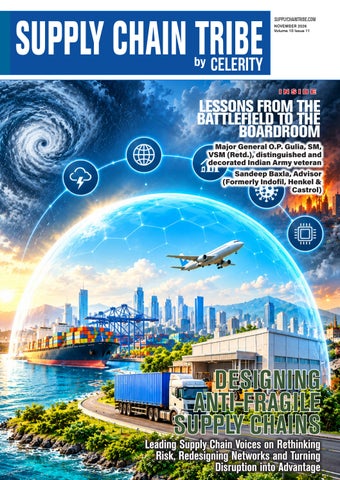
SUPPLYCHAINTRIBE.COM NOVEMBER 2026 Volume 10 Issue 11
INSIDE
LESSONS FROM THE BATTLEFIELD TO THE BOARDROOM Major General O.P. Gulia, SM, VSM (Retd.), distinguished and decorated Indian Army veteran Sandeep Baxla, Advisor (Formerly Indofil, Henkel & Castrol)
DESIGNING ANTI-FRAGILE SUPPLY CHAINS
Leading Supply Chain Voices on Rethinking Risk, Redesigning Networks and Turning Disruption into Advantage
2 CELERITY November 2026
PUBLISHER’S NOTE
What Disruption Teaches Us About Leadership Dear Readers, Wishing you and your families a joyful Diwali. May the festival of lights bring warmth to your homes and fresh energy to the work ahead. In this November issue of Supply Chain Tribe, we revisit three conversations from our 8th Celerity Supply Chain Tribe Conference held in August. Each explores a different question about how leaders and their teams respond when plans are upended. Our Cover Story on Anti-Fragile Supply Chains draws on insights from our conference panellists. It asks what it takes for a supply chain to emerge stronger from a disruption. What can a shortage, a missed delivery or a sudden demand shift teach us about the way we operate? In our Leadership section, a fireside chat brings together perspectives from the battlefield and the boardroom. The conversation explores how leaders make decisions with incomplete information and give their teams the clarity to act amid uncertainty. Our Special Report, Going Beyond Visibility and the Control Tower Imperative, returns to another August panel to examine what happens after an alert appears. Who makes the call, and how do teams coordinate their response? As you read this issue, consider one recent disruption. What did it reveal, and what will your team do differently next time? Happy reading!
Charulata Bansal Publisher Charulata.bansal@celerityin.com www.supplychaintribe.com
Published by: Charulata Bansal on behalf of Celerity India Marketing Services Edited by: Prerna Lodaya e-mail: prerna.lodaya@celerityin.com Designed by: Lakshminarayanan G e-mail: lakshdesign@gmail.com Logistics Partner: Blue Dart Express Limited
3
supplychaintribe.com
CONTENTS
NOVEMBER 2026 Volume 10 Issue 11
10 COVER STORY DESIGNING ANTI-FRAGILE SUPPLY CHAINS The architecture of a supply chain is increasingly being tested not by one disruption at a time, but by several forces moving simultaneously. Decisions around sourcing, capacity, inventory, infrastructure and fulfilment now have to account for a business environment where conditions can shift before traditional planning cycles have caught up. That is creating a new strategic imperative. This cover story brings together the nuanced perspectives of supply-chain leaders across these domains, exploring how they are interpreting the changing risk landscape and, more importantly, how they are redesigning their organisations to navigate it.
04 | LEADERSHIP
21 | INTERVIEW
Lessons From the Battlefield to the Boardroom
Resilience by Design
The worlds of the battlefield and the boardroom may be vastly different, but the questions that define leadership are often remarkably similar: How do you make decisions when information is incomplete? How do you inspire confidence when the stakes are high? And how do you prepare people and organisations for a future no one can fully predict? In this thought-provoking exchange, Major General O.P. Gulia, SM, VSM (Retd.), distinguished and decorated Indian Army veteran and Sandeep Baxla – Advisor (Formerly Indofil, Henkel & Castrol), bring together perspectives forged in two very different arenas.
In this interview, Manoj Tripathi, CEO, TCI Supply Chain Solutions, shares his perspective on navigating global disruptions, strengthening logistics networks and leveraging technology to build agile, future-ready supply chains, while advancing India’s ambitions as a global manufacturing and logistics hub. 24 | SPECIAL REPORT
Beyond Visibility: The Pursuit of Predictability For years, visibility has been central to the quest for more responsive supply chains. The ability to track movements, monitor performance and identify exceptions has brought greater transparency to increasingly complex operations. Yet, visibility alone does not guarantee better decisions. As supply chain control towers evolve, their role is expanding beyond monitoring towards predictive intelligence, contextual decision-making and more coordinated responses. This special report brings together nuanced perspectives from industry experts on this transition, examining the promise of connected data, artificial intelligence and predictive analytics.
DISCLAIMER: This magazine is being published on the condition and understanding that the information, comments and views it contains are merely for guidance and reference and must not be taken as having the authority of, or being binding in any way on, the author, editors, publishers who do not take any responsibility whatsoever for any loss, damage or distress to any person on account of any action taken or not taken on the basis of this publication. Despite all the care taken, errors or omissions may have crept inadvertently into this publication. The publisher shall be obliged if any such error or omission is brought to her notice for possible correction in the next edition. The views expressed here are solely those of the author in his private/professional capacity and do not in any way represent the views of the publisher. All trademarks, products, pictures, copyrights, registered marks, patents, logos, holograms and names belong to the respective owners. The publication will entertain no claims on the above. No part of this publication can be reproduced or transmitted in any form or by any means, without prior permission of the publisher. All disputes are subject to the exclusive jurisdiction of competent courts and forums in Mumbai only.
4 CELERITY November 2026
LEADERSHIP
LESSONS FROM THE BATTLEFIELD TO THE BOARDROOM The worlds of the battlefield and the boardroom may be vastly different, but the questions that define leadership are often remarkably similar: How do you make decisions when information is incomplete? How do you inspire confidence when the stakes are high? And how do you prepare people and organisations for a future no one can fully predict? In this thought-provoking exchange, Major General O.P. Gulia, SM, VSM (Retd.), distinguished and decorated Indian Army veteran and Sandeep Baxla – Advisor (Formerly Indofil, Henkel & Castrol), bring together perspectives forged in two very different arenas. From decisive action and adaptability to trust, empowerment and preparedness, their experiences underline a timeless truth: leadership is tested not when everything goes according to plan, but when certainty gives way to complexity and people look to their leaders for clarity and conviction. The contexts may differ, but the lessons travel powerfully from the battlefield to the boardroom.
supplychaintribe.com
L
EADERSHIP reveals itself most clearly when the familiar rules no longer apply. When information is incomplete, conditions are shifting and the consequences of getting it wrong are significant, leaders have little choice but to act—with judgement, courage and the ability to bring others with them. While the battlefield and the boardroom operate in very different worlds, both increasingly demand the capacity to navigate uncertainty and respond when there is no perfect plan. Drawing on a distinguished 37year military career, Major General O.P. Gulia, SM, VSM (Retd.) brings the perspective of a leader for whom preparation, courage, trust and adaptability have been tested in some of the most demanding environments. Alongside him, Sandeep Baxla, Advisor and former leader with Indofil, Henkel and Castrol, reflects on how these same leadership imperatives play out across modern organisations and increasingly complex supply chains. Their experiences come from different worlds, but reveal a striking common ground. How do leaders know what matters when they cannot know everything? How do they build trust when people are being asked to step into uncertainty? And how do organisations prepare for disruption without becoming constrained by process? As perspectives from the battlefield and the boardroom come together, the conversation explores these questions—and the lessons each world has to offer the other.
In military operations, waiting for complete information can mean losing the initiative. How do you make life-critical decisions when information is incomplete, uncertainty is high and there is no second chance? MAJOR GENERAL O.P. GULIA: You are absolutely right… In battle, there are no runners-up. You get one opportunity, and you have to make it count. The first reality we accept is that information will never be complete. That is true in the military, and I believe it is equally true in business. In fact, in military operations, obtaining information can be even more
LEADERSHIP
5
Earlier, organisations would create war rooms when a major disruption or crisis occurred. Today, disruptions have become so frequent that the war room is almost becoming a permanent feature of organisations. Whether it is tariffs, geopolitical developments, regulatory changes, supply chain disruptions, technology or AI, something is constantly changing. difficult because the other side is actively trying to hide it from you. So, the way we approach decision-making can be summarised in three words:
KNOW. DECIDE. ADAPT. The first is Know. what information do I really need to make the decision. Since complete information will never be available, so we broadly divide it into three categories: Must Know, Should Know and Could Know. The Must Know is information without which I simply cannot make a decision. The Should Know helps improve the quality and effectiveness of my decision. And the Could Know is useful, but I can still proceed without it. The mistake leaders often make is waiting for complete information. Complete information rarely arrives. The real skill is identifying what you absolutely need to know before acting—and separating it from information that would simply be good to have. Then comes Decide. Once you have the critical information, you analyse the factors that matter. What is the objective? What are the constraints? What resources are available? What is the environment in which I am operating? How much time do I have? What are the possible actions of the other side? And what are my own options? You then evaluate those options and select the best course of action available at that moment. It may not be the perfect decision, but you do not wait indefinitely
for perfection. A good decision taken in time is often far better than a perfect decision taken too late. And then comes Adapt. For me, this is perhaps the most important principle, because no plan unfolds exactly as you imagined it. In battle, I would say no plan survives the first bullet. The moment you engage with reality, the situation starts changing. The other side responds. New information emerges. Assumptions prove wrong. Circumstances change. So you have to adapt. In the military, we may go down to the tenth order of contingency and yet something completely unexpected can still happen. So, apart from alternatives, you also keep reserves up your sleeve. Reserves give you options when the original plan is no longer working. I think the business world understands this as well. When you invest, you don’t put everything into one basket. You diversify. You keep some reserves. You retain the ability to respond to the unexpected. The same principle applies to leadership. Don’t wait for perfect information. Know what you must know. Decide in time. And remain flexible enough to adapt when reality changes. Because ultimately, leadership is not about proving that your original plan was right. It is about ensuring that the mission succeeds even if the plan has to change.
Business leaders face geopolitical
6 CELERITY November 2026
LEADERSHIP
Major General O.P. Gulia, SM, VSM (Retd.), distinguished and decorated Indian Army veteran There is a very important principle in the military: We never leave a man behind—dead or alive. A soldier knows that if he is injured, everything possible will be done to bring him back. And if he makes the ultimate sacrifice, his family will not be forgotten. That knowledge creates an extraordinary bond. It gives people confidence that the organisation stands with them—not just when things are going well, but especially when things go wrong. I think there is a powerful lesson here for every leader. Your people must know that you will stand with them when the situation becomes difficult. You cannot expect commitment from people if they believe that the leader will disappear when there is a problem.
uncertainty, supply disruptions, AI disruptions and changing customer expectations. How do you make high-impact business decisions when there is no perfect data and the environment is changing every week? Sandeep Baxla: That is absolutely true. Earlier, organisations would create war rooms when a major disruption or crisis occurred. Today, disruptions have become so frequent that the war room is almost becoming a permanent feature of organisations. Whether it is tariffs, geopolitical developments, regulatory changes, supply chain disruptions, technology or AI, something is constantly changing. I think the biggest shift businesses need to make is from predict and plan to sense and adapt. Earlier, we operated in a relatively stable environment. We developed forecasts, created plans and assumed that, broadly speaking, the world would behave according to those assumptions. Today, that approach is no longer sufficient. The ability to sense what may be coming, understand its potential impact and respond quickly is becoming a far more important organisational capability. The second important element is scenario planning. We cannot wait for
disruption to happen and then start asking ourselves what to do. We need to think through different possibilities in advance—the best case, the expected case and the disruption case. And these scenarios need to be stress-tested. If a key supplier becomes unavailable tomorrow, what do we do? If a particular geography becomes inaccessible, what alternatives do we have? If freight costs suddenly increase or lead times extend, how does the business respond? These questions need to be addressed before the disruption happens. The third element is resilience. For supply chains, resilience may mean multisourcing, flexible contracts, strategic buffers, alternative routes or diversified networks. The exact answer will vary from business to business, but the principle remains the same: Efficiency alone is no longer enough. Resilience has become equally important. For many years, organisations focused on reducing inventories, reducing costs and making supply chains leaner. Today, leaders also have to ask: How vulnerable have we become in the process of becoming efficient? That is an important question. Ultimately, disruption cannot become a permanent excuse for poor performance. The organisations that will succeed will be those that build the ability to
sense change early, anticipate different possibilities and adapt faster. You may not be able to predict every disruption. But you can certainly build an organisation that is better prepared to respond to it. Increasingly, that preparedness itself will become a competitive advantage.
Soldiers don’t simply follow orders; they follow leaders they trust. How do you build trust, confidence and commitment in teams when they know that they are actually walking into uncertainty? Major General O.P. Gulia: I would perhaps take that one step further. Sometimes, it is not simply uncertainty. A soldier may be walking towards a very real possibility of death. Imagine a situation where one hundred soldiers are asked to move towards an enemy position. They know there will be firing. They know there will be casualties. Some may not return. Nobody knows who that person will be. Yet, they move forward together. The question is: Why? The answer is trust. In the military, that trust is not built in one speech or one moment. It is built every single day. The first and most important principle is leading by example. I cannot ask my men to do something that I am not prepared to do myself. I cannot demand courage if I don’t
supplychaintribe.com
demonstrate courage. I cannot ask for discipline if I don’t practise discipline and I cannot expect integrity from my people if my own conduct does not reflect it. In a combat unit, the trust is developed over years. They eat together, they train together, they play together and face challenges together. The soldiers know the leader and each other extremely well. They observe you all the time. Therefore, you cannot have double standards. The single most important factor in this trust building is the Leader. Leadership is not something you switch on when you enter the workplace. You have to demonstrate consistency in your behaviour. You need physical courage, but equally important is moral courage. Your people must know that you will do the right thing even when it is difficult and even when nobody is watching. You have to be upright. Your words and actions have to match. There is another very important principle in the military: We never leave a man behind—dead or alive. A soldier knows that if he is injured, everything possible will be done to bring him back. And if he makes the ultimate sacrifice, his family will not be forgotten. That knowledge creates an extraordinary bond. It gives people confidence that the organisation stands with them—not just when things are going well, but especially when things go wrong. I think there is a powerful lesson here for every leader. Your people must know that you
LEADERSHIP
will stand with them when the situation becomes difficult. You cannot expect commitment from people if they believe that the leader will disappear when there is a problem. So, for me, trust is built on a few very simple principles: Lead by example Moral and physical courage Integrity Uprightness Stand by your people Most importantly, make sure they know that when the situation becomes difficult, you will stand by their side and give them that confidence. Trust is not created through speeches. Trust is created through consistent behaviour over time. When that trust exists, people are capable of doing extraordinary things together.
There is so much transformation happening today. Organisations are dealing with AI adoption, restructuring, new technologies and constant change. How do you inspire people to continuously embrace change instead of resisting it? Sandeep Baxla: I think the key distinction here is between managing processes and leading people. Processes can be managed. You can establish KPIs, SOPs, systems and performance measures. But people cannot simply be
7
treated as another input into a process. They need to be led. A process-focused leader might ask: Why didn’t you achieve your target? A people-focused leader might ask: You weren’t able to achieve the target. What can I do to help you succeed? That difference in approach is fundamental. The first may get you compliance. The second is far more likely to get you commitment. And during periods of constant transformation, commitment is what organisations need. Today, people are dealing with change on multiple fronts simultaneously – New technology; New systems; New roles; New expectations; and now AI is adding another layer of uncertainty. It is natural for people to feel anxious or fatigued. A leader cannot simply announce a transformation and expect people to embrace it automatically. People need to understand why the change is happening. They need to know what it means for the organisation. And importantly, they need to understand what it means for them. Leaders also have to make people part of the journey. If change is constantly imposed from the top, people will eventually disengage. But when people are involved, empowered and given an opportunity to contribute, they are far more likely to develop ownership. That is where empathy becomes extremely important. A leader who only looks at numbers and targets may get short-term performance.
Sandeep Baxla, Advisor (Formerly Indofil, Henkel & Castrol) I think the biggest shift businesses need to make is from predict and plan to sense and adapt. Earlier, we operated in a relatively stable environment. We developed forecasts, created plans and assumed that, broadly speaking, the world would behave according to those assumptions. Today, that approach is no longer sufficient. The ability to sense what may be coming, understand its potential impact and respond quickly is becoming a far more important organisational capability.
8 CELERITY November 2026
LEADERSHIP
A leader cannot control every decision in a large organisation—and nor should he try to. The leader must identify the few critical factors that really determine success and remain focused on them. Everything else should be handled by capable and empowered people. The real test of preparedness is not how many manuals an organisation has. The real test is: How effectively do your people respond when they encounter a situation that is not in the manual? That is where training, trust and empowerment come together. But a leader who understands the concerns of the team, listens to them and supports them through change will build something much more valuable— trust and commitment. Ultimately, transformation does not happen because a CEO announces it. Transformation does not happen because a new technology is installed. Transformation happens when people change the way they think and the way they work. And that requires leadership. The responsibility of a leader is not simply to communicate that change is coming. It is to help people find the confidence and capability to move through that change.
Military organisations spend years preparing for situations they hope never happen. How can businesses build the same level of preparedness without becoming slow or bureaucratic? Major General O.P. Gulia: Preparedness does not come from voluminous manuals or endless SOPs. When you are in the middle of a rapidly changing situation, you may not have the time to open a manual and look for the answer. You have to act and you have to act fast. Preparedness, in my view, comes from Training. As a leader, your responsibility is to give your people the resources they need, train them thoroughly for their roles, and then give them the freedom and authority to act when the situation demands it. The purpose of training is not simply to teach someone a process. It is to train them so thoroughly that,
when the moment comes, they can respond instinctively. That is how the military prepares. Training is continuous throughout a career. At different stages, officers and soldiers undergo different forms of structured training. The objective is to keep developing their judgement, capability and ability to take decisions under pressure. I think businesses can learn an important lesson from this. Don’t become excessively dependent on manuals and processes. Processes and SOPs are important. They create discipline. They create consistency. They help during training. But an SOP cannot anticipate every situation. When the unexpected happens, you need people who can think beyond the written process. That requires five things from a leader: clarity of mission, adequate resources, clearly defined responsibility, proper training and the authority to act. Tell people what has to be achieved. Make sure they understand their role. Give them the resources they require. Train them thoroughly. And then trust them to act. A leader cannot control every decision in a large organisation—and nor should he try to. The leader must identify the few critical factors that really determine success and remain focused on them. Everything else should be handled by capable and empowered people. So, to me, the real test of preparedness is not how many manuals an organisation has. The real test is: How effectively do your people respond when they encounter a situation that is not in the manual? That is where
training, trust and empowerment come together. Preparedness does not mean creating more bureaucracy. It means creating capable people who can make sound decisions when the unexpected happens.
Supply chains have become a competitive advantage for modern enterprises. What capability should leaders build today so that their organisations don’t merely survive disruption but gain from it? Sandeep Baxla: I think the traditional model of leadership is gradually being dismantled. Earlier, leadership was often hierarchical and authoritative. The leader was expected to know everything, make the decisions and tell everyone else what to do. That model is increasingly becoming inadequate. The environment today is simply too complex. No individual, however experienced, can have all the answers. That is why leadership needs to become more collective. The role of the leader is not necessarily to be the smartest person in the room. The role of the leader is to bring together capable people, create a common understanding of the challenge and enable the organisation to move towards a meaningful goal. For future leadership, I think four capabilities will become particularly important. 1. The first is AGILITY. The ability to respond quickly when circumstances change. 2. The second is ADAPTABILITY.
supplychaintribe.com
Leaders themselves must be willing to change their approach, assumptions and sometimes even long-held beliefs. 3. The third is COURAGE because in today’s environment, leaders often have to make important decisions without complete certainty. 4. And the fourth is COLLABORATION. No leader can manage uncertainty alone. The strength of an organisation lies in its collective intelligence. A good leader brings together different perspectives, different capabilities and different functions—and creates the conditions in which people can work together effectively. Innovation will also be critical. Leaders cannot simply manage disruption. They have to encourage people to think differently and identify opportunities that may emerge from change. That is particularly relevant in supply chains. A disruption may initially look like a problem but it can also become an opportunity to redesign networks, develop new partnerships, improve visibility or create entirely new capabilities. The future leader will not be someone who sits in an office and commands. The future leader will build strong teams, create clarity amid uncertainty and enable people across the organisation to act together. That is how organisations move from simply surviving disruption to becoming stronger because of it.
Looking back at your career, what is that one leadership belief you held early on but have now completely changed your mind about? Major General O.P. Gulia: Early in my career, I think I believed that a good leader needed to know everything. At that stage, perhaps I could do it. I had a small team and a limited area of responsibility. I could know every detail—the people, the equipment, the terrain and the task. But as my responsibilities grew, that belief was challenged. Eventually, I was responsible for thousands of people and a much larger area. There were capabilities and equipment under my command that I had never personally operated. That was when I realised something very important: You don’t have to know everything.
LEADERSHIP
9
What you need to know is how to bring together people who know more than you do in their specific areas of expertise—and how to use that expertise effectively. As a leader grows, the nature of leadership changes. You move from knowing every detail to understanding the bigger picture. You move from doing everything yourself to enabling others to do their best work. You have to trust specialists. You have to delegate and you have to accept that people in your team may know certain things better than you do. In fact, if everyone in your team knows less than you, you probably don’t have the right team.
“The process should guide you—but leadership requires judgement when reality goes beyond the process.”
My belief changed from: “I need to know everything.” To: “I need to know enough to make the right decisions, ask the right questions and bring the right expertise together.”
Major General O.P. Gulia: That is a very important question because success and failure are both part of leadership. For every successful outcome, there may be several attempts that did not produce the desired result. The important question is how a leader responds when someone in the team fails. If you give someone responsibility, you must also give them the confidence to act. And if they fail despite making a sincere and considered effort, the leader must be prepared to stand behind them. As a leader, you must be willing to accept responsibility for failure. But when your team succeeds, give them the credit. That is how you build confidence. That is how you encourage initiative. If people believe that one mistake will destroy their career, they will stop taking responsibility. They will stop making decisions. They will simply wait for instructions. But if they know their leader will support them when things don’t go as planned, they will have the confidence to act. Of course, failure should always lead to learning. You have to understand what went wrong, what could have been done differently and what needs to change next time. But you should not create a culture where people are afraid of honest mistakes. My philosophy is simple: Give people responsibility. Give them authority. Support them when they fail. Learn from the experience. And recognise them when they succeed. That is how you build confident people and ultimately, that is how you build a strong team.
For me, that was a major leadership shift. Sandeep Baxla: For a large part of my career, I was a strong believer in processes and SOPs. I believed that once a process had been established, people should follow it without deviation and I still believe processes are important. They create discipline. They create consistency. They provide control. But over time, I realised that no process can anticipate every possible situation. The world changes faster than processes can sometimes be rewritten. There will be situations where leaders and teams have to exercise judgement and make decisions outside the normal process. Of course, that does not mean compromising on ethics, integrity or compliance. Those boundaries remain absolutely non-negotiable. But within those boundaries, people need flexibility. They need the confidence to respond when they encounter a situation that the SOP did not anticipate. If the decision proves to be effective, the organisation can learn from it and incorporate that learning into future processes. That is how organisations evolve. My thinking has shifted from: “The process must always be followed.” To:
I think that distinction has become increasingly important in today’s world because the organisations that will succeed will not be those with the thickest manuals. They will be the ones with the best judgement, the strongest people and the greatest ability to adapt.
We often speak about success stories, but failure is also part of leadership. Can you share your perspective on failure and what leaders should learn from it?
10 CELERITY November 2026
COVER STORY
supplychaintribe.com
COVER STORY
Designing Anti-Fragile
Supply Chains The architecture of a supply chain is increasingly being tested not by one disruption at a time, but by several forces moving simultaneously. Decisions around sourcing, capacity, inventory, infrastructure and fulfilment now have to account for a business environment where conditions can shift before traditional planning cycles have caught up. That is creating a new strategic imperative. Organisations are re-examining how much certainty they should build into their models, where flexibility creates genuine value, which dependencies deserve to be challenged and how closely supply-chain decisions need to connect with the broader business agenda. The answers are far from uniform. The level of optionality required in a fast-moving consumer business can look very different from the preparedness needed for specialised medical technology or industrial supply chains. The same is true of procurement, logistics, planning and infrastructure. This cover story brings together the nuanced perspectives of supply-chain leaders across these domains, exploring how they are interpreting the changing risk landscape and, more importantly, how they are redesigning their organisations to navigate it.
11
12 CELERITY November 2026
S
UPPLY chains have always been exposed to disruption, but the nature of that disruption has fundamentally changed. What we are seeing today is not a series of isolated shocks that organisations can simply absorb and move past. Geopolitical realignment, trade fragmentation, changing consumer behaviour, shorter product lifecycles, climate events and accelerating technology are simultaneously challenging the assumptions on which supply chains have traditionally been designed. For years, the dominant objective was resilience—to withstand the shock, restore operations and return to business as usual. But the environment we operate in today raises a more fundamental question: what if business as usual itself is changing? That is where the idea of anti-fragility becomes relevant. An anti-fragile supply chain does not simply survive disruption. It uses disruption to identify weaknesses, rethink existing assumptions, create new options and emerge better equipped for the next shock. Against this backdrop, our moderator, Rajat Sharma, Vice President, ISCM & Customer Service, Hamilton Housewares, brought together a diverse group of supply chain leaders to examine how organisations are moving beyond resilience to build supply chains capable of sensing change, responding faster and learning from disruption. Setting the context, Rajat Sharma observed: There is a fundamental change in the operating environment. Supply chains were built on the premise that greater interconnectedness would create greater efficiency, while better information and forecasting would progressively make demand and supply more predictable. That premise is being challenged. We are seeing a generational shift from Millennials and Gen X towards Gen Z and Gen Alpha, an economic shift towards a more multipolar world, and a movement from globalisation towards what is increasingly being described as anti-globalisation. At the same time, the pace of change has accelerated to a point where a decision made today can become irrelevant within days—or even hours.
COVER STORY
The question, therefore, is no longer simply how accurately we can forecast fragility. It is whether we can build supply chains that respond quickly when our assumptions change.
From your experience, what has been the most significant source of fragility for your organisation, and how have you responded to it? Varun Kakkar, Sr GM – Supply Chain, Birla Opus Paints: I believe fragility is emerging across several dimensions simultaneously. We are witnessing a generational transition from Millennials and Gen X towards Gen Z and Gen Alpha; an economic transition from a predominantly US-led world towards a more multipolar one; and, perhaps most significantly from a supplychain perspective, a movement from globalisation towards anti-globalisation. For decades, supply-chain architecture was built around the assumption that the world would become progressively more interconnected. Sourcing would become global, production would move towards the most efficient locations and supply networks would optimise around cost and scale. That assumption is now being challenged. At the same time, the speed at which conditions change has made conventional forecasting increasingly difficult. Sentiment can shift almost instantly, and decisions that appeared rational yesterday can become irrelevant today. We spent considerable time trying to build increasingly sophisticated models to forecast and manage fragility. But there comes a point when we have to recognise that no formula or algorithm can reliably predict every variable in an environment where the variables themselves are constantly changing. That has led us to rethink the objective. If disruption cannot always be predicted, the supply chain must become capable of responding to it rapidly. This has meant building greater agility into the operating model itself. At Birla Opus, for example, instead of relying solely on a monthly S&OP cycle, we increasingly work with a weekly cadence because what worked last week may not necessarily work this week. We are gaining market
share, launching new products and operating in an environment where assumptions are constantly being reset. The same principle extends to the supplier ecosystem. We have become much more integrated with our chemical partners so that we understand their capacity and responsiveness. Even for imported products, we are building relationships where suppliers can respond to requirements with very short notice. The fundamental shift, therefore, is from trying to predict every disruption to building the agility required to respond to whatever emerges.
How did that experience influence your understanding of antifragility, particularly the balance between preparing for extreme events and avoiding the cost of preparing for every possible scenario? Varun Kakkar: During COVID, Asian Paints was asked to manufacture sanitiser. Sanitiser chemicals were not part of our traditional paint supply chain, so we had to work with partners such as Clariant, access their supplier ecosystem, understand the formulation, source packaging from FMCG suppliers and convert our paint lines into sanitiser production lines. Those lines operated 24/7. The result was not only that we were able to contribute to an urgent requirement; our distributors were also able to keep their shops open because they were selling sanitiser instead of paint. Our plants could continue operating as well. That experience reinforced the importance of thinking beyond the conventional boundaries of the supply chain. A disruption does not necessarily have to be viewed only as a constraint. It can force an organisation to connect capabilities that previously existed in separate ecosystems.
How is this compression of time, particularly the changing behaviour of younger consumers and shorter product lifecycles, altering the way you approach demand planning and fulfilment? Ramkumar Sunder, Head – Supply Chain Planning & Logistics, Pepe
COVER STORY
supplychaintribe.com
13
Raja Kumar, Head of Logistics – Aftermarket, Endurance Technologies Logistics is where fragility becomes visible in action. Whatever inefficiency exists upstream eventually percolates into logistics. A supplier issue becomes a transportation issue. A planning issue can become excess inventory at the warehouse. A plant issue can become a shortage at the warehouse. Excess inventory, in turn, becomes a storage problem. So logistics often becomes the point at which the consequences of upstream decisions become physical. We recently experienced this with packaging material. We have experienced enough disruptions now to become more accustomed to questioning the conventional solution. A disruption can therefore become a trigger for innovation rather than simply a cost to absorb. Jeans London: Consumer behaviour is fundamentally changing the operating rhythm of supply chains, particularly in fashion. Gen Z and Gen Alpha are already exerting significant influence on the way businesses operate. The rise of fast fashion is essentially a reflection of this acceleration—product lifecycles are shorter, trends change faster and their relevance lasts for a much smaller window. That immediately compresses the time available to bring products to market. Traditional forecasting models that rely heavily on two or three years of historical data become far less effective when the product itself has a short lifecycle and consumer preferences can change rapidly through platforms such as Instagram and Facebook. New designs and trends can emerge almost continuously. Consequently, demand planning can no longer remain a purely analytical exercise. The role of the demand planner is becoming much broader. We need to work closely with design, merchandising and other functions to understand what is emerging in the market and incorporate those signals into our forecasts. The same shift is happening downstream. A conventional supply chain would source products from the vendor, bring them into a warehouse, aggregate them and then distribute them according to destination. That model is not always compatible with the speed of today's market. Where possible, we have to explore alternatives such as dispatching directly from vendors to destination points. Warehousing also needs to become more flexible. When demand can shift rapidly from one geography
to another, committing to three or four years of capacity can create rigidity. Instead, we may need to identify where demand is emerging and secure capacity for a shorter period in that location. Ultimately, the supply chain has to move at the speed of the market rather than expecting the market to accommodate the supply chain.
When demand expectations compress from days to minutes while roads, airspace and sea routes remain vulnerable to disruption, what does fragility look like on the logistics front— and how can it be converted into an opportunity for innovation? Raja Kumar, Head of Logistics – Aftermarket, Endurance Technologies: Logistics is where fragility becomes visible in action. Whatever inefficiency exists upstream eventually percolates into logistics. A supplier issue becomes a transportation issue. A planning issue can become excess inventory at the warehouse. A plant issue can become a shortage at the warehouse. Excess inventory, in turn, becomes a storage problem. So logistics often becomes the point at which the consequences of upstream decisions become physical. We recently experienced this with packaging material. We have experienced enough disruptions now to become more accustomed to questioning the conventional solution. A disruption can therefore become a trigger for innovation rather than simply a cost to absorb.
When products are highly
specialised and the ability to substitute suppliers or products is constrained, how do you build resilience across the ecosystem? Meghna Bhatt, Former Director – Indirect Channel Performance, Eurasia, Medtronic: The nature of resilience depends significantly on the industry, and my experience across FMCG and medical technology has made that distinction very clear. During COVID, when I was with Unilever, we faced an extraordinary increase in demand for sanitiser and other products. We were able to leverage the external capacity available in the third-party ecosystem and collaborate extensively outside the organisation. A small, purpose-driven cross-functional team, combined with strong external collaboration, enabled us to launch a new product in less than 120 days. The lesson was that we did not try to build everything internally. We expanded the network around us. Medical technology is fundamentally different. Today, we operate across Eurasia in an environment where warehouses may be in one geography while customers are spread across markets affected by geopolitical restrictions, airspace closures or financial constraints. Yet these are not customers we can simply stop serving. A stent, a surgical robot or another specialised medical device cannot necessarily be replicated through an alternative supplier at short notice. The supplier ecosystem for many components is also limited. Therefore, our resilience strategy has had to extend beyond supplier diversification. We rely heavily on long-term planning and on local partners and distributors
14 CELERITY November 2026
COVER STORY
Priyanka Shivan, Head of Supply Chain – South Asia, Clariant IGL Specialty Chemicals There is a fine line between being prepared for a disruption and overpreparing to the point where that preparedness becomes a vulnerability in itself. Resilience is about absorbing a shock and continuing to operate; antifragility goes a step further by learning from disruption and redesigning systems to emerge stronger. The objective is not to build redundancy everywhere, but to create thoughtful optionality, nurture strategic supplier relationships and maintain the financial headroom to manage the aftermath of a crisis. By institutionalising scenario planning, we can move from reaction to execution, responding with greater speed and conviction while adapting to realities on the ground. that have the infrastructure, financial strength and ability to hold inventory within the market. We also have to bring financial, legal and regulatory partners into the ecosystem. Where conventional banking channels become constrained, alternative mechanisms have to be established to keep the supply chain functioning. The lesson here is that resilience is not always about finding another supplier. Sometimes it is about strengthening the ecosystem around a supply chain that cannot easily be replicated. And that requires collaboration—across functions and beyond organisational boundaries.
How do you distinguish between being resilient enough to absorb a shock and being over-prepared in ways that create a new form of fragility? Priyanka Shivan, Head of Supply Chain – South Asia, Clariant IGL Specialty Chemicals: There is a fine line between being prepared for a disruption and over-preparing to the point where that preparedness becomes a vulnerability in itself. COVID-19 illustrated this particularly well. When demand for an anti-bacterial soap surged dramatically, we were asked to scale up our capacity for a particular raw material almost fourfold. As the exclusive supplier of that raw material to the customer, we had to respond to an unprecedented international emergency where lives were at stake. Today, however, we are operating at roughly a quarter of that capacity, leaving a significant portion
underutilised. While the expansion was essential to meet the immediate need, the subsequent decline in demand brought home the challenge of managing capacity built for an exceptional, time-bound situation. The lesson is that resilience requires more than the ability to absorb a shock; it also calls for the financial buffer to manage its aftermath and sustain the business without compromising its longterm viability. For me, resilience is about absorbing a shock and continuing to operate. Antifragility goes a step further: it is about learning from disruption and redesigning our systems to emerge better equipped for the future. However, this transformation must be guided by commercial pragmatism. We cannot restructure our entire supply chain around the assumption that a major disruption could occur tomorrow. The objective is to strengthen our ability to respond to uncertainty without creating new vulnerabilities through excessive investment. The same principle applies to supplier diversification. Having alternative suppliers across China, Singapore and other geographies gives us options when established supply lines are disrupted. However, established supplier relationships also offer trust, continuity and commercial advantages that take time to develop with new partners. Maintaining alternative networks is important, but it comes at a cost and may mean sacrificing some of those advantages. The answer, therefore, is not redundancy everywhere, but thoughtful optionality: knowing where alternatives
are essential, nurturing strategic supplier relationships and maintaining the financial headroom to absorb the cost of preparedness. For us, the key has been to institutionalise scenario planning rather than treat it as an exercise undertaken in response to a crisis. We now work through different possibilities in advance, assess their implications and establish how we would respond. The past seven to ten years have exposed businesses to an extraordinary range of uncertainties, reinforcing the need to prepare for plausible disruptions without assuming that every risk can be predicted or eliminated. The real advantage of this approach is that it enables us to move from reaction to execution. When disruption strikes, we should not be starting from a position of uncertainty, debating possible responses or assessing the implications for the first time. We should already have evaluated the scenarios, understood the trade-offs and established a clear course of action. This allows us to respond with greater speed and conviction, while adapting our plans to the realities on the ground. For me, that is what antifragility demands: not merely the ability to withstand disruption, but the capacity to learn from experience and embed that learning into the way the organisation operates.
How is procurement evolving from a transactional function into a strategic capability for managing that tension? Devarajan
Iyengar,
Former
COVER STORY
supplychaintribe.com
Procurement Team Lead – Segment 3, APAC, Surventis: Before COVID, upstream supply chains were often a black box. Procurement professionals understood much of the complexity, but much of that complexity remained invisible to the front end of the organisation. Today, I see that complexity as an opportunity for procurement to play a much more strategic role. The procurement operating model is changing. Progressive organisations are moving away from thinking only in terms of sourcing professionals and category managers and increasingly developing business partners who understand the business strategy, growth plans and future operating model. The role is no longer simply to ask where procurement can take cost out of the system. It is to understand where the business wants to grow and determine how market-specific sourcing strategies can protect and enable that growth. The same thinking applies to strategic suppliers. We increasingly segment suppliers according to their strategic importance at country, regional and global levels. Those suppliers should not be managed as transactional partners. They require relationships built over three- and five-year horizons, supported by dedicated procurement ownership. But strategic procurement also means challenging the organisation itself. For example, if R&D has created a highly customised specification when a marketstandard specification could achieve the same outcome, that customisation may
unnecessarily narrow the supplier base and create fragility across the entire chain.
The procurement business partner should be able to challenge that assumption and ask: Are we creating our own fragility? Devarajan Iyengar: Strategic suppliers can also become sources of innovation. Instead of simply asking them to fulfil a specification, organisations should be asking where the supplier can help simplify, innovate or redesign the requirement. There is another upstream black box that needs greater visibility— sustainability and process safety. Where is the supplier located? What is the operating environment? Is the site exposed to safety or environmental risks? What happens when a critical material is single-sourced? Procurement therefore has moved well beyond its transactional roots. The procurement professional increasingly has to help the organisation see risks that remain invisible because they sit upstream.
What are the structural disruptions that organisations may be underestimating today? Varun Kakkar: I see three structural shifts that deserve much greater attention. The first is demographics. For decades, global commerce has been built around the assumption of an expanding population and therefore an expanding consumer base. That assumption is changing. Japan and China have
15
already experienced the consequences of demographic decline, and several Western economies are confronting similar challenges. Over the next 10 to 15 years, this could fundamentally alter how organisations think about capacity, investment and demand. The second is deglobalisation. If supply chains are becoming less global, future products may have to be designed with greater consideration for selfsufficiency and strategic availability of materials. Rare earth elements provide a useful illustration. Many technologies were designed with the assumption that these materials would remain globally available. Concentration of supply has demonstrated how quickly that assumption can become a vulnerability. Future product design may therefore have to ask a different question: Can this product or system function without relying on globalisation in the way we historically understood it? The third is the changing consumer. Gen Z interacts with brands very differently from previous generations. The journey from discovery to purchase is increasingly taking place directly through social platforms rather than through the traditional search-and-review pathway. This generation is also AI-native. That raises a broader economic question: if AI becomes deeply embedded in everyone's work and everyone becomes a user of AI, who ultimately pays for the AI? If the people who currently generate the income that pays for products and services are displaced at scale, that creates a much
Meghna Bhatt, Former Director – Indirect Channel Performance, Eurasia, Medtronic Resilience is not always about finding another supplier. Sometimes, it is about strengthening the ecosystem around a supply chain that cannot easily be replicated. This calls for a broader approach to preparedness, one that extends beyond internal capabilities and conventional supplier relationships. Strong local partnerships, collaboration across functions and close coordination with financial, legal and regulatory stakeholders can help keep supply chains operating when conventional channels are constrained. Ultimately, resilience depends on how effectively organisations bring together the capabilities, relationships and support systems needed to sustain continuity in the face of disruption.
16 CELERITY November 2026
COVER STORY
Varun Kakkar, Sr GM – Supply Chain, Birla Opus Paints We spent considerable time trying to build increasingly sophisticated models to forecast and manage fragility. But there comes a point when we have to recognise that no formula or algorithm can reliably predict every variable in an environment where the variables themselves are constantly changing. That has led us to rethink the objective. If disruption cannot always be predicted, the supply chain must become capable of responding to it rapidly. This has meant building greater agility into the operating model itself. At Birla Opus, for example, instead of relying solely on a monthly S&OP cycle, we increasingly work with a weekly cadence because what worked last week may not necessarily work this week. We are gaining market share, launching new products and operating in an environment where assumptions are constantly being reset. larger question about how the economic system itself functions. These are not simply technology or demographic issues. They could become significant structural disruptions for businesses and supply chains. Ramkumar Sunder: One of the structural disruptions is the changing relationship between inventory, time and demand. We have traditionally used historical data to determine where and how much inventory to position. But when product lifecycles become shorter and demand can shift geographically very quickly, the question is no longer simply how much inventory to hold. It is where to hold it and how long that inventory will remain relevant. This creates an inventory paradox. Holding more inventory provides protection against uncertainty, but it can also increase the risk of obsolescence. Holding less inventory improves efficiency, but leaves the organisation more exposed when demand moves faster than expected. The same issue applies to warehousing capacity. If demand can move from one geography to another, it becomes difficult to justify locking in capacity for several years in advance. The organisation needs to be able to access capacity where the demand emerges rather than simply relying on a fixed network designed around yesterday’s demand pattern. That means planning, warehousing and fulfilment increasingly need to work together. The structural change is that the physical location of inventory and capacity is becoming almost as important as the quantity itself.
Raja Kumar: From a logistics perspective, I think organisations may be underestimating how quickly a relatively small disruption can propagate through the network. A problem with a supplier can become a transportation issue. A planning mismatch can become excess inventory in one location and shortage in another. A material constraint can eventually become a customer-service issue. These are often treated as separate operational problems, but they are connected. We have seen situations where a sudden increase in the cost of a packaging material, for example, could have been treated simply as a cost escalation. Instead, the disruption forced us to look at alternative materials, benchmark what other companies were using and rethink the requirement itself. That is an important capability for logistics and supply-chain teams. The ability to challenge the established solution when conditions change can sometimes be more valuable than simply managing the disruption within the existing model. So the structural issue I would highlight is interdependency. Organisations may understand the individual risks within their network, but underestimate how quickly those risks can interact and amplify one another once a disruption begins.
relationship, while much of what sat behind that relationship remained a black box. An organisation could see the outcome—availability, cost, lead time or quality—without necessarily understanding the dependencies creating it. That is changing. A disruption may not originate with the immediate supplier at all. It could sit several layers upstream—in a raw material, a manufacturing process, a particular geography, a regulatory requirement or even a supplier’s own dependency on another ecosystem. This is why procurement has to move from managing transactions to understanding the architecture of the supply base. We need to know where single-source dependencies exist, where specifications unnecessarily narrow the supplier base and where a seemingly efficient sourcing decision could create vulnerability further upstream. Sustainability also needs to be viewed through this lens. It is not enough to know that a supplier has a sustainability policy. We need greater visibility into the processes, operating environment and dependencies that could affect supply over the medium and long term. The disruption, therefore, may not always arrive as one dramatic external event. It can be the accumulation of hidden dependencies that organisations have not fully understood.
Devarajan Iyengar: I think one of the disruptions organisations may still be underestimating is what is happening upstream of the organisation. For a long time, procurement was largely viewed through the immediate supplier
Meghna Bhatt: I would look at structural disruption through the lens of ecosystem dependence. We often think about resilience in terms of our own facilities, suppliers and inventory, but the ability to serve a market increasingly
supplychaintribe.com
depends on a much wider network— logistics partners, distributors, financial institutions, regulatory systems and local infrastructure. COVID demonstrated how quickly external capacity could become critical. In an FMCG environment, we were able to work with third-party partners and create capacity rapidly. But medical technology presents a very different level of complexity. When a product is highly specialised, substitution is not always possible simply because the primary supply route has been disrupted. A warehouse may be in one geography, the customer in another and the financial or regulatory mechanism required to complete the transaction somewhere else. A disruption in any one of those layers can affect the entire flow. That is why organisations need to think beyond the resilience of the immediate supply chain. The more important question is whether the ecosystem surrounding the supply chain has enough capability, capacity and flexibility to keep the customer served when conventional channels are no longer available. Priyanka Shivan: One structural disruption that organisations may be underestimating is the way climate change and changing consumer behaviour can interact with the supply chain. We tend to think of climate disruption in terms of physical events—extreme weather, water availability or disruption to a particular location. But its implications can extend much further. Climate conditions can influence what consumers want, which products gain relevance and how quickly demand can move from one category to another. At the same time, newer generations are changing the speed at which those shifts happen. Gen Z and Gen Alpha discover products differently, respond to trends differently and can move demand much faster than traditional planning cycles were designed to accommodate. That creates a different challenge for organisations. The disruption is not necessarily a single event that can be isolated and planned for. It can be a gradual change in the environment that alters both the availability of supply and the nature of demand. Technology will play an important role in responding to that, but I do not think technology can
COVER STORY
Moderator's Take
Rajat Sharma, Vice President - ISCM & Customer Service, Hamilton Housewares
The supply chain is no longer simply responding to change; it is becoming a defining capability for navigating it. Perhaps the strongest conclusion from the discussion is the changing nature of stability itself. Disruption is no longer an exception to the operating model. It is increasingly part of the environment in which businesses plan, invest and compete. The real test is how effectively an organisation can maintain momentum when the assumptions behind its plans begin to shift. Preparedness, therefore, needs a broader definition. It cannot mean protection against every conceivable shock. It means having the visibility to recognise change early, the
be viewed in isolation. Organisations will still need people who understand the business deeply enough to interpret what is changing and challenge whether the response being generated is actually appropriate. Rajat Sharma: What makes structural disruption particularly difficult is that it does not always announce itself as a disruption. A pandemic, a war or a major logistics blockage is visible. We know when something has happened and can begin responding to it. Structural change is different. It gradually alters the assumptions on which decisions have been made for years. One such shift is demographic. Much of global commerce has been built around the assumption of a growing population and, therefore, an expanding
17
flexibility to respond decisively and the organisational confidence to act before uncertainty becomes disruption. Anti-fragility also extends well beyond any individual function. Procurement, planning, logistics, infrastructure, technology and leadership each see a different dimension of risk. Competitive strength comes from connecting those perspectives and converting them into coordinated action. The strategic role of supply chain is consequently evolving. It is moving beyond managing flows to influencing how a business responds, competes and evolves. For leadership, the mandate becomes equally clear. The organisations that thrive in the years ahead will not be those attempting to eliminate uncertainty. They will be the ones capable of turning uncertainty into informed action—recognising change, making deliberate choices and moving forward without losing strategic direction. Ultimately, anti-fragility is not about protecting a supply chain from disruption. It is about building an organisation capable of emerging from disruption with greater capability, sharper perspective and greater strategic freedom.
consumer base. That assumption will not hold uniformly in the future. Over the next decade or two, demographic change could influence where demand comes from, where companies invest and how they think about capacity. The second is the movement from globalisation towards a more fragmented economic environment. Products have traditionally been designed around the assumption that materials and components can be sourced from wherever they are most efficiently available. That assumption becomes more complicated when critical materials or capabilities are concentrated in particular geographies. The third is digital dependence. We have become increasingly sophisticated at building contingencies for physical disruption—alternative suppliers, routes, warehouses and inventory. But
18 CELERITY November 2026
COVER STORY
Devarajan Iyengar, Former Procurement Team Lead – Segment 3, APAC, Surventis Rather than attempting to predict precisely what will happen, organisations need to become more agile in sensing what could happen and determining how they will respond. The environment is changing too quickly for any organisation to have complete visibility into what the next disruption will look like. We have seen enough in the last few years to know that disruptions can come from places and in forms that we would not necessarily anticipate. So, for me, the emphasis has shifted from prediction to preparedness. The question is not whether we can accurately forecast the next disruption, but whether we have built the agility to respond when it arrives.
as AI and digital systems become more deeply embedded in the supply chain, we also need to consider what happens when the digital layer itself becomes unavailable, compromised or simply unable to cope with an unfamiliar situation. And there is another shift that may ultimately be even more consequential: the changing relationship between technology, work and consumption. New generations are changing how they discover and purchase products, while AI is beginning to change the nature of work itself. If those changes alter how people work, earn and consume, then they will eventually alter the assumptions behind demand as well. These changes are difficult to capture in a conventional risk register because they do not necessarily have a start date or an end date. They gradually change the environment in which every supply-chain decision is made. That, for me, is the real structural challenge: not simply preparing for the next disruption, but recognising when the world in which the existing supply chain was designed is itself beginning to change.
When designing the organisation of the future, what matters more: the experience of a tenured leader or the adaptability of a younger leader? Varun Kakkar: Perhaps we are asking the wrong question. We are assuming that Gen Z will eventually step into the leadership roles that we occupy today. But after spending time with Gen Z, I am not convinced that they necessarily want the same careers or the same definition
of work. The question may therefore not be who will lead the next organisation? but what kind of organisation will the next generation actually want to lead? We cannot assume that the future will replicate the organisational structures of the past. And that brings us back to the central theme of this discussion: Uncertainty is certain. We will not be able to predict everything. What we can do is build the mindsets, skills and organisational capabilities required to sense change early and respond quickly. New generation. New consumer. New leader. The common requirement is adaptability. Ramkumar Sunder: Age is ultimately just a number. Learning does not have an expiry date. Someone can continue learning at 60 or 65 just as effectively as someone much younger. The ability to remain curious and keep developing is more important than the number of years a person has been in the workforce. In a changing environment, continuous learning becomes a leadership capability in its own right. Raja Kumar: I would look for a seasoned leader with a strong technology orientation—a leader with experience, but also someone who is young at heart and open to change. Experience is important because it provides judgement, particularly when decisions have to be made under pressure. But technology is changing the way organisations operate, and leaders have to be comfortable learning, experimenting and adapting alongside that change.
Devarajan Iyengar: Experience remains valuable, provided it is accompanied by adaptability. Experience gives leaders context—the understanding of how systems have evolved, what has worked in the past and why certain decisions were made. But that experience becomes relevant only when there is a willingness to rethink it as circumstances change. The ideal combination is therefore experience with the willingness to think and operate differently. The future organisation needs leaders who can draw on what they have learned without becoming constrained by it. Meghna Bhatt: For me, mindset matters more than age. I would look for a growth mindset rather than a fixed mindset, combined with genuine passion for the work. The environment is changing too quickly for leaders to rely only on what they already know. They have to remain curious, continue learning and be willing to change their approach when the situation demands it. Those qualities determine how readily someone can adapt, irrespective of when they entered the workforce. Priyanka Shivan: Experience can certainly make the job easier because someone who has spent years within a system understands how it works. But skills can be learned and taught. Attitude and mindset are much harder to teach. Someone who has spent a very long time within a system can sometimes become accustomed to established ways of working and less willing to change. A younger person with the right mindset
COVER STORY
supplychaintribe.com
may therefore have greater capacity to adapt. For me, the priority would be a combination of capability and a strong growth mindset. The organisation of the future needs people who know their domain, but are not defined by the way the domain has always been managed.
that gives decisions context. Because in an environment where the next disruption cannot always be predicted, the real advantage lies not in knowing exactly what comes next, but in building an organisation capable of learning, adapting and responding when it does.
Rajat Sharma: I don't think the organisation of the future can afford to choose between experience and adaptability. Experience provides context; adaptability provides the ability to respond when that context changes. Experience gives us institutional memory—the understanding of what has worked, why it worked and what the organisation has learned through previous cycles of disruption. But that experience becomes valuable only when leaders remain willing to question whether those lessons still apply. Adaptability, meanwhile, is not simply a generational trait. It is the willingness to challenge assumptions, learn quickly and change course when circumstances demand it. And perhaps that is the larger leadership lesson from the discussion. The future does not require organisations to choose between the wisdom of experience and the energy of new thinking. It requires them to create an environment in which the two can continuously challenge and learn from each other. The strongest organisations will be those that can preserve what experience has taught them without allowing that experience to become convention— and embrace new thinking without discarding the institutional knowledge
What emerging disruption do you believe supply-chain leaders should prepare for over the next two to three years, and what capability will be most important in responding to it? Ramkumar Sunder: It is extremely difficult to predict the next disruption. If we look at the last decade, few would have anticipated that a single ship could block the Suez Canal and disrupt global supply chains. Whatever the disruption, however, I believe two issues will remain central. The first is demand volatility. The second is what I call the inventory paradox: how much inventory should we hold, where should we hold it and at which node of the supply chain should that inventory sit? Rather than designing a solution for one specific disruption, we should build supply-chain optionality— capabilities that allow the organisation to respond to multiple types of disruption. I would also go one step beyond the conventional control tower and develop a supply-chain resilience intelligence system. Such a system would combine internal quantitative data with qualitative inputs from suppliers, partners and other stakeholders. The objective is not simply to analyse what has already happened. It is to create an early-warning capability
19
that helps the organisation sense what may be emerging. If uncertainty cannot be predicted, it should at least be sensed as early as possible. Raja Kumar: One emerging vulnerability is overdependence on digital systems. Organisations have developed contingency plans for physical infrastructure, but the same level of preparedness does not always exist for digital infrastructure. If we rely on AI-based forecasting, for example, we should still retain the capability to forecast manually. There should be people who understand how to operate when the technology is unavailable. Digital resilience therefore needs to become as deliberate as physical resilience. Devarajan Iyengar: Rather than attempting to predict precisely what will happen, organisations need to become more agile in sensing what could happen and determining how they will respond. The environment is changing too quickly for any organisation to have complete visibility into what the next disruption will look like. We have seen enough in the last few years to know that disruptions can come from places and in forms that we would not necessarily anticipate. So, for me, the emphasis has shifted from prediction to preparedness. The question is not whether we can accurately forecast the next disruption, but whether we have built the agility to respond when it arrives. That means being able to sense early signals, bring the right people together quickly, understand the
Ramkumar Sunder, Head – Supply Chain Planning & Logistics, Pepe Jeans London One of the structural disruptions is the changing relationship between inventory, time and demand. We have traditionally used historical data to determine where and how much inventory to position. But when product lifecycles become shorter and demand can shift geographically very quickly, the question is no longer simply how much inventory to hold. It is where to hold it and how long that inventory will remain relevant. This creates an inventory paradox. Holding more inventory provides protection against uncertainty, but it can also increase the risk of obsolescence. Holding less inventory improves efficiency, but leaves the organisation more exposed when demand moves faster than expected. The organisation needs to be able to access capacity where the demand emerges rather than simply relying on a fixed network designed around yesterday’s demand pattern.
20 CELERITY November 2026
COVER STORY
Not every disruption necessarily creates a negative outcome. Some disruptions can fundamentally re-engineer supply chains in positive ways. The emergence of bilateral and regional trade agreements, for example, can reshape sourcing and manufacturing footprints. As more such agreements take effect, there could be significant opportunities for manufacturing in India. For infrastructure providers, the question becomes not only how to protect against disruption, but also how quickly we can position ourselves to support the structural opportunities that disruption creates. implications and make decisions without waiting for complete information. Agility to adapt is becoming the new normal. The organisations that can respond quickly to changing conditions, rather than waiting for certainty before they act, will be better equipped to operate in this environment. Meghna Bhatt: I would highlight three areas: geopolitics, digital disruption and climate. Geopolitics is likely to remain a major influence on critical minerals, metals, EV components and other strategic materials. The second is digital disruption. AI is likely to make the operating environment considerably more complex, particularly as AI systems increasingly interact with one another and become embedded across business processes. The third is climate. Even a single airspace closure can materially affect costs. Floods, extreme heat and other climate events can affect not only suppliers but also employees, sales teams and the wider ecosystem. That means resilience can no longer be limited to the supplier network. The resilience of the entire ecosystem surrounding the supply chain will increasingly matter. Priyanka Shivan: Over the next two to three years, I see two significant challenges for supply-chain leaders: embracing AI and machine learning while keeping people at the centre of transformation, and staying attuned to evolving consumer expectations. While AI and machine learning offer tangible gains in efficiency and decisionmaking, the pressure to adopt these technologies must be balanced with the need to nurture people and strengthen
their capabilities. Particularly in the chemicals industry, where margins are relatively tight, leaders must carefully assess where technology can deliver meaningful business value without losing sight of the people who drive organisational performance. The objective should be to advance technologically while continuing to develop the talent and expertise that underpin long-term success. The second challenge lies in anticipating how consumer preferences translate into market demand. While organisations have become more adept at navigating geopolitical uncertainty and large-scale disruptions, shifts in consumer behaviour remain harder to foresee. Younger generations, particularly Gen Z and Gen Alpha, are reshaping expectations, while climate change and growing awareness of health and wellbeing are influencing purchasing choices. The surging demand for sunscreens illustrates this shift, with growing interest in formulations tailored to different skin types, SPF requirements, textures and climatic conditions. Greater awareness of skin health and recommendations from dermatologists are further accelerating demand for specialised, laboratory-developed formulations, adding to product variety and formulation complexity. For supply-chain leaders, the priority is to interpret these market signals early and make informed decisions on sourcing, capacity and inventory. Technology can strengthen this process, but sound judgement remains essential to distinguish lasting shifts from emerging trends and determine the appropriate response. The ability to combine data-
driven insights with human judgement and organisational agility will be critical to navigating an increasingly dynamic business environment. Rajat Sharma: The important shift here is that we are moving away from the idea that resilience can be built by anticipating every possible disruption in advance. The experience of the last few years has made that increasingly difficult. We have seen geopolitical events, trade restrictions, sudden changes in demand, physical disruptions and technologyled changes emerge in ways that were difficult to model beforehand. What is becoming more important is the ability to sense change early and reduce the time between sensing, deciding and acting. And that has implications for how supply chains are designed. If we cannot know with certainty what the next disruption will be, then building a response around one specific scenario may not be enough. The organisation needs sufficient flexibility to respond to different scenarios as they unfold. That also changes the role of planning. Planning cannot remain an exercise that produces a fixed answer for a fixed set of assumptions. It increasingly has to create the ability to move between alternatives as those assumptions change. The range of potential disruptions is clearly widening—from geopolitical and physical shocks to digital dependence, demographic change and shifting consumer behaviour. The more fundamental question, therefore, is whether the supply chain has been designed for a relatively stable world or for one in which the underlying assumptions themselves can change.
INTERVIEW
supplychaintribe.com
21
Resilience by
DESIGN
Geopolitical uncertainty and shifting trade routes are compelling businesses to rethink the fundamentals of supply chain planning. Resilience is no longer a contingency; it is a strategic imperative. In this interview, Manoj Tripathi, CEO, TCI Supply Chain Solutions, shares his perspective on navigating global disruptions, strengthening logistics networks and leveraging technology to build agile, future-ready supply chains, while advancing India’s ambitions as a global manufacturing and logistics hub. electronics, pharmaceuticals, automotive components and engineering goods, the exposure is significant because disruptions can quickly affect freight flows, transit reliability, input costs and delivery commitments. The impact is not limited to logistics costs alone. Rising energy prices influence manufacturing economics, working capital and export competitiveness, making resilience a business imperative rather than a contingency measure. The clear takeaway is that companies must move beyond dependence on single routes or assumptions of stability. Diversified logistics networks, stronger risk assessment and greater operational agility are essential to withstand an increasingly volatile trade environment.
How are leading manufacturers and exporters responding today? Are they actively redesigning logistics networks and building alternate routing strategies, or are most organisations still adopting a cautious wait-and-watch approach? Recent developments around the Strait of Hormuz have once again highlighted the vulnerability of global trade chokepoints. From your perspective, how exposed are India’s high-value cargo supply chains—particularly sectors such as electronics, pharmaceuticals,
automotive components, and engineering goods—to disruptions of this nature? The latest developments around the Strait of Hormuz are a reminder that global trade chokepoints remain a material risk for supply chains. For India’s high-value cargo sectors such as
Leading manufacturers and exporters are increasingly moving beyond a wait-and-watch approach. Geopolitical disruptions are now being treated as a recurring business risk, prompting companies to rethink logistics network design and build greater resilience into their supply chains. We are seeing a shift toward supplier diversification,
22 CELERITY November 2026
alternate routing, regional inventory buffers and closer coordination across the value chain. Many organisations are also rebalancing just-in-time models to improve agility and continuity without compromising efficiency. In today’s environment, logistics is no longer judged only on cost and speed. It is equally about continuity, customer commitment and the ability to absorb disruption with minimal impact.
High-value cargo leaves very little room for delays or uncertainty. What contingency measures become most critical during geopolitical disruptions—from multimodal routing and inventory positioning to realtime visibility and risk monitoring? For high-value cargo, contingency planning must be built into everyday operations, not activated only when disruptions occur. The priority is to maintain continuity through alternate routing, strategic inventory positioning and faster decision-making. At TCI, our integrated multimodal network across road, rail and coastal shipping, supported by a pan-India presence across 1,400+ locations, helps customers move freight flexibly and position inventory closer to demand centres. This improves responsiveness when trade routes or market conditions shift unexpectedly. Just as important is real-time shipment visibility, centralized monitoring and dynamic route planning. These capabilities allow businesses to respond early, reduce uncertainty and protect service reliability during periods of geopolitical volatility.
Do events like these fundamentally alter the traditional cost-versusefficiency equation? Are businesses
INTERVIEW
now willing to pay a premium for resilience, security, and supply assurance rather than optimising purely for transportation costs? Yes, the equation has changed. Logistics decisions are no longer driven by cost alone; they are increasingly shaped by the need to protect customer commitments, ensure continuity and reduce exposure to disruption. As a result, businesses are more willing to invest in resilience, alternative routing and network redundancy when the cost of delay or supply interruption is far greater than the premium for security and reliability. The focus is shifting from the lowest freight cost to the highest value outcome. This is also encouraging companies to evaluate cleaner and more efficient mobility models over the long term, where operating savings and supply assurance together create stronger business value.
Over the past few years, businesses have navigated the pandemic, the Red Sea crisis, and now renewed tensions in West Asia. How have these successive disruptions reshaped long-term logistics planning for mission-critical cargo? Successive disruptions have fundamentally reshaped long-term logistics planning. Businesses are no longer designing supply chains only for efficiency; they are building them to withstand multiple disruption scenarios. This has accelerated scenario planning, supplier diversification beyond Tier-1 vendors and closer collaboration across the supply chain. The focus is shifting from simply avoiding disruption to recovering quickly and maintaining continuity when volatility occurs. For mission-critical cargo, the future belongs to logistics networks that
can adapt rapidly, protect customer commitments and remain resilient in an uncertain environment.
As companies diversify sourcing through China+1 and friend-shoring strategies, how do you see India’s role evolving as a trusted manufacturing and logistics hub? What capabilities must the country’s supply chain ecosystem strengthen to support this shift? India is well placed to emerge as a trusted manufacturing and logistics hub in the evolving China+1 and friendshoring landscape. But to fully capture this opportunity, the country must strengthen not just its manufacturing base, but also the speed, predictability and integration of its logistics ecosystem. Policy initiatives such as PM Gati Shakti, Dedicated Freight Corridors and ULIP are building important momentum. The next step is to deepen multimodal connectivity, improve digital integration and expand the role of rail and coastal shipping to enhance efficiency, resilience and sustainability. India’s long-term competitiveness will depend on whether its supply chain ecosystem can deliver world-class infrastructure, seamless coordination and reliable execution at scale.
Technology is becoming central to supply chain resilience. Which digital capabilities—AI-powered route optimization, predictive risk analytics, digital control towers, or real-time shipment visibility—are proving most valuable in managing high-value cargo during periods of geopolitical uncertainty? Technology is making supply chains more predictive, resilient and responsive. Among the most valuable capabilities
Successive disruptions have fundamentally reshaped long-term logistics planning. Businesses are no longer designing supply chains only for efficiency; they are building them to withstand multiple disruption scenarios. This has accelerated scenario planning, supplier diversification beyond Tier-1 vendors and closer collaboration across the supply chain. The focus is shifting from simply avoiding disruption to recovering quickly and maintaining continuity when volatility occurs.
INTERVIEW
supplychaintribe.com
23
Customer expectations from logistics partners have changed fundamentally. Today, businesses are looking for strategic partners who can improve visibility, strengthen reliability and help them anticipate disruption rather than merely respond to it. At TCI, this shift is reflected in our continued investment in infrastructure and integrated capabilities. are AI-powered route optimization, predictive risk analytics, digital control towers and real-time shipment visibility, all of which help businesses anticipate disruption and act faster. Just as important is the ability to connect data across the logistics network. When stakeholders have a shared view of movement, risk and capacity, decisions become more coordinated and significantly more effective. At TCI, this approach is reflected in our Transportation Emissions Measurement Tool, developed with the TCI-IIM Bangalore Supply Chain Sustainability Lab, which helps customers optimise modal choices, improve efficiency and measure emissions. Combined with analytics and digital monitoring, such tools are becoming essential to supply chain resilience.
What infrastructure and policy interventions would have the greatest impact in making India’s high-value cargo corridors more resilient? India’s high-value cargo corridors will become more resilient when the logistics ecosystem is truly integrated across road, rail, ports and airports. The goal must be seamless cargo movement, supported by infrastructure that gives businesses multiple routing options and greater flexibility during disruption. A major priority is modal diversification. Expanding Dedicated Freight Corridors, multimodal logistics parks, modern port infrastructure and stronger regional connectivity will improve both efficiency and resilience, while also supporting more sustainable freight movement. Ultimately, the most effective interventions are those that strengthen network redundancy, reduce transit friction and enable cargo to move reliably even when one route or mode is under pressure.
For logistics providers, resilience today extends beyond moving freight. How is TCI Supply Chain Solutions evolving its operating model to help customers anticipate disruptions rather than simply respond to them? Customer expectations from logistics partners have changed fundamentally. Today, businesses are looking for strategic partners who can improve visibility, strengthen reliability and help them anticipate disruption rather than merely respond to it. At TCI, this shift is reflected in our continued investment in infrastructure and integrated capabilities. In FY27, we are expanding our network through additional warehouses, new automobile rail rakes, warehouse automation and the induction of two coastal vessels, which will increase our shipping capacity by about 20%. We also manage around 17 million sq. ft. of warehousing infrastructure, helping customers position inventory more effectively and improve service responsiveness. Our focus on integrated solutions and value-added services, including the expanding LTL segment, allows us to deliver greater flexibility and stronger supply chain performance.
Do you believe geopolitical volatility is becoming the new normal for global supply chains? What leadership mindset should businesses adopt to build supply networks that are not only efficient, but also agile, resilient, and future-ready? Yes, geopolitical volatility is increasingly a permanent feature of global supply chains. The real question for businesses is no longer whether disruption will happen, but how prepared they are to adapt when it does. The leadership mindset required today is one of continuous reinvention. At TCI, our 68-year journey has shown
that long-term success comes from investing ahead of change, embracing innovation and staying closely aligned to customer needs. We also bring in nearly 500+ entry-level professionals and around 100+ B.Tech and MBA graduates each year, ensuring the organisation continues to refresh its capabilities and perspective. The businesses that will lead in the years ahead will not just be efficient; they will be agile, resilient and able to deliver consistently in an uncertain world.
24 CELERITY November 2026
SPECIAL REPORT
Beyond Visibility:
The Pursuit of Predictability For years, visibility has been central to the quest for more responsive supply chains. The ability to track movements, monitor performance and identify exceptions has brought greater transparency to increasingly complex operations. Yet, visibility alone does not guarantee better decisions. The more consequential challenge lies in translating real-time information into meaningful foresight—and determining the right course of action before emerging risks escalate into disruptions. As supply chain control towers evolve, their role is expanding beyond monitoring towards predictive intelligence, contextual decisionmaking and more coordinated responses. This special report brings together nuanced perspectives from industry experts on this transition, examining the promise of connected data, artificial intelligence and predictive analytics alongside the enduring challenges of data integrity, fragmented technology landscapes and cross-functional alignment. Their insights reveal that predictability is not a technological end state, but a developing organisational capability—one shaped as much by human judgement and collaboration as by digital intelligence.
supplychaintribe.com
SPECIAL REPORT
25
What are the business challenges that make a control tower necessary—and what value can it create beyond visibility?
this approach to recognise and reward drivers who perform consistently well. Over a journey of three to four years, the combined impact of these initiatives has helped us reduce our incident rate by almost 90%. It has also changed the way we look at exceptions. When a shipment is delayed, we do not view it merely as an SLA breach. We need to understand what lies behind that deviation. Has something happened on the road? Could there be a safety implication that requires immediate attention? For us, that is where the role of the control tower becomes much more meaningful. The question is no longer simply, “Where is my truck?” It is, “Is my material safe?”
the platform. Today, we have around 140 dashboards covering a wide range of supply chain parameters. But the value is not simply in seeing more information. It lies in being able to drill down and understand what is driving an outcome. If a particular warehouse, for example, is showing a higher cost, we can progressively examine the underlying data to identify the route, activity or operational factor responsible for it. Automation has been equally important. Nobody manually feeds information into these dashboards. The platform pulls information from multiple systems and consolidates it automatically. The biggest learning from our journey, however, has been that technology is only as good as the data behind it. The real value of a control tower comes from reliable and authentic information that allows the organisation to move beyond reporting what has happened and understand what requires attention.
Mahendra Shelke, Former Head – Logistics Region India, Lanxess India Pvt. Ltd.: Visibility is fundamental to any supply chain. In the chemical industry, however, it assumes an even wider significance. It is about far more than simply knowing where a shipment is. It has a direct bearing on transport safety, regulatory compliance and manufacturing continuity. The value of a control tower, therefore, extends well beyond cost or operational efficiency. Control towers have been part of the industry conversation for many years. The Indian Chemical Council, for instance, had initiated a similar concept for the chemical industry, with a particular focus on emergency response. The initiative, known as NICEr Globe, brought together fleet tracking and information from different GPS service providers to create a more integrated view of what was happening on the road. This becomes particularly important in an industry such as chemicals, where the ability to respond within the critical golden hour can make a significant difference. Access to timely and reliable information is not simply about visibility; it is about enabling the right response when it matters most. At Lanxess, we took this thinking a step further by establishing transportation management centres at both our manufacturing sites, supported by external experts who regularly monitor fleet movement. Over time, we also began looking beyond the vehicle itself and bringing a stronger human dimension into the process. This is particularly close to my heart because we linked the system to driver performance while also ensuring that drivers received the recognition and respect they deserve. Drivers are central to transport operations, yet their contribution is not always adequately acknowledged. Through the control tower, we have been able to monitor parameters such as route deviations, night driving and speed compliance, giving us a clearer understanding of performance and potential risks. At the same time, the objective has not been simply to identify deviations or poor performance. We have also used
That shift—from tracking movement to understanding what is happening and responding appropriately—is where a control tower can create real value, particularly in an industry where safety, compliance and continuity are so closely interconnected. Nikul Dholu, DGM – Manufacturing and Supply Chain Excellence, Godrej Agrovet: In agriculture, the challenge is the sheer fragmentation of the supply chain. Material moves through multiple stakeholders—from farmers and collection centres to intermediaries, processors and eventually consumers. Every hand-off has the potential to create a gap in information. The need for a control tower, therefore, is not simply about digitising individual processes. It is about bringing together information from across this fragmented ecosystem and creating a single version of the truth. As traceability and sustainability become increasingly important, organisations need to understand the complete journey of a product and have confidence in the information associated with it. The challenge is not merely collecting data, but connecting it across multiple touchpoints and making sense of it. That is where a control tower can add real value. It can help bring together areas that would otherwise remain disconnected and create a more complete, end-to-end view of the material journey. Jaswinder Saini, Senior Vice President – SCM, Tata Play: At Tata Play, our journey began around five years ago with a simple ambition: anything we wanted to track in the supply chain should happen automatically through
Devraj Kumar, Global Head – Logistics Excellence, bp: Supply chains today are defined by fragmentation: multiple geographies, diverse partners, and volatile demand patterns. The biggest challenge is the lack of synchronized information across stakeholders. Traditional ERP or TMS systems provide siloed visibility, but they don’t resolve the latency of data, the inconsistency of formats, or the inability to act in real time. A control tower becomes necessary when organizations face frequent disruptions—port congestion, regulatory changes, geopolitical risks, or sudden demand spikes—that require coordinated responses across multiple tiers. Beyond visibility, the true value lies in orchestration. Visibility alone is passive; it tells you what has happened. A control tower, when designed well, creates predictive and prescriptive intelligence. It can simulate scenarios (e.g., rerouting shipments to avoid strikes), prioritize scarce resources (e.g., allocating containers to high-margin customers), and enforce governance (e.g., ensuring compliance with sustainability targets). It also builds resilience by enabling proactive collaboration— suppliers, carriers, and customers can align on the same data set. In essence, the control tower shifts the supply chain from reactive firefighting to proactive
26 CELERITY November 2026
SPECIAL REPORT
The next level of control tower capability will be defined by how early an organisation can recognise a potential problem and how much time it has to respond. Visibility tells us where a shipment is. Predictability takes us further by helping us understand what could affect its journey and what the likely consequence could be. Dynamic ETA is a good example because it requires the system to account for changing road conditions, unusual stoppages and other operational risks rather than relying only on the original plan. decision-making, embedding resilience into daily operations rather than treating it as a crisis response.
simply where we need more visibility. It is where can integrated information help us make better decisions?
Swetha Sampath, Director – Services Supply Chain Transformation, Schneider Electric: We often associate control towers with transportation, planning or sales, but the business challenge can extend much further across the organisation. Most organisations already have a lot of data. The challenge is that it sits in different functions and systems, so we don’t always see how a decision in one area affects the rest of the value chain. For example, if we connect customerdemand data with product and supply chain information, we can ask: how many product variants are customers actually buying? What is the supply chain impact of maintaining those variants? Can product design decisions be changed to simplify the downstream logistics network? These may not appear to be traditional control-tower questions, but they illustrate the broader opportunity. The real value lies in connecting information that would otherwise sit in different parts of the organisation and using those insights to improve decisions. So, for me, the question is not
Talha Sait, Director – Solutions, Pando.ai: Every organisation approaches a control tower with a different business objective. For some, the priority may be safety. For others, it could be speed to market, inventory availability, customer service or execution efficiency. I would look at the value of a control tower at two levels: what it helps the organisation manage operationally today, and what it helps the organisation decide better tomorrow. At an operational level, the control tower should help teams identify situations that require intervention and respond quickly. In transportation, that can include monitoring route deviations, vehicle movement, driver behaviour, transporter performance, transit delays and cargo safety. Safety is an important example. Videobased driver monitoring can help identify risks such as drowsiness, distraction or unsafe driving behaviour. Accident or abnormal-event detection can trigger an immediate response workflow, including alerts to the control room, transporter or designated responders. AI-assisted
calling and escalation can further reduce the time between identifying a potential safety event and initiating action. The same principle applies to everyday execution. A route deviation, an unexplained halt, a shipment moving outside its expected transit window or repeated non-performance by a transporter should not simply appear as another alert. The control tower should help determine whether the event is meaningful, understand its potential impact, prioritise the incidents and direct the team towards the appropriate response. The second level of value comes from what the organisation learns through execution. Take logistics partner performance as an example. A control tower can help assess partners on parameters that go well beyond cost, including safety, capacity fulfilment, ontime delivery, route adherence, billing accuracy and overall execution reliability. The real value comes when that information flows back into procurement and planning. Instead of evaluating partners primarily on price, organisations can make sourcing and allocation decisions based on how reliably and effectively those partners that perform on the ground. That creates a closed loop
Mahendra Shelke, Former Head – Logistics Region India, Lanxess India Pvt. Ltd. One of the most important lessons in building a reliable control tower is that technology alone cannot guarantee the quality of the information it receives. A system may be designed to provide complete visibility, but its effectiveness ultimately depends on what is happening on the ground. If the people involved in the process do not understand the purpose of the technology or see it as something imposed on them, the quality of participation can become a challenge. A control tower becomes genuinely reliable when technology, process and people work together. The objective should not simply be to collect more data, but to create information that people trust and can act upon.
supplychaintribe.com
SPECIAL REPORT
27
Nikul Dholu, DGM – Manufacturing and Supply Chain Excellence, Godrej Agrovet The need for a control tower is not simply about digitising individual processes. It is about bringing together information from across this fragmented ecosystem and creating a single version of the truth. As traceability and sustainability become increasingly important, organisations need to understand the complete journey of a product and have confidence in the information associated with it. The challenge is not merely collecting data, but connecting it across multiple touchpoints and making sense of it. That is where a control tower can add real value. It can help bring together areas that would otherwise remain disconnected and create a more complete, end-toend view of the material journey.
between execution and future decisionmaking. The control tower becomes both an operational response mechanism and a source of intelligence for future planning and procurement.
What does it take to build a control tower that can move beyond dashboards and deliver reliable, actionable intelligence? Swetha Sampath: The starting point is the technology architecture. Large organisations rarely operate with a single ERP or a single source of information. There are multiple enterprise systems, supplier portals and customer platforms, all generating data that may be relevant to the control tower. The ability to connect these different sources is therefore critical. But connecting data is not enough. The data also has to be reliable, with clear definitions, ownership and governance, so that people trust the insights and act on them. Equally important is flexibility. Systems will evolve, applications may change and new sources of data will emerge. You should be able to add or replace those elements without rebuilding the entire control tower. Individual functions may develop their own control towers, but the longer-term ambition is often to create an integrated, end-to-end view. That requires strong central technology governance to ensure that different initiatives can eventually work together rather than becoming another set of disconnected platforms. So, it is not really about creating another sophisticated dashboard. It is about building a trusted, flexible architecture that can connect, evolve with the organization and support action. Jaswinder Saini: If I were to summarise our learning, I would say that the
challenge is rarely the technology itself. Technology capabilities are advancing rapidly. The more fundamental challenge is data quality and authenticity. Our journey actually began well before the dashboards were built. We made a conscious decision that supply chain information should come from systems rather than manual intervention. We also learnt that relying on a single system was not practical. Multiple systems will exist in any large organisation. The important thing is ensuring that the control tower can consume reliable, system-generated information from across those systems. Today, nobody manually feeds information into our dashboards. The data is picked up automatically from the underlying systems. Whenever we encountered a problem with the output, the root cause often came back to the quality of the underlying data rather than the dashboard itself. That reinforced a very important lesson: if manual workarounds become part of the process, the integrity of the control tower is compromised. For a control tower to deliver reliable intelligence, the data foundation has to be trusted first. Nikul Dholu: Data quality is important, but the source of the data matters just as much. Take transportation as an example. A control tower may be technologically sophisticated, but if a GPS device is switched off, the signal immediately becomes unreliable. The issue, therefore, is not only whether the technology can process data, but whether the data being generated reflects what is actually happening on the ground. This is particularly relevant in fragmented operating environments where different transporters may use
different GPS systems. Bringing those data sources together is one challenge; ensuring that the information continues to be generated reliably is another. Technology has to account for real-world behaviour. It needs to be sufficiently robust and tamper-resistant, while also becoming easier to validate as additional sources of information become available. A control tower does not operate in isolation from human behaviour. Its intelligence will ultimately depend on the integrity and reliability of the information flowing into it. Mahendra Shelke: One of the most important lessons in building a reliable control tower is that technology alone cannot guarantee the quality of the information it receives. A system may be designed to provide complete visibility, but its effectiveness ultimately depends on what is happening on the ground. If the people involved in the process do not understand the purpose of the technology or see it as something imposed on them, the quality of participation can become a challenge. That is why the human dimension is critical. The people generating the information—particularly drivers and other frontline participants—need to see how the system supports them and contributes to safer, better operations. A control tower becomes genuinely reliable when technology, process and people work together. The objective should not simply be to collect more data, but to create information that people trust and can act upon. Devraj Kumar: Dashboards are the starting point, but they often trap organizations in descriptive analytics. To move beyond, three elements are critical:
28 CELERITY November 2026
SPECIAL REPORT
Leaders will distinguish themselves not by building bigger dashboards, but by embedding foresight and adaptability. The next generation of control towers will integrate external intelligence—geopolitical risk indices, ESG compliance data, carbon footprint tracking, and even social sentiment analysis. Leaders will use these to anticipate disruptions before they materialize. For instance, predicting port congestion weeks in advance by analysing vessel traffic and labour union negotiations. data fidelity, contextual intelligence, and decision automation. First, data fidelity requires harmonizing inputs from ERP, WMS, TMS, IoT sensors, and external feeds like weather or customs. Without clean, timely data, intelligence collapses. Second, contextual intelligence means layering business rules—understanding that a delay in raw material for a pharma company has different implications than for a consumer electronics firm. This requires embedding domain expertise into the tower’s logic. Third, decision automation is where the leap happens. Instead of merely flagging exceptions, the control tower should recommend actions—reroute, expedite, consolidate—or even trigger workflows automatically. This demands advanced analytics, machine learning, and scenario modelling. Governance is equally important: organizations must define escalation protocols, accountability matrices, and thresholds for intervention. A control tower that delivers actionable intelligence is not just a technology platform; it’s an organizational capability. It requires cross-functional buy-in, change management, and a culture that trusts data-driven decisions. Without this, the tower risks becoming a “pretty dashboard” rather than a nerve centre of supply chain resilience.
Talha Sait: The starting point is to define the decision, not the dashboard. Organizations first need to be clear about the problem they are trying to solve. Is the priority safety and accident prevention, operational performance, cargo security, service reliability, customer commitments or planning accuracy? The design of the control tower should follow from that. The next step is to define the information ecosystem required to support those decisions. In transportation, that may include GPS and telematics, driver-facing applications, in-cab video, order and shipment data, transporter performance, customer SLAs, vehicle movement, toll data, partner communications and external signals such as weather, traffic, regulatory changes or geopolitical disruptions. An important part of this is also partner governance. Organizations will need to decide what information and connectivity they require from transporters and logistics partners before onboarding them. That could include approved GPS devices, minimum tracking frequency, telematics standards or system integration requirements. The control tower can only work with the signals that the ecosystem is capable of providing.
Jaswinder Saini, Senior Vice President – SCM, Tata Play The differentiator will ultimately be visible in the outcomes an organisation is able to deliver. A control tower can provide a better view of the supply chain and help anticipate issues, but that capability has to translate into something tangible—better availability, more reliable execution and a more consistent customer experience. That is why the focus has to remain on what the technology enables the business to achieve. A control tower is valuable when it connects these moving parts and helps the organisation deliver the outcome it has committed to. Ultimately, the technology will matter less than the consistency of the outcome it enables—particularly when it comes to meeting customer commitments without disruption.
Once those inputs are available, the real value comes from combining them in context. A truck stopping on the road is simply an event. But when you combine location, route, expected transit time, driver behavior, cargo type and customer commitment, the system can begin to determine whether that stop is routine or whether it requires intervention. That is where the control tower needs to separate meaningful exceptions from noise. AI can increasingly help with this first level of investigation. For example, if a vehicle stops unexpectedly, an AI agent could contact the driver to understand the reason before escalating it to a control-tower executive. If the driver confirms a planned rest stop, the event may be closed. If there is no response and other signals indicate a potential accident or safety risk, the event should be escalated immediately. The next layer is business impact and prioritization. Not every exception has the same consequence. A twohour delay on one shipment may have little impact, while the same delay on another could affect production, a customer commitment or a regulatory requirement. The control tower should help teams understand which events require attention first. Once an exception is prioritized, the
supplychaintribe.com
SPECIAL REPORT
29
Devraj Kumar, Global Head – Logistics Excellence, bp The most reliable measure is not the number of dashboards or alerts, but the tangible impact on supply chain outcomes. Metrics like reduced lead time variability, improved forecast accuracy, and higher customer service levels are key. However, the clearest measure is the reduction in “cost-to-serve volatility.” In other words, does the control tower help the organization deliver consistently at optimal cost, even during disruptions? Ultimately, the measure is whether the control tower shifts the organization from reactive firefighting to proactive orchestration, delivering both efficiency and resilience. If customers notice fewer delays and shareholders see more predictable margins, the tower is doing its job.
response also needs to be defined. A delay may require a recalculated ETA, customer communication, an alternate route or an expedite decision. A safety event may require immediate contact with the driver, transporter and emergency responders. A route deviation may require verification and a cargo-security response. Over time, well-defined and repetitive actions can be automated, while higherimpact decisions can remain with people where judgement and local context are important. The longer-term opportunity is to close the loop. What the organization learns through execution should improve future planning and procurement. Actual transporter performance should influence sourcing and allocation. Actual lane behavior should improve transittime assumptions. And over time, the organization should be able to provide a more realistic ETA from the point of order placement because it has learned how the network actually performs. That is what moves a control tower beyond a dashboard: it combines the right signals, identifies what matters, determines the business impact, supports the right response and uses every execution cycle to improve the next decision.
How do organisations decide what to centralise through a control tower—and what should remain close to the point of execution? Talha Sait: Repetitive manual information gathering, monitoring and administrative work are strong candidates for centralisation and automation. This becomes particularly valuable in global supply chains, where organisations deal with multiple documents, partners,
regulatory requirements and compliance processes across geographies. A significant amount of time can otherwise be spent simply collecting, reconciling and validating information before anyone is able to make a decision. Technology can bring this information together, reduce repetitive manual work and identify potential compliance issue, service or financial risks earlier. In an export or import process, for example, teams may be dealing with documentation, customs requirements, classification, shipment milestones and communications across several parties. A control tower can help consolidate that information, identify missing or inconsistent inputs and highlight issues before they create downstream impact. The opportunity is not simply to move work into a central team or GCC. It is to remove the administrative burden that prevents people from focusing on higher-value decisions. At the same time, not every activity should be centralised or automated. Decisions that depend heavily on local operating conditions, physical intervention or information available only on the ground may still need to remain close to execution. A system may be able to identify that a shipment has deviated, explain the likely impact and recommend an alternative. But the final decision may still require someone who understands the immediate operating context. A useful principle is therefore to centralise activities that are repetitive, informationintensive and capable of being standardised, while keeping decision-making close to the business wherever local context and judgement remain important. Swetha Sampath: The scope for
centralisation is much wider than we often assume. Many activities that don’t require physical intervention on the ground can be managed centrally, from planning and monitoring to more complex analytical and decision-support activities. Bringing these capabilities together can create real advantages. A central team can develop deeper expertise, work with a broader view of the business and apply more consistent processes across locations and functions. Technology is also making it possible to support operations remotely and bring greater intelligence into decision-making. But centralisation should not become an objective in itself. The purpose is to bring intelligence together where it creates a genuine advantage, whether that comes from deeper expertise, greater consistency or a more complete view of the business. At the same time, there will always be aspects of execution that depend on physical presence and an understanding of local realities. Decisions that are highly time-sensitive or depend on conditions on the ground may still need to remain close to the point of execution. So, the challenge is to make sure that centralisation strengthens local teams rather than creating distance between decision-making and what is actually happening on the ground. The real question is not simply, “What can we centralise?” It is, “Where does centralisation add intelligence and consistency, and where does proximity to execution remain essential?” Nikul Dholu: I think activities that require consistency across the organisation are naturally suited to centralisation. Planning, standard processes and common technology
30 CELERITY November 2026
SPECIAL REPORT
Swetha Sampath, Director – Services Supply Chain Transformation, Schneider Electric What will set the leaders apart is their ability to learn continuously and act earlier. A control tower can tell us what is happening today. The next level is to anticipate what could happen, understand the potential impact and recommend the best course of action. But those recommendations have to become increasingly relevant to the realities of the business. That means learning not only from historical data, but also from outcomes: which actions worked, which did not, and where human intervention was still required. Over time, this feedback should make the recommendations more accurate and more trusted. So, I believe the leaders will be those who create this continuous learning loop between technology and people. They will use the control tower not only to respond faster, but to anticipate challenges earlier and make better decisions before those challenges become disruptions.
frameworks are good examples because they benefit from a single view and a common set of rules. Field execution, however, is different. A control tower can identify a disruption, provide context and even suggest possible actions, but the person closest to the situation may still have insights that are not immediately visible to a central system. That is why the ideal model is not about complete centralisation or complete automation. It is about combining central intelligence with local judgement. The control tower can provide the visibility, context and analytical capability to support better decisions, while execution teams retain the ability to respond to the realities on the ground. Ultimately, the question is not simply what can be centralised. It is where centralisation can genuinely improve the quality, speed and consistency of decision-making—and where local context remains essential. Mahendra Shelke: I think anything that is repetitive and follows a clearly defined process can increasingly become part of the control tower. Take activities such as vehicle indenting and allocation. These can be system-driven rather than relying on repeated phone calls, manual coordination and individual follow-ups. Centralising such processes can bring greater consistency and reduce the time and effort spent on routine activities. But wherever direct human interaction and judgement are essential, those elements have to remain part of the operating model. The algorithm alone cannot run the supply chain. Human factors remain an integral part of the system. A control tower can provide information, identify
deviations and support decisions, but there will always be situations where experience and human understanding are critical. The real value lies in using technology to remove unnecessary repetition while ensuring that human judgement remains where the situation demands it. Jaswinder Saini: My view is relatively straightforward: activities that require physical execution should remain close to the point of operation, while strategic capabilities and technology can be centralised. Centralisation can bring greater consistency, standardisation and a common view of what is happening across the organisation. It can also reduce duplication and enable specialist capabilities to be used more effectively across multiple locations. At the same time, supply chains ultimately operate in the real world. Physical execution has to remain connected to local realities, whether that involves a warehouse, a transport operation or a specific customer requirement. The value lies in finding the right balance between the two. Centralise where scale, standardisation and specialist capability create an advantage, but keep execution close to where action needs to be taken. Devraj Kumar: The centralization decision hinges on two factors: strategic impact and repeatability. Activities that require cross-enterprise coordination— like global inventory positioning, multimodal transport planning, or compliance monitoring—belong in the control tower. These are areas where a single source of truth and centralized
governance create efficiency and reduce risk. Similarly, analytics-heavy tasks like demand forecasting or risk scenario planning benefit from centralization because they leverage scale and expertise. On the other hand, executional tasks that demand local agility—such as last-mile delivery routing, customs clearance, or plant-level scheduling— should remain close to the point of execution. These decisions rely on local knowledge, relationships, and immediate responsiveness. A hybrid model often works best: the control tower sets the guardrails, KPIs, and escalation paths, while local teams execute within those boundaries. For example, the tower may dictate that shipments must meet a 95% on-time delivery threshold, but the local warehouse decides how to prioritize labour shifts to achieve it. The art lies in balancing governance with empowerment—centralizing what drives resilience and scalability, while decentralizing what ensures responsiveness and customer intimacy.
What is the clearest measure of whether a control tower is genuinely improving supply chain performance? Jaswinder Saini: For us at Tata Play, the clearest measure is very closely linked to the outcome the supply chain is expected to deliver: the number of installations pending because material is unavailable. Our target is zero. That may appear to be a simple metric, but achieving it consistently requires multiple parts of the supply chain to work together. Inventory has to be available in the right quantities and at the right locations.
supplychaintribe.com
SPECIAL REPORT
31
Shipments have to arrive as planned, and the wider logistics network has to operate in sync with customer demand. This makes it a meaningful measure of the value created by the control tower because it connects supply chain intelligence directly to a real business and customer outcome. A control tower should not ultimately be judged by the number of dashboards it creates or the volume of data it processes. Those are capabilities, not outcomes. The more important question is whether the organisation is able to use that intelligence to improve the service it delivers. For us, ensuring that an installation is not held up because material is unavailable is a clear and tangible indicator of whether the supply chain is performing as it should—and whether the control tower is helping make that happen.
teams to manage exceptions earlier and communicate proactively rather than waiting for a delay to become visible after the fact. For me, this is where the shift from visibility to predictability becomes tangible. Knowing where a vehicle is tells us what is happening now. Being able to provide a reliable view of when it will arrive helps the organisation and its customers plan what happens next. The quality and accuracy of dynamic ETAs is therefore a clear measure of whether the control tower is genuinely becoming more intelligent and creating value beyond tracking.
simply whether the control tower can tell us that something has gone wrong. It is whether it can identify a potential problem early enough for corrective action to prevent a business impact. That is where visibility begins to become predictability—when the organisation is no longer merely reacting to an event but has enough time and intelligence to influence the outcome.
Mahendra Shelke: For me, an important measure is the accuracy of dynamic ETAs. Customers increasingly expect to know not simply where a shipment is, but when it is likely to arrive. That requires the control tower to move beyond static tracking and continuously interpret changing conditions. A shipment may be progressing according to plan when it leaves, but road disruptions, unusual stoppages, congestion or other operational events can change the expected arrival time. A strong control tower should be able to recognise these changes and continuously update its assessment of when the shipment is likely to reach its destination. The real value, therefore, lies not simply in generating an ETA, but in making that ETA increasingly reliable. This has a wider business impact as well. A more accurate ETA enables customers to plan their own operations with greater confidence. It also allows internal
Nikul Dholu: For me, the real test is how quickly the system can predict a deviation and enable corrective action before it creates a business impact. Not every deviation requires intervention. A vehicle stopping at a planned rest area, for example, is very different from an unexplained halt. The role of the control tower is not simply to generate an alert whenever something changes. It has to understand the difference between what is normal and what is genuinely abnormal. That ability to interpret the situation is critical. Too many alerts can be as unhelpful as too little information. If every small variation demands attention, teams can quickly become overwhelmed and may miss the exceptions that genuinely require intervention. The control tower therefore needs to become increasingly selective and intelligent. It should identify the deviations that matter, provide enough context to understand their potential impact and enable the organisation to act early enough to prevent the issue from escalating. The real measure of success is not
Devraj Kumar: The most reliable measure is not the number of dashboards or alerts, but the tangible impact on supply chain outcomes. Metrics like reduced lead time variability, improved forecast accuracy, and higher customer service levels are key. However, the clearest measure is the reduction in “costto-serve volatility.” In other words, does the control tower help the organization deliver consistently at optimal cost, even during disruptions? For example, if a company previously faced 20% cost spikes during seasonal demand surges, and the control tower reduces that to 5%, that’s genuine improvement. Similarly, measuring resilience—time to recover from a disruption—is critical. A tower that cuts recovery time from weeks to days demonstrates its value. Employee adoption is another proxy: if planners and managers rely on the tower daily, it signals trust in its intelligence. Ultimately, the measure is whether the control tower shifts the organization from reactive firefighting to proactive orchestration, delivering both efficiency and resilience. If customers notice fewer delays and shareholders see more predictable margins, the tower is doing its job. Swetha Sampath: For me, success has two dimensions: are supply chain
Talha Sait, Director – Solutions, Pando.ai I would look at the value of a control tower at two levels: what it helps the organisation manage operationally today, and what it helps the organisation decide better tomorrow. The real value comes when that information flows back into procurement and planning. Instead of evaluating partners primarily on price, organisations can make sourcing and allocation decisions based on how reliably and effectively those partners that perform on the ground. That creates a closed loop between execution and future decision-making. The control tower becomes both an operational response mechanism and a source of intelligence for future planning and procurement.
32 CELERITY November 2026
SPECIAL REPORT
The real measure of success is not simply whether the control tower can tell us that something has gone wrong. It is whether it can identify a potential problem early enough for corrective action to prevent a business impact. That is where visibility begins to become predictability—when the organisation is no longer merely reacting to an event but has enough time and intelligence to influence the outcome. outcomes improving, and are the recommendations becoming increasingly trusted and useful? I would start with the business outcome the control tower was designed to improve. Depending on the use case, that could be service levels, inventory, cost, response time or the speed at which exceptions are resolved. Ultimately, if those outcomes are not improving, then the control tower is not genuinely creating value. But I would also look at how often the system’s recommendations are overridden by planners. As control towers evolve, their role should move beyond reporting information towards recommending the next best course of action. At that stage, the quality and relevance of those recommendations become an important measure of maturity. In the early stages, planners may override many recommendations. That is understandable. The system may still be learning, the data may not capture every business reality, and people may still be building confidence in the output. Over time, as the intelligence improves and learns from outcomes, the number of overrides should reduce. That suggests the recommendations are becoming more relevant and better aligned with the business. But a lower override rate should always be viewed alongside actual performance. Planners may accept a recommendation, but it still has to deliver a better outcome. The goal is not to remove human judgement, but to combine it with intelligence that supports faster and better decisions. Talha Sait: I would look at success across two dimensions. The first is operational: Is the control tower identifying the exceptions that genuinely require action, and is it helping the organisation prioritise and respond early enough to change the outcome? A control tower can generate significant amounts of information, but more alerts do not necessarily mean
better control. A vehicle stopping at a planned rest point is very different from an unexplained halt. A minor delay that has no impact on a customer may not require intervention, while another delay could affect production, service or a delivery commitment. The value lies in helping teams distinguish between normal operating variation and situations that genuinely require attention. From an operational perspective, I would therefore look at measures such as how accurately relevant exceptions are identified, how quickly the organisation responds, how many service or safety issues (like a drowsy or unauthorised driver) can be addressed before they become larger problems, and how much manual effort is removed from monitoring and follow-up. The second dimension is more strategic: Is the organisation using what it learns during execution to improve future decisions? Every execution cycle generates information. Over time, organisations should be able to use that information to improve route planning, customer communication, partner selection, capacity allocation, lead-time assumptions and other supply-chain decisions. That is where the value begins to compound. The control tower should not simply help the organisation respond better today. It should help it make better decisions tomorrow because of what it learned today. Ultimately, I would measure success by whether the organisation is closing the loop between insight, action and improved future performance. If the control tower is helping teams manage today's exceptions while also improving the quality of tomorrow's decisions, then it is creating sustained value.
As control towers evolve, what will set the leaders apart in how they anticipate and respond to supply chain challenges? Jaswinder Saini: The differentiator will
ultimately be visible in the outcomes an organisation is able to deliver. A control tower can provide a better view of the supply chain and help anticipate issues, but that capability has to translate into something tangible—better availability, more reliable execution and a more consistent customer experience. In our own experience, one of the clearest measures is whether installations are pending because material is unavailable. The objective is zero, but achieving that consistently requires the entire supply chain to work together. Inventory has to be in the right place and at the right level, shipments have to move as planned, and material has to reach the point of installation when it is required. That is why the focus has to remain on what the technology enables the business to achieve. A control tower is valuable when it connects these moving parts and helps the organisation deliver the outcome it has committed to. Ultimately, the technology will matter less than the consistency of the outcome it enables—particularly when it comes to meeting customer commitments without disruption. Mahendra Shelke: The next level of control tower capability will be defined by how early an organisation can recognise a potential problem and how much time it has to respond. Visibility tells us where a shipment is. Predictability takes us further by helping us understand what could affect its journey and what the likely consequence could be. Dynamic ETA is a good example because it requires the system to account for changing road conditions, unusual stoppages and other operational risks rather than relying only on the original plan. The quality of that prediction, however, depends on the quality of information coming from the ground. If data is missing or unreliable, even the most sophisticated technology will
supplychaintribe.com
SPECIAL REPORT
33
be working with an incomplete picture. People therefore remain an important part of the equation—not only in providing reliable information, but also in understanding and acting on what the system is telling them.
between technology and people. They will use the control tower not only to respond faster, but to anticipate challenges earlier and make better decisions before those challenges become disruptions.
the next decision better because of what it has already learned.
The stronger the connection between what the system predicts and what teams can act on, the greater the organisation's ability to manage risk before it affects safety, service or continuity. Nikul Dholu: A major shift will be from simply seeing more information to understanding which information actually matters. Leaders will be defined not by visibility, but by decision velocity. Their control towers will predict disruptions, simulate trade-offs across service, cost, cash and risk, and trigger coordinated action before customers are impacted. The differentiator will be integrated data, AI-enabled insights, clear decision rights and empowered teams. Ultimately, leading control towers will shift supply chains from reactive firefighting to proactive orchestration— turning volatility into competitive advantage. The maturity of a control tower will ultimately be reflected in its ability to focus organisational attention where it matters most—and give the people making decisions enough context and time to act. Swetha Sampath: What will set the leaders apart is their ability to learn continuously and act earlier. A control tower can tell us what is happening today. The next level is to anticipate what could happen, understand the potential impact and recommend the best course of action. But those recommendations have to become increasingly relevant to the realities of the business. That means learning not only from historical data, but also from outcomes: which actions worked, which did not, and where human intervention was still required. Over time, this feedback should make the recommendations more accurate and more trusted. That does not mean taking human judgement out of the process. It means allowing the system to handle more of the analysis, while people focus on decisions that genuinely require experience, context and judgement. So, I believe the leaders will be those who create this continuous learning loop
Talha Sait: I believe the next stage is about moving from visibility to a much more active form of decision support. Today, many control towers can tell you where a shipment is, whether it is delayed or whether it has deviated from plan. The next level is to understand the significance of that event. Is the shipment carrying critical material? Will the delay affect production or a customer commitment? Is there a safety risk? Is there an alternative route, mode, transporter or source of inventory available? Who needs to be informed, and what action should happen next? That is where AI and automation can play an increasingly important role. The system can help prioritise exceptions, recommend actions and, for well-defined and lower-risk situations, initiate those actions automatically within agreed business rules. But the larger opportunity is the learning loop. If a particular route consistently takes longer than expected, that should influence future planning assumptions. If a regional event repeatedly disrupts movement, that knowledge should be considered before the next shipment is planned. If a logistics partner's actual performance consistently differs from expectations, that should influence future sourcing and allocation. The same applies to external intelligence. Regulatory changes, geopolitical events, weather, port disruptions or supply-partner risks become much more useful when they can be connected to the specific materials, orders, suppliers or shipments that may be affected. The question then changes from, “What disruption has occurred?” to, “What does this mean for my supply chain, what is at risk, and what can I still do about it?” That is where predictability becomes more than a technology feature. The leading organisations will be those that can connect detection, impact assessment, response and learning in one continuous cycle. The control tower then evolves from a system that observes the supply chain into one that helps the organisation sense earlier, respond faster and make
Devraj Kumar: Leaders will distinguish themselves not by building bigger dashboards, but by embedding foresight and adaptability. The next generation of control towers will integrate external intelligence—geopolitical risk indices, ESG compliance data, carbon footprint tracking, and even social sentiment analysis. Leaders will use these to anticipate disruptions before they materialize. For instance, predicting port congestion weeks in advance by analysing vessel traffic and labour union negotiations. Another differentiator will be the ability to orchestrate across ecosystems, not just within the enterprise. Leaders will build towers that connect suppliers, logistics providers, regulators, and customers into a shared digital environment. This ecosystem-level visibility creates collective resilience. Finally, leaders will embed sustainability and ethics into the tower’s logic— prioritizing low-carbon routes, ensuring fair labour compliance, and aligning with corporate ESG goals. In short, leaders will move from “visibility and response” to “anticipation and orchestration.” They will treat the control tower not as a reporting tool, but as a strategic capability that shapes competitive advantage. Those who succeed will be the ones who blend technology, governance, and foresight into a seamless operating model—turning the control tower into the brain of the supply chain.
Celerity India Marketing Services Email: tech@celerityin.com | Mobile: 79771 05913 Website: www.supplychaintribe.com www.supplychaintribe.events