
















Dear Readers,
The supply chain function has always evolved with every major disruption— globalization, digitization, sustainability, and now, perhaps the most transformative force yet: Artificial Intelligence.
In this special Talent Issue of Supply Chain Tribe, we explore a question that is increasingly occupying boardrooms and leadership discussions across industries: What does talent look like in an AI-powered supply chain? Through conversations with some of the most respected supply chain leaders from diverse sectors, we uncover how AI is reshaping not only processes and productivity, but also the very nature of human contribution, leadership, and decisionmaking.
The value of talent is moving beyond operational execution towards judgment, collaboration, adaptability, creativity, and the ability to navigate ambiguity. Leaders are no longer asking whether AI will replace jobs; they are asking how human intelligence, and artificial intelligence can work together to create stronger, faster, and more resilient supply chains.
These conversations gain even greater relevance amid a turbulent global environment. The ongoing tensions in the Middle East and the resulting uncertainty around energy markets have once again highlighted the vulnerability of global supply chains. For India, concerns around fuel costs, forex volatility, and inflationary pressures continue to test business resilience and planning capabilities.
In such times, technology remains a powerful enabler, but talent remains the differentiator. The future of supply chains will not be built by AI alone. It will be built by people who know how to harness its power.
Happy Reading!
Charulata Bansal Publisher Charulata.bansal@celerityin.com
www.supplychaintribe.com
by:
Edited by: Prerna Lodaya e-mail: prerna.lodaya@celerityin.com
Designed by: Lakshminarayanan G e-mail: lakshdesign@gmail.com
Logistics Partner: Blue Dart Express Limited
From Patterns to Priorities: Human Leadership in an AI World
Artificial intelligence is rewriting the operating rhythm of supply chains. What once relied on manual coordination now runs on predictive dashboards, automation, and instant visibility. But as systems accelerate, the true shift is not from human to machine—it is from patterns to priorities. And as AI strips away operational noise, leadership quality is revealed more starkly— whether in the calmness to solve problems at 2 AM or the foresight to prevent an expensive lesson. This Cover Story draws on perspectives from leaders navigating the frontier where algorithms accelerate—but human leadership decides, showing how visibility becomes action and priorities define resilience.
Human Edge, AI Scale – Akhil Srivastava, Senior Director – New Business Development, International Supply Chain & Innovation, AB InBev
Beyond Algorithms – Ashish Joshi, Senior Supply Chain Director – Europe, Mars
From Operators to Orchestrators – Bikash Prasad, Assistant Vice President – Human Resources, Reliance Retail
Supply Chains at the Human–AI Crossroads –Dr. Chandan Shirbhayye, Vice President and Head – Supply Chain & Operational Excellence, Aragen Life Sciences
The Leadership Imperative – D K Rai, CEO India and VP Global Business Expansion, Smartlog Corp.
Judgment Beyond Dashboards – Manoj Bhatia, SCM Industry Expert
Breaking Patterns – Shivam Pandey, Head –Distribution, Dabur India Ltd.
Chief Supply Chain Officers (CSCOs) are currently navigating a transformative period marked by the rise of AI and digital technologies, which require more than just adopting new tools. These leaders need to prioritize comprehensive data governance and standardized processes as foundational elements. To ensure success, CSCOs must address employee concerns about job security through strategic upskilling initiatives and thoughtful change management strategies, all while balancing organizational objectives with the needs of their workforce to usher in the next big cycle, decodes research by KPMG.
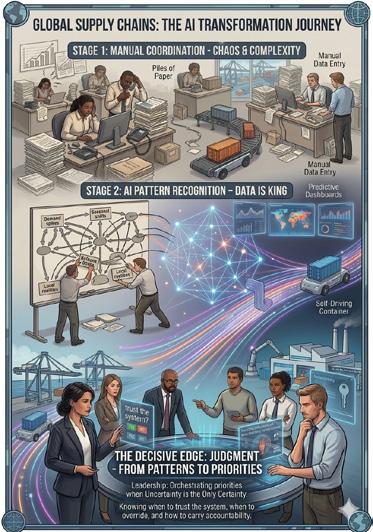
Artificial intelligence is rewriting the operating rhythm of supply chains. What once relied on manual coordination now runs on predictive dashboards, automation, and instant visibility. But as systems accelerate, the true shift is not from human to machine—it is from patterns to priorities.
AI thrives on patterns, yet supply chains thrive on disruption. Demand spikes, seasonal shifts, and local realities constantly break forecasts. In this environment, leadership is no longer about executing processes; it is about orchestrating priorities when uncertainty is the only certainty. The decisive edge lies in judgment—knowing when to trust the system, when to override it, and how to carry accountability when outcomes are unpredictable.
This transition is reshaping talent and leadership models. Routine coordination is giving way to hybrid capabilities: data fluency, scenario thinking, and cross‑functional orchestration. Emotional stability and clarity of communication are becoming essential, because credibility in moments of disruption travels faster than dashboards. And as AI strips away operational noise, leadership quality is revealed more starkly—whether in the calmness to solve problems at 2 AM or the foresight to prevent an expensive lesson.
This Cover Story draws on perspectives from leaders navigating the frontier where algorithms accelerate—but human leadership decides, showing how visibility becomes action and priorities define resilience.
“As AI scales in supply chains, human decision making shifts from controlling flows to architecting systems—focusing less on what to do and more on when to intervene, what risks to take, and how to balance trade offs at scale,” highlights Akhil Srivastava, Senior Director – New Business Development, International Supply Chain & Innovation, AB InBev.
While AI adoption in supply chains is still evolving in markets like India, how do you see the role of human decision-making changing as these technologies scale?
As we see AI adoption scaling across supply chains—especially within vibrant emerging markets like India—it’s clear that the role of human decision-making isn’t diminishing; it’s evolving and moving upward, transitioning from transactional control to strategic orchestration. The narrative isn’t about replacement, but rather a redefinition of where humans truly add value.
Let’s look at how this shift unfolds. Today, in environments with low AI maturity, humans are at the center of planning, forecasting, and inventory decisions, relying heavily on experience, spreadsheets, and heuristics. As AI becomes more integrated, it takes over demand forecasting, replenishment triggers, and route optimization, freeing people to focus on managing exceptions, validating model outputs in volatile contexts, and ultimately, making strategic trade-off decisions. In markets like India, where volatility and infrastructure constraints are real, this shift is particularly pronounced.
AI also revolutionizes data processing. Where leaders once asked, “What is happening?” or “Can I trust this data?”, they now move toward interpreting what the data means for network strategy, identifying risk signals, and contextualizing AI outputs with local truths—like festivals, regional demand spikes, and policy shifts. Humans become indispensable as context interpreters and reality validators.

While AI optimizes individual nodes—such as warehouse efficiency and transport costs—human decisionmaking increasingly focuses on crossfunctional trade-offs: inventory versus cash flow, service levels versus cost-toserve, network-wide optimization, and long-term capability building such as localization and supplier diversification. In this landscape, humans act as system
architects, not merely node managers. As AI brings predictive models, simulations, and digital twins into the mix, planning transitions from deterministic to probabilistic and scenario-based. Human roles shift towards interpreting probability distributions, making decisions amidst uncertainty, and navigating ambiguity—areas where local volatility and supplier fragmentation in
India make human expertise crucial.
Another critical evolution is from control to governance and ethics. As AI scales, humans must define when it can auto-execute, when it must escalate, and set acceptable thresholds for stockouts, forecast errors, and cost deviations. Leaders become guardians of decision frameworks, ensuring AI remains unbiased and avoiding “automation complacency.”
As AI adoption accelerates, decisionmakers need to build new capabilities across four dimensions: data and model literacy (understanding what models do and their limitations), scenario thinking (embracing a “what if” mindset for disruptions), commercial acumen (translating AI recommendations into P&L impact), and change leadership (driving adoption in teams and bridging frontline with digital systems).
Ultimately, AI is set to industrialize decision-making at scale—but humans will define the rules, intervene strategically, and carry higher accountability for each decision. Fewer manual tasks, more strategic interventions, and an elevated role for human judgment are on the horizon.
Which traditional supply chain roles are losing relevance, and what new roles or capabilities are emerging as critical in this shift?
Traditional supply chain roles are evolving in response to technology-led changes. We’re not seeing jobs disappear entirely, but rather, many traditional roles are shrinking, being automated, or transforming into more complex and valuable work.
For example, transactional planning roles like demand planners who rely on spreadsheets, or supply planners running manual replenishments, are becoming less relevant. AI-driven forecasting and autonomous planning systems are outpacing manual, rulebased approaches, and continuous planning is replacing periodic cycles. The nature of these roles is shifting from plan creation to plan orchestration and exception management.
Order management and execution coordinator positions, which require manual order entry, allocation, and shipment tracking, are also declining.
With RPA, EDI/API integration, and control towers automating workflows and execution visibility, and real-time logistics data reducing the need for human tracking, these roles are shifting from execution follow-up to network control and disruption response.
job
Forecast accuracy
Process adherence
Functional expertise
Cost optimization
Manual analysis
Scenario agility
Decision-making under uncertainty
End-to-end systems thinking
Risk + resilience optimization
AI-augmented decision making
Reporting Insight storytelling
In pure procurement transaction roles, tactical buyers who focus on RFQs and PO processing are seeing their work streamlined by e-sourcing platforms and AI-based vendor comparison tools. Automated catalog buying and replenishment are reducing the need for manual involvement, with the focus moving from buying to supplier strategy and risk management.
Static reporting and MIS roles, where analysts generate historical reports, are also affected. Self-serve BI tools and AI copilots now deliver instant insights, so the role is evolving from reporting to decision intelligence and insight shaping.
Even narrow functional specialists— those who are siloed in logistics, warehousing, or planning—are being affected. The demand now is for crossfunctional thinking, as end-to-end visibility and integrated planning become more critical. The shift is from pure functional depth to systems-level thinking.
The real transformation is in the mix of capabilities. The most significant change isn’t necessarily in job titles, but in the skills required. Where we once focused on forecast accuracy and process adherence, scenario agility and decision-making under uncertainty are now essential. Functional expertise is giving way to end-to-end systems thinking, and cost optimization is being replaced by a focus on risk and resilience optimization. Manual analysis is evolving into AI-augmented decision making, and reporting is transforming into insight storytelling.
It’s important to note that around 40–60% of traditional transactional supply chain work is automatable. The value is migrating from execution to orchestration, efficiency to resilience, and data generation to decision intelligence. Organizations that succeed in this
new landscape will flatten transactional layers, build decision-centric roles, invest in AI-human hybrid capabilities, and redesign their structures around process flows instead of traditional functions.
Let’s keep these shifts in mind as we continue to build our teams and develop our skills for the future.
What are the most essential skills the next-generation supply chain professional must develop to remain relevant in an algorithmdriven environment?
As we continue to navigate the evolving landscape of supply chain management, I wanted to share some key leadership skills that are emerging as critical in our increasingly digitized environment. These skills not only enhance our ability to leverage technology but also strengthen our capacity to drive business outcomes and adapt to change.
First and foremost, data fluency and analytical thinking have become non-negotiable. Being able to interpret, challenge, and act on AI and algorithm outputs is essential. A strong grounding in statistics, forecasting logic, and optimization principles, along with comfort using tools like Python, SQL, or BI dashboards, equips us to validate context, bias, and trade-offs in the insights generated by algorithms. Moving from simply consuming reports to owning decisions, and asking questions such as, “What assumptions is this model making?” helps us stay proactive.
Next, systems thinking and end-toend visibility are vital. Understanding supply chain as an interconnected system—from demand and supply through logistics to the customer— allows us to anticipate ripple effects and optimize system-wide performance. Identifying trade-offs among inventory, service, cost, and cash is key to preventing
suboptimal “black-box optimization.”
Human and machine decision orchestration is another important area. Knowing when to trust the algorithm and when to override it and designing frameworks that combine AI recommendations with human judgment, ensure we strike the right balance. Escalation logic for exceptions and clarity on decision rights (what’s automated and what’s manual) are practical tools that help manage this balance.
Digital and AI literacy is essential, but it needs to be applied rather than theoretical. Understanding the capabilities and limits of AI/ML forecasting, digital twins, control towers, and autonomous planning systems positions us to deploy and scale technology effectively. Acting as a bridge between operations and data science teams and translating business problems into technical solutions drives real impact.
Scenario planning and risk thinking develop our ability to model uncertainty and disruption. Strong grounding in probabilistic thinking helps us build contingency playbooks and stress-test supply chain resilience, recognizing that algorithms are often trained on historical data and may not always respond well to non-linear or novel disruptions.
Execution excellence in a digitized environment means driving outcomes in automated, real-time supply chains and managing exception-based operations. Value increasingly shifts from simply doing tasks to managing overall system performance, so focusing on cycle times, service levels, and cash velocity—and operating via dashboards and triggers— ensures we keep pace.
Cross-functional influence and stakeholder alignment are also important. Aligning commercial, finance, manufacturing, and logistics stakeholders, and translating analytics into business language, helps drive adoption of algorithmic decisions, recognizing that leaders—not algorithms—manage stakeholders.
Change leadership and adoption management are crucial for transformation. Leading the shift from legacy processes to digital workflows, managing resistance to automation and
AI, and training teams on new decision models build trust in algorithm outputs and ensure that technology ROI is fully realized.
Commercial and financial acumen strengthen our ability to understand the P&L impact of supply chain decisions, linking operations to growth, margins, and working capital. This positions supply chain as a strategic profit lever, not just a cost center, and enables us to translate service improvements into revenue impact and optimize cost-toserve.
Finally, agility, a learning mindset, and curiosity are indispensable in a rapidly evolving tech environment. Continuous upskilling, comfort with ambiguity, and rapid iteration ensure we remain competitive, as tools change faster than roles and our learning speed becomes the ultimate differentiator.
How are organisational structures and leadership models evolving as supply chains move from process execution to system orchestration?
Core issue: The gap isn’t just “AI skills”—it spans three distinct layers:
Decision Makers (Leaders)
Operators (Planners, Logistics, Procurement)
Intuition-driven, experience-heavy
ERP-driven execution
Looking ahead, what will differentiate supply chains in an AI-driven future, and how will talent capability shape and accelerate this growth?
In high stakes situations (safety, legal exposure, large financial impact, reputational risk), the right balance is not “AI vs. human” but system design: create conditions where AI accelerates reasoning while humans retain accountable authority, supported by guardrails that make over trust and under trust both unlikely.
Make AI “trustworthy by design” using calibration, not persuasion. Humans are prone to automation bias (over-trusting AI) and algorithm aversion (rejecting AI after a visible error). Calibration reduces both: people trust AI appropriately when it “knows what it doesn’t know.”
Our approach to AI oversight ensures our systems continue to deliver value while upholding high standards of safety and ethics. First, it's crucial that human judgement is focused on the right areas, namely context, ethics, and exception handling. By concentrating on human expertise where it's most impactful, we can trust AI with pattern detection, scenario simulation, early warning
AI-augmented decision-making, scenario thinking
Data interpretation, exception-based management
Specialists (Analytics/IT) Reporting-focused Predictive modeling, optimization, AI/ML
Build a “T-Shaped” Workforce (Most Effective Mode) with Broad AI/Data literacy across all supply chain roles and Deep expertise in a few specialized teams
• Create “Use-Case Driven Upskilling”
• Instead of generic AI programs, anchor learning to high-impact supply chain use cases:
signals, and optimization within known constraints.
Demand sensing Data interpretation, model trust Forecast accuracy
Network optimization Scenario modeling Cost + service
Supplier risk prediction External data usage Resilience
Inventory optimization Trade-off thinking Working capital
When it comes to monitoring performance, we should rely on leading indicators, not just outcomes. Waiting for a failure means we've already missed an opportunity to intervene sooner. Instead, let's proactively track signs such as calibration drift (where confidence and actual accuracy diverge), data drift (shifts in input distributions), override patterns (whether humans are overriding AI decisions too often or too rarely), near misses (instances where guardrails successfully averted negative outcomes), and decision latency (observing
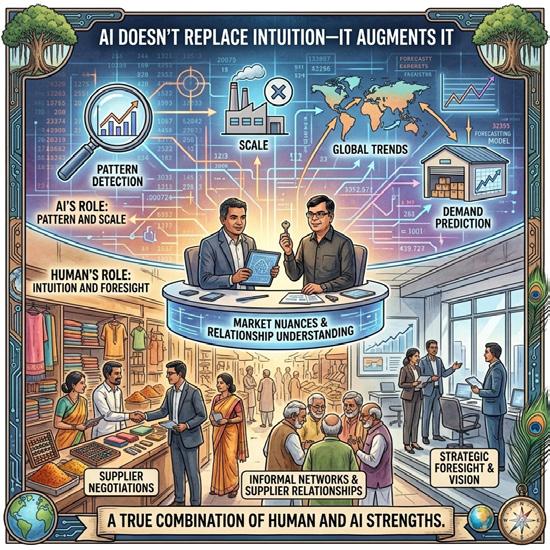
AI doesn’t replace intuition—it augments it. The best organizations blend machine intelligence for pattern detection and scale with human intelligence for market intuition, relationship understanding, and strategic foresight. In India, informal networks, supplier negotiations, and market nuances remain vital, making the competitive advantage a true combination of human and AI strengths.
whether AI is speeding up decisions without sacrificing quality).
Ultimately, a mature organization treats AI as a “living system”—something that requires ongoing attention and adaptation, rather than a static feature that's simply deployed and forgotten. By adopting these practices, we can ensure our AI capabilities remain robust, ethical, and aligned with our organizational goals.
In an AI driven future, supply chains won’t be differentiated by assets or even scale—they will be differentiated
by decision quality at speed, enabled by intelligent systems + augmented talent. The winners will be those that combine machine precision with human judgement at the right control points.
Below is a clean, executive view of what will differentiate supply chains and how talent capability becomes the multiplier.
From linear execution Autonomous, self orchestrating networks.
Not visibility—but closed-loop execution (detect decide act learn). Ability to price risk into every operational decision in real time.
Predictive + pre-emptive resilience, not reactive firefighting when supply chain becomes a margin engine, not just a cost center
In summary, humans move from doing tasks to designing and supervising decisions.
As AI steadily reshapes supply chain operations, the conversation is no longer just about automation, but about how organisations balance technological intelligence with human judgement. Ashish Joshi, Senior Supply Chain Director – Europe, Mars, reflects on the evolving role of talent, leadership, and decision making in building supply chains that are not only digitally enabled, but also adaptive, contextual, and deeply customer centric.
While AI adoption in supply chains is still evolving in markets like India, how do you see the role of human decision-making changing as these technologies scale?
AI adoption in supply chains is still evolving, not only in India but globally as well. Very few organisations today can claim to have implemented AI-led use cases at scale across their endto-end operations. Most companies continue to remain in a ‘Test-andLearn’ phase, experimenting with pilots while evaluating where AI can create sustainable business value.
That said, it is already evident that several supply chain functions — including demand planning, supply planning, network optimisation, distribution planning, and customer service — will undergo significant transformation. Activities traditionally dependent on manual analysis and repetitive decision-making will increasingly become automated, predictive, and system-enabled.
However, this does not reduce the importance of human judgement. Instead, the nature of decisionmaking will evolve. Supply chain professionals will gradually move from operational execution toward contextual interpretation, strategic oversight, and orchestration. AI can process data and generate recommendations rapidly, but supply chains continue to operate in dynamic environments shaped by market volatility, customer behaviour, geopolitical uncertainty, and human relationships.
As these technologies scale, human judgement will remain essential in
balancing algorithmic recommendations with business realities and long-term strategic priorities. In many ways, AI will augment human capability rather than replace it.
Which traditional supply chain roles are losing relevance, and what new roles or capabilities are emerging as critical in this shift?
Roles centred around repetitive
analytics, transactional execution, and routine exception handling are likely to be impacted most significantly by AI-driven transformation. Functions involving manual reporting, forecasting adjustments, operational coordination, and basic decision support will increasingly become automated as intelligent systems mature. The shift, however, is less about eliminating roles and more about changing the nature
of work. Supply chain professionals will need to evolve from being ‘DOERS’ to becoming ‘ORCHESTRATORS’ — individuals who oversee interconnected systems, interpret insights, and drive cross-functional collaboration.
This evolution could particularly affect segments of the BPO and shared services industry, where repetitive and rules-based activities have historically formed the operational backbone. Even basic levels of exception handling are increasingly being managed through AIenabled systems capable of learning from historical patterns.
At the same time, new capabilities are becoming critical. The relevance of data scientists, AI specialists, data stewards, and digital process architects will continue to rise sharply. Organisations will increasingly require professionals who can ensure data quality, govern intelligent systems, and bridge the gap between technology platforms and operational realities. More importantly, future supply chains will value professionals who combine domain expertise with digital understanding and strategic thinking.
What are the most essential skills the next-generation supply chain professional must develop to remain relevant in an algorithmdriven environment?
In addition to learning how to work with AI tools and advanced technologies, staying deeply aware of changing business realities will become even more important for the next generation of supply chain professionals. As organisations become more dependent on algorithms and automated decisionmaking, there is also a growing risk of relying excessively on systems while losing sight of the broader context and practical business judgement. Algorithms can provide recommendations based on data patterns, but they cannot fully account for evolving market dynamics, behavioural shifts, or the nuances of human relationships.
Human wisdom, common sense, and contextual understanding will therefore continue to remain highly relevant for a long time to come. Professionals who can combine data-driven insights with commercial understanding and
operational pragmatism will be far more valuable than those who rely solely on technical proficiency.
At the same time, adaptability and continuous learning will become essential. The pace of technological change is likely to remain extremely rapid, requiring professionals to constantly evolve their capabilities. Communication, collaboration, and the ability to work across interconnected ecosystems will also become increasingly important. Ultimately, the most futureready professionals will be those who can combine digital fluency with strategic thinking, business awareness, and sound human judgement.
There is a clear gap between current supply chain talent and emerging AI-driven capability requirements. What are the most effective ways to bridge this gap?
Upskilling existing teams is likely to be the fastest and most cost-effective way to bridge the growing capability gap, rather than depending entirely on external hiring. Existing supply chain professionals already possess valuable institutional knowledge, operational understanding, and business context, which provide a strong foundation for adapting to AI-enabled ways of working.
While hiring specialised talent may bring fresh digital expertise into the organisation, relying solely on external recruitment is unlikely to be sustainable over the long term. Organisations that invest in developing their current workforce are more likely to build resilient and adaptable teams capable of evolving alongside technological change. However, upskilling must go beyond basic technical training. Employees need exposure to how AI, analytics, and automation can influence decision-making and reshape operational processes. Creating a culture of continuous learning and digital curiosity will be equally important.
Leadership also plays a critical role in enabling this transition. Employees need to view technology not as a threat to their relevance, but as an enabler that enhances their effectiveness and decision-making capability. Ultimately, AI transformation is not only a technology journey — it is equally a workforce and mindset transformation.
How are organisational structures and leadership models evolving as supply chains move from process execution to system orchestration?
Historically, supply chain organisations relied on large execution-heavy layers to manage transactional processes and operational coordination. As automation takes over many repetitive tasks, organisations will have the opportunity to strengthen their middle layers of leadership and expertise.
This shift will enable greater focus on collaboration, ecosystem management, and strategic coordination with suppliers, logistics partners, distributors, and customers. Leadership models are also becoming less hierarchical and more adaptive. Future leaders will need to encourage faster decision-making, manage ambiguity, and lead through influence rather than control. In essence, supply chains are transitioning from execution-centric structures to intelligence-led ecosystems, requiring a very different balance of skills and leadership capabilities.
In high-stakes situations, how should organisations balance trust in AI-driven recommendations with human judgement?
AI tools can undoubtedly help organisations arrive at potential solutions with far greater speed and analytical depth than traditional methods. In high-stakes situations, this capability can significantly enhance responsiveness by processing large amounts of data and presenting possible scenarios in real time. However, important decisions cannot be evaluated solely through the lens of numbers and algorithms. Supply chain decisions often carry broader consequences that affect employees, customers, suppliers, and long-term business relationships. While AI may optimise for efficiency or cost, it still lacks the human sensitivity and contextual understanding required to fully appreciate the emotional and relationship-driven dimensions of decision-making.
It will take considerable time for AI to truly understand the complexities of human interactions and behavioural dynamics within organisations. Until
As
supply chains become increasingly digitised and AI-enabled, organisational structures are gradually evolving away from the traditional pyramid model toward more agile and collaborative frameworks. In many ways, organisations are likely to move toward more ‘Diamond-Shaped’ structures, where a significant portion of the operational base traditionally responsible for repetitive execution is progressively replaced or augmented by intelligent systems.
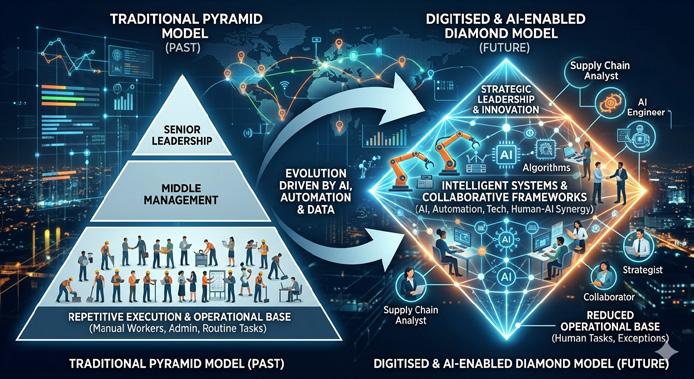
then, human judgement will continue to play a critical role in interpreting AI-generated recommendations and evaluating their broader implications beyond operational metrics. The most effective organisations will therefore adopt a balanced approach where AI acts as a powerful decision-support enabler rather than a complete substitute for human thinking.
Looking ahead, what will differentiate supply chains in an AI-driven future, and how will talent capability shape and accelerate this growth?
Staying focused on customers — both internal and external — will continue to remain the most important differentiator for businesses and supply chain functions, even in an increasingly AI-driven future. While technology will
play a transformative role in enabling faster and more intelligent operations, long-term relevance will still depend on how effectively organisations evolve alongside changing customer and consumer expectations.
AI can significantly strengthen supply chains by improving visibility, forecasting accuracy, agility, and decision responsiveness. However, technology alone will not create sustainable competitive advantage unless it is supported by the right organisational mindset and talent capability.
The organisations that will lead in the future are likely to be those that can successfully combine technological advancement with human adaptability. Future-ready supply chain professionals will need to be digitally aware, strategically agile, collaborative, and continuously open to learning and reinvention.
Ultimately, the future of supply chains will not be defined solely by the sophistication of technology adoption, but by how effectively organisations integrate human intelligence with artificial intelligence to build more adaptive, responsive, and customercentric ecosystems.
Disclaimer: The views, insights, and opinions expressed in this interview are solely those of the author and are shared in an individual and professional capacity. They do not necessarily represent or reflect the official views, positions, strategies, or policies of the author’s employer, its leadership, subsidiaries, or affiliated organisations. The discussion is intended purely for industry knowledge-sharing and thought leadership purposes.
“As AI capabilities mature across supply chains, the real transformation is unfolding not in automation alone, but in the evolving role of human judgement. From interpreting algorithmic recommendations to managing uncertainty, supply chain professionals are increasingly shifting from transactional execution to intelligent orchestration,” believes Bikash Prasad, Assistant Vice President – Human Resources, Reliance Retail.
While AI adoption in supply chains is still evolving in markets like India, how do you see the role of human decision-making changing as these technologies scale?
In India, we are gradually moving from being ‘Drivers of Data’ to ‘Navigators of Systems’ which means that from ‘Doing Manual Tracking and Reporting’ to ‘Using Intelligent Systems To Take Better Business Decisions’. AI can help in route planning, forecasting demand and inventory optimization but human judgement will continue to remain very important. For example, earlier a logistics manager in an FMCG or retail company in Mumbai used to spend hours making calls to track trucks delayed due to rains. Today AI systems can predict such delays much earlier. The manager’s role is no longer just tracking the truck but deciding whether to reroute stock from another warehouse or delay the deliveries or to take a commercial call like giving discount to the customer. AI gives speed and visibility, but humans provide practical judgement, customer understanding and local context.
Which traditional supply chain roles are losing relevance, and what new roles or capabilities are emerging as critical in this shift?
Roles focused mainly on manual data entry repetitive reporting and routine coordination are slowly reducing. For example, inventory tracking or dispatch planning that earlier happened manually

through Excel sheets is now increasingly automated through WMS, TMS and AIenabled dashboards. At the same time, new roles are emerging such as:
Supply Chain Control Tower managers
Network planning specialists
Automation managers
Data and analytics professionals
Exception management teams
In large Indian organizations like Reliance Retail or Big Basket, systems can automatically trigger replenishment decisions. Human intervention mainly
happens during exceptions like sudden demand spikes, transport disruptions or mandi strikes. The future role is less about ‘Pushing Excel’ and more about ‘Managing Exceptions’.
What are the most essential skills the next-generation supply chain professional must develop to remain relevant in an algorithmdriven environment?
The next-generation supply chain professional does not necessarily need to become a programmer but must become
The next-generation supply chain professional does not necessarily need to become a programmer but must become comfortable working with technology and AI systems. One very important capability will be ‘Algorithmic Fluency’ which means understanding what the system is recommending and whether it practically makes sense.
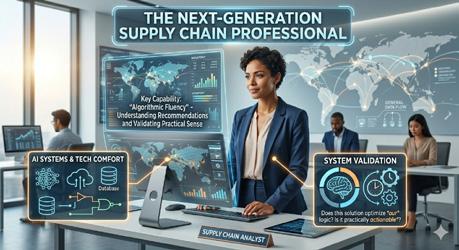
comfortable working with technology and AI systems. Important skills will include Data interpretation; Problemsolving; Decision-making; Collaboration; and Technology adaptability. One very important capability will be ‘Algorithmic Fluency’ which means understanding what the system is recommending and whether it practically makes sense. For example, just like a pilot uses autopilot but still monitors the aircraft, supply chain professionals must know when AI recommendations may not fully capture Indian market realities such as sudden GST changes, regional festivals or local disruptions. The future professional will act as a translator between AI outputs and real business outcomes.
There is a clear gap between current supply chain talent and emerging AI-driven capability requirements. What are the most effective ways to bridge this gap? The answer is not simply replacing people but reskilling them. Indian organizations should focus on Practical digital training; Exposure to analytics tools; Cross-functional learning; and Hands-on project experience. One effective approach is ‘Digital Shadowing’ where operational teams work closely with analytics or technology teams.
For example, when demand planners spend time with data science teams and understand how forecasting models work, they stop seeing AI as a threat and start using it as a support tool. The future is not “Human vs AI” instead, it is “Human + AI.”
How are organisational structures and leadership models evolving as supply chains move from process execution to system orchestration?
Organizations are becoming leaner, more centralized and technology driven. Earlier, warehousing, planning, transport and reporting teams often worked separately. Now companies are moving towards Centralized Planning; Control Towers; Integrated Visibility Platforms; as well as Shared Analytics Teams. Leadership roles are also evolving. Leaders are expected not only to manage operations but also to orchestrate systems, technology and people together. In many Indian companies, supply chain leaders who earlier focused mainly on execution are now expected to drive automation adoption, visibility and AIenabled decision-making.
In high-stakes situations, how should organisations
balance trust in AI-driven recommendations with human judgement?
AI should support decisions, but final accountability should remain with humans. A good approach is:
Trust AI during normal operating conditions
Trust human judgement during highly uncertain situations
For example, during floods in Chennai, an AI system may recommend stopping all shipments because of risk alerts. However, an experienced operations manager may know that one supplier or transport partner still has alternate access routes and can continue deliveries. AI is excellent for efficiency and speed, but humans are still better at resilience, relationships and handling unpredictable situations. Especially in India, local knowledge and field experience continue to play a very important role.
Looking ahead, what will differentiate supply chains in an AI-driven future, and how will talent capability shape and accelerate this growth?
In the future, almost every company will have access to similar AI tools and technologies. The real differentiator will not be technology alone but the agility of people and organizations. If an AI system flags a disruption, the company that can quickly analyse, decide and act within 30 minutes will outperform the company that takes 2–3 days. Futureready supply chains will be differentiated by Faster decision-making; Better visibility; Agile teams; Strong execution capability; and Technology Adaptability. Indian organizations that invest early in both technology and workforce capability building will move ahead faster. Ultimately, talent will become the biggest competitive advantage in an AIenabled supply chain world.
The supply chain is shifting from Muscle to Mind, where algorithms handle the routine and humans steer the complex. Dr. Chandan Shirbhayye, Vice President and Head – Supply Chain & Operational Excellence, Aragen Life Sciences, outlines how this transition is redefining roles, skills, and leadership in an AI‑driven future.

How do you see the role of human decision making changing as these technologies scale?
As AI adoption scales across supply chains, particularly in evolving markets like India, the role of human decision making will fundamentally shift rather than diminish. Routine and repetitive decisions related to planning, forecasting, scheduling, and operational execution will increasingly be automated through intelligent systems. This will allow supply chain professionals to move
beyond transactional activities and focus on more strategic responsibilities such as exception management, disruption response, ethical oversight, and crossfunctional trade-off evaluation.
In many ways, humans will transition from ‘Doing the Work’ to ‘Governing the System’. The responsibility of supply chain leaders will increasingly revolve around defining decision boundaries, validating AI-driven recommendations, and intervening when contextual understanding or stakeholder sensitivity
requires judgement that algorithms alone cannot provide. AI can undoubtedly improve efficiency, speed, and analytical precision, but human intelligence remains essential for accountability, ethical reasoning, and navigating uncertainty. The future will therefore not be about AI replacing people, but about creating a strong human–AI collaboration model where technology enhances operational effectiveness while humans ensure responsible and context-aware decision making.
Which traditional supply chain roles are losing relevance, and what new roles or capabilities are emerging as critical?
The growing integration of AI and digital technologies is steadily reducing the relevance of traditional executionheavy and transactional supply chain roles. Functions centred around manual planning, repetitive follow-ups, data consolidation, and report generation are increasingly being automated through intelligent platforms capable of processing information in real time and triggering faster responses. As organisations adopt predictive analytics and autonomous systems, the dependence on purely coordination-based roles is expected to decline significantly.
At the same time, an entirely new set of strategic capabilities is emerging as critical for future-ready supply chains. Organisations are now looking for professionals who can interpret complex datasets, translate insights into business
The traditional ‘Command-and-Control’ style of management is steadily giving way to a more enabling and governance-oriented leadership approach. Future supply chain leaders will increasingly act as system stewards who establish operational guardrails, define decision rights, and empower teams to respond autonomously while remaining aligned to organisational priorities.
actions, and manage interconnected supply chain ecosystems. Roles such as data-driven decision analysts, risk and resilience leaders, and supplier ecosystem managers are becoming increasingly important. The emphasis is shifting toward individuals who can integrate technology, business understanding, and operational context rather than operate within isolated functional silos. Future supply chain success will depend heavily on professionals capable of managing complexity, enabling collaboration, and driving informed decision-making across the value chain.
What are the most essential skills the next generation supply chain professional must develop?
The next generation of supply chain professionals will need to build a far broader capability framework than what was traditionally expected from the function. One of the most essential skills will be data literacy and AI interpretability. Professionals must develop the ability not only to use digital tools but also to understand why a system recommends a particular action and what assumptions drive those recommendations.
Equally important is systems thinking — the ability to evaluate supply chains holistically and manage trade-offs across cost, service, sustainability, compliance, and risk simultaneously. Supply chains today operate as interconnected ecosystems, and future professionals must be capable of understanding how decisions in one area affect the broader network. Beyond analytical capabilities, business judgement and storytelling will also become critical differentiators. Leaders must be able to convert datadriven insights into clear, actionable narratives that influence strategic decisions at the leadership level.
In addition, change management
and adaptability will play a major role as organisations continue to accelerate digital transformation initiatives. Supply chain professionals will increasingly be required to drive technology adoption across teams, manage resistance to change, and continuously adapt to evolving processes and tools. Alongside technical expertise, softer capabilities such as curiosity, agility, collaboration, and ethical reasoning will become equally important in defining long-term relevance and leadership potential.
How are organisational structures and leadership models evolving as supply chains move from execution to orchestration?
Supply chain organisations are gradually moving away from traditional hierarchical and function-centric structures toward more agile, networked, and collaborative operating models. As supply chains become more data-driven and interconnected, organisations are recognising the need for faster decisionmaking and greater cross-functional alignment. This is leading to structures built around decision ownership and orchestration rather than rigid departmental boundaries.
Leadership models are also evolving significantly in response to this transformation. The traditional ‘Command-and-Control’ style of management is steadily giving way to a more enabling and governanceoriented leadership approach. Future supply chain leaders will increasingly act as system stewards who establish operational guardrails, define decision rights, and empower teams to respond autonomously while remaining aligned to organisational priorities.
Success in the future will not be measured solely through execution efficiency or cost optimisation. Instead,
leadership effectiveness will increasingly be judged by how well systems can learn from disruptions, adapt to changing market conditions, and scale resilience over time. The focus is shifting from managing activities to building intelligent, adaptive, and continuously evolving supply chain ecosystems.
What will truly differentiate supply chains in an AI-driven future?
In the long term, technology itself is unlikely to remain a sustainable differentiator because advanced digital capabilities will eventually become widely accessible across industries. The real competitive advantage will come from talent capability, organisational mindset, and the ability to interpret complexity effectively. Supply chains that succeed in the AI-driven era will be those that build leaders capable of thinking beyond operational KPIs and understanding broader business, sustainability, and resilience implications.
Organisations will increasingly need talent that can thrive in ambiguity, adapt rapidly to changing conditions, and make informed decisions in uncertain environments. At the same time, futureready supply chains will need to embed continuous learning, resilience, and sustainability directly into their decisionmaking frameworks rather than treating them as separate initiatives.
Ultimately, the defining factor will not simply be how advanced a company’s systems are, but how effectively its people can leverage those systems to make balanced, responsible, and forward-looking decisions. In the AI era, competitive advantage will depend less on how systems compute and more on how people think, interpret, and lead through complexity.
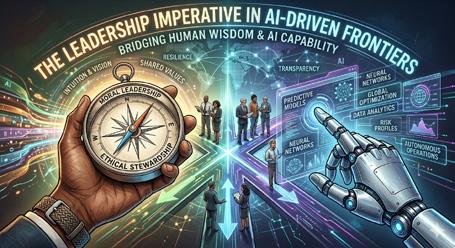
“My own rule would be this: never ask a human to rubber‑stamp an AI recommendation; ask them to own the consequence of accepting or rejecting it. That changes the quality of decision‑making immediately,” observes D K Rai, CEO India and VP Global Business Expansion, Smartlog Corp. His perspective reframes expansion in the AI era as a leadership challenge—where growth is measured not only by speed and scale, but by the responsibility leaders take for the outcomes their choices create.

AIwill not replace supply chain judgement. It will expose whether we ever had good judgement to begin with. That, to me, is the real shift underway. In India, we often talk about AI in supply chains as if the destination is a “lights-out”, fully autonomous system. I think that is the wrong metaphor for our market. India is too dynamic, too fragmented, too infrastructuresensitive, and frankly too human for that fantasy. Our roads, vendors, demand signals, regulatory realities and channel behaviour still refuse to behave like a clean spreadsheet. So the future here is not human-less supply chains. It is human judgment operating at a higher
altitude. Indian enterprises are already moving quickly on AI adoption— including in strategy, operations and supply chain—but capability depth still lags, which is exactly why human quality will matter even more in the next phase.
How will human decision-making change as AI scales?
I do not believe humans will become less important. I believe routine human intervention will become less important. The planner of the future will not be valued for producing a forecast file, chasing updates on WhatsApp, or sitting in review meetings explaining why yesterday’s numbers changed. AI will increasingly do the sensing, the pattern detection, the recommendation and,
in some cases, even the execution. The human role will move upward — from processing decisions to framing them, challenging them, and carrying the commercial and ethical responsibility for them. That is a profound shift. It means the real premium will be on judgment under ambiguity, not on mechanical coordination. That is also where the best AI performers are separating themselves: they are not merely automating old work; they are redesigning workflows and defining where human validation is required.
In practical terms, I see the human role becoming more like an air-traffic controller than a ticketing clerk. Less touching every transaction, more supervising the system, interpreting
exceptions, and deciding when the algorithm is technically right but contextually wrong. In India especially, context still matters enormously: a port delay is not just a delay, a festival spike is not just a spike, and a supplier commitment is often as much about relationship temperature as contractual SLA. That is why I say AI will compress routine judgment, but it will increase the value of seasoned judgment.
“I learned this the hard way during the COVID crisis, when the system gave us one answer, but the ground reality demanded another.”
Which traditional roles are losing relevance, and what new roles are becoming critical?
The roles losing relevance are not entire job families overnight; it is the parts of jobs built on low-value repetition.
The classic expeditor who spends the day chasing status updates, the analyst who manually reconciles spreadsheets from five systems, the planner whose identity is tied to monthly file-making rather than decision quality, and the coordinator who adds no insight beyond moving information from one inbox to another — these roles will steadily lose
relevance.
What will grow instead are hybrid roles. We will need supply chain professionals who can act as decision architects, not just process owners. We will need people who understand data, but also know operations well enough to spot when the data is lying. We will need AI product owners inside supply chains, scenario designers, model-governance leaders, exception managers, controltower orchestrators, and translators who can convert business ambiguity into machine logic. McKinsey’s framing is useful here: gen AI becomes a “team member” that must be trained, given business context and improved through feedback. That means new human value lies in teaching the machine, supervising it and redesigning work around it.
If I were being blunt, I would say this: in the old supply chain, being busy was enough. In the new supply chain, you have to be useful. AI will be ruthless about that distinction. “Early in my career, I was rewarded for speed of response. Today, I value quality of intervention far more — knowing when to step in, when to let the system run, and when to escalate.”
What skills must the next-
generation supply chain professional develop?
The first is systems thinking. A lot of people can optimize a node. Very few can understand what that optimization breaks somewhere else. In an algorithmdriven supply chain, local efficiency can create network fragility. So the future professional must think in terms of trade-offs, feedback loops and secondorder effects.
The second is data literacy without data arrogance. People do not need to become coders to remain relevant, but they do need to understand what data is being used, what is missing, what assumptions are embedded in the model, and where bias or blind spots may sit. The fastest-growing skills globally now include AI and big data, technological literacy, creative thinking, resilience, curiosity and analytical thinking — and that combination matters. The next supply chain leader must be both numerate and adaptive.
The third is commercial judgment. AI can tell you what is probable. It cannot fully tell you what is worth doing. That still requires an understanding of customer strategy, working capital, market share, supplier relationships and risk appetite.
The fourth is narrative ability. This is underrated. In the future, the person who wins will not be the one who has the most dashboards, but the one who can explain what the dashboard means, what decision is required, and what trade-off the business is actually making. And the fifth is the courage to challenge clean-looking output. In my view, one of the most important future skills is not prompt engineering. It is respectful scepticism.
“I tell young teams that in the AI era, your career will not be protected by knowing more screens than the
The old supply chain organisation was designed around process control. The new one is being designed around decision velocity. That means the hero model is changing. The celebrated leader of the past was often the person who could personally unblock every crisis. The leader of the future will be the one who builds a system where fewer crises require heroics in the first place.
next person. It will be protected by asking better questions than the next person.”
How do we bridge the gap between current talent and AIdriven capability needs?
The biggest mistake companies make is treating this as a training problem alone. It is not. It is a work redesign problem first, and a talent problem second. If an organisation simply runs AI workshops but leaves the underlying workflow unchanged, people will go back to old habits. The more effective approach is to redesign a few high-value decisions end-to-end: forecasting, replenishment, supplier risk, transport planning, inventory deployment. Then train people inside those redesigned workflows. Highperforming AI organisations do exactly this — they redesign work, define validation checkpoints, and back it with leadership ownership, not just tech enthusiasm.
In India, bridging the gap requires a very practical model. First, create mixed teams of operators, planners, data people and business leaders. Second, use apprenticeships more than classrooms. Third, rotate high-potential talent through plant, procurement, logistics and analytics roles so they become bilingual in operations and algorithms. Fourth, reward adoption and decision quality, not only course completion. Deloitte’s India data is telling: Indian firms are scaling AI quickly, but expertise depth is still low, so the imperative is not just to deploy tools but to build specialist and managerial capability around them.
India also has a broader workforce challenge and opportunity here. Deloitte and NASSCOM have noted that AI talent demand in India is set to more than double across 2022–27, while many workers already see AI skills as careerenhancing. That tells me the answer is not to wait for the perfect talent market. It is to convert current supply chain talent into AI-capable operators through structured upskilling, live use cases and cross-functional exposure.
“The companies that win won’t necessarily hire the most data scientists. They’ll be the ones that best reskill their toughest planners,
buyers and plant managers into human supervisors of machine-led decisions.”
How are organisational structures and leadership models changing?
The old supply chain organisation was designed around process control. The new one is being designed around decision velocity. That means the hero model is changing. The celebrated leader of the past was often the person who could personally unblock every crisis. The leader of the future will be the one who builds a system where fewer crises require heroics in the first place. So leadership is shifting from command-and-control toward orchestration, from vertical silos toward cross-functional pods, and from static reviews toward dynamic controltower environments.
The language matters here. “Execution” suggests people moving tasks through a chain. “Orchestration” suggests humans, machines, partners and platforms working as an adaptive network. The World Economic Forum describes this evolution as a journey from digital to adaptive to autonomous supply chains, with talent, governance and cross-functional collaboration as critical enablers. IBM makes the same point differently: as AI agents act within defined constraints, human teams move toward setting objectives, handling exceptions and overseeing outcomes.
In India, I expect the strongest organisations to build what I would call a federated intelligence model: central standards for data, governance and architecture, but decision rights distributed close to the market, plant, customer or supplier. That suits our complexity far better than importing a rigid global operating template.
“In my own experience, some of the worst supply chain decisions were not made because people lacked data; they were made because the data was trapped in silos and nobody owned the full outcome.”
In high-stakes situations, how should organisations balance AI recommendations with human judgement?
My view is simple: the higher the
stakes, the more explicit the human role must become. I do not believe in blind trust in AI, and I also do not believe in romanticising human intuition. Both are dangerous when left unchecked. The answer is a risk-tiered model. For routine, high-volume, low-consequence decisions, let the machine decide within thresholds. For medium-impact decisions, let AI recommend and humans approve. For high-stakes situations — major allocation choices, crisis response, safety risks, compliance exposure, strategic customer service trade-offs — require a visible human decision owner, with model confidence, assumptions and escalation triggers made transparent.
What will differentiate supply chains in an AI-driven future?
Not technology access. That will commoditise faster than most people think.
For India, I think the winners will be the companies that combine three things unusually well:
The frugality to scale AI pragmatically rather than fashionably;
The operational realism to build for messy ground conditions rather than idealised ones;
The talent discipline to turn current managers into orchestrators.
India has strong momentum on enterprise AI adoption, but many firms are still early in maturity and continue to face barriers in quantifying value, changing behaviours and building ecosystem readiness. That is why talent capability will be the real accelerator: it converts AI from a pilot into a compounding advantage.
For years, supply chains rewarded endurance — the people who could tolerate complexity, chase updates, and keep the machine moving. The next era will reward something else: judgment. AI will handle more of the motion. Humans will be judged by the quality of their intervention. That is why I don’t think the future belongs to autonomous supply chains in the purest sense, especially not in India. I think it belongs to intelligently human supply chains — systems where machines scale speed, and people scale wisdom.
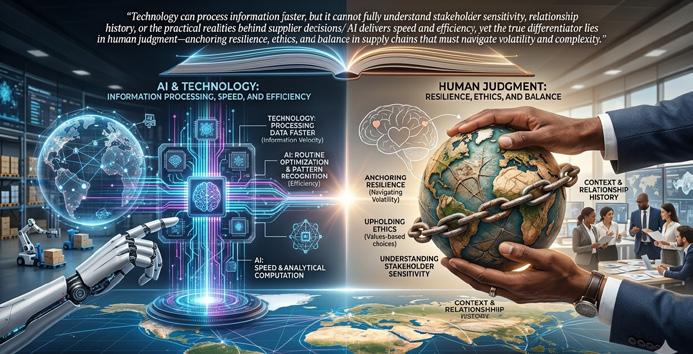
“Technology can process information faster, but it cannot fully understand stakeholder sensitivity, relationship history, or the practical realities behind supplier decisions,” emphasizes Manoj Bhatia, SCM Industry Expert. His perspective points to a future where AI delivers speed and efficiency, yet the true differentiator lies in human judgment—anchoring resilience, ethics, and balance in supply chains that must navigate volatility and complexity.

How do you see the role of human decision-making changing as AI technologies scale in markets like India?
We often talk about VUCA (Volatility, Uncertainty, Complexity, and Ambiguity) as if it is a management concept, but for supply chain teams today, it is simply the operating environment. Geopolitical disruptions, supplier instability, regulatory changes, logistics uncertainty, and shifting customer expectations now influence sourcing decisions far more regularly than they did earlier. In that kind of environment, AI becomes an extremely valuable support tool, but not a replacement for human judgment. One thing experience teaches very quickly is that context matters as much as data
I remember when I worked with a global organisation operating across both pharma and consumer products businesses, the contrast between the
two sides was remarkable. The pharma business operated within highly regulated timelines and compliance structures, while the consumer side moved at a completely different pace driven by market pressures. The priorities, risks, and decision cycles were entirely different even within the same organisation. Technology can process information faster, but it cannot fully understand stakeholder sensitivity, relationship history, or the practical realities behind supplier decisions. Those situations still require judgment, balance, and accountability. Even in my current role leading global procurement operations, the visibility available through analytics today is far ahead of where the industry stood a decade ago. The tools genuinely help. But the moment a sourcing decision involves reputational risk, commercial sensitivity, or supplier complexity, human judgment becomes far more important than dashboards alone. And in India especially, many supply chain realities
still sit outside structured systems. Regional operating practices and local business dynamics are often understood better through experience than through standardised global AI models.
Which traditional supply chain roles are losing relevance, and what new roles are emerging?
The shift happening in supply chains today is less about replacing people and more about changing the kind of work people spend their time on. When I was leading transformation initiatives at a large Indian organisation, one thing became obvious very quickly. Highly capable professionals were spending far too much time on repetitive operational activities such as manual PR-to-PO processing, approval follow-ups, and recurring reporting. The capability existed within the teams, but too much of the day was being spent on low-value activities.
That transformation journey was
built around what internally became known as the three Ps: People, Process, and Platform.
People came first because transformation rarely succeeds through technology alone. Teams needed confidence, exposure, and opportunities to move into more strategic work. The second focus was process simplification and standardisation to reduce unnecessary manual dependency. Only after that came platforms and automation.
That sequence made a real difference. As repetitive work reduced, teams became more involved in category strategy, stakeholder management, supplier engagement, and business partnering The conversations themselves started changing. Teams that were earlier focused mainly on transactions gradually became far more aligned with business priorities and decision-making.
I can see the same shift happening very clearly across GCC environments today. Earlier, many GCC structures were designed primarily around execution support and operational efficiency. Today, organisations increasingly expect GCC teams to contribute to analytics, governance, sourcing strategy, transformation initiatives, and global business decision-making. While transactional activities are steadily declining, demand for higher-order capabilities is growing rapidly. The professionals becoming most valuable now are the ones who can combine commercial understanding, digital awareness, stakeholder management, and supplier relationship skills.
What are the most essential skills for the next generation supply chain professional?
Alongside my corporate experience, I also interact regularly with students at various business schools as a guest speaker. One topic that comes up quite often during those interactions is how young professionals can remain relevant in an environment increasingly shaped by AI and automation. My answer is usually that technical knowledge alone will not be enough. The professionals who will stand out are those who can adapt, think clearly under pressure, and work effectively in rapidly changing
business environments.
Adaptability is probably the most important capability today. Supply chain environments change faster than operating models can fully stabilise. Professionals are expected to navigate technology transformation, regulatory shifts, supplier disruptions, and changing stakeholder expectations, often all at the same time. The ability to stay composed, learn quickly, and adjust without losing business focus is becoming extremely valuable.
Data fluency is equally important. Not necessarily advanced coding or technical modelling, but the ability to interpret information intelligently and recognise when something does not fully add up, even when the numbers appear correct.
Judgment under pressure also matters enormously. I still remember a major technology sourcing situation in a global entertainment environment where a key vendor stopped delivering during an important phase of execution. Contracts alone were not enough to resolve the situation quickly. What ultimately helped was relationship management, commercial thinking, and the confidence to make decisions without waiting for perfect information.
Another critical capability is stakeholder influence. Procurement and supply chain professionals increasingly work across multiple functions without formal authority, making communication and alignment all the more important.
And finally, legal and commercial reasoning remains highly underrated. Supply chain decisions today often carry legal, financial, operational, and reputational implications simultaneously. Professionals who understand those connections will always have an advantage.
What are the most effective ways to bridge the talent gap?
Most organisations today acknowledge there is a growing capability gap in finding professionals who can adapt to rapidly changing business environments. The challenge is that almost every
organisation is looking for a very similar profile: professionals who combine commercial understanding, digital awareness, stakeholder confidence, and operational depth. Demand far exceeds the available talent pool. Which is why organisations cannot rely only on external hiring. Capability building within teams has become equally important. But meaningful capability development goes far beyond workshops and certifications. Real learning usually happens through exposure to practical business situations.
When I was leading transformation and Centre of Excellence initiatives, one approach consistently proved effective. Teams were given opportunities to work closely with finance, legal, technology, and business stakeholders on real sourcing challenges rather than only classroom-style training. Junior professionals participated in live negotiations and business discussions alongside experienced leaders. That kind of practical exposure builds confidence and decision-making capability much faster than theoretical learning alone.
I have also seen that transformation becomes far more sustainable when organisations invest in structured capability-building rather than isolated training programmes. Teams that were once focused mainly on transactional execution gradually moved into more strategic and business-facing roles. There is also a larger industry-level challenge here. Many academic programmes are still preparing students for business environments that have already evolved significantly. Industry and academia need much closer collaboration so that future professionals are better prepared for the realities organisations face today.
How are organisational structures and leadership models evolving?
Traditional organisational structures were built around large operational teams executing defined processes, with decision-making concentrated at the top. That model is changing quite rapidly. As automation reduces repetitive work, organisations increasingly require smaller but more capable teams that can solve problems, manage stakeholders, and contribute strategically rather than simply execute tasks.
This shift is especially visible across GCC environments today. Earlier, success was largely measured through efficiency and cost optimisation. Today, organisations increasingly expect GCC teams to contribute to analytics, governance, transformation initiatives, and global business decision-making.
Leadership expectations are evolving as well. In the past, authority often came from controlling information and processes. Today, information is widely accessible, and systems are increasingly automated. The leaders who stand out now are those who can operate comfortably in ambiguity, remain calm during uncertainty, and make balanced decisions even when information is incomplete. There is also a stronger expectation for leaders to be collaborative rather than purely directive. Modern business environments move too quickly for siloed leadership models to remain effective.
How should organisations balance trust in AI recommendations with human judgment in high-stakes situations?
For structured, repeatable activities where data quality is strong and the downside risk is manageable, organisations should absolutely leverage AI and automation. That is where speed, scale, and efficiency create real value. But the moment decisions involve supplier relationships,
commercial sensitivity, legal exposure, or reputational risk, human judgment becomes essential. I have seen situations where dashboards and analytics pointed in one direction, but practical business realities pointed in a very different direction. Systems can process historical patterns extremely well, but they cannot always understand context, stakeholder sensitivity, or the history behind complex supplier relationships.
One issue that deserves far more attention is automation bias. People naturally tend to trust outputs more when they come from systems and dashboards. But experienced professionals often bring contextual understanding and practical knowledge that systems have never seen. That is why organisations need governance structures that clearly define where human oversight is necessary. AI should support decision-making, not replace accountability. Ultimately, the organisations that will benefit most from AI will not be the ones that rely on it blindly. They will be the ones that combine technology with strong judgment, balanced governance, and experienced leadership.
What will differentiate supply chains in an AI-driven future?
Over time, the technology gap between large organisations is likely to reduce significantly. Most companies will eventually have access to similar
automation tools, analytics capabilities, and AI platforms. What will truly differentiate organisations is the quality of decision-making and leadership sitting on top of that technology.
The strongest supply chains will not necessarily be the ones with the most sophisticated systems. They will be the ones with professionals who know when to trust technology, when to challenge it, and how to respond when situations move beyond predefined processes. I believe the real differentiator will increasingly come from human capabilities such as adaptability, commercial judgment, relationship management, and the ability to make balanced decisions under pressure. The organisations that will stand out in the future will not simply be the ones investing the most in AI. They will be the ones that combine technology with capable teams, strong governance, and leaders who can operate confidently in uncertain environments.
Disclaimer: The views, insights, and opinions expressed in this interview are solely those of the author and are shared in an individual and professional capacity. They do not necessarily represent or reflect the official views, positions, strategies, or policies of the author’s employer, its leadership, subsidiaries, or affiliated organisations. The discussion is intended purely for industry knowledge-sharing and thought leadership purposes.
“Algorithms work brilliantly with patterns. India works brilliantly at breaking patterns,” observes Shivam Pandey, Head – Distribution, Dabur India Ltd. He explains that AI can forecast possibilities at speed, but India’s unique disruptions—from festivals to weather shifts—ensure human judgment remains indispensable.
While AI adoption in supply chains is still evolving in markets like India, how do you see the role of human decision-making changing as these technologies scale?
AI will dramatically improve supply chains, but it will not replace operational judgment anytime soon especially in India, where variability itself behaves like a business model. Algorithms work brilliantly with patterns. India works brilliantly at breaking patterns.
Festivals shift demand overnight, weather changes movement plans, local disruptions alter buying behaviour, and one highway blockage can redesign an entire dispatch plan by evening. AI can predict possibilities faster, but human intervention will still decide priorities under uncertainty. The role of supply chain professionals is therefore shifting from ‘Process Execution’ to ‘Exception Management’.
Earlier, planners spent hours collecting data. Tomorrow, systems will provide recommendations instantly. The real value will come from the human ability to challenge assumptions, interpret context, and take commercially balanced decisions. In many ways, AI will remove operational noise and expose leadership quality more clearly. The future supply chain leader will not be the person with maximum reports open on screen. It will be the person who knows when to trust the system and when to override it before the business learns an
expensive lesson.
Which traditional supply chain roles are losing relevance, and what new roles or capabilities are emerging as critical in this shift?
Roles based purely on repetitive coordination are gradually losing relevance. The traditional model of manually chasing updates across mails, spreadsheets, and calls is becoming unsustainable. In many organisations,

highly capable people still spend their day asking-
“Has the truck left?”
“Has the PO been approved?”
“Has the stock been updated?”
Frankly, if a human being is spending six hours daily performing work that a dashboard can do in six seconds, the issue is not talent shortage, it is process design. What is emerging instead are hybrid operational roles: DecisionOriented Planners; Supply Chain Analysts; Automation Translators; Control Tower Specialists; Network Optimisation Professionals, etc. The industry increasingly needs people who can connect operations, technology, and commercial understanding together.
What are the most essential skills the next-generation supply chain professional must develop to remain relevant in an algorithmdriven environment?
Three capabilities will become nonnegotiable: Clarity, Adaptability, and Decision-Making Under Ambiguity. Technical knowledge will remain important, but execution environments are becoming too dynamic for rigid expertise alone.
A young professional today must understand – data interpretation; automation logic; cross-functional collaboration; operational finance; and
scenario-based thinking. But equally important is emotional stability. Supply chains are live systems. Something will fail every day somewhere: a forecast, a machine, a truck, a supplier, or occasionally an entire monthly plan by lunchtime.
The professionals who grow fastest are usually not the smartest people in the room. They are the calmest people in unstable situations. Communication also becomes extremely important. Not presentation-style communication, but operational communication, clear escalation, clear priorities, clear accountability. Because during disruption, confusion spreads faster than information.
There is a clear gap between current supply chain talent and emerging AI-driven capability requirements. What are the most effective ways to bridge this gap? The biggest mistake organisations make is trying to ‘Digitally Transform’ supply chains without transforming learning models.
Most companies still train employees function-wise-
planning learns planning, warehousing learns warehousing, transport learns transport.
But modern supply chains no longer operate in silos. Decisions are
interconnected in real time.
Capability building now requires three shifts: Cross-Functional Exposure; Digital Fluency; And Practical ProblemSolving. The answer is not turning every supply chain professional into a data scientist. The answer is creating operational leaders who are comfortable working alongside technology. Interestingly, younger professionals adapt to systems very quickly. Senior professionals adapt to business context very quickly. The strongest organisations are the ones where both sides stop underestimating each other. That combination is far more powerful than any software implementation.
How are organisational structures and leadership models evolving as supply chains move from process execution to system orchestration?
Earlier, supply chains were measured function by function. Now, businesses are increasingly evaluated network by network. This changes leadership behaviour significantly. The future supply chain leader cannot operate as only a warehouse expert, planning expert, or procurement expert. Modern leadership requires orchestration capability — the ability to align decisions across manufacturing, logistics, inventory, commercial priorities, and
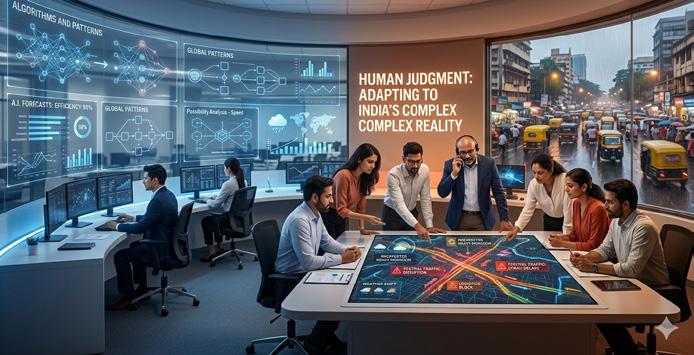
Future supply chain talent will not survive on functional knowledge alone. The winners will be people who can understand data, simplify complexity, and still remain grounded in operational reality. Because eventually, no algorithm unloads a delayed truck at 2 AM during peak season. Someone still has to solve the problem calmly.
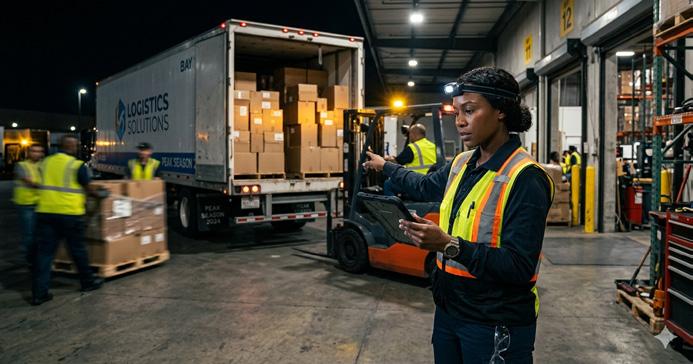
customer expectations simultaneously. Organisations are also becoming flatter operationally because technology reduces information delays.
Earlier, information moved upward slowly and decisions moved downward even slower. Today, dashboards expose reality instantly. Which means leadership quality is becoming more visible — both positively and negatively. Interestingly, AI may automate reporting, but it will increase the importance of trust-based leadership. Because during uncertainty, people still follow credibility, not dashboards.
In high-stakes situations, how should organisations balance trust in AI-driven recommendations with human judgement?
AI should support decisions, not become an excuse to avoid accountability. That distinction is extremely important. In high-pressure environments, systems can identify patterns faster than
humans. But they still lack situational awareness, commercial intuition, and contextual understanding. For example, a system may recommend inventory reduction based on historical trends.
A human leader may recognise that a regional festival, competitor activity, or transport disruption is about to change consumption behaviour dramatically.
Both inputs matter.
The strongest organisations will not blindly trust AI, nor blindly resist it. They will create decision cultures where:
systems provide speed
humans provide judgment
and accountability remains visible
Otherwise, companies risk creating a dangerous future where every bad decision is defended by saying: “The dashboard suggested it.” History already has enough examples of humans making bad decisions confidently. We do not need algorithms joining the club unsupervised.
Looking ahead, what will
differentiate supply chains in an AI-driven future, and how will talent capability shape this growth?
In the future, competitive advantage will not come from having technology alone. Most companies will eventually access similar tools. The differentiator will be:
speed of decision-making
quality of execution
adaptability during disruption
and leadership capability under pressure
Technology can improve visibility. Talent determines response quality. That is why supply chains of the future will increasingly behave like intelligent operating systems: highly connected; highly responsive; but still deeply dependent on human judgment. The best organisations will not be the ones with the most dashboards. They will be the ones where people know what to do after seeing the dashboard. Because execution has always been the real differentiator. AI will simply expose it faster.
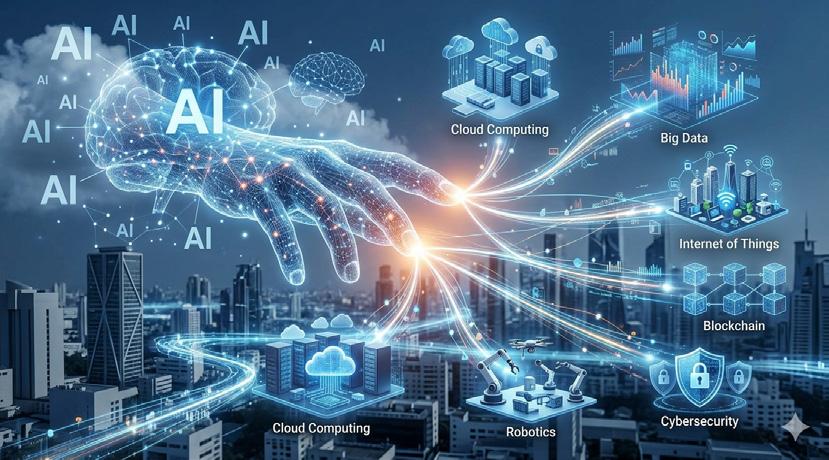
Chief Supply Chain Officers (CSCOs) are currently navigating a transformative period marked by the rise of AI and digital technologies, which require more than just adopting new tools. These leaders need to prioritize comprehensive data governance and standardized processes as foundational elements. To ensure success, CSCOs must address employee concerns about job security through strategic upskilling initiatives and thoughtful change management strategies, all while balancing organizational objectives with the needs of their workforce to usher in the next big cycle, decodes research by KPMG.
IN our conversations with Chief Supply Chain Officers (CSCOs), discussions have swirled around the challenges and opportunities with integrating artificial intelligence (AI) into the supply chain. To navigate what’s being referred to as Supply Chain’s Next Big Cycle, CSCOs are focusing on data governance and process standardization as a precursor to fully embracing AI and the agentic future.
However, the next big cycle is not just about integrating the latest technology; it also involves upskilling the workforce and implementing effective change management. Supply chains face issues like employees’ resistance to change and fear of job replacement. To combat this, CSCOs are taking a measured approach, implementing programs like centers of excellence and digital badges for completing AI programs. The constant
struggle for CSCOs is in balancing organizational goals while trying to lead their staff forward. The journey towards an AI-driven supply chain is complex but tantalizing in its promises.
As organizations continue to integrate AI into their operations, the potential for significant productivity gains and enhanced employee experiences is becoming increasingly clear. Recent research shows that companies anticipate
productivity improvements of up to 40% with GenAI. Additionally, a recent study found that tools like ChatGPT can increase efficiency by reducing working times by 50% for a third of job tasks. However, realizing these benefits requires a strategic approach that goes beyond simply adopting new technologies. Organizations must focus on driving employee engagement, embedding AI into workflows, and redefining roles that are ripe for AI augmentation. A robust change-management strategy is essential to navigate cultural shifts, elevate the employee value proposition, and ensure widespread acceptance and utilization.
Some key factors and considerations for CSCOs are:
The conversation with CSCOs highlighted AI and digital transformation’s role in modernizing today’s supply chain. Participants shared programs implemented and challenges encountered. It’s a multiyear transformation that Mary Rollman, KPMG US Supply Chain Advisory leader, refers to as the “next big cycle of supply chain.” “We went through 20 years of globalizing our supply chains. The next generation of supply chain is all around AI,” noted Rollman. While AI first is looking truer with each passing day, supply chains are taking a measured approach. The CSCO for a consumer goods company put it this way: “We have a standard process, and our data is in a good place. This is where we have started gradually to bring in some AI element.”
For this company and others, there is logic for the slower adoption of AI. Companies are strengthening their
fundamentals around planning and logistics, as well as considering risk management with every stream. It’s about laying groundwork for AI. “I would say having the strength of data governance and process standardization would help us be holistic and serve as a foundation for AI,” remarked the CSCO for a food and drink company.
A goal of process standardization resonates with CSCOs because it’s central to AI adoption. For some, it’s going to be a major priority for the next 18 to 24 months. Another aspect is picking the right AI pilots. “We were very selective in what we went after in the beginning, ensuring the pilots chosen show broader application,” communicated the CSCO of another consumer goods company.
Even with digitalization agenda and productivity improvements of 20%, companies are discovering a different standard with AI agents. The CSCO articulates the distinction. “It’s been hard enough engaging traditional AI capabilities like digital twins. We can only get the benefits of agentic AI from a solution that scales.”
Danny Seto, managing director in the KPMG Human Capital Advisory Group, points out how value drives implementing AI and digital at scale. “When you measure a pilot’s value, scalability becomes the business case. The scalability and monetization can be blown out to the rest of the organization.”
AI and digital are impacting employees in a multitude of ways, from forcing companies to roll out upskilling programs to employees’ nagging fear of job loss from AI agents. As the CSCO for a power and utilities company put it, “A lot of challenges we’re facing right now is just the fear of replacement.” Many
CSCOs are trying their best to bring their employees along the AI journey. The CSCO for an automotive company explains how they’re going about it.
“We’re trying to evolve the skill set of supply chain team members to see the value from AI and grow in their ability to use the new digital tools. We even developed a data analytics training program that featured our data scientists training our supply chain analysts.”
Other CSCOs are using tried and true training options like instructor-led or online training modules. Effectiveness often depends on how quickly employees engage learnings into their daily routines. Danny Seto echoes this sentiment. “What training is going to impact their work and their job on day-today basis? How will training impact role tasks?”
Despite upskilling and training programs, fear of job replacement can crop up at any moment. For one CSCO, it was working toward data standardization that restricted workers’ data access. It spooked employees, making them think their days were numbered. Seto sees the upside of an AI-driven supply chain. “You’ll have digital employees working with human employees. You’ll have to find them, onboard them, measure their performance, even offboard them. It’s a mental shift in how people define the workforce.” There are some signs of progress on integrating AI and digital in supply chains.
“It’s a lot easier with plug-and-play RPA stuff,” remarked the CSCO for a global industrial technology company. “People get on board, and we’ve had some nice pockets of success.” An oil and gas company’s CSCO uses a recognition program to enhance digital fluency. “We reward people with digital badges that show they completed AI training.”
This CSCO also sums up the challenge embracing the next big cycle focused on
How can organizations create a successful AI-centric workforce? By driving employee engagement, embedding AI into workflows, and redefining roles that are ripe for AI augmentation. This strategic and holistic approach ensures that the transition is smooth, and that the workforce is well-prepared to leverage AI’s full potential.
As organizations continue to integrate AI into their operations, the potential for significant productivity gains and enhanced employee experiences is becoming increasingly clear. Recent research shows that companies anticipate productivity improvements of up to 40% with GenAI. Additionally, a recent study found that tools like ChatGPT can increase efficiency by reducing working times by 50% for a third of job tasks.
AI. “As an organization, in terms of the shift, it’s all got to come together.”
CSCOs reacted positively to the idea inherent in the phrase, “skill versus will.” It’s a balancing act executing on the organization’s will while trying to improve people’s skills to thrive.
To Mary Rollman, “skill versus will” summarizes everything we’re trying to figure out right now. Given the enormity of the AI transition underway in supply chains, change management is needed. Organizations must articulate the reasons behind AI adoption and how it benefits the company and employees. At the same time, organizations need to invest in training and development, identify and empower change champions, and incentivize adoption.
However, executing on proven change management techniques can be problematic. A CSCO shared their change management experience. “We thought we were doing a great job at change management until we weren’t. We literally had to pry people away from Excel spreadsheets.” Employees are at different points of the AI adoption curve. Top AI performers require recognition while bottom performers need special attention. The largest group in the middle is often overlooked. The experience taught the CSCO a lesson. “We weren’t telling the story. We weren’t enticing them.”
There is a trust factor at work in the relationship between the worker and the company. The CSCO for an automotive company communicated how it is trying to build trust. “The big part of the transformation is developing the trust with the team in whatever we’re doing from a solution standpoint. Overall, we’ve done a pretty good job, although
some groups don’t feel they’re getting the same treatment as others. We keep showing the data, the facts, and the results.”
Another CSCO for a food and drink company articulated what’s important for their change management. “We’re not keen on putting things out in the wild that fail only to confirm people’s expectations. Our change management journey is to build up momentum with wins and demonstrate value.”
Danny Seto understands the human capital side of change management. “If you’re painting the picture with a lot more transparency to the impact to employees, then you’ll understand the types of training to provide that are highly relevant to their jobs and roles.”
When it comes to embracing AI in your organization, measuring its impacts is just as crucial as adopting the technology itself. It's not enough to simply deploy AI; you need to understand how it's driving value. This means monitoring its usage, gathering feedback, and constantly reassessing to ensure it meets your goals. To measure the return on investment of AI, you'll need to go beyond traditional financial metrics and consider both qualitative and quantitative aspects. Key performance indicators can range from workforce productivity enhancements and better employee experiences to the successful transition into new roles for your team members.
By tracking how AI impacts various dimensions such as productivity and job satisfaction, you can identify areas for improvement and pivot as necessary. Creating these detailed metrics helps in building an adaptive, resilient, and future-ready workforce, ensuring your AI investments pay off not just in dollars
but in a more engaged and efficient team.
How can organizations create a successful AI-centric workforce? By driving employee engagement, embedding AI into workflows, and redefining roles that are ripe for AI augmentation. This strategic and holistic approach ensures that the transition is smooth, and that the workforce is wellprepared to leverage AI’s full potential. Organizations will streamline operations and boost efficiency while cultivating a more resilient, adaptive, and innovative workforce, driving significant value creation. This, in turn, will help them remain competitive in an everevolving market landscape, attract and retain top talent, and continuously adapt to future technological advancements. Imagine a workforce where routine tasks are automated, allowing your employees to focus on what truly matters: strategic decision-making and innovation. Companies that harness the power of AI are not only streamlining operations but also driving unprecedented growth and efficiency. In a global economy defined by continuous policy shifts, realizing the full value of an AI investment depends on building a more resilient and strategically enabled workforce. Are you prepared to lead this transformation and secure a competitive edge for your organization?
Source: This article has been compiled from KPMG LLP insights.

Email: tech@celerityin.com | Mobile: 79771 05913 Website: www.supplychaintribe.com www.supplychaintribe.events