







Is Your Supply Chain Ready?









STRUCTURED NETWORKING
Curated introductions between pre-selected buyers and solution providers.s.


A inash G pta,
Dr. Prasanta
Curated introductions between pre-selected buyers and solution providers.s.

Dear Readers,
As the world emerged from the recent G7 Summit in Évian, global leaders once again confronted the realities of an increasingly fragmented geopolitical landscape. Discussions around the evolving U.S.-Iran peace framework, energy security, the reopening of critical trade routes, and resilient supply chains underscored a truth that supply chain leaders know all too well: volatility has become the new normal. The G7’s renewed focus on economic resilience, critical mineral security, and diversified supply networks highlights how deeply geopolitics and supply chains are now intertwined.
Against this backdrop, our Cover Story explores another transformation that is gathering momentum—the chemical industry’s sustainability journey. While significant strides have been made in reducing emissions within manufacturing operations, the next frontier lies beyond factory gates. From sustainable feedstocks and responsible sourcing to low-carbon logistics, circular product design, and end-of-life recovery systems, the industry is reimagining value creation across the entire ecosystem. Industry experts share how carbon intelligence, digital enablement, circularity, and collaborative partnerships are becoming essential building blocks of futureready chemical supply chains.
This issue also examines how emerging technologies are reshaping India’s logistics landscape. Autonomous systems, drone-enabled deliveries, AI-powered fleet management, and intelligent automation are no longer futuristic concepts. However, their successful adoption requires adaptation to India’s uniquely dynamic operating environment—characterized by diverse infrastructure, complex regulatory realities, and highly variable demand patterns.
As disruption and opportunity continue to coexist, one thing remains clear: organizations that combine sustainability, technology, and resilience will be best positioned to thrive in the decade ahead.
Happy Reading!
Charulata Bansal Publisher Charulata.bansal@celerityin.com
www.supplychaintribe.com
Published by: Charulata Bansal on behalf of Celerity India Marketing Services
Edited by: Prerna Lodaya e-mail: prerna.lodaya@celerityin.com
Designed by: Lakshminarayanan G e-mail: lakshdesign@gmail.com
Logistics Partner: Blue Dart Express Limited
The chemical industry’s sustainability journey is entering a more complex and consequential phase. While considerable progress has been made in reducing emissions within manufacturing operations, the industry’s next frontier lies across the broader value chain— within feedstocks, supplier networks, logistics ecosystems, product lifecycles, and end-of-life recovery systems. The perspectives featured in this Cover Story reveal an industry at a critical inflection point. As the boundaries of decarbonization expand beyond manufacturing operations, the conversation is shifting from emissions reduction alone to the broader challenge of redesigning value chains, rethinking carbon flows, and building more resilient industrial ecosystems. Together, these voices explore how carbon intelligence, circularity, digital enablement, and ecosystem collaboration are shaping the future of the chemical industry.
Carbon-Intelligent Chemical Industry of the Future – Prof. Ganapati D. Yadav, Bhatnagar Fellow & Former National Science Chair (ANRF) Former Vice Chancellor, Institute of Chemical Technology (ICT), Mumbai
The Shift from Carbon Reporting to Carbon Influence – Dhiraj Asthana, President – Commercial, Atul Ltd.
Scope 3 Starts with Partnerships – Dr. Raj V. Amonkar, Professor, Goa Institute of Management (GIM)
The Operational DNA of Decarbonization
– Sanjay Kshirsagar, Chief Operating Officer, Prince Pharma
Decarbonization Beyond the Factory Gate
– Sandeep Chatterjee, Digital Supply Chain & Sustainability Leader, Trinamix

This article by Dr. Sourabh Bhattacharya, Dean (Academics) and Professor of Operations & Supply Chain Management, Institute of Management Technology, Hyderabad and Arisha Ali Rahi, Business Project Associate, Evernorth Health Services, explores how autonomous systems, drone logistics, connected vehicle ecosystems, and AI-driven fleet intelligence are being adapted for India’s uniquely dynamic operating landscape.
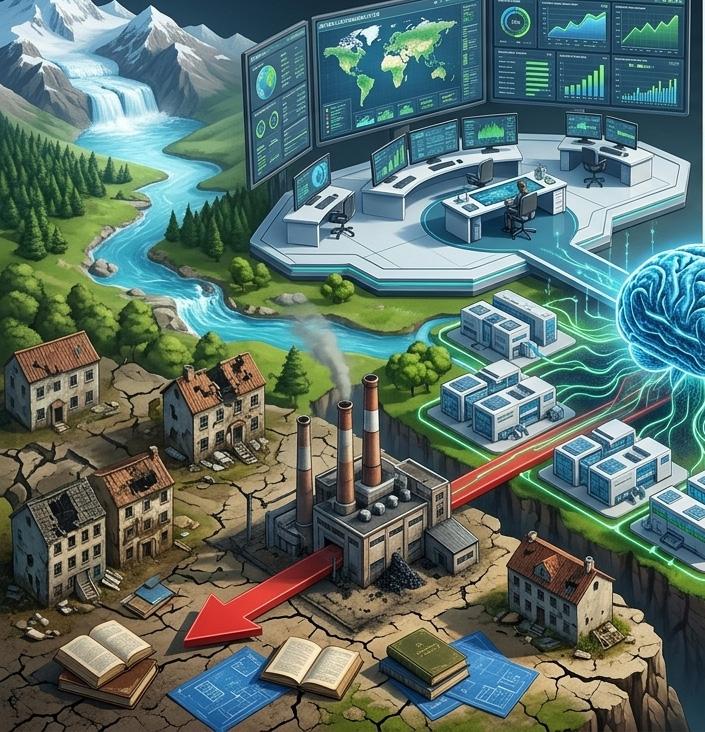

The chemical industry's sustainability journey is entering a more complex and consequential phase. While considerable progress has been made in reducing emissions within manufacturing operations, the industry's next frontier lies across the broader value chain— within feedstocks, supplier networks, logistics ecosystems, product lifecycles, and end-oflife recovery systems. As Scope 3 emissions gain strategic prominence, the conversation is shifting from compliance and disclosure to transformation and value creation. Carbon is no longer viewed solely as an environmental liability to be measured and reported; it is increasingly being recognized as a strategic resource that must be managed with the same rigor as cost, quality, and operational performance.
The perspectives featured in this Cover Story reveal an industry at a critical inflection point. As the boundaries of decarbonization expand beyond manufacturing operations, the conversation is shifting from emissions reduction alone to the broader challenge of redesigning value chains, rethinking carbon flows, and building more resilient industrial ecosystems. Together, these voices explore how carbon intelligence, circularity, digital enablement, and ecosystem collaboration are shaping the future of the chemical industry.
The emergence of the carbon-intelligent enterprise reflects this shift—where sustainability moves beyond corporate commitments to become embedded in decision-making, innovation, and competitive strategy. For the leaders of tomorrow, carbon intelligence may well become the defining measure of business resilience, market relevance, and long-term growth.


“The future of the chemical industry lies not merely in reducing emissions including Scope 3 but in becoming carbon-intelligent. A carbon-intelligent chemical industry recognizes carbon as a valuable resource that must be managed efficiently throughout its entire life cycle. This includes reducing dependence on virgin fossil carbon, maximizing carbon circularity through recycling and reuse, utilizing biomass and captured carbon dioxide as alternative carbon sources, and deploying renewable and low-carbon energy systems across manufacturing and supply chains,” asserts Prof. Ganapati D. Yadav, Bhatnagar Fellow & Former National Science Chair (ANRF) Former Vice Chancellor, Institute of Chemical Technology (ICT), Mumbai Padma Shri Awardee (2016), Distinguished Chemical Engineer & Researcher in Green Chemistry, Catalysis, Circular Economy and Sustainable Manufacturing, during this exclusive interview…
As Scope 3 emissions become a strategic priority for the chemical industry, what practical and scalable interventions are helping organizations decarbonize their extended value chains beyond manufacturing operations? Scope 3 emissions represent the most difficult but also the most important frontier in industrial decarbonization because they occur outside the factory gate. In many chemical companies, they account for more than 70% of the overall carbon footprint. While substantial progress has been made in improving energy efficiency and reducing emissions within manufacturing facilities, the next phase of decarbonization must focus on feedstocks, logistics, product use, and end-of-life management.
My research over the last four decades has focused on developing catalytic technologies that transform renewable and waste-derived carbon resources into chemicals, fuels, and materials. I firmly believe that feedstock transformation offers the single largest opportunity for Scope 3 reduction. Replacing virgin fossil resources be they crude oil,

natural gas or coal, with biomass, waste plastics, captured carbon dioxide, and green hydrogen can dramatically reduce embedded emissions throughout the value chain.
Another important intervention is the adoption of circular economy principles. Chemical recycling of plastics, valorisation of agricultural residues, industrial waste utilization, and resource recovery systems can convert environmental liabilities into economic assets. My group has demonstrated several catalytic pathways for converting waste plastics and biomass into valueadded products, thereby reducing dependence on fossil carbon.
Supply chains must also become geographically smarter. Regional sourcing, multimodal low-carbon logistics, and supplier sustainability programmes can reduce transportationrelated emissions. Ultimately, Scope 3 decarbonization cannot be achieved through incremental improvements alone. It requires a systems approach that integrates green chemistry, circularity, renewable feedstocks, and collaborative innovation across the entire value chain.
The transition toward a carbonintelligent chemical industry requires moving beyond traditional carbon accounting to active carbon management across the entire value chain. The objective should not simply be reducing emissions but optimizing carbon utilization through carbon circularity, renewable feedstocks, and low-carbon energy systems.
Which parts of the industry ecosystem currently present the greatest decarbonization challenge, and how can the industry address them collaboratively?
The most significant decarbonization challenge lies in the carbon embedded within raw materials and the complexity of downstream product life cycles. Chemical manufacturers generally have direct control over their own operations ( Scope 1), but they have limited control over upstream feedstock production, transportation systems, and downstream product usage and disposal.
The chemical industry was built around fossil carbon because it was
abundant, inexpensive, and supported by a mature infrastructure. Moving away from this model requires a fundamental transformation of feedstock supply chains. Renewable carbon sources such as biomass, and also waste plastics, municipal solid waste, captured carbon dioxide, and green hydrogen offer promising alternatives, but they require new technologies, logistics networks, and investment frameworks.
My own work in green chemistry and heterogeneous catalysis has focused extensively on creating economically viable pathways for converting biomass and waste into chemicals, fuels and materials. Such technologies demonstrate that decarbonization can be achieved without sacrificing industrial competitiveness. A carbon-intelligent chemical industry must ensure that carbon flows are optimized across international supply chains, irrespective of geographical boundaries.
The logistics sector also presents a major challenge. Chemical supply chains are global, involving multiple transport modes and thousands of intermediaries. Significant emission reductions will require coordinated efforts among producers, logistics providers, ports, warehousing companies, and customers.
The solution lies in collaborative ecosystems rather than isolated initiatives. Industry, academia, government, and technology developers must work together to create common carbon accounting standards, shared infrastructure for hydrogen and carbon utilization, and scalable circular economy platforms. Decarbonization is not merely a technical challenge; it is an ecosystem challenge requiring collective action.
Because the chemical industry is inherently transnational, with supply chains extending across continents, its decarbonization challenges have always been global in nature. The challenge is not simply reducing emissions in one facility but optimizing carbon utilization throughout the global industrial ecosystem.
How is Scope 3 performance influencing procurement decisions, customer relationships, and long-term competitiveness for chemical companies?
Scope 3 performance is rapidly evolving from a sustainability metric into a strategic business differentiator. Increasingly, customers are not merely purchasing chemicals; they are purchasing the embedded environmental attributes associated with those chemicals. As a result, carbon intensity is becoming as important as quality, cost, reliability, and technical performance. Customers are increasingly demanding evidence of carbon intelligence, including transparent carbon footprints, carbon circularity metrics, and sustainable sourcing practices.
Many multinational corporations have committed to ambitious net-zero targets. Consequently, they are placing increasing pressure on suppliers to provide transparent life-cycle carbon data and demonstrate measurable progress toward emissions reduction. Chemical companies that fail to address Scope 3 emissions may find themselves excluded from preferred supplier lists and highvalue international markets. Future procurement decisions will increasingly favour suppliers who demonstrate superior carbon management capabilities and low-carbon product portfolios.
From my perspective as a researcher, innovator, technology developer and policy maker, this trend creates tremendous opportunities for innovation. Green chemistry, catalytic process intensification, renewable feedstocks, and circular manufacturing systems can generate products with significantly lower environmental footprints. Such products command greater acceptance in environmentally conscious markets and strengthen customer confidence.
I have long advocated that sustainability should not be viewed as a compliance burden but as a source of competitive advantage. Companies that invest early in carbon-efficient technologies, circular economy solutions, and transparent sustainability reporting will be better positioned to secure market access, attract investment, and build long-term customer relationships.
In the coming decade, carbon footprint data may become as routine as product specifications. Organizations that can demonstrate credible reductions across their entire value chain will enjoy a distinct competitive advantage in
global markets. Carbon performance is rapidly becoming a proxy for innovation capability and long-term business resilience.
How can chemical companies improve data transparency, emissions traceability, and sustainability alignment across fragmented supplier and partner networks?
Supplier engagement is perhaps the most challenging aspect of Scope 3 management because chemical supply chains often involve hundreds or even thousands of suppliers operating across different geographies and levels of technological maturity. The Hormuz crisis in the West Asia demonstrated this vulnerability. One cannot manage what one cannot measure, and therefore data transparency must become the cornerstone of sustainability initiatives.
In my view, the first requirement is the adoption of standardized methodologies for carbon accounting and life-cycle assessment. Unless all stakeholders speak the same language and use comparable metrics, meaningful benchmarking and improvement become impossible. Sustainability data should become as important as cost, quality, and delivery performance during supplier evaluation.
Digital technologies will play an increasingly important role. Carbon intelligence platforms, blockchainenabled traceability systems, and AIassisted data analytics can improve the reliability and visibility of emissions information throughout the supply chain. However, technology alone is not sufficient. Large organizations must actively support smaller suppliers by providing technical guidance, training, and access to cleaner technologies. Digital carbon intelligence systems will become essential tools for tracking carbon flows across complex transnational supply chains.
Throughout my career, I have observed that innovation flourishes when knowledge is shared rather than restricted. The same principle applies to sustainability. Companies should view suppliers as partners in decarbonization rather than mere vendors. Collaborative programmes involving industry,
academia, and technology providers can accelerate the adoption of cleaner processes and materials. The future objective should be end-to-end carbon traceability, where every significant carbon input and output can be measured, monitored, and optimized.
Ultimately, successful Scope 3 management will depend on creating trusted ecosystems where environmental performance is measured consistently, reported transparently, and rewarded commercially. Supplier engagement must evolve from data collection toward collaborative carbon management.
Which emerging innovations or ecosystem partnerships do you believe can create the biggest long-term impact on indirect emissions reduction?
As someone who has spent decades working in green chemistry, catalysis, biomass valorisation, waste plastics recycling, and sustainable process development, I believe that circular carbon utilization will be one of the most transformative developments of the twenty-first century. Carbon circularity represents one of the most important pillars of the carbon-intelligent chemical industry.
Historically, the chemical industry has operated on a linear model based on extraction, production, consumption, and disposal. This model is no longer sustainable. The future lies in retaining carbon within the economic system for as long as possible through recycling, reuse, and conversion into higher-value products. Recycle engineering will be the prevalent theme by the mid of this century. Nothing virgin will be available.
My research group has demonstrated catalytic routes for converting lignocellulosic biomass, waste plastics, and carbon dioxide into fuels, chemicals, and advanced materials. These technologies show that waste streams can become valuable feedstocks rather than environmental burdens. In fact, I always talk about net negative (carbon) systems as one of the pillars of modern chemical industry. Carbonfree or low-carbon technologies will come to the central stage. Chemical recycling of mixed plastic waste, catalytic hydrogenolysis, biomass-based
biorefineries, and carbon capture and utilization (CCU) technologies have the potential to significantly reduce indirect emissions. Through advanced catalysis, waste carbon can be transformed into valuable chemicals, fuels, and materials, thereby extending the productive life of carbon atoms.
Green hydrogen will also play a transformative role. It can serve both as a clean energy carrier and as a sustainable feedstock for numerous chemical processes. When combined with captured carbon dioxide, green hydrogen can facilitate the production of fuels and chemicals with substantially lower carbon footprints. Green hydrogen, renewable electricity, biomass, recycled plastics, and captured carbon dioxide will form the foundation of future carbonmanaged value chains.
The greatest breakthroughs will emerge from partnerships among industry, academia, start-ups, government agencies, and financial institutions. Sustainability challenges are too complex for isolated solutions. Integrated innovation ecosystems will determine how rapidly we transition toward a circular and low-carbon chemical economy. The goal should be to keep carbon circulating within the economy for as long as possible before it is ultimately returned to the atmosphere.
How are the upcoming digital technologies helping chemical companies improve emissions visibility, operational efficiency, and sustainability decisionmaking?
Digital technologies are enabling the emergence of carbon intelligence as a core management function. The future of sustainable manufacturing will be driven by the convergence of chemistry, engineering, and digital technologies. We are entering an era where artificial intelligence and advanced analytics can significantly accelerate both operational excellence and environmental performance.
Traditionally, environmental management relied heavily on historical reporting and periodic audits. Today, digital technologies enable real-time monitoring, predictive decision-making, and proactive optimization. AI algorithms
The chemical industry has always been global in character. Raw materials may originate in one continent, be processed in another, transformed into products in a third, and consumed worldwide. Consequently, the environmental challenges associated with the chemical industry including climate change, waste generation, resource depletion, and emissions, have always been global challenges requiring global solutions. The transition will require unprecedented collaboration among industry, academia, governments, financial institutions, and society. Just as the chemical industry played a pivotal role in driving industrial development during the 20th century, it now has an opportunity to lead the global transition toward a sustainable, circular, and low-carbon economy in the 21st century.
can analyse vast quantities of operational data to identify inefficiencies, reduce energy consumption, optimize logistics routes, and minimize waste generation.
Digital twins are particularly promising. By creating virtual replicas of manufacturing facilities and supply chain networks, organizations can evaluate alternative operating strategies before implementing them in practice. This reduces both economic and environmental risks while improving resource efficiency. AI, predictive analytics, and digital twins allow organizations to move from carbon reporting to carbon optimization.
From a research perspective, AI is also revolutionizing catalyst discovery, reaction engineering, and process development. Many of the catalytic systems that my group has developed required extensive experimentation. Future generations of researchers will increasingly use machine learning tools to accelerate catalyst design and process optimization.
Carbon intelligence platforms further enable companies to track emissions across multiple tiers of suppliers and customers, providing a comprehensive view of Scope 3 impacts. Such visibility allows organizations to identify emission hotspots and prioritize investments where they can achieve the greatest benefit. Future carbon-intelligent enterprises will operate digital carbon management systems analogous to modern financial management systems.
The most successful companies of the future will be those that combine scientific innovation with digital intelligence to create sustainable, resilient, and competitive supply chains. The combination of advanced catalysis and artificial intelligence will be a powerful driver of sustainable innovation.
What policy support, financing mechanisms, or industry collaborations are essential to make Scope 3 transition efforts commercially scalable?
The transition to low-carbon supply chains is not merely a technological challenge; it is also an economic and policy challenge. Many promising technologies already exist, but their large-scale deployment often requires supportive policy frameworks and innovative financing mechanisms. Governments can play a critical role by creating stable and predictable policies that encourage investment in green technologies, renewable energy systems, carbon utilization, advanced recycling, and green hydrogen infrastructure. Incentives for industrial decarbonization should focus not only on direct emissions but also on emissions across the entire value chain. Governments should encourage investments not only in emissions reduction but also in carbon circularity infrastructure.
Equally important is the availability of patient capital. Sustainability projects often involve long payback periods
and higher initial costs. Green bonds, sustainability-linked loans, blended finance mechanisms, and public-private partnerships can help bridge this gap and accelerate commercialization. This is again a policy issue including green hydrogen infrastructure, CCU, advanced recycling hubs, renewable electricity networks and sustainable logistics corridors.
I have always believed that universities and research institutions have a crucial role in translating scientific discoveries into industrial practice. Stronger collaboration among academia, industry, government, and financial institutions can significantly reduce the risks associated with technology deployment. The history of the chemical industry demonstrates that transformative innovations emerge when science, policy, and entrepreneurship work together. The same principle will apply to Scope 3 decarbonization. We must create ecosystems that reward long-term sustainability investments rather than short-term economic gains alone. The transition toward a carbon-intelligent chemical industry requires long-term policy stability and patient capital.
What will define a truly futureready and sustainable chemical supply chain ecosystem, and how can the industry move from isolated sustainability initiatives toward integrated, ecosystemwide transformation?
The industry of the future will increasingly be powered by renewable electricity, green hydrogen, advanced catalysis, digital technologies, and circular economy principles. Carbon accounting will evolve into carbon management, and eventually into carbon optimization, where every carbon atom is tracked, utilized, recovered, and reintroduced into productive use whenever technically and economically feasible.
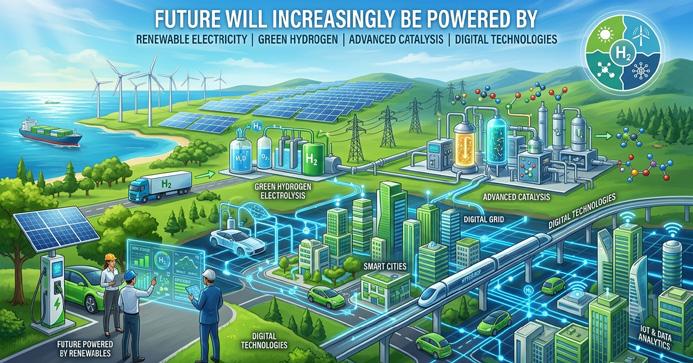
A truly future-ready chemical supply chain will be circular, carbon-efficient, digitally connected, transparent, and resilient. Sustainability will no longer be a separate corporate programme; it will become an integral part of business strategy, product design, procurement, manufacturing, logistics, and customer engagement. India’s contribution to this sector will be at least two trillion USD by mid of this Century.
The defining characteristic of future supply chains will be circularity. Carbon atoms already present in biomass, plastics, industrial waste streams, and carbon dioxide emissions must be repeatedly reused rather than continuously extracted from fossil resources. This philosophy has guided much of my own research in green chemistry, catalysis, biomass valorisation, waste plastics recycling, and carbon utilization. Carbon accounting will evolve into carbon management and ultimately into carbon optimization, where carbon is treated as a strategic resource rather than merely a
source of emissions.
Future supply chains will also be highly data-driven. Real-time visibility of material flows, energy use, carbon footprints, and resource efficiency will enable better decision-making and greater accountability across the value chain. Renewable electricity, green hydrogen, advanced catalysis, CCU, and circular manufacturing systems will become integral components of future industrial ecosystems. However, technology alone cannot achieve transformation. The transition requires a cultural shift toward collaboration. Industry, academia, government, financial institutions, and society must work together to create integrated solutions. Individual companies can optimize their own operations, but only collaborative ecosystems can transform entire value chains.
The chemical industry has historically been a catalyst for societal progress through innovation. Today, it has an equally important opportunity to lead
the transition toward a sustainable and circular economy. Those organizations that embrace systems thinking, invest in innovation, and collaborate across traditional boundaries will define the future of global manufacturing and supply chains.
The chemical industry has historically transformed society through scientific innovation. In the coming decades, its greatest contribution may be the creation of a carbon-intelligent global manufacturing ecosystem in which every carbon atom is valued, managed, optimized, and, wherever possible, continuously recycled. This transformation will require unprecedented collaboration among industry, academia, governments, financial institutions, and society, reflecting the fundamentally global nature of both the chemical industry and the sustainability challenges it seeks to address.
“The Scope 3 journey is no longer about incremental improvement; it is about redefining how chemical supply chains are designed and operated. What we are really witnessing is a shift from isolated sustainability initiatives to a far more integrated ecosystem mindset, where procurement, manufacturing, logistics, and customers are all part of one connected carbon system,” highlights Dhiraj Asthana, President – Commercial, Atul Ltd., during this interview…
As Scope 3 emissions become a strategic priority for the chemical industry, what practical and scalable interventions are helping organizations decarbonize their extended value chains beyond manufacturing operations?
If we look at Scope 3 honestly, the first mistake many industries make is trying to treat it like an internal sustainability extension. It is not. It sits outside the boundary of direct control, so the only way to influence it is through system redesign and partner alignment. At Atul, the starting point has been procurement discipline—moving toward structured frameworks like responsible sourcing and embedding ESG expectations into supplier evaluation. But what really matters is not the framework itself, it is the behavior it drives.
We are increasingly focusing on supplier engagement beyond compliance—helping suppliers identify efficiency opportunities in energy use, material handling, and logistics. Even small process improvements at supplier end compound significantly when viewed across the value chain.
Globally, Scope 3 typically contributes 70–90% of total emissions (GHG Protocol / McKinsey estimates), which makes it clear that internal decarbonization alone has limited impact. What is becoming practical at scale is:
Supplier collaboration on efficiency improvement

Localization of sourcing where feasible
Logistics optimization through route and load efficiency
Standardization of emissions measurement approaches
The shift is subtle but important— from reporting emissions to influencing emissions behavior across partners.
The chemical sector depends on highly interconnected ecosystems involving feedstocks, energy
providers, logistics networks, contract manufacturers, and downstream industries. Which parts of this ecosystem currently present the greatest decarbonization challenge, and how can the industry address them collaboratively?
In my experience, the most difficult part is not one segment—it is the interfaces between segments. Feedstocks, logistics, contract manufacturing, packaging— each has its own optimization logic.
But emissions do not respect these boundaries. Logistics is one of the most visible pressure points. Globally, it contributes around 10–12% of CO₂ emissions (IEA / World Bank estimates), and in chemicals it becomes even more critical because of bulk movement and long supply chains.
We also cannot ignore energy. Any volatility in crude or fuel prices immediately cascades into freight, manufacturing, and raw material costs. With nearly 20% of global oil and LNG passing through the Strait of Hormuz, geopolitical disruptions quickly become supply chain disruptions. At Atul, we are seeing that collaboration is no longer optional. It is the only way forward. But collaboration here does not mean meetings—it means shared visibility and shared accountability.
Industry-wide decarbonization will require:
Common emissions accounting standards
Shared logistics optimization initiatives
Supplier capability building
Joint investments in cleaner energy and transport modes
The biggest challenge is not intent. It is alignment across fragmented ecosystems.
With global customers and export markets increasingly demanding sustainable sourcing and low-carbon products, how is Scope 3 performance influencing procurement decisions, customer relationships, and long-term competitiveness for chemical companies?
This is where the shift is becoming very visible. Earlier procurement was driven almost entirely by cost, quality, and delivery. Today, especially in export-linked markets, sustainability is becoming a parallel decision filter. We are increasingly seeing customers ask not only for product specifications but also for the carbon intensity of the value chain behind it. That changes the procurement equation completely.
At Atul, responsible procurement frameworks and ESG-aligned supplier evaluation processes are helping us respond to this shift. But more
importantly, it is changing conversations with suppliers—moving from transactional sourcing to long-term alignment. Globally, studies indicate that over 70% of large enterprises now include ESG criteria in procurement decisions, which shows how quickly this is becoming mainstream. The implication is clear: Scope 3 performance is no longer a back-end sustainability metric. It is becoming a market access and competitiveness factor.
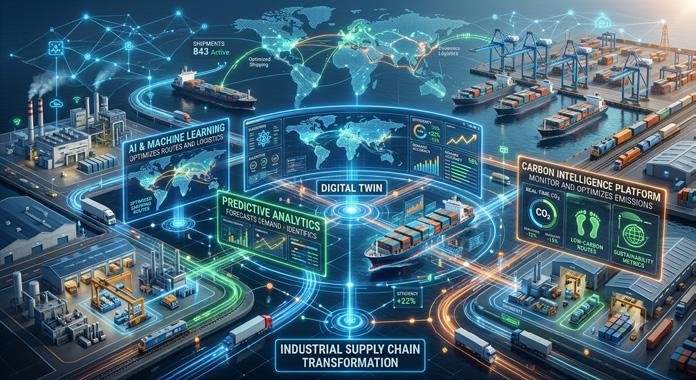
Digital technologies such as AI, predictive analytics, digital twins, and carbon intelligence platforms are transforming industrial supply chains. How are these technologies helping chemical companies improve emissions visibility, operational efficiency, and sustainability decisionmaking?
Technology is definitely enabling the conversation on Scope 3, but I would not say it is the solution by itself. What it really enables is visibility at scale and faster decision-making loops. At Atul, digital systems across procurement and logistics are helping us connect data points that were earlier fragmented— supplier performance, logistics efficiency, procurement patterns, and operational planning. But the real shift is not dashboards. It is decision behavior.
Globally, companies leveraging advanced analytics in supply chains have seen 20–30% improvements in operational efficiency (McKinsey estimates). The same logic applies to emissions—if you cannot measure it in near real time, you cannot manage it effectively. Carbon intelligence platforms, AI-driven planning tools, and predictive analytics are beginning to shift organizations from retrospective reporting to proactive decision optimization. We are still early in this journey, but directionally, it is very clear that decision intelligence will define the next phase of Scope 3 management.
Circular economy models, green chemistry innovations, bio-based feedstocks, wasteto-value initiatives, and sustainable packaging are gaining momentum. Which emerging
innovations or ecosystem partnerships do you believe can create the biggest long-term impact on indirect emissions reduction?
If I step back, the most meaningful change I see is that sustainability is slowly becoming a design principle, not an afterthought. Circularity, waste recovery, and material efficiency are no longer ‘innovation projects’—they are becoming structural elements of supply chain design. At Atul, we are increasingly focusing on efficiency across multiple dimensions—not just cost efficiency but also material and energy efficiency. That shift is subtle but powerful because it changes decision-making at every level. Globally, circular economy systems are estimated to unlock ~USD 4.5 trillion in value (World Economic Forum estimates). But the more important part is not the economic value, it is the systemic redesign it forces.
What will likely have the biggest impact going forward is not one breakthrough technology, but ecosystem-level integration:
Waste-to-value systems
Bio-based material substitution
Cross-industry material loops
Collaborative packaging and logistics redesign
The chemical industry will not decarbonize through isolated innovations. It will happen through interconnected ecosystem redesigns, where every participant influences the other. And that, in many ways, is the real future of Scope 3.
“Supplier involvement should be treated as a partnership, not an audit exercise. The companies that can successfully integrate transparency, capability building, technology enablement, and value creation for both parties will find themselves capable of reducing carbon emissions,” emphasizes Dr. Raj V. Amonkar, Professor, Goa Institute of Management (GIM), during this interview…
As Scope 3 emissions become a strategic priority for the chemical industry, what practical and scalable interventions are helping organizations decarbonize their
extended value chains beyond manufacturing operations?
For the chemical industry, Scope 3 emissions represent a strategic priority rather than just a compliance

requirement. While the focus used to be mainly on manufacturing facilities, there are better opportunities in the upstream and downstream value chains.
One of the best practical interventions in this area is sustainable procurement. The carbon factor has increasingly become integral when choosing suppliers, evaluating performance, and renewing contracts with partners. Suppliers are encouraged or required to provide information about their carbon footprint, use of renewable energy, and setting of science-based emissions reduction targets.
Feedstock switching has been an effective intervention, too. Companies are moving away from fossil-based feedstocks and are exploring bio-based alternatives, recycled feedstocks, and renewable chemicals. This applies to green methanol, bio-naphtha, recycled plastic waste, and renewable hydrogen.
Logistics optimization also brings a lot of scalable benefits. Route optimization, modal shifts from road to rail or sea to reduce road transport, improved load utilization, and implementation of low-carbon fuel options can result in substantial emission reductions.
In addition, product redesign can have a significant impact on emissions. By developing a lower carbon footprint product that would enable customers to reduce their emissions further while in operation, the carbon saving effect can be amplified several times. Examples include lightweight materials, specialty
The transformation of the industry will depend on the transition from the corporate-level perspective to the ecosystem level. Sustainable transformation cannot happen without cooperation and collaboration among different organizations and stakeholders. It means that manufacturers, suppliers, logistics providers, energy companies, technology partners, consumers, investors, and regulators must join efforts to pursue sustainable goals jointly.
chemicals promoting energy efficiency, and battery materials.
Finally, digital carbon management platforms are helping organizations gather supplier data, assess emissions across the value chain, and identify key areas for improvement. When combined with supplier engagement efforts and industry-wide collaboration, these tools enable companies to go beyond reducing emissions within their own operations and take meaningful action across the entire product lifecycle
With global customers and export markets increasingly demanding sustainable sourcing and low-carbon products, how is Scope 3 performance influencing procurement decisions, customer relationships, and long-term
competitiveness for chemical companies?
Scope 3 performance is fast becoming one of the most critical factors in determining access to markets and competitive advantage. Customers have started to rate suppliers not just on cost, quality, and punctuality, but also on carbon footprint and sustainability
In procurement, larger multinational companies have begun adding carbonfootprint-based criteria to their supplier evaluations and screening processes. Those companies that cannot provide reliable carbon footprints or have failed to develop any programs to address their Scope 3 emissions risk are excluded from preferred supplier lists
There has been a shift in the relationships that customers maintain with their suppliers. Many customers
now look for a strategic relationship with suppliers whose sustainability credentials allow them to help in the customer's pursuit of its net-zero ambitions. Companies that can provide emissions data and lifecycle assessments along with carbon footprint information can build more sustainable and mutually beneficial relationships with their customers.
Competitiveness in exports is gradually being tied to sustainability performance. Regulatory changes, including the introduction of carbon border adjustment systems, mandatory sustainability reporting, and carbon footprinting of products, are influencing global trade. Firms with solid scope 3 management will be more equipped to meet regulatory requirements and customer demands. Moreover, the
financial community is now evaluating value chain emissions as an indicator of resilience. An excellent Scope 3 performance may help gain better access to finance and improve reputation.
Sustainability has now moved away from being an issue of compliance to one of differentiation. Those firms that take initiative and reduce their Scope 3 emissions will have a better chance at gaining customer loyalty, market access, and competitive advantage.
Supplier engagement remains one of the most complex aspects of Scope 3 management. How can chemical companies improve data transparency, emissions traceability, and sustainability alignment across fragmented supplier and partner networks? One of the toughest things about Scope 3 is the supplier engagement aspect due to the fact that chemical companies have many suppliers located in varied geographical locations at varied stages of maturity.
The first stage is setting up proper expectations through suppliers' sustainability policies and codes of conduct. The suppliers should be aware of the organization’s environmental goals, reporting needs, and performance expectations from the outset. Data transparency can be enhanced by adopting standardized frameworks for reporting. It is not necessary to develop many questionnaires; organizations need to work with international standards and digital reporting systems.
The role of digital traceability technology becomes increasingly significant. Blockchain, IoT, Digital Product Passport, and cloud solutions for carbon calculation offer greater transparency in relation to material flow and emissions through the supply chain. Such digital solutions are especially beneficial when used in complex global network environments where verification of data is difficult.
Capacity building is just as important. A lot of suppliers, particularly SMEs, do not have the skills or resources to undertake carbon measurement. Training, tools, benchmarks, and continuous improvement measures can play an important role in building supplier
capacity. Incentives for performance can help promote such alignment. Longterm contracts, preferred supplier relationships, and collaboration in innovation can all be incentives for suppliers who show themselves to be sustainable leaders.
Digital technologies such as AI, predictive analytics, digital twins, and carbon intelligence platforms are transforming industrial supply chains. How are these technologies helping chemical companies improve emissions visibility, operational efficiency, and sustainability decisionmaking?
Digital technologies have become potent means of ensuring sustainability since organizations are unable to manage what they do not measure properly. Chemicals have had poor emission visibility because of the fragmented and disjointed nature of the information available about them
The carbon intelligence platforms are assisting businesses in collecting the emissions data generated by their suppliers, logistics, production, and consumers within one decision-making environment. The process helps in achieving better insights into potential carbon hotspots and areas for carbon reduction.
Artificial Intelligence is contributing through forecasting and optimization functions. AI can detect inefficiencies in the company's procurements, production schedule, inventory, and logistics processes that would be missed by traditional approaches. Better forecasts contribute to decreased waste and excess inventories, thus resulting in a lower number of logistics activities.
Predictive analytics contributes to proactive sustainability management. It allows businesses to analyze their alternatives of sourcing, supplier risks, possible emissions levels, and resource management to avoid undesirable effects on environmental performance. Digital twins are especially useful for chemical organizations. A digital twin is a software representation of some physical entity used for simulating certain situations. It allows companies to check out the energy efficiency of new logistics alternatives or the use of different types of feedstock in
a safe environment.
With the help of IoT devices, companies can monitor their energy consumption, emissions levels, logistic conditions, and machine performance in real time. The information is necessary for taking fast action when needed. Together, these technologies are transforming sustainability from a report-based to a data-driven management process.
What will define a truly futureready and sustainable chemical supply chain ecosystem, and how can the industry move from isolated sustainability initiatives toward integrated, ecosystemwide transformation?
The sustainable chemical supply chain of tomorrow will exhibit transparency, circularity, resilience, digital connectivity, and collaboration in governance. Sustainability will no longer remain an independent practice; rather, it will become a fundamental consideration in each strategic and operational decision made along the entire value chain.
In addition, real-time transparency on how materials move through the network, as well as the associated emissions and the amount of energy consumed, will become critical. It will allow organizations to make timely and informed decisions, thereby maximizing opportunities and managing risks more effectively. Another important change is the shift away from the linear and unsustainable approach towards circular approaches based on the principles of reuse and recycling.
It will become possible to design an efficient system where all economic, environmental, and social goals are optimized simultaneously. Artificial intelligence, for example, will play a key role here, providing intelligent decision support, while digital twin technology and carbon accounting systems will ensure end-to-end transparency on climate change impacts. Finally, resilience will become another vital characteristic of a sustainable chemical supply chain. The reasons are clear: climate disruptions, geopolitical risks, and resource limitations will call for more resilient supply networks.
"The companies that will lead the next decade are not the ones with the best sustainability reports. They are the ones that have built decarbonization into their operational DNA — into the daily decisions that no sustainability team is in the room for," believes Sanjay Kshirsagar, Chief Operating Officer, Prince Pharma. As Scope 3 emissions become a strategic business priority, organizations are realizing that meaningful carbon reduction is driven not by reporting frameworks, but by the decisions made across procurement, logistics, product design, and supplier networks.

What practical and scalable interventions are helping organisations decarbonise their extended value chains beyond manufacturing operations?
Having led supply chain and operations across Henkel, Givaudan, Galaxy Surfactants, and Brenntag, I can say with certainty that the most effective Scope 3
interventions are never the ones that start in the sustainability department. They start on the operations floor — in procurement decisions, in logistics contracts, in the way you design a product's bill of materials. That is where the real carbon sits, and that is where it can be meaningfully reduced.
At Henkel, I saw firsthand how
embedding carbon KPIs into supplier scorecards — not as aspirational targets but as contractual performance metrics — transformed the quality of upstream data and, over time, supplier behaviour. When decarbonisation becomes a condition of commercial relationship, the conversation changes entirely. At Givaudan, the challenge was different: fragrance and flavour ingredient sourcing spans hundreds of natural raw materials across dozens of origin countries, and achieving traceability — let alone carbon measurement — required years of systematic supplier development and joint investment in origin-level data infrastructure.
The most scalable Scope 3 interventions are the ones built into operational systems — procurement, logistics, product design — not the ones bolted on as reporting exercises.
At Galaxy Surfactants, reformulating toward bio-based fatty alcohols and sugarderived surfactants was not a marketing decision — it was an operational one, driven by the realisation that the carbon intensity of our feedstock was our single largest Scope 3 lever. And at Brenntag, I experienced the distributor's unique position: the ability to aggregate freight, consolidate shipments, and shift modal choices across thousands of customers simultaneously — delivering Scope 3 reductions at a network scale that no
individual manufacturer could replicate. Across all four companies, the pattern was consistent: scalable decarbonisation is built on operational integration, not sustainability overlays.
Which parts of the chemical ecosystem present the greatest decarbonisation challenge, and how can the industry address them collaboratively?
In my experience across these four very different businesses, the hardest part of the chemical ecosystem to decarbonise is not the part you control — it is the part two or three tiers upstream that you can barely see. At Galaxy Surfactants, our palm-derived feedstock supply chain stretched from Indonesian and Malaysian plantations through crushing facilities, refineries, and traders before reaching our manufacturing gate. The carbon embedded in that journey — land use change, fertiliser inputs, processing energy — dwarfed anything we could address in our own operations. And the traceability infrastructure simply did not exist at the granularity we needed.
At Givaudan, the complexity is botanical: natural ingredients sourced from smallholder farmers across Africa, Asia, and Latin America, where carbon measurement is practically impossible through conventional means and where the social and environmental dimensions are deeply intertwined. These are not problems any single company can solve through procurement policy alone. At Brenntag, I saw the logistics dimension: the chemical distribution network is inherently fragmented, with last-mile delivery requirements — driven by hazardous goods regulations, customerspecific scheduling, and product compatibility constraints — that make clean consolidation enormously difficult.
The hardest emissions to address are always in the tier you cannot see. That is why industry collaboration is not optional — it is the only viable architecture for upstream decarbonisation.
The answer, I believe, is collaborative infrastructure — shared audit frameworks like Together for Sustainability, where Henkel was a founding participant, that eliminate duplication and pool the cost
of supplier engagement. For logistics, sector-wide investment in green freight corridors and intermodal solutions is essential. No individual company will fund that infrastructure alone. The chemical industry's greatest opportunity is to treat pre-competitive collaboration as a structural strategy, not an occasional gesture.
One of the most instructive experiences of my Brenntag-connected work was seeing how a distributor's network-level decisions — which most people think of as purely operational and commercial — are in fact one of the most powerful Scope 3 levers in the entire chemical value chain. By applying load optimisation algorithms across EMEA distribution routes and identifying 14 high-volume corridors where road freight could be shifted to rail, the network delivered an estimated 18,000 tonnes CO2e reduction in a single year — without any change in product formulation, supplier selection, or customer service levels. The lesson: in distribution, the carbon lever is the network itself.
How is Scope 3 performance influencing procurement decisions, customer relationships, and long-term competitiveness?
I have watched this shift happen in real time across my career, and I can tell you the change in the last five years has been dramatic. When I was working within Henkel's supply chain ecosystem in the mid-2010s, sustainability was a procurement consideration — important, but rarely decisive. Today, it is a threshold question. I have sat in commercial review meetings where a supplier's inability to provide verified
product-level carbon data was treated with the same seriousness as a quality non-conformance. That would have been unimaginable a decade ago.
At Givaudan, we experienced this from the supplier side: FMCG customers were increasingly requiring Environmental Product Declarations for fragrance ingredients, and the companies that could provide them — backed by ISO 14044-compliant LCAs — were gaining commercial advantage that had nothing to do with price. At Galaxy Surfactants, the investment in product-level carbon footprinting for our surfactant lines was driven almost entirely by customer pull: personal care brands under CSRD obligations needed primary supplier data, not spend-based estimates, and were actively differentiating between suppliers on that basis.
Carbon data is becoming the new quality certificate. Suppliers who cannot provide it will lose preferred status regardless of their price competitiveness — I have seen this happen.
At Brenntag, I saw the commercial opportunity this creates for a distributor: customers willing to pay a green premium can be actively matched with certified bio-based or lower-carbon chemical alternatives, converting sustainability performance into a revenue differentiation strategy. The dynamic is now clear across all four companies I have been associated with: Scope 3 leadership protects margin, secures long-term contracts, and opens market segments that are closed to those who cannot demonstrate verifiable progress.
During my time connected to Henkel's supply chain operations, one of the most impactful structural changes I witnessed was the integration of carbon performance data into the standard supplier review cycle — placing it alongside cost, quality, and delivery metrics. Suppliers who could not provide primary emissions data were progressively moved from preferred to conditional status, creating a commercial incentive for transparency that no amount of sustainability communication had previously achieved. Within 18 months of implementation across a pilot category, primary data coverage improved from under 20% to over 60% of spend — a transformation that made downstream Scope 3 reporting materially more accurate and actionable.
improve data transparency, emissions traceability, and sustainability alignment across fragmented supplier networks?
This is the question I am asked most often, and the honest answer is that there is no shortcut. Data transparency across a fragmented chemical supplier network is an organisational capability that takes years to build — it cannot be purchased off the shelf or delegated to a software platform. I learned this progressively across my career, and each company taught me a different dimension of the challenge.
At Henkel, the critical insight was the difference between spend-based emission estimates and primary supplier data. Spend-based estimates are operationally convenient but strategically useless — they tell you approximately where your carbon sits but give you no basis for targeted reduction. The shift to primary data requires systematic supplier engagement, tiered requirements that match the materiality of each supplier relationship, and investment in the internal capability to verify and use the data once it arrives. The Together for Sustainability framework was invaluable here: by sharing audit infrastructure with peer companies, Henkel could extend meaningful engagement further into its supply base than any proprietary programme could have reached costeffectively.
At Givaudan, the data challenge was about origin traceability — knowing not just that a natural ingredient came from a certified supplier, but which farm, which harvest, and under what
conditions. This required blockchainenabled provenance tracking for key ingredient streams, co-developed with smallholder cooperatives who needed technical and financial support to participate. At Galaxy Surfactants, the equivalent was RSPO chain-of-custody documentation for palm-derived feedstocks, providing immutable records that satisfied both procurement and certification requirements. At Brenntag, the opportunity was different: as a data aggregator sitting between thousands of producers and customers, building a carbon data intermediary function alongside the product distribution function is one of the most scalable contributions the distribution sector can make to industry-wide transparency.
Supplier data transparency is not a technology problem — it is a relationship and capability problem. The technology is the easy part.
Which emerging innovations or ecosystem partnerships can create the biggest long-term impact on indirect emissions reduction?
Having worked across the ingredient, distribution, and formulated product sides of the chemical value chain, my conviction is that the biggest longterm lever is feedstock circularity — fundamentally redesigning what the industry uses as its raw material base, rather than optimising processes built on inherently carbon-intensive petrochemical inputs. Everything else — energy efficiency, logistics optimisation,
At Galaxy Surfactants, one of the most strategically significant supply chain investments I observed was the development of verified lifecycle assessments for the company's high-volume surfactant lines. When a leading European personal care customer requested primary carbon intensity data for five Galaxy actives — to replace the spend-based estimates in their own Scope 3 Category 1 reporting — the initial response was to treat it as a compliance burden. What it became, once the LCA programme was operational, was a commercial differentiator: three additional key accounts requested integration within 12 months, and the programme became a standard offering within Galaxy's key account management framework. The lesson I draw from this: sustainability data capability, when built properly, converts from a cost centre into a retention and growth tool.
packaging redesign — matters, but it is marginal compared to changing the molecular origin of what we make.
At Galaxy Surfactants, I saw this most clearly. The transition from petrochemical-derived surfactants to sugar-based glucosides and plantderived betaines was not just an environmental improvement — it was a strategic repositioning of the product portfolio toward a raw material base that is renewable, increasingly traceable, and aligned with where downstream customer demand is heading. The Renewable Carbon Index framework gave the business a structured way to measure and communicate this transition, which made it real in commercial conversations rather than just a sustainability claim.
At Henkel, the investment in chemical recycling partnerships — integrating pyrolysis-derived feedstocks into adhesive and packaging material development — opened a genuinely new raw material pathway that could not exist without ecosystem collaboration between brand owners, recyclers, and chemical producers. At Givaudan, partnerships with agricultural research institutions to develop lower-input cultivation methods for natural ingredients are reducing the land-use and fertiliser-related carbon embedded in our natural raw material base. And at Brenntag, the curation of a bio-based and recycled-content chemical alternatives portfolio is performing the essential market infrastructure function: making green chemistry commercially accessible to formulation customers who cannot source it independently.
Optimising a petrochemical supply chain is a holding strategy — rebuilding it around renewable and recycled carbon is the transformation.
The introduction of the Renewable Carbon Index as a portfolio management tool at Galaxy Surfactants was, in my view, one of the most practically useful sustainability innovations I encountered across my career. Rather than relying on high-level sustainability commitments, the RCI gave operations and commercial teams a product-level metric — the share of renewable carbon in each formulation — that could be tracked, targeted, and
communicated. By 2024, approximately 68% of Galaxy's surfactant portfolio by volume was derived from renewable carbon sources. More importantly, the RCI became a live commercial tool: customers could request RCI scores for specific products during formulation discussions, enabling them to make ingredient choices that moved their own product sustainability metrics. Measurement made the strategy real.
How are digital technologies helping chemical companies improve emissions visibility, operational efficiency, and sustainability decision-making?
I have been both a beneficiary and a sceptic of digital technology in supply chain sustainability, and my honest view is this: the technology is powerful when it is connected to operational reality, and largely performative when it is not. I have seen both in my career. The companies that are genuinely advancing their Scope 3 capabilities through digital tools are the ones that started by cleaning up their operational data — master data quality, consistent unit definitions, reliable transactional systems — before layering sustainability analytics on top.
At Henkel, the integration of sustainability data into the enterprise resource planning environment was transformative precisely because it made carbon a live operational variable rather than an annual accounting exercise. When a procurement manager can see the carbon consequence of a sourcing decision at the point of making it — not six months later in an ESG report — the decision-making changes. That is the real value of digital integration: not visibility for reporting purposes, but visibility for operational decision-making. At Brenntag, the application of predictive analytics to freight optimisation — using order pattern data to identify consolidation opportunities before shipments are booked — delivered carbon and cost reductions simultaneously, which is the kind of aligned outcome that sustains organisational commitment to decarbonisation over time.
Digital tools give you visibility. But visibility only creates value if it changes decisions. Building that connection between data and
One of the most complex supply chain data challenges I encountered in my career was at Givaudan, where the traceability requirements for natural fragrance and flavour ingredients — sourced from smallholder farming communities across multiple continents — could not be met through conventional supplier audit approaches. The solution required co-investment in digital traceability platforms at origin, partnering with local cooperatives to implement mobile-based harvest recording and GPS-linked batch documentation. The programme, initially piloted across three ingredient origins, generated primary carbon and provenance data at a granularity that spend-based models could not approximate. It also created lasting local capacity — farmers who completed the programme reported improved agronomy practices and better negotiating position with other buyers. Traceability investment, done properly, generates value well beyond the carbon number.
operational action is the hard part — and most organisations have not done it yet.
At Givaudan, digital twins of key manufacturing processes allowed our teams to simulate the emissions impact of process parameter changes before physical trials, compressing the timeline for green chemistry implementation significantly. At Galaxy Surfactants, AIassisted demand forecasting reduced overproduction in specialty ingredient lines, lowering both inventory waste and the energy intensity of batch manufacturing. Across all four companies, the pattern is consistent: digital technology delivers sustainability value when it is integrated into the operational workflow, not when it exists as a parallel reporting infrastructure.
What policy support, financing mechanisms, or industry collaborations are essential to make Scope 3 transition efforts commercially scalable?
After two decades in supply chain and operations leadership across chemical, consumer goods, and distribution businesses, my view on policy is pragmatic: the private sector will move faster and further with clear, consistent policy signals than it ever will through voluntary commitment alone. I have seen ambitious corporate sustainability strategies stall because the policy environment was too uncertain to justify the capital allocation — and I have seen modest corporate commitments accelerate rapidly when regulatory
requirements created commercial urgency.
The most valuable policy intervention, in my experience, is carbon pricing that is credible, long-term, and covers Scope 3 emissions in a meaningful way. When carbon has a reliable price, investment decisions change — renewable feedstocks become commercially competitive, green logistics infrastructure gets funded, and circular economy business models become viable at scale. The EU Carbon Border Adjustment Mechanism is a step in this direction, but its current scope is narrow, and the administrative burden for chemical companies with complex, multi-origin supply chains is significant. Harmonised international standards — particularly for productlevel carbon disclosure — would remove the market fragmentation that currently disadvantages bio-based and recycledcontent producers competing against subsidised petrochemical alternatives. On financing, I was closely connected to Henkel's sustainability-linked bond programme, which tied borrowing costs to verified Scope 3 reduction milestones. This structure worked precisely because the KPIs were operational — not communications targets — and the verification was independent. That credibility attracted institutional investors at a scale and cost that conventional financing could not match. For mid-sized companies like Galaxy Surfactants operating in emerging markets, blended finance mechanisms that de-risk green chemistry investment are equally important. And for the
One of the most instructive digital transformations I observed in the distribution sector was Brenntag's development of a per-order carbon intensity dashboard within its customer portal. By applying actual carrier emissions factors and route-specific load data — rather than the spend-based estimates most customers were using — the platform gave customers primary transport carbon data alongside their standard order documentation. In a pilot with key accounts across Germany and the Netherlands, this enabled customers to make informed modal shift decisions, collectively reducing Scope 3 Category 4 emissions by an estimated 8,400 tonnes CO2e in year one. What struck me most was the commercial dimension: account managers reported that the carbon dashboard became a recurring agenda item in quarterly business reviews, deepening customer relationships in a way that purely transactional service conversations could not. Data, when presented in a decisionrelevant format, changes the nature of the commercial relationship.
industry collectively, pre-competitive collaboration — through TfS, the Alliance to End Plastic Waste, and similar coalitions — provides the shared infrastructure that makes systematic supply chain transformation possible without every company bearing the full cost independently.
Voluntary commitment accelerates what regulation makes inevitable. The companies investing in Scope 3 capability now are building the competitive position that the next regulatory cycle will reward.
My exposure to Henkel's sustainability-linked bond structure gave me a clear view of how financial architecture can accelerate operational decarbonisation. The EUR 1 billion framework, which tied the bond coupon to three verified sustainability KPIs including a Scope 3 reduction target, worked because the milestones were operational and independently verified — not aspirational commitments. The bond was oversubscribed 3.2 times at issuance, reflecting strong institutional investor appetite for credible, KPIlinked instruments. The practical effect inside the organisation was significant: Scope 3 reduction targets that might previously have been treated as sustainability ambitions became financial obligations, with treasury and operations aligned around the same metrics. If I were advising a mid-sized
chemical or pharmaceutical company today, establishing a sustainabilitylinked financing structure would be one of my first operational recommendations — not for the capital cost benefit, but for the organisational alignment it creates.
What will define a truly futureready chemical supply chain, and how can the industry move from isolated initiatives toward integrated transformation?
I have spent the better part of my career building and transforming supply chains in businesses where the stakes — product quality, regulatory compliance, customer relationships — were always high. What I have learned, and what I now bring to my role at Prince Pharma, is that truly future-ready supply chains share a common characteristic: sustainability is not a programme that runs alongside operations. It is embedded in the operational system itself — in how procurement decisions are made, how logistics is contracted, how manufacturing processes are designed, and how supplier relationships are structured and measured.
Across Henkel, Givaudan, Galaxy Surfactants, and Brenntag, I observed different stages of this journey. Henkel, with its 2030 climate-positive commitment and deep TfS engagement, is perhaps furthest along the path of making sustainability a systemic operational capability rather than a strategic overlay. Givaudan's investment
in origin traceability and smallholder partnership programmes reflects an understanding that the future-ready supply chain must be resilient and equitable as well as low-carbon — because natural resource scarcity and social instability in origin communities are as existential a risk as carbon regulation. Galaxy Surfactants' portfolio transformation toward renewable carbon demonstrates that a mid-sized specialty chemical company can reorient its entire product logic without sacrificing commercial performance. And Brenntag's evolution from product distributor to sustainability infrastructure platform shows how the distribution layer of the chemical value chain can become an active driver of ecosystem-wide decarbonisation rather than a passive intermediary.
The shift from isolated initiatives to ecosystem-wide transformation requires three things. First, shared data infrastructure — carbon transparency across supply chain tiers, enabled by common standards like the PACT Pathfinder Framework, so that every node in the value chain can build on reliable upstream data rather than estimates. Second, collaborative commercial models that distribute the cost and benefit of decarbonisation fairly — because if the financial burden falls entirely on suppliers while the commercial benefit accrues to brands, the system will not sustain. And third, operational leadership that is willing to make Scope 3 a firstclass performance metric — measured, managed, and rewarded with the same rigour as cost and customer service. That is the standard I try to apply in my current role, and it is the standard I believe the industry must collectively adopt to make the sustainability transition both genuine and durable.
"The future of sustainability in the chemical industry will be shaped not within factory walls, but across interconnected value-chain ecosystems. With the majority of emissions residing beyond direct operations, Scope 3 management is rapidly emerging as a strategic imperative for organizations seeking to build resilient, transparent, and low-carbon supply chains," elaborates Sandeep Chatterjee, Digital Supply Chain & Sustainability Leader, Trinamix, during this interview.
What practical and scalable interventions are helping organizations decarbonize their extended value chains beyond manufacturing operations? Since purchased raw materials are often the largest source of Scope 3 emissions, leading chemical companies are working closely with suppliers to reduce upstream emissions. Some of the measures are encouraging suppliers to switch to renewable electricity and incentivizing them, supporting energyefficiency upgrades (where there is co-investment) and investment in lowcarbon feedstocks. Of late, there has been a lot of emphasis on Packaging chemicals that improve recyclability or adhesives that enable easier separation of materials. BASF has developed a large-scale Product Carbon Footprint program that calculates the embedded carbon emissions of thousands of products. The company shares this data with customers, enabling them to reduce emissions in their own value chains. Dow collaborates with waste management firms, converters, and consumer goods companies to increase the use of recycled plastic feedstocks. LyondellBasell invests in chemical recycling technologies that convert plastic waste into feedstocks for new products. Covestro uses captured carbon dioxide and bio-based materials as feedstocks in selected polyurethane products. Evonik evaluates suppliers on

sustainability and carbon performance, integrating environmental criteria into procurement decisions. Henkel works with suppliers to increase renewable energy adoption and improve material efficiency. AkzoNobel develops coatings that cure at lower temperatures, reducing energy consumption for customers.
The chemical sector depends on highly interconnected ecosystems involving feedstocks, energy providers, logistics networks, contract manufacturers, and downstream industries. Which parts of this ecosystem currently present the greatest
decarbonization challenge, and how can the industry address them collaboratively?
For many chemical companies, purchased feedstocks account for the largest share of lifecycle emissions. Companies across the plastics value chain are collaborating to increase the availability of chemically recycled feedstocks, reducing reliance on virgin petrochemicals. The other problem is that many chemical processes require large amounts of heat, steam, and electricity. Several European industrial clusters are building shared hydrogen networks that serve multiple chemical and manufacturing facilities. Reliance is creating low-carbon feedstock and energy infrastructure for downstream chemical operations. The most successful companies are acting as ecosystem orchestrators, bringing together suppliers, customers, logistics providers, energy companies, recyclers, and governments to create shared lowcarbon value chains. This is increasingly becoming a source of competitive advantage as customers and regulators demand lower-carbon products.
How is Scope 3 performance influencing procurement decisions, customer relationships, and long-term competitiveness for chemical companies?
Scope 3 performance is rapidly becoming a competitive differentiator in the chemical industry, as global customers increasingly evaluate suppliers based on the carbon footprint of their products and value chains. Procurement teams in sectors such as automotive, consumer goods, electronics, and construction now incorporate sustainability criteria alongside cost, quality, and delivery. BASF provides Product Carbon Footprint (PCF) data to customers, helping them measure and reduce their own Scope 3 emissions. This strengthens customer relationships and improves supplier attractiveness. Similarly, Covestro has developed products using bio-based and CO₂derived feedstocks to meet demand for lower-carbon materials from automotive and consumer-goods manufacturers. In the plastics value chain, Dow collaborates with brand owners seeking recycledcontent materials to achieve circular economy and climate targets. Companies
unable to provide transparent emissions data or low-carbon alternatives risk losing contracts as customers pursue netzero commitments.
Long term, strong Scope 3 performance can enhance market access, strengthen customer loyalty, support premium pricing for sustainable products, and improve compliance with emerging regulations such as the European Union sustainability reporting requirements. As a result, Scope 3 management is evolving from a reporting exercise into a strategic driver of growth, resilience, and competitive advantage.
How can chemical companies improve data transparency, emissions traceability, and sustainability alignment across fragmented supplier and partner networks?
Supplier engagement is often the most challenging aspect of Scope 3 management because chemical companies rely on thousands of suppliers with varying levels of sustainability maturity and data quality. Improving transparency requires moving from periodic reporting to continuous collaboration and digital integration.
Leading companies use supplier sustainability scorecards, carbon disclosure requirements, and standardized reporting frameworks to improve emissions visibility. BASF provides Product Carbon Footprint (PCF) data and works with suppliers to collect primary emissions data rather than relying on industry averages. Similarly, Henkel evaluates suppliers on environmental performance and supports them in adopting renewable energy and emissions-reduction initiatives.
Digital technologies are also improving traceability. Cloud-based carbon accounting platforms, blockchainenabled supply chain records, and digital product passports allow companies to track emissions across multiple tiers of suppliers. Supplier training programs, joint decarbonization projects, and sustainability-linked contracts further align incentives throughout the value chain.
Unilever works closely with strategic suppliers to set emissions targets and improve sustainability
performance. Similar approaches in the chemical industry can create greater data accuracy, stronger supplier relationships, and shared accountability for decarbonization. Ultimately, successful Scope 3 management depends on treating suppliers as partners in sustainability transformation rather than simply sources of compliance data.
Which emerging innovations or ecosystem partnerships do you believe can create the biggest long-term impact on indirect emissions reduction?
Among emerging solutions, circular feedstock ecosystems are likely to deliver the greatest long-term reduction in indirect (Scope 3) emissions because they address emissions at the source by reducing dependence on virgin fossil resources. LyondellBasell and BASF are investing in advanced recycling technologies that convert plastic waste into feedstocks for new chemical products, creating closedloop material cycles.
Bio-based feedstocks also offer significant potential. Braskem produces bio-based polyethylene from sugarcane ethanol, reducing lifecycle emissions compared with conventional petrochemical plastics. Similarly, partnerships between chemical companies, farmers, and bio-refineries can create scalable low-carbon raw material ecosystems. Another highimpact innovation is green hydrogen. Collaborations among chemical producers, energy companies, and infrastructure providers can decarbonize ammonia, methanol, and other hydrogenintensive products. Industrial hydrogen hubs enable multiple companies to share costs and infrastructure.
Sustainable packaging ecosystems are also gaining momentum. Partnerships among chemical companies, consumergoods manufacturers, recyclers, and municipalities improve collection, sorting, and recycling rates, reducing end-of-life emissions. Finally, wasteto-value initiatives, where industrial by-products or captured carbon dioxide become feedstocks for new products, can significantly lower Scope 3 emissions. The greatest impact will come not from a single technology but from ecosystem partnerships that connect suppliers,
To move beyond isolated sustainability initiatives, the industry must adopt ecosystem-wide partnerships, common carbon-accounting standards, shared investment models, and joint innovation programs. Success will increasingly depend on collective action rather than individual company efforts. The organizations that can orchestrate collaborative, data-driven, and circular value chains will be best positioned to achieve net-zero goals, meet customer expectations, and maintain long-term competitiveness in a low-carbon economy.
manufacturers, customers, recyclers, and energy providers in circular, low-carbon value chains.
How are digital technologies helping chemical companies improve emissions visibility, operational efficiency, and sustainability decision-making?
Digital technologies are becoming critical enablers of sustainability in the chemical industry by providing real-time visibility into emissions, improving operational efficiency, and supporting data-driven decision-making across complex value chains. AI and predictive analytics help companies forecast demand more accurately, optimize inventory levels, and reduce waste and unnecessary transportation. For example, Dow uses advanced analytics to improve supply chain planning and resource efficiency, reducing both costs and emissions. Digital twins—virtual replicas of plants, processes, or supply chains—allow companies to simulate operational changes and identify the most energyand carbon-efficient scenarios before implementation. This helps reduce energy consumption, raw material losses, and process emissions.
Carbon intelligence platforms improve Scope 3 emissions management by collecting supplier data, calculating Product Carbon Footprints (PCFs), and identifying emission hotspots. AI-powered logistics optimization can also identify efficient transportation routes and modes, reducing fuel consumption and emissions. Across the industry, these technologies are helping organizations move from retrospective sustainability reporting to proactive
carbon management. As regulatory and customer expectations increase, digital tools are becoming essential for integrating sustainability into everyday operational and strategic decisions.
What policy support, financing mechanisms, or industry collaborations are essential to make Scope 3 transition efforts commercially scalable?
Making Scope 3 decarbonization commercially scalable requires a combination of supportive policies, innovative financing, and cross-industry collaboration because many investments extend beyond the direct control of chemical companies.
Governments can accelerate adoption through carbon pricing, renewable energy incentives, tax credits, and funding for green hydrogen, carbon capture, and recycling infrastructure. For example, the European Union supports low-carbon industrial projects through innovation funding programs, helping reduce investment risks for companies.
On the financing side, green bonds, sustainability-linked loans, and blended public-private financing can help fund supplier decarbonization, renewable energy projects, and circular economy initiatives. Many global companies now tie financing costs to sustainability performance, creating incentives for emissions reduction across value chains. Industry collaboration is equally important. Shared infrastructure models—such as hydrogen hubs, carbon capture and storage (CCS) networks, and advanced recycling facilities—allow multiple companies to share costs and achieve economies of scale. For example,
Air Liquide collaborates with industrial partners on hydrogen ecosystems that serve multiple users rather than individual facilities.
Similarly, partnerships among chemical producers, logistics providers, recyclers, and customers can create demand certainty for low-carbon materials. These collaborative approaches reduce financial risk, improve technology adoption, and make large-scale Scope 3 emissions reductions economically viable while maintaining competitiveness in global markets.
How can the industry move from isolated sustainability initiatives toward integrated, ecosystemwide transformation?
A truly future-ready and sustainable chemical supply chain will be defined by end-to-end carbon transparency, circular resource flows, renewable energy integration, resilient sourcing networks, and deep collaboration across the entire ecosystem. Rather than focusing only on emissions within manufacturing facilities, leading companies will manage sustainability across feedstock suppliers, energy providers, logistics partners, contract manufacturers, customers, and recyclers. Key characteristics will include the use of low-carbon and bio-based feedstocks, widespread adoption of renewable energy and green hydrogen, closed-loop recycling systems, and digital platforms that provide real-time visibility into emissions and material flows. Technologies such as AI, digital twins, and carbon intelligence platforms will enable companies to optimize both operational and environmental performance simultaneously.
The future of logistics mobility is being shaped by speed, intelligence, and the ability to operate efficiently in increasingly complex environments. In India, where congestion, fragmented infrastructure, and rising delivery expectations continue to strain freight networks, emerging technologies are forcing a rethink of conventional mobility models. This article by Dr. Sourabh Bhattacharya, Dean (Academics) and Professor of Operations and Supply Chain Management, Institute of Management Technology, Hyderabad and Arisha Ali Rahi, Business Project Associate, Evernorth Health Services, explores how autonomous systems, drone logistics, connected vehicle ecosystems, and AI-driven fleet intelligence are being adapted for India’s uniquely dynamic operating landscape. Rather than replicating Western frameworks, the focus is shifting toward frugal, scalable, and highly adaptive innovation capable of transforming freight efficiency and creating a globally relevant model for the next generation logistics mobility.
LET us take a look at the daily reality of a metropolitan hub in a developing nation and follow the journey of a commercial freight vehicle as it attempts to traverse this environment. The economic engine of the metropolitan hub is severely handicapped by an inescapable, glaring problem: a paralyzing, chronic state of gridlock. This is a critical issue from an operations and logistics management standpoint because it represents a systemic bottleneck in the metropolitan supply chain. It is the direct outcome of unstructured, rapid urbanization violently crashing into a physical infrastructure that is woefully inadequate and outdated.
This is the root cause of spiralling logistics costs, unpredictable delivery times, and a general degradation in freight network efficiency. When the standard deviation in delivery times can range from minutes to hours, the concept of “Just In Time” (JIT) inventory and tightly scheduled truck fleets becomes completely obsolete. With increasing urban density and rising expectations of 10 minute commerce, the conventional road based freight infrastructure is becoming fundamentally overwhelmed,


Dr. Sourabh Bhattacharya’s expertise span operations strategy, supply chain management, and the application of emerging technologies to optimize business processes. His research interests include the integration of Information and Communication Technologies (ICT) to enhance primary education, embedding sustainability education in business curricula, and, more recently, examining the spillover effects of regulatory frauds on supply chain members. His publications and presentations contribute to global dialogues on innovation, ethics, and sustainability in business and education.
leading to a fractured and inefficient urban logistics system.
This is not a hypothetical scenario; it is the gritty ground reality in all major cities in India. The solution requires a radical rethinking of how we move
not just people but, more importantly, goods—from containers and pallets to blood samples and e commerce parcels. The global transportation and logistics landscape is in the midst of a revolutionary technological

shift driven by automation, digital intelligence, advanced data analytics, and electrification. New vehicle technologies are radically changing the face of global mobility and logistics. This paradigm shift rests on four primary pillars: Autonomous Mobility, Drone Logistics, Urban Air Mobility & Advanced Air Mobility (UAM & AAM), and Connected Vehicle Technology (V2X).
However, the integration of these technologies into freight operations is highly fragmented worldwide. Operational playbooks that work in the highly structured environments of the West and China cannot simply be transposed to the Indian subcontinent. Achieving similar success in India is not just difficult; it is a highly localized logistics innovation challenge. Attempting to transplant deterministic Western technology into the high entropy Indian landscape is like trying to run a bullet train on gravel.
One of the most visible disruptions in logistics is autonomous mobility.
From an operational perspective, the foundational objective is to remove human error from the system, which causes the majority of road accidents and contributes to unpredictable dwell times and fleet utilization. In freight operations, removing variance is critical because variance disrupts flow, increases buffer inventories, and inflates working capital.
In developed economies, rigid deployment methodologies aim to minimize variance. Companies like Alphabet’s Waymo and Amazon’s Zoox focus on structured urban grids for robotaxis, while Aurora Innovation leverages predictable interstate corridors like Texas I 45 to deploy commercial driverless trucking services. These freight pilots rely on consistent lane markings, disciplined driver behaviour, and high quality infrastructure.
The Indian scenario makes this rigid approach inefficient for logistics fleets. Indian traffic presents a high entropy environment: constrained geometries, limited lane discipline, heterogeneous vehicle mixes from trucks to two wheelers, and unpredictable behaviour from pedestrians and even stray
cattle. A Western AV algorithm that is programmed to halt whenever an unpredictable variable appears would leave an autonomous truck permanently parked in Mumbai traffic.
To address this, Indian start ups are redesigning AI frameworks away from rigid rulebooks towards predictive negotiation—exactly what is needed for logistics fleets that must continuously thread through chaos. Swaayatt Robots uses Deep Reinforcement Learning to train AI agents via millions of simulations rather than relying on costly high definition maps. This makes it possible to deploy autonomous capabilities for logistics even where road infrastructure is unsystematized, dramatically lowering the cost of maintaining digital maps. Minus Zero uses nature inspired AI to focus on context and outcomes instead of heavy object classification pipelines, predicting collision trajectories with light neural nets and multiple cameras. This cuts dependence on expensive LiDAR arrays and makes autonomy more viable for cost sensitive freight applications.
As consumer expectations shift from “next week” to “next hour,” the logistics system, not just passenger transport, faces relentless pressure to deliver faster, cheaper, and more reliably. We are moving from a paradigm of days to a paradigm of minutes, especially in last mile and mid mile deliveries. In this context, drone logistics has leapfrogged from pilot projects to industrial scale operations in record time and is emerging as a critical answer to the last mile and hard to reach mile problem. According to the theory of constraints, if we cannot expand the capacity of the physical bottleneck (congested roads), we must route around it. Airspace is the ultimate bypass for cargo flows.
Globally, the operational focus of drone logistics has been on suburban convenience and medical supply chains.
Wing, a subsidiary of Alphabet, uses a sophisticated Autonomous Airspace Management System (AAMS) to orchestrate hundreds of daily drone flights, targeting a package every 30 seconds within its zones. Manna in Europe operates eVTOL drones as a high frequency aerial conveyor belt for suburban deliveries, with drop times under three minutes. Zipline runs the world’s largest medical drone delivery network, using fixed wing aircraft to transport blood and vaccines up to 150 km into remote regions—core logistics missions where reliability and cold chain integrity are paramount.
For India, integrating AI and drone technology is less about delivering coffee and more about building an alternative logistics infrastructure layer. India has quickly become one of the most exciting
drone markets, using aerial logistics to overcome geographic and infrastructure constraints rather than just adding convenience.
Fully autonomous drones are being developed by Redwing Labs, a Bengaluru based company, to serve difficult terrains. Their beyond visual line of sight (BVLOS) operations deliver temperature controlled vaccines and diagnostic samples to rural communities and primary health centres in Arunachal Pradesh and Odisha. From a logistics standpoint, they are solving one of the hardest problems: maintaining an unbroken cold chain. By slashing transit times, they practically eliminate spoilage risk.
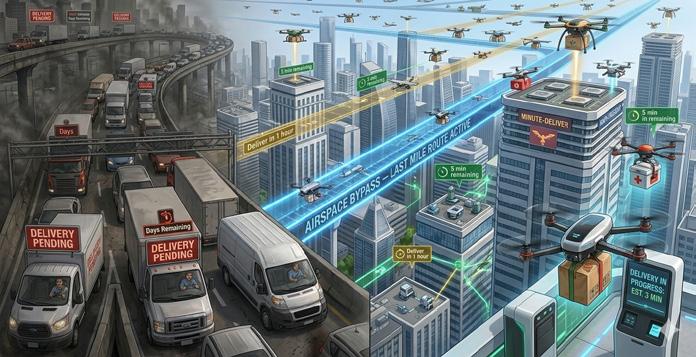
As consumer expectations shift from “next week” to “next hour,” the logistics system, not just passenger transport, faces relentless pressure to deliver faster, cheaper, and more reliably. We are moving from a paradigm of days to a paradigm of minutes, especially in last mile and mid mile deliveries. In this context, drone logistics has leapfrogged from pilot projects to industrial scale operations in record time and is emerging as a critical answer to the last mile and hard to reach mile problem. According to the theory of constraints, if we cannot expand the capacity of the physical bottleneck (congested roads), we must route around it. Airspace is the ultimate bypass for cargo flows.
drones for emergency healthcare and disaster response logistics. With over 500,000 kilometres of autonomous BVLOS operations and a 10 minute diagnostic service with Apollo Hospitals, they demonstrate how aerial fleets can shave critical minutes off emergency logistics, where response time directly correlates with survival.
Indian innovation is also revolutionizing aerodynamic hardware to relentlessly pursue reductions in operating costs. Airbound’s blended wing body tailsitter prototype, with thrust vector control, offers up to six times more aerodynamic efficiency than traditional multicopter drones. For logistics operators, this translates directly into lower cost per kilogram kilometre and improved fleet economics—critical in a price sensitive market.
In densely populated urban centres, Skye Air has proven its scalability by targeting 2 million drone deliveries by the end of 2025. By optimizing flight paths with proprietary unmanned traffic management software, Skye Air is cutting urban transit times to under seven minutes in cities like Gurugram. Here, drones function as a parallel express network for small cargo, relieving pressure on overburdened road based last mile fleets.
In sum, drone logistics is not a futuristic add on; it is a core logistics capability enabling India to leapfrog over traditional road centric bottlenecks.
THE CASE OF THE URBAN SKY COMMUTE (CARGO VS. PREMIUM PASSENGERS)
Urban Air Mobility (UAM) and eVTOL aircraft are the most visually dramatic innovations: flying taxis that promise to lift commuters above ground congestion. However, from a logistics perspective, their current role in India is more symbolic than systemic. They primarily target premium passengers rather than carrying significant cargo volumes. Western developers like Joby Aviation and Archer Aviation are investing heavily
to meet stringent certification standards and deploy urban air taxi fleets. In Eastern markets, EHang has already obtained full commercial certification for autonomous air taxis in Chinese cities, while the UAE is granting exclusive operating rights for such services.
In India, UAM is motivated by the economic cost of congestion but is positioned as a premium commute rather than mass or cargo transit. InterGlobe’s partnership with Archer aims to deploy 200 “Midnight” aircraft, cutting the Connaught Place–Gurugram trip from 90 minutes to seven. Eve Air Mobility with Blade India similarly plans to shorten the 2.5 hour drive between Bengaluru airport and city hubs.
From a logistics standpoint, these services are high margin but low throughput. Carrying four ultra wealthy travellers per flight does little to improve the overall throughput of millions of commuters or the daily megatonnes of urban freight. Moreover, vertiport development in dense cities faces immense zoning and bureaucratic friction. For now, the true logistics impact lies not in eVTOL taxis but in cargo first drone networks and high utilization ground fleets augmented by digital intelligence.
None of these new vehicles—whether trucks, vans, two wheelers, or drones— operate in a vacuum. They require a digital nervous system, often referred to as Connected Vehicle Technology or V2X (Vehicle to Everything). For logistics, this effectively creates a digital twin of the fleet and infrastructure, shifting from passive protection (insurance after accidents) to active, collaborative prevention and optimization (avoiding breakdowns, rerouting around congestion, and predicting failures).
China’s vehicle road cloud integration sends traffic signal data to vehicles in cities like Wuxi and uses roadside cameras and LiDAR in Changsha to support autonomous decisions. In the U.S., projects like Tampa apply V2X to prevent wrong way collisions. These deployments directly support more reliable freight flows by smoothing
throughput and improving safety.
India cannot afford such capital intensive, greenfield infrastructures at scale. Instead, frugal logistics innovation leads the way. Indian OEMs are embedding IoT connectivity into vehicles using existing cellular networks (V2N). Platforms like MG’s iSMART and similar offerings from Kia and Hyundai offer remote immobilization, geofencing, and telemetry using ordinary 4G/5G subscriptions—without expensive roadside units.
In commercial fleets, organizations like Intangles use digital twin technology to collect engine management data from trucks and buses, uploading it to the cloud to predict component failures before they occur. This enables predictive maintenance and improves fleet uptime and asset utilization—key levers in logistics profitability.
Given the dominance of two wheelers in India’s last mile delivery fleets, V2P (Vehicle to Pedestrian/Motorcyclist) solutions from companies like Honda, which use smartphones as beacons, are essential. They help larger vehicles detect riders hidden in blind spots, reducing last mile accident risk.
On the infrastructure side, research bodies like C DAC are creating low cost C V2X adapters that retro fit existing traffic signal controllers. These enable smart traffic functions such as ambulance priority corridors without replacing legacy hardware. This is classic frugal engineering: extracting maximum logistics benefit with minimal capital expenditure.
The theory behind autonomous fleets, drone logistics, and V2X is exciting, but the practical application in India faces significant friction. Root cause analysis reveals that assuming Western mobility and logistics blueprints will seamlessly work in Indian conditions is fundamentally flawed. Developed economies are layering digital systems onto already reliable physical roads. India is attempting to run advanced logistics intelligence over a physical layer that is strained, flood prone, and highly variable. A pothole cannot be patched with an algorithm.
In India, Urban Air Mobility (UAM) is motivated by the economic cost of congestion but is positioned as a premium commute rather than mass or cargo transit. From a logistics standpoint, these services are high margin but low throughput. Carrying four ultra wealthy travellers per flight does little to improve the overall throughput of millions of commuters or the daily megatonnes of urban freight. Moreover, vertiport development in dense cities faces immense zoning and bureaucratic friction. For now, the true logistics impact lies not in eVTOL taxis but in cargo first drone networks and high utilization ground fleets augmented by digital intelligence.
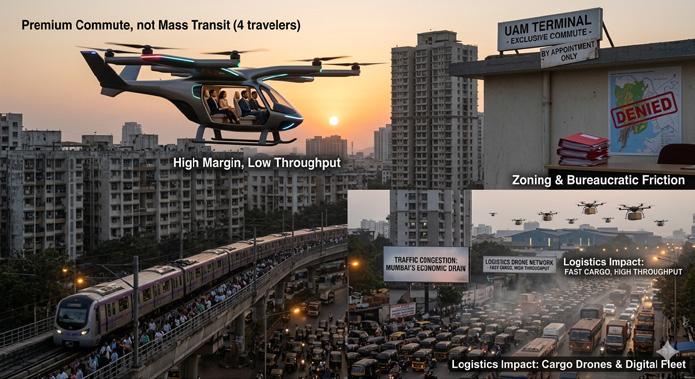
Machine learning models trained on highly compliant Western traffic do not generalize to India’s high entropy freight corridors. Deterministic planning approaches and classical safety stocks fail under such variability. AI architectures must be redesigned towards robust, camera based predictive analytics and frugal sensing, rather than brittle, expensive LiDAR stacks.
Capital intensity is another barrier. AI, advanced sensors, and drone networks are expensive, while Indian consumer and B2B markets are price sensitive. Economic viability demands frugal engineering: smartphones as V2P devices, low cost V2X adapters, camera only ADAS, and highly efficient drone airframes. In logistics, unit economics—
not just technological elegance— determines adoption.
The mobility sector has reached an inflection point, and these new vehicular technologies—autonomous fleets, drone networks, V2X ecosystems—are here to stay. As the world evolves, so will the way global supply chains and freight flows are managed.
India’s path will not be a copy of Western blueprints. Success will not come from simply importing foreign AI and logistics platforms, but from operations driven innovation tuned to Indian constraints. AI must be trained to understand chaos; drone networks
must be architected as parallel logistics layers that bypass gridlocked roads; telecom networks must be leveraged as the backbone for connected fleets instead of waiting for perfect smart city infrastructure.
If India gets this right, it has an extraordinary opportunity to leapfrog: to bypass antiquated, road heavy logistics models and build a uniquely resilient, frugal, and digitally integrated freight ecosystem. Such a system would not only transform cargo movement within India but could also become the reference model for logistics innovation across the developing world.

Email: tech@celerityin.com | Mobile: 79771 05913 Website: www.supplychaintribe.com www.supplychaintribe.events