SUPPLYCHAINTRIBE.COM JANUARY 2026 Volume 10 Issue 1
INSIDE
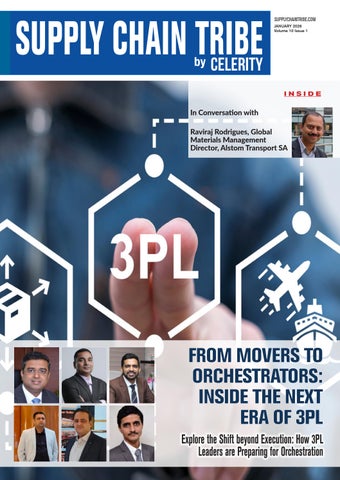
In Conversation with Raviraj Rodrigues, Global Materials Management Director, Alstom Transport SA
FROM MOVERS TO ORCHESTRATORS: INSIDE THE NEXT ERA OF 3PL Explore the Shift beyond Execution: How 3PL Leaders are Preparing for Orchestration
www.supplychaintribe.events
2026
Lead the Shi . Shape the Future. Three Ci es. One Mission. Transforming India’s Supply Chains.
Bengaluru – 26 February 2026
New Delhi – 16 April 2026
Mumbai – 20 August 2026
The boldest conversa ons, the sharpest insights, and a high-impact gathering of CXOs, supply chain leaders, innovators, policymakers, and solu on providers—all in one place. Focussed on transforma on, digitalisa on, sustainability, risk and resilience, mul modal expansion, new business models and customer expecta ons. To know about our past conferences visit - h ps://supplychaintribe.events/conferences/
2026 isn’t just a calendar year. It’s a call to par cipate, contribute, and be celebrated—together, as a Tribe. For details regarding sponsorships, speaker slots and/ or delegate Register here- h ps://bit.ly/CeleritySCTEvents2026
www.supplychaintribe.events
A Landmark year for Supply Chains Make it Count. The Celerity Supply Chain Tribe 2026 Award Nomina ons are now open! You’ve solved complex problems. You’ve built resilient, customer-centric, and future-ready supply chains. You’ve delivered results when it ma ered most. YOUR NAME HERE
Now it’s me the industry no ced.
The Supply Chain Tribe Awards 2026 are not about glossy presenta ons or big names alone. They are about real impact, measurable outcomes, and leadership that moves the needle—across all facets of the value chain. To know about our past winners visit - h ps://supplychaintribe.events/awards/hall-of-fame/
Register your interest for nomina on here - h ps://bit.ly/CeleritySCTAwards2026
4 CELERITY January 2026
PUBLISHER’S NOTE
Quiet Reflections, Powerful Transitions Dear Readers, A new year always arrives with a certain quiet promise. For me, the last week of December unfolded in gentle reflection at home. I didn’t travel this holiday season, and that pause— away from packed itineraries and constant motion—offered something equally valuable: time to think, to observe, and to prepare for what lies ahead. In those quieter moments, one realisation stood out clearly—our industry never truly stands still, even when we briefly slow down. As we step into 2026, this issue of Supply Chain Tribe captures that very momentum.
Published by: Charulata Bansal on behalf of Celerity India Marketing Services Edited by: Prerna Lodaya
Our cover story focuses on the evolving world of Third-Party Logistics (3PL) in India—a sector that is transforming rapidly in response to changing client expectations, digital acceleration, and increasingly complex supply chain networks. The story explores the challenges they face, the complexities they manage daily, and the opportunities emerging for those willing to adapt and innovate.
e-mail: prerna.lodaya@celerityin.com
In our Leadership section, we trace the inspiring journey of Raviraj Rodrigues, Global Materials Management Director, Alstom Transport SA. Raviraj’s story stands out for its cross-industry exposure and multidisciplinary experience—an approach that is becoming increasingly relevant in modern supply chains.
Blue Dart Express Limited
Adding further perspective, Sanjay Desai, Independent Board Advisor and Mentor, reflects on the key lessons from 2025 and shares his outlook on what leaders must prepare for in 2026. We round off this issue by revisiting some of the most inspiring quotes from industry leaders featured across our 2025 editions—voices that challenged conventional thinking, shared hard-earned wisdom, and continue to shape conversations across the supply chain community. Here’s to a year of thoughtful leadership, purposeful growth, and resilient supply chains!
Charulata Bansal Publisher Charulata.bansal@celerityin.com www.supplychaintribe.com
Designed by: Lakshminarayanan G e-mail: lakshdesign@gmail.com Logistics Partner:
5
supplychaintribe.com
CONTENTS
JANUARY 2026 Volume 10 Issue 1
12 COVER STORY From Movers to Orchestrators: Inside the Next Era of 3PL India’s third-party logistics sector is at an inflection point. Once defined by asset intensity and execution efficiency, 3PLs are being reimagined as strategic orchestrators of supply-chain intelligence. As manufacturing shifts closer to consumption, e-commerce compresses delivery windows, and sustainability moves from aspiration to mandate, logistics providers are no longer judged by how fast they move freight—but by how intelligently they connect networks, data, and decisions. Digital control towers, multimodal integration, predictive analytics, and customer centric design are reshaping the industry’s DNA. In this next phase of growth, India’s 3PLs are navigating rising complexity, margin pressure, and heightened expectations, while simultaneously unlocking new value pools. This Cover Story examines how leading logistics players are responding—what they are investing in, what they are rethinking, and how they see their role evolving in a supply chain that now demands ORCHESTRATION OVER EXECUTION.
6 | LEADERSHIP
26 | RECAP
From Materials to Momentum: Building Supply Chains that Perform
The Year That Was 2025
For Raviraj Rodrigues, Global Materials Management Director, Alstom Transport SA, a supply chain is far more than a transactional network—it is a deliberately engineered system built to anticipate disruption, manage risk, and embed sustainability by design. During this interview, he illustrates how technology, strong governance, and leadership alignment can transform operational excellence into a strategic advantage.
2025 will be remembered as a year when supply chains were re-architected, leadership was redefined, and business resilience became a global imperative. In this edition, we bring together the most compelling voices we engaged with throughout the year—leaders whose insights illuminated changing market forces, evolving customer expectations, technological breakthroughs, and the new rhythms of global enterprise. These quotes do more than capture opinions; they reflect the mindset of a world in transition.
22 | FOCUS
The Supply Chain Crossroads: Lessons from 2025 and the Leadership Mandate for 2026 The world of supply chains changed in 2025. Disruptions— geopolitics, climate impacts, shifting consumption, and rapid technology cycles—intersected to make uncertainty structural, not episodic. Sanjay Desai, Independent Board Advisor / Mentor, explores how leaders can architect supply chains that anticipate change, respond decisively, and create enduring value in an unpredictable and interconnected world.
DISCLAIMER: This magazine is being published on the condition and understanding that the information, comments and views it contains are merely for guidance and reference and must not be taken as having the authority of, or being binding in any way on, the author, editors, publishers who do not take any responsibility whatsoever for any loss, damage or distress to any person on account of any action taken or not taken on the basis of this publication. Despite all the care taken, errors or omissions may have crept inadvertently into this publication. The publisher shall be obliged if any such error or omission is brought to her notice for possible correction in the next edition. The views expressed here are solely those of the author in his private/professional capacity and do not in any way represent the views of the publisher. All trademarks, products, pictures, copyrights, registered marks, patents, logos, holograms and names belong to the respective owners. The publication will entertain no claims on the above. No part of this publication can be reproduced or transmitted in any form or by any means, without prior permission of the publisher. All disputes are subject to the exclusive jurisdiction of competent courts and forums in Mumbai only.
6 CELERITY January 2026
LEADERSHIP
FROM MATERIALS TO MOMENTUM:
Building Supply Chains That Perform Materials management sits at the intersection of material flows, strategic intent, and enterprise decision-making. For Raviraj Rodrigues, Global Materials Management Director, Alstom Transport SA, a supply chain is far more than a transactional network— it is a deliberately engineered system built to anticipate disruption, manage risk, and embed sustainability by design. Drawing on deep, cross-sector experience spanning automotive, engineering, oil & gas, and consumer industries, he illustrates how technology, strong governance, and leadership alignment can transform operational excellence into a strategic advantage. The result is a future-ready supply chain—one that balances efficiency with agility, insight, and resilience, and turns material movement into a source of enduring competitive strength. A graduate in Mechanical Engineering with a postgraduate qualification in SCM from the Shailesh J. Mehta School of Management, IIT Bombay, Raviraj Rodrigues brings over 25 years of cross-industry experience spanning automotive, engineering, oil & gas, consumer goods, and fashion and lifestyle sectors, having worked with organizations such as Mahindra, Mondelez, 3M, Britannia, Wildcraft, and Alstom. Outside work, he is a certified Advanced Open Water Diver and lives by the motto, ‘Supply Chain Professional by Chance, Scuba Diver by Choice’.
supplychaintribe.com
Across automotive, engineering, oil & gas, consumer goods, and lifestyle sectors, you’ve experienced supply chains with vastly different rhythms and risk profiles. How has this diversity shaped your ability to design supply chains that are both adaptable and inherently disruptionproof? Every industry faces unique challenges. Automotive demands just-in-time precision and rapid adaptability, while engineering requires accuracy and fast design-to-production cycles. Yet, at a strategic level, the expectation from supply chain professionals remains constant: Anticipate and mitigate risks to secure supply lines and Deliver a competitive edge. Risks range from near-term threats like lost sales or line stoppages to large-scale geopolitical disruptions such as tariff imbalances. Companies like Walmart and Zara show how supply chain excellence can become a strategic weapon—leveraging speed, visibility, and agility to dominate markets. My experience across diverse sectors has shaped a core belief: resilience is not an operational fix; it’s a strategic capability. Lessons learned—takt discipline in automotive, redundancy in oil & gas, postponement in consumer goods—inform a design philosophy: one network, many tempos, disruption-proof by design. This resilience rests on three pillars: Structural Adaptability: Segment networks, embed modularity, dual sourcing, and capacity assurance to absorb shocks without hurting margins. Predictive Risk Management: Use scenario modeling and AI-driven sensing to anticipate supplier and geopolitical risks early, enabling proactive decisions. Governance & Assurance: Enforce global standards and digital process adherence for compliance and traceability, especially in multi-source environments. The result? A supply chain that protects revenue, safeguards customer commitments, and fuels strategic growth—even under volatility. And while mistakes happen, what matters most is how quickly we recover and
LEADERSHIP
what we learn along the way. Having championed technology adoption throughout your career, which breakthrough technologies do you see fundamentally transforming materials management—from planning and visibility to execution— in the coming decade? What shifts will matter most? The coming decade will transform materials management from reactive planning to predictive, autonomous execution. Three major shifts will define this evolution: AI in Planning: Generative AI and machine learning will deliver far more accurate demand forecasts and enable rapid scenario modelling across networks. Agentic AI will proactively optimize inventory and mitigate risks before disruptions occur—turning planning into a dynamic, adaptive process that gives supply chains a true competitive edge. End-to-End Traceability: Standards like GS1 and technologies such as blockchain, combined with IoT sensors, will enable real-time tracking and connected systems. This transparency will cut waste, accelerate issue resolution, and reduce compliance risks. Autonomous Execution & Robotics: Smart warehouses and AGVs will manage inventory flows automatically, adjusting in real time based on AI-driven demand signals. Integrated digital twins will give planners complete visibility and control. The Impact: Together, these innovations will make material planners largely locationagnostic, freeing them to focus on troubleshooting unexpected challenges—which will always remain part of the game. Materials management has moved far beyond forecasting and replenishment. In today’s volatile world, how do you define its strategic role, and where do you see the biggest gaps in current industry practice? Materials management has moved far beyond the traditional focus on
7
forecasting and replenishment. Today, it’s a strategic lever for resilience, cost efficiency, and growth. In a volatile global landscape, its scope spans three critical areas: Risk & Continuity: Building resilience through dual sourcing, capacity assurance, and predictive risk modelling. These measures protect revenue and help companies stay ahead of disruptions. Value Creation: It’s about optimizing planning and working capital to deliver better service at lower cost. Sustainability and compliance aren’t add-ons—they’re embedded into every decision. Governance & Transparency: Enforcing global standards, digitizing processes, and ensuring end-to-end traceability are essential for control and trust across the supply chain. That said, challenges remain. Many organizations still face siloed ownership, outdated tools, and a culture of reactive firefighting. These issues slow decisionmaking and limit predictive power. The way forward is clear: integrated processes, advanced analytics, and proactive risk governance. When we achieve that, supply chains stop being cost centers and become true strategic growth engines. True supply chain integration remains aspirational for many organizations. What, in your view, are the most underestimated barriers to achieving realtime synchronisation across planning, sourcing, logistics, and operations? On paper, integration sounds straightforward—connect systems, align processes, and you’re done. In reality, it’s one of the hardest transformations to achieve because of structural, cultural, and technology gaps. The biggest barriers we see are: Fragmented Digital Architecture: Most organizations run on legacy ERPs with regional customizations and niche tools. This creates data silos. Real-time synchronization requires unified data models and seamless connectivity, but harmonizing old systems with modern platforms is a complex, multi-year effort.
8 CELERITY January 2026
LEADERSHIP
By 2030, the biggest leap will be moving from reactive planning to autonomous, self-orchestrating supply networks. AI won’t just forecast—it will prescribe and execute decisions across Planning, Procurement, logistics, and inventory in real time. Digital twins will let us stress-test entire ecosystems before disruptions hit, and blockchain will make provenance and compliance fully transparent. This evolution turns materials management into a strategic nerve center, balancing cost, service, risk, and carbon footprint simultaneously. It’s not just operational— it’s a board-level capability. Poor Master Data & Governance: Inaccurate material masters, supplier codes, and BOMs lead to misaligned schedules, duplicate purchase orders, and incorrect inventory levels. The result? Firefighting and costly expedited freight. Without strong governance, even the best tools fail. Cultural & Process Misalignment: Technology alone doesn’t solve behaviour. Planners often override system logic with local practices. If governance and aligned incentives aren’t in place, Excel files and conflicting priorities persist— undermining integration efforts. True integration isn’t just a tech project; it’s a change management journey. It demands harmonized systems, clean data, and cultural alignment to unlock the full potential of digital supply chains. Companies often invest in dashboards without building real digital execution capability. How can leaders distinguish between meaningful digital maturity and ‘digital theatre’ in supply-chain transformation? True digital maturity is about execution, not just visualization. In my view, dashboards should: Be Prescriptive: Show how to improve, not just what happened Integrate with ERP: No manual “data massaging” Be On-Demand: Accessible anytime, not built only for reviews Have Governance: Clear RACI for action and accountability
Link to Business Outcomes: KPIs tied to top organizational goals for real impact. As AI increasingly influences supplychain planning, how do you see the balance between algorithmic decision-making and human judgement evolving? AI and human judgment should operate as partners, not competitors. AI excels at processing massive data sets and spotting patterns that improve efficiency— particularly in areas like inventory optimization and demand forecasting. It brings speed, scale, and predictive power that humans simply can’t match. But AI has limitations. It relies on historical data and often misses qualitative signals—geopolitical shifts, regulatory changes, cultural nuances, and emerging trends. That’s where human insight becomes indispensable. People provide strategic alignment, ethical oversight, and adaptability, especially during crises when decisions require context and creativity. The future isn’t about choosing one over the other. It’s about integrating AI’s analytical power with human judgment to build smarter, more resilient supply chains. Organizations that achieve this balance will not only respond faster to disruptions but also shape strategies that are ethical, adaptive, and forwardlooking. From localized clusters to global sourcing networks, what characteristics will define supplier ecosystems that can withstand geopolitical and market uncertainty? Resilience must be built on structural, relational, and digital strengths—not
just cost arbitrage. Robust ecosystems will share these traits: Multi-Tier Visibility: Implement real-time tracking beyond Tier-1 using IoT and blockchain to enhance transparency Diversification & Dual Sourcing: Ensure qualified alternatives through full supply chain assessments, capacity audits, and flexible contracts Health Monitoring: Conduct continuous checks on liquidity and perform stress tests on capacity to ensure resilience Digital Connectivity: Utilize API/ EDI integration, predictive alerts, and automated workflows to streamline processes Collaborative Governance: E s t a b l i s h joint risk review mechanisms and standardized escalation playbooks for effective decision-making EHS & Ethical Compliance: E n s u r e verified sustainability and regulatory adherence through the use of digital audits. Given your strong logistics and transportation background, what innovations—operational or technological—do you believe will have the biggest impact on future logistics models? Logistics is evolving at an unprecedented pace. Tomorrow’s supply chains will be smarter, greener, and more agile, and several forces are shaping this shift: Automation & Robotics – Accelerating
supplychaintribe.com
warehouse operations and reducing errors. Smart Warehousing – RFID enables real-time inventory tracking for better accuracy. AI & ML – Predicting demand, optimizing routes, and dynamically adjusting flows. IoT – Delivering real-time visibility for shipments and stock levels. Blockchain & GS1 Standards – Building transparency and trust across the supply chain. On the operations side, we’ll see: Agile Networks for flexibility and rapid response Self-Learning programs for handlers
& Certification logistics material
Last-Mile Innovation—including drones and crowd-sourced delivery models AI-driven logistics isn’t just smart— it’s cost-effective and sustainable. By combining AI with green practices, companies can cut transportation and inventory costs while reducing emissions. Optimized routes, smarter sourcing, and predictive planning mean fewer disruptions and lower spend. The payoff? Efficiency, savings, and sustainability— all in one strategy.
LEADERSHIP
UP, CLOSE &
PERSONAL How do you usually reset after a tough or draining week? I try and balance work and life through structured compartments. Mornings start with reflection and yoga, I use the commute for learning, and work hours for deep engagement with operational challenges. Evenings are reserved for family and nonwork conversations, and weekends for outdoor activities and portfolio reviews. This discipline ensures I recharge fully and maintain clarity for highstakes decisions. What motivates you more: solving complex problems or helping people grow? Helping people grow. Supply chains will always present complexity—disruptions, constraints, and trade-offs—but a strong team transforms those challenges into opportunities. When people develop, the entire value chain benefits. Growth creates resilience, and resilience drives performance. If you weren’t in supply chain leadership, what would you enjoy doing just as much? Teaching scuba on a liveaboard. It’s about precision, preparation, and calm execution in dynamic conditions—skills that mirror supply chain leadership. Both require trust in systems and people, and the ability to adapt quickly without losing sight of safety and outcomes.
End-to-end visibility remains the industry’s biggest promise and biggest gap. What does a truly futureready data architecture for materials management look like? Visibility is the industry’s biggest promise—and its biggest gap. Futureready materials management isn’t just about dashboards; it’s about creating a living, connected system. That means:
What’s a small, everyday moment at work that brings you genuine satisfaction? Ending the day with a clear mind and falling asleep within minutes. It signals that my compartmentalized approach works—issues are addressed in their time and place, so I’m ready to lead decisively the next day.
One Source of Truth: A unified data layer spanning all of the organization’s and its suppliers’ platforms
A leader or mentor you look up to—and how they shaped your approach. My leadership style is a mosaic of lessons from leaders I’ve worked with over 25 years. Observing how they act under pressure and asking why they make certain choices has shaped my ability to respond with clarity. For aspiring leaders: watch closely, ask questions, and learn from realworld decisions—that’s where judgment is forged.
API-First & Cloud-Native: To scale quickly and onboard partners without expensive custom builds
9
A book (or movie) you’ve loved—and why it resonated with you. Jugaad Innovation by Jaideep Prabhu, Navi Radjou, and Simone Ahuja. Its principle of ‘doing more with less’ resonates deeply with supply chain leadership. In a world of volatility, simplicity and frugality aren’t just ideals—they’re competitive advantages. ‘Keep it simple’ is my mantra for problem-solving.
10 CELERITY January 2026
LEADERSHIP
In a world of shortages, unpredictable logistics, and fragmented suppliers, resilience can’t rely on quick fixes—it has to be structural and systemic. My recommended approach rests on five pillars: Risk Segmentation & Dual Sourcing: Start by mapping exposure across your supply base. Identify and qualify alternate sources, and audit capacities for critical components. This ensures continuity when disruptions hit. Time-Fenced Planning: Freeze demand strategically to stabilize execution during volatile periods. It’s about creating controlled windows that reduce chaos without sacrificing agility. Supplier Governance: Move beyond transactional relationships. Adopt performance-based contracts, conduct financial health checks, and enable digital connectivity for real-time collaboration. Digital Risk Orchestration: Leverage IoT for real-time tracking, AI for predictive risk modelling, and digital twins for scenario planning. These tools turn uncertainty into actionable insights. Anticipate: Institutionalize cross-functional crisis centers and proactive shortage reviews. When everyone knows the playbook, response time shrinks and decisions improve. Resilience isn’t a one-time project—it’s a continuous discipline that blends technology, governance, and collaboration to transform supply chains from vulnerable networks into competitive advantages. Digital transformation isn’t just about technology—it’s about aligning people, processes, and purpose. My approach focuses on six practical principles: Understand the Business: Start with clarity. What is your organization’s vision, and how does the change you’re driving fit into that bigger picture? Transformation without alignment is wasted effort. Fix Processes First: Technology won’t fix broken basics. Clean up master data, define demand freezes, and establish clear escalation paths before you automate. Solid foundations matter. Go Step by Step: Not all sites are equal in maturity. Use a roadmap: Start → Accelerate → Optimize. Scale progressively rather than forcing uniformity. Focus on People: Resistance often stems from fear. Redesign roles, train teams, and show tangible benefits. Celebrate quick wins—they build momentum and trust. Measure What Matters: Dashboards mean nothing if service, cost, and resilience don’t improve. Tie every initiative to KPIs that reflect real business impact. Create Champions: Peer advocates drive adoption better than mandates. Build site-level digital champions who can influence and inspire others. Success = Process + People + Outcomes—not just tech.
Real-Time Intelligence: IoT streaming combined with event-driven architecture for instant disruption detection AI at the Core: Moving from reporting problems to prescribing actions Digital Twins: Stress-testing scenarios before they hit the real world Governance: Master data integrity and cybersecurity baked into every layer Visibility isn’t optional—it’s the backbone of resilience. Without it, organizations can’t anticipate risks, optimize flows, or respond effectively to disruptions. Sustainable operations are now business-critical. How can materials management directly contribute to decarbonisation without compromising service levels and cost efficiency? Sustainability isn’t optional—it’s business-critical. Materials management can cut carbon without sacrificing cost or service by embedding green practices into core operations: Smart Sourcing: AI-driven supplier mix for lowest cost + CO₂ impact Inventory Strategy: Rely more on delayed differentiation to avoid highcarbon air freight Mode & Packaging: Rail over Land where possible; standardized packaging for container efficiency, Use of Returnable packaging Supplier Collaboration: Carbon KPIs + co-develop low-carbon materials Digital Visibility: IoT + blockchain for real-time carbon tracking; dashboards with sustainability metrics. Green supply chains = competitive supply chains. As digital tools take over routine tasks, what new capabilities do tomorrow’s materials and supplychain professionals need to cultivate? The role is evolving dramatically. As
supplychaintribe.com
digital tools automate routine tasks, tomorrow’s leaders will shift from transactional planning to strategic orchestration. The future planner won’t just manage schedules—they’ll shape strategy. Key capabilities include: Interpreting advanced analytics and validating AI outputs to ensure decisions are data-driven yet contextaware. Stress-testing risks with scenario thinking to anticipate disruptions before they occur. Integrating IoT, blockchain, and automation platforms for real-time visibility and seamless operations. Embedding sustainability into sourcing decisions, making environmental and social impact part of the core strategy. Leading cross-functional teams and managing supplier ecosystems, moving beyond silos to collaborative networks. Ensuring governance and ethics in AI-driven decisions, balancing innovation with responsibility. The future supply chain professional will be a strategist, not just an operational planner—combining technology fluency with leadership and foresight Do you believe current supply-chain operating models—centralised,
LEADERSHIP
11
decentralised, hybrid—are adequate for the future? What new structures might emerge as complexity increases? Traditional models — centralized, decentralized, hybrid — were designed for stability. Today’s reality is volatility, geopolitical shocks, and ESG mandates, and these models show their limits: Centralized models deliver scale but lack agility Decentralized responsiveness fragmentation
models but
offer create
Hybrid models often end up as patchwork, not true orchestration The future lies in better networked models – Planning, Procurement and Logistics sharing the same digital backbone. We will be connected to our suppliers and customers in real time though API linked platforms. We will have transparency and traceability in our Supply Chains through Standards like GS1 or technologies like Block chain. AI will integrate data from multiple points to help scenario building and Control Towers will assess and mitigate risks and drive governance. If you look toward 2030, what do you believe will be the biggest leap in materials management—as well as the biggest risk if industries fail to evolve? By 2030, the biggest leap will be moving from reactive planning to autonomous,
self-orchestrating supply networks. AI won’t just forecast—it will prescribe and execute decisions across Planning, Procurement, logistics, and inventory in real time. Digital twins will let us stresstest entire ecosystems before disruptions hit, and blockchain will make provenance and compliance fully transparent. This evolution turns materials management into a strategic nerve center, balancing cost, service, risk, and carbon footprint simultaneously. It’s not just operational— it’s a board-level capability. By 2030, success will hinge on two imperatives: Autonomous Decisioning: AI-driven systems that not only predict but prescribe and execute actions across sourcing, logistics, and inventory. Integrated Digital Ecosystems: Unified platforms linking suppliers, partners, and internal systems for real-time visibility and resilience. Organizations must treat this as a capital allocation priority today— not a future project. Those who delay risk structural fragility and loss of competitiveness in an era where resilience and sustainability are board-level KPIs. Disclaimer: The views expressed above represent the author’s personal perspective and do not necessarily reflect the strategy, policies, or official position of the organization with which the author is currently associated.
12 CELERITY January 2026
COVER STORY
From Movers to Orchestrators: INSIDE THE NEXT ERA OF 3PL
supplychaintribe.com
COVER STORY
13
India’s third-party logistics sector is at an inflection point. Once defined by asset intensity and execution efficiency, 3PLs are being reimagined as strategic orchestrators of supply-chain intelligence. As manufacturing shifts closer to consumption, e-commerce compresses delivery windows, and sustainability moves from aspiration to mandate, logistics providers are no longer judged by how fast they move freight—but by how intelligently they connect networks, data, and decisions. Digital control towers, multimodal integration, predictive analytics, and customer-centric design are reshaping the industry’s DNA. In this next phase of growth, India’s 3PLs are navigating rising complexity, margin pressure, and heightened expectations, while simultaneously unlocking new value pools. This Cover Story examines how leading logistics players are responding—what they are investing in, what they are rethinking, and how they see their role evolving in a supply chain that now demands ORCHESTRATION OVER EXECUTION.
14 CELERITY January 2026
F
OR decades, progress in India’s logistics sector was written into the landscape— roads stretching farther, warehouses rising higher, fleets growing denser. Today, transformation is unfolding more quietly, in the spaces where decisions are made—guided by data, informed by analytics, and executed across complex networks. As supply chains grow more interconnected and less predictable, advantage is moving beyond physical scale to the ability to sense, decide, and act with precision, while embedding sustainability into every choice. Scale still matters, but it no longer speaks first. Speed remains powerful, but only when paired with foresight, intelligence, and environmental responsibility. In this transition, 3PL leaders are stepping into a more deliberate role—shaping flow, aligning intent, reducing carbon impact, and turning complexity into coherence. What follows is a window into how India’s logistics players are learning to lead not just by moving goods, but by mastering the analytics, intelligence, and sustainability that move supply chains. Because in a world of constant motion, it is judgment—not momentum—that creates advantage.
What are the few “big bets” that can help 3PLs’ role in the logistics ecosystem over the next five years? Deepak Kumar Goel, Chief of Last Mile Operations, Shadowfax: The first transformational bet is the shift toward an EV-Enabled Last-Mile Workforce. India’s delivery ecosystem is deeply dependent on gig workers who predominantly use petrol and diesel twowheelers. As demand rises, this model becomes increasingly unsustainable— both environmentally and economically. EV adoption fundamentally resets this equation. But the real opportunity is not just transitioning to electric vehicles; it is building the EV participation infrastructure around gig workers. When delivery partners can access vehicles through flexible leasing instead of upfront ownership, the talent pool expands dramatically. Today, hiring is restricted to individuals who already
COVER STORY
own a vehicle. Tomorrow, with accessible EV leasing models—daily, weekly, monthly—we unlock participation for thousands who are currently excluded simply because entry costs start at ₹1 lakh or more. This is a structural redesign of supply—more inclusive, more stable, and far more scalable. EVs become not just a sustainability lever but a workforceenablement tool. The second major bet is IntelligenceLed Last-Mile Execution, anchored in deep address analytics. Address quality remains one of the biggest friction points in Indian logistics— ambiguous locations, inconsistent descriptions, and behavioural nuances that aren’t captured by traditional systems. Advancing address engines through geospatial intelligence, pattern recognition, and delivery behaviour data can dramatically reduce first-attempt failures, eliminate fake attempts, and improve predictability. As e-commerce volumes climb, accuracy—not speed— becomes the real differentiator. Building this layer of intelligence turns last-mile delivery from a reactive function into a precision system. The third bet is on Next-Generation Network Design, especially leveraging new freight and logistics corridors being developed across the country. The industry has experimented with them in pockets, but the potential remains largely untapped. These corridors can fundamentally alter the cost–speed balance—reducing transit times, ironing out variability, and enabling more reliable mid-mile operations. The challenge, and the opportunity, lies in designing networks that are not only cost-efficient and scalable but dynamically aligned with emerging infrastructure. This is where the next wave of competitive advantage will come from. Together, these represent a shift from incremental efficiency to structural transformation. They redefine how the ecosystem will scale, how costs will stabilize, and how experience will be delivered in a logistics environment that is becoming more digital, more distributed, and more demanding every year. Sougata Mitra, Senior GM – Business Head, Pristine Value Logistics: A few
big bets stand out as critical for 3PLs to elevate their role in the logistics ecosystem over the next five years— shifting from operational execution to strategic enablement, and from scale alone to intelligence and resilience. These include: Building a Tech-Enabled, Predictive Supply Chain Ecosystem: We are investing in next-generation digital capabilities— advanced WMS/TMS platforms, IoTenabled visibility, etc. Our goal is to shift from reactive operations to predictive, data-led logistics that deliver real-time transparency, improved accuracy, and faster decision-making for our customers. Expanding Pan-India, Multi-Temperature Logistics Infrastructure: We are accelerating our footprint across the country with state-of-the-art ambient and cold chain facilities, supported by a multimodal transportation network. This infrastructure expansion, backed by strong compliance and quality systems, will allow us to serve new industries, deepen our offering in healthcare and pharmaceuticals, and enable futureready supply chains. Ajit Jangle, MD, FM Logistic India: Our primary focus is on sustained investment in technology, digitalisation, and AI to create measurable value for customers. These investments are not about adopting technology for its own sake, but about improving visibility, decision-making, and responsiveness across the supply chain. Alongside this, we are strengthening our operational capabilities to ensure that technologyled solutions translate into real, onground execution excellence. Dr. Vikash Khatri, Founder, Aviral Consulting Pvt. Ltd.: The Indian 3PL sector stands on the cusp of a transformative era, projected to witness strong double-digit growth in the coming years. The ecosystem is steadily evolving from an unorganized and fragmented structure toward a more formalized, technology-driven environment. In this new phase, leading players are expected to actively integrate sustainability and innovation into their operations. Over the next five years, one of the key
supplychaintribe.com
COVER STORY
15
Deepak Kumar Goel, Chief of Last Mile Operations, Shadowfax There is no single equilibrium point between speed, cost, and resilience—it is a design choice rooted in customer understanding. Every supply chain must begin with a sharply defined service promise. Are you building a three-day delivery proposition? A next-day commitment? Or an ultrafast 10-minute model? That clarity becomes the north star for the entire network. In essence, customer experience determines the boundaries; cost optimization happens within those boundaries. Within the chosen service tier, companies still have significant levers to optimize—load consolidation, intelligent routing, flight selection, density-based carrier negotiations, and network timing. These interventions can meaningfully lower cost while preserving the speed and reliability that customers expect.
strategic priorities of 3PL should be a shift in modal mix through the adoption of multimodal transportation networks. Currently, around 65% of freight movement relies on road transport, while greater utilization of rail and coastal shipping can unlock significant cost efficiencies and environmental benefits. Ongoing infrastructure initiatives such as the Dedicated Freight Corridors (DFC) and Multi-Modal Logistics Parks (MMLPs) will further enhance supply chain efficiency and connectivity. A second major area of focus for 3PL players should be strategic collaboration and advanced outsourcing models. By adding a consultative layer to their services, 3PLs can transition from being logistics providers to endto-end solution partners, delivering enhanced value across clients’ supply chains. Finally, 3PL companies should invest in specialized offerings tailored to specific industry verticals, technologies, or networks. Such specialization will not only create differentiation but also strengthen customer trust and longterm partnerships.
How can companies balance the triangle of speed, cost, and resilience in a world where volatility is constant, and customer expectations keep rising? Deepak Kumar Goel: There is no single equilibrium point between speed, cost, and resilience—it is a design choice rooted in customer understanding. Every
supply chain must begin with a sharply defined service promise. Are you building a three-day delivery proposition? A next-day commitment? Or an ultra-fast 10-minute model? That clarity becomes the north star for the entire network. Once the customer promise is set, it becomes the non-negotiable. If a nextday delivery from Delhi to Bengaluru is part of your service design, then the network must deliver on it—even if it means using air freight. Customers intuitively understand that speed carries a premium, and they are receptive to it when the experience is consistent. Conversely, when the promise allows a three-day window, the network can be optimized for cost through multimodal options without compromising the experience. In essence, customer experience determines the boundaries; cost optimization happens within those boundaries. Within the chosen service tier, companies still have significant levers to optimize—load consolidation, intelligent routing, flight selection, density-based carrier negotiations, and network timing. These interventions can meaningfully lower cost while preserving the speed and reliability that customers expect. Resilience, meanwhile, comes from precision and predictability, not from building excess buffers. When organizations rigorously design around the customer promise and dynamically optimize within that framework, they create supply chains that remain stable
even when external volatility rises. Customer experience is the principle. Cost and resilience are the disciplines that follow. Nikhil Agarwal: India’s freight ecosystem navigates seasonal demand fluctuations, asymmetric return-load availability, and infrastructure that, although advancing, remains uneven across regions. Balancing equilibrium between speed, cost, and resilience involves an analytical and disciplined approach, monitoring network performance, using data to identify operational inefficiencies, and applying insights to improve service reliability, manage costs, and increase throughput. At CJ Darcl, our technology stack supports this balance. Our AI-enabled dashcams offer behavioural insights to encourage safer and more efficient driving practices. Our Transport Management System (TMS) ensures end-to-end shipment visibility and realtime tracking, while our Warehouse Management System (WMS) manages inventory flows and operational accuracy. These digital systems create a data-driven framework that enables monitoring of each execution stage, managing disruptions, and providing logistics solutions for a agile and costmanaged supply chain. Mahendra Pratap Singh, National Sales Head – Warehousing & Transport, Pristine Value Logistics: As a 3PL service provider for almost
16 CELERITY January 2026
COVER STORY Nikhil Agarwal, President, CJ Darcl Logistics Ltd. India’s supply chains are transitioning from linear, siloed operations to integrated, technology-enabled networks spanning transportation, storage, demand cycles, and end-to-end supply chain flows. With expectations for speed, visibility, and reliability, 3PLs shift from executing discrete services to orchestrating interconnected supply chain operations. This evolution requires synchronizing diverse logistics functions, reducing friction across touchpoints, and managing operations with accountability. Industry growth favours logistics partners that use real-time data, analyse demand–supply dynamics, and optimize modes or routes to manage risks and maintain continuity.
three decades, Pristine Value Logistics has provided their clients with best-inclass services, including contributions to clients: Reducing operational costs through network optimization, and route planning. Streamlining processes like inventory management, order fulfilment, and distribution services using global best practices. Deploying next-gen technologies like WMS, TMS, real-time tracking, automation, AI, and predictive analytics. Providing supply chain visibility and transparency through digital dashboards and data sharing with clients. Adopting green practices in warehousing infrastructure and operations Ensuring customer service on behalf of clients through On-Time In-Full Secured and Guaranteed (OTIF) services. Acting as a strategic partner instead of just a vendor. Ajit Jangle: Speed, cost, and resilience are all essential elements of a strong value proposition. However, achieving higher speed and resilience often requires additional investment, which comes at a cost. The key lies in finding the right trade-
off, aligned with customer expectations and their willingness to pay for enhanced capabilities. A balanced approach, rather than an absolute focus on any one parameter, delivers sustainable value.
As India’s supply chains become more digital, multimodal, and customer-driven, how will the role of a 3PL evolve from service provider to strategic orchestrator? Deepak Kumar Goel: The evolution is already in motion—and it is redefining the industry’s value creation model. For D2C and mid-sized brands, building an end-to-end logistics capability internally is neither viable nor strategic. These brands rely on 3PLs not just for fulfillment but for growth enablement. Faster delivery directly boosts conversion rates, strengthens retention, reduces returns, and enhances brand equity. When a 3PL delivers same-day, 30-minute, or hyperlocal fulfillment, it becomes a codriver of revenue, not merely a logistics handler. For larger, more established enterprises with their own logistics infrastructure, the orchestration role manifests differently. Indian commerce experiences sharp seasonality, with demand spikes during festivals and promotional windows. These peaks can overwhelm even the most sophisticated captive networks. Here, a 3PL acts as a flexible surge enabler—absorbing seasonal volatility so that enterprises can maintain service levels and stay focused on growth, innovation, and customer engagement rather than operational bottlenecks. This is why 3PLs are transitioning
from execution partners to strategic orchestrators of agility—integrating capacity, technology, and real-time intelligence to enable brands to scale with confidence. They shape demand, smooth volatility, and strengthen the customer promise. In the years ahead, the most impactful 3PLs will not simply move goods; they will co-architect the growth journeys of the brands they serve. Nikhil Agarwal, President, CJ Darcl Logistics Ltd.: India’s supply chains are transitioning from linear, siloed operations to integrated, technology-enabled networks spanning transportation, storage, demand cycles, and end-to-end supply chain flows. With expectations for speed, visibility, and reliability, 3PLs shift from executing discrete services to orchestrating interconnected supply chain operations. This evolution requires synchronizing diverse logistics functions, reducing friction across touchpoints, and managing operations with accountability. Industry growth favours logistics partners that use real-time data, analyse demand– supply dynamics, and optimize modes or routes to manage risks and maintain continuity. At CJ Darcl, with more than 39 years of operational excellence, we deliver a comprehensive suite of multimodal logistics solutions—including full truckload, rail, air cargo, coastal/shipping, project logistics, freight forwarding, warehousing, distribution, and valueadded services. Our integrated service ecosystem, strengthened by advanced digital platforms, enables us to operate as strategic supply chain orchestrators.
supplychaintribe.com
We take end-to-end ownership, ensuring agility, resilience, and performance across our clients’ logistics value chains. Sougata Mitra: Firstly, as India’s supply chains rapidly shift toward digitization, multimodal integration, and customerdriven models, the role of a 3PL will expand far beyond execution. A modern 3PL will evolve into a strategic supply chain orchestrator—one that designs, integrates, and manages end-toend logistics ecosystems. A 3PL will become the nerve centre, connecting warehousing, transport, and last-mile partners seamlessly. Secondly, the future 3PL will not only execute tasks but also anticipate needs. With control tower visibility, real-time tracking, predictive analytics, and AI-led planning, 3PLs will deliver insights that will help customers improve all- round KPIs, set better benchmarks, and be responsive to consumers. Thirdly, 3PLs like us will take a more proactive role. We co-create solutions with our customers, build infrastructure, and ensure resilient operations. We have become a truly strategic partner that supports growth, ensures business continuity, and drives competitive advantage. Ajit Jangle: Today, many service providers are still largely managing transactional activities. The real evolution lies in moving from transactions to value-added services, and eventually to true partnerships. For a 3PL to reach that stage, it must demonstrate strategic intent, the ability to execute consistently, and the willingness to invest. Only then can it offer customers solutions that are timely, cost-effective, and aligned with their long-term business goals.
COVER STORY
In your view, where will the next wave of value creation emerge—contract logistics, 4PL, cross-border, shared logistics, or integrated supply chain orchestration? Deepak Kumar Goel: The next wave of value creation will emerge most strongly in true 4PL-led orchestration—where logistics partners evolve from Execution Specialists to Business Performance Enablers. The industry is already moving beyond the traditional 3PL model of managing transportation and warehousing. The real value now lies in influencing growth outcomes for brands. When logistics partners take ownership of the entire experience— speed, availability, reliability—they begin to shape customer retention, conversion, and demand patterns. Faster fulfillment consistently drives higher volumes, stronger repeat behavior, and better brand recall. As delivery timelines compress, the logistics partner becomes an active contributor to commercial growth rather than a cost center. Across segments, the future belongs to logistics partners that integrate: multi-node network design; speed-based service differentiation; demand surge cushioning; and intelligence-led coordination. 4PL is no longer a theoretical construct—it is becoming the core engine of value creation as logistics shifts from fulfilment to growth acceleration. Nikhil Agarwal: Value creation arises from end-to-end integrated supply chain orchestration. Customers select logistics partners to manage the entire value chain, reducing coordination with multiple vendors. Integrated solutions that combine transportation, customs clearance, freight forwarding,
17
warehousing, and value-added services allow logistics providers to take accountability and provide a seamless experience. This approach enables providers to analyze the value chain, respond to demand shifts, manage routing, control overstocking or stockouts, and meet sustainability goals. Using data-driven management of the supply chain, 3PLs and 4PLs that adopt integrated orchestration create value for their clients, acting as strategic partners. Mahendra Pratap Singh: The next wave of value creation in logistics will not come from the convergence of contract logistics, 4PL capabilities, shared networks, and integrated orchestration. 3PL will become orchestrators who bring together infrastructure, technology, partners, and data into one unified ecosystem. We believe that the future will be shared to defray rising costs and sustainability pressures - shared assets, shared transportation, and multi-client consolidation. Secondly, traditional 3PL is evolving into super-specialized, tech-enabled operations, especially in sectors like healthcare, pharma, food, retail, and e-commerce. 3PLs will create value through combining infrastructure + digital + compliance + operational excellence. Ajit Jangle: Integrated supply chain orchestration will create the most value. By improving visibility and coordination across material flows, documentation, information, and financial processes, it enhances performance across both domestic and international supply chains. This holistic integration enables better decision-making and stronger outcomes for customers.
Sustainability will shape the future of logistics not because it is fashionable, but because the cost of inaction—economically and environmentally—is far greater than the investment required to transition. Green fleets and carbon-efficient networks will move from being differentiators to being the defining backbone of next-generation logistics models.
18 CELERITY January 2026
COVER STORY Sougata Mitra, Senior GM – Business Head, Pristine Value Logistics As India’s supply chains rapidly shift toward digitization, multimodal integration, and customer-driven models, the role of a 3PL will expand far beyond execution. A 3PL will become the nerve centre, connecting warehousing, transport, and last-mile partners seamlessly. The future 3PL will not only execute tasks but also anticipate needs. With control tower visibility, real-time tracking, predictive analytics, and AI-led planning, 3PLs will deliver insights that will help customers improve all-round KPIs, set better benchmarks, and be responsive to consumers. 3PLs like us will take a more proactive role. We co-create solutions with our customers, build infrastructure, and ensure resilient operations. We have become a truly strategic partner that supports growth, ensures business continuity, and drives competitive advantage.
Dr. Vikash Khatri: Historically, Indian 3PL providers have primarily operated as execution-focused service partners. However, transitioning into strategic collaborators demands deliberate action across three key dimensions — technology and automation, channel capabilities, and commercial models. While technology adoption is inevitable in any industry, the transaction-intensive nature of logistics makes automation-driven innovation essential. Investments in Transportation Management Systems (TMS), Warehouse Management Systems (WMS), Artificial Intelligence (AI), Machine Learning (ML), Automated Storage and Retrieval Systems (ASRS), and network optimization tools can significantly enhance efficiency and decision-making through predictive analytics. To stay competitive, 3PLs must also build omnichannel capabilities— integrating service offerings across physical and digital channels—to deliver industry-specific solutions for sectors such as e-commerce, FMCG, pharmaceuticals, automotive, and retail. On the commercial front, the focus should shift from traditional perunit distance or per-unit weight pricing models to outcome-based contracts. These should link revenues to measurable client outcomes such as logistics cost reduction, on-time, in-full performance, inventory efficiency, and enhanced customer experience.
Which technology shifts—AI planning, digital twins, network intelligence, automation—will create the biggest competitive advantage in the next decade? Deepak Kumar Goel: Three technological shifts will fundamentally reshape competitive advantage over the next decade. AI-led demand and inventory intelligence: The first major shift is in how companies predict demand, build assortments, and place inventory. With quick commerce expanding, the question is no longer how to stock one lakh SKUs everywhere—it is how to identify the 5–10% of SKUs that drive 70–80% of immediate demand. AIand ML-driven analytics will determine – what to stock in dark stores; how quickly to replenish; how to maintain freshness and relevance; and how to optimize churn to improve working capital. For both e-commerce players and 3PLs, this intelligence defines the speed and precision of fulfillment. Deep address intelligence and geospatial mapping: India’s addressing framework is still highly unstructured, and this remains one of the biggest drivers of delivery failures and return rates. The next leap will come from creating machine-readable, hyper-granular location grids that map the country down to meter-level precision. This will transform first-attempt accuracy; returnto-origin rates; delivery productivity;
and customer experience. As return rates drop, profitability and sectorwide efficiency will rise significantly. Address intelligence will likely be one of the biggest unlocks for India’s logistics economy. EV ecosystem and charging infrastructure maturity: The third shift is the evolution of the EV ecosystem—not just vehicles, but the infrastructure that enables mass adoption. Costs are already stabilizing, but what the industry urgently needs is a widespread, reliable charging network. Once this infrastructure matures, EV adoption in last-mile logistics will accelerate exponentially, reducing costs, improving sustainability, and expanding participation for gig workers. Nikhil Agarwal: These technologies shape a digitalized supply chain ecosystem, with the most significant competitive advantage from combining predictive intelligence and automation. Using historical patterns across freight capacity, fuel consumption, pricing volatility, and network performance, AI-driven forecasting equips logistics providers to respond to demand changes, improve asset utilisation, and use dynamic pricing strategies that support operational agility and profitability. In transportation, intelligent planning reduces empty miles—a costly inefficiency. Automation manages routine workflows, removes manual bottlenecks,
supplychaintribe.com
and improves process accuracy. At CJ Darcl, we support a digitalized workflow—from order creation and shipment planning to trip execution and vendor coordination—through our cloud-based Transport Management Platform, MoveX. Our driver ecosystem uses applications that enable drivers to report trip-related issues, manage expenses, and track settlements with limited human intervention. Integrating AI-powered analysis with automated execution enables precision—supporting decision-making alongside delivery performance. Ajit Jangle: All these technologies are important in building a future-ready value proposition. However, AI will play a particularly significant role by automating repetitive tasks, improving efficiency, and enabling round-the-clock decision support. This not only reduces costs but also enhances responsiveness and consistency across operations. Dr. Vikash Khatri: To stay competitive over the next decade, Indian 3PLs should prioritize investments in Artificial Intelligence (AI), digital twins, and network intelligence to unlock automation and predictive decision-making across their networks. Among these, AI and machine learning must take precedence, enabling the automation of repetitive tasks and the continuous optimization of end-to-end supply chains. The emergence of “Agentic AI” – autonomous AI agents capable of independently executing complex, multistep workflows – will quickly become a
COVER STORY
must-have capability for 3PLs seeking step-change gains in efficiency and service quality.
How are 3PLs evolving solutions to meet the changing expectations of users—especially around transparency, reliability, service flexibility, and end-to-end visibility? Deepak Kumar Goel: Transparency and visibility have become the baseline expectation for today’s users. Realtime tracking, status updates, and transactional visibility—whether in quick commerce or e-commerce—are now hygiene features across most modern logistics networks. Customers expect to know where their shipment is at every step, and 3PLs have evolved rapidly to deliver that level of clarity both to end consumers and to enterprise clients. The real gap now lies not in visibility but in experience management. The moment a customer sees a failed delivery attempt or an unexpected delay, dissatisfaction spikes—often disproportionately. This emotional friction is where the next wave of innovation is needed. 3PLs must shift from simply providing movement visibility to enabling proactive, empathetic, and contextrich communication, especially when exceptions occur. Customers want to understand why a delivery failed, what the next promise window is, and how quickly the issue will be resolved. Closing this communication gap—through intelligent alerts, seamless rescheduling, and personalized engagement—will
19
be critical to elevating reliability and building trust. Nikhil Agarwal: At CJ Darcl, technology supports our strategy to improve the customer experience. We invest in our cloud-based Transport Management System (TMS) and digital control towers, which combine real-time data from GPS and IoT sensors to offer clients a view of their consignments across the supply chain from first mile to last mile. This visibility supports operational reliability through disruption management and reinforces our safety practices through AI-enabled dashcams that monitor driver behaviour. Using the expertise of our corporate promoter, South Korea’s CJ Logistics, we apply automation via their proprietary TES framework, providing smart warehouses with unmanned forklifts, robotics, and automated systems. This combination of real-time visibility, analytics, and automation delivers transparent and reliable solutions, meeting customer expectations. Mahendra Pratap Singh: Customers expect greater transparency, higher reliability, flexible service models, and real-time end-to-end visibility. At Pristine Value Logistics, we are evolving our solutions in four keyways to stay ahead of these expectations: We are investing in advanced WMS, TMS, and IoT-enabled tracking systems that provide customers with a single, unified view of inventory, shipments, and exceptions.
Ajit Jangle, MD, FM Logistic India The 3PL of 2030 will be a trusted partner rather than a service vendor. Getting there requires a clear journey of building operational excellence to earn trust, investing in technology to enhance visibility and speed, and having the intent to continuously invest in new capabilities. This combination of trust, technology, and long-term commitment will define the next generation of logistics players.
COVER STORY
20 CELERITY January 2026
We have enhanced our operations with robust SOPs and quality frameworks, in-house compliance and safety audits, Data-driven performance monitoring etc. We have introduced flexible service points such as multiclient warehousing for quick scalability, customized distribution models based on industry needs, modular transport solutions across ambient and cold chain, and valueadded services (kitting, labelling, repackaging). In essence, we are evolving from being operators of logistics to being enablers of customer-driven logistics services. Our commitment is to deliver solutions that inspire trust, support growth, and elevate the user experience across every touchpoint. Ajit Jangle: Solutions today can no longer be standardized. They are increasingly customised and play a critical role in value creation. At FM Logistic India, we strongly believe in co-creating solutions with customers. Traditional RFQs often provide limited insight, whereas meaningful innovation requires deeper collaboration. Through co-creation, we not only address current service expectations but also align with the customer’s three-to-five-year supply chain vision. Dr. Vikash Khatri: To meet rising expectations around transparency, reliability, and speed, 3PLs must develop agile, end-to-end visibility platforms
tailored to the needs of Q-commerce and modern, omni-channel supply chains. The rapid growth of Q-commerce has not only sharply compressed delivery timelines but also established new benchmarks for turnaround efficiency for other channels as well. Delivering on these expectations will require dynamic inventory management, strategically located warehouses, micro-fulfilment centres, and a scaled-up physical network underpinned by automation and advancements.
What role will sustainability play in future logistics models, especially around Scope 3 visibility, carbon efficiency, and the shift to green fleets? Deepak Kumar Goel: Sustainability is no longer a peripheral theme; it is becoming a strategic imperative driven by environmental responsibility, cost economics, and long-term ecosystem health. The logistics sector contributes significantly to Scope 3 emissions, and as supply chains become more customerdriven and urbanized, the urgency to address carbon intensity is only increasing. Green mobility—particularly EVled last mile—sits at the center of this transition. It promises not just lower emissions but also long-term cost efficiency, reduced congestion, and a more sustainable operating model as demand scales. But adoption hinges on one foundational factor: infrastructure readiness. Without robust and reliable charging networks, India cannot
mirror the rapid EV penetration seen in markets like Norway, where battery electric vehicles (BEVs) accounted for approximately 95% of all new car sales in 2025. The aspiration is clear; the ecosystem, however, still requires substantial investment. The industry is witnessing early momentum—especially in twowheeler EVs—but scaling to a truly green fleet requires aligning infrastructure, policy support, cost structures, and operational readiness. Ultimately, sustainability will shape the future of logistics not because it is fashionable, but because the cost of inaction—economically and environmentally—is far greater than the investment required to transition. Green fleets and carbon-efficient networks will move from being differentiators to being the defining backbone of next-generation logistics models. Nikhil Agarwal: With policy support and customer alignment toward environmentally responsible operations, sustainability defines selection of logistics partners, evaluation of performance, and development of strategic relationships. The industry moves beyond speed and cost to include carbon visibility, greener transport modes, and supply chain models designed to reduce environmental impact. Logistics providers integrate sustainability into their digital and operational frameworks to provide traceable, compliant, and environmentally aware solutions. At CJ Darcl, we follow a sustainability
Mahendra Pratap Singh, National Sales Head – Warehousing & Transport, Pristine Value Logistics The next wave of value creation in logistics will not come from the convergence of contract logistics, 4PL capabilities, shared networks, and integrated orchestration. 3PL will become orchestrators who bring together infrastructure, technology, partners, and data into one unified ecosystem. We believe that the future will be shared to defray rising costs and sustainability pressures - shared assets, shared transportation, and multi-client consolidation. Secondly, traditional 3PL is evolving into superspecialized, tech-enabled operations, especially in sectors like healthcare, pharma, food, retail, and e-commerce. 3PLs will create value through combining infrastructure + digital + compliance + operational excellence.
supplychaintribe.com
COVER STORY
21
Dr. Vikash Khatri, Founder, Aviral Consulting Pvt. Ltd. Over the next five years, one of the key strategic priorities of 3PL should be a shift in modal mix through the adoption of multimodal transportation networks. Currently, around 65% of freight movement relies on road transport, while greater utilization of rail and coastal shipping can unlock significant cost efficiencies and environmental benefits. Ongoing infrastructure initiatives such as the Dedicated Freight Corridors (DFC) and Multi-Modal Logistics Parks (MMLPs) will further enhance supply chain efficiency and connectivity. A second major area of focus for 3PL players should be strategic collaboration and advanced outsourcing models. By adding a consultative layer to their services, 3PLs can transition from being logistics providers to end-to-end solution partners, delivering enhanced value across clients’ supply chains.
strategy that covers transportation, warehousing, and network design. Using our multimodal capabilities, we support clients to use road–rail and road–coastal combinations to lower their carbon footprint. We replace vehicles older than 10 years and transition our fleet from BS IV to BS VI standards to manage carbon efficiency. We test electric vehicles for short-haul movements and assess alternative fuel technologies for longhaul operations. These initiatives build resilient logistics ecosystems aligned with sustainability goals. Ajit Jangle: Sustainability is no longer a buzzword; it is a business imperative. At FM Logistic, it is one of our top priorities. While sustainable solutions sometimes require higher upfront investment in infrastructure, they are strategic decisions that deliver long-term value. They also help us partner with customers who share a similar long-term, responsible approach to growth. Dr. Vikash Khatri: Indian 3PLs are beginning to embed sustainability into the core of their operations, but robust measurement and management of Scope 3 emissions remain underdeveloped. Companies are increasingly deploying greener fleets, especially for first and last mile, and selectively introducing LNG trucks on specific long-haul routes, with hydrogen-fuelled vehicles a likely option in the longer term. At the same time, a stronger push toward shifting cargo from road to rail and coastal shipping
is expected, as modal shift is one of the most powerful levers available to meaningfully reduce logistics-related carbon emissions.
What does the 3PL of 2030 look like—and what capabilities must today’s players build to get there? Nikhil Agarwal: The logistics sector adopts advanced technologies, characterizing a 3PL by deep digital integration, real-time visibility, and AI-driven predictive intelligence. This digital framework operates with India’s expanding physical infrastructure, multimodal hubs, logistics parks, dedicated freight corridors, and warehousing ecosystems, enabling 3PL providers to scale and manage end-to-end supply chain networks. To compete, organisations build robust data architectures, expand their physical networks, and integrate sustainable practices into their operations. Compliance frameworks, safety standards, and predictable service levels form expectations for logistics enterprises. Sougata Mitra: By 2030, the 3PL landscape will be defined by intelligence, integration, sustainability, and customercentricity. The 3PL of the future will not just move goods—it will orchestrate networks, optimize decisions, and enable business transformation for its customers. The 2030 3PL will operate using AI,
digital twins, advanced robotics, and autonomous mobility. Warehouses will be smart, self-regulating ecosystems, and transportation will be planned through predictive algorithms that eliminate inefficiencies before they occur. Integrated road–rail–air–sea networks will become the norm. The 3PL will function as a network integrator, managing multimodal flows to reduce cost, emissions, and lead time while offering superior reliability. The 3PL of 2030 will operate green warehouses, electric or alternativefuel fleets, and carbon-transparent supply chains—positioning itself as a sustainability partner, not just a service provider. Will deliver integrated value through collaboration rather than ownership. Ajit Jangle: The 3PL of 2030 will be a trusted partner rather than a service vendor. Getting there requires a clear journey of building operational excellence to earn trust, investing in technology to enhance visibility and speed, and having the intent to continuously invest in new capabilities. This combination of trust, technology, and long-term commitment will define the next generation of logistics players.
22 CELERITY January 2026
FOCUS
THE SUPPLY CHAIN CROSSROADS:
LESSONS FROM 2025 AND THE LEADERSHIP MANDATE FOR 2026 The world of supply chains changed in 2025. Disruptions—geopolitics, climate impacts, shifting consumption, and rapid technology cycles—intersected to make uncertainty structural, not episodic. Organizations that thrived were those that combined resilience, disciplined operations, and data-driven decision-making with talent capable of interpreting ambiguity. As 2026 approaches, the challenge is no longer simply managing supply chains—it is leading them as agile, intelligent, and ethical networks. Sanjay Desai, Independent Board Advisor / Mentor, explores how leaders can architect supply chains that anticipate change, respond decisively, and create enduring value in an unpredictable and interconnected world.
2025
offered a masterclass in how global and domestic realities reshape supply chains, proving that uncertainty is now structural rather than episodic. It reinforced foundational truths about sustainability, adaptability, capital discipline, and the need for governance-led resilience. Most importantly, it reminded leaders that resilience is engineered through design and daily execution, not declared in conferences; and agility emerges from capability, not intention. Across industries, six themes defined the year and reshaped how companies think about continuity and competitiveness. Resilience Overtook Efficiency: Supply chains finally acknowledged the limits of lean. Efficiency without buffers revealed itself as fragility, prompting organisations to rebalance their models. Dual sourcing, distributed inventories, alternative trade lanes, and micro-
fulfilment networks became standard. The mindset shifted from optimising for cost to optimising for continuity and customer reliability. 2025 made it clear: efficiency without customer-centricity is not resilience. Digital Adoption Moved from Promise to Proof: Digital transformation stepped firmly into execution. AI-assisted planning, IoT visibility, and demandsensing tools moved from pilots to daily workflows. Early adopters reaped tangible benefits—sharper forecasts, improved service levels, lower cost-to-serve, and far fewer blind spots. Digital maturity became a competitive advantage, with outcomes strong enough that digital no longer needed a business case; it became the business case. Regionalization Found Firm Ground: With geopolitical fluidity, shipping disruptions, and rising import dependencies, companies shifted decisively toward regional networks. Modular plants, near-customer
Sanjay Desai is an experienced commercial operations professional. In the past, he has been running profit & loss for over 500 million USD leading more than 2000 professionals located remotely across 30 international markets. He has led many Fortune100 multinationals in various segments like Pharma, FMCG, Oil & Gas, MedTech, IT/Technology and Chemicals successfully for the last 40 years. Sanjay’s expertise lies in developing commercial & operational strategies, developing people’s skillset, and enabling market growth. He is a mentor for a couple of startup incubators. He sits as an advisory member on multiple startups and MSME organizations in SEA.
supplychaintribe.com
distribution centres, and multigeography sourcing became mainstream. This was not the end of globalization but a rebalanced version of it—global scale with local responsiveness. India, ASEAN, MENA, and Latin America became anchors in diversified “China+1” and “China+Many” strategies. Sustainability Evolved from Rhetoric to Routine: Sustainability became embedded in day-to-day decisions. Carbon tracking entered procurement dashboards, circularity shaped product design, and ESG-linked financing influenced supplier choices. Quarterly supply chain reviews began including sustainability performance. ESG matured from a boardroom narrative to an operational metric, driven by regulators, investors, and increasingly conscious customers. Talent Took Center Stage: The quiet transformation of 2025 was in capability. Organisations realised technology enables speed only when people know how to apply it. Planners fluent in analytics, managers who interpreted weak signals, and leaders comfortable with ambiguity became essential. Hybrid work sharpened collaboration, while digitally confident teams made faster, smarter decisions. Talent emerged not as a cost line but as strategic capital. Risk Management Became Local and Continuous: Risk shifted from an annual audit to a real-time discipline. Companies localised risk dashboards, built contingency buffers, strengthened scenario modelling, and adopted continuity insurance. They accepted that
FOCUS
global models cannot predict every local disruption, and that resilience depends on continuous sensing and response rather than episodic reviews. WHAT THESE LESSONS TEACH US
Ultimately, 2025 was a year of learning to operate with both caution and confidence—caution because unpredictability will remain embedded in global systems; confidence because preparation, design, and digitally empowered teams can turn uncertainty into opportunity. These lessons now shape 2026, where leadership—not operations alone—will determine which organisations move ahead and which get left behind. 2026: OUTLOOK AND STRATEGIC IMPERATIVES
As we look toward 2026, the expectations from supply chain leaders will expand dramatically. The coming year will reward not just operational precision but expansive strategic thinking. Supply chains will no longer be viewed as linear logistics systems—they will be recognised as long-term value engines that shape customer experience, innovation velocity, cost competitiveness, sustainability performance, and enterprise resilience. Increasingly interconnected ecosystems will emerge, capable of autonomous execution in many areas while still guided by human judgment, governance, and ethics. Leadership Judgment in an Era of Accelerated Change: While technology will advance at unprecedented speed, leadership judgment will matter more
23
than ever. The ability to interpret signals early, make decisions with incomplete information, and course-correct in time will become a defining differentiator. Global trade flows will remain fluid, shaped by shifting geopolitical blocs, divergent regulations, climate-linked disruptions, and evolving regional alliances. Leaders will need diversified supplier bases, multiple trade corridors, and stronger market-adaptation capabilities. Talent— particularly individuals combining digital fluency with business context— will become a core competitive asset. Sustainability, too, will shift from being a compliance concern to a source of value creation influencing design, sourcing, production, and distribution. The Rise of Real-Time Autonomous Supply Chains: A profound transformation in 2026 will be the emergence of real-time, autonomous supply chains. Visibility, once considered a competitive advantage, will become the baseline expectation. The aspiration will shift toward systems that can sense, decide, and act with minimal human intervention across procurement, production, warehousing, and transport. As autonomy expands, the leadership challenge will lie in preserving transparency, accountability, and ethical guardrails. Ensuring that automated decisions reflect enterprise values and customer expectations will become central to responsible growth. India’s Expanding Strategic Role: India will assume an increasingly pivotal role in global supply chains. A combination of domestic consumption strength, digital public infrastructure,
As we step into 2026, supply chains stand at a defining moment. No longer back-end enablers, they have become strategic engines shaping competitiveness, customer experience, sustainability performance, and enterprise value. The experiences of 2025 made one truth clear: uncertainty is now structural, but preparedness is a deliberate choice. They reminded us that resilience must be designed, digital fluency must be embedded, and leadership must be principled and agile.
24 CELERITY January 2026
FOCUS
rapid manufacturing growth, and largescale physical infrastructure upgrades will position the country as a critical node in global networks. India’s advantage will move beyond cost competitiveness; it will lie in its evolution into a capabilityrich ecosystem where engineering talent, sustainable manufacturing, and digital innovation converge. Indian enterprises will need to integrate procurement, technology, compliance, logistics, and sustainability into unified platforms to unlock this opportunity fully. Southeast Asia as a Complementary Global Hub: Southeast Asia will reinforce its role as a complementary manufacturing and supply chain hub, particularly in electronics, EV components, semiconductors, agroprocessing, and consumer goods. Vietnam, Indonesia, Thailand, and Malaysia will continue strengthening their ecosystems, attracting companies seeking diversification and resilience. Frameworks such as RCEP and digital customs corridors will reduce friction and accelerate cross-border flows. As India and ASEAN deepen economic alignment, a powerful regional integration story will emerge—one that blends India’s scale with Southeast Asia’s geographic agility. Sustainability Moves to the Center of Decision-Making: Sustainability will evolve into a core driver of strategy rather than a set of compliance obligations. Carbon, water, waste, and circularity metrics will influence supplier selection, network design, and material choices. Access to financing, regulatory approvals, and customer loyalty will increasingly depend on credible sustainability performance. Companies embedding circularity across product design, packaging, and logistics
will strengthen competitiveness while reducing long-term risks. Sustainability will operate as both an economic and reputational engine. Convergence of Physical and Digital Supply Chains: Another defining shift will be the seamless convergence of physical and digital systems. Robotics, IoT-enabled assets, blockchain-based traceability, and AIdriven planning will form continuous digital threads connecting factories, warehouses, transport networks, and customer touchpoints. Organisations will increasingly evaluate technology investments based not on novelty but on business impact—specifically resilience, speed, accuracy, and superior customer experience. Human–machine collaboration will become foundational to execution excellence. Geopolitics and the New Architecture of Trust: Global geopolitics will continue reshaping sourcing, manufacturing, and market access decisions in 2026. Trade
tensions, export controls, sanctions regimes, climate regulations, and national-security policies will require companies to build adaptive and often dual compliance structures—one aligned with Western regulatory expectations and another suited to emerging Asia. Leaders will need clarity, integrity, and transparent governance to navigate diverging demands. Trust will become a strategic asset earned through responsible sourcing, supplier integrity, and consistent ethical conduct. LEADERSHIP ROLE IN 2026 – WHAT THE FUTURE WILL DEMAND
Supply chain leadership in 2026 will demand a new blend of capability, perspective, and character. It will move beyond running efficient operations toward shaping organisations that can think, adjust, and execute at speed while staying grounded in their values. Leaders will need to champion adaptability without losing discipline, autonomy without losing oversight, and innovation
Leadership in 2026 will demand clarity of purpose, ethical depth, and agility under pressure. Leaders must build teams that learn continuously, systems that remain transparent even when automated, and networks that grow stronger through collaboration. In an environment shaped by geopolitical shifts and rapid technological change, the defining leaders will be those who can convert uncertainty into strategic advantage.
supplychaintribe.com
FOCUS
25
The age of linear supply chains is over. In 2026, winners will operate dynamic, self-adjusting ecosystems that reroute, rebalance, and recover in real time. Networks will act more like living systems—guided by data, governed by ethics, and enabled by people who understand complexity. The shift from pipelines to ecosystems is the defining structural transformation of the decade.
without diluting purpose. They will be expected to delight customers, strengthen ecosystems, and build teams that thrive in a world where ambiguity is not an anomaly but the norm. Autonomy with Accountability: The first requirement will be the ability to build autonomous yet accountable organisations. As technology-driven supply chains begin making independent decisions—rerouting shipments, predicting disruptions, adjusting production—leaders must ensure that autonomy does not erode governance or ethical alignment. The challenge will be designing systems that are self-learning yet traceable, automated yet explainable. Leadership will lie in enabling speed without compromising trust, ensuring that decision-making remains transparent and values-driven. From Cost Efficiency to Capability Leadership: Another fundamental shift will be moving from a cost-centric mindset to a capability-driven one. India is rapidly transitioning into a design-and-build ecosystem, and the legacy narrative of low-cost advantage no longer reflects its true potential. Leaders will need to cultivate deep expertise in engineering, analytics, sustainability, and digital integration. Competitive advantage will emerge from how intelligently, responsibly, and innovatively organisations create value—not from how inexpensively they operate. Partnerships as Engines of Competitiveness: Partnerships will become more important than ownership. As India strengthens its economic linkages with Southeast Asia, the
Middle East, Europe, and Africa, leaders will need to build networks grounded in trust, collaboration, and shared capability. Future competitiveness will come from coordinated strength across ecosystems—shared logistics corridors, co-manufacturing partnerships, datasharing frameworks, and collaborative R&D platforms. The organisations that master ecosystem leadership will move fastest. Sustainability as the Value Driver: Sustainability will need to be championed as a business accelerator rather than a reporting obligation. Leaders who embed sustainability into core decisions— material selection, supplier onboarding, packaging design, and transportation— will outperform those who treat ESG as a compliance burden. Circularity must evolve from concept to execution, and responsible practices must convert into measurable, operational outcomes. Sustainability will define both resilience and reputation. Data Governance as a Leadership Mandate: As digital and physical systems converge, data governance will become a central leadership responsibility. The integrity, security, and interoperability of data will determine the quality, speed, and foresight of decisions. Leaders must ensure that data is trusted, consistent, unbiased, and accessible across functions. The true competitive edge will not come from accumulating more data but from converting data into actionable insight through analytics, simulation, and scenario modelling. Principled Leadership in a Fractured Global Landscape: Geopolitical volatility will continue to test leadership
ethics and resilience. Leaders will need to stay principled even as markets diverge and incentives conflict. Integrity in sourcing, transparency in partnerships, and compliance across operations will shape long-term trust with regulators, investors, and customers. In a world of competing narratives and shifting alliances, ethical clarity will become a defining marker of strong leadership. Building Organizations That Learn Faster: Finally, leaders will need to re-skill their organisations at systemic scale. Technology is advancing far faster than traditional learning models. To stay competitive, learning must become a continuous discipline woven into everyday execution. Teams that understand customers deeply and can harness technology to deliver sustainable solutions will make sharper decisions and collaborate more effectively. Leadership will no longer be defined by authority or tenure but by the ability to build organisations that learn continuously and operate confidently amid uncertainty. CONCLUSION: A NEW MANDATE FOR A NEW ERA
The mandate for 2026 is unmistakable. Leaders must design adaptable ecosystems, build intelligent networks, govern data with discipline, champion sustainability, strengthen partnerships, and empower their people to think and act with confidence. Leadership in 2026 will not be about managing supply chains; it will be about architecting complex, interconnected systems that thrive in turbulence and perform with consistency. Organisations that rise to this challenge will not only navigate the uncertainties ahead—they will shape the opportunities of the decade to come.
26 CELERITY January 2026
RECAP
THE
YEAR
WAS
THAT
2025 will be remembered as a year when supply chains were re-architected, leadership was redefined, and business resilience became a global imperative. From India’s accelerating shift toward digital-first operations to the world’s renewed focus on trust, transparency, and sustainable growth, this was a year of profound recalibration. Across boardrooms, shop floors, policy circles, and innovation hubs, leaders confronted disruptions with clarity and imagination—reimagining how economies move, how organizations collaborate, and how value is created in a volatile world. In this edition, we bring together the most compelling voices we engaged with throughout the year—leaders whose insights illuminated changing market forces, evolving customer expectations, technological breakthroughs, and the new rhythms of global enterprise. These quotes do more than capture opinions; they reflect the mindset of a world in transition. Together, they offer a panoramic view of 2025—its challenges, its momentum, and the leadership shaping the future.
supplychaintribe.com
RECAP
27
SUSTAINABLE PARADIGMS
Shailesh Haribhakti, Chairman, Shailesh Haribhakti & Associates
Vishal Bhavsar, Head ESG, Multiples Alternate Asset Management
Swaroop Banerjee, VP – Corporate Sustainability, JSW Group
Scope 3 is now the hardest truth in the boardroom—and the most powerful lever of competitive advantage. It is the x-ray of an enterprise: revealing where risk accumulates, where value leaks, and where resilience can be built before disruption hits. For years, companies managed what they could measure. Today, AI, autonomous logistics, and carbon-intelligent design have made Scope 3 fully visible, fully modelable, and impossible to ignore. The leaders of this decade will treat Scope 3 as a core business system—not an ESG disclosure. They will make supplier carbon intensity a procurement criterion, integrate emissions into product design, and tie executive incentives to real reductions, not paper claims. This is not about reporting. It is about survival in a world where cost, carbon, continuity, and credibility are converging into a single performance equation. Companies that fail to operationalize Scope 3 will see margins erode, risks compound, and market relevance fade. Those that act will command investor trust, attract superior partners, and set the pace of industry transformation. Scope 3 is the new strategic baseline. It separates the companies that are prepared for the future from those that will be defined by it.
The journey to full decarbonization will demand large-scale, cross-industry collaboration—moving beyond isolated sustainability efforts toward ecosystem-wide transformation. While decarbonization, circularity, and transition funds have gained traction, the next frontier lies in the emergence of dedicated supply chain climate finance mechanisms—solutions that unlock investment for emissions reduction across upstream and downstream tiers. Technology will be a decisive enabler in this shift. Real impact will come when digital tools reach deep into Tier 2 and Tier 3 supplier networks—generating insights, guiding investments, and powering collective progress. In the future, we won’t just ask ‘how fast and how cheaply can we deliver?’—we’ll ask ‘how sustainably can we operate at scale?’ Scope 3 will be the compass, and supply chain leaders will be the trailblazers.
Scope 3 emissions are increasingly emerging as a critical parameter in future-oriented supply chain design. As stakeholder expectations, global regulations, and climate commitments continue to evolve, there is a clear shift towards integrating emissions data into strategic procurement and logistics decisions alongside conventional factors such as cost, speed, and reliability. Decarbonizing the value chain is not only essential for achieving Net Zero ambition, but also a lever for long-term business resilience. In this context, companies are working and adopting to embed Scope 3 considerations into their supplier evaluation frameworks, raw material sourcing strategies, and freight optimisation models. Looking ahead, the next frontier will involve the convergence of digital technologies and sustainability data. We foresee greater adoption of real-time emissions modelling, AI-enabled scenario analysis, and collaborative digital platforms that enhance transparency across multi-tier supplier networks. These innovations will enable the creation of adaptive, low-carbon supply chains that are agile, cost-efficient, and aligned with global climate goals.
28 CELERITY January 2026
Bipin Odhekar, Head – Sustainability, EHS & Operations Excellence, Marico India Ltd.
Prof. Jitender Madaan, Professor – Operations & Supply Chain Management, Department of Management Studies, Indian Institute of Technology Delhi
RECAP
Increasingly, Scope 3 emissions are no longer peripheral, they are foundational to reimagining supply chains for a carbon-constrained world. Historically, supply chain design has been governed by the holy trinity of cost, speed, and reliability. But climate intelligence is now emerging as the fourth axis of supply chain value creation and Scope 3 sits at its core. The next frontier isn’t just digital—it’s ecosystemic. Shared data standards, sectoral alliances, co-developed supplier scorecards—these will be key in enabling full-spectrum visibility and coordinated decarbonization across complex, multi-tier value chains. Scope 3 will soon be a standard input. But more importantly, it will become a strategic lens for designing supply chains that are not only lean and agile—but also just, regenerative, and future-fit.
I see six high-impact focus areas for sustainable transformation in supply chains. First is reducing carbon emissions, particularly across Scope 1, 2, and 3 activities. Second, enhancing operational efficiency through digital technologies like AI/ML and IoT, which help uncover and eliminate waste. Third, implementing the 3Rs—Reduce, Reuse, Recycle—to minimize resource consumption and extend product lifecycles. Fourth, preparing for closed loop and circular supply chains, where reverse logistics and returns become integral to warehousing and inventory planning. Fifth, increasing the use of biodegradable, non-toxic materials—especially in packaging. And sixth, transitioning to bio-based products and raw materials, which align both with ecological goals and emerging consumer preferences.
AGILE & STRONGER
Yogesh Sarin, Director – Supply Chain, South Asia, Dell Technologies
Maintaining resilient supplier partnerships and engaging customers with clarity become mission-critical in periods of supply chain volatility. Begin with the fundamentals: structured, consistent communication and periodic check-ins that reinforce trust, surface risks early, and enable swift course correction. Strengthen this foundation with a well-defined set of KPIs that track supplier performance with precision. Reviewing these metrics regularly helps identify improvement opportunities and ensures alignment with your quality and service expectations. Equally important is cultivating long-term, strategic relationships built on shared objectives, transparent risk-sharing, and joint value creation. Invite suppliers to participate in continuous improvement by contributing ideas, experimenting with new approaches, and co-developing solutions. This collaborative, innovation-driven model elevates performance for both partners and creates a more agile, future-ready supply chain.
supplychaintribe.com
Milind Tailor, Global Head – Resale Products & Services Procurement, Diebold Nixdorf Inc.
RECAP
29
Operational excellence isn’t a badge you earn once—it’s a living discipline that aligns people, processes, and priorities to deliver value at scale. It begins with the customer, because anything that doesn’t translate into end-value is simply wasted motion. Every SKU, every shipment, every workflow must reinforce the experience we promise. The real engine, however, is people. In one of my earlier roles, managing 10,000+ SKUs across global warehouses, the breakthrough didn’t come from technology—it came from engaging teams to redesign the pick-pack-ship flow, mapping pain points, simplifying layouts, and building true process ownership. Productivity surged because alignment replaced effort. The next layer is disciplined process excellence: leaner inventory, rightfirst-time execution, and replenishment cycles that run with precision. But excellence isn’t about squeezing harder—it’s about choosing what to standardize, automate, and humanize. Ultimately, operational excellence is a mindset of continuous improvement, measured not by KPIs alone but by value delivered.
CHANGING DYNAMICS
Gopala Krishna, National Head – Supply Chain, Big Basket
Dharmesh Srivastava, Vice President – Supply Chain, Sundrop Brands Ltd.
Customer expectations have shifted significantly, especially with Gen Z leading the way. Speed is definitely a key factor now, with even small delays becoming a point of frustration. Customers not only want quick delivery but also expect reliability and convenience. For them, it’s about how quickly and dependably a service can meet their needs, and how easily they can access it. Looking ahead, the pace of change in e-commerce and quick commerce will continue to drive innovation. This shift is also creating lots of opportunities in the industry, not just for businesses, but for people looking to contribute to this growing space. There’s a big focus on agility and flexibility, and it’s exciting to think about how this will shape both operational processes and customer experiences in the next decade.
Quick commerce has unlocked an entirely new growth curve, driven by consumers who now expect instant convenience at their doorstep. Over the past 18 months, this shift has accelerated sharply, bringing new consumers into the fold and reshaping channel dynamics. What’s most fascinating is how visibility on apps is influencing preferences—customers are far more willing to try new flavors and pack sizes that would have remained slow-moving in traditional trade. This velocity, however, brings forecasting complexity. In high-growth categories, the priority is clear: serve demand first. Just as companies invest in media or factory capacity, supply chain investment becomes mission-critical to sustain momentum. Efficiency cannot be the starting point—it follows scale. First we build the business, acquire consumers, and meet demand. As trends stabilize, we refine forecasting and drive efficiencies. Quick commerce and omnichannel are still scaling, and the long game lies in building resilient infrastructure before optimizing it.
30 CELERITY January 2026
Shonik Goyal, President & Head – Supply Chain Management, Sheela Foam Ltd.
Sudip Gupta, Senior Director – Manufacturing and Supply Chain, South Asia, Cargill
Nitin Saini, Director – Supply Chain, Kohler Co. India
RECAP
Managing inventory volatility in hyperlocal fulfillment isn’t just an operational challenge—it’s a test of real-time intelligence, predictive planning, and ecosystemwide agility. In a landscape where every SKU, every node, and every minute matters, leading organizations are moving beyond reactive models to engineer predictive, selfadjusting inventory systems. Real-time visibility, AI-driven forecasting, and microfulfillment networks form the backbone of this new architecture, enabling instant synchronization, precise stock allocation, and dynamic replenishment. But technology alone isn’t enough. The real differentiator lies in deep supplier integration, collaborative 3PL partnerships, and analytics engines capable of simulating scenarios before they unfold. Hyperlocal leaders are building fully connected, anticipatory ecosystems where decisions are faster, risks shrink, and fulfillment becomes a strategic advantage—not a constraint. In the high-velocity world of hyperlocal commerce, resilience is no longer built on buffers, but on Intelligence, Orchestration, and Continuous Optimization.
In the food and beverage industry, supply chain is the one function with true farmto-fork visibility—and that makes it the strategic backbone of freshness, quality, and profitable growth. With a line of sight into procurement, production, inventory, distribution, and customer stock levels, supply chain becomes the organization’s most powerful decision-making engine. The strength of that engine lies in a mature Integrated Business Planning framework that synchronizes demand, supply, product strategy, and financial priorities into one unified agenda. But real leadership is about mastering trade-offs: balancing cost with service, lot size with freshness, bulk buying with product integrity, and compliance with agility. As modern trade and e-commerce reshape consumption, a deeply customer-centric supply chain is critical to meeting demand with precision. And as automation accelerates—from AI-led forecasting to IoT-enabled cold chains—the supply chain evolves from an operational function into a source of competitive advantage. When done right, it doesn’t just support growth—it enables it.
Supply chain efficiency must be viewed not as an operational pursuit, but as a strategic force multiplier for competitive advantage. It begins with product availability—the uncompromising ability to place the right product in the right market at the right moment. Every stockout chips away at consumer trust and creates whitespace for competitors, while consistent service levels reinforce both brand loyalty and market leadership. The second pillar is cost excellence. By eliminating friction, redundancy, and non–value-adding activities across the value chain, we unlock a leaner cost structure that can be reinvested in innovation, customer value, or pricing agility. Quality, the third pillar, is anchored in robust supplier partnerships and disciplined, standardized processes that safeguard consistency and strengthen brand equity. The fourth is innovation through strategic supplier collaboration, where co-created capabilities and insights help us anticipate market shifts. Ultimately, true supply chain leadership integrates availability, cost, quality, and innovation into one cohesive engine of sustainable differentiation.
RECAP
supplychaintribe.com
31
LEADERSHIP
Vivek Sarbhai, Sr. Director Supply Chain India & South Asia at ThermoFisher Scientific
My guiding principle has always been servant leadership. At its core, this means shifting the traditional leadership mindset—from being the “commander” to becoming the “enabler.” I see my role not as someone who directs from the top, but as someone who clears the path so my team can move fast, with clarity and confidence. My job is to build the systems, platforms, and capabilities that allow people to thrive—be it digital infrastructure, decision-making frameworks, upskilling programs, or simply a culture where it’s safe to speak up and take risks. Servant leadership also means being deeply attuned to people’s aspirations. I spend time understanding what motivates my team members, where they want to grow, and what holds them back. Because when people feel seen, heard, and supported—they move mountains. You don’t need to push them—they pull themselves and others forward. That’s when you know the culture is working.
My leadership style is deeply rooted in adaptability, empathy, and continuous learning. In an environment defined by rapid technological shifts and unpredictable change, I believe in moving beyond rigid, top-down leadership models. Instead, I focus on fostering a mindset-driven approach that embraces agility, encourages experimentation, and places people at the core of every decision. I prioritize creating a culture where teams feel empowered to take risks, share ideas, and grow. Rather than delegating tasks mechanically, I align responsibilities with individual strengths and aspirations to drive both performance and personal fulfillment. My leadership is collaborative and purpose-led, always evolving to meet the demands of the moment while preparing for the future.
Kapil Makhija, MD & CEO, Unicommerce
LATENT TALENT
Anil Tomar, COO, Aliaxis India Region, Member Board of Directors, Ashirvad
Building a high-performing team starts with establishing a clear, shared vision that aligns and motivates everyone toward a common goal. Such teams thrive on diversity of skills, perspectives, and experiences, which fuel innovation and effective problemsolving. Trust and accountability are essential, but so are interdependence and collaboration—ensuring that team members not only excel individually but also rely on and elevate each other to achieve collective success. As a leader, I focus on empowering the team by removing obstacles, providing the right resources, and creating opportunities for development. I encourage open communication and feedback to foster transparency and continuous improvement. By celebrating successes, learning from failures, and leading by example with commitment and adaptability, I create an environment where individuals feel valued, challenged, and supported. High-performing teams are built on alignment, empowerment, interdependence, and a culture that prioritizes collaboration and shared ownership of results.
32 CELERITY January 2026
Somnath Chatterjee, Executive Vice President – Head of Procurement & Logistics (Foods Division), ITC Ltd.
Ravikant Parvataneni, CEO – India, Argon & Co.
TS Venketram, Co-Founder, UNPAUSE Consulting Pvt Ltd.
Nikhil Puri, Senior Vice President—Direct Procurement, Yokohama-ATG
RECAP
Building a high-performing team begins with a compelling and clear vision that inspires and aligns both individual and collective goals. It’s crucial to understand each team member’s unique strengths and talents, ensuring they feel valued and connected to a greater purpose. Empowering individuals to take ownership of their roles creates a strong sense of responsibility and belonging, driving motivation. Open, transparent communication is key, fostering an environment where feedback is not only welcomed but actively sought. Recognition for achievements, big and small, reinforces a culture of appreciation and trust. A high-performing team also thrives on a culture of continuous learning and growth. Encouraging development opportunities and the sharing of knowledge ensures that the team is always evolving and adapting to meet new challenges. This dynamic approach keeps the team agile, engaged, and forward-thinking. At the core of it all, trust and empathy are paramount. Creating a space where individuals feel heard, respected, and supported strengthens the bonds within the team. When each member shares a commitment to excellence and the success of the team, the collective potential becomes limitless. A high performing team is one where collaboration, respect, and a shared vision fuel continuous success.
A high-performing team isn’t built by micromanagement; it’s built by creating an environment of psychological safety. It starts with trust. Back your team— unconditionally. Push them, challenge them, set the bar high, but always ensure they know you’re standing firmly behind them. When people feel genuinely supported, they’re more willing to stretch beyond their limits and take calculated risks. Your team should feel confident that even if they make a mistake, you’ve got their back. That safety fosters initiative, accountability, and innovation. I’ve always believed: if they don’t move, you don’t either. As a leader, your progress is directly tied to how empowered and confident your team feels. Success is never a solo act—it’s a shared journey, and the leader’s role is to ensure everyone is equipped to move forward together.
In today’s world, uncertainty is the new normal. Planning cycles are shorter, technology is evolving faster than adoption, and supply chains are being disrupted in ways we never imagined. In this environment, the most important skill is the ability to stay grounded in the present. My advice to young professionals is simple: be excellent at what you’re doing right now. If you’re a production engineer, become the best engineer in your plant. If you’re a supply planner, learn every lever that impacts inventory, cost, and service. Too often, people get caught up in where they want to go next and lose sight of building strength in their current role. Yes, have ambition. Yes, plan for growth. But remember: your next opportunity is shaped by how well you perform this one. Skill-building, learning agility, and resilience—these will never go out of fashion.
One of the most critical qualities for aspiring supply chain leaders is the ability to be an effective problem solver. Organizations increasingly rely on supply chain professionals to address complex business challenges, and this problem solving mindset must be actively cultivated by young professionals. It’s equally important to maintain a strong appetite for learning—whether it’s new technologies, evolving processes, or emerging best practices. Lateral thinking should become second nature, as the conventional playbook will likely address only a fraction of the supply chain challenges we’ll face in the coming decade. Those who can think creatively, approach problems from multiple angles, and deliver impactful solutions will naturally stand out—and ultimately progress into leadership roles.
supplychaintribe.com
Arpita Srivastava, Supply Chain Planning & Logistics Leader, Schreiber Foods
Sharmishtha Niyogi, India Supply Chain Director, Merck Life Science Pvt. Ltd.
RECAP
33
I strongly believe that having a rock-solid foundation is essential to establishing your space in the professional world. For supply chain professionals, a major hurdle is often the lack of comprehensive exposure across the end-to-end supply chain. Since supply chains are inherently interconnected, limited experience in just one vertical—be it procurement, planning, or logistics—can hinder the development of strategic thinking and delay leadership readiness. On the opportunity front, one of the biggest advantages today’s professionals have, is their openness to step outside their comfort zones and embrace continuous learning. Their fluency in data analytics, automation, AI tools, and digital supply chain platforms gives them a clear edge in leading transformation initiatives. Additionally, their global connectedness and cultural awareness are invaluable in managing remote teams, crossborder stakeholders, and diverse supplier and customer ecosystems. With the growth of supply chain tech startups and quick commerce, younger professionals now have the chance to take on leadership roles much earlier than in conventional corporate structures.
A high-performing supply chain operates like the organization’s nervous system— connecting information, products, and value across a vast network of internal and external stakeholders. Collaboration is the differentiator. When supply chain teams share last-mile and point-of-purchase insights with R&D, it elevates product design, sharpens demand forecasting, and enables proactive customer communication across the product lifecycle. Partnering with commercial and marketing teams unlocks richer market intelligence, strengthening demand plans and ensuring material availability. Collaboration with finance, trade compliance, and IT ensures compliant, financially viable, and technologically efficient operations, from AI-enabled automation to strong data governance. Externally, deep partnerships with vendors and 3PLs reduce damage, improve quality, and build scalable, sustainable ecosystems. And at a societal level, inclusive supply chains create diverse employment opportunities that lift regional economies. Across plan, source, make, and deliver, collaboration remains the engine of operational excellence and customer-centric performance.
AUTOMATION
Sanjeev Suri, Senior Vice President - Global Omni Channel Logistics & CS, Amway India
AI is rapidly reshaping the way supply chains operate—and with it, the role of supply chain leaders. It is no longer enough to simply oversee processes. Today, leadership is about orchestrating intelligence, agility, and innovation across the value chain. This shift means embracing AI not just as a tool, but as a core enabler of better decisions and leaner, more adaptive systems. Leaders need to be comfortable with data, open to ethical complexities, and able to connect the dots across functions and partners— quickly and purposefully. The future belongs to those who can lead with clarity in a tech-enabled world—blending strategic thinking with digital fluency and a keen sense of accountability. At Amway, we are progressively embedding AI, starting with intelligent chatbots and process automation to drive faster resolutions and enhanced distributor experiences as part of customer services. These innovations have improved efficiency and satisfaction. Going forward, we plan to integrate AI into the bot to deliver hyper-personalized support, enabling data-driven business decisions and ensuring a consistently satisfied customer base.
34 CELERITY January 2026
Satyendra Patidar, General Manager – Supply Chain, Asian Paints PPG
RECAP
The encouraging shift I see today is that automation is becoming more accessible. Thanks to economies of scale in IIoT and cloud-based platforms, solutions that once seemed prohibitively expensive are now well within reach for many organizations. This democratization of technology is a huge advantage. Looking ahead, I believe the real inflection point will come from the shift away from traditional B2B models toward B2C and even direct-to-consumer models. Why should a salesperson still be burdened with manually managing distributor inventory? Why should orders rely on phone calls, emails, and manual entry into ERP systems? This model feels increasingly outdated in a digital-first world. In the next five years, this process has to change fundamentally. We need systems that are predictive, automated, and seamless—where inventory, demand, and fulfillment are all digitally synchronized. That shift, in my view, will be the true game-changer in how supply chains operate and deliver value.
FUTURE FORWARD SUPPLY CHAIN
Shailendra Bobhate, Senior Advisor, KPMG Assurance and Consulting India
Nilanjan Das, VP & Head – SCM, Tata Hitachi Construction Machinery Co. Pvt. Ltd.
The world of supply chain is in a constant state of evolution, influenced by emerging technologies, shifting consumer expectations, and global disruptions that can appear overnight. My advice to the next generation is simple yet powerful: never stop learning. Stay curious and proactive about new trends—whether it’s AI, sustainability practices, digital platforms, or risk management strategies. The willingness to continuously upskill, question old ways of working, and adapt to new realities is what will keep you relevant and resilient. Remember, it’s not the most experienced or the smartest alone who thrive—it’s those who keep an open mind and embrace change as an opportunity rather than a threat.
To make the ‘Make in India’ initiative a success, one has to deliver capabilities, in terms of producing goods of equivalent quality / durability and at lower cost. While cost advantage may naturally come to Indian manufacturers due to advantages in lower cost of labour, power, commodities, etc., they have to really scale up in terms of reliable and consistent quality in comparison to global best standards. To do this, Indian manufacturers have to adopt cutting edge automation to improve productivity and avoid human errors. It also helps shorten the learning curve. Hence, we see growing use of Cobots, articulated robots, AGVs, apart from advanced IT systems in manufacturing like Industry 4.0 and others. Poke yoke and failsafe methods of manufacturing are also moving on to automated systems. Hence to shorten the journey on the road to reliable manufacturing, one has to rely on increased level of automation.
supplychaintribe.com
Bheem Manthale, Former President – Operations and Supply chain, Parag Milk Foods
Srinath Reddy, Head – S&OP, United Breweries Ltd.
Kapil Premchandani, Founder & MD, KD Supply Chain Solutions
RECAP
35
It is very important to embrace aspects such as adaptability, cultivating a mindset of flexibility and openness to change for surviving and sustaining in unforeseen situations. This means willing to reassess your plans, pivot when necessary and approach the challenges with problem solving attitude by staying adaptable. By doing this, you are better equipped to navigate uncertainty and find creative solutions to unexpected obstacles. Besides one must showcase integrity in doing right thing no matter what. They must possess courage to take up the right issues, have the utmost conviction and monomaniacal focus on the tasks to be achieved. Leaders must have a growth mindset when it comes to either a project or team or yourself. Leaders must be adaptable, nimble, have broad perspective, showcase speed of execution, and relentless determination. They must value differences among the team, pursue and reinforce collaboration, hold self and others accountable for any mistake, and should have a keen sense of priorities.
The future of supply chain planning will be defined by agility, integration, and sustainability. We are entering an era of hyper-integration where real-time data flows seamlessly across ecosystems, enabling AI-powered forecasting, dynamic scenario planning, and autonomous decision-making. Digital twins will become the strategic cockpit for simulation and optimisation, while sustainability and resource efficiency will shape every planning choice. Resilience will be built on continuous sensing and rapid response to disruption. Most importantly, empowered teams will use intelligent, intuitive tools to focus on high-value decisions rather than manual firefighting. As we move ahead, supply chain planning will shift from a functional necessity to a strategic growth engine—driving speed, intelligence, and competitive advantage.
The evolution of warehousing and supply chains over the past two decades has been nothing short of transformative. What once were simple storage spaces have evolved into sophisticated, highly automated, and data-driven networks. This shift has been driven by the need for greater efficiency, scalability, and the ability to serve multiple sales channels—from traditional retail to rapid e-commerce fulfillment. Today’s warehouses are complex ecosystems that integrate advanced technology such as automation, AI, and real-time data analytics to optimize operations. As we look to the future, the challenge isn’t just about solving current logistics problems—it’s about anticipating future demands and investing wisely in innovations that will keep supply chains agile and competitive. The key lies in balancing immediate operational needs with strategic foresight to build resilient, adaptable, and technology-enabled infrastructure that can meet the evolving expectations of customers and markets.
Celerity India Marketing Services Email: tech@celerityin.com | Mobile: 79771 05913 Website: www.supplychaintribe.com www.supplychaintribe.events