PLUS
STAYING POWER: JIVA YOGA THE STORY BEHIND
SHELL RING OYSTER COMPANY JANUARY 2026
HEALTHY RECIPES TO START YOUR YEAR OFF RIGHT GROWING A HEALTHIER LOWCOUNTRY
How the Wearren Family Is Cultivating Change
MAHJONG MANIA
34
SHELL RING OYSTER COMPANY WHAT’S INSIDE 40
STAYING POWER: JIVA YOGA
46
JANUARY: A FRESH START
62
MEET THE DOCTORS: A SPOTLIGHT ON LOCAL DOCTORS IN THE LOWCOUNTRY
76
YOUR NEW HOMETOWN PHARMACY: HILTON HEAD PHARMACY ISN’T NEW, IT’S JUST NEW TO YOU
84
HEALTHY HILTON HEAD: A NEW ERA IN COMMUNITY HEALTH STARTS NOW
86
BEAUTIQUE MEDICAL AESTHETICS: PERSONALIZED CARE, NATURAL RESULTS, AND A PATIENT-FIRST PHILOSOPHY
90
RUNNING WITH THE DEVIL: ULTRAMARATHONERS PUSH THEIR BODIES, MINDS, AND SOULS TO THE BREAKING POINT - AND BEYOND
97
LESS PRESSURE MORE PURPOSE: CRAFTING VALUES-CENTERED RESOLUTIONS
108
HILTON HEAD PREP: CELEBRATING ITS LEGACY OF 60 YEARS OF EDUCATIONAL EXCELLENCE
118
FROM THE ISLAND TO ENGLAND: RETIRED CHORAL DIRECTOR LANDS A SPOT IN LONDON’S ROYAL CHORUS
50
GROWING A HEALTHIER LOWCOUNTRY
How the Wearren Family is Cultivating Change
100
A HEALTHIER POUR: Juicebox Bluffton Redefines ‘Clean Drinking’
ON OUR COVERS CB2 CELEBRATE
CH2 CELEBRATE
BLUFFTON AND BEYOND
HILTON HEAD!
STAYING POWER: JIVA YOGA
HEALTHY RECIPES TO START YOUR YEAR OFF RIGHT
HEALTHY RECIPES TO START YOUR YEAR OFF RIGHT
THE STORY BEHIND
PLUS
THE STORY BEHIND
GROWING A HEALTHIER LOWCOUNTRY
How the Wearren Family Is Cultivating Change
MAHJONG MANIA
JANUARY 2026
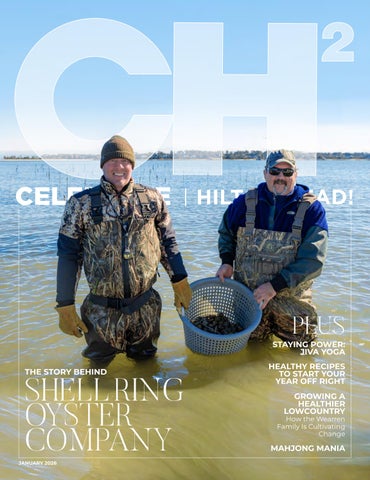
ON THE CH2 COVER Andrew Carmines and Doug Rodgers are photographed at Shell Ring Oyster Farm
JANUARY 2026
JANUARY 2026
SHELL RING OYSTER COMPANY
SHELL RING OYSTER COMPANY
PLUS
GROWING A HEALTHIER LOWCOUNTRY
How the Wearren Family Is Cultivating Change
MAHJONG MANIA BEAUTIQUE MEDICAL AESTHETICS
ON THE CB2 COVER A healthy smoothie from Delisheeyo
112
MAHJONG MANIA
JAN. 2026
EDITOR'S NOTE
GENIUSES AT WORK Vibe Manager Maggie Marie Washo Master of Coin Marion Elizabeth Bowser Rainmaker Kim Conrad Crouch Head Unicorn Wrangler “Just Kandace” Cunningham Collector of Business Cards Morgan Ambler Employee of the Year Jevon Daly Mascot in Training Buoy Conrad Crouch Pritchard The Gatekeepers Greta Von Bowser Vincent Von Bowser Comic Sans Annihilator Catherine Davies Punctuation Prodigy Lynne Cope Hummell Innovation Sherpas Jesse Blanco Courtney Hampson Charlotte Hardwick Heather Hinshelwood Lynne Cope Hummell Barry Kaufman Brooke Peck Alan Perry Cheryl Ricer Larry Toomer Sheila Tucker Lighting Experts Photography by M.Kat Photography by Charlotte Berkley Photography by Nick Morgan Big Foot Photography Photography by Ruben Cosme Photography by Brooke Peck Photography by Lisa Staff Tim Reynolds Find Us Here PO Box 22949 Hilton Head Island, SC 29925 843.816.6247 maggie@ch2cb2magazine.com
I
can’t recall exactly when I heard about Farmer B “Brent” Wearren and the cool things he was teaching the kids at May River Montessori about gardening and nutrition. I filed it away somewhere. A few months ago, when Jevon and I were at Delisheeyo, talking about January content, it reappeared in my consciousness. The January issue is always heavy on health and wellness content so I asked Blake Wearren, owner of the restaurant, for his dad’s number and we put the story in motion. As we were loading pages to the printer, Cheryl Ricer, who wrote the story, sent a text late on a Sunday night. “Have you heard about the Wearren family?” My heart sank – which is honestly an interesting study in itself. When someone leads with that, it’s almost never good. The percentage of times the news is good after a text like that is 10% or less. But, I digress. At this point, most of the Lowcountry knows that someone backed their car into the front of Delisheeyo at 2 a.m. on a Sunday morning, causing damage that made it unclear how long they would have to be closed. As someone who has insight into the food and beverage biz on Hilton Head Island, let me state that you do not want to have to close the week between Christmas and New Years. That’s when your entire revenue for the month of December comes in. But wait, there’s more. Later Sunday morning, as Blake and his wife, Maddie, were dealing with issues
at the restaurant, they got word that their entire house was up in flames. Yes – within the same 8-hour time period. “What should we do?” asked Cheryl. I knew what she meant. You don’t want to run a story about a business that could potentially be closed for the entire month it’s featured in the magazine – but the flip side was what an incredible opportunity to get the word out that this family could use some help. You can find that story on page 50 – and if you are so moved, there are details on how to help them recover from this dual tragedy. It wasn’t my plan to talk about this in my editor’s note, but things don’t always go to plan, do they? So, here’s the bit about what else is in this issue: an in-depth story about a nearby oyster and clam farm; healthy recipes to start your year off right; the birth of Staying Power, a new series about long-standing businesses on the island; a feature about a woman who runs 100 miles routinely just for “funsies”; and a closer look at Mahjong. Happy New Year, my f riends – I’m looking forward to all the new adventures to come in 2026!
MAGGIE WASHO
Publisher / Editor-in-Chief
Instagram - @ch2hhimag Facebook - facebook.com/ch2magazine TikTok - @ch2mag YouTube - youtube.com/celebratehiltonhead
32
JANUARY 2026
CH2CB2MAGAZINE.COM
5 REASONS TO CELEBRATE KANDACE CUNNINGHAM, Sales Executive & Stylist · Photography by Maggie Washo
1
Born and raised in Western New York, Kandace grew up as a Buffalo Bills fan. Every game you’ll see her at RBar, a Buffalo Bills Backer bar in Bluffton, cheering and screaming for her forever team! Let’s Go, Buffalo!
2
Working on a few films and the magazine for almost 13 years, Kandace has learned so much about photography, it’s naturally become one of her favorite hobbies.
3
With her birthday being National Sunglasses Day, June 27, you will always find Kandace wearing a stylish pair of sunglasses.
4
Kandace loves being a dog mom! Dakota (left) just turned 12; she’s the sweetest dog you’ll meet. Rebel, a.k.a. Devil Rebel is their little monster; he will be 2 next month on Valentine’s Day.
5
If there is a fast-food place around, Kandace will find it and be a very happy girl.
CH2CB2MAGAZINE.COM
JANUARY 2026
33
Ar ticl e by Brooke Peck · P h o to g ra p hy by Ma g g ie Wash o
SHELL RING OYSTER COMPANY W
hile most businesses strive to stay afloat, Shell Ring Oyster Company is always under water. L o c a te d i n S k u l l C r e e k between Pinckney Island and Port Royal Sound, the company has based its financial future on being staked to the bottom of the ocean. It is producing briny, fresh oysters that have created a high demand from locals and visitors alike. Known as “aquaculture,” the saltwater farm is licensed through an intertidal lease from the South Carolina Department of Natural Resources. Andrew Carmines is the founder and a co-owner of Shell Ring Oyster Company. Even though Carmines grew up on Hilton Head Island, his introduction to aquaculture started across the country in the Pacific Ocean. After graduating from college, Carmines took an internship in California at the St. Regis and Century Plaza hotels in Century City that eventually turned into a permanent position. On his off days, Carmines spent as much time as possible in the Pacific Ocean, surfing and spearfishing. Near Santa Barbara, he learned about oysters growing in nets in the open ocean waters. These farms were harvesting big, perfect, single select oysters in an area that was not indigenous to growing oysters. “It piqued my interest,” he said. “It was something I noticed that could solve a lot of problems by developing oysters of proper size and shape.” Carmines moved back to Hilton Head in 2006. He began learning the management side of his family’s business, Hudson’s Seafood House on the Docks, which they had purchased in 1975. As he worked to strengthen Hudson’s future, and eventually became its owner, he never stopped thinking about aquaculture entrepreneurship opportunities.
Andrew Carmines and Doug Rodgers are the owners of Shell Ring Oyster Company, an oyster and clam farm next to Pinckney Island
Rodgers and Carmines work to remove a bag of oysters at the company's farm
Carmines, Rodgers, Brooke Peck and Trevor Harden bundled up for a day on the water to visit the farm
The oyster tumbler is used to sort oysters by size and knock off new growth
36
JANUARY 2026
CH2CB2MAGAZINE.COM
CH2's Jevon Daly and Carmines enjoy a sunny day on the farm
The Start of Shell Ring Oyster Company The motivation to start an oyster company started with soft shell crabs. Considered a seafood delicacy by many, soft shell crabs are very popular among Lowcountry diners because the entire crab can be consumed. In 2015, Hudson’s started the impressive effort of harvesting soft shell crabs on-site. That spring, live blue crabs were caught in traps from local waterways and brought to the restaurant. There, they were placed in shallow tubs, covered in salt water, and monitored 24 hours a day, seven days a week. As part of their molting process, crabs shed their hard shell exterior and a few hours later their new soft skin hardens into a larger shell. During the small window of being without a hard shell, the crabs are quickly harvested for consumption. This on-site process allowed the restaurant to serve incredibly fresh soft shell crabs – straight from the ocean. “People were so enamored with being able to see the process and understand it,” Carmines said. “The quality of the product, because we had hands on it from start to finish, was superior to anything I had ever seen at a restaurant before.” The experience and response was a lightbulb moment for Carmines. The tidal creeks of the Lowcountry are lined with wild oysters growing clustered together. However, consumer demand has skyrocketed over the years for single select oysters, which are individually grown and harvested. Unlike a cumbersome cluster of oysters, single selects are easily shucked and eaten on the half shell. Carmine’s goal was to cultivate his own single select oysters from the waterways underneath his restaurant. He headed to Chincoteague Island, Virginia, to learn the process from well-established oyster operations. That is where he met his oyster farm mentor, Mike McGee. “He just took us under his wing and showed us everything that
he could show us in three to four days,” Carmines said. From there, he returned to Hilton Head armed with the knowledge needed to start Shell Ring Oyster Company. The first five years were full of trial and error. “We’d have one year where we did pretty good, where 80% of the oysters that we put out went to full size and we were able to sell them at the restaurant,” he said. “Then we had years where we got completely wiped out.” The worst year was 2016, when Hurricane Matthew completely annihilated their farming efforts in October. Just as they started to rebuild, Tropical Storm Irma hit in 2017, slowing the farm’s progress yet again. A New Partnership In 2020, Carmines met Doug Rodgers, an experienced clam harvester from the Northeast. Rodgers had spent years carefully combing the Long Island Sound to commercially harvest clams. Each week, he delivered clam orders to restaurants in Brooklyn and Manhattan, New York. Early into the New York City COVID-19 shutdown, orders for his fresh clams at local restaurants evaporated overnight. He was forced to pivot to delivering clams to individual homes to keep his business going. Back on Hilton Head, Carmines was overwhelmed with the financial ramifications of COVID-19. Learning to navigate furloughs and trying to figure out how to safely pivot the restaurant’s operations required a lot of attention. He had little time for working at the oyster farm, as keeping Hudson’s afloat was his top priority. Looking for warmer weather and more sunny days, Rodgers and his family packed up and moved to Bluffton. He came to Carmines for advice on how to start his own oyster farm, but quickly learned that bureaucracy, time, and the resources to start a farm would require many years of no income and stress. Business advice from years ago kept popping into Carmines’ mind: “Would you rather have 50% of something or 100% of nothing?” After meeting several times, the two CH2CB2MAGAZINE.COM
JANUARY 2026
37
Carmines hopes to build a larger demand for raw clams from his Hudson's diners
Doug Rodgers loves being on the water and heads up operations for Shell Ring Oyster Co.
men decided to become equal partners in the company. “We really hit it off,” Rodgers said. “That's the biggest thing about having a business partner is someone you get along with really well.” “He came with a whole lot of experience,” Carmines said. “My goal was never to grow a lot of oysters, it was just to have enough for the restaurant. But Doug has every inclination to scale the business, which is wonderful, because I just wouldn’t have the bandwidth to do that.” Plus, Rodgers brought a fresh outlook to the farming process and business. “It’s a no-brainer to try to fix something that was sort of broken, and elevating it to the next level was an easy choice,” Rodgers said. Shell Ring Oysters Accessing a submerged aquaculture farm is a daily challenge. The farm is accessible only by boat at low tide, since the Lowcountry experiences huge tidal shifts every 12 hours. “You’re working against the clock all the time,” Carmines said. Even during low tides, the farm might not be accessible due to various weather-related issues. Storms or strong winds blowing from the Northeast can push water inland and cause low tides to be higher than expected. High waters make the farm inaccessible, which impedes its success. Due to quality water and a large food supply around Hilton Head, the farmed oysters grow quickly most of the 38
JANUARY 2026
CH2CB2MAGAZINE.COM
Shell Ring is producing clams along with oysters. Both are available at Hudson's Seafood House on the Docks. year. Grown in bags, baby seed oysters measure around nine millimeters in diameter but can grow to the size of a quarter in just a week. If not monitored and sorted frequently, the fast-growing oysters can easily burst the bag open and become lost profit. Much of the farm’s physical labor involves sorting oysters by size. Shell Ring’s boat is outfitted with an electric tumbler tube with various sized holes that start small and slowly get larger throughout the tube. Keeping oysters of similar size together is important so that large oysters grouped with smaller oysters don’t jeopardize equal access to the ocean’s food supply. Bags of oysters are removed from the farm’s ocean floor and are dumped in the tumbler. It slowly spins as oysters make their way down the tube. The smallest oysters quickly fall through the tiny holes and are caught in the first bin. Medium sized oysters go a bit farther through the tube and fall into a second bin. The largest oysters that make it through the full gamut are large enough for consumption. Each bin of similar sized oysters is then dumped in its own bag to go back in the ocean to continue growing. With more than half a million oysters growing at any time, the work of sorting never ends. Another benefit of tumbling is to help shape the growth of the oysters. “You have to constantly be tumbling the oysters to knock the new growth off,” Carmines said. “That
CH2's Maggie Washo learns about wild oysters trying to attach themselves to Shell Ring's single select oysters. In the distance, the shadowy oyster cages are barely visible beneath the water. process makes them grow a much harder shell and makes them more uniform in shape and size.” With the vast amount of oysters – and clams – the farm requires attention most days and hard work year-round. Rodgers is tasked with overseeing the farm’s maintenance and he is a perfect fit. “Ever since I was a kid, I was drawn to salt water,” he said. “I always wanted to be near it, on it, or in it. No matter how hard I have to work, I will always be connected to salty water!” Shell Ring Clams Clams were added a few years after the farm started its operation. Grown in mesh bags that are staked to the bottom of the ocean, the clams slowly bury themselves in the sand as they mature. It takes approximately two years for a clam to be large enough for consumption. “Oysters are way more labor intensive than clams,” Rodgers said. Clams need to be sized three times between planting on the farm and serving on a plate. Whereas oysters need only a year to reach maturity, they each require around 10 tumbles between planting and harvesting. “If I had known this back in 2016, I would have planted clams first because they take a little longer to grow than oysters,” Carmines said. Last year, a cownose ray, the sting ray’s bigger cousin, gnawed its way into the company’s clam bags and devoured them. “It chewed them up like Chiclets,” said Carmines. Unfortunately, this wiped out a large clam harvest and was a mess to clean up. Many people are surprised to see raw clams on the menu at Hudson’s. “If you go up to Long Island, clams are almost more popular than oysters up there,” Carmines said. “Down here, I tell people to try the raw clams, and they look at you like you have eight heads.” But that doesn’t slow down Carmines and his love of clams. “Doug thought that I was the biggest hindrance to the clam profits because I eat them a lot,” he said. He hopes that as more people try the clams, a bigger demand for raw clams will follow. Shell Ring’s clam harvest has been so plentiful, that in addition to Hudson’s, the business has been able to sell fresh clams to other local restaurants. Cafe al Dente in Coligny Plaza and Farm in Bluffton are both purchasing Shell Ring clams for their diners to enjoy. Shell Ring’s Future Carmines and Rodgers hope to move the farm operation from the bottom of the ocean to the top by setting up a floating farm in the future. With the current set-up, Shell Ring Oyster Company harvests between 200,000 to 300,000 oysters and approximately 300,000 clams each year. Due to high demand, Shell Ring oysters are only available at Hudson’s for now, but Carmines hopes to expand the farm’s output in the future. “So far, the reviews have been overwhelmingly positive, which is encouraging,” he said. If approved by South Carolina, a pivot to a floating farm would allow access to the operation during all tide levels. “You can be out there for six to eight hours a day,” Carmines said. The change would also allow the company to substantially scale their production capabilities. “We’re super excited about the future,” he said. “It's going to be really exciting and fun when we are able to get up to two to three million oysters a year.” Visit shellringoystercompany.com for more information.
Just another day at the office for Rodgers
Carmines loves offering super fresh clams and oysters to his Hudson's diners all year long.
Jean Rioux is photographed at Jiva Yoga.
Photography by Maggie Washo
Article by Cheryl Ricer
S T AYI NG POW ER: Celebrating the Lowcountry’s Legacy Businesses Introducing a New Series Honoring 2 0 + Ye a r s o f V i s i o n , G r i t & G r o w t h
A
s this magazine celebrates its 20th anniversary in 2026, we’re turning the spotlight on the local legends who’ve been here just as long— the businesses whose resilience, relevance, and roots have shaped the heartbeat of the Lowcountry. Our new year-long series, Staying Power, honors the entrepreneurs and establishments that have weathered economic shifts, cultural change, hurricanes, recessions, growth booms, and everything in between- yet continue to open their doors with purpose, passion, and unmistakable Lowcountry spirit. Kicking off in our January Health & Wellness issue is a business that embodies exactly what this series is about: Jiva Yoga Center, turning 25 in 2026. Founded by husband-and-wife team Jean and Ken Rioux, Jiva has grown from a humble island studio into a community anchor- one that has shaped not only local wellness culture but the lives of thousands who have stepped onto their mats seeking strength, healing, peace, or simply a breath of grounding in a fast-moving world. Over the coming months, Staying Power will take readers behind the scenes of the Lowcountry’s longest-standing businesses- exploring where they began, how they’ve evolved, the challenges they’ve overcome, and the wisdom they’ve gained along the way. These stories are more than business profiles; they are tributes to endurance, authenticity, and the entrepreneurs who define what it means to last. Here’s to the next 20 years- and to those who’ve shown us how it’s done.
S t a y i n g P o w e r : H o w J i v a Yo g a Ce n t e r T u r n e d a P a s s i o n I n t o a 2 5 -Ye a r L e g a c y
W
hen Jean Rioux first unrolled her mat in a dimly lit yoga room in Portland, Oregon, she never imagined that moment would eventually ripple all the way to Hilton Head Island and shape the wellness culture of an entire community. At the time, she was a young lifelong mover – mountain biker, runner, hiker, rock climber – who thought yoga was something she’d “get to later” when she wasn’t so immersed in high-impact activities. “I always knew I would stick with yoga once I wasn’t quite as active,”
Images by Sum Kai Photography
Paddleboard yoga classes. Rioux said. “But back then, I thought yoga was something totally different. I didn’t understand it the way I do now.” That curiosity, combined with timing and a deep love for the Lowcountry, became the seed of Jiva Yoga Center, celebrating its 25th anniversary this year. From West Coast Wellness to a Second-Floor Studio Rioux and her husband and business partner, Ken Rioux, met on Hilton Head Island back in 1987. By 1990, they had set off on an adventure, eventually landing in Portland for four years, where Jean worked at a wellness center that combined chiropractic care, massage, psychotherapy, flotation tanks, hot tubs, and yoga. “It was the classic scene,” Rioux said, smiling. “There was this guy who looked like an iconic Indian guru with a long beard teaching yoga. Very old-school. But even then, I knew there was something powerful happening in that room.” Yoga followed Rioux as she moved through Oregon, San Diego, and Utah, but it was still a side interest – an intriguing complement to the intensity of mountain biking, running, and other outdoor sports. Only when she and Ken moved back to Hilton Head in 2000 did everything begin to coalesce. Back home, Rioux began taking yoga classes at a local gym. “I loved how it made me feel inside and out,” she said. “I was extremely passionate about the benefits I reaped, and I wanted everyone to feel that way.” She enrolled in a yoga teacher training program in Atlanta while simultaneously working as a massage therapist. Her first “studio” was not a studio at all, but a small massage space in the Gallery of Shops near Sea Pines Circle. There, she had a little extra room – just enough to roll out a few mats. “At first, I thought I’d just do some one-on-one yoga with my massage clients,” Rioux said. “Then my friends were like, ‘Let’s do yoga for golfers!’ and I said, ‘OK, let’s try it.’ It built from there, very slowly and very organically.” 42
JANUARY 2026
CH2CB2MAGAZINE.COM
Word spread. Students started telling friends. Classes grew. Soon, that tiny extra room wasn’t enough. “The tenants upstairs were so kind,” Rioux recalled. “They moved to a different part of the building so we could expand. And then we just kept knocking down walls until there were no more walls to knock down.” For nine years, Jiva lived in that second-floor space at the Gallery of Shops. It was not the most visible location. You had to know where you were going to find it. But for those who climbed the stairs and stepped through the door, it was a refuge – warm, welcoming, and transformative. Then, in 2009, Rioux faced a pivotal decision. She had the opportunity to move Jiva to its current location on Highway 278, a more visible, Main Street-style address that would require a leap of faith. “It was a big step,” she said. “Suddenly we were not tucked away upstairs anymore. We were in a place where the community could really see us. It was scary, but it was absolutely the right move.” The space was rebuilt and reshaped to fit Jiva’s needs. Rioux now had space for two yoga rooms, more class offerings, and what would become a thriving retail area. The move signaled a new chapter, not just for Jiva, but for yoga on Hilton Head Island. The Early Days: Manifesting a Dream Like most small businesses, Jiva did not launch full. Classes were sometimes sparse. Some days, no one came at all. “I remember another teacher, Bob, and I would show up for class and nobody would come,” Rioux said. “It hurt my feelings, of course, but we decided we were going to keep practicing anyway. We told ourselves, ‘We’re creating the energy for what we want.’” Looking back, she believes those empty-room practices were critical because it helped to develop a strong sense of purpose and a drive to succeed.
The Mindful Triathalon Team, a joint venture with Al Olivetti at Hilton Head Running Company. “We were manifesting,” she said. “Instead of being defeated, we chose to keep doing the thing. That’s my advice to any business owner: Don’t give up just because the place is empty one day. Keep showing up. Even if there’s one person walking through your door, you give them everything.” That steadfastness of showing up when it wasn’t glamorous, when it wasn’t guaranteed, when it wasn’t easy became part of Jiva’s DNA. Today, Jiva’s community includes students and teachers who have been with the studio for nearly its entire life. Teachers like Vicki Rickard, Rioux’s sister-in-law, came on early and have helped shepherd generations of practitioners. Longtime students like Ann Webster, Hester Hodde, and octogenarian powerhouse Helen Hopkins have been practicing at Jiva since the early days. “They’ve seen everything – the moves, the changes, the evolution of the studio, and the evolution of yoga itself,” Rioux said. At Jiva, community isn’t just a marketing buzzword; it’s a lived reality. Students turn to the studio through seasons of joy and seasons of sorrow, through marriages, births, job changes, diagnoses, surgeries, and loss. Rioux and her team have quietly observed and absorbed it all. “People go through so much,” she said. “In every single situation, our desire is for everyone to feel safe, to feel loved, to feel comforted, and to grow here.” Whether it’s the first time someone walks into a yoga class, the first time they finally relax into savasana, or the first time they find themselves in a posture they never thought possible, Jiva has become a place of discovery. “When you see that ease come over someone’s face, or that spark of ‘I did it!,’ it’s amazing,” Rioux said. “We get to witness that every day.” Growing Up with the Practice One of the reasons Jiva has remained so relevant for
25 years is that it has grown right alongside its students and its founder. “I’ve been in health and fitness since I was about a teenager,” Rioux said. “Dance, gymnastics, outdoor sports – I’ve always navigated life through movement.” As she entered her 50s and 60s, she began to experience what many of her students also face: aging joints, surgeries, recovery, and the reality that the body simply changes over time. “You can’t keep yourself where you were in your 20s or 30s or even 40s,” she said. “The question becomes: Where am I today? What can I do now? Maybe all I can do today is breathe – and that’s OK. The point is to do it consciously.” Following knee replacement surgeries, Rioux even created her own “bed vinyasa,” visualizing movement while lying flat and experimenting with what was safely available to her body in that moment. “That’s what yoga cultivates – self-curiosity, body awareness, and an absence of fear,” she said. “You find that comfortable edge, that place where movement brings joy instead of pressure or performance. That’s how you stay connected to the practice for life.” As Jiva settled into its Hwy. 278 location, the expanded space allowed Rioux to grow the retail side of the business. This was pre-Amazon, pre-click-to-buy-everything, and certainly pre-Lululemon-online or on the island. “There was no online shopping for yoga clothes,” Rioux said. “If you wanted quality yoga wear, you came to us.” But as the world changed, so did Jiva. Online shopping exploded, and Rioux and her husband began asking different questions about what they could offer that fit not just the market, but their lives. “Ken is a surfer, we were rollerbladers, we love all kinds of movement and adventure,” she said. “We started thinking: How can we bring more of that to Hilton Head?” That question led to paddle board rentals, skateboards, CH2CB2MAGAZINE.COM
JANUARY 2026
43
Photography by Maggie Washo
Jiva Yoga Family (from left to right): Helen Hopkins, Connie Cappy, Hester Hodde, Jean Rioux, Vicki Rickard and Ann Webster.
surfboards, skimboards, bodyboards, beach tents, and eventually Onewheel, the electric board one rides like a snowboard. Paddle board yoga became one of Jiva’s signature offerings for more than a decade, merging the studio’s love of movement, nature, and play. Today, Jiva’s retail and rental offerings continue to reflect that spirit of adventure, expanding the brand beyond the studio walls while staying rooted in its core mission: movement, joy, and connection. Another way Rioux brings her passion into the broader community is by co-hosting (with Al Olivetti of Hilton Head Running Company) the annual Mindful Triathlon: Run/Walk + Yoga + Meditate at Coligny Beach. “It’s a community event in the truest sense,” Rioux said. “A 5K run or walk, followed by 45 minutes of yoga and 15 minutes of meditation, all right on the beach.” Jiva has hosted eight of these events so far, with the next Mindful Triathlon planned for spring. The gathering has become a beloved seasonal ritual, drawing residents of all ages who want to move, breathe, and connect in a shared spirit of wellness. For a time, Jiva extended its presence across the island and over the bridge. Responding to feedback that the drive to the south end was “too far,” Rioux opened a north-end location, which operated for five years. Later, the studio launched a location near the Bluffton traffic circle, serving that growing community for another five years. “Those locations were amazing,” Rioux said. “We met so many new students – people who might never have 44
JANUARY 2026
CH2CB2MAGAZINE.COM
made their way to our main studio.” Eventually, though, she noticed something interesting: students were willing to drive across the island to attend their favorite classes, teachers, and times. It became clear that maintaining multiple locations wasn’t necessarily the best way to serve the community – or the business. “We realized people would travel for what they loved,” she said. “So, when the timing was right, we brought it back to one main focus. And I’m really grateful for that. It’s vibrant. It feels exactly like what it’s supposed to be.” Training Teachers, Deepening Roots Over the years, Jiva has become more than a place to take a yoga class; it’s become a training ground for future teachers and serious students. The studio has hosted numerous 200-hour and 300-hour teacher trainings, as well as workshops with respected international instructors. “There’s something for everybody on our schedule,” Rioux said. “Heated, non-heated, different styles, different levels. You can truly live your life through the practice; wherever you are in your journey, there is a place for you.” That inclusive, lifelong approach is one of the reasons Jiva continues to thrive. It’s not a studio only for the young or ultra-flexible. It’s a home for curious beginners, longtime practitioners, and everyone in between. Most recently, Jiva has welcomed an influx of new students through its Hot 26 program, a sequence beloved by many who previously practiced elsewhere on the island. “It has been an honor to offer space for that whole group,” Rioux said. “They bring a fresh wave of energy into the studio.”
To support this growing hot yoga community, Jiva upgraded its hot room with infrared heat panels, which provide deep, therapeutic warmth. “Infrared heat is incredibly healing,” she said. “It’s not just about making the room hot; it’s about helping the body feel supported and nourished in the practice.” Perhaps the most remarkable part of Jiva’s story is how, in building a place where others could grow, Rioux has grown herself – particularly as a leader. “I had no formal training as a leader or manager,” she said. “I just organically navigated my way into this. Finding my voice, setting boundaries, guiding teachers – all of that has been a process.” Her leadership evolution has been supported by Ken’s steady presence and by her own commitment to personal work. “If I do my own work – if I keep growing as a person – then I can lead from that place,” she said. “It’s really that simple.” The Legacy Continues As Jiva approaches the 25-year mark, Rioux is quick to emphasize that staying power isn’t magic. It’s a blend of passion, consistency, community, humility, and a willingness to adapt. Her four points of advice to other business owners, especially those in health and wellness, are both practical and deeply spiritual: • Commit to your craft. “You have to truly believe in what you’re offering,” she said. “It can’t be something you’re only half in on. Your belief is what carries you through the hard days.” • Show up, even when no one else does. “Don’t let an empty room convince you to quit,” she said. “Show up with the energy you want to see, whether there are 20 people or one person.” • Let the work be an extension of who you are. “This isn’t something I turn on at the studio and turn off at home,” she said. “Yoga is my lifestyle. It’s who I am. That authenticity is what people feel.” • Trust that you’re rewarded for consistency. “Whether you call it God or the universe, there is a response to your commitment,” Rioux said. “You always get back what you give.” As the Lowcountry changes, as new trends arrive and old ones fade, Jiva remains grounded in something timeless: Presence. A quarter century after that first little yoga room above the Sea Pines Circle, the studio at 1032 William Hilton Parkway continues to hum with breath, sweat, laughter, and quiet transformation. “It’s still exciting to wake up and come here,” Rioux said. “I love sharing this practice. I love seeing people discover new parts of themselves. I’m eternally grateful to be able to work at what I love and share it with everyone who walks through our doors.” Twenty-five years in, Jiva Yoga Center is not just a business with staying power – it’s a living, breathing example of what can happen when passion, perseverance, and community come together and refuse to quit. And in a year when CH2 celebrates 20 years of telling the Lowcountry’s stories, there’s something beautifully fitting about honoring a place that has spent 25 years helping people write new stories of their own, one breath at a time. CH2CB2MAGAZINE.COM
JANUARY 2026
45
R EC I PE S BY C H A R LOT T E H A R DWI CK
·
PHOTO G RA PHY BY MAG G I E WA SHO
Charlotte Hardwick assembles a warm winter vegetable salad with miso vinaigrette in her kitchen.
J
A
N
U
A
R
Y
A FRESH START W inter is the time to nourish and strengthen the body through warm and hearty foods like animal protein or legumes, nuts, lots of warming spices, root vegetables, and dark leafy greens. Many of my clients love salads, and I do too, but I encourage them to eat their greens a different way than just cold salads. One way is adding warm root
vegetables to a salad; another is adding dark greens to warm soups. During the winter months, it is important to stay warm from the inside out and eat as many warm foods as you can. This keeps the digestive fire consistent and the immune system strong. The way we eat and drink in winter prepares us to be strong and healthy as we go into spring.
This is a delicious and hearty winter salad that can be great for those wanting to eat less meat in the New Year. This salad is inspired by winter vegetables that are here to nourish and keep us well during the colder months. Some of my favorites are butternut squash, beets, and sweet potatoes. It is amazing to me to think that when we want to get more grounded and nourished, we look under the earth and to the beautiful vegetables that drink in the nutrients from the dark rich soil. They are packed with phytonutrients, antioxidants, fiber, and complex carbohydrates. The sweetness of these root vegetables can also satisfy a sweet tooth. FALL SALAD WITH MISO VINAIGRETTE Serves 6 ¾ lb. brussels sprouts ¾ lb. cauliflower or broccoli florets 3 cups butternut squash, or sweet potato, cubed 2 tablespoons extra virgin olive oil 1 tablespoon balsamic vinegar salt and pepper pinch of nutmeg and cinnamon pinch of cayenne 1 cup cooked beans (I like white beans or chickpeas) ½ cup pomegranate seeds (if you can find; they are so pretty) 2 cups arugula or shredded kale Dressing: 1 tablespoon miso (I used chickpea miso) 2 cloves garlic 1 shallot 1 teaspoon maple syrup or honey 2 tablespoons white wine or apple cider vinegar
¼ cup extra virgin olive oil handful of fresh parsley (or add any favorite herbs) Preheat the oven to 400ºF. Cut the brussels sprouts in half and cut the cauliflower or broccoli into similar size pieces. Add both of these and the squash to a large, rimmed baking tray. Drizzle the vegetables with the olive oil, balsamic, salt, pepper, nutmeg, cinnamon, and a few pinches of cayenne, then toss everything together with your hands to coat. Roast for 35 minutes or until edges are browned. While the vegetables roast, make the dressing. Blend the miso, garlic, shallot, maple, vinegar, olive oil, salt, and pepper until well combined. As soon as the vegetables are out of the oven, add the beans onto the tray and toss everything together. Allow them to cool while you make the green salad. Add arugula and/or kale to your salad bowl and lightly coat your greens by drizzling dressing over. Add roasted vegetables and beans over greens. Sprinkle pomegranate seeds and parsley or herbs of choice. You could also sprinkle a little feta or goat cheese on top. Be creative and play with this. You can use any squash or root vegetable you like. It is delicious with delicata squash, acorn squash, and beets. Add as many colors as you can; they are loaded with antioxidants to clear and boost the body. If I have extra brussels sprouts that I am not roasting, I will finely chop or shred them to add to the arugula. I love thinking about the greens that we eat absorbing sunlight as they grow and then filling our bodies
VEGAN ORANGE CACAO TRUFFLES Yield: 65 small truffles This recipe makes a lot of truffles because I like to freeze them and pull some out when I have people over. They are delicious and easy to make. I use them with my clients as the perfect treat to crowd out the sweets that they are reaching for in the afternoons that are leaving them tired and wanting more sugar. These truffles are loaded with magnesium and healthy fats and are super high in antioxidants. Raw cacao is not cocoa like you would use to make hot chocolate. It is raw unprocessed chocolate and is bitter. The dates sweeten these truffles naturally and give the truffles a wonderful consistency. It is citrus season, so I had to add oranges!
with that light. They bathe our cells with chlorophyll and oxygenate our bodies. In turn, they lift our moods and give us energy. The fiber in greens also supports gut micro biome, contains amino acids for protein, supports detoxification, digestion, cleanses the blood, and strengthens our lungs. LEMON LENTIL SOUP WITH LEEKS AND KALE Serves 6 This is a very simple soup that is easy to digest and high in protein. I love that it uses winter citrus and gives a great immune boost. You could also add chickpeas or shredded chicken for more protein. olive oil sea salt and pepper 2 cups sliced leeks, white parts (rinse and save the green for broths/stocks) 1 cup sliced and peeled carrots 1 cup chopped celery 2 cups red lentils, rinsed 2 teaspoons coriander 8 cups water or broth ½ cup chopped parsley 1 tablespoon lemon zest 4 tablespoons fresh-squeezed lemon juice Saute leeks, carrots, and celery in 4 tablespoons of olive oil until soft. Add rinsed lentils, coriander, and salt/pepper. Stir until well coated. Add water or broth. Bring to a boil. Then simmer until for 20-30 minutes until lentils are tender. Stir in parsley, lemon zest, and lemon juice. Taste. Add more salt and pepper if needed. You can finish with a drizzle of olive oil and any fresh herbs you like. I also love it with chopped chives and avocado. of cayenne, then toss everything together with your hands to coat.
48
JANUARY 2026
CH2CB2MAGAZINE.COM
2 cups raw almonds (or you can use almond meal) 1 cup unsweetened shredded coconut 12 dates 1 ½ cup raw cacao powder 1 cup coconut milk ¼ cup cacao nibs 1 tablespoon of orange zest 1 tablespoon of fresh orange juice 1 tablespoon of vanilla pinch of sea salt Blend ingredients in a high-speed blender or food processor until smooth like cookie dough. If your dough isn’t sticking together, you can add an extra date or a little more cacao. If it seems too dry, add a little more coconut milk or orange juice. Refrigerate, then roll into balls. I use a small melon ball scooper but you can use a spoon. Roll into cacao powder, crushed nuts, or shredded coconut and refrigerate. You can refrigerate for a week or freeze. Cover and chill for 2 hours or until firm. Scatter the coconut, crushed nuts, or cacao on a large plate. Scoop up approximately 1 tablespoon of the chocolate mixture and roll it into a smooth ball between your palms, then roll to coat. Repeat with the remaining mixture, then place the truffles in an airtight container and chill before serving.
OLIVE OIL GRANOLA 3 cups rolled oats 1 cup raw pumpkin seeds 1 cup raw sunflower seeds 1 cup unsweetened coconut chips 1 cup raw pecans or walnuts, whole or chopped 1 tsp. kosher salt ½ cup maple syrup ¼ cup olive oil Preheat the oven to 300°F. Line a rimmed baking sheet with parchment paper. In a large bowl, combine the oats, pumpkin seeds, sunflower seeds, coconut chips, nuts, and salt. Stir to mix. Add the olive oil and maple syrup and stir until well combined. Spread the mixture in an even layer on the prepared sheet pan. Bake, stirring every 15 minutes, until the granola is golden brown and toasted, about 45 minutes. Remove the granola from the oven, and season with more salt to taste. Cool completely on a wire rack. If you’d like, stir in some dried cherries. Store in an airtight container. Add any dried fruit and nuts or seeds you like. Here are a few of my favorites: pistachio and dried figs, pecans and dried cherries, walnuts and dried cranberries, almonds and chocolate chips. ABOUT THE AUTHOR: Charlotte Hardwick offers a proven practice built upon her studies with some of the world’s top health and wellness experts at the Integrative Institute of Nutrition in New York. She has a degree in holistic health and teaches cooking and yoga classes. She teaches grace and awareness around health by inspiring her clients to slow down and simply begin where they are. Her restorative and fluid approach makes cooking and yoga accessible to everyone and she recently finished a workbook to inspire people to find practices they love by weaving moments of movement, cooking, breath, peace and joy into their days. You can learn more about Charlotte at her website, www.flowandnourish.com.
Brent “Farmer B” Wearren is photographed in the self-sustaining garden outside of May River Montessori on Calhoun Street in Bluffton.
Article by Cheryl Ricer Photography by M.Kat
If Delisheeyo has a secret ingredient, it’s not hidden in a sauce or smoothie. It grows right outside its front door.
GROWING A HEALTHIER LOWCOUNTRY How the Wearren Family Is Cultivating Change
Soup du jour using vegetables grown in Farmer B's garden, is served daily at Delisheeyo.
O
n Hilton Head Island, where outdoor living and coastal beauty inspire a natural approach to wellness, one local family has quietly and steadily been shaping how the community eats, learns, and thinks about healthy food. Through Delisheeyo, a beloved vegan restaurant at 32 Palmetto Bay Road, and through groundbreaking hands-on education in Bluffton schools, the Wearren family’s influence reaches from toddlers munching sugar snap peas to adults seeking vibrant, nutritious meals. Together, father and son Brent “Farmer B” Wearren and Blake Wearren, owner of Delisheeyo, have created a movement rooted in organic gardening, fresh ingredients, and a belief that healthy eating is a lifelong journey. It’s a story of family legacy, community impact, and the transformative power of food grown with love and intention. When Blake purchased Delisheeyo in 2014, he wasn’t dreaming of reinventing health food. At the time, the small shop – originally opened as a froyo hangout in 2010 – already had a solid menu of wraps, salads, juices, and smoothies crafted by its chef-owner. Blake, then a young
Blake, Millie and Madeline .
Community Call to Action: Standing with the Wearren Family Just before press time, Blake and Maddie Wearren—owners of Delisheeyo on Hilton Head Island and parents to their 8-month-old daughter, Millie—shared devastating news with our team. In a single day, their family experienced two life-altering tragedies. In the early morning hours, a vehicle crashed directly into the front of their restaurant, causing extensive damage that may force Delisheeyo to close during one of the busiest weeks of the year. Just hours later, before they could even process the shock, their home caught fire and was quickly engulfed in flames. While the family is safe, nearly everything they own was lost to fire or smoke damage. The Wearrens now face lost income, rebuilding their home, replacing baby essentials, temporary housing expenses, and supporting their staff during the restaurant’s closure. For years, they have nourished the Lowcountry with intention, generosity, and heart. Now, they humbly ask for that same support in return. To help the Wearren family rebuild, donate here: gofundme.com/f/help-the-wearren-family-rebuild-after-two-devestating-losses manager with a budding interest in nutrition, simply wanted to expand what worked. “I added things like the kale chips, the açaí bowls, the bottled juices to go, and a lot of the snacks,” he said. “But really, I’ve just kept the menu the same with a few additions every few years. It seems to work that way.” His introduction to healthy food came during college while working at Whole Foods, where he was exposed to veganism, food allergies, and the superfoods that would later define Delisheeyo. But, like many in their early 20s, it wasn’t until after graduation, when he settled on Hilton Head and took over the restaurant, that nutrition became central in his life. “You just want to have energy, especially to run a business,” he said. “Part of growing up was taking care of myself. … At this point, I’m still not vegan. I own a vegan restaurant, but I don’t want anyone to think you have to eat a certain way to be healthy. It’s a journey. Everyone feels differently eating different foods. You figure out what works for you.” Now a new father, Blake’s motivations have grown even clearer: “I want to be healthy and around for a long time for my child,” he said. “That’s my new motivation.” Enter Farmer B: The Man Behind the Garden If Delisheeyo has a secret ingredient, it’s not hidden in a sauce or smoothie. It grows right outside its front door. Blake’s father, Brent, known to many as Farmer B, is a horticulturalist by trade and a lifelong organic gardener. 52
JANUARY 2026
CH2CB2MAGAZINE.COM
Originally from Louisville, Kentucky, he spent more than three decades as a wholesale grower before moving to the Lowcountry in 2014. His arrival coincided with a growing concern: He kept hearing about children’s food allergies and the disturbing disconnect between kids and the food they eat. “I told my son, ‘This is pretty serious,’” he recalled. “Kids weren’t aware of where their vegetables were coming from or even what they ate.” After relocating, Brent began teaching workshops on how to grow one’s own food. Soon after, he was offered a part-time role at May River Montessori in Bluffton, an opportunity he initially resisted. But the children, families, and community embraced his work so wholeheartedly that a part-time job soon became a full-time passion. Eight years later, Farmer B has built one of the most respected organic gardening programs in the region. “I teach ages from 18 months all the way up to sixth grade,” he said. “Every classroom has its own garden. They grow five vegetables, they harvest them, and they eat them raw right there in the garden. We don’t take them home. We eat them right where they grow.” Through the school’s Healthy Organic Plant Evolving (HOPE) program, the gardens are self-sustaining. Students sell plants (never produce) to fund the program, learn agricultural business principles in upper grades, and experience the taste of truly living food. “Over 80% of my student base eats raw kale leaves we
Farmer B with one of his students at May River Montessori. A healthy wrap with carrots, avocado, sprouts, beets and tofu.
grow at school,” Brent said. “When you harvest that kale and eat it alive, you’re getting the maximum nutritional value. Kids know the difference.” The Garden at Delisheeyo Takes Root When Brent arrived on Hilton Head, it didn’t take long for him to turn his attention to the small garden outside Blake’s shop. “He’s kind of a perfectionist in the garden – almost a control freak,” Blake said with a laugh. “He couldn’t take how I was taking care of it. So I asked him if he wanted to help.” What began as casual advice quickly blossomed into a full partnership. During a period when Brent took a brief medical leave from work, he approached Blake with an ambitious proposition: “I said, ‘Blake, I’m going to transform this into an edible, sustainable landscape. Are you OK with this? And you’re going to pay for it,’” Brent said. “He said, ‘Sure.’” What followed was three months of intense redesign. Using companion planting techniques, horticultural expertise, and Blake’s vision for fresh, hyper-local ingredients, Farmer B created a thriving organic ecosystem. “We looked at what Delisheeyo uses the most – kale, tomatoes, herbs – and planted based on that,” Brent said. “Kale became a major crop. Cherry tomatoes grow beautifully with basil, so we plant those together. And we add seasonal color so it always looks beautiful.” Today, the Delisheeyo garden produces kale for chips, juices, and salads; tomatoes for sauces and wraps; herbs for soups; cherries and blueberries for customers (especially children) to forage; and seasonal experiments like papaya, guava, pomegranates, and even avocado. “It’s pretty wild,” Blake said. “A lot of what we grow is supplemental, but the kale alone – cases a week once it’s in full season – makes a huge difference. And the kids love coming to forage. That’s where my dad really shines.” A Community Fueled by Freshness Blake is the f irst to credit the “health-oriented community” of Hilton Head and Bluffton for Delisheeyo’s
longevity. “I think it’s a big part of what keeps Delisheeyo going,” he said. “People here are active – they love outdoor activities, and they want to feel good. Over the years I’ve seen a lot of places like us come and go. But our locals are the reason we’ve lasted.” For Brent, the effect is even more visible in Bluffton, where his gardening curriculum has inspired a wave of home growers. “It has gone through that little town like a tsunami,” he said. “Everybody is growing gardens. Everybody is eating healthy. You can see the difference.” During the 2020 lockdowns, Brent didn’t let the connection falter. He sent every family home with a tomato plant, conducted virtual coaching, and facilitated a mass harvest of produce so no child went without fresh vegetables. On weekends, families still gather at the school gardens to help weed, plant, and harvest. “The parents have already bought in,” Brent said. “It spills over to everything they do.” Food as Education, Wellness, and Legacy Both Wearren men see their work as a long-term investment in the health of the Lowcountry. “I can see the tangible results,” Brent said. “If I can get one child to eat a raw vegetable in a year, I’m successful. If I can get someone to switch from processed food to fresh, I’m successful.” Blake sees similar transformations at Delisheeyo. “We have people come to the restaurant with health conditions,” he said. “By consuming and following our lead on adjusting their intake, we’re seeing results. My dad and I – we’re making this area healthier one family at a time.” Their partnership is authentic, unpretentious, and rooted in generational wisdom. Blake grew up watching his father trade vegetables for dairy and asparagus, tend a two-and-a-half-acre garden, and run a roadside stand at his grandmother’s house. He and his siblings didn’t realize until much later how rare and valuable that upbringing was. “We grew everything we consumed,” Brent said. “My kids grew up organically. They didn’t know any different.” Today, that same reverence for real food def ines Delisheeyo’s menu and Farmer B’s curriculum. From toddlers sampling papaya and pink guava to adults sipping green juice pressed from living kale, the Wearrens’ imprint is unmistakable. At the center of their work are two simple principles: 1. Start young. “You don’t have to say much,” Brent said. “You take a vegetable, rinse it, take a bite. They mimic what you do. Start them at 2, and they’ll try anything.” 2. Start local. “I think Delisheeyo works because of the community,” Blake said. “People love the food, but they also love how it makes them feel.” Together, they’re making the Lowcountry not just a beautiful place to live - but a healthier, more connected, more mindful one. As Delisheeyo continues to thrive and as Farmer B’s gardens continue to shape the next generation of eaters, the Wearren family’s impact is just beginning. Their work reflects a rare blend of passion, purpose, and partnership – one that honors the past while cultivating the future. In a region known for its natural bounty, the Wearrens remind us that the foundation of wellness is simple: fresh food, grown with care, shared in community. And sometimes, the greatest changes begin with a single kale leaf, eaten right from the garden. CH2CB2MAGAZINE.COM
JANUARY 2026
53
Photography by Charlotte Berkeley
Dr. Cory Messerschmidt with patient
Special to C2 Magazine
Don’t Let Knee Pain Call the Shots
Keep pickleball knee-f riendly with warm-ups, proper technique
W
hen it first arrived on the scene, the universally appealing sport of pickleball didn’t just sweep the Lowcountry – it swept the nation, attracting millions with its accessibility, lower physical demands and casually competitive gameplay. The call of the court has reached all ages, too, from the young to the young at heart, illustrating that no matter who you are, anyone can play pickleball. While the game is a fun, social way to increase physical activity in your routine without any extensive athletic training needed, the lunging, squatting and quick movements that characterize the sport can be hard on your joints – particularly your knees, and particularly if you already suffer from chronic knee pain or arthritis in the joint.
“Pickleball’s popularity has surged over the last few years, and with good reason. It’s fun, easy to learn and doesn’t require as much athleticism as other sports,” said Dr. Cory A. Messerschmidt, a board-certified orthopedic surgeon with Beaufort Memorial Orthopaedic Specialists, who is also fellowship-trained in sports medicine. “With the right warm-up, strength routine and good technique, most people at any age can enjoy the sport.” Pickleball and Your Knees You don’t have to be a professional athlete to pick up pickleball, but it’s a good idea to talk to your doctor before adding it into your routine. “Pickleball places stress on your knees, requiring rapid direction changes, frequent explosive movements, quick CH2CB2MAGAZINE.COM
JANUARY 2026
55
pivots and lunges,” said Dr. Messerschmidt, “all of which can load the knee joint and result in knee pain without proper preparation.” As a result of these diagonal and side-to-side movements, players can often develop painful conditions such as: - Patellar tendonitis (pain at the front of the knee) - Meniscus tears - Ligament strains - Arthritis flare-ups Over 54 million American adults suffer from arthritis, including osteoarthritis, which can cause chronic knee pain and present a challenge for the afflicted pickleballer. “Pickleball doesn’t cause arthritis, and it doesn’t make it worse, either. In fact, the worst thing for someone with arthritis is inactivity,”
56
JANUARY 2026
CH2CB2MAGAZINE.COM
Dr. Messerschmidt said. “If you have arthritis and play pickleball, just listen to your body. If you experience joint pain, take a break.” Preventing Knee Injuries While pickleball is known for lower physical demands than some other popular athletic pastimes, injuries still can happen – and not just in your knee, but in your shoulders with rotator cuff injuries, as well as your elbows and ankles. “A few key additions to your athletic routine before and after hitting the court can help reduce your risk of knee injury while playing pickleball,” said Dr. Messerschmidt. “A proper warm-up is essential for improving mobility and preparing your joints and muscles to support your knee.” A few warm-up exercises that can get those joints lubricated are: - Marching in place - Mini-lunges, both forward and lateral - Side shuffles - Dynamic leg swings (forward/backward and side-to-side) - Stretches to open your hips, which can improve overall stability “While warming up ahead of gameplay is essential, exercises to build the muscles around the knees can prevent injury in the longer term,” Dr. Messerschmidt said. “These
muscles act as shock absorbers and help control movement on the court.” Some of these exercises to add into your workout routine include: - Mini squats or sit-to-stands for activating your quads - Glute bridges to support hip and knee alignment - Step-ups to build functional strength - Lateral band walks for improved hip stability - Hamstring curls Aim for two to three short strength sessions per week, which can significantly improve joint stability and reduce knee stress, advised Dr. Messerschmidt. Play it Right Pickleball’s appeal rests in its accessibility and easy-tolearn rules, but proper technique and appropriate footwear can make a difference in your knee health as you build your pickleball prowess. Your shoes are your first line of defense against knee pain during play, and while you may be tempted to simply don your regular running or walking shoes, think again. “Running shoes are built for forward motion and don’t offer the right support for pickleball,” Dr. Messerschmidt said. “Wearing shoes that don’t support you properly can increase your risk of injury.” Appropriate shoes for pickleball offer strong lateral support, durable outsoles and enough cushioning – especially if you play the sport on courts made from harder materials. On these harder surfaces, consider rotating your shoes more often, using insoles for shock absorption and seeking out softer alternatives whenever possible. Some of the most common knee injuries stemming from pickleball play are a result of improper technique. Players may overreach, twist, pivot awkwardly or put extra strain on their knees, which can all result in joint pain or injury. To play safely: - Move your feet first, then swing your racquet (instead of twisting your knee to reach for shots) - Bend at the hips and knees together when lunging - Keep your weight centered to maintain balance and minimize the risk of falling - Avoid locking your knees - Use small, controlled steps rather than long reaches Bringing in the Professionals Even with the best form and top-of-the-line equipment, too much pickleball can still strain your knees. Aim to rest at least one day a week and increase your play volume gradually (rather than all at once), paying attention to your joints for any signs of overuse injuries. “Overuse injuries occur when you perform the same movement over and over without giving your body time to recover,” Dr. Messerschmidt explained. “This type of injury can occur in practically any joint or ligament – including your knees, elbow or shoulder.” If you’re noticing knee pain that lasts more than a few days, swelling that doesn’t go down or any sort of locking sensation in your knee, Dr. Messerschmidt advises that it may be time to see a specialist. “Pickleball is fun and rewarding- but it can take a toll on your knees if you’re not careful,” he said. “A little preparationwarming up, wearing the right shoes, building strength, and listening to your body- can keep you moving smoothly and enjoying every match.” CH2CB2MAGAZINE.COM
JANUARY 2026
57
58
JANUARY 2026
CH2CB2MAGAZINE.COM
Architect's rendering of Beaufort Memorial Emergency & Urgent Care, scheduled to open on Hilton Head Island this fall.
GROWING TOGETHER Beaufort Memorial builds for tomorrow, offering expanded access to healthcare South of the Broad
S
outhern Beaufort County is defined by one thing: growth. At the intersection of Bluffton and Buckwalter Parkways, steel beams now rise against the Lowcountry sky – the emerging frame of what will become Bluffton’s f irst hospital in approximately one year’s time. Meanwhile, on the south end of Hilton Head Island, construction is underway on a new combined emergency and urgent care facility, expanding and simplifying immediate care options for residents and visitors alike. “As Beaufort and Jasper counties grow at an unprecedented rate, Beaufort Memorial is growing right alongside it, bringing new facilities, new care models and broader access to healthcare across the Lowcountry,” said Beaufort Memorial President and CEO Russell Baxley. Beaufort and Jasper counties are some of the fastestgrowing regions in South Carolina, and particularly
in Bluffton, Okatie, Hardeeville, and on Hilton Head Island, that growth is easy to see. With the surge of new residents and visitors to the area, an increase in healthcare demand follows. That demand has stretched existing healthcare facilities and increased travel time for thousands of patients. For years, many residents who live south of the Broad River have relied on Beaufort Memorial’s main hospital location in Beaufort for everything from routine diagnostics to emergency care. Currently, around 20% of the Beaufort hospital’s inpatients come from these southern zip codes. At the same time, Hilton Head Island has long dominated as a major tourist destination, but the south end of the Island – where the majority of visitors stay – has lacked access to immediate care options. “The Bluffton Community Hospital will bring comprehensive care to the county’s fastest-growing communities, and our new Beaufort Memorial Emergency & Urgent Care will ensure island residents CH2CB2MAGAZINE.COM
JANUARY 2026
59
Final beam is put into place as Bluffton Community Hospital is officially topped off. The facility is scheduled to welcome its first patients in early 2027. Beaufort Memorial broke ground in November for its new Emergency & Urgent Care facility to be located on the south end of Hilton Head Island. and visitors have timely, high-quality, cost-effective care,” Baxley said. “Together, these projects demonstrate our commitment to expanding access through smart growth and making patientcentered care more convenient across the region.” Building a Hospital for the Future The corner of Bluffton and Buckwalter parkways has visibly transformed as the Bluffton Community Hospital takes shape. The $103 million facility will be Bluffton’s first hospital, allowing Southern Beaufort County residents – who previously traveled to Beaufort for care – to receive the same compassionate, patientfirst treatment closer to home. Once completed, the three-story, 28-bed community hospital will include: • A full-service emergency department • A modern surgery center with surgical and endoscopy suites • A fully equipped cardiac catheterization lab • An acute inpatient nursing unit • Comprehensive imaging services, including 3T MRI, CT, and ultrasound • On-site laboratory services Construction on the facility began in February 2025 and moved along swiftly to the building’s groundbreaking in May. At the beginning of December, the organization held a “topping-off” ceremony to commemorate the completion of the structural framework. Although construction is far from finished, the project remains on track for completion in late 2026, scheduled to see its first patients in early 2027. “This moment would not be possible without the dedication and collaboration of so many – our leadership team, physicians, nurses, staff, architects, construction partners, donors and community members who believed in this project and supported it every step of the way,” said Steve Meyer, chair of the South of Broad Healthcare board of directors. “We still have work to do before we open our doors, but today, we celebrate the progress we’ve made and the bright future that lies ahead of Beaufort Memorial and our community.” A New Care Model for Hilton Head Island Meanwhile, on the southern end of Hilton Head Island, shovels hit the dirt in November with a groundbreaking event for the Beaufort Memorial facility designed to serve both emergency and urgent care needs for Island residents. The Beaufort Memorial Emergency & Urgent Care, a collaboration between Beaufort Memorial, MUSC Health, and Dallas-based Intuitive Health, this innovative model will combine the capabilities of both an ER and urgent care under one roof, with the cost of care based on the level of care needed – and take the guesswork out of the process for patients. Every patient who walks through the doors will be seen by a physician trained in emergency medicine, and if it’s determined that they don’t need emergency-level care, then they’re treated with urgent care services, walking out with a bill to match. The facility will be open 24/7 and equipped with on-site lab equipment and a radiology suite with X-ray and CT scanners and will be one of the first combination facilities of its kind in South Carolina. 60
JANUARY 2026
CH2CB2MAGAZINE.COM
Generosity Shapes the Healthcare Landscape With Beaufort Memorial’s growth – and no plans to slow down anytime soon – the Beaufort Memorial Foundation is harnessing the transformative power of philanthropy to support the nonprofit health system’s vision for increased access to innovative care and a sustainable, thriving workforce. This summer, the Foundation received its largest gift in the nonprofit’s history – an extraordinary $2.5 million donation from Okatie resident Mary McCarthy. Her choice to support the Foundation stemmed from Beaufort Memorial’s commitment to and deep roots within the community. “Beaufort Memorial is a community hospital,” McCarthy said simply. “I am part of this community and leaving it better than when I arrived is what matters to me.” Just a few miles from McCarthy’s home is the emerging Bluffton hospital, and her legacy will shape the landscape of healthcare being delivered in her own community. “This remarkable act of generosity is a defining moment for the Foundation and for the future of healthcare in our region,” said Kim Yawn, Chief Development Off icer for the Beaufort Memorial Foundation. “Gifts like this one stay right here in this community, transforming the way healthcare is delivered right here in Beaufort County, touching our lives for generations to come.”
Beaufort Memorial CEO Russell Baxley
Looking Ahead A growing community means a growing need for critical healthcare. From establishing immediate care options in the sparse healthcare landscape at the south end of Hilton Head Island to creating a hub for patient care in Bluffton with a brand-new hospital, Beaufort Memorial is committed to that mission. In early 2026, another exciting facility milestone is on the horizon: a groundbreaking at the site of LiveWell Terrace by BMH, an affordable workforce housing development in partnership with Woda Cooper Companies, Beaufort County, and the Town of Bluffton, which will provide 120 affordable housing units for healthcare workers and other qualified renters – less than a mile away from the new hospital. As Beaufort Memorial expands with facilities such as the Bluffton hospital and the ER and urgent care on Hilton Head Island, hiring and retaining employees play a critical role in the health system’s mission. The lack of affordable housing for healthcare workers drove the project, Baxley said, and the groundbreaking will be another exciting milestone in the organization’s growth. “More patients in Southern Beaufort County are choosing Beaufort Memorial as their provider of choice,” Baxley said. “As they make the trip to Beaufort for care, it’s our responsibility as their community health system to meet them where they are. These projects bring our services closer to home, and that’s exactly what our patients deserve.” CH2CB2MAGAZINE.COM
JANUARY 2026
61
C
H
2
/
C
B
2
P
R
E
S
E
N
T
S
MEET THE DOCTORS
Maurizio Buscarini M.D., Ph.D., MPH-MBA
Beaufort Memorial Urology Specialists 1055 Ribaut Road, Beaufort 122 Okatie Center Blvd. North, Okatie (843) 524-7607 BeaufortMemorial.org/MaurizioBuscariniMD
What is your specialty? I’m a board-certified urologist who is also fellowshiptrained in robotic surgery, endourology and laparoscopy. I specialize in urologic oncology, reconstructive urology and stone treatment, with about 90% of my work centered on treating urological cancers. Why did you become a physician? Being a physician has been a dream of mine ever since I was a young boy. My mom had breast cancer, and I remember thinking it was incredible that one day you can be sick and dying, and the next day you’re recovering and can live a normal life. I wanted to be able to do that for people. What is exciting about your field right now? Urology is evolving rapidly. New robotic systems, including single-incision technology, are making it possible to perform complex cancer surgeries with just one small cut. This shift means patients often go home the same day instead of staying in the hospital for days. In prostate cancer, we can now target only the cancerous lesions rather than removing the entire gland, preserving healthy tissue and minimizing side effects. Artif icial intelligence is also starting to play a role in both research and clinical practice, opening new possibilities for patient care. What advice would you give someone who just started their career? For those pursuing a career in medicine, my advice is to focus on the patient first and foremost. We are physicians
before we’re surgeons. Also, maintain your skills and keep them up-to-date. Our field changes so rapidly that if you’re doing the same thing that you were doing five years ago, you’re probably doing something wrong. It’s exciting to be a part of a field that advances so quickly, but it can also be a challenge. What are your hobbies and interests outside of work? I have been volunteering with Doctors Without Borders for the last 25 years and have completed over 50 medical missions with the organization — with another one planned for the Middle East this spring. Outside of medicine, I enjoy sailing and fishing, and hope to be able to do both now that I live here in the Lowcountry! What are you watching on Netflix these days? I don’t watch TV – I don’t even own one. I’m an avid reader and am currently enjoying “Outlive” by Robert Attia and John Grisham’s latest, “The Widow.” And I’m currently writing a medical fiction mystery thriller! What skill or craft would you like to master outside of your profession? Mid-career, I pursued a master's degree in business administration, which keeps me up to date with business literature, management and leadership – all things that you don’t learn about in medical school. We come out of medical school with very little knowledge of how the world works or the economy shapes the healthcare industry, so I want to continue pursuing that. When you have 30 minutes of free time, how do you pass the time? I meditate every morning for 30 minutes, and I practice mindfulness and prayer as well. I also try to go to the gym and exercise – I hate it, but it’s what my internist wants me to do!
CH2CB2MAGAZINE.COM
JANUARY 2026
63
Dr. Ravina Balchandani Heart Associate of Hilton Head, LLC Hilton Head Island 35 Hospital Center Commons, Suite 101 Bluffton 14 Westbury Park, Suite 103 (843) 682-HOPE (4673) heartassociateofhiltonhead.com
You Feel Healthy, But Are You Protected? Advertorial by Dr. Ravina Balchandani
I
f this is your first time “meeting” me, here’s what you should know: • I am an interventional cardiologist, and I’ve been practicing here in the Lowcountry for the past 17 years. In all that time, I’ve become the doctor who won’t stop talking about prevention. • I’ve been saying “prevention is better than the cure” my entire career – and I know how easy that phrase is to gloss over. It sounds responsible. Sensible. Slightly boring. But I don’t say it because it’s a slogan. I say it because I’ve seen what happens when we ignore it. I would shout this from the mountaintops if Hilton Head Island had any – instead, I’ll say it here. Most people who land in a cardiac catheterization lab never thought they would be there. They exercised. They ate “pretty well.” Many had been told their labs were “fine.” Almost all of them say the same thing afterward: “I thought I was healthy.” As a cardiologist, I don’t just treat heart attacks. I see what comes before them – often years before. Cardiovascular disease develops quietly while people are doing everything they believe counts as taking care of themselves. That’s why preventative cardiology matters. Primary prevention should include cardiology, not just after something goes wrong, but while you still feel well. Today, we have tools that go far beyond a basic cholesterol 64
JANUARY 2026
CH2CB2MAGAZINE.COM
panel. Advanced lipid testing, inflammatory markers, genetic risk, and family history tell a much fuller story. Two people can look identical on paper and have very different levels of risk. I think of a patient I’ve cared for over many years – now in her late 70s, active, and deeply engaged in her health. Her family history is striking: Her parents, grandparents, and close relatives who all suffered significant cardiac events. Genetically, her risk could not have been stronger. Together, we focused on what could be influenced. We tracked her labs consistently, addressed her genetic risk directly, refined her nutrition, corrected deficiencies, and adjusted her plan as new data and treatments became available. Over time, her numbers improved, her risk profile changed, and she gained clarity about how to care for her heart – despite the family history she carries. Genetics matter, but they are not destiny. Prevention also doesn’t stop after a cardiac event. Secondary prevention – the work done after someone has already had a heart attack, stent, or procedure – is just as important, and it is never too late to start. Thoughtful cardiology care at this stage can dramatically reduce the risk of future events and help people live longer, fuller lives. Prevention isn’t just about avoiding a first event; it’s about shaping the trajectory of health over time. When we intervene intentionally, we’re not only protecting the heart, but supporting the entire vascular system that feeds the brain, kidneys, and the rest of the body. Good cardiac prevention is foundational medicine: It influences how we think, how we age, and how long we maintain independence and quality of life. If you’re in your 30s or 40s, now is the time to establish a baseline. If you’re older – even if you’ve already had a cardiac event – it’s never too late to refine your strategy. Feeling healthy is a good place to start. Knowing your heart is protected is the point.
J. Eric Turner, M.D. Beaufort Memorial Oncology Specialists Beaufort Medical Plaza, Suite 310 989 Ribaut Road, Beaufort (843) 522-7350 BeaufortMemorial.org/EricTurnerMD
What is your specialty? My specialty is medical oncology and hematology – I take care of patients with all types of cancer, as well as benign blood problems and blood disorders. Why did you become a physician? Both of my parents were cancer survivors, and so when I was growing up, I spent a lot of time around the healthcare profession. That piqued my interest, and I began a career in cancer research, which solidified my desire to go back to school to become a physician. What is one aspect of the job that you find particularly rewarding? Helping patients navigate what is undoubtedly one of the hardest points in their life after being diagnosed with cancer. There are lots of moving parts to cancer treatment and working with staff to make that journey as seamless as possible is what I find most rewarding. Are there any challenges in the profession? What are they and how do you overcome them? One of the biggest challenges in my profession is helping patients overcome barriers to care- whether it’s transportation, financial assistance, or navigating insurance. Thankfully, Beaufort Memorial has an outstanding team of nurses and social workers who go above and beyond to support patients. What is exciting about your field right now? It’s exciting to see the changes that have come about in cancer treatments in the last decade or so. Advances in chemotherapy, immunotherapy, and targeted drugs have revolutionized care - helping patients live longer with a better quality of life. What advice would you give someone who just started their career? For anyone pursuing a career in medicine, my advice is simple: treat every patient as you’d want your own family treated- with respect, hope, and compassion. Whether they’re facing a curable condition or a complex, incurable disease, this approach builds trust and ensures patients feel valued. In the long run, it not only improves their experience but also brings you greater fulfillment and satisfaction in your work. “If I wasn’t a doctor, I’d be…” Before an injury sidelined me in high school, I wanted to pursue a career in professional baseball! But I did think briefly about teaching before I went to medical school. I could see myself as a science or math teacher who also coaches high school baseball. What skill or craft would you like to master outside of your profession? I really want to learn how to play the guitar! It’s been a lifelong goal that I’ve never pursued in any serious fashion. What are your hobbies and interests outside medicine?
I enjoy playing golf and tennis. I also have been around the automotive industry for my entire life, so I’m into classic cars, going to car shows and working on my own classic cars. I also am a sports fan and love sporting events, particularly college basketball and football! What are you watching on Netflix these days? I’m watching “Full Swing,” which is a sort of documentary series that follows the life of various professional golfers. When I’m watching TV, I’m probably either watching that or a sporting event. When you have 30 minutes of free time, how do you pass the time? I love listening to music to decompress. My favorite genres are probably country and classic rock. It helps me clear my mind.
CH2CB2MAGAZINE.COM
JANUARY 2026
65
Optical Solutions Team Optical Solutions Hospital Center Commons 10 Hospital Center Commons, Suite 100 (843) 681-6682 Shelter Cove 50 Shelter Cove Lane, Suite G (843) 785-8008 Bluffton 109 Persimmon Street (843) 706-0607 dr.michaelcampbell.com
W
hen Dr. Michael Campbell Sr. opened his first Optical Solutions office in the Plaza at Shelter Cove in 1987, he wasn’t just creating a business. He was pouring the foundations for a legacy. Now 40 years later, as he prepares for retirement, he does so knowing that the future of the company is in the very capable hands of his sons, Dr. Kevin Campbell and Dr. Michael Campbell Jr. However, “retirement” might be a strong word. “His version of retirement is just working one less day a week,” Michael Jr. said. “But he’s definitely taking more time to be with the grandchildren and live a little.” The brothers have been operating the practice for three years now, bringing in the most advanced technology and practice modalities to create a more comprehensive eye exam and accurate disease treatment. Now that the official passage to the next generation was finalized, the Campbell brothers are finding new ways to build on Optical Solutions’ renowned reputation for cutting-edge techniques partnered with strong customer care. As one example, Kevin expanded the capabilities of the practice by adding a dry eye clinic that leverages the latest treatments to help patients avoid daily eye drops. “Dad laid such a great foundation of how to run an optometric practice focused on customer satisfaction, and Michael and I have continued that,” Kevin said. “But with both of us having graduated more recently, we were exposed to new techniques 66
JANUARY 2026
CH2CB2MAGAZINE.COM
and technologies that we’ve been able to bring into the practice to take it to the next level.” The brothers split their time between the three locations of the practice – Plaza at Shelter Cove, Hospital Center Commons, and in Old Town Bluffton, leaving them just one day a week where they’re in the same location. But the partnership between them runs 24/7. “We’re constantly calling each other and checking up on things. Luckily, we have a very good relationship inside and outside of work,” Kevin said. “With having a family of doctors, including two other associate doctors, the patients at Optical Solutions get a team of eyecare providers that is unmatched.” The two associate doctors are Dr. Jessica Sirak and Dr. Megan Cope. Dr. Sirak has been with Optical Solutions for three years and is seeing patients five days per week in the Bluffton location. The newest addition to the family is Dr. Cope. She moved down from Boston in May 2024 and began at Optical Solutions in July 2025. Dr. Cope has been practicing optometry for 20 years and is excited to bring her skills and compassionate care to the Lowcountry. “I have enjoyed being closer to family and do not miss the snow in Boston,” she said. “It has been great developing new relationships with patients down here and I look forward to developing many more.” This year is going to be a big one for the Optical Solutions Team. With the growth of the Bluffton area, they will be transitioning into a 10,000-square-foot, state of the art office on Bluffton Parkway. Just a mile down the road from the original Bluffton office, the doctors and team of Bluffton will be providing advanced eye care in this larger space. “It has been amazing to see the growth of Bluffton in the past five years. Although we have loved the quaint feel of the current Bluffton office, this larger space will allow us to give better care to our patients and meet the demand of the Lowcountry growth,” Kevin said. The new address is 109 Persimmon Street on Bluffton Parkway and appointments will be available starting in February. “Education is such an important factor when it comes to the eye exam, and our ability to educate patients about their eye diagnosis allows us to work as a team and keep their eyes as healthy as possible,” Kevin said. “My dad has laid down a foundation that we will continue for another 40 years.”
Dr. George Sutherland Jr. Optim Orthopedics 8201 Pinellas Dr, Bluffton (843) 705-9401 optimorthopedics.com/george-sutherland-jr-md
G
eorge Sutherland, MD is a sports medicine specialist with over 16 years of experience in the medical field. Hailing from Richmond, Virginia, he graduated with honors from Eastern Virginia Medical School. After graduation, he completed a residency in orthopedic surgery at LSU Medical Center in Shreveport, Louisiana. Dr. Sutherland received his fellowship training from the Hughston Sports Medicine Clinic in Columbus, Ga. He is trained to treat and identify all forms of injury to your musculoskeletal system including the bones, ligaments, tendons, muscles, and joints. After making a diagnosis, Dr. Sutherland will resort to surgery when all other treatment options have already been exhausted or ruled out. His
expertise in performing shoulder and knee reconstruction is unsurpassed and constantly keeps up to date with the latest advancements in medical-technology and treatments. "In my practice, I cover a lot of sports medicine injuries with a lot of shoulder & knee injuries but my training lends to the entire musculoskeletal system. Which is to say, I have a lot experience in an array of different areas," Sutherland said. This cross-training between trauma and sports injuries has given him a uniquely well-rounded perspective. Patients might need the attention from Dr. Sutherland for torn ligaments, fractures, sprains, and more. Dr. Sutherland performs surgery at Coastal Carolina Hospital in Hedeeville S.C., Hilton Head Hospital on Hilton Head Island, S.C., and Doctors Hospital of Tattnall in Reidsville, Ga. He performs outpatient surgery at Optim Orthopedic Center in Savannah, Ga. He is currently seeing new patients at the Bluffton clinic on Buckwalter Pwky.
CH2CB2MAGAZINE.COM
JANUARY 2026
67
68
JANUARY 2026
CH2CB2MAGAZINE.COM
P R
O V I
D
E
D
B Y
N
O V A
N
T
H
E
A
L T
H
Alexis Almeida, MD, graduated from Bluffton High School and knew she wanted to return to the Lowcountry.
‘I always knew I’d come back’ Bluffton High School grad returns home as primary care physician
B
luffton has changed dramatically over the past decade, growing f rom a quiet coastal town into one of South Carolina’s fastest-expanding communities. With so many new residents moving in each year, the need for more primary care doctors is also growing. That’s one reason Alexis Almeida, MD decided it was time to come home.
The Bluffton High School graduate has joined Novant Health Arley Way Primary Care, one of eight new primary care providers recently hired by Novant Health in the Lowcountry as part of a regional expansion to increase access to family medicine. “I always knew I’d come back to Bluffton,” Almeida said. “Even when I was away for school or residency, I stayed plugged in. This is home.” CH2CB2MAGAZINE.COM
JANUARY 2026
69
Almeida’s extensive training exposed her to full-scope care – inpatient, outpatient, and even obstetrics, and taught her the value of long-term relationships with patients. Born in New Jersey while her father completed his medical residency, Almeida spent her early years in Baltimore before her family relocated to Bluffton when she was 14. The move came with slight cultural adjustments. “I remember someone saying hello to me in a grocery store and I panicked – stranger danger!” she said, laughing. “Then I realized, oh wait … that’s that Southern charm people talk about!” Almeida quickly found her place in the community, joining service clubs such as Rotary and Interact in high school, volunteering for health-related causes, and staying active in town events. She left for the University of South Carolina – a proud Gamecock – then earned her medical degree at St. George’s University in Grenada before completing her residency at the University of South Carolina School of Medicine – Greenville, with a Seneca Family Medicine Residency. That opportunity allowed her to learn more about rural medicine, too.
70
JANUARY 2026
CH2CB2MAGAZINE.COM
Alexis Almeida with her grandfather, a cardiothoracic surgeon. The power of primary care Almeida’s extensive training exposed her to fullscope care – inpatient, outpatient, and even obstetrics, and taught her the value of long-term relationships with patients. “When you see someone regularly over time, you notice things that a one-time visit could miss,” she said. “Continuity is powerful. Preventative care can help prevent or manage illnesses before they become emergencies.” Bluffton might be booming, but Almeida says its heart hasn’t changed. “There’s still this small-town spirit. People look out for each other,” she said. Since moving back in July, she’s already run into familiar faces – a contractor who remembered her from the school bus stop, a family friend now working in real estate, even former classmates now raising children of their own. “That’s the special part of practicing medicine in your hometown,” she said. “These aren’t just patients; they’re my neighbors.” Almeida says Novant Health’s investment in both urgent care and primary care has helped smooth the path for patients who might have gone years without a dedicated physician. Many in the community, she notes, rely on urgent care simply because it’s accessible. “Urgent care is a great resource, and we also want patients to have a long-term primary care home to help them stay healthy and manage acute and chronic conditions,” she said. “Research shows people with a consistent doctor are significantly less likely to need Emergency Department visits.” Almeida sees her role – and Novant’s broader expansion – as building that bridge. “Whether someone is new to the area or has lived here their whole life, they deserve consistent, preventative care,” she said. “Our clinic gives them a place to call home for their health.” Dr. Alexis Almeida is now accepting patients at Novant Health Arley Way Primary Care in Bluffton. “It feels good to say I’m not just visiting … I’m here to stay.” Appointments are available online or by calling Novant Health’s new primary care patient navigator at 843-471-1239.
72
JANUARY 2026
CH2CB2MAGAZINE.COM
Dr. Addison Wilson Jr.
Article by Carter Mello
FROM THE NAVY TO THE LOWCOUNTRY: Dr. Addison Wilson’s lifelong mission to serve
W
hen Dr. Addison Wilson Jr. earned his first aid merit badge as a young Boy Scout, he had no idea it would chart the course of his life. “I really liked learning about treating health problems,” he said. That early spark would carry him through challenges far greater than he could have imagined, and ultimately to a lifelong mission of service through medicine. In high school, Wilson was drawn to both the discipline and camaraderie of the military. “I was very impressed with
the Naval Academy. The combination of athletics and academics made me want to join,” he said. But before that dream could take shape, life delivered a profound test. At 17, Wilson was diagnosed with thyroid cancer. What could have been a devastating setback instead became a turning point. “Cancer can be a terrible diagnosis, but in my case, it changed my life for the better,” he said. “I experienced firsthand the impact doctors and nurses had in my life, and ever since then I’ve wanted to give back in a CH2CB2MAGAZINE.COM
JANUARY 2026
73
similar fashion, hoping to change others’ lives for the better.” Once he was declared cancer-free in 1997, Wilson said he was determined to pay forward the care he had received. That determination carried him to the U.S. Naval Academy, where he majored in chemistry and fully embraced campus life, walking onto the baseball team as a freshman and later playing rugby for three years. He proudly served as
74
JANUARY 2026
CH2CB2MAGAZINE.COM
one of the handlers of Bill the Goat, the academy’s mascot, during football games. After graduating in 2001, Wilson pursued his medical career at the Uniformed Services University of the Health Sciences in Bethesda, Maryland, completing medical school in 2005.
Dr. Wilson's military experience taught him lessons about teamwork and preparation that now guide his work as an orthopedic surgeon with Novant Health Orthopedics and Sports Medicine – Beaufort. His early Navy medical career took him both underwater and overseas. He served as a diving medical officer in Virginia Beach, Virginia, from 2007 to 2009, including a deployment to Iraq. From there, he pursued orthopedic surgery training in Portsmouth, Virginia – work that prepared him for the many ways he would support service members through injury, recovery, and resilience. Early in his career, Wilson had the privilege of caring for military retirees, including World War II veterans whose stories left an indelible mark on him. “One patient in particular was a survivor of Pearl Harbor,” Wilson said. “Over time I saw fewer and fewer of them as they passed on. Time is precious, and I have a deep appreciation for those who came before me securing the freedom we have today. I think of that Pearl Harbor survivor and others like him often.” In his later years of service, Wilson provided care to Marines and recruits at Parris Island in the Lowcountry. “I’ve been fortunate to take care of America’s best,” he said. “Most of my patients were young and healthy – 18 to 40 years old – and deeply motivated to recover and return to duty.” He retired from the military in May 2025 and joined Novant Health. His military experience taught him lessons about teamwork and preparation that now guide his work as an orthopedic surgeon with Novant Health Orthopedics and Sports Medicine – Beaufort. “Serving in the military showed me the importance of investing in people,” Wilson said. “I was blessed to have so many amazing surgeons invest in me over the years. The Navy gave me incredible opportunities to learn, sending me to Boston to study joint replacement surgery and to Tampa to train under some of the best trauma surgeons in the world.” Wilson brings that same mindset to his patients today. “Teamwork and clear communication are crucial for success,” he said, quoting a phrase he still carries from his military days: “Proper preparation prevents poor performance.” While the pace of civilian medicine is different, his personal mission hasn’t changed: to help people recover, stay active and return to the lives they love. “I’m a strong believer in physical therapy before and after surgery to help maintain range of motion and strength,” Wilson said. “The Lowcountry is blessed with some of the best physical therapists anywhere I’ve ever lived.” For Wilson and his family, putting down roots in Beaufort felt like coming home, in more ways than one. “Novant Health offered me the chance to remain in Beaufort. My family and I feel at home here,” he said. “My great-grandmother was born in Beaufort in the 1890s.” When he’s not in the operating room, Wilson f inds inspiration in his faith, family, and travel. “My faith in Jesus Christ is what keeps me grounded. I’m a small piece in a much bigger puzzle,” he said. “Spending time with family and traveling helps me recharge. We were privileged to live in Italy for three years with the Navy, and we love learning languages and trying food all over the world.” Wilson’s story is a reminder that service takes many forms, and that the same dedication that heals a soldier’s injury can also restore a neighbor’s stride. “I’ve had the privilege to serve my country and now to serve this community,” he said. “That’s what keeps me going, knowing I can make a difference, one patient at a time.” CH2CB2MAGAZINE.COM
JANUARY 2026
75
Cole Holloway and Rob Vaughn
A r t i cl e by B a rr y Kauf m an
.
P h o to g rap hy by M.Kat
YOUR NEW HOMETOWN PHARMACY Hilton Head Pharmacy isn’t new, it’s just new to you
A
s long as there has been a bridge, a friendly sort of rivalry has existed between Hilton Head Island and Bluffton. Some islanders hesitate to cross that bridge into “Bluffghanistan” unless there’s something they need that can be procured only at one of the big box stores on the mainland. Likewise, Bluffton went and built an entire parkway just to be able to get around without accidentally getting swept up in the endless parade of tourists heading onto the island. And while our high school football teams square off on the field, the people of both towns will begrudgingly point out the beauty of both. Those of us who live in Bluffton may bristle at tourist traffic, but we’ll also throw a fit when we are asked to pay to visit some of our favorite beaches. Because we get what brings those tourists to the island – it’s one of the most beautiful places on earth. Likewise, those of us who live on Hilton Head must eventually admit that behind those big box stores is a place where the genuine spirit of a small town thrives. Because that is ultimately Bluffton’s greatest strength. It might not be a Conde Nastrecognized tourist destination, but it is a place where everyone still knows everyone else’s name and asks how their mama is doing. If you need any evidence, you need only visit Bluffton Pharmacy. “We know everyone by name. You’re meeting with a pharmacist who knows you,” said Bluffton Pharmacy owner Rob Vaughn. “When you call, you’re not waiting on hold. It’s one of us who answers the phone. We build those relationships all day long.” A stunning contrast to the sterile corporate coldness of a CVS or a Walgreen’s, Bluffton Pharmacy has always been that welcoming throwback to a time when the word “care” played a larger role in health care. It’s been that place where you know you’re going to get all the
The exterior of Hilton Head Pharmacy, located on Park Lane accross from the former site of Nick's Steak & Seafood.
Adding to that atmosphere of a familiar hometown drugstore backed by decades of expertise, the new location on Park Lane brings a host of state-ofthe-art upgrades to Vaughn’s family of pharmacies going back to 1988.
answers you need about the medications you’re taking, underscored by a wealth of knowledge and services like compounding and personalized recommendations. It’s the small-town charm of Bluffton, encapsulated in a single storefront. And now, that charm is casting its spell on Hilton Head Island. With the opening of Hilton Head Pharmacy, Vaughn is taking that same personalized service that made Bluffton Pharmacy an institution and using it to give folks on the south end and mid-island an alternative to corporate order filling. “I want to make it a place where we’re not filling a million prescriptions like the big box stores do. I want to offer that same experience to Hilton Head that we do for Bluffton, where we know everyone who walks in the door and they know us,” he said. “Here, we want patients to be able to come in, have access to their pharmacist and be able to ask the questions they need answered. That’s important, and you don’t always get that at a CVS or a Walgreen’s.” Of course, as much as Bluffton typifies the small-town experience, Hilton Head Island has its own culture as a 78
JANUARY 2026
CH2CB2MAGAZINE.COM
community. Your neighbors might live behind a different gate than you do, but it’s still a small town and familiar faces are part of that. In opening Hilton Head Pharmacy, Vaughn reached out to one of the island’s most familiar faces, pharmacist Cole Holloway. “Cole has worked on the island for about 15 years now, and he knows everybody. Plus, a lot of people know him, including the prescribers,” Vaughn said. “He’s going to be a familiar face for a lot of people.” But Holloway is much more than just a familiar face. With the New Year bringing changes to insurance regulations, his expertise will be massively important to patients at Hilton Head Pharmacy. “There are going to be a lot of new insurance questions, and Cole is a master at that. He knows every plan and what’s going to be best for that particular patient,” Vaughn said. “Plus, he’s just a wealth of information about prescriptions or medical questions.” Adding to that atmosphere of a familiar hometown drugstore backed by decades of expertise, the new location
Hilton Head Pharmacy has a USP 800 compounding chamber, allowing the team to compound your medications safely and effectively, giving you a tremendous option for personalizing your drugs. on Park Lane brings a host of state-ofthe-art upgrades to Vaughn’s family of pharmacies going back to 1988. First up is a USP 800 compounding chamber, allowing Hilton Head Pharmacy to compound your medications safely and effectively, giving you a tremendous option for personalizing your drugs. With a little bit more room than the Bluffton location, the new Hilton Head store has a pair of office spaces that Vaughn hopes to fill with prescribers for a one-stop shop. “We are looking to add a prescribing entity, whether an MD or a nurse practitioner, so you can meet with somebody if you’re not feeling well,” Vaughn said. Stay tuned as those plans develop. In the meantime, you can stop by your new hometown pharmacy, have your prescriptions f illed by some of the most experienced pharmacists in the Lowcountry, and sample a little bit of the small-town attention that sets Hilton Head Pharmacy apart. “Bluffton Pharmacy has been around since 1988 and has become a huge part of the community,” Vaughn said. “We want to bring that same feeling over here to give the people of Hilton Head an opportunity to get away from the big box stores.” Hilton Head Pharmacy is located at 5 Park Lane. Call them at 843-802-0215 or visit hhipharmacy.com. CH2CB2MAGAZINE.COM
JANUARY 2026
79
ART ICLE
BY
H E ATH E R
H IN S H E LWO O D,
MD
Healthspan, Not Just Lifespan:
M
How to Ad d Good Years to Your Life
ost people say they want to “live longer,” but what they truly want is to feel good for as many years as possible. That’s healthspan – the years you’re strong, clear-minded, energetic, and independent, free from major disease or disability. Lifespan is how long you live; healthspan is how well you live. In the United States, the average person now spends nearly 10 years in poor health at the end of life. Many of those years are limited by heart disease, diabetes, arthritis, frailty, and cognitive decline. Half of Americans who reach 65 will
need nursing home level care. Our goal for 2026 shouldn’t be adding years but expanding the years of vitality and shrinking the years of illness. January brings extreme diets and quick fixes. They might help for a few weeks, but they don’t shape how you’ll feel decades from now. What determines your healthspan are steady habits you can maintain. Studies of long-lived populations show the same pillars: Regular activity, strong muscles, metabolic health, quality sleep, emotional resilience, meaningful relationships, and constant learning. Build CH2CB2MAGAZINE.COM
JANUARY 2026
81
This year, shift your question from “How do I live longer?” to “How do I stay strong, clear, and capable for as many years as possible?” Healthspan isn’t about rigid rules. It’s about smart, sustainable choices that compound over time. resolutions around these, not a number on the scale. Discipline 1: Longevity Begins with Musculoskeletal Fitness Movement is the most powerful “medicine” we have for extending healthspan. Regular exercise lowers the risk of heart disease, diabetes, cancer, depression, and cognitive decline. Even people already managing chronic illness improve with strength training. A balanced week includes: • Aerobic exercise (1-2 days/week): Walking, cycling, swimming, rowing • Strength training (2-3 days/week): Key for muscle, bone, and joint stability; focus on squats, hinges, pushes, pulls, carries • Balance and mobility (1-2 days/week): Yoga, Pilates, mobility work Consistency matters most. Choose activities you enjoy so movement becomes part of your life. Muscle is one of the strongest predictors of healthy aging. After 30, adults lose muscle each decade, and the decline accelerates with age. Low muscle mass and weak grip strength are tied to falls, disability, hospitalization, and loss of independence. Strong muscles help regulate blood sugar, protect joints, and support posture. Shift your goal from “weight loss” to “muscle gain and strength.” Simple strategies include: • Strength train at least twice per week • Eat adequate protein throughout the day • Track functional markers like getting off the floor easily, walking faster, or carrying heavier items This is especially important for women, who experience accelerated bone and muscle loss during menopause. Discipline 2: Protect Your Metabolic Health Metabolic health – your body’s ability to manage blood sugar, blood pressure, cholesterol, and inflammation – is a major driver of healthspan. Poor metabolic health fuels many chronic diseases that shorten healthy years, including type 2 diabetes, heart disease, stroke, and fatty liver disease. The good news is that small habits make a big difference. Try some of these tips: • Extending your overnight fasting window • Eating more fiber-rich plants and quality proteins • Reducing sugary and ultra-processed foods • Walking after meals • Limiting sugary drinks and excess alcohol • Avoiding inhaled toxins You don’t need perfection, just steady direction. Discipline 3: Sleep, Stress, and the Brain Sleep and stress directly influence how long and how
82
JANUARY 2026
CH2CB2MAGAZINE.COM
Heather Hinshelwood, MD
well you live. Chronic sleep deprivation increases the risk of metabolic disease, cognitive decline, and heart disease. Chronic stress drives inflammation and unhealthy coping patterns. Protect your brain and body by keeping a regular sleep schedule, making your bedroom dark and cool, and establishing a calming wind-down routine. Even small improvements in sleep pay off with better mood, steadier appetite, more energy, and stronger immunity. Manage stress with practices that genuinely help you: Walking outdoors, strength training, breathwork, prayer, meditation, or time with supportive people. Discipline 4: Relationships and Purpose Strong relationships and a sense of purpose are powerful predictors of longer, healthier lives. Loneliness increases the risk of heart disease, dementia, depression, and early mortality. Protecting healthspan means preserving your ability to participate fully in the parts of life that matter – playing with grandchildren, traveling, volunteering, or pursuing hobbies. Nurturing friendships, joining groups, and contributing to something bigger than yourself improves emotional wellbeing and reduces inflammation and stress. Partnering with the Right Kind of Care Healthspan grows when you work with a healthcare team that looks beyond symptom management. Traditional medicine often reacts after disease appears. A healthspanfocused team acts earlier, tracking meaningful metrics, identifying risks, and blending lifestyle strategies with targeted medical support. This year, shift your question from “How do I live longer?” to “How do I stay strong, clear, and capable for as many years as possible?” Healthspan isn’t about rigid rules. It’s about smart, sustainable choices that compound over time. If by the end of 2026 you’re moving more, getting stronger, sleeping better, managing stress, and staying connected to people and purpose, you will have done more for your future self than any cleanse or crash diet ever could. The reward is not just more years, it’s better years, filled with energy, independence, and joy. CH2CB2MAGAZINE.COM
JANUARY 2026
83
Article by Nick Bergelt
Healthy Hilton Head
W
A New Era in Community Health Starts Now
e all know the date. It hovers on the calendar like a cliff’s edge: January 15. Often dubbed “Quitter’s Day,” it marks the moment when the shiny veneer of New Year’s resolutions begins to crack. The gym bags stay in the trunk, the meal prep containers gather dust, the motivation fades into the gray of mid-winter. But this year, in the heart of the Lowcountry, a revolution is brewing that promises to catch us right before we fall. Healthy Habit, the forward-thinking restaurant brand known for its globally inspired, nutrient-dense menu, is spearheading a movement that transcends the dining table. They are launching Healthy Hilton Head, a community-wide initiative anchored by their inaugural January Jumpstart Challenge. Launching mid-January, intentionally timed to rescue us from the post-resolution slump, this challenge is free, open to everyone, and powered by a piece of technology that might just change the way we think about food and health forever. The Missing Link: WellnessIQ At the center of this initiative is their new wellness challenge app powered by their WellnessIQ technology. It is a bold, first-of-its-kind move: a restaurant brand deploying comprehensive, high-level wellness technology usually reserved for Silicon Valley tech giants. “We realized that our guests needed more than just a healthy meal; they needed a partner,” said the founders, whose own personal wellness journeys inspired the platform. “Maintaining a healthy lifestyle requires two things: access to 84
JANUARY 2026
CH2CB2MAGAZINE.COM
high-quality, clean nutrition, coupled with the accountability to make sustainable lifestyle choices through a disciplined healthy habit routine.” The app features a custom-built AI coach with subject matter expertise in nutrition and holistic wellness. It was created to solve the universal problem of accountability. We all want to be healthy, but few of us know exactly how our caloric and macronutrient intake affects our energy, sleep, and long-term health. WellnessIQ bridges that gap, giving users real control over how habits and food support their lifestyle. Gamifying the Good Life The genius of the Jumpstart Challenge lies in its simplicity and its “stickiness.” The onboarding is effortless: A quick download enrolls you in the four-week journey. But unlike grim starvation diets of the past, this challenge is about abundance and winning. Users track easy-to-attain baseline goals across five pillars: physical activity, nutrition, hydration, breath work, and personal development-focused reading. This isn’t just about cutting carbs; it’s about building your best life, on your terms. And here is where Healthy Habit has changed the game: They are paying you to be healthy. The system is built on one’s status. Hit your goals for the day, and your status elevates. Bronze Status means “Good start”; Silver is “Getting serious”; and Gold recognizes that “You’ve completed all your daily habit goals.” This status isn’t just a digital badge; it is real currency.
A user with Gold Status for the day unlocks an immediate 20% discount at Healthy Habit and participating wellness retail partners. It is a real-time reward loop: Execute the habit, earn the status, save money on the fuel that keeps you going. Additionally, users earn in-app bonus points for specific wellness-oriented actions, which can be redeemed directly for items at their brick and mortar restaurant. From Calorie Counting to Clinical Data Perhaps the most visionary aspect of the Healthy Hilton Head initiative is the long-term view. In an era where healthcare is often reactive, Healthy Habit is empowering users to be proactive. The WellnessIQ allows users to retain all their habit and nutrition data, creating a comprehensive health profile that has historically been difficult for doctors to access in an organized and comprehensive fashion. Imagine exporting your health data into an easy to digest PDF and walking into your annual check-up not just with vague memories of what you ate, but with objective data on your macronutrients, hydration levels, and activity consistency. It turns the patient-doctor relationship into a collaboration based on facts. A Community United by Health While the technology is impressive, the soul of the campaign is the food. Healthy Habit has always been a pioneer in proving that “clean” doesn’t mean “bland” and has advocated that true health starts with what we consume. From their flagship restaurant to their subscription meal prep programs, they offer the convenience of clean eating without the friction. By combining this culinary excellence with a digital accountability partner, they have created a closed-loop system for success. You can track your macros in the app, and then build the exact meal prep regimen that fits those numbers, fully prepared and waiting for you to start each week. The Jumpstart Challenge is more than a contest; it is a call to action for the community. It is an invitation to live better, eat better, and improve our “macro” wellness while competing alongside neighbors and friends. This year, we aren’t quitting. We’re just getting started. Welcome to the era of Healthy Hilton Head. Join the movement: The January Jumpstart Challenge begins January 15. Download the Healthy Habit Wellness app to enroll for free. Users who complete the challenge will unlock a free annual premium subscription to get access to all the premium features being unlocked after the challenge. Visit HealthyHabitHHI.com/jumpstart to sign up for early access. See you inside. CH2CB2MAGAZINE.COM
JANUARY 2026
85
Article by Cheryl Ricer
Some of the team that includes nurse practitioners, registered nurses, medical assistants, and estheticians.
BEAUTIQUE MEDICAL AESTHETICS Personalized Care, Natural Results, and a Patient-First Philosophy
I
The retail area is stocked with the most trusted brands in medical skincare.
n a world where medical aesthetics is continually evolving, and where trends can shift faster than the seasons, Beautique Medical Aesthetics stands out for one timeless reason: a steadfast commitment to natural, individualized results. For five years, the practice has grown under the leadership of co-owners Amanda Ellis, an aesthetician, and Jessica Lowther, a certif ied nurse practitioner. Together, they’ve developed a culture of expertise, safety, and heart-centered care, where every treatment is tailored to the person sitting in the chair. “We are a local women-owned business with a full team of estheticians, nurse practitioners, and wellness staff,” Ellis said. “We emphasize customized regimens tailored to each person, making them a better version of themselves, rather than a one-size-fits-all approach. Each client has a unique set of needs, budget, and downtime requirements, and we treat them as such.” Ellis and Lowther operated independently within the same location until July 2023, when they decided they could better serve clients as a team. “We built up the business and then moved into our new Washington Square location in January 2025,” Lowther said. “This month marks one year in our new space.” One of the faces patients know best is Elizabeth Olson, RN, an aesthetic registered nurse whose approach blends clinical precision with artistry, and whose philosophy has earned her a devoted following. “I see a
Beautique Medical Aesthetics is a welcoming space to enhance your natural beauty.
lot of patients who come in because they want to look like themselves, just refreshed,” Olson said. “We aren’t changing who they are; we’re enhancing what they already have.” A Practice Rooted in Expertise and Access From the beginning, Beautique Medical Aesthetics has offered both clinical and cosmetic services designed to support patients’ overall well-being. With roots in both nursing and esthetics, Ellis and Lowther built the practice to bridge the strengths of their disciplines, providing a thoughtful mix of services – not just what’s popular, but what delivers meaningful, safe, and lasting results. Today, the practice offers medical-grade facials, injectables, weight-loss support, peptide therapy, vitamin injections, biostimulators, and neurotoxins. With both aesthetic and medical professionals on staff, patients experience a range of treatment options that don’t just focus on appearance but also on the physiological elements that support beauty from within. “We truly have something for everyone,” Olson said. “Some people want regenerative treatments. Others want to soften wrinkles. Others need a lift or volume. Our job is to assess, discuss their goals, and create a plan that honors their natural anatomy.” Before entering aesthetics, Olson spent a decade working in nursing – most recently in labor and delivery, a role that taught her how deeply women value compassionate 88
JANUARY 2026
CH2CB2MAGAZINE.COM
care, reassurance, and confidence. “I absolutely loved taking care of women and making them feel beautiful from the inside out,” she said. “That’s part of what led me to aesthetics. I wanted to be in a space where people chose to be, and where I could still make them happy.” Her approach hinges on personalization. No two patients receive the same treatment plan, and no injectable is ever chosen simply because it’s trending. “I like to evaluate each patient, see their anatomy, and then use my expertise to decide what’s going to work best for their unique features,” she said. That patient-specific mentality is especially important now that so many people are using GLP-1 medications. Patients on these medications often experience rapid weight loss, which can leave the face hollow or deflated. Rather than rushing into quick fixes, Olson begins with a thorough assessment and open conversation about their goals. “My treatment plan usually starts with neurotoxins like Botox or Dysport,” she said. “It gives them a more immediate result and helps restore confidence quickly. Once we address fine lines, then we look at whether they need volume with filler, or whether they’d be better served with biostimulators.” The Art and Science of Symmetry Injectables are a blend of medicine and artistry, requiring skill, an eye for beauty, and a steady hand. Olson embraces the challenge of facial symmetry with care and
Jessica Lowther, co-owner and certified nurse practitioner Elizabeth “Liz” Olson, RN specializes in BioStimulator injections. precision. “No two sides of the face are the same,” she said. “They’re sisters, not twins. My goal is to help everything look harmonious.” To achieve this, she uses facial mapping, taking time to make precise markings before placing any filler. During procedures, she watches closely to ensure proportions remain balanced and that each enhancement supports a patient’s natural beauty. “I’m very detail-oriented,” she said. “It matters to me that the outcome looks right from every angle.” Her favorite combination? Pairing biostimulators like Sculptra with neurotoxins. “It keeps the look very natural,” she said. “You’re rebuilding collagen over time while keeping lines soft and the skin smooth.” When asked why clients consistently request her and refer their friends, Olson hesitates – she is humble by nature – but she eventually answers with honesty. “I’m a perfectionist,” she said with a laugh. “I make sure everything I do turns out excellent and meets the patient’s expectations.” But beyond perfectionism, there’s something deeper that defines her: a commitment to comfort, kindness, and connection. “My number one priority is safety. My second is comfort. Some patients want to pray before we start. Some meditate. Some need a hand to hold. Whatever helps them feel safe and supported, I’m there for it.” That gentle approach has built bonds that extend beyond the treatment room. “I end up becoming friends – even family – with patients I didn’t know before they came here,” Olson said. “That’s really special to me.” A Focus on Regenerative Aesthetics One of the most sought-after categories of treatments at Beautique Medical Aesthetics is regenerative aesthetics, an approach that restores youthful structure through collagen stimulation rather than using volume alone. Biostimulators like Sculptra and Radiesse are at the center of this movement. “Sculptra is one of my favorite treatments,” Olson said. “You’re helping the body rebuild collagen naturally. It’s subtle, long-lasting, and so beautiful when paired with other treatments.” For many patients, especially those impacted by weight fluctuations, biostimulators can return vibrancy and fullness in a way that feels authentic and not overdone. “If someone doesn’t want to add volume or look ‘different,’ Sculptra is the perfect choice,” she said. “We typically do two vials a month for two or three months, depending on the patient. It takes four to six months to see full results, but it’s worth the wait.” To usher in the New Year, Beautique is offering a special on Sculptra. Normally $900 per vial, the January launch price is $750 per vial. For patients seeking a ref reshed, youthful appearance without looking “done,” this is an ideal time to begin. At Beautique Medical Aesthetics, the heart of the practice is clear: It is a place where medical expertise meets artistry, where safety meets compassion, and where patients are known, valued, and treated as whole individuals. “I want people to look like themselves,” Olson said. “Just refreshed, confident, and beautiful.” CH2CB2MAGAZINE.COM
JANUARY 2026
89
Catherine Davies runs towards mile 50 during her 5th 100-mile race, The Virginia Trail Running Festival held by Run Bum Races.
Photography by Nick Morgan
Article by Barry Kaufman
Running with the Devil Ultramarathoners push their bodies, minds, and souls to the breaking point – and beyond
W
ho knows what makes people do some of the things they do. George Mallory said he tackled the impossible heights of Mount Everest “because it was there.” When asked why he robbed banks, famed criminal Willie Sutton replied, “Because that’s where the money is.” And Babe Ruth famously explained his swing-for-the-fences batting by saying, “If I’d worried about striking out, I wouldn’t have hit so many home runs.” So, what makes ultramarathoners do what they do? There must be some burning reason that would compel a person to subject their body to 100-plus miles of straight running, when the first person to run 26 in a row, Pheidippides, famously died afterward? Why would they push their mental endurance to its limits, forgoing the comforts of
sleep and company for days on end? Why would they put themselves into a position where vomiting into a ditch is just part of the overall strategy? “I see Peter West, an acupuncturist on the island, who has done 11 Ironman races, and he described it as, ‘You’re trying to face the devil and see if you can win.’ Your devil is whatever you fear or whatever is driving you,” said CH2 designer Catherine Davies, who is no stranger to ultramarathons. “That’s pretty accurate. Your body and your mind are telling you ‘no’ and you’re just pushing through it to see if you can.” Davies began her love/hate relationship with running shortly after moving to Hilton Head Island. “I used to hate running really. In high school, I played soccer and volleyball, which gave purpose to running. But running just to run sounded horrible,”
Catherine Davies and Ronald Vargas finishing together at Southern Discomfort.
Davies accepts her second 100-mile buckle at the Peyton Johnson Moore Track and Field.
Davies at the end of her first successful 100-mile race, Stevi's Roost held by Rough Runners.
Ronald Vargas pacing Davies on a bike during Catherine's 4th 100-mile race, Cannonball Run. Photography by Ruben Cosme
Big Foot Photography
she said. “My dad was a big marathon runner, though, and he and his father were very into endurance cycling. In fact, my dad ended up cycling across most of the 50 states as well as the Oregon Trail. At any rate, when I ended up moving down to Hilton Head, I didn't know anybody and didn't really have any friends at the time, so to fill my free time, I just started running.” Her casual runs started becoming more frequent and eventually she decided to try and run a half marathon, to see if she could. After that goal was accomplished, Davies set her sights on following in her father’s footsteps and running a full marathon in 2018. However, after completing the 26.2-mile goal, her newfound love affair with running was almost cut short when she tore her meniscus, and then later developed an edema on her patella. She was told to stop running if she didn’t want to exacerbate the injury or have serious surgery. Not accepting that her running career was over so soon, Davies instead decided to work with a trainer, Kevin Purvis, to rebuild her right leg and learn how to run again by undergoing grueling PT for more than nine months. With her leg healed, she started eyeing the Marine Corps Marathon. “That was one that my dad always ran, so it was pretty sentimental for him to be there and see me cross the finish line,” she said. “But there were supposed to be no more races after that.” Her second retirement from running was just as shortlived as her first, and before too long Davies was floating the idea of running a 100-mile race. “I’d never really had much interest in running hundreds, but it kind of became 92
JANUARY 2026
CH2CB2MAGAZINE.COM
another ‘what if I can’ situation ,” she said. “After moving back to Hilton Head, I made a bunch of friends who were ultra runners. One person in particular, Ronald Vargas, took me under his wing and literally showed me how to train mentally and physically, and fuel properly in order to tackle some of these longer-distance races.” Ultramarathons exist on an entirely different level than the typical 26.2 miles. Stretching across hundreds of miles, and taking days to complete in some cases, these races by design stretch the human body to the breaking point. Racers eat when they can and sleep when they can on a circuit that can be a simple one-mile loop or stretch up the entire coast of Georgia. They push through pain, exhaustion, and the deterioration of their own mental state in pursuit of their goal. Even knowing from her ultramarathoner friends the heavy toll these races extract, Davies pursued her training until she took on her first ultramarathon just a month after her father passed. Called the Bronze Dragonfly, this race wasn’t about distance but endurance, testing runners to see if they can push themselves for 30 straight hours. “It didn’t go well. I packed it in at 60-something miles,” she said. “However, knowing that my first attempt might not be successful I had a backup race in September of that year called Stevi’s Roost that had a 48-hour time limit. That was a roller coaster of emotions and pain. I remember really struggling with a major inferiority complex, I didn’t think that I belonged there, and I was afraid I wouldn’t be successful again, which was stupid. After I crossed the finish line of my first 100-mile race I felt so good that I wanted to do another loop, because my tank wasn’t empty yet.”
Each race is different and presents different obstacles to push through. Flash forward to April 25, 2025, when Davies decided to celebrate her 40th birthday by running her fourth 100-mile race, called Cannonball Run. “This race started at 8 p.m. and was on a 3.3-mile loop through wooded horse trails. I had a mental breakdown around mile 70 or 80 and just wasn’t thinking right. I also ended up hallucinating a lot in that one,” she said. “You’re in the woods, exhausted, and it is pitch black around you, your eyes start to play a lot of tricks on you and make you see things that aren’t there. I remember seeing a lot of large bushes and thinking that I was seeing massive possums on top of each other. I saw a wild boar, and I’m not sure if that was real or not. Another time I thought I saw The Mothman sitting in a tree looking down on me.” If anything, Davies said, these races create an entirely unique kind of inclusion. In a normal marathon or a normal race or any kind of running pursued by normal people, there is an element of competition. Each racer may wish each other the must superficial of luck, but in their heart of hearts, each wants to be the first to cross the finish line. In ultramarathons, where the only real competition is your own body’s vulnerability to pain and suffering, there’s a much greater spirit of camaraderie. And when you’re running for 30-plus hours straight, sometimes with no sleep and with as much food as you can hold down, you need all the fellowship you can get. “It’s probably not the healthiest, but at a certain point, you don’t care. The people are so encouraging and so friendly. Even though you don’t know any of these people, they’re all rooting for you to finish,” she said. “Everybody is going to cheer you on from the first person to the very last person. However you finish the race, the first person sometimes will wait for the last person to finish and cheer them on … we’re trauma bonding.” Ultimately, these ultramarathons aren’t about competing with one another. They’re about competing with the devil, in whatever form he takes that drives you to move forward. After f ive ultramarathons and countless races in between, what devil is Davies still running against? “I think my devil is fear and lack of belief in myself. That’s probably par for the course of a lot of people. I think I’ve
The before and after of a 100-mile race. Photography by Nick Morgan.
heard people say that if you feel that you’re an imposter, it’s probably because what you’re doing means so much to you,” she said. “Fear of failure and what lies ahead is a big devil for me, but I also never thought I’d do five of these. And now I’m pushing myself further and believing in myself more. The ‘why’ is still, of course, to see what I’m capable of achieving.”
CH2CB2MAGAZINE.COM
JANUARY 2026
93
94
JANUARY 2026
CH2CB2MAGAZINE.COM
Article by Barry Kauf man
Remembering Raleigh Peters First Tee – The Lowcountry honors community member
T
here’s an old saying, whose attribution has been lost to the ages, that you never truly die until the last time someone says your name. The thinking behind this saying is that each of us just wants to leave behind a legacy when we’re gone, something that will keep our name alive for years to come. Something that, effectively, lets us live on. Not everyone in the Lowcountry knew Raleigh Peters’ name, but those who did cherished the impact he had on our community. “Raleigh loved golf, and he loved the Lowcountry,” said Bob Risk, First Tee – The Lowcountry board member. “He had been sick for a while, and there just wasn’t anything we could do for him. So, we thought we should put something together for him while he’s alive, so he could see it before he passed.” To keep Peters’ spirit alive, Risk partnered with Mark Piegza and reached out to his fellow board members about establishing the Raleigh Peters Scholarship. Part of the organization’s secondary education scholarship program, this scholarship would help young First Tee participants shoulder the economic burden of college, providing them with $5,000 a year for up to four years to pursue their degree. Everyone at First Tee – The Lowcountry jumped at the opportunity. And the community responded. “The response from the people who knew Mr. Peters was incredible. There were 50 to 60 donations and counting made within the first few weeks,” said Executive Director Pat Zuk. “When you talk to people who knew him, they’ll tell you he was just the best guy, and always went out of his way to make you feel like you were important. And that shows in the reaction to this scholarship.” Originally hailing from Conway Springs, Kansas, Raleigh Peters built a highly successful career in finance with firms like Federated Investors, Capital Group, JP Morgan Chase, Blackstone, and New Mountain Capital. While he spent the majority of his time in New York, his constant trips to the Lowcountry introduced people here to his incredible energy. “He would come down here as much as he could. He loved playing Secession Golf Club and he never missed a Heritage week,” Risk said. “Ultimately, he was always looking to see how he could extract himself from the world of New York and come down here full time.”
Not everyone in the Lowcountry knew Raleigh Peters’ name, but those who did cherished the impact he had on our community.
His illness robbed him of the chance, but not before Risk was able to share with him the news of the scholarship that would bear his name. “We were able to tell him about it before he passed,” said Risk. “His family was so moved that we were thinking of him.” Students interested in the Raleigh Peters Scholarship can apply through the Community Foundation of the Lowcountry at cf-lowcountry.org. CH2CB2MAGAZINE.COM
JANUARY 2026
95
96
JANUARY 2026
CH2CB2MAGAZINE.COM
Article by Sheila Tucker
.
Photography by M.Kat
Less Pressure More Purpose: Crafting Values-Centered Resolutions
I
t’s that time of year again. You know – the one where you have to wait 30 minutes to use the treadmill or leg press. Yep, it’s resolution time. The gym is packed, organic veggies are sold out, and there’s a resurgence of Stanley tumblers because you’ve got to increase your hydration. You go strong in the beginning, pumped and ready for change. Then slowly, you begin to sleep in or make deals with yourself. “I’ll skip today, but I’ll get back on track tomorrow.” You and I both know that pattern will likely begin to wear itself out. The slide has been greased, and there’s no amount of gripping at the edges that will prevent you from slipping and sliding to the bottom. Every year, you excitedly tell yourself, “It will be different this time.” Then you find yourself uttering the phrase, “Maybe next year.” It’s easy to assume the problem is a lack of willpower. “If I were more disciplined, I’d stick with it,” you might tell yourself. But often, the issue isn’t your discipline. It’s your alignment. You’re far more likely to follow through on your New Year’s resolutions when they grow out of your core values rather than out of guilt, comparison, or “shoulds.” When your goals reflect what truly matters to you, they stop feeling like another check mark on your to-do list and start feeling more like a choice. Values are a tricky concept. Most people know what they are, but don’t really know what they are. Let me help. According to Brené Brown, values are “a way of being or believing that we hold most important.” She defines values as principles that guide your actions and decisions. In short, values define how you
CH2CB2MAGAZINE.COM
JANUARY 2026
97
You’re far more likely to follow through on your New Year’s resolutions when they grow out of your core values rather than out of guilt, comparison, or “shoulds.” When your goals reflect what truly matters to you, they stop feeling like another check mark on your to-do list and start feeling more like a choice. show up in the world. They’re the qualities and experiences that make life feel meaningful, such as: • Connection • Freedom • Growth • Creativity • Health • Adventure • Stability Another way to think of values is as the “why” behind your actions. Or, if your life were a compass, your values would be the north star that helps you choose your direction.
98
JANUARY 2026
CH2CB2MAGAZINE.COM
Less Pressure More Purpose For clarity, values differ from goals. A goal is something you can check off: “Run a 5K” or “Save $1,000.” A value is ongoing: “Be responsible with money” or “Keep learning.” Goals can be completed. Values are lived, moment by moment, through the choices you make. Why have your values match your resolutions? Resolutions that don’t match your values usually come f rom outside pressure: “I should lose weight.” “I should make more money.” “I should be more productive.” (You can read more on my thoughts about productivity in the November 2025 issue of CH2/CB2) “Should”ing all over yourself usually leads to resistance, dread, a sense of pushing against yourself, or all of the above. Meanwhile, when your resolutions are rooted in your values, you’re setting yourself up for greater success. You might even notice: • Your motivation feels steadier. Instead of forcing yourself to go to the gym because you “have to,” you remember you’re honoring your value of health or energy. The workout becomes an act of support for your future self, not punishment for your current one. (By the way, ouch, that’s not nice.) • Setbacks don’t derail you as easily. If your resolution is aligned with your value of growth, missing a day or two doesn’t mean you’ve failed. It simply becomes feedback, and you start again because your value is still important to you. • The entire process is more meaningful. Achieving a goal that isn’t tied to your values can feel surprisingly unsatisfying and empty. When your goals arise from what matters most, the process and the outcome both feel more fulfilling. Think of it this way: resolutions are the “what.” Values are the “why.” Without a clear “why,” the “what” doesn’t have enough fuel. How to discover your values If you’ve never named your values, you’re not alone. I’ll be the first to tell you, when given a long list of possibilities, I want to choose them all. Narrowing it down to two or three becomes almost
impossible. Instead of giving you that list, here are a few exercises to guide you. Oh, and it should be noted, there are no wrong answers. Think of times in your life when you felt deeply alive, proud, or at peace. Maybe it was: • A quiet walk with a loved one • Completing a challenging project • Traveling somewhere new • Helping someone through a hard time Ask yourself: What made that moment meaningful? You might f ind values like connection, achievement, adventure, service, or beauty hiding in those memories. Pay attention to what hurts. It may seem counterintuitive, but your values also surface when you feel most frustrated, angry, or disappointed. If you feel outraged by unfairness, you may value justice or equality. If you find small talk boring, you may value depth and intimacy. If you feel trapped in rigid routines, you may value freedom or spontaneity. Pain often points to a value that feels ignored or violated. Try the “perfect day” exercise. Imagine a day when you feel content and aligned. It doesn’t have to be glamorous. Walk through it from morning to night. How do you spend your time? Who are you with? What are you doing for work, rest, or fun? Look for themes: Do you see simplicity, connection, creativity, contribution, learning, or play? Those themes are clues to your values. Now choose your top five. From everything you’ve noticed, make a list of words that resonate. Then gently narrow it down to three to five core values. Pay attention to any words you mentioned more than once. Don’t worry, you’re not throwing the others away. You’re simply choosing the top five that feel most central right now. How do your values fit with your resolutions? Once you’ve named your values, can you match them to your resolutions, or create a resolution that’s aligned with them? Let’s say your values are connection, health, and creativity. Instead of default resolutions like “Lose 15 pounds” or “Be more productive,” change it to be more specific: • To lean into your value of health, commit to cooking one nourishing meal two nights a week. • If connection is your value, plan a monthly phone call or coffee date with a friend. • To support your value of creativity, spend 20 minutes on a creative hobby two times a week. These resolutions are specific and doable, and they clearly connect back to what matters most. When you’re tired or tempted to quit, you can ask, “Which value am I caring for if I take this step?” That question reconnects you to your “why.” You don’t need a “new you” to have a new year. Instead, try a clearer connection to who you already are and what you truly value. Before you declare your resolutions, pause. Give yourself a little time to explore your values. When your resolutions and your values are on the same team, you’re no longer forcing yourself into someone else’s vision. You’re building a life that fits. And that’s the kind of change that lasts longer than January. CH2CB2MAGAZINE.COM
JANUARY 2026
99
Joe Proctor, owner of Juicebox Natural Wine and Craft Beer in Bluffton
Article by Cheryl Ricer
.
Photography by M.Kat
A Healthier Pour Juicebox Bluffton Redefines ‘Clean Drinking’
W
hen Joe Proctor opened Juicebox Natural Wine and Craft Beer in Bluffton, he wasn’t simply starting another beverage boutique. He was inviting the Lowcountry into a new kind of wellness conversation, one that considers not only what we eat, but what we drink. A chef turned wine enthusiast with a background in culinary creativity and farmto-table philosophy, Proctor has created a space where transparency, sustainability, and mindful consumption take center stage. “We’re just trying to showcase wines that have been farmed cleanly with sustainability and care – wines that are sometimes unpredictable but always unique, expressive, and delicious,” he said. His philosophy couldn’t be timelier. Before Juicebox existed, before natural wine entered Proctor’s world, he was an art student who discovered a passion for food. That passion turned into a full culinary career. “I went to art school, which quickly turned into a food career,” he said. “Food became the new creative outlet for me … and it led to opening restaurants, becoming a chef.” He and his wife, Kelly, eventually opened three restaurants in Upstate New York, each emphasizing farm-to-table dining and developing deep relationships with organic farmers. That food philosophy became the bridge to natural wine. “As we were focusing on the food, it led us to think about our wine program, and how it should be similar,” Proctor said. “We started looking for winemakers that were focused on organic farming, and sustainable and regenerative farming practices.” That shift opened a door to a world that felt familiar: a world of creativity, purity, and intention. “It kind of opened this whole new world for us … a world that felt like art in itself,” he said. “We found these people that were like-minded and really cared for their products.” Slowing Down, Starting Fresh Life in the restaurant business is not for the faint of heart, especially for parents of young children. With two little ones now ages 3 and 5, Proctor felt the grind pulling him away from his family. “Young kids and restaurants didn’t mix well,” he said. “The hours were too long. I felt like I was missing out on quality time, and we needed to slow things down.”
A variety of canned fish by the Fishwife brand on display in the store. Olive oil and blasamic in bright, happy little containers at the Juicebox. The practices behind natural wine align with clean-food principles: transparency, minimal processing, environmentally responsible farming, and fewer synthetic agents.
Knowing they wanted a change, Joe and Kelly looked south, to a place they’d visited for eight years and had come to love. Kelly’s parents live on Hilton Head Island, so the move to Bluffton felt natural. About a year and a half ago, they made it official. As they settled in, they began noticing a gap. “When we moved here, we were having a hard time finding natural wine in the Bluffton-Hilton Head area,” Proctor said. “Charleston has a great natural wine scene, but it wasn’t exactly around the corner.” One day, while walking through Old Town Bluffton, they saw a renovated garage with a glass roll-up door. It was available for lease. The creative spark struck again. “We thought, ‘Wow, that would be perfect for a natural wine shop,’” he said. And Juicebox was born. What Makes Wine ‘Natural’? Proctor opened Juicebox in April 2025, and from Day One, education has been as essential as inventory. Many customers come in curious: What exactly is natural wine? Is it healthier? Does it taste different? Natural wine doesn’t have one internationally agreed-upon definition, but Proctor uses clear criteria for his selection: Organically or biodynamically farmed grapes, native yeast fermentation, and minimal intervention in both vineyard and cellar. “Everything is farmed organically or biodynamically,” he said. “Everything is fermented with native yeast, and there’s overall just minimal intervention.” Proctor described organic farming as vineyards that avoid synthetic pesticides, herbicides, and fertilizers. “Farmers introduce insects, birds, or cover crops for natural pest control,” he said. “Some allow farm animals to graze to fertilize the soil and control weeds.” Biodynamic farming is a holistic approach that treats the vineyard as a living organism, Proctor said. Planting and harvesting often follow a lunar calendar. Natural soil supplements are used to create biodiversity and ecological balance. Native-yeast fermentation is a natural process in which yeast found on the grape skin begins the fermentation – no lab-grown yeast is added. “Natural
102
JANUARY 2026
CH2CB2MAGAZINE.COM
The Juicebox exterior, as seen on their Instagram page. Follow them @juiceboxbluffton. winemakers argue that using wild yeast is the best way to show time and place – what the wine should truly taste like from a certain area,” Proctor said. Natural wine typically contains either very low sulfites, or none added at all. Sulfites do occur naturally during fermentation, but in mass-produced wine, additional sulfites and additives are common. This last point gets to the heart of why natural wine aligns so well with a health and wellness lifestyle. “We’re in a time when people are more conscious about what’s going into their bodies,” Proctor said. “Wine is interesting – you don’t have to list ingredients. In conventional winemaking, there’s a lot of chemical farming and a lot of additives.” But natural wine? “It’s more transparent,” he said. “You’re just getting fermented grapes that are farmed without chemicals.” For many, that transparency is reason enough to choose a cleaner pour. Inside the Juicebox Experience Walking into Juicebox feels like stepping into a space where community, craftsmanship, and curiosity intersect. The shop is warm, modern, and approachable – which describes Proctor as well. “There’s no sense of pretentiousness,” he insists. “We love people who are open to learning and trying wine.” Because natural wine is constantly evolving, the inventory rotates frequently. “We work with a lot of smaller producers,” he said. “A lot of our favorite wines come in limited quantities and go fast. That’s the beauty of wine: you can always look forward to the next vintage.”
Although wine is the heartbeat of the shop, Juicebox offers other products as well, such as craft beer f rom small independent brewers; wine-adjacent gifts like jams, charcuterie, cheeses, crackers, sauces, and pastas; and cookbooks and candles. “It’s kind of a one-stop gift shop as well,” Proctor said. If you want to dip your toes into the world of natural wine, Fridays are your day. “Every Friday, we have a free tasting,” Proctor said. “All day, I open three bottles. It changes every week. If people are curious, they can stop in and try for themselves.” It’s an open invitation with no purchase required, and it has quickly become a beloved community ritual. For a deeper dive, the Juicebox also hosts private tastings for groups of 10. “We explain natural wine in more depth and talk about the winemakers behind each bottle,” Proctor said. “It’s fun, casual, and people learn a lot.” In the broader health landscape, where people examine ingredients, sourcing, and environmental impact, natural wine fits naturally. Proctor is quick to clarify that wine is still alcohol. It isn’t a health food. But the practices behind natural wine align with clean-food principles: transparency, minimal processing, environmentally responsible farming, and fewer synthetic agents. “In conventional winemaking, you don’t know what’s in your bottle,” he said. “Natural wine is different. It’s more transparent, more honest.” For consumers increasingly reading labels, prioritizing whole ingredients, and choosing sustainable agriculture, the Juicebox offers a path to enjoy wine more mindfully and responsibly. Proctor and his wife didn’t simply move to Bluffton, they integrated into it. Juicebox has quickly become a gathering space for locals hungry – and thirsty, in this case – for something fresh. “We’re just trying to offer something unique to Bluffton,” he said. “A place where people can learn, taste, ask questions, relax, and enjoy wine that’s been made with care.” Influenced by years of restaurant work and deep relationships with farmers, Proctor’s approach feels more like stewardship than retail. With the shop, he advocates for sustainable agriculture, biodiversity, regenerative farming practices, and clean, transparent ingredients. He supports small, independent producers. It’s a natural fit for a wellness-driven community that values knowing where its food and drink comes from. Though Proctor currently focuses on in-store retail, tastings, and community events, he’s working on expanding the business online. “Our website is a work in progress,” he said with a laugh. “We’d like to offer online sales at some point.” For now, Instagram and Facebook (@juiceboxbluffton) are the best way to stay updated. With a growing customer base, enthusiastic word-ofmouth, and an ever-changing lineup of small-produced natural wines, The Juicebox Bluffton is on track to become a cornerstone of Bluffton’s wellness and culinary scene. “Overall, we just want to showcase wines that have been farmed cleanly with sustainability and care with wines that are unique, expressive, and delicious,” Proctor said. For those seeking a healthier approach to drinking, the Juicebox offers a better way to raise a glass. Juicebox Natural Wine and Craft Beer is located at 1266 May River Road. CH2CB2MAGAZINE.COM
JANUARY 2026
103
A LINE IN THE SAND COURTNEY’S THOUGHTS
W
hen I was young, I wanted to be Julie McCoy. Yes, that Julie McCoy, cruise director for the 1970s television series The Love Boat. I wore a little blue blazer with white piping (an Easter outfit leftover) and walked around the house with a clipboard. I wanted to plan the activities on the Lido deck, book the dinner entertainment, and taste-test Isaac’s signature drink. Once Julie was written off the show because of the actress’s drug addiction that led to delays on set, I switched my focus. I would instead pore over the wedding section of the JC Penney catalog and plan weddings for make believe clients, selecting their dress, veil, bridal party. I had a full-service operation, on my Fisher Price phone, in my 8x10 bedroom on Shawnee Drive. Ultimately, I wanted to plan everything (still do!), which my therapist will tell me was the early indication of my control-freak personality. I parlayed my need for control and my gift of considering every last detail into a 17-year marketing and events career at Palmetto Bluff. So, I guess I checked the box. In college, when questioning how a certain professor became a professor (and not because he was exceptional
Topic: What is Your Dream Side Hustle?
at his job), I thought maybe I could teach at the college level when I retired. And guess what, it turns out that all you really need to teach at the college level is a Master’s degree. So, I did that too, and my first side hustle was born. I decided not to wait until retirement and have been teaching college courses for the past 20-plus years. Full disclosure: I had zero idea what I was doing when I started and for that I apologize to the students at Northampton Community College circa 2002-2004. When I moved to Bluffton, I thought writing would be a fun side hustle. Heck, I’ve always preferred to write out my feelings over verbalizing them. I miss handwritten notes (but not the high school days that accompanied them). I wrote a research paper on the longevity of greeting cards in graduate school. So, my first published writing gig was a column for Bluffton Today, where I first met Barry (circa 2005) and penned a column about being a Jersey girl in the South. You can imagine how that went over. I’m told the Chief of Bluffton Fire District used to read my column out loud at the station and say, “Who does this girl (I was 32) think she is?” And there was that time – 11 years ago – when I got hankering and took the firefighters agility test and wrote about it here. I dropped the 150-pound dummy and struggled to get him back up mere inches short of the finish line and missed the time cutoff by seven seconds. I met a cute firefighter though. A year later I said “yes” when he asked me out and now, I live vicariously through him. If fixing the healthcare system and/or the social service system could be a side hustle I would be all in. My pet peeve CH2CB2MAGAZINE.COM
JANUARY 2026
105
BARRY'S THOUGHTS
I in life is things that become a “system,” because in my experience once it is a system it breaks. If I could be paid for the one thing that comes easy to me, I would be making a fortune solving “Law and Order,” “NCIS,” and “Dateline” episodes within the first 10 minutes and ruining the suspense for everyone else. Alas, when I do finally retire and aim to fill my days with only side hustles, I want to do it with something that brings me joy. So, you will find me walking dogs around my neighborhood, where I already know all the dogs’ names (but not their owners). Sit. Stay. Repeat. PS: When I describe Barry, as I am so often asked to do, I say, “He is a brilliant writer and editor.” So, while he pretends that writing is a side hustle, he is, in fact, one of those rare unicorns who has been able to make his passion his life’s work. Sorry to spoil it for you Barry, but you are a writer. And a damn good one. The second best one I know.
106
JANUARY 2026
CH2CB2MAGAZINE.COM
recently found myself, as one does, standing at the edge of the Bluffton Dog Park while two of my clients, adorned in inflatable wiener dog costumes, filmed themselves flinging plush poop emojis into the air. It should come as no surprise to regular readers of this magazine that the clients in question were Jevon Daly and Maggie Washo. It’s not the f irst time that a client has asked me to partake in something far beyond my parameters as a writer. My freelancing career has brought with it extracurricular perks from staying the night in a haunted brewery to twisting through the air in a biplane. But few have encapsulated the weirdness of my job as perfectly as that day – watching my clients pretend to be a pair of defecating dachshunds. Naturally, it was at that exact moment that Red Cedar Elementary School called me asking if I’d like to participate in their career day. Standing there watching two professionals discuss the funniest angle at which to shoot a plush poop emoji, knowing that that was my career that day, what else could I say but, “Can I assume everyone with real jobs said ‘no’?” I did end up accepting, even though I feel like I’ve been invited as more of a cautionary example than anything else. But it was fortuitous that Courtney reached out later that day with a potential topic for this month: What is your dream side hustle?
My response was, obviously, “Does ‘Batman’ count?” Courtney relented that it would count as a side hustle, but since it would require physical fitness and considerable financial resources, we quickly ruled it out for me. The fact is, all I really have is side hustles. One day I might be chasing magazine publishers in inflatable canine costumes, but the next I could be sitting down and hearing someone’s life story. This issue of CH2 alone has me writing about Hilton Head Prep, Hilton Head Pharmacy, and Catherine Davies’ potentially psychotic love affair with running. And they’re not the only magazine I write for! That’s to say nothing of the copy writing. One day might find me pitching copy for a luxury resort’s website before touring a multi-million-dollar home to complete a property write-up for a real estate client. The next might find me crafting prose for the packaging on a jewelry line. Writing for a living, it turns out, is not a monolith. It’s a million different things, all loosely tied together by my being better at writing than ChatGPT (for now). Oh, and I host trivia three nights a week (ironically enough, at Side Hustle Brewing at The Bank on Tuesdays). So that’s a side hustle to my side hustles. I hate to say it, but I’m kind of living my dream side hustle. That might end up being my advice to those young Red Cedar Foxes come career day: Find what you enjoy doing and do it. If it’s a career, great. If it’s a side hustle, find other side hustles you also enjoy to occupy your time and keep the lights on. It won’t all be biplanes and poop emojis, but it’ll be enough. And, young Foxes, if you have the means, be Batman. I know a couple of clients who more than likely have a costume for you.
CH2CB2MAGAZINE.COM
JANUARY 2026
107
A r t i cl e
by
B a rr y
Ka uf m a n
Hilton Head Prep Celebrating Its Legacy of 60 years of Educational Excellence
R
anked the No. 1 private school in all of Beaufort County, Hilton Head Prep has made its influence known far beyond the Lowcountry, ranking among the top private schools in South Carolina and the top 2.5% of schools across the country. Those numbers come from the respected school ranking site niche.com, which gave Hilton Head Prep an A-plus rating. As the school celebrates its 60th anniversary, it celebrates the thread that has run throughout its history. The school tracks its evolution from Sea Pines Academy through its merger with May River Academy in 1985, and with Sea Pines Montessori Academy in 2025, seeing the rise of its arts and athletic programs and of groundbreaking initiatives like the Institute for Business and Innovation. The enduring impact of Charles Fraser, and his uncanny ability to unlock the potential of the world around him, is one that has defined who we are as a community. Whereas those he worked with saw Hilton Head Island as potential timber land, he saw the resort community it could become. He saw Sea Pines as a place where development looked a little different, growing with reverence to the nature that surrounds it. Today, the Sea Pines Resort is not only a template that has been followed by developments the world over, it also stands apart as a world-caliber resort of distinction. And when Fraser saw the potential to give his employees’ children the best possible education, he founded The Sea Pines Academy in 1965. Today, 60 years since that momentous occasion, even he might be surprised to see how far that school, now called Hilton Head Prep, has come. “I always talk about this school as being a bit of a unicorn, because to have a national caliber independent prep school, right here on this idyllic
island, is very unique,” said Head of School Paul Horgan. “And since the merger with Sea Pines Montessori, we can now offer this education to children from 15 months old through 12th grade.” Theirs is a mission that asks how they can create students who better their community in whatever avenue they choose. And since Day One, the mission has been to give each student the advantage of an education that goes deeper, asks more of them, and rewards them with a level of development they won’t find anywhere else. “A lot of education has become very transactional, in my opinion. But in a place like this, you're getting a more
110
JANUARY 2026
CH2CB2MAGAZINE.COM
transformational education. It provides very purposeful preparation for life beyond school, into college and into the workplace,” Horgan said. “These kids are being well prepared not only with academic excellence, but also for everything from their own personal finances to job interviews to how to present themselves professionally, how to communicate and collaborate … what you refer to as the ‘durable skills.’” But beyond simply preparing students outside the boundaries of a curriculum, by ensuring that each child who graduates from Prep does so with the full suite of tools for building their own success, Prep has always been a place that views education holistically. The lessons students
learn in the classroom at Prep are augmented by the lessons they learn on the stage, in the music room, and on the field. “To truly prepare kids for college and beyond, they have to have experiences that put them in different situations, and our kids get involved in a lot of different things,” Horgan said. “It's very common for an athlete to be in a play, or for a musician to be involved in the Institute for Business and Innovation and business competitions. Our quickly growing internship program here on the island is challenging their comfort zones and exposing them to real world experiences. In addition to that, service is an expectation for our students.” The Institute for Business and Innovation is being led by Jeff Rehling, who came to Prep after 13 years on the faculty at USC’s Darla Moore School of Business. He came to bring the innovative vision to life and create a cuttingedge program that would better prepare students for college. “This new program is committed to next generation business education through our curriculum, clubs, and competitions. But there is more to the institute than just our daily teaching and activities: One of our core pillars is engaging our community,” said Rehling, director of the Institute for Business and Innovation. “From our new Prepternship program, to guest speakers from the area, to field trips that visit different types of businesses and volunteer activities, we know our community is critical to Hilton Head Prep’s success in the future while at the same time we believe Prep is just as essential to the success of our community. It's a win-win.” This proactive footing, one that sees the job of preparing students for the real world as being something loftier than simply proving they can get top marks on tests, informs a holistic perspective that is guiding the school forward. As it looks beyond the future and into the next 60 years of its history, Hilton Head Prep will follow a consciously crafted road map already in place. Their strategic plan, updated in the spring of 2024, lays out the school’s priorities for the next five years, from developing a future-facing campus to broadening their stance in the community and courting the very best faculty. But what this plan ultimately boils down to is a strategy that pushes forward Hilton Head Prep’s longstanding commitment to its students and their futures. “The future is rapidly changing for these kids, and the best schools are going to think about the things they need to succeed in a world that is already taking a different shape in a lot of different ways,” Horgan said. It’s a commitment that mirrors Fraser’s own when he first launched the academy, and like everything else at Hilton Head Prep, it’s a commitment that has only grown stronger. “I think any of the founders of Sea Pines, seeing how Hilton Head Prep has turned into a national-caliber school, would be very excited,” Horgan said. “What we’ve done here enhances what Sea Pines is and what our community can offer. I can’t imagine a better place to grow up.”
Left to right: Pascale, Brenda, Brooke, Mary Reid, Leslie and Ashley enjoy an afternoon of bams, dragons, craks, and dots.
Article by Brooke Peck . Photography by M.Kat Mahjong tile sets come in a variety of designs, colors, and price points.
Mahjong Mania
T
his past summer, my social media feeds were full of friends playing Mahjong on porches, patios, and even in swimming pools. It seemed like out of nowhere, friends from all parts of my middle-aged life were socializing around Mahjong. They were drinking champagne, wearing caftans, and smiling while showing off a row of domino-like tiles that I couldn’t decipher. Their fabulousness and fun made me yearn to learn the game. Online, it seemed like everyone was playing Mahjong. But in my real life on Hilton Head Island, it felt like the craze hadn’t made it across the bridge yet. I was determined to learn the game because I love competition, puzzles, making new friends, and having fun. Putting on my investigator hat, I was determined to see if I could find a local Mahjong community for myself. What I realized is the game is being played all over the Lowcountry and its popularity is exploding right now. In 2018, Crazy Rich Asians was released in theaters across the United States, garnering lots of attention and positive reviews. During a prominent scene, an intense game of Chinese Mahjong is played to determine a character’s romantic future. Seeing Mahjong showcased on the big screen introduced it to wider audiences, including myself. That, coupled with increased popularity during COVID-19, has accelerated the game’s growth throughout the United States. Chinese Mahjong originated during the mid- to late 1800s in the Yangtze River Delta region of China. It made its way to Brenda Dunaway is an experienced player who has graciously taught numerous people the competitive game.
Memorizing the various tile types is an important first step to learn the game.
New York City in the 1920s and that’s where it morphed into American Mahjong. The two variations have key differences, including the number of total tiles, scoring, and the type of winning hands. American Mahjong uses jokers, and the winning combinations change annually based on the American Mah Jongg League’s (AMJL) scorecard for that year. Chinese Mahjong has fewer tiles, no jokers, and the winning combinations never change. In simple terms, American Mahjong is a board game with a combination of rummy, Scrabble, and bingo. The goal is to be the first person to match 14 tiles to a specific hand from the AMJL’s game card, which offers 77 winning combinations. You must collect the correlating tiles on racks, which is similar to Scrabble, by drawing and discarding tiles to achieve your desired hand. Once a hand is completed, that person wins Mahjong, which is a similar excitement level as achieving “bingo.” My Mahjong Journey My hunt for local Mahjong started with Leslie Trenta, owner of Marsh on the May in Old Town Bluffton. Last spring, I visited her carefully curated shop, where I saw brightly colored Mahjong accessories. Hats that stated “Mahj is My Golf,” bedazzled carrying cases, pillows flaunting “Mahjong Forever Housework Never,” gorgeously designed tile sets, and smooth playmats filled her back showroom. That was my first sign of Mahjong life in these parts. “My involvement has been through carrying the sets in the store, loving the game, and talking about it,” Trenta said. She got hooked on Mahjong about three years ago with a small group of women who all live in Old Town Bluffton. “I personally love it. We have such a great group of women and community around it,” she said. Her Mahjong crew has grown significantly and recently has been capped at 20 players each Sunday afternoon. “I find it very relaxing,” she said. “The game is hard to learn, because there are a lot of nuances and caveats about it, but once you start playing, you kind of understand it.” Another place I spotted Mahjong during my sleuthing was on a flyer at the Hilton Head Branch Library promoting free play time during their upcoming Mahjong club meeting. I decided to check it out. Prior to attending, I carefully memorized photos of the various tiles, read through the rules of American Mahjong, and tried to become familiar with the flow of the game. When I arrived, I pulled up a chair to observe, take notes, and ask questions. Thankfully, the players were very kind with their explanations, patience, and help. In my short experience, there seems to be a communal spirit of helping new players learn and enjoy the game together. 114
JANUARY 2026
CH2CB2MAGAZINE.COM
This table at Marsh on the May was Brooke’s first sign of Mahjong life in the Lowcountry. Jennifer Kenwell and Carrie Collins are instructing new players across the Lowcountry with their company, Pink Palmetto Mahjong. When I told Trenta that I was learning to play, she graciously invited me to her home to play with some of her Mahjong friends. Meeting Mary Reid Carter, Ashley Gering, and Pascale Dunaway helped me understand some of the deeper reasons why people are drawn to the game besides the competition. “I play Mahjong because I relish the time with my girlfriends and I also am working hard to keep my brain sharp,” Carter said. Gering is a very active mom of three children, a full-time employee, and serves as president of the PTO at a local school. “I want something for myself and this was it,” she said. “No children, no husband, and it was nice to get away by myself.” Dunaway and her husband learned to play during COVID-19 while living in Chicago. “I relish the community and time together,” she said. Brenda Dunaway, Pascale’s mother-in-law, was also in attendance to help work her experienced magic on me, the newbie. As an avid card player, Brenda taught herself to play Mahjong about a decade ago and she’s gone on to teach dozens of friends to play in Maryland and Bluffton. “I love the game especially for beginners because you don’t have a partner, so if you start messing up, it doesn't really matter,” she said. “You just keep playing and no one really
knows what you did with your hand. That takes the pressure off. If you're having a bad day just enjoy the company and don’t worry about it.” Brenda shared some wisdom that has really stuck with me as a new player. “I think it’s challenging, but 90% of the game is luck and the rest is sense and skill,” she said. “You can be the best player in the world, and if you don’t draw good tiles, you are going to have trouble winning.” Brenda and her expertise (and maybe a little bit of that luck she mentioned) helped coach me to my first Mahjong win at Leslie’s house that day! I’ve really enjoyed learning the game, meeting new people, and, of course, winning. Creating More Mahjong Communities A new local business is instructing amateur players in our area. “I love every day that I get to teach and play Mahjong,” said Jennifer Kenwell, founder, owner, and instructor at Pink Palmetto Mahjong. “It’s building friendships and giving people a way to get out and socialize to meet people.” Kenwell and her business partner, Carrie Collins, are members of Trenta’s Sunday Mahjong group in Old Town Bluffton. Together, they are teaching private lessons, group classes, and hosting Mahjong gatherings all over the area. At a recent Pink Palmetto Mahjong event, I learned so many nuances and tips to help make me a better player. To date, Pink Palmetto Mahjong has instructed more than 150 students on how to play the challenging game. “If you’re not in a gated community, it's kind of hard to find your people,” she said. Her goal is to create clubs in various locations throughout Beaufort County so everyone can have easier access to Mahjong groups. Kenwell also has a personal connection to the game. “Mahjong gave me community, friendship, and it opened up Bluffton for me,” she said. As a new transplant who worked from home, she struggled to meet people. After being invited to a local Mahjong game, she instantly found a community. “It made Bluffton home for me. I couldn’t imagine living anywhere else. This is it. And Mahjong opened the door.” Want to Play? My advice for new players is to watch online videos to become familiar with the game tiles, rules, and flow. Then, ask an experienced player to teach you the game or hire an instructor. You will also need to purchase an AMJL scorecard directly from the league. As the game’s popularity continues to grow, playing opportunities are being offered by area organizations like the Women’s Association of Hilton Head Island, the Hilton Head Island Senior Center, and various Beaufort County libraries. In the past year, the Hilton Head Branch Library and University of South Carolina Beaufort campus have offered classes for beginners. I also learned that many gated communities have had active Mahjong communities for years. Once you confirm that you enjoy the game and want to continue playing, consider purchasing Mahjong tiles and accessories so you can host your own games. Note that the pricing varies greatly for game sets depending on the design, colors, and manufacturer. Good luck to you as you join the world of dragons, dots, craks, and bams. Warning, you might get hooked and for that, I say, “You’re welcome!” Visit marshonthemay.com for more info about purchasing Mahjong game sets and accessories. Interested in hiring Pink Palmetto Mahjong for lessons? Email info@ pinkpalmettoevents.com or call (843) 441-9691. CH2CB2MAGAZINE.COM
JANUARY 2026
115
116
JANUARY 2026
CH2CB2MAGAZINE.COM
Article by Cheryl Ricer . Photography by M.Kat
A Fresh Chapter for The Pink Pineapple Boutique
O
ne of Hilton Head Island’s most charming shopping destinations, The Pink Pineapple Boutique, has entered an exciting new chapter: It is now located at 1000 William Hilton Parkway, Suite D4, in the Village at Wexford. The women’s apparel and accessories store continues to do what it has always done best – offer thoughtfully curated fashion with a personal touch – while benefiting from a location that feels like a natural fit. For owner Susan Davis, the move has been incredible. “This is my third location and I can tell you it’s my favorite! I love being part of the Village at Wexford, which is definitely a shopping destination for women,” Davis said. “The Pink Pineapple’s last location was a little bit off the beaten path, but now being part of this community has greatly widened our exposure.” Inside, The Pink Pineapple feels instantly welcoming, warm, approachable, and unmistakably personal. Davis has taken advantage of the slightly larger space to truly make it her own, refining the layout and atmosphere to reflect her vision. Regular customers know it well, often stopping in simply to browse, catch up, or see what’s new. “We are trying to create a very relaxed shopping experience,” Davis says. “We want our shoppers to feel at home; a place where you can find what you’re looking for and get an honest opinion.” What keeps them coming back, however, is the constantly evolving merchandise. The Pink Pineapple is known for its carefully edited selection of women’s clothing, shoes, and accessories. From everyday wear to statement pieces, the boutique carries a variety of brands chosen for quality fabrics and fit. Davis follows a deliberate buying philosophy designed to keep the inventory f resh. “I always try to have new merchandise flowing in,” she said. “If you see something this week, it may not be here next week. I usually only get four to six of each item and then try something new.” That approach has created a sense of discovery and urgency for shoppers. “I have people who come in every couple of weeks just to see what’s new, because it’s consistently changing,” Davis said. As the New Year unfolds, shoppers can expect seasonal transitions that mirror the boutique’s rhythm. January typically brings sales on fall and winter merchandise, while February signals the start of spring arrivals. “February is really when the new stuff starts pouring in,” Davis said, noting that early spring pieces often begin to trickle in sooner. Open Monday through Saturday from 10 a.m. to 5:30 p.m., The Pink Pineapple Boutique remains a place where personal service matters. Friendly, attentive staff help
Susan Davis with her daughters, Ava and Eve, and the store's canine greeters, Phoebe Buffay and Joey Tribbiani.
Spring arrivals at the Pink Pineapple.
customers find pieces that make them feel confident and comfortable, never rushed, never pressured. Whether you’re a longtime local or a visitor exploring Hilton Head Island, The Pink Pineapple Boutique offers more than fashion. It’s a place to linger, to be inspired, and to feel at home – now settled comfortably into a location that feels just right. For more information, visit pinkpineapplehhi.com, call (843) 715-0634, or stop by and see what’s new this week. CH2CB2MAGAZINE.COM
JANUARY 2026
117
Christmas at the 5,000-seat Royal Albert Hall in London, featuring the Royal Choral Society with full orchestra.
Article by Lynne Cope Hummell Photos Courtesy of Tim Reynolds
From the Island to England RETIRED CHORAL DIRECTOR LANDS A SPOT IN LONDON’S ROYAL CHORUS
W
hen Tim Reynolds retired in 2022, he told friends travel was at the top of his to-do list. He had always enjoyed travel – especially for holidays, and especially to other countries. During his 22-year tenure as artistic director of the Hilton Head Choral Society, while also serving as a part-time music director at local churches, travel around the holidays was based on seasonal concert schedules. “December was always just the push to get through, between church services and gigs and all that, so starting in about 2010, I would fly out every year on December 26 and go to London for 10 days – because there's no more festive place for Christmas than London!” Reynolds said. “So, the year I retired, I went to London the first week of December and went to a bunch of concerts, then took a side trip, and I came back and spent the last week of December back in London.” A couple of those concerts were at the Royal Albert Hall, a London landmark built by Queen Victoria in 1871. One of the concerts was a performance by the impressive 200-member Royal Choral Society. “I had seen them in a concert there a couple of years before,” Reynolds said. Fast forward to late 2024, when Reynolds decided that visiting London occasionally wasn’t enough; he wanted to move there. “I’ve always had a love affair with London,” he said with a smile.
And, if he was going to live there, he wanted to entertain the possibility of singing with the esteemed chorus. “I've been running around a lot for the past two and a half years, but I haven't been doing anything musical – other than being an attendee,” Reynolds said. “So I thought it was time, while I’ve still got something to offer vocally.” The Royal Choral Society was originally formed as the house chorus for the Royal Albert Hall, first performing in 1872, with Verdi conducting his Requiem for the first time. “They have a significant historical past,” Reynolds said. In September 2024, Reynolds emailed the auditions chairperson, “just kind of scoping out what was involved – what was the rehearsal schedule, how many rehearsals could you miss and still participate,” he said. When all the answers came back suitable for his participation, he set up an audition time for May 2025. The audition was held just prior to the group’s regular Monday night rehearsal. “It's you and the conductor and the accompanist, and he has you do some vocalizing, just to kind of figure out your range,” Reynolds said. “And then you sing a prepared piece – and I think this is a brilliant idea: Everyone who auditions for chorus sings the same thing. It’s a Handel aria called ‘Where’er You Walk.’ As a choral conductor, I could see that it tells the director everything you need to know. It's got awkward leaps in it. Then you do some sight reading just to prove that you can read notes, because the big thing is you don't come to rehearsal to learn notes; you come to rehearsal to make music. I mean, to put a Brahm's Requiem together in six rehearsals, you’ve got to know your stuff.” Reynolds was delighted when the conductor informed him immediately after the audition that he had passed, and then welcomed him as a new member of the Royal Choral Society. He attended his first rehearsal that evening. A bonus to being a member is that, after rehearsals, a group of choristers goes to the nearby pub for a cold beverage. “I built an immediate social life,” he said. A PLACE TO LIVE Once Reynolds decided to move to London, he began scoping out potential neighborhoods in the general vicinity of Royal Albert Hall. Even if he hadn’t been accepted to sing with the Royal Choral Society, he would still attend events there. And if he was accepted, that area would be convenient. “Most importantly, I wanted to be near the tube stop [subway station] for easy access all over London, including the airport,” Reynolds said. “I've never lived in a big city for an extended period of time. I've never functioned without a car. I pretty much knew where I wanted to be, because I know London pretty well, and I wanted to be in central London – I want to be able to take advantage of what the city has to offer.” When he visited in March 2025, he narrowed his search for a flat that was turnkey – fully furnished and complete with internet and utilities. “There's not a lot of that around,” Reynolds said. “So, I had it pretty much down to one set of buildings that are all interconnected. I looked at some units in the building and then when I went back in May, I could finally see what might be available, because I didn't need anything until September. There was only one unit 120
JANUARY 2026
CH2CB2MAGAZINE.COM
Royal Albert Hall at Christmas time. Tim Reynolds, left, with Richard Cooke, director of the Royal Choral Society, at a September rehearsal. that was going to be available starting mid-August. I said ‘OK, I’ll take that one.’” His flat turned out to be perfect. “There’s a tube stop at the top of the street that goes to where I need to go for rehearsals. The same tube stop will take me to the train station that I need to take to the airport. I really tried to think all of that through,” he said. In addition, “there's a grocery down the street, there's a better one a little further down the street, there's a liquor store across the street. Lots of restaurants,” he said. “I really felt prepared when I went for the audition, that if it's going to all come together, I'd be ready.” Reynolds chose not to sell his house on Hilton Head, so he always has a place to stay when he returns to the island for business or other visits. Asked if he thought a lot of folks in his new locale had heard of Hilton Head Island, Reynolds chuckled and said,
From the Island to England “Several years ago I was in Harrods, the big store, and I was in one of the stairwells when I looked up and there was Harbour Town on a digital billboard. I actually took a picture of it! It was something about golf, because golf is so British, but it just cracked me up. There was this huge promotion for Hilton Head, with the lighthouse and the golf course in the background.” CONCERTS Rehearsals began in September for an October concert – Reynolds’ first with the choir – the Verdi Requiem. It was the 150th anniversary of the first time the Royal Choral Society performed the piece – which was the UK premiere, with the composer himself conducting in the new Royal Albert Hall. Immediately following was the onslaught of Christmas programs, which began December 13 with “Carols at the Royal Albert Hall.” “We have 16 concerts in December – and they'll all be sold out,” Reynolds said. “I've been to those concerts before and it's pretty amazing. And sometimes you have two or three a day at the end of the week before Christmas. It'll be 11:00 in the morning, 3:00 in the afternoon, 7:00 at night.” Reynolds was pleased that his sister and brother-in-law were able to attend an early Christmas concert. And closer to Christmas, his good friend and former accompanist from Hilton Head, Janice Creech, came for a visit and to see the final concert on Christmas Eve. After Christmas, the dust settles until March, when an evening of classical music will be performed at Southwark Cathedral. Then, on Good Friday is the 150th annual production of the full Handel Messiah, again at the Royal Albert Hall. Concerts continue through July, then the chorus takes a month off. The PERFORMANCE SPACE Royal Albert Hall is a London landmark that opened with great ceremony in March 1871. Queen Victoria dedicated the building to her beloved husband, Prince Albert, a staunch patron of the arts, who had died about 10 years prior. The Royal Choral Society was formed as the “house chorus” shortly thereafter, providing outstanding choral music for significant events since the beginning. But choral concerts aren’t the only events presented in the large space. “It's a really big, circular building, seats 5,000 people, and it's sort of a cross between – I don't know – maybe Carnegie Hall and Madison Square Garden,” Reynolds said. “It could be literally a symphonic concert tonight and Cirque de Soleil tomorrow night, and a sumo wrestling thing the next night.” Reynolds is fascinated with the space, and recalled seeing a production of The King and I years ago. “The arena (around the stage) was flooded, and there were boats floating around to represent Siam. The space is amazing. I want to just get into the guts of the place and see how it works!” CH2CB2MAGAZINE.COM
JANUARY 2026
121
Article by Barry Kaufman
The Spirit of Charli W Coligny’s annual CharliFest binds community together
hen Charli Bobinchuck passed away, it wasn’t just her family and friends who mourned her. The news hit this community like an electric shock, leaving all who had been lucky enough to encounter her unforgettable energy stunned with grief. “I’ve never met another person like Charli. She was just such a great person and a free spirit,” said Joe Maffo, who helped foster the love of animals that Charli was perhaps best known for. “She was so intelligent, and she loved meeting people and educating them about the wildlife around here.” Rallying around her parents, Bryan and Daisy Bobinchuck, the entire community came together to launch the first CharliFest seven years ago. “It was our friend Sonie Johnson who reached out to the community for that f irst one and started that tradition,” Bryan said. “Then our f riend Heather Rath realized Coligny would be a great venue to keep this going and growing. She got the restaurants and community involved and really helped us step it up from a simple gathering to something bigger.” This year’s event, scheduled for January 24, continues a tradition that uniquely honors Charli’s spirit. Reflecting her love of Lowcountry wildlife, the group that bears her name – Charli’s Critters – will be on hand with alligators and snakes to help kids learn about our native neighbors. As a testament to the way she seemed to naturally bring people together, the community will join together to help her parents support organizations from the Boys & Girls Club to Pockets Full of Sunshine. And representing her love of music will be a cross-section of some of the island’s favorite bands. Among acts scheduled to appear at CharliFest 2026 are Jevon Daly, Pretty Groove, Kyle Wareham, Derrick Ludaway, Zach Stevens Band, Heavy Equipment, and John Cranford. “I travel a fair amount, and the music scene we have in our community is pretty special,” Bryan said. “Charli was an incredibly loving individual, and you feel that throughout the event. The music and art, these were things she was all about. It’s a complete representation of who she was.” And who she was, was remarkable. “Charli was our daughter, but her spirit belongs to all of us,” Daisy said. “Her energy is alive through our community – through each of us – and we can draw on it every day. We can carry forward her love of all things Lowcountry, her love for animals, art, music, land and waters, and one another. Her energy lives in our community, in our island, and in all the critters and music she loved.” CharliFest 2026 will be held from noon to 4 p.m. January 24 at Coligny Plaza. Children under 12 are admitted free, with general admission tickets (inclusive of food) $25, and admission with a T-shirt and donation to Charli’s Critters is $35. Visit Coligny.com/events for more information.
124
JANUARY 2026
CH2CB2MAGAZINE.COM
Article and Photos by Jesse Blanco
Eat It and Like It Cooking Stage Returns to Savannah
T
here’s a whole lot of talk about the most wonderful time of the year, for a great many reasons, of course, but our New Year cheer doesn’t wrap up on the morning of January 1. January has become one of our busiest months of the year around here and so many of you reading this are a huge reason why. I’m very happy to share that we will be back for the 2026 Home and Garden Show at the Savannah Convention Center January 23-25. We will be set up in our usual corner, manning the Eat It and Like It Cooking Stage. If I come across as if this is old news to you, it’s because it pretty much is to so many people. Our Cooking Stage events are one of our most popular of the year and a significant majority of the people who come to see us are from north of the Savannah River – Sun City, Bluffton, and Hilton Head and beyond. It has been a great pleasure meeting and chatting with so many of you over the years. Of course, there are those that might not know what this is all about. We are here for you as well. The Eat It and Like It Cooking Stage is a prominent figure at the Home and Garden Show every year. We set up a stage and I invite a series of local chefs to come and prepare a dish or two for us. There’s question and answer and there are, yes, free samples while those supplies last. I lost count a while back, but I am going to guess this is maybe the seventh or eighth year that we’ve had a stage at the Convention Center (newly expanded by the way) and have always had a good time. Equal parts educational (our chefs are always happy to offer cooking tips) and delicious, the Cooking Stage, as well as the rest of the Home and Garden Show, is a great way to get out of the elements that might be served up in January. Cold? No problem. The best part? Admission to the Home and Garden Show is always free. Grab yourself a bag up front and start collecting samples – for hours if you’d like. I’m still working on the list of participants at press time, but suffice it to say it will be a great line-up. It always is. In the past, we’ve enjoyed fried shrimp, we’ve had Greek bites, we’ve had soups. All of it delicious and all of it a good time. If you need more information about the who, what, when, where, you can find that on my website, eatitandlikeit.com. We’ll see you there! Happy New Year!
Jesse Blanco will return to the 2026 Home and Garden Show at the Savannah Convention Center January 23-25.
CH2CB2MAGAZINE.COM
JANUARY 2026
125
M A Y O R
A Note from Hilton Head Island Mayor Alan Perry
UPDATES ON IMPORTANT COMMUNITY PROJECTS
H
Lisa Staff Photography
appy New Year! It’s hard to believe another year has come and gone. The saying might be “Time flies,” but for me, it seems to move at the speed of light these days. When I think about everything the town accomplished in the past year, and what we’ve got coming in 2026, it’s a little overwhelming, and for all the right reasons. For now, I want to focus on some updates regarding a huge milestone in workforce housing for the island and some major progress regarding the town’s efforts to manage growth and redevelopment. On Dec. 10, Town Manager Marc Orlando and I, on behalf of town council, signed a 65-year ground lease for Northpoint at Jarvis Creek – a new, multifamily workforce housing neighborhood offering activities, programs and amenities designed to help its residents connect with each other, with proximity to the Island Recreation Center, the Boys and Girls Club, our public schools, as well as town parks and pathways. Northpoint is unique among workforce housing-related developments nationwide because it will consist entirely of workforce housing and residents must be employed on Hilton Head Island to live there. As part of the public-private partnership with OneStreet Residential LLC, the town provides the ground lease, $1 million to support eligible site work with contributions secured from the American Rescue Plan Fund, affordability covenants to maintain a workforce neighborhood in perpetuity, zoning entitlements, long-term programming support, and overall vision. OneStreet’s role involves design, permitting, financing, project management, construction, lease-up, long-term programming, and property management. There will be 157 units, composed of one-, two-, and three-bedroom apartments with rental rates attainable for households with incomes ranging from 60% to 150% of the Area Median Income (AMI). Teachers, first responders, law enforcement, hospitality workers, skilled tradesmen, and health care providers are just some examples of who will live there; the eligibility criteria ensures accessibility for a wide range of essential workers on the island. We will break ground on this exciting development in February, and it will be reflective of the development and design principles that our community desires. Our town team has never been more committed to protecting the island’s natural beauty, cultural heritage, and community character. You may recall that the town’s top priority for the next several years of our strategic plan is to “protect island character
M AY O R A Note from Bluffton Mayor Larry Toomer
KEEPING BLUFFTON SAFE AS GOLF CARTS AND SPECIALIZED VEHICLES CULTURE GROWS
G
olf carts and other specialized vehicles, such as low-speed and utility terrain vehicles, are part of Bluffton’s charm. They’re how many of us get our morning coffee, visit neighbors, or enjoy that short trip to a park or restaurant. They’re convenient, they’re fun, and they’re woven into the Bluffton lifestyle we love. But as Bluffton grows, so does the need to make sure our culture grows safely. After months of public conversation and community feedback, town council approved a new specialized vehicle-golf cart safety law on November 13. It will be effective January 1, 2026. This law was shaped by residents. At an August workshop, we heard clearly that you want to preserve that lifestyle – but also protect neighbors, children, and visitors. That balance was at the heart of every discussion. Since 2024, the Bluffton Police Department has responded to six golf cart accidents. Some involved children. One adult was seriously hurt after falling from a cart. National data shows that about 90% of golf cart injuries occur when someone is ejected. Those statistics – and our own local experiences – made it clear: Safety must come first. The new law focuses on simple, common-sense protections. Seat belts are required for everyone in the cart – adults and children. Drivers must be at least 16 years old and have a valid license. Carts must be registered with the SCDMV, with the permit decal clearly visible, and they must have working lights and turn signals if used at night. The vehicle is also required to have liability insurance. The law also limits where these vehicles can operate. Golf carts and specialized vehicles may travel only on streets with speed limits of 35 mph or less. They can’t be driven on four-lane roads or through roundabouts unless a designated golf cart lane is provided. 126
JANUARY 2026
CH2CB2MAGAZINE.COM
A Note from Alan Perry continued through managing growth.” By carefully shaping how and where development occurs, we ensure that Hilton Head Island remains a place where residents, businesses, our workforce, and visitors can enjoy a high quality of life. One major way we do that is by continuing to modernize our development code through the ongoing land management ordinance (LMO) rewrite and public review process. Town council recently appointed 21 individuals from the community to a new LMO Task Force, representing a cross section of stakeholders including residents, industry experts, elected officials, community leaders, and community general managers. This group is charged with helping the town ensure that the new code is better aligned with the growth management goals and objectives of the island today – namely, that it evolves to meet today’s needs, changing development patterns, and incorporates best practices in modern land use regulation. The task force will make recommendations to town staff, the Planning Commission, and town council, ensuring that ordinance revisions strike a balance across community character, economic vitality, and environmental stewardship. Meetings commence this month. It’s important to note that various LMO and municipal code amendments adopted to date already position the town to better regulate growth and enforce the rules governing it during the past 18 months. Since 2023, the town has taken almost 20 specific actions to address some of the issues related to growth management, such as beach parking, variance limitations, traffic reporting standards, amended height calculations, construction management and noise standards, and more. In the interest of word count, I encourage you to review the October 13, 2025, news release on the town’s website for additional details. So, as we look forward to 2026 and reflect on 2025, I’m optimistic about what’s in front of us. I know that all of us who love this island want to make certain that there is a positive future for it, and we understand the collaboration it will take us to get there.
A Note from Larry Toomer continued Crossing a four-lane road is allowed only at a traffic signal. I want to be very clear about enforcement: We are prioritizing education first. The town is launching a two-phase rollout, beginning with community education, outreach, and materials to help you understand what’s required. Enforcement and continued education will continue once the law goes into effect January 1. This law applies to all roads within the Town of Bluffton. Even if your home is in unincorporated Beaufort County, such as Alljoy, Fern Lakes, or Lake Linden, your daily golf cart route may take you through town limits. When you’re inside town limits, this law applies. If you’re unsure, I encourage you to check the town’s interactive “Am I in Bluffton?” map, available on our website. As we approach the new year, I’m asking every specialized vehicle owner to take a few minutes to prepare. Check your cart for seat belts, confirm your SCDMV registration is up to date, and ensure your lights and turn signals work if you drive after dark. Seat belt kits are easy to find online or through local golf cart businesses. Ensure you have liability insurance. Bluffton is at its best when residents look out for one another. That’s exactly what this new law is designed to do – protect our families while preserving what makes our community special. Buckle up, be safe, and we’ll see you around town. CH2CB2MAGAZINE.COM
JANUARY 2026 127
C2 Magazine • January 2026 Edition
Dawn on Colleton by Jackie Schletter Anything Goes! Opens the New Year at Art League Ring in the new year with Anything Goes!, Art League of Hilton Head’s annual exhibit showcasing the diverse talents of its member artists. This much-anticipated show features more than 300 original works in a wide range of media – painting, photography, ceramics, jewelry, fiber, mixed media, sculpture, and more – all created by local artists and all available for purchase. “Anything Goes! truly lives up to its name,” said Gallery Manager Lyndsi Caulder. “There are no rules, no themes, and no limits on creativity. It’s an inspiring way to kick off the year and celebrate the incredible breadth of talent within our artist community.” An opening reception will be held Wednesday, January 14, from 5 to 7 p.m. The event is free and open to the public. Guests can meet the artists, enjoy refreshments, and cast votes for the People’s Choice Awards, to be announced that evening. The exhibit runs January 6-30. All artworks on display are available for sale. Gallery hours are 10 a.m. to 4 p.m. Monday through Saturday, noon to 4 p.m. Sunday, and 90 minutes prior to Arts Center performances. Art League of Hilton Head is a 501(c)(3) nonprof it organization. Art League Gallery is located mid-island inside Arts Center of Coastal Carolina, 14 Shelter Cove Lane, on Hilton Head Island. For more info, call (843) 681-5060, visit ArtLeagueHHI.org, or follow Art League of Hilton Head on Facebook, Instagram, or LinkedIn.
Thinking of Monet #1 Oil by Trish Weeks
128
JANUARY 2026
Boys & Girls Clubs of the Lowcountry Hosts Annual Santa’s Workshop The Boys and Girls Clubs of the Lowcountry, Hilton Head Island Club hosted its annual Santa’s Workshop in December for Club members and their families, celebrating the joy of giving and the magic of the season. Through the generosity of local businesses, organizations, and individuals, the Hilton Head Island Club gymnasium was transformed into a Christmas toy workshop filled with bikes, dolls, toys, games, stuffed animals, and more. During the Christmas event, hundreds of Club members and their siblings walked through the toy workshop with volunteer elves, picking out their favorite toys for Christmas, taking pictures with Santa and Mrs. Claus, and enjoying hot chocolate. The Club also opened up the event to the community to serve additional children and families. Throughout the Christmas season, Boys & Girls Clubs of the Lowcountry served more than 1,700 kids across Beaufort, Jasper, and Colleton counties, providing toys and holiday cheer. The Boys & Girls Clubs of the Lowcountry’s mission is to enable all young people, especially those who need us most, to reach their full potential as productive, caring, and responsible citizens.
Art League Academy will host a two-day workshop, Painting with Palette Knife & Vibrant Color, led by Ohio-based guest instructor Trish Weeks. The workshop will take place Tuesday and Wednesday, February 3-4, from 9:30 a.m. to 4 p.m. at Art League Academy, 106 Cordillo Parkway on Hilton Head Island. This immersive workshop is designed to help artists refine their painting techniques using palette knives, focusing on impressionistic approaches and the dynamic use of complementary colors. Participants will explore how to integrate these methods with composition and color theory to create expressive, balanced works of art. Throughout the two days, Weeks will conduct demonstrations on a variety of subjects and surfaces, emphasizing the importance of clean color and vibrant energy. The workshop will also address how to translate source materials into compelling horizontal, square, and vertical compositions. The workshop is open to oil and acrylic painters of all experience levels. Whether working in a studio or en plein air, participants will gain practical skills to enhance their artistic expression and versatility. Registration is now open. For more information or to register, visit ArtLeagueHHI.org or contact Art League Academy at Academy@ArtLeagueHHI.org or (843) 842-5738.
CH2CB2MAGAZINE.COM
Article by Barry Kaufman
Slowcountry Songwriter Series celebrates best of local music and food
M
usic has long been one of the cornerstones of Coligny Plaza. From rock to reggae, you need only take a short journey around the plaza to find something your ears will dig. With a new series of intimate evenings featuring some of the best songwriters in town, Slowcountry BBQ is serving up those sounds with a side of mouthwatering Southern cuisine. “We love having music down in Coligny because there are so many talented singers and songwriters that call the island home,” said Lee Lucier, co-owner of the popular south end eatery. “After Hilton Head Island Jam was such a huge success, we realized we’re a great venue to keep something like this going.” Kicking off New Year’s Eve 2025, the Slowcountry Songwriter Sessions will bring out a new artist each month for an intimate evening of song with a special menu crafted by Slowcountry BBQ’s chefs. That first event, starting at 8 p.m. December 31, welcomed celebrated songwriter Angie Aparo for a celebration that culminated in a champagne toast at midnight. While enjoying Aparo’s songs and a menu including Lowcountry favorites like braised beef short rib, guests were delighted to hear his tales of working with artists such as Faith Hill (whose multi-platinum hit, “Cry” he wrote), Miley Cyrus, Matchbox 20, and more. “We want to give people this wonderfully intimate evening, but also hear the background on all these great songs while enjoying a great Lowcountry meal,” said Lucier. “It’s dinner and a show.” The series will continue in the months ahead with Cranford & Reed this month and Jevon Daly on Valentine’s Day. Tickets are $50. Visit slowcountrybbq. com to learn more.
CH2CB2MAGAZINE.COM
JANUARY 2026
129
9
Jan. 2026 Calendar
TUESDAYS
10 a.m.-2 p.m. Farmers & Makers Market The Shops at Sea Pines Center
Friday SPANISH WINE DINNER Harbour Town Clubhouse 6:30 p.m. seapines.com/experiences
“THE PLAY THAT GOES WRONG” Arts Center artshhi.com
10 Saturday
Thursday
9 a.m.-1 p.m. Hilton Head Farmers Market Coastal Discovery Museum 70 Honey Horn Drive
WEDNESDAYS Wick It Wednesday Sea Love Candle Bar SeaLoveHiltonHead.com
SCULPTRA BIOSTIMULATOR Lunch & Learn 12:30 p.m. Bluffton Beautique Reservations (843) 227-5501
14
Thursday
“ANYTHING GOES!” Opening Reception 5-7 p.m. Art League of HH
WOOFTOP PARTY 4-6 p.m. Posiedon Benefits HH Humane
15 Thursday YAPPY HOUR 4-6 p.m. Nectar Bluffton Benefits HH Humane
BLUFFTON FARMERS MARKET 12 - 4 p.m. 68 Boundary Street, Bluffton
29
31
Saturday SNOW DAY 11 a.m.-4 p.m. Shelter Cove Community Park
22
COMING UP!
“EVERY BRILLIANT THING” Lean Ensemble at HHSO’s Soundwaves leanensemble.org
FEB. 23-24 Monday and Tuesday
23 Friday
VIENNA BOYS CHOIR IN BLUFFTON! hiltonheadchoralsociety.org
Thursday
THURSDAYS
29
PALM TREES & PISTONS 9-11 a.m. Nala’s Beach Bar & Grill 14 Folly Field Road Free Car Show
Wednesday
TUESDAYS
JAN. 28 FEB. 22
NALA’S ADOPTION EVENT 4-6 p.m. Nala’s Beach, HHI Pets from HH Humane
24
Saturday CHARLIFEST Coligny Noon-4 p.m. Coligny.com/events