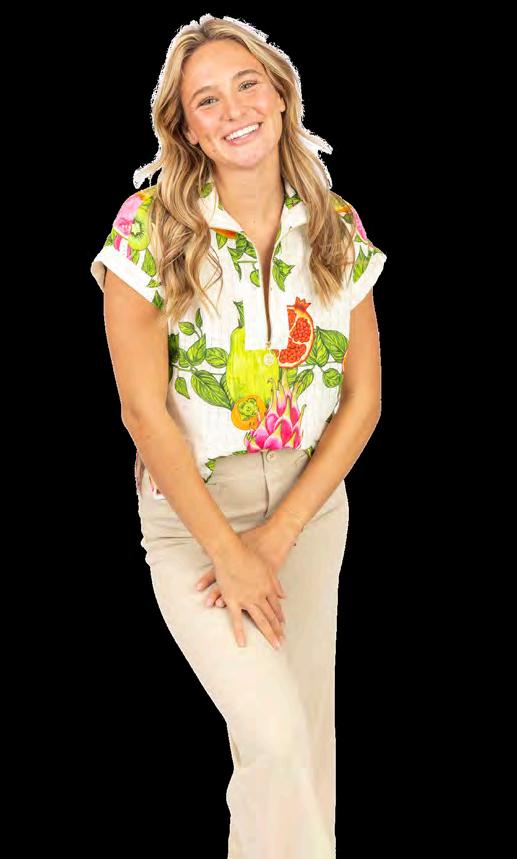
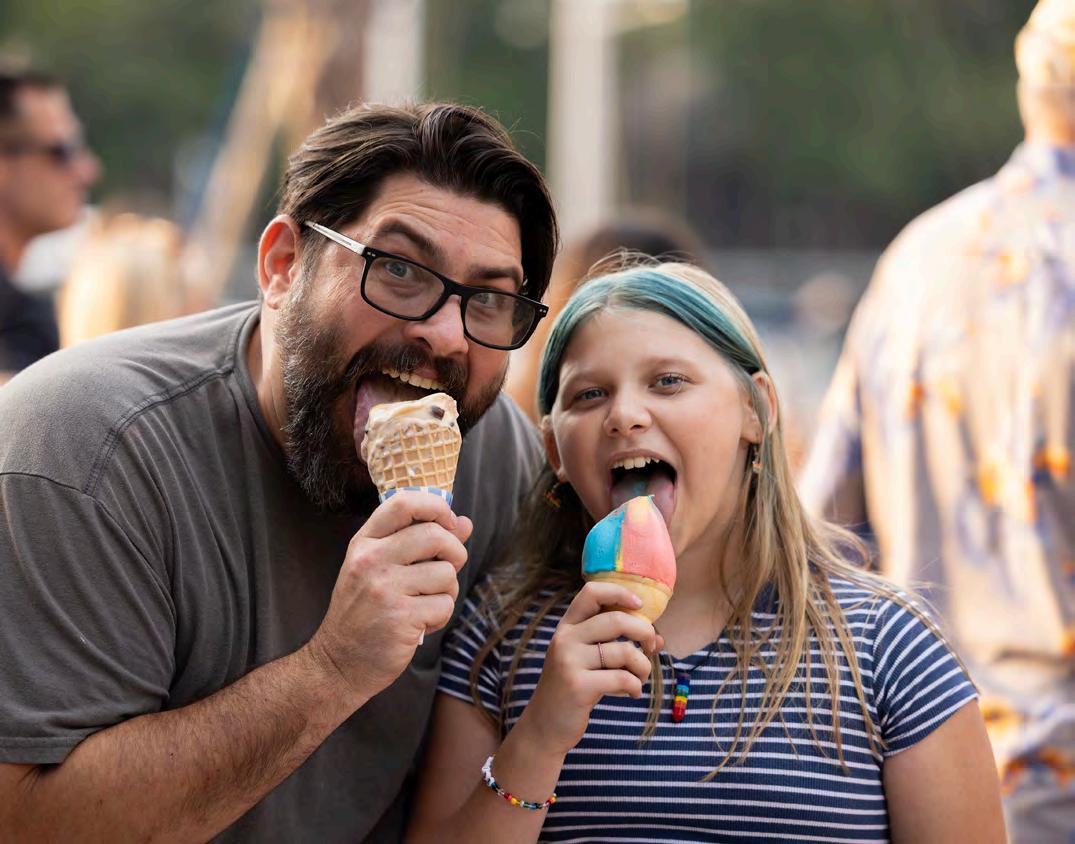
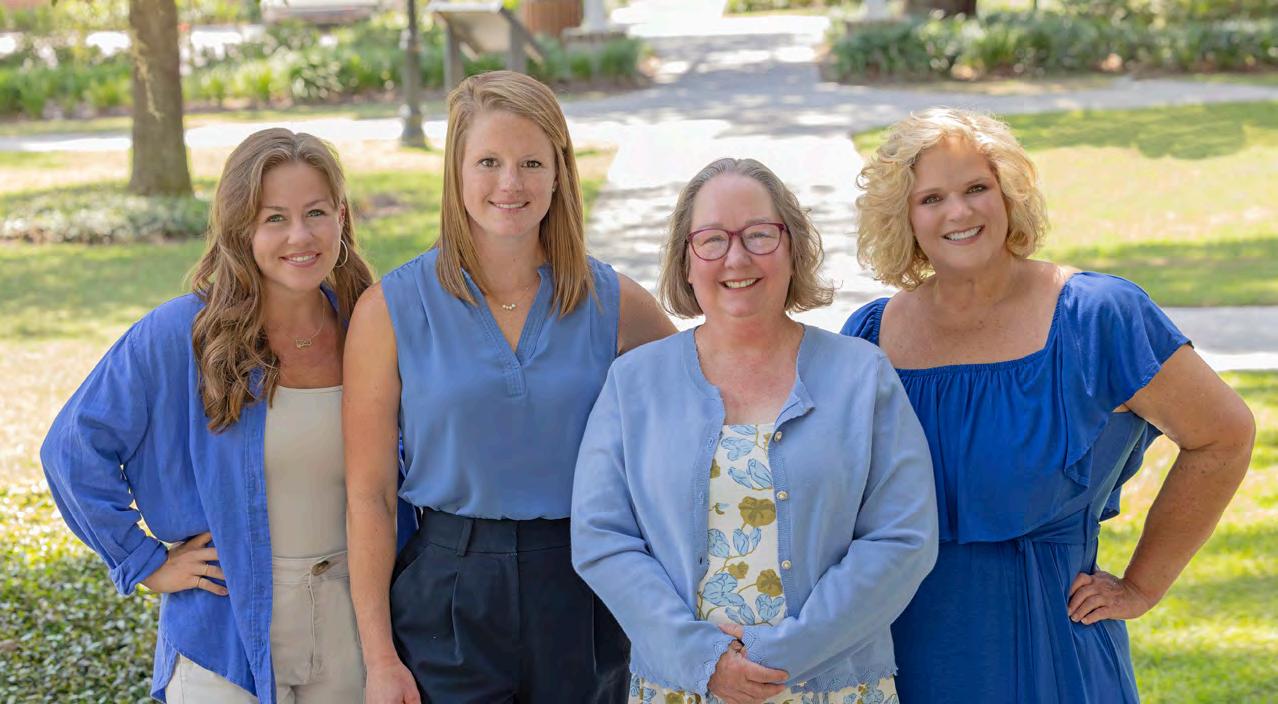
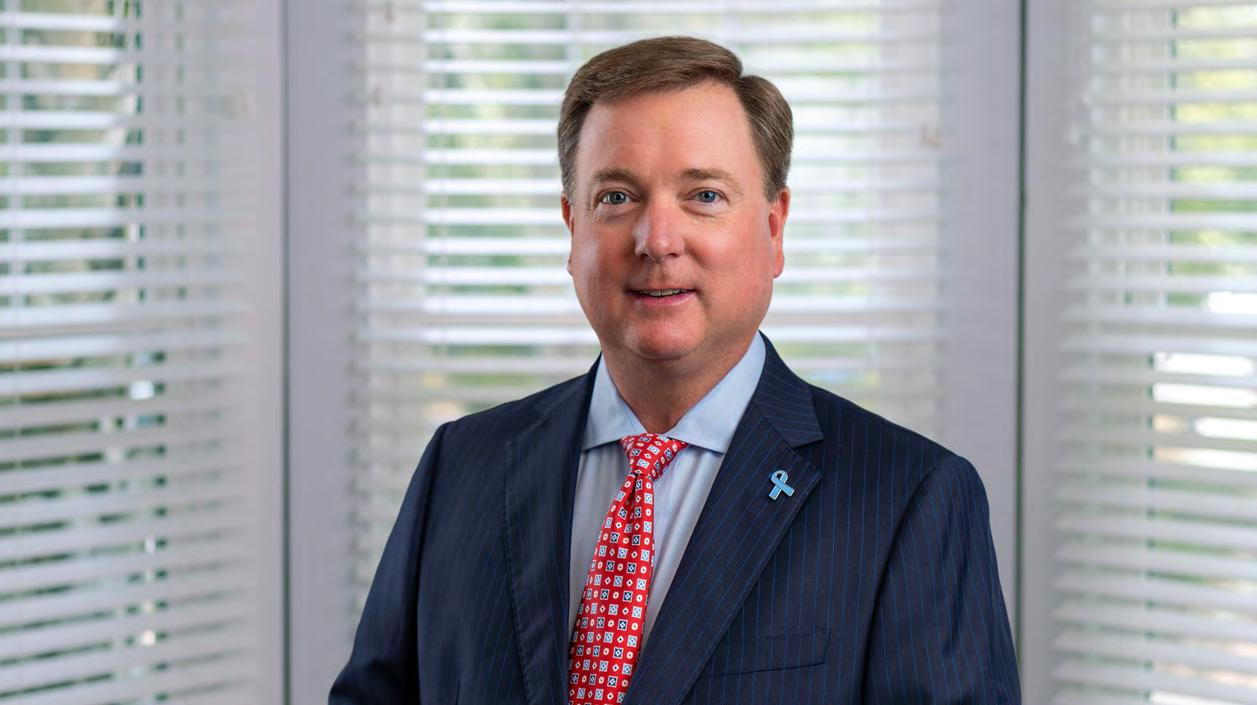
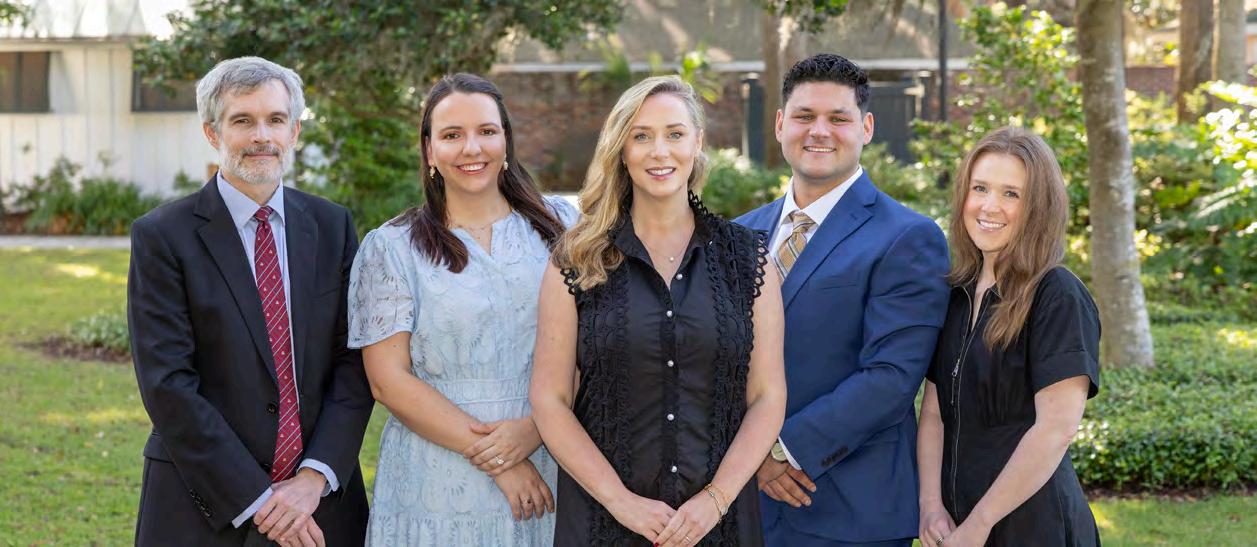
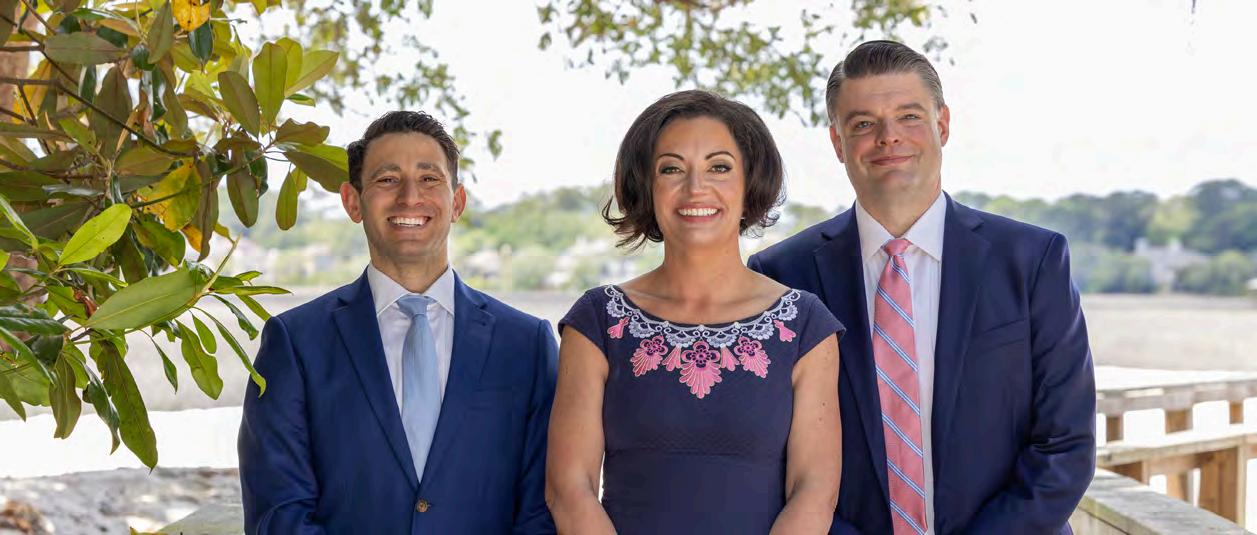
ENJOY AN AFTERNOON AT BUFFALOS IN MONTAGE PALMETTO BLUFF · A DAY ON THE WATER WITH NATIVE SON ADVENTURES · SPOTLIGHT ON LOWCOUNTRY LAWYERS · SUMMER FASHION FEATURING SUMMER SCHULTZ AND ZACH WOODS · LOVE & ICE CREAM: EVERY DAD’S JOURNEY IS DIFFERENT, BUT EVERY DAD’S PURPOSE IS THE SAME · NESTING SEASON AT THE PORT ROYAL CYPRESS WETLANDS
GENIUSES AT WORK
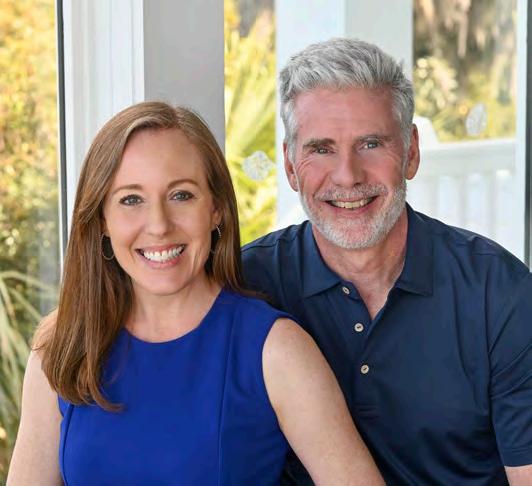
Vibe Manager
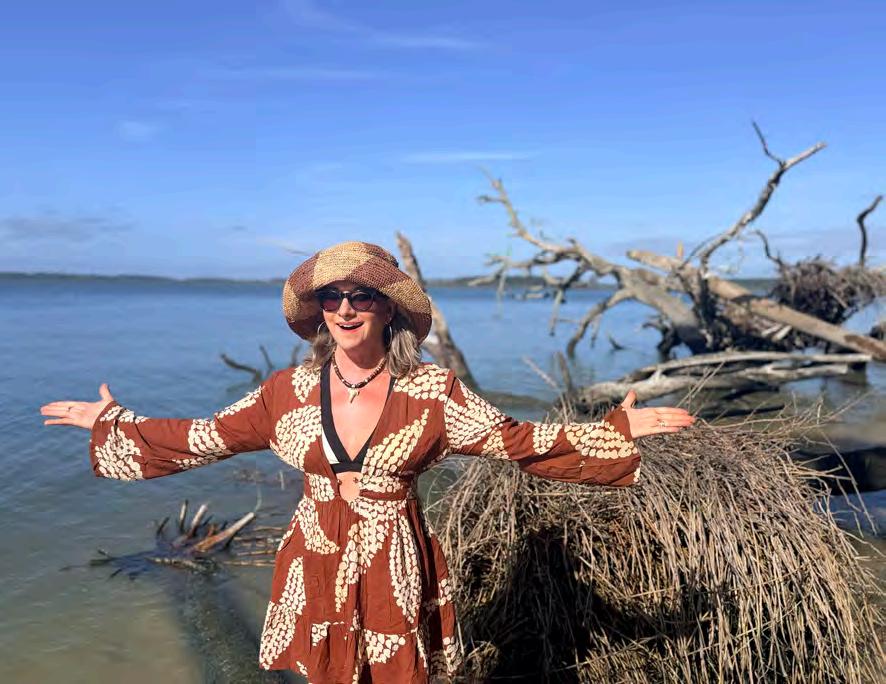
Maggie Marie Washo
Master of Coin
Marion Elizabeth Bowser
Chief Chatter
Kim Conrad Crouch
Head Unicorn Wrangler
“Just Kandace” Cunningham
Collector of Business Cards
Morgan Ambler
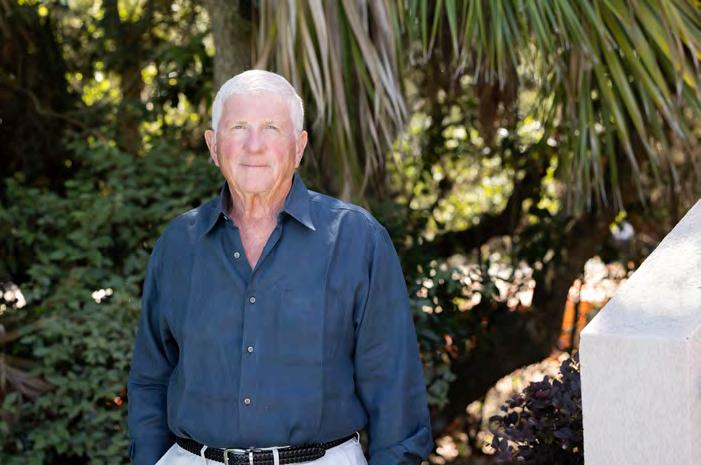
Czar of Creativity: Jevon Daly
Mascot in Training
Buoy Conrad Crouch Pritchard
The Gatekeepers
Greta Von Bowser
Vincent Von Bowser
Kerning Queen
Catherine Davies
Punctuation Prodigy
Lynne Cope Hummell
Innovation Sherpas
Jesse Blanco
Courtney Hampson
Lynne Cope Hummell
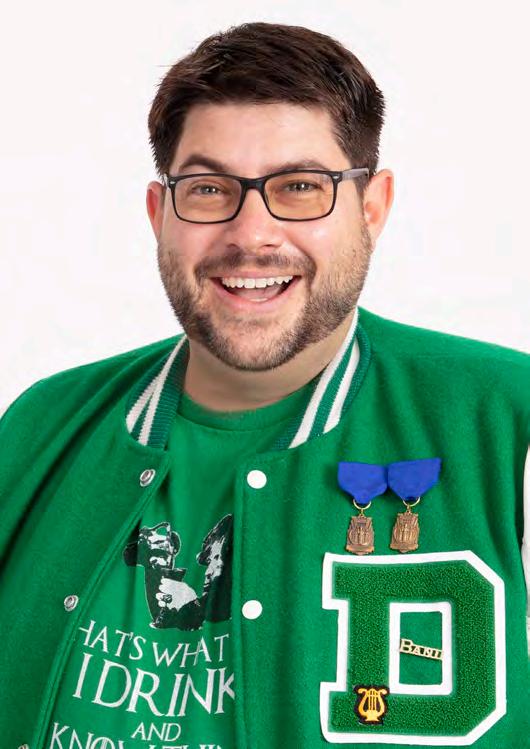
Barry Kaufman
Debra Kleinman
Amber Hester Kuehn
Brooke Peck
Alan Perry
Cheryl Ricer
Larry Toomer
Sheila Tucker
Lighting Experts
Photography by M.Kat
Photography by Lisa Staff
Find Us Here
PO Box 22949
Hilton Head Island, SC 29925
843.816.6247
maggie@ch2cb2magazine.com
AEDITOR'S NOTE
JUNE 2026
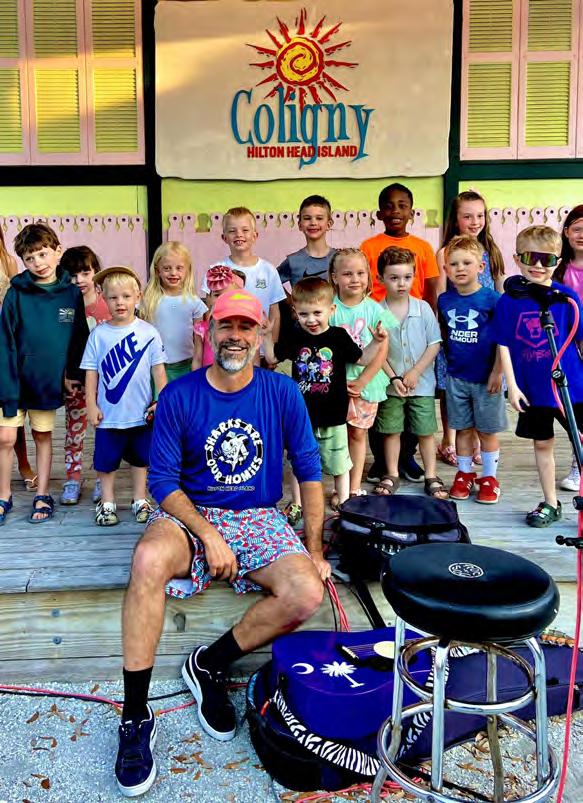
fter 34 years in the South, I think it’s finally happening. This basic fall girlie might actually be (dare I say it out loud?!?) looking forward to summer. Last year, I resolved not to wish it away. This year I’m going to embrace June through August and become a tourist in my own town. I’ll call my bestest girlfriends and head to the beach on some random Friday night to experience families taking photos on the beach at Coligny before they make memories with Jevon at his Kids’ Show.
Or perhaps I’ll casually pop into Shelter Cove Harbour on a Tuesday night to hear laughter float over the water from guests enjoying margaritas at San Miguels. Maybe I’ll stay to watch Shannon Tanner sign 100 whirly-top hats before the fireworks go off at dark.
If I’m feeling really adventurous, maybe rent a bike and traverse the paths through Sea Pines, casually falling in line with a generational family of 24, headed singlefile to the Salty Dog Café.
Our summer issues are generally full of enjoyable summer activities that our visitors are drawn to, and this year, I’m going to do them too.
To kick off this issue of Lowcountry activities, the CH2 crew went out on the water with Native Son Adventures owner and guide Byron Sewell. This is the second time I’ve had the pleasure of exploring local waterways with Byron and I really cannot recommend this enough. Our focus on this trip was finding sharks’ teeth at all of his
secret spots, but a day with Byron can really be customized to what your family likes to do- from crabbing and tubing to trips to Daufuskie or fishing. Read all about it on page 42.
Next, we headed over to Port Royal with another longtime local, Mollie Kinard with Moore 2 Life. Our birding expedition yielded hundreds of amazing photographs and knowledge only a master naturalist could share so easily. Flip on over to page 60 if you’re into birds and such.
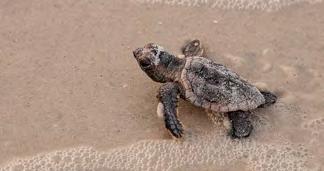
As everyone knows, this is the month our most famous visitors arrive, and Sea Turtle Patrol’s Amber Kuehn is a guest writer this month, sharing the story of one of her very favorite nesting loggerhead turtles, Stumpy. Yes – she’s missing a flipper. But even that doesn’t stop her from her repeat summer vacations on Hilton Head Island. Check out the story on page 56.
There’s so much good stuff in this issue – and so many extras coming your way on our social media pages – so be sure to follow along there for everything we can’t put in print. ;-)
See you next month for more adventures – or maybe at San Miguel’s for that spicy margarita.
Photography by Jevon Daly
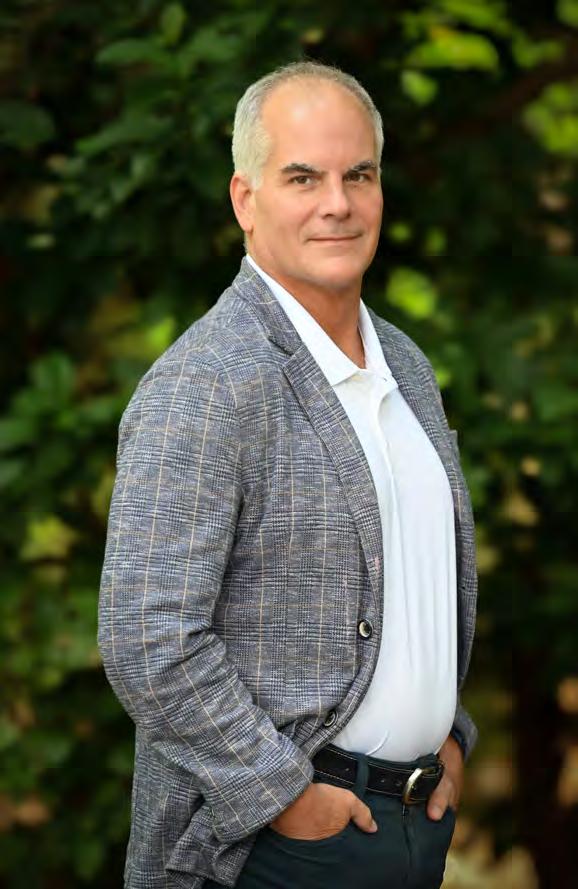
5 REASONS TO CELEBRATE BARRY KAUFMAN,
Writer · Photography by Maggie Washo
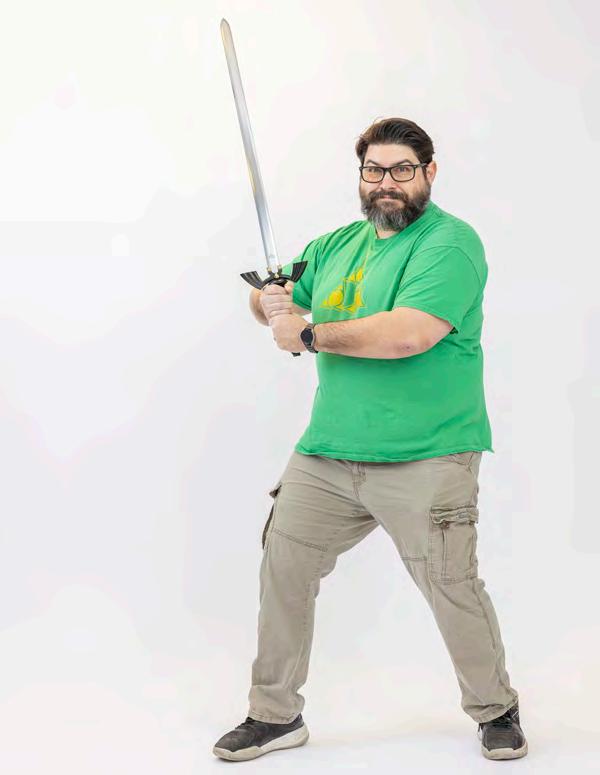
1As you’ve probably guessed if you’ve read any of his writing, Barry is a giant nerd. Specifically, his jam is the long-running video game series The Legend of Zelda This stretches all the way back to his Michigan childhood, running around swinging sticks at imaginary monsters, and carries through to the names of his three children, chosen to represent the three aspects of the Triforce: wisdom, courage and power. If you don’t know what that last sentence meant, ask your local nerd.
3
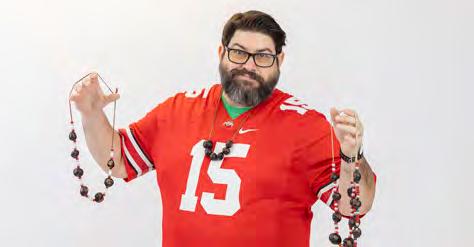
Barry is very aware of the reputation given to fans of his beloved Ohio State Buckeyes and attempts to fight them by occasionally admitting other teams have good qualities as well. Just not Michigan. Or Clemson, as he has one child at USC and another headed there in the fall.
2
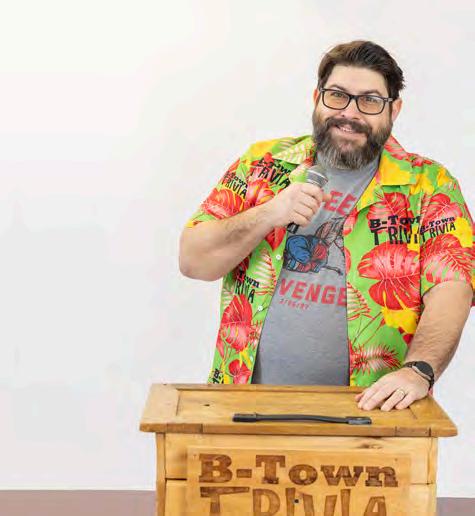
Three nights a week, Barry rocks a microphone as the host of B-Town Trivia at The Bank, Captain Woody’s Bluffton and Lot 9 Brewing Company. Beyond just handing out prizes, he’s used the game as a fundraising platform, collecting goods for Bluffton Self Help and donations for locals in need.
4
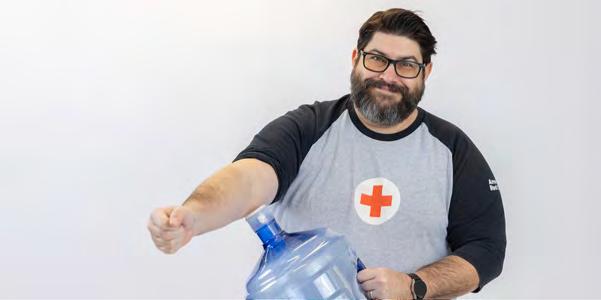
A newly minted member of the American Red Cross’ Three Gallon Club, Barry has been a regular donor since college. His personal record for filling a bag is three minutes and four seconds, just above the three-minute threshold at which they are required to get you medical help for your fast bleeding.
5
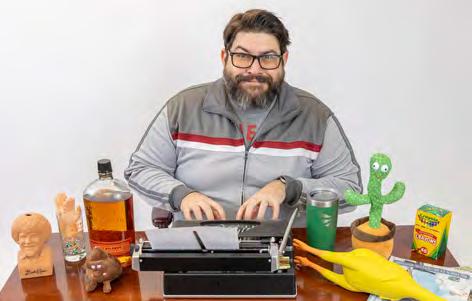
Barry has been writing professionally for 23 years, launching Kaufman Copy in 2017. Along with (obviously) magazine articles, he writes for businesses, real estate agents, and organizations, providing them with whatever they need to be written, from press releases to MLS descriptions.
BE A GOOD NEIGHBOR THIS SUMMER
Summertime has officially arrived on Hilton Head Island! With the warm sun gracing our shores, we’re excited to welcome both returning and first-time visitors. Many of these visitors will be staying in one of our many short-term rental properties, nestled within our beloved neighborhoods. With more than 7,000 short-term rentals on the island, we understand that this influx can bring about a variety of concerns for residents and visitors. That’s precisely why we launched our short-term rental program several years ago and why we continue to refine its focus on how to be good neighbors.
At the heart of our program is our commitment to balance, protecting our residential neighborhoods while supporting tourism. We strive to preserve our community’s quality of life, emphasizing that being a good neighbor truly matters. To help achieve this, we’re encouraging our visitors to maintain respectful noise levels, adhere to parking guidelines, and properly dispose of their trash. These simple steps can go a long way in ensuring that our neighborhoods remain serene for both long-time residents and visitors.
Our commitment extends to accountability as well, ensuring that short-term rental operators meet clearly defined standards. We aim to protect the integrity of our community while offering a welcoming environment for visitors. Alongside our informational initiatives, we remind everyone of the importance of responsible behavior during their stay.
To further enhance our efforts, we have established a new ShortTerm Rental Rapid Response Hotline at 843-341-6864. This hotline allows our dedicated staff to address any issues related to noise, parking, or trash swiftly and effectively.
Quality of Life for All
Our dedication to quality of life is unwavering. Last fall, we made updates to our short-term rental regulations, ensuring that properties are safe and that neighborhoods remain secure and welcoming. Our goal is simple: We want to ensure our residents feel confident in the well-being and safety of their communities while also creating an enjoyable and welcoming experience for our visitors.
As we enjoy the summer season, I’d like to highlight an initiative that embodies the spirit of giving back: Second Helpings. This nonprofit organization runs a remarkable post-vacation food donation program for visitors. Instead of discarding unopened groceries, visitors can contribute to local families in need by dropping off nonperishable items at various donation bins across the island before heading home. Volunteers collect and distribute these donations to local pantries and soup kitchens. For more details, visit secondhelpingslc.org and find a location near you.
To our residents, thank you for your continued support as we work to preserve the character and charm of Hilton Head Island. To our visitors, we hope you have a fantastic stay and thank you for being thoughtful guests who contribute to the safety and vibrancy of our community.
Happy summer, everyone!
A Note from Hilton Head Island Mayor Alan Perry
Lisa Staff Photography
A
Note from Bluffton Mayor Larry Toomer
PREPARING FOR HURRICANE SEASON –AND HELPING OTHERS DO THE SAME
Welcome to summer and the return of hurricane season. Though officially the season runs from June 1 to November 30, here in the Lowcountry, the heart of hurricane season is typically from mid-August through October, with September usually being the time when tropical activity is at its peak.
For residents of Bluffton, hurricane season is simply part of living in a beautiful coastal community. Every year, hurricane season also brings a new “freshman class” of residents who may have never experienced tropical weather, evacuation orders, storm surge, or coastal flooding before.
That is why preparation is not just about your own household – it is also about helping your neighbors.
For longtime residents, a quick conversation can go a long way. Help new neighbors understand where to find trusted information, what “Know Your Zone” means, and which agencies handle different parts of hurricane response. Sometimes just helping someone understand what to expect can ease a great deal of anxiety.
It is also important to remember that everyone has a different comfort level during storms. Some people feel safer leaving early. Others may choose to stay during lower-level events. There is no perfect answer that fits every family. The important thing is to
think ahead, make a plan, and decide now what you need to feel safe and prepared.
One of the biggest areas of confusion during hurricane season is understanding who does what during an emergency.
The governor of South Carolina is the only person who can order an evacuation. Beaufort County Emergency Management oversees countywide emergency coordination and manages re-entry after a storm. Locally, the Town of Bluffton’s Police Department and Public Services Department work throughout storms and recovery efforts to monitor conditions, clear roads when it is safe, protect infrastructure, and help keep an eye on the community.
Residents should also take time now – before a storm develops –to review evacuation zones, emergency supplies, insurance coverage, and flood risks. Waiting until a hurricane is approaching the coast can create unnecessary stress and confusion.
The town’s hurricane FAQ page is designed to help residents understand the basics in a clear and practical way. It includes information about evacuation zones, emergency alerts, sandbags, flood insurance, storm preparation, and what residents can expect before, during and after a storm.
Most importantly, hurricane season reminds us how connected we are as a community. Bluffton has always been a place where neighbors help neighbors. That spirit matters during emergencies just as much as it does during everyday life.
As we head into another hurricane season together, please take a few moments to prepare, check in on neighbors, and help new residents feel more comfortable navigating coastal storms for the first time. Preparation is not about fear – it is about taking care of yourself, your family and your community.
Residents can learn more by visiting the town’s hurricane preparedness FAQ page at townofbluffton.sc.gov.
A scene from Plié on the May
Article by Cheryl Ricer
STAYING POWER:
Hilton Head Dance School & Theatre
A Legacy in Motion
When Hilton Head Dance School opened in May 1985, it began with a single studio, a rolled-up dance floor, and just 17 students. It was modest, makeshift, and full of possibility. Four decades later, that small beginning has grown into one of the island’s most enduring cultural institutions. It is an organization whose staying power comes not only from artistic excellence, but from its deep roots in the community, its devotion to discipline and training, and its unwavering belief that dance can shape lives.
At the center of that legacy are Karena Brock-Carlyle and John Carlyle, the school’s owners and artistic directors, and Lori Finger, board president of Hilton Head Dance Theatre. Together, they represent the artistic vision, practical leadership, and community stewardship that have sustained the organization for 40 years.
What they have built is far more than a dance school. It is a place where children grow into artists, artists grow into leaders, and generations of Lowcountry families have found beauty, belonging, and purpose.
A Remarkable Beginning
Hilton Head Dance School did not begin with a business plan so much as an invitation. Before arriving on Hilton Head, Karena Brock-Carlyle had already enjoyed an extraordinary professional career. A principal dancer with American Ballet Theatre (ABT), she had shared roles with renowned stars including Natalia Makarova and Cynthia Gregory and had been partnered by ballet legends Rudolf Nureyev and Mikhail Baryshnikov. Her training had taken her from Texas to California, Amsterdam, and ultimately to the company she had long dreamed of joining. She spent 15 years with ABT, building a career most dancers only imagine.
After leaving ABT, Brock-Carlyle became artistic director of the Savannah Ballet. It was there that a Hilton Head connection took shape. Margaret Jones, who served on the Savannah board, and Mary Coleman approached her about coming to the island to open a school. Brock-Carlyle had not been planning that move, but she said yes, and that decision changed Hilton Head’s arts landscape.
John Carlyle came into the story through dance as well. He had also danced professionally, including a brief period with ABT, and joined Brock-Carlyle in Savannah after she invited him to teach and dance there. Their professional partnership evolved into a personal one. In fact, between opening the Hilton Head school in May 1985 and launching their first full season in the fall, the two got married, making the beginning of the school inseparable from the beginning of their life together.
“It’s been a dream ever since,” Brock-Carlyle said of the move and the decades that followed.
Two players in achieving that dream are Allyson and Joe Harden, who were instrumental in finding the building that the school and theatre occupy to this day. The couple also helped to renovate the space and create two studios outfitted with sprung floors and barres. After 40 years, the school and theatre own the entire building and have three studios, a costume shop, storage space, and office space.
From Principal Dancer to Teacher of Generations
If Brock-Carlyle brought prestige to Hilton Head from the start, she also brought something even more important: standards.
From the beginning, she and Carlyle were determined to create not just a recreational program, but a serious school of dance – one grounded in classical technique, artistic integrity, and discipline. That level of commitment was unusual for a growing island community, especially in the mid-1980s, but it quickly resonated.
The early days were far from glamorous. In the first studio, Carlyle had to unroll the dance floor before classes and roll it back up afterward so the space could serve multiple purposes. Yet even in those humble circumstances, the school’s vision was clear.
Carlyle summed up their philosophy simply: “As long as we stay true to the art, we get kids that are dedicated to it, devoted to it.”
That devotion has become one of the school’s hallmarks. Students often begin as small children and remain all the way through high school graduation. As Brock-Carlyle noted, when a family stays with the school from age 3 to 18, “that develops a pretty deep relationship.” Over the years, those relationships have multiplied into something even more meaningful: generations. Former students now return as parents, and in some cases, even their children are dancing in the school.
One especially meaningful example is a former student who started in 1987 as a 4-year-old, stayed through high school, studied dance in college, performed professionally, then returned to teach at the school. Today, her own daughter – named Karena – is a student there. That kind of full-circle continuity says more than any anniversary banner ever could.
The Nutcracker Effect
The school’s real turning point came with its first encounter with performance. After opening, Brock-Carlyle approached the late Bill Dunnagan of the Hilton Head Community Playhouse and asked whether the dancers might have a little stage time to present a small portion of The Nutcracker. At the time, they only had enough students to do the snow scene and Act II.
It sold out.
That response revealed something powerful: Hilton Head wanted dance. More than that, it was ready to embrace it as part of the cultural life of the island. After that first success, Dunnagan invited them to produce The Nutcracker and offered theatre space each Christmas and spring. For about 10 years, until the Arts Center of Coastal Carolina opened in 1996, the organization performed at Dunnagan’s Alley. It was a formative partnership and one of the earliest signs that Hilton Head’s arts organizations were willing to work together rather than compete.
That spirit of cooperation remains one of the organization’s defining strengths. “A high tide lifts all boats,” Finger said, describing the atmosphere among the island’s arts institutions.
Today, The Nutcracker remains central to Hilton Head Dance Theatre’s identity, but it is far from the only production that has shaped the company. The official repertoire includes such classics as Swan Lake, Sleeping Beauty, Cinderella,
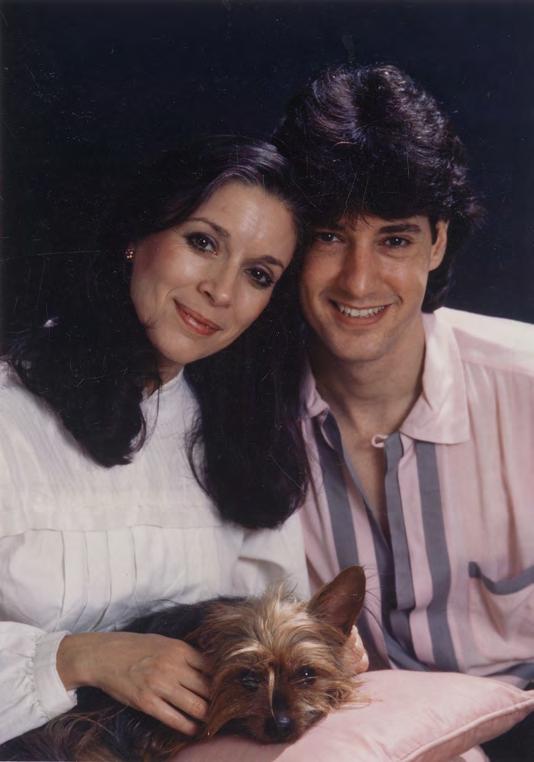
Karena Brock-Carlyle and John Carlyle, circa 1987
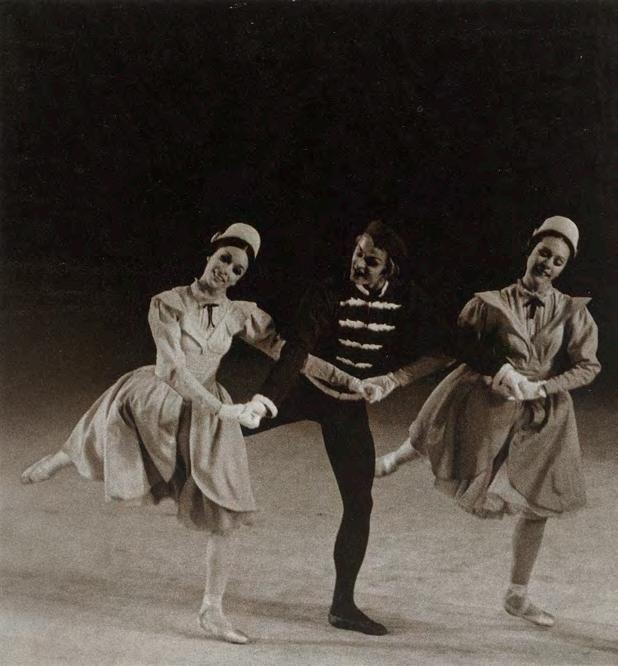
Karena Brock in Les Patineurs alongside Mikhail Baryshnikov
Giselle, Coppélia, and Don Quixote, along with original works – evidence of both artistic ambition and remarkable longevity.
School and Theatre: Two Arms of One Mission
A key part of the organization’s success is the way its two branches work together. The dance school, founded in 1985, is the training ground. The dance theatre, founded in 1986, is the nonprofit performing arm. The school develops dancers; the theatre creates the productions, raises support, handles logistics, and makes large-scale performance possible. The theatre’s mission is to foster an appreciation of dance as an art form in the Lowcountry, while the school prepares students with the technique and discipline to carry that art forward.
Finger explained that this division of labor is essential. The theatre handles ticketing, venue rental, publicity, guest artists, printed programs, costumes materials, and the website. It also manages contributed support and memberships, which are crucial to sustaining productions. That structure frees Brock-Carlyle and Carlyle to do what they do best: teach, rehearse, choreograph, and produce.
The relationship is unusually strong, and it works because each side respects the other. Finger describes the board’s role as creating the conditions that let the artists focus on art. Brock-Carlyle put it even more bluntly: Without the theatre, “we wouldn’t be doing the shows that we do.”
Excellence in the Studio
For an institution built on classical training, faculty matters enormously. Here, too, Hilton Head Dance School & Theatre stands out.
The school proudly includes the American Ballet Theatre National Training Curriculum, an age-appropriate, outcomebased program designed to support strong technique, dancer health, and child development. The academy
Founders & Artistic Directors: Karena Brock-Carlyle & John Carlyle
Board President: Lori Finger
Notable Artistic Legacy: Karena BrockCarlyle, former principal dancer with American Ballet Theatre, performed alongside legends including Mikhail Baryshnikov and Rudolf Nureyev
Mission: To inspire discipline, confidence, and artistry through exceptional dance training while enriching the cultural fabric of the Lowcountry through performance
Students Served: Approximately 300 annually
Training Focus: Classical ballet foundation with comprehensive instruction in pointe, variations, jazz, Pilates, nutrition, and dance history
Distinction: Incorporates the American Ballet Theatre National Training Curriculum with multiple ABT-certified instructors on faculty
Signature Productions:
• The Nutcracker (annual holiday tradition)
• Swan Lake
• Sleeping Beauty
• Cinderella
• Giselle
• Coppélia
• Don Quixote
Community Impact:
• Multi-generational student families
• Alumni in professional dance, medicine, academia, and the arts
• Strong collaboration with other local arts organizations
• Participant in island-wide arts initiatives
• Summer showcase collaborations with regional dance programs
• Guest artist residencies and performances
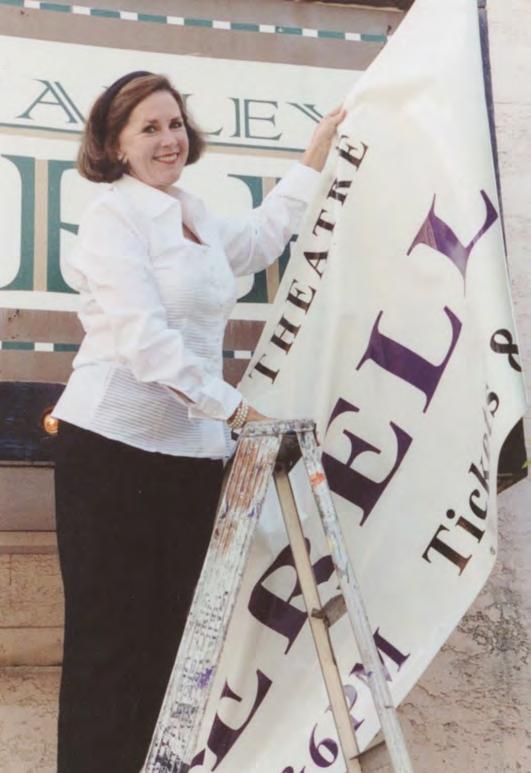
Mary Coleman at the old Dunnagan’s Alley Theater
program for middle and high school students offers ballet, pointe, variations, jazz, Pilates, nutrition, audition preparation, and dance history, giving serious students a deeper and more accelerated path.
Brock-Carlyle, an ABT Certified Teacher, has completed ABT teacher training from Primary through Level 7. The faculty also includes several other ABT-certified instructors, including Katie Girardi, Jamal Edwards, and Caitlin Hoffman. Girardi, a graduate of Mercyhurst University, also teaches Pilates and brings a deep understanding of alignment and body mechanics. Edwards, a University of Alabama dance graduate, works throughout the Lowcountry as a dancer, choreographer, dance instructor, and Pilates instructor. Hoffman, a University of Maryland graduate, brings additional training in ballet, jazz, tap, and Pilates.
Brock-Carlyle spoke with obvious pride about that faculty. “Our faculty is outstanding,” she said. “That strength matters not just for prestige, but for safety and longevity.” She noted that dance teaching is one of the few disciplines where formal certification is not universally required, making the school’s embrace of ABT curriculum and credentialing all the more significant.
That insistence on quality is one reason the school has earned such trust over four decades.
The Students and What They Become
Ask the artistic directors what makes them proudest, and the answer comes quickly: the students.
Not only do many students achieve impressively in dance, but they also excel beyond the studio. Brock-Carlyle and Carlyle spoke at length about the connection between ballet training and academic achievement. “The company girls, they’re honor students – not some of them, some of the time, but all of them, all of the time,” Brock-Carlyle said.
For them, that is not a coincidence. Ballet requires time management, focus, perseverance, and an ability to receive correction without losing heart. Those habits transfer. One former student, they recalled, went on to become a heart surgeon and was repeatedly asked during her professional interviews about her ballet background. Another former student presented a school project at the United Nations. Still another became involved with the Kennedy Center and worked with major arts institutions including Carnegie Hall. Others have returned to the school as teachers, extending the legacy from within.
What moves Brock-Carlyle most is not simply that students succeed, but that they “go on and become leaders in their community.”
That may be the school’s most compelling definition of success. Not every student becomes a professional dancer. But many carry the discipline, imagination, poise, and work ethic of dance into medicine, academia, leadership, family life, and the arts. The school is producing not just excellent performers, but capable human beings.
Collaboration as Culture
Another reason for the organization’s staying power is that it has never operated in isolation. From the early partnership with the Community Playhouse to ongoing ties with the Arts Center, Hilton Head Symphony Orchestra, and other local arts groups, Hilton Head Dance School & Theatre has flourished as part of a wider cultural ecosystem.
Finger and Edwards participate in quarterly gatherings through the Town of Hilton Head Island’s Office of Cultural Affairs, in which representatives from numerous arts and cultural organizations share plans and explore ways to collaborate. The company also participates in Crescendo, Hilton Head’s fall celebration of the arts, and has become
Terpsichore 2022
The Coda of the Nutcracker 2022
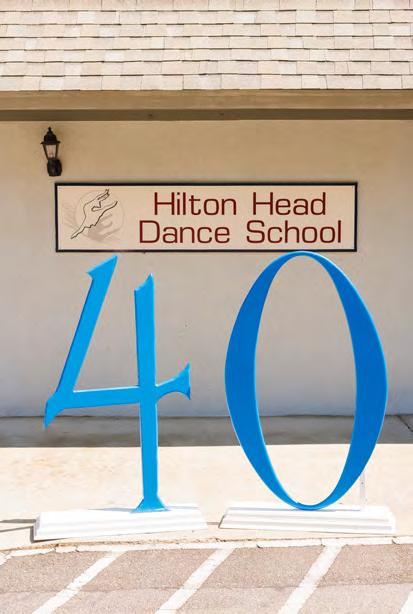
The exterior of the building in Palmetto Business Park that Hilton Head Dance has occupied since 1986.
the final event in that month-long calendar. Those connections matter. They keep the organization visible, engaged, and woven into the larger life of the island.
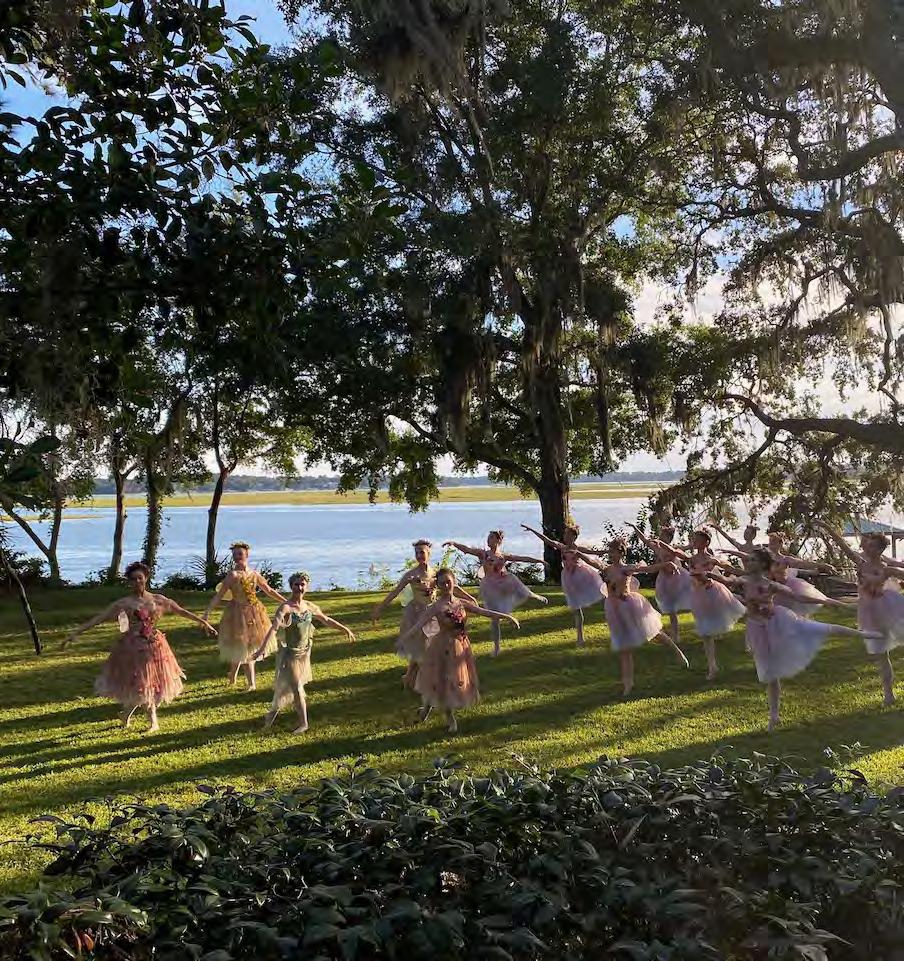
There have also been more distinctive collaborations. One favorite is Plié on the May, a special event staged at a former board member’s home on the May River, where dancers perform outdoors against a breathtaking Lowcountry backdrop. Another is the company’s summer showcase collaboration with a Savannah school, giving dancers from both communities a chance to perform, learn, and support one another.
The organization also regularly brings in guest artists, especially for The Nutcracker and spring performances. Those guest artists not only elevate productions but also give students the rare chance to rehearse and partner with experienced professionals –an essential part of classical ballet training that smaller schools often cannot offer.
Milestones Worth Marking
Over 40 years, Hilton Head Dance School & Theatre has celebrated its milestones with intention: the 25th anniversary, the 30th, the 35th, and now the 40th anniversary season. The organization has marked those moments with galas, performances, and commemorative events, but the deeper milestone is less about a date than about endurance.
Few arts organizations thrive for four decades. Fewer still do so while maintaining such a high level of training, producing full-length classics, building an accomplished faculty, cultivating a nonprofit support structure, and retaining the loyalty of generations of families.
The growth has been practical as well as artistic. From 17 students in the first months, the school has grown to nearly 300 students. The theatre continues to present productions and develop dancers through its company and apprentice levels, while the school and academy sustain the pipeline of training.
What gives Hilton Head Dance School & Theatre its staying power?
Part of it is exceptional leadership. Part of it is artistic credibility. Part of it is a community that has shown up, bought tickets, volunteered, donated, and entrusted its children to the school for decades. But perhaps most of all, it is the consistency of the mission.
“To do something like this, it takes a community,” Finger said. And as Carlyle added, quality instruction, quality productions, and support all have to work together.
That is exactly what has happened here.
For 40 years, Hilton Head Dance School & Theatre has remained true to the art while also serving the people around it. It has trained dancers seriously, staged performances beautifully, collaborated generously, and helped shape generations of students into thoughtful, disciplined adults. In a transient world, that kind of continuity is rare. In the arts, it is even rarer.
But on Hilton Head Island, because of the vision of Karena Brock-Carlyle and John Carlyle, the stewardship of Lori Finger and the board, and the devotion of families who believed in what they built, that legacy continues – gracefully, powerfully, and still very much in motion.
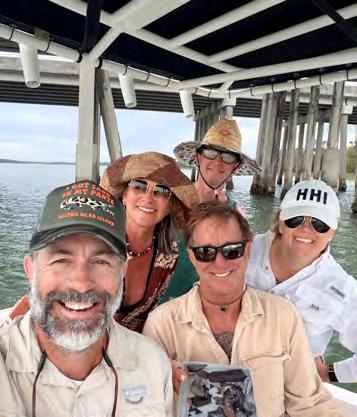
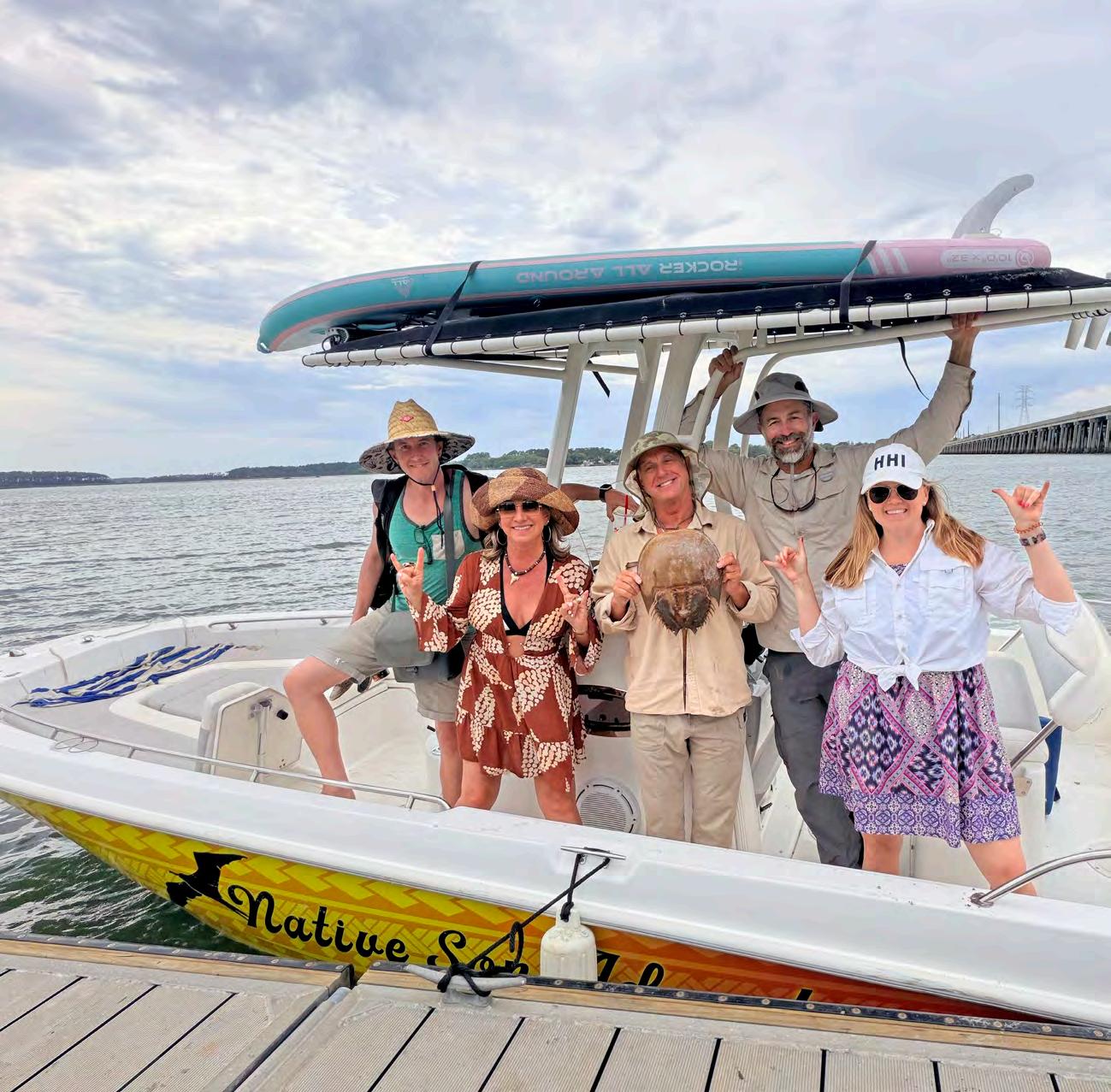
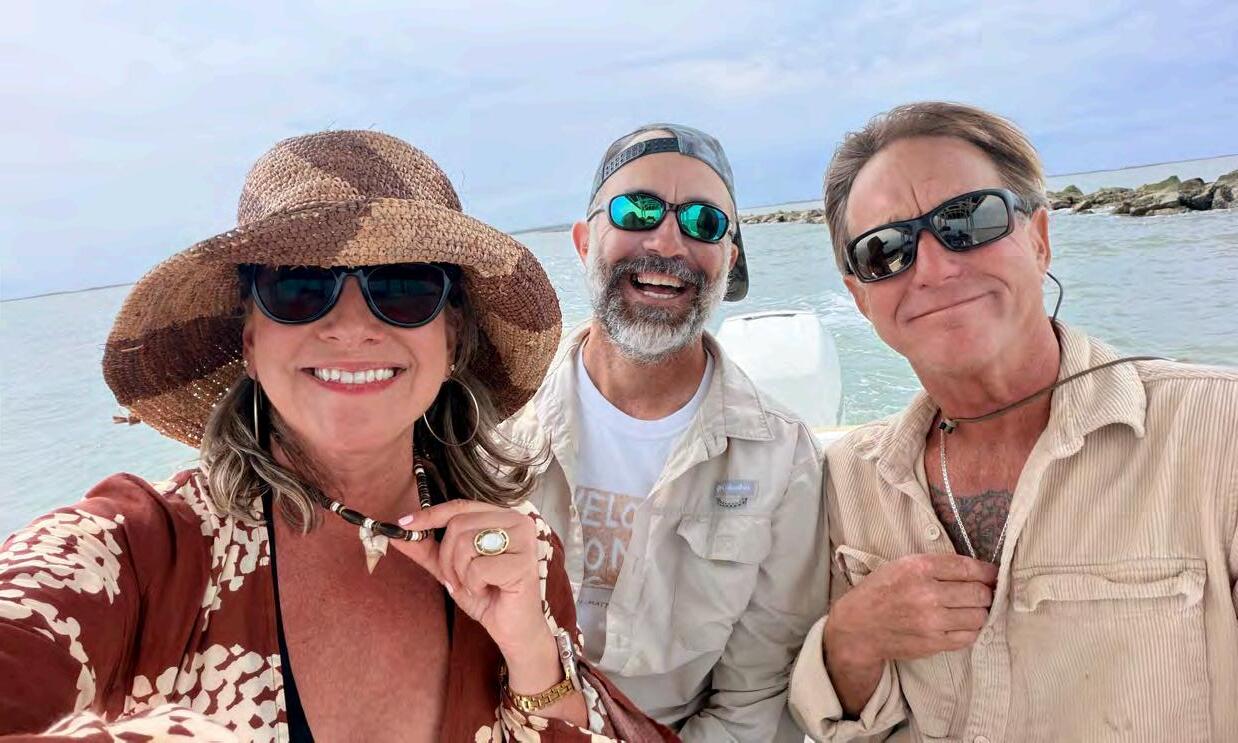
Trevor Harden, Maggie Washo, Jevon Daly and Brooke Peck pose with Byron Sewell of Native Son Adventures.
Article by Brooke Peck . Photography by Maggie Washo
A DAY ON THE WATER WITH NATIVE SON ADVENTURES
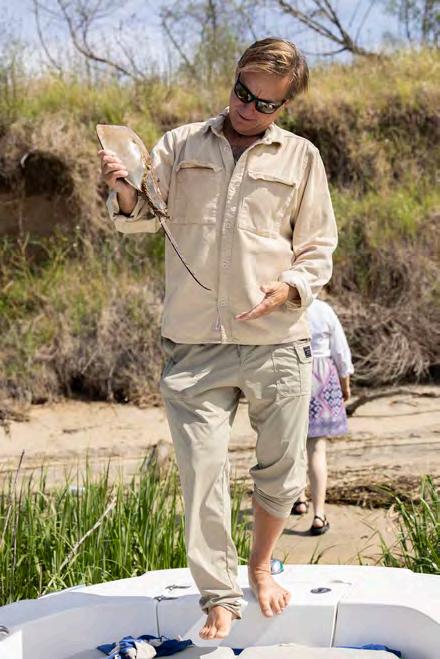
Over the past five years, I’ve been exploring Hilton Head Island’s waterways on my own. But after spending a day out with Native Son Adventures, I realized there is still so much more to experience and was reminded that an unexpected adventure can remind you of childhood joy.
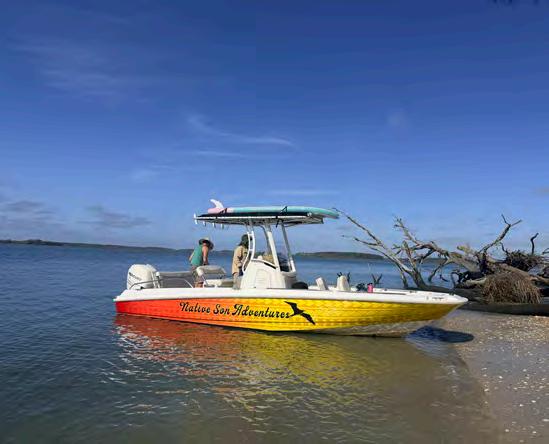
Our adventure crew of Maggie Washo, Jevon Daly, Trevor Harden, and I met up with Byron Sewell, owner of Native Son Adventures in April. Born and raised on Hilton Head Island in North Forest Beach, Sewell is a native who loves exploring and sharing the Lowcountry with others.
During the 1970s, his childhood was spent exploring a much less populated version of Hilton Head. “Growing up on North Forest Beach with my dog, it was all dirt roads,” he said. “We had treehouses everywhere.”
His first adventures in life included his bike, backpack, and a fishing rod. He would often head off to Sea Pines or Shipyard to climb trees and fish. “That’s just turned into traveling the world, exploring really virgin areas for me,” he said. “It’s just part of my blood and I have to have a lot of nature in my life.”
Sewell started his career as a captain on Lowcountry waterways more than two decades ago. “I started fishing, fly fishing, and light tackle guide services in 2004 and did that for about five years out of Palmetto Dunes,” he said. “About five years into it, I was starting to do really well with fly fishing.”
But an opportunity for international adventures beckoned him to leave the Lowcountry for several years. He was recruited to use his guide skills on private islands all over the world. “I had some crazy epic jobs that snowballed from one to the other,” Sewell said. “Then, I got an adventure job on an expedition yacht around the world.”
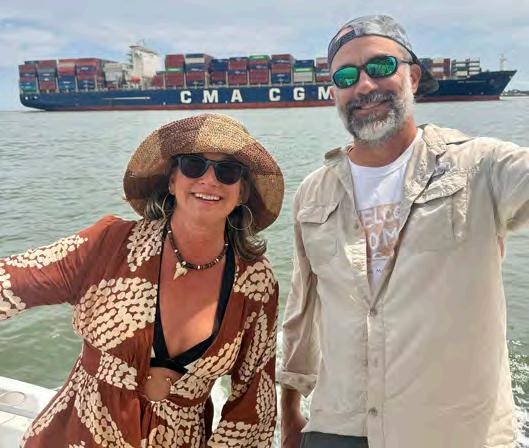
Washo and Daly pose for a quick snap as a cargo ship headed to Savannah provides an interesting backdrop.
After several years of thrilling experiences abroad, he returned to the island to be closer to family and started Native Son Adventures back up again. “We changed it from strictly fishing to what we called the “day with a native” trip, where you get to pick different interests,” Sewell said. “We fish a little, and when the fishing slows down, we go find shark’s teeth, and then we’ll go teach the kids to throw cast nets, or paddleboard with dolphins, or go to Daufuskie.”
OUR NATIVE SON ADVENTURE
No one really knew what to expect for our day-long excursion with Sewell. We were told to wear water shoes and be prepared to get dirty. Honestly, I thought we were about to be hazed in the pluff mud but nonetheless, I was excited for an adventure with a local expert.
Sewell’s goal for our group was to locate shark’s teeth. I quickly learned that Daly is a savvy shark tooth ninja with years of experience and a keen eye for quickly spotting them in the wild. He might also be a bit competitive. Washo, on
the other hand, had yet to locate one on her own if it had not been circled by Sewell, but she was committed to trying.
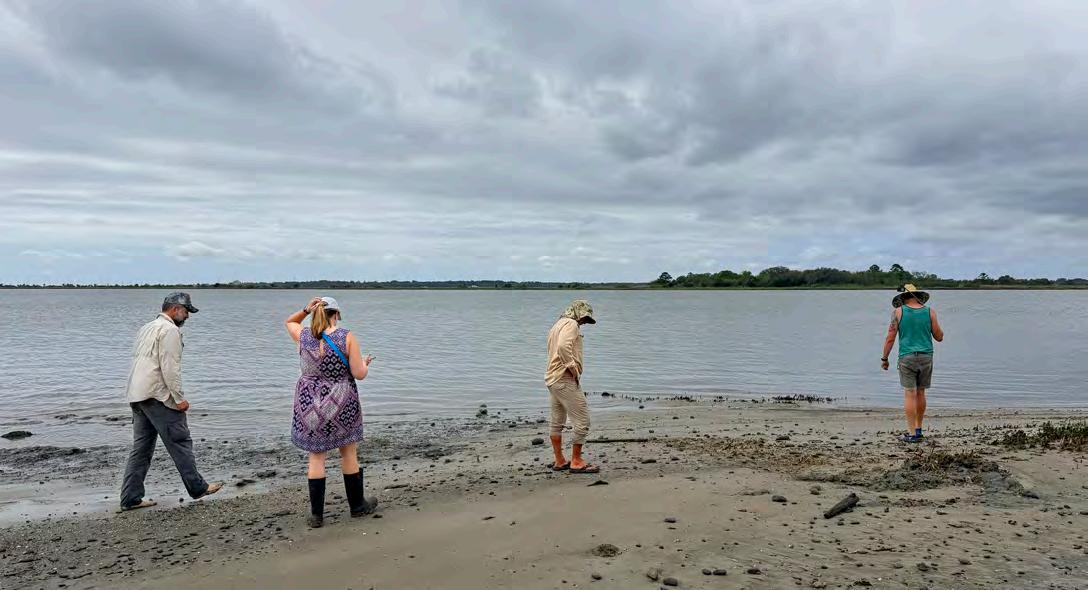
Searching for shark’s teeth is nature’s version of an Easter Egg hunt because you must search through shells, leaves, twigs, rocks, and other natural debris to locate the fossilized teeth. Plus, they come in a variety of sizes which doesn’t help narrow down what your eyes are constantly scanning.
“We’ll find shark teeth, fossilized turtle shells, horse teeth, giant sloth bones, and dire wolf bones,” Sewell said. “You can find anything out here. This is a legendary area of the world and you can only find shark’s teeth in certain parts of the world, not everywhere.”
Our adventure led us to numerous successful fossil hunting locations. The first stop yielded a piece of broken pottery from indigenous people estimated to be 500-2500 years old. At our next stop, Daly found some small shark’s teeth and we were all relieved to get the ball rolling.
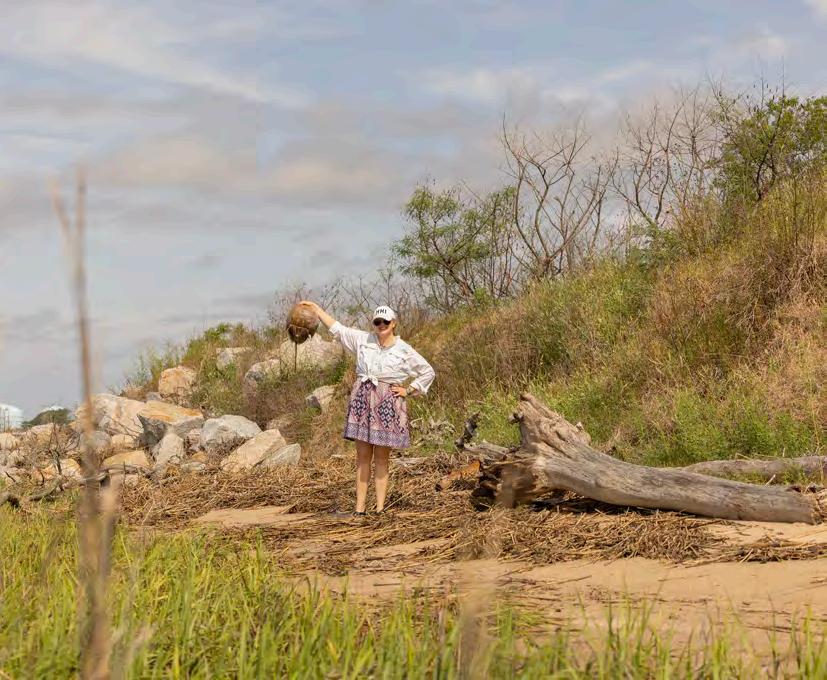
Brooke Peck shows off her first find of the day, a horseshoe crab.
The first stop on the Native Son Adventures tour.
“Most of these are fossilized teeth,” Sewell said. “They are anywhere from 5,000 to 20 million years old. We don’t find a bunch of young teeth from a shark yesterday.”
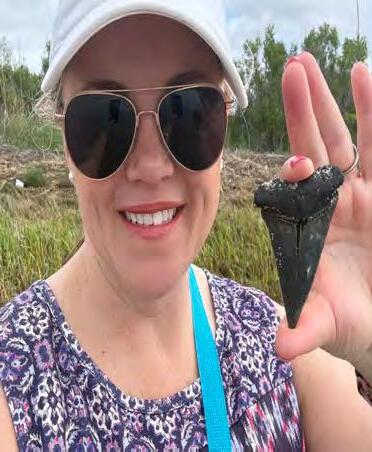
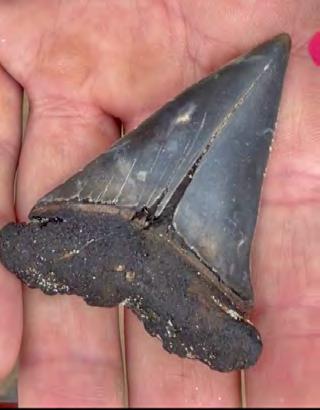
As the adventure continued, I spotted my first shark’s tooth and it was a doozy – a 3-inches long and from great white. We all celebrated the successful find and Sewell said
it was the first time he had ever visited that specific location.
Admittedly, I was able to find it because it was so big and only partially covered by sand. The competitor in me was excited to have a point on our non-existent scoreboard.
A few minutes later, a pod of dolphins playfully swam by the edge of the island. We all took in their frolicking and
Daly, Peck, Sewell and Harden scour the beach for shark teeth.
Sewell jokingly inspects Peck's first find of the day, and promises there are much more interesting finds ahead.
Washo captures nesting pelicans with her zoom lens.
Washo, Daly and Sewell are all smiles after a day in the Lowcountry exploring local waterways.
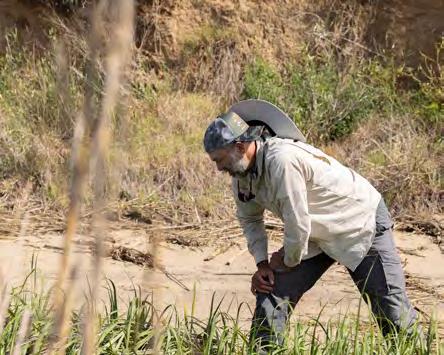
Daly concentrates his efforts in the tall grass, where shark teeth can sometimes wash up in the tides.
Peck is exuberant after finding this monster of a tooth within the first hour of the Native Son adventure.
The
Daly
enjoyed seeing the new, bright green marsh growth nearby. We were surrounded by nature’s beauty and enjoyed the opportunity to disconnect from our normal lives.
It was about this time that Washo spotted her first shark’s tooth of the day and became excited. “It’s like when you learn how to spot a gator in the water. It’s the same sort of thing,” she said. “Once you see it, you can’t unsee it.”
The landscape of some of the places we visited had steep, eroded edges. Since the Lowcountry is known for being flat, seeing these sharp ledges was very surprising for us. Sewell explained that the bottom of waterways around the Savannah River are constantly dredged for the safe passage of large ships. The removed dirt is relocated to the existing islands nearby. This unearthing is why fossils can be easily accessed.
“They dig down to these certain time periods and then dump them on these islands,” he said. “Rain comes and tides come and then erosion. We walk the banks looking for them and you never know what you’re going to find.”
When we found our way into the Savannah River, I was delighted to see two container ships headed our way. It doesn’t matter what size boat I am on, those ships make me feel very small. They create a massive wake, which Sewell safely navigated.
As we turned back toward Hilton Head, Sewell had one more habitat to show us – a place he called “Bird Island.”
As one might expect, the area was packed with birds. I couldn’t believe how many pelicans were out there, including migratory white pelicans.
As we looked closer, Sewell grabbed his binoculars, and we realized that the island was covered in dozens of pelican nests. I had never seen one pelican nest, much less 30 at one time. It was a special nature moment in my life.
Sewell was a great captain that day. He took us to so many scenic spots, educated us on our finds, and shared his love of the waterways, which invigorated the rest of us. When we started out the day, we had no idea what we’d find, see, explore, or experience. At the end of the day, we were happy, sun-kissed, and windblown, which is the recipe for a fun day on the water. It made me feel like a kid again.
Thanks to nature, even if you did this excursion every day for a week straight, each day would present something different. From bird sightings to fossils recovered to dolphin pods and the weather, each day is unique and full of adventure.
Native Son Adventures offers fishing trips, a day with a native excursions, tiki hut boat tours, and surfing lessons. Visit nativesonadventures.com for more information.
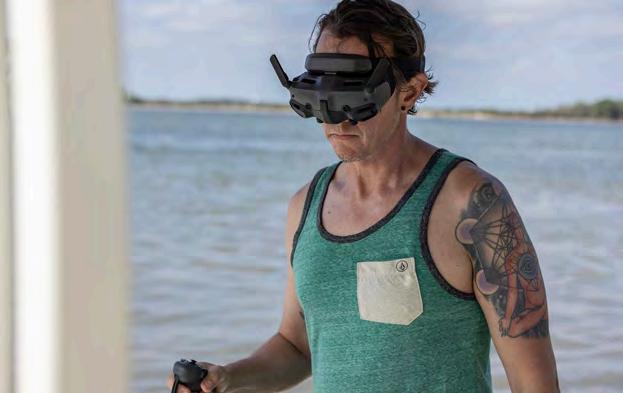
Trevor Harden captures drone footage of the day. Find the video on CH2's social media pages later this month.
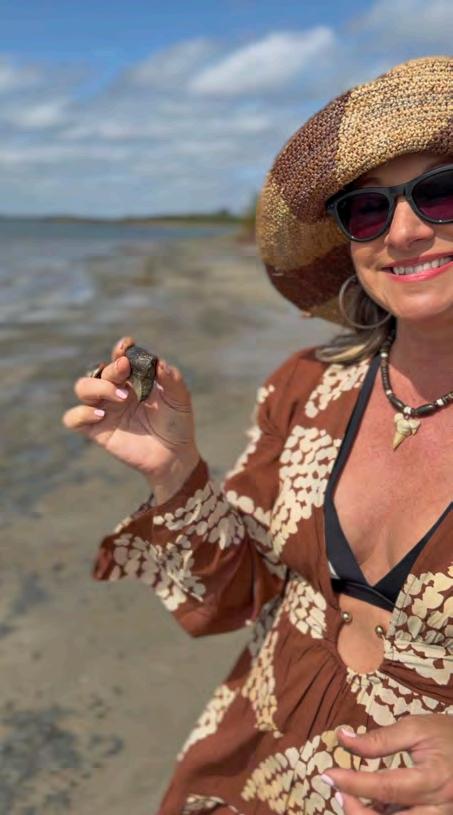
Washo's first find of the day, located with assistance from Sewell, who has an eye for spotting shark teeth hidden in the sand.
celebrated the day with one of the biggest teeth he's ever found in over 40 years of combing local beaches.
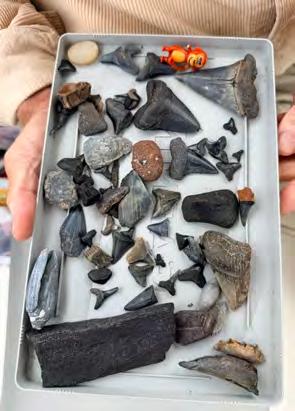
day's haul, with dozens of teeth and fossils.
Residents recognized as Honored Islanders for their volunteer service
Congratulations to Chris Shively, Linda Ferguson, Don Hendrickson, William Bilek, and Bernie Riedel on being selected as recipients of the Hilton Head Island Mayor’s Honored Islander Award. The award is given to Hilton Head Island residents whose steady volunteerism and good deeds enrich the island community; bolster community organizations that depend on in-kind, hands-on support; and help uplift their fellow man.
“These residents – honored islanders – are people I love to brag about,” said Hilton Head Island Mayor Alan Perry. “They spend countless hours giving back to our community and serving others without asking for anything in return. They have big hearts, and this is our way of thanking them for what they do.”
The recipients were honored at a luncheon with Mayor Perry, sponsored by Hudson’s Seafood House on the Docks. The Mayor's Honored Islander Award program publicly recognizes residents who make a significant sacrifice of their time, talents and/or resources, to better the community without compensation or significant public or media attention. A committee of individuals appointed by the mayor reviews nominations and selects individuals to receive the award. Anyone or any organization may nominate individuals for the award through the town’s website.
CHRIS SHIVELY
Home is where the heart is, and for Chris Shively, that sentiment is more than a saying; it’s a calling. Chris leads the volunteer home repair team at Deep Well, where he serves as construction supervisor. Under his steady leadership, the team has completed a wide range of projects that help homeowners remain safe and secure while creating warm, comfortable spaces for them and their families.
A retired commercial contractor, Chris moved to Hilton Head Island full-time five years ago. It wasn’t long before
he found his way to Deep Well, where he put his decades of experience, craftsmanship, and contracting expertise to work in service of the community. Since joining the home repair team in 2020, Chris has played a vital role in helping Deep Well with its mission. In addition to his hands-on work in the field, he spearheaded the renovation and expansion of Deep Well’s office facilities – further demonstrating his commitment to building not just structures, but a stronger foundation for service.
Beyond Deep Well, Chris is active in the men’s group at Hilton Head Community Church and contributes his skills
CHRIS SHIVELY
to the church’s facilities maintenance efforts. Through his leadership and dedication, Chris continues to embody the spirit of service, proving that home truly is where the heart is.
LINDA ANN HORNBEAK FERGUSON
At any given time, you can find Linda Ferguson doing what she loves: volunteering. When she retired as an educator from the Beaufort County School District in 2015, her calendar quickly filled with a wide range of volunteer roles she had come to know during her more than 45 years as a Hilton Head Island resident.
Working with young people is one of her greatest passions. She serves as a trustee and lead youth advisor at Central Oak Grove Missionary Baptist Church, one of the island’s historic congregations. She is also a board member of the Gullah Museum of Hilton Head Island, where she helps organize a summer program that encourages local youth to learn about and embrace Gullah culture. Linda’s commitment to education continues through her service on the board of the Ella C. White Memorial Scholarship Fund, where she helps raise funds to support scholarships for local high school students. In addition, she volunteers with the Pregnancy Center & Clinic of the Lowcountry and the Boys & Girls Club.
Her community involvement also includes serving as a board member for Habitat for Humanity of the Lowcountry and the Palmetto Electric Trust, further reflecting her deep dedication to strengthening and uplifting residents of the Hilton Head Island community and beyond.
DON HENDRICKSON
Through his volunteer work, Don Hendrickson is driven by a simple goal: helping others live well and succeed in life. A resident of Hilton Head Island for more than 15 years, Don has dedicated his time and energy to supporting community members through service with several local organizations.
Don serves as a board member of the Neighborhood Outreach Connection, which provides education, health, and workforce development programs designed to uplift and empower participants. Through NOC, Don also helps coordinate wellness screenings held at various locations throughout the year, expanding access to important health services. He further supports the community by tutoring adults in English through Bluffton Self Help, helping individuals build language skills that open doors to new
DON HENDRICKSON
opportunities. When he shifts into his business mindset, he volunteers with SCORE, where he mentors aspiring entrepreneurs and small business owners seeking guidance to launch or strengthen their businesses.
Don shares his warm and welcoming spirit as a greeter at All Saints Episcopal Church, where he brings a ray of sunshine to parishioners each Sunday morning.
DR. WILLIAM BILEK
From the perspective of Dr. William Bilek, who for the past 18 years has devoted himself to caring for women on Hilton Head Island, hope and health go hand in hand.
An OB/GYN physician, Dr. Bilek volunteers his time and expertise at the Volunteers in Medicine Clinic, where he helps ensure that women in the community receive high-quality, compassionate healthcare regardless of their ability to pay.
That commitment reflects the very principle upon which the clinic was founded when it opened its doors in 1993 – to offer free, compassionate care to people without insurance or who cannot afford medical services. At VIM, women of all ages can get a wide range of health services focused on prevention, early detection, and ongoing care. These services include pap smears, mammograms, lab and diagnostic tests, access to breast cancer support groups and more, all designed to promote long-term wellness.
Dr. Bilek’s impact goes beyond his work in the clinic. Through his compassionate approach, professionalism, and unwavering respect for patient dignity, he has helped improve health outcomes and bring hope to countless women and families on Hilton Head Island. His dedication exemplifies the very best of community service, leadership, and a deep commitment to caring for others.
LINDA ANN HORNBEAK FERGUSON
BERNIE RIEDEL
Bernie Riedel lives and breathes the Rotary Club mantra, “service above self.” He has been a dedicated volunteer and member of the Rotary Club of Hilton Head Island since 1992. As a club leader, he upholds the club's principles to improve the lives of others around the world. His latest Rotary service calling – help make the world polio-free.
As Rotary's Zone 33 End Polio Now coordinator, Bernie helped Rotarians work together to end polio, a serious and contagious disease. He raised awareness, advocated for polio’s eradication, and led fundraising efforts at both the district and club levels. Because of his dedication, Bernie received the Rotary Foundation's International Service Award for a Polio Free World. He currently serves as Rotary’s Zone 33 Regional Rotary Foundation coordinator.
Over his 33 years with Rotary in Hilton Head Island, Bernie has taken on many roles, including club president, assistant governor,
District 7770 governor, and District Foundation chair.
In 2004, he was District Conference Chair and was named District Rotarian of the Year. He has also received the Foundation's Citation for Meritorious Service and the Distinguished Service Award. Outside of Rotary, Bernie volunteers with groups like the Concours d ’Elegance & Motoring Festival and St. Francis by the Sea Catholic Church.
DR. WILLIAM BILEK
BERNIE RIEDEL
Founded in 2007 on Hilton Head Island, LAF began as a grassroots effort to support autism families in the region.
Article by Cheryl Ricer
Lowcountry Autism Foundation
A Lifeline of Hope, Help, and Healing
In the Lowcountry, where waterways weave through neighborhoods and marshland defines the landscape, beauty and risk often coexist. For families navigating autism, that reality takes on a deeper urgency – one that Lowcountry Autism Foundation (LAF) is working tirelessly to address.
At the heart of this mission is Sophia Townes, whose leadership is as personal as it is powerful. “I serve as president and executive director of the Lowcountry Autism Foundation,” she says. “But more importantly, I’m a mom of three boys – two of whom are on the autism spectrum. This work is not just professional for me. It’s deeply personal.”
Founded in 2007 on Hilton Head Island, LAF began as a grassroots effort to support autism families in the region. A few years later, operations transitioned to the Medical University of South Carolina in Charleston, expanding its reach but unintentionally leaving a gap in localized support for families in Beaufort County. That gap would eventually become Townes’ calling. After her son was diagnosed with autism in 2014, she became involved with LAF as a volunteer and advisory board member. “I started bringing programs from Charleston down to Bluffton and Hilton Head,” she said. “There was such a need here.”
By 2017, Townes officially joined the organization
as a program coordinator. In June 2024, she stepped into the role of executive director and made a decisive move. She relocated the foundation’s headquarters back to Bluffton.
Today, LAF serves the entire South Carolina Lowcountry, including Charleston, but its renewed presence in the southern region has transformed access for local families.
Bridging the Gap in Critical Services
One of the most urgent challenges facing autism families is access to timely diagnosis. In many parts of South Carolina, families can wait up to two years for an autism evaluation, a delay that can significantly impact early intervention. LAF is changing that.
Through a partnership with a developmental pediatrician, the foundation now offers a diagnostic program for children up to age 9. “That diagnosis is the key that unlocks everything,” Townes said. “Without it, families can’t access therapies, state support, or insurance-covered services like ABA therapy.”
By reducing wait times and offering evaluations based on available funding, LAF is helping families move forward when time matters most.
In the Lowcountry, surrounded by lagoons, pools, and tidal waterways, water safety is not optional – it’s essential. For children with autism, the stakes are even
While much of LAF’s work focuses on children, its impact extends to entire families, especially caregivers who often operate in a constant state of vigilance.
higher. “Drowning is the number one cause of death for autistic children under the age of 14,” Townes said. “Not on my watch.”
That conviction led to the creation of LAF Swim, a program providing free, private swim and water safety lessons for children on the autism spectrum. Over the course of eight weeks, participants receive individualized instruction designed to build both confidence and life-saving skills.
The urgency of this program is not theoretical. “I recently received a call from a coroner in Berkeley County,” Townes said. “They had two autistic drowning deaths in just two weeks. Those families didn’t know about us. That’s what keeps me up at night.”
Her mission is clear: Get the word out, and get families connected – before tragedy strikes.
Recognizing the Signs Early
Awareness is another cornerstone of LAF’s work. Early detection can dramatically improve outcomes for children with autism, yet many parents are unsure what to look for. Townes encourages families to pay close attention during early developmental milestones.
“If your baby isn’t pointing or babbling by 12 to 15 months, that’s a red flag,” she said. “Delayed speech, lack of eye contact, repetitive behaviors like lining up toys, or what we call ‘stimming’ – rocking, hand flapping – these are all signs.”
She also noted behaviors such as toe walking, limited attention, and echolalia (repeating words or phrases) as potential indicators.
Her advice is simple but urgent: Seek early intervention. Programs like BabyNet can provide therapy and additional evaluation, placing more trained eyes on the child and accelerating support.
Supporting the Whole Family
While much of LAF’s work focuses on children, its impact extends to entire families, especially caregivers who often operate in a constant state of vigilance. “Many of our families are on high alert 24/7,” Townes said. “They don’t get breaks.”
That’s where the foundation’s respite program, Parents Night Out (or Parents Afternoon Out), becomes invaluable. Once a month, trained volunteers and therapists care for children with autism for two to three hours, giving parents the rare opportunity to rest, reconnect, or simply breathe.
“For some families, this is the only break they get,” Townes said. “And it’s essential.”
As children with autism grow into adolescence, a new set of challenges emerges – particularly around social development.
“Social skills are often overlooked, but they’re critical,” Townes said. “The number one cause of death for autistic individuals over 14 is suicide. That’s often tied to isolation and difficulty forming relationships.”
In response, LAF launched structured social skills groups for preteens and teens, offering eight-week sessions designed to teach communication, friendship-building, and emotional awareness.
Plans are already underway to expand these programs to adults on the spectrum – an often-underserved population.
A Community of Support
In addition to its core programs, LAF offers monthly parent support groups, both in-person and virtual, including sessions specifically for newly diagnosed families. “It’s so important for parents to know they’re not alone, that there’s a community here that understands,” Townes said.
Referrals to LAF come from a variety of sources –pediatricians, therapists, early intervention providers – but Townes hopes to strengthen partnerships with local schools to ensure more families are reached.
“Everything we do is free,” she said. “There’s no barrier to access. We just need families to know we’re here.”
For Townes, the work of the Lowcountry Autism Foundation is not defined by programs alone. It’s defined by people. “My son Jack has moderate autism, and my son Joseph has severe autism,” she said. “I understand this journey from every angle.”
That lived experience fuels her vision: A Lowcountry where every individual on the spectrum, regardless of where they fall, has access to the support they need.
“Whether a child is mildly affected or severely impacted, every family deserves help,” Townes said. “That’s my mission – to expand that support across our entire community.”
Families can learn more about the Lowcountry Autism Foundation by visiting their website at LAFinc. org or connecting through social media platforms. With headquarters now firmly rooted in Bluffton, the organization continues to grow its reach, one family at a time.
For Townes, the goal is simple, yet profound: “No family should have to navigate autism alone.”
Families can learn more about the Lowcountry Autism Foundation by visiting their website at LAFinc.
Sea Turtle Patrol’s Amber Kuehn (MTP566) relocating a nest laid close to the high tide line.
Article by Amber Hester Kuehn
Stumpy is coming
I’ve seen most of it and cherish all of it. But periodically, I get a desperately needed, direct, and novel experience on the beach. These moments stoke the fiery passion that swam itself into my story like a gatekeeper that was expecting me – revitalizing my intuition and reminding me that I am exactly where I need to be. I wasn’t expecting it. I was just doing what I loved on, under, and near the water. I indulged in every opportunity and learned that accomplishments were forthcoming if I really wanted it and enjoyed getting there. Although my end goal was unclear, becoming a scuba instructor and boat captain put me in the right place at the right time for a significant encounter with a sea turtle that touched me – literally, with her flipper. I was alone, still and calm on the ocean floor. And maybe I was subconsciously asking for guidance when she approached to deliver an unmistakable and overwhelming message that I clearly understood.
I was young and “on fire!” This experience inspired me to attend graduate school to earn a master’s degree in marine science, an invaluable tool focused on the “purposefully built” marine environment. It’s been 27 years since my career path became a fiery mission, and these randomly occurring, yet intentional moments have become vital. The impeccable timing of these events coincides with a need for clarity.
At times, my resolute vision is clouded by injuries inflicted from spite, jealousy, ego, and ignorance that stifle my creativity. A sea turtle is a perfect creature that communes only with a higher power. They are determined and loyal to their purpose. If they can try, they will. God knows how hard I strive to achieve my vision – and a sea turtle is often the messenger that ignites my weakened spark.
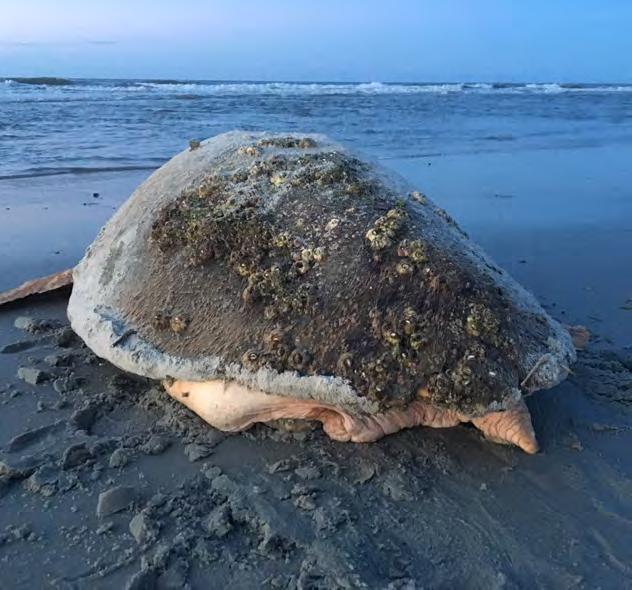
“Stumpy” is a term that we give to any nesting female loggerhead with an injured flipper. In the database, there are several “stumpies” with documented aborted digs and unique tracks in the sand that reveal injuries. Partial flippers can be compensated for, but absent flippers are a barrier to nesting.
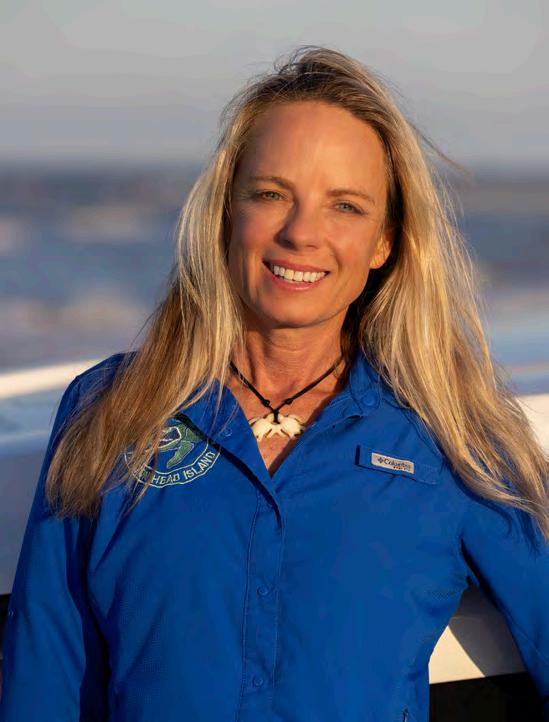
Amber Kuehn
I met my Stumpy in person in 2017. I took a picture of her injury as she crawled back into the ocean after several failed nesting attempts, one of which involved a canopy and beach gear left on the beach overnight, which had nothing to do with her handicap.
This incident resulted in two years of data collection and town meetings to create a municipal ordinance prohibiting unattended personal property left on the beach after sunset. The ordinance was passed in November 2019, just in time for Stumpy’s remigration after her two-year nesting interval.
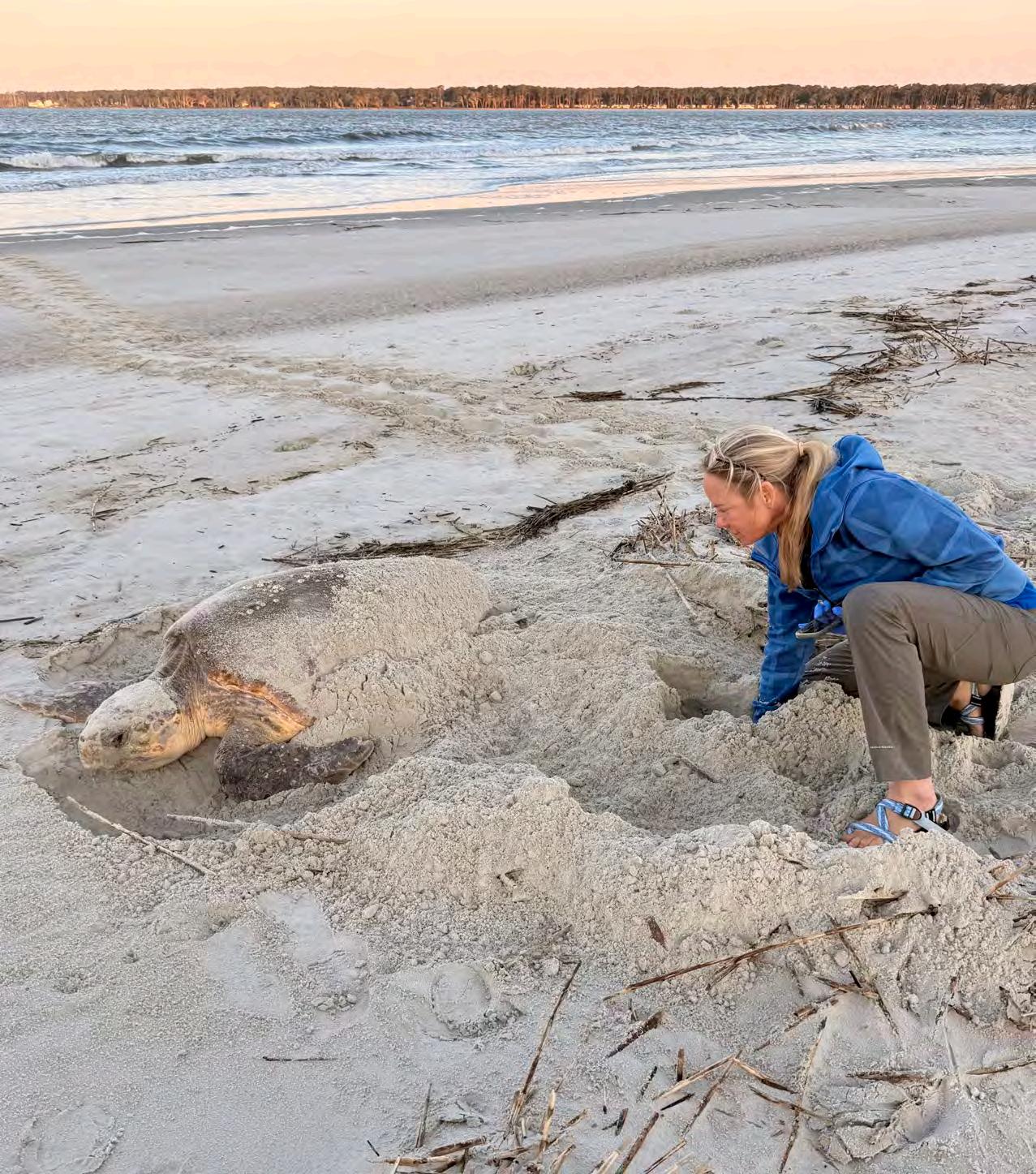
When I encountered her again on my night patrol in 2020, I did not hesitate to help her excavate the nest chamber that she desperately wanted to complete. I followed her distinct track and saw two aborted digs in the dry sand on her path. I quietly approached her from behind, and watched her right rear flipper clear the loose sand for a third attempt. Once the depression started to form, she scraped the compact sand, curled the end of her right rear flipper to lift the sand from the shallow hole, and then released the sand to the side by uncurling her flipper. She shifted her body to allow the opposite flipper to repeat these motions. However, Stumpy had lost her entire left rear flipper to a shark attack at some point after the 2012 nesting season (DNA tracking revealed a five-year hiatus). She proceeded to make the same motions on the left side, but only her hip moved behind the healed wound.
She continued to ineffectively allow her left hip to “dig.” I acknowledged her patience and the instinctual process that she allowed herself to endure. I had never excavated a nest chamber with a sea turtle before, but I didn’t hesitate to grab my “digger” from the truck. I dug for her missing flipper. I know the shape and size of a loggerhead egg chamber because I’ve seen thousands of them. I took great care to make it perfect.
I learned her rhythm very quickly as she shifted the weight of her 400-pound body, alternating sides. I promptly
Stumpy the Loggerhead
removed my hand, digging tool attached, when it was her turn. Stumpy’s intact flipper reached into the hole and as long as she felt progress, she continued. She scraped and shaped the walls for a narrower cylinder in the first 12 inches to provide direction for emerging hatchlings and then widened it at the bottom to ensure that all of the eggs in the clutch would fit. Honestly, I removed most of the sand while she made the fine adjustments. When I knew that the hole was deep enough, I sat back and watched her feel the walls of the egg chamber with her flipper as if she had waited for so long to successfully accomplish it.
It gave me pause to look up at the stars and “hear” the quiet. As she started to drop her leathery, ping pong ballshaped eggs into the two-foot vertical chamber, I reflected in amazement at what we had accomplished together. It wasn’t a competition, and we both benefitted from the experience.
I can’t explain why this encounter means so much to me, but it comforts me with the assurance that I am doing what I was meant to do. As a scientist, I can’t confirm that she realized I was there, but my soul believes that she receives her directives from the universe, powerful beyond comprehension. There must be some level of awareness and appreciation.
She covered her eggs, disguised her nest, and we went our separate ways. She will never return to her nest site, but Sea Turtle Patrol HHI will check on it daily. This perfect collaboration resulted in a 93% hatchling emergence success from the nest. Unfortunately, it was evident that all of her hatchlings had followed the exterior lights on a nearby rental home that were not shielded or directed downward. I had been working with town staff to revise the existing 1990 lighting ordinance, but it would take another year to see it through (March 2021). I was relieved that the revised lighting ordinance was passed before Stumpy returned to nest in 2023.
Stumpy and I have constructed four nests together –two in 2020 and two in 2023. She is due back this year. If we keep meeting up like this, I’ll be ready with my digger and honored to receive this rare blessing.
Since this encounter, I have assisted two other stumpies, but they are distinctly different – one with a “peg leg” and the other with a paralyzed flipper. My Stumpy is coming!
Visit SeaTurtlePatrolHHI.org for more information.
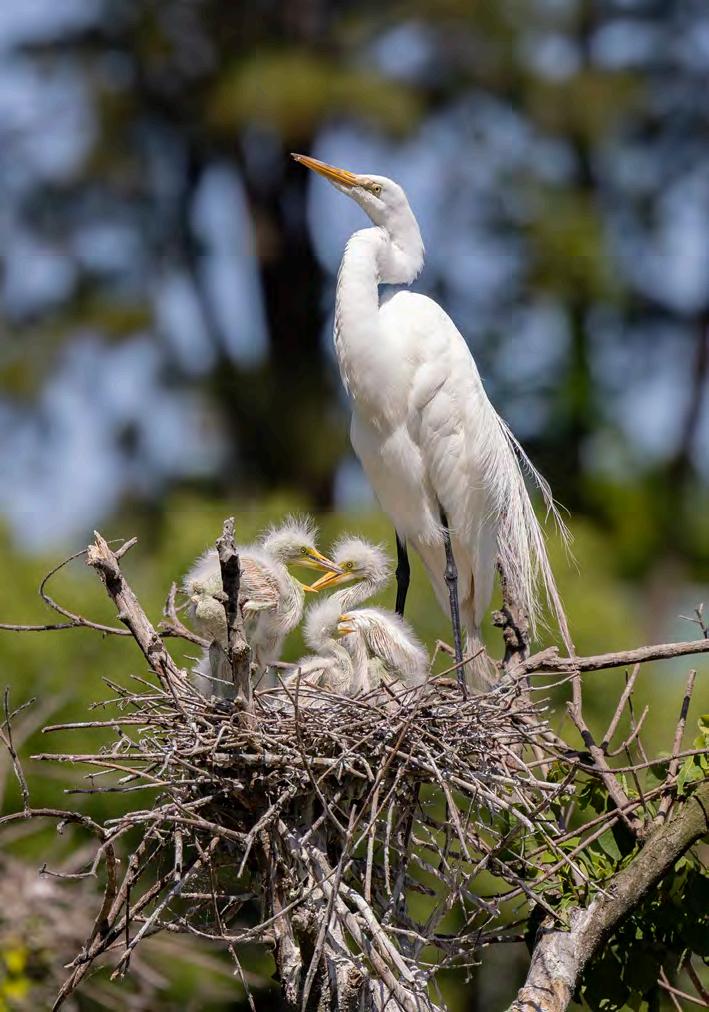
A Great Egret keeps a watchful eye over three new chicks.
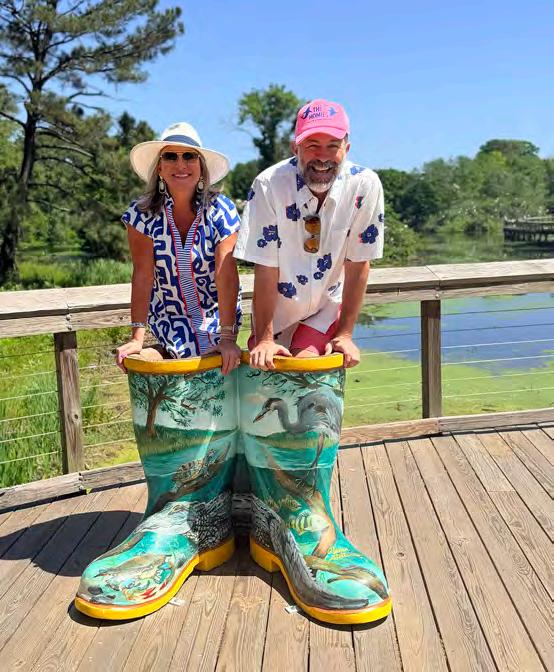
The Waterman's Wave Lowcountry Boot Trail is an art installation that launched in January 2024, coinciding with the Beaufort Oyster Festival. These oversize boots have been creatively painted by local artists and can be found at various places throughout the area.
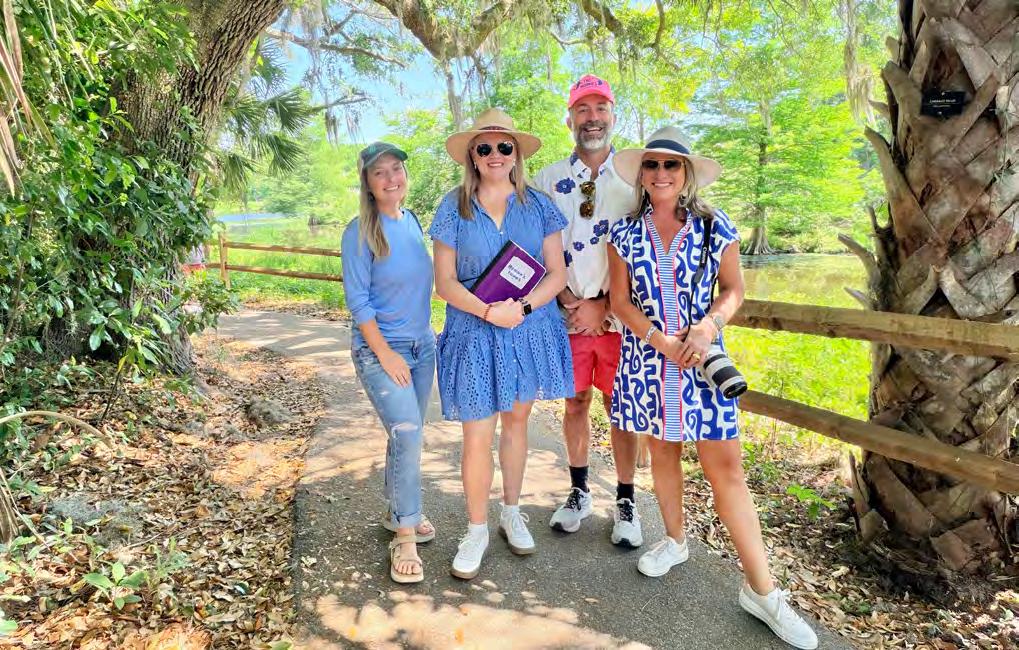
Mollie Kinard gives the CH2 crew a tour of the Cypress Wetlands. Educational outtings with Moore to Life, a concierge nature company, can also be scheduled at Hunting Island, Pinckney Island, Fish Haul Beach, and Botany Bay on Edisto Island.
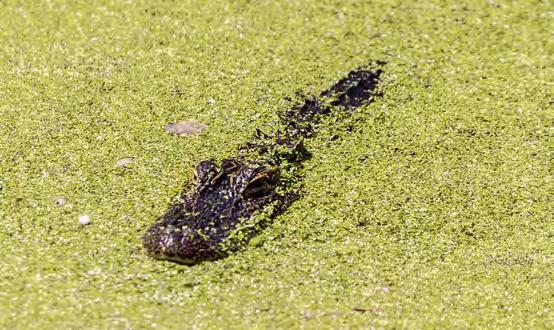
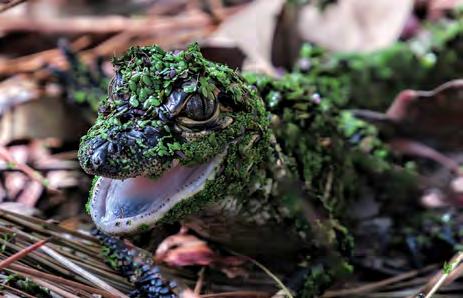
A curious alligator swims towards the shore.
Article by Brooke Peck
NESTING SEASON AT THE PORT ROYAL CYPRESS WETLANDS
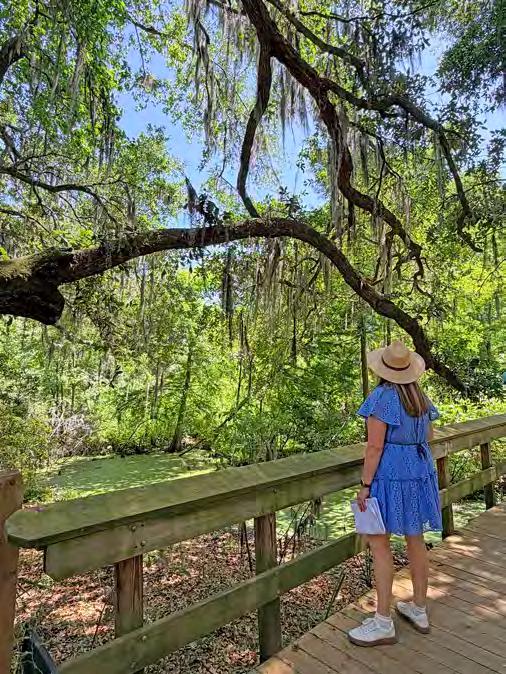
Just a short drive from Hilton Head and Bluffton is the quaint town of Port Royal, home to one of the most prolific rookeries for nesting birds in the Lowcountry. What started as a runoff retention pond in its downtown area has turned into an active mating habitat of thousands of birds and Lowcountry creatures each year.
The wetlands are managed through a partnership with the town of Port Royal and the nonprofit Friends of Port Royal Cypress Wetlands. Admission is free and open to the public during daylight hours. Visitors can expect about a half mile trail of pathways and boardwalks to explore this unique environment.
During a mid-April visit, the CH2 crew of Maggie Washo, Jevon Daly, and I met up with Mollie Kinard and Jill Moore. Both women are master naturalists who help people discover our region’s wildlife, ecology, and landscapes through Moore to Life, a concierge nature company.
Together, we explored the wetlands and learned why it’s a unique habitat full of plants and birds that all work together to survive and thrive. Springtime mating was on full display, with hundreds of birds on nests carefully watching eggs. We were excited to see that a few nests had already welcomed their babies.
Photography by Maggie Washo
One of the many boardwalks that offer viewing spots along the trail.
A male red-winged blackbird forages for insects.
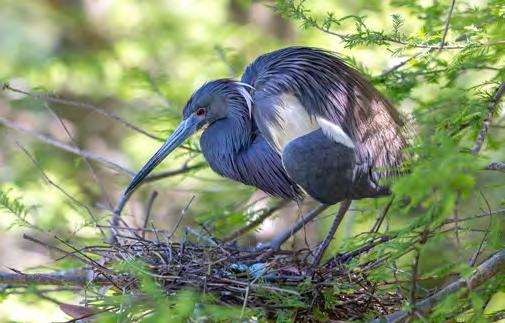
A Tri-colored Heron sits on small blue eggs.
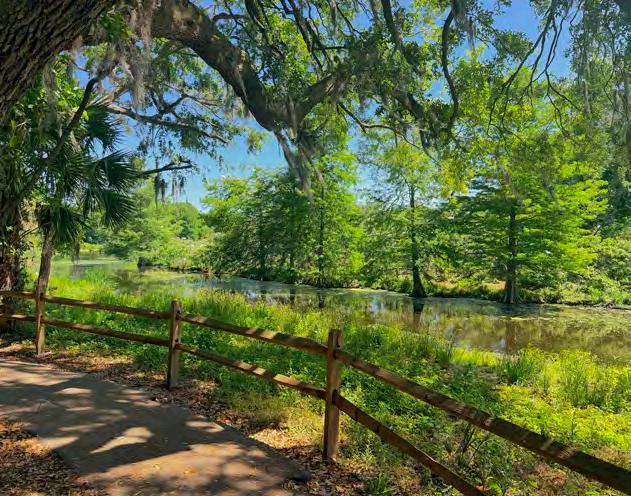
As we entered the wetlands from Richmond Avenue, I was immediately blown away by its beauty. Tall, lush trees surrounded us and offered coolness in their shade. Bird voices were loud and constant.
Kinard shared that the forest is home to bald cypress trees, deciduous conifers that are green in the summertime but lose their needles in the winter, leaving them bald. “In November-ish, they’ll turn this really pretty orangey cinnamon color,” she said.
A bald cypress trunk, the fluted buttress, is a wide, sturdy base that helps maintain its stability while surrounded by water. Its stubby “knees” look like tree stumps and are part of its root system.
As we peered at the forest, we quickly spotted our first birds, Black-crowned Night Herons, who make their nests in the shady forest on the edge of the wetlands. They are skilled hunters and most active after dusk, which draws them to the quiet forest for resting during the day.
When we emerged on the water’s edge, we watched birds that were constantly in flight as they worked to gather nest supplies and food, then stop to watch over their nests.
We witnessed a flurry of wood storks, ducks, anhingas, egrets, and roseate spoonbills in close proximity. We learned that most of the bird varieties are non-migratory but some birds, including roseate spoonbills, are migratory and usually arrive in late spring and stay throughout the summer.
“We’re super proud of the fact that our wood storks, which just came off the endangered and protected list in February, had less than 10 nests a few years ago, and last year we had 75 nesting wood storks,” Kinard said.
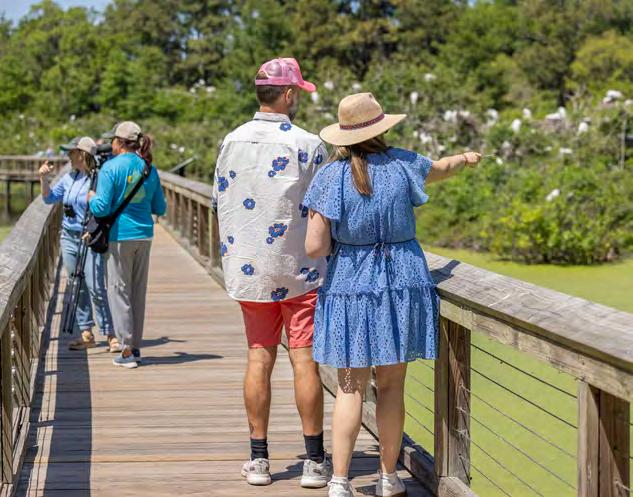
A large boardwalk offers a view from all vantage points, with hundreds of native birds tending to their nests.
next bird to visit was the Yellow-crowned Night Heron, who was busy building a nest. “These birds spend the first few weeks at Home Depot getting sticks,” Moore said. “Then once the nest is built, they turn to Home Goods to get leaves and Spanish moss to make little pillows and comfort items.”
As we made our way out of the forest onto the boardwalk over the middle of the wetlands, the busyness of nature’s activity made it difficult to know where to look. Gators were swimming on both sides of us, birds were flying overhead, hundreds of bird parents were in their nests, and some baby birds were perched in nests.
“The rookery involves all your senses,” Moore said. “You can hear things, see things, and you can definitely smell things.” We had experienced the first two senses in the forest but when we emerged over the water and got closer to the density of nests, the smell of pungent poo hit us very quickly. “It’s definitely a kind of fishy, insect odor to it,” Kinard said.
We spotted numerous gators of various sizes during our outing that help secure the rookery’s efforts. “They’re providing a kind of protection from things like snakes and raccoons to protect the nests,” Kinard said.
Bats also find their home in the wetlands. “We have a lot of little brown bats here,” Kinard said. “They really manage the mosquito and insect population. We always suggest
The
A shaded trail offers respite from the heat and a magnificent view.
to people, if you have bats around your yard, building bat houses is great because it keeps them out of your house and benefits the environment around you.”
In addition to wading birds and bats, we also spotted songbirds. Bird boxes are sprinkled around the wetlands for chickadees and bluebirds to make a safe home.
Between our guides’ master naturalist education and Daly’s self-taught knowledge, Washo and I were schooled about the flora in the wetlands. We sampled syrupy honeysuckles, which reminded me of my childhood. Moore pointed out elderberry flowers which both humans and birds use for their medicinal purposes. Daly broke up a wax myrtle leaf that can be used as a deterrent for bugs and Kinard pointed out wild poinsettias and bay leaves. We learned that yaupon holly leaves contain caffeine.
Most people know the phrase “Leaves of three, let it be” to help avoid a poison ivy interaction. But Kinard gave us an extra warning about poison ivy vines. “It looks hairy, it has all these little tendrils coming off of it, which tells you it’s poison ivy,” she said. “That vine can be just as itchy as the leaves; it will have all the same oils. I do remind people if they are cutting poison ivy out of their yard, do not put it in a burn pile because you can get it in your lungs.”
Kinard showed us a large muscadine grape vine with lines of dots. “See all these little spots in a perfect line?” she asked. “This is one of those things that once you see it, you’ll never be able to unsee it. Those are holes made by a Yellow-bellied Sapsucker. They are woodpeckers that hang out here in the wintertime but always leave their mark before they go.”
Though we visited the wetlands in the spring, it remains an active habitat for visitors to enjoy in the summertime as well. “You’re going to have a lot of babies that were born in late April and early May start to be fledging, so you’ll see a lot more action,” Kinard said. “A lot of juveniles hang out around the outskirts trying to learn how to hunt and fish on the edges of the pond.”
The Port Royal Cypress Wetlands is just one of the many locations where Moore to Life offers concierge services. Educational outings can also be scheduled at Hunting Island, Pinckney Island, Fish Haul Beach, and Botany Bay on Edisto Island. Tours can be tailored to meet the needs of each group. Visit moore2lifesc.com for more information about all their tour offerings.
Visit friendsofportroyalcypresswetlands.org to learn more about the Port Royal Cypress Wetlands Preserve.
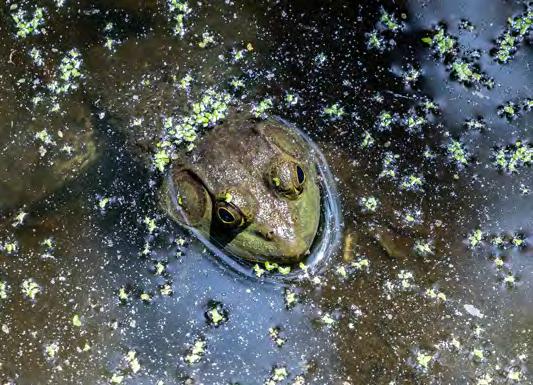
An American Bullfrog
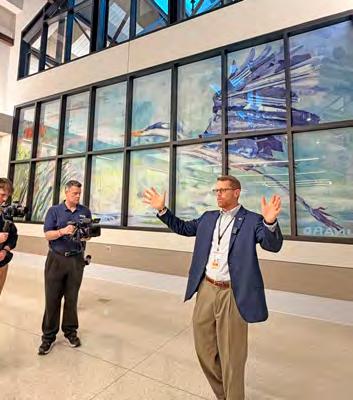
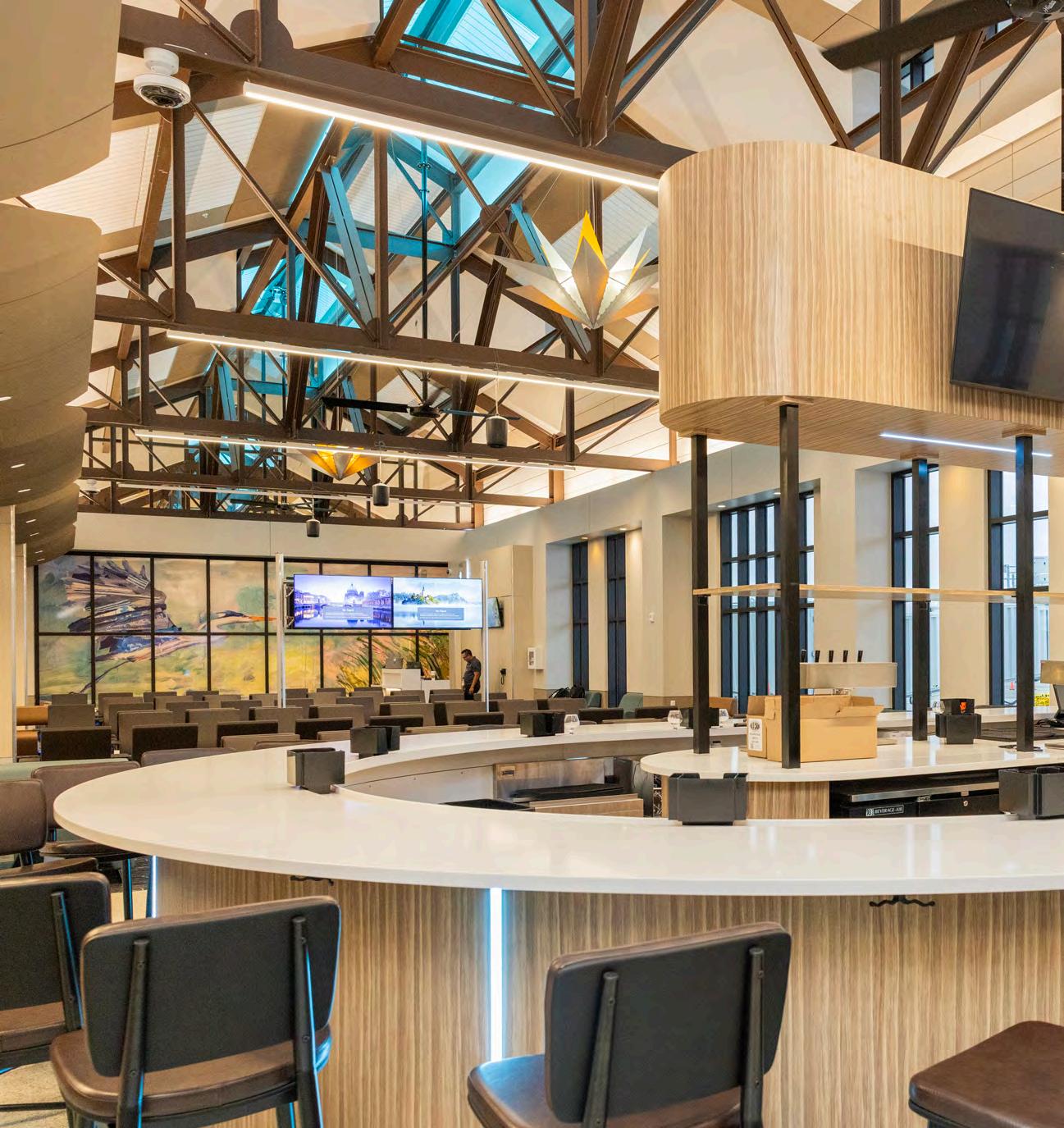
The new terminal at Hilton Head Airport opened last month. The project took six years of planning and construction plus a budget of $42 million.
Article by Brooke Peck
HILTON HEAD ISLAND’S NEW AIRPORT TERMINAL NOW OPEN
Many people never need a reason to leave Hilton Head Island but now they might have one. Phase one of the terminal expansion project at the Hilton Head Island Airport is complete and summer travelers are in for a treat. It’s expansive, airy, well thought through, shiny, and new.
“It’s kind of hard to believe we’re here,” said Jon Rembold, airports director for Beaufort County. “We broke ground in November of 2023 and then construction started in earnest in February of 2024. So it’s been just over two years from trees and dirt to this gorgeous building.”
The total project took six years of planning and construction plus a budget of $42 million. The money was secured from the Federal Aviation Administration (FAA). “The beauty of it is we are a county airport but there’s no tax money in the building,” Rembold said. “That also carries through all our projects, payroll, and everything else at the airports. Our team is a county team, and this is a county facility, but all expenses are paid by revenues generated at the airport.”
According to Rembold, Hilton Head Island Airport (HHH) is the smallest commercial airport in the country. Sitting on just 200 acres, the airport averages about 300,000 visitors a year, with fewer than 10 departures per day. According to its website, direct flight routes are seasonal with travel to LaGuardia, Charlotte, Atlanta, Newark, Boston, Philadelphia, DC, and Chicago.
During COVID, the island experienced a massive
Photography by Maggie Washo
influx of travelers. “We literally had passengers completely filling that (old) building, out the doors, and down the sidewalks waiting to get to TSA,” Rembold said. “We were actually handing out water during the summer to everybody who was standing in line outside.”
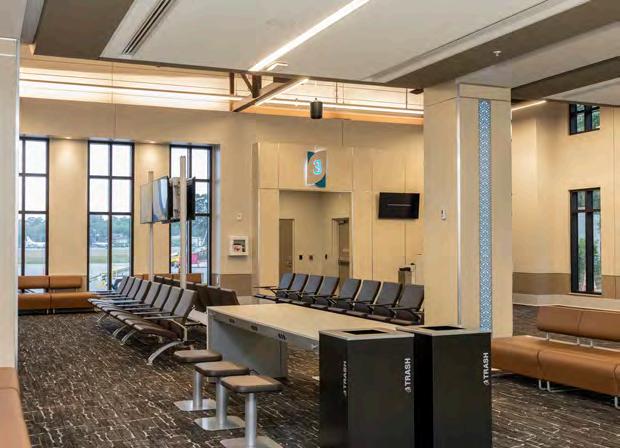
The new, spacious terminal opened May 1. With a modern design, high ceilings, and natural light, it offers more than 27,000 square feet and houses three gates. Delta Air Lines, United Airlines, and American Airlines each have a dedicated gate.
The new terminal has seating for about 350 people, which is almost triple the old seating capacity. “We have enough (room) to have at least one airplane load from each airline in here at any given time,” Rembold said. “The fire marshal likes us a lot better now.”
Each gate also includes a modern jet bridge found in most major airports but new to HHH. Previously, passengers had to walk out on the tarmac to an exterior ramp to enter planes. Now, the new jet bridges easily guide passengers from the terminal directly to their aircraft. This upgrade makes flights more accessible for all abilities and eliminates weather concerns.
Passengers will also experience an expanded security area. The original commercial terminal opened in 1995 with four gates prior to the required security procedures being installed after 9/11. As a result, the airport had to get creative on fitting the TSA security process into its existing footprint. About 30% to 40% of the terminal space was needed for TSA, which took the number of operational gates from four to two. Even though they made it work, the area was cramped
and led to long lines.
Eventually, a third gate was needed when an additional airline came to HHH. It came in the form of a modular building with three bathrooms and a small concession stand. With the opening of the new terminal, the older building
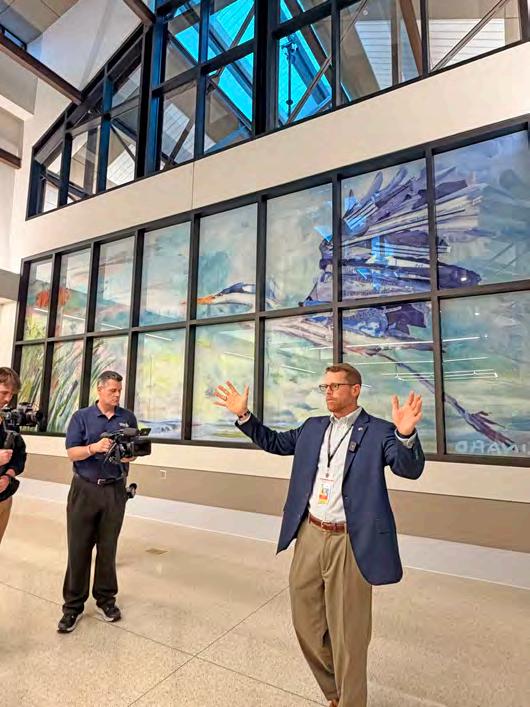
Jon Rembold, airports director for Beaufort County, speaks to the media one day before the new terminal opened to the public.
is no longer needed and will be re-purposed elsewhere in Beaufort County.
The new TSA security layout has a larger queuing area, two ID checkpoints, two security imaging lines, and a space for securing belongings after completing security. TSA agents also have their own internal training room and break areas in the new facility.
As travelers transition from TSA security to their gates, they pass by a massive art glass installation created by Charleston artist Christy Kinard. “Focused Precision” was selected from 225 submissions after the airport issued an open call to Lowcountry artists. It features a great blue
heron in flight towards the Harbour Town Lighthouse in Sea Pines Resort.
Other terminal upgrades include large, modern restrooms, including a family restroom. Pet owners will enjoy access to the outdoor pet relief area before boarding or upon arrival. This fenced amenity offers fresh water and a sink.
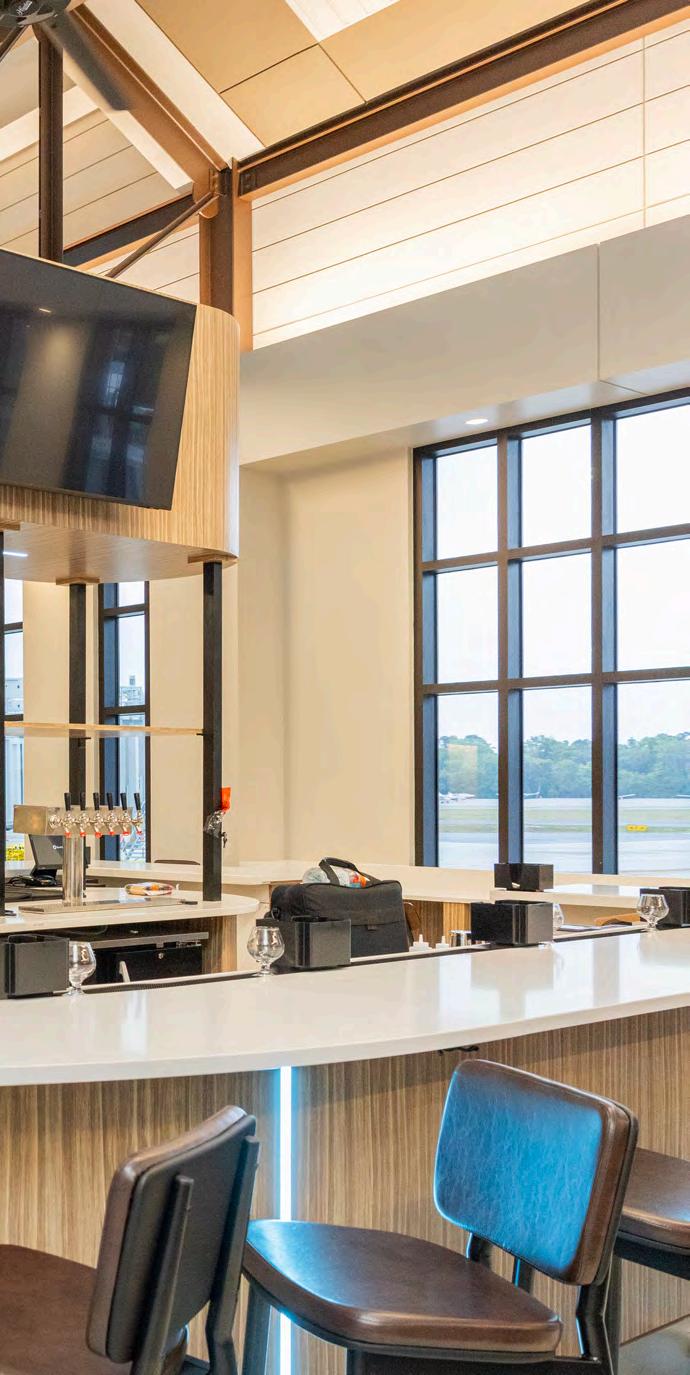
Some passengers will be excited to learn that the new terminal also houses a bar. Located between gates 1 and 2, the large semi-circle bar seats about 25 people for food and drinks.
Tailwind Airport Concessions has been contracted by HHH to provide concessions in the new terminal. Traditional airport snacks and drinks will be available, but the goal is to also provide local flavors and treats to greet visitors and highlight locally owned businesses.
The traffic pattern for the airport has also been improved. More lanes are available for picking up and dropping off travelers. Future plans are in place to improve the parking lot conditions as well.
It’s important to note that the baggage claim area is still in its original form. Upgrading the baggage claim process is scheduled to take place in phase two of the project, but planning and securing funding is still necessary before its construction can begin.
The goal for phase two is to renovate the old terminal area, install a baggage claim carousel, expand rental car areas, and increase the overall technology. The estimated cost for phase two is another $42 million dollars.
The new terminal has seating for about 350 people, which is almost triple the old seating capacity.
What Is Our Model Thinking?
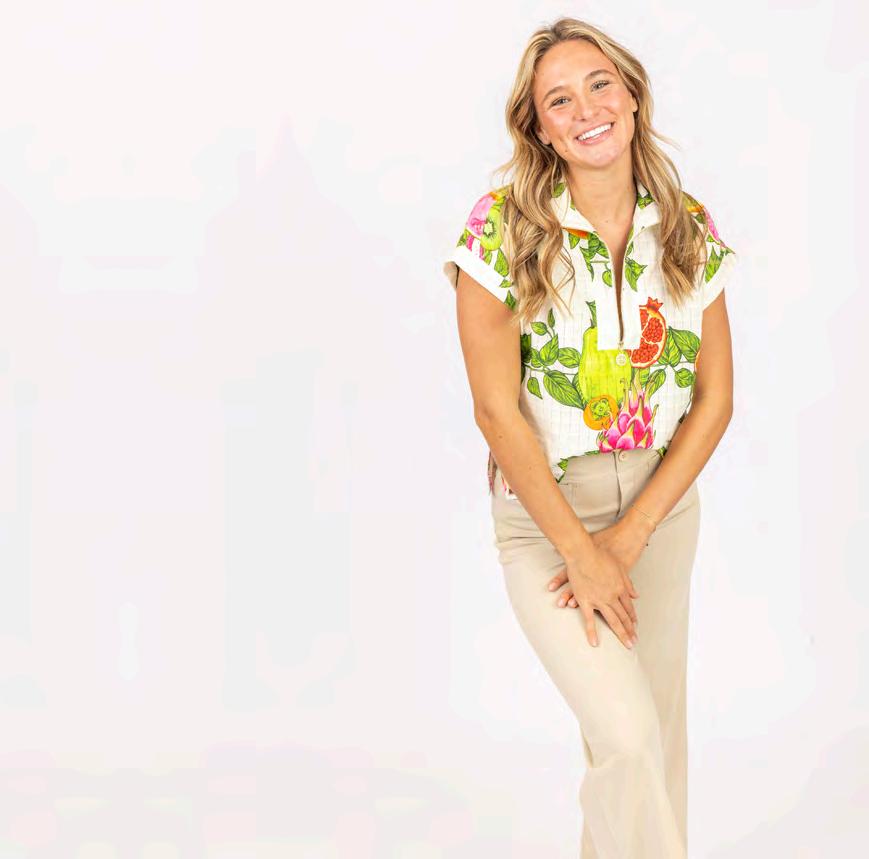
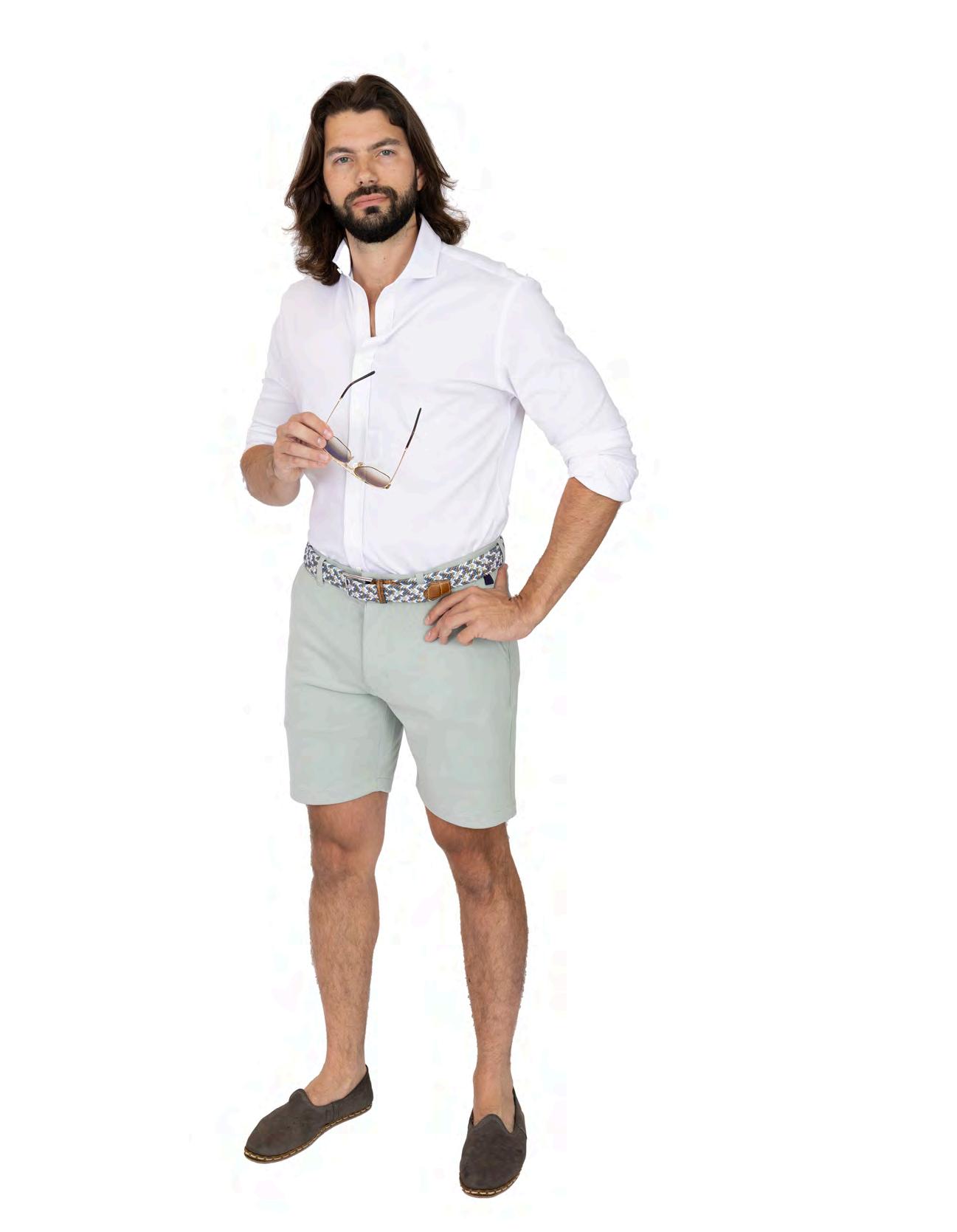
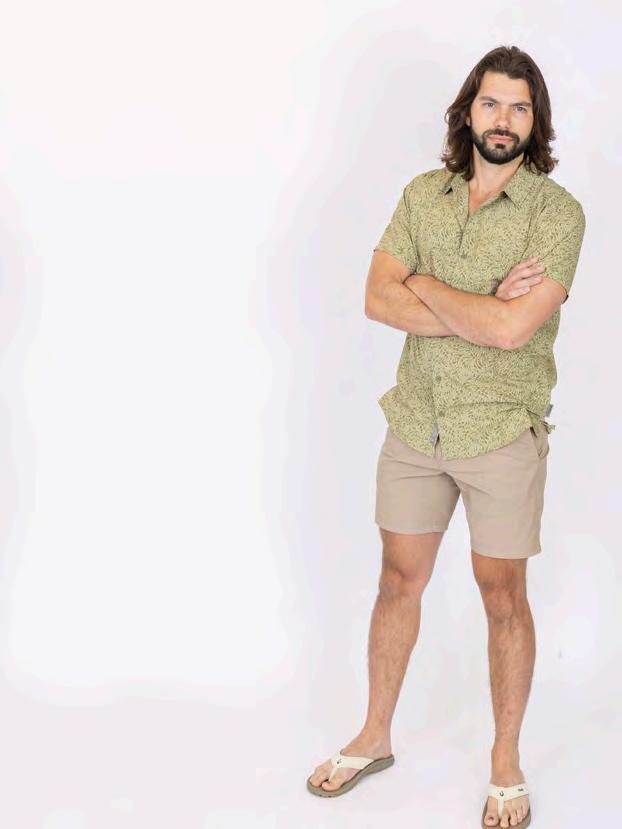
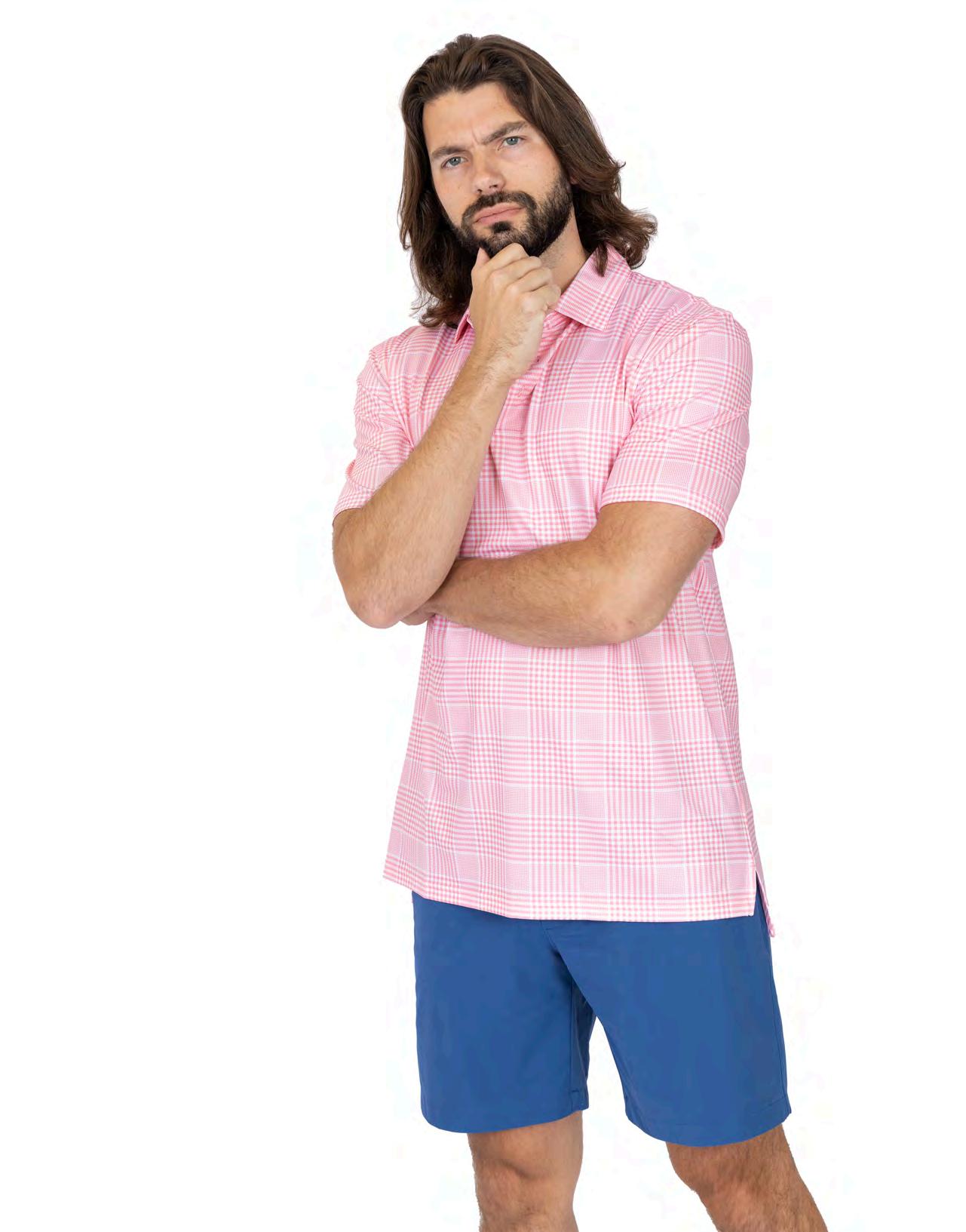
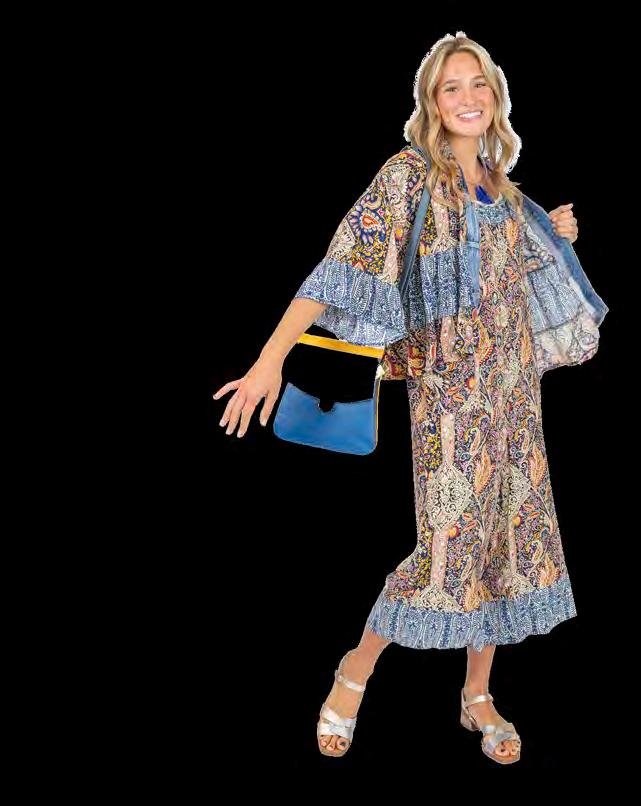
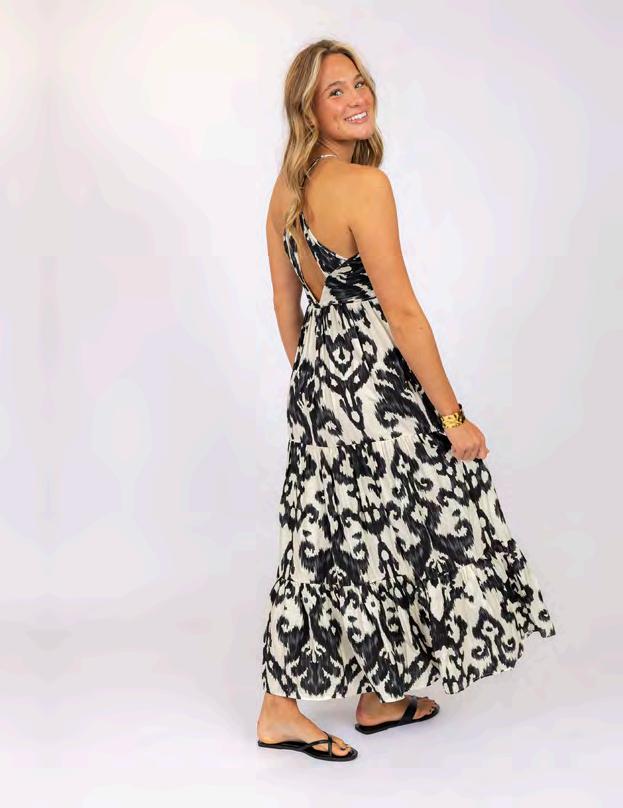
THEY SAY A PICTURE IS WORTH A THOUSAND WORDS, BUT WE DON'T HAVE THAT KIND OF SPACE. GUESS WHAT IS GOING ON IN OUR MODEL'S HEAD IN EACH PHOTO. WE GAVE YOU SOME IDEAS TO MAKE IT A BIT EASIER FOR Y’ALL.
I wish I had a double espresso on the way here.
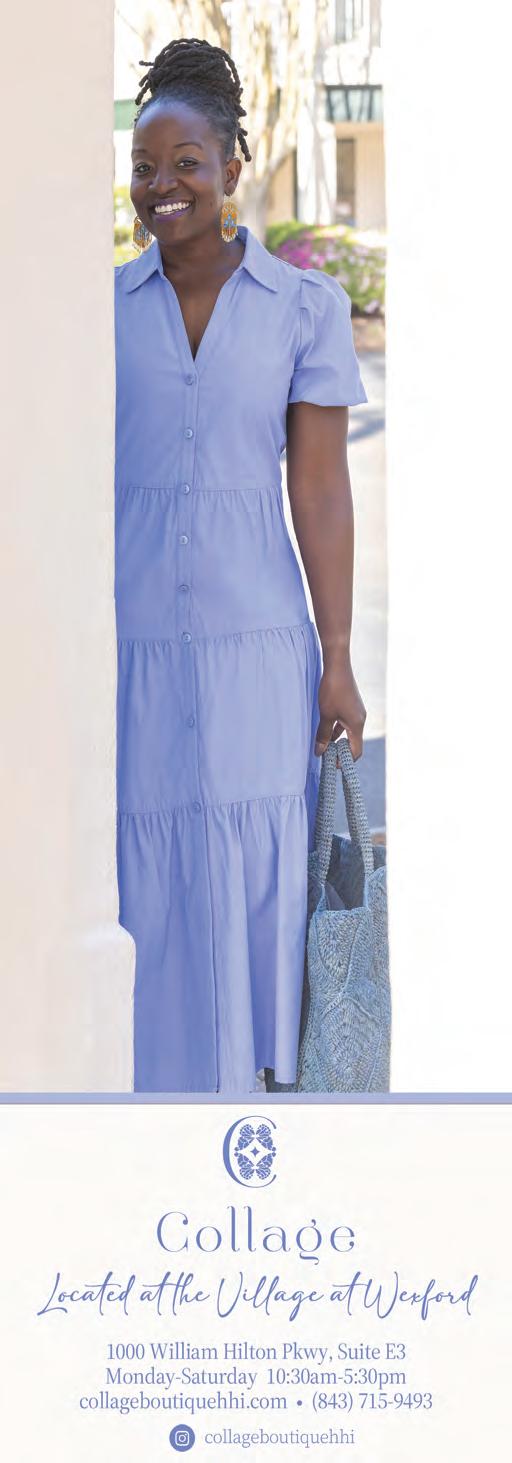
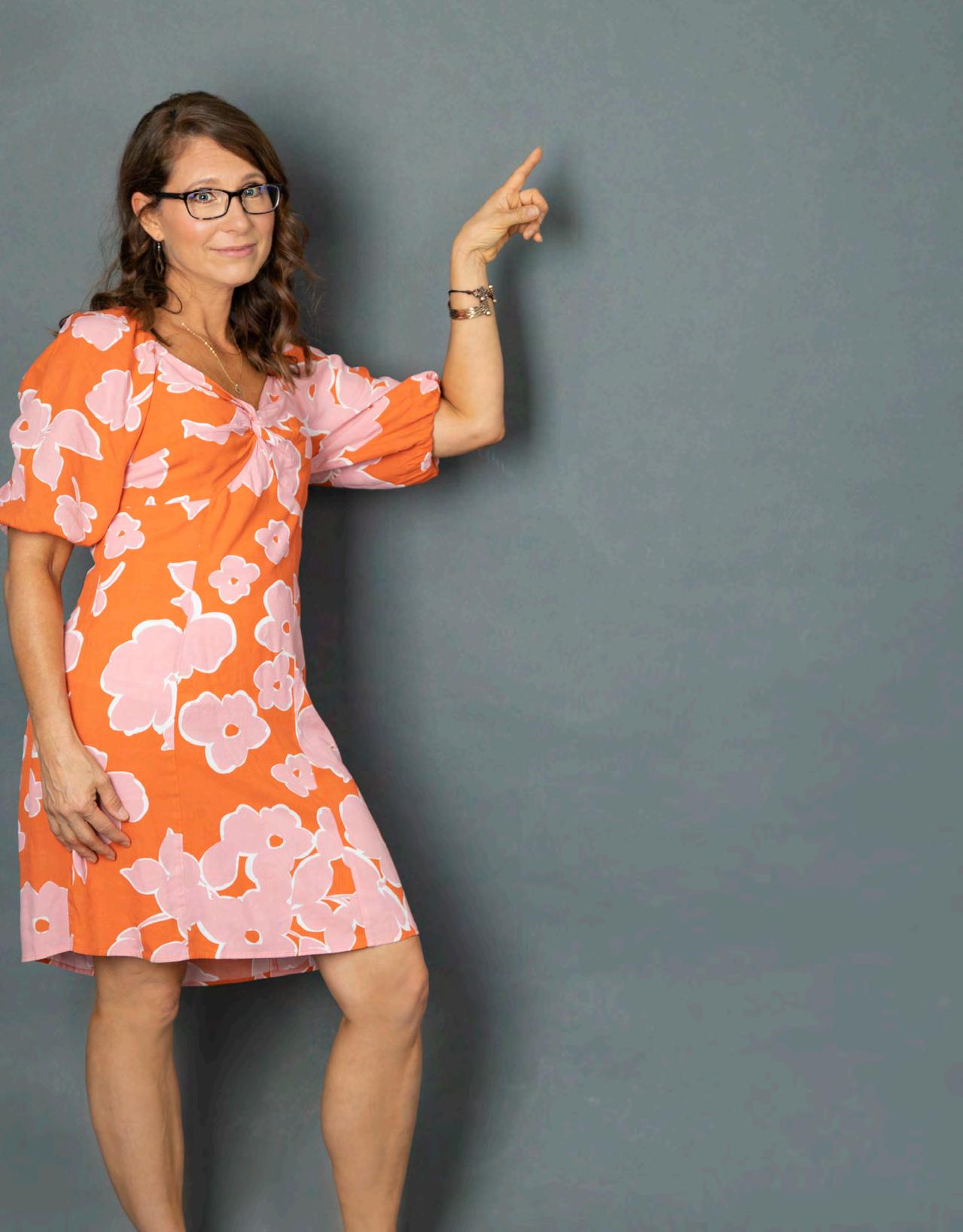
Find Summer's ensemble at Collage
Styled by Kandace Cunningham
Photography by Maggie Washo
Special thanks to our models
Summer Schultz and Zach Woods
This
makes me want fruit!
Find Summer's ensemble at Coastal Bliss
Find Summer's ensemble at Evelyn + Arthur
shirt
stillIsitraining outside?
Find Zach's ensemble at John Bayley
Find Summer's ensemble at Jean-Pierre
I can't wait to tell my friends what I did today!
Klifa
Justanother cdayatwork!
Find
This shirt wouldbegreatfor anightout.
Summer's ensemble at Palmettoes
Find Zach's ensemble at Palmettoes
Find Summer's ensemble at Maggie & Me
Find Zach's ensemble at Outside Hilton Head
Iwonderifwewillbreakfor lunch?
Find Zach's ensemble at Southern Tide
Ineedthis
bag!
This dress is perfect for summer!
Find Summer's ensemble at The Haven
Find Summer's ensemble at Gigi's Boutique
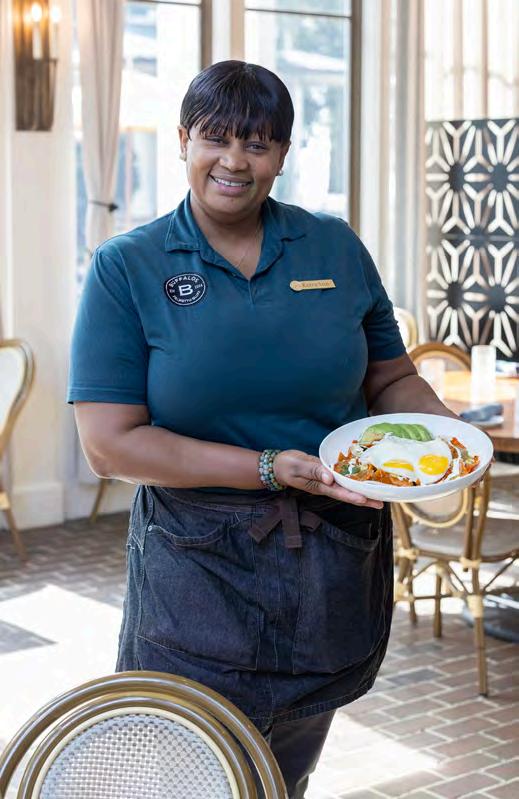
Made with corn tortillas, fried eggs, salsa roja, and lime crema, the chilaquiles srtike the perfect balance between texture and flavor.
Article by Cheryl Ricer
Sunday Brunch, Lowcountry Style
ENJOY AN AFTERNOON AT BUFFALOS IN MONTAGE PALMETTO BLUFF
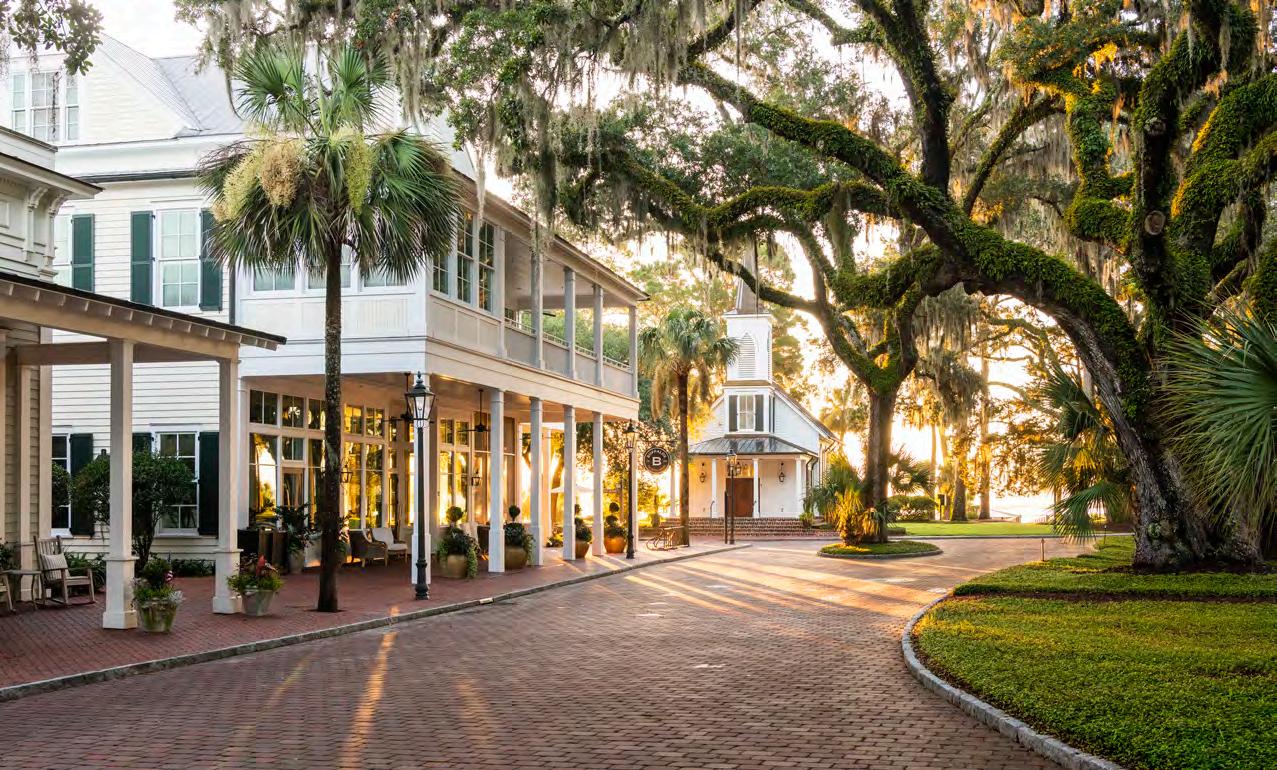
There are brunches, and then there are experiences – those magical, slow-paced afternoons where the food is exceptional, the cocktails are thoughtfully crafted, the music drifts through the air like part of the scenery, and nobody at the table wants to leave. That’s exactly what my husband and I discovered during a recent Sunday brunch at Buffalos in the heart of Wilson Village at Montage Palmetto Bluff.
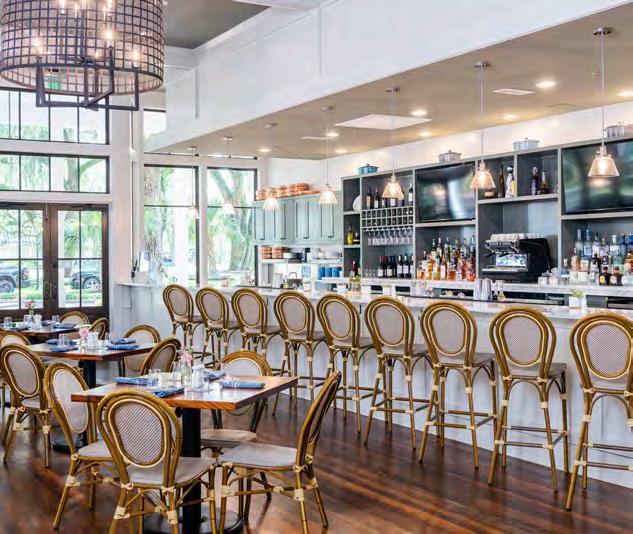
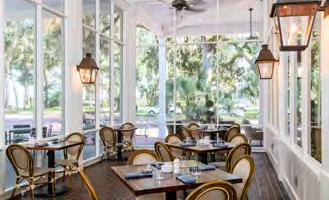
Buffalos manages to strike that elusive balance between upscale dining and relaxed Lowcountry charm. The bright, airy dining room spills naturally into outdoor seating surrounded by moss-draped oaks and lush greenery, while the energy inside feels polished without ever becoming pretentious. Families gathered around oversized brunch spreads. Couples lingered over cocktails. Groups of friends toasted with flutes of champagne, and
Photography Provided by Palmetto Bluff
bottomless mimosas flowed generously alongside signature cocktails, beer, and wine.
Adding to the atmosphere was live music by a local guitar soloist whose easy acoustic style somehow perfectly matched the pace of brunch itself – unhurried, soulful, and distinctly Southern.
The entire experience felt less like dining out and more like slipping into a leisurely Lowcountry Sunday tradition.
One of the things that made the afternoon especially memorable was the fact that Buffalos is wonderfully dogfriendly – something our three teacup Yorkies greatly appreciated. We opted to sit outside beneath the shade of the oaks, where the entire scene unfolding around us felt almost cinematic in its charm.
Throughout brunch, locals and visitors alike strolled through Wilson Village with dogs of every breed imaginable
happily trotting alongside them. Children laughed and played bocce ball across the park while couples wandered hand-in-hand between the nearby shops and pathways. Every 30 minutes, the church bells chimed softly through the village, adding another layer to the relaxed, storybook atmosphere that makes Palmetto Bluff feel so distinctly special.
There’s an intentional slowness to life there – a sense that people are encouraged to pause, linger, and simply enjoy where they are.
And honestly, Buffalos is perfectly designed for exactly that.
Naturally, we began with cocktails.
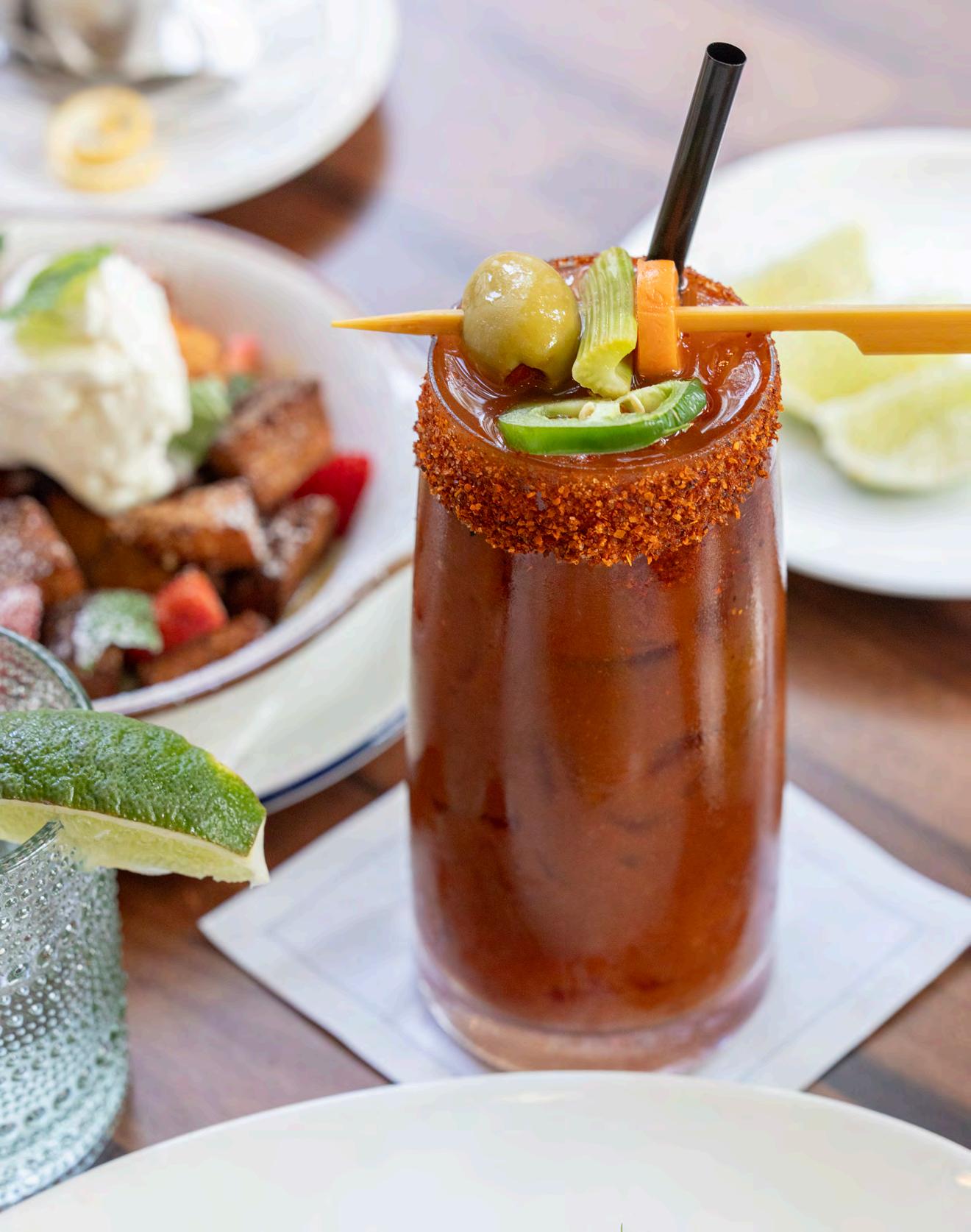
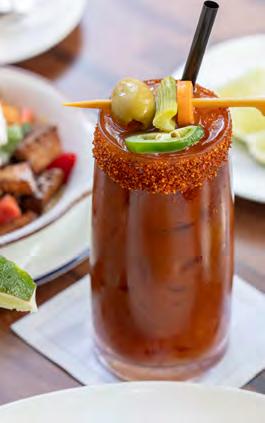
I ordered the Spicy Bloody Mary, served in a salt-rimmed glass garnished with lime, olive, and pickled okra. It was
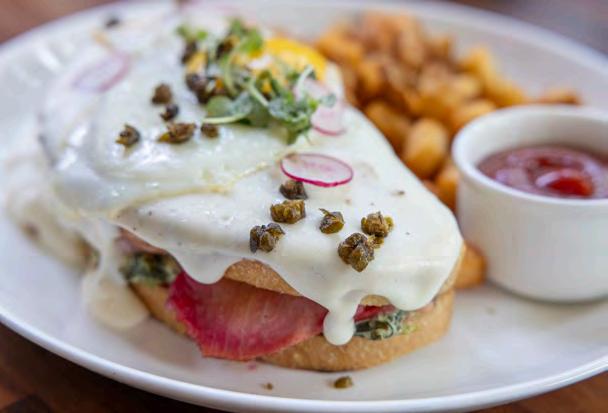
The Smoked Salmon Croque Madame.
Avocado Toast
visually dramatic in the best possible way, but more importantly, it delivered exactly what a Bloody Mary should: bold tomato flavor, savory spice, a subtle kick of heat, and enough complexity to keep every sip interesting. The salt rim paired beautifully with the acidity of the drink, while the garnish added that classic brunch indulgence that somehow makes you feel as though you’re drinking and snacking simultaneously.
My husband opted for the signature Buffalos Old Fashioned, crafted with Bacon Fat Washed Maker’s Mark bourbon, angostura bitters, sugar, orange twist, and cherry garnish. If you’re an Old Fashioned fan, this cocktail alone is worth the trip. The bacon fat washing gave the bourbon an almost velvety richness and subtle smoky depth without overpowering the drink. Balanced with citrus oils from the orange twist and the sweetness of the cherry, it was smooth, layered, and undeniably memorable.
Before our entrées arrived, we decided to share a couple of appetizers – a decision I highly recommend.
First came the Classic Deviled Eggs topped with bacon jam. These weren’t your grandmother’s picnic deviled eggs, though they certainly carried a hint of Southern nostalgia. The filling was creamy and velvety with just enough tang, while the bacon jam added a smoky sweetness that elevated the entire dish into something far more indulgent.
Alongside the eggs came a basket of perfectly crisp French fries served with spicy mayo. Simple? Maybe. But there’s something undeniably satisfying about great fries at brunch, especially when paired with cocktails and conversation. The fries were golden, crisp on the outside, fluffy on the inside, and utterly addictive when dipped into the creamy, slightly spicy sauce.
Kerry Ann Williams has been a smilimg face at Buffalos for over 18 years.
Together, the appetizers set the perfect tone for the meal ahead: elevated comfort food done exceptionally well.
For my entrée, I chose the Chilaquiles – and I’d order them again tomorrow without hesitation. Made with corn tortillas, fried eggs, salsa roja, and lime crema, the dish struck that perfect balance between texture and flavor. The tortillas maintained just enough structure beneath the sauce to avoid becoming soggy, while the salsa roja delivered warmth and spice without overwhelming the palate. The fried eggs added richness, and the lime crema brightened every bite with just the right amount of acidity. It was hearty without feeling heavy – a brunch accomplishment that deserves recognition all on its own.
My husband was equally impressed with his Smoked Salmon Croque Madame, which featured spinach, béchamel, and fried egg, finished with capers and dill atop fresh sourdough bread. It did not disappoint.
The sourdough offered the perfect crunch against the creamy béchamel, while the smoked salmon brought a delicate saltiness that paired beautifully with the richness of the egg. The capers and dill added brightness and balance, cutting through the creaminess with little bursts of flavor that kept every bite interesting. And truly, who doesn’t love a great béchamel sauce? This one was silky, luxurious, and exactly what the dish needed to tie everything together.
As we enjoyed our meal, I found myself watching other dishes being delivered, each one more tempting than the last. That’s part of the fun of brunch at Buffalos: Even if you love what you ordered, you’ll inevitably start planning what you want to try next time.
The Blue Crab Benedict looked especially popular, featuring toasted English muffins topped with blue crab, poached eggs, hollandaise, and crispy hash browns. Nearby diners enthusiastically devoured the French Toast bites, dusted with powdered sugar and topped with whipped cream. Another table shared the Signature Biscuit Board, complete with pimento biscuits, butter, seasonal jam, and honey – a dish that perfectly captures the restaurant’s Lowcountry roots.
For those seeking more traditional Southern brunch fare, Buffalos also offers dishes like Lowcountry Biscuit and Gravy, shrimp and grits, omelets, and classic breakfast staples, all executed with a polished culinary touch that
reflects the standards of the Montage brand without losing the warmth and comfort that Southern cuisine demands.
And while the food is certainly the star, what truly makes Buffalos memorable is the atmosphere surrounding it.
There’s a rhythm to Palmetto Bluff that encourages people to slow down. Perhaps it’s the towering live oaks. Perhaps it’s the nearby May River. Or maybe it’s simply the intentional hospitality woven into every corner of the property. Whatever the reason, brunch at Buffalos feels wonderfully disconnected from the frantic pace of everyday life.
Nobody rushes you through your meal. Nobody hovers with the check before you’re ready. Guests linger over one more cocktail, another cup of coffee, or one final conversation while music drifts softly in the background.
It feels luxurious in a way that has nothing to do with formality and everything to do with time.
Even after finishing brunch, we weren’t quite ready to leave the moment behind. Thankfully, Wilson Village makes it easy to continue the experience long after the last sip of coffee or cocktail. Just steps away from the restaurant sits Melt, the charming ice cream shop that has become something of a destination.
While Buffalos certainly offers sweet brunch options, there’s something undeniably nostalgic about strolling next door for a scoop or two of handcrafted ice cream after brunch on a warm Southern afternoon.
Watching families gather outside Melt with cones in hand while dogs lounged beside shaded benches felt like the perfect continuation of the day. It’s the kind of simple pleasure that somehow becomes a lasting memory.
That, perhaps more than anything else, is the magic of Palmetto Bluff.
It isn’t simply about the meal, though the meal is exceptional. It’s about the way the entire experience slows you down enough to notice the details: the church bells, the music, children laughing in the distance, ice cream melting a little too quickly in the Carolina heat, and the unmistakable feeling that for a few hours, you’ve stumbled into a version of the Lowcountry exactly as it was meant to be enjoyed.
To plan your next brunch, visit Montage.com/ PalmettoBluff/Dining/Buffalos.
Article by Cheryl Ricer
Photography by M.Kat
SECOND ACT, FIRST DRAFT
How a Local Author Turns a Lifetime of Stories into a Thriving Series
For many, retirement signals a slowing down. For Frank Lazarus, it marked the beginning of an entirely new chapter filled with intrigue, plot twists, and the quiet discipline of daily writing. A longtime financial services professional, Lazarus has transformed a lifelong curiosity about storytelling into a growing body of work that blends crime, humor, and real-world inspiration.
Born and raised in Philadelphia, Lazarus spent more than five decades in the financial services industry. His career was rooted in logic, numbers, and structure – an unlikely training ground, perhaps, for a novelist. But beneath that pragmatic exterior, there was always a creative undercurrent waiting to surface.
“I think someone told me 40 years ago that everybody has a novel in them,” Lazarus said. “I tried to write one back then, but it went nowhere. Every few years, I’d revisit it, maybe add a sentence or two – but it never really took off.”
That early attempt might have stalled, but the impulse never disappeared. About 20 years ago, Lazarus began writing a blog, not with aspirations of fame or fortune, but simply as a way to stay connected. Shared with a small circle of friends and family, his posts offered humorous takes on everyday life, often described by readers as having a “Seinfeld-ish” tone.
“I wasn’t trying to build an audience,” he said. “It was just an outlet. But it helped me find my voice.” That voice would later become the foundation of his fiction.
Lazarus first came to Hilton Head around 2006, eventually purchasing a home in Bluffton before relocating full-time to the island in 2021. With retirement came something many professionals struggle to find: time. And with time came possibility.
The turning point arrived unexpectedly. A friend shared a manuscript that had been rejected by publishers. After reading it, Lazarus had a realization – one that would change his trajectory.
“I thought, ‘I could do this,’” he said.
That spark of confidence led him back to the idea he had shelved decades earlier. Drawing on his experience in the life insurance industry, Lazarus crafted his first novel, The Murder Gambit, weaving in a little-known but fascinating niche of the business as the backbone of a crime story.
“I had no idea how to get it published,” he said. “Then someone introduced me to self-publishing, and that changed everything.”
Building a Series and a Style
What began as a single novel soon evolved into something more expansive. Encouraged by others who understood reader habits, Lazarus pivoted toward writing a series, introducing recurring characters that audiences could follow from book to book.
His Brown and McNeil series was born, anchored by two characters who emerged organically from his first story: Vernon Brown, a detective, and James McNeil, the son of one of the victims in Lazarus’ first book (in which the two characters met). Subsequent books expanded both the narrative scope and thematic depth, incorporating elements as varied as high school basketball, socioeconomic contrast, and regional identity.
Books two and three, for example, explore the world of competitive basketball, juxtaposing vastly different environments – from affluent communities in Massachusetts to overlooked towns in Virginia. The result is a layered narrative that blends mystery with social observation.
“I read a lot of authors like John Grisham and James Patterson,” Lazarus said. “So I think I absorbed a feel for that genre – legal thrillers, procedurals. But over time, I’ve developed my own style.”
That style, he said, leans heavily on dialogue, infused with light humor and the unmistakable cadence of a Philadelphia upbringing.
While Lazarus draws inspiration from his professional background and personal experiences, his approach to research reflects the tools of a modern writer. “I rely a lot
Frank Lazarus with his latest book, The Coligny Beach Murders.
For Lazarus, writing remains a passion project, one that balances creative fulfillment with a realistic view of the industry.
on Google and AI, but only for research,” he said. “If I’m writing about a place I’ve never been – like Emporia, Virginia – I’ll research everything: demographics, geography, legal systems. It’s all accessible now.”
This blend of lived experience and digital research allows Lazarus to create believable worlds without being constrained by geography. It also underscores a key theme in his work: the intersection of reality and imagination.
That intersection is perhaps most evident in one of his favorite books, The Murder Hobbyist. When Fiction Gets Personal
Unlike his earlier works, The Murder Hobbyist takes a bold narrative turn – placing Lazarus himself at the center of the story as a fictionalized version of the author.
“I wrote it in the first person,” he said. “The premise is that I’ve learned so much about murder from writing these books that I decide to try committing one – and see if I can get away with it.”
What follows is a meta-narrative that blurs the line between author and character, fiction and reality. The story
begins in Philadelphia but quickly shifts to Hilton Head, where Lazarus' fictional counterpart becomes entangled in a second murder – this time as the prime suspect.
The detectives from his earlier books re-enter the scene, traveling south to investigate, creating a crossover that ties the series together while introducing readers to the Lowcountry setting Lazarus now calls home.
“It was a lot of fun to write,” he said. “A little risky, too. Some people weren’t sure what to make of it.”
That risk paid off, not only in terms of storytelling but also in expanding the geographic and emotional range of his work. His latest book, Coligny Beach Murders, continues that evolution, grounding the mystery firmly in Hilton Head’s coastal landscape.
Beyond Fiction:
Humor, Dating, and Observation
In addition to his novels, Lazarus has published two nonfiction books that showcase another side of his writing.
One is a compilation of his blog posts, spanning two decades of observations about modern life. Titled Is Anything All Right?, the collection offers a humorous, sometimes exasperated look at everything from customer service to cultural quirks.
The other, 103 First Dates: Mismatch.com, chronicles his personal experiences with online dating after the age of 60.
“It’s tongue-in-cheek,” he said. “But there’s truth in it. I let readers decide what’s real and what’s fiction.”
The book has struck a chord, particularly with women, who find both humor and relatability in the stories.
Despite his growing catalog, Lazarus is quick to temper expectations for aspiring writers. “It’s tough,” he said. “You can write a great book, but getting it noticed is another challenge entirely.”
With millions of titles available online and thousands more added each month, visibility is a constant hurdle. Lazarus emphasized the importance of understanding one’s goals from the outset. “Are you trying to build a career? Or are you doing it for enjoyment?” he asked. “That will determine everything – from how you publish to how much you invest in marketing.”
For Lazarus, writing remains a passion project, one that balances creative fulfillment with a realistic view of the industry.
A Quiet Life, A Busy Mind
Now fully settled on Hilton Head, Lazarus embraces a lifestyle that suits both his personality and his craft. A selfdescribed introvert, he finds comfort in solitary activities – walking, reading, and even golfing alone.
“Writing requires a lot of time by yourself,” he said. “You have to be comfortable with that. I’m fortunate to have an understanding partner in Debra Migden.”
It’s a rhythm that allows his stories to take shape, one chapter at a time.
And while he may not have envisioned this path decades ago, Lazarus has found something many seek but few achieve: a second act that feels both purposeful and personal.
“I didn’t start this to become a bestselling author,” he said. “I started it because I had something to say.”
As it turns out, he still does.
For more information, visit FrankLazScribe.com. To purchase books, shop locally at Emry Bookshop, Gifted, By Hand, Ink, and Calhoun Street Gallery, or visit Amazon.com.
Love & ıce cream
Every dad’s journey is different, but every dad’s purpose is the same
I’ve been thinking a lot lately about what it means to be a dad. I’ve been a dad for quite some time, but it’s never been something I put a lot of conscious thought into. There are books out there I could have read, or Ted Talks I could have listened to, that might have helped me be a better father, but I’ve always taken an approach of winging it and letting the kid’s psychologist pick up the pieces.
As far as I know, it has worked so far.
I know that I’m playing the game on easy mode. I have buddies with special needs kids, buddies with way more kids
than me, buddies with problem kids, buddies with step-kids who struggle to make a connection. Each has my respect and admiration (although obviously I have never told them this because that’s not how male friends work. We mainly communicate through insults at one another’s sports teams). When I talk to these dads and see what their fatherhood journey looks like, I see how being a dad can be a hell of a lot harder than we’re usually given credit for. It’s not just a matter of teaching your kids right from wrong, it’s a matter of showing them the difference. Most of the time they’re
Article by Barry Kaufman
Barry Kaufman and his daughter Charlie enjoy ice cream at Shelter Cove Marina during HarbourFest.
Love & ıce cream
not even paying attention, but you have to be that example for them, knowing full well that any screw up becomes a moment they’re never going to forget.
It’s a high-stakes game I’ve never really had to worry about playing, because I had three fairly low-maintenance kids, all things considered. They’re all pretty smart, with good hearts and a strong sense of fairness. They’re all tremendous smart asses as well, and occasionally irritating, but genetically that was always going to be in the cards. Whatever lapses I have as a father, they’re pretty forgiving. Especially if I smooth things over with ice cream.
Right now is a strange time in my journey as a dad. As of this writing, I am in my ninth day as a father of three teenagers. It’s an interesting phase, one that will last only another 83 days until my oldest turns 20. For those 92 days, my three low-maintenance kids are operating on probably the highest difficulty level I’ve known.
Case in point: As is my process, I abandoned this essay after five paragraphs because I wanted a bowl of soup. Writing is harder than you think, and sometimes chicken noodle is the only muse who will have me. So down to the kitchen I go, before discovering that there are no clean bowls.
"D" is for DAD.
But then life gradually cranks up the difficulty. You have to help them through breakups. You have to stay on the phone with them after a minor traffic accident because you can hear the strains of panic setting into their voice. You have to figure out where an extra few hundred dollars is coming from when they have roommate issues that force them to break a lease.
I quickly discovered that most of our arsenal of bowls was divided into precarious towers in each of my kids’ rooms, ringed by water bottles and Diet Coke cans. These are things you deal with when you have teenagers in the house. When you have teenagers out of the house, taking their first wobbly steps into the real world, there is a whole different set of pitfalls. Suddenly you have to co-sign for leases on apartments, help with tuition payments and keep yourself on-call if they suddenly need advice at odd hours of the night. You have to tamp down the gnawing fear in your gut that your child is now facing all the dangers and hazards of an uncaring world, from back alley muggers to credit card scams.
I freely admit I’ve been playing the game on easy mode. But right now, it’s as hard as it’s ever been because the rules are so vague. When they’re little, it’s easy. The things they’re upset about are easy to fix, whether it’s repairing a broken toy or explaining why we can’t have candy for dinner. I think back to when all three of my kids were younger, and I can’t think of any huge crises other than my son’s routine trips to the emergency room for being what doctors called a “human cannonball.” Once he mellowed out and stopped hurling himself headlong into things, it was a breeze.
But then life gradually cranks up the difficulty. You have to help them through breakups. You have to stay on the phone with them after a minor traffic accident because you can hear the strains of panic setting into their voice. You have to figure out where an extra few hundred dollars is coming from when they have roommate issues that force them to break a lease.
It is a completely different proposition, but it has its upside. You finally get to talk to your kids, these small people you’ve known their whole life, as something resembling an adult. You get to see them through the eyes of the world and really take in what great people they’ve turned into.
It can be nothing but heartbreak or it can be nothing but joy. It’s rarely anything in between. But that’s what sets dads apart. We’re the ones who know either end of that spectrum usually calls for a hug, a few practiced words of advice and, in extreme cases, ice cream.
That’s ultimately our purpose. No matter how old our kids get, we as dads are there to give them all the love and mentorship we can, and all the ice cream we need to get them through the teenage years and beyond.
ARTICLE BY BARRY KAUFMAN
BRIGHT FUTURE AHEAD
Meet First Tee scholarship winner Delaney Anne-Amelia Arroyo
When First Tee – The Lowcountry held its Community Leadership Awards banquet this past April, it wasn’t just to recognize members of our community who uphold and exemplify the core values of the storied youth golf organization. Along with honoring neighbors from all walks of life, First Tee also took the opportunity to announce the winner of its Raleigh Peters Memorial Scholarship.
Now in its third year, the scholarship was established to provide $5,000, renewable up to four years, for the further education of a First Tee student who has proven themselves as someone who goes above and beyond in their school and in their community.
“The biggest thing I’m looking for is somebody who utilized their time well in high school and are already thinking about their future,” said Pat Zuk, who serves as executive director of First Tee – The Lowcountry as well as on the selection committee for the scholarship.
In Delaney Anne-Amelia Arroyo, the committee made an excellent choice. Along with her exceptional academic career and long involvement with First Tee, Arroyo has proven to be a motivated student at Hilton Head Island High School, founding the school’s Student Advocacy Club. Arroyo founded the club after struggling to adapt to a move back after years in Indiana. Its focus is dedicated to making every student feel heard, safe, and valued.
“She leads a 50-member club representing student voices and presenting agendas to the district. That really conveys how she can see a need and act on it. I thought it was very impressive,” said Zuk. “We’re all very interested to see what becomes of her five or 10 years down the road.”
For Arroyo, creating the Student Advocacy Club was almost a natural extension of her time as a student at First Tee. As she wrote in her scholarship application, “Inspired by the sense of inclusion and encouragement I experienced at First Tee, I wanted to create a similar environment at my school. This led me to build my club Student Advocacy, a club dedicated to making every student feel heard, safe, and valued.”
In a cycle that only creates more and more opportunity in our community, First Tee inspired Arroyo and Arroyo inspired others. And now, thanks to First Tee’s generosity, she can pursue her goals and continue to lift up those around her.
“The First Tee has granted me the ability to pursue the college of my choosing due to their incredibly gracious scholarship, allowing me to grow and truly flourish at Furman, my dream school,” she said. “Overall, it has opened so many pathways, and even 10 years in the future I’ll still look back on this as a milestone and thank First Tee.”
To learn more, visit firstteelowcountry.org.
Delaney Anne-Amelia Arroyo is photographed with her parents.
Laura Peters (right) and Delaney Anne-Amelia Arroyo, winner of the Raleigh Peters Memorial Scholarship.
Lowcountry Lawyers
Regina M. Banis
CARR LEGAL GROUP
Regina M. Banis
Being an attorney is not for the faint of heart. Every day brings some new challenge, one that transcends the usual workplace difficulties that others might experience, because an attorney’s business is people’s lives. A chef merely ruins someone’s meal if they aren’t on their A game. An attorney can impact someone’s entire life.
Because their job is so massively consequential, an attorney needs to find joy where they can. Regina Banis doesn’t need to look far.
“Just last week, three of my days started with doing a song and dance routine to ‘Let It Go’ with a 4-year-old. What lawyer gets to start their day like that?” she said. “It’s heavy work sometimes, but I love being around children.”
That love for children, working to ensure they have a healthy and prosperous future, has become the cornerstone of Banis’ practice. Originally envisioning her firm as being focused on real estate law, she saw family law as a better way forward when the 2008 real estate crash brought the entire business model down around her ears.
The moment that lightbulb turned on came when she first read John Kotter’s “Our Iceberg is Melting,” a treatise on adapting to rapid change.
“It reinforced what I already knew – that real estate alone wasn’t going to be enough. At that point a mentor of mine reached out to recommend I learn more about estate planning and probate,” Banis said. “Shortly after that, I was appointed by the court as a guardian ad litem for a father.”
With that appointment as guardian ad litem, an entire world opened up for Banis. Being allowed to put her sole focus on acting in the best interests of a child or legally incapacitated adult was more than just a job for her. It was a calling. She
quickly began reaching out to local judges with pitch letters.
“Pete Fuge was a family court judge, and my letter hit his desk just as one of his attorneys was getting out, so he was the first to give me a chance,” she said. “He was such an incredible judge, always generous with his time and knowledge. After that, I just built a reputation.”
Her reputation for tireless advocacy, personal connection, and fierce protectiveness has since made her one of the most sought-after attorneys for guardian ad litem work.
“There are really only a handful of attorneys who consistently do this, and as far as I can figure, I’ve been doing it longer than anyone else at 19 years,” she said.
Guardian work also propelled her firm into its new position as a respected resource for family law cases, handling divorce, custody disputes, and mediation on top of real estate and probate law.
“I really enjoy family court mediation because it gives me the ability to do some outside-the-box creative thinking to find solutions for people,” she said. “Sometimes the solution isn’t immediately evident, but that’s where I become a creative courier pigeon. If you don’t like an idea, I have five more and I’ll take the ones you like to the other party.”
With the iceberg of her real estate law practice melting under the glare of the financial crisis, that same creativity helped Banis pivot into family law. Nineteen years later, she finds balance in the devoted service she provides for her clients, and the immeasurable good she does in protecting the best interests of children and families as their own iceberg begins to melt.
BLUFFTON, SC
181 Bluffton Road, Suite F-202 (843) 757-5500
reginabanis.com
Carr Legal group
If there is one quote that sums up the legal philosophy of attorney Patrick Carr, it would be something he said during a discussion with this magazine on the topic of tort reform.
“People think the system is only available to the rich and powerful, but that’s never been what our civil justice system is about,” Carr said. “It’s about holding people accountable. It’s about encouraging good behavior and curbing bad behavior.”
Viewed through that lens, you can see why he fights so hard for his clients. It also underscores why tort reform is a subject that he’s so passionate about. As the principal of Carr Legal Group, he spearheads an experienced group of personal injury attorneys who have dedicated their careers to helping those who have been hurt in an accident or impacted by drunk driving.
And too often, he sees bad actors attempting to twist the system to make it harder for victims to be made whole.
“Tort reform is a hot button issue in our legislature. Sadly, the people who are promoting tort reform are doing it in a dishonest manner,” Carr said. “They tell you it will make insurance rates go down, but there’s no evidence to support that. When they make changes to our civil justice system to diminish or eliminate the remedies available to injury or death victims, who benefits from that? The wrongdoer, by not being held accountable – and their insurance companies.”
One of the proposals at hand he sees as a grave injustice is the lowering of mandatory minimum liability from $1 million down to $300,000. “If a drunk driver runs a red light and kills someone, do you think $300,000 is adequate compensation for that loss? It’s not. Even a million isn’t enough,” Carr said.
“They’re going in the wrong direction; if anything, it should be increasing due to inflation.”
It is a valid point, especially in South Carolina, where drunk driving injuries and deaths are among the worst in the nation. And when someone is injured or killed by their actions, it’s a grave injustice that Carr has built his career around redressing.
“It’s about making sure that people who are harmed through no fault of their own can get just compensation for what they’ve experienced,” he said. “If you’re a client of mine, you’re going to get personal attention and diligent service. You’re going to get my 28 years of experience and the finest legal representation within the highest ethical standards.”
And you’re going to get an ally who wants to see you made whole, one who knows how to fight a system that far too often tries to keep you from getting the justice you deserve.
HILTON HEAD ISLAND, SC
1 Corpus Christi Place, Unit 113 BEAUFORT, SC 1917 Lovejoy Street Office: (843) 738 - 2277 Toll Free: (833) 728 - 2277 carrlegal.com
Butler & College
Butler & College is a multi-state law firm serving clients across the Southeastern coast with a focus on real estate and estate planning. With offices spanning from Wilmington, North Carolina, to Pooler, Georgia, and as far West as Columbia, SC the firm has grown to a 60-plus-person operation dedicated to providing exceptional legal services rooted in community connection.
Each office maintains the warmth and accessibility of a local practice while benefiting from the resources of a regional firm. Whether you’re closing on your dream home, planning your estate, or navigating probate, Butler & College brings professional excellence and genuine care to every client.
As COO and equity partner, Ashley Adams Brown has been a driving force behind Butler & College’s remarkable expansion since joining in 2019. Brown balances running a multi-state law firm with being a devoted mother to three young daughters. She is passionate about coaching talent within the firm, creating opportunities for attorneys and staff to grow into leadership roles while maintaining the firm’s commitment to client service and community connection.
Originally from Brooklyn, New York, Natalia Chandler traded city life for the Carolina coast eight years ago and never looked back. Now deeply woven into the Lowcountry community, she leads the firm’s Bluffton, Pooler, and Okatie offices as Coastal Division director, with a focus on residential real estate. Based in the Old Town Bluffton office, Chandler understands firsthand what it means to plant roots somewhere new. She brings warmth, local expertise, and genuine care to every client ready to call this beautiful region home.
Sal LaValle is a real estate and estate planning attorney licensed in Georgia and South Carolina, bringing a client-focused approach to every transaction. A graduate of Charleston School of Law, LaValle spent six years in the Lowcountry before planting roots outside Statesboro, Georgia. He is passionate about helping clients navigate one of the most significant investments of their lives with clarity and confidence. LaValle is based in the Pooler office and enjoys traveling, spending time with family and friends, and golf.
Originally from Greenville, South Carolina, Lindley Hightower is a proud alumna of both Clemson University and the University of South Carolina School of Law. She began her legal career in civil
litigation before transitioning into real estate and estate planning. Hightower is passionate about helping clients navigate transactions with confidence and clarity. Based in the firm’s Okatie office, she resides in Savannah with her husband and their two dogs, Bowman and Sadie.
Tom McNutt grew up in Bluffton and is now the estate planning director for this region region, based in the Bluffton office. After a decade of living and working abroad, the beauty of the coast called him home to the Lowcountry in 2019. McNutt brings a global perspective and commitment to service to estate planning clients. A proud “Double Deacon,” he earned both his BA and JD from Wake Forest University. He lives in Bluffton with his wife, two children, cat, and dog.
The Bluffton, Okatie, and Pooler offices are staffed by attorneys who aren’t just practicing law in the Lowcountry – they’re living in it. Led by Brown, Chandler, and McNutt, alongside attorneys LaValle and Hightower, this team brings deep local roots, genuine understanding of what it means to call this region “home,” and a shared commitment to guiding clients through life’s most important legal decisions with warmth and expertise. They are not just your attorneys; they are your neighbors.
BLUFFTON, SC
152 State Steet,Suite 201 OKATIE, SC
3369 Argent Blvd.Unit 101 POOLER, GA
121 US -80 Hwy. E.
Main Phone: (843) 277-6220 bandclawfirm.com
Bannon Law Group, LLC
The numbers don’t lie. If you look at data from the Lowcountry Council of Governments, the population of Beaufort County increased more than 15% between 2010 and 2020. In Jasper County, it increased 16%. And that was just up to 2020. Since the pandemic, when a horde of first-time visitors discovered the Lowcountry after international travel shut down, those numbers have only gone up. There isn’t anything official to back it up, but anecdotally we’ve all seen it. And if you haven’t, you need only ask Meredith Bannon.
As one half of the married couple/legal powerhouse Bannon Law Group, Meredith oversees the real estate side of the practice. And as you might imagine, she has been incredibly busy.
“Jasper County has been called the fastest growing county in the country, and Charleston has been identified as the hottest real estate market in the country,” she said. “People keep moving down here and we are here for it.”
Technically, they are here for it while also being in Charleston and Savannah for it, having wisely anticipated that growth and set up branch offices to take advantage. Each branch lets them bring their expertise and unique mix of services to the Lowcountry’s metropolitan bookends, with the close proximity allowing them to maintain the kind of personal services that have made them some of the most reputable attorneys in the Lowcountry.
“We’re serving the same community, but that community is growing,” said Jim Bannon, whose side of the practice focuses on criminal defense. From something as trivial as traffic tickets to as life altering as felony charges, Jim’s experience as both defense attorney and prosecutor gives him a unique perspective on the law that he brings to each client. “Expanding in the way we have has really allowed us to see the need in each community. Our unique combination of services is highly sought after.”
Theirs is an unusual law firm by any standard metrics. The first and most obvious quirk is their decades-long marriage, combining their strengths in and out of the courtroom as they serve clients and raise their daughter E.G., who will start ninth grade in the fall. The other unique aspect of Bannon Law Group is their dual areas of focus, with Meredith focusing on real estate and Jim focusing on criminal defense. Like their ads say, “From ROI to DUI, the Bannon Law Group has got you covered.” That mix, as unorthodox as it may seem, has become highly symbiotic as the Lowcountry’s population has skyrocketed.
“You look at areas like Pooler which are massively growing, and because of that we are seeing our HOA arm exploding with all of the new developments,” Meredith said. “And the more people that move down here, the more traffic there is, and the more people who need Jim’s services.”
It’s not that Jim wants anyone to view our new neighbors with any kind of suspicion. “I certainly don’t think it’s an increase in crime per capita, but the more people living in your area, the more you’re naturally going to see more of it,” he said.
As long-time Bluffton residents, Jim and Meredith Bannon consider us all their neighbors. Yes, there are a few more of us than there were when the couple founded their firm in 2012. By getting ahead of that growth, expanding their reach up and down the coast, they’re simply letting those new neighbors take advantage of the most dynamic legal team in the Lowcountry.
“We love meeting new people coming to the Lowcountry and helping them transition,” Jim said. “We hope they don’t need us again, but if they do, we are ready to help.”
Visit Bannon Law Group at bannonlawgroup.com.
BLUFFTON, SC
10 Westbury Parkway, Unit A (843) 815-4505
POOLER, GA
2201 Pooler Parkway, Suite 200 (912) 239-6610
CHARLESTON, SC
78 Ashley Point Drive, Suite 201 (843) 815-4505
Valerie Colaianni, Robin Coker, Scott Pierce, Amy Pierce, Madison Cassedy, and Cassie Bennett
FArticle by Cheryl Ricer
A Better Way to Age
Coastal Care Partners offers clarity, advocacy, compassion
or Amy and Scott Pierce, Coastal Care
Partners wasn’t born from a business plan – it was born from experience.
With more than two decades in nursing, Amy had spent her career caring for older adults across hospitals, primary care settings, and hospice. Over time, she noticed a recurring challenge that extended far beyond any single diagnosis.
“There’s such a tremendous need for helping older adults navigate complex health issues,” she said. “The system can be incredibly difficult, not just for patients, but for their families trying to support them.”
At the same time, Scott was navigating that reality firsthand. Living in Atlanta while his parents remained in Savannah, he found himself managing their care from a distance as their health began to decline.
“When my parents reached their mid-80s, everything became more complicated – doctor
visits, daily needs, even communication,” he said. “And trying to coordinate all of that from another city was overwhelming.”
What the Pierces encountered during that time was something many families don’t fully understand until they are in it: The healthcare system is not designed to guide the aging process.
For most people, healthcare feels manageable – until it isn’t. “For younger individuals, healthcare is relatively straightforward,” Scott said. “But as people move into their 70s, 80s, and beyond, there’s no built-in support system to help navigate what comes next.”
Primary care physicians focus on diagnosing and treating specific conditions. Specialists address individual systems. But no one is tasked with helping patients and their families connect the dots. “People simply don’t know what they don’t know,” Scott said.
That lack of guidance often leads to confusion, gaps in care, and unnecessary stress at a time
when clarity is needed most. For the Pierces, it became clear that something was missing – and that something needed to be built.
The Vision
When Coastal Care Partners launched in Savannah in 2018, it began with a single, defining concept: nurse care management.
Rather than leaving families to navigate aging alone, the model places experienced nurses at the center of the process, guiding, coordinating, and advocating every step of the way. “We created a model where a nurse helps families understand the full picture,” Amy said. “Someone who can connect the dots between providers, appointments, and care decisions.”
That role has become increasingly important as medical care grows more complex. It’s not uncommon for older adults to see multiple specialists, each operating independently. “Today’s patients may have five or more physicians involved in their care,” Amy said. “Without someone coordinating that information, it can quickly become overwhelming.”
Through nurse care management, clients receive not only oversight, but also a clear, personalized plan – what Coastal Care Partners calls a “success plan” – designed to support both immediate needs and long-term goals.
As the company grew, so did its understanding of what families truly need. Initially, Coastal Care Partners partnered with outside home care providers. But the experience often fell short of the standard the Pierces had envisioned. “We realized we couldn’t fully control the quality of care if we were relying on outside providers,” Amy said.
So, they expanded. By becoming licensed for in-home care, Coastal Care Partners created a seamless connection between care management and daily support, ensuring that clients received consistent, high-quality care at every level.
“When you combine advocacy with caregiving, the outcomes are significantly better,” Amy said. “Families feel more supported, and clients experience a higher quality of life.”
A Fully Integrated Approach
Today, Coastal Care Partners operates on a three-part model that sets it apart: nurse care management, in-home caregiving, and medical services.
The addition of a chief medical officer and a growing network of concierge primary care practices and specialty services has further strengthened that approach. “Bringing those three components together creates a level of continuity that doesn’t typically exist in healthcare,” Amy said.
Scott noted that most providers operate in silos, focusing on one piece of the puzzle. “Most companies offer a single service,” he said. “What we’ve built is something that addresses the entire journey.”
That distinction has driven rapid growth, positioning Coastal Care Partners as one of the largest providers of its kind in Georgia.
After establishing a strong presence in Savannah, the company recently expanded into Bluffton and Hilton Head, a region with a growing population of retirees and a clear need for specialized aging support.
“We’ve seen such a positive response in the Lowcountry,” Amy said. “There’s a real desire for guidance, especially among families who are trying to plan ahead or manage care from afar.”
Currently offering nurse care management and in-home care, Coastal Care Partners plans to introduce its medical services locally soon, further enhancing its integrated model.
A Process Designed for Peace of Mind
Despite the complexity of aging care, Coastal Care Partners has intentionally designed its process to feel simple and approachable. “It starts with a conversation,” Scott said. “We listen to what’s going on and then send a nurse to meet with the family – at no cost.”
That initial assessment provides clarity and direction, often uncovering needs families might not have recognized on their own. “From there, families can decide what level of support makes sense for them,” he said.
It’s a model built on trust, transparency, and flexibility –meeting families where they are, whether they’re planning proactively or responding to a crisis.
At the heart of Coastal Care Partners is a philosophy that runs counter to much of the traditional healthcare experience. “In health care, you hear ‘no’ all the time,” Scott said. “We built this company to focus on solutions – to figure out how we can say ‘yes’ to families.”
That mindset guides every aspect of the organization, from care planning to day-to-day operations.
It’s a commitment to problem-solving, even when solutions aren’t obvious.
The Donna Rule
For Amy, delivering exceptional care begins with the people who provide it. “We have a standard we call the Donna Rule, named after my mom,” she said. “If we wouldn’t trust someone to care for her, they don’t belong on our team.”
It’s a simple but powerful philosophy, one that resonates deeply with families inviting caregivers into their homes.
“We understand how vulnerable that can feel,” Amy said. “So we’re incredibly intentional about who we hire and how we train them.”
To support that commitment, Coastal Care Partners developed its own training program: Coastal Care University.
“It’s a 100-hour program that goes far beyond what’s required,” Amy said. “We wanted to create something that truly prepares caregivers – not just technically, but professionally.”
The program emphasizes communication, mentorship, and ongoing development, ensuring that caregivers are equipped to deliver both skill and compassion.
For families, it offers an added layer of confidence – and peace of mind.
Purpose-Driven Growth
From a two-person startup to a team of more than 300 employees, Coastal Care Partners has grown rapidly, but with intention. “We’ve expanded in a big way, but we’re still very hands-on,” Scott said. “This work is personal to us, and that hasn’t changed.”
That personal connection continues to shape the company’s culture, its services, and its future.
For families navigating the complexities of aging, Coastal Care Partners offers something that is often in short supply: clarity. “What we’ve created is a way to bring everything together so families don’t have to figure it out alone,” Amy said.
In doing so, the Pierces are not only filling a critical gap in the healthcare system, they are redefining what it means to age with dignity, support, and confidence.
To learn more, visit CoastalCarePartners.com.
Article by Sheila Tucker
THE SILENT STRUGGLE
MEN, DEPRESSION, AND WHY ASKING FOR HELP IS SO HARD
There is a particular kind of loneliness that comes from suffering in silence, carrying a weight so heavy your shoulders slouch, yet insisting to everyone around you that everything is fine.
When most people think of someone who’s depressed, they picture a visibly sad person, maybe crying, struggling to get off the couch or out of bed. And sure, that can be part of it. But for a lot of men, depression shows up in ways that are much harder to recognize.
Irritability. A man who’s snapping at people more than usual, feeling on edge all the time, low-key frustrated with everything … well, that can be depression. It doesn’t look like textbook sadness, so it often goes unnoticed.
Excess. It’s not uncommon for men experiencing depression to find themselves working excessive hours, throwing themselves into exercise, or generally staying busy in ways that keep them from having to sit with how they’re feeling. Research backs this up. Studies published through PubMed (Oliffe et al., 2019) have pointed to things like risk-taking behavior, poor impulse control, and substance misuse as specific signs of depression in men.
Physical symptoms. There’s also a physical aspect. Persistent headaches, stomach issues, fatigue, or unexplained aches and pains. These symptoms can be the body’s way of expressing what the mind hasn’t acknowledged.
Photography by M.Kat
to trivia night, and becomes harder to reach or more isolated. Sure, it can be blamed on busyness. It might be jSo Why Don’t More Men Just Ask for Help?
This is really the heart of it. Most men know, on some level, when something isn’t right. So, what makes reaching out feel so difficult?
There are so many factors. There’s the societal conditioning, which is beginning to shift. However, from pretty early on, many boys get the message, either directly or just by watching how the world works, that strength means handling things yourself. That showing vulnerability isn’t safe.
Those messages aren’t usually coming from a bad place; they’re often passed down by people who genuinely care and were just working with what they knew. But over time, they settle in deep. By the time a man is struggling with depression as an adult, asking for help can feel like it goes against something fundamental about who he is. There are thoughts of “I can handle it.” Or, “It will go away ... tomorrow.” Only it doesn’t.
There’s also the identity piece. Many men think of themselves as the provider, the one who keeps things together, and the problem-solver or fix-it guy. To admit to depression is, for many, to admit an inability to fulfill these roles. The fear isn’t simply of being judged by others, though that fear is real, but of losing one’s sense of self. In short, admitting to depression equals a fundamental inadequacy.
Let’s not forget that the mental health stigma is alive and well. A Canadian research study in 2016 found that men were significantly more likely than women to say they’d feel embarrassed seeking help for depression. Even with all the mental health awareness campaigns we see these days, and even though this study was conducted 10 years ago, that embarrassment hasn’t gone away. Although, like the societal programming, this too is beginning to shift.
I’ll be the first to admit that, practically speaking, the mental health system isn’t always set up in a way that works well for men. Sitting across from someone you don’t know and talking about your feelings is, well, really weird. It isn’t a natural fit for everyone. Research has confirmed that uncertainty about how therapy even works is one of the things that puts men off seeking it in the first place (Seidler et al., 2020).
The Numbers Are Hard to Ignore
The statistics on this are genuinely striking. According to the Anxiety and Depression Association of America, nearly 1 in 10 men experience depression or anxiety, but fewer than half ever get treatment. Men account for around 75% of all suicides in the United States. And in a survey by the American Psychological Association, only 35% of men said they’d seek help from a mental health professional if they needed it, compared to 58% of women.
A 2022 study in the American Journal of Preventive Medicine found that suicide rates were especially high among men with no known mental health history. This seems to indicate there are a lot of men who reach a breaking point without ever being identified as struggling.
What Can You Do Today and Where Do We Go From Here?
OK, so if you’re a man dealing with depression –or you know someone who is – what actually helps? Here are some real, practical tips that don’t require you to overhaul your entire life overnight – or ever.
Talk to your doctor. Your GP can rule out any physical causes (thyroid issues, low testosterone, and vitamin deficiencies can all affect mood), discuss medication options if appropriate, and point you toward next steps.
Get your body moving. This one sounds almost too simple, but the research on exercise and depression is genuinely impressive. Regular physical activity, even just 30 minutes of walking a few times a week, has been shown to significantly reduce depressive symptoms. The key is consistency over intensity (and not literally running away from your feelings).
Sort out your sleep. Depression and poor sleep feed each other in a vicious cycle. It’s hard to manage anything when you’re overly tired.
Stay connected, even when you don’t feel like it. Isolation makes depression worse. Simply staying in touch with people you trust, in low-key ways, matters. Family time, a round of golf, playing pickleball, or watching a game with a friend keeps the thread of connection alive when depression is pulling you toward withdrawing.
Limit alcohol. It feels like it helps in the short term, but alcohol is a depressant. That means it can make your symptoms worse, not better. Cutting back, even gradually, can make a noticeable difference in mood and energy.
Give yourself some credit. Depression has a way of making everything feel like evidence that you’re failing. Small wins count. Getting out of bed, making a phone call, or going for a walk all matter, even when they don’t feel like much.
Try therapy. Depression is very treatable. Therapy, medication, lifestyle changes, and peer support all have solid evidence behind them. Men who do get help often describe it as life-changing, and many say they wish they’d done it sooner. The treatment really does work.
None of this is about changing who men are. It’s about making sure the support that exists actually reaches those who need it. You don’t have to struggle alone ... or in silence.
Article by Cheryl Ricer
Photography by Debra Kleinman
PASSION, PRECISION, AND PEOPLE FIRST
Hilton Head Plastic Surgery & MedSpa
For Dr. David Reid, plastic surgery has always been about more than appearances. At its core, he says, it’s about transformation, confidence, and helping people feel like the very best version of themselves.
“I became a doctor because I love science and I like to fix things,” Dr. Reid said. “This isn’t work to me – it’s my passion.”
That passion has shaped the reputation of Hilton Head Plastic Surgery & MedSpa into one of the Lowcountry’s most respected cosmetic and reconstructive practices. Known for advanced surgical expertise, natural-looking results, and an unusually warm and personal patient experience, the practice has built lasting relationships that often feel more like family than business.
Dr. Reid specializes in a wide range of cosmetic procedures, but he is especially passionate about facial rejuvenation and body contouring surgeries for patients who have experienced massive weight loss.
“Body lifts and thigh lifts can truly change someone’s life,” he said. “These patients have worked so hard to transform themselves, and surgery helps complete that journey. Seeing their happiness and confidence afterward makes me happy too.”
Ask Dr. Reid what truly sets the practice apart, and he quickly points to the people around him. “I have a great team,” he said. “I get compliments all the time from patients and even other physicians about how impressed they are with my staff. They are genuinely caring and nice, and that’s what makes us the best.”
That team-centered culture starts the moment a patient walks through the door. Rather than simply handling appointments or answering phones, the staff at Hilton Head Plastic Surgery & MedSpa takes time to listen, connect, and build trust. “They become friends and family,” Dr. Reid said. “That relationship matters.”
Practice manager Lisa Croye has experienced that culture firsthand. What began as a part-time position four years ago unexpectedly grew into a career she now deeply loves.
“I initially came to Hilton Head Plastic Surgery with no expectations,” Croye said. “Now I’m the practice manager, and I absolutely love my job. I love coming to work and working with Dr. Reid.”
Croye described Dr. Reid as both highly skilled and refreshingly authentic. “He has a quirky sense of humor, but he’s genuine and a great surgeon,” she said. “When I talk to patients, it’s not a script. I’m not a salesperson. If I didn’t trust Dr. Reid, I couldn’t look people in the face. Patients can feel my sincerity.”
That honesty and compassion help create an environment where patients feel comfortable, safe, and understood – qualities that can be especially important in cosmetic medicine.
“People want a surgeon or injector who is going to make them feel better and make them feel safe,” Croye said. “That’s what he does. That’s what we do here.”
Dr. Reid is equally enthusiastic when speaking about the talented professionals who make up the practice. From longtime surgical staff to the front office team, he believes every person contributes to the experience patients receive.
“From my nurse Becky to my scrub tech Jenni, who’s been with me for more than 10 years, to Lisa and Tanya – we have an amazing team,” he said.
He is especially complimentary of nurse injector Tanya Mattison, whose dedication to continuing education and patient care has quickly earned trust and admiration.
“When Tanya came here, she immediately fit in,” Dr. Reid said. “Her skills and desire to constantly learn impress me daily. Patients love her, trust her, and she’s really that good.”
While Dr. Reid is widely respected for his surgical expertise, those closest to him say it is his balance of professionalism, humor, and humility that leaves the greatest impression.
Outside the office, he enjoys spending time with his wife, Kathy, their three grown children, and five grandchildren, whom they “love to spoil.”
That sense of family clearly extends into the practice itself. At Hilton Head Plastic Surgery & MedSpa, patients are not treated like transactions. They are treated like people – with empathy, honesty, and genuine care.
In an industry often focused solely on outward appearance, that human connection might be the most beautiful transformation of all.
To learn more, visit HiltonHeadPlasticSurgery.com
Top row (left to right): Becky Beckemeyer (Nurse), Peggy Hopkins (Front Desk), Tanya Mattison, RN; 2nd row: Jenni Toth (Surgical 1st Assist), Lisa Croye, (Practice Manager), Dr. David S Reid, Nancy Bottone (Associate Practice Manager), Nicole Matik (Patient Coordinator)
Article by Barry Kaufman
At the Heart of It All
A destination within a destination, The Shops at Sea Pines Center anchor a community and a lifestyle.
It’s sometimes difficult to gauge things in years when it comes to The Sea Pines Resort. After all, this is a place where every perfectly manicured fairway, quiet street and bike path is shaded by the branches of live oaks that have towered over this spot for centuries. Even if you fast forward through its generations of history, you still have to at least pause during the period in the 1950s and 1960s when Charles Fraser and a small army of ambitious MBAs set out to make their mark on this place.
In the light of that kind of history, what is 40 or so years? Quite a bit, it turns out. Up until The Shops at Sea Pines Center opened, the greater Sea Pines community was still just a collection of beach houses, condos and wooded getaways where people from all over the world would vacation and create memories. With the 1983 debut of these shops, however, Sea Pines had itself a legitimate downtown shopping district, and thus was born a community.
“The Shops at Sea Pines Center were designed to be more than just a place to shop,” said Shelly Workman of Club Group, who have managed this Sea Pines destination for the last 20 years. “It’s where people come to spend time, connect, and experience the best of Hilton Head in one walkable destination.”
Few have had a better view to that origin story than Truffles Cafe. One of the island’s signature restaurants, it has called The Shops at Sea Pines Center home since the day the first ribbon was cut.
“We were one of the first merchants to open,” said Truffles owner Price Beall. “Merrill Pasco did the original design on it, and if you think about it in 1983 an open mall was unheard of. But that’s where they’re all going now. It was a bit of a bold step, but he was a bit of a visionary.”
Beyond simply anticipating the open-air shopping experience that is now de rigueur, The Shops at Sea Pines Center was ahead of the curve in the incredible mix of shopping, dining and attractions that it offers. Delightfully walkable, the entire layout evokes the measured laid-back pace of the entire island, inviting you to slow down and explore.
Exploration is best done on a full stomach, as we all know, and The Shops at Sea Pines Center offera endless opportunities for culinary adventures. Start your morning with coffee and pastries from C’est Bon. Pick up a few ingredients or a grab-and-go lunch at Lowcountry Produce Market & Café. Swing through Giuseppi’s Pizza & Pasta for a slice of the island’s original neighborhood trattoria pizza. Or, as so many have done before you, book a seat at Truffles to experience pure Lowcountry hospitality.
“One of the best parts of being part of The Shops at Sea Pines Center is the support we get from the Sea Pines community. We’re really at the heart of Sea Pines,” said Beall. “We have gone through a few different changes in ownership, and I have to sat that the resort owning it now is really nice. They’ve been great, and it’s rewarding to have
Every Tuesday, from May through November, Sea Pines Center hosts a Farmers & Makers Market, from 10 a.m. - 2 p.m.
Sea Pines Center is an open-air shopping experience featuring boutiques, dining and special events.
THE SHOPS AT SEA PINES CENTER
Artists of Sea Pines
By Hand, Ink
Forsythe Jewelers
Palmettoes
Sea Love Candle
Bar & Boutique
Sea Pines Liquor
The Back Door
VIVID Gallery
Sea Pines Pottery
C’est Bon
Giuseppi’s Pizza
Lowcountry Produce
Plantation Station
Truffles Café
GoVitaShot
Lighthouse Realty
Peddling Pelican
Le Spa
Smith Stearns
Tennis Academy
The Sea Pines
Resort Fitness Center
Hagood Homes of the Low Country
ownership that’s so involved with the center and wants it to be a big part of the resort.”
Beyond dining, the center offers an intentionally curated retail experience that feels personal rather than transactional. Guests can browse luxury jewelry and gifts at Forsythe Jewelers, explore upscale island fashion at Palmettoes, or discover unique clothing, jewelry, and accessories at The Back Door. By Hand, Ink adds a creative touch with specialty gifts, books, and stationery that reflect the center’s artistic personality.
“Being a merchant in The Shops at Sea Pines Center means being part of a community where locals and visitors come to connect, discover, and experience the heart of Hilton Head,” said Sarah Brown, manager of Sea Love Candle Bar & Boutique. “It’s a place where small businesses are supported and discovered and each store front creates a unique charm to make Sea Pines so special.”
Sea Love is part of the newer vanguard of merchants who have embraced the open-air beauty and perfect location of The Shops at Sea Pines Center, helping to carry it into the future. But all around those new faces are familiar shops who have been a part of our community’s fabric for decades.
“I have been fortunate enough to have businesses at Sea Pines Center since 1995,” said Dennis Jaworski of Palmettoe’s. “This venue promotes and supports the close rapport that we strive to develop with our customers.”
It is a place that is both old and new, with a blend of shops that has changed and evolved over the years, but has always held itself to a singular standard: to create a place where Sea Pines residents and visitors alike can create lifelong memories. Those memories linger in the mind forever, whether it’s a simple weekday trip to do some shopping and grab a meal or one of the monthly First Thursday Artisan Alley events that bring together local makers, artists, crafters and musicians.
And in creating those memories, The Shops at Sea Pines Center proves itself to be a place as timeless as those live oaks, as eternally welcoming as the resort around it. It welcomes all who visit and creates a nucleus around which a community is formed.
So many place make shopping an experience that is rushed and transactional. At The Shops at Sea Pines Center, in the shade of centuries old live oaks in a community that somehow survived 20 years before it was built, time moves a little differently. Here the pace is simple – slow down, enjoy whatever shops and restaurants you come across, and find yourself slowly becoming a part of the community.
Photography by M.Kat
A LINE IN THE SAND
Conspiracy Theories
ACOURTNEY’S THOUGHTS
fter all the moon talk last month, it was only natural that Barry would point out that the first moon landing is, apparently, a conspiracy theory. As in, people genuinely believe it never happened. No worries. Every good columnist eventually ends up ankledeep in conspiracy theories. It’s basically a professional development requirement.
Sure, “the moon landing is fake” is a perfect example of institutional distrust, misunderstanding expertise, and why evidence often loses to emotion. UFO conspiracies are particularly interesting because they sit at the intersection of government secrecy, public imagination, and the internet’s endless rumor mill. And certainly, the
JFK assassination remains the heavyweight champion of American conspiracy theories.
But if I was going to lean into one, I have to be team “Birds Aren’t Real” because um … they are.
The theory claims the U.S. government exterminated real birds, replacing them with surveillance drones disguised as birds. Pigeons sitting on power lines? Recharging. Bird poop? Tracking technology. “If it flies, it spies.”
Honestly, at first glance it sounds ridiculous. Then you spend five minutes online and realize it’s one of the more emotionally stable corners of the internet.
I didn’t pay much attention to birds until a few years ago.
On the morning of my father-in-law’s funeral, a cardinal followed me on my morning run. After that, a cardinal appeared almost every morning when I opened the garage door. A few weeks later, my husband was cutting the grass when one landed on the fence and squawked at him incessantly, as if trying to deliver an urgent message. We started seeing the cardinal constantly.
Then, 18 months ago, after my father died, we learned from his neighbors that he spent hours in his backyard birdwatching and photographing birds. He apparently also enjoyed terrorizing squirrels that approached his bird feeders, which explained the abundance of BBs hidden in every spare drawer in the house.
While cleaning out his home, we discovered an overwhelming variety of birdseed – all meticulously separated, labeled, and organized by type. Apparently different birds prefer different diets. Of course, the irony is that my father carefully labeled his massive birdseed collection and yet died without a will.
But I digress.
We brought my dad’s birdbath home and put it in our backyard. My husband added a few feeders because, honestly, what else were we supposed to do with the inherited birdseed inventory? A few weeks later, we buried my father’s ashes in New Jersey. When we returned home from the airport and pulled into the driveway, there were two red cardinals sitting on the fence. We looked at each other and said, “What are the chances?”
Apparently, 100%.
We couldn’t ignore the coincidence. Then, just three months later, when my mother-in-law died – yes, it was a rough year – a third cardinal appeared in the yard.
Now, every morning they wait on the patio until we refill the feeders. They flit and float around the backyard, visit whenever we’re outside, and squawk at us when they’re hungry. Frankly, they have us trained pretty well. We even keep their food in the “special bin” of birdseed, labeled accordingly.
I’m not typically a signs-andsymbols person. I prefer evidence. But three cardinals showing up after losing three parents starts to feel statistically aggressive.
Maybe the most interesting thing about conspiracy theories isn’t whether people believe them. It’s why they want to.
Maybe we create stories because grief and chaos are hard to sit with.
Or maybe my Dad and Allen’s parents hang out in our backyard now. Honestly, I’m okay with either explanation.
BARRY'S THOUGHTS
Ihave to admit, I should have seen this coming. After Courtney and I shared our thoughts on this past April’s Artemis II mission, I was expecting to hear from certain sectors of my social group about how naïve I was to think that we’d ever landed on the moon.
What I wasn’t expecting was that some of them would insist the Artemis II mission was faked as well. You know, the one we all watched happen live. The one they basically livestreamed from the capsule, replaying the footage during crew appearances on every talk show on earth.
Conspiracy theories occupy a weird space in our culture. On the one hand, you have the beliefs that are pretty easily disproven. If we had faked the moon landing, the Russians A) definitely would have known, and B) definitely would not have played along. If 9/11 was an inside job, then somehow the government (a group of people famous for doing nothing right) would have had to have held an entire army of engineers, explosives experts, and skilled workers to an absurd vow of secrecy. If birds weren’t real, we’d finally be able to eat something else on Thanksgiving.
But then you have the ones that turn out to be true, or at least true enough. Remember when the internet was sure there was a shadowy cabal of elites preying on children? It wasn’t happening at a D.C. pizza place, but it was happening. If you’re old enough, you’ll remember hearing from crackpots that the second attack in the Gulf
of Tonkin, which was used as justification for escalating the Vietnam war, was faked. Score another one for the crackpots. But overall, the track record for conspiracy theories being proven right isn’t great. More importantly, their track record for being really fun to start is undeniable. And occasionally, lucrative. Go ahead and search online for ways to block 5G signals from giving you COVID. There’s a whole Amazon section devoted to Faraday hats. Do they block the insidious 5G signals from invading your brain pan and activating the trackers in your vaccines? It doesn’t matter, because these hats only exist to make someone rich.
So today, readers, I’m going to let you in on a secret that the media, the elites, and the lizard people at the highest levels of our government don’t want you to know. I’m putting my life at great risk telling you this, but the truth has to be known: Everyone you’ve ever known who speaks English with an accent is faking it. All of them. The Scots, the Irish, the English, the Australians, even the Canadians. It’s all a ruse. None of them actually talk like that. I mean, can you imagine? Try talking like a Scottish person without having a stroke first. You can’t. It’s impossible.
When Americans aren’t around? They’ll all talk in the same region-less dialect you’d find spoken on the 6 o’clock news. But as soon as someone who loves freedom shows up, suddenly they’re throwing shrimp on the barbie, acting as if the R at the end of words doesn’t exist, and using gibberish words like snogging and wanker. And the Canadians are so lazy they just throw an extra O in the word “sorry.”
Why do they do it? To make us think we talk funny. And it’s time the truth was known. So, if you’d like to purchase one of my accent-blocking earphones, send me $5 in care of this magazine. Act now and we’ll throw in the REAL footage from Artemis II, showing that it was just four people hanging out in a Winnebago for 10 days.
WHERE HEALTH FINALLY WORKS TOGETHER
Most people do not think about their health as a collection of separate parts. They think about whether they have enough energy for the day, whether they feel strong enough to keep doing what they love. They consider whether they can walk the course, play with their grandchildren, travel comfortably, recover from an injury, or understand why something in their body feels different than it used to.
But healthcare often separates those questions.
A doctor handles one concern. A trainer handles another. Nutrition advice comes from somewhere else. Recovery, aesthetics, hormones, weight loss, pain relief, and mobility might all live in different places, with different providers and different plans.
For patients, that can feel confusing. It can also leave them carrying the work of connecting the dots on their own.
Symbios Health was built around a different idea.
Located on Hilton Head Island, Symbios brings primary care, fitness, nutrition, performance health, recovery, aesthetics, regenerative medicine, and advanced wellness services together in one place. The purpose is not convenience alone. The purpose is coordination.
At Symbios, care begins with the whole person.
That means listening before recommending it. Looking at root causes, health history, current concerns, lifestyle, goals, and lifelong quality of life. It also means helping patients understand what is happening in their bodies and what steps make sense next.
Dr. Stephen Luther built Symbios after more than 30 years in internal medicine. Over time, he saw how often traditional healthcare managed problems without giving people a clear understanding of their health. Patients left appointments with prescriptions or referrals, but not always with answers. They were managed but not always understood.
Symbios reflects a different philosophy.
Patients deserve time. They deserve clear explanations. They deserve to be seen as people, not charts. They deserve guidance that considers how they want to live, not only what needs to be treated.
That approach matters for people in the Lowcountry, where healthy living is deeply tied to daily life. Many residents want to stay active, independent, and engaged. They want to keep playing
Dr. Stephen Luther
At Symbios, care begins with the whole person. .
golf, tennis, and pickleball. They want to walk the beach, travel, volunteer, work, garden, spend time with family, and continue participating in the life they have built.
Health, in that context, is not abstract. It is personal.
For one patient, the next step might be a safer weightloss approach with medical oversight, nutrition guidance, strength training, and accountability. For another, it may be recovery support after pain or injury. For someone else, it may be preventive care, metabolic health, regenerative medicine, fitness, or aesthetic services that help them feel more like themselves.
The value of Symbios is that those paths need not exist in isolation.
The team works from one shared standard. Professionals understand that one concern often connects to another. Movement, nutrition, prevention, confidence, recovery, and medical care all influence how a person feels and functions.
This is what makes the Symbios model distinct. It is not simply a medical office, gym, spa, or wellness center. It is a physician-led health practice built around connection.
One coordinated plan. One trusted team. One place for healthy living.
For patients, that means fewer disconnected pieces and a clearer path forward.
At its heart, Symbios Health is about helping people understand their health, making informed decisions, and continuing to live with strength, confidence, and support. It is a new kind of health home on Hilton Head – one where health finally works together.
Article by Barry Kaufman .
The Plush life
At Island Child, Jellycat is a must-have obsession
To the uninitiated and those without a young child in their life, the concept of Jellycat might require some explanation. While on the surface it may appear to be a line of soft toys, plush dolls that take on shapes from the standard (bears, bunnies, dogs) to the peculiar (a smiling pickle, a UFO with feet, a diamond ring), it is so much more.
Blowing up during the pandemic, with 2.5 million followers on Tik Tok who follow every drop of new designs, Jellycat is a complete phenomenon. Jellycat has become a darling of the social media age, developing a devoted following that goes far beyond traditional plush toys. People are obsessed.
“I think ‘obsessed’ may be a bit strong. Maybe just ‘focused,’” said Steve Powell of Island Child with a laugh.“Like, extremely focused.”
Powell has been selling Jellycat at Island Child since the year the British brand was available in the United States, going back 27 years. As one of the island’s most celebrated stores for kids, the line of stuffed animals was a perfect fit at the store.
“Their hallmark is that they are very concerned about the environment and the working conditions of the places where they are manufactured, but really it’s just that the design and the quality are incredible,” Powell said. “It’s different than any other plush stuffed animal. And the way they do
Photography by M.Kat
Steve Powell is photographed at Island Child, surrounded by the latest shipment of JellyCat plushes.
business, offering different collections, is incredible.”
He’ll say he’s not obsessed. But he can also tell you the backstories of some of their more popular characters like Jellycat Jack, Bartholomew Bear and Bashful Bunny, as well as what the new collections of Amuseables will include. At press time, the current lineup was food items, with the
shelves at Island Child showing off adorable plush heads of broccoli, stems of asparagus, and ears of corn.
“Corn is a big deal right now because you can’t get it anywhere, and we have six ears in here,” he said. “Last November, they offered a Jellycat space line in Korea, and they just released it here in the U.S. They only selected certain retailers to receive it, and we actually got the entire collection before anyone else did.”
Those in the know realize what a big deal that is. Because Powell is not the only one obsessed with – excuse us, “extremely focused on” – Jellycat. A true viral phenomenon, these adorable plushies lead a craze that goes far beyond child’s play.
“It all started with this college girl who went viral when she purchased a Jellycat, and that established Jellycat as a college thing. Then it trickled down to the high school and the middle school. Now the moms and dads are buying
Three best-sellers from the Jellycat Summer Collection; Keli Pelican, Larry Lobster and Bartholomew Bear.
Boiled Egg Scientist Outfit from Jellycat's Amuseables line. This is part of the Jellycat Space Collection.
The Jellycat "Amuseables" collection focuses on plush versions of food and other inanimate objects.
Jellycat,” Powell said. “But the most rewarding thing is when you see a kid find their Jellycat. They just can’t contain themselves.”
As a place that has been selling Jellycat for years, Island Child was uniquely positioned to meet this new demand.
“Jellycat has never sold slowly because they were better than anything else in terms of quality and design. But then it took off,” he said. “I mean, it's phenomenal what they’ve done and it really fits with what we offer at Island Child. As it has expanded, it has become really trendy, which we typically don’t do.”
Island Child didn’t sell Jellycat because they were a viral sensation. They’ve sold them for a quarter of a century because they’re a store for quality children’s toys and Jellycat fits the bill. But with their sudden viral explosion, the store is in a unique position to be the island’s source for the latest and greatest Amuseables. And Powell gets to meet a few more Jellycat fans who share in his obsession. Sorry – extreme focus.
“OK, obsession might be the right word,” Powell said.
Visit Island Child, an Official Jellycat Stockist, in The Village at Wexford on Hilton Head to discover the newest Jellycat arrivals and seasonal collections, or shop online at islandchild.com.
Island Child has been selling Jellycat plush toys for 27 years - long before they became a viral sensation.
Article by Barry Kaufman
The Rhythm of Hilton Head’s Downtown
COLIGNY CENTER STAGE TREATS
LISTENERS TO A SUMMER OF SOUND
You can go back as far as you’d like into Coligny's incredible 70-year history, and the more you follow its journey to today the more you’ll realize: This place is more than just a shopping center. The riches here far exceed what you’ll find in its 60-plus locally owned shops and restaurants. It’s an experience that moves with the rhythm of Hilton Head Island. Within that soundtrack, you’ll hear the hum of a place where the fun never stops.
But front and center (literally at Coligny Center Stage) in this symphony, you’ll hear music from some of the island’s most celebrated players. On an island that has long been known for its wealth of musical talent, Coligny has always kept a stage open for its brightest stars to shine. That’s true all year long, with live music pouring forth from the many restaurants around Coligny, but in the summer it reaches a beautiful crescendo.
This year, when its summer music lineup hits center stage each night from 6:30-8:30, Coligny will show once again how it is the best place to catch local talent.
“We hear so much from locals and visitors how they love coming back every night to see who’s playing,” said Coligny owner JR Richardson. “We’re blessed to have so many great musicians on Hilton Head Island, so it’s only natural that we would want to show them off.”
The lineup this year brings out an amazing cross section of the island’s best musicians. Taking the stage on Sundays, Wednesdays, and Fridays, Jevon Daly’s Kids’ Show will bring families a highenergy evening with the island’s most dynamic entertainer. In the atmosphere nicknamed “The Jevonsphere,” these shows crank up Daly’s naturally goofy energy.
“Doing a kids’ show is so unique to our island,” Daly said. “I get to become a part of more than 50,000 families over the course of the summer.”
Along with the thrice-weekly kids shows, the Summer Music series will also showcase some of the island’s most popular recording artists, including solo shows from the members of legendary local band Pretty Darn. The iconic duo splits the week with Kyle Wareham on Tuesday and Nick Poulin on Thursday. On Monday, the duo of John Cranford and Eric Reid, known to islanders as one-half of Cranford Hollow, will delight the crowd with their signature Southern stomp sound.
“I love Coligny. I love how much they support live music,” Cranford said. “They've been doing it longer than anyone in the Lowcountry and I'm proud to be a musician there.”
Finally, the big addition to this year’s lineup sees island-born recording artist Anna Barnes taking the stage on Saturdays. A touring artist whose RV has pulled up to stages from Memphis to Miami, she returns to her native island from Nashville where her profile as a singer-songwriter continues to rise.
To learn more, visit colignyplaza.com/events.
Jevon Daly at his Kid's Show
Anna Barnes
Article by Jesse Blanco
Chicago-style pizzeria coming to Hilton Head’s south end
Anew spot for pizza on Hilton Head Island will always get the locals’ attention. After seafood, pizza is probably the most-discussed food item around here. The quest for the taste of “back home” is insatiable. If you’ve been around here for any length of time, then you know of what I speak. And that is not necessarily a bad thing.
Now we’ve got a new, authentic pizza spot on the way and they are promising all your favorite flavors from the Windy City.
Capri Pizza HHI is the name of the Italian casual eats spot headed to the Coligny Plaza area on Hilton Head’s south end. They will be occupying the space at 5 Lagoon Road that formerly was known for Rockfish Seafood and Steaks. Most recently, it was Dive Bar and Grille.
Capri is being brought to you by the same very talented family behind Coastal Capri Ristorante up the road at South Island Square, mid-island on William Hilton Parkway. They had been considering the idea of opening a more casual concept for a while, and this one came together.
They’ve been tinkering with pizzas in their kitchen – Chicagostyle, of course – but also thin crusts and other menu items that they plan to offer at this 200-seat restaurant near the beach. If you like Chicago-style Italian beef sandwiches, I would expect theirs to be great as well.
How can I be so sure? If you’ve not been to Coastal Capri yet, then you don’t know it has become an island go-to. Their food is as good as anything you will find in the region (Savannah included). The attention to detail is impeccable. If that same philosophy carries over to the more casual eatery – and I have no reason to believe it will not – then we are in for a treat on the south end.
Chef Johnny Rotivo at Coastal Capri is leading the charge here for now, but he tells me he will be getting help from some family members soon enough. I’m excited about this one. I think you will be too.
They recently took possession of the building, so now it’s a matter of getting in there, cleaning it up, and getting it ready for the season. There will indoor and outdoor seating as well as televisions and a large-ish bar for a far more casual feel than you get at their other location.
A quick search and a few questions of research later, and I found that you can’t find deep dish pizza on the island. I’ve seen many people being referred to Ricciardi’s Pizzeria in Richmond Hill, Georgia – which, by the way, is great Chicago-style pizza if you are ever over that way.
But soon you won’t have to do that. Your tastes of Chicago pizza will be right here on the island for you to eat and like.
The plan has been to open this summer. We will keep you posted.
A Series of Fortunate Events, interesting news and a hodge-podge of other items. You know…this and that! If you would like to submit something for this special section, please email maggie@ch2cb2magazine.com. If we have room and it’s appropriate for public consumption, we’ll be happy to oblige.
Art League of Hilton Head will present A Feathered Focus, an exhibition featuring wildlife photography by local artist Morgan Thompson. The exhibit will be on view June 23 through July 24 at Art League Gallery, with an opening reception from 5 to 7 p.m. June 24.
A special artist demonstration will be held from 10 a.m. to 12 p.m. July 10. The demo will begin as a gallery walk at Art League Gallery and continue with a field demonstration at Fish Haul Beach Park. Both the exhibit and demonstration are free and open to the public.
Through her lens, Thompson offers an intimate look into the lives of the Lowcountry’s diverse bird population, capturing fleeting moments of feeding, courtship, nesting, and territorial behavior. Her work goes beyond simple documentation, revealing distinct personalities and expressions that bring viewers closer to the natural world.
A Hilton Head Island resident since 2017, Thompson is a self-taught photographer who developed her craft through years of observation, practice, and a deep curiosity about nature. Her passion for wildlife extends beyond photography; she has been a dedicated volunteer with the Hilton Head Island Sea Turtle Patrol for the past five years and is actively involved in the local environmental community.
Her work has earned recognition across the region, including multiple first-place awards through the Camera Club of Hilton Head. In 2025, her photograph Winged Embrace: Great Egrets Pair was selected as a finalist in the prestigious National Biennale, marking a significant milestone in her artistic career.
Art League Gallery is located mid-island inside Arts Center of Coastal Carolina, 14 Shelter Cove Lane. For more information, call (843) 681-5060 or visit artleaguehhi.org.
C2 Magazine • June 2026 Edition
All Smiles – American Alligator Photography By Morgan Thompson
The Bluffton Township Fire District (BTFD) broke ground May 12 on Fire Station 39, its 10th fire station, at 301 Sun City Blvd. in Okatie. The ceremony marked a significant milestone for the district as it expands emergency response capacity to keep pace with one of South Carolina’s fastestgrowing areas.
Station 39 will house an engine company staffed by BTFD firefighters as well as a Beaufort County EMS ambulance, bringing co-located fire and EMS resources to the area. The $5.7 million capital improvement project is being led by Beaufort County and funded through the county’s 2017 General Obligations Bond.
“Station 39 has been a long time coming,” said Fire Chief David Hindman. “Seeing it finally become real, with shovels in the ground and the people who are making it happen all in one place, was something worth celebrating. We are ready to get started.”
BTFD currently serves approximately 75,000 residents across 246 square miles of southern Beaufort County from nine stations. Station 39 will add coverage capacity within Sun City as well as in the Lawton Station, Cypress Ridge, and Hampton Lake areas. It is expected to improve response times for residents in the western part of the district.
The Bluffton Township Fire District Board of Commissioners swore in District 5 representative Rick Krob during its regular monthly meeting May 19.
Krob was nominated and approved by Beaufort County Council during its April 20 meeting. County Council voted unanimously to appoint him to a four-year term ending in April 2030.
Krob brings 38 years of fire service experience to the board. He retired from Burton Fire District in April 2017 as a lieutenant after more than 25 years of service, during which he was actively involved in technical rescue, urban search and rescue operations, and firefighter training. He was a member of the state Urban Search and Rescue Team, SCTF-1, including its first deployment to Hurricane Katrina.
Since 2019, Krob has served with the 165th Airlift Wing Fire and Emergency Services in Savannah, Georgia, where he was promoted to assistant chief of training in 2025. He began his firefighting career as a volunteer with the City of Beaufort/Town of Port Royal Fire Department in 1989, earning Volunteer Firefighter Rookie of the Year honors that same year.
Krob has been a Beaufort County resident since 1986.
June 2026 Calendar
MONDAYS
JUNE, JULY & AUGUST
7:30-8 p.m. Family Fun
8-9 p.m. Turtle Talk
Lowcountry Celebration Park 94 Pope Avenue, HHI
TUESDAYS
FARMERS & MAKERS MARKET 10 a.m.-2 p.m. The Shops at Sea Pines Center
HABOURFEST
Shannon Tanner, Cappy the Clown & Fireworks Tuesdays 6:30-9:30 p.m.