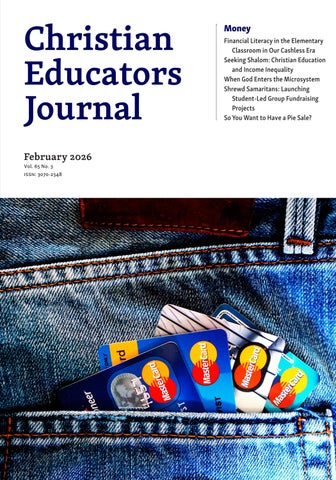
Christian Educators Journal February 2026 Vol. 65 No. 3 ISSN: 3070-2348
Money Financial Literacy in the Elementary Classroom in Our Cashless Era Seeking Shalom: Christian Education and Income Inequality When God Enters the Microsystem Shrewd Samaritans: Launching Student-Led Group Fundraising Projects So You Want to Have a Pie Sale?
Contents
3 Editorial 5 Financial Literacy in the Elementary Classroom in
Our Cashless Era: Integrating Money Activities and Projects into the Curriculum SUSAN DYKSHOORN
11 Seeking Shalom: Christian Education and Income Inequality CHRIS STEENHOF
15 When God Enters the Microsystem: How Divine Wisdom Can Transform Everyone’s Financial Life LUCIANO CID AND SHANE ENETE
23 Shrewd Samaritans:
Launching Student-Led Group Fundraising Projects MIRIAM LILI
36 So You Want to Have a Pie Sale? SIMON JEYNES
Christian Educators Journal
February 2026
1
Christian Educators Journal Vol. 65 No. 3, February 2026 ISSN: 3070-2348 cejonline.com Editor Abby Zwart cejeditor@gmail.com The Christian Educators Journal (CEJ) encourages letters to the editor in response to articles presented in the CEJ. Letters must be accompanied by the author’s name and email address. The CEJ reserves the right to edit letters for length and clarity. Where a letter addresses issues raised by the author of an article, the CEJ reserves the right to invite the article author to respond to the letter. Subscriptions Klaas Wolterstorff Business Manager Christian Educators Journal 2474 Westboro Dr NE Grand Rapids, MI 49506 business@cejonline.com Subscription Price (US dollars) Digital only: $25.00 per year Beginning October 2025, all subscriptions are digital only. Please visit www.cejonline for subscription information. Indexed in Christian Periodicals Index Copyrighted 2000 CEJ. All rights reserved. Christian Educators Journal (130630) is published quarterly by Christian Educators Journal Association. Scripture All Scripture quotations, unless otherwise indicated, are taken from the Holy Bible, New International Version®, NIV®. Copyright ©1973, 1978, 1984, 2011 by Biblica, Inc.™ Used by permission of Zondervan. All rights reserved worldwide. www.zondervan.com
Statement of Purpose The Christian Educators Journal Association publishes the Journal as a channel of communication for all educators committed to the idea of Christian day school at the elementary, secondary, and college levels. The views expressed are those of the writers and not necessarily those of the association. Reprint Policy We allow free reprinting or photocopying of individual articles that have appeared in our journal, as long as the copied articles are used within the context of schooling and the source is acknowledged. Editor Abby Zwart Copyeditor Bethany Murphy Design Editor Klaas Wolterstorff Business Manager Klaas Wolterstorff Web Shepherd Heather Altena Board of Trustees Dr. Henry Algera Heather Birch (Chair) Eunsub Cho Justin Cook Albert Kok Dave Loewen Gayle Monsma Sean Schat Christine Scholma (Secretary) Tricia Stobbe Heather VanDyke Supporting Institutions Calvin University The King’s University Redeemer University Trinity Christian College Tyndale University Subscribing Organizations Christian Educators Association Christian Educators of British Columbia Edvance Christian Schools Association Prairie Centre for Christian Education Printed back issues (if available) can be purchased for $7.50 per copy (cost of shipping to be added to total). Some back issues may be available in digital format.
Editorial
I
can pretty confidently say that I learned about loans and interest rates from a computer game. It was summer in the late 1990s, and I retreated to our damp and cool Midwestern basement for several hours a day to play Roller Coaster Tycoon (RCT) on my family’s desktop computer. The game sets you up as a theme park designer tasked with building a thriving park full of haunted houses, roller coasters, concession stands, and imaginative scenery. To win each level, you must achieve a set of goals displayed on the first day the park opens. You might need two thousand guests by the end of year three, or maybe you need to have five roller coasters rated “high excitement” by the end of year two. Though it debuted in 1999, RCT is still highly rated in the computer game community for its intricate design and realistic features. When designing a roller coaster, you can watch as the ride records stats on G forces, number of drops, and top speed. Guests get lost if you place too many pathways or make them too meandering. Each guest enters with a certain amount of cash in their pocket and will display thoughts like “I can’t afford to go on Mad Mouse!” after spending a few hours in the park. Along with guest spending, there’s an impressive amount of other financial data in the game. You can look at concession records and figure out which of your four ice cream stands is making the most per hour and which one should be demolished and replaced with a popcorn stand. You can study the financial records of the park overall, looking for things like rides that cost more to run than what they earn in profit. Maintenance workers, mechanics, and security guards can be hired, but you’ll take a hit at the beginning of each month when you have to pay their salaries. But don’t worry—if you go in the red, you can take out a loan! It’s in this game that I learned about interest—loans were hard to pay back! I also discovered that building a small attraction the minute I had $600 to pay for it wasn’t the best strategy—it was better to save up money for a couple of hours and then build a big expensive roller coaster that guests would pay a lot to ride. I figured out how to read a budget ledger with its green and red lines and discovered what net value was. All of this learning happened when I was between eight and thirteen, and none of it happened at school. As I continued into high school, I still don’t think I took a class— even economics!—that taught me as much as RCT. (Honorable mention: having to budget my meager savings in the game Oregon Trail.) I often hear my high school students complain that we don’t teach them things they’ll need in the “real world.” It’s usually around the time that they get their first jobs and have to fill out a form and set up an appointment to Christian Educators Journal
February 2026
3