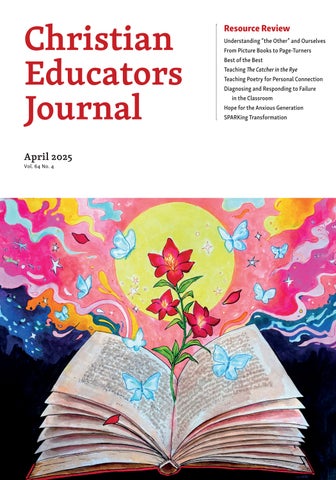
Christian Educators Journal April 2025 Vol. 64 No. 4
Resource Review Understanding “the Other” and Ourselves From Picture Books to Page-Turners Best of the Best Teaching The Catcher in the Rye Teaching Poetry for Personal Connection Diagnosing and Responding to Failure in the Classroom Hope for the Anxious Generation SPARKing Transformation
Contents
3 Editorial 4 Understanding “the Other” and Ourselves:
Using Memoir and Autobiography in Middle School and High School Classrooms ABBY DE GROOT
14 From Picture Books to Page-Turners: Books for Every Young Reader MARY JO STAAL
20 Best of the Best: Excellent Reading Experiences across a Range of Eclectic Categories BILL BOERMAN-C ORNELL
29 Listening to Holden: A Case for Teaching The Catcher in the Rye JUDITH E. ANDERSON
36 The Resonant Moment: Teaching Poetry for Personal Connection
HANNAH MAIN-V AN DER KAMP
40 “Well, There’s Your Problem”: Diagnosing and Responding to Failure in the Classroom ERIC WILDERMUTH
43 Hope for the Anxious Generation: Engaging with Jonathan Haidt TOBY COFFMAN
47 SPARKing Transformation: Redemptive Adaptive AI Courseware for Student Achievement
LISA DEVALL-M ARTIN AND MATTHEW SCHONEWILLE Christian Educators Journal
April 2025
1
Christian Educators Journal Vol. 64 No. 4, April 2025 cejonline.com Editor Abby Zwart cejeditor@gmail.com The Christian Educators Journal (CEJ) encourages letters to the editor in response to articles presented in the CEJ. Letters must be accompanied by the author’s name and email address. The CEJ reserves the right to edit letters for length and clarity. Where a letter addresses issues raised by the author of an article, the CEJ reserves the right to invite the article author to respond to the letter. Subscriptions Klaas Wolterstorff 2474 Westboro Dr NE Grand Rapids, MI 49506 business@cejonline.com Subscription Price (US dollars) US: $25.00 (one year, print) Canada: $30.00 (one year, print) Digital: $25.00 (one year) Beginning September 2021, all subscriptions outside the US and Canada are digital only. Please visit www.cejonline for subscription information. US Postal Information Nonprofit Organization Postage paid in Grand Rapids, MI Permit No. 657 Return postage guaranteed to: Christian Educators Journal 2474 Westboro Dr NE Grand Rapids, MI 49506 Address Correction Requested Canadian Postal Information Registered under Publications Mail Agreement: No. 40022165 at Norwich, ON Return postage guaranteed to: Christian Educators Journal PO Box 39 Norwich, ON N0J 1P0 Indexed in Christian Periodicals Index Copyrighted 2000 CEJ. All rights reserved. Christian Educators Journal (130630) is published quarterly by Christian Educators Journal Association. Scripture All Scripture quotations, unless otherwise indicated, are taken from the Holy Bible, New International Version®, NIV®. Copyright ©1973, 1978, 1984, 2011 by Biblica, Inc.™ Used by permission of Zondervan. All rights reserved worldwide. www.zondervan.com
Statement of Purpose The Christian Educators Journal Association publishes the Journal as a channel of communication for all educators committed to the idea of Christian day school at the elementary, secondary, and college levels. The views expressed are those of the writers and not necessarily those of the association. Reprint Policy We allow free reprinting or photocopying of individual articles that have appeared in our journal, as long as the copied articles are used within the context of schooling and the source is acknowledged. Editor Abby Zwart Copyeditor Bethany Murphy Design Editor Klaas Wolterstorff Business Manager Klaas Wolterstorff Web Shepherd Heather Altena Board of Trustees Dr. Henry Algera Heather Birch Justin Cook Sara Leo Albert Kok (Chair) Gayle Monsma Ed Noot Jim Rooks Sean Schat Christine Scholma (Secretary) Tricia Stobbe Edith van der Boom Heather VanDyke Christine Webb Supporting Institutions Calvin University Edvance Christian Schools Association The King’s University Redeemer University Trinity Christian College Tyndale University Subscribing Organizations Christian Educators Association Christian Educators of British Columbia Prairie Centre for Christian Education Printed back issues (if available) can be purchased for $7.50 per copy (cost of shipping to be added to total). Some back issues may be available in digital format.
This month’s cover illustration is by Ava Boes, Class of 2025 at Grand Rapids Christian High School
Editorial
I
joined a book club this year. I’m a female English teacher in her thirties living in the Midwest, so you’re probably not surprised—I seem like someone who is probably in three book clubs. But actually, it’s my first time! As I write this in February, I haven’t attended my first meeting yet, but we’re gearing up to discuss Niall Williams’s This is Happiness at the end of the month. As I read, I’ve been excitedly scribbling thoughts on the index card I’m using as a bookmark— things I notice about the prose, questions I have about the characters—and just the other day, it hit me: this is what I’m training my students for. Many of my high schoolers don’t love to read. Some do, of course, but for the majority of them, being assigned a few chapters of a novel each night is a hoop to jump through rather than something to look forward to. Because of that, I have occasional moments of doubt that the skills I’m teaching will ever be of use to them in “the real world.” But then I’m reading Niall Williams on a Saturday morning with a cup of coffee thinking of questions I can ask my new book club, and I remember that humans just love stories. Whether or not I can convince my students to enjoy reading, someone someday will ask them about a story they love. Maybe that story is a movie or a TV show or a YouTube channel or a recipe blog. But chattering on about that story will help them build a connection with a coworker or a friend or a partner. And that’s a “real world” skill. In this, our annual resource review issue, we’ve got a lot of stories. Abby DeGroot’s students at Dordt have suggestions of memoirs to teach in your middle or high school classrooms. Mary Jo Staal and Bill Boerman-Cornell have a plethora of genres and titles for your middle grades and elementary school kids, too. Judith Anderson thinks Holden’s story in The Catcher in the Rye can still resonate with students despite being frequently ignored in Christian classrooms. And Hannah Main-van der Kamp recommends a book that can help you teach the story of poetry. From there, we continue the issue with two articles focused on our readers themselves. Eric Wildermuth reviews Alex Quigley’s Why Learning Fails (And What to Do About It) and Toby Coffman has some faith-centered thoughts to add to Jonathan Haidt’s much-discussed The Anxious Generation. Lastly, Lisa Devall-Martin and Matthew Schonewille address the technology tool of the decade and offer a framework to help our Christian schools decide how to use AI ethically. Maybe you’ll gather a club of coworkers, pick a book from this issue, and spend some of your summer with a great story. (And if reading’s not your thing, maybe writing is? Consider contributing to CEJ next year—our issue themes announcement is at the end of this issue.) —Abby Zwart Christian Educators Journal
April 2025
3
Understanding “the Other” and Ourselves: Using Memoir and Autobiography in Middle School and High School Classrooms ABBY DE GROOT
I
love memoir and autobiography as a genre. Throughout my time as a reader, they have played a key role in helping me discover, tweak, and name things about my own identity; these books have also unlocked for me a secret glimpse into the way that God has wonderfully created other people. Rudine Simms Bishop famously coined a phrase regarding the particular power that books have to act as “mirrors, windows, and sliding glass doors”: Books are sometimes windows, offering views of worlds that may be real or imagined, familiar or strange. These windows are also sliding glass doors, and readers have only to walk through in imagination to become part of whatever world has been created or recreated by the author. When lighting conditions are just right, however, a window can also be a mirror. Literature transforms human experience and reflects it back to us, and in that reflection we can see our own lives and experiences as part of a larger human experience. (Bishop x)
First, these texts can serve as great mirrors for students to explore their own identities at this crucial time in their lives.
As a former high school English teacher, church youth group leader, professor who regularly teaches about adolescent development, and—most importantly—a mom of two middle school daughters, I am keenly interested in the ways that stories can play a part in shaping our young people’s perspectives. I want them to examine the stories that they tell themselves about their own identities and the stories they believe about others, to deeply explore what it means to be human and how to live faithfully with those who differ from us. I believe that memoir and autobiography are tools made fittingly for that task, and this article is dedicated to sharing ideas about how to use these genres, as well as offering up a few titles that may work well in a variety of classrooms as mirrors, windows, and sliding glass doors. First, these texts can serve as great mirrors for students to explore their own identities at this crucial time in their lives. At this point in their development, adolescents are often “trying on” different versions of themselves, cycling through friendships and hobbies, considering future school or career plans, and looking for affirmation that they are doing OK—that who they are is acceptable and lovable. Autobiography and memoir can serve as wonderful mentor texts for students in these endeavors, allowing students to study how authors crafted their own life stories, how they organized their experiences around themes and ideas, and how they came to accept themselves or work through their challenges. Students may be able to see their own life circumstances in some cases, but more often, they may be able to identify with feelings, perspectives, or epiphanies that authors share, reinforcing that they are not alone or teaching them a new approach to a trial. 4
April 2025
Christian Educators Journal
The reading experience can lead to powerful writing experiences in these cases, offering opportunities for students to write their own stories in unique ways, to explore experiences that have defined them, and to come to conclusions about their own identities in Christ. Practicing daily quick writes in the style of an autobiographical text or around the topics it addresses is a wonderful way to generate student ideas for these longer writing pieces. In addition to seeing and thinking about their own life experiences, it is also important for our students, many of whom have had homogenous home and school environments, to encounter and contemplate diversity through their reading. While children from dominant social groups (such as white middle class Americans) have had many mirror-like reading experiences, they suffer a disadvantage in their perspective when not exposed to the lived experiences of other groups. Bishop passionately argues that these students “need [diverse] books as windows onto reality, not just on imaginary worlds. They need books that will help them understand the multicultural nature of the world they live in, and their place as a member of just one group, as well as their connections to all other humans” (xi). We are robbing students of the chance to see the reality of God’s diverse creation if we limit our texts to stories from one perspective. Additionally, it may lead students to have an “exaggerated sense of their own importance and value in the world” if they are only reading reflections of themselves (Bishop xi). Autobiographies and memoirs are a wonderful antidote to this skewed reading diet, as many of them offer windows and doors into unfamiliar but real- life experiences of the authors. They allow readers to build empathy and comradery that will hopefully carry into real-life encounters with “the other”—people from different walks of life who share our humanity. Of course, the key to teaching this genre well is picking the right book for your students. The reviews shared here were written by my students in Education 354: Methods of Teaching English at Dordt University in the fall of 2024, with each of them submitting a review of a relevant memoir, autobiography, or autobiographical fiction book that helped them understand “the other,” and in turn, themselves. The variety of experiences represented in these books includes multiple ethnicities, socioeconomic statuses, physical abilities, religious affiliations, and native countries. They are written as vignettes, graphic novels, and plain prose. They are suitable for different grade levels and a variety of reading abilities. Simply said, they represent the beautiful diversity of human experience, and we are excited to share them. We humbly hope that these suggestions serve you well as you help students look in mirrors, peer through windows, and walk through some sliding glass doors. We know that these stories alone, and even the instruction that we as teachers may dutifully design around them to shape student learning, will not always move students toward the outcomes we desire. Because we are human and sin still taints the world, we will see ourselves and others imperfectly. But alongside students, we can work diligently toward seeing God’s world more clearly, loving those around us more authentically, and developing our identities more fully in Christ. These things are the worthy end goals of lesson plans and units, the meaningful takeaways that standards, outcomes, and scaffolds should build toward. And someday, perfection will come: “For now we see only a reflection as in a mirror; then we shall Christian Educators Journal
April 2025
5
We are robbing students of the chance to see the reality of God’s diverse creation if we limit our texts to stories from one perspective.
Alongside students, we can work diligently toward seeing God’s world more clearly, loving those around us more authentically, and developing our identities more fully in Christ.
From Picture Books to Page-Turners: Books for Every Young Reader MARY JO STAAL
Picture Books Partly Cloudy, written and illustrated by Deborah Freedman Viking Books for Young Readers, 2024
“What do you see when you look at the clouds?” is the opening question of this breathtaking book about what two bunnies see when they look at the sky. One bunny sees whipped cream, popcorn, and pea soup. The other bunny sees cumulus, stratus, and cirrus clouds. While the bunnies can’t agree on what is in the sky, they can start to appreciate the other’s perspective and eventually learn from each other. Partly Cloudy would be a great book to introduce a weather unit, teach different points of view, or simply celebrate the beauty God put in the sky in the form of clouds.
My Daddy Is a Cowboy, written by Stephanie Seales, illustrated by C. G. Esperanza Harry N. Abrams, 2024
A girl and her dad get to spend the start of the day with “just-us time” in this beautiful picture book set in a city where cowboys ride through town bringing people joy. The two of them ride their horses through the quiet streets before dawn as they watch the sky change from black of night to blue of day. My Daddy Is a Cowboy would be a great book to share with students when breaking down stereotypes. The cowboys in this book are not the cowboys most people picture in their heads. Stephanie Seales was inspired by the Compton Cowboys of southern California, and every place in the text is a real place in Compton. The vibrant colors of the book combined with the relationship between a father and a daughter make this a great book to use on so many different levels and for a variety of purposes.
The Yellow Bus, written and illustrated by Loren Long Roaring Brook Press, 2024
The Yellow Bus appears to be just a basic back-to-school book, but it is surprisingly so much more. Readers experience the life of a yellow bus from being a school bus to a homeless shelter to a playground for goats and beyond. 14
April 2025
Christian Educators Journal
Loren Long got the idea for this book when he saw an abandoned bus and started to wonder what stories that bus held. The Yellow Bus would be a great book to use in writing exercises to discuss where to find ideas. This book could also be used in reading to discuss how books are so much more than their covers. The art and story of this book are stunning, and readers will enjoy all the twists and turns this yellow bus takes.
We Are Definitely Human, written and illustrated by X. Fang Tundra Books, 2024
When Mr. Li is startled awake by a crash, he doesn’t know what to think about the three unique strangers he discovers. The strangers declare themselves to be definitely human and ask for help to fix their broken car. Mr. and Mrs. Li are kind humans and do what kind humans do—help others in need. The whole town is filled with kind humans, so they all help fix the strangers’ car and see them safely back on their journey. Celebrating kindness to everyone, We Are Definitely Human would be an outstanding book to use at the beginning of the year, or anytime readers need a reminder that we can all be kind humans.
Jump for Joy, written by Karen Gray Ruelle, illustrated by Hadley Hooper Astra Young Readers, 2024
Joy has always wanted a dog. Jump has always wanted a kid. They both create dogs and kids out of different things in nature like flowers, sand, sticks, and snow. All of their creations wilt or melt or blow away, but when Joy and Jump finally find each other, they don’t disappear. Joy’s and Jump’s dreams come true, and all is right in their world. The illustrations in this book are unique. Illustrator Hadley Hooper used brush and ink alongside found textures and images from the eighteenth, nineteenth, and early twentieth centuries. Put the art together with Karen Gray Ruell’s text, and you have a picture book that could be used to talk about perspective, voice, and celebrating unique art.
Chapter Books Bibsy Cross (series), by Liz Garton Scanlon Knopf Books for Young Readers, 2024–25
Bibsy Cross is full of life. She exemplifies the best parts about being a kid: she is curious, passionate, and excited about everything. Bibsy Cross reminds me of Ramona Quimby or Beatrice Zinker. Bibsy happily lives with her parents and a cat, she has a best friend named Natia, and she struggles with asking too many questions. In each of the three books—so far— Bibsy bumps up against problems that kids will relate to: a teacher who is very strict, her desire to win a fundraiser, and a terrarium jar that is out Christian Educators Journal
April 2025
15
Best of the Best: Excellent Reading Experiences across a Range of Eclectic Categories BILL BOERMAN-C ORNELL
B
elow are some of the best books out of the two hundred or so I read in 2024. When I teach children’s literature, I remind my students (most of whom will be teachers in a year or two) that reading is a gift from God, that reading should be fun, and that not every book is for every person. I hope you’ll find some good books in this list. But if you start reading a book and don’t find yourself enjoying it after a few chapters, feel free to put it down and find a better one!
Best Graphic Novel for Middle School Readers A First Time for Everything, written and illustrated by Dan Santat First Second, 2023
Opening lines: “I grew up in a small town just outside of Los Angeles. Everything I knew about the world happened in Camarillo.” Interesting quote: “Do you know what the best part of being a teenager is? You only have to do it once” (268). Short summary: After a rough time in middle school—bullying, ridicule, insecurity—Dan has an opportunity to go on a class trip to Europe with the same kids who made fun of him. He isn’t too optimistic about his chances of survival. But he is surprised to find himself getting to know kids he never talked to before, making new friends, having amazing experiences together, and maybe even finding his first girlfriend. Why should I read this book? What makes nerd stories so fantastic is that they are about an underdog who feels like he has little to offer but finds out that his contributions are indispensable to his community. What makes nerd stories so wonderful is the depth of sympathy we feel for the character and the excitement we feel when the character succeeds. This isn’t a nerd revenge story—it is more about the nerdy kid growing up and the kids who were jerks to him growing up, too. This graphic memoir is a heartwarming story about what it means to discover yourself at the same time others are discovering you. Who is this book best for? While fourth graders would have no trouble comprehending this book, the content would probably resonate best with middle school students. High school students might also enjoy it, but in a 20
April 2025
Christian Educators Journal
nostalgic way. Thematically, this book is certainly strong enough to be used for literature circles and possibly for whole class study in combination with another book focusing on identity or independence or cultural experiences. It would also be a great choice for class and school libraries. Is this book likely to be challenged? I don’t think so.
Best Nonfiction Picture Book Champion: The Comeback Tale of the American Chestnut Tree, by Sally M. Walker Henry Holt, 2018
Opening lines: “Have you ever climbed a tree? Have you ever breathed in the spicy scent of pine trees or looked closely at a leaf?” Interesting quote: “You know you’ve got a good neighbor when he or she plants a tree” (99). Short summary: American Chestnut trees, which were once the mainstay of North America’s eastern forests, were wiped out by a tree disease in the early 1900s. There were almost no trees that survived. This is the story of the scientists that have been working to restore the trees, what they are doing, their chances for success, and some indications of hope that someday the majestic American Chestnut will return. Why should I read this book? Forestry science is not glamorous. It is a branch of science that gets overshadowed by fields like medicine, astrophysics, and robotics. However, forestry scientists could make a huge impact by both restoring a beautiful and important tree and also educating about the disease and how we can respond to such blights in the future. Part mystery, part history, and part comeback tale, this book is surprisingly captivating and features amazing photography. Who is this book best for? Though it is technically formatted like a picture book, the vocabulary and concepts make this book best suited to fourth grade and older. This would be an excellent book to use as a supplemental text for any unit connected with plants or genetics. Classroom libraries in upper elementary, middle school, and high school science as well as school libraries should consider it. Is this book likely to be challenged? No.
Christian Educators Journal
April 2025
21
The Resonant Moment: Teaching Poetry for Personal Connection HANNAH MAIN-V AN DER KAMP
A Review of Word Made Fresh, by Abram Van Engen Eerdmans, 2024
A master teacher and scholar, Abram Van Engen teaches poetry in congregations. He is a missionary of poetic arts. His purpose, methods, and motivation are equally suited to classrooms of senior English students, especially those in Christian schools. Van Engen explores forty poems, traditional as well as modern, and reveals the riches they offer. Always encouraging rereading and never insisting on finding a message, he invites readers (and listeners) to let poems do what they do.
What Poems Can Do What poems can do is refresh and enliven language, eliciting from the reader new perceptions, nuances, and insights.
What poems can do, even when they may be initially confusing, is refresh and enliven language, eliciting from the reader new perceptions, nuances, and insights. One of the first poems Van Engen discusses is “When Kingfishers Catch Fire” by Gerald Manley Hopkins. He recounts how struck he was on first discovering this poem as a fifteen year old. It confused and also fascinated him. It spoke to him as he was held by the sound of the words. His heart was stirred: it was a resonant moment. By rereading with close attention, gradually he discovered it has many layers, including a theological dimension. When teaching the poem, Van Engen does not start with “what the poem means” but with asking if the reader/student finds a connection. If so, is it strong enough to want to reread and learn more? If not, his advice is to leave it but keep reading other poems to find those that connect with personal experience.
Just Start and Keep Going Why do so many Christian readers avoid poetry? Van Engen asks. Though they are familiar with the poetry of the Scriptures—that of psalmists, prophets, wisdom teachers, gospel and epistle writers—poetry is not valued. Van Engen suggests that it is in part because people believe it cannot speak to them. They find it puzzling and irrelevant. Poems are as relevant as the life experiences readers can bring to them. Every reader, whether an adult in a church or a teen in class, has unique life experience. Not all poems 36
April 2025
Christian Educators Journal
will connect with all. We shouldn’t struggle over it. There are so many more poems waiting. When you experience the resonance between yourself and the poem, pay attention: it’s a gift. Readers do not have to “understand” a poem to appreciate it. Do we fully “understand” the opening of John’s gospel or the powerful images of Revelation? Using linear, rational skills to explicate destroys the depth of imaginative writing. As Van Engen takes on a more thorough reading of the layers of background, form, and theological import, he demonstrates how worthwhile it is to do some patient “digging deeper.” How should one read a poem? Just start—any way will do. “No fancy sword swings back and forth to guard the entrance,” he notes (22). Some words, a line, or an image will go directly to the heart; they surprise and delight. It is a moment of resonance.
When you experience the resonance between yourself and the poem, pay attention; it’s a gift.
What Is Christian Poetry Anyway? George Herbert, the seventeenth-century devout Anglican priest and poet, is one of Van Engen’s favorite “friends.” Van Engen encourages approaching poems as friends. This befriending is a pleasure, though it may also be challenging in the way some friendships are. Van Engen discusses four of Herbert’s poems without didacticism. When we engage poems as friends, they begin to speak in new ways. Herbert’s poems do not preach; they entice. Readers who approach Herbert’s work for delight find it also reveals the wounds of our hearts and opens us to mercy. The pieces Van Engen discusses with his adult learners in a church building are not all by Christian writers or on Christian themes. Instead, he shows how a poet like William Carlos Williams invokes awareness of the same concerns that Milton did in Paradise Lost. What is “Christian poetry” anyway? It can’t be limited to writers of faith who may be good or bad poets. Nor can it exclude writers of other faiths or no faith whose work shows profound awareness of sin, goodness, redemption,and community. There is no clear distinction in good writing between sacred or secular writing. No poem will be experienced by students in exactly the same way. Good writing prompts divergent responses. Poetry truth and the Christian truth are not in competition. Philip Larkin’s famous poem “Church Going” describes a non-believer who often enters into empty old churches just to look as a tourist with a critical and bored eye. Wondering what, if any, use “this special shell” still has, he’s pleased to just stand in the silence. Nevertheless, he admits it’s a “serious house.” The last lines admit an awareness that he has “a hunger in himself to be more serious.” Van Engen comments, “The effects of this poem matter beyond any intention of the author” (33). Larkin was an ardent atheist, yet there is an awkward reverence. Van Engen reads it personally. It evokes strong memories for him of childhood experiences of worship in churches—the hymns, the community—and, like Larkin, he feels “compelled to return often to a place that takes seriously the love and hope and fear and regret and healing and longing of human hearts” (35). William Carlos Williams wrote small poems about ordinary things. Van Engen uses twelve pages to explore “This Is Just to Say,” the famous poem Christian Educators Journal
April 2025
37
Poetry truth and the Christian truth are not in competition.
By doing so, teachers can embody the grace of Christ for students who feel beat down by their lack of achievement.
Evaluation and Uses One of the greatest strengths of this book is the common grace insights Quigley provides about the brain for teachers who may not have the time or confidence to pore over academic research.
One of the greatest strengths of this book is the common grace insights Quigley provides about the brain for teachers who may not have the time or confidence to pore over academic research. Understanding how the brain works this side of Eden is essential for creating effective learning environments, and Why Learning Fails distills these insights into a concise, accessible guide. At under 150 pages, it is approachable for busy educators. Because of its brevity, the book is concentrated on cognitive factors affecting student learning, without deeply exploring emotional, social, or spiritual dimensions. While Quigley’s primary focus is on student learning failures, a reflective practitioner can use the book’s examples to assess and refine their own teaching practice. Experienced teachers will likely recognize many of the suggested methods from prior training, though they will also discover new strategies or a clearer reasoning for approaches they already use. Regardless of what stage of their career a teacher is in, Why Learning Fails will equip them with plenty of ideas for improving student learning. Any teacher or administrator will find value in this book, but it will be especially beneficial for those actively teaching and looking to apply its insights toward “intelligent failure” (139). For administrators seeking to improve instructional practice, Why Learning Fails could serve as a valuable faculty reading group selection, an in-service training resource, or a recommended professional development tool. The final chapter is devoted entirely to supporting teacher success and is useful for teachers and administrators alike. Ultimately, this book is for any educator who wants to look failure in the face and learn to reach every student more effectively.
Works Cited Quigley, Alex. Why Learning Fails (And What to Do About It). Routledge, 2024. Eric Wildermuth is the Director of Advancement at the Christian Academy in Brookhaven, PA. Previously, he taught Bible and history in middle and high school for eight years. Eric lives outside Philadelphia with his wife, Janel, and their two wonderful toddler boys.
42
April 2025
Christian Educators Journal
Hope for the Anxious Generation: Engaging with Jonathan Haidt TOBY COFFMAN
I
f one book in the past year not explicitly about education has had an outsized effect on educational practice and policy, it is undoubtedly Jonathan Haidt’s The Anxious Generation. Though the book’s subtitle, “How the Great Rewiring of Childhood Is Causing an Epidemic of Mental Illness,” accurately reflects Haidt’s aim in writing, the more pragmatic policy fallout from the book has been perhaps the most straightforward lever to pull: the now- nationwide drive to ban cell phones in the classroom or the school building altogether. This issue is, miraculously, bipartisan. Left and right, coastal metropolises and flyover country, California and Florida—it feels like the lion is about to lie down with the lamb. And let’s give credit where credit is due: no one has moved the national dial on smartphones in schools to the degree Haidt has in the past year. For this, every educator owes him a tip of the hat. Ten years ago, we could pretend to be ignorant about what smartphones were doing to our teenagers. Now, we can no longer do so. The data are in, and they are damning. Haidt has the charts to back up his case. Since roughly 2010, teenagers in the United States endured an inexorable rise in mental health diagnoses. Something changed around then, and that change was the mass adoption of smartphones and the apps, games, and pornography accessible on those phones. Like many school administrators, I picked up The Anxious Generation last spring when it first appeared. Haidt’s previous work—namely, The Righteous Mind and The Coddling of the American Mind—has proven helpful in the classroom, and I knew this would be a worthy read. If luck is when opportunity meets preparation, Haidt picked the right time to publish this book. A growing unrest about the state of things with our teens has simmered beneath the surface for some time. Haidt’s book gave voice to these frustrations, which were felt acutely by teachers, administrators, parents, and the young men and women who had been unwittingly plunged into a massive social experiment. His four encouraged reforms are worth considering and would enrich the experience of most students, teachers, administrators, and parents. They are as follows: 1. No smartphones before high school. 2. No social media before 16. 3. Phone-free schools. 4. Far more unsupervised play and childhood independence. (15) Haidt makes these recommendations after carefully portraying the scope of the current crisis. Perhaps the superlative contribution of Haidt’s book is that it has broken the spell cast by the supposed inevitability of our increasing Christian Educators Journal
April 2025
43
Credit where credit is due: no one has moved the national dial on smartphones in schools to the degree Haidt has in the past year.
A student at my school recently put it to me like this: “None of us are happy. But none of us know what to do.”
Because of God’s grace, we can go beyond restricting harmful practices to doing whatever is in our power to make—within the walls of our schools— the kingdom come on earth as it is in heaven.
book, Haidt mentions many of Gen Z’s strengths, but two stand out: 1) they are not in denial about the reality of how this experiment has panned out; 2) they desire to bring about a more just world (12). I mentioned this earlier, but it is worth focusing on as I bring this article to a close. This generation has been at the mercy of and did not choose modern practices around technology and social media and parental over/underprotection. Haidt acknowledges this when he begins delineating his recommendations: while it is hard to be a parent, teacher, coach, and so on today, “it’s even harder to be an adolescent” (226). One of the keenest responses I see from thoughtful members of the Gen Z cohort is an overwhelming feeling of letdown. A student at my school recently put it to me like this: “None of us are happy. But none of us know what to do.” I was raised at the tail end of a “stiff upper lip culture.” I was encouraged to tamp my emotions and pretend everything was fine. It is safe to say this generation has seen the pendulum swing in the opposite direction. Rather than lamenting this cultural shift, however, we should see it as an opportunity. Our students know that they are broken. Parents feel unprepared and ill-equipped to navigate a foreign cultural moment. The traditional mission of the school, to serve in loco parentis, has never been more needed. To be a teacher is to be squarely and irrevocably involved in the roiling and seemingly insurmountable world of the teen mental health crisis. And for those of us who have not been high school students in some time, this new world can be confounding and difficult to navigate. But navigate it we must. And, as Christian educators, we must navigate it with the gospel blend of grace and truth. In many ways, Haidt’s book has provided Christian educators with an opportunity to address the problems we have seen in our classrooms in a way that is scientifically based and non-sectarian. But we must not forget what my pastor calls the “how much more” (Matt. 7:11) quality of the gospel: because of God’s grace, we can go beyond restricting harmful practices to doing whatever is in our power to make—within the walls of our schools— the kingdom come on earth as it is in heaven. I pray that we do just that.
Works Cited Haidt, Jonathan. The Anxious Generation: How the Great Rewiring of Childhood Is Causing an Epidemic of Mental Illness. Penguin, 2024. Sax, Leonard. “Toxic Phones—or a Toxic Culture?” Institute for Family Studies, 30 September 2024, ifstudies.org/blog/toxic-phones-or-a-toxic- culture. Accessed 4 January 2025. Thompson, Derek. “America’s Top Export May Be Anxiety.” The Atlantic, 19 June 2024, www.theatlantic.com/ideas/archive/2024/06/mental- health-crisis-anglosphere-depressed. Accessed 4 January 2025. Toby Coffman is the Dean of Humanities at Valor Christian High School in Highlands Ranch, Colorado, where he has served since 2014. He and his family live eight thousand feet above sea level. They are regularly visited by bears, bobcats, herds of elk, and debilitating snowstorms. 46
April 2025
Christian Educators Journal
SPARKing Transformation: Redemptive Adaptive AI Courseware for Student Achievement LISA DEVALL-M ARTIN AND MATTHEW SCHONEWILLE
T
he arrival of generative artificial intelligence (AI) parallels that of the Ford Model T in the early twentieth century. This model revolutionized transportation by making cars affordable and accessible. However, the infrastructure to support this transportation was lacking. The roads were rough, traffic laws were non-existent, and driving skills were undeveloped. Urban congestion, rural inaccessibility, and decades of trial and error were necessary to build the infrastructure—highways, traffic signals, and driver education—needed to fully realize the potential of motorized vehicles. Generative AI presents similar realities. It holds incredible promise; however, society lacks the essential infrastructure to fully realize AI’s wholesome potential. Ethical guidelines, data privacy protection, regulatory frameworks, and grade curricula are required to reflect God’s justice, wisdom, and care for human dignity. From a Christian perspective, embedded courseware has become a critical tool in stewarding this technology wisely. Similar to highways and driver education, which supported the safe adoption of automobiles, embedded courseware equips students and educators with structured ways to operate AI responsibly. By integrating digital tools, interactive content, and frameworks—such as Matthew Schonewille’s SPARK—discernment, critical thinking, and ethical use are nurtured, which aligns AI’s potential with a commitment to serve others in Christ-like humility, ensuring that technology serves as a tool for good rather than harm.
Embedded courseware equips students and educators with structured ways to operate AI responsibly.
Say Goodbye to Textbooks: How AI Courseware Is Changing the Classroom Imagine opening an e-textbook and finding not just text but also videos, simulations, quizzes, and even personalized tutoring powered by artificial intelligence. This is what embedded courseware promises: a new way of learning that moves beyond the dusty pages of a static book. As Walter notes, “To equip both students and teachers to become apt in the use of AI for their academic purposes, a new ‘culture of AI’ seems in order” (8). The embedded courseware provider TopHat supports the science-of- learning through peer-to-peer connections, data-informed interactions, and scaffolded assessments with immediate feedback (Leung). Research shows that low-stakes assessments, such as quizzes, promote retrieval practice, which strengthens memory and is more effective than passive methods such as re-reading (Roediger et al. 385). Retrieval practice improves long- term recall, understanding, and problem-solving, supporting Bloom’s Christian Educators Journal
April 2025
47
Imagine opening an e-textbook and finding not just text but also videos, simulations, quizzes, and even personalized tutoring powered by artificial intelligence.