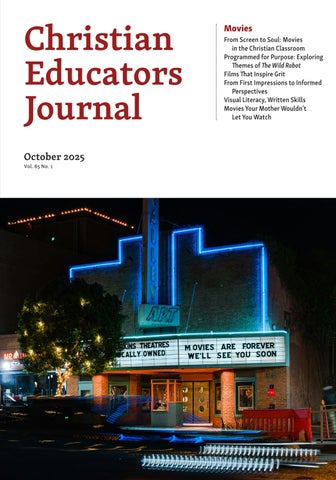
Christian Educators Journal October 2025 Vol. 65 No. 1
Movies
From Screen to Soul: Movies in the Christian Classroom Programmed for Purpose: Exploring Themes of The Wild Robot Films That Inspire Grit From First Impressions to Informed Perspectives Visual Literacy, Written Skills Movies Your Mother Wouldn’t Let You Watch
Contents
3 Editorial 5 From Screen to Soul:
The Transformative Threshold of Movies in the Christian Classroom COLIN WARD
12 Programmed for Purpose:
Exploring Themes of The Wild Robot in the Christian Classroom JENNIFER SHONIKER
18 Films That Inspire Grit:
Teaching Perseverance Through Story ADAM RASMUSSEN
22 From First Impressions to Informed Perspectives: Elevating Student Responses to Movie Scenes Through the Critical Analysis Process HEATHER J. S. BIRCH, NICOLE FLETCHER, CHERYL METCALF, AND CLARA BIRCH
33 Visual Literacy, Written Skills:
Screenwriting as a Tool for Student Voice PRISCILLA MEEUWENBERG
38 Movies Your Mother Wouldn’t Let You Watch MURRAY STILLER
Christian Educators Journal
October 2025
1
Christian Educators Journal Vol. 65 No. 1, October 2025 cejonline.com Editor Abby Zwart cejeditor@gmail.com The Christian Educators Journal (CEJ) encourages letters to the editor in response to articles presented in the CEJ. Letters must be accompanied by the author’s name and email address. The CEJ reserves the right to edit letters for length and clarity. Where a letter addresses issues raised by the author of an article, the CEJ reserves the right to invite the article author to respond to the letter. Subscriptions Klaas Wolterstorff 2474 Westboro Dr NE Grand Rapids, MI 49506 business@cejonline.com Subscription Price (US dollars) Digital only: $25.00 per year Beginning October 2025, all subscriptions are digital only. Please visit www.cejonline for subscription information. US Postal Information Nonprofit Organization Postage paid in Grand Rapids, MI Permit No. 657 Return postage guaranteed to: Christian Educators Journal 2474 Westboro Dr NE Grand Rapids, MI 49506 Address Correction Requested Canadian Postal Information Registered under Publications Mail Agreement: No. 40022165 at Norwich, ON Return postage guaranteed to: Christian Educators Journal PO Box 39 Norwich, ON N0J 1P0 Indexed in Christian Periodicals Index Copyrighted 2000 CEJ. All rights reserved. Christian Educators Journal (130630) is published quarterly by Christian Educators Journal Association. Scripture All Scripture quotations, unless otherwise indicated, are taken from the Holy Bible, New International Version®, NIV®. Copyright ©1973, 1978, 1984, 2011 by Biblica, Inc.™ Used by permission of Zondervan. All rights reserved worldwide. www.zondervan.com
Statement of Purpose The Christian Educators Journal Association publishes the Journal as a channel of communication for all educators committed to the idea of Christian day school at the elementary, secondary, and college levels. The views expressed are those of the writers and not necessarily those of the association. Reprint Policy We allow free reprinting or photocopying of individual articles that have appeared in our journal, as long as the copied articles are used within the context of schooling and the source is acknowledged. Editor Abby Zwart Copyeditor Bethany Murphy Design Editor Klaas Wolterstorff Business Manager Klaas Wolterstorff Web Shepherd Heather Altena Board of Trustees Dr. Henry Algera Heather Birch (Chair) Eunsub Cho Justin Cook Albert Kok Dave Loewen Gayle Monsma Sean Schat Christine Scholma (Secretary) Tricia Stobbe Heather VanDyke Supporting Institutions Calvin University The King’s University Redeemer University Trinity Christian College Tyndale University Subscribing Organizations Christian Educators Association Christian Educators of British Columbia Edvance Christian Schools Association Prairie Centre for Christian Education Printed back issues (if available) can be purchased for $7.50 per copy (cost of shipping to be added to total). Some back issues may be available in digital format.
Cover photo by Jared Murray on Unsplash
Editorial
D
epending on your age, the sights and sounds of movie day in class varied. If you were in school in the ’60s or ’70s, maybe you heard frustrated sighs from your teacher as they struggled to thread the reel-to-reel projector. Or maybe you can still hear the click of a film strip as the machine advanced the slides while a record or cassette tape played the narration. If you’re more of an ’80s or ’90s student, you probably rejoiced at seeing your teacher push the big TV cart with a squeaky wheel down the hall and laughed when they discovered Mr. McGuire forgot to rewind the VHS tape again. Perhaps your school even invested in the short-lived LaserDisc player! You early 2000s kids mostly watched DVDs, and your teacher probably had a dedicated player that got to stay in the room. But there was still that one old school teacher who insisted on showing an ancient VHS from a now-defunct educational media company. These days, students likely still watch DVDs, but a teacher might even pull up a streaming service in the classroom to show a film. What never changes, though, is the excitement both students and teachers feel at the prospect of showing a movie in class. Students look forward to a low-key hour where notetaking is minimal and the story is engrossing. Behind the desk, teachers are glad someone else is doing the talking for the day while they knock out some report card comments or tackle an overflowing email inbox. But today, film in the classroom is more than just an easy lesson plan. Twenty-first-century students are adept at reading the messages behind a moving image, and most teachers recognize that movies and even YouTube videos are key texts for understanding the world around us. Plus, many of our students have far exceeded their teachers’ ability to create video—it’s their native language and can be used effectively as an assessment tool. In this issue, we hope you’re reminded of the power of film in the classroom. Colin Ward, Jennifer Shoniker, and Adam Rasmussen offer suggestions for specific movies and genres that can foster deep analysis and conversation in the classroom, while Heather Birch and her coauthors outline a critical analysis process that can help those conversations flourish. On the assessment side, Priscilla Meeuwenberg offers an assignment suggestion for getting students to think outside the box—the screenplay. At the close of the issue, Murray Stiller tackles a question Christians have been debating for centuries: How do we approach films or other media that contain strong language, violence, or sex? It’s a question I often ask myself on the first few days of school when I’m getting to know my students. I open the floor for them to ask me any questions about myself, and they often want to know what my favorite movie is. I always have to pause. Christian Educators Journal
October 2025
3
I pause first because I’m a huge film buff and this is such a hard question. But I usually answer that my favorite is the 1987 classic Dirty Dancing starring Jennifer Grey and Patrick Swayze’s dreamy dance moves. I assume many students haven’t seen this film, and it gives me pause again because the title always generates a few giggles in the room. I sometimes worry they’ll start a rumor that Ms. Zwart watches saucy movies. And sure—the film has a sex scene and some dancing that might have shocked 1980s audiences (but looks pretty tame in 2025). But then I think about the transformative power the movie had on me when I watched it as a teenager, and I feel confident I could defend recommending it to any high schooler. Abby, you might be thinking, it’s just a sappy romantic drama with the most predictable ending of all time and the problematic issues of most 1980s movies. But Dirty Dancing mattered when I was fifteen. It was the first piece of media I remember that talked about abortion in a nuanced and empathetic way. It was a story of class inequality. The main character made a gray-area moral choice in order to defend someone powerless. The sexual relationship between the characters felt respectful and earned. I hope you have a film in mind that mattered when you were young. It may not have aged well, or maybe your kids think it’s corny, or maybe your tastes have changed. But movies have a certain magic, a power to transport us and teach us and make us fuller, more empathetic people. I hope that in this issue, you’re reminded of some of your favorites and inspired to pass on great cinematic stories to your students. —Abby Zwart
4
October 2025
Christian Educators Journal
From Screen to Soul: The Transformative Threshold of Movies in the Christian Classroom COLIN WARD
We all come into the world looking for someone looking for us. —Curt Thompson, The Soul of Shame
G
rowing up in the 1980s, I found that movies felt more like mirrors than mere entertainment. Stand by Me, Dead Poets Society, The Outsiders— these weren’t just films; they were companions that walked with me through the formative years of adolescence. Many years later, I now realize the impact those films had as they gave shape to many quiet questions: Who am I becoming? What will I stand for? How do I stay true to myself in a world that often asks me to conform? Looking back, I now see those movies as thresholds, moments of crossing, when something inside me shifted or awakened and a deeper sense of self began to form. As a Christian school teacher today, I watch my students wrestle with those same questions, often quietly, often beneath the surface. I’ve come to believe that carefully chosen films can become sacred spaces for them too: not just entertainment, but invitations—invitations to linger at the thresholds where questions of identity, belonging, and courage are already pressing in on their vulnerability, anxiety, and convictions. These stories help students navigate the in-between places of growing up, where innocence fades, complexity emerges, and faith begins to take deeper root. Stories matter—not just that we tell them, but how we tell them. The right stories help students recognize and step into moments of courage, discovery, and transformation. These stories don’t just teach: they awaken. They help students cross the thresholds of adolescence into a deeper understanding of who they are and who God is calling them to become. If, like me, you remember yourself as a child captivated at a campfire, where storytellers wove fiction into moral and formative experiences that stirred reverence and awe as the embers slowly dimmed, then you know the power of story. Today’s students experience coming-of-age films in much the same way. These stories open a space to explore what it means to live with integrity, courage, and compassion as they strive to examine and live out faith in a broken world. Films like Akeelah and the Bee invite reflection on identity and perseverance. Eighth Grade speaks honestly about anxiety, loneliness, and the pressure to conform. The Boy Who Harnessed the Wind helps students see innovation and resilience in the face of injustice and poverty. These stories ask essential questions: Are these characters trying to prove themselves, or
Christian Educators Journal
October 2025
5
I now see those movies as thresholds, moments of crossing, when something inside me shifted or awakened and a deeper sense of self began to form.
These stories open a space to explore what it means to live with integrity, courage, and compassion as they strive to examine and live out faith in a broken world.
Programmed for Purpose: Exploring Themes of The Wild Robot in the Christian Classroom JENNIFER SHONIKER
C
The Wild Robot, drawing by Emma Touw, grade 2, student of the author
an a castaway robot inspire students to light up the world in new and impactful ways? The 2024 movie The Wild Robot (based on a novel by Peter Brown) provides a beautiful backdrop for helping students explore Christian practices and themes like hospitality, home, truth, and community. Rated PG and suitable for almost all ages, the film would be an excellent addition to any Christian classroom. The film’s protagonist, a robot named Roz, was designed, assembled, and destined for service in a distant industrial setting but finds herself suddenly marooned on the wildest of islands. How can she survive and possibly even thrive in a world where she doesn’t belong? At first seen as a monster, Roz is an outcast and learns from the wildlife about camouflage. She might have gotten away with hiding in the shadows indefinitely, but one fateful day, the robot, incapable of emotions, accidentally slips down a cliff and falls right into the nest of a family of geese. Only the smallest of the eggs survives the tragedy. The gosling hatches, and Roz, designed for service, finds her purpose in motherhood. When Fink the fox sees the hatchling, Brightbill, as only a snack, Roz realizes that if Brightbill is ever to truly thrive and take his own place in the world, she must access the entirety of her design to defy the limits of her programming and build the safe, supportive, peaceful community he needs to flourish. This sci-fi animated film contains unexpected godly wisdom and has found a huge and enthusiastic audience (the original novel has sequels, so perhaps we’ll be treated to more films soon!). This story, told in short, fable like chapters, provides engaging and thought-provoking illustrations of how love can be made visible even to those who act wildly or instinctually, and how love can become a transformative, community-building influence. Below are some of the rich Christian themes of the film that could encourage a welcoming classroom community and foster great discussion with students.
Hospitality Though she arrives as a
Share with the Lord’s people who are in need. Practice hospitality. Bless those who persecute you; bless and do not curse. Rejoice with those who rejoice; mourn with those who mourn. Live in harmony with one another. Do not be proud, but be willing to associate with people of low position. Do not be conceited. (Rom. 12:13–16)
stranger, Roz wins trust not through persuasion or power but through consistent acts of welcome, care, and service.
Roz’s story is, at its heart, a masterclass in how to win friends and influence people. Though she arrives as a stranger, Roz wins trust not through 12
October 2025
Christian Educators Journal
persuasion or power but through consistent acts of welcome, care, and service. Her kindness becomes contagious, even among a feral crowd. Over time, what begins as cautious survival blossoms into community transformation. In this way, The Wild Robot offers a compelling parable of the early church’s mission: not to grow through force or argument but through visible love, faithful presence, and radical inclusion. Just as the first disciples in Acts 2 made God’s love known by breaking bread and meeting needs, Roz demonstrates that selfless hospitality provides us with an irresistible taste of heaven, and we were made to be moved by it. After building a lodge for Brightbill’s protection, Roz knows she must convince the islanders that she is not a monster. The beavers and Tawny the deer suggest Roz grow a garden in the meadow so the animals will visit her lodge. They know that this will help Roz make friends. The garden is just the first of Roz’s acts of hospitality that she extends so often and generously, and the animals begin to respond to her with more openness. Viewers can easily see that quality relationships take time and care, and some people are more open than others, but all are worthy of understanding and dignity. The surge of personal growth in the islanders gives Roz the hope and courage to introduce a bold vision and challenge them to establish a daily safe space to gather, connect, and be supportive. Named the Dawn Truce, this safe space allows the animals to suspend their focus on pecking orders and food chains and gather in the Great Meadow. The commitment to these daily moments of suspended instinctual drives and shared experiences opens the door to greater connection and understanding that was unheard of previously and transforms many relationships on the island from fearful to friendly.
Viewers can easily see that quality relationships take time and care, and some people are more open than others, but all are worthy of understanding and dignity.
Home as Purpose As the robot looked out at the island, it never even occurred to her that she might not belong there. As far as Roz knew, she was home. (Brown 24)
Can you remember the moment it dawned on you that this world is not your home? This truth explains why we have pain, suffer loss, fall ill, or lash out when we are angry, but is that a consolation? We spend a lifetime being uncomfortable and chasing happiness, contentment, peace, and fulfillment. Our only consolation is knowing we have a divine purpose that we have been equipped to fulfill. Any ground covered or mountain climbed is often short lived but provides a glimpse or taste of where and what we are meant to be. Because she is alone on an island with no client or distinct service to render, Roz struggles to find her purpose. Is she wild as the robots would say? Is she defective as the CEO of TechLab would say? Is she a monster, as the island animals do say? Maybe the RECOs were right. Maybe Roz really was defective, and some glitch in her programming had caused her to accidentally become a wild robot. Or maybe Roz was designed to think and learn and change; she had simply done those things better than anyone could have imagined. (Brown 268)
This moment captures Roz’s self-awareness and growth—a moment where she questions whether her transformation is a fault or a feature, and Christian Educators Journal
October 2025
13
The Wild Robot, drawing by Shari Doseger, student of the author
Films That Inspire Grit: Teaching Perseverance Through Story ADAM RASMUSSEN
May the God of endurance and encouragement grant you to live in such harmony with one another . . . that together you may with one voice glorify the God and Father of our Lord Jesus Christ. — Romans 15:5–6 (ESV)
A
In positive psychology, grit is not defined as talent or intelligence, but the sustained pursuit of a meaningful goal over time.
long time ago, in a farming community far, far away . . . But seriously, folks. I grew up in a small Midwestern American town built upon loyalty, hard work, and grit. These values were passed on through slogans spoken by our coaches, pastors, teachers, and parents. Of course I could be wrong, but it seemed like every single older individual was on the same team, channeling one simple message. “Rub some dirt on it,” the football coach demanded after I got my bell rung. As we were bailing hay, over the roar of the tractor engine, the boss exclaimed, “Whatever doesn’t kill you makes you stronger.” And all those times I felt like pouting, giving up, or feeling sorry for myself, I heard, “Lift your chin up.” My mom would correct me by saying it straight: “Remember, you are a Rasmussen.” Grit is necessary because we live in a fallen and broken world. Seldom are things easy; rarely are things quick. A life worth living always requires dedication, effort, and perseverance. In positive psychology, grit is not defined as talent or intelligence, but the sustained pursuit of a meaningful goal over time. One study by A. L. Duckworth (et al.) shows us that gritty individuals often outperform their peers in school, sports, and life—even when they lack natural aptitude. The military, especially through programs like the U.S. Army’s Master Resilience Training, intentionally cultivates grit by emphasizing growth mindset, purpose, and deliberate practice (Duckworth et al.). Scripture affirms these insights. Romans 15:5 describes God as the “God of endurance and encouragement,” showing that perseverance is a gift from the Lord. Scripture urges believers to “run with endurance the race that is set before us” (Heb. 12:1). Paul’s own life exemplifies commitment to Christ in the face of pain (2 Cor. 11:24–28). We can conclude that for the Christian, grit is not just a natural trait—it’s a fruit of the Spirit working through personal discipline and a supportive community. Hollywood gets many, many things wrong, but every once in a while, it provides praiseworthy contributions (see Phil. 4:8). Thank you, Rocky Balboa; my hat is off to you, Luke Skywalker. You captured my young imagination. When you endured those grueling regiments set up by Mickey and 18
October 2025
Christian Educators Journal
Yoda, I was watching and learning. But above all, I felt inspired. Your story was the same story—whether set in Philadelphia or Dagoba—and then it became my story. This Iowa boy became a true believer in grit. Let’s find some films that will help us teach grit to a new generation. Sports films provide emotionally charged, narrative-driven contexts where perseverance triumphs over hardship. In this article, I offer McFarland, USA (2015) as a primary case study for modeling grit in faith-based classrooms, followed by applications from The Boys in the Boat (2023) and Unstoppable (2024). Through these stories, students can reflect on endurance, examine their own goals, and learn that sustained effort, grounded in purpose, leads to flourishing.
Sports films provide emotionally charged, narrative-driven contexts where perseverance triumphs over hardship.
McFarland, USA: A Model for Teaching Grit Set in a predominantly Latino farming town in California, McFarland, USA tells the true story of Coach Jim White and a group of boys who rise from obscurity to win the 1987 California state cross-country championship. But this is not a typical underdog story. What makes McFarland so compelling is its portrayal of grit in the face of systemic obstacles—poverty, labor expectations, racial stereotypes—and the spiritual and communal transformation that results from endurance.
What makes McFarland so compelling is its portrayal of grit in the face of systemic obstacles and the spiritual and
Passion and Perseverance
communal transforma-
Duckworth’s grit model focuses on two dimensions: passion (sustained interest) and perseverance (effort over time). McFarland displays both through the characters’ growth. Thomas Valles, the team’s fastest runner, nearly quits due to family trauma. His decision to stay with the team after Coach White reaches out to him reflects grit forged through hardship. “There’s nothing you can’t do with that kind of strength, with that kind of heart,” Coach White tells the boys before the final big race (1:52). Coach White himself undergoes a transformation. Initially reluctant to remain in McFarland, he sacrifices ambition for purpose, rooting himself in the lives of the boys and their families. His choice to persevere—even when easier jobs beckon—models grit as commitment to a higher calling.
A Christian Pedagogy of Grit Educators can use McFarland not merely to entertain but to inspire and teach. Romans 15:5 calls believers to endure in unity and worship. The cross-country team becomes a parable of this truth—each member pushes through fatigue not just for himself but for the team. One runner falters; another sacrifices pace. They win not by sheer talent but by gritty interdependence. Pedagogically, McFarland is a gold mine. Teachers might assign journaling prompts, such as “Describe a time you wanted to give up. What helped you persevere?” Or they might facilitate a “Grit Timeline,” tracing each boy’s obstacles and breakthroughs. The film also encourages vocational reflection.
Christian Educators Journal
October 2025
19
tion that results from endurance.
From First Impressions to Informed Perspectives: Elevating Student Responses to Movie Scenes Through the Critical Analysis Process HEATHER J. S. BIRCH, NICOLE FLETCHER, CHERYL METCALF, AND CLARA BIRCH
T
The Ontario curriculum is designed to guide learners through thoughtful, deep engagement with artistic works, including digital media works such as movies.
he development of critical analysis skills and habits of mind is significant in this particular era of education when students are growing up with a greater volume and frequency of daily media inputs. Short clips peppered throughout childhood and adolescence make it more difficult to distinguish the value between virtual and in-person experiences and constantly compete for attention and influence regarding identity formation (Haidt 9). Foundational systems-theories of child development, which placed media at the outermost circle of human interaction, have seen transformation and critique in recent years (Navarro and Tudge). Media content today can be as influential on the socio-emotional development of children as family, teachers, and members of a faith community. When we give students the tools to interact with and understand media, they engage in a process not only of critical thinking and expression but of formation as well. The Ontario curriculum offers a practical and well-structured framework known as the “critical analysis process” (Ministry of Education 23) designed to guide learners through thoughtful, deep engagement with artistic works, including digital media works such as movies. This article describes how K–12 teachers within Ontario and beyond might apply this process in connection with drama curriculum expectations, based on movie scenes, which can foster critical thinking as well as active engagement in dramatic arts.
Overview of the Critical Analysis Process The critical analysis process in Ontario’s arts curriculum is a framework teachers can use to guide their learners through an intentional and reflective journey toward understanding artistic creations such as movie scenes. This process consists of five core stages that scaffold students’ thinking and expression. The stages are intentionally ordered to prompt students to first express an initial reaction and then to conduct further investigation to build knowledge. It is important to note that the “consideration of cultural context” stage can be revisited at any point during the process, and this stage must be engaged in for at least one round or more before reaching the final stage, where an informed point of view is expressed. Each stage can be done through discussion with a partner, or a small or large group, and is effectively done through recording individuals’ or the group’s ideas throughout, in order to be able to refer back to the results of engaging in each stage. Here is a short description of each stage in the critical analysis process, as described in the arts curriculum (Ministry of Education 23–28), as applied to movie scenes. 22
October 2025
Christian Educators Journal
Initial Reaction Students experience a movie scene and then record their first impressions and emotional responses. Writing and drawing are both legitimate ways to record the initial reactions that are experienced at this stage, without yet getting to deep thinking, conversation, or time to reflect. Description Students view the movie scene again and identify and describe details they observe such as shapes, colors, framing, camera angles, background images, and so on, focusing on concrete observations without immediate interpretation or asking why. Analysis and Interpretation Students think critically about the details listed in the previous stage and what they might mean, why they may have been included by the movie makers, and how those details contribute to character, narrative, messages, or themes. Before this stage is complete, students should also engage in the stage “consideration of cultural context.” Consideration of Cultural Context Students investigate the context surrounding the creation of the movie scene, or the culture represented within the scene. This is a fact-finding mission to bring information to the background of the scene. Students can look for information about topics as general as the time period, setting, or genre of the movie, or as specific as information directly from the movie producers and actors about what they were intending to accomplish in the scene. The information gathered during this stage is put together with the previously gathered information to inform, deepen, or enlighten the previous thinking. Expression of an Informed Point of View Putting everything together, students now articulate their own point of view about the movie scene, which is informed by their engagement in all the stages of the process so far. This informed point of view will be supported by evidence from their analysis and research and go beyond a statement of personal preference to demonstrate a nuanced and more critical understanding of the scene. The Ontario arts curriculum (Ministry of Education 23–28) lays out the five stages in the process and provides a sample set of guiding questions to help students engage in each stage. The following section presents the stages in a linear fashion; however, in the curriculum presentation, “consideration of cultural context” appears at the center of the process to depict that we may go back to engaging in this stage at any time during the process to continue informing our approach to any stage. These questions are printed here, directly as they appear in the curriculum (reproduced with permission).*
Initial Reaction • What is your first impression? • What does this work bring to mind? • What does this work remind you of? • What do you feel? What emotions does this work evoke? • What puzzles you? What are your questions? * © King’s Printer for Ontario, 2009 Christian Educators Journal
October 2025
23
Putting everything together, students now articulate their own point of view about the movie scene, which is informed by their engagement in all the stages of the process so far.
Movies Your Mother Wouldn’t Let You Watch MURRAY STILLER
Why Media Literacy Matters I experienced a Christian culture that distrusted secular media for promoting promiscuous sex, graphic violence, and foul language.
My mother was cautious about the movies I could watch. Thankfully, my dad was more flexible. I experienced a Christian culture that distrusted secular media for promoting promiscuous sex, graphic violence, and foul language. But avoiding media that offends, confuses, or even corrupts (thinking we are immune) is naive. So I became a filmmaker, not to try to right some cultural moral wrong or as an excuse to watch movies my mother wouldn’t let me watch, but out of curiosity. Studying cultural theory, I realized that film is the modern practice of philosophy. Movies question reality, wrestle with meaning, and ask difficult questions. Adults need advice navigating social media algorithms. Young people need to understand what they are watching on YouTube. Impressionable teens need to know that they won’t forget what they see. Fortunately, media ethics gives us literacy tools to think critically.
Ethics for Dummies
Each of these principles of ethics can be useful. But each has limitations.
Before tackling the ethics of a movie, it helps to have a grasp of major ethical traditions. Ancient Greeks laid the groundwork. Socrates interrogated social authorities to discover truth. Plato’s Cave showed how people mistake the illusions of shadows for reality. Aristotle believed storytelling teaches virtue, arguing that we learn by watching our heroes make moral choices. Medieval Christian thinkers like Augustine and Aquinas tied ethics to our relationship with God and natural law. The Enlightenment philosopher Immanuel Kant spoke of a universal moral duty to treat others as we want to be treated. Utilitarians like Jeremy Bentham and John Stuart Mill based ethics on outcomes that brought the most happiness to the greatest number of people. The twentieth century emphasized individualism, focusing on a person’s right to define what is best for themself. We see ethics through three lenses: Universalism argues that moral principles, like justice and human dignity, apply to all people, everywhere, in all times. Utilitarianism focuses on ethical decisions that benefit the majority. And individualism prioritizes personal rights and freedoms. Each can be useful. But each has limitations. Applying these principles to media helps us put what we watch into context. 38
October 2025
Christian Educators Journal
Christianity and the Magic Lantern We see visual storytelling all the way back to prehistoric cave drawings and hieroglyphics. But in the 1600s, Athanasius Kircher, a Jesuit scholar, used his magic lantern invention to project shadow-plays. Supported by the Catholic Church to encourage church attendance, his projections were theological stories designed to scare people back to faith, warning about the torments of hell. This was one of the earliest versions of what would become cinema: motion picture stories reflected on a wall in the dark, while the audience sat in lines with their backs to the projector, watching in silence. Kircher’s important invention also reminds us that the content of media has always carried moral messages. Christians rejected cinema as corrupt—associated with content that encouraged sinful living—through much of the twentieth century. But in the 1960s, parachurch ministries like the Billy Graham organization used media to evangelize people. Eventually the popularity of faith-based entertainment became a booming industry. But Christianity as a label on a film does not guarantee good art. Too many faith-based films were preachy, with poor-quality storytelling. And Christians realized that their favorite secular movies also offered powerful messages of hope and redemption. (How many times have you seen The Matrix used as an example in church? The Shawshank Redemption and Schindler’s List are about compassion. Life is Beautiful is about the importance of humor. There are movies about nearly every moral virtue and ethical pursuit.) Public tolerance for what is ethically acceptable in media has shifted over the decades. Pastors now use salty language from the pulpit that could not be broadcast on television in the previous century. Nudity once confined to pay-per-view is now a mainstream marketing tool. Violence has always been more accepted than language or sex, but graphic images barely shock us any more. Our mothers told us to avoid sex, violence, and bad language. But how do we tell stories about a sinful world without showing sex, violence, or bad language? Sanitizing content robs stories of their power to reveal grace and transformation. We need to ask instead, Does the content in a movie glorify sin or reveal its cost and consequences? We won’t agree on ethical boundaries. But to say “To each their own” is also shallow and lazy and does not lead us to solutions. Christian ethics demands from us more reflection on the content we consume.
A Critical Approach to Ethics and Movies We need to do two things when thinking critically about what we watch: 1) understand how ethical values are demonstrated in any given movie, and 2) recognize principles of faith that help determine our ethical values. Although this is a general list, the following are foundations of beliefs that I think most Christians would agree with: God, Jesus, and the Holy Spirit are divine. God is relational and present in human history. Humans are stewards of creation. Jesus teaches love and sacrifice. The Bible Christian Educators Journal
October 2025
39
Christianity as a label on a film does not guarantee good art.
We need to ask instead, Does the content in a movie glorify sin or reveal its cost and consequences?