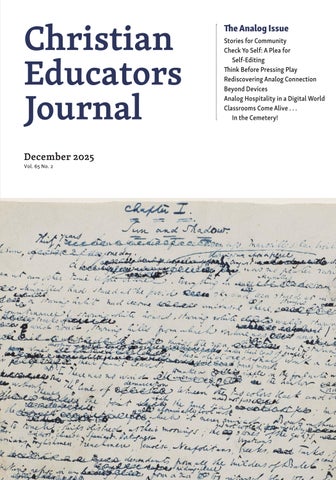
Christian Educators Journal December 2025 Vol. 65 No. 2
The Analog Issue Stories for Community Check Yo Self: A Plea for Self-Editing Think Before Pressing Play Rediscovering Analog Connection Beyond Devices Analog Hospitality in a Digital World Classrooms Come Alive . . . In the Cemetery!
Contents
3 Editorial 5 Stories for Community: Curriculum Planning ERIKA KNIGHT BAKKER
9 Check Yo Self: A Plea for Self-Editing JEFF MINGEE
17 Think Before Pressing Play: A Call for Hands-On, Experiential Learning Opportunities SUSAN DYKSHOORN
22 Ink, Presence, and Prayer: Rediscovering Analog Connection in the Classroom TOBY BROOKS AND DOUG DENDY
28 Beyond Devices: A People-Focused Approach to Citizenship Education
CHRIS PRIOR AND ANDREW LESLIE
32 Analog Hospitality in an Increasingly Digital World: Re-Imagining and Re-Claiming Universal Design for Learning TIMOTHY HENDRICKSON AND MICHAEL DIETER
39 Classrooms Come Alive . . . In the Cemetery! CARY SHAW
Christian Educators Journal
December 2025
1
Christian Educators Journal Vol. 65 No. 2, December 2025 cejonline.com Editor Abby Zwart cejeditor@gmail.com The Christian Educators Journal (CEJ) encourages letters to the editor in response to articles presented in the CEJ. Letters must be accompanied by the author’s name and email address. The CEJ reserves the right to edit letters for length and clarity. Where a letter addresses issues raised by the author of an article, the CEJ reserves the right to invite the article author to respond to the letter. Subscriptions Klaas Wolterstorff 2474 Westboro Dr NE Grand Rapids, MI 49506 business@cejonline.com Subscription Price (US dollars) Digital only: $25.00 per year Beginning October 2025, all subscriptions are digital only. Please visit www.cejonline for subscription information. US Postal Information Nonprofit Organization Postage paid in Grand Rapids, MI Permit No. 657 Return postage guaranteed to: Christian Educators Journal 2474 Westboro Dr NE Grand Rapids, MI 49506 Address Correction Requested Canadian Postal Information Registered under Publications Mail Agreement: No. 40022165 at Norwich, ON Return postage guaranteed to: Christian Educators Journal PO Box 39 Norwich, ON N0J 1P0 Indexed in Christian Periodicals Index Copyrighted 2000 CEJ. All rights reserved. Christian Educators Journal (130630) is published quarterly by Christian Educators Journal Association. Scripture All Scripture quotations, unless otherwise indicated, are taken from the Holy Bible, New International Version®, NIV®. Copyright ©1973, 1978, 1984, 2011 by Biblica, Inc.™ Used by permission of Zondervan. All rights reserved worldwide. www.zondervan.com
Statement of Purpose The Christian Educators Journal Association publishes the Journal as a channel of communication for all educators committed to the idea of Christian day school at the elementary, secondary, and college levels. The views expressed are those of the writers and not necessarily those of the association. Reprint Policy We allow free reprinting or photocopying of individual articles that have appeared in our journal, as long as the copied articles are used within the context of schooling and the source is acknowledged. Editor Abby Zwart Copyeditor Bethany Murphy Design Editor Klaas Wolterstorff Business Manager Klaas Wolterstorff Web Shepherd Heather Altena Board of Trustees Dr. Henry Algera Heather Birch (Chair) Eunsub Cho Justin Cook Albert Kok Dave Loewen Gayle Monsma Sean Schat Christine Scholma (Secretary) Tricia Stobbe Heather VanDyke Supporting Institutions Calvin University The King’s University Redeemer University Trinity Christian College Tyndale University Subscribing Organizations Christian Educators Association Christian Educators of British Columbia Edvance Christian Schools Association Prairie Centre for Christian Education Printed back issues (if available) can be purchased for $7.50 per copy (cost of shipping to be added to total). Some back issues may be available in digital format.
Cover: Page from original manuscript of Little Dorrit, by Charles Dickens.
Editorial
T
his month’s issue arrives in the midst of holiday preparation. My social media and search engine algorithm has been serving me all kinds of ideas for holiday crafts over the last few weeks—how to recycle paper bags into handmade decorations, suggestions for easy and personalized gifts kids can make for their family members, and of course, a hundred and one unique ways to wrap a gift. I’ve always loved crafts, but during the school year, when planning and grading and emailing take over, I don’t get to pull out the scissors and paint as often as I like. Which is why the day after school lets out for Christmas break is one of my favorite personal rituals: I stir up some hot chocolate, turn on the Christmas music, and clear the kitchen table for an entire morning of wrapping gifts. After hours of reviewing end-of-semester projects and exams, it’s a relief to do something with my hands that has a starting point, an ending point, and a tangible and beautiful result. I believe that in this digital world, our students are yearning for that same hands-on experience. As students get older, it seems that they spend more and more time—likely hours each day—on their computers or tablets scrolling resources, playing educational games, typing out their thoughts, and watching or recording video. This is all well and good. Technology provides incredible resources for efficient teaching, engaging learning, and personalized instruction. However, there likely has come a time in all of our careers when we thought, “Maybe I could just explain this, write something on the board, and then have them write down an answer!” That may sound a bit “oneroom schoolhouse” to some of us, but research supports the idea that analog or low-tech teaching and learning are still effective—sometimes even more so. So in this “analog issue,” we’ve asked writers to share lessons or methods that they find work even better than technological solutions. They remind us that seeing a unit’s scope and sequence written out instead of just on a screen can foster collaboration and help us picture a student’s learning. They suggest no-tech field or service trips you can take with your class to build connection to the local community. They think about the ways technology can actually create barriers instead of destroy them. And, they give suggestions for practices in your classroom that go beyond pressing play or asking students to email you their questions. This Christmas season, we turn our gaze away from the glow of the screen and toward the tangible, intentional practices that nurture deep Christian Educators Journal
December 2025
3
learning, connection, and a robust faith grounded in the physical reality of the Word made flesh. May your mind be still this season as your hands continue to work—wrapping gifts, baking pie, wrangling batteries into a new toy, and holding your loved ones close. —Abby Zwart
4
December 2025
Christian Educators Journal
Stories for Community: Curriculum Planning ERIKA KNIGHT BAKKER
S
tories nurture the forming of community (Vryhof xiii). Listening to stories about our school places students in a narrative, creating a sense of belonging. How did our school begin and for what reasons? How do these stories affect our present practices? What vision do we have for the future in light of these stories? For staff, too, stories can be a powerful way to connect and reflect. For example, the following stories of curriculum planning demonstrate opportunities to place ourselves within a larger narrative of Christian education, to reflect on curriculum practices in the present, and perhaps to adjust our actions in the future.
A Curriculum Story from the Past Thirty years ago, I opened the cupboards of my first classroom and saw a sea of plastic buckets. It was a second grade classroom, and the curriculum I inherited was organized by monthly themes. Each bucket was labeled with a marker in that cheerful printing of primary teachers. The buckets contained picture books, bulletin board pieces, homemade worksheets, and photos and articles cut from magazines. At the top of each bucket, well worn, was a large piece of paper describing the important details of the unit. Those 11 × 17 pieces of paper were especially valuable. They held the plan. Main goals, faith foundations, objectives, and assessments were handwritten in detail. I studied those plans carefully that first year! We taught in big, integrated units, so the theme of our buckets directed our days. I remember how satisfying it was to put one topic away and how exciting to dive into a new one. In our June meeting at the end of my first year, we gathered as staff to catch up on curriculum planning. We each brought to the meeting our papers that summarized each unit and reflected on the year. When it was time to consider scope and sequence, we moved the furniture to the edge of the room and spread our papers on the floor. The Kindergarten papers formed the top row, showing September to June’s themes from left to right: names, apples, fairy tales. First grade topics were placed in a row below it, and so on. We could see the whole year at once, easily visualizing our students’ experiences from K to 8. I clearly remember our petite curriculum leader climbing up on a chair for a good view. She peered over her glasses at the sea of papers and helped us draw conclusions. One of the decisions made during that session was that we needed an ecosystem study, and I was asked to create a unit on the rainforest. The curriculum coordinator brought me a bucket and a blank 11 × 17 piece of paper. Christian Educators Journal
December 2025
5
Thirty years ago, I opened the cupboards of my first classroom and saw a sea of plastic buckets.
We could see the whole year at once, easily visualizing our students’ experiences from K to 8.
Ink, Presence, and Prayer: Rediscovering Analog Connection in the Classroom TOBY BROOKS AND DOUG DENDY
I
What we call the “communication card” has become, in our experience, one of the most analog, unpretentious, and surprisingly transformational tools in our teaching toolkits.
Students are specifically told that the instructor will pray over each card individually and by name each time a card is submitted.
n an age where apps track everything from steps to sleep cycles and where artificial intelligence can generate convincing essays in seconds, it may seem almost quaint to rely on a 3 × 5 notecard and a pen to facilitate classroom communication. Yet after nearly two decades each in higher education faculty roles, we have found that this simple approach has produced some of the most significant impact in our teaching. In the past, faculty might have turned to a mobile survey tool or logged attendance in a spreadsheet. Post-COVID-19, however, the need to cultivate authentic, bi-directional communication has only grown (Avcı; Garrad and Page; Marler et al.). In that context, the power and value of a personal, handwritten system has come into clearer focus. What we call the “communication card” has become, in our experience, one of the most analog, unpretentious, and surprisingly transformational tools in our teaching toolkits. At the beginning of every class session, a blank notecard is distributed to each member of the class. Every student is asked to write their name and a praise or gratitude on the front of the card along with any concerns on the back. The prompt is simple: “I care about you. Let me know if there’s anything in your world you’d like me to know about.” In a state or secular institution, this practice can be framed as an opportunity to share a gratitude and/or a concern. In a faith-based institution, it can be presented as an opportunity to share a praise and a prayer request. Gratitude exercises like this or variants on the theme (i.e., “three good things,” etc.) have demonstrated the ability to potentially reduce the incidence of depression and anxiety in some populations (Petrocchi and Couyoumdjian; Schienle et al.). Regardless of setting, the card is a tangible means for faculty to open a dialogue with each student in the hopes that they feel seen, valued, and appreciated. By adding in the “if there’s anything in your world you’d like me to know about,” we seek to extend a genuine invitation for students to share whatever they feel led to communicate. In practice, responses may include a question about the course material, a comment about the class, or—more often—something deeply personal. In faith-based contexts, students are specifically told that the instructor will pray over each card individually and by name each time a card is submitted, so each is encouraged to include a prayer request if they choose. Cards are then collected and reviewed. When a student’s comment warrants a reply, a personal, handwritten note is created and delivered at the next class session on a fresh notecard or sealed envelope. Simple. Analog. And profoundly human.
22
December 2025
Christian Educators Journal
A Gentle Disruption of Routine Like most faculty who have taught for any length of time, we have experimented with numerous systems for tracking attendance, soliciting questions, and keeping communication lines open. From digital gradebook signins to QR codes and course management messaging systems, we have tried a host of options. While convenient, these methods often lacked soul. What they gained in efficiency, they tended to lose in intimacy. The notecard, by contrast, slows the moment down. It provides students with a tangible pause. It is a quiet breath before each class session to reflect, to reach out, or simply to be present. It also reinforces that our classrooms are not merely transactional spaces where information is dispensed. Instead, they are intended as transformational spaces where presence matters. This small act of reflection resonates with recent scholarship on contemplative pedagogy, which emphasizes intentional stillness and reflection in learning environments as a means to enhance focus, deepen learning, and foster emotional resilience (Grace; Chapman). Such analog practices may also serve as an antidote to the cognitive overload and information fatigue so prevalent in digitally saturated learning environments (Barbezat and Bush; Zajonc).
Figure 1: Example of a card submitted by a student concerned for family.
Figure 2: Example of a card submitted by a student excited to share a triumph.
Building Belonging and Trust One of the unintended but deeply welcome consequences of the notecard practice has been the trust it cultivates. Students often share things on those cards they might never feel comfortable putting in an email. From mental health struggles to worries about a parent’s cancer diagnosis to hopes for Christian Educators Journal
December 2025
23
Our classrooms are not merely transactional spaces where information is dispensed. Instead, they are intended as transformational spaces where presence matters.
Beyond Devices: A People-Focused Approach to Citizenship Education CHRIS PRIOR AND ANDREW LESLIE
I We offer a few reflections on our teaching of citizenship in year 9, particularly on our approach to teaching justice, including biblical justice.
n the midst of the busyness of our roles at Plenty Valley Christian College, we regularly discuss what we consider to be “big picture” issues of Christian teaching. A significant portion of our time is spent working with students and their families. We earnestly desire for the students we teach not only to understand the gospel but to seek the kingdom of God themselves, to follow Christ, including at school. As we reflect on our practice, there are days when we think we are maturing in our understanding and practice as Christian teachers. We also have moments when we look at our own teaching and the practices of our school and wonder whether we are truly gospel focused. In this article, we offer a few reflections on our teaching of citizenship in year 9, particularly on our approach to teaching justice, including biblical justice.
Our Context
We rely on technology. Almost everything we do requires digital connectivity.
Plenty Valley Christian College is a growing Christian school with approximately one thousand students located on the northern suburban fringe of Melbourne, Australia. Like many other Christian schools, our promotional material includes several lofty claims regarding the education provided within our classrooms and across our various programs. We are “Christcentered.” We state that the curriculum at Plenty Valley Christian College is taught from a Christian or biblical perspective. Additionally, like many Christian schools, we aim to equip students for Christian discipleship. In many respects, if we were to remove the word “Christian” from our signage, our school and our classroom spaces could be described as typical of schooling in Australia. Whether our classrooms have been recently refurbished or not, it is evident that “digital devices and the media they access have moved to the center of our lives and many of our classrooms. Digital technologies and the practices associated with them therefore loom large in our cultural and educational conversations” (Smith et al. 16–17). We rely on technology. Almost everything we do requires digital connectivity. While some classrooms still have projectors, most have large smart televisions as a central feature. Students are issued a personal laptop, and almost all of our textbooks are online. Indeed, without a digital device, it can be difficult for students to participate in classroom activities. There is undoubtedly an intentionality to our uptake of technology. It is also true that many Christian schools, like ours, have, over the past generation, mirrored the culture we are embedded in. Additionally, the COVID pandemic had a significant impact. During that time, our state government 28
December 2025
Christian Educators Journal
enforced a series of lockdowns. Students were not permitted to attend school, and schools were instructed to provide online learning opportunities. Today, although some secondary school classes still involve writing in notebooks, the majority of learning is now computer based. Most lessons and curriculum materials are delivered through a digital learning management system. As teachers, we certainly see the impact of technology in the classroom, both positive and negative. Among the benefits is ease of access. Students can access their learning whether at school or at home. Work can be submitted and feedback given using the same technology. Parents can also easily monitor their children’s progress. We have also found that this approach has unintended consequences. Classrooms, at times, are seemingly more device directed than teacher directed. This is evident when students automatically open their devices upon entering a classroom. We have also found that students often turn to the internet or artificial intelligence for answers to posed questions, rather than wrestling with ideas and collaborating with others.
Classrooms, at times, are seemingly more device directed than teacher directed.
Teaching Citizenship In our year 9 program, we emphasize citizenship, particularly justice. More accurately, across several subjects, we aim to deepen our students’ understanding of the communities in which we are embedded, the issues that affect our communities, and the diverse peoples who live in our local communities. Our ideal is to ground students’ learning in the biblical story. A significant theme across Scripture is for the people of God to adopt “a distinctive way of being and living in the world” (Watkin 137). The call for those of us who profess to follow Christ is to love the Lord with all of our hearts (Deu. 6:5; Matt. 22:37), and to love our neighbour as ourselves (Matt. 22:39). A key verse we anchor learning in is Micah 6:8. Our ideal is for students to go beyond knowing about justice issues to living in ways that are consistent with God’s call to love our neighbour. Our teaching of citizenship begins with classroom projects. We introduce students to community issues and show them how to seek the perspectives of others, including through interviews and surveys. Students work in groups of four, exploring issues and presenting their findings to their classmates. This year, there have been many moments when we were reminded of the extent to which young people are prone to being “formed relationally and ideologically through a screen” (Burrows 37). Despite working in groups, on several occasions, we noted the students weren’t talking with each other, weren’t sitting together, and weren’t discussing the issues they were exploring. When quizzed on this, the replies were unanimous. They said they were working in groups, discussing ideas, and doing it all through online platforms. Several also balked at personally interviewing or surveying others. Again, the preference was to interact online. From our vantage point, there appears to be a growing disconnect and relational distance within certain sections of our student body. Admittedly, like the goals of the Christian school where we teach, ours are lofty! Our ideal is for students to engage deeply with the material. We do not want them to understand topics like justice simply as concepts. Instead, Christian Educators Journal
December 2025
29
Students go beyond knowing about justice issues to living in ways that are consistent with God’s call to love our neighbour.
From our vantage point, there appears to be a growing disconnect and relational distance within certain sections of our student body.