Accelerating
04 The Art of Orchestrating AI
AI is the orchestra section; your systems are the instruments. Without a conductor, it’s just noise. Here’s how to create harmony.
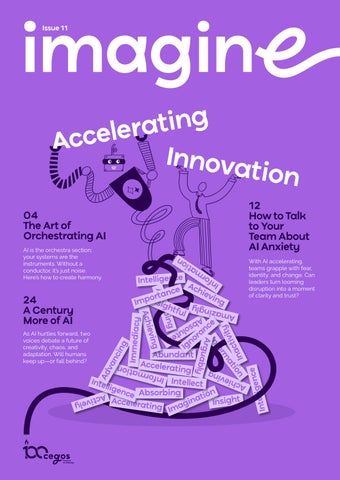
AI is the orchestra section; your systems are the instruments. Without a conductor, it’s just noise. Here’s how to create harmony.

With AI accelerating, teams grapple with fear, identity, and change. Can leaders turn looming disruption into a moment of clarity and trust?
As AI hurtles forward, two voices debate a future of creativity, chaos, and adaptation. Will humans keep up—or fall behind?
Contributors
Publisher Cegos UK
Writers
Jonna Sercombe
Emily Link
Ben Heath
Tim Volans
Rebecca Woods
Simone Sullivan
Reuben Fletcher-Louis
Blair Wagner
Ross Hardy
Anite Cangi
Lara Mohammad
Scarlet Woods
Sahanshil Dangol
Editors
Emily Larson
Scarlet Woods
Design
Daisy Whittle
Illustration
Daisy Whittle
Gaby Bran
Sahanshil Dangol
Printed in the UK by Blissetts Unit 1, Shield Drive, West Cross Industrial Park, Great West Road, Brentford, TW8 9EX
Artificial intelligence has moved quickly from an interesting idea to a real part of how we learn, work, and grow. It’s changing the way organisations support development — not by replacing the human element, but by enhancing it.
As we continue exploring what AI has to offer, one thing remains clear; technology is at its best when it amplifies our strengths. AI may provide the data or the recommendations, but it’s the people who bring curiosity, creativity, and connection — and they’re the qualities that make learning truly impactful.
The interesting thing about this edition is that we look beyond common conventions — from sharing a team perspective in A Century More of AI (p.24), to debating the impossible in Can AI Make Us More Human? (p.34). Our aim is to open up the conversation, moving past the usual narratives to shine a light on the practical and the surprising.
As you read on, I hope you feel encouraged to approach these tools with openness and confidence. The future of learning is evolving quickly, and we’re all part of shaping what comes next.
Copyright Cegos UK © 2026
All rights reserved. No part of this magazine may be reproduced, in whole or in part, without written permission from the publisher. Whilst every effort is made to achieve total accuracy, we cannot be held responsible for any errors or omissions within this magazine.
To work with us please contact: info@cegos.uk or call +44 (0) 2033185753 cegos.uk

Enjoy the read,

Jonna Sercombe CEO Cegos UK & US
AI is the orchestra section; your systems are the instruments. Without a conductor, it’s just noise. Here’s how to create harmony.
With AI accelerating, teams grapple with
If AI delivers perfect-looking work in seconds, who’s left to decide whether it’s any good? A deep dive into the new judgement
As AI hurtles forward, two voices debate a future of creativity, chaos, and adaptation. Will humans keep up — or fall behind?
With
— welcome to techlash.
Same Tools, Different Playbooks
AI adoption isn’t one-size-fits-all. Discover how generational behaviours shape workplace readiness — and the targeted training that actually moves the needle.
Track the major milestones that shaped workplace learning and discover how a hundred years of progress is defining L&D’s next era.
What if AI isn’t stealing our humanity at all but sharpening it? This article uncovers how machines might boost our softest skills.
the Plug
Unclogging the myth of AI replacement with clear insight, human nuance, and light
At

Is “AI First” the future of work or just another overhyped slogan? Tim Volans makes the case that the real revolution lies in orchestration — intentionally weaving autonomy, governance, and human-centred design into the fabric of organisational strategy.
Unless you’ve been living in an off-grid commune, nestled in some faraway hills, you will undoubtedly have seen countless headlines extolling the virtues of AI. “AI First” or “AI Native” slogans emblazon websites and collateral, but what does — or what should — this newly coined phraseology mean?
It would seem that it can mean anything from the inclusion of AI chatbots to the use of AI-developed, tested, and deployed code, and almost everything in between.
I’ve always been a bit of an AI sceptic. Until, a number of years ago, I sat in on a prompt engineering course led by a veteran trainer in the IT sector. It all became much clearer when
I examined the origin of my initial scepticism. My hesitation wasn’t rooted in a dislike of technology, but rather in a fatigue with “solutionism” — the idea that we can simply sprinkle some silicon-based magic dust over a broken process and expect it to fix itself.
In the world of Learning and Development, we see this often. A new platform arrives, everyone buys a licence, and six months later it sits gathering digital dust because nobody figured out how it actually fits into the flow of work. AI is no different — and with a 327% increase in AI implementation expected over the next two years, alongside hopes of 30% gains in productivity, HR leaders need to firm up organisational structures. 1
When we talk about orchestration, we are moving away from the idea of AI as a stand-alone “assistant” and towards AI as a foundational layer of the business ecosystem. If you think of a traditional orchestra, you have various sections: strings, brass, woodwind and percussion. Each is brilliant in its own right, but without a conductor and a score, you simply have a lot of noise.
In a corporate L&D context, your “sections” might include your LMS, your content libraries, your performance data and your communication channels. Orchestration is the art of making these elements communicate with one another through an AI framework to create a seamless experience for the employee.
For instance, an “AI First” approach shouldn’t just mean a learner can ask a bot for a course recommendation. It should mean AI has already analysed the learner’s recent project feedback, identified a skills gap, curated a bespoke three-minute microlearning module from internal documentation, and scheduled a practice session in their diary. That is the difference between a tool and a strategy.

The prompt engineering course I attended was a revelation because it reframed AI from a “Google on steroids” into a “reasoning engine.” It shifted the burden of effort from the doing to the directing.
For L&D professionals, this changes our job descriptions. We are no longer just content curators or workshop facilitators; we are becoming architectural designers of learning journeys. To do this effectively, we need to master three specific areas:
Sources: 1 Salesforce. (2025). HR Leaders to Redeploy a Quarter of Their Workforce as Agentic AI Adoption Expected to Grow 327% by 2027. [online] Available at: https://www.salesforce.com/uk/news/stories/agentic-aiimpact-on-workforce-research/. 2 State of AI in the Enterprise, The Untapped Edge. (2026). Available at: https://www.deloitte.com/content/dam/ assetszone3/us/en/docs/services/consulting/2026/state-of-ai-2026.pdf.
• Contextual Insight: Understanding the specific nuances of our organisation’s culture so that AI provides relevant, tone-appropriate support.
• Data Integrity & Sovereignty: Ensuring information is accurate and secure. This is increasingly geopolitical; with 77% of firms vetting AI origin and 58% prioritising local stacks, L&D must build the regulatory literacy required to navigate these sovereign AI environments confidently. 2
Human-Centric Design: Recognising where the line between human and AI should be drawn.
There is a pervasive worry that AI orchestration leads to the dehumanisation of the workplace. However, by automating the administrative heavy lifting — the tagging of content, the scheduling, the basic knowledge retrieval — we free up humans to do what they do best: innovate, empathise, and collaborate.
We must, however, be careful not to fall for the ‘easy button’ trap. Orchestration requires a significant upfront investment in thought. You cannot orchestrate what you do not understand. If your underlying learning strategy is flawed, AI will simply help you fail faster and at a larger scale.
As we look toward the future, the term “AI Native” will likely fade away simply because it will become the default. We don’t call ourselves “Electricity Native” businesses anymore; we just expect the lights to come on when we flip the switch.
The “Art of AI Orchestration” is about preparing for that inevitability. It is about moving past the sceptic-versusevangelist debate and getting down to the practical work of integration. It requires a blend of technical curiosity and a deep, empathetic understanding of how people actually learn and grow.
For those of us in senior leadership roles, our task is to lead this transition with a steady hand. We must encourage experimentation while maintaining a focus on tangible outcomes. We aren’t just buying software; we are redesigning the way our people interact with knowledge.
When work becomes effortless, what happens to the thinking that once made it great? How can we continue to think critically in an environment that both requires it and hinders it? Reuben Fletcher-Louis takes a look.
There’s a peculiar magic trick happening in modern workplaces.
Work appears instantly. Reports appear in seconds. Slide decks assemble themselves. Marketing copy materialises with unnerving confidence. Ask the machine a question and voilà, polished output appears faster than your coffee order.
For many organisations, this feels like progress. Efficiency has always been the holy grail, and AI seems to have found the shortcut. But beneath the magic trick lies a small problem: when work arrives quickly, our ability to judge whether it’s good enough often doesn’t keep up.
The result is a new paradox emerging across organisations. We get fast work, but fragile judgement.
So, where does judgement come from? In most organisations, early-career roles act as training grounds. Graduates write the reports, get feedback and try again. Marketing executives test campaigns that fail. New product managers prioritise features that customers ignore.
It might seem inefficient, frustrating, and is often painful. But it works. Repeated engagement with problems — remembering, analysing, evaluating, and refining solutions — is central to how humans develop critical thinking and reasoning skills.
Now, instead of creating imperfect work and refining it, employees increasingly review work generated by machines. Reviewing is not the same as creating.
To use AI effectively, people need good judgement. But as AI takes on more of the tasks that once built judgement, the chances to develop it start to vanish.
And so, the Judgement Paradox begins.
AI simultaneously increases the need for judgment and erodes the experiences that produce it.
— David Duncan,
HBR1
For learning and development leaders, the challenge is clear: judgement can’t be left to chance anymore. It needs to be built deliberately — through discussion, simulation, reflection, and gradually increasing responsibility.
If AI is reshaping how work gets done, organisations need to be more deliberate about how judgement develops. Historically, critical thinking emerged naturally through
messy work: writing the first draft, solving the problem from scratch, and occasionally getting it wrong. If those experiences are disappearing, can they be recreated?
One effective approach is surprisingly simple: turn work itself into the classroom. Teams revisit a recent project, decision, or client challenge and treat it as a case to be unpacked.
What assumptions were made? What signals were missed? What alternatives might have led somewhere better? Was it any good?
One structured model that might facilitate such an approach would be Kolb’s Learning Cycle:
Active Experimentation
Trying out what you have learned
Abstract Conceptualisation
Learning from experience
Concrete Experience Having actual experience
Reflective Observation Reflecting on experience
Through structured reflection and open debate, people move beyond simply remembering what happened to analysing why it happened. It’s a chance to practise the thinking behind the decisions. Could these conversations sharpen judgement in the same way messy first drafts once did?
AI will keep making work faster. The real question is whether organisations can ensure people keep learning how to think. Because in a world where answers appear instantly, the most valuable skill might simply be asking:
“Is this actually any good?”
Sources: 1 Is AI flattening the curve of critical thinkers leaving behind a cognitive cap for learners? (2024). David Scibelli. Brian Stevens. Information Systems. https://www.iacis.org/iis/2024/3_iis_2024_133147.pdf 2 How do workers develop good judgement in the AI era? (2026). David S. Duncan. Harvard Business Review. https://hbr.org/2026/02/ how-do-workers-develop-good-judgment-in-the-ai-era
Is AI a creative partner or a rival in disguise? Sahanshil Dangol explores how artificial intelligence is reshaping the design studio — from ethical dilemmas to workflow hacks — and asks whether it threatens originality or unlocks entirely new ways to create.
The Use of AI in Creative Spaces: A Good or Bad Thing?
Since the start of the AI boom, the use of AI tools in creative spaces has been a hot topic. While the technology is developing at breakneck speed, our ability to comprehend its full potential — and to regulate new laws effectively — has lagged behind.
Creatives are understandably wary of generative AI, and at the core of this reluctance lie ethical concerns. Most AI models are trained on datasets containing millions of pieces of copyrighted material, often used without the original artist’s consent. To many, this feels less like innovation and more like a breach of trust.
Furthermore, the “hit or miss” nature of AI-generated visuals frequently means fundamental design principles, such as composition, visual balance, and colour value, are neglected (or miss the mark completely). AI lacks the intentionality that has underpinned human design for centuries, often producing a sanitised average of the saturated data it was fed.
However, AI has firmly established itself in the modern workplace, becoming an integral tool across countless industries. The most effective way I’ve found to integrate AI into a creative workflow isn’t to let it do the drawing, but to let it handle the chores. Using AI for admin tasks, note summarising, and organising data gives us more time to explore and create.
We’re seeing a shift towards using AI to build tools that supplement our work, much like developers do. Instead of asking AI to “make art,” we can use it to:
• Build custom plugins: Create bespoke tools that adapt to our workflows and consolidate frequently used shortcuts and actions in one place.
Write scripts: Generate codes that handle repetitive tasks, such as reformatting designs into hundreds of variations at once.
• Organise data: Take lists of translations or scripts and automatically integrate them into design templates.
By focusing on workflow rather than output, we can use AI to lighten the load without sacrificing the human touch that defines creative work.

A global asset management firm partnered with us to develop the next evolution of decision-making and big-picture thinking for their senior leaders. To support leaders in navigating the complexities of strategic decision-making and data-led judgement, we designed a high-impact AI Business Simulation as part of their Leadership Development Programme. The primary objective? To sharpen critical leadership capabilities through the lens of international expansion — one of the firm’s five strategic priorities.
The Cegos team faced a sophisticated engineering challenge:
Content Synthesis: The AI-powered simulation needed to do more than just summarise information; it had to replicate the analytical depth of a senior strategic advisor, delivering ‘professional opinions’ consistent with industry-leading standards.
Engineering Speed: We had just 1.5 weeks to move from brief to a fully functional, fine-tuned AI simulation.
We engineered a bespoke growth simulation — an immersive digital environment where teams acted as Strategic Advisory Panels. The goal was to challenge leaders to think beyond their specific verticals and defend their logic against an AIpowered board, all while ensuring alignment with the firm’s strategic ambitions.
To ensure a realistic and credible experience, the business simulation required extensive fine-tuning and scenario engineering. This involved a deep-dive into the firm’s specific investment language and market-entry logic, ensuring every interaction felt authentic to a senior-level boardroom discussion.
To deliver this, our development team built a custom web application using Next.js for the front end of the simulation. The interface was carefully prototyped in Figma to ensure clarity, speed, and intuitive learner navigation.
Using OpenAI technology powered by GPT-4.0, our team created a tailored AI architecture designed specifically for strategic decision-making contexts. This included multi-layered system prompts and analysis pathways that enabled the AI to interpret submissions with executive-level nuance.

Teams were tasked with selecting a region, distribution channel, and asset class before preparing a concise strategic market-entry submission.
The simulation required participants to define their strategy across the six key pillars of international expansion:
1. Activation: Defining how to establish a presence and begin operating within the chosen region.
2. Engagement: Demonstrating how to attract and build sustainable relations with local clients.
3. Positioning: Structuring and marketing products tailored to local needs and preferences.
4. Enablement: Outlining the internal resources and capabilities required to execute the strategy.
5. Digital: Leveraging AI tools to accelerate, scale, or improve operational effectiveness.
6. Financials: Articulating the commercial rationale, including costs, payback, and ROI.
To validate participants’ strategies, we integrated a proprietary scoring engine designed to evaluate the level of ‘executive-style’ thinking. The evaluation framework categorised responses across three performance levels, determined through AI analysis of current marketentry considerations and leadership capability metrics.
By cross-referencing every submission against pre-defined benchmarks, the engine generated instantaneous, data-driven performance metrics. This transformed the AI simulation into a dynamic performance partner, enabling it to move beyond simple summarisation and deliver definitive ‘professional opinions’ required by the brief.
The deployment of the simulation was a seamless success. By leveraging AI, we surpassed the limitations of traditional facilitation, reducing the feedback loop from hours to seconds. This allowed participants to maintain a high-performance ‘flow’, enabling them to iterate on complex decision making and refine their strategic logic in real time.
By successfully launching an AI-powered environment, the firm’s senior cohort developed more than just technical knowledge; they built the essential skills and confidence required to lead in an increasingly complex landscape. Leaders left not only prepared to make highstakes decisions but also equipped to integrate AI fluently into their strategic toolbox.
We are proud to continue partnering with the firm on the next iteration of their leadership journey. We are currently developing version 2.0 of the growth simulation, where we’re harnessing GPT-5 capabilities to create an even more adaptive, immersive, and powerful experience for future cohorts.




AI may boost productivity, but it is also raising quiet fears across workplaces. Blair Wagner shares how leaders can go beyond platitudes to acknowledge the real, sometimes uncomfortable truths of AI transitions — and help teams navigate a shift that affects not just workflows, but professional identity.

AI is no longer just a buzzword; it is a pressure point.
Whilst boardrooms celebrate efficiency gains and cost reductions, employees are asking harder questions: Will my role look the same in two years? Will the skills I have spent years building still matter? Am I being automated out of relevance?
If you are leading a team right now, managing this transformation is not merely a technical challenge — it is an emotional and human one. You cannot hand out logins and expect a standing ovation. Real transformation requires trust, honesty, and shared ownership.
Here is how to help your team shift from feeling like passengers in this change to active participants shaping it — even when the road ahead involves real disruption.
One of the worst things a leader can do is ignore the elephant in the room. Acknowledge openly that AI anxiety is real — and in some cases, justified. Sometimes AI will take over parts of someone’s job. Sometimes workflows will change dramatically. Avoid the instinct to gloss over it. A more honest framing sounds like:
“Some parts of our work are going to change significantly. You may see AI take over certain tasks you have mastered. That can feel unsettling — and it is entirely normal to feel that way. We are going to navigate this together.”
This level of transparency builds psychological safety because it treats employees as adults who can handle the truth.
Move from “To” to “With”
When people fear losing control, they cling to the status quo. Inviting them into the transformation process helps them imagine a future they actually want to be part of — even if their role will look different.
Go beyond asking where AI could help. Ask deeper, structural questions:
If parts of your role become automated, what new problems would you love to solve?
What skills would you like to develop that you have not had time for?
How can we redesign your role so that it becomes more strategic rather than more squeezed?
In departments where the overhaul will be considerable — finance, operations, customer support — cocreate transition roadmaps. Show people what future versions of their roles could look like, and allow them to shape those versions. People do not fear change as much as they fear having no say in it.
Most teams have already heard the familiar line: “AI will not replace you; it will augment you.” Many simply no longer believe it. Instead of repeating it, take the idea a level deeper. Shift the narrative from replacement avoidance to identity evolution.
Help people explore questions such as:
• Which parts of your expertise remain uniquely human, even if task-level work shifts?
• What does mastery look like when AI handles the groundwork?
• How can your judgement, creativity, and contextual understanding become more valuable — not less — in an AI-shaped workflow?
This framing acknowledges the loss of certain tasks, but highlights the growth of higher-order skills. It respects the emotional process of letting go of old expertise whilst building new identity anchors.
Experimentation helps, but it is not enough when someone fears becoming obsolete. Go beyond sandboxes. Create learning pathways that are:
• Personalised
• Structured, yet flexible
• Connected to future role expectations
• Supported by coaching and peer practice
For example:
• “Here is what your role may look like in 12 months.”
• “Here are the skills that will matter most.”
• “We will give you the time, training, and mentorship to build them — and we will support you throughout the learning curve.”
This turns fear into a development journey rather than a countdown clock.
Teams appreciate clarity more than comfort.
If a role is going to shift significantly, say so. If tasks will be eliminated, say so. If a department will be redesigned, say so.
People can adapt to major changes. What they cannot adapt to is ambiguity. Follow clear truths with clear commitments:
• How you will support redeployment
• How you will reskill teams
• How performance expectations will evolve
How decisions about AI-driven changes will be made
Certainty reduces anxiety — even when that certainty involves difficulty. AI transformation is not merely a marathon — it is an identity transition. And identity transitions require emotional intelligence, transparency, and partnership.
You will not resolve AI anxiety in a single meeting, or even a single quarter. But you can build a culture in which fear becomes dialogue, and dialogue becomes direction.
By leading with honesty, openness, and shared ownership, you are not just implementing AI — you are helping your team become future-ready humans. It is time to stop talking about AI as a threat, and stop overselling it as a saviour. Instead, talk about it as a catalyst: a catalyst for redesigning work in ways that make people not only more efficient, but more fulfilled.
In this article, Emily Link reflects on how AI’s efficiency seduces us into overwork. Rather than freeing our time, it quietly inflates standards, workloads, and the myth that we should always be doing more.


It’s 6:00 PM. The sun is dipping low, and my “To-Do” list is still staring back at me with a judgmental glare. At the very bottom, mocking my optimism, sits the entry: Write magazine article.
In a pre-digital age, this would be the moment I’d admit defeat, pour a glass of wine, and move the task to Tuesday. But today, I turn to my intellectual companion: Gemini (though, of course, other AI tools are available). We have entered an era where “I don’t have time” feels like a lie we aren’t allowed to tell anymore. If AI can draft a brief in seconds, why can’t I finish five more tasks before dinner?
We were promised that Generative AI would be the ultimate liberator. We imagined shorter workdays and a renaissance of leisure. However, the reality is proving to be a bit of a “productivity paradox.”
Recent research suggests that high exposure to generative AI is actually associated with an average increase of 3 hours and 15 minutes of time spent at work per week 1 Predictably, this comes at the direct expense of our leisure time. The problem isn’t that AI isn’t working; it’s that it works so well as a complement to human labour that we simply use the “saved” time to raise the bar.
Instead of finishing our work early and going for a walk, we use AI to:
Meet higher standards of quality.
Increase our responsiveness.
Take on three additional projects we previously would have declined.
This isn’t a new phenomenon; it’s a high-tech echo of the 20th century. When labour-saving devices like washing machines and dishwashers first entered the home, the narrative was the same: technology will free
us! In theory, these machines should have yielded hours of relaxation. In practice, the “saved” time didn’t go toward rest; we simply raised the bar and filled the void with more labour. Instead of enjoying the afternoon, we upped the standards: we stopped wearing shirts twice, started washing linens weekly instead of monthly, and found new domestic chores to occupy the gaps. The “leisure” we were promised was immediately devoured by a higher expectation of perfection and an endless list of new things to do.
When AI acts as a substitute, we might actually save time. But when it acts as a complement, it becomes an accelerator. It makes us feel like “super-workers” capable of achieving massive outputs in short bursts. This dopamine hit of efficiency tricks us into saying “yes” to more work, under the illusion that AI is doing the heavy lifting.
In reality, the human remains the bottleneck. We still have to prompt, fact-check, edit, and integrate. We are running faster because the treadmill has been upgraded, but we aren’t getting off any sooner.
As I sit here at 6:15 PM, article nearly finished thanks to my digital partner, I face a choice. I could use this “extra” time to clear my inbox or prep tomorrow’s meeting notes. Or, I could recognise the trap for what it is.
AI is a brilliant tool, but it shouldn’t be a reason to extend the workday. True productivity isn’t just about doing more; it’s about knowing when you’ve done enough
Sources: 1 Hello Future. (2026). The impact of AI on working hours: does more productivity lead to a greater workload? [online] Available at: https://hellofuture.orange.com/en/the-ai-productivity-paradox-thenew-tech-may-be-eating-into-your-leisure-time/.
In her article, Lara Mohammad delves into the rise of techlash, a phenomenon that’s dominating popular culture and shaping societal attitudes towards technology: what is it, why is it trending, and how does it affect L&D?


In 2013, the term ‘techlash’ was coined by The Economist to describe society’s rising hostility towards technology, driven by a shift in public sentiment regarding Silicon Valley giants and their growing power. Though it didn’t quite take shape as expected by some at the time, the idea lingered for years to follow. In 2018, the term made Oxford Dictionary’s shortlist for Word of the Year, and now, in 2026, the term — and the sentiment — is once again on the rise.
Social media has long been home to misinformation and disinformation to some extent; however, with recent developments in AI technology, this has increased at an exponential rate.
The rapid rise of ‘fake news’ — spreading articles, tweets, and memes based on ‘alternative facts’ — has grown immensely. Its heavy influence on public opinion has fed vast echo chambers online, causing people to become increasingly polarised.
In more recent years, it has arguably worsened through the emergence of countless AI scandals, one of which includes the popularisation of a, later to be discovered, AI-generated band ‘The Velvet Sundown’. The band, self-described as a “synthetic music project guided by creative human direction”, sparked outrage and concern globally regarding the lack of transparency and consent surrounding AI use in the creative sector, as well as governments’ roles in regulating it.
As many trends operate in cycles, it is perhaps unsurprising that tech disillusionment has resurfaced, particularly towards AI.
But what does online misinformation mean for our culture? Distrust, disillusionment, and outrage towards technology are a few words that arguably describe the current societal outlook.
What Does Techlash Mean for L&D Professionals?
When we examine AI distrust, we’re not simply witnessing a fear of machines; we’re seeing a broader societal pivot towards values such as agency, accountability, and empathy (the human touch, if you will).
What does this mean for L&D? A return to the analogue approach.
Overarching learning trends we’ve noticed include: In-person learning
Mentoring
• Soft skills development
What’s Being Subliminally Signalled To L&D Professionals?
At its core, the return to analogue signals a resurgence of human-centred learning.
Let’s revisit some of its foundational thinkers to get a better understanding of what this actually means:

Maria Montessori
Developed the ‘following the child’ approach, whereby learning is tailored to the individual’s psychology, physical traits, and social behaviour. It is an observation-based teaching method founded on the idea that learners shouldn’t be mindlessly fed content in the same way, but that education should be tailored to each individual’s personality.

George Siemens
Created the theory of connectivism, which argues that building collections of connections is more powerful than internalising masses of knowledge. He believed that it was important for individuals to develop relationships with knowledge centres (e.g. books, the internet, AI) than to memorise knowledge itself.

Howard Gardener
Believed that intelligence is not a stagnant, fixed trait (as IQ tests suggest). Instead, it is a person’s biophysical potential to process information that can be activated in the correct cultural setting. Measuring performance, he believed, should look different for each person.
Although these theories have existed for some time, they form the key building blocks of human-centred learning. If this approach is indeed regaining momentum — as we believe it is — then it’s worth understanding what these thinkers had to say.
What connects these theories, and what is becoming increasingly important in L&D in 2026, includes:
• Radical empathy: The ability to read a room and motivate different personalities at a high level.
• Curation: The ability to select concise, relevant methodologies and readings.
• Vulnerability: Particularly among leaders, openly acknowledging challenges and admitting when they don’t have all the answers is increasingly valued as a sign of authenticity.
• Pattern spotting: Acting as a ‘sensemaker’ by identifying meaning within patterns and connecting learning data to tangible business outcomes.
• Mentorship: A human-oriented learning approach centred on relationships between individuals. It fosters belonging, emotional support, and the transfer of institutional wisdom.
• Individuality: Giving learners autonomy to shape their own career paths and choose projects aligned with their personal values. This means viewing organisations as fluid pools of talent with unique, overlapping skillsets rather than rigid job descriptions.
Sources: 1 https://www.economist.com/news/2013/11/18/the-coming-tech-lash 2 https://www.balticapprenticeships.com/blog/ what-is-techlash-and-what-does-it-mean-for-the-digital-industry/ 3 https://www.theguardian.com/technology/2025/jul/14/an-aigenerated-band-got-1m-plays-on-spotify-now-music-insiders-say-listeners-should-be-warned 4 https://www.impactinternational. com/blog/2025-trends-and-2026-forecasts?gad_source=1&gad_campaignid=21817763424&gbraid=0AAAAADtWkdqksN_ njeOJllRY8pteU7yyZ&gclid=Cj0KCQiAy6vMBhDCARIsAK8rOgmLerz8llSCMU2upU49L3A6rsPEyf5MazkV_IZd3-rOlvQxLQfpzFQaAlykEALw_wcB
Rebecca Woods examines how the culture of constant busyness is changing. As AI speeds up work, the real advantage may lie in protecting focus, creating space for reflection, and redefining productivity beyond perpetual availability.
In a world saturated with AI-generated noise, the real luxury is no longer access — it’s absence. Increasingly, the modern high performer is trading notification alerts for protected focus time. As popular culture has shifted from flashy branding to “quiet luxury”, workplace status is beginning to evolve too. The new marker of influence may not be responsiveness, but autonomy.
This shift presents an important challenge for organisations. AI was widely promised as a time-saver, yet many businesses move faster without feeling more effective. Recent industry data suggests that 95% of businesses see zero ROI from AI tools unless they invest in “Human-Enablement”.1

The risk lies in treating AI as a task-generator rather than a tool for freedom. If an employee uses AI to complete a piece of work in half the time, but that space is immediately filled with more low-value digital activity, the efficiency gain disappears. This phenomenon, described as “digital debt,” suggests that technology can accelerate output whilst simultaneously amplifying noise. 2 True ROI depends on teaching people how to manage their energy and headspace, not just how to prompt a chatbot. For L&D leaders, the question is: if productivity tools increase speed, are we equally intentional about protecting focus?
Forward-thinking L&D teams are beginning to rebalance the equation. Instead of measuring success solely by content consumption or completion rates, they are asking whether learning creates space for reflection, application, and mastery. Some organisations are experimenting with structured “reflection rituals” — short, AI-facilitated checkins that summarise a week’s learning and cement growth. Used well, this approach uses technology to create breathing room. AI becomes less of a taskmaster and more of a buffer, helping employees protect their most valuable resource: attention. This is not about doing less; it’s about doing what matters, more deliberately.
All of this suggests we may be quietly rewriting our definition of hard work. It’s no longer the grind of perpetual availability. Increasingly, it’s the discipline to focus deeply, to step away from digital noise, and to manage energy as carefully as output. Immediate responsiveness is no longer the clearest signal of value. The ability to prioritise, think critically, and create space for deep work is far more powerful. In that sense, being offline — strategically and intentionally — becomes a marker of trust and autonomy.
As Eugene Healey observes in his reflections on “wasteful time”, we’ve spent years optimising ourselves into exhaustion.3 Perhaps the next phase of performance is not about acceleration, but discernment. We are moving beyond conspicuous consumption to welcome conspicuous disconnection.
For today’s workplace, the question is this: if AI can help us do more, will we use it to create margin — or simply more momentum? The organisations that answer that wisely may find that the real status symbol is not busyness at all, but balance.
Sources: 1 Degreed (2026) Learning and Development Trends for 2026: The Rise of Human-Enablement. Available at: https://degreed. com/experience/blog/learning-and-development-trends-for-2026/ (Accessed: 24 February 2026). 2 Microsoft (2024) Work Trend Index Annual Report: AI at Work is Here. Available at: https://www.microsoft.com/en-us/worklab/work-trend-index/ (Accessed: 24 February 2026).
3 Healey, E. (2024) ‘Wasteful Time’, The Recovering Perfectionist, Substack, 15 November. Available at: https://eugenehealey.substack.com/p/ wasteful-time (Accessed: 24 February 2026).

Tejal Shah Founder of Transformation Unlocked
Tejal is the founder of Transformation Unlocked, a consultancy advising on AI strategy, talent and culture transformation, and workforce design. A former Chief Talent Officer at Kantar, she combines expertise in transformation, AI, HR and commercial strategy to help CEOs and leadership teams redesign operating models, build capability at scale, and create inclusive performance cultures. Recognised for award-winning talent programmes and as a multi-year diversity role model, she has worked across private equity, financial services, marketing, and M&A sectors.
Scarlet Woods speaks with Tejal as she shares how AI can reshape talent, leadership and culture — and why trust, inclusion, and human-centred design are essential to scaling AI beyond pilots.
Can you tell us a little about yourself and how your interest in AI began?
I’m a business transformation leader with a career that has spanned commercial, financial, and people centred roles. I’m passionate about how organisations create value at scale, with their people at the heart of it, in a very fast-paced world with constant disruption. My interest in AI emerged when I saw how profoundly it changed decision making, roles, and expectations of leadership. For me, AI is a human transformation — one that requires trust, empathy, and thoughtful design. I’m focused on helping organisations use AI responsibly to create value and build the skills, confidence, and cultures people need to succeed in an AI enabled world.
What determines whether an organisation successfully integrates AI into everyday workflows rather than remaining stuck in pilot mode?
The organisations that successfully scale AI treat it as a capability transformation, not a technology experiment. They start with clear business outcomes and redesign workflows rather than simply bolting AI onto existing processes. Just as importantly, they invest in governance that builds trust and confidence. But the real differentiator is adoption. We found that leaders who model how they use AI and inspire their teams to put their AI training into practice, were able to showcase early use cases and tangible value quickly. When AI becomes part of everyday rituals — thought partner for decision-making, content creation, customer interactions — it moves from pilot to practice. The organisations that succeed align technology, people, and purpose... rather than chasing the newest AI tool!
Can you share an example of how you’ve used or embedded AI within an L&D strategy, and what impact it had?
At Kantar, we recognised our 4,000 managers as the heartbeat of the organisation, so we built GEM, our Growing Exceptional Manager programme. It used AI to create content, but it wasn’t generic. Instead, it immersed managers in Kantar-specific contexts grounded by our purpose, values, strategic drivers, and real scenarios. AI helped managers explore prioritisation, commercial thinking in non client roles, and how to lead teams through our AI change agenda. An AI-powered coach trained on Kantar’s context enabled practice in a safe space. The impact was clear: manager confidence and performance improved, there was higher engagement rate, stronger alignment to strategy, and improved AI adoption.
How can organisations address resistance, build trust, and create a culture where AI is seen as an enabler rather than a threat?
AI adoption succeeds when leaders own the narrative and the change. People need honesty about why AI matters. This includes the competitive pressure organisations face, but also a clear “what’s in it for me”: less admin, more time with clients, stronger digital skills, and future proof careers. Managers sit at the tension point between strategic ambition and operational reality, so they play a critical role in translating how AI is used in their teams. We found creating psychological safety an essential: space to experiment, learn fast, and reflect. When leaders model usage, coach their teams, and set clear goals that incorporate AI, it becomes an enabler rather than a threat.
How would you ensure AI integration supports diversity and inclusion rather than reinforcing bias?
The starting point is recognising that AI will reflect the data it is trained on. If that data contains bias, AI can amplify it at scale. That’s why strong governance, diverse data sets, and continuous auditing are essential. But AI can also elevate performance when used intentionally, especially for neurodiverse colleagues, by reducing cognitive load and simplifying complex tasks. There is also a gender dimension emerging in AI adoption. Current research suggests women are using AI tools around 25% less than men, which means organisations need to actively encourage equitable access and confidence. Managers therefore play an important role in creating environments where everyone feels safe experimenting with the technology. With thoughtful design and inclusive leadership, AI can become a powerful enabler of inclusion.
What are the most practical ways AI is currently being used within L&D teams, and which applications are delivering the greatest value?
AI is enabling L&D teams to shift from “content producers” to “true capability accelerators”. In my team, we were piloting AI powered career guidance, adaptive learning pathways, and coaching that support people in the flow of work, not after it. AI insights are helping to rethink roles, skills, and career pathways so people evolve alongside technology rather than being displaced. The L&D teams creating the most value are thinking about accelerating capability-building at scale that truly improves performance — for example, building new manager capabilities to lead humans and AI teams, or revamping career pathways — all in a hyper-personalised way in the flow of work. This prepares the organisation for the future of work, not just the next static learning course.
As AI continues to reshape the digital landscape, our Web Team offer their opinion on what comes next. From bold optimism about a century of acceleration to cautious reflection on hype and human value, this piece explores where AI may take us — and what remains uniquely ours.





Anite,
We still remember when the internet felt like magic — emails replacing letters and online markets reshaping the success of physical businesses overnight. That was the dot-com era: messy, chaotic, and truly worldchanging.
The expansion of AI feels similar; except this time, it’s not about connecting people. It’s about how we work, how we think, and how we build.
I still remember the moment (and impact) when ChatGPT launched. I was immediately mind-blown. As I typed into what looked like a familiar chat interface — like something reminiscent of the 2010s but with a modern twist — it generated responses that were not pre-set, but fully formed sentences created in real time. As someone who was studying the intricate details and foundations of artificial intelligence at that time, I felt something I had never experienced before… a feeling I still struggle to describe to this day. In that moment, I understood the potential of this technology and how quickly it could shape the world.
The world — and human beings — are built on patterns. Patterns can be translated into complex numbers, and that is where artificial intelligence thrives. We are living in a moment in time where AI is drastically improving every single day, yet, as customers, we have little control over its momentum.
This rapid progress is causing insecurity. People are anxious about their futures, unsure if AI will replace them, or simply take their job. While I partially agree, I don’t believe we are there yet.
At the start of the ChatGPT boom, many people didn’t trust how well it could produce content, write emails, or generate code. In some workplaces, it was barely a word
you could mention. But have you noticed how recently organisations have started encouraging the use of AI tools? And have you asked yourself why?
For the first time in history, organisations can dramatically reduce project turnaround times while aiming for greater profits. They know that investing in artificial intelligence allows them to become far more productive — and if they fail to board the AI train, they risk being left behind.
So, when will this end? The short answer; it won’t.
This is only the beginning. If we look 100 years into the future, I believe that most jobs — and even many everyday tasks — will be heavily supported by AI.
Every industry, from major technology companies to the film industry, will rely on AI if they don’t already. There will be autonomous vehicles requiring no drivers, studios using AI to create entire worlds, and profession-specific AI agents operating 24/7 in synchrony to run companies.
Anyone will be able to produce an industry-level product. The differentiating factor will remain human creativity. There will be so much AI-generated content that standing out will depend on the ability to think outside of the box.
Yes, it is a daunting future. But then you ask yourself, what can I do? How can I “secure” my future?
The only honest answer is learning how to adapt.
Whenever a world-changing technology has emerged, a lot of professions and roles have disappeared — but new, previously unimagined ones have also been created. The real question is, are you adapting in your workplace, or are you staying behind?
Most jobs – and even many everyday tasks – will be heavily supported by AI.

While experience will become irrelevant in hiring, it will be superseded by the ability to empathise and connect.



Ross, Associate Director | IT: I Guess It’s Not All Gloom And Doom…
I can’t read any think pieces written before 2022 without cringing. This includes my own.
Back when GPT sounded like something you’d find at the gym, I wrote an article for our website with the bold assertion that we “all needed to calm down a bit” about AI.
Four years on, my washer-dryer boldly offers a cycle powered by AI. TikTok’s parent company, ByteDance, has released a model capable of generating complete Marvel movies. And many people are reporting that their over-reliance on Large Language Models (LLMs) for complex tasks has manifested in an undesirable effect known as “de-skilling”.
Foretelling the results of one hundred more years of AI development tempts further ridicule on the part of the author, but if Arthur C Clarke was able to describe the music generation app Suno in his 1957 short story The Ultimate Melody, predicting a machine that trains on “hundreds of the really famous tunes in classical and popular music”, then why shouldn’t I have a go?
Let’s start with the most pessimistic approach. AI will likely continue to redistribute the wealth of artistic creation from individual artists into the hands of tech giants. The tide of “slop” and disinformation will only continue to rise, making trust a rare and valuable currency. Wild prose will become homogenised (or as Gemini puts it, “Refined”).
We’re heading towards a bland future.
However, it’s not all gloom. In our own industry of L&D, while experience will become irrelevant in hiring, it will be superseded by the ability to empathise and connect.
This is where I am a little more optimistic. Nothing can replace shared human experience. It’s a biological need. As much as the relentless accelerationists promise absolute tech integration, the novelty will wear off, and people will sense the shallowness of it all.
With that in mind, in one hundred years’ time, people will still be connecting with people.
Unless, of course, we’ve all been replaced by robots.
Simone Sullivan explores how different generations are adopting AI at work — and what L&D and HR leaders can do to close training gaps and drive confident, inclusive adoption.
AI adoption in the workplace is top of mind for nearly all leaders aiming to drive scalable solutions across their organisations. To help drive adoption forward, leaders need to consider the differences across generations — both in how and why they are using AI, and how these insights can inform tailored adoption strategies.
Across many organisations, a growing disparity exists between generations in both the frequency and behaviours of AI use. Stereotypically, younger generations are perceived as more “tech savvy”, adopting and utilising technology faster than their older colleagues — and research appears to support this. While overall adoption rates are encouraging, with over 70% of employees reporting AI use, the number rises to 82% among Gen Z and drops to 52% for Baby Boomers, demonstrating a clear gap in usage.1

Gen Z are considered the highest users across the generations. They tend to experiment with AI across a wide range of tasks, though they may be more prone to ‘hallucination blindness’ or struggle to critically evaluate outputs.
Millennials are the next highest users by age, typically using AI for task automation (and often the tasks they consider boring). They are less likely to use it strategically at this stage.
Gen X and Baby Boomers, while using it, tend to be more sceptical. They don’t trust the privacy or the accuracy.
Looking at the data, usage is clearly skewed toward younger generations. However, the difference is not only about frequency — it is also about purpose. Perhaps surprisingly, across all generations, the primary use cases are similar. Most individuals report using AI for writing and content creation, followed by communication and collaboration tasks.1
For leaders, recognising generational differences should inform AI enablement strategies. For example, Gen Z employees are more likely to report receiving formal AI training compared to Baby Boomers — and unsurprisingly, those who have received training are far more likely to use it confidently.1 Similarly, Gen Z employees are more likely to be directly involved in AI initiatives.
This dynamic can create tension. While Gen Z and Millennials often receive more structured training, Gen X and Baby Boomers frequently hold decision-making and leadership roles. As a result, expectations around AI adoption may not always align with confidence or capability at senior levels. To scale adoption effectively, leaders must move beyond blanket approaches and intentionally close generational knowledge gaps.
To scale adoption effectively, training needs to be tailored. One way to do this is to tailor training to the common behaviours and needs seen across different groups. For example, Gen Z employees may benefit from training that strengthens critical evaluation of AI outputs and responsible usage, helping them move beyond experimentation and toward more reliable application. Millennials, who often use AI for task automation, could be supported in exploring highervalue use cases such as strategic problem solving, decision support, or workflow redesign, so they can better understand the broader business impact of AI tools. Meanwhile, for Gen X and Baby Boomers, training that focuses on practical applications, governance, and data privacy can help address common concerns around accuracy and security.
Importantly, generational differences should not be viewed as a liability. Teams with greater generational diversity report significantly higher productivity on AI initiatives (77%). Additionally, once trained, productivity gains are consistent across all generations. Employees with AI training are nearly twice as productive (28% time savings) compared to those without training (14%). 1
So, where does this leave leaders trying to leverage AI adoption in 2026?
It is a reminder that the most successful teams aren’t necessarily the youngest, but the ones most capable of working in tandem. High-performing organisations create space for cross-generational partnership — involving younger employees early in experimentation and innovation, while equipping every generation with the training, guardrails, and confidence to use AI responsibly and effectively.
Workplace learning has travelled a long way — from informal knowledge sharing to global digital learning ecosystems. Ben Heath traces the evolution of learning and development, and what a century of change reveals about the future of organisational learning.
Long before we had learning platforms, leadership programmes, or training budgets, humans were learning. The ability to acquire knowledge, pass on skills, and adapt behaviour is fundamental to how societies survive and progress. For thousands of years, this learning happened informally: through observation, storytelling, and shared experience. Hunters taught

the next generation how to track animals, craftspeople passed down the tricks of their trade, and mentors shaped the thinking and judgement of those who followed them.
In other words, learning and development is not a modern invention — it is a defining feature of being human.
1920s
Scientific management and training courses
Early corporate training focused on efficiency and operational skills.
Organisations such as Cegos promoted scientific work methods and organisational consulting.
Management development emerges Post-war economic expansion drove demand for leadership capability. Management training programmes and executive development began to take shape.
The rise of professional training functions
Corporate universities and HR-led development programmes became common. Video-based training and early computer based learning began to appear. Cegos launched video-based training programmes in 1995.
What is relatively new, however, is the formalisation of learning within organisations. As work became more complex during the industrial age, businesses began to recognise that developing people could improve productivity, leadership capability, and organisational performance. From the early 20th century onwards, structured training programmes, management development initiatives, and, eventually, digital learning platforms began to emerge. Few organisations can claim to have travelled this journey and still be standing the test of time.
And that is what makes Cegos so special.
Founded in 1926 and now one of the world’s leading learning and development providers, Cegos’ history offers a useful lens through which to explore how learning has evolved. From the early days of scientific management to today’s technology-enabled learning ecosystems, Cegos has seen it all.
Established in France as the Commission Générale de l’Organisation Scientifique du Travail, Cegos promoted structured training to improve productivity before later helping introduce modern management and leadership development across Europe.
Over time, the role of L&D has fundamentally changed. Early programmes focused on knowledge
transfer — teaching people how to perform tasks. Modern L&D is more concerned with behaviour change, leadership capability, and organisational performance.
Cegos’ evolution mirrors the wider transformation of L&D. From improving management practices in its early years, the company expanded across Europe and then globally, pioneering digital learning platforms and large-scale blended learning solutions.
Today, we train more than 250,000 people annually across more than 50 countries, in 20 different languages, combining classroom learning, digital platforms, and coaching to support continuous development.
If the past century tells us anything, it is that L&D continually reinvents itself. The classroom has not disappeared — it has simply become one part of a much broader learning ecosystem.
As skills cycles shorten and organisations face constant change, the future of L&D will likely centre on three themes: continuous learning, personalised development, and technology-enabled performance support.
To put it simply, the L&D time machine is moving faster than ever. We’re only just getting started.
2000s
e-Learning and blended learning
The internet transformed learning delivery. In 2001, Cegos launched its first e-learning modules, reflecting a wider shift towards digital and blended learning approaches.
Social, mobile, and experiential learning
Learning expanded beyond the classroom into collaborative platforms, microlearning, and learning experience design.
Learning ecosystems and AI
Today’s L&D leaders focus on skills, adaptability, and performance. Digital platforms, analytics, and AI are reshaping how organisations personalise learning at scale.


Scarlet Woods speaks with Marianne as she lifts the lid on how LX design, design fiction, and human imagination unlock deeper learner impact, reshape roles, and guide organisations through complex, fast moving transformation.
Marianne Ruffié
For over a decade, Marianne has pioneered LX design — an innovation-driven approach to learning and development. Grounded in design thinking, she leads complex skill-building and workplace transformation projects in France and internationally. She is currently exploring design fiction and systems design. Her passion for pedagogy, art, UX, technology, and music inspires learning experiences that stand out in both substance and style.
Tell us about your role as International Project Director and Head of Custom Design at Cegos France.
I lead a great team composed of learner experience designers and international project managers. Together with Elise, Mathilde, Pierre-Yves, Denis, Charlotte, all our colleagues in bespoke direction, and all our wider talent network, we imagine, build, and deliver bespoke — and often complex — projects, working in close alignment with our clients’ transformations.
Beyond our core mission, we experiment by innovating to provide our learners with the best possible experience. We also lead transversal projects to create value around learning. Each project brings a new, living, and agile roadmap, covering topics such as learner experience design combined with systemic design, our bespoke pedagogical
signature, impact measurement, design fiction, and learning formats databases.
Each project is, for us, a playground for creativity and imagination. We don’t pursue creativity for its own sake, nor innovation for innovation’s sake; our approach is focused on creating impact by design — for learners, for organisations — across four dimensions: project, learning, business, and social and environmental.
What is the ‘hidden ingredient’ in your design process that transforms a standard training brief into a truly bespoke learning experience?
I’d dare to say: “In design we trust!” Trust is the central word in this tagline. In my opinion, the key to learner experience design lies in building confidence in the LX design process and, more broadly, in a user-centred design approach.
There are four ingredients required to achieve this: Firstly, a problem-solving mindset turns any brief into a bold and precise question. Moving from a strategic objective to a design challenge, the paradoxes that drive us crazy are often the very foundation of our thinking. Next, haste and perfection are not our best friends. Aiming for a perfect solution from the out-set prevents ideas from emerging; allowing space early on gives every idea a better chance to develop.
Thirdly, stakeholders’ and learners’ pain points are your best friend! Once identified, you can transform them into opportunities.
Finally, we must be prepared to fail fast and pivot even quicker. As Bruce Lee said, “Don’t fear failure. Not failure, but low aim, is the crime. In great attempts, it is glorious even to fail.”
You often mention your work with design fiction. How do you use ‘imaginary futures’ to solve very real business problems for your clients?
At the crossroads of several disciplines — science fiction, futurology, strategic design, philosophy, and art — design fiction enables new ways of acting, doing, and approaching. Workshops encourage teams to look at the present and make decisions through an entirely new lens, rather than focusing on short-term solutions. The aim is to stimulate debate and generate reactions by exploring and materialising scenarios that could unfold in the future.
When a topic calls for strategic thinking with potentially significant impacts on organisations, people, or even the planet, practising design fiction becomes a powerful way to imagine alternative futures. It allows us to question assumptions, develop anticipation and critical thinking, and embrace a more prospective perspective.
That said, this approach is not suited to all business problems. Design fiction adds the most value when addressing medium- to long-term strategic challenges. For short-term business issues, design thinking is often the more appropriate approach.
The most transformative learning reshapes how people see their role, not just their skills. How do you design for that?
Transformations are happening at a rapid pace, and skills and professions are continually being impacted. There’s no more pausing or slowing down — change is everywhere. In this context, roles are constantly evolving and professions are being redefined.
The changes currently underway are not always immediately visible. Designing for this level of transformation requires us to listen carefully to our learners and stakeholders to understand the real problem to solve. We investigate to assess effort levels, identify potential obstacles and tailwinds, and consistently adopt a systemic approach, anticipating the impact on both people’s roles and organisations.
By developing a better understanding of this transformation, and by listening closely to people’s needs and motivations, we’re able to identify the tipping points of learning. What are they? I would describe them as the key moments in the learner experience where content and objectives are particularly difficult to grasp. These are the moments that must be overcome.
Learning tipping points are what ultimately build skills. Once put into practice, these skills not only enhance efficiency and comfort at work, but also make it easier to adapt to evolving roles — leading to a transformed, and perhaps more balanced, perspective on one’s role within an organisation.
How would you ensure AI integration supports diversity and inclusion rather than reinforcing bias?
The starting point is recognising that AI will reflect the data it is trained on. If that data contains bias, AI can amplify it at scale. That’s why strong governance, diverse data sets, and continuous auditing are essential. But AI can also elevate performance when used intentionally, especially for neurodiverse colleagues, by reducing cognitive load and simplifying complex tasks. There is also a gender dimension emerging in AI adoption. Current research suggests women are using AI tools around 25% less than men, which means organisations need to actively encourage equitable access and confidence. Managers therefore play an important role in creating environments where everyone feels safe experimenting with the technology. With thoughtful design and inclusive leadership, AI can become a powerful enabler of inclusion.
As AI tools become increasingly creative, what becomes more valuable about human imagination?
Well, humans can still say “I don’t know” without apologising, which sets us apart from AI in terms of imagination!
All jokes aside, the good news regarding imagination is that AI responds to human commands. As human imagination lies in the ability to question the world, to draw from original sources; everyone carries their own little cabinet of curiosities with them. By combining our capabilities with AI as a sparring partner, we can push ideas further. We can rely on it to amplify our thoughts, refine them, and make them more incisive.
However, my motto is never to use AI as a first resort for creative approaches. If I’m completely blocked, I prefer a “walk and talk” or a “walk and walk” if I’m alone. AI queries so many sources simultaneously that, for me, using it for its imaginative potential can feel somewhat flattening, with no genuinely new ideas emerging and no distinctions made. Just as mixing people brings together quirks, strengths, weaknesses, and histories — the perfect recipe for creativity and imagination — AI can be a valuable partner when used like a team member, provided we always maintain a good dose of nuance and critical thinking.
In this article, Scarlet Woods flips the AI narrative on its head. Forget asking whether machines will replace us — ask whether they might actually make us more human. Drawing on fresh research, she reveals how AI might sharpen the very skills we value most.
At first glance, this might feel like a slightly irritating question; can something so artificial actually make us more authentically human? It’s a perspective rarely considered, particularly when the dominant narrative suggests that Artificial Intelligence is on a relentless path toward replacing us altogether.
Headlines often focus on automation, job displacement, and machine superiority. Yet, as we continue integrating these tools into our professional lives, a more intuitive truth begins to surface; AI might be the very thing that restores and improves humanity at work.
We tend to think of ‘soft skills’ — empathy, problemsolving, teamwork — as the final fortress of human exclusivity… our safe territory. And yet, data suggests that AI is not a competitor in this field, but a sophisticated training partner.




According to a 2025 study from VirtualSpeech, users of AI-supported training saw a 26% improvement in their interpersonal communication skills.1 By providing a ‘safe to fail’ environment, AI allows us to practice highstakes conversations, like delivering tough feedback or managing conflict, without the social anxiety of immediate judgement.
Emerging talent is already embracing this shift. Research from KPMG found that 56% of UK workers aged 18-24 are already using generative AI to learn new workplace skills, including communication and leadership. Even more telling, 61% said they want formal training on how to use AI effectively. That’s a generation not outsourcing their thinking — but actively using AI to develop it. 2
With an uncanny ability to act ‘human’ and respond to a user’s emotion with nuance and understanding, AI can also function as a ‘flight simulator’ for human interaction. Research from the Kellogg School of Management found that large language models (LLMs) are now as effective as human experts at recognising and teaching empathetic communication.3 Instead of guessing how a message might land, professionals are using AI to roleplay with ‘digital twins’ of their stakeholders — testing how to frame a budget request to a sceptical CFO or how to negotiate a complex deal.
But the distinction between recognising empathy and practicing it is precisely the point.
AI can simulate empathy; it can’t care. It can model difficult conversations; it can’t carry their emotional weight. It can suggest the right phrasing; it can’t replace the lived experience, intuition, and moral responsibility behind the words. And in recognising that boundary, we’re reminded of what remains uniquely ours.
What’s emerging isn’t a story of substitution — it’s one of amplification. When tools informed by research demonstrate measurable gains in communication and skill development, the narrative shifts. AI becomes less of a rival and more of a rehearsal space, a place to refine our judgment, expand our perspective, and build confidence before stepping into the real world.
Perhaps the real irony is this: the more convincingly machines replicate human behaviours, the more conscious we become of what makes those behaviours meaningful. Empathy matters because someone is listening. Leadership matters because someone is accountable. And collaboration matters because trust is at stake.

So, can something artificial make us more authentically human?
The answer may depend on how intentionally we choose to use it.
Theory only goes so far. So at Human Intelligence, Artificial Support, we put it to the test, with participants using AI to complete empathy maps on current stakeholder situations. The technology offered perspective and feedback; the judgement, nuance, and care remained human. The result wasn’t replacement — it was refinement.
That’s what our SpeakEasys are about: a space to connect with the tools — and people — that are shaping our future.

Don’t miss our next event; sign up now:
Sources: 1 O’Dowd, D. (2026) Top 40 AI training stats in 2026 (for corporate and education). https://virtualspeech.com/blog/ai-training-statistics.
2 KPMG and KPMG International Limited (2025) UK workers turn to social media and AI to sharpen office skills. https://kpmg.com/uk/en/media/ press-releases/2024/05/uk-workers-turn-to-social-media-and-ai-tosharpen-office-skills.html. 3 Northwestern University (2026) Can AI Help Humans with Empathy? https://insight.kellogg.northwestern.edu/article/ can-ai-help-humans-with-empathy.
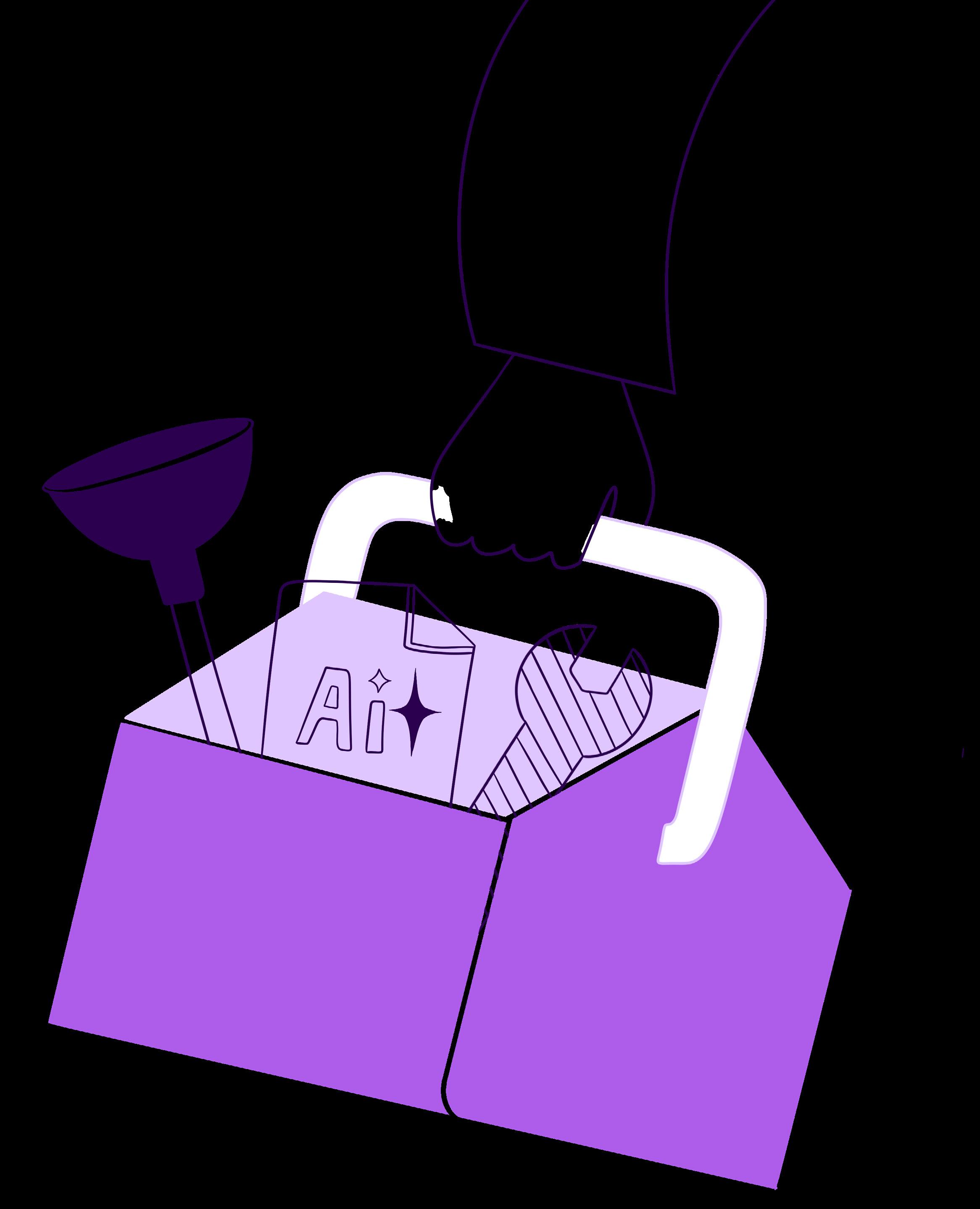
Hi Cegos,
I’m worried I'm going to be replaced by AI. I’m an L&D Leader in a global organisation. I create content for courses and run programmes in our company. I join up the dots.
Am I in trouble? I’m wondering about becoming a plumber.
Senior L&D Head FTSE100 Organisation
Dear Senior L&D Leader,
You could become a plumber. But first, have a think about this.
Yes, you are being replaced (sort of)
The bad news: Yes, you’re being replaced. The good news: Not entirely.
AI is great at the grunt work, but it’s remarkably bad at being human. It can’t walk into a room, meet people, influence a sceptical board, or make a final executive decision. Those key parts of your job? AI can't touch them.
Don't Be Harder To Manage Than A Robot
Whether you worry about this or not is entirely up to you, but worrying doesn't actually achieve much. The funny thing is, AI doesn’t worry, which makes it incredibly easy to manage. We actually accelerate our own demise if we become more of a headache to manage than the software.
Content Is No Longer Your "Unique Selling Point"
Content creation isn't the strength it used to be. Since search engines and YouTube arrived, all knowledge is already out there. Now, AI can turn it into brilliant content instantly.
But remember, humans are the ultimate tool-makers and tool-users. I use a hot water tap, a titanium bike, and an iPhone. These are brilliant tools to be embraced — they’re there to make your job easier, not take it away.
The Three-Day-Week Event Horizon Macroeconomically, there are always winners and losers when new tech arrives. But in the medium term, it’s better for society if we average out the gains. A 50% improvement in productivity is the event horizon for a four-day or even three-day work week. It suits society better to have us all happier as a result of technology.
The Final Strategy
Why worry? Embrace the tools. Just make sure you stay ahead of your peers, and you can leave the plumbing tools in the shed.
CEO Cegos UK & US
Innovators. Agitators. Designers. Disruptors.
Normal yet brilliant people. Our diverse range of backgrounds brings together teachers, marketers, psychologists, anthropologists, sellers, and creatives.

Jonna Sercombe
CEO Cegos UK & US
Entrepreneur, philosopher, logician, psychologist.

Anite Cagni EdTech Developer
Crafting user-focused digital solutions that blend technical expertise with business insight.

Ben Heath Lead Learning Consultant
Turning organisations and leaders across the globe into high-performing teams.

Ross Hardy Associate Director | IT
Transforming creative ideas into digital realities with years of diverse industry experience.

Simone Sullivan Learning Consultant
Combining learning design, psychology, and facilitation to drive performance.

Sahanshil Dangol Learning Creative
Creating long-lasting learning through animation and illustration for organisations around the globe.

Emily Larson
Executive Creative Director
Bringing world-class programs to life with creative design and process thinking.

Emily Link
Executive Learning Director
Specialising in individual and team performance through creative design and expert learning solutions.

Reuben Fletcher-Louis Learning Consultant
Leveraging psychology to optimise learning experiences.

Lara Mohammad
Marketing Executive
Fuelling L&D conversations with fresh insights, trends, and human connection.

Rebecca Woods
Product & Learning Consultant
Designing transformative and engaging learning programmes to drive success.

Blair Wagner
Learning Consultant
Designing and delivering with a passion for people.

Daisy Whittle
Learning Creative
Crafting compelling visuals that bridge the gap between information and learner engagement.

Gaby Bran
Lead Learning Creative
Crafting excellent animated films for organisations across the globe.

Scarlet Woods
Marketing Executive
Connecting L&D minds through bold ideas and brilliant content.

Tim Volans
Senior Client Partner
Bringing cross-industry expertise in client relationships, creative strategy, and learning solutions to deliver impactful, tailored results.

Somewhere in this issue, one of the articles was entirely written by AI. No human drafts, no editing passes, no late night coffee — just a machine doing its best impression of us.
Think you know which one it is?
Scan the QR code to place your bets with a chance at winning two free places at our next Leader of the Future programme.