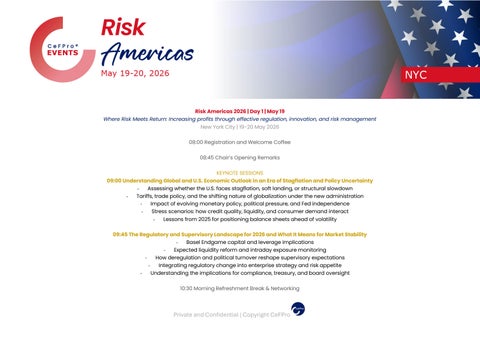
Risk Americas 2026 | Day 1 | May 19 Where Risk Meets Return: Increasing profits through effective regulation, innovation, and risk management New York City | 19-20 May 2026 08:00 Registration and Welcome Coffee 08:45 Chair’s Opening Remarks KEYNOTE SESSIONS 09:00 Understanding Global and U.S. Economic Outlook in an Era of Stagflation and Policy Uncertainty Assessing whether the U.S. faces stagflation, soft landing, or structural slowdown Tariffs, trade policy, and the shifting nature of globalization under the new administration Impact of evolving monetary policy, political pressure, and Fed independence Stress scenarios: how credit quality, liquidity, and consumer demand interact Lessons from 2025 for positioning balance sheets ahead of volatility 09:45 The Regulatory and Supervisory Landscape for 2026 and What It Means for Market Stability Basel Endgame capital and leverage implications Expected liquidity reform and intraday exposure monitoring How deregulation and political turnover reshape supervisory expectations Integrating regulatory change into enterprise strategy and risk appetite Understanding the implications for compliance, treasury, and board oversight 10:30 Morning Refreshment Break & Networking
Private and Confidential | Copyright CeFPro
Non-Financial & Operational Risk GRC 11:00 Bringing Governance, Risk and Compliance Together to Create an Integrated Control Framework -
Merging governance, risk, and
AI & Model Risk AI 11:00 Making AI Work in Practice and Scaling from Pilot to Enterprise Adoption -
compliance into unified decision-making -
-
profitability
deployment Change-management
Linking financial controls, NFR
lessons for embedding AI
and strategic risk under one
responsibly -
Creating dashboards linking
Managing transition from
level accountability and
structure
-
capital, liquidity and
experimentation to scaled -
BSM 11:00 Integrating Capital, Liquidity and Funding for a Unified Balance Sheet Strategy
compliance and finance
Addressing renewed boardoversight expectations
-
-
Real use cases within risk,
Balance Sheet Management & Treasury
-
resistance and skill-set
regulatory actions and
barriers
GEOPOLITICS 11:00 Assessing the Political and Regulatory Landscape Ahead of the 2026 Election -
-
Aligning treasury, finance and Translating regulatory metrics
agencies -
Preparing compliance strategies for multiple
Lessons from 2025 market volatility
Anticipating leadership changes across supervisory
into commercial decisioning -
Projecting how policy shifts will reshape financial regulation
-
risk incentives
Overcoming internal
Governance lessons from recent
Market & Global Trends
outcomes -
Managing uncertainty around fiscal and monetary direction
enforcement trends
PANEL DISCUSSION 11:35 Embedding Accountability and Conduct Culture Throughout the Organization -
Translating tone-from-the-top
PANEL DISCUSSION 11:35 Managing Model Risk for AI and Machine Learning with Greater Transparency and Control -
into measurable outcomes -
Designing incentive structures
-
opaque and adaptive models -
Meeting regulatory
Positioning portfolios amid
-
Hedging and asset-liability
documentation and validation
strategies under persistent
Managing conduct risk in a
expectations
volatility
-
Sustaining engagement once remediation fatigue sets in
Embedding AI into existing
-
MRM frameworks -
Ensuring ongoing oversight throughout the model lifecycle
PANEL DISCUSSION 11:35 Embedding Geopolitical Scenarios into Enterprise Risk and Capital Planning -
uncertain rate trajectories
that reinforce ethical behaviour looser regulatory environment
-
Establishing controls for
PANEL DISCUSSION 11:35 Managing Interest-Rate Volatility and Portfolio Duration in a Changing Policy Cycle
-
impacting markets -
Aligning rate views with earnings objectives
Evaluating tariff and supplychain implications
-
Assessing duration risk within deposits and securities
Mapping global flashpoints
Integrating geopolitical variables into stress testing
-
Strengthening contingency planning
RESILIENCE 12:20 Strengthening Operational Resilience Through People, Process and Partnerships -
GEN & AGENTIC AI 12:20 Agentic AI Risk Governance -
with a risk and compliance Framework
Re-engineering the three-lines model to embed risk within
-
operations -
Enhancing workforce capability through scenario testing and cross-training
-
Examination of Agentic AI Risks
-
Regulatory Adaptation: regulatory developments
transformation programmes
-
-
Incorporating intraday analytics
-
Supervisory attention on nonbank leverage build-up
-
Applying behavioural modelling to improve stress realism
Evaluating data opacity and contagion channels
-
exposures and deposit-flight
and vendor ecosystems -
Anticipating regulatory updates
PRIVATE CREDIT 12:20 Understanding Systemic Risk and Growth Dynamics in Private Credit and Shadow Banking
on liquidity measures
Implementation Case Studies Guidance on responding to
Integrating resilience into
-
Focus on Controllability and Third-Party Risk
-
LIQUIDITY RISK 12:20 Advancing Liquidity Risk Management Through Behavioral and Intraday Analytics
Strategic responses from traditional lenders
-
Aligning liquidity buffers with
Potential regulatory convergence with funds
client behaviour
Measuring the return on investment in resilience initiatives
12:55 Lunch Break and Roundtable Discussions BUSINESS CONTINUITY 1:55 Redefining Business Continuity and Crisis Preparedness for Complex Multi-Hazard Events -
Designing next-generation
AI FLUENCY 1:55 Developing AI Fluency and Workforce Readiness Across the Organization -
continuity plans for cyber, geopolitical and liquidity shocks -
-
Embedding AI fundamentals
-
Defining usage policies and monitoring for responsible
crisis playbooks
deployment -
fluency between data science
and third parties
and risk teams
endured 2025 disruptions
-
-
Building trust and confidence among non-technical staff
-
into business planning
Evaluating partnership opportunities between banks
Managing cost of funds and Integrating treasury insights
Comparing return profiles and risk transmission channels
-
and funds
transfer-pricing frameworks -
Exploring regulatory responses to non-bank credit expansion
-
Exploring secured, repo and synthetic financing
-
11:35 Navigating the Growth of Private Credit and Alternative Financing Models
Building diversified, stable funding structures
Enabling cross-functional
recovery across internal teams Insights from institutions that
-
into risk and control training
Table-top simulations and live Coordinating response and
TREASURY & FUNDING 1:55 Optimizing Treasury and Funding Strategies to Balance Cost and Resilience
-
Understanding liquidity and valuation challenges in private markets
PANEL DISCUSSION 2:30 Turning Risk Culture and Appetite into Measurable Business Discipline -
PANEL DISCUSSION 2:30 Improving Data Quality, Traceability and Lineage to Strengthen Model Reliability
Converting culture assessments
-
quality metrics and
Aligning appetite statements
traceability
with business-line KPIs and
-
growth targets -
Balancing risk tolerance and
-
Using RCSA evolution to
Integrating liquidity, credit and
PANEL DISCUSSION 2:30 Keeping Ahead of Financial Crime and Sanctions in a Fragmented Global Environment -
capital scenarios
Managing real-time data
Using AI to accelerate scenario
-
Moving beyond compliance to
Benchmarking governance
Enhancing collaboration across
Embedding AI into AML and KYC monitoring
-
strategic insight -
Responding to cross-border enforcement collaboration
-
design and computation
Linking data lineage to model validation confidence
landscape
-
flows while containing cost
profitability in a deregulated -
Establishing robust data-
into actionable data points
PANEL DISCUSSION 2:30 Enhancing Stress Testing to Strengthen Enterprise-Wide Resilience
Identifying emerging typologies in trade and digital channels
-
functions
Strengthening alignment between financial crime and
maturity across peers
reputation risk
enhance transparency and accountability
3:15 Afternoon refreshment break ENTERPRISE RISK 3:45 Building a Holistic Enterprise View of Risk Across All Functions -
-
Integrating credit, liquidity,
-
Applying innovative validation
operational and compliance
techniques for machine-
assessment
learning models
Leveraging AI to unify risk data
ENTERPRISE STRESS TESTING 3:45 Expanding the Scope of Enterprise Stress Testing -
Exploring broader impacts of
-
Considering impacts to Liquidity and Capital
and enable real-time visibility
automation for continuous
Contingency Plan triggers and
Translating disparate reports
testing
Actions
-
-
Anticipating regulator
Case studies of successful
expectations for explainability
convergence projects
and control -
FRAUD 3:45 Preventing Fraud in an AIEnabled Economy -
Geopolitical Events
Leveraging synthetic data and
into a single institutional view -
MODEL VALIDATION 3:45 Modernizing Model Validation for the AI Era
-
Assessing impacts to Business Strategies and Initiatives
-
Assessing operational
Aligning validation resources
readiness of key capabilities (
with model complexity
i.e. Settlement, Sanctions, Third Party Risks, Cyber)
Understanding convergence of fraud, cyber and AML risk
-
Deploying machine-learning for early detection
-
Managing synthetic identity and social-engineering threats
-
Coordinating industry and lawenforcement responses
FIRESIDE CHAT: INFOSEC 4:20 Managing Data Privacy, Cyber Resilience and Digital Ethics in a Connected Ecosystem -
Protecting data integrity while
MODEL GOVERNANCE 4:20 Learning from Big Tech to Scale Model Governance and Monitoring -
MRM maturity with technology
Balancing AI advancement with
peers
privacy and ethical
-
considerations -
Comparing financial-sector
enabling innovation
Strengthening collaboration
through standardised
Preparing for supervisory
production -
programmes
Understanding the U.S.
DEREGULATION 4:20 Evolving Compliance Practices for a Deregulated but Politically Sensitive Market -
implementation path -
Adjusting RWA strategies to
-
Balancing optimisation with Aligning regulatory and
Ensuring agility amid policy oscillation
-
supervisory scrutiny -
Reconciling fewer formal rules with greater scrutiny
-
protect competitiveness
Avoiding pilot paralysis
between CISOs and risk leads scrutiny of digital-ethics
-
Lessons in lifecycle monitoring and retraining
-
BASEL ENDGAME 4:20 Adjusting to Basel Endgame and Evolving Capital Adequacy Requirements
Monitoring state-level and international divergence
-
economic capital frameworks
Defining meaningful compliance success metrics
Building agile governance that scales with AI demand
REGULATION
AI REGULATION
ALM AUTOMATION
INNOVATION
4:55 Supervisory Expectations for NFR Programs in 2026 and How Firms Can Get Ahead
4:55 Preparing for Global AI Regulation and Supervisory Expectations
4:55 Integrating ALM Strategy & Automation for Margin Preservation
4:55 Driving Innovation in Financial Products While Balancing Risk and Return
-
-
-
Insights from regulators on
Reviewing the global
-
Modelling deposit behaviour
regulatory landscape for
and duration with real-time
governance trends
financial AI
analytics
Addressing weaknesses
-
Anticipating the
-
Automating liquidity monitoring
observed in recent
documentation and
through dashboards and
examinations
transparency to needed
intraday data
Building proactive, forward-
ensure AI systems are safe
looking risk identification
and legal
processes
-
-
control effectiveness and
-
Evaluating resilience maturity post-implementation -
Implementing necessary
-
Building agile, data-driven
documentation and controls
teams through fintech
to establish audit readiness
partnership
Mapping forthcoming AI legislation and preparing for cross-border supervision of AI governance
5:30 Chair’s Closing Remarks and Networking Drinks Reception
Reviewing evolution of synthetic repo, SRT and structured credit
-
Embedding control frameworks in product-development cycles
-
Applying AI to forecasting, hedging, and funding decisions
-
-
Balancing speed-to-market with risk oversight
-
Exploring investor appetite and transparency demands
Risk Americas 2026 | Day 2 | May 20 Where Risk Meets Return: Increasing profits through effective regulation, innovation, and risk management New York City | 19-20 May 2026 08:00 Registration and Welcome Coffee 08:45 Opening Remarks KEYNOTE SESSIONS 09:00 Using AI in Risk Management to Separate Hype from Practical Opportunity Reviewing how firms are applying AI beyond proof-of-concept Understanding where AI delivers measurable return versus operational noise Building controls and accountability for algorithmic decisioning Re-defining the risk professional’s role in an AI-augmented environment 09:45 Managing Strategic Risk Amid Regulatory Shifts and Changing Market Expectations Balancing risk appetite and growth in a deregulated but uncertain landscape Anticipating supervisory priorities for the next 12–18 months Integrating strategic and operational risk for enterprise resilience Building board-level oversight that links regulation, innovation and profitability
10:30 Morning refreshment break and networking
Non-Financial & Operational Risk
AI & Model Risk
11:00 Strengthening Risk Accountability and Ownership Across the Three Lines of Defense
11:00 Managing Model Risk for AI Governance and Machine Learning with Greater Transparency and Control
-
Embedding clear ownership from first-line to board
-
Aligning accountability
-
matters for lending or
structures Addressing skill gaps and overlapping responsibilities
-
Practical approaches for measuring effectiveness of the
11:00 FIRESIDE CHAT: Reviewing Credit Quality and Market Exposures as Macroeconomic Conditions Tighten -
problem and why opacity
frameworks with incentive -
Understanding the "Black Box"
Balance Sheet Management & Treasury
Preventing algorithmic bias via
-
Defining the necessary human
-
Monitoring early warning Integrating credit data into
-
Adjusting underwriting
re-orientation -
Identifying sectors most exposed to deglobalisation risk
-
Evaluating capital-flow and FXvolatility trends
-
Incorporating trade and political dynamics into stress
standards for late-cycle risk
scenarios
automated AI decisions -
Assessing macroeconomic implications of supply-chain
liquidity and capital forecasting
oversight roles within
model
-
Assessing corporate, consumer
indicators across portfolios
active auditing systems -
11:00 Understanding the Impact of Deglobalization and Onshoring on Financial Markets
and CRE credit trends
investment decisions. -
Market & Global Trends
Managing the risk of AI mistakes and hallucinations
11:35 Developing Regulatory Readiness for Non-Financial Risk Reviews -
-
Understanding current
-
Applying machine learning to
supervisory focus and testing
expand scenario coverage and
expectations
realism
Preparing documentation,
-
synthetic data to stress
Conducting internal mock-
portfolios -
11:35 Addressing Commercial Real Estate Refinancing and Portfolio Concentration Risk -
Measuring performance of AI-
Quantifying exposure to highrisk sectors and maturities
-
Combining historical and
evidence and data narratives reviews to identify weak points -
11:35 Integrating AI and Stress Testing to Enhance Scenario Design and Forecasting
-
Evaluating collateral quality
Creating a feedback loop
traditional methods
management
lenders -
reporting
Incorporating physical and transition risk into capital
Aligning results with governance and board
Understanding insurancewithdrawal implications for
Considering regulatory expectations for CRE risk
business teams
regions -
and geographic distribution -
Assessing concentration of assets in climate-sensitive
declines and refinancing gaps
driven stress tools against -
-
Stress testing for valuation
early between audit, compliance and
11:35 FIRESIDE CHAT: Managing Climate and Environmental Risk as Insurers and Investors Re-price Exposure
planning
-
Leveraging data for portfolio heat-mapping and disclosure
PANEL DISCUSSION 12:10 Enhancing Third-Party and Outsourcing Governance for Endto-End Resilience -
Moving beyond vendor risk to
PANEL DISCUSSION 12:10 Evolving Model Validation Practices for Next-Generation Models -
validation for adaptive and
Applying proportionate
self-learning systems
oversight to critical and non-
-
critical providers -
-
Managing continuous
ecosystem risk management
Managing concentration and
around explainability and bias
portfolios
control
-
Aligning capital allocation with
PANEL DISCUSSION 12:10 Exploring Digital Assets and Payments Innovation as Risk and Opportunity -
plausible stress outcomes -
stablecoin rules -
Embedding reverse-stress testing into strategic planning
model criticality and
and contracts
complexity
Evaluating tokenised payments and settlement options
-
Prioritising resources based on
requirements into procurement
Assessing operational and counterparty risks in crypto
-
Balancing shareholder return with prudence and optionality
Tracking progress toward U.S. market-structure and
Testing interconnected risks across credit, liquidity and rates
Understanding expectations
geographic risk in supplier Integrating resilience
-
Using challenger models and parallel runs for benchmarking
-
PANEL DISCUSSION 12:10 Optimizing Balance Sheet Resilience Through Scenario Planning and Capital Buffers
Implementing effective control frameworks
12:55 Lunch break and roundtable discussions 1:55 Building a Stronger Risk Culture Through Communication and Leadership Visibility -
1:35 Third Party Risk Management in the Era of Artificial Intelligence Examining how AI is reshaping outsourcing models, vendor
Translating risk strategy into
-
institutions
Encouraging transparency and -
-
Tracking cultural change
-
-
Evaluating green funding obligations
-
Addressing heightened Applying AI-enabled analytics
regulatory risk around ESG claims -
Linking sustainability goals to cost of capital and investor
third-party due diligence, and
relations
Turning regulatory efficiency into business advantage
-
Using risk insight to support growth and innovation
-
Managing reputation and
and automation to enhance ongoing monitoring
-
instruments and disclosure
regulatory expectations
through surveys and qualitative feedback
-
Identifying emerging AIdomains
appropriate risk behaviours
PROFITABILITY 1:35 Profit Through Prudence and the Role of Risk in Driving Commercial Value
allocation
specific third-party risk
Training leaders to model
Integrating climate and sustainability data into asset
ecosystems in financial
levels challenge within teams
-
relationships, and third-party
relatable messaging for all -
1:35 Embedding ESG and Sustainability Metrics into Treasury and Funding Decisions
Reframing risk functions as strategic partners
-
Encouraging board-level ownership of risk intelligence
PANEL DISCUSSION 2:30 Using Scenario Analysis to Prepare for Emerging Operational Risks -
-
Designing forward-looking
PANEL DISCUSSION 2:30 Creating Enterprise Model Inventories and Risk Taxonomies for Greater Transparency -
recalibration of liquidity
functional threats
and validation status
coverage and NSFR
Linking scenario testing to
-
-
Reviewing capital planning
risk tiers and dependencies
frameworks under Basel
Enabling portfolio-level
Endgame evolution
planning across technology,
concentration risk
regulators on model-based
Using inventory insights to drive
approaches
-
Turning scenario outcomes into
prioritisation and resource
concrete mitigation actions
planning
Adapting roles and frameworks
3:15 Operationalizing AI Risk Management Frameworks and Lifecycle Oversight -
Integrating AI risks into the
-
-
3:15 Re-imagining Treasury Operating Models for Digital Speed and Strategic Insight -
Implementing automation and predictive analytics in daily
Management (ERM) taxonomy
liquidity management
Establishing automated and
-
Consolidating systems for real-
incident reporting and root-
manual continuous monitoring
cause analysis
thresholds for key AI
Embedding risk control in
performance metrics
teams combining risk, data and
Developing specific Risk and
technology
-
-
teams for AI-driven
(RCSA) questions for data
professionals for a digital
environments
provenance and model
environment
Designing specialized compliance training for the first line of defense
into planning -
Aligning business strategy with risk appetite and metrics
-
Using board engagement to bridge risk and performance dialogue
-
Monitoring reputation and policy risk in dynamic markets
3:15 Managing Digital Transformation and Technology Change Without Creating Hidden Vulnerabilities -
-
Balancing innovation velocity with control strength
-
Addressing obsolescence, technical debt and data
Building cross-functional
Control Self-Assessment
-
emerging-risk identification
time visibility and decisioning
Preparing operational-risk
explainability
Integrating strategic and
feedback into funding strategy
innovation -
-
Integrating supervisory
existing Enterprise Risk
Using automation to improve
PANEL DISCUSSION 2:30 Embedding Strategic Risk Practices to Support DecisionMaking and Long-Term Resilience
Enhancing dialogue with
to support agile delivery and
product and technology design -
-
oversight of model
3:15 Positioning Operational Risk Functions for the Next Wave of Digital Transformation
-
-
Tagging AI and ML models with
Coordinating response finance and HR
-
Preparing for potential
capture ownership, purpose
assessments
-
-
scenarios for complex, cross-
capital and liquidity -
Developing inventories that
PANEL DISCUSSION 2:30 Adapting Capital and Liquidity Strategies to Evolving Supervisory Expectations
migration risk -
Coordinating risk oversight during large-scale
Re-training treasury
transformations
-
Establishing clear ownership of end-to-end technology risk
3:50 Afternoon Refreshment Break
CLOSING KEYNOTES 16:20 The Future of Risk Management in an Integrated and Innovative World What risk leadership will look like by 2027 and beyond Redefining value creation through integrated risk thinking Balancing AI, governance and profitability in decision-making The evolution of the Chief Risk Officer as a strategic business partner 16:50 Redefining the Purpose of Risk Leadership in 2026 Elevating risk functions as commercial strategists Balancing profitability, trust and compliance Leveraging data, AI and human judgement for foresight The evolving profile of tomorrow’s Chief Risk Officer
5:20 Chair’s Closing Remarks & End of Risk Americas 2026!