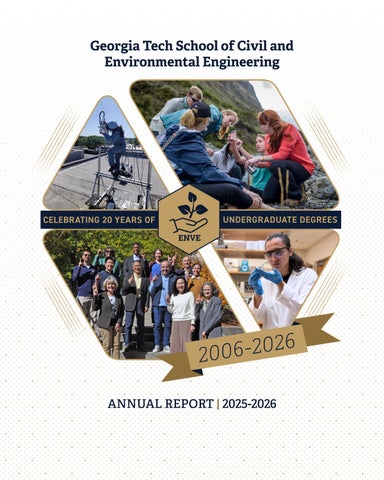
Georgia Tech School of Civil and Environmental Engineering
CELEBRATING 20 YEARS OF
UNDERGRADUATE DEGREES
6 2 0 2 6 200 ANNUAL REPORT | 2025-2026
ANNUAL REPORT
JULY 2025 – JUNE 2026
Leadership Donald R. Webster, Ph.D., P.E. Karen and John Huff School Chair Kevin Haas, Ph.D. Associate Chair for Administration and Finance Adjo A. Amekudzi-Kennedy, Ph.D. Frederick Law Olmsted Professor Associate Chair for Academic Innovation Lauren Stewart, Ph.D., P.E. Williams Family Professor Associate Chair for Graduate Programs Director, Structural Engineering and Materials Laboratory Ryan J. Sherman, Ph.D., P.E. Associate Chair for Undergraduate Programs John E. Taylor, Ph.D. Frederick Law Olmsted Professor Associate Chair for Faculty Development and Research Innovation Dave Zaksheske Assistant Vice President of Development davez@coe.gatech.edu School of Civil and Environmental Engineering at Georgia Tech 790 Atlantic Drive N.W. Atlanta, Georgia 30332-0355 communications@ce.gatech.edu P / 404.894.2201 ce.gatech.edu Communications Team Melissa Fralick Communications Manager Michael Hunter Communications Officer
Table of Contents 2
Welcome from the Chair
3
By the Numbers
4
The Year in Pictures
6
School News
22
Achievements
27
Explore Our Research
36
A Community of Excellence
45
The Impact of Giving
Stay in Touch
Don't miss out on any School of Civil and Environmental Engineering news. Visit our website ce.gatech.edu or follow us on Instagram, LinkedIn and Facebook at CEEatGT.
WELCOME
From the Chair
A
s I reflect on the past academic year, I am filled with immense pride in what our community has accomplished together. The pages of this report celebrate not only our milestone achievements but also the dedication, innovation, and passion that define our School. This year, we celebrate the 20th anniversary of our undergraduate environmental engineering degree. This milestone is made even more special by a monumental achievement: for the first time in our history, the undergraduate environmental engineering program has been ranked No. 1 in the nation. This recognition is a testament to two decades of hard work by our faculty, staff, and students, and it solidifies our position as a leader in shaping the future of the field. Our commitment to advancing groundbreaking research and supporting the next generation of scholars has never been stronger. I am thrilled to share that we successfully raised $10 million to support fellowships for our PhD students. This incredible investment will allow us to recruit and retain the brightest students and empower them to pursue highimpact research while removing financial barriers. Our faculty also continue to drive innovation and build partnerships with industry. This year, Professor David Frost took over leadership of the Geosynthetic Institute, which relocated its headquarters to Georgia Tech. Additionally, we celebrated the opening of the Agilent Center of Excellence for Environmental Health and Engineering, an exciting partnership for Professor Shane Snyder’s research team. These collaborations will serve as hubs for cuttingedge discovery and provide our researchers with unprecedented resources. Finally, our students continue to impress me with their talent, resilience, and competitive spirit. Our ASCE chapter won the Sustainable Solutions competition for the fourth consecutive year at the regional student symposium. They also earned the Fan Favorite Award and Best Design with Community in Mind Award at the national competition. Their victory underscores the practical, forward-thinking education our students receive and their ability to solve real-world challenges. As you read through this year's report, I hope you feel a shared sense of pride in these accomplishments. Thank you for your continued partnership and support as we build on this incredible momentum. Go Jackets!
Don Webster Karen and John Huff School Chair
CEE
By the Numbers
1
Undergraduate Civil Engineering
1
Undergraduate Environmental Engineering
Degrees Offered
2
6
Bachelor's Degrees: • Civil Engineering • Environmental Engineering
1
Master's Degrees: • • • • • •
Bioengineering Civil Engineering Computational Science and Engineering Engineering Science and Mechanics Environmental Engineering Dual Degree - M.S. Civil Engineering & City and Regional Planning
3
4
Graduate Environmental Engineering
Graduate Civil Engineering
Minor: • Global Engineering Leadership
6
5
Concentrations: • Construction and Infrastructure Systems • Geosystems • Structural Engineering, Mechanics, and Materials • Transportation Systems • Water Resources
Doctoral Degrees: • Bioengineering • Civil Engineering • Computational Science and Engineering • Engineering Science and Mechanics • Environmental Engineering • Ocean Science & Engineering
Enrollment:
Faculty:
Undergraduates:
Endowed Positions:
727 Graduates: 299
Total Faculty:
60
26
2025-2026 Annual Report 3
1
We are
CEEatGT
2
Clockwise from top: 1) The Georgia Tech chapter of ASCE’s entry “Ragnarok” and crew in the regional Concrete Canoe competition; 2) Srinivas Peeta (standing) and Ph.D. students Gulam Kibria and Yangjiao Chen prepare driving scenarios for their driving simulator; 3) Alumni, faculty, staff and students at the Homecoming tailgate; 4) The Environmental Engineering faculty celebrate their first-ever No. 1 Undergraduate School ranking from U.S. News & World Report.
4
3
4
School of Civil and Environmental Engineering
1
2 6
3
Clockwise from top: 1) Professor Shane Snyder and students conducting water sampling along the Igazu River in Brazil; 2) Professor Xie Xing (center) with students Wei Wang (2nd from left), and Mo Jarin (4th from left), winners of CEE Awards; 3) Buzz, checking out resumés from students meeting with engineering firms at CEE’s annual Career Fair; 4) Professor Emeritus F. Michael Saunders, three-time Environmental Engineering Group Leader, speaking to gathered faculty, students and alumni at the School of Environmental Engineering’s 20th Anniversary celebration; 5) Assistant Professor Edvard Bruun demonstrating his Cooperative Multi-Robot Gantry at the Structural Engineering and Materials Laboratory; 6) Karen and John Huff school chair Don Webster with students at the annual Scholarship luncheon at the Georgia Tech Alumni Association.
5
4
2025-2026 Annual Report 5
Mike Zhang, Senior VP at Agilent Technologies and Professor Shane Snyder cut the ribbon declaring the Agilent Center of Excellence for Environmental Health and Engineering officially open while School Chair Don Webster and Julia Kubanek, Georgia Tech's Vice President for Interdisciplinary Research, look on. (Photo by Melissa Fralick)
1
2
Farhan Khan, left, and his brother Farshid Khan were motivated by water pollution in Bangladesh to pursue graduate education in environmental engineering. (Photo by Candler Hobbs)
1) Shane Snyder with visitors from Agilent. 2) Maricius Marcos Dos Santos leads a tour of the lab facilities. 3) Cleyde Helena, left, and David Stella from Agilent with the new laboratory signage. 4) Mike Zhang, Agilent Senior VP with Tarun Anumol, Director for the Global Applied Markets, and Elaine Ricicki, VP of Laboratory Solution Sales. (Photos by Melissa Fralick) 6
3
School of Civil and Environmental Engineering
4
Shane Snyder Leads New Agilent Center of Excellence at Georgia Tech by Melissa Fralick
R
epresentatives from Georgia Tech and Agilent Technologies gathered on campus Oct. 30, 2025, to celebrate the official opening of the Agilent Center of Excellence for Environmental Health and Engineering. The event featured a lab tour, mini symposium, and speakers from Agilent and Georgia Tech highlighting the power of collaboration between industry and academia. Led by José Domingo Pérez Foundation Chair and Professor Shane Snyder, the mission of the center is to tackle global environmental challenges and advance research in sustainability, water recycling, and biologics. The state-of-the-art tools in the new Center of Excellence will enable researchers to identify, quantify, and evaluate the toxicity of trace contaminants in drinking water, particularly "forever chemicals" known as PFAS. The Center of Excellence will foster collaboration and innovation among researchers, serve as a hub for innovation in environmental characterization, and integrate Agilent’s advanced cell analysis instruments and mass spectrometers to support research on rapid evaluation of water and environment safety. The Agilent Center will focus on: l Developing novel technologies for municipal and
industrial water recycling.
l Advancing waste material upcycling and resource
recovery.
l E xploring cell-based analysis to rapidly evaluate
complex environmental mixtures.
l Training the next generation of scientists in sustainable
environmental solutions.
Snyder brings a distinguished background in water technologies. He previously served as President’s Chair Professor at Nanyang Technological University in Singapore and executive director of the Nanyang Environment and Water Research Institute. His research focuses on sustainable water treatment and safety, waste materials upcycling, and resource recovery. “This partnership with Agilent enables us to push the boundaries of environmental research,” Snyder said. “With access to state-of-the-art instrumentation and Agilent’s scientific expertise, we will accelerate discoveries that address some of the world’s most pressing sustainability challenges.” The Georgia Tech Center of Excellence is Agilent’s third in the U.S. and the only one focused on environmental contaminant measurement and toxicity evaluation. It will be unique in exploring cell-based analysis to better understand the health relevance of complex chemical mixtures in environmental systems. “Agilent is excited to collaborate with Professor Snyder and Georgia Tech on this Center of Excellence,” said Agilent CEO Padraig McDonnell. “This partnership illustrates Agilent’s objective to empower academic researchers with the tools and support they need to drive meaningful scientific progress — especially in the critical area of environmental health and safety.” This collaboration builds on a longstanding relationship between Agilent and Snyder, who received an Agilent Research Catalyst Award in 2017 for his influential work in water-quality research. Among Agilent’s Centers of Excellence, the Georgia Tech center will serve as a model for how industry and academia can work together to address global environmental challenges. l
The attendees of the ribbon-cutting ceremony and symposium gathered for a photo in the courtyard before the tours. (Photo by Melissa Fralick) 2025-2026 Annual Report 7
SCHOOL NEWS
CEE Students Shine at Fall and Record number of teams compete as faculty renew emphasis
MPLS Consulting (L to R: Lauren Sisk, Samuel Cushman, Phoebe Ellis and Meghan McGurk) accept the big check prize from school chair Don Webster for their project “Peachtree Corners Intersection Improvement” as Buzz looks on. (Photo: Candler Hobbs)
Unique Intersection Design Wins Best CEE Fall Capstone Project By Melissa Fralick
S
even civil and environmental engineering teams participated in the Fall 2025 Capstone Design Expo, showcasing their semester-long design projects in transportation, dam restoration, environmental remediation, structural design and more. The Capstone Design Expo, which took place Dec. 1 at McCamish Pavilion, featured 118 student teams across engineering, design and computing. Judges selected an overall best project, a best interdisciplinary project, and a best project from each discipline. Judges selected MPLS Consulting as the top CEE team and awarded the students a $1,000 prize for their “Peachtree Corners Intersection Improvement” project. Team members Samuel Cushman, Phoebe Ellis, Meghan McGurk and Lauren Sisk worked with the Peachtree Corners Department of Transportation to redesign an intersection for improved efficiency and pedestrian safety. "Our team is honored to have been awarded best CEE project. We are proud of the work we produced, and we are grateful to have had such hardworking team members, Continues on page 10
8
School of Civil and Environmental Engineering
MPLS Consulting worked with Peachtree Corners Department of Transportation to redesign an intersection for improved efficiency and pedestrian safety. (Photo: Candler Hobbs)
SCHOOL NEWS
Spring Capstone Design Expos on the importance of the multi-disciplinary competition
CivCore Consulting (L to R: Paul Baisier, Anuj Patel, Jessica DaSilva and Nathan Dunagan) accept the award for best civil engineering project from school chair Don Webster for “Development of Battery Recycling Plant.” (Photo: Candler Hobbs)
Lithium-Ion Battery Reclamation Facility Design Wins Spring Expo By Michael Hunter
W
ith their plan to develop a battery recycling plant, the CivCore Consulting team took home the prize for the best civil and environmental engineering project at the Spring 2026 Capstone Design Expo. The CEE students won $1,000 for their plan to develop a comprehensive civil design for a lithium-ion battery reclamation facility with a goal of capturing 5% of the U.S. electric vehicle recycling market. CivCore Consulting was one of 14 civil and environmental engineering teams competing in the Capstone Design Expo on April 28 at McCamish Pavilion. The projects ranged from erosion control and stormwater infrastructure at a landing in Hiawassee to widening Concourse D at Hartsfield-Jackson Atlanta International Airport to aeration design at a water reclamation facility in Gainesville, Ga. They were among more than 1,300 students that showed off their semester-long projects, which serve as a culmination of their undergraduate studies. The teams, representing 12 schools from four of Georgia Tech’s colleges, competed for more than $18,500 in prize money.
CivCore Consulting gave their client TMTS Associates, a chemical engineering firm, a clear civil engineering roadmap for developing a lithium-ion battery reclamation facility near Macon. (Photo: Michael Hunter)
Continues on page 11
2025-2026 Annual Report 9
SCHOOL NEWS CEE Capstone Group #7 (L to R: Bryce Tate, John McMahon, Logan Robbins) created a structural design for a football training facility at the new North Clayton High School near Hartsfield-Jackson Atlanta International Airport. (Photo by Melissa Fralick) Continued from page 8
amazing mentors, and a great sponsor," said Lauren Sisk. The students’ capstone project focused on the three-leg intersection of West Jones Bridge Road and Peachtree Corners Circle in Peachtree Corners, Ga. Located adjacent to a school, the intersection receives a large volume of pedestrian traffic from students. The team’s proposed redesign seeks to improve traffic efficiency along Peachtree Corners Circle while focusing on pedestrian safety. The students proposed an intersection design known as a “displaced left turn” to alleviate traffic congestion. According to the Georgia Department of Transportation, the uncommon intersection design moves left-turning traffic to the other side of the road into a parallel left turn lane separated from opposing lanes. This allows left turning and through traffic to move simultaneously, increasing efficiency and safety. The team concluded that a displaced left turn would improve the level of service at the intersection and enhance safety for both pedestrians and vehicles. “We chose to design a displaced left turn at this intersection because it directly addresses the approach that currently has the highest delay times, the mainline left," Sisk said. "Additionally, a displaced left turn can be designed in a way that maximizes pedestrian refuge spaces, decreases crosswalk lengths, and reduces pedestrian confusion that alternatives like a roundabout might cause."
Other CEE teams participating in the Design Expo: HydroLogical Solutions
Team members: Abigail Carlsen, Riley Lofgren, Jackson Martin, and Mya Moffitt Sponsor: Gwinnett County Department of Water Resources Advisor: P rofessor of the Practice Joe Manous This team did a conceptual design on structural repairs for the masonry dam of Pounds Lake in Gwinnett County. The granite stone and grout dam was built in the 1930s. The team did hydrologic and hydraulic modeling and suggested maintenance improvements including masonry repairs and vegetation removal.
GAIA Design Solutions
Team Members: Bahar Banihashemi, Dani Sarantis, Lanie Cantrell, Mili Kher Sponsor: City of Alpharetta and Metropolitan North Georgia Water Planning District Advisor: Professor of the Practice Sharon Just GAIA Design Solutions evaluated impervious surfaces in Alpharetta, Ga., and identified a school parking lot suitable for a Depave project. Depave is a program that transforms underutilized paved surfaces into lively, pervious areas that improve the environment and quality of life. The team redesigned the area to include a rain garden and outdoor classroom. 10 School of Civil and Environmental Engineering
CEE Capstone Group #7
Team Members: John McMahon, Logan Robbins, Bryce Tate Sponsor: Uzun + Case Advisor: Professor of the Practice Fred Meyer This group created a structural design for a football training facility at the new North Clayton High School being constructed just south of Hartsfield-Jackson Atlanta International Airport. Their design includes a steel framing system, lateral support system, shallow foundations, retaining walls, and a cost estimate.
Soil Mates
Team Members: Grant Marshall, Kevin Hu, Matias Collantes, Sean Kirby Sponsor: Georgia Department of Transportation Advisor: Professor of the Practice Joe Manous Students on this team worked with the Georgia Department of Transportation (GDOT) on a project to replace an existing culvert in a tidally influenced area near Savannah, Ga. They conducted hydrologic and hydraulic analyses, researched project parameters such as culvert size, cost, and regulations, and applied optimization techniques to evaluate alternative culvert configurations.
Green City Strategies
Team Members: Aaron Qiu, Adrien Tirouvanziam, Ewan Pritchard Advisor: Professor of the Practice Sharon Just Sponsor: Hazen and Sawyer Green City Strategies designed stormwater infrastructure for Pittman Park in South Atlanta. Their project addressed the need to alleviate flooding impacts, improve runoff water quality, mitigate erosion damage due to storms, and increase community resilience through grey and green solutions.
Sustained Solutions
Team Members: Alex Campbell, Bishop Uhlrich, Maxwell Jiang, Noelle Watkins Advisor: Professor of the Practice Sharon Just Sponsor: Ramboll, EPA The Sustained Solutions team worked on a Soil Vapor Extraction (SVE) system compound design for the Hardeman County Velsicol superfund site. The project involved the design of a site layout, site grading, planning of access road and utilities, and stormwater and erosion considerations. l
SiteSense (L to R: Elie Patrick Abou-Fadel, Camila Roldan, Lyubomir Tushir and Leo Toller) received an honorable mention in the Georgia Tech Overall category for their project “Johns Creek Trail Design for Multimodal Park Connectivity.” (Photo by Michael Hunter) Continued from page 9
CivCore Consulting is made up of civil engineering majors Paul Baisier, Jessica DaSilva, Nathan Dunagan and Anuj Patel. The team was advised by Professor of the Practice Sharon Just, with advising on truck paths from Lecturer Georgene Geary. The project was sponsored by TMTS Associates. “Our team was gratified by the judges' response to our holistic approach, beginning with a business and market analysis, progressing through site selection and facility design, and concluding with a detailed cost estimate,” said team member Anuj Patel. According to Patel, this framework gave their client TMTS Associates, a chemical engineering firm, a clear civil engineering roadmap for developing a facility around their proprietary reclamation process. “As battery usage continues to grow across consumer devices and electric vehicles, scalable recycling infrastructure will become increasingly critical to a sustainable energy future,” he said. “The judges appreciated seeing a project that addressed a pressing and timely challenge.” SiteSense, the team of civil engineering majors Elie Patrick Abou-Fadel, Camila Roldan, Leo Toller and Lyubomir Tushev, received an honorable mention in the Institute-wide overall awards. Their project, “Johns Creek Trail Design for Multimodal Park Connectivity” is a conceptual site planning and feasibility study aimed at enhancing multimodal mobility within the City of Johns Creek, Ga. Working with the city of Johns Creek, the team developed three trail concepts connecting The Boardwalk at Town Center to Cauley Creek Park, along with cost estimates for each. Their work included assessing right-of-way, geotechnical and hydrological considerations with a goal of improving the walkability of the city. The team’s advisor on the project was Professor of the Practice Joe Manous, who said, “From my first meeting with the SiteSense team, their enthusiasm and optimism were remarkable. Georgia Tech students are inherently "can-do" folks, but this team took the mission-
Timeless Consulting Solutions (L to R: Kerrie Newton, Nina Roush, Victory Ekpekurede and Avril Adams) demonstrate their lattice bridge concept to Karen and John Huff School Chair Don Webster. (Photo by Candler Hobbs)
accomplishment ethos to another level, reminding me of why I chose civil engineering as my profession.” Professor of the Practice Sharon Just commented on the team’s 3-D model of their site elevations as a great visual reference for the judges. “They should be congratulated for breaking CEE into the overall awards category with their honorable mention,” she said. With 14 teams competing, the Spring 2026 Capstone Design Expo marked the highest participation of teams from the School of Civil and Environmental Engineering in recent history. Just attributed this to the School’s renewed emphasis on student participation in competitions, including the Capstone Design Expo and the Georgia Association of Water Professionals (GAWP) competition. Participation in the Design Expo is voluntary for students who are taking the Capstone Design class in their final semester. “Each of the current capstone professors is actively encouraging, supporting, and guiding teams to compete,” Just said. “This is clearly seen in the Fall 2025 and Spring 2026 Expos, with teams in each area represented. It’s great that the students are enthusiastically supporting both the Design Expo and GAWP.” l
Other CEE teams participating in the Design Expo: l
l l
l
l
l
ltaCore Engineering LLC A | McConnell-Chadwick Homestead Restoration
l
l
A NTSolutions | The Hive @ Garson gret Environmental Solutions E | Erosion Control and Green Stormwater Infrastructure for Lloyd’s Landing leven Design Solutions | E Campbellton Fairburn Road Outfall Pump Station Design AS Consulting | Jekyll G Island Clam Creek Bike Trail Alternatives to Repave/Replace iveMind Consulting | Pelican H Drive Trailer Storage & Stormwater
l
l
l
l
ASPAR | Aloft & Element J Co-Branded Hotel M AVERICK Design Solutions | Flat Creek Water Reclamation Facility Supplemental Aeration Design O mnimodal Designs | Improving Pedestrian Connectivity on Hugh Howell Rd. ALM Group | HartsfieldP Jackson International Airport Concourse D Widening T imeless Consulting Solutions | Historic Assessment and Design of Lattice Truss Bridge W hite and Gold Infrastructure Solutions | Lakewood Park Dam Improvement Design
2025-2026 Annual Report 11
SCHOOL NEWS
The panel of judges listen to the Hydroloop team pitch their product at the Entrepreneurial Impact Competition on April 1. Robert Hauf, left, and Anuj Patel with a model of the Hydroloop sprayer device. (Photo by Michael Hunter)
Student Inventors Win Big at Sixth Annual Entrepreneurial Impact Competition By Michael Hunter
T
wo teams of student innovators won $5,000 prizes with concepts for keeping vaccines cool during transportation and dust control on construction sites at the sixth annual Entrepreneurial Impact Competition on April 1. The winning teams were among four finalists who pitched their ideas in front of a panel of judges and an audience at the event. The finalists were selected from a field of 17 applicants. At the competition, each team had five minutes to explain their concept in front of an audience and then field 10 minutes of in-depth questioning from the panel of judges. After the presentations, the judges deliberated and selected the winner of the two awards. The Higginbotham Entrepreneurship Award recognizes a more developed project, which is closer to being launched in the marketplace. The Zeitlin Innovation Award recognizes creativity in a project at any stage of its development. Hydroloop, the team comprised of Anuj Patel and Robert Hauf, won the Higginbotham Entrepreneurial Award for their system to eliminate water waste and reduce dust-control costs on construction sites. According to Hauf, the main problem with the current dust suppression method is “it’s largely brute force.” Millions of gallons of potable water and thousands of dollars of excess fuel and labor are wasted and the result is a lack of management of the moisture levels in soil, he told the audience. “It’s inefficient and it relies on manual intervention to adjust the nozzles,” he said.
12 School of Civil and Environmental Engineering
Hydroloop’s solution is a system of thermal imaging cameras and an automated nozzle system that can be rented by the companies as they rent the water trucks to control dust on the construction sites. Team captain Anuj Patel explained the team’s business model, addressing a $204 billion site excavation and preparation market. “When developing Hydroloop, the customer return on investment and impact was a high priority of ours,” Patel said. He predicted a company could save 25% on water and 15% in fuel and labor, creating a 167% return on investment when integrating Hydroloop into their dust control. Additionally, the usage would save about 20,000 pounds of carbon emissions, creating a benefit for the local community in terms of air quality and the environment. “When looking at the financial perspective, Hydroloop hopes to break even in year 2.5,” he said. He explained that the planned $500 a month rental would allow customers to try the technology out at a low cost while allowing Hydroloop to be the asset owners, allowing for a recurring revenue model as well as asset depreciation over time. “Our goal at Hydroloop is not only to maximize the efficiency of dust control on sites, but to work towards a future where we can implement our models in other aspects such as landscaping or reusing concrete washout water,” he concluded. OmniTherm, the team of Veda Kodithala, Eden Goode, Amaniel Tesfay, Bin Huang, Adrian Trujillo and Roshni Chimmili, won the 2025 Zeitlin Innovation Award.
SCHOOL NEWS
OmniTherm presenting their innovative new vaccine carrier with expanded space and longer cooling time ability.
Team member Adrian Trujillo began the presentation by asking how many audience members had ever received a vaccine. “We all understand how vital vaccines are, but up to 50% of vaccines produced globally are wasted every year, with a large portion of this waste happening during the last stage of transportation from district stores to local clinics to patients,” he said. OmniTherm is a fully passive, reusable vaccine carrier that is engineered to keep vaccines safe without relying on a fragile power grid. Current vaccine carriers can only last 40-45 hours and have a capacity of just 3.4 liters, while the OmniTherm carrier will last from 53-61 hours and provides 5 liters of usable space, said team captain Bin Huang. Additionally, the OmniTherm carrier includes backpack style straps for ease of transportation and vacuum insulation panels that are lighter and better than traditional insulation. The OmniTherm carrier relies on an innovative combination of phase change material (PCM), which absorbs heat through melting and releases heat through freezing, maintaining a constant temperature, and a graphite-coated gyroidal skeleton, which extends the PCM cooling time by 5-6 hours while decreasing the freezer conditioning time from 4.9 to 3.9 hours.
OmniTherm, (l to r) Amaniel Tesfay, Eden Goode, Roshni Chimmili, Adrian Trujillo, Veda Kodithala and Bin Huang, receive the Zeitlin award check from School Chair Don Webster. (Photos by Michael Hunter)
“At $400 per unit, OmniTherm is accessible to NGOs and government procurement programs,” said team member Veda Kodithala. “And at $86 per cost-of-good sold, we have strong margins that allow us flexibility of scale. “If adopted by UNICEF alone, we estimate we not only save $50 million annually, but the lives of 330,000 children every single year,” she said. FEArless, the team of Aarosh Dahal and Summit Shrestha, were the finalists for the Higginbotham award with their project FEA.I. FEA.I utilizes AI technology to make Finite Element Analysis (FEA) simpler and more affordable. DozeOn Technologies, the team of Alani Allen and Andrea Lewis, were the finalists for the Zeitlin award. Their construction site safety project featured a unified system of fixed cameras, LiDAR, and thermal imaging to provide heavy equipment operators with comprehensive, realtime environmental awareness and improved visibility. The team of judges, comprised of notable CEE alumni who are business owners or experts in their field, were impressed by all the competitors. “The judges were struck by the large number and high quality of the submissions this year,” said Associate Chair John E. Taylor, the host of this year’s Entrepreneurial Impact Competition. “It shows how the culture of entrepreneurship and innovation is spreading at CEE.” The Entrepreneurial Impact Competition was established in 2021 to encourage a spirit of entrepreneurship in CEE students. The idea was led by Bill Higginbotham, CE 76, a serial entrepreneur and instructor who teaches Innovation and Entrepreneurship in CEE Systems. He endowed the Higginbotham Entrepreneurship Award and Greg Zeitlin established the Zetilin Innovation Award in honor of his parents, Phyllis C. And Alan G. Zeitlin, CE 62. l
Bill Higginbotham, CE 76, presents the check for winning the Higginbotham Entrepreneurship Award to Anuj Patel, center, and Robbie Hauf of the winning team HydroLoop. (Photo by Michael Hunter) 2025-2026 Annual Report 13
Professor David Frost stands at the entrance of the Geosynthetic Institute's new home on Means Street.
Major Geosynthetic Research Hub Moves to Georgia Tech
(Photo by Melissa Fralick)
By Melissa Fralick
T
he Geosynthetic Institute (GSI) is relocating to Georgia Tech and bringing with it a new range of opportunities for students interested in this dynamic and growing field. Geosynthetics are a category of materials—textiles, grids, membranes, composites, and more—that are used in infrastructure projects like roads, retaining walls and landfills. Professor David Frost, the new president of the Geosynthetic Institute, said geosynthetic materials are an important technology for engineers working to design more resilient infrastructure to withstand the increasingly severe natural disasters of the future. “Geosynthetics are a resilience maker,” Frost said. “Whether to enhance the strength, alter the hydraulic conductivity, limit the deformation or control various rate processes, geosynthetics inherently augment the engineering properties of natural geomaterials.” The Geosynthetic Institute, previously based in Philadelphia, is an a member-supported organization made up of businesses throughout the geosynthetic industry. The Institute’s Board of Directors voted in 2025 to select Georgia Tech as its new home. Frost is overseeing the organization’s move to a facility on Means Street later this year. Frost, a Regents’ Entrepreneur and the Higginbotham Professor in the School of Civil and Environmental Engineering, has been conducting research on geosynthetics for more than 20 years.
14 School of Civil and Environmental Engineering
“
I’m trying to encourage students to think through their research collaboratively with industry and say ‘is there something there that could become the seed for a new product or even a startup company?’
”
— Professor David Frost,
president of the Geosynthetic Institute He envisions the center putting that research “on steroids,” enabling post-doctoral researchers and Ph.D. students to work at the Geosynthetic Institute, in addition to opening more research opportunities for master’s students and undergraduates students. The research and education activities undertaken by GSI are intended to support all sectors of the geosynthetics industry as infrastructure application and solutions are proposed and developed.
SCHOOL NEWS
The Geosynthetic Institute’s Means Street facility is being renovated, with plans for four laboratories, offices, and meeting spaces. The labs will be utilized by researchers bringing expertise in analysis, resilience, and sensors. Frost is excited about the Geosynthetics Institute’s potential to offer a whole new model of university research and education. His goal is to create entrepreneurially minded graduate students who can put their research out into the world and help member companies advance the field of geosynthetics. “A lot of good research gets done in universities and then it gets put on a shelf,” Frost said. “I’m trying to encourage students to think through their research collaboratively with industry and say ‘is there something there that could become the seed for a new product or even a startup company?” Unlike a typical grant-funded university research center, GSI is a membership organization made up of a wide range of industry partners that pay dues annually. In addition, the organization has an endowment that can provide can provide additional support for GSI in the future. While most research grants have a term of a few years, the funding from the Geosynthetic Institute “is potentially a lifetime contract,” Frost said. Frost emphasized the importance of acquiring different funding sources in light of recent changes to federal grant funding. “Times have changed, and in all honesty, I don’t think they’re going back,” Frost said. Karen and John Huff School Chair Don Webster said GSI will help to diversify Georgia Tech’s research funding portfolio.
“GSI represents an excellent example of engaging key industry partners with a self-sustaining funding model,” Webster said. “We are grateful for Dr. Frost’s leadership to bring GSI to the State of Georgia and Georgia Tech.” Another benefit of the Geosynthetic Institute’s industry membership is the opportunities that will open for students. “I’m trying to create this ecosystem around the geosynthetics industry,” Frost said. “In the Southeast there is a concentration of companies with headquarters and facilities here. Geographically, this is a great place to be. We need to embrace that and take advantage of that proximity.” Frost said GSI works with all sectors of the geosynthetic industry beginning with polymer and product manufacturers to the designers, installers, operators and owners of geosynthetically enhanced infrastructure systems. As part of the move, the Geosynthetic Institute added two new focus areas: Artificial Intelligence and Hazard Resilience. Frost said significant developments in infrastructure design and construction are usually in response to newly realized problems or challenges—in this case, natural and man-made hazards — and are often facilitated by new technologies and solution approaches—artificial intelligence. “When challenges and solution paths emerge simultaneously, transformational developments can occur,” Frost said. “The co-emergence of increasing natural hazards and their impact on society and the rapid developments of data science solutions creates a wonderful opportunity for the geosynthetic industry to merge them in addressing critical societal challenges.” l David Frost standing inside the future home of the Geosynthetic Insitute.
(Photo by Melissa Fralick) 2025-2026 Annual Report 15
SCHOOL NEWS
The 2026 GT-ASCE Sustainable Solutions team, led by Sowmithra Prakash, fifth from left, after winning first place. (Photo courtesy GT-ASCE)
GT-ASCE Chapter Wins Five First Place Awards, Finishes Fourth of 19 at Regionals By Michael Hunter
T
he Georgia Tech chapter of the American Society of Civil Engineers (ASCE) had a successful showing at the 2026 Southeastern ASCE Student Symposium, winning five first place awards, two second place, and one third place showing. GT-ASCE finished fourth overall out of 19 teams competing. The symposium, held in March at Florida Atlantic University in Boca Raton, brought students from universities around the Southeast together to compete in a variety of civil engineering-related events. The GT-ASCE Sustainable Solutions team garnered a perfect “100” score for their entry in the competition, marking the fourth win in this category in a streak that began in 2023. The Sustainable Solutions Competition challenges students to develop a strong understanding of sustainability and to incorporate sustainability into everyday engineering problems in creative ways. In this year’s competition, the teams were given a challenge: the “Civil Engineering Computing Corporation” is building a data center along the banks of the Big Brown River in the fictional “City of ASCE.” The teams were tasked with creating a water cooling system and required to use the Institute for Sustainable Infrastructure’s Envision framework to achieve sustainability goals. According to team captain Sowmithra Prakash, the team put in 675 hours to design a water-based cooling system for four 120,000 square feet buildings and factored in natural resource use and community well-being. She credited the long hours spent on the project with her team’s confident presentation.
16 School of Civil and Environmental Engineering
The members of GT-ASCE’s Timber Strong team, led by Andy Lainez, celebrate their second place finish. (Photo: Courtesy GT-ASCE)
“Coming into it, I knew there was already going to be a big learning curve, but getting thrown a difficult prompt was not an easy obstacle to overcome,” Prakash said. “We learned the power of networking and simply just reaching out to see who could help us understand the world of data centers and cooling systems. Ultimately, we found people who dedicated spending time with us at least twice a month, which helped us understand the data center world a bit better. I’m extremely proud of the team for working hard.” Faculty advisor and Professor of the Practice Fred Meyer praised the 61 CEE students who made the trek to the
SCHOOL NEWS
The GT-ASCE Steel Bridge team, led by Peter Grafstein, finished in third place.
The first place T-shirt design, from the GT-ASCE team led by Nicole Wang. (Photos: Courtesy GT-ASCE)
conference and noted that the Timber Strong team delivered Tech’s best finish ever in the category and the Steel Bridge team’s third place finish was “one of the best results we’ve achieved in recent years in a field of tough competitors.” “Our students were great ambassadors of Georgia Tech throughout the competition,” said Meyer. “Despite several challenges, they demonstrated tremendous spirit, camaraderie, and a desire to compete and win. I could not have been prouder of them.” Here are the results from the events in which GT-ASCE placed in the top three: First Place: l Sustainable Solutions, led by Sowmithra Prakash l T-Shirt Design, led by Nicole Wang l Muddy Waters, led by Grace Jiang l FE Problem Solving, led by Jalen Cunanan l 3-D Printing, led by Ty Vasquez
Second Place: l Timber Strong, led by Andy Lainez l Solutioneering, led by Grace Jiang
Third Place: l Steel Bridge, led by Peter Grafstein l
Jake Koster, Jonathan Camina, Sowmithra Muthulakshmi Prakash, Sophia Scherrer and Samuel Li with their second-place award. (Photo: Courtesy GT-ASCE)
GT-ASCE Sustainable Solutions Takes Second Place in National Competition The Sustainable Solutions team from Georgia Tech was awarded second place in the national student competition June 25-27 at Fairmont State University in Fairmont, West Virginia. The team’s project, “The Orchard,” which converted the agricultural site into an advanced technological campus with 4 data center buildings and efficient mechanical systems, was also awarded the fan favorite prize, “Best Design with Community in Mind.”
2025-2026 Annual Report 17
SCHOOL NEWS
Jackets Win State Water Competition, Head to International Event in Fall By Michael Hunter
T
wo student teams from Georgia Tech advanced to an international competition after topping a record field of 12 teams from around the state at the Georgia Association of Water Professionals (GAWP) Student Design Competition. GAWP’s Student Design Competition promotes real-world design experience for students interested in pursuing education and a career in the water and wastewater field. Each team submits a written report on a self-generated project topic in the field and then delivers an oral presentation and fields questions from the judges at GAWP’s spring conference. Seven teams from Georgia Tech participated in the Student Design Competition on April 24. They competed against teams from other Georgia schools including Mercer University, Kennesaw State University, and the University of Georgia. “Nature-Based Solutions for Coastal Erosion Advisor Sharon Just with Erik Wootten, Mary Adams, Verity Goulas and Flooding in St. Mary’s,” presented by civil and Alexader Brison of the second-place team “Flat Creek Water engineering students Mia Witthoff, Amanda Reclamation facility.” Chin, Abi Lin, and Nayrie Patel won first place overall and first place in the water division. Mary Adams, Alexander Brison, Verity Goulas, and The team received a $5,000 travel award to Eric Wootten presented “Flat Creek Water Reclamation the annual Water Environment Federation’s Technical Facility: Supplemental Aeration Project,” which won Exhibition and Conference (WEFTEC), which is the second place overall and first place in the wastewater largest water quality conference in North America. division. The students calculated projected air flow The winning project focused on the prevention of requirements, evaluated engineered alternatives, erosion and flooding along the St. Mary’s River in prepared an AACE cost estimate, and selected equipment Georgia. The city of St. Mary’s is currently experiencing to create a temporary aeration tank upgrade for a flooding, saltwater inundation, shoreline erosion and water reclamation facility in Gainesville, Georgia. habitat loss in the downtown area. The team conducted Third place went to the team of Sarah Moreno Amezquita, a site visit and proposed a solution that utilizes natureElizabeth Childs, Nahli Jinks, Jackson Martin, Matthew based engineering strategies to create a design for Tate, Srivatsa Varadarajan, and Daniel Salkeld Villagran for a living shoreline, promoting marsh restoration. their project “Mississippi Phosphates Superfund Leachate Treatability Testing and Wastewater System Design,” which was presented by Childs and Varadajaran. The team designed a full-scale wastewater treatment system for the Mississippi Phosphates Superfund site, a former fertilizer plant now managed by the EPA. In addition to designing a system capable of handling 200,000 gallons a day, they explored alternative management strategies and evaluated overall cost of construction and long-term operation. Professor of the Practice Sharon Just said the 2026 competition was especially strong. “This year was notable for the increased total teams competing and multiple universities with more than one team entered,” Just said. l “Nature-Based Solutions” team (L to R: Amanda Chin, Mia Witthoff, Nayrie Patel, and Abi Lin) took home first prize. (Photos: Courtesy Sharon Just)
18 School of Civil and Environmental Engineering
SCHOOL NEWS
Karen and John Huff School Chair Don Webster presents Kenneth Grundborg with his MSCE degree 60 years after he earned it.
After 60 Years, He Finally Made It to Commencement
88-year-old Kenneth Grundborg was sent to war zones by the Army before he could walk at graduation for either of his two Georgia Tech degrees. This year, he walked across the stage. By Josh Stewart
I
n his 88 years, Kenneth Grundborg had never attended a finishing his degrees, Grundborg always seemed to be posted graduation ceremony. overseas when a graduation came up and couldn’t return stateside. So when he walked onto the floor of Not for his younger siblings or other family McCamish Pavilion last weekend, 66 years after members. Not even for himself — despite earning finishing his undergraduate degree, it was a two civil engineering degrees at Georgia Tech. special moment. In 1960, he finished his bachelor’s and the U.S. “It’s something I have wanted for all these Army promptly sent him for reserve officer training at Fort Belvoir in Virginia. He was then deployed to 60 years,” Grundborg said. “You just can’t Korea. In 1966, he wrapped up a master’s, and the understand what this day means to me. It feels like Army immediately sent him off to Vietnam. a dream come true.” His mother was disappointed they couldn’t Thanks largely to the doings of his wife, Mila attend Commencement, but Grundborg didn’t think Lynne Floro, Grundborg walked not once but twice much of it. And he hasn’t thought about it in the six during Georgia Tech’s Commencement weekend: decades since. Friday with his fellow civil engineering bachelor’s Grundborg as a Senior graduates and Saturday at the master’s ceremony. “When the military says go, you go. They said in 1960. they wanted me at a certain date in Vietnam and I He did it with a full contingent of family from all said, ‘Yes, sir,’ and that was it,” Grundborg recalled recently. over the country, who traveled to Atlanta to surprise him. Continues on next page An officer in the Army Corps of Engineers in the years after 2023-2024 Annual Report 19
SCHOOL NEWS
Grundborg knew and admired Dean George Griffin, so he was thrilled to encounter the statue of Griffin near the Student Center during a visit to the campus in 2023. (Photo courtesy: Kenneth Grundborg)
It was a fitting tribute to a Yellow Jacket who’s been a passionate supporter throughout his life, sending in regular donations and keeping a close eye on Tech’s athletic teams. Floro said it’s a major party in their Arlington, Virginia, house whenever the Jackets post a win. “To me, there is nothing better than Georgia Tech,” Grundborg said. “I can’t think of a better place to get an education. We don’t have any kids, but if we did, I would almost insist they go to Tech. I was so content and excited to be there every day and get an education.”
A Tech Man
Grundborg arrived at Tech after starting college at Cornell University. He recalled never feeling quite settled in southern New York. After his dad — also an engineer in the Army — took a post at Fort McPherson in Atlanta, Grundborg transferred. Everything clicked on campus. He’d wanted to be an engineer from a young age and had always been drawn to construction sites, where he could watch things being built. He switched from electrical to civil engineering and joined the ROTC. That set him on the path to a globe-spanning career with the Army Corp of Engineers: Korea, Vietnam, Panama, and multiple tours in Germany. He built missile sites and roads in war zones, led engineering for the Army and Air Force on-base exchanges (commonly called the PX), and oversaw construction of space launch facilities at Vandenberg Air Force Base in California. He earned a long list of accolades, including his Army Ranger tab and a Bronze Star. His work as project manager at Vandenberg was the highlight of his career, Grundborg said. The idea was to add a West Coast launch facility for a variety of missions, including the Space Shuttle. The work included extending the runway to three miles to accommodate Shuttle landings. It was challenging, fulfilling work.
20 School of Civil and Environmental Engineering
“We had thousands working day and night. The tolerances for floors on some of the assembly buildings had to be flat, within half a centimeter. That’s a really tough spec,” he said. “It was a fascinating project to build these facilities that were going to launch rockets and people into space. You’re part of it; you’re doing the groundwork for them to be able to succeed.” After nearly 29 years with the Corps, a retired general Grundborg had worked with recruited him out of the service to join Jacobs Engineering. Grundborg retired as a colonel and started a second act in his career. For another two decades, he did civilian work for the government, including renovations to the Treasury Department, the General Services Administration, and one of the FBI’s training centers. He also returned overseas to help build embassies in Jordan and Bolivia. “Every job is different. Every job has challenges. Every job is unique,” Grundborg said. “I just love being out there with people doing construction and documenting what they did and how well it was done.” He finally retired for good at 75.
Returning Home
Over the last few years, Floro has been surprising him with trips to all the places he loved so they can make new memories together. A few years ago, she brought him back to Georgia Tech for the first time in decades. A pair of civil engineering students showed them around campus for hours. They visited the Old Civil Engineering Building where Grundborg studied and the Mason Building, where the School of Civil and Environmental Engineering moved shortly after he graduated. His favorite spot, though, was the bench near the Student Center where he encountered the statue of Dean George Griffin, a fellow civil engineering alumnus. “I knew him pretty well. He was the guy who I always wanted to be like,” Grundborg said. “If I could be like him, life would be good. He, to me, was the epitome of an engineer.” It was that trip that planted the seed about Commencement. Grundborg never dwelled on not getting to walk across a graduation stage, but Floro wanted to plan another surprise. She contacted the Alumni Association earlier this year, and soon the wheels were in motion for a double graduation for the double Jacket. “This trip is not only because I believe Ken should have the experiences and joy he missed because he was in the military, but also because I wanted him to know that people appreciated his service,” Floro said. “He loves Georgia Tech and talks about it all the time. I wanted him to go back to the place where he really had a great time.” For his part, Grundborg was a bit apprehensive at all the fuss. Still, he said Tech has always been part of his life and he knew finally “graduating” would be a special moment. “I feel so indebted to all the people who were there and the time these professors took to teach us and the dedication they had to making us good students,” he said. “I just can’t forget that. I would not have had the experiences I’ve had were it not for Georgia Tech. My most heartfelt thanks to everyone at Tech who made this weekend so memorable.” l
SCHOOL NEWS
New Faces
C E E W E LC O M E S N E W FA C U LT Y Francis Baek Assistant Professor
Baek's research focuses on advancing construction operations through the human-centric integration of robotic technologies to enhance both task performance and worker well-being. His research leverages robotics, humansensing technologies such as wearable biosensors, and artificial intelligence. His teaching interests encompass fundamental construction management and the integration of digital innovation into civil engineering, with a current focus on Building Information Modeling (BIM). He is committed to expanding his pedagogical reach to include automation in construction and Artificial Intelligence, aiming to bridge the gap between traditional engineering practice and emerging technologies. By developing curricula for both undergraduate and graduate levels, he seeks to prepare students to navigate and lead the digital transformation of the construction industry through data-driven and robotic solutions.
Joe Manous
Professor of the Practice Manous brings over four decades of experience in civil and environmental engineering, including service as Chief Information Officer and Director of the Institute for Water Resources for the U.S. Army Corps of Engineers. Earlier roles at USACE included managing international activities and policy support within the Office of the Assistant Secretary of the Army for Civil Works. A retired Army officer, his final active-duty post was as an Academy Professor at West Point. His academic experience includes 12-years on the West Point faculty and 10-years as an adjunct professor at George Mason University. He is a licensed Professional Engineer in Virginia and board-certified by the American Academy of Water Resources Engineering.
2025-2026 Annual Report 21
ACHIEVEMENTS
Celebrating 20 Years of
Story by Melissa Fralick
I
n the fall of 2006, Georgia Tech officially launched its bachelor’s degree in environmental engineering. Twenty years later, the undergraduate program is thriving and ranked No. 1 in the nation. Over the past two decades, Georgia Tech has become a leader in environmental engineering education. More commonly offered as a graduate degree, many other top engineering universities have only recently started to offer bachelor’s degrees in environmental engineering or don’t have them at all.
22 School of Civil and Environmental Engineering
“We were fortunate to recognize the opportunity early and act decisively 20 years ago,” said School of Civil and Environmental Engineering Chair Don Webster. “The program has developed into a strong and enduring asset, and I’m proud of its continued success and growth.” In that first semester, 11 undergraduates enrolled in the environmental engineering program. Within five years, it had blossomed to 148 students. Now, the program enrolls around 200 students every year. Since its inception, U.S. News and World Report has ranked Georgia Tech’s undergraduate environmental engineering degree in the top 10. For the first time, Georgia Tech was named the No. 1 program in the nation in 2025. “I’m proud of the remarkable progress and sustained success we’ve achieved over the years,” Webster said. “The No. 1 ranking this year is a gratifying affirmation of that work and our continued commitment to excellence.”
ACHIEVEMENTS
Undergraduate
Environmental Engineering How It Started
Georgia Tech had a well-established graduate program in environmental engineering dating back to the 1960s. Already, there was an accomplished faculty, staff, and experimental facilities in the School, which provided a foundation for developing a bachelor’s degree. Plans for the bachelor’s degree began to take shape in 2003 thanks in large part to growing student demand and a new professional engineers’ exam in environmental engineering. Armistead “Ted” Russell, the Howard T. Tellepsen Chair and Regents’ Professor in environmental engineering, has been on the faculty at Georgia Tech since 1996. Russell said in the early 2000s, there was a growing awareness of environmental challenges among undergraduate students. “This was an era when climate was really becoming of much greater interest,” Russell said. “These students came in wanting to be engineers but really wanted to focus on the environment.”
Russell said students were also becoming more aware about the negative health impacts of environmental exposures around the world. “That’s always been a driver: environmental engineering students by and large want to have a global impact,” Russell said. In 2003, Webster was chair of the Undergraduate Curriculum Committee and was actively involved in developing the bachelor’s degree in environmental engineering. He said another factor that led to the timing of the program was professional licensure. Georgia Tech wanted to prepare students to graduate with a bachelor’s degree and be able to successfully pass the professional engineers exam. “The introduction of the Professional Engineer (P.E.) examination in environmental engineering created an important opportunity for our program,” Webster said. “We wanted to provide students with the knowledge and experience needed to successfully pursue licensure and advance as professionals in the field.” Continues on next page 2025-2026 Annual Report 23
ACHIEVMENTS
Colin Boswell, the first person to earn a bachelor's degree in environmental engineering from Georgia Tech, spoke at a celebration recognizing the 20th anniversary of the program. (Photo by Melissa Fralick)
The First Graduate
One of first students to major in environmental engineering was Colin Boswell, a third-year civil engineering student who decided to switch to the new major. Despite it being a brand-new degree program, Boswell said he had no hesitation. “I was at Georgia Tech, so I wasn’t really afraid,” Boswell said. “I just was excited, because I got to focus and pivot to something that I had become passionate about.” Once Boswell changed his major, faculty members started plotting his course of study and realized he was on track to be Georgia Tech’s first environmental engineering graduate. The timing could not have been better: His estimated graduation date of 2008 coincided with the first major milestone for the new program, a scheduled accreditation visit in the same year. “A key requirement for accreditation is having at least one graduate from the program,” Webster said. “At the time, Colin was that student. We followed his progress closely, knowing how important it was for both him and the program, and we were delighted when he successfully completed his degree.” Boswell stayed at Tech for his master’s degree in environmental engineering. He currently serves as senior manager of emission compliance strategy at Toyota North America. Earlier this year, Boswell spoke at a celebration recognizing the program’s 20th anniversary and its No. 1 ranking. A group of students, faculty members, retired professors, and alumni from around the country gathered at the Ford Environmental Science & Technology Building to mark the occasion. Joining online from Texas, Boswell said that environmental engineering is a field where you can make an impact quickly if you’re willing to step outside of your comfort zone. “My degree and my time at Georgia Tech really prepared me to be at the center of some of the most important challenges that businesses, communities and governments are facing, and that’s really exciting,” Boswell said.
24 School of Civil and Environmental Engineering
The environmental engineering faculty poses for a group photo in recognition of Georgia Tech's ranking as the No. 1 undergraduate environmental engineering program in the nation. (Photo by Michael Hunter)
Building on a Legacy
Over the years, the environmental engineering program has evolved to keep up with emerging technologies and changes in the field. For example, Russell said the growth of biomolecular environmental engineering — using cellular organisms — and evolving applications for sensors and nanotechnology have changed how engineers address environmental challenges. The large size of the School’s environmental engineering program means Georgia Tech has deep expertise in all aspects of environmental engineering, including the newest technologies and approaches. “We continue to have world-class expertise in air, water, and bio-environmental engineering,” Russell said. “Our size says we can be really, really good and have leading programs in each one of these areas.” Over the last two decades, students who have graduated from Georgia Tech’s undergraduate environmental engineering program have made their mark across industry and academia. “We have students who have gone to the very top programs in the country, as faculty,” Russell said. “They’ve become industry leaders in their areas. Many started their own companies. That is truly what I am most proud of.” One of those alumni is Shannon Evanchec, a 2016 graduate. Her work in an environmental engineering lab with fellow CEE alumna Sam Becker led them to found a company together focused on drinking water quality and infrastructure. Now they have projects with communities in 22 states addressing drinking water challenges such as contamination from lead and emerging issues like PFAs, the so-called “forever chemicals.” “These problems are not going away,” Evanchec said. “The urgency of those problems is going to continue to grow, and so are the opportunities within environmental engineering. Twenty years is an awesome achievement for Georgia Tech, but it also feels like it’s just getting started. I can’t wait to see what the program accomplishes over the next 20 years.” l
ACHIEVEMENTS
Professor Rafael Bras serves up leadership wisdom along with pizza to members of the Graduate Leadership Academy. (Photo by Michael Hunter)
From Freshmen to Faculty: Rafael Bras caps off career at Tech with focus on leadership By Michael Hunter
P
rofessor Rafael Bras retired this year after 16 years at Georgia Tech, where he served as provost and executive vice president, as a professor in civil and environmental engineering and earth and atmospheric sciences, and most recently as a teacher of leadership to students of all ages. In addition to his career as a leading scholar in the field of hydrology, Bras developed a focus on leadership in academia. He worked with first-year students as an instructor of GT 1000, created a faculty leadership program, and established a program focused on leadership for graduate students in civil and environmental engineering.
Filling the Gap
During a visit to Stanford University, Bras was impressed by its Knight-Hennessy Scholars program. The program provides financial support to students to pursue graduate studies at Stanford while engaging in experiences that prepare them for leadership roles upon graduation. He recognized a gap in leadership training for graduate students at Georgia Tech — one that he was determined to fill. “I felt for a long time that that graduate students do not get the opportunities that undergraduates and, for that matter, staff and faculty get in one particular dimension: leadership development and development as overall individuals beyond
their particular specialties,” said Bras. “They tend to focus very much on what they’re doing and do nothing else.” In the fall of 2024, Bras launched the Graduate Leadership Academy (GLAD) for civil and environmental engineering graduate students. The program is a voluntary, year-long experience designed to foster self-awareness, communication skills, and leadership capacity. Students apply and are selected to participate, receiving a modest stipend and, as Bras humorously noted, “free pizza.”
Academic Leaders of the Future
According to Bras, the program consists of three components. One is engaging with established leaders, who share their stories with the students and encourage questions and discussion. Bras hopes the students will realize “not all leaders are the same and most likely they will be quite different to any of the people they see.” His goal was to help the students realize their strengths and weaknesses and build on that knowledge in terms of leadership and self-awareness. Past speakers include Georgia Tech President Ángel Cabrera, former Tech presidents G.P. “Bud” Peterson and G. Wayne Clough, as well as Georgia Tech school chairs. Continues on next page
2025-2026 Annual Report 25
ACHIEVEMENTS
The other components come into play when the program doesn’t have a guest speaker. Bras led the students in open discussion related to leadership issues, often spurred by current articles in journals, newsletters or newspapers. Another aspect of the program is role-playing scenarios. “What would you do if this happens, and how would you handle communications?” Bras said. Bras put students on the spot to develop their oral communication skills because he believes that “one of the best strengths of a leader is the ability to articulate their vision and their ideas in a story.” Since many of the graduate students will seek careers in academia, Bras spent time explaining how a university works, covering budgeting, university processes and assembling a leadership team. “They get an appreciation of what are the functionalities, what are the processes that you have to worry about,” Bras said. While every university is different, there are a lot of similarities. The students “begin to understand those complexities and that a leader, when faced with decisions, very rarely faces a decision where the answer is completely backed up with data and is completely clear,” Bras said. Bo Rider, a graduate student who participated in GLAD, said he appreciates that it’s not a standard leadership program, with a focus on current events and “very targeted, topical issues.” “I signed up for GLAD due to the opportunity to learn about academic leadership from a proven leader in Dr. Bras,” Rider said. “The program has helped me understand what effective academic leadership entails through intimate discussions both within the cohort and with visiting academic leaders.” Rider, who is interested in a career in academia, said he has especially enjoyed talking to guest speakers like Raheem Beyah, the provost of Georgia Tech. “He was very inspiring in his interpersonal humility and professional confidence,” Rider said.
A “Labor of Love” Interweaving Leadership
Since 2018, Bras has been an instructor for GT 1000, a seminar course that aims to help first-year students at Georgia Tech build a sense of belonging, develop academic and career plans, and connect with the people and resources that will support them throughout their time at Tech. Bras’ co-teacher in the GT 1000 course was Sandi Bramblett, the retired executive director and associate vice president for institutional research and enterprise data management at Georgia Tech. She said having the Institute’s chief academic officer teach a first-year seminar was highly unusual, but that Bras wanted to do it to better understand the first-year student experience. She was surprised and delighted when he reenlisted every subsequent year. “He does not have to teach these undergraduates,” Bramblett said about Bras. “He could focus all his time on faculty and graduate students if he wanted to, but he chooses to be here. The fact that he could take an hour a week and commit that to students just spoke volumes about his dedication to teaching these students.” 26 School of Civil and Environmental Engineering
Co-teacher Sandi Bramblett and GT 1000 students Deeya Mepani and Joe Zheng with Rafael Bras accepting his GT 1000 Teacher of the Year award in November.
Bramblett described the class as a “labor of love,” for the two co-teachers. They teach first-year students academic planning, how to work on team presentations, build resumes, and how to foster a sense of community with classmates. “We try to get them to picture what their future is,” Bramblett said. “And we interweave leadership into almost all of our lessons.” And his students appreciate his efforts. Several current and former students nominated Bras for “GT 1000 Teacher of the Year,” an honor he accepted on Nov. 13 at a presentation at the Bill Moore Success Center.
Mentoring Faculty Leaders and Beyond
Bras’ leadership efforts also extend to the faculty. He served as the program director for the Faculty Executive Leadership Academy (FELA), a program designed to identify, foster, and develop senior academic faculty members for leadership. The two-year program began in 2022 and included in its first cohort was CEE Professor Susan Burns, Georgia Tech’s Associate Vice President for Research Operations and Infrastructure. A second cohort of four professors was selected in July 2024. Bras served as a mentor, discussion leader, and guide to the participants, who spent six months shadowing the Institute’s executive officers and work on two year-long, high-impact projects focused on the mission or strategic goals of Georgia Tech. While the GLAD program serves students in CEE, Bras’ influence has radiated out across the Institute. The Stamps Fellows Program is a merit-based doctoral fellowship started in 2025, created to attract exceptional scholars and support their development into leaders. Bonnie Ferri, Vice Provost for Graduate and Postdoctoral Education said, “I really respect the GLAD program and used it as an inspiration for the Stamps Fellows leadership program that we started this year. Dr. Bras is on the advisory board of the Stamps Program because we were impressed by GLAD and wanted him to help shape the vision for Stamps.” How does Bras feel about molding leaders from freshman to faculty? His answer is characteristically forthright: “You know, after all, leadership is leadership, no matter how old you are.” l
Explore Our
RESEARCH
RESEARCH
Aditya Kumar Receives NSF CAREER Award for Composite Materials Research By Melissa Fralick
A
ssistant Professor Aditya Kumar has received a Faculty Early Career Development (CAREER) Award from the National Science Foundation (NSF), one of the foundation's most prestigious honors for early-career faculty. The award provides $638,740 over five years to support Kumar’s research project, “Linking Macroscopic Fracture to the Microscopic Behavior in Soft Composites.” Kumar’s research focuses on understanding how composite materials fracture and fail based on their internal structure. The long-term goal is to enable a more predictive approach to designing stronger and more fractureresistant materials. “It’s an honor to receive this award,” Kumar said. “It provides my group with support to pursue this important fundamental problem with the time and depth it requires. I am deeply grateful to NSF and to my students, collaborators, and mentors at Georgia Tech and beyond.” Composites are made by combining two or more materials at the microscopic scale to improve properties such as stiffness, strength, and toughness. For decades, materials scientists and engineers have sought to predict how the arrangement and properties of these constituents govern the behavior of the overall material. However, Kumar said that because this connection is extremely complex, the development of new composite materials has still relied heavily on extensive experimental testing and iterative design. “This project aims to build new mathematical and computational models that accurately connect what happens at the microscopic level to the overall strength and fracture resistance of the material,” Kumar said. “In simpler terms, we want to understand how the “recipe” of a composite material determines how it breaks. That understanding could eventually help engineers design tougher, more reliable composites with greater confidence.”
28 School of Civil and Environmental Engineering
Aditya Kumar
“
“We want to understand how the ‘recipe’ of a composite material determines how it breaks. That understanding could eventually help engineers design tougher, more reliable composites with greater confidence.”
Kumar will focus on “soft” composites, in which one part of the composite is a soft material such as natural rubber. The research utilizes Kumar’s recently developed fracture-modeling framework, which predicts both where new cracks form and how existing cracks grow, and enables the study of complex cracking mechanisms in soft composites for the first time. Today, developing new materials for applications in infrastructure, aerospace, energy, and transportation is a slow and expensive process. Through this research, Kumar aims to enable engineers to use computational tools to screen and design materials before they are manufactured and tested. This could eventually reduce early-stage materials development from a process that often takes months or years to one completed in weeks or even days. “In the long term, I hope this research will contribute to a more systematic science of material design,” Kumar said. “Rather than discovering fractureresistant materials primarily through trial and error, the goal is to move toward a future where fracture properties can be deliberately designed from the bottom up.” As part of the project, Kumar aims to build a pathway for students from high school to graduate school to engage with mechanics, computational modeling, and material design. The multi-tiered educational program will include an AI-enabled “material recipe” app that draws on the project’s findings to help users explore how different microscopic material combinations influence properties such as stiffness, strength, and toughness. Educational activities, supported through CEISMC, will provide research opportunities for high school students and professional development for teachers. The outreach program will also strengthen connections between academic research and industry through workshops with industry professionals and development of short courses and open-source instructional material on advanced research topics. l
RESEARCH
Da Pan Receives NSF CAREER Award for Nitrogen Monitoring Research By Melissa Fralick
A
ssistant Professor Da Pan has received the prestigious Faculty Early Career Development (CAREER) Award from the National Science Foundation. The NSF CAREER Award supports early-career faculty who have the potential to serve as academic role models in research and education and to lead advances in the mission of their department or organization. The award provides $986,119 over five years to support Pan’s research project, Understanding Land-Atmosphere Exchange of Reactive Nitrogen through Tiered and Machine Learning Assisted Monitoring. Pan said it is an incredible honor and a strong encouragement to receive the award at this stage of his career. “I am grateful for NSF’s support because this award gives me the opportunity to build a long-term research and education program around a problem I care deeply about: improving our understanding of the nitrogen cycle so that society can better manage nitrogen for food security, air quality, ecosystem health, and climate-relevant impacts,” Pan said. Nitrogen is essential for plant growth and food production, but excess nitrogen from agriculture and combustion can enter the air as compounds such as ammonia and nitrogen oxides. These compounds contribute to air pollution, fine particulate matter, ozone formation, and ecosystem impacts when they return to the land through deposition. “A major challenge is that scientists do not currently have enough direct flux measurements to understand where these nitrogen compounds are emitted, how they travel, and where they are deposited,” Pan said. To bridge this gap, Pan’s project will develop a tiered monitoring framework that combines direct measurements at highly instrumented “supersites,” lower-cost measurements at additional locations, existing air quality observations, satellite data, atmospheric models, and
machine learning. The goal is to create a more complete and cost-effective way to monitor nitrogen exchange across larger regions. In the long term, Pan hopes this research will help provide the scientific foundation for better nitrogen management. The monitoring framework and datasets developed through this project could help evaluate agricultural practices, improve air quality and deposition models, support satellite-based estimates of nitrogen emissions, and inform environmental policy. “Ultimately, the work aims to contribute to strategies that maintain agricultural and industrial productivity while reducing harmful nitrogen losses to the atmosphere and ecosystems,” Pan said.
Da Pan
“
“Ultimately, the work aims to contribute to strategies that maintain agricultural and industrial productivity while reducing harmful nitrogen losses to the atmosphere and ecosystems.”
Beyond research, the CAREER Award also supports an educational and outreach component. A key goal of the project involves launching A-NICE (Atmospheric Nitrogen Cycle Education), which will engage students, teachers, agricultural stakeholders, and community participants in learning about nitrogen’s environmental impacts. The program will include educational modules, student participation in monitoring activities, and community-oriented sampling efforts such as precipitation and air sample collection. Pan also sees this as an important opportunity to train students in an interdisciplinary area that connects environmental engineering, atmospheric science, agriculture, data science, and public policy. Additionally, Pan and the research team will collaborate with the National Atmospheric Deposition Program (NADP) to share findings with researchers and stakeholders, connecting the project’s monitoring and outreach activities with broader national efforts to understand atmospheric nitrogen deposition. l 2025-2026 Annual Report 29
Rising From the Ashes: A Hidden Supply of Critical Elements By Michelle Azriel
Anuja Tripathi works in a lab developing an energy and environmentally friendly method for extracting rare earth elements from coal fly ash.
A
nuja Tripathi grew up in Kanpur, India, where coal fly ash from a nearby power plant coated rooftops, windowsills, and laundry hung outside to dry. “I used to see ash settling on our terrace from time to time and thought it was just waste,” Tripathi said. Years later, at Georgia Tech, Tripathi started looking at that ash differently. What once appeared to be ordinary industrial waste became the focal point for her work. As a postdoctoral researcher in the School of Civil and Environmental Engineering, Tripathi, along with ChingHua Huang, Turnipseed Family Chair and Professor, and Xing Xie, Carlton S. Wilder Assistant Professor, both in the School of Civil and Environmental Engineering, developed a method to recover rare earth elements from coal fly ash. Rare earth elements (REEs) help power electric vehicle motors, wind turbines, MRI machines, smartphones, and defense systems because of their unusually strong magnetic and electrical properties. Despite the name, most REEs are not actually rare in quantity. They’re rare in concentration. REEs are scattered through the Earth’s crust in amounts too small to mine easily, and much of their global supply chain remains concentrated outside of the United States. That imbalance has turned REEs into
30 School of Civil and Environmental Engineering
both an economic and national security concern. Countries are competing for the materials sustaining advanced manufacturing, energy systems, and military technologies, increasing pressure to find domestic sources. That urgency has pushed researchers like Tripathi, Huang, and Xie to look at coal fly ash differently: not just as industrial waste but as a potential source of materials that modern technology depends on. Coal naturally contains trace amounts of rare earth elements. Burning the coal concentrates those elements in the ash left behind. Tripathi developed a method for extracting rare earth elements that avoids the corrosive chemicals used in conventional extraction. The same ash that once coated her rooftop could now become a secondary domestic source of critical materials.
Mining What Was Left Behind
Coal fly ash already exists in enormous quantities across the United States. About 2 billion tons are stored in impoundments, such as storage ponds and landfills, according to the Department of Energy. Those sites require long-term monitoring because coal fly ash can release contaminants into soil and groundwater. Major storms can also damage storage sites and spread the material into surrounding communities and waterways.
Inside that ash, REEs are dispersed in tiny concentrations. Recovering them is a challenge; recovering them cleanly is an even greater one. Many existing recovery methods rely on concentrated acids, large amounts of water, or extreme heat during extraction. Some techniques require temperatures high enough to rival industrial furnaces. Others create additional waste streams. Tripathi and her team wanted a different approach. They built the system around a recyclable ionic liquid, a salt-based substance stable enough to operate under conditions that would break down water-based systems. The liquid pulls rare earth elements away from the ash. An applied electrical current then causes the recovered elements to collect onto a surface where they can be removed. Afterward, the liquid can be cleaned and reused. “The beauty of this system is that it works beyond the limits of water,” Tripathi said. “The ionic liquid allows us to recover rare earth elements under conditions that water-based systems just can’t handle.” The process also changes depending on the voltage applied. At lower voltages, the system selectively recovers neodymium, an REE used in high-strength permanent magnets found in electric vehicles, wind turbines, and defense systems. At higher voltages, it recovers a broader mixture. The system recovered nearly half of the available neodymium during testing. l
RESEARCH
Data Centers, Microbes, and the Future of Water Reuse
By Anne Wainscott-Sargent
A
s metro Atlanta becomes a magnet for hyperscale data centers, the region faces a twin challenge: securing enough water to cool these facilities while ensuring that wastewater reuse doesn't introduce new public health risks. At Georgia Tech, Katherine Graham, assistant professor of environmental engineering and Brook Byers Institute for Sustainable Systems (BBISS) Faculty Fellow, is working at exactly that nexus, using viruses, bacteria, and advanced analytics to understand how water reuse and cooling systems can support data center growth without compromising community health. "Data centers are important, and so are their cooling needs. I don't think they're going away," she said. "But there needs to be a lot of investigation to develop guidelines for operating these facilities based on how microbes behave so that we can get the economic benefit and protect the communities where they operate."
Tracing Viruses Across Georgia's Water Systems
Data centers need to dissipate massive quantities of heat and are increasingly turning to treated wastewater as a supply (Photo: Adobe Stock)
This work builds on Graham's wastewater surveillance experience dating to 2018, which became central during the Covid-19 pandemic. Her lab helped develop actionable public health guidelines to show how wastewater can be used to monitor for mpox outbreaks.
Through a Sustainability A Proactive Public Next Seed Grant project Health Lens administered by the While Graham's BBISS, Graham's lab Sustainability Next Seed focuses on water reuse Grant project isn't safety, particularly in exclusively about data Georgia communities centers, the connection to facing water stress. Her team works with their cooling systems is municipal reuse facilities, direct. Data centers need to where, she said, “We look at dissipate massive quantities of Graham heat — typically with water-hungry what comes out of wastewater treatment plants, what exists in the cooling towers — and are increasingly natural waters they discharge treated turning to treated wastewater as a supply. water into, and what comes into down"Reuse can supply more water of stream drinking water plants at their sufficient quality for these cooling intake." Her team is especially interested systems," Graham said. But beyond the in pathogens such as viruses and phages. quantity issue lies an underexplored Phages — viruses that infect bacteria dimension: microbial risk. rather than humans — pose no direct Cooling towers have long been linked human hazard. Still, because they travel to Legionnaires' disease, with documentthrough water systems similarly to ed outbreaks occurring miles downwind viruses that can harm people, they serve of a source. "For most healthy people, it as powerful ecological markers. "They may not be a problem," Graham noted, can be good surrogates for human "but for the immunocompromised and viruses," she said. elderly, it can be a really big problem."
What makes this especially concerning is how little is known. "It's not well quantified. It's not well characterized," she said. "There's been no national study collecting cooling-tower waters and looking at the prevalence of these bacteria." There is currently no systematic, national effort to characterize the prevalence of Legionella and other opportunistic pathogens in any cooling towers — let alone the potential additional risk of building more cooling systems to accommodate the needs of hyperscale data centers.
Teaching and Outreach
Graham teaches undergraduate environmental engineering and graduate courses in quantitative microbial risk assessment and public health microbiology. She serves as associate editor for Water Research and has hosted a microbiology outreach workshop for K-12 students through Georgia Tech’s Center for Education Integrating Science, Mathematics, and Computing (CEISMC). The through line across her work is consistent: science that anticipates risk and informs action. "As we expand this data center infrastructure, a proactive approach should be taken to understanding concerns that, maybe, haven't been fully addressed yet."l
2025-2026 Annual Report 31
RESEARCH
Skopii founders from left: Ameet Pinto, Farhan Khan, Benjamin Gincley. (Photo by Kaiqin Bian)
GT Researchers Commercialize New Technology for Faster Water and Environmental Monitoring By Lacey Cameron
M
icrobial monitoring includes tracking bacteria and other microorganisms that affect water quality, food production, and environmental systems. It’s traditionally been slow, expensive, and often restricted to specialized laboratories. Water samples often need to be shipped off-site, where testing could take days or even weeks. During that time, contamination risks grow, and critical decisions about water safety, food production, or environmental health are delayed. In response, researchers in the Pinto Lab at Georgia Tech set out to reimagine the monitoring process. They began developing a portable technology that allows teams to see and understand what microorganisms are present in a sample almost immediately. That work has now moved beyond the lab and into the marketplace through a newly launched startup called Skopii.
Research Driven by Real-World Needs
Skopii was launched by the research group of Ameet J. Pinto, the Carlton S. Wilder Professor in the School of Civil 32 School of Civil and Environmental Engineering
and Environmental Engineering. Pinto also serves as the faculty director for Interdisciplinary Research and Collaboration at the Brook Byers Institute for Sustainable Systems. The idea for Skopii grew directly from challenges Pinto encountered in his environmental microbiology research. Traditional tools used to study microorganisms often cost tens of thousands of dollars and require specialized facilities, putting them out of reach for many professionals responsible for water safety and environmental monitoring. “We needed a way to quickly understand what was in a sample without investing days of lab work,” said Pinto, co-founder of Skopii. “The existing tools were too expensive and too stationary. We wanted something small, affordable, and smart enough to provide real-time insight wherever the sample is collected.”
What Skopii Does
Skopii helps water utilities, environmental teams, and industry
partners quickly understand what is happening with microbiology in the environment and engineered systems without waiting for complex lab tests. The platform combines a compact imaging device with built-in artificial intelligence that analyzes samples on the spot. Instead of sending samples away for sequencing or advanced lab work, operators can place a sample directly into the device and receive fast, visual information about the microorganisms present. This early insight helps communities, utilities, and industry partners make informed decisions sooner, whether they are monitoring drinking water, wastewater systems, algae growth, or biological processes used in manufacturing.
How the Technology Works
Skopii’s technology pairs a small, modular, portable imaging device with built-in artificial intelligence. The imaging tool, called ARTiMiS, captures detailed pictures of microorganisms in a sample, much like a microscope that can be taken into the field.
RESEARCH
Skopii’s technology pairs a small, modular, portable imaging device called ARTiMiS that captures detailed pictures of microorganisms in a sample, much like a microscope that can be taken into the field.
business modeling to help prepare the technology for market use.
Supported by Georgia Tech’s Commercialization Ecosystem
(Photo by Farhan Khan)
Those images are analyzed immediately by Skopii’s AI software, PhycoSight, which identifies and counts microorganisms without the need for lab testing or long processing times. Together, these tools, licensed through Georgia Tech’s Office of Technology Licensing, allow operators and researchers to see microorganisms, measure changes, and identify potential issues within minutes rather than days or weeks. The goal is not to replace advanced laboratory testing, but to provide fast, early information that helps guide decisions before more timeconsuming analysis is needed. For example, a water utility operator could use Skopii’s technology to quickly assess phytoplankton in their drinking water sources to determine the presence and quantities of harmful algae, or engineers could monitor large-scale biological processes to evaluate the health and productivity of microalgal cultures for biofuel production or wastewater treatment instead of waiting for days for results.
Advancing From Lab to Market
Skopii’s development has been supported by funding from the National Science Foundation, the U.S. Department of Energy, and the Water Research Foundation. This support allowed the team to refine the imaging system, train its artificial intelligence models, and test the platform with real-world partners. The work also gained national recognition in 2023 when two of Pinto’s students, Benjamin Gincley (co-founder
“We needed a way to quickly understand what was in a sample without investing days of lab work. The existing tools were too expensive and too stationary. We wanted something small, affordable, and smart enough to provide real-time insight wherever the sample is collected.” — Ameet Pinto and CEO of Skopii) and Farhan Khan (co-founder and CTO of Skopii), were named national champions in the Department of Energy’s Algae Prize competition, helping accelerate early development and visibility for the venture. They also received the School of Civil and Environmental Engineering’s Higginbotham Entrepreneurship Award in 2022. Students played a key role in moving Skopii from research toward commercialization. Two team members advanced the startup through CREATE-X and VentureLab, applying customer discovery, market validation, and early
Skopii’s progress reflects the strength of Georgia Tech’s commercialization ecosystem and the coordinated support researchers receive as they move innovations from the lab to the market. After refining the technology through research and field testing, the team worked with the Office of Technology Licensing, part of Georgia Tech’s Office of Commercialization, to protect intellectual property and outline a clear path forward. Licensing associate Ali Asgar Yunus supported the team through the patent process and the early commercialization steps. “Our role is to help researchers protect their work and create the right pathway for real-world use,” said Mary Albertson, director of the Office of Technology Licensing. “Skopii is a strong example of Georgia Tech innovation moving toward meaningful market impact.”
Looking Ahead
The team is already in early discussions with bioprocessing and algae reactor manufacturers interested in integrating Skopii’s technology into commercial equipment. They are also supported by the Georgia Research Alliance and Georgia Artificial Intelligence in Manufacturing to advance their technology and its commercialization. They are seeking support from the National Science Foundation’s Small Business Innovation Research program as they continue expanding the platform’s reach. For Pinto, long-term success is measured by adoption and sustained use. “When people are using Skopii’s technology in the field and relying on its insights as part of their daily work, that’s when we know we’ve made an impact,” he said. “Our goal is to help people make better decisions about water systems and biological processes in ways that were not possible at this cost or speed before.” l 2025-2026 Annual Report 33
RESEARCH
An app developed at Georgia Tech generates a safe advisory speed while driving around a curving road.
(Photo by Candler Hobbs)
New Technology Aims to Keep Drivers Safe Around Curves By Melissa Fralick
W
hen Tim Allen began working for the Forsyth County Engineering Department in 1995, the county had more than 100 miles of rural roadways without posted speed limits and lacking many curve warning signs. Allen spent months driving the winding roads with a device called a ball bank indicator mounted on the dashboard of his vehicle. Driving up and down the same stretches of roadway, Allen watched the way the ball inside this device moved to calculate safe advisory speeds to drive around curves. “It took a lot of time and several trips back and forth,” Allen said. This manual device is still the main method local governments use to determine advisory speeds around curves, which account for 25% of fatal vehicle crashes. And it’s a never-ending effort: Road conditions change over time, making it necessary to
34 School of Civil and Environmental Engineering
check that signage and advisory speed limits are still accurate. However, it’s not feasible for most municipalities to reassess roads frequently due to the time and staffing required. That’s where Georgia Tech Professor James Tsai and his research team come in. They’ve developed a way to quickly calculate safe speeds for curves using the sensors built into smartphones. “Our goal is to develop innovative solutions to address this critical societal challenge and ultimately save lives,” said Tsai, a professor in the School of Civil and Environmental Engineering. Tsai and his team created an app that collects data from a
phone’s camera, accelerometer, and gyroscope while a vehicle is driving around a curve. Using artificial intelligence, the app calculates a safe driving speed for that stretch of road in real time. Typically, curves aren’t reassessed until there is an uptick in vehicle accidents. The app allows transportation officials to be proactive rather than reactive and assess roadways more frequently. It also streamlines the process: With the smartphone app, one person can perform an assessment that traditionally required two engineers, reducing the time to reassess a city or county’s roads from years to just weeks or even days.
Professor James Tsai has spent eight years studying ways to reduce vehicle crashes around curves, which account for 25% of crash fatalities.
RESEARCH
A group of Georgia Tech students joined Professor James Tsai in Forsyth County to demonstrate their technology to Tim Allen and Denise Freund from the Forsyth County Department of Engineering. (Photo by Candler Hobbs)
“With this new technology it would be just as easy to check the entire length of roadway in the time it used to take us to check a single curve,” Allen said. In 2025, Tsai and a team of students drove to Forsyth County to demonstrate the app again to Tim Allen and to Denise Freund, the newly hired deputy director of the Forsyth County Engineering Department, as part of a pilot program to deploy the technology. The pilot program with Forsyth County is the start of what Tsai hopes will be a solution to better equip local governments for roadway safety management. The goal is to ensure proper curve signage, which can reduce crashes by up to 40%.The collaboration is one of four projects funded last year through the Partnership for Innovation (PIN). The program supports teams of university researchers and local governments by providing funding, expert advice, and project management on year-long pilot projects across the Southeast. As part of their PIN project, the Georgia Tech team was able to put their technology to use on the roads in Forsyth County. In just an hour, they were able to drive several roads county officials identified as safety concerns and quickly calculate safe speeds. The app is the culmination of eight years of work and 10 research projects by Tsai and his research group. Tsai said his students’ passion for safety inspired him to investigate the problem of curve-related fatalities.
Tim Allen, retired assistant director of engineering for Forsyth County, holds the ball bank indicator used to calculate advisory speeds around curves. (Photo by Candler Hobbs)
In 2023, more than 40,000 people died on U.S. roadways, according to the U.S. Department of Transportation (USDOT). A quarter of these fatal crashes are associated with horizontal curves, the majority of which involve vehicles leaving the roadway and striking trees, utility poles, rocks, or overturning. “It’s quite serious,” Tsai said. “That’s a national challenge we can take on.” Tsai started investigating the contributing factors with funding from the Georgia Department of Transportation, National Science Foundation, USDOT, and others. “Roadway geometry design, speed, site friction of the pavement — there’s a lot of components all combined together causing the problem,” Tsai said. He studied what signage for safe driving is best and whether applying high-friction treatments to pavement might help. Then he began working with smartphones to create a platform that’s accessible and affordable for local transportation engineers. Tsai hopes that Forsyth County is just the beginning: he’d like to see the app adopted by other local governments and transportation agencies. “The ultimate goal is to improve roadway safety and save lives,” Tsai said. “Starting from a community like Forsyth, we want to work all the way up and impact the nation and the world.” l
Ph.D. Student Mohsen Mohammadi mounts a smartphone on the windshield of a Forsyth County vehicle. (Photo by Candler Hobbs) 2025-2026 Annual Report 35
A Community of
EXCELLENCE
FACULTY ACCOLADES
David Frost Named to NAI Senior Members Class of 2026
P
rofessor David Frost has been elected as a senior member of the National Academy of Inventors (NAI). Members are recognized as distinguished academic inventors with a strong record of patenting technologies, licensing IP, and commercializing their research. Their innovations have made, or have the potential to make, meaningful impacts on society. Frost is one of five Georgia Tech faculty members elected as senior members of NAI in 2026. “The election of our faculty members to this prestigious association is a powerful affirmation of the innovative research happening at Georgia Tech,” said Raghupathy “Siva” Sivakumar, chief commercialization officer at Georgia Tech. “Their work to take research to market reflects the growing importance of invention in addressing
society’s most complex challenges. This recognition signals the strength of the commercialization ecosystem at Georgia Tech to advance impactful research, encourage innovation, and prepare the next generation of inventors.” Frost has built a career at the intersection of civil engineering research and entrepreneurship. A leader in the study of natural and human-made disasters and their impacts on infrastructure, he has founded two Georgia Tech-based software companies: Dataforensics, which offers tools for subsurface data collection and infrastructure project management, and Filio, an AI-powered mobile platform that supports visual asset management in construction and post-disaster reconnaissance. In 2023, Frost was named a Regents’ Entrepreneur by the University System of Georgia’s Board of Regents, a designation reserved for tenured faculty who have successfully taken their research into a commercial setting. He holds four U.S. patents.
Taylor, Mohammadi Earn Recognition for Digital Twin Project
G
eorgia Tech researchers have been recognized with a Smart 20 Award for their work using digital twin technology to predict how flood water levels will impact Charleston, South Carolina’s historic streets. Their project, “AI-enabled Coastal Community Flood Resilience: Digital Twin-Reinforced Emergency Infrastructure Systems,” was recognized at the 2026 Smart Cities Connect Conference as one of the most impactful smart city projects around the world. The project was chosen as one of the top three projects out of 20 awardees. Recipients included cities in the US, Taiwan, and Brazil. Professor John E. Taylor and Senior Research Engineer Neda Mohammadi leveraged AI and digital twin technology to strengthen emergency infrastructure and improve flood resilience for coastal communities, creating practical tools for local government decision-making. Coastal communities frequently face severe flooding, hurricanes, and tropical storms that disrupt critical infrastructure, especially road networks and emergency response services. In partnership with Charleston County officials, the researchers built a digital twin of downtown Charleston that shows every road on the low-lying peninsula. By integrating AI and GIS analytics, this system will predict flood impacts on transportation routes and enable real-time adjustments for emergency services, such as EMS, fire rescue, and police dispatches. Senior Research Engineer Neda Mohammadi, second from left, and Professor John E. Taylor, far right, were recognized with a Smart 20 Award. 2025-2026 Annual Report 37
FACULTY ACCOLADES
From left, Instructors Ameet Pinto, Todd Long, Hermann Fritz, Eric Marks, Laurie Garrow, Sofía Pérez-Guzmán and Adair Garrett all received CTL honors for courses taught in 2025.
CEE Instructors Recognized Among the Best at Georgia Tech
S
ix instructors from the School of Civil and Environmental Engineering have been honored for their exceptional classroom skills by the students of Georgia Tech. Each year, the Georgia Tech Center for Teaching and Learning (CTL) honors instructors with exceptional response rates and scores on the Course Instructor Opinion Survey (CIOS). In particular, the awards recognize those who receive top scores in three scale items: instructor’s respect and concern for students, enthusiasm about teaching, and ability to stimulate interest in the subject matter. Faculty members Ameet Pinto and Todd Long were awarded the Student Recognition of Excellence in Teaching: Annual CIOS Award. Pinto and Long are among just 40 winners selected from across the Institute based upon courses taught in 2025. Each award winner receives a $1,000 stipend provided by the Class of 1940 and Jack and Frances Mundy endowments. Pinto was recognized for teaching CEE 6331: Biological Processes and Long was recognized for teaching CEE 6605: Transport Admin & Policy. Four instructors were awarded the Fall 2025 Student Recognition of Excellence in Teaching: Semester Honor Roll: lP rofessor Hermann Fritz lP rofessor of the Practice Eric Marks lP rofessor Laurie Garrow lA ssistant Professor Sofía Pérez-Guzmán
The Honor Roll recognition is based on the same criteria used for the award. To be eligible, instructors must have a 70 percent response rate and place in the top 25 percent of the composite CIOS scores for each class size group. Each honored faculty member receives a certificate from the Center for Teaching and Learning recognizing their accomplishment. Additionally, CTL recognized Teaching Assistants (TAs) at the annual TA and Future Faculty Awards Day Ceremony on March 10. Out of a field of over 70 candidates nominated from 29 schools, 15 Institute-Wide TAs of the Year were selected from four categories: Graduate Instructors, Graduate and Undergraduate TAs, and On-line Head TAs. Fifth-year Ph.D. student Adair Garrett was selected as one of three Graduate Instructors of the Year for teaching CEE 6651: Infrastructure Systems. "This recognition is a testament to how much students appreciate our faculty and the quality of the instructional experience they provide," said Karen and John Huff School Chair and Professor Don Webster. 38 School of Civil and Environmental Engineering
Kevin Haas Recognized with Outstanding Teacher Award
A
ssociate Chair Kevin Haas is one of eight faculty members honored by the College of Engineering for the fifth annual Faculty Excellence Awards for excellence in research, service, teaching, inventorship, and commercialization. Haas was selected for Outstanding Teacher Award at the midcareer or senior level. Haas’s teaching philosophy centers on innovation, engagement, and the creation of supportive learning environments. He created homework chats for his courses: short, one-onone video conversations with students that focus on a single homework problem and allow for individualized guidance. Students have overwhelmingly praised the chats for improving confidence, conceptual understanding, and instructor connection. To address retention challenges, Haas co-developed Exploring Civil and Environmental Engineering, a first-year course designed to promote identity formation and engagement. The class incorporates engineering communication, teamwork, hands-on activities, and self-reflection exercises. Students who voluntarily took the course prior to its required adoption had retention rates as high as 83%, compared to 50%-57% in earlier cohorts who did not take it. After the course was required, student retention rates averaged 94% in 2025.
FACULTY ACCOLADES
Ted Russell Receives ASME’s 2025 Dixy Lee Ray Award
P
Georgia Tech professor Armistead Russell with an air quality prediction model showing how the impacts from generating plant emissions vary over time. (Photo by Rob Felt.)
rofessor Armistead “Ted” Russell has been recognized by the American Society of Mechanical Engineers (ASME) for his contributions to air pollution modeling. Russell, a Regents’ Professor and the Howard T. Tellepsen Chair, received ASME’s 2025 Dixy Lee Ray Award. The award recognizes significant achievements and contributions in the broad field of environmental protection. It honors not only those who have contributed to the enhancement of environmental protection and engineering, but also those who have contributed to other disciplines where accomplishments have indirectly impacted environmental protection. Russell was recognized for impactful research in air pollution modeling and its applications for effective policy and improving air quality and human health; for exceptional leadership in environmental education; and for exemplary service to society in the pursuit of environmental quality. Russell is a well-regarded expert, with research that has led to significant advancements in understanding the dynamics of air pollutants and assessing their impacts on health and the environment. He has been a member of the U.S. Environmental Protection Agency’s Clean Air Science Advisory Committee (CASAC) and has served on 15 National Academy Committees, chairing six of them.
Rafael Bras Honored with International Hydrology Prize
T
he International Association of Hydrological Sciences (IAHS) with UNESCO’s Intergovernmental Hydrology Programme and the World Meteorological Organization (WMO) have selected Rafael Bras as the winner of the 2026 Dooge Medal. Bras is a Regents’ Professor and holds the K. Harrison Brown Family Chair. The International Hydrology Prize is awarded annually to two people who have made an outstanding contribution to hydrological science. Two medals are awarded under the International Hydrology Prize. Bras received the Dooge Medal, which recognizes fundamental contributions to the science of hydrology. The Dooge medal is intended for hydrologists who have demonstrated scientific excellence and have made fundamental contributions to the science of hydrology as evidenced by publications in the international scientific literature and other evidence of high standard. The jury selected Bras in recognition of his distinguished and outstanding research contributions in hydrology and geophysical sciences, dedication to education, visionary leadership and extraordinary service to science and society.
2025-2026 Annual Report 39
FACULTY ACCOLADES
Konstantinidis Receives Sigma Xi Research Award
P
rofessor Kostas Konstantinidis recieved a 2026 Faculty and Student Research Award from the Georgia Tech chapter of science honor society Sigma Xi. Kostantinidis, the Richard C. Tucker professor in the School of Civil and Environmental Engineering, received the Sustained Research Award, which includes a plaque, certificate and $6,000. As part of the Sustained Research Award, Kostantinidis gave a short talk on his research at the chapter's annual Spring Awards banquet. Sigma Xi, founded at Cornell University in 1886, is a society of scientists and engineers that recognizes scientific achievement. The Georgia Tech chapter currently has over 250 members. Professor Kostantinidis delivering a talk on his research at the Spring Sigma Xi awards banquet. (Photo courtesy Sigma Xi)
Xie Named Rising Star by American Chemical Society
C
arlton S. Wilder Associate Professor Xing Xie received the 2026 Rising Star in Environmental Chemistry Award from the Division of Environmental Chemistry of the American Chemical Society. According to the award letter, the committee was impressed with the creativity and originality of Xie’s research program, and the impact of his work on the environmental chemistry community, as well as Xie's mentorship and support for students. The Rising Star award recognizes early-career investigators who have demonstrated outstanding promise for research contributions in environmental chemistry and impactful service to the American Chemical Society (ACS) Division of Environmental Chemistry (ENVR) The award winner receives a plaque and $2,000 from the division.
Pérez-Guzmán Named BBISS Faculty Fellow
A
ssistant Professor Sofia Pérez-Guzmán was named a faculty fellow of the Brook Byers Institute for Sustainable Systems (BBISS) along with six other distinguished faculty from across the Institute. The fellowship includes support for the faculty members’ research as well as leadership roles within BBISS. Established in 2014, the BBISS Faculty Fellows program draws talent from all seven Georgia Tech Colleges and the Georgia Tech Research Institute. The fellows serve as strategic advisors, cultivating a vibrant community of sustainability-focused scholars and students and championing the Institute's mission, goals and values to the world outside the campus. Each fellow serves a term of three years, with the possibility of renewal.
40 School of Civil and Environmental Engineering
STUDENT ACCOLADES
Adair Garrett named NCST’s 2025 Student of the Year By Lea Skille
P
h.D. student Adair Garrett has been recognized by the National Center for Sustainable Transportation with the Outstanding Student of the Year Award. Garrett’s research focuses on transportation asset management, with an emphasis on rail and transit infrastructure resilience and adaptation. Her interest in transportation systems is rooted in her experience of navigating Atlanta for more than 10 years without a car. Relying on walking, biking, and public transit for daily travel, Garrett experienced firsthand how uneven sidewalks, unreliable bus service, and unsafe bike infrastructure can discourage the use of active and public transportation and diminish quality of life. Her encounters with transportation systems of varying quality sparked a growing curiosity about the design, planning, and management decisions that shape mobility, ultimately inspiring her to pursue a bachelor’s degree in civil engineering with a focus on transportation at Georgia Tech. After earning her bachelor’s degree, she gained professional experience through internships at transportation consulting firms,
designing road and intersection alignments, assisting with corridor studies, and supporting environmental assessments for major transportation projects across the Southeast. Seeking a deeper, systems-level understanding, she returned to Georgia Tech to pursue graduate studies in transportation systems engineering with Professor Adjo Amekudzi-Kennedy in the Infrastructure Research Group. After successfully defending her master’s thesis in Spring 2023, Garrett transitioned into the doctoral program to continue her research under the same advisor. In her Ph.D. research, Garrett develops and applies metrics to measure system resilience, analyzes international examples of successful rail system adaptations, and prepares open-access tools for those interested in rail infrastructure asset management. Her research projects provide practical tools and insights that help practitioners and decision-makers improve the reliability of rail and transit networks for the communities that rely on them. Looking ahead, Garrett hopes to leverage her research, teaching, and service to support the development of reliable and adaptive transportation systems.
Lara Rios Wins National Research Presentation Competition
P
h.D. Student Lara Rios won first place in the graduate oral presentation section at the national convention of the Society of Hispanic Professional Engineers (SHPE). Rios was one of 10 students selected to give an oral presentation at the conference, which took place in Philadelphia Oct. 29 -Nov. 1. Rios presented her research on blast simulation, focusing on a test series done on structural bolts to simulate far-field blast loading. She discussed how different variables, like velocity and programmer material, contributed to the trial. A group of faculty members from sponsoring universities judged the presentations and selected Rios to win first place and $2,000. “It's truly an honor to be recognized for this work,” Rios said. “This was my first time presenting as a graduate student, and it was a great experience to present in front of faculty members who are experts in various engineering fields. It's also empowering! I'm more excited than ever to be doing this work. I look forward to future opportunities to participate in this kind of exchange of knowledge.”
2025-2026 Annual Report 41
STUDENT ACCOLADES
Megan Jermak Receives Prestigious Luce Scholarship Megan Jermak has been awarded the prestigious Luce Scholarship for the 2026-2027 cycle. The Luce Scholars Program is a yearlong opportunity in which recipients take on a job placement aligned with their interests in an Asian country. Through language training and immersion, Scholars develop skills and cultural ties to become global leaders. Jermak is interested in the intersection of social, economic, and environmental factors on the sustainability of emerging technologies. In particular, she is focused on ethical adoption of green technologies in lithium mining and the electric vehicle transition. Jermak earned her Bachelor of Science in Civil Engineering in 2025 and Master’s degree in 2026.
Shuai Wang Wins Gonter Research Paper Award Ph.D. student Shuai Wang has been awarded the Gonter Research Paper Award from the Division of Environmental Chemistry of the American Chemical Society. This prestigious award is the highest honor given to students by the Division of Environmental Chemistry and recognizes exceptional research contributions in the field. Wang is advised by Carlton S. Wilder Associate Professor Xing Xie. His research concerns electrical fields and water treatment. He presented his paper at the fall ACS meeting in August in Chicago.
Mo Jarin Wins Sigma Xi Award for Best Ph.D. Thesis Dr. Mourin “Mo” Jarin, a recent Ph.D. graduate, was honored with the Best Ph.D. thesis award from scientific honor society Sigma Xi. Under the guidance of her advisor Xing Xie, Jarin's research involves development and advancement of Locally Enhanced Electric Field Treatment with Copper (LEEFT-Cu) — a novel chlorine-free water disinfection technology with low energy consumption and efficient microbial inactivation. Jarin also received the award for Best Ph.D. thesis from the School of Civil and Environmental Engineering in 2026.
Three Students Earn Scholarships And Fellowships From ACI The Georgia chapter of the American Concrete Institute (ACI) awarded two Georgia Tech civil engineering students $5,000 scholarships. Collins Twum was awarded the Robert H. Kuhlman scholarship and Alan Wang was awarded the LaGrit F. “Sam” Morris scholarship. Twum and Wang are students of Raymond Allen Jones Chair and Professor Kimberly Kurtis. Additionally, the chapter funds the Nicholas F. Maloof, Jr. Georgia Chapter of ACI Fellowship which is administered through the national ACI Foundation. The fellowship is awarded to a student studying an advanced degree related to the concrete industry with a focus on construction or building material sciences and comes with $10,000. This year’s recipient is Peter Grafstein, who is pursuing a Master's degree in structural engineering. 42 School of Civil and Environmental Engineering
ALUMNI ACCOLADES
Alumni Honored for Excellence with College of Engineering Awards At its annual Engineering Alumni Awards Induction Ceremony on March 21, The College of Engineering recognized 32 alumni for their contributions to the engineering profession, career accomplishments, and the ways they’ve enhanced the lives of others both personally and professionally. Three civil and environmental engineering alumni were among the honorees:
Gretchen Goldman, MS EnvE 08, PhD EnvE 11, received the Council of Outstanding Young Engineering Alumni Award, which recognizes alumni who have had rapid advancement and early achievements within their profession, field, or organization. Goldman is the president and CEO of the Union of Concerned Scientists. As CEO, she leads the organization's science-based advocacy, working to create and implement innovative, practical solutions for a healthy, safe, and sustainable future. Goldman previously served in the White House Office of Science and Technology Policy as the assistant director for environmental science, engineering, policy, and justice, and at the U.S. Department of Transportation as the climate change research and technology director.
Guiomar Obregón, MS CE 93, MBA 94, earned the Academy of Distinguished Engineering Alumni Award, which recognizes highly placed executives who are actively involved in engineering, management, industry, academia, or government. Obregón is the CEO of Precision 2000, a general contractor specializing in aviation and transportation infrastructure across the Southeast. The firm was recently named one of the 20 Largest Women-Owned Firms by the Atlanta Business Chronicle. The company supports emerging engineers through its Georgia Tech Fellowship and Scholarship Program, internships, and the Georgia Hispanic Construction Association, which Obregón co-founded in 2012.
Christopher Pappas, CE 78, was honored with membership in the Engineering Alumni Hall of Fame, which recognizes successful alumni who have reached the highest levels of achievement in their professional endeavors and who are committed to maintaining the highest standards of their profession. Pappas is the Principal of CDP Consulting LLC. Pappas started his 47-year career in chemicals and plastics in 1978 with Dow Chemical. After 22 years at Dow, he went to Nova Chemicals, where he became CEO in 2009. In 2010, he partnered with Bain Capital as the CEO on the carve-out of Styron from Dow Chemical into a free-standing company. For the last 22 years, Pappas has served on the public boards of several NYSE-listed companies and several private equityowned companies. Pappas is currently an active consultant and board member to private equity in industrial, construction, and chemicals companies. (Photos by Candler Hobbs) 2025-2026 Annual Report 43
ALUMNI ACCOLADES
CEE Alumni Win Honors for Engineering in Industry, Government and Private Practice Three CEE alumni were among the nine engineers selected to receive the Georgia Society of Professional Engineers’ 2026 Engineer of the Year Awards. The awards celebrate the achievements and contributions of Georgia’s engineering professionals and companies that have demonstrated exceptional skill, innovation, and dedication.
Christopher Brazell | CE 01, MS CE 04 Engineer of the Year in Private Practice Brazell is the chief operating officer of EMC Engineering Services, Inc., a full-service civil engineering and surveying consulting firm, where he leads more than 100 employees across ten offices. He is also a member of the firm’s Board of Directors. Brazell is a licensed Professional Engineer in 33 states and a Professional Land Surveyor in Georgia.
Suzanne Cooler | CE 96 Engineer of the Year in Government Suzanne Cooler is the County Engineer for Chatham County, where she has overseen county construction projects, environmental regulation, SPLOST initiatives, and critical infrastructure planning. Over more than two decades of service to Chatham County, she has worked on major projects such as road widening and transportation enhancements, new public safety and operations facilities, and the development of a new courthouse.
Suleman Rana | CE 19, MS CE 21 Engineer of the Year in Industry Rana is the managing director of transportation for Douglas County. He has worked with the Douglas County transportation department since 2022, previously serving as its deputy director. In 2024, Rana was one of 57 local leaders selected to take part in the Atlanta Regional Commission’s Regional Leaders Institute (RLI), a highly competitive and prestigious program designed to cultivate collaborative, cross-sector leadership across metro Atlanta.
(Photos: Courtesy GSPE)
Roozbahani Selected for Alumni Association’s 40 Under 40 The Georgia Tech Alumni Association’s 2026 Class of 40 Under 40 celebrates the inspiring work of Yellow Jackets around the globe. Honorees must have completed at least one semester at Georgia Tech and be under the age of 40 as of June 30, 2026.
Max Mahdi Roozbahani, MS CE 16, MS CSE 16, PhD CSE 19 Chief Technology Officer | Filio
44 School of Civil and Environmental Engineering
Max Mahdi Roozbahani is a senior lecturer in Georgia Tech’s College of Computing, and the founder, president, and CTO of Filio, an AI-powered visual documentation platform that began through CREATE-X. His work connects large-scale computing education, entrepreneurship, and applied AI for construction, engineering, and infrastructure. At Georgia Tech, Roozbahani teaches machine learning, data and visual analytics, and natural language processing while mentoring students and teaching teams across campus and online programs. Through Filio, he helps organizations turn field media into documentation and reporting tools used by thousands of professionals nationwide. His teaching honors include the Class of 1940 W. Roane Beard Outstanding Teacher Award and the College of Computing Dean’s Award in 2026.
The Impact of
GIVING
GIVING
Invest in the Future
CEE students attending the 2026 Spring Scholarship luncheon at the Georgia Tech Alumni Association. (Photo by Melissa Fralick)
Dear CEE Alumni and Friends,
T
hanks to the generosity of our alumni, friends, and corporate and foundation supporters, fiscal year 2026 was a huge success for CEE: l We completed a transformational $10 million campaign to fund Ph.D. students. l We beat CEE’s Transforming Tomorrow campaign goal by raising a total of $58.1 million —16% over the School’s $50 million goal with 18 months left in the campaign. The $10 million giving challenge for Ph.D. funding was seeded by a $5 million gift from Jenny and Mike Messner to match new endowment contributions dollar-for-dollar. Private philanthropy is essential to ensuring the next generation of engineering researchers and educators
have the resources they need to pursue their education. Our alumni rose to this challenge, creating 16 new endowments. To our knowledge, this is the largest amount raised by a single unit at Georgia Tech to support Ph.D students. We are deeply grateful to the Messners and all our alumni who invested in this important campaign. To everyone who contributed to CEE in FY 2026, whether to the Fund for Excellence, a new endowment, an existing endowment, faculty support, or sponsorships for student programming, thank you so very much for your generous support. CEEatGT’s students and faculty are among the best and most creative civil and environmental engineers in the world, and your generosity and loyalty is an essential part of making this excellence possible.
Your CEE Development Team
Dave Zaksheske Assistant Vice President of Development davez@coe.gatech.edu
46 School of Civil and Environmental Engineering
Gloria Lin Development Associate gloria.lin@ce.gatech.edu P / 404.342.0238
Kasey Wethington Program Manager II kasey.wethington@ce.gatech.edu P / 404.894.7121
GIVING
Thank you for your generosity Graduate Research Assistant Challenge Donors New Endowments The Jose Domingo Perez Foundation Dwight H. Evans Howard T. Tellepsen, Jr. William E. Higginbotham The Frank E. Wyatt Family Jose and Caterina Bern Jamie and Jim Hamilton
Raymond J. and Judith M. Lawing Isaac J. Scott, III Federico Stubbe Richard C. Tucker Mike and Natalie Woody John and Carolyn Wylder Novel Construction, Inc.
The Skylar Bernstein-Wombough Graduate Student Endowment Evan and DeLane Haren Michael W. Montgomery Orlando R. Mendez Paul H. Flower John A. and Bobette W. Grant Selma A. “Sally” Jabaley Christopher E. Brazell Anonymous Anita B. Atkinson Karen M. Jenkins Scott L. Johnson Rebecca L. Nease and Anthony T. Gody, Jr. Blake V. Peck Wassim Selman Barbara F. Sloan Kimberlie S. Staheli Taylor P. Wright Martin C. Boyd
Gary D. Matthews Thomas S. Heckman Alvin B. James Daveitta L. Knight William R. Toole Michael B. Planer David R. Magid Liliana Maldonado George B. Nathan Guiomar Obregon Kerrie L. Boyette Lawrence D. McDowell Elliot J. Siegel Merissa H. Gamba John D. Bass James W. Boylan Gregory A. Farmer Fred H. Carlson
New Founders Council Members The Founders Council recognizes generous alumni and friends who have made provisions of at least $25,000 in their estate planning for the future financial strength of Georgia Tech Robert J. Clark, Jr., CE 61 Roger W. Fincher, CE 79 John A. Grant, CE 74
Rusty Birchall, IV, CE 91 Gary Thomas, CE 74, MS SANE 74 Mark P. Cox, CE 02
Blake V. Peck, CE 78 Ab Conner, CE 66 James H. Stovall, SANE 57 2025-2026 Annual Report 47
CHALLENGE ACCEPTED
Successful giving challenge raises $10 million to support graduate students By Melissa Fralick
S
upporters of Georgia Tech’s School of Civil and Environmental Engineering have donated $10 million to create 16 new endowments to financially support Ph.D. students. The successful targeted giving challenge will transform the School’s ability to recruit and retain top graduate students. Funding for graduate students bolsters not only their individual academic journeys but also Georgia Tech’s reputation and the success of Institute’s research enterprise. To encourage giving to support CEE’s graduate students, Jenny K. and Michael G. Messner, CE 1976, HON Ph.D. 2023, established a challenge fund and pledged to provide dollar-for-dollar matching gifts up to $5 million. CEE alumni and friends stepped up to complete the challenge. “The impact of these endowments cannot be overstated,” said Don Webster, Karen and John Huff School Chair. “The funds facilitate recruiting and supporting the finest Ph.D. students in the world.
48 School of Civil and Environmental Engineering
I am incredibly grateful to the Messners and the numerous donors who have contributed to this transformational set of gifts.”
Why Prioritize Ph.D. Funding? Ph.D. students are essential to the success of top-tier research universities like Georgia Tech.
Their roles on campus are multifaceted. In addition to pursuing their doctoral degrees, they teach undergraduate Jenny and Michael Messner, CE 76. students and conduct research with faculty. The discoveries and innovations that grow out of their increased, particularly in the heart of research efforts influence the School’s Atlanta. This has also posed a reputation and influence. Top Ph.D. competitive problem for recruiting when students attract top faculty members to other top universities are able to offer Georgia Tech and vice-versa, creating a students higher stipends. mutually beneficial relationship. Ph.D. students receive a stipend to cover their living expenses. Over time, CEE’s stipend offers have remained flat due to funding constraints— a problem when the cost of living has steadily
The Messner Challenge
Upon learning about the need to increase financial support for graduate students, Jenny and Michael Messner decided to help. They generously
GIVING
created a giving challenge to help the School quickly raise money for new Graduate Research Assistant (GRA) endowments. They would provide dollar-for-dollar matching funds up to $5 million – allowing donors to double their money and have the right to name their endowment fund. “Jenny and I are pleased to be able to assist the School of Civil and Environmental Engineering at Georgia Tech,” Michael Messner said. “CEE continues to rank among the top departments in the nation, and we should all strive to keep it there. That’s why we are supporting Ph.D. students, who are doing critical research in the field solving problems for the world. As CEE's mission statement notes: ‘People are our priority; the world is our Graduate students in Professor Lauren Stewart's research group work in the Structural responsibility.’ Ph.D. students are on the Engineering and Materials Laboratory. (Photo: Melissa Fralick) front line supporting that mission.” A total of 50 people answered the day, but also to embrace each day In 2018, they launched the Messner challenge, creating 16 new endowments. with joy.” Faculty Endowment Challenge to fund A fellowship endowment generates funding each year to provide support for endowed faculty chairs and So far, $778,150 has been raised for the graduate students in perpetuity. Of that professorships within the School. Skylar Bernstein-Wombough Endowment number, five were created by individuals from 36 people, including 15 first-time At the time, there were only eight establishing their first endowment at donors to Georgia Tech academics. endowed faculty chairs and Georgia Tech, a testament to the professorships available to the School’s effectiveness of the challenge. Philanthropy at Work 55 tenured and tenure-track faculty. That One of these is an endowment funded The money raised in the giving means only 14% of the faculty had access by multiple people in memory of Skylar challenge is already being used to to the career-building, programBernstein-Wombough, CE 24. support Ph.D. students. enhancing benefits that come with During her senior year, BernsteinProfessor Lauren Stewart, associate endowed chairs and professorships. Wombough was diagnosed with an chair for graduate programs, said the In comparison, 25-50% of faculty in the aggressive form of brain cancer. She was new endowments are life-altering determined to finish her degree, nation’s other top-five CEE programs — for graduate students. The which she did in August 2024, Georgia Tech’s competition for top-tier School has been able to graduating with high honors faculty — hold endowed chairs or increase the average before she passed away professorships. annual compensation just a few months later. package for graduate Today, there are 24 endowed positions Professor Michael research assistants in CEE, plus two Institute-level positions Hunter worked closely from $29,500 to held by CEE faculty members, meaning with Bernstein$40,000. nearly half of tenured or tenure-track Wombough as she faculty now hold an endowed chair or “This means we are completed her professorship. able to recruit the best coursework. She shared that if given the opportunity, talent to work on impactful Webster said the flexibility of the she would have pursued a research projects,” Stewart Skylar income generated by the faculty graduate degree, with a vision of said. “It also provides a wage Bernsteinendowments is highly attractive to faculty becoming a professor and Wombough that compensates our graduate members and allows them to elevate the educator. students for the vital work that student experience in their labs and “Skylar was the most dedicated student they do, which is a critical part of the classrooms. I have known during my time at Georgia research enterprise of Georgia Tech.” “We have strategically recruited and Tech,” Hunter said. “She believed strongly retained world-class faculty with these A Winning Formula in the personal growth that comes from endowments, demonstrating another knowledge, far beyond its role in This is the second time that the preparing for a future career. Even while transformative impact that has been Messners have used a fundraising facing a life ending health crisis, she challenge to match donations and create a catalyzed by the Messner’s philanthropic continued not only to find meaning in each quick and targeted impact for CEE. vision and generosity,” Webster said. l 2025-2026 Annual Report 49
1
STUDENT TRAVEL
The Joe S. Mundy Global Learning Endowment provides financial support for CEE students to travel for the purpose of cross-cultural development. Our students utilized Mundy Funds to travel across the world to explore and gain new cultural perspectives. Students traveled to The Netherlands, Portugal, Denmark, and across Europe.
1) Georgia Tech Madrid group; 2) Jack Sabo at the IAAPA Conference Expo in Barcelona; 3) Amelia Faust and friends outside La Sagrada Familia in Barcelona, Spain on November 22, 2025.
2
50 School of Civil and Environmental Engineering
3
1
1
5
2 Clockwise from top left: 1) John McMahon overlooking the Inner Oslofjord in Oslo, Norway; 2) The pillars of the Sagrada Família designed to mimic branching trees; 3) Sophia Scherrer outside the Colosseum in Rome, Italy. 4) Professor David Frost and his spring break class in Utatsu, Sendai Region, Japan; 5) The aqueduct of Segovia, photographed by Michael Popplewell.
3
4
2025-2026 Annual Report 51
HYATT LECTURE SERIES
Kimberlie Staheli Shares Lessons from a Life of Leadership By Melissa Fralick
K
imberlie Staheli is a world-renowned leader in the field of trenchless technology— but that wasn’t always her plan. As the Fall 2025 speaker for the Hyatt Distinguished Leadership Lecture Series, Staheli shared with students how she learned from her failures and found an unlikely path to becoming an internationally recognized expert in her field. Staheli, who earned a PhD in Geosystems Engineering in 2006, is the president and principal engineer at Staheli Trenchless Consultants. She had a very different vision for what her future would look like as an undergrad studying mechanical engineering. Growing up in Seattle, she dreamed of working for Boeing. But when her application was rejected by the aerospace giant, she had to change course. She focused on perfecting her interview skills to project leadership and confidence in any situation. “My singular focus was to thrive in a job,” Staheli said. She got her first job as a construction contractor, and it was admittedly not a great fit. Her manager even told her that she was an “Equal Employment Opportunity” hire, intended to increase diversity in the workplace. At the beginning of her job, she was told to go out to the construction site and observe. Staheli was determined to make the most of her time on the job. While observing, she became interested in a
52 School of Civil and Environmental Engineering
“
(Photo by Melissa Fralick)
Work hard, produce results, and make decisions that command respect. People recognize these qualities and are drawn to follow your example.
”
– Kimberlie Staheli
microtunneling machine, a new technology in the early 1990s when she started her career. In fact, her company owned one of just three microtunneling machines in the United States. Microtunneling is a trenchless technique for boring a tunnel and then installing pipes underground. Staheli began taking detailed notes and recording data about the machine to understand how and why it worked — and to learn from mistakes in the field. There wasn’t much information available at the time about these machines or how to improve the technology. As she learned more about the machine, she saw an opportunity to become a leader in an emerging field. “I wanted to be the best microtunneling engineer in the United States,” Staheli said.
GIVING
At 25, she founded her own consulting firm specializing in in trenchless pipeline techniques. She went on to earn a master’s degree in civil engineering from Mississippi State University and worked with a research team for the U.S. Army Corps of Engineers. But her educational journey wasn’t yet complete. She recognized that there was a need for more technical understanding of trenchless technology and decided to pursue a Ph.D. Through her extensive research, she discovered the work of renowned geotechnical engineer and professor G. Wayne Clough. She was inspired by his style of research wanted to learn under his guidance. “That was my motivation for coming to Georgia Tech, which was one of the best decisions I ever made,” Staheli said. The only problem? At the time, Clough was the president of Georgia Tech. Staheli did not let that stop her. Though his schedule was packed with the administrative duties of a university president, she convinced Clough to take her on as a Ph.D. student under the co-advisement of Professor David Frost. At Georgia Tech, Staheli focused her research on jacking force. Pipe jacking is a trenchless technique of pushing pipes through the ground. Her work culminated in a thesis that
introduced a new method for predicting jacking forces in pipe jacking design. “Her thesis is considered a seminal document on surface roughness for pipes,” said Frost, her Ph.D. advisor. This year, Staheli was selected as the 2025 inductee to the North American Society for Trenchless Technology’s Hall of Fame. She is the 35th inductee and the first woman selected for the honor. Staheli told students her theory that there are two kinds of leadership: passive and targeted. Reflecting on her career, Staheli said she has been able to succeed in both. Passive leadership is when you don’t set out to be a leader, but you work hard, produce results, and make decisions that command respect. People recognize these qualities and are drawn to follow your example. Targeted leadership is when you position yourself to be a leader. You learn the important qualities, show enthusiasm, and let others know that you want to lead. When there is a position that you want, you take steps to achieve it. The commonality between passive and targeted leadership, Staheli said, is hard work. She left students with the earliest advice she received from her father to succeed in life: “Work, work, work,” Staheli said. l
Left to right: Professor David Frost, Associate Chair Adjo Amekudzi-Kennedy, Kimberlie Staheli, and School Chair Don Webster. (Photo by MIchael Hunter) 2025-2026 Annual Report 53
GIVING
HYATT LECTURE SERIES
John Carroll’s Four Pillars for Building a Strong Engineering Career By Michael Hunter
“W
Photo by Melissa Fralick
John Carroll
KENNETH HYATT DISTINGUISHED LEADERSHIP SPEAKER SPRING 2026
“ to solve community problems Use your engineering toolkit and leave the world better than you found it. Your degree from Georgia Tech is the
”
ultimate foundation.
– John Carroll
54 School of Civil and Environmental Engineering
hy am I here?” John Carroll, the Spring 2026 Hyatt speaker, asked a room full of civil and environmental engineering students. “Because I am failing at retirement.” Carroll hasn’t failed at much over the 40-year career in engineering and construction that he began after graduating from Georgia Tech in 1977 with a degree in civil engineering. Carroll, currently serving as a city councilman in Vero Beach, Florida, retired as vice president for forensics from international consulting firm J.S. Held in 2023. J.S. Held bought Twenty First Century Engineering, a company Carroll founded in 1989, in 2020. Carroll is currently the President of Carroll Holdings Inc. Carroll was invited to speak as part of the Hyatt Distinguished Leadership Speaker Series, which brings a distinguished leader to campus each fall and spring to share wisdom and insight with students and the wider Georgia Tech community. Carroll called his career advice a “40-year site plan,” and organized the talk into four key stages of professional development: foundation, framing, the professional bridge, and civic leadership. Together, these stages form a long-term plan for building both a successful career and a stronger society.
Phase I: The Foundation: Technical Mastery and Real-World Experience
Carroll described the early phase of a career as the foundation, where young engineers focus on technical competence, data analysis, and design. He emphasized that classroom knowledge alone is insufficient; real understanding comes from field experience. Early in his career designing water, sewer, and drainage systems in Houston, Texas, he learned that design is only as effective as its execution. Carroll advised the students that computer models can’t predict weather conditions, labor shortages, or the ability to meet deadlines that visiting a job site can reveal. This insight led Carroll to pursue dual credentials as both a professional engineer and licensed contractor. “That allowed me to control my whole destiny,” he said. “I could design it. I could build it. And then ultimately, I became a developer and I sold it.” His message to students: build a strong technical base, seek hands-on experience, and understand how your work performs in the real world. He also stressed adaptability. Moving from Florida to booming 1970s Texas expanded his perspective. “It proved to me that I was able to navigate life's twists and turns; that I could survive on my own and actually flourish,” he said. The foundation stage, he said, is about more than technical skill — it is about resilience, curiosity, and the willingness to step outside one’s comfort zone.
GIVING
Phase II: The Framing: Management, Communication and Relationships
The second stage, framing, represents the transition from technical contributor to manager and leader. At this point, success depends less on calculations and more on communication, trust, and relationship-building. Carroll characterized this stage as transitioning from doing the work to guiding people who do the work. “Communication is key,” Carroll said. Engineers must listen carefully, document accurately, and explain complex issues clearly — sometimes to juries or clients under stress. Strong writing skills are equally essential, as technical reports must present logic, evidence, and conclusions in a clear, defensible structure.
Phase III: The Professional Bridge
Carroll described the bridge stage as ongoing professional engagement — connecting technical expertise with broader industry awareness. He admitted he initially underestimated the value of such involvement but later recognized its importance in expanding perspectives and fostering innovation. “Once I started getting involved in different organizations, I realized how important they were for interacting with others, getting people other ideas, and also thinking out of the box,” Carroll said. Professional groups such as the American Society of Civil Engineers (ASCE) and the National Society of Professional Engineers (NSPE) help engineers understand policy changes, market trends, and emerging opportunities. Carroll said this is critical knowledge for those interested in starting their own business. Carroll is a past president of the Ft. Lauderdale and Vero Beach Rotary Clubs and served as assistant district governor. Carroll stressed engaging with professionals outside of the engineering world can improve problem-solving and open unexpected career paths. “Community service organizations are eager for young professionals who can bring technical expertise and fresh ideas,” he told the students.
Carroll with, from left, Professor Adjo Amekudzi-Kennedy and Chair Don Webster. (Photo by Melissa Fralick)
Carroll accepting a commemorative statue celebrating his return to campus to speak to the students and faculty. (Photo by Melissa Fralick)
Phase IV: Civic Leadership
The final stage, civic leadership, represents the most rewarding phase of a career: using professional skills to serve the community, Carroll said. Carroll saw civic leadership early on in life, as his mother served as the city clerk of Plantation, a suburb of Ft. Lauderdale and again when his wife, Tracy, ran for Vero Beach City Council in the 2010s. Carroll followed in his wife’s footsteps in 2022, winning his own seat on the city council. He has contributed to major community improvements, including airport expansion, marina redevelopment, and a waterfront development project that is repurposing an old power plant that has sat dormant since 2016. Finally, Carroll urged the students not to chase promotions alone in their careers but to pursue impact—mentoring others, improving communities, and strengthening the engineering profession. “Use your engineering toolkit to solve community problems and leave the world better than you found it,” he said. “Your degree from Georgia Tech is the ultimate foundation. Now, go out and build the road you travel and the bridges you cross.” l
2025-2026 Annual Report 55
Kenneth Hyatt Distinguished Leadership Speaker Series OUR 2026-2027 SPEAKERS FALL 2026 SPRING 2027
Ronald Blum, CE 71
Principal Vice President/ General Manager, Tank Business Line Bechtel Oil, Gas and Chemicals, Inc.
Oct. 15, 2026
Andrea Hence Evans, Esq. CE 99 The Law Firm of Andrea Hence Evans, LLC
Feb. 11, 2027
The Hyatt Distinguished Leadership Speaker Series brings distinguished leaders to campus each fall and spring to share wisdom and insight with the School’s students and the wider Georgia Tech community. It is made possible by the generous support of Kenneth Hyatt, CE 62, MS IM 66.
CE.GATECH.EDU/HYATT
GIVING
From left: New Board chair Carlyle Bernard, Danena Gaines, Craig Ruyle, Jennifer McMahon, Merissa Gamba, Annie Gillespie, David Magid, outgoing Board chair Karen Jenkins, Karen and John Huff School chair Don Webster. (Photo by Melissa Fralick)
New Members Join External Advisory Board Six alumni began their six-year terms on the School's External Advisory Board. We are pleased to welcome: • • • • • •
Danena Gaines, CE 02; MS CE 03; PhD CE 07 | Associate VP of Regional-Cambridge Systematics Merissa Gamba, CE 98 | Principal, Uzun + Case Engineers Annie Gillespie, CE 05; MS EnvE 08 | Chief Engineer-State Road & Tollway Authority David Magid, CE 01; MS CE 03; MBA 03 | Vice President, Kahua Jennifer McMahon, CE 95; MS EnvE 97 | Associate Vice President, Hazen and Sawyer Craig Ruyle, CE 90 | Vice President, The Liro-Hill
Give to the School of Civil and Environmental Engineering
Your support provides vital resources that allow us to lead new initiatives, weather cyclical changes in government support, and make longterm investments in programs and technologies. Your gift can be directed to CEE students, faculty, and facilities in a variety ways, depending on your interest. Please contact us to discuss what you would like to achieve by partnering with us. Contact: Dave Zaksheske Assistant Vice President of Development davez@coe.gatech.edu
Gloria Lin Development Associate gloria.lin@ce.gatech.edu P / 404.342.0238
2025-2026 Annual Report 57
GIVING
External Advisory Board Anita Atkinson Advisory Board Vice Chair Vice President of Engineering & Surveying, Patterson & Dewar Engineers CE 00 Carlyle Bernard Advisory Board Chair Founder/President, St. Martin Consulting LLC CE 86, MS CE 94 Stacy Blakly Chief Executive Officer & Founder, Douglas Consulting Group CE 98 Marty Boyd President, Carter & Sloope CE 94, MS CE 97 Chris Brazell Chief Operations Officer EMC Engineering Services, Inc. CE 01, MS CE 04 Christy Darden Regional Engineering Director, USDA Forest Services (retired) CE 92 Eli Diaz-Atienza Owner/CEO One Stone Solution LLC CE 99 Darion Dunn Managing Partner, Atlantica Properties CE 01 Danena Gaines Associate VP of Regional, Cambridge Systematics CE 02; MS CE 03; PhD CE 07
Annie Gillespie Chief Engineer, State Road & Tollway Authority CE 05; MS EnvE 08 Lorraine Green Retired President, Pond & Company ChE 84, MS EnvE 93 Andrea Hence Evans Owner/Attorney, The Law Firm of Andrea Hence Evans CE 99 Kate Henry Principal, LKH Consulting CE 08 Alvin James Jr. Senior Vice President, Kimley-Horn & Associates, Inc. CE 01, MS CE 04 Karen Jenkins Co-Founder and Managing Partner, Shear Structural M Arch 92, MS CE 93 Daveitta Knight Vice President, Atlanta Area Leader, RS&H CE 94 Brian Lu Founding Partner, The Leaven Group CE 99 David Magid Vice President, Kahua CE 01; MBA 03; MS CE 03
Merissa Gamba Principal, Uzun+Case, LLC CE 98
Larry McDowell Principal Emeritus, Uzun+Case, LLC CE 76
Bijoy Ghosh President, Infrastructure Consultants, LLC MS EnvE 87
Jennifer McMahon Vice President, Hazen and Sawyer CE 95; MS EnvE 97
58 School of Civil and Environmental Engineering
CEEatGT External Advisory Board Members provide an important outside perspective on our programs that is essential to maintaining their relevance to industry. They play a significant role in vetting programs designed for students, alumni and corporate constituencies to ensure we maintain the highest quality standards in our curriculum, practice and outreach.
Michael Montgomery Retired CE 70, MS CE 76 Guiomar Obregón CEO & Founder, Precision 2000, Inc. MS CE 93, MS MGT 94 Craig Ruyle Vice President The Liro-Hill CE 90 Zakiya Seymour Vice President, Arcadis MS EnvE 13, Ph.D. EnvE 13 Kimberlie Staheli President, CEO Staheli Trenchless Consultants PhD CE 06 Clifford Wang Partner, GENCapital Advisory Partners CE 94, MS CE 97 Taylor Wright Vice President, AtkinsRèalis CE 93
GIVING
Construction and Infrastructure Systems Engineering Board Amanda Atkinson VP of Sustainable Services Holder Construction BC 02 Justis Brogan Senior Vice President McCarthy ME 04
Drew Clayton Project Executive Winter Construction CE 15 Steve Davis Director of Corporate Services Williams Industries of Georgia CE 76
Russ Brockelbank VP Operations Balfour Beatty Construction US CE 82
Tom Gambino Board Chair Founder Prime Engineering CE 79
Brad Carroll President and CEO Plateau Excavation CE 98
Alberton Gomez Operations Manager Precision 2000 CE 08
Paul Carter Senior Vice President Archer Western
Dan Lemieux Principal and Director WJE BSAR 88
Brent Cash VP/Division Manager Brasfield & Gorrie CE 12
Jimmy Mitchell Senior Director Business Development Skanska USA CE 05
Robert Chambers Partner Smith Currie CE 79 (BS), CE 80 (MS)
Morgan Nesmith Director of Engineering Berkel & Company Contractors, Inc. CE 97
The Construction and Infrastructure Systems Engineering (CISE) Board provides guidance to administrators, faculty and students on the current needs of the construction industry. Members of this board also aid the School through industry networking, student curriculum, and advances in technology and innovation in construction engineering and management education at Georgia Tech.
Blake Peck Founder Mcdonough Bolyard Peck, Inc. CE 78 Robyn Schoch Senior VP of Construction TriBridge Construction BC 08 Greg Smith Operations Leader DPR Michael Spivey Operations Manager Gilbane Building Company CE 03 Dwayne Tedder Traffic Practice Leader Jacobs CE 00
2025-2026 Annual Report 59
GIVING
Corporate Affiliates Program GOLD PARTNERS
WHITE PARTNERS
60 School of Civil and Environmental Engineering
Corporate Affiliates Program companies have partnered with us to recruit our students and enhance our programs, ensuring our graduates are ready to meet industry needs.
Corporate Affiliates Program
The goal of our Corporate Affiliates Program is to provide meaningful engagement to industry partners with the School of Civil and Environmental Engineering. Engagement opportunities extend past the standard career fair to give industry partners year-round access to our program and opportunities to build recognition and targeted relationships with our students. Companies also give valuable insight into the practice of being a civil or environmental engineer.
Partner Benefits White Tier- $6,000
Free registration to CEE’s Fall Career Expo (2 days) Logo advertisement within CEE buildings & Football Suite Access to student resumes Invitation to present in one civil-engineering class per year Host Day-in-the-Lobby events twice a year Host information session in Fall semester Facilitate a skills-based or career workshop Participation on GOLD mentoring Program Specialized postings for jobs and internships Company information listed on CEE website Join school sponsored events with student and faculty
Gold Tier- $8,000 All benefits included in White Tier plus: Free registration to CEE’s Spring Career Expo (1 day) Present in one additional civil-engineering class Contribution to CAP undergraduate student scholarship Annual updates on scholarship recipient Invitation to Scholarship Luncheon to meet recipient Annual 1:1 meeting with School Chair Invitation to CEE’s Annual Alumni Homecoming Tailgate Students attend site visit or Day-in-the-Office Program
Interested in joining CEE CAP? Visit