CEDARS-SINAI NEWS | LIFE | HEALTH | L.A.
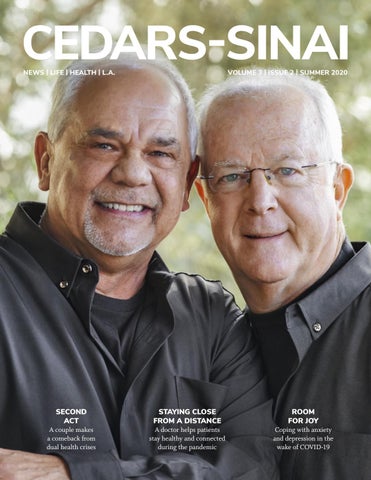
SECOND ACT A couple makes a comeback from dual health crises
VOLUME 3 | ISSUE 2 | SUMMER 2020
STAYING CLOSE FROM A DISTANCE A doctor helps patients stay healthy and connected during the pandemic
ROOM FOR JOY Coping with anxiety and depression in the wake of COVID-19
EDITOR IN CHIEF
Laura Grunberger SENIOR EDITOR
Sarah Spivack LaRosa ASSOCIATE EDITOR
Cassie Tomlin
MANAGING EDITOR
Susan L. Wampler DESIGN
DISTINC_ CONTRIBUTOR
Victoria Pelham EXECUTIVE VICE PRESIDENT, CEDARS-SINAI MEDICAL NETWORK
John E. Jenrette, MD
VICE PRESIDENT, PHYSICIAN RECRUITMENT AND NETWORK DEVELOPMENT, CEDARS-SINAI MEDICAL NETWORK
Julie Reback Spencer
VICE PRESIDENT, STRATEGIC INTEGRATION, CEDARS-SINAI MEDICAL NETWORK
Mary Clare Lingel
VICE PRESIDENT, MARKETING AND COMMUNICATIONS
Pattie Cuen
EXECUTIVE DIRECTOR, BRAND STRATEGY AND CREATIVE SERVICES
Jennifer Fagen
cedars-sinai.org/csmagazine Cedars-Sinai is published three times a year. TO UNSUBSCRIBE please go to giving.cedars-sinai.org/unsubscribe Provide the code that appears above your name, your full name as listed on the mailing, your mailing address, email, title of piece received and request type (unsubscribe from all Cedars-Sinai mailings or only Cedars-Sinai). MAIL EMAIL
Senior Editor 8700 Beverly Blvd., Suite 2416 Los Angeles, CA 90048 groupeditorial@cshs.org
©2020 by Cedars-Sinai. All rights reserved. Reproduction or use in whole or in part without written permission is prohibited. This publication is for informational purposes only and should not be relied upon as medical advice. It has not been designed to replace a physician’s medical assessment and medical judgment. Always consult first with your physician regarding anything related to your personal health. Cedars-Sinai does not discriminate against any person on the basis of race, color, national origin, disability, age or sex in admission, treatment or participation in its programs, services and activities, or in employment. For further information about this policy, contact the public civil rights coordinator at 310-423-7972.
CEDARS-SINAI NEWS | LIFE | HEALTH | L.A.
VOLUME 3 | ISSUE 2 | SUMMER 2020
HERE & NOW
STAYING CLOSE FROM A DISTANCE
12
A doctor helps patients stay healthy and connected during the pandemic
2
NEWS FEED
PREPARE & PREVENT
4
Stories from the Cedars-Sinai landscape
ROOM FOR JOY
Coping with anxiety and depression in the wake of COVID-19
LIFE & HEALTH
SECOND ACT
6 14 AT-A-GLANCE
A couple makes a comeback from dual health crises
Maintaining continuity of care and peace of mind during the pandemic, keeping your kids safe through vaccination, and more
Some stories and photos in this issue were created before the COVID-19 pandemic led to physical distancing. CEDARS-SINAI.ORG
1
NEWS FEED
STORIES FROM THE CEDARS-SINAI LANDSCAPE
SOUTH L.A.
Cedars-Sinai staff joined SEE-LA and L.A. County Supervisor Mark RidleyThomas to help distribute fresh produce and other food staples to more than 1,000 families experiencing food insecurity.
WENATCHEE, WA
After months of trips to the ER for debilitating headaches, Lisa Simmons (center) reached out to Dr. Wouter Schievink, director of the Microvascular Neurosurgery Program, and got the right diagnosis—a cerebrospinal fluid leak. Simmons traveled to Los Angeles in 2019 for treatment and is enjoying time with her family again.
SOUTH L.A.
Families got free flu shots at a pop-up clinic in South Los Angeles, an area with some of the highest levels of flu activity in the county. The clinic was jointly sponsored by Cedars-Sinai, Martin Luther King Jr. Community Hospital, the Los Angeles County Department of Public Health and Watts Health Center.
SYRIA
Three years ago, a bomb blast outside her home in Northern Syria left Aysha Al Saloom with severe burns and disfigured hands. Dr. David Kulber, director of Hand and Upper Extremity Surgery at Cedars-Sinai, rebuilt Aysha’s hands through multiple surgeries, allowing the precocious 8-year-old to return to doing the things she loves: writing, drawing and dancing.
SANTA BARBARA
An ulcerative colitis diagnosis couldn’t sideline Andrew Juiliano from his semi-professional cycling career. For two years, he struggled to find effective treatments and almost gave up on racing. Then he visited the Cedars-Sinai Inflammatory Bowel Disease (IBD) Center, which helped him control his condition and return to the road. “The first time I went to the IBD Center changed my life,” Juiliano says. “They care about me and my goals, and I felt so relieved.”
2
CEDARS-SINAI—VOLUME 3 | ISSUE 2 | SUMMER 2020
WEST HOLLYWOOD
The Cedars-Sinai Accelerator, a technology innovation program, manufactured personal protective equipment to ensure that the hospital had supplies to protect all patients and employees.
WEST HOLLYWOOD
Cedars-Sinai nurse Ally Quinonez, RN, shows off a note of gratitude she received from a local child for her work at the medical center’s drivethrough COVID-19 testing site.
HOLLYWOOD
A group of Cedars-Sinai residents joined June’s #AllBlackLivesMatter march to offer masks, bottled water and hand sanitizer.
WEST HOLLYWOOD
Responding to a critical blood shortage caused by the COVID-19 pandemic, Cedars-Sinai CEO Thomas M. Priselac gave a donation. To make a lifesaving appointment today, call Blood Donor Services at 310-423-4170.
MARINA DEL REY
“I’ve been an ER nurse for 20 years, and this is really difficult to see patients so scared,” says Michiko Matsue, RN, a nurse at Cedars-Sinai Marina del Rey Hospital. “At the end of the day, we’re doing what we need to do.”
For all you’ve done in this great city of #LosAngeles, we see you and appreciate you. Life may be on pause. Your health isn’t.
Learn more: bettertogether.health
WEST HOLLYWOOD
Nurses in COVID-19 areas recognized the extra anxiety their protective masks caused patients who couldn’t see their faces. One nurse started an initiative to display nurses’ smiling photos on their gowns to alleviate a little uncertainty.
FOLLOW US @CEDARSSINAI cedars-sinai.org/csmagazine
CEDARS-SINAI.ORG
3
PREPARE & PREVENT
by Victoria Pelham illustration by Nathan Stock Strategies for Coping Anxiety and depression are common during times of upheaval like the COVID-19 pandemic. Here are some suggestions to help you manage your mental health.
› Meet your basic needs, including sleep, food and hydration.
› Practice daily self-care. That could include
meditation, music, journaling or taking a bath. › Engage with your body. Exercise can help relieve stress. › Get outside every day. › Limit media exposure.
4
CEDARS-SINAI—VOLUME 3 | ISSUE 2 | SUMMER 2020
› Name anxiety as you experience it. You’ll be
more likely to keep it in perspective and calm down if you use coping skills to understand what’s happening. › Focus on breathing to help ground you when overwhelmed. › Allow feelings to come and go without judgment. › Stay connected to your community. Connection helps maintain resilience. › Don’t be afraid to seek help. Many treatment options are available. Sometimes a short course of medication or goal-directed therapy will be enough to get you through.
ROOM FOR JOY
Coping with mental health concerns in the wake of COVID-19
I
n hospitals like Cedars-Sinai, intensive care units (ICUs) overflowed from the onslaught of a respiratory illness no one had previously heard of—COVID-19. Loved ones of those stricken couldn’t be with them in their final hours. But the dangers have been more than physical. Amid the pandemic, the demand for psychological and psychiatric services has grown exponentially. Fear of the novel coronavirus has harmed the mental health of 45% of Americans, according to a Kaiser Family Foundation poll released in April. Even for those without previous psychological symptoms, the effects of COVID-19 on mental wellness are significant and could reverberate long after the country reopens completely. “There’s individual trauma—how people receive and experience these events that render them helpless—but then there’s also a collective trauma, where the entire society is rendered helpless in some way,” says Megan Auster-Rosen, PsyD, a clinical psychologist at CedarsSinai. “What happens with collective trauma is the fabric that ties us together unravels.” ANXIETY AND DEPRESSION IN THE TIME OF COVID
People have spent months afraid for their health, for the health of friends and relatives—especially older ones— and for their livelihoods, housing and financial status. That fear can manifest as anxiety, especially with so many unknowns still at play. “We want to know when the end is, but the can keeps getting kicked down the road,” Auster-Rosen says. Depression has also been on the rise, according to Cedars-Sinai psychiatrist Scott Campbell, MD. For example, suicide hotlines have experienced a dramatic increase in calls. Campbell and Auster-Rosen emphasize that anxiety and depression are reasonable, normal reactions to a world-altering event. Strategies, tools and sometimes outside assistance can help manage these responses (see sidebar). MANY KINDS OF LOSS AND GRIEF
More than 130,000 people had died of COVID-19 in the U.S. as of early July, according to the Centers for Disease
Control and Prevention. And with hospitals, care homes, funeral homes and religious institutions on lockdown, many never got the chance to say goodbye to loved ones. “You can’t even properly grieve because some of the rituals we, as humans, do to mark someone’s passing have been delayed,” Campbell says. Even letting go of pre-COVID-19 routines can trigger similar cycles of grief—from denial, anger and bargaining to sadness and acceptance. Physical distancing, especially, can be a burden on vulnerable populations and many are feeling the sting of job loss as unemployment has soared, Campbell notes. Allowing yourself to recognize, name and grieve losses as they happen can be helpful, Auster-Rosen says. Mourning shouldn’t be diminished just because others have it worse. “There is room for everybody to experience grief, and this minimization of grief hurts us. It’s helpful to experience these emotions so we can let them pass,” she adds. MAKE SPACE FOR HAPPINESS
During times of adversity, humans have a harmful tendency to judge themselves or feel guilt for their feelings, AusterRosen says. “People are resisting feeling any emotion at all, because it feels scary.” Campbell adds: “It’s funny but true that, even with positive emotions, the human mind has a way of punishing itself if one feels like it’s not appropriate. But at what point are you allowed to smile and hold onto something that’s positive or silly or irreverent?” A silver lining of the psychological effects of COVID19 may be that the pandemic has brought emotional health to the forefront. “The goal with a [collective] trauma like this is to look for opportunities to reestablish connection, because that’s what humans need in order to find contentment in any meaningful way,” AusterRosen says. LONG-TERM MENTAL HEALTH FALLOUT
We won’t truly know the mental health repercussions of the pandemic until things start to return to some semblance of normal, and we don’t know when that will be, according to both Auster-Rosen and Campbell. When the pandemic does end, the experience could be akin to soldiers coming home from war, Auster-Rosen says. People may then believe they should feel calmer but not understand why they don’t. “When we’re in less of a fight-or-flight scenario, that’s when these thoughts and feelings can arise, because it feels safer to process them,” she says. Still, as people digest the experience, the resilience they have built up over months in isolation could shine through. People have adapted to waves of changes, and many have used the time to take stock of what they really want from life. “Some things are really painful and sad, but I think there are also things that are really beautiful,” Campbell says. CEDARS-SINAI.ORG
5
LIFE & HEALTH
SECOND ACT
DYNAM DUO by Cassie Tomlin photos by Ted Catanzaro
A couple makes a comeback from dual health crises
6
CEDARS-SINAI—VOLUME 3 | ISSUE 2 | SUMMER 2020
FOR A
MIC
Paul Del Vecchio (left) and Wayne Smith prepare to perform their signature singing act.
CEDARS-SINAI.ORG
7
P
aul Del Vecchio and Wayne Smith live their lives as a duet. “We’re virtually together 24/7,” Smith says. “We thrive on it,” Del Vecchio chimes in, over his husband’s shoulder. “We still have a crush on each other.” After more than 40 years of living and performing together, the couple still lives in harmony: Del Vecchio’s gentle nature complements Smith’s aplomb. They’re perfectly in sync, including in times of crisis. Five years ago, they each became critically ill mere months apart— one with cancer and the other with a heart attack. With the help of the doctor they share, and the support of their families and each other, Smith, 71, and Del Vecchio, 66, both recovered. Healthy and retired, they emerged with a two-man show performing Big Band concerts at assisted-living facilities across Los Angeles (though their in-person shows are now suspended indefinitely). “We both had life-threatening illnesses, and we both came through scot-free,” Smith says. “It’s an amazing miracle to get to share.”
left mixtapes with songs by The Carpenters in Smith’s dressing room before their first date. When the musical wrapped, the couple embarked on careers that would take them around the world—Del Vecchio danced in Tokyo and Smith sang in Paris. They moved to New York, where Del Vecchio performed in the Broadway musical 42nd Street and Smith sang in church choirs by day and Catskills resorts by night. When they relocated to celluloid L.A., Del Vecchio picked up gigs in soap operas and movies; Smith taught voice lessons and took on a corporate “survival gig” that allowed him to travel extensively. The lifestyle could get stressful. The rejection, the hustle and the schedule eventually led them to jobs at Trader Joe’s—a natural fit for the warm and charismatic duo, who worked the same shifts at the same store. They wed in West Hollywood in 2008—their colleagues cheered for them when California legalized same-sex marriage—and settled into a more relaxed chapter of their lives. Until, in strange synchronicity in 2015, they suffered major health setbacks.
FIRST VERSE
MINOR KEYS
Smith and Del Vecchio fell in love on the stage, in 1976 San Francisco. Del Vecchio, fresh out of Chico State University, joined the cast of a revival of Babes in Arms, as the new lead dancer. Smith, a classically trained opera singer, sang lead in the musical comedy. The show was a smash and the two were smitten: Del Vecchio
First came Del Vecchio’s bladder cancer. He noticed blood in his urine, and assumed it was an infection. His primary care doctor, Yalda Azarmehr, MD, referred him to a urologist, and the diagnosis shocked him. Del Vecchio underwent surgery to remove his bladder and prostate. His surgeon, Hyung L. Kim, MD, was
8
CEDARS-SINAI—VOLUME 3 | ISSUE 2 | SUMMER 2020
PRIMARY CARE IN TARZANA
Smith and Del Vecchio see their doctor in the new Cedars-Sinai primary care offices in Tarzana, where four physicians help bring excellent care closer to home for patients in the San Fernando Valley.
YALDA AZARMEHR, MD Azarmehr graduated from medical school at the University of California, San Diego, and completed her residency at Cedars-Sinai in 2012. She was born in Iran, but, at age 18, she and her family fled the country to escape religious persecution. She had to restart her medical training in the United States but never questioned her calling. “Every single day, at least one patient reminds me I absolutely love what I do,” she says. “Cedars-Sinai feels like home to me.” She and her husband live in Tarzana with their 2-year-old daughter and enjoy spending time with their large extended family.
MEHUL THAKKAR, MD Thakkar went to medical school at Wayne State University and joined Cedars-Sinai in 2017. “In primary care, we get to grow old with our patients and develop long relationships,” he says. “It’s a gift and privilege when a patient tells you everything— not just about their chest pain, but an intimate look into their life. It’s sacred and special.” Thakkar and his wife live in Westlake Village with their 10-yearold son and 7-year-old daughter. The family enjoys hiking in Malibu Creek State Park and Wildwood Regional Park.
MICHELLE SHUKHMAN, DO Shukhman earned her medical degree at the Arizona College of Osteopathic Medicine at Midwestern University and completed her internship and residency at Cedars-Sinai in 2016. One foundation of her practice is encouraging patients to prioritize their own health. “It’s a conversation I have 10 times a day as part of my job to be the central point in my patients’ care,” Shukhman says. She lives in Woodland Hills with her husband and their 2- and 5-year-old sons, who play in local sports leagues and enjoy trips to the zoo.
ALOYISUS TSANG, MD Tsang earned his medical degree at Saint Louis University School of Medicine and joined CedarsSinai in 2019. He stays connected to his patients through My CS-Link™. “I encourage my patients to send me a message anytime rather than turning to the internet,” he says. “I can provide more accurate information, and they won’t necessarily have to make an appointment.” Tsang, his wife and their sons, ages 16 and 18, live in La Cañada Flintridge, where they enjoy family-oriented activities like the town’s annual July 4 celebration.
CEDARS-SINAI.ORG
9
“serious and matter-of-fact, but also had a sense of humor,” which quelled Del Vecchio’s anxieties from the start. “His attitude was as important as his technical skills,” Del Vecchio says of Kim, director of the Academic Urology Program and the Homer and Gloria Harvey Family Chair in Urologic Oncology in honor of Stuart Friedman, MD. It took a year to get used to his urostomy bag—he suffered complications that made him feel confined to the house. Then, two months after his surgery, before Del Vecchio could fully recover, Smith suffered a massive, lifethreatening heart attack. “If you had written it in a script, it would be implausible,” Smith says of the devastating duality. He’d fallen ill swiftly, with flu-like symptoms and a painful burning in his armpits, an atypical reaction. After about a day, he showed up for an emergency appointment at Azarmehr’s office. She ran tests and instructed him to go to the emergency department (ED) if his symptoms got worse. But the next morning, Smith again made his way to Azarmehr’s office, wanting to see his own, trusted doctor. At 7 a.m., pale and sweating, he waited for her in the hallway, cradling a bucket to catch his vomit. Azarmehr shepherded him to the ED immediately, where an EKG showed he was having a heart attack.
10
CEDARS-SINAI—VOLUME 3 | ISSUE 2 | SUMMER 2020
Doctors placed stents in his heart that night, and again a couple of days later. After rest and some lifestyle changes, he’s now healthy. The couple says they wouldn’t be here without their longtime physician. “As far we we’re concerned, she saved both of our lives,” Smith says. Azarmehr gives her patients more credit. “They let me know as soon as they developed symptoms, and they followed up,” she says. “Patients often don’t want to bother me with their concerns, but this is what we do, and this is why I’m here.” She also touts the strength of their relationship as a big advantage in their recovery. “They’re so loving and extremely close, and they supported each other through their tough times,” Azarmehr says. “I cannot imagine how scary that must have been. But they have such a positive outlook on life.” Last year, Azarmehr moved from her West Hollywood office, minutes from Smith and Del Vecchio’s apartment, to Tarzana, a longer drive. The couple followed her there, shrugging off the commute. “When you and your doctor go through something like this together, it can be difficult to start with someone who doesn’t know you at all,” Azarmehr says. “That’s where the relationship is really important.”
“They’re so loving and extremely close, and they supported each other through their tough times.” Yalda Azarmehr, MD Cedars-Sinai Primary Care in Tarzana ENCORE
With renewed gratitude for their health, Smith and Del Vecchio now enjoy hikes in Franklin Canyon and drives around pocket neighborhoods (“Side Street Sundays,” they call it). But mostly, they’ve thrown themselves into their singing act, which they have been performing for older adults in assisted-living facilities—sometimes for patients
with Alzheimer’s or Parkinson’s who have lost most of their memory. Their faces animated and their feet in step, they sing tunes by Bing Crosby, the Andrews Sisters, and other gems from the 1930s, ’40s and ’50s that they know will resonate. “It’s magical to watch the power of music get people’s shoes tapping, get them humming a little and mouthing the words,” Del Vecchio says. In mid-March, safe-distance guidelines forced them to halt their shows and shelter at home. Not content to press pause on their purpose, they’re using the time to research new songs to add to their repertoire—relevant tunes like “Accentuate the Positive” and “Don’t Fence Me In.” “When we come back, people are going to be sick of the old show, so we’ve got to come up with something new,” Del Vecchio says. “It keeps our brains active.” And they’re broadcasting livestreams online for clients and friends from their improvised home stage. “We’re happy to be performing live, even if our audience is on the other end of a computer,” Smith says. Now more than ever, the couple focuses on how grateful they are to keep living. “We’re not finished,” Del Vecchio says. Smith completes the thought, “We just keep on trucking, see what’s next and feel glad we get to do it together.”
CEDARS-SINAI.ORG
11
HERE & NOW
STAYING CLOSE FROM A DISTANCE by Cassie Tomlin photo by Rachael Porter
12
CEDARS-SINAI—VOLUME 3 | ISSUE 2 | SUMMER 2020
P
rimary care physician Ara Thomassian, MD, first heard about COVID-19 the way most of his patients did— on the news and in social media. And like his patients, he spends every day balancing his risk of contracting the virus and adapting to a more sequestered life. Thomassian, who practices at Cedars-Sinai Valley Internal Medicine in Valley Village, California, relies on one consistent prescription for his patients during the evolving health crisis: honest, transparent communication. He finds it especially necessary, since, like those he cares for, he learns something new about the novel coronavirus on an almost daily basis. “I’m leaning on the trust I’ve built with my patients as I’m honest about what I don’t know,” he says. “The anxiety of getting sick from this thing is overwhelming, but they trust me because I’m thorough, diligent and explain what I do know.” Since March, Thomassian has treated more than 150 patients for confirmed or suspected COVID-19 infections, while continuing to care for countless patients with other health concerns. Most of Thomassian’s patients haven’t been sick enough to require hospitalization or even an office visit, so he sees them by video appointment, talks with them by phone or exchanges messages through My CS-Link™. Whether he’s monitoring a patient’s COVID-19 symptoms, answering questions about new or ongoing health issues, or simply soothing worries, staying connected is crucial. For example, Thomassian has one patient who is 94 and lives alone. He checks in with her by phone every Friday to make sure he can address any new concerns. She looks forward to his calls, which make her feel less alone. “When a patient and I can work through a problem, despite the circumstances, it strengthens our therapeutic alliance,” Thomassian says. He admits to his COVID-19 patients that he’s learning on his feet as he evaluates their health, adjusts his advice based on new guidelines and shares sometimes unsatisfyingly inconclusive diagnoses. In the pandemic’s earliest weeks and months, rigid testing guidelines forced doctors to diagnose the disease based on symptoms alone, especially in otherwise healthy adults with mild cases. After cautiously gauging a patient’s disease severity, Thomassian advised most to assume they were infected, isolate from their families, stay hydrated and take Tylenol. Some grew frustrated, especially since COVID-19 symptoms are less typical compared to those of other viral infections. “A lot of times, these patients are very anxious—they’ve never experienced anything like this,” Thomassian says. “But I walk them through what to expect based on the most recent science. Much of what I know about this virus is coming from Cedars-Sinai, where we have expert epidemiologists and infectious disease physicians providing constant guidance. That gives my patients and me a lot of confidence.”
Thomassian says the experience he’s developed after years of caring for patients with multiple medical conditions and chronic diseases applies now as much as ever. “There’s no cookie-cutter treatment to any health condition or problem,” he says. “That’s why we have to listen, ask the appropriate questions and take patients’ medical history into consideration—so we can tailor our approach.” Now, during every appointment—whether for diabetes or blood pressure management—he discusses COVID-19 to educate patients about keeping themselves safe and when to reach out for help or go to the Emergency Department. According to Thomassian, the fear, uncertainty and stress he sees in his patients over COVID-19 only make him more dedicated to his job. “Patients share things with me that they don’t tell anybody in the world,” he notes. “There are patients who don’t take advice from anyone else—but will listen to me.” Along with that sense of responsibility comes another emotion, Thomassian says. “I understand that being someone’s physician means so much, and that brings me joy. I love what I do.”
SILVER LININGS For most Angelenos, the COVID-19 pandemic has disrupted well-established, relied-upon routines. For many, stay-at-home orders have caused fear, anxiety and loneliness. Thomassian suggests his patients search their new situations for “silver linings,” and focus on positive changes. LEARN (OR TEACH) SOMETHING NEW Thomassian takes advantage of the added time at home by teaching his kids to swim. “Every day as it gets closer to 5 p.m., they’re waiting for me in their swimsuits with sunscreen on—they really look forward to it, and I’ve been able to see them improve, which is rewarding for me.” EMBRACE THE POSITIVE CHANGES Thomassian’s work has changed dramatically, and one element he hopes will stick around is virtual care. Though video chat is not always an adequate substitute for an office visit, the ability to treat a patient from a distance improves access. It can be helpful when patients live far away or while they’re out of town. ELEVATE SMALL RITUALS Thomassian says many of his patients have noticed new tenderness in small moments with loved ones, like sharing coffee or a walk. “My family used to get really restless at home—if we didn’t take a trip on a weekend or a day off, we felt it was a waste. Now, we’ve found that we don’t need to go out to enjoy a meal. We’re regaining an appreciation for togetherness.”
CEDARS-SINAI.ORG
13
AT-A-GLANCE
Get the Care You Need— Now “ We’re here for the community, and we’ve created the safest possible environment amid this pandemic.” — Jonathan Weiner, MD, Chair, Primary Care
Telehealth appointments offer patients continuity of care and peace of mind during the COVID-19 pandemic. It’s crucial that patients can safely access preventive care, get help managing chronic disease and address other health concerns even when physical distancing rules are in effect. Cedars-Sinai clinicians remain committed to meeting the full range of your healthcare needs during the COVID-19 crisis. You might not even have to travel to your doctor’s office. VIDEO, AUDIO OR IN-PERSON Some patient care can be provided through video or telephone calls, says Jonathan Weiner, MD, chair of Primary Care at Cedars-Sinai. “Doctors can do routine health checks and monitor certain chronic problems, such as well-controlled diabetes, with a virtual appointment.” For other conditions, however, in-person consultation is still the best option. Examples include poorly controlled diabetes, high blood pressure, heart or lung disease, and mental illness. One size does not fit all, Weiner says, so “call your doctor’s office to discuss how your needs can best be met.” SAFE AND SECURE Patients who need to come in for an appointment can do so with confidence, as extra protections have been added to Cedars-Sinai’s standard (but stringent) safeguards. Patients are carefully screened for COVID-19 symptoms upon arrival. Everyone—from patients to personnel—is required to wear masks. In addition, waiting rooms have been configured for physical distancing, and visitation is limited. “We’re taking these significant precautions and are strictly implementing public health rules,” Weiner says. “You’ll be cared for regardless, but we keep infected patients separate to minimize risk to everyone.” URGENCY OF CARE You’ll find the same preventive measures at CedarsSinai’s urgent care clinics. “We’ve set up separate sections for respiratory versus non-respiratory symptoms,” says Stacy Tarradath, MD, division chief of Urgent Care. “We’ll ask you questions to figure out the right section for you.” Whether you visit your doctor’s office or Cedars-Sinai urgent care, you can feel confident that your safety is our highest priority, and that your needs will be met—safely and compassionately.
14
CEDARS-SINAI—VOLUME 3 | ISSUE 2 | SUMMER 2020
Care for the Spirit
Research Roundup
Patients in the hospital can have complex spiritual needs. Members of the Cedars-Sinai Spiritual Care Department offer guidance and comfort to those who are sick or in pain, and to the friends and family members experiencing grief or distress. The team also trains religious leaders in the community to better support their hospitalized congregants.
A STRESS TEST FOR THE MIND Postpartum depression (PPD) is the most common complication new mothers experience, and yet it’s one of the ailments they’re most reluctant to talk about. The social, biological and medical demands of pregnancy all feed into the risk of developing PPD—and women who have a postpartum mood disorder are at increased risk of future major depression episodes. Cedars-Sinai is working on multiple fronts to identify, treat and ultimately predict postpartum mood disorders, such as depression and anxiety. The goals include the development of early interventions—including a blood test that would catch those at highest risk—as well as medical and mental health support for women who need it.
BY THE NUMBERS
23,745
visits with patients and families by Spiritual Care chaplains in 2019
8,000
people attended weekly worship services in the Cedars-Sinai chapel in 2019
50+
faith traditions of people served by Spiritual Care chaplains to date
30
students trained in 2019 in Cedars-Sinai’s nationally accredited Clinical Pastoral Education Program, which offers clergy members real-world experience engaging with hospitalized patients and families
2
fellows have completed or are currently enrolled in Cedars-Sinai’s Clinical Pastoral Education Program, which helps fulfill requirements to become a board-certified chaplain
“ Chaplains are ordained in their own faith traditions but our primary focus is to provide nonjudgmental support to people of all religions and traditions, and those of no religion at all. Most of our work focuses on spiritual wellbeing, which is much broader than any specific religion.” —R abbi Jason Weiner, PhD, Director, Spiritual Care Department
WINDOW BACK IN TIME People who develop Parkinson’s disease before age 50 may have been born with disordered brain cells that went undetected for decades. Parkinson’s occurs when brain neurons that make dopamine, a substance that helps coordinate muscle movement, become impaired or die. In most cases, the exact cause of neuron failure is unclear, and there is no known cure. Cedars-Sinai investigators have generated special stem cells from patients with young-onset Parkinson’s. The scientists used the stem cells to produce dopamine neurons and analyze their functions, providing a window back in time to the origins of the disease. Next, they’ll test a number of drugs that might reverse the cell abnormalities they observed. OPIOID OPTIONS Cedars-Sinai scientists and clinicians are employing multiple strategies to help stem the nationwide epidemic of opioid abuse. The National Institutes of Health recently recognized Cedars-Sinai’s commitment with grants from its Helping to End Addiction Long-term Initiative. Projects include using virtual reality as an alternative to opioid prescriptions for chronic lower back pain, exploration of novel methods for easing inflammatory bowel disease pain and assessment of the impact of pre-birth exposure to opioids. HEART OF A WOMAN Women’s hearts differ significantly from men’s, and a recent Cedars-Sinai investigation unlocked a key reason why: blood vessel aging. The large and small arteries in females grow older more rapidly, which could help explain why women often develop different types of cardiovascular disease—and with different timing— than men. Rates of accelerating blood pressure elevation—a leading indicator of cardiovascular risk—were significantly higher in women than men, and started earlier in life. The study serves as a reminder that many aspects of cardiovascular evaluation and therapy need to be tailored specifically for women. CEDARS-SINAI.ORG
15
AT-A-GLANCE
Stay Safe, Vaccinate
Immunizations have a long history of keeping dangerous diseases at bay and are critical to preventing their resurgence. But during the COVID-19 pandemic, the number of children receiving scheduled vaccines plummeted, according to the Centers for Disease Control and Prevention (CDC). From mid-March to mid-April, doctors in the CDC’s Vaccines for Children Program ordered about 2.5 million fewer doses of routine flu shots and 250,000 fewer doses of measles-prevention vaccines than during the same time period in 2019. Declines like these raise the risk of unvaccinated and undervaccinated kids contracting and spreading preventable diseases, says Sharon Wirawan, MD, a pediatrician at Cedars-Sinai. “Just because COVID-19 is out there doesn’t mean measles and whooping cough [pertussis] aren’t, or that the risk of contracting those is lower,” she says. “We can protect infants and children from these diseases. Vaccines truly do save lives.” DON’T SKIP VACCINES We know the toll that infectious diseases can take. Measles, for example, is highly contagious and can cause serious complications such as pneumonia, blindness and brain inflammation (encephalitis). Mumps can cause deafness and even meningitis. Vaccines are very effective in combating these diseases. Two doses of the measles, mumps and rubella (MMR) vaccine are about 97% effective in preventing measles, according to the CDC. YOU CAN VACCINATE AND STILL STAY SAFE Doctors’ offices have safeguards in place to keep patients protected, such as frequent sanitizing, wearing masks, physical distancing, limiting the number of visitors, and temperature checks for everyone at entrances. Pediatricians are also separating sick-child visits from well-child preventive visits. MAINTAIN YOUR VACCINE SCHEDULE Make sure to follow the CDC immunization schedule, and don’t space vaccines out from the recommended time frame. Vaccines are available for 16 diseases for children, and Wirawan also recommends getting your kids— and yourself—annual flu shots, especially during an outbreak like COVID-19, to improve your odds of staying out of a hospital or clinic later on.
16
CEDARS-SINAI—VOLUME 3 | ISSUE 2 | SUMMER 2020
Visit Our Doctors ESTHER AHN, MD INTERNAL MEDICINE
MARVIN MINA, MD FAMILY MEDICINE
4676 Admiralty Way, 4th Floor Marina Del Rey, CA 90292 310-423-2301
8767 Wilshire Blvd., 2nd Floor Beverly Hills, CA 90211 310-423-0881
JOANNE BELGARDE, MD INTERNAL MEDICINE
FIROZ SHEIKH FAMILY MEDICINE
12746 W. Jefferson Blvd., 3rd Floor Playa Vista, CA 90094 424-315-2490
4676 Admiralty Way, 4th Floor Marina del Rey, CA 90292 310-306-6966
TERESA DEAN, MD INTERNAL MEDICINE
MICHELLE SHUKHMAN, DO INTERNAL MEDICINE
1919 Santa Monica Blvd., Suite 210 Santa Monica, CA 90404 310-423-4619
18133 Ventura Blvd., Suite 405 Tarzana, CA 91356 818-774-3838
NICOLE HERZOG, MD PEDIATRICS
ALOYISUS TSANG, MD INTERNAL MEDICINE
8501 Wilshire Blvd., Suite 201 Beverly Hills, CA 90211 310-385-3345
18133 Ventura Blvd., Suite 405 Tarzana, CA 91356 818-774-3838
NITIN KAPUR, MD INTERNAL MEDICINE
MEHUL THAKKAR, MD INTERNAL MEDICINE
1919 Santa Monica Blvd., Suite 210 Santa Monica, CA 90404 310-423-8828
18133 Ventura Blvd., Suite 405 Tarzana, CA 91356 818-774-3838
STEVEN KREMS, MD INTERNAL MEDICINE
URGENT CARE
4676 Admiralty Way, 4th Floor Marina del Rey, CA 90292 310-306-6966
8501 Wilshire Blvd., Suite 150 Los Angeles, CA 90048 310-248-7000
ISSUE CONTRIBUTORS MEGAN AUSTER-ROSEN, PSYD p.4 CLINICAL PSYCHOLOGY
250 N. Robertson Blvd., Suite 412 Beverly Hills, CA 90211 310-248-8100 YALDA AZARMEHR, MD p.6 INTERNAL MEDICINE
18133 Ventura Blvd., Suite 405 Tarzana, CA 91356 310-774-3838 SCOTT CAMPBELL, MD p.4 PSYCHIATRY/BEHAVIORAL NEUROSCIENCES
250 N. Robertson Blvd., Suite 412 Beverly Hills, CA 90211 310-423-3513
STACY TARRADATH, MD p.14 FAMILY MEDICINE
8501 Wilshire Blvd., Suite 150 Beverly Hills, CA 90211 310-248-7000 ARA THOMASSIAN, MD p.12 INTERNAL MEDICINE
12660 Riverside Dr., Suite 215 North Hollywood, CA 91607 818-487-0040 JONATHAN WEINER, MD p.14 INTERNAL MEDICINE
8767 Wilshire Blvd., 3rd Floor Beverly Hills, CA 90211 310-385-3571 SHARON L. WIRAWAN, MD p.16 PEDIATRICS
12746 W. Jefferson Blvd., Suite 4000 Playa Vista, CA 90094 310-423-6275
BEVERLY HILLS
CULVER CITY
10100 Culver Blvd., Suite E Culver City, CA 90232 310-423-3333 PLAYA VISTA
12746 W. Jefferson Blvd., Suite 2000 Playa Vista, CA 90094 424-315-2220
SPECIALTY CARE IN THE VALLEY
Cedars-Sinai hospital services and specialty care are now available in the San Fernando Valley. A network of 75 specialists in more than 20 disciplines has teamed up with Cedars-Sinai primary care physicians throughout the Valley. Providence Cedars-Sinai Tarzana Medical Center offers surgery and other hospital services to our patients—without having to drive over the hill. Learn more about our locations and expanded care at cedars-sinai.org/valley.html
Call 1-800-CEDARS-1 to schedule an appointment. CEDARS-SINAI.ORG
17
NON-PROFIT ORG. U.S. POSTAGE PAID LOS ANGELES, CA PERMIT NO. 22328