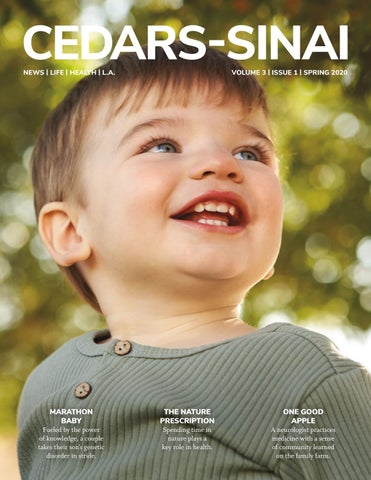
CEDARS-SINAI NEWS | LIFE | HEALTH | L.A.
MARATHON BABY Fueled by the power of knowledge, a couple takes their son’s genetic disorder in stride.
VOLUME 3 | ISSUE 1 | SPRING 2020
THE NATURE PRESCRIPTION Spending time in nature plays a key role in health.
ONE GOOD APPLE A neurologist practices medicine with a sense of community learned on the family farm.
EDITOR IN CHIEF
Laura Grunberger SENIOR EDITOR
Sarah Spivack LaRosa ASSOCIATE EDITOR
Cassie Tomlin
MANAGING EDITOR
Susan L. Wampler DESIGN
DISTINC_ CONTRIBUTORS
Kyle Beswick Amy Paturel Rosanna Turner
EXECUTIVE VICE PRESIDENT, CEDARS-SINAI MEDICAL NETWORK
John E. Jenrette, MD
VICE PRESIDENT, PHYSICIAN RECRUITMENT AND NETWORK DEVELOPMENT, CEDARS-SINAI MEDICAL NETWORK
Julie Reback Spencer
VICE PRESIDENT, STRATEGIC INTEGRATION, CEDARS-SINAI MEDICAL NETWORK
Mary Clare Lingel
VICE PRESIDENT, MARKETING AND COMMUNICATIONS
Pattie Cuen
EXECUTIVE DIRECTOR, BRAND STRATEGY AND CREATIVE SERVICES
Jennifer Fagen
cedars-sinai.org/csmagazine Cedars-Sinai is published three times a year. TO UNSUBSCRIBE please go to giving.cedars-sinai.org/unsubscribe Provide the code that appears above your name, your full name as listed on the mailing, your mailing address, email, title of piece received and request type (unsubscribe from all Cedars-Sinai mailings or only Cedars-Sinai). MAIL EMAIL
Senior Editor 8700 Beverly Blvd., Suite 2416 Los Angeles, CA 90048 groupeditorial@cshs.org
©2020 by Cedars-Sinai. All rights reserved. Reproduction or use in whole or in part without written permission is prohibited. This publication is for informational purposes only and should not be relied upon as medical advice. It has not been designed to replace a physician’s medical assessment and medical judgment. Always consult first with your physician regarding anything related to your personal health. Cedars-Sinai does not discriminate against any person on the basis of race, color, national origin, disability, age or sex in admission, treatment or participation in its programs, services and activities, or in employment. For further information about this policy, contact the public civil rights coordinator at 310-423-7972.
CEDARS-SINAI NEWS | LIFE | HEALTH | L.A.
VOLUME 3 | ISSUE 1 | SPRING 2020
HERE & NOW
12 ONE GOOD APPLE
A neurologist practices medicine with a sense of community learned on the family farm.
2
NEWS FEED
PREPARE & PREVENT
Stories from the Cedars-Sinai landscape
4
THE NATURE PRESCRIPTION
Spending time in nature plays a key role in health and healing.
LIFE & HEALTH
MARATHON BABY
6
Fueled by the power of knowledge and unparalleled access to supportive resources, a couple takes their son’s genetic disorder in stride.
14
AT-A-GLANCE
How casual athletes can protect their joints, when to use urgent care and more
CEDARS-SINAI.ORG
1
NEWS FEED
STORIES FROM THE CEDARS-SINAI LANDSCAPE LOS ANGELES
Aiden Duong, 10, with Los Angeles Rams guard and fellow cancer survivor Chandler Brewer. Duong was honored as coin-toss captain at the game.
MARINA DEL REY
Kids played “doctor for a day” while parents received blood pressure screenings during the annual Del Rey Day in Glen Alla Park. Cedars-Sinai co-sponsored the event and also provided free flu shots, nutrition information and tips on electric scooter safety.
WEST HOLLYWOOD
Patient Ella Robinson (right) gets a visit from Barbie Marshall and her dog, Arlo, a volunteer with Cedars-Sinai’s Pets Offering Ongoing Care and Healing (POOCH) program.
WEST HOLLYWOOD
Numa Beron, who was born with a degenerative brain condition and has spent much of her life in Cedars-Sinai’s Pediatric Intensive Care Unit, celebrated her bat mitzvah with family, friends and caregivers at the medical center.
ENCINO
Cedars-Sinai employees wore pink to mark Breast Cancer Awareness Month.
SAN PEDRO
Neurologist Dr. Robert Baloh (center), the Ben Winters Chair in Regenerative Medicine, was honored at the Muscular Dystrophy Association’s L.A. Muscle Walk. 2
CEDARS-SINAI—VOLUME 3 | ISSUE 1 | SPRING 2020
TORRANCE
SANTA MONICA
Tyler Higa (right) got a tour of the operating suite where he underwent robotic surgery to remove a benign tumor in his lung, performed by Dr. Amirhossein Mahfoozi.
Cedars-Sinai staff and their families volunteered with Heal the Bay at one of the environmental group’s monthly Coastal Cleanup days.
IRVINE
During a bike ride in 2017, Jeff Tong suffered a life-threatening heart attack and woke up at Cedars-Sinai. Following emergency surgery, in addition to diet and lifestyle changes, Tong is back on the trail again and grateful for a “second chance at a good, quality life.”
PLAYA VISTA
Cedars-Sinai Kerlan-Jobe Institute orthopaedic physician Dr. Ralph Gambardella serves as team physician for Loyola Marymount University athletics.
WEST HOLLYWOOD
Instead of throwing away medicine bottle caps, a group of cancer nurses created “The Colors of Courage,” an artwork they hope will inspire the patients they treat.
ORLANDO
Steven Levy Cruz, a Cedars-Sinai employee, also runs a nonprofit that helps children in Central America attend soccer academies. His colleague Kelly Salazar also volunteers with his foundation, Academia de Futbol Juvenil Amatence, which was recently honored with Major League Soccer’s Community MVP Award at the All-Star Game in Orlando, Florida.
FOLLOW US @CEDARSSINAI cedars-sinai.org/csmagazine
CEDARS-SINAI.ORG
3
PREPARE & PREVENT
by Amy Paturel illustration by Caitlin Cordtz Forest Bathing 101 Getting away from it all—specifically, other people— is tough in Los Angeles, but doable. L.A. County is the most populous in the nation, but it’s also home to one of the country’s largest urban parks (Griffith Park), 75 miles of coastline, and thousands of acres of mountains, marshes and valleys. Forest bathers aspire to connect with nature using all of their senses. Here’s how to pull that off when the city is dragging you down.
› Find a spot. Choose a place that helps you relax
and unwind, where the sights, sounds and smells are soothing to you. Transplants from cooler climates can sniff out the piney scent of home in the Angeles National Forest. Quiet your mind. Leave your worries and your › phone behind and focus on the world outside your mind. 4
CEDARS-SINAI—VOLUME 3 | ISSUE 1 | SPRING 2020
› Use your senses. Ground yourself in your surround-
ings. At the beach? Watch the sunlight dance on the water, listen to the caws of the seagulls, inhale (and taste) the salt air, and dig your feet and hands into the sand. › Let your body be your guide. Instead of methodically planning your time outside, wander aimlessly. Let your body—and spirit—move you, or simply keep you grounded in place. › Take your time. In true forest bathing, there are no clocks. In the real world, you may need to sound an alarm after 20 to 30 minutes outdoors. The good news: Spending time in nature is not medicine that you must take in set doses. Squeeze it in where and when you can.
THE NATURE PRESCRIPTION Spending time in nature plays a key role in health and healing.
W
hether you’re angry, stressed, scared or sad, connecting with Mother Nature is powerful medicine. The smells of the forest, the sounds of rustling leaves and the feel of soft grass can help reduce stress, boost feel-good hormones and clear a cluttered mind. In fact, a growing body of research confirms that getting outside is good for both body and mind. There’s even data to suggest that spending time in nature can reduce the risk of asthma, allergies and heart disease. “We’re biologically wired to seek out blue and green spaces because those colors represent fertile environments where humans can thrive,” says Teresa Dean, MD, a primary care physician at Cedars-Sinai. The benefits are so systemic, doctors are increasingly writing “nature prescriptions.” Scientists haven’t been able to tease out how or why the great outdoors produces these whole-body effects. It could be the increased vitamin D from sunshine or that people tend to exercise more when they’re outdoors. It might even be the reverse—that healthier, happier people are more likely to spend time outside. “Being in nature helps us disconnect from everyday worries and tune in to ourselves,” says Hayden Lowenstein, MD, an infectious disease specialist at Cedars-Sinai. He adds that getting away from ubiquitous electronic devices can’t hurt. The idea of stepping out into nature to enhance health and healing dates back centuries. “In Japan, they call it ‘shinrin-yoku,’ which translates as ‘forest bathing,’” says Nima Gharavi, MD, PhD, a dermatologist at Cedars-Sinai, and spending mindful time outside plays a key role in that country’s health program. The Swedish government offers tax breaks to encourage people to spend more time outdoors. And for good reason: Inhaling fresh air is essentially free medicine. While scientists haven’t yet identified the optimal dose of outside time, a study from the United Kingdom reported that people who spent two or more hours outdoors each week experienced greater health perks than those who remained indoors. “You can start by spending just five minutes outside and build up from there,” Dean says. “Over time, you might discover that it feels good to slow down, take a breath and connect with the world around you.”
Connecting with nature often involves exercise, but not always. Here’s how four Cedars-Sinai physicians choose to recharge outdoors: ROBERT KLAPPER, MD, ORTHOPAEDICS Surfing When you go surfing, you’re on animal time. When the wave comes, you ride that energy. There’s a symbolism to it, too. The nose of the board is your future. The tail of the board is your past. And the surfer stands in the middle of the board and learns to live in the moment.”
“
HAYDEN LOWENSTEIN, MD, INFECTIOUS DISEASES Rock Climbing For me, climbing not only presents a physical challenge, but it’s also about problem-solving. Climbing gets me outdoors to beautiful places and allows me to disconnect from the everyday worries and stresses of the job.”
“
TERESA DEAN, MD, INTERNAL MEDICINE Seeking Out Green Spaces I was born and raised in Alaska, so we were always outside. When I was in medical school, I took time to sit outside on the grass during breaks. That’s where I feel most grounded.”
“
ARUN RAMACHANDRAN, MD, NEUROLOGY Walking to Work I live in the Beverly Grove area, a mile away from Cedars-Sinai, so I try to walk to work whenever possible. It’s easy exercise and it helps me prepare for the day and then, on the way home, unwind.”
“
NIMA GHARAVI, MD, PHD, DERMATOLOGY (Responsible) Sun Seeking When I spend time outside, I feel better. I have more energy. I’m happier, and I’m convinced it makes me a better doctor. So making time to get outside is a top priority for me, whether that means hiking Temescal Canyon Trail with my family, playing tennis or hitting the beach. Of course, as a dermatologist, I also prioritize sunscreen.”
“
CEDARS-SINAI.ORG
5
LIFE & HEALTH
MARATHON
BABY by Amy Paturel photos by Ted Catanzaro
Fueled by the power of knowledge and unparalleled access to supportive resources, Playa Vista residents Matt and Marci Tatham take their son Jack’s genetic disorder in stride.
6
CEDARS-SINAI—VOLUME 3 | ISSUE 1 | SPRING 2020
CEDARS-SINAI.ORG
7
O
n any given day, Marci and Matt Tatham follow their giggling, nearly 2-year-old son, Jack, through their cozy Playa Vista apartment. The space is custom designed to cater to Jack’s curiosity and sensory development. A space shuttle fort allows for easy games of peekaboo. Toy airplanes and helicopters hover near the ceiling, and a playhouse on the patio opens the door to Jack’s imagination. Engaging Jack’s senses during playtime helps keep his development on track. Though nothing in the toddler’s chipper demeanor indicates it, he has a rare syndrome that can lead to developmental delays in the short term and more serious outcomes later. Marci Tatham learned she was pregnant just two weeks before running the New York City Marathon in 2017. Diagnosed with Type 1 diabetes in 2012, she was determined to join her fellow Type 1 teammates. “It never occurred to me not to run, but because I was pregnant, I decided to trot rather than run at full speed,” she says. “I realize now that running that race somewhat represents Jack’s life and how it’s beginning to take shape.” Even though Tatham was only 26 at the time, diabetes put her pregnancy into a high-risk category. So when she was about 10 weeks along, her Cedars-Sinai obstetrician encouraged her to undergo a noninvasive prenatal screening for genetic abnormalities in her baby. “The genetic counselor told me I tested positive for a chromosomal abnormality that’s only present in males,”
8
CEDARS-SINAI—VOLUME 3 | ISSUE 1 | SPRING 2020
Tatham recalls. “That’s how I found out we were having a boy.” She froze, paralyzed with fear, confusion, anger, sadness and denial. There was a 33% chance her son would be born with Klinefelter syndrome, a disorder that affects about 1 in 650 newborn boys. Klinefelter syndrome occurs when boys are born with an extra X chromosome, in addition to the usual XY that identifies males. The presence of an extra X chromosome may result in underdeveloped testes, testosterone insufficiency, and delayed or incomplete puberty—and it almost universally results in low sperm count. Affected boys can experience speech delays, decreased muscle tone and social-emotional deficits. The syndrome is also associated with mental health disorders, autoimmune conditions, metabolic syndromes and certain types of cancer. “My mind was reeling,” Tatham says. “If Jack has Klinefelter syndrome, what will that look like for him? Will he be ‘normal’? Will he excel in school? Will he be able to have children?” But it’s not in the Tathams’ DNA to get bogged down with negative possibilities. Fortunately, Matt Tatham was able to draw on his career skills and training. As manager of demand planning for The Honest Company, his mind is primed to forecast and strategize. The pair hit the ground running, poring over research papers, scouring the internet for parent support groups and spending hundreds of hours online learning about Klinefelter syndrome.
PEDIATRIC CARE CLOSE TO HOME
“ I like the continuity of care and the mutual trust that is inherent in pediatric medicine —and being able to see my patients grow and thrive.” The Tathams found Jack’s standout pediatrician, Karina Eastman, MD, at Cedars-Sinai’s Playa Vista location, just a five-minute walk from their home. Eastman’s career choice was a natural outgrowth of her own childhood.
Eastman graduated from the University of Vermont’s Larner College of Medicine in 2014. She completed her residency and fellowship at UCLA, where she coordinated care for pediatric patients with complex conditions.
“My parents instilled in me a sense of wanting to be of service to others, and I’ve always loved working with kids,” says Eastman, whose mother was an elementary school teacher.
For fun, and to reboot a childhood passion, Eastman has been taking weekly ballet classes with her sister.
CEDARS-SINAI.ORG
9
The couple also found a “coach”—Karina Eastman, MD, a pediatrician at Cedars-Sinai—to help them navigate the rocky terrain after Jack tested positive for Klinefelter shortly after his birth. CHARTING A NEW COURSE
When the Tathams brought baby Jack home, they were looking forward to spending time together as a party of three, taking him to the park, visiting the beach, and hanging out with friends and family. But those dreams had to be balanced with a rigorous treatment schedule. “Dr. Eastman was instrumental in partnering with us to select the best services for Jack’s needs,” Marci Tatham says. “Unlike many pediatricians, she understood Jack’s diagnosis and gave us clear direction for next steps. With her guidance, we have been able to give Jack not only an active childhood but also the best healthcare.” Doctors like Eastman face the challenge of explaining a syndrome that falls on a spectrum. Klinefelter syndrome’s effects range so widely that some males are severely affected while others don’t even realize they have the condition. Only 25% will ever be diagnosed. “It’s hard to say from birth how Klinefelter syndrome will affect a child because it varies so much,” Eastman says. “But the Tathams have done a lot of research and they are very proactive with Jack. He’s on track for his age, and I credit that to early intervention.” Like Jack, more children than ever are being diagnosed with Klinefelter syndrome long before they hit puberty. 10
CEDARS-SINAI—VOLUME 3 | ISSUE 1 | SPRING 2020
“With knowledge comes power,” Eastman says. “Not only can parents prepare for the future, but they can also intervene early with a variety of therapies.” By the time Jack was 1 month old, he had a team of Cedars-Sinai specialists ensuring he received the best care, including a geneticist and a pediatric endocrinologist. At 2 months, Jack started occupational therapy and physical therapy sessions to help build his motor skills, and at 1 year he began speech therapy—all three of these services are less than 10 minutes from the Tathams’ home. Jack’s mom doesn’t sit on the sidelines during these sessions. She’s an active participant, learning tools that will encourage her son’s development. “I take what I learn during his therapy sessions and weave it into his playtime at home,” she says. All of this work is helping Jack master climbing and balance and explore different foods, textures and sensory input—activities that can be challenging for boys with Klinefelter syndrome. He’s also learning how to ask for what he wants. “Jack is the first patient with Klinefelter syndrome that I have followed from birth,” Eastman says. “My job is to make sure he sees the right specialists and that he’s getting the services he needs so he stays on track with his development.” It’s a busy schedule, to be sure, but Jack has met every milestone and, even though he’s still very young, the family is learning more every day about how he will grow, think, learn and develop.
“Living with Type 1 diabetes has prepared me to embrace Jack’s syndrome and teach him how to persevere through his own unique challenges,” Marci Tatham says. It’s too soon to tell how Klinefelter will affect Jack down the line. That uncertainty can be unnerving for his parents. “It’s a one-day-at-a-time kind of thing,” says his mom, whose optimism and determination continue to grow alongside her son.
“As Jack’s life unfolds, we will begin to see how this will impact his development, learning, social skills, and long-term health and wellbeing,” she says. “In the meantime, we’re learning to let him run this race on his own timing.”
TO TEST OR NOT TO TEST Until recently, most men didn’t discover they had Klinefelter syndrome until they wanted children and ran into fertility problems. With advances in screening technology, parents like the Tathams are now able to learn about potential obstacles months or even years before they come to fruition.
that doing a prenatal screening test is a decision in itself.”
“Noninvasive prenatal screening doesn’t provide a confirmed diagnosis, but it does tell you whether there’s a high or low risk of having one of these chromosomal conditions,” says Pedro Sanchez, MD, Jack’s pediatric geneticist at Cedars-Sinai. “I see a lot of families who struggle with the knowledge that their unborn baby may be carrying a genetic disorder. So it’s important to realize
The Tathams would never have screened Jack for genetic abnormalities if Marci hadn’t been diagnosed with Type 1 diabetes, and Klinefelter syndrome would likely have remained a mystery until much later in Jack’s life. “It’s a gift that we learned about this diagnosis so early because now we can make sure he receives the services he needs to succeed,” she says.
Parents must ask themselves whether they really want information that may be incomplete or confusing, Sanchez notes.
CEDARS-SINAI.ORG
11
HERE & NOW
ONE
GOOD APPLE by Cassie Tomlin photos by Ted Catanzaro
12
CEDARS-SINAI—VOLUME 3 | ISSUE 1 | SPRING 2020
E
arly one Sunday at the Hollywood Farmers’ Market, the smells of celery and incense and the gentle wail of a street musician’s trumpet usher orderly crowds through a few closed-off city blocks. Shoppers pile produce into pushcarts and chase after toddlers with faces stained red from devouring fresh strawberries. At Ha’s Apple Farm stand, James Ha, MD, serenely bags armfuls of apples for a queue of customers. A few shriek in delight when they see him, demand to see pictures of his 3-year-old daughter and 8-month-old son, and send their love to Jane, his wife. Ha, a neurologist at Cedars-Sinai, has made an appearance this morning to help out his dad, David, and mom, Kyung, who run the business. “It’s like a family here,” Ha says, between hugs. “We see a lot of the same people every week because these are the only apples their kids will eat.” A nearby customer chimes in: “That’s my kids! If I’m forced to buy an apple in the supermarket, it’s like flushing money down the toilet.” Faithful patrons return to the fruit stand every weekend as much for the Ha family as for the Fuji, Blondee and Honeycrisp apples. Over 25 years at various Los Angeles markets, customers have grown into friends who’ve watched Ha graduate from high school, finish undergrad as a public health major, and complete medical school and a residency. And the family has followed their customers’ lives, too. “We still see people who were pregnant when we first met them, and now their kids are in college,” Ha says. Ha and his two siblings grew up in Tehachapi, a small city about two hours north of Los Angeles, on the family farm, where peach and plum blossoms flood the air with fragrance, and ducks, quail and chickens run free. His parents emigrated from Korea to Oklahoma in 1973, first
operating a small grocery store and then a hotel. In the 1980s, they gathered their savings and headed West, seeking a “quiet country life.” They bought land advertised in a Korean newspaper. The couple taught themselves to grow their own food, and eventually turned an apple orchard into a business. “They had a pioneer spirit, and they’d always been committed to eating healthfully,” Ha says. On the farm, Ha learned tenacity and generosity watching his parents and other farmers support each other through hard times and bad seasons. “Even after they’d worked themselves to the bone, at the end of the day my dad would always drive the tractor out to help the neighbors when they needed it,” Ha says. That sense of community shapes the backbone of his neurology practice, where he collaborates closely with other physicians to care for patients following a stroke or a spinal cord injury, or to monitor patients with chronic conditions such as migraines, epilepsy, seizures, Parkinson’s disease or amyotrophic lateral sclerosis (ALS). Ha specializes in neurophysiology, the diagnosis and treatment of nerve and muscle diseases. Each of his colleagues brings a unique focus to their work, so their patients benefit from their combined expertise. “A lot of the cases we deal with are really complex and challenging, which requires constant care and thought,” he says. “Especially when the treatment isn’t so straightforward, we learn from and lean on each other.” In keeping with Ha family values, he encourages patients to protect their health by eating a balanced diet, including plenty of fresh fruits and vegetables. As it turns out, an apple a day might not keep the doctor away—if you shop at the farmers market.
FARMER FAVES
Angelenos flock to more than 800 certified farmers markets for fresh, seasonal foods as well as to feel a connection with the people who grow them. Like the neighborhoods they serve, each market has a personality. Here, Ha shares three of his favorites.
PASADENA CERTIFIED FARMERS MARKETS
HOLLYWOOD FARMERS MARKET
LARCHMONT VILLAGE FARMERS MARKET
Victory Park, 2900 block of North Sierra Madre Boulevard Saturdays, 8:30 a.m.–12:30 p.m.
Between Ivar and Selma avenues Sundays, 8 a.m.–1 p.m.
209 N. Larchmont Blvd. Sundays, 10 a.m.–2 p.m.
The largest market in Los Angeles attracts a diverse group of shoppers from all over the city. “Since it stays open longer, people drag in late on Sunday morning, recovering from Saturday night,” Ha says. “It’s almost as good for meeting different people as for the food.”
This “small, cozy market” features about 20 vendors and draws a mostly local crowd. Shoppers also congregate at the boulevard’s coffee shops and browse stores and restaurants. “The markets in L.A. are so different— they all have their own flavors and quirks,” Ha says. “It’s fun to try out new markets for the experience.”
Villa Parke Center, 363 East Villa St. Tuesdays, 8:30 a.m.–12:30 p.m. Open since 1980, this family-oriented market in two locations caters to a focused bunch who “come in early, do their shopping for the week and they’re off,” Ha says. The Saturday market is located next to Victory Park, which makes for a great post-shopping family activity.
CEDARS-SINAI.ORG
13
AT-A-GLANCE
Crush the Weekend —Not Your Joints “ Keeping a great physical therapist and sports medicine doctor on speed dial is always a good idea.” — Michael Gerhardt, MD Orthopaedist, Cedars-Sinai Kerlan-Jobe Institute
For casual athletes who escape the demands of adulthood through exercise and playing sports, pursuing their athletic passions on weekends brings joy—and the possibility of joint injury. Michael Gerhardt, MD, and Joshua Scott, MD, orthopaedists from the newly launched Joint Preservation Program at the Cedars-Sinai Kerlan-Jobe Institute, offer advice on how to crush it as a weekend warrior while preserving joint mobility and avoiding surgery.
“ When it comes to exercise, slow and steady literally wins the race. We always recommend gradual increases in activity to prevent injury.” — Joshua Scott, MD Orthopaedist, Cedars-Sinai Kerlan-Jobe Institute TWIST AND SHOUT Athletes in their 60s and 70s often choose lower- impact sports such as tennis and golf, but the torque involved in holding and swinging a racket or golf club puts the shoulder, elbow and back joints at risk for microtears and inflammation that may need surgical repair if left untreated. Physical therapy is the mainstay of treatment in the early stages of these injuries, with high success rates returning amateur athletes to their weekend activities while avoiding more serious damage. YOUNG, FIT AND INJURY-PRONE Younger weekend warriors who choose high-intensity training, from “boot camps” to pickup basketball games, need to pay special attention to stretching. Dynamic stretching—active movements where joints and muscles go through a full range of motion—can help with joint mobility of the shoulders and knees. Scott warns that taking on a new sport or exercise routine at full throttle, without proper s tretching, has repercussions. Easing into training with sport-specific shoes and gear can help reduce the risk of overuse injuries. 14
CEDARS-SINAI—VOLUME 3 | ISSUE 1 | SPRING 2020
A Commitment to Fight Homelessness An increasing number of people across Los Angeles County are experiencing homelessness or are on the verge of losing their homes. Last year, Cedars-Sinai more than doubled its annual commitment to improve the health and wellbeing of underserved populations, including people without a place to live. GRANTS IN ACTION Cedars-Sinai grants go to organizations that foster housing stability, provide supportive services and build capacity at community clinics. This year, these grants have helped fund: › A City of Santa Monica study into how to provide comprehensive healthcare for homeless residents › The Los Angeles LGBT Center’s job training for youth transitioning out of homelessness › The St. Joseph Center, which prepares first responders in Culver City to meet the needs of the city’s h omeless population and teaches members of the business community to connect those experiencing homelessness to social services › The establishment of the Jewish Free Loan Association’s Cedars-Sinai Housing Stability Loan Fund, designed to provide immediate housing assistance to those at risk of homelessness BY THE NUMBERS
15 million
$
committed by Cedars-Sinai in fiscal year 2019 to 108 community nonprofits
2.4 million
$
invested in a total of 20 grants to programs and organizations that work directly with people e xperiencing homelessness
59,000
homeless people in L.A. County as of 2019, an increase of 12% from 2018
“ We take our role in the community as seriously as we take patient care, research and education. Ultimately, we are working to break down barriers that affect tens of thousands of people within the safety net.”
Research Roundup MEDICAL MYSTERIES Real-life mysteries are seldom as fun as those in fiction—especially when rare or chronic health conditions leave physicians baffled and patients in pain. Cedars-Sinai’s new Center for the Undiagnosed Patient teams up diagnostic sleuths to solve medical puzzles so patients can get answers and, hopefully, relief. The center includes cardiologists, geneticists, neurologists, endocrinologists, gastroenterologists and infectious-disease experts— all dedicated to bringing patients’ diagnostic odysseys to a healthy destination.
KEEPING SENIORS MOBILE Hip fractures can present a significant challenge for seniors: After a fall, about one-third of older patients die of related complications within a year. Another third will never regain the mobility or independence they previously enjoyed. Cedars-Sinai’s new Geriatric Fracture Program aims to improve bone-fracture outcomes for patients 65 and over. The effort focuses on specialized training for nurses and physicians treating older patients after surgery. It includes techniques for getting patients moving to prevent muscle decay and tailors medication to reduce potentially addictive opioid use.
A QUEST TO DELIVER BETTER HEALTH The pregnancy disorder preeclampsia remains a leading cause of maternal mortality. The only cure is delivery of the baby—and the placenta, where the disease process begins. But what helps the mother could harm the baby, as preeclampsia is a major cause of preterm birth. A Cedars-Sinai team is leading a national study of a diagnostic test they developed that could help guide medical decisions, such as how long it’s safe to delay delivery.
INNOVATIVE STROKE STUDY A stroke-causing blood clot is treated by either dissolving it or surgically removing it. While both methods help patients heal, studies in mouse and rat models suggest that some therapies may help protect the brain during these treatments and improve patient recovery. To assess the effectiveness of the experimental therapies, CedarsSinai will lead a first-of-its-kind, nationwide stroke research program to improve treatment outcomes. The program will look beyond the standard of care to find new ways to help patients get back to normal after a stroke.
— Thomas M. Priselac, president and CEO, Cedars-Sinai CEDARS-SINAI.ORG
15
AT-A-GLANCE
Get In, Get Out When to visit an urgent care clinic
Patients who visit the emergency room (ER) spend an average of 2 hours and 15 minutes there before being sent home. By comparison, urgent care centers are walk-in clinics where patients can get treated more quickly. Cedars-Sinai physician Duc Tran, MD, describes urgent care as a bridge between the ER and your primary care doctor. “One of the main differences between an ER visit and one to urgent care is convenience,” Tran says. “Urgent care centers are much more convenient and the wait time is shorter, so I strongly advise patients to visit urgent care for minor or common ailments.” He notes that patients should rely on the ER for immediate, lifesaving care. If you have chest pain, severe abdominal pain or difficulty breathing, or are experiencing weakness, numbness, dizziness, fainting spells or severe bleeding, get to the ER right away.
KNOW BEFORE YOU GO
›
Visit urgent care centers at night, on the weekend or when you can’t get in to see your primary care doctor. › Urgent care clinics are staffed by physicians and nurse practitioners/physician assistants trained in family medicine and emergency medicine. › Usually, an urgent care visit costs less than a trip to the ER and could cost as little as a copay, depending on services. NEED CARE NOW? URGENT CARE CLINICS TREAT:
› Back pain › Cold or flu symptoms › Ear or sinus infections › Mild allergic reactions › Mild asthma symptoms › Minor burns › Minor cuts that need stitches › Minor fractures › Nausea, vomiting and diarrhea › Rashes › Some routine labs, tests and common vaccines › Sprains › Urinary tract infections › Yeast infections See p. 17 for a list of Cedars-Sinai urgent care locations.
16
CEDARS-SINAI—VOLUME 3 | ISSUE 1 | SPRING 2020
Visit Our Doctors MAYA BENITEZ, MD FAMILY MEDICINE
ALYSSA QUIMBY, MD OBSTETRICS/GYNECOLOGY
10458 Culver Blvd. Culver City, CA 90232 424-315-2458
8635 W. Third St., Suite 475W Los Angeles, CA 90048 310-385-3380
JEFFREY BROWN, MD PEDIATRICS
MICHELLE SHUKHMAN, DO INTERNAL MEDICINE
8501 Wilshire Blvd., Suite 205 Beverly Hills, CA 90211 310-385-3345
5525 Etiwanda Ave., Suite 320 Tarzana, CA 91356 818-774-3838
EVAN KOURSH, MD PEDIATRICS
SARA TWOGOOD, MD OBSTETRICS/GYNECOLOGY
8501 Wilshire Blvd., Suite 201 Beverly Hills, CA 90211 310-385-3345
8635 W. Third St., Suite 475W Los Angeles, CA 90048 310-385-3380
MICHELLE NEELY, MD INTERNAL MEDICINE
NICOLE TYER, MD INTERNAL MEDICINE
8767 Wilshire Blvd., 3rd Floor Beverly Hills, CA 90211 310-423-2703
8635 W. Third St., Suite 295W Los Angeles, CA 90048 310-385-3518
FRANCES PANG, MD PEDIATRICS
SHARON WIRAWAN, MD PEDIATRICS
8501 Wilshire Blvd., Suite 201 Beverly Hills, CA 90211 310-385-3345
12746 W. Jefferson Blvd., Suite 4000 Playa Vista, CA 90094 310-423-6275
ISSUE CONTRIBUTORS
URGENT CARE
WEEKDAYS: NOON–9 P.M., WEEKENDS: 9 A.M.–6 P.M.
TERESA DEAN, MD p.4 INTERNAL MEDICINE
HAYDEN LOWENSTEIN, MD p.4 INFECTIOUS DISEASES
1919 Santa Monica Blvd., Suite 210 Santa Monica, CA 90404 310-423-4619
8635 W. Third St., Suite 465W Los Angeles, CA 90048 310-358-2300
KARINA EASTMAN, MD p.6 PEDIATRICS
ARUN RAMACHANDRAN, MD p.4 CULVER CITY 10100 Culver Blvd., Suite E NEUROLOGY
12746 W. Jefferson Blvd., Suite 4000 Playa Vista, CA 90094 310-423-4898
8635 W. Third St., Suite 850W Los Angeles, CA 90048 310-385-6016
MICHAEL GERHARDT, MD p.14 ORTHOPAEDICS
PEDRO SANCHEZ, MD p.6 PEDIATRIC GENETICS
2020 Santa Monica Blvd., Suite 400 Santa Monica, CA 90404 310-829-2663
8723 W. Alden Dr., Suite 240 Los Angeles, CA 90048 310-423-9914
NIMA GHARAVI, MD, PHD p.4 DERMATOLOGY
JOSHUA SCOTT, MD p.14 ORTHOPAEDICS
99 N. La Cienega Blvd., Suite 202 Beverly Hills, CA 90211 310-423-3300
16030 Ventura Blvd., Suite 680 Encino, CA 91436 424-314-7784
JAMES HA, MD p.12 NEUROLOGY
DUC TRAN, MD p.16 INTERNAL MEDICINE
8635 W. Third St., Suite 866W Los Angeles, CA 90048 310-358-6016 ROBERT KLAPPER, MD p.4 ORTHOPAEDICS
8737 Beverly Blvd., Suite 303 Los Angeles, CA 90048 310-659-6889
8501 Wilshire Blvd., Suite 150 Beverly Hills, CA 90211 310-248-7000
BEVERLY HILLS
8501 Wilshire Blvd., Suite 150 Los Angeles, CA 90048 310-248-7000
Culver City, CA 90232 310-423-3333
PLAYA VISTA
12746 W. Jefferson Blvd., Suite 2000 Playa Vista, CA 90094 424-315-2220 WEST LOS ANGELES
11620 Wilshire Blvd., Suite 100 Los Angeles, CA 90025 310-423-4800
TOP HOSPITAL Cedars-Sinai has again been honored by U.S. News & World Report as one of the nation’s best hospitals. The medical center ranked No. 8 nationally and No. 2 in Southern California among the “Best Hospitals 2019– 20.” Additionally, 12 Cedars-Sinai medical specialties ranked in the top 10 for clinical excellence, including cardiology, gastroenterology and gastrointestinal surgery, and orthopaedics. The rankings are based on patient outcomes, patient experience, technology and reputation, among other measurements.
Call 1-800-CEDARS-1 to schedule an appointment. CEDARS-SINAI.ORG
17
8700 Beverly Blvd., Suite 2416 Los Angeles, CA 90048 NON-PROFIT ORG. U.S. POSTAGE PAID LOS ANGELES, CA PERMIT NO. 22328
1-800-CEDARS-1
THE EXPERTS YOU TRUST, NOW IN YOUR NEIGHBORHOOD. L.A.’s best doctors are closer than ever, with locations in more than 20 communities in the greater Los Angeles area. So whether you’re in need of a simple checkup or more specialized care, Cedars-Sinai is close by for you and your family. •
SPECIALTY CARE
1-800-CEDARS-1
•
URGENT CARE
cedars-sinai.org
Most insurance plans accepted.
•
EMERGENCY CARE
© 2020 Cedars-Sinai
PRIMARY CARE