THE ILLUSTRATED WORKSHOP | VOLUME 1
The Illustrated Encyclopedia of
WOODWORKING HANDTOOLS Instruments & Devices
GRAHAM BLACKBURN
The Illustrated Encyclopedia of
WOODWORKING HANDTOOLS, INSTRUMENTS & DEVICES written & illustrated by
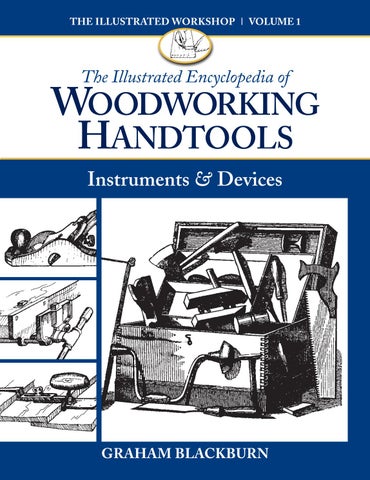
Graham Blackburn This book is a comprehensive pictorial index of those woodworking handtools common in Western civilization from the eighteenth century to the present. Not only a fascinating record of trades and skills – from cabinetmakers to wheelwrights – in an age before powertools became the norm, , also emerges as a remarkable tribute to man’s technological ingenuity. More than 600 tools are listed and described here, both alphabetically and fully cross-referenced for easy access, from the adze, awl, bevel, and bit to the wrest, yardstick, and zig-zag rule, complete with explicit definitions, many interesting etymologies, and much fascinating historical information. , contains more than 570 detailed line drawings, accompanied by an expert’s authoritative text. Whether used as a handy reference book to identify a tool and its use, or read simply for enjoyment, this book stands alone in capturing the sophisticated beauty and inventiveness of woodworking handtools.
T he o f
WOODWORKING HANDTOOLS & written & illustrated by
GRAHAM BLACKBURN containing a description of the tools used by: Carpenters, Joiners, & Cabinetmakers with many examples of tools used by other Woodworkers such as: Woodsmen, Sawyers, Coachmakers, Wheelwrights, Shipwrights, Wainwrights, Coopers, Turners, Patternmakers, & Whittlers
with more than line drawings & plates from antiquity.
S PRI NG HO U SE P RESS
:
of
CONTENTS Li s of Illu rative Matter: Plates ...........................................................................................x Tables..........................................................................................xi Figures .......................................................................................xii Preface (Introdu ion) to Fir Edition .........................................xviii Preface to Second Edition................................................................xx Preface to Third Edition .................................................................xxi The Illu rated Encyclopedia: A–Z ................................................1 Appendices: Associations .............................................................................178 Au ions ..................................................................................178 Colle ions...............................................................................179 Dealers.....................................................................................179 Sele Bibliography..................................................................180
ix
The
PLATES Frontispiece from The Description & Use of the Carpenter’s Rule, by John Brown, . . . . . . . . . . . . . . . . . . . . . .ix ‘Wie der jung weyßkunig die gepew mit dem zymerwerch gelernt hat.’ (How the young White King [Maximilian ] learnt about timber con ru ion.) a woodcut by Hans Schäuflein (?), from Der Weißkunig, ca. . . . . . . . . . . . . . . . . . . . . . . . . . . . . . .1 Joyners Tools from Mechanick Exercises, by Joseph Moxon, . . . . . . . . . . . . . . . . . . . . . . . . . . . . . . . . . . . . . . . .11 Several Tools used in Carpentry, that are not used in Joinery from Mechanick Exercises, by Joseph Moxon, . . . . . . . . . . . . . . . . . . . . . . . . . . . . . . . . . . . . . . . .23 Carpenters Framing a Building from Perspectiva, by Hieronimus Rodler, . . . . . . . . . . . . . . . . . . . . . . . . . . . . . . . . . . . . . . . . . . .45 Joiner’s Tools from L’Encyclopédie, ou Dictionnaire Raisonné des Sciences, des Arts et des Métiers (The Encyclopedia, or Analytical Di ionary of the Sciences, the Arts, and the Trades), by Denis Diderot, . . . . . . . . . . . . . . . . . . . . . . . . . . . . . . . . . . . . . . . . . . . . . . . . . . . . . . . . . . . . . . . .53 The Carpenter from Das Ständebuch (The Book of Trades), by Jo Amman, . . . . . . . . . . . . . . . . . . . . . . . . . . .55 The Cooper from Das Ständebuch (The Book of Trades), by Jo Amman, . . . . . . . . . . . . . . . . . . . . . . . . . . .61 The Joiner from Das Ständebuch (The Book of Trades), by Jo Amman, . . . . . . . . . . . . . . . . . . . . . . . . . . .67 The Lutemaker from Das Ständebuch (The Book of Trades), by Jo Amman, . . . . . . . . . . . . . . . . . . . . . . . . . . .79 The Turner from Das Ständebuch (The Book of Trades), by Jo Amman, . . . . . . . . . . . . . . . . . . . . . . . . . . .81 The Wagonwright from Das Ständebuch (The Book of Trades), by Jo Amman, . . . . . . . . . . . . . . . . . . . . . . . . . . .83 Squares, the English Saw, & other Cabinetmaker’s Tools from L’Art du Menuisier Ébéniste (The Art of the Cabinetmaker), by Jacques-André Roubo, . . . . . .89 Carpentry Tools from Mechanical Exercises, by Peter Nicholson, . . . . . . . . . . . . . . . . . . . . . . . . . . . . . . . . . . . . . .95 x
of
A Dutch Woodworker’s Shop an etching by Jan Joris van der Vliet, . . . . . . . . . . . . . . . . . . . . . . . . . . . . . . . . . . . . . . . . . . . . .101 Joinery Tools, Plate I from Mechanical Exercises, by Peter Nicholson, . . . . . . . . . . . . . . . . . . . . . . . . . . . . . . . . . . . . .105 The Turner an etching by Jan Joris van der Vliet, . . . . . . . . . . . . . . . . . . . . . . . . . . . . . . . . . . . . . . . . . . . . .107 Joinery Tools, Plate II from Mechanical Exercises, by Peter Nicholson, . . . . . . . . . . . . . . . . . . . . . . . . . . . . . . . . . . . . .131 Carpenters, Turner, Cabinetmaker from Orbis Sensualium Pictus by Johann Amos Comenius, . . . . . . . . . . . . . . . . . . . . . . . . . . . .133 The Cabinetmaker’s Shop from Orbis Pictus nach Zeichnungen der Susanna Maria Sandrart, by Elias Pozelius, . . . . . . . .139 Carpentry, Plate I from The Circle of the Mechanical Arts, by Thomas Martin, . . . . . . . . . . . . . . . . . . . . . . . . . . . .161 Using the Marquetry Saw from L’Art du Menuisier Ébéniste (The Art of the Cabinetmaker), by Jacques-André Roubo, . . . . .165 Sawing Veneer from L’Art du Menuisier Ébéniste (The Art of the Cabinetmaker), by Jacques-André Roubo, . . . . .167 The Wheelwright an th century English engraving. . . . . . . . . . . . . . . . . . . . . . . . . . . . . . . . . . . . . . . . . . . . . . . . . .171 Pitsawyers from The Book of Trades, English, . . . . . . . . . . . . . . . . . . . . . . . . . . . . . . . . . . . . . . . . . . . . . . .175
TABLES . . . .
. . . . . . . . . . . . . . . . . . . . . . . . . . . . . . . . . . . . . . . . . . . . . . . . 27 - . . . . . . . . . . . . . . . . . . . . . . . . . . . . . . . . . . . . . . . . . . . . . . 29 . . . . . . . . . . . . . . . . . . . . . . . . . . . . . . . . . . . . 36 . . . . . . . . . . . . . . . . . . . . . . . . . . . . . . . . . . . . . 109
xi
The
FIGURES The following figures accompany the alphabetized entries in the order given, but many are also cross-referenced from within the text.
. . . . . . . . . . . . . . . . . . . . . . . . . . . . . . . . . . .
’ ’ ’ ’ ’ ’ ’ -- - , , &
. . . . . . . . . . . . . . . . . . . . . . . . . . . . . . . . . . .
xii
& - - - & - -’ ‘’
The
PREFACE
()
T
his book arted out as an illu rated book of carpenter’s tools. It then grew to include a few tools which, while not ri ly carpentry tools, might be found in the average carpenter’s toolbox. By the time I had decided to include woodworking tools other than those that a carpenter might use — for example, tools used by cabinetmakers or joiners — it had become apparent that I would have to e ablish some limits, for the li was growing endlessly. Scope The fir qualification, therefore, for a tool’s inclusion was that it mu be a handtool. No matter how the other qualifications may have been occasionally disregarded, the requirement of a tool being a handtool was ri ly observed. There are included in this book no powertools of any description, whether powered by water, gasoline, or ele ricity. Even tools worked by foot, such as treadle-operated jigsaws or lathes, have been excluded. The second major qualification was that the tool be used by woodworkers. This includes all those varied trades in which wood is the main
material, such as those of not only the carpenter, but also, among many others, the joiner, the cabinetmaker, the coachbuilder, the cooper, the patternmaker, even the woodsman and the whittler. This qualification, however, has not been adhered to completely. When dealing with a class of tool — such as the hammer — which although much used in a variety of forms by woodworkers, is also used by other trades, I have included examples of the non-woodworking types for the sake of useful comparison. I mu also confess to having included a few tools with dubious woodworking conne ions simply because they appealed to me. Although I have attempted to give some hi orical background, particularly with regard to the larger and older tool groups — such as adzes, axes, chisels, and planes — this is not an hi orical treatise on woodworking tools, but rather an index, as comprehensive as possible, of those tools common to we ern civilization from the th century to the present day. Nevertheless, few tools from the pa are missing, mo having remained essentially the same for centuries. Furthermore, many which may have become obsolete and have
xviii
of
disappeared have frequently left recognizable descendants. The Roman carpenter might not recognize some of the newer tools in this book, but it is doubtful that he would miss many from his own toolbox. Format Although related tools, such as all the various chisels and the numerous planes, are grouped together in families, each tool is also li ed alphabetically. If any particular tool is sought under its own name it will be found — appropriately crossreferenced where necessary. Where there are many examples of one class of tool, a comprehensive li will be found at the beginning of the group, as well as cross-references to each member within the work as a whole. Any tool in italics, e.g., maul, may be looked up as a separate entry. In addition, many technical terms and various procedures have been explained and illu rated wherever it has been necessary to include them in the description of particular tools. Aim My aim has been to gather together in one place as many as possible of those tools conne ed with woodworking that are solely dependent on the rength and ingenuity of a single human being. Wood is no longer the only important material in our society. It now takes its place along with pla ics and metals, which require different tools
and approaches to be worked. It is only natural that man should seek to apply efficient techniques developed through the working of one material to the working of another. In very many cases the introdu ion of powertools has greatly benefited those trades and indu ries previously dependent on handtools. Though it is hard to imagine a spaceship being built solely with the tools of the carriagemaker, it would be equally hard to imagine a world bereft of the simpler beauty of a handcrafted piece of wooden furniture. It is for this reason that I think the crafts of the pre-mechanized age should be augmented, and not merely supplanted, by modern technology. It would be a pity to lose that body of knowledge represented by handtools in the name of economy or efficiency. For those who may be intere ed in pursuing further either the hi orical aspe or the technical application of the tools li ed in this book, a sele bibliography concerned primarily with woodworking handtools, as well as a li of some of the places where many of the older tools may be seen, are included at the end of the book. Grave, or even slight omissions brought to my attention will be gratefully received, for if through the improvement of this book the survival of beauty and the identity of the individual can be furthered, we shall all benefit. Graham Blackburn Woodstock, New York
xix
of
PREFACE to the Revised Edition
W
hen I fir became intere ed in tools and woodworking more than half a century ago there were ill many in ru ors and workmen for whom the use of handtools was commonplace. The general dearth of literature on the subje of handtools, however, was to continue for many years to come. The old classics by Moxon, Roubo, and Nicholson* had yet to be reprinted, and virtually the only information available to me when I began to write The Illustrated Encyclopedia of Woodworking Handtools was Henry C. Mercer’s classic work: Ancient Carpenters’ Tools (originally published in ), W. L. Goodman’s: The History of Woodworking Tools (), and a handful of old catalogs and one or two late th century school texts. The resulting book refle ed, therefore, an extremely personalised approach to a field I was, and remain, deeply entranced by. In the years since the appearance of the fir edition much more has been written, researched, and republished, and now more than ever The Illustrated Encyclopedia of Woodworking Handtools ands as one man’s view of an ever-growing subje . Perhaps because the subje has grown so va that no one book could hope to encompass all that is known about it — far less be held to be the * see Sele Bibliography
definitive arbiter of the subje ’s proper limits — there is value to be gained from a neccesarily narrower, subje ive approach. Taken with some of the other books I have written on the subje — mo especially Traditional Woodworking Handtools: A Manual for the User, which may be read as a companion volume to the present work — the contemporary handtool enthusia has, in effe , what the woodworker of fifty or more years ago might have had: perhaps not the entire pi ure but an emminently pra ical approach based on experience and a tradition that has despite (or perhaps because of ) new technologies proved increasingly hard to displace completely. That man is a tool-using animal is well under ood, and that the computer and other ele ronic devices are also tools is beyond dispute, but woodworking handtools con itute a more fundamental link with man’s need for a dire , hands-on approach to his world than do more modern tools that interpose screens, keyboards, goggles, and earplugs between the tool user and what he or she produces. This fa is something to be valued and nurtured. It remains my hope that The Illustrated Encyclopedia of Handtools will aid this process. Graham Blackburn Bearsville, New York
xxi
H
itherto I cannot learn that any hath undertaken this Task, though I could have wisht it had been performed by an abler hand then mine ; yet, since it is not, I have ve[n]tured upon it. Joseph Moxon,
From the preface to Joseph Moxon’s book: Mechanick Exercises: or the Doctrine of Handy-Works.
The
‘Wie der jung weyßkunig die gepew mit dem zymerwerch gelernt hat.’ (How the young White King [Maximilian ] learnt about timber con ru ion.) a woodcut by Hans Schäuflein (?), from Der Weißkunig, ca. .
of
A
Adju able Plumb, Level, and Inclinometer: see Level. Adju able Rabbet Plane: see Plane, Specialpurpose. Adze This is a shaping and smoothing tool chara erized by having its blade set at right angles to its haft (also called the ‘helve’ or ‘handle’). It has been in use for thousands of years; the ancient Egyptians thought so highly of this tool that the heiroglyph for an adze translates literally as: ‘the able one’. Since in use it is swung towards the user’s legs, it has also earned the nickname: ‘old shin splitter’. ~ Adze, Carpenter’s Older carpenter’s adzes have raight hafts. Note the square poll in the back for use as a maul. Poll
Haft ( ft. long) Inside bevel
. ’
~ Adze, Cooper’s (Howel) A cooper’s adze, or howel, is much smaller than a carpenter’s adze. It is held in one hand, and has a very curved blade called a ‘colt’s foot’. Largely Inside bevel Haft ( in. long)
Poll
1
. ’
,
The
replaced by the chiv plane, it was used to prepare the inside ends of the barrel aves to receive the heads of the cask or barrel. The depression it makes is known as the ‘howel’.
adze, its blade may be flat or side-lipped. Its haft is invariably made with a pronounced curve Spur
~ Adze, Gutter The gutter adze is a long-handled adze, also known as a ‘spout adze’. Early adzes were flatheaded (made without polls), and the hafts were generally raight, lacking the curve that later became chara eri ic of mo full-size adzes. Flat head
Straight haft
. ’
Angle Divider With this ingenious device any interior angle can be found and easily bise ed. It is especially useful when fitting oddly-angled moulding or trimwork. The cross-piece at the bottom enables it to be used as a square.
Side-lipped blade
.
The head ends of most adze hafts are square, so that the head, which is fitted from the handle end, cannot fall off in use.
The arms are adjustable so as to fit into any interior angle.
Round blade
Arm
~ Adze, Sculptor’s Sculptor’s adzes, like their close cousins, cooper’s adzes, are small adzes made for use with one hand.
The stock bisects the angle formed by the arms.
8"
Cross-piece
.
A ragal Plane: see Plane, Moulding.
. ’
~ Adze, Ship Carpenter’s Also known as a ‘shipwright’s adze’, the ship carpenter’s adze is much broader and flatter than other full-size adzes, and is further di inguished by the addition of a spur, used as a nail set or punch, on the back of the head. Like the gutter
Auger This curious word comes from the Teutonic word: ‘nafugar’, which means literally ‘nave borer’ — nave being the hole in the hub of a wheel through which the axle passes. Like many other words in English, such as ‘orange’ and ‘adder’, the initial ‘n’ has been lo . An auger is properly a complete tool in itself, with a transversely fitted handle, used for boring
2
of
,
in. long overall
.
holes in wood. However, the word ‘auger’ is sometimes erroneously used to mean an auger bit, which is something used in a bit brace. ~ Auger, Burn This tool, being heated red hot, is used to burn a hole rather than to cut a hole.
The lead screw pulls the auger into the work.
Lead screw
Cross-section of blade
.
.
~ Auger, Carpenter’s Nut Before ele ric drills became common, this was the tool used by every woodworker for making medium sized holes. It is called a nut auger because a nut (and a washer) is used to fa en the
Removable handle
wooden handle. A carpenter might have several sizes of nut auger bits, ranging from ½ in. to in., and the same handle could be used for all.
~ Auger, Raft (Ship Auger) The raft, or ship, auger was made not for use on ships but for boring holes in logs to be floated down rivers. The holes thus made were for the spikes and chains that kept the logs together in rafts. The augers were made long enough for a man to bore holes in the floating logs while anding on them, floating down river. ~ Auger, Tap The small, one-handed tap auger not only bores a hole, but because of its tapered sides, also makes 7"
in.-long auger bit
. ’
.
3
The
it bigger the farther it penetrates. Thus this auger is in effe a reamer as well. Its chief use was for tapping barrels.
~ Awl, Carpet Used for piercing holes in carpet, the very be carpet awls often have handles made of apple, maple, or even rosewood.
Auger Bit: see Bit. Auger-bit File: see File. Auger-bit Gauge: see Bit Gauge. Awl Although an awl is basically no more than a sharp point with a wooden handle, used essentially for making small holes, a surprisingly large variety has been developed for many di in purposes.
.
~ Awl, Magazine Brad(awl) A bradawl with a hollow handle containing a magazine (set) of variously-sized blades.
~ Awl, Belt A belt awl is sometimes made with holes in the blade as shown, which fits it not only for piercing holes in belting but for pulling lacing through as well.
.
~ Awl, Brad(awl) This is the mo common awl, typically carried by carpenters, and frequently spelled as one word: ‘bradawl’. Its chief purpose is to make pilot holes for screws, or for arting holes to be completed by larger tools.
.
~ Awl, Peg The peg awl is used in chair-caning. The blade, which ends in a square tip, may be from in. to in. long.
.
.
4
of
The scratch awl’s blade is typically longer and thinner than that of the common bradawl, and its tip is sharpened to a fine point rather than being ground square.
.
~ Awl, Scratch Used for general marking and measuring in woodwork, such as when laying out joints.
for woodworking (as, for example, the battle axe, and the headsman’s axe used for executions).
~ Awl, Stabbing A very small, all-purpose awl. th century broad axe
(Handle)
. th century German axe
~ Awl, Uphol erer’s The uphol erer’s awl, also known as a ‘caneseating awl’, is a heavy awl used in the caning and rushing of chairs and ools. The blade is often driven entirely through the handle and then riveted at the end.
.
American coloni s early developed their own particular axes, producing a variety of regional axes such as the Connecicut axe, the Michigan axe, the Yankee axe, the We ern axe, the Puget
Brass ferrule
. ’
Axe Along with the hammer, the axe is probably one of the olde tools used by mankind, the operations of hitting and cutting being two very primal a ions. As far as cutting goes, the knife and the axe are surely at lea fir cousins, both being undoubtedly descended from pieces of sharp one. Having been around for such a long time, it is scarcely surprising that so many different axes have been developed — by no means all of them 5
Poll
The triangular shape of the head is typical of early western-American axes.
.
,
The
Poll
Heel
Shoulder
Eye, with wedges
Foot Neck
Toe
Cheek
.
Sound axe, and, mo famous of all regional axes, the Hudson’s Bay axe. A significant American contribution to axe design was the addition of a heavy poll, giving more weight and thus more momentum to chopping. Earlier European axes were typically flat-backed. ~ Axe, Broad The broad axe, together with the wood axe, was the carpenter’s axe of choice in the days of heavy wood-framing. Together with the adze, it was one of the tools used for hewing large beams. It is di inguished from other axes by having a proportionately larger head and smaller haft. Furthermore, only one side of the cutting edge is beveled since the blade is commonly used flat again the work. This is also the reason why the haft, often hand-made, is formed so that it emerges from the eye of the head at an angle, thereby allowing the hand to clear the wood being trimmed.
~ Axe, Dock The dock axe is a very good example of the specialization of axes: it has a large poll to make chopping easier, and the top of the head is flat.
The 6 lb. head has a 4 in. bit.
.
~ Axe, Fire The fire axe, or fireman’s axe, is intended mo ly for use in hotels, public buildings, fa ories, and warehouses. Part of the head and sometimes the
Short haft Head Work
Bit
When the head is held flat against the work, the offset handle clears the work.
Single Double bevel bevel
.
.
6
of
,
haft are painted red, and the axe is usually to be found hanging from, or sitting in, special brackets on the wall. Stout spike
A mortise axe is an old tool once commonly used for excavating the large mortises needed for the mortise-and-tenon joints used in heavy timberframe con ru ion. It was often used together with the bruzz and mortise chisel. ~ Axe, Ship Carpenter’s Shipbuilders have their own kinds of axes to accommodate the large amount of hand shaping and hewing necessary in a wooden vessel. This axe may be beveled on one side or both sides of its cutting edge.
Red-painted head
Wall-mounted supporting bracket
Bit (single-beveled or double-beveled)
.
~ Axe, Ice The ice axe is a narrow-headed axe made with a solid- eel pick in place of a poll. Pick
.
~ Axe, Mortise
. ’
~ Axe, Wood Wood axes are made in different weights ranging from lb. to lb., in one-pound increments. The mo popular sizes are the lb. hand axe used for light trimming, and the lb. felling axe used for felling trees ( lb. felling axes are preferred in Sweden). Haft shapes and sizes vary considerably; many craftsmen and woodsmen prefer to fit their own. Hafts are commonly made of ash or hickory, which while rong are also flexible and absorb
Short haft
Mortise Tenon
The head is made flat, so that it may be pounded on with a mallet, and the blade made long to be used like a chisel.
.
. --
7
,
The
Flat back
Doubled-beveled bit
.
shock comfortably. A woodsman’s axe is very frequently provided with two cutting edges. Such double-bitted axes offer the great advantage of saving considerable down-time due to the necessity of sharpening: when one edge becomes blunt the tool is turned around and the other edge used, both edges then being serviced together at a more convenient time
8
of
Present-day names and spellings for the various tools are given in parentheses after Moxon’s — although these are far from consistent in his text. Several, moreover, are incorrectly lettered in the original plate. A
B1 B2 B3 B4 B5 B6 B7 C1 C2 C3 C4 C5 C6 D
aaaa, dddd b bb c d e g
a bb
a b
Work-bench (Workbench) Pin Holes (for board-support pins) Hook (Bench Stop) (Holdfa mortises) Bench-Screw (Face Vise) Hold-fa (Holdfa ) Mallet Double Screw (Double-screw Vise) Fore Plane Joynter ( Jointer Plane) Strike-Block ( Jack Plane) Smoothing-Plane (Smooth Plane) Rabbet-Plane (Rabbet Plane) Plow (Plough Plane) (Toothing Plane) (Iron) (Sole) Former (Straight Firmer Chisel) Paring-Chissel (Paring Chisel) Former (Fishtail Firmer Chisel) Skew-Former (Skew Firmer Chisel) Mortess-Chissel (Mortise Chisel) Gouge Square (Trysquare) Handle (Stock) Tongue
Outer Square Inner Square E Compass-Saw (Compass Saw) F Bevil (Bevel) G Gage (Marking Gauge) a Tooth (Pin) b Oval (Stock or Head) c Staff (Stem) H Piercer (Brace and Bit) a Head (Head or Nave) b Pad c Stock d Bitt (Bit) I Gimblet (Gimlet) K Augre (Auger) aa Handle (b) Bitt (Auger Bit) L Hatchet M Pit-Saw (Pitsaw) N Whip-Saw (Two-man Crosscut Saw) O Frame or Bow-Saw (Turning Saw) P Whetting-Block (Saw-sharpening Block) Q Saw Wre aaaa Notches R Miter Square (unlettered) Hand-Saw (Handsaw) c d
9
The
Joyners ( Joiner’s) Tools from Mechanick Exercises, by Joseph Moxon, .
of
B
Back-bent Gouge: see Chisel, Woodcarving. Backeroni: see Chisel, Woodcarving, Box Tool. Backsaw: see Saw. Ball-pein Hammer: see Hammer, Machinist’s. Bar Clamp: see Clamp. Beading Plane: see Plane, Moulding. Beading Tool A beading tool is employed for making moulded profiles in those situations where moulding planes cannot be used, such as when working diagonally, across the work, or on irregularly shaped surfaces. For an unrelated tool with the same name, see under woodturning chisel. ~ Beading Tool, Single-handed Beader This tool is designed to cut beads, reeds, or flutes with one hand. While not as easy to control as the universal hand beader, it is invaluable in close quarters where there is little room for the larger tool. Reeding cutter
. - Bead
Reeds
Flutes
. , , &
11
of
C
Cabinetmaker’s Block Plane: see Plane, Block. Cabinetmaker’s Scraper: see Scraper. Cabinet Rasp: see Rasp. Cabinet Scraper: see Scraper. Calipers (Br. Callipers) A pair of calipers is an in rument with bowed legs for measuring the diameter of convex bodies, originally bullets or cannonballs, which were then said to be of such-and-such ‘caliber’. Hence, derivatively, phrases like: ‘a heavy-caliber gun’. It is intere ing to note that from the beginning the two words have been spelled differently (in British English they are spelled ‘calliper’ and ‘calibre’). As with many other tools and in ruments, specialization has occurred, and a pair of calipers may also be an in rument with raight legs and points turned outwards for measuring the bore of tubes and other hollow obje s. To avoid any confusion, these are known as inside calipers, the original variety now being called outside calipers. ~ Calipers, Double This in rument may be used not only as inside calipers and outside calipers, but also as dividers.
Leg Arm The arms and legs may both be pivoted °.
.
23
of
D
Dado Plane: see Plane, Special-purpose. Deck Chisel: see Chisel, Wood, Special-purpose. Diamond-nose Chisel: see Chisel, Cold. Dividers Dividers developed from the compass, and so are called properly, though rarely, ‘dividing compasses’. They are, in fa , a pair of compasses (more usually and simply referred to as a ‘compass’) with eel points at the end of each leg. Used largely for dividing lines, transferring dimensions, and general measuring, they are often made with the same methods of adju ment as calipers.
Early th century French dividers
. Wing Securing screw Spring
Adjustment nut
.
45
of
E
Emery Wheel An emery wheel is a wheel-shaped mass of hard, granular material called emery, used for grinding and sharpening metal tools. It is mo typically mounted in a frame so that it may be rotated, either by hand or ele ricity. Thickness: ¹⁄₄ in. to in. Diameter: in. to in.
.
Emery Wheel Dresser This tool is used for shaping the emery wheel when, in the course of use, it becomes grooved or otherwise worn out-of-round. Its cutters are capable of resi ing great wear since they are specially hardened during their manufa ure. The cutters are held against a rotating emery wheel.
Cutters
.
Engineer’s Hammer: see Hammer. Expansive Bit: see Bit. Extension Bit Holder: see Bit Holder. 53
of
F
Farrier’s Hammer: see Hammer. Felt Knife: see Knife. Fiber-head Mallet: see Mallet. File A file is a hard eel in rument, its surfaces covered with parallel rows of sharp teeth or furrows, generally at an angle of ° to the center line. Files are used for shaping and smoothing wood, metal, and other materials. The following discussion focuses mainly on those files used by the woodworker. Tang
Length
Heel
Edge
Side (or face)
Point (or tip)
.
Files are classified by the type and coarseness of their cut, their cross-se ion and longitudinal shape, and their length. Their width usually increases proportionately as they become longer. The Cut: Files may be single-cut, double-cut, or curved-cut, as illu rated below. Single-cut files are used for producing fine, smooth finishes. Double-cut files are used for fa er removal of material, and consequently produce a rougher cut
Single cut
Double cut
Curved cut
.
55
of
G
Gauge The origin of the word ‘gauge’, sometimes spelled ‘gage’, is unclear. It has many meanings but as far as woodworking is concerned it refers to various in ruments used for measuring, marking, or te ing. ~ Gauge, Butt A butt gauge is a gauge used to mark the position of butts (hinges) to be in alled when hanging doors and windows. Cutter bar B
Cutter bar A
Cutter A
Cutter B
Cutter C Cutter bar A has two cutters mounted on it, cutter A and cutter C. When cutter A is set for gauging on the edge of the door, cutter C, being on the same bar, is automatically set for gauging from the back of the jamb. Cutter bar B has a steel cutter, cutter B, to gauge accurately the thickness of the butt. The butt gauge is thus a rabbet gauge, a marking gauge, and a mortise gauge all in one, and is therefore capable of being used for all door trim, including lock plates, strike plates, and other hardware.
. Ball tip
Button tip
Olive knuckle
A butt is a hinge composed of two leaves, or plates, the edges of which meet without overlapping.
.
61
of
H
Hacking Knife: see Knife. Hacksaw: see Saw. Half-roundnose Chisel: see Chisel, Cold. Hammer A hammer is one of the mo basic and olde tools of mankind. It was originally probably ju a heavy one, as sugge ed by its etymology, which relates the common Teutonic root: ‘hamor’ to the Slavic word: ‘kamy’, meaning ‘ one’. A hammer consi s essentially of a heavy head, usually made of metal, set crosswise on a handle, and is used in woodworking primarily for driving nails, as well as for other beating and breaking operations. ~ Hammer, Adze-eye Bell-face The adze-eye bell-face hammer is an example of the extreme specialization that often develops with a much-used tool. It is basically a nail hammer, used by carpenters for driving nails. Its long name refers to its special chara eri ics: ‘adze-eye’ means the haft (handle) is fitted into a sleeve at the base of the head, in the same manner as an adze; ‘bell-face’ refers to the fa that the head is slightly rounded so that a nail may be driven below the surface without the wood being dented. Claw Eye
Haft Shoulder
Neck
Cheek
Face
. - - Bell
Plain flat
Check flat
.
67
of
I
Improved Bevel: see Bevel. Improved Miter Square: see Square. Inclinometer An inclinometer is an in rument consi ing of a bubble level mounted in a movable protractor fixed to a blade. The blade is held again or on the work which is then moved until the bubble is centered in the level, the protractor having been set to the required angle, thus allowing the angle of the work to the horizon to be read off the inscribed scale and transferred if desired. Protractor
Bubble
Blade
.
Inshave The inshave is a single-handled form of scorp. Both these tools are related to drawknives and exi in a variety of forms used by chairmakers coopers, shoemakers, and other specialized trades.
.
Inside Calipers: see Calipers. Inside- art Saw: see Saw. Iron Wedge: see Wedge. 79
of
J
Jack Knife: see Knife. Jack Plane: see Plane, Bench. Jeweler’s Hammer: see Hammer. Jeweler’s Mallet: see Mallet. Jeweler’s Saw: see Saw. Jeweler’s Screwdriver: see Screwdriver. Jigger: see Drawknife. Joiner Saw: see Saw. Joiner’s Hammer: see Hammer. Jointer Plane: see Plane, Bench. Joint Knife: see Knife.
81
of
K
Keyhole Saw: see Saw. Knife While the knife, next to the hammer, is probably the mo basic of all tools, and the one tool that almo everybody owns at one time or another, there are relatively few knives conne ed solely with woodworking compared to the number of non-woodworking knives, which range from table knives to hunting knives. ~ Knife, Drawing The old-time drawing knife (not to be confused with the drawknife) has been superseded by the sloyd (or bench) knife, which performs the same fun ions and which is made expressly for the purpose, the drawing knife being generally made from an old knife or discarded chisel. One of the drawing knife’s particular jobs was to cut a V-shape groove along a line to be sawed, so that the sawblade would remain in the groove and not wander.
.
~ Knife, Felt The felt knife is used by pianotuners, cabinetmakers, and various other furnituremakers. Consequently, it exi s in various patterns, although all are used to cut felt. 6"
.
83
of
L
La maker’s Rasp: see Rasp. Lath Hammer: see Hatchet. Lath Hatchet: see Hatchet. Level A level is an in rument for determining whether something is perfe ly horizontal. There are two types of level: the older A-level, known by the Egyptians and used for centuries, and which is ill in use today in many parts of the world, and the spirit level, which, although the only level mo people now know, took almo two hundred years to gain acceptance after its invention in France in . The A-level consi s of a triangular frame, shaped like the letter ‘A’, from the apex of which is suspended a plumb bob. When the level is positioned so that the plumb bob is centered over the bottom member of the frame, the surface on which the level is re ing mu be horizontal.
Plumb bob
. -
Plumb bob 3'
.
89
of
M
Macaroni: see Chisel, Woodcarving, Box Tool. Magazine Bradawl: see Awl. Mallet A mallet may be described as a kind of wooden hammer. The word ‘mallet’ a ually means a small maul (which word derives from the Latin for hammer: ‘malleus’). In general, the woodworker uses a mallet only for riking wood and woodenhandled tools, and a hammer only for riking metallic things, such as nails or cold chisels. ~ Mallet, Carver’s The mo di in ive feature of the carver’s mallet is its cylindrical head, which enables it to rike a chisel from any angle. Carver’s mallets are usually made from the very harde woods, such as lignum vitæ, boxwood, or dogwood.
3"
. ’
~ Mallet, Fiber-head The heads of these mallets are made of vulcanized fiber, which is very hard and dense, extremely Iron band
. -
95
of
N
Nail Claw A nail claw, which is very often called a ‘cat’s paw’, is used for removing nails. Using a hammer, its claw is beaten under the head of a nail already driven into wood. By levering the tool backwards, again with the help of hammer blows to the other end of the handle, the nail may be pried out. Claw
Hammer hits here
.
Nail Puller Like the nail claw, the nail puller is also used for removing nails. The jaws are positioned on either side of the nail’s head, the shank is drawn out to its fulle extension, and then rammed back onto the foot, causing the jaws to dig into the wood. When the puller is levered backwards, the hinged jaw digs farther into the wood and the nail is pried out.
Handle
Shank Foot Jaws
.
101
of
O
Offset Screwdriver: see Screwdriver. Ogee Plane: see Plane, Moulding. Oil one: see Sharpening Stones. Old Woman’s Tooth: see Plane, Special-purpose. Outside Calipers: see Calipers. Oval Mallet: see Mallet. Oval Scraper: see Scraper. Ovolo Plane: see Plane, Moulding.
105
of
P
Panel Gauge: see Gauge. Panel Saw: see Saw. Paper-hanger’s Knife: see Knife. Paring Chisel: see Chisel, Wood, Bench. Paring Gouge: see Chisel, Wood, Gouges. Parting Tool: see Chisel, Wood, Turning. Patternmaker’s Chisel: see Chisel, Wood, Bench. Patternmaker’s Gouge: see Chisel, Wood, Gouges. Patternmaker’s Router Plane: see Plane, Special-purpose. Patternmaker’s Shrinkage Rule: see Rule. Peeling Chisel: see Chisel, Wood, Special-purpose. Pianomaker’s Edge Plane: see Plane, Specialpurpose. Pianomaker’s Plane: see Plane, Special-purpose. Pincers A pair of pincers is a holding tool similar to a pair of pliers, but, as the name implies, is made with sharp jaws that ‘pinch’ and may be used to cut wire or nails. Pincers are mo usually used by the woodworker to pull out small nails and tacks.
Tack claw
Jaws
107
.
of
Q
Quirk Moulding Plane: see Plane, Moulding.
131
of
R
Rabbet Plane: see Plane, Special-purpose. Rasp A rasp may be defined as a very coarse file with raised points in ead of lines for cutting. Ju like the file, the rasp is made in different degrees of coarseness and in various shapes. Rasps are used for rapid removal of wood, especially in nonre ilinear work such as the shaping of curved legs or chair arms. Raised points or teeth
. Continuous lines of cutting edges
.
Flat wood rasp
Half-round wood rasp
Half-round cabinet rasp
.
133
of
S
Sandpaper Holder A sandpaper holder may be any one of numerous devices for holding sandpaper or other abrasives securely during use. Simple holders may be mere blocks of wood; more elaborate devices are often made of other materials fitted with a variety of clips and paper-securing mechanisms. Shop-made slotted wood block
Sandpaper may be wrapped around the curved part or the flat part.
.
Sash Clamp: see Clamp. Sash Filli er: see Plane, Special-purpose, Rabbet. Sash Moulding Plane: see Plane, Moulding. Saw The word ‘saw’ is very old, deriving from the pre-Teutonic root: ‘sek’, meaning ‘to cut’. Early saws were made of one or bone, but now the word implies a blade, bar, or rod made of metal, usually with teeth formed along one edge, although there are some saws made of abrasive material that cuts without teeth. Saw Teeth: An important di in ion between saws is the number of teeth they possess. How many, and exa ly how they are formed, determine what kind of sawing the saw is be suited for. The size of the teeth may be inferred from the ‘pont size’ of the saw. Usually expressed in terms of ‘points per inch’, point size is a measure of the number of teeth per inch that a saw is provided with. ‘Point’ refers to the tip of a tooth. 139
of
T
Table Planes: see Plane, Moulding. Tack Claw
Rosewood handle
Brass ferrule
Claw
.
A tack claw is similar to, but much smaller than, a nail claw, being intended only for tacks and small nails. The claw is driven under the head of the tack which is then levered out. Tape Measure Metal hook
ft. cloth tape
Leather case Folding handle
.
161
of
U
Undertaker’s Screwdriver: see Screwdriver. Universal Bevel: see Bevel. Universal Bevel Protra or: see Bevel. Universal Hand Beader: see Beading Tool. Universal Plane: see Plane, Special-purpose. Universal Spokeshave: see Spokeshave. Uphol erer’s Awl: see Awl. Uphol erer’s Hammer: see Hammer. Utility Knife: see Knife.
165
of
V
Veiner: see Chisel, Woodcarving, Straight Gouges. Veneer Punch A veneer punch is a large metal punch used to cut out small pieces of veneer to be used for repairing damaged se ions of veneered work. The shape of the punch is irregular in order that the grain of the piece cut out may blend better when inserted.
Head
Cutting edge
.
Patch The veneer punch cuts matching shapes around the veneer damage and the replacement patch.
.
Vise (Br. Vice) A vise is a device consi ing of two jaws which may be opened and closed by a lever, a cam, or more usually a screw. Vises used by woodworkers generally have wooden or wood-lined jaws in order to avoid marring the work. The word ‘vise’ 167
of
W
Wagonmaker’s Drawknife: see Drawknife. Wall Scraper: see Scraper. Water one: see Sharpening Stones. Web Clamp: see Clamp. Web Saw: see Saw. Wedge Wedges are used for splitting logs into smaller pieces. They are usually made of iron with eel tips, and may be sold by the pound according to weight. In Colonial America, oak wedges ringed with iron and called ‘gluts’ were the common form.
Steel tip
.
Iron rings
.
Wheelwright’s Reamer: see Reamer. 171
of
Y Z
Yankee Screwdriver: see Screwdriver. Yard ick: see Rule.
Zig-zag Rule: see Rule.
175
More Great Books from
Spring House Press
The Uke Book Illustrated ISBN: 978-1-940611-14-3 $24.95 | 256 Pages
The Tinkering Woodworker ISBN: 978-1-940611-08-2 $24.95 | 160 Pages
Getting Started in Woodturning ISBN: 978-1-940611-09-9 $27.95 | 224 Pages
The Handmade Skateboard ISBN: 978-1-940611-06-8 $24.95 | 160 Pages
The New Bandsaw Box Book ISBN: 978-1-940611-32-7 $19.95 | 128 Pages
Classic Wooden Toys ISBN: 978-1-940611-34-1 $24.95 | 200 Pages
The Illustrated Workshop Series
Furniture Design & Construction ISBN: 978-1-940611-05-1 $24.95 | 256 Pages
Traditional Woodworking Handtools ISBN: 978-1-940611-03-7 $27.95 | 356 Pages
Look for these Spring House Press titles at your favorite bookstore or woodworking retailer. For more information or to order direct, visit www.springhousepress.com or call 717-208-3739.
G
raham Blackburn was born and educated in London, England, before moving to New York City to continue his studies at the Juilliard School. While subsequently pursuing a career as a professional musician, he built his own house in Wood ock, NY. His fir book, , was published in 1974. Since then he has written and illu rated sixteen books on building, woodworking, and sailing. He has also published two works of fi ion. A long-time columnist for Popular Woodworking and a contributing editor to Fine Woodworking, he also served as the editor-in-chief of Woodwork magazine before founding and launching the DVD Video Magazine, Woodworking in Action. Also by in series:
NASHVILLE, TENNESSEE
WWW.SPRINGHOUSEPRESS.COM
CRAFTS & HOBBIES/WOODWORKING $24.95 US
An Inventory of Tools for Today’s Hands-On Maker M
an is a tool-using animal. And, while computers and electronics are technically “tools”, woodworking tools constitute a more fundamental link with man’s need for a direct, hands-on approach to the world. With The Illustrated Encyclopedia of Woodworking Handtools, Instruments & Devices, the contemporary woodworker, maker, and handtool enthusiast can enjoy a practical perspective that captures the ingenuity of handtools employed by woodworkers decades ago, that despite new technologies, have proved hard to displace.
Inside you’ll discover: • 570 original, hand-drawn illustrations • Over 600 handtools, from an adze to a zig-zag rule • Alphabetical listings fully cross-referenced • An amazing variety of handplanes, chisels, gouges, clamps, and cutting devices • Detailed, clearly stated definitions of each tool • Fascinating historical information • A helpful Bibliography and Appendices
“…a work of love and a work of art.”
—The Wall Street Journal
“ …highly inclusive and a delight to browse.”
—Library Journal
ISBN 978-1-940611-02-0
www.springhousepress.com