The Tracks
Lodging, Market Demand & Feasibility Study: Proposed Resort & Attractions
N E W M AR K V AL UAT I O N & A DV I S O R Y
Lodging Market Demand & Feasibility Study: Proposed Resort & Attractions 2,700 acres of land in Bluefield and Princeton, West Virginia Newmark Job ID: 21-0149001
Feasibility Study Prepared For: Mr. Jim Christie, PLA Principal Civil & Environmental Consultants, Inc. 120 Marketplace Genesis BlvdAve., Suite 200 600
Bridgeport, WV 26330
Prepared By: Newmark Valuation & Advisory Hospitality, Gaming & Leisure Group Valuation & Advisory 1300 East 9th Street, Suite 105 Cleveland, OH 44114
N E W M AR K V AL UAT I O N & A DV I S O R Y
1300 EAST 9TH STREET, SUITE 105 CLEVELAND, OH 44114 May 9, 2022 Mr. Jim Christie, PLA Principal Civil & Environmental Consultants, Inc. 600 120 Marketplace Genesis BlvdAve., Suite 200 Bridgeport, WV 26330 RE:
Lodging Market Demand & Feasibility Study: Proposed Subject Resort on 2,700 acres of land in Bluefield and Princeton, West Virginia, prepared by Newmark Valuation & Advisory, LLC (herein “Firm” or “Newmark”) Newmark Job No.: 21-0149001
Dear Mr. Christie: Newmark Valuation & Advisory, LLC has prepared a market demand analysis of the referenced property presented in the following Feasibility Study. Summary of the Proposed Subject Property The proposed subject resort will be developed on approximately 2,700 acres of land in Bluefield and Princeton, West Virginia. The site has rolling topography, densely wooded areas, two large reservoirs, and offers sweeping views of the surrounding area (from portions of the site). The site is approximately 1.5 miles from the nearest entrance to Interstate 77. Developed over approximately five years and three phases, the approximately 516-unit resort is recommended to include 300 guestrooms in two separate main hotel (lodge) buildings, 216 detached cabins, eco villas, and yurts; and 304 RV sites and 10 primitive (tent) sites. The fullservice resort is recommended to be operated independent of a nationally recognized franchise such as Marriott, Hilton, or Hyatt, or potentially affiliate with a soft brand. In addition to lodging, the resort complex will offer several attractions and amenities, such as:
7-Station Zipline Course
Dan Hale Lake including a boardwalk, Wibit waterpark, beach area, boat ramp, kayak rentals, and firepit
Kayak & Paddleboat Rental
ATV Rental & Maintenance Facility
Snowflex Tubing Hill with Magic Carpet Lift
18-Hole Miniature Golf Course
Splash Pad & Interactive Play Structure
Amphitheater with Stage and Seating area
Hiking/Biking Trails
2
N E W M AR K V AL UAT I O N & A DV I S O R Y
Dam Bridge
New ATV Trails (part of the Hatfield-McCoy Trails System (HMC) system)
Conference Center (Attached to a Hotel)
8-Court Indoor Basketball Facility
2 Grass Multisport Fields
1 Turf Multisport Field
Gondola transportation to and from downtown Bluefield to the subject
Key Considerations Strengths ‒
Potential to affiliate one or both hotels with a national franchise or soft brand
‒
The subject site enjoys good access due to positioning of its main welcome center 1.5 miles from an entrance to Interstate 77. In Phase 3, the subject resort will also be accessible from downtown Bluefield via gondola. Visibility is average for a resort, and much of the property will offer views of the surrounding area.
‒
Demand for destination weddings in southern West Virginia is strong, and the resort's lake views, and onsite event space present an opportunity to capture demand in this market segment. The property will leverage its traditional hotel guestrooms and residential-style villa, cabin, and yurt offerings in a resort setting to attract wedding parties and their families.
‒
Corporate retreat travel and family reunion groups align well with the proposed resort’s detached villa, cabin, and yurt units and inclusion of numerous onsite amenities and activities.
‒
Development of the subject could entice others to develop complementary restaurants, bars, and entertainment facilities nearby.
Risk Factors ‒ There is generally an increase in the investor requirements for this asset type, and the lending environment will remain apprehensive in the foreseeable future. ‒
New resorts and/or hotels could be developed in the subject area. This could adversely impact occupancy levels and reduce profit margins.
Extraordinary Assumptions An extraordinary assumption is defined in USPAP as an assignment-specific assumption as of the effective date regarding uncertain information used in an analysis which, if found to be false, could alter the consultant’s opinions or conclusions. The value conclusions are subject to the following extraordinary assumptions that may affect the assignment results. ‒
We assume cross promotion of the subject’s athletic fields and courts by the regional Sports Commission as well as at the civic and county level.
3
N E W M AR K V AL UAT I O N & A DV I S O R Y
‒
We assume targeted marketing towards casual users interested in guided trail rides (renters) as well as core enthusiasts who own their own equipment
‒
We assume inclusion of a differentiating “hook” such as a cohesive green initiative and special accommodation/promotion of all-electric ATVs, UTVs, Jeeps, Rivian trucks, and other all-electric trail-rated vehicles.
‒
We assume this subject resort will add approximately 50 to 90 miles of new ATV trails that will be connected to and marketed by the existing The Hatfield-McCoy Trails System, which is specifically designed to accommodate all levels of riders from novices to professionals, and covers hundreds of miles throughout Southern West Virginia
Hypothetical Conditions A hypothetical condition is defined in USPAP as a condition, directly related to a specific assignment, which is contrary to what is known by the appraiser to exist on the effective date of the assignment results, but is used for the purpose of analysis. ‒
This feasibility study does not employ any hypothetical conditions.
Compliance Remarks The intended use and user of our report are specifically identified in our report as agreed upon in our contract for services and/or reliance language found in the report. No other use or user of the report is permitted by any other party for any other purpose. Dissemination of this report by any party to non-client, non-intended users does not extend reliance to any other party, and Newmark will not be responsible for unauthorized use of the report, its conclusions or its contents used partially or in their entirety.
4
N E W M AR K V AL UAT I O N & A DV I S O R Y
Certification We certify that, to the best of our knowledge and belief: 1.
The statements of fact contained in this report are true and correct.
2.
The reported analyses, opinions, and conclusions are limited only by the reported assumptions and limiting conditions and are our personal, impartial, and unbiased professional analyses, opinions, and conclusions.
3.
We have no present or prospective interest in the property that is the subject of this report and no personal interest in with respect to the parties involved.
4.
We have no bias with respect to the property that is the subject of this report or to the parties involved with this assignment.
5.
Our engagement in this assignment was not contingent upon developing or reporting predetermined results.
6.
This consulting assignment was not based upon a requested minimum valuation, a specific valuation, or the approval of a loan.
7.
Laurel A. Keller, MAI, ISHC made a personal inspection of the property that is the subject of this report.
8.
Valuation & Advisory operates as an independent economic entity within Newmark. Although employees of other Newmark divisions may be contacted as a part of our routine market research investigations, absolute client confidentiality and privacy were maintained at all times in regard to this assignment without conflict of interest.
9.
Within this report, "Newmark", “Newmark Valuation & Advisory”, “Newmark, Inc.”, and similar forms of reference refer only to the appraiser(s) who have signed this certification and any persons noted above as having provided significant real property appraisal assistance to the persons signing this report.
Laurel A. Keller, MAI, ISHC Senior Vice President Telephone: +1 216 453 3023 Email: laurel.keller@nmrk.com
5
N E W M AR K V AL UAT I O N & A DV I S O R Y
Table of Contents Executive Summary
7
Pertinent Dates Scope of Work
10 11
Economic Analysis
12
Regional Area Analysis Local Area Analysis
12 21
Site Analysis
30
General Description
30
Proposed Components Description
32
Overview DEVELOPMENT COMPONENTS
32 34
Real Estate Taxes
48
Tax Projection
48
National Lodging Market Analysis
49
National Lodging Highlights Closures Revenue Air Travel Pricing and Cap Rates Consumer Confidence Transactions Markets
49 52 54 56 57 58 59
Local Lodging Market Analysis
62
Bluefield, WV Hotel Market Overview Major Hotel Demand Generators Scale and service Distribution Trends, RISKS, and Investment Rates Performance Cycle published rate activity Net Hotel Closures Local Airport Statistics
62 65 65 65 66 67 68 69
Local Supply and Demand
71
Analysis of Demand Segments Subject hotel Occupancy Projection Average Daily Rate Projection
75 80 83
Key External Drivers Operating Conditions Sports Complexes Industry Outlook
111 112 113 114
Multisport Complex Court and Field Rentals 119 Financial Analysis
120
Projection of Revenue and Expenses
136
Assumptions & Limiting Conditions
139
Glossary
141
Addenda
149
National RV Park and Campground Overview 86 RV Campground Revenue Analysis
98
Local Outdoor Attractions Market Analysis 101 National Multisport Industry Analysis 108 Overview of Sports Complex Facilities Economic Impact Cycle COVID-19 Impact
108 108 110
6
N E W M AR K V AL UAT I O N & A DV I S O R Y
Executive Summary PROPOSED DEVELOPMENT We forecast a surplus of room night (cabin night) demand in the six-county Hatfield McCoy Mountain Region beginning in 2025/2026. Recent and proposed lodging supply additions have kept pace with the ATV overnight rider demand for the past few years. The large amount of grant money pouring into the region has fueled developers’ ability to add supply, mainly via relatively small cabin resort developments and additions to existing resorts. Lodging market occupancy stands at about 52% and has declined slightly over the past six years according to data from AirBNB, VRBO, and Smith Travel Research (STR). Our research and data are wellsupported and indexed to the number of ATV permits sold over the past two decades, which indicate a compound annual rate growth of 8.7%. Though the Hatfield McCoy ATV trails alone do not and will not provide the overnight lodging demand necessary to attract developers to a large-scale project in Bluefield, the recommended multi-phase development of numerous day-use and overnight attractions unique to the market area (listed above) will manufacture the need for several hundred new guestrooms and other lodging unit types for visitors. Factors to Success Capture existing demand for new, upscale RV slips and amenities (developers already interested) Provide easy access to the resort from major roadways, interstates, and the surrounding area Offer a superior, diverse, and unique lodging product relative to existing supply in the Hatfield McCoy Mountain Region (i.e., higher scale hotel accommodations and glamping options) Develop modern event space offering sweeping views of the surrounding area Tap into and grow existing sports tourism-related demand with indoor sport courts and other offerings that complement multisport complexes in the region Develop attractions and amenities designed to increase the average length of stay from 3.2 nights Pioneer the first ATV and UTV group tours in the market area for first timers and casual enthusiasts, who will need to rent their machines and equipment. Group tours would appeal to corporate team building activities, class reunions, family groups, couples, and individuals. Ideally, around 30% to 40% of the overnight demand at the resort’s lodging options would stem from group business (tours and catered events, etc.). Incorporate and activate the area’s existing water reservoirs, since there is a lack of water attractions in the market area
7
N E W M AR K V AL UAT I O N & A DV I S O R Y
Develop and offer a greatly enhanced guest arrival and departure layout as well as secure storage areas for trailers and toys when not in use Position a portion of the cabins in such a way as to afford seclusion and privacy to their occupants. In our experience, many guests are willing to pay a premium for that privilege. Increase the area’s appeal to under-represented market segments including non-ATV riders and females. Approximately 79% of the ATV-related visitors are male. We recommend all lodging and entertainment developments focus on shifting the demand closer to 50% male and 50% female, thereby including families, corporate groups, social groups Target marketing towards casual users interested in guided trail rides (renters) as well as core enthusiasts who own their own equipment Include a differentiating “hook” by incorporating special accommodation/promotion of all-electric ATVs, UTVs, and other all-electric trail-rated vehicles Set a price point for the subject development less than that offered at the Greenbrier & Stonewall to differentiate this market and broaden in its appeal to more potential users. Potentially affiliate one or both hotels with a soft brand such as Tribute (Marriott) Curio Collection (Hilton), Trademark (Wyndham), Voco (IHG), or Unbound (Hyatt). This would give the hotel an independent look and feel while also offering access to a major brand’s network of loyal guests, guest rewards program, and extensive marketing throughout the U.S. and abroad. Soft brands have grown 19% in the last decade as consumers seek unique lodging experiences but are attracted to the comfort and stability of a trusted brand.
8
N E W M AR K V AL UAT I O N & A DV I S O R Y
PROPOSED LODGING MIX AND AMENITIES Type and Number of Rentals
Lodging Components Village/Area
Com ponent
Dan Hale Lake
Lakefront Hotel
Phase
# of Units
2
120
Dan Hale Lake
Yurt Village
2
26
Dan Hale Lake
E Village Rental Units (Villas)
3
30
Dan Hale Lake
Bunkhouses
3
4
Dan Hale Lake
Lakefront Condos & Cabins
2
32
Dan Hale Lake
Hidden Cove Cabins
3
20
Dan Hale Lake
RV Park
1
304
Stony Ridge
Stony Ridge Hotel & Conference Center
3
140
Stony Ridge
Stony Ridge Condos & Cabins
3
104
Dow ntow n Bluefield
Dow ntow n Hotel
3
40
Total Hotel
300
Total RV Park
304
Total Bunkhouse
4
Total Yurt, Villa, Cabin, and Condo, Units
212
Total Lodging
820
Source: Newmark Valuation & Advisory and CES
Additional Amenities
The subject resort development will offer amenities that are typical of a lodging facility in this service scale, as detailed in the following table. Revenue-Generating Attractions Village/Area
Com ponent
Phase
Day Use Area
7-Station Zipline Course
Day Use Area
Waterslide Park w ith Wibits
1
Day Use Area
Kayak & Paddleboat Rental
1
Stony Ridge
ATV Rental & Maintenance Facility
1
Dan Hale Lake
Snow f lex Tubing Hill w ith Magic Carpet Lift
2
Dan Hale Lake
18-Hole Miniature Golf Course
2
Dan Hale Lake
Splash Pad & Interactive Play Structure
2
Dan Hale Lake
8-Court Indoor Basketball Facility
2
Dan Hale Lake
2 Grass Multisport Fields
2
Dan Hale Lake
1 Turf Multisport Field
3
1
Source: Newmark Valuation & Advisory and CEC
9
N E W M AR K V AL UAT I O N & A DV I S O R Y
OPERATIONAL ASSUMPTIONS Property Management
For purposes of this study, we assume that any and all management contracts will be market-oriented. Specifically, management fees are projected to equate to 3.50% percent of total revenue throughout the holding period.
Franchise and Licensing:
We assume the proposed hotel, RV campground, and outdoor adventure attractions are independently affiliated throughout the holding period.
General Assumptions:
For the purposes of this report, we assumed that the subject resort will be operated with a centralized national or regional reservation system that is fully integrated with wellknown third-party marketing platforms (i.e., online travel agencies, reservation systems, etc.). We further assumed that the subject will be operated by competent and experienced management familiar with the operation of resorts in the United States, and more specifically, in Bluefield and Princeton, West Virginia. If any of the above conditions are not consistent with the subject’s actual status, it could have an impact on its overall marketability.
Space Lease:
We assume the subject resort’s ATV rentals and facility, as well as planned retail space in the third phase are leased at market rates throughout the holding period. Refer to the Financial Analysis section for details regarding the lease rates and overall analysis.
FEASIBILITY STUDY DESCRIPTION Client:
Civil & Environmental Consultants, Inc.
Intended Use:
Internal consideration
Intended User:
Civil & Environmental Consultants, Inc.
PERTINENT DATES The following table summarizes pertinent dates related to this feasibility study. PERTINENT DATES Prem ise Date of Inspection Market Value Upon Completion Prospective Market Value Upon Completion Prospective Market Value Upon Stabilization
Date October 11, 2021 January 1, 2024 January 1, 2024 January 1, 2032
10
N E W M AR K V AL UAT I O N & A DV I S O R Y
SCOPE OF WORK Extent to Which the Property is Identified The property is identified through various sources such as: –
Physical characteristics
–
Legal characteristics
–
Economic characteristics
Extent to Which the Property is Inspected Laurel A. Keller, MAI, ISHC made a personal inspection of the property that is the subject of this report. Type and Extent of the Data Researched –
Exposure and marking time;
–
Zoning requirements and compliance;
–
Neighborhood and land use trends;
–
Real estate tax data;
–
Demographic trends;
–
Cost data;
–
Market trends;
–
Comparable listing and sales data; and
–
Flood zone status;
–
Comparable income and expense data.
Type and Extent of Analysis Applied Overall, the consultants received adequate information to produce credible results, as reflected in this feasibility study report; however, we call your attention to all the extraordinary conditions, standard conditions, and assumptions that are discussed throughout this report.
11
N E W M AR K V AL UAT I O N & A DV I S O R Y
Economic Analysis REGIONAL AREA ANALYSIS
The following map illustrates the population within a 300-mile radius of Bluefield, West Virginia, according to the U.S. Economic Development Administration.
12
N E W M AR K V AL UAT I O N & A DV I S O R Y
Approximately 33 million people lived within a 250-mile radius of Bluefield, West Virginia in 2021. The interstate system (Interstate 77) in Bluefield provides relatively convenient access to several major metropolitan areas to the north and south including Akron, Ohio and Charlotte, North Carolina. Demographics Snapshot: Moody’s Analytics The following regional profile of the nearest MSA, which excludes Bluefield and Princeton, was prepared by Moody's Analytics, which is a subsidiary of Moody's Corporation established to focus on non-rating activities, separate from Moody's Investors Service. It provides economic research regarding risk, performance, and financial modeling, as well as consulting, training, and software services. Concise and timely economic research by Moody’s Analytics supports firms and policymakers in strategic planning, product and sales forecasting, credit risk and sensitivity management, and investment research. The analysis tracks and forecast economic growth and covers specialized topics such as labor markets, housing, consumer spending and credit, output and income, mortgage activity, demographics, central bank behavior, and prices. As such, it is considered a reliable source for determining the health of the subject’s region. Recent Performance The subject property is not located within a major metropolitan area. However, we note that the nearest MSA does have an influence on trends in the local area. As such, we have analyzed this market in order to ascertain the long-term health of the subject's immediate vicinity. Huntington-Ashland’s recovery has made little progress over the past year, causing the metro area to notably underperform against the region and nation. The weakness has been broad-based. Employment in services has stalled following growth at the beginning of 2021, dragged by losses in the key healthcare industry. Moreover, after a strong start to 2021, the public sector has been moving in the wrong direction in recent months, giving up the job gains from earlier in the year. Employment tied to logistics has also struggled, having retreated to near a historical low. The weakness is largely reflective of Huntington-Ashland’s tightening labor market, with the labor force having contracted significantly since spring and the jobless rate now below its pre-pandemic long-run average. The following chart includes salient information about the region’s key economic and demographic indicators.
13
N E W M AR K V AL UAT I O N & A DV I S O R Y
Logistics Logistics employment will climb modestly in the coming years thanks to rebounding energy demand. Huntington-Ashland serves as a distribution hub for WV coal, with the majority of its trade, transportation and warehousing activities linked to servicing the movement of WV’s flagship product across the state and region. Rail transportation in particular is a source of high-wage employment. The sector will be key to near-term wage growth, which will have spillover effects across the rest of the economy. However, the industry will underperform further out because of its overreliance on the fading coal industry. The impact of coal’s decline on jobs and income has been profound, with transportation/warehousing employment falling by about 15% from 2015 to the start of the pandemic despite robust gains regionally and nationally during that time. The push toward renewable energy will erase coal’s prevalence in the U.S. energy supply, weighing on HuntingtonAshland’s logistics industry and weakening job and income gains in the broader economy. Healthcare Healthcare is positioned to rebound in the near term as the pandemic eases and working conditions improve. Demand for medical services will remain stable given Huntington-Ashland’s large senior population, and funding from West Virginia’s “Save Our Care” initiative will help shore up hospitals’ finances. However, filling open positions to meet demand is proving difficult. Stressful working conditions amid virus variants, including the latest Omicron variant, are deterring potential workers, a problem compounded by Huntington-Ashland’s tightening labor market. As the pandemic eases, employers should be able to attract and retain workers at higher rates, but the tight labor market could impede progress. Demographics Huntington-Ashland’s lack of viable growth drivers will deepen out-migration in the coming years. The metro area’s population has been in decline for a decade, while climbing elsewhere across the region. Structural impediments have contributed to the poor demographic trends. For example, Huntington-Ashland’s dearth of high-wage jobs and overreliance on the struggling logistics industry limit job prospects, contributing to outmigration. Further population loss will dampen the outlooks for industries reliant on local spending such as leisure/hospitality, healthcare and construction. Fewer residents will also weaken the tax base that supports local governments. The following includes highlights of the regional economy’s business cycle characteristics and future risks.
14
N E W M AR K V AL UAT I O N & A DV I S O R Y
The following graphics contain additional salient information about the subject’s region.
15
N E W M AR K V AL UAT I O N & A DV I S O R Y
16
N E W M AR K V AL UAT I O N & A DV I S O R Y
17
N E W M AR K V AL UAT I O N & A DV I S O R Y
18
N E W M AR K V AL UAT I O N & A DV I S O R Y
19
N E W M AR K V AL UAT I O N & A DV I S O R Y
Conclusion Huntington-Ashland’s recovery will advance in the near term, but more slowly than nationwide. Gains in logistics and healthcare will drive the recovery. Long term, an overreliance on coal will weigh on logistics and persistent out-migration driven by weak job prospects will cap healthcare growth. As a result, the metro area will underperform the U.S.
20
N E W M AR K V AL UAT I O N & A DV I S O R Y
LOCAL AREA ANALYSIS
LOCATION DESCRIPTION Mercer County lies in the ridge and valley region of the extreme southern section of West Virginia, approximately 100 miles from the State Capitol, City of Charleston. Two major cities in the county are Bluefield and Princeton, the County Seat. Mercer County is within a 500-mile radius of 50% of the U.S. population. Mercer County, West Virginia lies at the hub of several major transportation routes serving the eastern United States. This network facilitates excellent intra-regional transportation links, and also offers outstanding intraregional networking potential. Interstate 77 provides a link with major northern population centers like Cleveland and via Interstate 79, Pittsburgh. Interstate 77 offers access to major centers in Virginia and North Carolina, as well as many major population centers in the southern United States. Interstate 64 east of Beckley, West Virginia provides access to the Midwest and with U.S. Route 460 in Virginia, the area has excellent
21
N E W M AR K V AL UAT I O N & A DV I S O R Y
service to the East Coast. Interstate 64, Interstate 77, and U.S. Route 460 provide convenient hookups with Interstate 81, which extends from Tennessee to New England.
Drive Times from Subject Property The following image illustrates the approximate distance from the subject property a motorist could reach at average traffic speeds over one, two-, three-, and four-hour periods. 1-, 2-, 3-, and 4-Hour Drive Times from Subject Site
Immediate Area Profile This section discusses uses and development trends in the immediate area that directly impact the performance and appeal of the subject property. We utilized CoStar to perform a search of all office, industrial/flex, retail, and multi-family uses within a 4.3-mile radius of the subject. This searched returned a total of 496 properties totaling ±7 million square feet of space. The distribution of these results is illustrated in the chart below:
22
N E W M AR K V AL UAT I O N & A DV I S O R Y
The proposed subject's competitive market area is characterized as a forestland (previously used for mining) support district. The local area has a mix of commercial uses nearby and the composition is shown in the preceding graph. Demographic Profile The following table details a demographic study of the area, sourced by CoStar, an online resource center that provides information used to analyze and compare the past, present, and future trends of properties and geographical areas.
Multifamily Development The following table shows a summary of multifamily residential data by type in the immediate area, as published by CoStar.
23
N E W M AR K V AL UAT I O N & A DV I S O R Y
SUMMARY OF MULTIFAMILY DEVELOPMENTS CLASS A B C TOTAL Source: CoStar
Num ber of Properties 0 14 21 35
NRA (SF) 0 302,225 894,464 1,196,689
Average Year Built 1954 1931 1940
Reported Occupancy 98% 99% 99%
Monthly Rent (Ask) $545 $504 $521
The subject site is in an area that has a fairly moderate density of multifamily structures. The following table shows the largest tracked multifamily properties in the immediate area, as published by CoStar: LARGEST MULTIFAMILY PROPERTIES No. Nam e 1 Multifamily Facility 2 Multifamily Facility 3 West Virginian Manor Apartments 4 Bluestone Apartments 5 Multifamily Facility 6 Mercer Manor Apartments 7 Multifamily Facility 8 Opera House Apartments 9 Laurel Place Apartments 10 Multifamily Facility Source: CoStar
Property Class C C B C B B C B B B
NRA (SF) 530,122 192,705 124,068 45,600 44,576 41,511 30,352 22,270 18,471 15,506
Year Built
Stories 1 1 12
1970 1924
2 3 8 3 2 2
1953 1994
Vacancy 0.0% 0.0% 2.6% 0.3% 1.3% 2.0% 1.3% 1.3% 1.9% 1.3%
Retail Development The following table shows a summary of retail data by type in the immediate area.
24
N E W M AR K V AL UAT I O N & A DV I S O R Y
SUMMARY OF RETAIL DEVELOPMENTS Property Type Bank Convenience Store Department Store Restaurant Freestanding Storef ront General Retail TOTAL/AVERAGE Source: CoStar
Num ber of Properties 7 8 1 6 64 94 71 251
NRA (SF) 91,221 22,050 73,627 20,617 521,212 1,494,536 886,580 3,109,843
Average Year Built 1952 1920 1966 1975 1947 1969 1976
Reported Occupancy 100% 100% 100% 100% 100% 100% 99% 106%
Reported Rent (Ask) $13.50 $11.25 $12.98 $11.05 $11.37 $11.17 $11.28 $12.00
The subject site is in an area that has a fairly moderate density of retail structures. The following table shows the largest tracked retail properties in the immediate area, as published by CoStar: LARGEST RETAIL DEVELOPMENTS No. Nam e 1 Mercer Mall 2 Blue Prince Plaza 3 Blue Prince Plaza (add'l bldg) 4 Low e's 5 Retail Property 6 Bluefield Plaza 7 Mercer Mall (add'l bldg) 8 Retail Property 9 Stafford Plaza Shopping Center 10 Retail Property Source: CoStar
Type Storefront Telecom Hotel/Data Hosting General Retail Freestanding Telecom Hotel/Data Hosting Storefront Retail/Office Department Store Telecom Hotel/Data Hosting Telecom Hotel/Data Hosting Telecom Hotel/Data Hosting
NRA (SF) 611,470 179,628 179,000 136,623 112,387 105,606 73,627 66,459 59,790 43,200
Year Built 1980 1967 1980 1993
1982 1915
Reported Occupancy 96% 100% 100% 100% 100% 100% 100% 100% 100% 100%
Reported Rent (Ask) $13.06 $9.07 $9.08 $12.98 $12.98 $13.03 $9.74 $9.10
Industrial Development The following table shows a summary of industrial data by type in the immediate area, as published by CoStar.
25
N E W M AR K V AL UAT I O N & A DV I S O R Y
SUMMARY OF INDUSTRIAL DEVELOPMENTS Type Industrial Flex TOTAL/AVERAGE Source: CoStar
Num ber of Properties 37 2 39
NRA (SF) 757,885 13,848 771,733
Average Year Built 1981 -
Reported Occupancy 100% 100% 100%
Reported Rent (Ask) $9.28 $12.28 $9.43
The subject site is in an area that has a very moderate density of industrial structures. The following table shows the largest tracked industrial properties in the immediate area, as published by CoStar. LARGEST INDUSTRIAL PROPERTIES No. Nam e 1 Industrial Facility Source: CoStar
Property Type Industrial
NRA (SF) 82,623
Year Built
Reported Occupancy 100%
Reported Rent (Ask) $7.40
Nearby Office Development The following table shows a summary of office data by class in the immediate area, as published by CoStar. SUMMARY OF OFFICE DEVELOPMENTS (SUBMARKET) Office Class A B C TOTAL/AVERAGE Source: CoStar
Num ber of Properties 0 99 55 154
NRA (SF) 0 936,516 499,795 1,436,311
Average Year Built 1967 1960 1964
Reported Occupancy 99% 98% 99%
Reported Rent (Ask) $21.57 $21.77 $21.64
The subject site is in an area that has a fairly moderate density of office structures. The following table shows the largest tracked industrial properties in the immediate area, as published by CoStar.
26
N E W M AR K V AL UAT I O N & A DV I S O R Y
LARGEST OFFICE BUILDINGS No. Nam e 1 Office Building 2 Office Building 3 Office Building 4 Office Building 5 Office Building 6 Office Building 7 Office Building 8 Bluefield Arts Center 9 Office Building 10 Office Building Source: CoStar
Property Class C B B B C B B B B C
NRA (SF) 139,868 87,094 69,116 53,378 50,269 46,321 44,000 42,385 35,991 31,248
Year Built
1975 2003
Reported Occupancy 100% 100% 100% 100% 100% 100% 0% 100% 100% 100%
Reported Rent (Ask) $21.32 $21.36 $21.64 $19.54 $20.20 $20.79 $24.17 $23.77 $20.85 $21.81
27
N E W M AR K V AL UAT I O N & A DV I S O R Y
HATFIELD MCCOY TRAILS The subject site is the gateway to the Hatfield-McCoy (ATV) Trails, which comprise ten trail systems covering 1,000 acres of professionally managed trails for recreational ATV driving in West Virginia. The following map shows the location of the trails relative to the subject site (see red oval around Bluefield).
PHYSICAL SPECIAL HAZARDS OR ADVERSE INFLUENCES Generally, properties in the subject neighborhood appear to be functional for their intended use and they exhibit minimal deferred maintenance and sufficient occupancy. No special hazards or detrimental influences were identified that are expected to affect local value levels.
LOCAL AREA OUTLOOK In recent quarters, the market has endured a significant retraction as the pandemic prompted numerous area corporations to scale back. However, the area's tourism industry remained healthy throughout the pandemic,
28
N E W M AR K V AL UAT I O N & A DV I S O R Y
as individuals flocked to the region and seek out outdoor leisure-oriented activities. Domestic productivity in the region is rebounding slowly, which (combined with continued growth in the tourism industry) bodes well for the health of area companies, lodging demand generators, and leisure and entertainment entities like the planned subject.
29
N E W M AR K V AL UAT I O N & A DV I S O R Y
Site Analysis GENERAL DESCRIPTION Land Area
The subject site contains 2,700.00 acres, or 117,612,000 square feet of land area.
Topography
The site is rolling terrain. The topography does not appear to bear any development limitations.
Drainage
No drainage problems were observed at the time of field inspection, and none were disclosed to the appraisers. Please note that this feasibility study assumes that surface water collection, both on-site, off-site and in public streets adjacent to the subject, is adequate.
Environmental Hazards
An environmental assessment report was not provided for review, and during our inspection, we did not observe any obvious signs of contamination on or near the subject. However, environmental issues are beyond our scope of expertise. It is assumed that the property is not adversely affected by environmental hazards.
Ground Stability
A soils report was not provided for our review. Based on our inspection of the subject and observation of development on nearby sites, there are no apparent ground stability problems. However, we are not experts in soils analysis. We assume that the subject’s soil bearing capacity is sufficient to support the subject improvements. Furthermore, it is our understanding that the subject site is not located in a seismic zone.
Utilities
Utilities are near the site, and will need to be extended. grant money is being secured to help offset this cost.
Parking
Surface parking; adequate spaces. Separate storage area (parking) for trailers and equipment, helping to improve the arrival and departure process and maximize resort aesthetics.
Other Land Use Regulations
We are not aware of any other land use regulations that would affect the property.
Easements, Encroachments and Restrictions
There do not appear to be any easements, encroachments, or restrictions that would adversely affect value. Our valuation assumes no adverse impacts from easements, encroachments, or restrictions, and further assumes that the subject has clear and marketable title.
30
N E W M AR K V AL UAT I O N & A DV I S O R Y
CONCLUSION OF SITE ANALYSIS
The subject site enjoys good access due to positioning of its main welcome center 1.5 miles from an entrance to Interstate 77. In Phase 3, the subject resort will also be accessible from downtown Bluefield via gondola. Visibility is average for a resort, and much of the property will offer views of the surrounding area.
31
N E W M AR K V AL UAT I O N & A DV I S O R Y
Proposed Components Description OVERVIEW We forecast a surplus of room night (cabin night) demand in the six-county Hatfield McCoy Mountain Region beginning in 2025/2026. Recent and proposed lodging supply additions have kept pace with the ATV overnight rider demand for the past few years. The large amount of grant money pouring into the region has fueled developers’ ability to add supply, mainly via relatively small cabin resort developments and additions to existing resorts. Lodging market occupancy stands at about 52% and has declined slightly over the past six years according to data from AirBNB, VRBO, and Smith Travel Research (STR). Our research and data are wellsupported and indexed to the number of ATV permits sold over the past two decades, which indicate a compound annual rate growth of 8.7%. Though the Hatfield McCoy ATV trails alone do not and will not provide the overnight lodging demand necessary to attract developers to a large-scale project in Bluefield, the recommended multi-phase development of numerous day-use and overnight attractions unique to the market area (listed above) will manufacture the need for several hundred new guestrooms and other lodging unit types for visitors. Factors to Success Capture existing demand for new, upscale RV slips and amenities (developers already interested) Provide easy access to the resort from major roadways, interstates, and the surrounding area Offer a superior, diverse, and unique lodging product relative to existing supply in the Hatfield McCoy Mountain Region (i.e., higher scale hotel accommodations and glamping options) Develop modern event space offering sweeping views of the surrounding area Tap into and grow existing sports tourism-related demand with indoor sport courts and other offerings that complement multisport complexes in the region Develop attractions and amenities designed to increase the average length of stay from 3.2 nights Pioneer the first ATV and UTV group tours in the market area for first timers and casual enthusiasts, who will need to rent their machines and equipment. Group tours would appeal to corporate team building activities, class reunions, family groups, couples, and individuals. Ideally, around 30% to 40% of the overnight demand at the resort’s lodging options would stem from group business (tours and catered events, etc.). Incorporate and activate the area’s existing water reservoirs, since there is a lack of water attractions in the market area
32
N E W M AR K V AL UAT I O N & A DV I S O R Y
Develop and offer a greatly enhanced guest arrival and departure layout as well as secure storage areas for trailers and toys when not in use Position a portion of the cabins in such a way as to afford seclusion and privacy to their occupants. In our experience, many guests are willing to pay a premium for that privilege. Increase the area’s appeal to under-represented market segments including non-ATV riders and females. Approximately 79% of the ATV-related visitors are male. We recommend all lodging and entertainment developments focus on shifting the demand closer to 50% male and 50% female, thereby including families, corporate groups, social groups Target marketing towards casual users interested in guided trail rides (renters) as well as core enthusiasts who own their own equipment Include a differentiating “hook” by incorporating special accommodation/promotion of all-electric ATVs, UTVs, and other all-electric trail-rated vehicles Set a price point for the subject development less than that offered at the Greenbrier & Stonewall to differentiate this market and broaden in its appeal to more potential users. Potentially affiliate one or both hotels with a soft brand such as Tribute (Marriott) Curio Collection (Hilton), Trademark (Wyndham), Voco (IHG), or Unbound (Hyatt). This would give the hotel an independent look and feel while also offering access to a major brand’s network of loyal guests, guest rewards program, and extensive marketing throughout the U.S. and abroad. Soft brands have grown 19% in the last decade as consumers seek unique lodging experiences but are attracted to the comfort and stability of a trusted brand.
33
N E WM AR K V AL UAT I O N & A DV I S O RY
DEVELOPMENT COMPONENTS Masterplan Key Map
34
34
N E W M AR K V AL UAT I O N & A DV I S O R Y
WELCOME CENTER AND RV PARK
35
N E W M AR K V AL UAT I O N & A DV I S O R Y
E-VILLAGE The first lodging village after the Welcome Center is the Electric ATV Village (E-Village). This site provides a unique, eco-futurism lodging option centered around electric modes of transportation, including electric vehicles (EV), bikes (e-bike), and ATVs. After turning into the village, guests encounter a large parking lot. The lot allows for both car and truck/trailer parking and features charging stations for those with EVs. After parking and unloading their vehicles, guests then walk to their near-by lodging units, following trails that branch off parking lot. Separating cars from the units immerses guests in nature and increases the resort’s overall aesthetics and flow. This village within The Tracks Resort features 30 lodging units. These modern, ecofuturistic units are open concept with one bedroom and bathroom, a living space, and a balcony. Large floor to ceiling windows allows guests to experience the outdoors in climate-controlled, modern settings. Guests will be able to observe wildlife from the comfort of the unit yet feel like they are outside with the animals. Charging stations will be provided at each unit to power electric ATVs and e-bikes. This village provides a direct connection to electric ATV-specific trails and the mountain bike area. Users will be able to ride the trails during the day and charge their vehicles at night. Other amenities available in this lodging village include picnic areas with fire rings. With an emphasis on eco-conscious, sustainable living features, this style of lodging will appeal to those who care most about their impact on the environment.
36
N E W M AR K V AL UAT I O N & A DV I S O R Y
E-Village
37
N E W M AR K V AL UAT I O N & A DV I S O R Y
HIDDEN KNOLL CABINS The Hidden Knoll Cabin Village will offer cabins settled on a wooded knoll along the ridge. Found after the evillage, all 20 cabins are woven in a loop around the knoll. In the center of this loop is an open turf field connected by various hiking and biking trails. The trails are entwined through the village, leading guests down to the lake and a private kayak cove. This provides a connection to the resort Lakeside Trail. At the cove, there are docks set up with kayaks awaiting water adventures. Each cabin is designed with an open floor plan containing a great room enclosed with a wall of windows. There are four floor plans to choose among ranging from two bedroom to eight-bedroom accommodations. This village will allow guests to get away from noise and distractions and offer a chance to relax and enjoy the natural environment.
38
N E W M AR K V AL UAT I O N & A DV I S O R Y
Bunkhouse Group Camping Perched on a ridge overlooking the Dan Hale Lake, the Bunkhouse Village accommodations are designed for large groups such as athletic teams, boy/girl scouts, church organizations, 4-H clubs, and more. The bunkhouse area is a dynamic team-building facility that includes four western style “barndominium” bunkhouses, each sleeping 30. These barndominiums have an open floor plan for the ground level with a large living room, kitchen, gaming area, and two chaperone bedrooms. Each barndominium has a fireplace to make the interior warm and create the mountain get-away feeling. In the rear of the main floor are two sets of locker rooms, dressing rooms and bathrooms. The second floor has 13 sets of bunkbeds to accommodate large teams and groups. In addition to the barndominiums, this village includes two large glamping tents that create a functional space aside from the barndominiums for team building activities. The bunkhouses and glamping tents encircle an active recreation park and adjacent parking lot. The recreation area includes multipurpose hard courts, multipurpose grass fields, picnic shelters, and an outdoor classroom/amphitheater area. These fields create opportunities for a team to practice, while the outdoor classroom space will have multiple functions, from learning to outside movies. The village is also connected by a trail to a floating amphitheater on the Dan Hale Lake and the Lakeside Trail that connects the Bunkhouse Village to the main resort area.
39
N E W M AR K V AL UAT I O N & A DV I S O R Y
Lakeside Yurts The luxurious Yurt Village within The Tracks Resort is hidden beyond the lake bridge crossing in a secluded cove. Entering from Park Road, guests arrive at a truck/trailer parking lot with 26 parking spaces. Here, visitors can unload their ATV and begin their adventure. The Lakeside Trail winds through the village providing easy access to the Lake Amphitheater, the lodge and amenity area, and hiking, biking, and ATV trails. An amenity for the village is the swimming area which includes parking, a picnic shelter, a fire pit, a sandy beach, and delineated swimming area. The isolated cove contains 26 yurts. The circular yurts symbolize unity and connection, which is a perfect place to spend a romantic weekend. Guests can rent a single yurt or rent out a cluster of yurts to accommodate a larger family vacation. Each accommodation is lofted in the interior and includes a wraparound porch to enjoy the relaxing views of the lake. Each yurt also has its own individual dock, providing easy-to-access storage of kayaks and quick access to Dan Hale Lake.
40
N E WM AR K V AL UAT I O N & A DV I S O RY
Resort Lodge, Lake View Cabins, and Amenities
41
41
N E W M AR K V AL UAT I O N & A DV I S O R Y
Sports Complex Located below the Resort Cabin and Condominium Village is the Sports Complex. This amenity is designed to complement other existing and planned facilities within the county. The Sports Complex has an indoor facility which accommodates approximately four size basketball courts for travel sports such as basketball, volleyball, wrestling and cheerleading. Beyond the indoor facility, the sports complex includes one full size and one halfsize multipurpose field. This gives the facility the opportunity to host small tournaments, since these fields can be divided to accommodate three simultaneous youth matches. It can also be used to complement larger, county-wide tournaments. Matches and tournaments can be played at this facility, or it can be utilized as a practice facility.
42
N E W M AR K V AL UAT I O N & A DV I S O R Y
RESORT TRAIL LAND USE The resort’s internal resort trail system will be designed to provide numerous trail experiences while separating conflicting uses. This is achieved by designating resort areas for specific trail uses. The proposed trails take advantage of the resort’s natural scenic beauty, giving each trail user an outstanding adventure. There are four internal trail systems in the resort area: standard internal combustion powered ATV, electric powered ATV, mountain bikes, and foot hiking. ATV (Internal Combustion Engine) This trail system is designed to funnel riders to the Kee Dam Trailhead and out into the greater trail system. The system includes the resort roads as the designated trails for traditional ATV riders. They will have direct access from every village and amenity area in the resort to the Kee Dam Trailhead. ATV (Electric Powered) Ultra-quiet, extremely reliable, no emissions and 100% torque at all times, electric powered ATVs are playing a bigger role in the future of outdoor adventure recreation. The resort has designated a 250-acre area strictly for the use of these electric vehicles. Over 13 miles of trails will be available to quietly explore. The trailhead for the E-ATVs is in the e-village. The e-village will provide the needed infrastructure to support the entire range of electric ATVs and UTVs. Mountain Bike Trail Area An area dedicated to mountain biking is located near the Yurt Village on Dan Hale Lake. The area will include terrain to satisfy every level of biker. The five plus miles of trails will include plenty of switchbacks, roll downs, drops, doubles, berms, rock gardens, and boardwalks. The trail system begins and ends at the Resort Lodge magic carpet feature. The magic carpet provides transport from the lake level up to the ridge. Riders then travel to the mountain bike trail system. Here, the rider will ride the trails to the lake and head over to the lodge area. They can then ride the magic carpet up to the ridge and start over. Hiking Trail System The hiking trails connect the resort’s villages and amenities. There is also a large section of the resort designated for hiking only. This is in the southern resort area, along Kee Dam Lake. All hiking trail systems include rest areas, viewing areas, and interpretive signage. Both Kee Dam Lake and Dan Hale Lake have trail systems that encompass the respective lakes. These lakeside trail systems will include bridges, boardwalks, fishing areas, wildlife viewing, and interpretive signage. The lakeside trails will also include trail connections to the resort villages and amenities.
43
N E W M AR K V AL UAT I O N & A DV I S O R Y
Resort Trail Land use
44
N E W M AR K V AL UAT I O N & A DV I S O R Y
SUMMARIZED DEVELOPMENT Type and Number of Rentals
Lodging Components Village/Area
Com ponent
Phase
# of Units
Dan Hale Lake
Lakefront Hotel
2
120
Dan Hale Lake
Yurt Village
2
26
Dan Hale Lake
E Village Rental Units (Villas)
3
30
Dan Hale Lake
Bunkhouses
3
4
Dan Hale Lake
Lakefront Condos & Cabins
2
32
Dan Hale Lake
Hidden Cove Cabins
3
20
Dan Hale Lake
RV Park
1
304
Stony Ridge
Stony Ridge Hotel & Conference Center
3
140
Stony Ridge
Stony Ridge Condos & Cabins
3
104
Dow ntow n Bluefield
Dow ntow n Hotel
3
40
Total Hotel
300
Total RV Park
304
Total Bunkhouse
4
Total Yurt, Villa, Cabin, and Condo, Units
212
Total Lodging
820
Source: Newmark Valuation & Advisory and CES
Additional Amenities
The subject hotel offers amenities that are typical of a lodging facility in this service scale, as detailed in the following table. Revenue-Generating Attractions Village/Area
Com ponent
Phase
Day Use Area
7-Station Zipline Course
1
Day Use Area
Waterslide Park w ith Wibits
1
Day Use Area
Kayak & Paddleboat Rental
1
Stony Ridge
ATV Rental & Maintenance Facility
1
Dan Hale Lake
Snow f lex Tubing Hill w ith Magic Carpet Lift
2
Dan Hale Lake
18-Hole Miniature Golf Course
2
Dan Hale Lake
Splash Pad & Interactive Play Structure
2
Dan Hale Lake
8-Court Indoor Basketball Facility
2
Dan Hale Lake
2 Grass Multisport Fields
2
Dan Hale Lake
1 Turf Multisport Field
3
Source: Newmark Valuation & Advisory and CEC
45
Downtown Hotel Rooftop Patio Buildings Shopping Buildings Amphitheater Gondola
Commercial Area Stoney Ridge Hotel Conference Center Stoney Ridge Condos Stoney Ridge Cabins Stoney Ridge Walkway Gondola Plaza Conference Center Plaza Rental/Maintence Facility ATV Rental Pad
Indoor Bball Court Playfield #1 Playfield #2 Yurt Village Lake Hotel Boardwalk on Lake E-Village Structures for E-Village Bunkhouses Glamping Tent #1 Glamping Tent #2 Future Team Building Area Amphitheater Boardwalk Amphitheater Stage Amphitheater Seating Area Lake Condos Lake Cabins Hidden Cove Cabins RV Park Lake Hiking/Biking Trails Dam Bridge
N E WM AR K V AL UAT I O N & A DV I S O RY Dan Hale Lake Resort
Total Hotel Total RV Slips Total Other Lodging Stoney Ridge Village
ATV Rental Total Hotel Total RV Slips Total Other Lodging Downtown Bluefield
Total Hotel Total RV Slips Total Other Lodging Day-Use Area
Bridge Rental Shop #1 Rental Shop #2 Kayak Cove Rental Shop Food Truck Parking Area Plaza Box Culvert Zipline #1 Zipline #2 Zipline #3 Zipline #4 Zipline #5 Zipline #6 Zipline #7
2 2 2-3 2 2 3 3 3 3 3 3 2-3 2-3 2-3 2 2 2 2-3 1 1 1
3 3 3 3-4 3-4 3-4 3-4 3-4 1 1
3-4 3-4 3-4 3-4 3-4
1 1 1 1 1 1 1 1 1 1 1 1 1 1 1
1 1 1 26 1 1 30 5 4 1 1 1 1 1 1 22 10 20 305 parking spaces
2 1 1 60 44
1 1
1
1
1 1 1 Room for 5 1 1 1 1 1 1 1 1
64,000sqft 42,500sqft 84,000sqft 315sqft 300ft long 750sqft 1,000sqft 7,500sqft 6,500sqft 5,200sqft 125,000sqft 200sqft 1,600sqft 15,000sqft 900sqft 1,400sqft 1,400sqft 66,000ft long 230ft long
12,000sqft 105,600sqft 14,000sqft 900sqft 1,400sqft 1,500ft long 55,000sqft 40,000sqft 6,000sqft 34,000sqft
7,500sqft 11,000sqft 10,000sqft 8,500sqft
130 ft long 2,400sqft 3,200sqft 3,200sqft 9,000sqft 6,500sqft 60ft 900ft long 1,200ft long 1,200ft long 1,300ft long 1,200ft long 1,800ft long 1,500ft long
400sqft 25,000sqft
10,000sqft 14,000sqft 30,000sqft
120
64,000sqft 42,500sqft 84,000sqft 18,590sqft 25,000sqft
16,000 0 0
7,500sqft 11,000sqft 10,000sqft 8,500sqft
55,000sqft 40,000sqft 6,000sqft 34,000sqft 105,600 0 99,400
24,000sqft 105,600sqft 14,000sqft 37,800sqft 61,600sqft
93,690
79,000
22,500sqft 5,000sqft Sleeps up to 25 30,000sqft 6,500sqft 5,200sqft 125,000sqft 200sqft 1,600sqft 15,000sqft 19,800sqft 14,000sqft 28,000sqft
120 304 112
140
140 0 104 40
40 0 0
12,400sqft 17,200sqft 33,200sqft 45,000sqft 6,500sqft
swimming area, picnic shelter, firepit, dock restaurant, dock, pool, snowflex & magic carpet, putt putt golf, playground, beach area, boat ramp, water park, firepit
bball court, amphitheater, tetherball court, picnic area, turf field Common area/ Gathering space for groups Common area/ Gathering space for groups
dock open play field
restaurant, shopping, street scape amenities (benches, fountain, ballords)
beach area, 3 waterslides
46
46
N E W M AR K V AL UAT I O N & A DV I S O R Y
OTHER PROPERTY CONSIDERATIONS ADA Compliance
Based on our inspection and information provided, we are not aware of any ADA areas of non-compliance for the subject, and a compliance assessment is beyond the scope of this assignment. Further study by an appropriately qualified professional would be recommended to assess ADA compliance. Any areas of potential non-compliance of the comprehensive requirements of the ADA were not considered in developing an opinion of value of the subject property.
Hazardous Substances
An environmental assessment report was not provided for review and environmental issues are beyond our scope of expertise. No hazardous substances were observed during our inspection of the improvements; however, we are not qualified to detect such substances. Unless otherwise stated, we assume no hazardous conditions exist on or near the subject.
Concealed Faults
We assume that there are no concealed faults nor structural defects for the subject. All structural elements are assumed to be functional and operational except for those specifically noted. The appraisers are not qualified structural or mechanical engineers; any concerns relating to the integrity of the improvements are beyond the scope of this assignment and may warrant a consultation with appropriate experts.
47
N E W M AR K V AL UAT I O N & A DV I S O R Y
Real Estate Taxes LOCAL TAXATION METHODOLOGY According to West Virginia Code Chapter 11 Taxation, Article 3: 11-3-1, all property, except public service businesses assessed pursuant to article six of this chapter, shall be assessed annually as of July 1 at sixty percent of its true and actual value; that is to say, at the price for which the property would sell if voluntarily offered for sale by the owner thereof, upon the terms as the property, the value of which is sought to be ascertained, is usually sold, and not the price which might be realized if the property were sold at a forced sale. First-half taxes are payable the second half of the year and second-half taxes are due the following year in the first quarter. It is understood that a sale in this jurisdiction does not typically trigger a reassessment, and although there may be a discrepancy between the indicated government-appraised and market value, the subject’s per-unit assessment relative to comparable properties is generally supported. Therefore, it is not likely that a substantial reassessment would occur immediately following a sale.
TAX PROJECTION Due to the preliminary nature of the subject development, forecasting the properties likely assessed value and real estate tax payments is difficult. Therefore, to project the likely tax costs on a going-forward basis following completion of construction, we considered a variety of factors including actual real estate taxes paid as a percentage of total revenue by comparable resorts throughout the region and country and the expected quality of the property. we estimated real estate tax equal to 3% total revenue throughout each year of the projection. The actual assessed value and resultant taxes levied on the subject will differ from this estimate and may have an impact on the project’s financial viability and market value.
CONCLUSION The following table summarizes our tax projection as measured against house profit over the first five projection years following inception.
TAX PROJECTION - FIRST FIVE YEARS Period
Tax Projection
Pct. Change
Year 1 - 2024
$87,463
-
Year 2 - 2025
$116,988
33.8%
Year 3 - 2026
$131,646
12.5%
Year 4 - 2027
$466,593
254.4%
Year 5 - 2028
$552,887
18.5%
48
N E W M AR K V AL UAT I O N & A DV I S O R Y
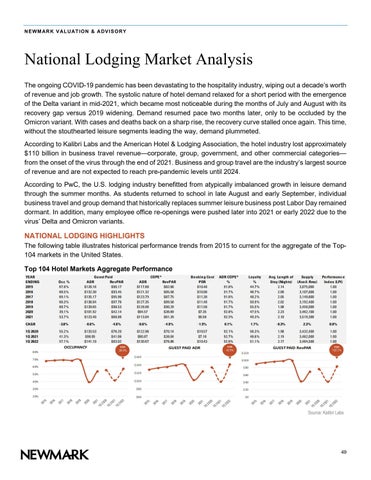
National Lodging Market Analysis The ongoing COVID-19 pandemic has been devastating to the hospitality industry, wiping out a decade’s worth of revenue and job growth. The systolic nature of hotel demand relaxed for a short period with the emergence of the Delta variant in mid-2021, which became most noticeable during the months of July and August with its recovery gap versus 2019 widening. Demand resumed pace two months later, only to be occluded by the Omicron variant. With cases and deaths back on a sharp rise, the recovery curve stalled once again. This time, without the stouthearted leisure segments leading the way, demand plummeted. According to Kalibri Labs and the American Hotel & Lodging Association, the hotel industry lost approximately $110 billion in business travel revenue—corporate, group, government, and other commercial categories— from the onset of the virus through the end of 2021. Business and group travel are the industry’s largest source of revenue and are not expected to reach pre-pandemic levels until 2024. According to PwC, the U.S. lodging industry benefitted from atypically imbalanced growth in leisure demand through the summer months. As students returned to school in late August and early September, individual business travel and group demand that historically replaces summer leisure business post Labor Day remained dormant. In addition, many employee office re-openings were pushed later into 2021 or early 2022 due to the virus’ Delta and Omicron variants.
NATIONAL LODGING HIGHLIGHTS The following table illustrates historical performance trends from 2015 to current for the aggregate of the Top104 markets in the United States. Top 104 Hotel Markets Aggregate Performance
Source: Kalibri Labs
49
N E W M AR K V AL UAT I O N & A DV I S O R Y
As indicated, lodging performance in most key performance indexes posted improvement from 2015 to 2019. At the onset of COVID-19 in March 2020, lodging performance deteriorated significantly. Guest PAID RevPAR decreased by nearly $54.00 in calendar-year 2020, mostly driven by occupancy fallout. Most of this decline was registered in the second quarter of 2020. However, we note that the later quarters in 2020 posted less severe declines, and 2021 exhibited that a recovery has taken hold in conjunction with the rollout of multiple vaccine options throughout the country which began at the beginning of the year. The hotel industry has been one of the hardest-hit sectors during the pandemic. A critical component in underwriting involves the perception of safety by hotel guests to travel; the lack of knowledge about a vaccine timeline made it difficult for companies to plan for a recovery. However, in early November 2020, vaccination schedules began to materialize and by February 2021, a rollout of the vaccine commenced. This news was well-received throughout the industry. However, ensuing versions of the virus emerged, namely the Delta and Omicron variants, which have stymied the recovery of lodging fundamentals and will be noticeable through at least the first half of 2022. Trends by Channel Distribution The following tables depict the impact of the COVID-19 outbreak on occupancy, ADR as well as hotel closings in the US since the beginning of 2020 and prior to the outbreak. As shown, beginning in the second week of March, when many states and municipalities began implementing social distancing measures and dictated that only essential businesses remain open, occupancy levels in the US declined precipitously. As a result, the composition of demand in hotels as well as the contribution by the primary distribution channels have been altered significantly.
Kalibri Labs has tracked noticeable improvement in all channel segments over the past several months, but with a deceleration heading into 2022. The largest positive change occurred in the group channel. While this
50
N E W M AR K V AL UAT I O N & A DV I S O R Y
category will continue to lag the other channels throughout the recovery period, improvement in this channel is indicative of a recovery across various demand segments, notably the highly profitable corporate segment. The following graph illustrates the trends in the various channel metrics since the beginning of 2020:
As shown, the immediate impact of COVID-19 on the way hotels booked rooms was such that there was an apparent surge in transient direct while simultaneously there was significant compression in the group segment. The reality is that all channels experienced a significant decline in early 2020, with property direct metrics experiencing the least amount of fallout. As a result, booking costs dropped precipitously by more than 55% since direct booking is a less expensive way for a room night to be transacted as it bypasses costly thirdparty channels, such as OTA and GDS. Cindy Estis Green—founder and CEO of Kalibri Labs—indicated that booking costs managed to post a recovery to some extent but by mid-year 2020 plateaued. This is because group business remains depressed, and it is typically the largest contributor to indirect booking channels. The FIT/Wholesale channel remains very compressed, again, due to a commensurate trend within the group segment. Channel booking activity began to normalize in the latter portion of 2020. Booking costs re-elevated to doubledigit dollars, which is an indication that third-party booking entities within Transient Indirect channels have regained their stance and importance in the purchasing process. To add context to the impact COVID-19 has imposed on the lodging industry, we have compared the most recent contribution to operating profit and expenses (COPE) metrics of the most recent month to pre-COVID 2019. The following chart illustrates the channel compositions of these two periods. We call your attention to the impact on the group and GDS channels in the negative direction; and also, to property-direct business which has filled a portion of the vacuum left behind by these travelers.
51
N E W M AR K V AL UAT I O N & A DV I S O R Y
CLOSURES By the third week of March 2020, a large portion of hotels in the US were closed. While some hotels will open when the restrictions are eased in each state, it is likely that some hotels will remain closed until travel recovers to a demand level that is 90% that of the same period in pre-COVID 2019. This is expected to occur throughout the remainder of 2022. The following tables depict net hotel closures, aggregate closures, and closures by chain scale since the onset of the pandemic in the US.
52
N E W M AR K V AL UAT I O N & A DV I S O R Y
As illustrated, hotel closures occurred very rapidly in the month of April 2020. Several thousand closures were reported and continued to be the case throughout the remainder of the year. It should be noted that independent hotels experienced the highest number of closures; however, the upper upscale and luxury segments account for most of the attrition of available supply in terms of number of rooms.
53
N E W M AR K V AL UAT I O N & A DV I S O R Y
The pace of reopening hotels became faster than the pace of closures by May 2020. Hotel operators were able to regenerate demand during the leisure summer months and early fall; however, a number of properties still remain closed. The pace of hotels reopening will continue to be stymied until RevPAR levels approach 90% of the pre-COVID 2019 pace, which will likely not occur until late 2022 to early 2023.
REVENUE According to Kalibri Labs, Guest Paid ADR and total occupancy in the United State followed a similar trendline, in that rates generally dropped a considerable amount in March and April, followed by some recovery but ultimately plateauing in the later portion of the year. It is noted that the highest degree of volatility was experienced in the Promotion and Loyalty Member Rates segment. It posted the greatest year-over-year drop in April, approaching negative 80% growth in multiple weeks. By the summer months, the segment rebounded until it intermittently posted the least year-over-year losses beginning in October. The following map represents a graphical representation of the Guest Paid RevPAR index for each market, comparing full-year 2020 performance vs. pre-COVID 2019 benchmark. The size of the markers corresponds to the size of the markets (in terms of number of hotel rooms), with darker markers indicating more pronounced declines in RevPAR relative to pre-COVID figures:
As noted earlier, the group meeting segment is likely to be the last demand segment to rebound, given the public’s aversion to large gatherings (since the outbreak), as well as social distancing measures which are likely to be part of our society for the near future. The following table depicts trends in Guest Paid RevPAR for all markets in the United States tracked by Kalibri Labs. The comparison is that of various-sized markets alongside five location types.
54
N E W M AR K V AL UAT I O N & A DV I S O R Y
As shown, RevPAR disparity was relatively moderate prior to the onset and during the early stages of COVID19. Declines were also heavily weighted towards the larger markets. Specifically, the total range of RevPAR for Large Metro markets was only about $35.00 in January 2020. In September 2020, competitiveness of major assets in these markets—which is dominated by larger box-style full-service hotels —increased significantly and the rate disparity between the various service tiers deteriorated significantly in some markets (but not all). As a result, in the fall of 2020, the disbursement in RevPAR increased to more than $85.00. As time moves on, the disparity for this segment and others appear to be narrowing, but at a moderate pace. Rural and tertiary markets were far less impacted than large markets; these hotels are primarily patronized by lower-rated, leisure-driven guests with no need for food, beverage, or meeting facilities. Furthermore, guests that normally patronize the higher-rated hotels were displaced to the lower-rated ones due to budget constraints. One notable trend that has been impacting operating strategies is the unusual and strong negative correlation between hotel size and RevPAR performance. This phenomenon is primarily being driven by the group segment and its propensity to patronize large, full-service hotels with significant meeting space. The correlation between hotel size and RevPAR levels in a typical pre-COVID year is usually near positive 80%. In mid-year 2020, this correlation reversed, registering a remarkable -94%. Most of the rooms in the United States that were removed from inventory were upper-upscale and luxury in nature, particularly hotels with expansive meeting facilities that relied heavily on the decimated group segment. These hotels have managed to re-open and have started to recapture some patronage, mostly competing for non-group transient demand that does not make much use of the meeting space. Since this time, the correlation has returned to a positive figure, indicating that a sustained recovery is underway. The following graph illustrates the most recent survey of RevPAR performance among various hotel size categories:
55
N E W M AR K V AL UAT I O N & A DV I S O R Y
As shown, the metrics of guest paid RevPAR to hotel size has turned positive again but is still right-sizing from the very strong negative correlation that was noticed in mid-2020.
AIR TRAVEL As noted herein, the resumption of air travel will be vital to the future of the lodging industry in the nation. For several months during 2020, the airline industry ran at record low levels with most domestic routes being temporarily cancelled. During the summer months, passenger volume rebounded temporarily, but dropped again once the summer leisure-driven period passed. During the vaccination and booster rollout period, these trends have improved, but cavitated temporarily at the onset of the Omicron variant.
56
N E W M AR K V AL UAT I O N & A DV I S O R Y
The outlook for travel is positive. While the accessibility of the market and the demand characteristics that influence the trends at each (i.e. corporate vs. group) will determine the duration of the region’s recovery, the consensus in the industry is that the second half of 2022 will bring considerable growth in travel, spending, and profitability.
PRICING AND CAP RATES As shown in the following table, it appears that the pandemic has not materially impacted investment rates. This is due primarily to the lack of transactions since the onset of the outbreak in the U.S. However, RCA reports that pricing for full-service assets dropped by 40 percent in mid-year 2020, but subsequently cut those losses considerably. Pricing for limited-service hotels indicated in the survey are currently near an all-time high. Investors report that the pricing is largely driven by duress activity. For non-duress, arm’s length transactions, the impact on pricing is substantially less. In fact, pricing for limited-service hotels reached an all-time high intra-COVID. However, volume has been very limited, so this metric is skewed to include a higher number of low-leverage, high-quality deals.
57
N E W M AR K V AL UAT I O N & A DV I S O R Y
Summary of Key Performance Metrics ‒ Significant lift in the U.S. industry’s average daily rate (ADR) during the back half of the second and third quarters caused this metric to exceed 2019 pre-pandemic levels in each month of the third quarter. ‒
With slowing growth in vaccinations (less than two-thirds of the U.S. population was fully vaccinated at the end of 2021) and waning consumer optimism heading into 2022, lodging’s recovery is expected to remain uneven. With leisure’s outsized importance in this recovery to date, destinations reliant on leisure demand are expected to continue to see stronger performance.
‒
With back-to-office plans only slowly starting to accelerate, markets reliant on individual business travel and group demand will likely have a softer fourth quarter performance this year than prepandemic.
‒
Occupancy and availability of labor are noted by investors as top challenges for the national lodging sector in 2022. However, a positive near-term outlook exists today as all segments continue to rebound.
CONSUMER CONFIDENCE Clearly, travel will only resume in force once people are confident that they can travel without contacting the virus. Early indications are that some confidence is returning. MMGY Global has revealed the findings from Wave 5 of its Travel Safety Barometer report, a sentiment tracking study that measures American travelers’ perceptions of how safe it is to engage in specific travel behaviors on a scale of 0 (Extremely Unsafe) to 100 (Extremely Safe). The latest findings reveal travelers’ perceptions of safety are rising across all sectors, from
58
N E W M AR K V AL UAT I O N & A DV I S O R Y
domestic and international travel to lodging, cruising, dining and entertainment, transportation and business travel. The Travel Safety Barometer survey is conducted monthly among more than 1,000 U.S. residents who have taken an overnight trip for either business or leisure in the past 12 months. The results of the most recent survey are below: ‒
Even as the COVID-19 pandemic continues to disrupt a return to workplaces, schools and sports arenas across the country, travelers report an increasing sense of safety with most types of travel activities in the most recent MMGY Travel Safety Barometer report. While barometer scores remain depressed overall compared to what we would typically expect in “normal times,” travelers seem to be adapting to the risks and safety scores continue to tick upwards.
‒
Most travel modes improved in safety perception between April and October 2020, but has since recoiled, namely in the latter portion of 2021 as the Delta and Omicron variants emerged.
‒
While Americans continue to feel safest traveling in their own cars, they’re also starting to feel somewhat more confident traveling by air and even by train/rail. These are important transportation modes for hotel guests which will impact lodging trends.
TRANSACTIONS MARKETS According to RCA, hotel cap rates fell in 2021 in line with the growth in prices. Some element of the growth in hotel pricing is likely a function of the rebound to normal. Trends in cap rates can provide some perspective on what it would mean for ongoing double-digit price growth to continue. The following chart summarizes quarterly transaction volume through year-end 2021, as tracked by RCA. Quarterly Transaction Volume by Subtype
59
N E W M AR K V AL UAT I O N & A DV I S O R Y
A rising interest rate environment might, however, cool any further compression in cap rates. Into Q4’21, fullservice hotel cap rates stood 520 bps higher than the 10yr UST while that for limited service hotels stood at a 680-bps spread. These spreads are narrower than the averages set since 2011, with full service and limitedservice spreads standing at 550 and 690 bps respectively. Investors would need to become even more optimistic for these spreads to narrow further in the face of a rising interest rates. The following table summarizes key markets with notable transaction activity in 2021:
TRANSIENT LODGING MARKET CONCLUSION Until November 2020 and absent a schedule of a COVID-19 vaccine rollout schedule, there was very low confidence in the underwriting of lodging performance. However, now that vaccinations and boosters are largely available, optimism in lodging demand forecasts is becoming more apparent within the investment community. Depending on the market, a return to 2019 RevPAR levels will occur from 2022 through 2024. Additionally, how a market (or hotel) rebounds from the impact of the outbreak will depend on the demand segmentation of the market or hotel. We have observed that the first demand segment to show signs of a recovery is the leisure segment but limited to those traveling to drive-to markets as air travel, and a lack of disposable income, will continue to impact this segment. Lastly, group meetings will likely be the last segment to rebound as social
60
N E W M AR K V AL UAT I O N & A DV I S O R Y
distancing guidelines – and the lack of large gatherings – will be part of the societal norms for the near future. The extended-stay lodging segment is considered the least impacted demand segment, particularly for lowerpriced extended-stay hotels. As debt sources gradually re-enter the hotel lending space, it is expected that transactional activity will rebound. However, lending restrictions will stymie the pace of these deals through the remainder of this year. On a positive note, it is expected that the recovery in lodging demand that began in mid-2020 and will extend through the early portion of 2023 will be the greatest on record.
61
N E W M AR K V AL UAT I O N & A DV I S O R Y
Local Lodging Market Analysis BLUEFIELD, WV HOTEL MARKET OVERVIEW The Bluefield, WV lodging market comprises approximately 3,560 hotel rooms located in Raleigh, Mercer, Tazewell, Giles and other counties. The primary municipal feeder market is Beckley and vicinity, which has a population of approximately 110,000 with an income per capita of $47,000 as of January 2022. This indicates that the feeder group size, which is the number of persons within a certain feeder market that are present for the sale of each room night, is 55.9 persons per sold room (PSR). This also means that the population's efficiency of selling rooms in this market is above average. Total feeder group earnings is approximately $2.6 million for each room night that was sold in this market. Accordingly, the total guest-paid hotel room revenue in the entire Bluefield, WV market is $68.8 million, which is soft relative to the Top 104 markets. The following map defines the geographical boundaries of the Bluefield, WV lodging market, the statistics of which are summarized in this section:
KEY PERFORMANCE METRICS The following graphs summarize recent key performance metrics for the local lodging market, along with comparisons and rankings of certain categories against the Top 104 markets over the past several years:
62
N E W M AR K V AL UAT I O N & A DV I S O R Y
Source: Kalibri Labs
Bluefield, WV is a custom, supplemental market with below average lodging characteristics. Its lodging performance index (LPI, or the measure of a hotel market's effective overall performance using multiple key performance metrics as inputs) would have been 0.81 in 1Q 2022 had it been recognized as one of Newmark's primary 'Top 104' markets. Although this particular market is not recognized as a primary market, the data are substantial enough to compare Bluefield, WV's performance against other major US markets. As a rank, the LPI for Bluefield, WV is 69th of 104 organized hotel markets that Newmark analyzes on a continual basis. Please see the Glossary for a more detailed description of LPI. The following table summarizes the key performance metrics for the market since 2015:
63
N E W M AR K V AL UAT I O N & A DV I S O R Y
KEY PERFORMANCE METRICS
As shown in the charts below, this market's occupancy ranked 97th during 1Q 2022 and 63rd during the trailing twelve-month period (44.4% and 56.0% respectively). Average guest-paid ADR ranked 93rd during 1Q 2022 and 93rd during T12, rendering guest-paid RevPAR of $40.98 (101st) and $53.60 (90th).
In addition to these performance measures, this market's moderate revenue recovery pattern from COVID-19 is similar with respect to T-12 loyalty contribution. Specifically, 51% of all rooms booked in this market are through loyalty programs—a pace which ranks 50th overall. As a rank, length of stay is unfavorable at 72nd (1.99 nights) while booking costs were favorable at $6.44, ranking 14th. Key benchmark index observations are illustrated below:
64
N E W M AR K V AL UAT I O N & A DV I S O R Y
MAJOR HOTEL DEMAND GENERATORS The following summarizes the largest hotel demand generators in the market. ‒ ‒ ‒ ‒ ‒ ‒ ‒ ‒ ‒ ‒
King's Daughters Medical Center Cabell Huntington Hospital St. Mary's Medical Center Marshall University Marathon Petroleum Toyota Motor Manufacturing Huntington VA Medical Center Marshall Health CSX, Huntington Division Amazon
‒ ‒ ‒ ‒ ‒ ‒ ‒ ‒ ‒ ‒
U.S. Army Corps of Engineers Wal-Mart Supercenter Alcon GC Services Steel of West Virginia AT&T Huntington Alloys Corp. Allevard Sogefi U.S.A. Inc. AK Steel Our Lady of Bellefonte Hospital
SCALE AND SERVICE DISTRIBUTION Most organized markets in the U.S. are host to all hotel chain scales and orientation of service. During the COVID-19 pandemic, we note that most markets have commenced a rebalancing of both metrics to best serve the evolving demands of the travelers to the area. The following graphic summarizes the distribution of supply as it existed in the most recent query, both in terms of chain scale and service orientation. These metrics are furthermore compared against the current distribution status of all hotels in the U.S., both in terms of number of rooms allocated to each category, as well as the penetration level of the subject market’s room count.
TRENDS, RISKS, AND INVESTMENT RATES Bluefield, WV has certain characteristics that contribute to its status as a below average hotel market. The following summarizes key performance trends in recent months: ‒
Revenue growth potential, which is an assessment of total revenue growth over the past three to five years against the Top 104 markets, is average. Specifically, it ranked 41st.
‒
Supplier power trend, which is an assessment of a market's ability to maximize loyalty and profits, and to ward off booking costs over the past 12 months, ranked 22nd out of 104 (above average).
65
N E W M AR K V AL UAT I O N & A DV I S O R Y
‒
Our analysis of investment yields is such that the market's investment parameters (yields, OAR, IRR, interest rates, etc.) against Top 104 markets was below average, ranking 74th.
‒
Supply risk, which is an assessment of market supply growth over the past 12 months that is still in the process of absorption, ranked 13th out of 104 markets. This is above average.
‒
Labor risk, which is a measure of current employment health over the past two years relative to the other markets (factoring in COVID fluctuations), ranked 20th, which is above average.
As a result of these observations, it is our opinion that investment rates (once transaction volume regains pace) are moderate. The following scattergram summarizes this market's investment positions relative to the Top 104 US hotel markets in the major hotel categories.
PERFORMANCE CYCLE The Bluefield, WV market is currently in the 'Regeneration' stage of the performance cycle. In this stage, hotels and the underlying economy are generally underperforming. The highest and best uses of hotel assets are challenged whether by COVID-19 impacts, oversupply, weak economic indicators, and/or poor corporate contribution. Hotel investors look for opportunities to either exit or regenerate demand. Example markets in this stage include Chicago, IL; Columbus, OH; and Detroit, MI.The following chart illustrates this market's position in the performance matrix relative to the other 104 lodging markets:
66
N E W M AR K V AL UAT I O N & A DV I S O R Y
PUBLISHED RATE ACTIVITY Travelers within the subject market book rooms through a variety of distribution channels. There are moderate rate variances amongst the channels with respect to free and independent travelers; however, significant variance can exist between the published rate and ultimate guest-paid rate, particularly with respect to the lead time. As the lead time increases, so does the spread between these two rates. The more published rates are manipulated by operators, the higher the rate competitiveness becomes and the longer a market could take to recover.
67
N E W M AR K V AL UAT I O N & A DV I S O R Y
UBLISHED RATE ACTIVITY 7-30 Day Advance vs. Three Weeks Prior
The U.S. on average also experienced positive change of 2.9% to its 7/30 lead time rates over this same interval. This represents calmer rate volatility compared to the U.S. where hotel operators are less inclined to overreact to changes in demand and more confidence exists in future upside in the market.
NET HOTEL CLOSURES As discussed, COVID-19 prompted several thousand lodging facilities to temporarily shutter. The highest velocity of closures in the United States occurred in the last week of May. Since this time, hotels have continued to close down, some temporarily and others potentially permanently. As shown in the following graph, net closures in the State of WV market reached peak velocity on about May 18th, plateauing shortly thereafter. The maximum number of hotels closed in this market during the COVID period was 40 and the approximate number of hotels most recently closed (as of April 11, 2022) was 24. Overall, a total of 80 hotels were closed at one point since the beginning of the pandemic. Looking back over the past few weeks, the velocity of hotels reopening (the inverse of net closings) appears to be behind that of the nation, according to Hotel Compete. The following graph summarizes the mix of currently closed hotel properties relative to that of the nation.
68
N E W M AR K V AL UAT I O N & A DV I S O R Y
LOCAL AIRPORT STATISTICS In mid-2020, air travel declined precipitously due to the pandemic crisis and by late 2020, air traffic began to recover. The following chart summarizes historical long-term growth in passenger enplanement counts as well as annual changes over the past 12 months.
69
N E W M AR K V AL UAT I O N & A DV I S O R Y
CONCLUSION Overall, the Bluefield, WV lodging market is below average relative to the Top 104 US markets tracked by Newmark. As this market recovers from COVID-19, the expectation of a full recovery within four to six years is unfavorable. As this market progresses through its recovery curve, investors will keep track of potential risks, such as Total Rooms Sold, Total Rooms Supply, and Short-Term Historical Supply Growth. However, Feeder Group Earnings PSR, Feeder Group Size, and Long-Term Historical Supply Growth are positive characteristics that will help in the healing process.
70
N E W M AR K V AL UAT I O N & A DV I S O R Y
Local Supply and Demand SELECTED COMPETITIVE SUPPLY To support our occupancy forecasts for the subject’s lodging component, we profiled a grouping of hotels that contribute their occupancy and average daily rate performance to a globally recognized hotel data aggregator called Smith travel research (STR). The selected grouping of six area hotels are all advertised on the Hatfield McCoy ATV trails website and other marketing materials, making them primary competitors for the proposed subject development. The following table summarizes the physical characteristics of the subject resort and its competitors and is followed by a map of their locations. The tables after the map summarize pertinent operating data for the subject and competitors.
71
Quality Inn Hotel & Conference Center Bluefield 3350 Big Laurel Hwy, Bluefield, WV
Proposed Subject Resort Bluefield and Princeton, WV
59
118
516
Number of Rooms
2005
2002
1980
2024
Year Opened
10,844
7,308
14,000
504
27.1 61.9 0.0 7.3 139.0 0.0
X
X
X
X X X X X
Golf
Whirlpool
X
X
72
X
72
Whirlpool, mini golf
Other
X
X
X
X
X X
X
X
X
X
X
Fitness Room
X
Business Center
N E WM AR K V AL UAT I O N & A DV I S O RY
Best Western Logan Inn 2 Central Avenue, Chapmanville, WV 69
2006
0
Meeting Space (Per Room)
44.3
Swimming Pool
COMPETITIVE PROPERTY FACILITIES OVERVIEW
Holiday Inn Express & Suites Logan 101 George Kostas Drive, Logan, WV 78
2012
2,701
Free Breakfast
General Property Information
Chief Logan Lodge & Conference Center 376 Little Buffalo Creek Road, Logan, WV
71
1970
Property Name / Address
Candlewood Suites Logan 743 Stratton Street, Logan, WV
61
0
Twin Falls Resort State Park 2999 Bearhole Road, Mullens, WV
Meeting Space (Total SF)
N E W M AR K V AL UAT I O N & A DV I S O R Y
MAP OF REGIONAL COMPETITIVE PROPERTIES
COMPETITION MAP KEY Property Nam e
Location
Pin No.
Distance
Latitude, Longitude
Proposed Subject Resort
Bluefield and Princeton, WV
S
-
37.1829,-81.1003
Quality Inn Hotel & Conference Center Bluefield
Bluefield, WV
1
7.2 m iles
37.260027,-81.187848
Best Western Logan Inn
Chapm anville, WV
2
73.9 m iles
37.9649331,-82.0221671
Holiday Inn Express & Suites Logan
Logan, WV
3
69.5 m iles
37.8564919,-82.0428139
Chief Logan Lodge & Conference Center
Logan, WV
4
69.8 m iles
37.8973784,-82.0012744
Candlew ood Suites Logan
Logan, WV
5
66.3 m iles
37.84328,-81.9780584
Tw in Falls Resort State Park
Mullens, WV
6
36.5 m iles
37.6368557,-81.4396648
73
N E W M AR K V AL UAT I O N & A DV I S O R Y
HISTORICAL PERFORMANCE: SELECTED COMPETITORS The aggregated operating data for the competitive set is presented in the following table. Please note that the competitors in the report are generally similar to what is reported by the management of the subject hotel; however, not all hotels that report to STR do so consistently and timely creating potential for some discrepancies within the data (particularly during COVID-19 as some properties may have temporarily closed). HISTORICAL COMPETITIVE MARKET TRENDS HotelCollected ADR
% Change
HotelCollected RevPAR
-
$86.81
-
$44.15
-
55.0%
8.2%
$83.04
-4.3%
$45.71
3.5%
-0.2%
54.9%
-0.2%
$88.82
7.0%
$48.78
6.7%
-8.5%
50.3%
-8.5%
$78.95
-11.1%
$39.69
-18.6%
81,464
-2.2%
49.2%
-2.2%
$84.19
6.6%
$41.39
4.3%
79,986
-1.8%
48.2%
-2.0%
$88.10
4.6%
$42.44
2.5%
0.2%
97,429
21.8%
58.5%
21.5%
$84.75
-3.8%
$49.61
16.9%
-3.6%
68,472
-29.7%
42.7%
-27.1%
$86.07
1.6%
$36.75
-25.9%
Year
Num ber of Room s
Total Market Supply
% Change
Total Market Dem and
2013
454
165,710
-
84,286
-
50.9%
2014
454
165,710
0.0%
91,209
8.2%
2015
454
165,710
0.0%
91,005
2016
454
165,710
0.0%
83,309
2017
454
165,710
0.0%
2018
455
166,045
0.2%
2019 (Pre-COVID)
456
166,440
2020
439
160,379
CAGR:
-0.5%
Market % Change Occupancy % Change
-2.9%
-2.5%
-0.1%
% Change
-2.6%
YTD Oct 2020
436
132,563
-
57,279
-
43.2%
-
$86.91
-
$37.55
-
YTD Oct 2021
456
138,624
4.6%
75,218
31.3%
54.3%
25.6%
$91.02
4.7%
$49.39
31.5%
T12 Oct 2021
459
166,440
3.8%
86,411
26.2%
51.9%
21.6%
$90.19
4.8%
$46.82
27.4%
Source: STR, Inc.
As illustrated in the table above, occupancy dropped over the trend history. In the most recent period (2020), occupancy declined by -27.1%. Year to date, the occupancy trend has grown by 25.6% to a level of 54.3%. During the same trend history, average rates remained flat. In 2020, ADR improved by 1.6% to $86.07. Year
74
N E W M AR K V AL UAT I O N & A DV I S O R Y
to date, room rates have grown by 4.7% to $91.02. Overall, rooms revenue within the competitive set posted negative growth over the trend period achieving a RevPAR metric of $36.75 during 2020. Year-to-date, rooms revenue has grown with RevPAR changing by 31.5%. The competitive hotel set has not recorded any new supply additions over the last eight years since most lodging additions in recent years have comprised alternative lodging options like RV sites, cabins, and other peer-to-peer rentals via platforms like Airbnb and VRBO. The increase alternative lodging options and the lack of reinvestment in existing hotel supply has resulted in the competitive hotel market recording gradual yearover-year declines in occupancy levels. The exception to this trend was in calendar-year 2019, which recorded an increase of demand of nearly 22% that resulted in the competitive hotel set's occupancy achieving 58.5%. Over the same period, the competitive hotel set's average daily rate (ADR) was more volatile recording increases and decreases year over year. These changes in occupancy and ADR led to uneven growth in RevPAR. While some of the hotels in the competitive set completed renovations and implemented revenue optimization strategies, other properties did not make investments in their properties and used less sophisticated revenue optimization strategies to better compete with newer alternative lodging options. In 2020, the competitive hotel market recorded a decline of nearly 30% in lodging demand due to the pandemic, which halted most travel in the first half of the year; however, leisure demand rebounded in the latter part of the year. Despite the steep decline in demand, the competitive hotel set recorded ADR gains. Performance through October 2021, on a year-to-date and trailing 12-month basis, has achieved a solid rebound in demand and a moderate improvement in ADR, with RevPAR nearly returning to pre-COVID-19 levels.
ADDITIONS TO SUPPLY During the course of our research, we have not identified any proposed hotels or properties that are currently under development that would be directly competitive with the subject. While the potential for new hotel inventory has been considered as a part of the market research and reasonable efforts were made to determine which new properties might be added to the market, it is important to note that it is not possible to ascertain every property that might be developed in the future. The impact that any new supply additions could have on the operational performance of existing properties and/or the subject property is very difficult to judge. As such, the characteristics of the local market and the potential for unexpected inventory additions within the market are both considered in the selection of the stabilized occupancy rate and appropriate investment parameters.
ANALYSIS OF DEMAND SEGMENTS The total room demand within the competitive set is comprised of the total number of rooms occupied by all demand segments during a full year. Operators within this market recognize multiple main demand segments; the distribution of accommodated hotel room night demand for the competitive set in aggregate is delineated into the following market segments: ‒ ‒
Transient Group
Illustrated in the following table is the estimated market mix of the subject hotel and the composite of the competitive properties during 2020.
75
N E W M AR K V AL UAT I O N & A DV I S O R Y
The primary segments are discussed in the following paragraphs along with our projections of future growth rates in each segment. Further discussion of the segments is presented in the Glossary section of this report. Transient Demand The following includes a list of major commercial-oriented demand generators in the subject’s market: COMMERCIAL DEMAND GENERATORS ACME
First Community Bank
American Red Cross
Mercer County Board of Education
Bluefield Industrial Park
Pepsi Cola Bottling Company
Bluefield Regional Medical Center
Princeton Community Hospital
Bluefield State College
The Daniels Company
Concord University
In the Bluefield and Princeton area, travelers visiting area attractions and friends and relatives of local residents comprise much of the leisure demand. The following summarizes some of the major leisure demand generators in the market: LEISURE DEMAND GENERATORS Bluefield Armory
Merecer County Convention and Visitors Bureau
Dan Hale Reservoir
Merecr County War Museum
East River Mount Overlook
Mitchell Stadium
Fincastle Country Club
Mountaineer Bow ling Alley
Fountain Springs
Pocahontas Coal Mine
Jimmy Lew is Lake
Princeton Recreation Center
Lotito City Park
Wolf Creek Indian Village
Mercer Mall
The following table illustrates our growth rate assumptions for the transient segment.
TRANSIENT SEGMENT GROWTH RATES Annual Growth Base Demand
2019 74,458
2022 29.5% 70,381
2023 5.0% 73,900
2024 2.0% 75,378
2025 0.0% 75,378
2026 0.0% 75,378
Group Demand The following table illustrates our growth rate assumptions for the growth segment.
76
N E W M AR K V AL UAT I O N & A DV I S O R Y
GROUP SEGMENT GROWTH RATES Annual Growth Base Demand
2019 22,909
2022 15.0% 19,230
2023 8.5% 20,865
2024 1.0% 21,074
2025 0.0% 21,074
2026 0.0% 21,074
SEASONALITY AND WEEKDAY DISTRIBUTION Generally, the demand for lodging accommodations in the Bluefield and Princeton area is strongest in the autumn months. Demand during these months often spike and drive occupancy levels to near-capacity levels. During the week, occupancy tends to peak on Friday and Saturday. This market has commanded its highest occupancy measurements in the months of October and July, with low months registering in January and December. While occupancy tends to be the highest on Friday nights throughout the course of the week, Sundays and Mondays typically command the lowest demand levels during this time. Seasonal demand distribution is graphically illustrated below with data from competitive set.
77
N E W M AR K V AL UAT I O N & A DV I S O R Y
ADDITIONAL COMPETITIVE HOTELS As additional support for our occupancy forecasts, we considered an aggregated grouping of hotels in the greater regional market area. The following tables depicts a listing of each of these hotels and their aggregated historical performance. ADDITIONAL COMPETITIVE HOTELS IN THE REGION Property Nam e
Room s
Property Address
City
State
Zip
Mountaineer Hotel
50
Hotel Class Economy
31 E 2nd Ave
Williamson
WV
25661
1925
Quality Inn Princeton
50
Midscale
136 Ambrose Ln
Princeton
WV
24739
1985
Chapmanville Inn
44
Economy
48 Brickyard Rd
Chapmanville
WV
25508
1984
Bluefield Inn
33
Economy
3144 E Cumberland Rd
Bluefield
WV
24701
1970
Economy Inn
42
Economy
3206 E Cumberland Rd
Bluefield
WV
24701
1960
Econo Lodge Near Bluefield College
46
Economy
3400 E Cumberland Rd
Bluefield
WV
24701
1973
The Comfort Motel
25
Economy
129 Deanna Ave
Comfort
WV
25049
2010
Hampton Inn Princeton
112
Princeton
WV
24739-9585
1995
Days Inn Princeton
70
Economy
347 Meadow Field Ln
Princeton
WV
24739-9590
1987
Eden Rock Motel
15
Economy
504 Oakvale Rd
Princeton
WV
24740
1977
Holiday Inn Express Princeton I-77
70
Upper Midscale 805 Oakvale Rd
Princeton
WV
24740
2005
Sleep Inn & Suites Princeton
108
Midscale
1015 Oakvale Rd
Princeton
WV
24740
1996
Microtel Inn & Suites by Wyndham Princeton
64
Economy
250 Ambrose Ln
Princeton
WV
24739
2009
Mountain Motel
46
Economy
1377 Appalachian Hw y
Pineville
WV
24874
1935
Coal River Inn
30
Economy
271 Bradley Rd
Danville
WV
25053
1995
Fairfield Inn & Suites Princeton
83
Upper Midscale 107 Halls Ridge Rd
Princeton
WV
24739
2016
Country Inn & Suites by Radisson Princeton
77
Upper Midscale 111 Halls Ridge Rd
Princeton
WV
24739-6829
2009
Mountain Creek Lodge at Pipestem Resort State Park
30
Lerona
WV
25971
1969
Upper Midscale 277 Meadow Field Ln
Economy
River Trl
Year Built
Source: STR
78
N E W M AR K V AL UAT I O N & A DV I S O R Y
HISTORICAL COMPETITIVE MARKET TRENDS Year
Num ber of Room s
Total Market Supply
2012
952
2013
952
2014 2015
HotelCollected RevPAR
% Change
347,615
-
203,377
-
58.5%
-
$76.48
-
$44.75
-
347,525
0.0%
191,058
-6.1%
55.0%
-6.0%
$79.15
3.5%
$43.51
-2.8%
952
347,525
0.0%
189,081
-1.0%
54.4%
-1.0%
$78.34
-1.0%
$42.62
-2.0%
952
347,525
0.0%
185,297
-2.0%
53.3%
-2.0%
$81.87
4.5%
$43.65
2.4%
2016
1,022
373,076
7.4%
199,310
7.6%
53.4%
0.2%
$83.53
2.0%
$44.62
2.2%
2017
1,036
378,185
1.4%
203,469
2.1%
53.8%
0.7%
$85.18
2.0%
$45.83
2.7%
2018
1,036
378,185
0.0%
220,996
8.6%
58.4%
8.6%
$83.43
-2.1%
$48.75
6.4%
2019 (Pre-COVID)
1,036
378,093
0.0%
222,278
0.6%
58.8%
0.6%
$86.18
3.3%
$50.66
3.9%
2020
1,035
377,820
-0.1%
154,532
-30.5%
40.9%
-30.4%
$77.64
-9.9%
$31.76
-37.3%
CAGR:
0.0%
Market % Change Occupancy % Change
HotelCollected ADR
Total Market Dem and
-3.4%
0.0%
% Change
% Change
0.0%
0.0%
YTD Feb 2021
1,020
60,180
-
22,350
-
37.1%
-
$74.09
-
$27.52
-
YTD Feb 2022
965
56,935
-5.4%
22,547
0.9%
39.6%
6.6%
$84.34
13.8%
$33.40
21.4%
T12 Feb 2022
981
358,021
-5.2%
199,693
29.2%
55.8%
36.4%
$88.14
13.5%
$49.16 54.8% Source: CoStar | STR, Inc.
MARKET OCCUPANCY PROJECTION PROJECTION OF BASE ROOM NIGHT DEMAND AND ANNUAL GROWTH Pre-COVID 2019
2022
2023
(Inception) 2024
2025
2026
(Phase 2) 2027
2028
2029
(Phase 3) 2030
2031
2032
Transient Annual Growth Base Demand Induced Demand Displaced Total Market Segment Demand
74,458 74,458
29.5% 70,381 0 0 70,381
5.0% 73,900 0 0 73,900
2.0% 75,378 0 0 75,378
0.0% 75,378 1,700 0 77,078
0.0% 75,378 3,400 0 78,778
0.0% 75,378 13,600 3,015 91,993
0.0% 75,378 15,300 3,015 93,693
0.0% 75,378 17,000 3,015 95,393
25.0% 94,223 17,000 3,769 114,992
9.0% 102,703 17,000 4,108 123,811
3.0% 105,784 17,000 4,231 127,015
Group Annual Growth Base Demand Induced Demand Displaced Total Market Segment Demand
22,909 22,909
15.0% 19,230 0 0 19,230
8.5% 20,865 0 0 20,865
1.0% 21,074 0 0 21,074
0.0% 21,074 3,762 0 24,836
0.0% 21,074 2,090 0 23,164
0.0% 21,074 30,400 1,159 52,633
0.0% 21,074 34,200 1,159 56,433
0.0% 21,074 38,000 1,159 60,233
20.0% 25,289 38,000 1,391 64,680
4.0% 26,301 38,000 1,447 65,748
2.0% 26,827 38,000 1,476 66,303
97,367 -
26.1% 89,611 0 0
5.8% 94,765 0 0
1.8% 96,452 0 0
0.0% 96,452 5,462 0
0.0% 96,452 5,490 0
0.0% 96,452 44,000 4,174
0.0% 96,452 49,500 4,174
0.0% 96,452 55,000 4,174
23.9% 119,512 55,000 5,160
7.9% 129,004 55,000 5,555
2.8% 132,611 55,000 5,707
Segment
Total Annual Base Demand Growth Base Demand Induced Demand Displaced Total Recovery Total Market Segment Demand % Change Rolling CAGR over 2019 Market Statistics Total Rooms Supply Total Available Room Nights % Change Rolling CAGR over 2019 MARKETWIDE OCCUPANCY
92% o f pre-COVID
97% o f pre-COVID
99% o f pre-COVID
99% o f pre-COVID
99% o f pre-COVID
99% of pre-COVID
99% of pre-COVID
99% of pre-COVID
Reco vered
Reco vered
Reco vered
97,367 -
89,611 26.1% -2.7%
94,765 5.8% -0.7%
96,452 1.8% -0.2%
101,914 5.7% 0.8%
101,942 0.0% 0.7%
144,626 41.9% 5.1%
150,126 3.8% 4.9%
155,626 3.7% 4.8%
179,672 15.5% 5.7%
189,559 5.5% 5.7%
193,318 2.0% 5.4%
456 166,440 -
456 166,440 0.0% 0.0%
456 166,440 0.0% 0.0%
456 166,440 0.0% 0.0%
456 166,440 0.0% 0.0%
456 166,440 0.0% 0.0%
634 231,410 39.0% 4.2%
634 231,410 0.0% 3.7%
634 231,410 0.0% 3.4%
972 354,780 53.3% 7.1%
972 354,780 0.0% 6.5%
972 354,780 0.0% 6.0%
58.5%
53.8%
56.9%
58.0%
61.2%
61.2%
62.5%
64.9%
67.3%
50.6%
53.4%
54.5%
79
N E W M AR K V AL UAT I O N & A DV I S O R Y
SUBJECT HOTEL OCCUPANCY PROJECTION To derive the occupancy projection of the subject, a room night analysis is completed that quantifies and projects overall room night demand for the subject property. This analysis is based on the competitiveness of the subject with the other hotels in the competitive set and its penetration into the various demand segments previously discussed. A more detailed discussion of the methodology associated with occupancy projection is presented in the Glossary section of this report. Development Phasing Our forecasts assume lodging development at the following pace for the three development Phases: Lodging Components Village/Area
Com ponent
Phase
# of Units
Dan Hale Lake
Lakefront Hotel
2
120
Dan Hale Lake
Yurt Village
2
26
Dan Hale Lake
E Village Rental Units (Villas)
3
30
Dan Hale Lake
Bunkhouses
3
4
Dan Hale Lake
Lakefront Condos & Cabins
2
32
Dan Hale Lake
Hidden Cove Cabins
3
20
Dan Hale Lake
RV Park
1
304
Stony Ridge
Stony Ridge Hotel & Conference Center
3
140
Stony Ridge
Stony Ridge Condos & Cabins
3
104
Dow ntow n Bluefield
Dow ntow n Hotel
3
40
Total Hotel
300
Total RV Park
304
Total Bunkhouse
4
Total Yurt, Villa, Cabin, and Condo, Units
212
Total Lodging
820
Source: Newmark Valuation & Advisory and CES
Occupancy Penetration Indexes The segment penetration indexes for the subject property and each of the competitive properties during 2020 are illustrated in the following tables. TRANSIENT Market Segmentation
Weighted Room Count
Fair Share
Estimated 2019 Rooms Occupied
Market Share
Quality Inn Hotel & Conference Center Bluefield
63.0%
118
25.9%
15,873
21.3%
82.4%
Best Western Logan Inn
90.0%
59
12.9%
11,338
15.2%
117.7%
Property
Penetration Index
Holiday Inn Express & Suites Logan
88.0%
69
15.1%
12,965
17.4%
115.1%
Chief Logan Lodge & Conference Center
65.0%
78
17.1%
10,826
14.5%
85.0%
Candlew ood Suites Logan
92.0%
71
15.6%
13,947
18.7%
120.3%
Tw in Falls Resort State Park
73.0%
61
13.4%
9,508
12.8%
95.5%
Total/Average (Pre-COVID)
76.5%
456
100.0%
74,458
100.0%
100.0%
80
N E W M AR K V AL UAT I O N & A DV I S O R Y
GROUP Market Segmentation
Weighted Room Count
Fair Share
Estimated 2019 Rooms Occupied
Market Share
Penetration Index
Quality Inn Hotel & Conference Center Bluefield
37.0%
118
25.9%
9,323
40.7%
157.3%
Best Western Logan Inn
10.0%
59
12.9%
1,260
5.5%
42.5%
Holiday Inn Express & Suites Logan
12.0%
69
15.1%
1,768
7.7%
51.0%
Chief Logan Lodge & Conference Center
35.0%
78
17.1%
5,829
25.4%
148.8%
Candlew ood Suites Logan
8.0%
71
15.6%
1,213
5.3%
34.0%
Tw in Falls Resort State Park
27.0%
61
13.4%
3,517
15.4%
114.8%
Total/Average (Pre-COVID)
23.5%
456
100.0%
22,909
100.0%
100.0%
Market Segmentation
Weighted Room Count
Fair Share
Estimated 2019 Rooms Occupied
Market Share
Penetration Index
Quality Inn Hotel & Conference Center Bluefield
100.0%
118
25.9%
25,196
25.9%
100.0%
Best Western Logan Inn
100.0%
59
12.9%
12,598
12.9%
100.0%
Holiday Inn Express & Suites Logan
100.0%
69
15.1%
14,733
15.1%
100.0%
Chief Logan Lodge & Conference Center
100.0%
78
17.1%
16,655
17.1%
100.0%
Candlew ood Suites Logan
100.0%
71
15.6%
15,160
15.6%
100.0%
Tw in Falls Resort State Park
100.0%
61
13.4%
13,025
13.4%
100.0%
Total/Average (Pre-COVID)
100.0%
456
100.0%
97,367
100.0%
100.0%
Property
TOTAL Property
81
N E W M AR K V AL UAT I O N & A DV I S O R Y
PENETRATION INDEX ANALYSIS In the following paragraphs, the rationale supporting the penetration index projections is discussed for each demand segment. Transient Demand Penetration The proposed subject hotel is anticipated to be independently affiliated throughout the holding period and it is expected to be recognized by transient travelers as a well amenitized and upscale lodging facility. The proposed hotel will be proximate to various attractions including the Hatfield-McCoy ATV trails, outdoor adventure attractions, and will have convenient access to/from Interstate 77. Overall, we forecast the penetration index for the transient segment to equal 111.6% in the stabilized year, which is due to the subject property’s superior facilities, amenities, and location relative to other lodging options in the region. Based on our estimated penetration levels, the stabilized transient market mix will equal roughly 67.7% of overall room night demand. Group Demand Penetration With roughly 14,000 square feet of flexible meeting and event space, the subject property will be well-positioned to attract small conferences, corporate retreats, wedding and other SMERFE demand, and tour-and-travel patronage over the long-term. Penetration levels for the group segment are forecast to equal 102.0%. The group penetration index is projected to stabilize at 32.3% of the subject hotel's overall segmentation mix. SUBJECT'S PROJECTED PENETRATION, MARKET SHARE AND TOTAL CAPTURE Pre-COVID 2019
2022
2023
(Inception) 2024
2025
2026
(Phase 2) 2027
2028
2029
(Phase 3) 2030
2031
2032
456 -
456 -
456 -
456 -
456 -
456 -
634 178
634 178
634 178
972 516
972 516
972 516
-
-
-
-
-
-
28.1%
28.1%
28.1%
53.1%
53.1%
53.1%
-
-
-
-
-
-
28.1% 80.0% 22.5%
28.1% 90.0% 25.3%
28.1% 80.0% 22.5%
53.1% 95.0% 50.4%
53.1% 105.0% 55.7%
53.1% 111.6% 59.2%
74,458 -
70,381 -
73,900 -
75,378 -
77,078 -
78,778 -
91,993 22.5% 20,662
93,693 25.3% 23,674
95,393 22.5% 21,426
114,992 50.4% 57,993
123,811 55.7% 69,013
127,015 59.2% 75,220
-
-
-
-
-
-
28.1% 70.0% 19.7%
28.1% 80.0% 22.5%
28.1% 90.0% 25.3%
53.1% 95.0% 50.4%
53.1% 100.0% 53.1%
53.1% 102.0% 54.1%
22,909 -
19,230 -
20,865 -
21,074 -
24,836 -
23,164 -
52,633 19.7% 10,344
56,433 22.5% 12,675
60,233 25.3% 15,220
64,680 50.4% 32,619
65,748 53.1% 34,903
66,303 54.1% 35,902
0 -
-
-
-
-
-
31,006 76.4%
36,350 86.2%
36,646 83.9%
90,612 95.0%
103,916 103.3%
111,122 108.3%
Pre-COVID 2019
2022
2023
(Inception) 2024
2025
2026
2027
2028
2029
2030
2031
2032
-
-
-
-
-
-
31,006 64,970 47.7%
36,350 64,970 55.9%
36,646 64,970 56.4%
90,612 188,340 48.1%
103,916 188,340 55.2%
111,122 188,340 59.0%
Subject Property Fair Share Market Room Supply Subject Property Room Count Fair Share Room Nights Captured by Subject Transient Fair Share Penetration Index Market Share Market Segment Demand Market Share Segment Room Nights Accommodated Group Fair Share Penetration Index Market Share Market Segment Demand Market Share Segment Room Nights Accommodated Total Capture Overall Penetration Index
SUBJECT PROPERTY PROJECTED OCCUPANCY Calendar Years Room Nights Accommodated Available Room Nights Occupancy Rounded Occupancy
-
-
-
-
-
48%
56%
56%
48%
55%
59%
Overall Market Share Overall Penetration Index
-
-
-
-
-
21.4% 76.4%
24.2% 86.2%
23.5% 83.9%
50.4% 95.0%
54.8% 103.3%
57.5% 108.3%
82
N E W M AR K V AL UAT I O N & A DV I S O R Y
The proposed subject hotel's occupancy level is expected to stabilize at some point during the 11th projection year (2032), which would be subject hotel number one’s sixth year of operation and hotel number two’s third year of operation. The stabilized occupancy figure is intended to reflect the projected occupancy level over the remaining economic life. An occupancy rate of 59% is selected as of the stabilized date of January 1, 2032. This is reasonable considering the competitive market’s historical and current performance and the planned lodging components and amenities, which will be superior relative to the existing supply. The subject development will not reach stabilized occupancy until 2032 after completion of the third phase. The following table depicts the subject resorts stabilized occupancy broken down by lodging type. SUBJECT RESORT OCCUPANCY BY LODGING TYPE STABILIZED-YEAR PROJECTION Tw o Hotels
Bunkhouses
Yurt, Eco-Villa, Cabin, & Tow nhom e Units
Total Non-RV Lodging
300
4
212
516
109,500
1,460
77,380
188,340
% of Total Supply
58.1%
0.8%
41.1%
100.0%
Annual Demand
65,700
584
44,838
111,122
% of Total Demand
59.1%
0.5%
40.3%
100.0%
60%
40%
58%
59%
Unit Type
Total Units Annual Units Available
Occupancy % (Rounded) Source: Newmark V&A - HGL
The proposed subject hotel would achieve an occupancy percentage that is greater than its fair share due to its unique onsite attractions and amenities and ability to accommodate additional weekday off-season demand (corporate groups) as well as attract visitors year-round due to some weather-proof amenity offerings and event space.
AVERAGE DAILY RATE PROJECTION After the subject’s occupancy level has been forecast, the next step is to estimate the average daily rate (ADR) of the subject hotel to determine the Rooms department revenue. A detailed discussion of the subject’s ADR projection is presented in the Glossary section of this report. In addition to the competitive set of hotels advertised via the Hatfield McCoy trail system, we also considered the weighted average of regional cabin, single family home, and villa rentals on AirBNB and VRBO, as reported by the data aggregator AirDNA. The following table summarizes the rate history at each type of competitor.
83
N E W M AR K V AL UAT I O N & A DV I S O R Y
HISTORICAL COMPETITIVE AVERAGE DAILY ROOM RATES Com parison
2018
2019
2020
2021
AirBNB & VRBO - Mingo County
-
-
-
$217
AirBNB & VRBO - Mercer County
-
-
-
$193
$88
$85
$86
* $91
Smith Travel Research Trend Report Subject's Positioned ADR:
$208
* YTD October 2021
The preceding table illustrates the subject’s positioned ADR of $207.77, which within the range of competitive properties. The positioned ADR is considered appropriate because the subject property will offer superior accommodations and on-site amenities relative to most lodging options in the region and will also have some much larger units in its mix of accommodations, which have greater capacity and command higher rates. The following table depicts the subject resorts stabilized ADR broken down by lodging type. Lodging Development Components ADR and Phasing Com ponent
Num ber of Units
ADR in 2022 Dollars
Stabilized ADR (in 2032 Dollars)
Hotel Phase 1
0
Hotel Phase 2
120
$132.15
$167.40
Hotel Phase 3
180
$158.58
$200.88
Total Hotel
300
$148.01
$187.49
RV Phase 1
304
$67.87
$93.88
RV Phase 2
0
-
-
RV Phase 3
0
-
-
304
$40.00
$93.88
Total RV Slips
-
Other Lodging Phase 1
0
-
-
Other Lodging Phase 2
58
$270.00
$342.03
Other Lodging Phase 3
158
$324.00
$410.43
Total Other Lodging
216
$309.50
$392.07
820
$214.00
$271.09
TOTAL RV, Cabin, Yurt, Villa, & Hotel Lodging TOTAL Lodging
Note: Other Lodging includes yurts, villas, cabins, and bunkhouses
84
N E W M AR K V AL UAT I O N & A DV I S O R Y
Conclusion The concluded room revenue is derived from the occupancy and ADR as forecast earlier in this section and is shown in the following table. PROJECTED ROOMS DEPARTMENT REVENUE Projection Year Number of Days Number of Rooms Rounded Occupancy Occupied Rooms (Rounded) Average Rate RevPAR Rooms Department Revenue
-
-
Phase 2 2027
Year 7 2028
Year 8 2029
Phase 3 2030
Year 10 2031
(Stabilized) 2032
365 178 48% 31,186 $248.08 $119.08
365 178 56% 36,383 $255.53 $143.10
365 178 56% 36,383 $263.19 $147.39
365 516 48% 90,403 $271.09 $130.12
365 516 55% 103,587 $279.22 $153.57
365 516 59% 111,121 $287.60 $169.68
$7,736,623
$9,296,948
$9,575,642
$24,507,349
$28,923,562
$31,958,022
85
N E W M AR K V AL UAT I O N & A DV I S O R Y
National RV Park and Campground Overview INTRODUCTION The U.S. Recreational Vehicle (RV) Park and Campground Industry is a $6.3 billion industry, according to an August 2021 IBISWorld report. The industry has experienced steady growth over the past five years due to disposable income increasing and increased travel throughout the U.S. Per capita disposable income is expected to increase. Though, in the first half of 2020 at height of travel and gathering restrictions, the industry contracted. This trend has since reversed with many RV parks and campgrounds recording the best performance on record in 2021 and strong demand leading into 2022. Annual growth is expected to average 3.0% over the next five years. RV parks are for vehicles that combine transportation and temporary living quarters for travel, recreation, and camping. RVs can be motorized, such as with motor homes, or towable, which includes folding camping trailers, truck campers, conventional travel trailers and fifth-wheel travel trailers. There are almost 14,000 privately operated campgrounds and RV parks in the United States. Since the beginning of the pandemic, sales for RV trailers and other camping gear have soared, leaving many retailers out of stock in the spring. Geography plays a critical role in operating a successful campground or RV park. Many sites are located near natural places of interest such as lakes, forests, or national parks. Climate is also a major consideration. Industry companies must incur year-round maintenance costs, but RV parks and campgrounds in colder climates operate only on a seasonal basis. Initial costs of capital and operating costs are rising as more industry companies offer a wider array of amenities comparable with those offered at campgrounds. In addition, after a new operator is ready for occupancy, it takes time, in some cases years, to attain stabilized occupancy rates and a steady stream of revenue. The Campgrounds and RV Parks industry has a low market share concentration, with the three largest companies in the industry collectively generating an estimated 6.8% of industry revenue. The industry is composed of mostly smaller establishments, as according to Census data and IBISWorld estimates, an estimated 93.8% of industry establishments have fewer than 20 employees. However, consolidation in the industry has become more commonplace. Low interest rates have provided the industry's largest companies with access to capital and sound amounts of financial resources, enabling them to expand, consolidate and upgrade existing properties. An example of such consolidation was Equity LifeStyle Properties Inc.'s (ELP) acquisition of Thousand Trails. In 2015, ELP also closed its acquisition of Miami Everglades, a RV resort facility in Florida. In 2016, Sun Communities Inc. completed its acquisition of Carefree Communities Inc. Though industry operators are expected to perform well over the next five years, a volatile US economy, higher gasoline prices, and inflationary concerns are expected to affect the industry in the short term. As air travel rebounds, industry operators expect the surge in demand for RV parks and campgrounds to normalize.
86
N E W M AR K V AL UAT I O N & A DV I S O R Y
RV PARK AND CAMPGROUND TRENDS Key Trends – The industry exhibited strong declines due to travel restrictions and stay-at-home orders, despite a temporary surge in RV sales –
Younger customer groups are expanding as camping has increased in popularity
–
Many RV parks and campgrounds have improved amenities such as adding splash pads, waterpark features, miniature golf, and enhanced food and beverage options to attract visitors
–
Volatility in both fuel prices and demand from RV dealers is expected to further contribute to a tempered recovery
–
The rising popularity of luxury camping, or “glamping”, is expected to drive millennials to spend time at industry sites that feature higher-end cabins, yurts, etc.
–
Operators are expected to benefit from increasing demand and the ability to charge premium fees for more amenities
–
An increasing amount of time spent on leisure and travel has contributed to strong growth for industry operators
Participation Statistics According to the Outdoor Foundation, 14% of Americans, or 40.5 million people over six years old, participated in car, backyard, backpacking, and RV camping. Each of these participants went on an average of approximately 13 camping outings per year. People aged 50 and older account for most of the total demand for RV parks, and this age group is expected to rise. The following graph prepared by IBISWorld shows the U.S. market segmentation by age group.
87
N E W M AR K V AL UAT I O N & A DV I S O R Y
International travelers make up a small segment of the total visitors to RV parks and campgrounds. However, international visitors (e.g., backpackers) have some influence on demand for camping, especially in areas of natural interest such as national parks. In the short term, international travel declined due to travel restrictions related to COVID-19, but this segment is expected to rebound as countries allow international visitation. The following graph prepared by The Coleman Company, Inc. and The Outdoor Foundation shows the increasing domestic trips by U.S. residents.
Revenue Statistics The Campgrounds and RV Parks industry has expanded steadily, with revenue expected to increase at an annualized rate of 3.0% between 2021 and 2026. The cost of using campground and recreational vehicle (RV) facilities is less expensive relative to other types of accommodations, and thus, especially appealing to millennials and members of Generation X. Furthermore, rising disposable income and time spent on leisure and sports have facilitated strong industry growth during most of the period. Despite a temporary decline in industry revenues in the first half of 2020, the industry benefited from a surge in RV sales as consumers shifted travel plans to RV and campground accommodations since consumers could isolate and reduce risk of exposure to the virus at campsites. Furthermore, the inability to travel international or concern with flying led many consumers to drive for leisure travel. The following graph prepared by IBISWorld shows projected percent change in RV park and campground industry revenue, industry value added, and establishments between 2013 and 2026.
88
N E W M AR K V AL UAT I O N & A DV I S O R Y
Average weekend rates in the Northeast are typically higher than other regions. Average rates are typically higher at corporate parks, larger parks (i.e., 150 or more total sites), and parks serving primarily vacation guests. Also, average rates are typically higher at parks open only 1-4 months, but it is hard to tell the extent that is due to parks with a shorter main season being concentrated in the Northeast, where rates are higher. The following chart prepared by Corona Insights shows the median revenue at campgrounds across the U.S.
89
N E W M AR K V AL UAT I O N & A DV I S O R Y
Independently owned parks have a much lower median campsite revenue than partnership or corporate parks, and the median campsite revenue for parks with primarily overnight guests is about half the median campsite revenue for parks with primarily vacation guests. As would be expected, campsite revenue is strongly related to total number of sites at the park. Increased RV Sales Key economic factors, such as an increase in disposable income levels and an appreciating US dollar, have enabled consumers to spend more on vacations in recent years, resulting in year-over-year growth in domestic travel prior to the pandemic. In particular, per capita disposable income has increased at an annualized rate of 3.3% over the five years to 2021. As individuals have more financial stability, they have increased flexibility to spend time outdoors and at campgrounds or RV parks. In turn, time spent on leisure and sports has increased during the period. Conversely, an appreciating US dollar tends to increase international travel by domestic travelers while deterring international travelers from visiting the United States. Over the five years to 2021, the trade-weighted index, which measures the strength of the US dollar relative to other currencies, has declined. In 2020, however, domestic trips by US residents and inbound trips by non-US residents dropped dramatically amid the pandemic. This has come largely because of the health and economic effects of the pandemic in addition to regulations placed to limit travel and slow the spread of the virus. The coronavirus pandemic has invoked fear and uncertainty over the economy, and many states and other countries have enacted travel bans, quarantine mandates and other restrictions, preventing nonessential travel. As a result, the industry contracted in the year because demand for industry establishments is dependent on consumers' ability to access them by automobile. Typically, sales and shipments of RVs are directly related to demand for RV spaces in campgrounds and RV parks. When sales and shipments of RVs increase, RV travel increases, resulting in greater demand for campgrounds and RV parks. The Recreational Vehicle Dealers industry (IBISWorld report 44121), which sells new and used motorized and towed RVs, has experienced revenue growth over the five years to 2021. In fact, according to the RV Industry Association, RV sales surged 170.0% in some regions in 2020 as consumers looked for safe ways to travel during the pandemic. Nevertheless, this growth was temporary and supply shortages limited additional purchases. Industry Life Cycle The Campgrounds and RV Parks industry is in the mature phase of its industry life cycle. Over the 10 years to 2026, industry value added (IVA), which measures an industry's contribution to GDP, is projected to grow at an annualized rate of 1.0%. In comparison, GDP is expected to grow at an annualized rate of 2.3% over the same period. When compared with GDP, a slower IVA growth rate is indicative of a declining industry. In this instance, however, the industry's recent boost (attributed to declining oil prices) has led to a volatile IVA growth that is truly indicative of its performance and demand from new markets has supported this industry's maturity. Organic industry revenue growth can be attributed to the increasing age of the US population, in particular adults aged 50 or older, who account for nearly a quarter of total campers. This demographic, also known as the baby-boomer generation, has a high level of disposable income, which has led to rising RV sales to this age group. In addition, more households are purchasing RVs because they view them as a low-cost form of travel. According to the RV Industry Association, one in 11 US vehicle-owning households owns an RV. As a
90
N E W M AR K V AL UAT I O N & A DV I S O R Y
result, RV parks and campgrounds are responding to this trend by providing high-quality facilities, including cabins, on-site amenities, and Wi-Fi. The following graph illustrates the RV park and campground industry’s life cycle stage relative to other entertainment options.
Products and Services Prices for RV parks and campgrounds vary depending on the location and amenities. The following chart prepared by IBISWorld shows the total industry revenue segmentation.
91
N E W M AR K V AL UAT I O N & A DV I S O R Y
According to Corona Insights, most parks have improved infrastructure or amenities in the past five years. These improvements include improved infrastructure such as roads, cable, electric, sewer, pools, and shower facilities. Amenities at RV parks and campgrounds include internet access, restrooms and showers, laundry facilities, firewood, playgrounds, convenience stores, arcade and game rooms, boat rental, waterpark/pool, etc. The following chart prepared by Corona Insights shows the amenities offered at campgrounds across the U.S.
92
N E W M AR K V AL UAT I O N & A DV I S O R Y
Almost all parks offer full hook-up campsites, and half offer water and electric only sites and rustic tent sites. The following chart prepared by Corona Insights shows the site types at campgrounds across the U.S.
93
N E W M AR K V AL UAT I O N & A DV I S O R Y
Differences within segments exist. Parks in the Midwest and Northeast have higher rates of various “other accommodations” than parks in the South and West.
CAPITAL AND LABOR Capital Intensity The campgrounds and RV parks industry exhibits a moderate to high level of capital intensity. For every dollar spent on labor in 2021, an estimated $0.27 is spent on capital, indicating that working capital costs are significant within the industry. Capital is needed for the construction and maintenance of buildings and facilities. Aside from necessities like bathrooms, many RV parks and campgrounds now offer facilities such as pools, tennis courts, outdoor dining areas and boating docks that must be maintained and upgraded. This new form of luxury camping, often referred to as glamping, has kept capital intensity at a high level in the industry over the five years to 2021. For example, several operators in the industry provide a full range of luxury services and amenities such as two-storied wooden tents, bathrooms, kitchens, spa facilities and even a personal butler and chef. This trend is expected to continue as facility upgrades and expansions will likely require greater levels of capital. Wages The campgrounds and RV parks industry is labor intensive. In 2021, wages are expected to account for 30.0% of industry revenue. The industry requires a high level of personal service because employees aid guests in a variety of tasks and are responsible for the cleaning, service, and maintenance of on-site facilities. This type
94
N E W M AR K V AL UAT I O N & A DV I S O R Y
of personal service is less likely to be replaced by technology or automation. Over the five years to 2021, industry wages as a share of revenue have increased as wage growth has outpaced revenue. The following graph prepared by IBISWorld shows the sector vs. industry costs, where wages make up the largest expense in the industry.
MAJOR COMPANIES Equity LifeStyle Properties Inc. (ELP) is a real estate investment trust (REIT) and publicly traded company headquartered in Chicago. ELP owns or operates 422 properties across 33 states and British Columbia. These properties include manufactured home communities, recreational vehicle (RV) resorts and campgrounds. ELP employs 4,000 full-time, part-time, and seasonal workers. Relevant to this industry, ELP manages more than 185 RV resorts and serves more than 100,000 customers, who can lease sites or sign contracts for limited stays. ELP generated $1.1 billion in total revenue in 2020. During the past five years, the company has engaged in substantial acquisition activity. In 2015, ELP completed the acquisition of Miami Everglades, an RV resort facility in Florida. Additionally in 2018 alone, the company acquired eight properties, including four RV properties. To increase park awareness and visits, ELP teamed
95
N E W M AR K V AL UAT I O N & A DV I S O R Y
up with RV dealers, offering a Thousand Trails Camping Pass (TTC), formerly the Zone Park Pass, membership incentive to customers who purchased an RV at a participating dealer. In 2020, ELP sold a total of 20,587 TTCs and activated an additional 23,542 RV dealer TTCs. including four RV properties. A combination of acquisitions and organic growth is driving company revenue, which is expected to reach $345.8 million in 2020. Amid the COVID-19 (coronavirus) pandemic in 2020, the company outperformed the overall industry, driven by its range of products and services, thus boosting the company's industry market share. Overall, strong performance during the pandemic in combination with acquisitions and organic growth have driven company revenue growth at an annualized rate of 6.5% over the five years to 2021 to $355.0 million. Similarly, ELP's profit, measured as earnings before interest and taxes, is estimated to expand to $78.9 million in 2021. The company's growth during the pandemic is expected to be temporary, with demand stabilizing and revenue dropping slightly in 2021, particularly as consumers return to other forms of travel and accommodations. Sun Communities Inc. (Sun Communities) is a fully integrated REIT that owns or operates 422 properties in 33 states and Canada. Sun Communities employs 4,872 full-time workers. Relevant to this industry, Sun Communities operates 136 RV communities and 34 properties containing both RVs and manufactured homes. Many of the company's RV communities contain amenities such as restaurants, golf courses, swimming pools, tennis courts, fitness centers and other social facilities. Over the five years to 2021, higher consumer spending and travel led to an increase in RV site occupancy and enabled the company to pass a modest rental rate increase onto its patrons. Sun Communities has also expanded by acquisitions, purchasing 20 RV communities as part of eight major acquisitions in 2018 alone. The company's biggest acquisition to date occurred in June 2016, when the company acquired all outstanding shares of common stock of Carefree Communities Inc. for an estimated $1.7 billion. This acquisition added 103 communities and 27,000 sites to the company's portfolio. Despite strong growth during the period, the coronavirus pandemic is expected to result in losses from the company's additional amenities as the company strived to reduce virus exposure. In 2021, however, economic recovery and a rebound in domestic travel are expected to push up industry relevant revenue to $235.8 million. Kampgrounds of America Inc. (KOA) was established in 1962 and is headquartered in Billings, MT. The company operates or franchises in 519 locations throughout 47 states and Canada. The company's campsites feature RV hookups, showers, laundry facilities, swimming pools, restrooms, playgrounds, and internet access. Facilities also include bare-bones cabins with air conditioning but no running water and deluxe cabins that include air conditioning and running water. Over the past five years, the company benefited from an uptick in domestic travel and the company's recent launch of a point-based rewards program designed to attract repeat patrons. The program offers savings on campground registration fees as well as discounts for industry-related products and services, such as batteries, chargers, and RV roadside assistance. In 2017, KOA reported strong growth in registration revenue as well as revenue from short and long-term RV and camper stays. Additionally, a trend toward a more upscale camping experience has boosted company revenue, with the deluxe cabin program being one of KOA's fastestgrowing segments. Despite positive trends in the first half of the period, declines in domestic travel amid the coronavirus pandemic led to overall revenue declines. Although the company is privately owned and little
96
N E W M AR K V AL UAT I O N & A DV I S O R Y
financial information is publicly available, IBISWorld estimates KOA's industry-relevant revenue will total $48.2 million in 2021, pressured by the pandemic's resulting declines.
CONCLUSION Year-over-year revenue fluctuations for industry participants were generally stable at the start of the period. Industry sales closely follow general economic indicators such as disposable income levels and consumer spending patterns. Over the five years to 2021, steady job growth and higher disposable income levels have enticed consumers to start spending on travel and vacations once again. This has boosted revenue in the Campgrounds and RV Parks industry over the past five years. However, severe volatility during the COVID-19 (coronavirus) pandemic in 2020 and 2021 has increased industry revenue volatility. Nevertheless, economic recovery and a shift in consumer travel habits in the aftermath of the pandemic will likely increase industry demand over the next five years.
97
N E W M AR K V AL UAT I O N & A DV I S O R Y
RV Campground Revenue Analysis ADDITIONS TO SUPPLY During the course of our research, we did not identify any campgrounds or RV resorts under development or proposed in the Bluefield area that would be directly competitive with the subject property. While the potential for new campground inventory has been considered as a part of the market research and reasonable efforts were made to determine which new properties might be added to the market, it is important to note that it is not possible to ascertain every property that might be developed in the future. The impact that any new supply additions could have on the operational performance of existing campgrounds and RV resorts and/or the subject property is very difficult to judge. As such, the characteristics of the local market and the potential for unexpected inventory additions within the market are both considered in the selection of the stabilized occupancy level and appropriate investment parameters.
MARKET SEASONALITY According to interviews with RV campground owners and operators in and throughout the region, RV site rental occupancy between Memorial Day weekend and the first week of September is near full capacity. Rental of cabins and other glamping sites (e.g., yurts, wagons, treehouses) typically are sold out Fridays through Sundays (roughly 75 to 80 days each season), while demand for such rentals average an occupancy between 50% and 60% on average throughout a season. Few campgrounds operate year-round in West Virginia and the overall region; therefore, occupancy performance is based on seasonal performance (average of 183 days per year). It is expected the proposed subject campground will operate between mid-April and October, which is similar to other campgrounds in the market. The following table summarizes actual occupancy data at comparable campgrounds that feature on-site amenities and operate seasonally: COMPARABLE CAMPGROUND OCCUPANCY SURVEY Com parable
Num ber of RV/Tent Sites
Num ber of Cabins/Glam ping
Total Rentable Sites
Operating Days per Season
Recent Seasonal Occupancy
A
91
19
110
214
68%
B
475
52
527
185
69%
C
147
18
165
153
74%
D
116
0
116
167
52%
E
127
9
136
153
74%
F
597
20
617
184
34%
Average
259
20
278.5
176
62%
Source: Newmark Valuation & Advisory/Confidential (2019-2021 occupancies rounded to nearest percent)
98
N E W M AR K V AL UAT I O N & A DV I S O R Y
REGIONAL CAMPGROUND RENTAL SURVEY The following table summarizes rental rates at campgrounds in Bluefield and the greater region that could be directly or indirectly competitive with the proposed subject campground. REGIONAL CAMPGROUND RENTAL RATE SURVEY Num ber of RV/Tent Sites
RV Nightly Rate Range (Transient)
Num ber of Tent (Prim itive) Sites
Tent Nightly Rate Range
Apalachian RV Resort
N/A
$50
N/A
$35
N/A
$200-$250
Coal Hertiage Camping & Rentals
34
$50
-
-
2
$318-$371+
Riverfront ATV Resort
5
$65
-
-
10
$125-$300
The Mud Pitt ATV Resort
6
$60
-
-
13
$149-$199
Ashland Resort
26
$35-$65
5
$30-$45
10
$70-$335
Brushcreek Falls RV Resort
52
$42-$60
-
-
2
$70
Pocahontas ATV Resort
2
N/A
-
-
11
N/A
Pipestem RV Park & Campground
28
$45-$47
3
$25-$27
-
-
Deer Trail Park Campground
70
$46-$73
$39-$44
6
$79-$119
Wytheville KOA Holiday
115
$60-$75
$40-$50
6
$90-$200
Property
13
Num ber of Cabin Nightly Rate Cabins/Houses Range
Source: Respective campgrounds public published rates
FORECASTED OPERATING PERFORMANCE The following tables summarize our revenue forecasts over the next six years at the proposed subject campground and RV resort. The forecasts consider the planned RV sites, tent (primitive) sites, quality of improvements, and amenities that will provide for a superior experience relative to existing campgrounds in the region. FORECASTED RV AND TENT RENTAL REVENUE Projection Period
Year
Total RV Sites
RV Average Daily Rate
RV Site Occ. %
RV RevPAS
Net RV Rental YOY % Revenue Change
Total Tent Tent Average Tent Occ. Tent Sites Daily Rate % RevPAS
Net Tent Rental Revenue
YOY % Change
1
2024
304
$72.00
50.0%
$36.00
$2,155,968
-
10
$50.00
40.0%
$20.00
$39,400
-
2
2025
304
$75.60
65.0%
$49.14
$2,942,896
36.5%
10
$52.50
45.0%
$23.63
$46,541
18.1%
3
2026
304
$78.62
70.0%
$55.04
$3,296,044
12.0%
10
$54.60
50.0%
$27.30
$53,781
15.6%
4
2027 (Phase 2)
304
$80.98
70.0%
$56.69
$3,394,925
3.0%
10
$56.24
50.0%
$28.12
$55,394
3.0%
5
2028
304
$83.41
70.0%
$58.39
$3,496,773
3.0%
10
$57.93
50.0%
$28.96
$57,056
3.0%
6
2029
304
$85.91
70.0%
$60.14
$3,601,676
3.0%
10
$59.66
50.0%
$29.83
$58,768
3.0%
*PAS (Per Available Site) Source: Newmark Valuation & Advisory
As the proposed subject campground ramps operations after the first year and develops a loyal base of guests, occupancy levels are expected to increase. On a stabilizaed basis, the proposed subject campground’s occupancy is forcasted to be above the market average, as well as the average of the comparable properties that were previously shown. The following table summarizes the combined forecast rental revenues over the next six years:
99
N E W M AR K V AL UAT I O N & A DV I S O R Y
COMBINED FORECASTED SITE RENTAL REVENUE Projection Period
Year
RV Site Rental Tent Site Cabin Rental Total Rental Revenue Rental Revenue Revenue Revenue
Blended Average Occupancy
Blended ADR
Blended RevPAS
1
2024
$2,155,968
$39,400
$0
$2,195,368
46.2%
$78.92
$6,992
2
2025
$2,942,896
$46,541
$0
$2,989,438
59.8%
$82.67
$9,521
3
2026
$3,296,044
$53,781
$0
$3,349,825
64.4%
$86.02
$10,668
4
2027 (Phase 2)
$3,394,925
$55,394
$0
$3,450,320
64.4%
$88.60
$10,988
5
2028
$3,496,773
$57,056
$0
$3,553,829
64.4%
$91.26
$11,318
6
2029
$3,601,676
$58,768
$0
$3,660,444
64.4%
$94.00
$11,657
Source: Newmark Valuation & Advisory
The forecasted combined seasonal occupancy considers the subject campground will not offer seasonal rentals (sites that are rented on a monthly or seasonal basis) and that the property will not fully stabilize until the third projection year. It is assumed subject management will be efficiently and effectively managed and revenue optimization strategies will continue to be used throughout the holding period.
100
N E W M AR K V AL UAT I O N & A DV I S O R Y
Local Outdoor Attractions Market Analysis REGIONAL COMPETITIVE SUPPLY The following table summarizes the physical characteristics of the subject outdoor adventure park and its competitors and is followed by a map of their locations. The information is estimated based on data obtained from third-party sources, as well as our understanding of competitive forces at property.
101
N E WM AR K V AL UAT I O N & A DV I S O RY
Amenities and Other Characteristics
COMPETITIVE REGIONAL OUTDOOR ATTRACTIONS OVERVIEW General Property Information
N/A $59
$70
N/A
N/A
N/A
$32-$52
N/A
N/A
$29
$54 - $74
$37-$52
N/A
N/A
N/A
-
$59 - $99
-
N/A
$95-$155
N/A
Flat Kayaking, Bike Rental, Walking Tours, Shuttle
Segway Tours, Shuttle
Laser Tag, Bik & Walking Tours, Paintball, Horseback Riding, Gun Range, Flat
Paddleboarding, Canoeing, Guided Adventure Tours
Stand-up Paddle Boarding, Horseback Riding, Mountain Biking, Paintball, Bridge
Mini Zipline Tour, Night Zipline Adventure
Other
$140-$210 $85
$69-$79
-
$59
-
Rock Climbing
N/A $69-$79+
$89 - $99
$24 - $33
-
Ropes Course
Hungry Mother Outdoor Adventures 760 Walkers Creek Road, Marion, VA
$69-$79 $84 - $114
$55 - $72
$29 - $39
Whitewater Whitewater Kayaking Tubing
Whitewater Rafting
River Expeditions 900 Broadway Avenue, Oak Hill, WV
$114 - $149 $59
$60 -$79
Ziplining
Property Name / Address
Buffalo Mountain Ziplines 3253 Black Ridge Road, Floyd, VA
$55 - $72
Groups Only
Adventures on the Gorge 219 Chestnut Road, Lansing, WV
River Rides Family Adventure Resort 408 Alstadts Hill Road, Harpers Ferry, WV
Harpers Ferry Adventure Center 37410 Adventure Center Lane, Purcellville, PA $60 - $79
102
River & Trail Outfitters 99 Cary Lu Circle, Harpers Ferry, WV
102
N E W M AR K V AL UAT I O N & A DV I S O R Y
MAP OF REGIONAL COMPETITIVE ADVENTURE PARKS
COMPETITION MAP KEY Property Nam e
Location
Pin No.
Distance
Latitude, Longitude
Proposed Subject Resort
Bluefield and Princeton, WV
S
-
37.1829,-81.1003
Hungry Mother Outdoor Adventures
Marion, VA
1
33.1 m iles
36.86614,-81.55057
River Expeditions
Oak Hill, WV
2
56.4 m iles
37.99894,-81.12885
Buffalo Mountain Ziplines
Floyd, VA
3
46.6 m iles
36.80491,-80.40041
River Rides Fam ily Adventure Resort
Harpers Ferry, WV
4
233.2 m iles
39.31593,-77.76881
Adventures on the Gorge
Lansing, WV
5
85.0 m iles
38.299091,-81.755238
Harpers Ferry Adventure Center
Purcellville, PA
6
236.0 m iles
39.320635,-77.70829
River & Trail Outfitters
Harpers Ferry, WV
7
231.1 m iles
39.30649,-77.809676
103
N E W M AR K V AL UAT I O N & A DV I S O R Y
ADDITIONS TO SUPPLY During the course of our research, we did not identify any outdoor adventure parks under development or proposed in the Bluefield area that would be directly competitive with the subject property. While the potential for new outdoor adventure park inventory has been considered as a part of the market research and reasonable efforts were made to determine which new properties might be added to the market, it is important to note that it is not possible to ascertain every property that might be developed in the future. The impact that any new supply additions could have on the operational performance of existing outdoor recreational parks and/or the subject property is very difficult to judge. As such, the characteristics of the local market and the potential for unexpected inventory additions within the market are both considered in the selection of the stabilized occupancy level and appropriate investment parameters.
FORECASTED ATTRACTION USAGE AND REVENUE The subject resort will offer several outdoor adventure attractions that will require an additional fee per user to enjoy. Some of the attractions will be open to guests of the subject resort and non-guests, while other attractions will be limited to only resort guest usage. The following table summarizes the outdoor adventure attractions open to guests and non-guests: Revenue-Generating Attractions Village/Area
Com ponent
Phase
Day Use Area
7-Station Zipline Course
1
Day Use Area
Waterslide Park w ith Wibits
1
Day Use Area
Kayak & Paddleboat Rental
1
Stony Ridge
ATV Rental & Maintenance Facility
1
Source: Newmark Valuation & Advisory and CEC
The outdoor adventure attractions open only to resort guests are summarized in the following table: Revenue-Generating Attractions Village/Area
Com ponent
Phase
Dan Hale Lake
Snow flex Tubing Hill w ith Magic Carpet Lift
2
Dan Hale Lake
18-Hole Miniature Golf Course
2
Source: Newmark Valuation & Advisory and CEC
Except for the ATV rentals, each attraction will require a fee per person per use. Guests of the subject resort will receive a discounted price relative to the published price for non-guests. Our price forecasts consider the average price of each attraction after discounts are applied. The splash pad and tiered play structure at the RV campground component is expected to be only available to those renting sites at the RV campground and usage included in the nightly site rental rates. The following tables summarize our usage and revenue forecasts for the subject property’s outdoor adventure attraction components over the first nine-year period:
104
N E W M AR K V AL UAT I O N & A DV I S O R Y
ZIPLINE USAGE AND REVENUE FORECAST Year 1
Year 2
Year 3
Year 4
Year 5
Year 6
Year 7
Year 8
2024
2025
2026
2027
2028
2029
2030
2031
Forecasted Campground Sites Occupied
Ye ar 9 2032
28,548
36,984
39,857
39,857
39,857
39,857
39,857
39,857
3.0
3.0
3.0
3.0
3.0
3.0
3.0
3.0
3.0
Estimated Participation Rate
3.0%
3.0%
3.0%
3.0%
3.0%
3.0%
3.0%
3.0%
3.0%
Annual Cam pground Participants
2,569
3,329
3,587
3,587
3,587
3,587
3,587
3,587
3,587 111,122
Avg. # of Guests per Occupied Site
Forecasted # of Resort Units Occupied
39,857
0
0
0
31,186
36,383
36,383
90,403
103,587
3.5
3.5
3.5
4.0
4.0
4.0
4.5
4.5
4.5
3.0%
3.0%
3.0%
3.0%
3.0%
3.0%
3.0%
3.0%
3.0%
0
0
0
3,742
4,366
4,366
12,204
13,984
15,001
Other/Local/Day Trip Use rs
2,500
2,750
3,000
3,000
3,000
3,000
3,000
3,000
3,000
Total Participants/Users
5,069
6,079
6,587
10,329
10,953
10,953
18,792
20,571
21,589
$65.00
$68.25
$70.30
$72.41
$74.58
$76.82
$79.12
$81.49
$83.94
$329,506
$414,864
$463,061
$747,921
$816,869
$841,375
$1,486,798
$1,676,448
$1,812,121
Avg. # of Guests per Occupied Room Estimated Participation Rate Annual # of Resort Participants
Average Rate per User (Net of Discounts) Gross Zipline Revenue Source: Newmark Valuation & Advisory
WATERPARK WIBIT USAGE AND REVENUE FORECAST
Forecasted Campground Sites Occupied
Year 1
Year 2
Year 3
Year 4
Year 5
Year 6
Year 7
Year 8
2024
2025
2026
2027
2028
2029
2030
2031
Ye ar 9 2032
28,548
36,984
39,857
39,857
39,857
39,857
39,857
39,857
3.0
3.0
3.0
3.0
3.0
3.0
3.0
3.0
3.0
Estimated Participation Rate
3.0%
3.0%
3.0%
3.0%
3.0%
3.0%
3.0%
3.0%
3.0%
Annual Cam pground Participants
2,569
3,329
3,587
3,587
3,587
3,587
3,587
3,587
3,587 111,122
Avg. # of Guests per Occupied Site
Forecasted # of Resort Units Occupied
39,857
0
0
0
31,186
36,383
36,383
90,403
103,587
3.5
3.5
3.5
4.0
4.0
4.0
4.5
4.5
4.5
3.0%
3.0%
3.0%
3.0%
3.0%
3.0%
3.0%
3.0%
3.0%
0
0
0
3,742
4,366
4,366
12,204
13,984
15,001
Other/Local/Day Trip Use rs
2,500
3,000
3,500
3,500
3,500
3,500
3,500
3,500
3,500
Total Participants/Users
5,069
6,329
7,087
10,829
11,453
11,453
19,292
21,071
22,089
$20.00
$21.00
$21.63
$22.28
$22.95
$23.64
$24.34
$25.08
$25.83
$101,386
$132,900
$153,295
$241,269
$262,818
$270,702
$469,649
$528,368
$570,489
Avg. # of Guests per Occupied Room Estimated Participation Rate Annual # of Resort Participants
Average Rate per User (Net of Discounts) Gross Waterpark Revenue Source: Newmark Valuation & Advisory
105
N E W M AR K V AL UAT I O N & A DV I S O R Y
PADDLESPORT USAGE AND REVENUE FORECAST Year 1
Year 2
Year 3
Year 4
Year 5
Year 6
Year 7
Year 8
Year 9
2024
2025
2026
2027
2028
2029
2030
2031
2032
Forecasted Campground Sites Occupied
28,548
36,984
39,857
39,857
39,857
39,857
39,857
39,857
3.0
3.0
3.0
3.0
3.0
3.0
3.0
3.0
3.0
Estimated Participation Rate
3.0%
3.0%
3.0%
3.0%
3.0%
3.0%
3.0%
3.0%
3.0%
Annual Cam pground Participants
2,569
3,329
3,587
3,587
3,587
3,587
3,587
3,587
3,587 111,122
Avg. # of Guests per Occupied Site
Forecasted # of Resort Units Occupied
39,857
0
0
0
31,186
36,383
36,383
90,403
103,587
3.5
3.5
3.5
4.0
4.0
4.0
4.5
4.5
4.5
4.0%
4.0%
4.0%
3.5%
3.5%
3.5%
3.0%
3.0%
3.0%
0
0
0
4,366
5,094
5,094
12,204
13,984
15,001
Other/Local/Day Trip Users
2,500
2,750
3,000
3,500
3,500
3,500
3,500
3,500
3,500
Total Participants/Users
5,069
6,079
6,587
11,453
12,181
12,181
19,292
21,071
22,089
$24.00
$25.20
$26.21
$26.99
$27.80
$28.64
$29.50
$30.38
$31.29
$121,664
$153,180
$172,636
$309,171
$338,675
$348,836
$569,050
$640,197
$691,234
Avg. # of Guests per Occupied Room Estimated Participation Rate Annual # of Resort Participants
Average Rate per User (Net of Discounts) Gross Watersport Rental Revenue Source: Newmark Valuation & Advisory
SNOW TUBING USAGE AND REVENUE FORECAST
Forecasted Campground Sites Occupied
Year 1
Year 2
Year 3
Year 4
Year 5
Year 6
Year 7
Year 8
Year 9
2024
2025
2026
2027
2028
2029
2030
2031
2032
28,548
36,984
39,857
39,857
39,857
39,857
39,857
39,857
3.0
3.0
3.0
3.0
3.0
3.0
3.0
3.0
3.0
Estimated Participation Rate
4.0%
4.0%
4.0%
4.0%
4.0%
4.0%
4.0%
4.0%
4.0%
Annual Cam pground Participants
3,426
4,438
4,783
4,783
4,783
4,783
4,783
4,783
4,783 111,122
Avg. # of Guests per Occupied Site
Forecasted # of Resort Units Occupied
39,857
0
0
0
31,186
36,383
36,383
90,403
103,587
3.5
3.5
3.5
4.0
4.0
4.0
4.5
4.5
4.5
5.0%
5.0%
5.0%
5.0%
5.0%
5.0%
5.0%
5.0%
5.0%
Annual # of Resort Participants
0
0
0
6,237
7,277
7,277
20,341
23,307
25,002
Other/Local/Day Trip Users
0
0
0
0
0
0
0
0
0
3,426
4,438
4,783
11,020
12,059
12,059
25,124
28,090
29,785
$16.50
$17.33
$17.84
$18.38
$18.93
$19.50
$20.08
$20.69
$21.31
$56,525
$76,890
$85,349
$202,550
$228,304
$235,153
$504,592
$581,096
$634,651
Avg. # of Guests per Occupied Room Estimated Participation Rate
Total Participants/Users Average Rate per User (Net of Discounts) Gross Snow Tubing Revenue Source: Newmark Valuation & Advisory
106
N E W M AR K V AL UAT I O N & A DV I S O R Y
MINIATURE GOLF USAGE AND REVENUE FORECAST Year 1
Year 2
Year 3
Year 4
Year 5
Year 6
Year 7
Year 8
2024
2025
2026
2027
2028
2029
2030
2031
Forecasted Campground Sites Occupied
Year 9 2032
28,548
36,984
39,857
39,857
39,857
39,857
39,857
39,857
3.0
3.0
3.0
3.0
3.0
3.0
3.0
3.0
3.0
Estimated Participation Rate
4.0%
4.0%
4.0%
4.0%
4.0%
4.0%
4.0%
4.0%
4.0%
Annual Campground Participants
3,426
4,438
4,783
4,783
4,783
4,783
4,783
4,783
4,783 111,122
Avg. # of Guests per Occupied Site
Forecasted # of Resort Units Occupied
39,857
0
0
0
31,186
36,383
36,383
90,403
103,587
3.5
3.5
3.5
4.0
4.0
4.0
4.5
4.5
4.5
5.0%
5.0%
5.0%
5.0%
5.0%
5.0%
5.0%
5.0%
5.0%
Annual # of Resort Participants
0
0
0
6,237
7,277
7,277
20,341
23,307
25,002
Other/Local/Day Trip Users
0
0
0
0
0
0
0
0
0
Total Participants/Users
3,426
4,438
4,783
11,020
12,059
12,059
25,124
28,090
29,785
Average Rate per User (Net of Discounts)
$5.25
$5.51
$5.68
$5.85
$6.02
$6.20
$6.39
$6.58
$6.78
$17,985
$24,465
$27,157
$64,448
$72,642
$74,821
$160,552
$184,894
$201,934
Avg. # of Guests per Occupied Room Estimated Participation Rate
Gross Miniature Golf Revenue Source: Newmark Valuation & Advisory
CONCLUSION The total attractions spend per participant/user is summarized in the following table. TOTAL ATTRACTIONS USAGE AND REVENUE FORECAST Year 1
Year 2
Year 3
Year 4
Year 5
Year 6
Year 7
Year 8
Year 9
2024
2025
2026
2027
2028
2029
2030
2031
2032
Forecasted Campground Sites Occupied
28,548
36,984
39,857
39,857
39,857
39,857
39,857
39,857
39,857
Annual Cam pground Participants
14,559
18,862
20,327
20,327
20,327
20,327
20,327
20,327
20,327
Forecasted # of Resort Units Occupied
0
0
0
31,186
36,383
36,383
90,403
103,587
111,122
Annual # of Resort Participants
0
0
0
24,325
28,379
28,379
77,295
88,567
95,009
7,500
8,500
9,500
10,000
10,000
10,000
10,000
10,000
10,000
Total Participants/Users
22,059
27,362
29,827
54,652
58,706
58,706
107,622
118,894
125,336
Average Total Spend per User (Net of Discounts)
$28.43
$29.32
$30.22
$28.64
$29.29
$29.75
$23.65
$28.78
$30.12
$627,066
$802,300
Other/Local/Day Trip Users
Gross Attractions Reve nue
$901,499 $1,565,359 $1,719,309 $1,746,382 $2,545,218 $3,421,352 $3,774,756
Source: Newmark Valuation & Advisory
According to industry data and actual operating comparable data we have in our files, the average spent per participant/user is supported and reasonable. The forecasted attractions spend per participant/user is similar to various attraction venues including family entertainment centers, indoor waterpark resorts, and amusement parks (excluding food and beverage spend). Furthermore, based on our previous analysis of adventure parks in the West Virginia and Mid Atlantic regions with similar attractions, the gross revenue forecast is supported and reasonable. Due to the confidentialty of this information, the data is kept in our workfiles and not presented in this study.
107
N E W M AR K V AL UAT I O N & A DV I S O R Y
National Multisport Industry Analysis Market conditions that influence the subject property are discussed in this section. The major factors requiring consideration are the supply and demand conditions, which affect the competitive position of the subject property. Although multisport facilities are market specific, this section of the report provides an overview of national market trends that influence demand for multisport structures in the subject’s market area. Our analysis includes excerpts and information from the 2020 IBISWorld Industry Report: Gym, Health & Fitness Clubs in the US.
OVERVIEW OF SPORTS COMPLEX FACILITIES Sports and entertainment multiplexes, or sports complexes, are a massive concept by the standards of a single or joint development party, but one which can be financed and supported within a handful of phases. The United States is host to thousands of single or dual-use sport or entertainment-oriented facilities (sports complexes, tennis clubs, soccer facilities, ice arenas, service cinemas, etc.) many of which ended up being unsuccessful efforts from the early stages of operation. The idea may have been sound at some point prior to construction of these projects, and they may have even been operating at near-capacity levels for some time. As stand-alone going concerns, each of these facilities often stands a far less convincing chance at achieving sustainability. But in an increasing number of circumstances, it is the larger, expansive, and more diverse projects that have yielded returns to not only investors, but also tax jurisdictions through ripple spending by the patrons. According to Trading Economics, consumer spending in the U.S. will remain stagnant until 2022 but is projected to increase by about three percent in 2023. Looking back several years, these growth figures were bleak and did not lend credence to the possibility of developing large-scale discretionary income-supported projects like sports complexes. If a development plan was ever to come to fruition, the chances are that the scope had been reduced, thereby narrowing the opportunity for the project to attract from a larger feeder market. Much like a regional shopping mall, sports complexes and entertainment venues exhibit significant flex in the trade areas they draw from as the magnitude of the project increases or decreases. As additional phases are implemented, those concentric rings swell rapidly. When phases are removed, patrons will not travel long distances to pay for the experience.
ECONOMIC IMPACT CYCLE Real property can be compared to a wheel and fission, particularly when large-scale projects are undertaken near a stable feeder market (people: fuel, gravity) and those which are developed using sound-minded economics at play. When mega sports complexes and other sports and entertainment-related endeavors are spawned, they are oftentimes thumbed by governmental agencies seeking ways to expand its own tax base (see first phase in graphic below). As in all capitalist environments in the world, the communities that enjoy healthy tax revenue levels tend to be those with more diverse arrays of businesses. These businesses depend on the presence of ancillary amenities to support the workforce, its dependents, and the consumers. But at
108
N E W M AR K V AL UAT I O N & A DV I S O R Y
some point, the fiscal performance of the area’s hotels, retail centers and other amenities will plateau either because of capacity constraints, oversupply or a depletion of demand.
© 2018 Bryan Younge
Sports and entertainment venues are increasingly becoming the go-to property type for municipalities that are seeking to fill in these weekend gaps. Attracting developers of sports complex properties by offering financing assistance or incentives to help these projects come to fruition is an early and important step towards spurring the generation of a self-sustaining micro economy. It is an important signal to many that the particular jurisdiction is willing to take risks to establish a pro-growth demeanor of a particular market area. It is also an initiative that government entities can “sell” the idea to the taxpayers because sports and entertainment facilities are not only attractive for businesses considering relocating to the area, but they are also directly appreciated by the local community. Once this attitude by the taxing authority is adopted and steps are taken to work alongside private entities to put a shovel in the ground for one of these large-scale projects, it is not long before other ancillary businesses begin to germinate. The absorption of developable land in the area for these projects, in turn, reduces the number of available parcels in the vicinity to support future property improvement. More pronounced than typical appreciation, this compression phenomenon prompts land values to rapidly increase in the immediate
109
N E W M AR K V AL UAT I O N & A DV I S O R Y
area, along with the prices of some of the local goods and services. And when this happens, fission within the economic impact cycle is imminent. Compression might be followed by an expansion of the highest and best use options of real property in the vicinity of the anchor development. Since we are considering a sports complex property playing the role of the anchor nucleus, we can expect that a wider array of property types would be feasible compared to those surrounding a commercial-oriented anchor. Although increasing land values are challenging the feasibility of these projects at this stage, the prices for certain goods and services will increase and offset enough of the loss so that a positive ROI can be enjoyed by the developer. Tournaments and events at the sports complex, once constructed, bring all sorts of travelers to the area from relatively large distances. Accordingly, lodging facilities would then be able to fill those weekend gaps and generate pressure behind their room rates. Higher room rates mean more direct tax revenues and add stability for a community’s growth prospects. If the success of the sports complex anchor and its surrounding developments becomes so significant, and the availability of land in the market drops, it is likely that existing uses will experience an adaptation phase. Adaptation is similar to redevelopment, in that the existing operations of a business are already viable, and that the business owner repositions the property to support a higher purpose (at least where economics are concerned). This is an extension of the expansion of the previous HBU phase, except that it is the first stage that shows evidence of a community’s existing base economy becoming altered. Over several years, the availability of vacant land and property available for adaptive reuse becomes scarce enough that structures begin to be built taller to achieve a desired minimum floor area. This vertical tenancy tends to be highly catered to human desires, as higher structures offer better views, better security, and better finessing of egos. We see several scenarios where vertical tenancy occurs—mostly within our major cities’ central business districts and in a variety of perimeter markets that serve as alternative and more affordable cultural centers to these CBDs. But in recent years, the development of S&E properties has accelerated this process, and in areas where population density in the immediate environs is not particularly high. In fact, the incremental tax benefits to communities that are lower in density are substantially higher compared to those in larger, heaping markets. In this situation, taxing jurisdictions enjoy substantial financial wherewithal as well as flexibility in the distribution of the capital to its infrastructure. Roads are repaved, promenades are enhanced, crime is managed, cleanliness is apparent, and the pride of the community advances. Which leads us into the final phase of the economic impact cycle—population growth and the achievement of critical mass.
COVID-19 IMPACT The COVID-19 pandemic caused many closures. Due to this unforeseen occurrence, state governments ordered nonessential businesses to temporarily close to prevent the spread of the virus. Therefore, as industry services are classified as nonessential, most industry establishments were required to close. However, some industry operators defied the state order and had remained open, leaving them subject to severe fines and lawsuits. Due to these closures, many gyms contended with mounting financial liabilities as revenue streams diminished. For instance, Gold’s Gym International Inc. filed for bankruptcy in May 2020, 24 Hour Fitness USA Inc. filed for bankruptcy in June and Town Sports International Holdings Inc. filed for bankruptcy in September. Consequently, IBISWorld expects that non-employing and small-scale operators are less capable to weather the negative effects of the pandemic.
110
N E W M AR K V AL UAT I O N & A DV I S O R Y
Some state governments, such as Texas and Florida, started to ease the restrictions in June 2020, permitting gyms to reopen at limited capacity. Nevertheless, this measure is expected to vary between states. Overall, gym owners are required to impose strict protocols, such as social distancing; enhanced sanitizing and disinfecting; and temperature checking. Still, the uncertainty around the number of gym members that are willing to return weighs on industry operators. The pandemic has caused many Americans to lose their income through layoffs, pay cuts or hour reductions. Consequently, individuals who did not previously commit to a membership contract are likely to forgo frequenting gyms. Simultaneously, safety concerns regarding sharing facilities, such as changing rooms, might discourage some gymgoers. Overall, despite some industry establishments that have gradually reopened, industry demand is unlikely to rebound to its pre-crisis level. Profit, measured as earnings before interest and taxes, accounts for an expected 8.2% of revenue in 2020, down from 12.9% in 2015, and this decline comes because of growing consumer demand for low-cost memberships, as well as diminishing revenue amid club closures.
KEY EXTERNAL DRIVERS Time Spent on Leisure and Sports When individuals have more leisure time, they can allocate more time toward their fitness regimen, which spurs consumer demand for gym, health and fitness club memberships. In 2020, IBISWorld estimates that time spent on leisure and sports will increase. The following graph presents trends in the time spent on leisure and sports, participation in sports, and revenue.
Participation in sports measures the percentage of individuals that participate in sports, recreation or exercise each day. Greater participation in sports reflects more health-conscious individuals, which typically increases consumer demand for gym, health and fitness club memberships. Participation in sports is expected to increase in 2020, representing a potential opportunity for the industry. Per capita disposable income As per capita disposable income rises, more individuals can purchase gym, health and fitness club memberships. Furthermore, as disposable incomes increase, more consumers can afford high-cost, all-
111
N E W M AR K V AL UAT I O N & A DV I S O R Y
inclusive gym memberships, which benefits the industry. Per capita disposable income is expected to decrease in 2020, posing a potential threat to the industry. Yield on 10-year Treasury Note The yield on a 10-year Treasury note measures the current interest rate. As interest rates rise, the investing environment for gym, health and fitness clubs will likely be less favorable, discouraging gyms from expanding their operations and boutique gyms from entering the industry. The yield on a 10-year Treasury note is expected to decrease in 2020.
OPERATING CONDITIONS Capital Intensity The Gym, Health and Fitness Clubs industry is moderately capital-intensive. In 2020, for every $1.00 spent on wages, the industry incurs an estimated $0.20 on capital costs. Wage costs are expected to account for 35.6% of industry revenue in 2020. Capital costs are moderate for the industry and include the cost of fitness equipment, buildings, vehicles, furniture, and computers. Nevertheless, labor costs remain high because of administration, training, supervision, and maintenance requirements. Gyms and fitness centers seek to minimize their labor costs by employing a part-time labor force and employing instructors and personal trainers on an as-needed basis. Technology & Systems The industry is experiencing a low level of both the rate of new patents and the concentration of patents in the industry. This creates an environment where the threat of new technologies driving disruption is low. This technology trend is underscored by structural factors that support new entrants. An accommodative structure can create a situation where small entrants can focus on less profitable albeit innovative industry entry points. Or large operators in other industries can leverage expertise in other areas to enter the industry from a new angle. Major market segments for industry operators are relatively diversified. The spread of market segments suggests that there are limited entry points other than those already served my incumbent operators. The most relevant forces of technological disruption for the Gym, Health and Fitness Clubs industry involves the increasing presence of at-home fitness services and equipment. Companies, such as Peloton Interactive LLC, now offer consumers the ability to work out from the comfort of their own homes at any time. Additionally, these at-home fitness service options enable consumers to get specialized training for a relatively lower cost than the same personal training cost in-person. As these at-home fitness service options become more popular amid an increasingly time-sensitive culture, gym, health and fitness club operators must adapt and leverage new technology. These at-home fitness service options pose a significant potential threat to the structure of the industry, which already exhibits a high level of fragmentation among services. There is a moderate level of technological change in the Gym, Health and Fitness Clubs industry. Most fitness centers compete to be the establishment with the most state-of-the-art equipment. This equipment includes the latest cardiovascular and weight-training machines. Patrons are seeking for added extras to improve their fitness regimens; therefore, it is vital for gym, health and fitness clubs to offer various equipment options that incorporate the latest technology. This has encouraged operators to continually update their equipment. For example, treadmills can become outdated within two years.
112
N E W M AR K V AL UAT I O N & A DV I S O R Y
Entertainment units are also becoming increasingly common in fitness centers, with units mounted to cardiovascular equipment and equipped with a color screen for TV viewing. Free Wi-Fi for gym members is also increasingly common in industry establishments. Fitness centers use computers to manage operations and to keep a database of members. Many gyms also offer electronic payment options, which incorporates computer technology. In selecting this option, on about the same date each month, a fixed payment is either automatically transferred via debit from members’ bank accounts or charged to members’ designated credit card. Revenue Volatility The Gym, Health and Fitness Clubs industry has a moderate level of revenue volatility. While there are varying degrees of membership rates across centers, which increase revenue volatility, the industry’s diverse array of services and a high level of fragmentation have partially minimized revenue volatility. Furthermore, the steady promotion of the health benefits of exercise by the medical community has supported consumer demand for gym memberships, constraining fluctuations in industry revenue. Nevertheless, in 2020 alone, the industry is expected to take a hard hit by the COVID-19 outbreak which forced most industry locations to shutter. The following graph shows the revenue volatility and revenue growth.
While technically a discretionary service, health and fitness clubs are increasingly viewed by consumers as a vital health expense. Furthermore, the structure of gym memberships has slightly mitigated revenue volatility. Gyms and fitness centers have traditionally signed up their members for 12- to 24-month periods and typically have included cancellation fees in their contracts. These fees often deter customers from canceling their memberships. As competition has increased over the past five years, many gyms have offered more flexible membership options, such as shorter contract periods and rolling contracts. As flexible membership options become more prevalent, revenue volatility is likely to increase.
SPORTS COMPLEXES Youth Sports There is $9 billion spent per year on youth sports travel, and it is growing 20% annually, on average. Youth sports tourism is one of the fastest-growing segments in travel. Youth sports are becoming increasingly
113
N E W M AR K V AL UAT I O N & A DV I S O R Y
expensive overall, including the equipment, travel, meals, etc. expected by the sport. As disposable income increases, the popularity of youth sports will increase as well. Many large cities that attract leisure visitors are starting to build multi-million-dollar sports facilities to accommodate youth sports, including leisure destinations, such as Sandusky and Myrtle Beach. More than $550 million has been spent developing complexes to host youth sports over the past three years to 2020, according to Sports Business Journal. There are 1,250 indoor soccer facilities across the country, according to the U.S. Indoor Sports Association. Youth sports are so favorable to many towns and cities because of the number of people each athlete brings into the area. Youth sports typically need at least one parent; however, it is becoming more common to bring the athlete’s family for a mini vacation in the area. Conclusion Looking forward, the industry will benefit from an expected revitalization in discretionary consumer spending. As consumers’ disposable incomes rise, more individuals will purchase gym memberships that include a plethora of amenities compared with low-cost memberships that fared well in the early 2010s. Moreover, while many individuals will be time-strapped over the period, which may constrain demand for gym memberships, growing demand for results-driven gyms that can help individuals achieve fitness goals will continue to drive growth. For example, personal and group trainers as well as fitness classes will be popular. Amid the COVID-19 outbreak, many state governments have imposed a closure of nonessential businesses order to prevent the spread of the virus. As this industry is categorized as nonessential, industry establishments are required to temporarily shutter. However, most restrictions have since been lifted. The level of assistance for the Gym, Health and Fitness Clubs industry is low, but it is increasing as more institutions promote the benefits of assistance. Such assistance is a significant benefit for the industry, as it reduces expenses and creates demand. The Department of Health and Human Services, under its Community Prevention umbrella, has allocated $16.0 million toward obesity prevention and fitness. Overall, the national trend in this sector is highly supportive of operations such as the subject multi-use sporting facility.
INDUSTRY OUTLOOK Over the five years to 2025, the Gym, Health and Fitness Clubs industry is expected to blossom, especially after the COVID-19 (coronavirus) pandemic has slowed and industry operators are permitted to reopen at full capacity. This growth is likely a result of increased per capita disposable income, in addition to growing healthconsciousness. As consumers’ disposable income levels rise, individuals are usually more willing to purchase gym memberships. Additionally, time spent on leisure and sports is expected to increase over the next five years, effectively increasing the potential pool of consumers. While many individuals are likely to be relatively strapped for time during the outlook period, which may constrain demand for gym memberships, growing demand for results-driven gyms that can help individuals achieve fitness goals is expected to continue to drive growth. Overall, industry revenue is expected to increase an annualized 3.2% to $38.1 billion over the five years to 2025. New Demographics During the outlook period, demographic changes are expected to drive revenue growth for operators. For example, baby boomers will likely purchase gym memberships to maintain healthier lifestyles. Additional
114
N E W M AR K V AL UAT I O N & A DV I S O R Y
revenue streams are also expected to play an integral part in industry growth. In particular, as healthcare costs continue to escalate, health insurance providers may implement incentives to promote preventive health practices, including the use of fitness centers among individuals within their provider network. Furthermore, the number of obese individuals in the United States has increased in recent years. Consequently, to cut healthcare costs, many health insurance providers will likely attempt to lower an individual’s risk for type 2 diabetes, heart disease and high blood pressure, among other ailments. Additionally, initiatives that promote the health benefits of exercise will likely increase over the next five years, stimulating industry revenue. Employers have been increasingly viewing exercise as a vital component of employee health due to studies indicating that fitness can boost worker productivity. As a result, employers may increasingly subsidize gym memberships for their employees, providing a boon to the industry. Furthermore, as many families become health and fitness conscious, more consumers aged 17 and younger will likely join gyms. Less physical education in schools, coupled with growing concerns regarding childhood obesity, will likely prompt gym membership sales for this age demographic. Moreover, many will likely invest in fitness classes and sessions with trainers to achieve fitness goals more efficiently. Industry Landscape According to 2020 data from the International Health, Racquet & Sportsclub Association, gym memberships increased to 64.2 million memberships in 2019 (latest data available). Although this trend has bolstered industry revenue, many gyms still compete based on price and flexibility. As a result, gyms that offer low-price, contract-free memberships have fared well, which is in line with strong demand from budget-conscious consumers. Prior to the pandemic, the industry contended with time-strapped consumers as unemployment decreased. However, this trend has reversed since the beginning of the pandemic. Time spent on leisure and sports has increased an annualized 0.3% over the five years to 2020, supporting consumers’ demand for industry services. Nevertheless, boutique fitness studios that offer targeted classes have entered the industry to attract demand for markets that are typically dominated by the industry’s traditional health clubs. These boutique fitness studios capture demand from local niche markets by locating themselves in areas that are in proximity to residential areas to be more accessible. Furthermore, boutique fitness studios primarily revolve around the experience offered. Accordingly, the emergence of such studios has placed pressure on traditional health clubs to adapt to consumer trends and preferences. As a result, industry operators have responded by offering new services and various establishment formats, particularly within urban areas. Additionally, demographic trends have helped shape the industry’s landscape. For example, the aging baby boomer generation has broadened the industry’s market. Furthermore, healthcare legislation has spurred an increase in support for at-home care and alternative methods of maintaining one’s well-being. As a result, many industry establishments have begun to tailor their service offerings portfolio to accommodate exercise activities for the elderly, such as air-powered resistance training. Life Cycle Stage The Gym, Health and Fitness Clubs industry is in the growth life cycle stage as consumers continue to be interested in exercise to boost their fitness and health. Industry value added (IVA), a measure of an industry’s
115
N E W M AR K V AL UAT I O N & A DV I S O R Y
contribution to the overall economy, is expected to grow at an annualized rate of 0.8% over the 10 years to 2025. Comparatively, the US GDP is anticipated to grow at an annualized rate of 1.9% during the same period. Over the five years to 2020, growing public discourse on health has increased membership rates and has led to industry revenue growth. Furthermore, as per capita disposable income has grown, more consumers have purchased personal trainers to accomplish their fitness goals, benefiting the industry. Although IVA growth is slower than GDP, which is indicative of an industry in the decline stage of its life cycle, rampant expansion and technological change demonstrate the industry as growing.
As public health campaigns spread awareness about the health benefits of fitness, consumers are expected to increasingly perceive gym and fitness club membership as a vital expense. As gym memberships become more entrenched in the average American’s life, revenue growth is expected to slow to match population growth, bringing the industry from growth to maturity. Future growth areas will likely be in participative sports for women and older demographics. These factors will likely support continued growth for gyms and health clubs over the five years to 2025. The number of industry enterprises is expected to increase at an annualized rate of 1.7% over the 10 years to 2025 as more independent and small-scale operators enter the industry to seize the growing consumers’ demand for fitness. Demand Determinants Demand for services provided by the Gym, Health and Fitness Clubs industry is determined by several factors, including household disposable income, consumer confidence, leisure time availability, participation in recreation and sports, seasonal conditions, attitudes toward health and fitness and the cost of services relative to other recreation options. Household disposable income is particularly relevant to industry demand, as the level of disposable income within a household will determine the amount spent at fitness and recreational sports centers. As discretionary spending rises, demand for gyms and fitness clubs typically increases. Similarly, industry growth is affected by consumer confidence, as an increase leads to higher demand and willingness to spend on the industry’s services. Overall, demand is also sensitive to seasonal and weather conditions. For example, cold weather can reduce the level of swimming pool attendance, while also increasing attendance at ice skating rinks. Additionally, the
116
N E W M AR K V AL UAT I O N & A DV I S O R Y
beginning of the calendar year marks the busiest season for new sales. A large portion of new gym members signs on in January or February, often because of New Year’s resolutions. Leisure time availability also influences demand, with time-poor consumers finding it difficult to incorporate industry services into their routine. As work hours decline, people find more ways to attend gyms and use facilities. The link between leisure time and demand relates to health and fitness awareness, as people view fitness as a valuable way to use their spare time. While health crazes generally have a positive effect on the industry, certain fitness trends can have varied effects on the industry. For example, the increase in popularity of yoga and especially in its muscle toning qualities reduce demand for weight training among females in particular. Finally, the lower cost of industry services compared with other sport and recreation activities can stimulate demand as well. Conversely, when industry costs are relatively higher than other recreational activities, consumer demand for gym memberships may contract. Major Markets
Over the five years to 2020, the Gym, Health and Fitness Clubs industry has experienced substantial growth in demand, and, as a result, the breakdown of the industry’s markets has also changed. The aging population has encouraged health and fitness clubs to widen their target demographic beyond the traditional market of 18- to 35-year-olds. Industry operators are increasingly expanding their target market to include 35- to 50-yearolds and individuals aged over 50. Consumers Aged 35 and Younger Consumers younger than 35 are expected to account for 49.0% of revenue in 2020. This demographic is more likely than others to participate in numerous fitness class activities, including group training, yoga, Pilates, and dance, in addition to free weights and weight machines. Over the five years to 2020, this market segment has expanded as a share of revenue as a large pool of customers in this age bracket becomes increasingly healthconscious and active, despite low rates of physical activity among some individuals in this demographic. Many gym, health and fitness clubs target individuals aged 18 and younger by offering yoga, karate, kickboxing, and outdoor physical activities. In 2020, IBISWorld estimates that consumers younger than 18 represent 21.5% of industry revenue.
117
N E W M AR K V AL UAT I O N & A DV I S O R Y
Consumers 35 to 54 Consumers aged 35 to 50 are estimated to make up 26.2% of industry revenue in 2020. Activities, such as swimming, running, and weightlifting, appeal to this demographic, which has incited many gym, health and fitness clubs to offer these services to cater to this market segment. Over the five years 2020, this market segment has remained stagnant as a share of revenue, as many industry operators focus on appealing to other market segments that fluctuate more frequently based on broader economic factors. Consumers Aged 50 and Older According to 2017 data from the Physical Activity Council, consumers older than 50 are most likely to be inactive, with 32.5% of individuals aged 55 to 64 and 40.7% of those over the age of 65 being considered inactive. However, this demographic has a relatively high participation rate in fitness sports and outdoor sports. Over the five years to 2020, the burgeoning elderly population has grown consistently as a share of revenue, representing a larger pool of customers from this age group. In 2020, IBISWorld expects that 24.8% of revenue will stem from this demographic.
118
N E W M AR K V AL UAT I O N & A DV I S O R Y
Multisport Complex Court and Field Rentals OVERVIEW The subject resort is expected to offer outdoor and indoor fields and courts that will be rented to third-party organizations such as tournament organizers, local leagues, and other users of such facilities. We assume the subject resort will not operate their own tournaments, leagues, and practices, rather solely rent the facilities on an hourly basis like other facilities in the region. The following table summarizes the planned fields and courts: Revenue-Generating Attractions Village/Area
Com ponent
Dan Hale Lake
8-Court Indoor Basketball Facility
Phase 2
Dan Hale Lake
2 Grass Multisport Fields
2
Dan Hale Lake
1 Turf Multisport Field
3
Source: Newmark Valuation & Advisory and CEC
FORECASTED RENTAL USAGE AND REVENUE The planned subject multisport complex is expected to rent its courts and fields to various soccer, lacrosse, baseball, and other amateur and youth sport leagues throughout the year. Most of the revenue is derived from the hourly rentals by local leagues and tournaments. The proposed subject multisport complex’s operating model of renting courts and fields on an hourly basis is comparable to similar facilities in the region as well as throughout United States. Field and Court Rental Revenue Based on the performance of comparable multisport complexes with three to five outdoor and indoor turf fields and/or courts, total annual field rental hours range from 3,000 to 8,000 (based on a stabilized operation). On average, an indoor field or court recorded 1,000 to 1,500 rental hours and an outdoor field recorded 500 to 800 rental hours (annual basis). The proposed subject property is expected to feature an indoor basketball court (two full size, or divisible into eight courts) and two grass fields in the second phase, with one turf field in the third phase. The following tables summarize the field rental revenue forecast for the subject property. GROSS COURT AND FIELD RENTAL REVENUE FORECAST Total Outdoor Fields
*Hours Available per Week
Total Hours Forecast
Avg. $/Hour (Blended)
YOY % Chg.
Gross Rental Revenue Forecast
YOY % Chg.
2024
0
70
52
2025
0
70
52
0
0
$0.00
-
$0
-
0
0
$0.00
-
$0
2026
0
70
-
52
0
0
$0.00
-
$0
2027 (Phase 2)
4
-
70
52
14,560
7,000
$49.00
-
$343,000
2028
-
4
70
52
14,560
9,000
$51.45
5.0%
$463,050
35.0%
2029
4
70
52
14,560
9,000
$53.51
4.0%
$481,572
4.0%
2030 (Phase 3)
5
70
52
18,200
10,500
$55.11
3.0%
$578,689
20.2%
2031
5
70
52
18,200
11,000
$56.77
3.0%
$624,433
7.9%
2032
5
70
52
18,200
11,500
$58.47
3.0%
$672,401
7.7%
Period
Total Available Total Available Weeks Hours
*Total hours available based on average 10 hours per day per court/field over 52 w eeks Source: Newmark Valuation & Advisory
119
N E W M AR K V AL UAT I O N & A DV I S O R Y
Financial Analysis VALUATION METHODOLOGY The financial analysis is based on the results of comparable facilities, industry standards, and forecasts considering the future environment in which the hotel will operate. This includes the assumption that the property will be operated in a competent and professional manner and will be properly advertised and promoted. The Discounted Cash Flow (DCF) method is used based on the physical and economic characteristics of the proposed subject hotel. This valuation method would be considered by a typical investor of this property type. The DCF method is based on the premise that the value indication of the operating lodging property is determined by the net return to the asset, or the present value of future benefits. The future benefits of lodging properties are defined as the earnings before interest, income tax, depreciation, and amortization (EBITDA), which is determined via a projection of income and expenses, plus any reversionary proceeds from the sale of the asset at the end of a holding period. The process considers the quantity and the durability of the income stream in determining the appropriate rates for a lodging property. The projection period begins on January 1, 2022 and stabilized on January 1, 2032 (after completion of third phase).
120
N E W M AR K V AL UAT I O N & A DV I S O R Y
Comparable Operating Data To further support our forecasts for the subject property, we analyzed the operating performance of the proposed subject hotel against hotel industry averages and the actual operations of various comparable hotels. We carefully analyzed all the relevant ratios, and have considered the data presented in this report, as well as those in our files, to prepare a well-supported forecast of revenue and expenses for each line item. The following page details averages for five selected property descriptive categories from the most recent HOST Report, published by STR, Inc. A map depicting the regions as defined by STR that were analyzed is below. Those comparative categories include:
CATEGORIES - STR, Inc. Orientation
Full Service Properties
Affiliation
Chain-Affiliated
Geographic Region
South Atlantic
Market Type
Resort
Price Category
Upscale Class
The second following page summarizes the operating results of various competitive assets that are known to have similar physical and/or economic characteristics.
121
N E WM AR K V AL UAT I O N & A DV I S O RY
HOST REPORT - STR, Inc. Full Service Properties
2020 HOST Report, Based on 2019 Data
312
365
74.6%
57,286
211
365
$239.73
74.9%
89,516
327
365
75.6%
46,435
168
Revenue Per Avail. Room (RevPAR)
Average Daily Room Rate (ADR)
63.3%
% Total
$151.76
$55,272
$ PAR $203.79
$ POR 63.9%
% Total
$150.84
$54,931
$ PAR $202.07
$ POR
60.0%
% Total
$125.95
$51,507
$ PAR
$189.27
$ POR
53.7%
% Total
$179.53
$68,258
$ PAR
$249.72
$ POR
80.4%
% Total
$113.59
$150.30
$38,690
$ PAR
$140.26
$ POR
Reserve for Replacement
Insurance
Property Taxes
HOUSE PROFIT (IBNOIE)
Base Management Fee
Total Undistributed Operating Expenses
Information & Telecomm Systems
Utilities
Property Operations & Maintenance
Marketing & Franchise Royalty Fees
Administrative & General
Total Departmental Expenses
Food & Beverage Other Oper. Dept. Expense
Rooms
Total Operating Revenue
Miscellaneous Income
Other Oper. Dept. Revenue
Food & Beverage
24.4%
7.0%
2.6%
0.9%
3.5%
31.4%
3.4%
24.7%
1.4%
2.8%
4.1%
8.3%
8.0%
59.5%
40.5%
71.8% 71.1%
26.5%
100.0%
3.6%
4.5%
28.6%
$21,337
$6,117
$2,236
$800
$3,080
$27,453
$2,982
$21,525
$1,225
$2,479
$3,575
$7,257
$6,990
$51,960
$35,352
$17,914 $2,771
$14,668
$87,312
$3,178
$3,896
$24,966
$78.67
$22.55
$8.25
$2.95
$11.36
$101.22
$10.99
$79.36
$4.52
$9.14
$13.18
$26.76
$25.77
$191.58
$130.34
$66.05 $10.22
$54.08
$321.92
$11.72
$14.36
$92.05
24.5%
7.1%
2.7%
0.9%
3.5%
31.6%
3.5%
24.7%
1.4%
2.8%
4.1%
8.5%
7.9%
59.9%
40.1%
71.4% 73.0%
26.3%
100.0%
3.5%
4.2%
28.5%
$21,085
$6,100
$2,284
$766
$3,050
$27,185
$3,025
$21,262
$1,215
$2,443
$3,499
$7,310
$6,795
$51,472
$34,484
$17,460 $2,604
$14,420
$85,956
$2,995
$3,567
$24,463
$77.56
$22.44
$8.40
$2.82
$11.22
$100.00
$11.13
$78.22
$4.47
$8.99
$12.87
$26.89
$25.00
$189.35
$126.86
$64.23 $9.58
$53.05
$316.20
$11.02
$13.12
$89.99
26.0%
6.9%
2.7%
1.2%
3.1%
33.0%
3.5%
24.7%
1.3%
2.8%
4.0%
8.5%
8.1%
61.2%
38.8%
66.9% 67.4%
24.3%
100.0%
3.8%
5.0%
31.1%
$22,344
$5,959
$2,346
$988
$2,626
$28,303
$2,975
$21,217
$1,128
$2,435
$3,422
$7,266
$6,967
$52,495
$33,279
$17,872 $2,890
$12,516
$85,773
$3,282
$4,288
$26,697
$82.11
$21.90
$8.62
$3.63
$9.65
$104.00
$10.93
$77.97
$4.14
$8.95
$12.58
$26.70
$25.60
$192.90
$122.29
$65.68 $10.62
$45.99
$315.20
$12.06
$15.76
$98.11
26.3%
6.2%
2.5%
1.1%
2.5%
32.5%
3.4%
22.1%
1.2%
2.8%
4.0%
7.0%
7.2%
58.0%
42.0%
69.3% 78.1%
25.1%
100.0%
6.2%
8.4%
31.7%
$33,469
$7,887
$3,227
$1,455
$3,205
$41,356
$4,297
$28,150
$1,569
$3,506
$5,070
$8,911
$9,094
$73,803
$53,348
$27,946 $8,299
$17,103
$127,151
$7,918
$10,628
$40,347
$122.45
$28.86
$11.81
$5.32
$11.73
$151.30
$15.72
$102.99
$5.74
$12.83
$18.55
$32.60
$33.27
$270.01
$195.18
$102.24 $30.36
$62.57
$465.19
$28.97
$38.88
$147.61
27.2%
7.6%
2.4%
1.1%
4.1%
34.8%
3.4%
28.7%
1.2%
3.4%
4.3%
10.5%
9.3%
66.9%
33.1%
78.2% 53.1%
24.9%
100.0%
2.1%
2.2%
15.4%
$13,074
$3,655
$1,175
$521
$1,959
$16,729
$1,626
$13,822
$569
$1,627
$2,083
$5,056
$4,487
$32,176
$15,944
$5,775 $550
$9,619
$48,121
$1,005
$1,037
$7,389
$47.39
$13.25
$4.26
$1.89
$7.10
$60.64
$5.89
$50.11
$2.06
$5.90
$7.55
$18.33
$16.27
$116.64
$57.80
$20.93 $2.00
$34.87
$174.44
$3.64
$3.76
$26.79
NON-OPERATING INCOME & EXPENSES
MANAGEMENT FEES
UNDISTRIBUTED OPERATING EXPENSES
TOTAL DEPARTMENTAL INCOME
DEPARTMENTAL EXPENSES
Total Non-Operating Charges
*No te: mo derate ro unding and re-allo catio n to so me line items have been applied.
122
NET OPERATING INCOME (EBITDA-LR)
Rooms
DEPARTMENTAL REVENUES
365
365 84,938 $168.93
Upscale Class
305 74.5%
Resort
Days Open 82,791 $202.53
South Atlantic
Number of Rooms 74.3%
Chain-Affiliated
Occupied Rooms $204.24
Full Service Properties (All)
Occupancy Rate
Category
122
N E WM AR K V AL UAT I O N & A DV I S O RY
Days Open 126,259
365
Full-Serv ice
1
492
$146.09
74.0%
121,005
365
Full-Serv ice
2
448
$150.81
48.0%
172,572
365
Full-Serv ice
3
985
$225.43
80.0%
282,948
365
Full-Serv ice
4
969
$126.84
73.1%
54,672
365
Full-Serv ice
5
205
80.9%
119,567
365
Full-Serv ice
6
405
COMPARABLE OPERATING STATEMENTS
Number of Rooms 70.3%
Property Number
Occupied Room s $167.46
Average Daily Room Rate (ADR) $117.74 $42,974
$ PAR $167.46
$ POR 66.4%
% Total
$108.11 $39,459
$ PAR $146.09
$ POR 67.2%
% Total
$72.39 $26,423
$ PAR
$150.81
$ POR
67.4%
% Total
$180.34 $65,825
$ PAR
$225.43
$ POR
76.5%
% Total
$92.68
$33,828
$ PAR
$126.84
$ POR
63.7%
% Total
$217.59
$269.02
$79,422
$ PAR
$269.02
$ POR
Property Type
Occupancy Rate Revenue Per Avail. Room (RevPAR) 57.7%
% Total
Other Operated Department
Food & Beverage
100.0%
0.0%
2.2%
40.1%
$74,443
$0
$1,604
$29,866
$290.09
$0.00
$6.25
$116.38
100.0%
0.0%
6.0%
27.6%
$59,445
$0
$3,584
$16,402
$220.08
$0.00
$13.27
$60.72
100.0%
0.0%
8.2%
24.5%
$39,306
$0
$3,243
$9,641
$224.35
$0.00
$18.51
$55.03
100.0%
0.0%
2.9%
29.7%
$97,625
$0
$2,849
$28,951
$334.33
$0.00
$9.76
$99.15
100.0%
0.0%
4.1%
19.4%
$44,198
$0
$1,799
$8,572
$165.73
$0.00
$6.74
$32.14
100.0%
17.6%
0.6%
18.0%
$124,698
$21,999
$799
$22,479
$422.38
$74.52
$2.70
$76.14
Other Fixed 1
Reserve for Replacement
Insurance
Property Taxes
Total Management Fees
Incentive Managem ent Fee
Base Management Fee
Total Undistributed Operating Expenses
Inform ation & Telecom m Systems
Utilities
Property Operations & Maintenance
Marketing & Franchise Royalty Fees
Administrative & General
TOTAL DEPARTMENTAL INCOME
Total Departmental Expenses
Attractions
Other Operated Department Expense
Food & Beverage
Rooms
24.6%
10.8%
0.2%
4.0%
0.5%
6.0%
35.4%
4.1%
1.1%
3.0%
26.8%
1.5%
3.2%
4.8%
8.4%
8.9%
66.3%
33.7%
0.0%
52.1%
50.1%
21.6%
$18,315
$8,020
$169
$2,978
$384
$4,490
$26,335
$3,085
$852
$2,234
$19,937
$1,083
$2,396
$3,543
$6,258
$6,657
$49,358
$25,085
$0
$835
$14,967
$9,283
$71.37
$31.25
$0.66
$11.60
$1.50
$17.50
$102.62
$12.02
$3.32
$8.70
$77.69
$4.22
$9.34
$13.80
$24.39
$25.94
$192.33
$97.75
$0.00
$3.26
$58.32
$36.17
21.4%
11.2%
1.0%
4.0%
1.0%
5.1%
32.6%
3.6%
0.0%
3.6%
30.6%
0.0%
2.7%
4.1%
13.0%
10.8%
66.8%
33.2%
0.0%
33.7%
60.8%
21.7%
$12,722
$6,633
$619
$2,378
$601
$3,035
$19,355
$2,170
$0
$2,170
$18,178
$0
$1,575
$2,436
$7,756
$6,411
$39,703
$19,742
$0
$1,207
$9,975
$8,560
$47.10
$24.56
$2.29
$8.80
$2.22
$11.24
$71.66
$8.03
$0.00
$8.03
$67.30
$0.00
$5.83
$9.02
$28.71
$23.74
$146.99
$73.09
$0.00
$4.47
$36.93
$31.69
26.8%
7.5%
0.0%
4.0%
0.8%
2.7%
34.3%
3.0%
0.0%
3.0%
23.0%
0.0%
4.4%
4.5%
2.7%
11.4%
60.3%
39.7%
0.0%
13.3%
28.6%
47.0%
$10,531
$2,934
$0
$1,572
$317
$1,046
$13,466
$1,179
$0
$1,179
$9,050
$0
$1,720
$1,786
$1,047
$4,496
$23,695
$15,611
$0
$432
$2,753
$12,426
$60.11
$16.75
$0.00
$8.97
$1.81
$5.97
$76.86
$6.73
$0.00
$6.73
$51.66
$0.00
$9.82
$10.20
$5.98
$25.66
$135.25
$89.10
$0.00
$2.47
$15.72
$70.92
31.7%
7.2%
0.0%
4.0%
0.6%
2.6%
38.9%
5.2%
0.0%
5.2%
25.1%
0.0%
3.2%
3.7%
9.2%
9.0%
69.2%
30.8%
0.0%
11.8%
58.9%
19.3%
$30,976
$7,047
$0
$3,905
$558
$2,584
$38,023
$5,076
$0
$5,076
$24,455
$0
$3,137
$3,578
$8,991
$8,750
$67,555
$30,069
$0
$336
$17,040
$12,693
$106.08
$24.13
$0.00
$13.37
$1.91
$8.85
$130.22
$17.39
$0.00
$17.39
$83.75
$0.00
$10.74
$12.25
$30.79
$29.96
$231.35
$102.98
$0.00
$1.15
$58.36
$43.47
27.5%
4.4%
0.0%
0.0%
0.8%
3.6%
31.9%
2.7%
0.0%
2.7%
28.3%
2.4%
3.3%
3.0%
10.7%
8.9%
63.0%
37.0%
0.0%
86.6%
74.1%
25.0%
$12,153
$1,964
$0
$0
$371
$1,593
$14,118
$1,215
$0
$1,215
$12,508
$1,070
$1,458
$1,317
$4,710
$3,953
$27,841
$16,357
$0
$1,557
$6,353
$8,447
$45.57
$7.37
$0.00
$0.00
$1.39
$5.97
$52.94
$4.56
$0.00
$4.56
$46.90
$4.01
$5.47
$4.94
$17.66
$14.82
$104.39
$61.33
$0.00
$5.84
$23.82
$31.67
32.8%
6.5%
0.0%
4.0%
0.7%
1.8%
39.3%
4.0%
0.0%
4.0%
20.5%
0.0%
3.4%
3.4%
6.6%
7.0%
63.8%
36.2%
67.1%
73.0%
69.8%
17.8%
$40,883
$8,147
$0
$4,989
$872
$2,287
$49,030
$4,989
$0
$4,989
$25,511
$0
$4,258
$4,270
$8,249
$8,735
$79,530
$45,168
$14,772
$583
$15,679
$14,134
$138.48
$27.60
$0.00
$16.90
$2.95
$7.75
$166.08
$16.90
$0.00
$16.90
$86.41
$0.00
$14.42
$14.46
$27.94
$29.59
$269.39
$152.99
$50.04
$1.97
$53.11
$47.87
NON-OPERATING INCOME & EXPENSES
HOUSE PROFIT (IBNOIE)
MANAGEMENT FEES
UNDISTRIBUTED OPERATING EXPENSES
Total Non-Operating Charges
No te: Some to tals have been adjusted to acco unt fo r similar line items o nly.
123
NET OPERATING INCOME (EBITDA-LR)
DEPARTMENTAL EXPENSES
Total Operating Revenue
Attractions
Rooms
DEPARTMENTAL REVENUES
123
N E W M AR K V AL UAT I O N & A DV I S O R Y
FINANCIAL PROJECTIONS The projection of revenue and expenses reflects the expectations of a well-informed and prudent buyer pertaining to the subject property's operating results. Anticipated economic benefits may be adjusted upward or downward relative to actual operating results based on the local market dynamics, which has been incorporated into this analysis. The following table illustrates the relationships of each line item. Please note that a more detailed discussion of inflation assumptions, etc. is presented in the Glossary section.
124
N E W M AR K V AL UAT I O N & A DV I S O R Y
DETAILED RATIO ANALYSIS The following narrative involves a brief discussion of the proposed subject resort’s operating data and our accompanying assumptions for each line item. A more detailed discussion of the relevant line items is presented in the Glossary section of this report. Departmental Revenue Room Revenue The revenue from the Rooms department was developed earlier in this report based on the room night analysis and market-oriented ADR projections. The summary of this revenue stream is reiterated in the following table. Occupancy figures have been rounded to the nearest full percentage point. The concluded room revenue is derived from the occupancy and ADR as forecast earlier in this section and is shown in the following table. PROJECTED ROOMS DEPARTMENT REVENUE Projection Year Number of Days Number of Rooms Rounded Occupancy Occupied Rooms (Rounded) Average Rate RevPAR Rooms Department Revenue
Food & Beverage Revenue
-
-
Phase 2 2027
Year 7 2028
Year 8 2029
Phase 3 2030
Year 10 2031
(Stabilized) 2032
365 178 48% 31,186 $248.08 $119.08
365 178 56% 36,383 $255.53 $143.10
365 178 56% 36,383 $263.19 $147.39
365 516 48% 90,403 $271.09 $130.12
365 516 55% 103,587 $279.22 $153.57
365 516 59% 111,121 $287.60 $169.68
$7,736,623
$9,296,948
$9,575,642
$24,507,349
$28,923,562
$31,958,022
The food and beverage departments represent revenue from the operation of the various food and beverage outlets as well as the meeting and event space. Trends and assumptions associated with the projection of this line item are illustrated in the following table. Food & Beverage Revenues Source Operating Com parables Low High Average STR HOST Study All Full Service Properties Chain-Affiliated South Atlantic Resort Upscale Class First Projection Year (2024) Stabilized Year (2032)
AMOUNT
RATIO
PAR
POR
$1,757,164 $28,053,844 $11,742,218
18.0% 40.1% 26.6%
$8,572 $29,866 $19,318
$32.14 $116.38 $73.26
$7,621,057 $7,643,564 $5,620,108 $13,213,501 $1,243,804
28.6% 28.5% 31.1% 31.7% 15.4%
$24,966 $24,463 $26,697 $40,347 $7,389
$92.05 $89.99 $98.11 $147.61 $26.79
$0
0.0%
$12,445,609
22.2%
$24,119
$112.00
125
N E W M AR K V AL UAT I O N & A DV I S O R Y
Other Operated Departmental Revenue
In addition to rooms and F&B, the subject will also accrue revenue from its gift shop(s), spa facilities, valet parking (events) childcare, and other sources. The following tables display comparable trends for these departments, as well as our future growth assumptions. Other Operated Department Revenue Source Operating Com parables Low High Average STR HOST Study All Full Service Properties Chain-Affiliated South Atlantic Resort Upscale Class First Projection Year (2024) Stabilized Year (2032)
Attractions Revenue
AMOUNT
RATIO
PAR
POR
$323,415 $3,194,008 $1,506,862
0.6% 8.2% 4.0%
$799 $3,584 $2,313
$2.70 $18.51 $9.54
$1,189,116 $1,114,605 $902,588 $3,480,741 $174,504
4.5% 4.2% 5.0% 8.4% 2.2%
$3,896 $3,567 $4,288 $10,628 $1,037
$14.36 $13.12 $15.76 $38.88 $3.76
$44,284
1.5%
$1,444,580
2.6%
$2,800
$13.00
The following table displays our future growth assumptions for the outdoor attractions’ revenue, which were separately analyzed in the feasibility study. Attractions Revenue Source
AMOUNT
RATIO
PAR
First Projection Year (2024)
$627,066
21.5%
-
$3,774,756
6.7%
Stabilized Year (2032)
RV Campground Revenue
$7,315
POR $33.97
The following table displays our future growth assumptions for the RV campground revenue, which were separately analyzed in the feasibility study. RV Park Revenue Source
Court and Field Rental Revenue
RATIO
PAR
First Projection Year (2024)
$2,195,368
AMOUNT
75.3%
-
Stabilized Year (2032)
$3,999,866
7.1%
$7,752
POR $36.00
The following table displays our future growth assumptions for the court and field rental revenue, which were separately analyzed in the feasibility study. Court and Field Rental Revenue Source First Projection Year (2024) Stabilized Year (2032)
AMOUNT
RATIO
$0
0.0%
$672,401
1.2%
PAR $1,303
POR $6.05
126
N E W M AR K V AL UAT I O N & A DV I S O R Y
Miscellaneous Income
The miscellaneous income line-item revenue is derived from all sources other than the primary categories discussed above and below, and typically includes cancellation and resort fees, pet fees, certain commissions, business interruption insurance payouts, foreign currency exchange fees, unused or forfeited gift certificates, certain interest income, and other miscellaneous revenue sources. Overall, we have observed that there is a moderate percentage of variable components in this department. The following table summarizes our projections in this category. Miscellaneous Income Source STR HOST Study All Full Service Properties Chain-Affiliated South Atlantic Resort Upscale Class First Projection Year (2024) Stabilized Year (2032)
AMOUNT
RATIO
$970,057 $935,962 $690,813 $2,593,130 $169,159
3.6% 3.5% 3.8% 6.2% 2.1%
$48,713
1.7%
$1,777,944
3.2%
PAR $3,178 $2,995 $3,282 $7,918 $1,005 $3,446
POR $11.72 $11.02 $12.06 $28.97 $3.64 $16.00
Departmental Expenses Departmental expenses are based on expense line items that correlate to a specific revenue department. A more detailed discussion of the core expense line items is presented in the Glossary section of this report. Rooms Expenses
This expense represents costs associated with the various guest services and operations of the guestrooms, yurts, cabins, and eco villas. Expenses within this department range from reservation/registration activities to the settlement of guest accounts upon checkout, as well as the wages of the rooms division manager, assistant managers, registration clerks, cashiers, mail and information clerk, and uniform service personnel. Trends and assumptions associated with the projection of this line item are illustrated in the following table.
127
N E W M AR K V AL UAT I O N & A DV I S O R Y
Rooms Expenses Source Operating Com parables Low High Average STR HOST Study All Full Service Properties Chain-Affiliated South Atlantic Resort Upscale Class Stabilized Year (2032)
Food & Beverage Expenses
AMOUNT
RATIO
PAR
POR
$1,731,644 $12,299,353 $6,732,746
17.8% 47.0% 25.4%
$8,447 $14,134 $10,924
$31.67 $70.92 $43.63
$4,477,490 $4,505,544 $2,634,813 $5,601,165 $1,619,232
26.5% 26.3% 24.3% 25.1% 24.9%
$14,668 $14,420 $12,516 $17,103 $9,619
$54.08 $53.05 $45.99 $62.57 $34.87
$7,989,505
25.0%
$15,484
$71.90
Trends and assumptions associated with the projection of this line item are illustrated in the table below. Food & Beverage Expenses Source Operating Com parables Low High Average STR HOST Study All Full Service Properties Chain-Affiliated South Atlantic Resort Upscale Class Stabilized Year (2032)
Other Operated Departmental Expenses
AMOUNT
RATIO
PAR
POR
$1,302,415 $16,512,155 $6,451,583
28.6% 74.1% 57.0%
$2,753 $17,040 $11,128
$15.72 $58.36 $41.04
$5,468,160 $5,455,531 $3,762,278 $9,152,384 $972,092
71.8% 71.4% 66.9% 69.3% 78.2%
$17,914 $17,460 $17,872 $27,946 $5,775
$66.05 $64.23 $65.68 $102.24 $20.93
$8,711,926
70.0%
$16,884
$78.40
These expenses are a result of their related revenue items, and these line items assume a relatively even balance of fixed and variable components. Trends and assumptions associated with the projection of this line item are illustrated in the following table.
128
N E W M AR K V AL UAT I O N & A DV I S O R Y
Other Operated Department Expense Source Operating Com parables Low High Average STR HOST Study All Full Service Properties Chain-Affiliated South Atlantic Resort Upscale Class First Projection Year (2024) Stabilized Year (2032)
Attractions Expenses
AMOUNT
RATIO
$236,093 $540,529 $376,340
11.8% 86.6% 45.1%
$336 $1,557 $825
$1.15 $5.84 $3.19
$845,718 $813,748 $608,438 $2,717,787 $92,661
71.1% 73.0% 67.4% 78.1% 53.1%
$2,771 $2,604 $2,890 $8,299 $550
$10.22 $9.58 $10.62 $30.36 $2.00
$30,999
70.0%
$938,977
65.0%
PAR
POR
$1,820
$8.45
These expenses are a result of the cost of goods/services for the related attractions, and these line items assume a even balance of fixed and variable components. Trends and assumptions associated with the projection of this line item are illustrated in the following table. Attractions Expenses Source
AMOUNT
RATIO
PAR
POR
First Projection Year (2024)
$250,826
40.0%
-
-
$1,509,902
40.0%
Stabilized Year (2032)
RV Campground Expenses
$2,926
$13.59
These expenses are a result of the cost of goods/services for the related RV campground, and these line items assume a relatively even balance of fixed and variable components. Trends and assumptions associated with the projection of this line item are illustrated in the following table. Reference was given to actual operating comparable data we have in our database for RV campgrounds, which indicate an average departmental expense ratio of between 5% and 10% RV Park Expenses Source
Court and Field Rental Expenses
AMOUNT
RATIO
First Projection Year (2024)
$131,722
6.0%
Stabilized Year (2032)
$239,992
6.0%
PAR $465
POR $2.16
These expenses are a result of the cost of goods/services for the related RV campground, and these line items assume a relatively even balance of fixed and variable components. Trends and assumptions associated with the projection of this line item are illustrated in the following table.
129
N E W M AR K V AL UAT I O N & A DV I S O R Y
Reference was given to actual operating comparable data we have in our database for multisport complexes, which indicate an average departmental expense ratio of between 10% and 20%. Court and Field Rental Expenses Source
AMOUNT
First Projection Year (2024) Stabilized Year (2032)
RATIO
$0
0.0%
$100,860
15.0%
PAR $195
POR $0.91
Undistributed Operating Expenses Undistributed or “non-direct” operating expenses are costs shouldered by the overall resort operation and not attributable to any one specific department or profit center. Administrative and General (A&G)
Trends and assumptions associated with the projection of this line item are illustrated in the following table: Administrative & General Expenses Source Operating Com parables Low High Average STR HOST Study All Full Service Properties Chain-Affiliated South Atlantic Resort Upscale Class First Projection Year (2024) Stabilized Year (2032)
Marketing Expenses
AMOUNT
RATIO
PAR
POR
$810,349 $8,478,533 $3,900,407
7.0% 11.4% 9.3%
$3,953 $8,750 $6,500
$14.82 $29.96 $24.95
$2,133,702 $2,123,228 $1,466,607 $2,978,374 $755,271
8.0% 7.9% 8.1% 7.2% 9.3%
$6,990 $6,795 $6,967 $9,094 $4,487
$25.77 $25.00 $25.60 $33.27 $16.27
$233,235
8.0%
$4,485,854
8.0%
$8,694
$40.37
Trends and assumptions associated with the projection of this line item are illustrated in the following table:
130
N E W M AR K V AL UAT I O N & A DV I S O R Y
Marketing & Franchise/Royalty Fee Expenses Source Operating Com parables Low High Average STR HOST Study All Full Service Properties Chain-Affiliated South Atlantic Resort Upscale Class First Projection Year (2024) Stabilized Year (2032)
Franchise Fee (Royalties)
AMOUNT
RATIO
PAR
POR
$965,546 $8,712,523 $3,434,025
2.7% 13.0% 8.4%
$1,047 $8,991 $6,169
$5.98 $30.79 $22.58
$2,215,109 $2,283,990 $1,529,513 $2,918,395 $851,172
8.3% 8.5% 8.5% 7.0% 10.5%
$7,257 $7,310 $7,266 $8,911 $5,056
$26.76 $26.89 $26.70 $32.60 $18.33
$262,389
9.0%
$5,046,586
9.0%
$9,780
$45.42
The subject resort lodging component (hotel guestrooms, cabins, yurts, and villas) could be operated independently or affiliated with a nationally recognized franchise, which would charge franchise fees (royalties) equal to approzimately 5.0% of rooms revenue annually throughout the holding period, (based on average rates paid by fullservice hotel resorts). for purpose of this analysis, we aggregated marketing and franchise royalty expense into one line item benchmarked against comparable results and industry averages. We call your attention to the Assumptions and Limiting Conditions of this report. Additional details behind the development of Franchise Fees is presented in the Glossary section of this report.
Property Operations and Maintenance
Trends and assumptions associated with the projection of this line item are illustrated in the following table: Property Operations & Maintenance Expenses Source Operating Com parables Low High Average STR HOST Study All Full Service Properties Chain-Affiliated South Atlantic Resort Upscale Class First Projection Year (2024) Stabilized Year (2032)
AMOUNT
RATIO
PAR
POR
$269,995 $3,466,752 $1,676,623
3.0% 4.8% 3.9%
$1,317 $4,270 $2,822
$4.94 $14.46 $10.78
$1,091,327 $1,093,221 $720,396 $1,660,386 $350,595
4.1% 4.1% 4.0% 4.0% 4.3%
$3,575 $3,499 $3,422 $5,070 $2,083
$13.18 $12.87 $12.58 $18.55 $7.55
$116,617
4.0%
$2,242,927
4.0%
$4,347
$20.18
131
N E W M AR K V AL UAT I O N & A DV I S O R Y
Utilities
Trends and assumptions associated with the projection of this line item are illustrated in the following table: Utilities Expenses Source Operating Com parables Low High Average STR HOST Study All Full Service Properties Chain-Affiliated South Atlantic Resort Upscale Class First Projection Year (2024) Stabilized Year (2032)
Information and Telecomm. Systems Expense
RATIO
PAR
POR
$298,922 $3,039,375 $1,440,341
2.7% 4.4% 3.4%
$1,458 $4,258 $2,424
$5.47 $14.42 $9.27
$756,609 $763,443 $512,585 $1,148,114 $273,888
2.8% 2.8% 2.8% 2.8% 3.4%
$2,479 $2,443 $2,435 $3,506 $1,627
$9.14 $8.99 $8.95 $12.83 $5.90
$102,040
3.5%
$1,962,561
3.5%
$3,803
$17.66
Trends and assumptions associated with the projection of this line item are illustrated in the following table: Information & Telecomm Systems Expenses Source Operating Com parables Low High Average STR HOST Study All Full Service Properties Chain-Affiliated South Atlantic Resort Upscale Class First Projection Year (2024) Stabilized Year (2032)
Management Fee
AMOUNT
AMOUNT
RATIO
PAR
POR
$219,327 $533,000 $376,163
1.5% 2.4% 1.9%
$1,070 $1,083 $1,077
$4.01 $4.22 $4.12
$373,820 $379,554 $237,377 $513,716 $95,741
1.4% 1.4% 1.3% 1.2% 1.2%
$1,225 $1,215 $1,128 $1,569 $569
$4.52 $4.47 $4.14 $5.74 $2.06
$43,731
1.5%
$841,098
1.5%
$1,630
$7.57
For purposes of this feasibility study, we assume that future management expenses are market-oriented. Specifically, management fees are projected to equal 3.50% of total revenue throughout the holding period. It is important to note that the effectiveness of management is not being evaluated and we are not responsible for future marketing efforts and other management actions upon which actual results may depend.
132
N E W M AR K V AL UAT I O N & A DV I S O R Y
Non-Operating (Fixed) Expenses Fixed expenses include any expenses that relate to the ownership of the hotel, including property taxes, building and contents insurance, reserve for replacements, and any applicable land, building, or equipment rent. Property Taxes
A discussion of the subject resort's real estate tax burden was included in an earlier section of this report. Our forecast of the subject's property taxes per year is reiterated as follows. Property Taxes Expenses Source Tax Com parables (RE Only) Low High Average Operating Com parables Low High Average STR HOST Study All Full Service Properties Chain-Affiliated South Atlantic Resort Upscale Class First Projection Year (2024) Stabilized Year (2032)
Insurance
AMOUNT
RATIO
PAR
POR
$326,595 $2,503,588 $1,392,480
-
-
-
$326,595 $2,503,588 $1,392,480
1.8% 6.0% 3.6%
$1,046 $4,490 $2,506
$5.97 $17.50 $9.54
$940,214 $952,952 $552,713 $1,049,602 $329,801
3.5% 3.5% 3.1% 2.5% 4.1%
$3,080 $3,050 $2,626 $3,205 $1,959
$11.36 $11.22 $9.65 $11.73 $7.10
$87,463
3.0%
$1,682,195
3.0%
$3,260
$15.14
Trends and assumptions associated with the projection of this line item are illustrated in the following table: Insurance Expenses Source Operating Com parables Low High Average STR HOST Study All Full Service Properties Chain-Affiliated South Atlantic Resort Upscale Class First Projection Year (2024) Stabilized Year (2032)
AMOUNT
RATIO
PAR
POR
$76,089 $541,042 $290,065
0.5% 1.0% 0.7%
$317 $872 $517
$1.39 $2.95 $1.96
$244,264 $239,310 $207,966 $476,656 $87,714
0.9% 0.9% 1.2% 1.1% 1.1%
$800 $766 $988 $1,455 $521
$2.95 $2.82 $3.63 $5.32 $1.89
$29,154
1.0%
$560,732
1.0%
$1,087
$5.05
133
N E W M AR K V AL UAT I O N & A DV I S O R Y
Capital Improvements Reserve for It is assumed that the subject hotel’s facilities will be well maintained and remain fully Replacements competitive throughout the projection period. Replacement reserves equal to 4.0% of total revenue per year is deducted from the operating cash flow to account for longlife replacement items and preserve the competitive positioning of the subject hotel. This estimate of capital reserves should be adequate to account for all typical future capital expenditures throughout the holding period following completion of construction. Non-Operating Income Non-Operating Revenue from operations separate from the resort operations is included in this line Income item. It is projected as net of related expenses and includes the ATV rentals and facility, as well as retail space in the third phase. The following table summarizes the leasable spaces related to the ATV rental and retail spaces. SUMMARY OF LEASABLE AREA IN SUBJECT PROPERTY Tenant
Gross Leasable Area (Sq. Ft.)
ATV Tour & Rental Operation
6,000
Misc. Retail (Phase 3)
10,000
Total
16,000
Source: Subjet's Developer
Retail Lease Analysis Based on our analysis of leases in the subject neighborhood, we estimate a base net lease rate of $16.50 per square foot in the first year of projections and an average lease term of 5 years. Forecasted Net Lease Income The following table depicts our combined potential gross lease income forecast for the subject’s 40,000 square feet of leased space. POTENTIAL GROSS INCOME (FIRST YEAR) - LEASED SPACE IN SUBJECT PROPERTY Tenant
Gross Leasable Area (Sq. Ft.)
Est. Base Rent / Sq. Ft.
Term (Years)
Average Annual Rent (PGI)
ATV Tour & Rental Operation
6,000
$25.00
5
$150,000
Misc. Retail (Phase 3)
10,000
$15.00
5
$30,000
Commercial Area
24,000
$15.00
5
$72,000
Total/Average
40,000
$16.50
5
$252,000
We assumed each subject lease would be a five-year term with annual rate increases of 3.0%. To account for vacancy and credit loss, we project a 10.0% reduction in net
134
N E W M AR K V AL UAT I O N & A DV I S O R Y
lease revenue in our first-year projections. Additionally, we reduced net lease revenue by 5.0% to account for commissions and lease-up costs. The following table presents our projected net lease income in the first year of operations. FORECASTED NET LEASE INCOME - FIRST YEAR (2024 DOLLARS) $
$ / GLA Sq. Ft.
% of PGI
Potential Gross Income (PGI)
$159,135
$3.98
100%
Less Vacancy & Collection Loss (10.0%)
-$15,914
-$0.40
-10%
Eff ective Gross Income (EGI)
$143,222
$3.58
90%
-$7,957
-$0.20
-5%
$135,265
$3.38
85%
Less Commissions and Fees (5.0%) Net Lease Income
To account for the tenant potentially not renewing their lease after the end of the fiveyear term and the costs of finding a new tenant, we reduced the net lease income by 85% in the first year of each new five-year term. The following table presents our net lease income over the 11-year projection period. FORECASTED NET LEASE INCOME - 11-YEAR PERIOD Period
Net Lease Incom e
$ / GLA Sq. Ft.
% Δ YOY
Year 1
$135,265
$3.38
-
Year 2
$139,323
$3.48
3.0%
Year 3
$143,502
$3.59
3.0%
Year 4
$147,807
$3.70
3.0%
Year 5
$129,405
$3.24
-12.5%
Year 6
$156,809
$3.92
21.2%
* Year 7
$282,721
$7.07
80.3%
Year 8
$291,202
$7.28
3.0%
Year 9
$299,938
$7.50
3.0%
Year 10
$262,596
$6.56
-12.5%
Year 11
$318,205
$7.96
21.2%
* Retail Added
NET OPERATING INCOME Net Operating Income
Net Operating Income is synonymous with Earnings Before Interest, Taxes, Depreciation and Amortization Less Reserves, or EBITDA-LR. The overall calculated conclusion of net operating income is illustrated in the following table.
135
N E W M AR K V AL UAT I O N & A DV I S O R Y
NET OPERATING INCOME (EBITDA-LR) Source Operating Com parables Low High Average STR HOST Study All Full Service Properties Chain-Affiliated South Atlantic Resort Upscale Class First Projection Year (2024) Stabilized Year (2032)
AMOUNT
RATIO
PAR
POR
$2,491,407 $30,016,197 $12,358,206
21.4% 32.8% 27.5%
$10,531 $40,883 $20,930
$45.57 $138.48 $78.12
$6,513,033 $6,588,109 $4,703,556 $10,961,073 $2,200,742
24.4% 24.5% 26.0% 26.3% 27.2%
$21,337 $21,085 $22,344 $33,469 $13,074
$78.67 $77.56 $82.11 $122.45 $47.39
$1,543,862
53.0%
$15,854,511
28.3%
$30,726
$142.68
As depicted, the subject resorts cashflows produce a positive return in the first projection year as well as the stabilized year.
PROJECTION OF REVENUE AND EXPENSES On the following pages, the forecast of revenue and expenses for the subject property is presented on a detailed basis for the first five years of operation, along with a summary presentation of the same line items over the entire 10-year holding period. The projection begins January 1, 2022. As discussed, stabilization is anticipated to occur on or about January 1, 2032. The statements are expressed in future values for each projection year. Cash Flow Conclusion As depicted in the following statements, the proposed subject resort produces positive cashflows over the 10year holding period.
136
N E WM AR K V AL UAT I O N & A DV I S O RY
DETAILED FORECAST OF INCOME AND EXPENSE - FIRST FIVE PROJECTION YEARS 2026
6
365
5
7
2028
2025 5
4
178
2027 (Hotel Phase 1)
4 3
178
365
2024 (Inception) 3 2 0
365
Period Analysis Year 1 0
365
Proposed Subject Resort
Projection Year 0
365
Days Open
-
-
$248.08
48.0%
31,186
$255.53
56.0%
36,383
Num ber of Hotel Rooms
-
0
-
0
-
$143.10
0
Occupancy Rate
$119.08 $ PAR
$248.08
$ POR
$332,173
$2,698,879
$9,296,948
9.3%
1.8%
14.6%
50.4%
% Total
$19,965
$9,659
$1,866
$15,162
$52,230
$ PAR
$97.68
$47.26
$9.13
$74.18
$255.53
$ POR
Occupied Room s Average Daily Room Rate (ADR) -
$43,464
$8.48
$60.99
19.3%
Food & Beverage
$10.04
$12.73
$ 49.7%
% Total
$1,487
$10,686
$3,553,829
$1,719,309
$2,601
$ $7,736,623
1.7%
12.2%
$50.19
2.5%
-
$264,612
$1,902,106
$110.64
$463,050
$ POR
-
-
$8,794
$11.00
-
$19,384 $1,927
$ PAR
-
22.2%
10.1% 2.2%
-
$1,565,359 $343,000
% Total
1.5%
$3,450,320
$0
$ $0
-
-
-
$65,175
-
$ POR
-
-
-
-
-
76.3%
20.5% $0
$ PAR
-
$901,499 -
1.3%
$3,349,825
-
% Total $0
-
-
$0
$
$51,370 -
-
-
-
-
76.7%
20.6%
$0
$2,053
$ POR
-
$802,300
-
2.0%
-
-
$2,989,438
-
$365,391
$ PAR
1.5% -
-
-
$18,429,580
-
$0
-
-
$0
$9.33
RV Park Court and Field Rental
$498.72
$506.54
$1,635
100.0% $103,537
$87,377
$67.72
1.9%
$13,841
$6.85
$59.34
100.0%
26.5%
$1,400
$12,130
$291,074
80.0%
$15,553,094
$2,463,691
75.0%
-
$66.98
$249,130
$2,159,104
-
$11,735
$6.79
$51.84
-
27.0%
$1,189
$9,083
-
85.0%
1.6%
$2,088,888
80.0%
100.0%
-
$211,690
$1,616,790
$71,693
-
-
-
$4,388,193
-
-
-
-
-
-
-
$0
65.0%
-
$0
1.4%
-
$42,364
100.0%
-
-
-
$56,507
-
-
-
$3,899,614
-
$0
68.0%
-
$0
$34,931
-
-
-
1.7%
-
-
100.0%
-
$48,713
$0 70.0%
$2,915,431
$0
Total Operating Revenue Rooms $30,999
Reserve for Replacement
Insurance
Property Taxes
HOUSE PROFIT (IBNOIE)
Base Managem ent Fee
Total Undistributed Operating Expenses
Information & Telecom m System s
Utilities
Property Operations & Maintenance
Marketing & Franchise Royalty Fee
Adm inistrative & General
RV Park
Attractions
Other Operated Departm ent Expense
$135,265
$233,235
$116,617
$29,154
$87,463
$1,641,831
$102,040
$758,012
$43,731
$102,040
$116,617
$262,389
$233,235
$2,501,884
$413,548
$0
$131,722
$250,826
53.0%
4.6%
8.0%
4.0%
1.0%
3.0%
56.3%
3.5%
26.0%
1.5%
3.5%
4.0%
9.0%
8.0%
85.8%
14.2%
-
6.0%
8.6%
-
-
-
-
-
-
-
-
-
-
-
-
-
-
-
-
-
-
-
-
-
-
-
-
-
-
-
-
-
-
-
-
-
-
-
-
-
-
$2,041,364
$139,323
$311,969
$155,985
$38,996
$116,988
$2,214,010
$136,486
$1,013,900
$58,494
$136,486
$155,985
$350,965
$311,969
$3,364,396
$535,218
$0
$179,366
$320,920
52.3%
3.6%
8.0%
4.0%
1.0%
3.0%
56.8%
3.5%
26.0%
1.5%
3.5%
4.0%
9.0%
8.0%
86.3%
13.7%
-
6.0%
8.2%
-
-
-
-
-
-
-
-
-
-
-
-
-
-
-
-
-
-
-
-
-
-
-
-
-
-
-
-
-
-
-
-
-
-
-
-
-
-
$2,282,170
$143,502
$351,055
$175,528
$43,882
$131,646
$2,489,723
$153,587
$1,140,930
$65,823
$153,587
$175,528
$394,937
$351,055
$3,784,239
$603,953
$0
$200,989
$360,600
52.0%
3.3%
8.0%
4.0%
1.0%
3.0%
56.7%
3.5%
26.0%
1.5%
3.5%
4.0%
9.0%
8.0%
86.2%
13.8%
-
6.0%
8.2%
-
-
-
-
-
-
-
-
-
-
-
-
-
-
-
-
-
-
-
-
-
-
-
-
-
-
-
-
-
-
-
-
-
-
-
-
-
-
$5,066,510
$147,807
$1,244,247
$622,124
$155,531
$466,593
$6,162,950
$544,358
$4,043,804
$233,296
$544,358
$622,124
$1,399,778
$1,244,247
$10,751,113
$4,801,981
$51,450
$207,019
$626,144
32.6%
1.0%
8.0%
4.0%
1.0%
3.0%
39.6%
3.5%
26.0%
1.5%
3.5%
4.0%
9.0%
8.0%
69.1%
30.9%
15.0%
6.0%
4.0%
$28,464
$830
$6,990
$3,495
$874
$2,621
$34,623
$3,058
$22,718
$1,311
$3,058
$3,495
$7,864
$6,990
$60,400
$26,977
$289
$1,163
$3,518
$162.46
$4.74
$39.90
$19.95
$4.99
$14.96
$197.62
$17.46
$129.67
$7.48
$17.46
$19.95
$44.88
$39.90
$344.74
$153.98
$1.65
$6.64
$20.08
$5,805,557
$129,405
$1,474,366
$737,183
$184,296
$552,887
$7,150,518
$645,035
$4,791,691
$276,444
$645,035
$737,183
$1,658,662
$1,474,366
$12,587,244
$5,842,336
$69,458
$213,230
$687,723
31.5%
0.7%
8.0%
4.0%
1.0%
3.0%
38.8%
3.5%
26.0%
1.5%
3.5%
4.0%
9.0%
8.0%
68.3%
31.7%
15.0%
6.0%
3.7%
$32,615
$727
$8,283
$4,141
$1,035
$3,106
$40,171
$3,624
$26,920
$1,553
$3,624
$4,141
$9,318
$8,283
$70,715
$32,822
$390
$1,198
$3,864
$3.56
$40.52
$20.26
$5.07
$15.20
$196.53
$17.73
$131.70
$7.60
$17.73
$20.26
$45.59
$40.52
$345.96
$160.58
$1.91
$5.86
$18.90
NON-OPERATING INCOME & EXPENSES
MANAGEMENT FEES
UNDISTRIBUTED OPERATING EXPENSES
TOTAL DEPARTMENTAL INCOME
Total Departm ental Expenses
Court and Field Rental
Total Non-Operating Charges
$1,543,862
NET OPERATING INCOME (EBITDA-LR)
137
$159.57
Retail and ATV Operation (Leased)
DEPARTMENTAL EXPENSES Food & Beverage
Miscellaneous Incom e
% Total
$44,284 75.3%
21.5%
$0
Revenue Per Avail. Room (RevPAR) $
$627,066
DEPARTMENTAL REVENUES
Other Operated Departm ent $2,195,368
Rooms
Attractions
137
N E WM AR K V AL UAT I O N & A DV I S O RY TEN-YEAR PROJECTION OF INCOME AND EXPENSE: Proposed Subject Resort
4
January
178
365
5
January
2028
56.0%
36,383
178
365
6
January
2029
$130.12
$271.09
48.0%
90,403
516
365
7
January
$153.57
$279.22
55.0%
103,587
516
365
8
January
2031
$169.68
$287.60
59.0%
111,122
516
365
9
January
2032
$174.77
$296.22
59.0%
111,122
516
365
10
January
2033
365 36,383
$263.19
(Stabilized)
2026
178 56.0%
$147.39
Projection Year
(Phase 3)
3
January
31,186 $255.53
2030
0
365
48.0% $143.10
Lodging Phase 2
0 $248.08
(Phase 2)
$119.08
2027
2025
-
Lodging Phase 1
2
January
-
(Incept ion)
1
January
0
365
-
2024 0
0
365
-
RV & Attractions
0
-
LINE ITEM
0 -
Period
Days Open
-
Ending Month:
Number of Hotel Rooms 0 -
0
Occupied Rooms 0 -
0
Occupancy Rate -
Food & Beverage
Rooms
DEPARTMENTAL EXPENSES
Total Operating Revenue
Miscellaneous Income
Court and Field Rental
RV Park
Attractions
Other Operated Departm ent
Food & Beverage
Rooms
0
0
0
0
0
0
0
0
0
0
0
0
0
$131,722
$250,826
$30,999
$0
$0
$2,915,431
$48,713
$0
$2,195,368
$627,066
$44,284
$0
0.0%
6.0%
40.0%
70.0%
0.0%
0.0%
100.0%
1.7%
0.0%
75.3%
21.5%
1.5%
0.0%
$311,969
$535,218
$0
$179,366
$320,920
$34,931
$0
$0
$3,899,614
$56,507
$0
$2,989,438
$802,300
$51,370
$0
4.0%
9.0%
8.0%
13.7%
0.0%
6.0%
40.0%
68.0%
0.0%
0.0%
100.0%
1.4%
0.0%
76.7%
20.6%
1.3%
0.0%
$65,823
$153,587
$175,528
$394,937
$351,055
$603,953
$0
$200,989
$360,600
$42,364
$0
$0
$4,388,193
$71,693
$0
$3,349,825
$901,499
$65,175
$0
26.0%
1.5%
3.5%
4.0%
9.0%
8.0%
13.8%
0.0%
6.0%
40.0%
65.0%
0.0%
0.0%
100.0%
1.6%
0.0%
76.3%
20.5%
1.5%
0.0%
0.0%
$544,358
$544,358
$4,043,804
$233,296
$544,358
$622,124
$1,399,778
$1,244,247
$51,450
$207,019
$626,144
$211,690
$1,616,790
$2,088,888
$15,553,094
$291,074
$343,000
$3,450,320
$1,565,359
$264,612
$1,902,106
$7,736,623
3.5%
3.5%
26.0%
1.5%
3.5%
4.0%
9.0%
8.0%
$10,751,113 0.691252
$4,801,981
39.6%
30.9%
15.0%
6.0%
40.0%
80.0%
85.0%
27.0%
100.0%
1.9%
2.2%
22.2%
10.1%
1.7%
12.2%
49.7%
$184,296
$552,887
$7,150,518
$645,035
$645,035
$4,791,691
$276,444
$645,035
$737,183
$1,658,662
$1,474,366
$69,458
$213,230
$687,723
$249,130
$2,159,104
$2,463,691
$18,429,580
$365,391
$463,050
$3,553,829
$1,719,309
$332,173
$2,698,879
$9,296,948
4.0%
1.0%
3.0%
38.8%
3.5%
3.5%
26.0%
1.5%
3.5%
4.0%
9.0%
8.0%
$12,587,244 0.682991
$5,842,336
8.0%
31.7%
15.0%
6.0%
40.0%
75.0%
80.0%
26.5%
100.0%
2.0%
2.5%
19.3%
9.3%
1.8%
14.6%
50.4%
$6,053,397
$1,535,382
$767,691
$191,923
$575,768
$7,588,779
$671,729
$671,729
$4,989,990
$287,884
$671,729
$767,691
$1,727,304
$1,535,382
$72,236
$219,627
$698,553
$240,616
$2,221,073
$2,489,667
$19,192,269
$423,062
$481,572
$3,660,444
$1,746,382
$343,737
$2,961,431
$9,575,642
0.7%
31.5%
8.0%
4.0%
1.0%
3.0%
39.5%
3.5%
3.5%
26.0%
1.5%
3.5%
4.0%
9.0%
8.0%
$13,250,498 0.690408
$5,941,771
32.2%
31.0%
15.0%
6.0%
40.0%
70.0%
75.0%
26.0%
100.0%
2.2%
2.5%
19.1%
9.1%
1.8%
15.4%
49.9%
$10,660,095
$282,721
$10,377,375
$3,384,004
$1,692,002
$423,000
$1,269,001
$13,761,378
$1,480,502
$1,480,502
$10,998,012
$634,501
$1,480,502
$1,692,002
$3,807,004
$3,384,004
$86,803
$226,215
$1,018,087
$753,622
$7,358,443
$6,616,984
$42,300,047
$1,236,713
$578,689
$3,770,257
$2,545,218
$1,004,829
$8,656,991
$24,507,349
0.7%
24.5%
8.0%
4.0%
1.0%
3.0%
32.5%
3.5%
3.5%
26.0%
1.5%
3.5%
4.0%
9.0%
8.0%
$26,239,892 0.620328
$16,060,155
25.2%
38.0%
15.0%
6.0%
40.0%
75.0%
85.0%
27.0%
100.0%
2.9%
1.4%
8.9%
6.0%
2.4%
20.5%
57.9%
$13,619,236
$291,202
$13,328,033
$4,058,255
$2,029,128
$507,282
$1,521,846
$17,386,289
$1,775,487
$1,775,487
$13,189,330
$760,923
$1,775,487
$2,029,128
$4,565,537
$4,058,255
$93,665
$233,002
$1,368,541
$895,510
$8,266,243
$7,520,126
$50,728,191
$1,574,522
$624,433
$3,883,365
$3,421,352
$1,279,299
$11,021,657
$28,923,562
0.6%
26.3%
8.0%
4.0%
1.0%
3.0%
34.3%
3.5%
3.5%
26.0%
1.5%
3.5%
4.0%
9.0%
8.0%
$32,351,105 0.637734
$18,377,086
26.8%
36.2%
15.0%
6.0%
40.0%
70.0%
75.0%
26.0%
100.0%
3.1%
1.2%
7.7%
6.7%
2.5%
21.7%
57.0%
$15,854,511
$299,938
$15,554,573
$4,485,854
$2,242,927
$560,732
$1,682,195
$20,040,427
$1,962,561
$1,962,561
$14,579,026
$841,098
$1,962,561
$2,242,927
$5,046,586
$4,485,854
$100,860
$239,992
$1,509,902
$938,977
$8,711,926
$7,989,505
$56,073,177
$1,777,944
$672,401
$3,999,866
$3,774,756
$1,444,580
$12,445,609
$31,958,022
0.5%
27.7%
8.0%
4.0%
1.0%
3.0%
35.7%
3.5%
3.5%
26.0%
1.5%
3.5%
4.0%
9.0%
8.0%
$36,582,014 0.652398
$19,491,163
28.3%
34.8%
15.0%
6.0%
40.0%
65.0%
70.0%
25.0%
100.0%
3.2%
1.2%
7.1%
6.7%
2.6%
22.2%
57.0%
$16,283,806
$262,596
$16,021,210
$4,620,430
$2,310,215
$577,554
$1,732,661
$20,641,640
$2,021,438
$2,021,438
$15,016,397
$866,331
$2,021,438
$2,310,215
$5,197,984
$4,620,430
$103,886
$247,192
$1,555,199
$967,146
$8,973,284
$8,229,191
$57,755,373
$1,831,282
$692,573
$4,119,862
$3,887,998
$1,487,917
$12,818,977
$32,916,762
8.0%
4.0%
1.0%
3.0%
35.7%
3.5%
3.5%
26.0%
1.5%
3.5%
4.0%
9.0%
8.0%
$37,679,475 0.652398
$20,075,898
0.5%
27.7%
34.8%
15.0%
6.0%
40.0%
65.0%
70.0%
25.0%
100.0%
3.2%
1.2%
7.1%
6.7%
2.6%
22.2%
$2,501,884 0.858152
$3,364,396 0.862751
138
28.2%
57.0%
Other Operated Departm ent Expense 0 $0 14.2%
$350,965
3.5%
$1,140,930
3.5%
$6,162,950
3.0%
$737,183
$129,405
% Total
Attractions 0 $413,548
8.0% $155,985
1.5%
3.5%
1.0%
$1,474,366
30.8%
$6,182,803
$
RV Park 0
9.0% $136,486
26.0%
$153,587
56.7%
$466,593
4.0%
0.7%
% Total
Court and Field Rental
0 $233,235 4.0% $58,494
$153,587
$155,531
8.0%
$5,676,152
31.5%
$
0
% Total
Total Departmental Expenses
0 $262,389 3.5%
$1,013,900
3.5%
$2,489,723
3.0%
$622,124
$129,405
$
TOTAL DEPARTMENTAL INCOME 0 $116,617 1.5%
3.5%
1.0%
$1,244,247
31.6%
$5,805,557
% Total
UNDISTRIBUTED OPERATING EXPENSES 0 $102,040 26.0%
$136,486
56.8%
$131,646
4.0%
1.0%
$
0
% Total
Administrative & General 0 $43,731
$136,486
$43,882
8.0%
$4,918,702
32.6%
$
Average Daily Room Rate (ADR) % Total
Marketing & Franchise Royalty Fee 0 $758,012 3.5%
$2,214,010
3.0%
$175,528
$147,807
$
Property Operations & Maintenance 0
3.5%
1.0%
$351,055
48.7%
$5,066,510
% Total
Utilities 0 $102,040
56.3%
$116,988
4.0%
3.3%
$
Revenue Per Avail. Room (RevPAR) % Total
Information & Telecomm Systems
0 $102,040
$38,996
8.0%
$2,138,667
52.0%
$0
Total Undistributed Operating Expenses 0
$1,641,831
3.0%
$155,985
$143,502
$
MANAGEMENT FEES 0
1.0%
$311,969
48.8%
$2,282,170
0.0%
Base Management Fee
0
$87,463
4.0%
3.6%
% Total
Total Management Fees
0 $29,154
8.0%
$1,902,041
52.3%
$0
HOUSE PROFIT (IBNOIE) 0
$116,617
$139,323
$
NON-OPERATING INCOME & EXPENSES 0
$233,235
48.3%
$2,041,364
0.0%
Property Taxes 0
4.6%
% Total
Insurance 0
$1,408,597
53.0%
$0
Reserve for Replacement
$135,265
$
Total Non-Operating Charges
0
$1,543,862
$3,784,239 0.862369
EBITDA
0
NET OPERATING INCOME (EBITDA-LR)
Retail and ATV Operation (Leased)
DEPARTMENTAL REVENUES
138
N E W M AR K V AL UAT I O N & A DV I S O R Y
Assumptions & Limiting Conditions The Feasibility Study contained in this Report (herein “Report”) is subject to the following assumptions and limiting conditions: 1.
Unless otherwise stated in this Report, title to the property which is the subject of this Report (herein, "Property") is assumed to be good and marketable and free and clear of all liens and encumbrances and that there are no recorded or unrecorded matters or exceptions to title that would adversely affect marketability or value. No responsibility is assumed for the legal description, zoning, condition of title or any matters which are legal in nature or otherwise require expertise other than that of a professional real estate appraiser. This Report shall not constitute a survey of the Property.
2.
Unless otherwise stated in this Report, it is assumed: that the improvements on the Property are structurally sound, seismically safe and code conforming; that all building systems (mechanical/electrical, HVAC, elevator, plumbing, etc.) are in good working order with no major deferred maintenance or repair required; that the roof and exterior are in good condition and free from intrusion by the elements; that the Property and improvements conform to all applicable local, state, and federal laws, codes, ordinances, and regulations including environmental laws and regulations. No responsibility is assumed for soil or subsoil conditions or engineering or structural matters. The Property is appraised assuming that all required licenses, certificates of occupancy, consents, or other legislative or administrative authority from any local, state, or national government or private entity or organization have been or can be obtained or renewed for any use on which the value estimates contained in this Report is based, unless otherwise stated. The physical condition of the Property reflected in this Report is solely based on a visual inspection as typically conducted by a professional appraiser not someone with engineering expertise. Responsible ownership and competent property management are assumed.
3.
Unless otherwise stated in this Report, this Report did not take into consideration the existence of asbestos, PCB transformers or other toxic, hazardous, or contaminated substances or underground storage tanks, or the cost of encapsulation, removal, or remediation thereof. Real estate appraisers are not qualified to detect such substances. The presence of substances such as asbestos, urea formaldehyde foam insulation, contaminated groundwater or other potentially hazardous materials and substances may adversely affect the value of the Property. Unless otherwise stated in this Report, the opinion of value is predicated on the assumption that there is no such material or substances at, on or in the Property.
4.
All statements of fact contained in this Report as a basis of the analyses, opinions, and conclusions herein are true and correct to the best of the appraiser's actual knowledge and belief. The appraiser is entitled to and relies upon the accuracy of information and material furnished by the owner of the Property or owner's representatives and on information and data provided by sources upon which members of the appraisal profession typically rely and that are deemed to be reliable by such members. Such information and data obtained from third-party sources are assumed to be reliable and have not been independently verified. No warranty is made as to the accuracy of any of such information and data. Any material error in any of the said information or data could have a substantial impact on the conclusions of this Report. The appraiser reserves the right to amend conclusions Reported if made aware of any such error.
5.
The opinion of value stated in this Report is only as of the date of value stated in this Report. A feasibility study is inherently subjective, and the conclusions stated apply only as of said date of value, and no representation is made as to the effect of subsequent events. This Report speaks only as of the date hereof.
6.
Any projected cash flows included in the analysis are forecasts of estimated future operating characteristics and are predicated on the information and assumptions contained within this Report. Any projections of income, expenses and economic conditions utilized in this Report are not predictions of the future. Rather, they are estimates of market expectations of future income and expenses. The achievement of any financial projections will be affected by fluctuating economic conditions and is dependent upon other future occurrences that cannot be assured. Actual results may vary from the projections considered herein. There is no warranty or assurances that these forecasts will occur. Projections may be affected by circumstances beyond anyone's knowledge or control. Any income and expense estimates contained in this Report are used only for the purpose of estimating value and do not constitute predictions of future operating results.
7.
The analyses contained in this Report may necessarily incorporate numerous estimates and assumptions regarding Property performance, general and local business and economic conditions, the absence of material changes in the competitive environment and other matters. Some estimates or assumptions, however, inevitably will not materialize, and unanticipated events and circumstances may occur; therefore, actual results achieved during the period covered by the analysis will vary from estimates, and the variations may be material.
8.
All prospective value opinions presented in this Report are estimates and forecasts which are prospective in nature and are subject to considerable risk and uncertainty. In addition to the contingencies noted in the preceding paragraphs, several events may occur that could
139
N E W M AR K V AL UAT I O N & A DV I S O R Y
substantially alter the outcome of the estimates such as, but not limited to changes in the economy, interest rates, capitalization rates, behavior of consumers, investors and lenders, fire and other physical destruction, changes in title or conveyances of easements and deed restrictions, etc. In making prospective estimates and forecasts, it is assumed that conditions reasonably foreseeable at the present time are consistent or similar with the future. 9.
Neither all nor any part of the contents of this Report (especially any conclusions as to value, the identity of the appraiser, or any reference to the Appraisal Institute) shall be disseminated through advertising media, public relations media, news media or any other means of communication (including without limitation prospectuses, private offering memoranda and other offering material provided to prospective investors) without the prior written consent of the Firm. Possession of this Report, or a copy hereof, does not carry with it the right of publication.
10. Client and any other Intended User identified herein should consider this Report and the opinion of value contained herein as only one factor together with its own independent considerations and underwriting guidelines in making any decision or investment or taking any action regarding the Property. Client agrees that Firm shall not be responsible in any way for any decision of Client or any Intended User related to the Property or for the advice or services provided by any other advisors or contractors. The use of this Report herein by anyone other than an Intended User identified herein, or for a use other than the Intended Use identified herein, is strictly prohibited. No party other than an Intended User identified herein may rely on this Report herein. 11. Unless otherwise specifically stated in the agreement to prepare this Report, the appraiser shall not be required to participate in, prepare for, or attend any judicial, arbitration, or administrative proceedings. 12. The Americans with Disabilities Act (ADA) became effective January 26, 1992. No survey or analysis of the Property has been made in connection with this Report to determine whether the physical aspects of the improvements meet the ADA accessibility guidelines. No expertise in ADA issues is claimed, and the Report renders no opinion regarding the Property's compliance with ADA regulations. Inasmuch as compliance matches each owner's financial ability with the cost to cure the non-conforming physical characteristics of a property, a specific study of both the owner's financial ability and the cost to cure any deficiencies would be needed for the Department of Justice to determine compliance. 13. Acceptance and/or use of this Report constitutes full acceptance of these Assumptions and Limiting Conditions and any others contained in this Report, including any Extraordinary Assumptions and Hypothetical Conditions, and is subject to the terms and conditions contained in the agreement to prepare this Report and full acceptance of any limitation of liability or claims contained therein. 14. During the course of fieldwork, the professionals within the Hospitality, Gaming, and Leisure Group at Newmark have understood actual segmentation data obtained by operators at the most competitive properties is problematic as the data may not be accurate for a variety of reasons. Efforts were made to ascertain the demand mix at each of the competitive hotels; however, additional industry data is utilized to enhance research collected in the competitive set. There is a correlation between the various service scales of hotels and the demand mix indicated by market participants as well as industry data. With this information, the base segmentation for each service class is estimated and additional qualitative adjustments are made in accordance with the hotel’s size, suite inventory, total inventory of meeting space, etc.
140
N E W M AR K V AL UAT I O N & A DV I S O R Y
Glossary In this section, we provide additional analysis and discussion of the terms, definitions and methodologies employed in this feasibility study. The sections are configured in the same sequence as this feasibility study.
LODGING PERFORMANCE INDEX (LPI) How is it Calculated? The Lodging Performance Index, or LPI, is the measure of a hotel market's effective overall performance using multiple key performance metrics as inputs. The higher the index, the more resilient the market is and the higher the probability will be for the market to recover from a downturn (such as COVID-19). The index considers all key performance measurements including but not limited to occupancy, guest-paid ADR, contribution to operating profit and expenses (COPE %), average length of stay, average booking costs, loyalty contribution, and both long-term (pre-COVID) and short-term (intraCOVID) fluctuations in these and other important metrics. The index also considers the performance of the market in pre-COVID and intra-COVID environments.
SUPPLY AND DEMAND ANALYSIS Meeting Space Index The metric is a ratio of the estimated number of annual group room nights sold relative to the square footage of meeting and event space (per 1,000 square feet). A higher figure represents a higher portion of group business in relation to the total meeting and event space at each property. A property that offers a significant amount of meeting space may show a lower factor. This is due to larger events requiring more space per attendee. The space required includes pre-function areas in addition to the meeting and event space, if available. The calculation is made as follows: Base year annual group nights accommodated ÷ total meeting space ÷ 365 x 1000 Using an example of 10,000 guests from group-demand and 20,000 square feet of meeting and event space, the MESI equates to 1.4. This metric is beneficial when viewing the overall meeting and event space utilization in addition to the ability of the property to accommodate additional group business, or to create compression within food and beverage as well as meeting and event space revenue line items. The range of MSI factors shows that the Holiday Inn Express & Suites Logan, which features 504 square feet of meeting space, displayed the highest MSI (7.0) during the base year relative to the other competitive properties. This property features the highest concentration of group-oriented guests in relation to the quantity of meeting and event space offered. This property is generally effective in utilizing its meeting space and may have the opportunity to displace group-related demand with commercial demand sources. The commercial demand segment is typically less price sensitive than group-related demand, and with additional commercial-oriented demand sources, this hotel could potentially increase its room rates. While an increase in room rates may cause a slight occupancy decline, room revenue may still grow with a more advantageous RevPAR mix that may also assist in reducing variable operating expenses. The hotel in the competitive set that displayed the lowest MSI during the base year (excluding hotels that do not contain meeting and event space) is Chief Logan Lodge & Conference Center, which features 10,844 square feet of meeting and event space and registering an MSI of 1.1. This hotel has the greatest upside relative to group-related demand, thereby indicating that occupancy may be improved with a more targeted marketing focus towards this segment. It is noted that management of this property would need make certain that higher-rated guests that already frequent the hotel would not be displaced because of the shift in marketing focus. Any such displacement may have an adverse influence on potential rates, and that additional variable operating expenses connected with increased occupancy may offset prospective revenue increases. The MSI for the competitive set was 1.3 during the base year. This figure represents by the total quantity of group-related guests relative to the combined square footage of the meeting and event space within the competitive set. In a market with substantial existing group demand where and there is a shortage of meeting and event space, the collective MSI will be even higher than most of the individual properties. The subject hotel’s MSI is lower than this, and generally operates within the range of the competition. As a result, we recognize that the subject may have some upside in either occupancy or room rates. Should management opt to increase occupancy, it can do so by targeting group-related guests. In implementing
141
N E W M AR K V AL UAT I O N & A DV I S O R Y
this strategy, there would be some deceleration in ADR growth because the group demand would eventually displace some of the higher-rated guests during some periods of the year. The subject's MSI under this premise would increase. Alternatively, management could opt to increase and/or reposition room rates. In doing so, additional non-group room nights (namely commercial or high-rated leisure-related nights) could be accommodated but with some softening in group penetration levels. During a transition of this type, the subject's MSI would decrease. The potential upside is considered in the projections and selection of investment parameters for the subject property.
MARKET SEGMENTS Transient Demand Travelers attracted to the local companies in an area comprise commercial demand. Most commercial demand patrons occupy hotel rooms from Sunday through Thursday nights, with fewer commercial travelers on Friday and Saturday nights. Duration of guest stays is typically one to three days and most often single occupancy per guestroom. These travelers are typically less rate sensitive than other travelers and provide a consistent source of demand at relatively strong room rates. This demand includes travelers visiting local companies or those passing through town. This type of traveler is usually influenced by quality of the product, brand loyalty, and location. Rates that are pre-negotiated with local companies for their employees or those doing business with the firm create volume demand, which can result in discounted rates in return for higher occupancy. This type of business is referred to as Local Negotiated Rates, or LNRs. In some cases, contract or “airline” demand is generated by a scheduled contract wherein an airline secures a fixed quantity of rooms for an extended period to guarantee room availability. The guarantee of room nights affords the airlines the ability to negotiate significant discounts on the room rates. The advantage for the hotel operator is the base level of occupancy the contract provides over a long period that include off-peak day and/or months; however, the boost to occupancy is countered by the discounted rates. Experienced hotel operators utilize this type of demand to fill in occupancy during off-peak periods and quickly displace this lower-rated demand during peak periods when higher-rated clientele provides a superior RevPAR mix.
Group Demand For this report, group travelers are defined as any collection of guests that occupy five or more room nights. Most often, this demand is part the conference and trade show industry and includes demand from corporate groups, associations, SMERFE organizations, governments, non-profit entities, and professional networks. The two key elements of this demand are business-to-business (B2B) events and business-to-consumer (B2C) events, both of which are moderately rate sensitive. Corporate marketing budgets directly impact B2B events as companies with larger budgets invest more into promotional events. Rising corporate profits in recent years have resulted in higher demand for trade show and event planning services for these events. Revenue from B2C events is driven by consumer attendance at events such as technology or car shows; these events can be correlated to employment figures, wage growth, and disposable income, which in recent years has bolstered attendance at many of these events. This industry is facing constant challenges from technology-based applications and websites that allow for virtual meetings and networking, such as LinkedIn, Facebook, and others. However, trade show and conference planners have embraced new technologies, which have helped reduce wage costs and improve industry margins over the past five years. Consequently, average profit in this industry margin is currently near 8.0%, up significantly from 1.7% in 2010, according to IBISWorld. We note that industry revenue is expected to increase at a comparatively healthy rate and remain at or above the $16 billion mark for each of the next two or three years, at a minimum. Demand will likely improve as companies continue to expand their marketing budgets and disposable income levels increase. Industry profit is projected to rise as new technologies, such as automated registration, enable operators to spend less on labor. However, technology may also pose a threat to the industry; the rising popularity of video conferencing and online events will serve as a substitute for live conferences for some patrons. Successful hotel meeting operators must leverage new technology as an asset, not as a replacement, for event attendance. Some of the notable external drivers to the health of this industry correlate to the success of the group demand segment are as follows:
Corporate profit – Declines in corporate profits cause event attendance to decrease as discretionary and unnecessary items are eliminated from budgets. Alternately, growth in corporate profits often provides an increase in event demand marketing efforts to sustain the increases in profits.
Disposable income – Declines in disposable per capita income can impede event attendance as income is diverted to fixed expenses.
142
N E W M AR K V AL UAT I O N & A DV I S O R Y
Domestic trips by U.S. residents - The industry is sensitive to changes in domestic travel patterns from factors such as fuel prices and availability of airlift. In addition, geopolitical tensions and fears of contagious diseases can contribute to altered travel patterns.
Inbound trips by non- U.S. residents – International travelers are attracted to domestic events for both business and pleasure. While international attendees comprise a small fraction of demand, an increase in inbound trips by non-U.S. residents aids event demand.
LATENT DEMAND Demand captured by the subject and the competitive set considers only those room nights sold. Latent demand considers the potential guests that could not be accommodated by the existing competitive supply for a variety of reasons. Latent demand can be divided into induced demand and displaced demand.
Induced Demand Room nights that are created by the development of a new demand generator are deemed to be induced demand as the existence of this new demand generator encourages additional business and property development, which in turn strengthens demand for lodging into the area on a longterm basis, permanently, or temporarily. Examples of events that may induce new lodging demand into a local hotel market are:
Development or expansion of an event or convention center
Development and opening of a new hotel, especially of a type or service sector not currently satisfied
Expansion or development of a theme park or sports entertainment facility, etc.
Development or expansion of an airport facility
Development or expansion of a major retail center
Completion of a public transportation facility
Implementation of a destination marketing organization or an economic development group
One method to quantify these additional room nights of induced demand is using a build-up approach. Demand generators are evaluated to estimate the potential number of room nights that may be introduced into the competitive set. The induced demand is phased-in to mimic the gradual increase of the potential room nights. The build-up method typically coincides with the opening of new hotel facilities that were developed due to the new economic driver. When induced demand is recognized to be the direct outcome of new hotel supply, the phase-in of the demand should closely match the timing of the opening of the hotel.
Displaced Demand Potential guests that were unable obtain the desired accommodations in the competitive set or were not successful for a variety of reasons are considered displaced demand. This displaced demand either settles for less desirable (non-competitive) lodging options, stays in a different market area, or defers the trip completely. Displaced demand is unable to be accurately tracked and is excluded from the accommodated room nights in historical periods. Displaced demand is opportunistic, as the local market could potentially take advantage of this demand when new hotels are constructed or as cycles shift. In many markets, there are peak periods or events that push hotel occupancies close to 100%. During these periods, it is not possible to accommodate all the demand. Displaced demand can be substantial based on seasonality and/or weekly cycles. In most markets, displaced commercial-oriented demand occurs during spring and autumn months from Monday through Thursday (during the week). Areas where hotels reach an annual occupancy level greater than 70% on average may experience displaced demand. Many operators try to track the quantity of guests turned away when the hotel is near full capacity. The higher the average occupancy of a hotel over the threshold in the market, the greater the number of room nights that are displaced. Displaced demand is particularly important when new supply additions are known to be entering the area. It is a reasonable assumption that displaced demand can be absorbed into the competitive set under these circumstances. Displaced demand is typically estimated as a percentage of accommodated demand in the base year, and can also be phased in according to the openings of additional hotel inventory.
143
N E W M AR K V AL UAT I O N & A DV I S O R Y
SUBJECT HOTEL OCCUPANCY PROJECTION Overview To derive the occupancy projection of the subject hotel, a room night analysis is completed that quantifies and projects overall room night demand for the subject property. This analysis is based on the competitiveness of the subject hotel with the other hotels in the competitive set and its penetration into the various demand segments previously discussed. The first step in the process is to examine the occupancy, average daily rate, and corresponding RevPAR (occupancy multiplied by ADR) of the subject hotel. Operating performance of an individual hotel may be above or below the metrics of its competitive set depending on a multitude of factors such as management, physical plant, location, visibility, access, etc., as well as future opportunities or threats. A method that is commonly employed by hotel valuation professionals is to analyze the penetration of the subject hotel against the competitive set via penetration indices. Relating to occupancy, this method demonstrates how well each property in a competitive set performs as compared to its competitors. The occupancy index of the subject hotel, as well as the indices in each demand segment, is therefore analyzed.
Occupancy Penetration Indexes The ratio between the portion of total demand accommodated by an individual property and its fair share of the market (which is represented by the portion of total supply accounted for by the same property) is the penetration index. A penetration index of 100% indicates that a property captures its fair share in a given demand segment, whereas indices above or below 100% indicates the relative strengths or weaknesses relative to the competitive set.
Average Daily Rate (ADR) Projection After the subject’s occupancy level has been forecast, the next step is to estimate the average daily rate (ADR) of the subject hotel to determine the Rooms department revenue. The market-appropriate room rates are derived via a market analysis and examination of the rates of the competitive hotels. Rate categories between hotels of different service scales and brand affiliations can vary widely. The ADR estimate represents a blended rate of each category across all demand segments, which factors in the various characteristics of the rented rooms such as size, floor location, view, amenities, etc. The primary rate categories are discussed as follows.
Rack Rate – A room rate that is not discounted and normally extended to a guest who does not qualify for a specific rate. This is typically the rate offered to walk-in guests or to patrons that are seeking accommodations during high-occupancy periods.
Published Rate – The rate listed on websites and in publications. Usually this rate is displayed as a range and represents a general rate that would be charged for a room without a specific contracted price; this rate can often increase as the arrival time nears. This rate on the same date of requested accommodation might be as high as the rack rate.
Corporate Rate – These rates are discounted rate for certain travelers that are members or agents of a specific company. This rate is often referred to as the LNR (Local Negotiated Rate) and, depending on the market mix, may be similar to the ADR of the property.
Contract Rate – A discounted room rate based on a contracted price over a defined time frame that is available to specific travelers. This rate is generally correlated with higher volume contracts and most often part of the Group market segment, and might include airlines, convention groups, or SMERFE-oriented travelers. This rate typically reflects a block of guaranteed sold rooms.
It is important to note that an estimate of ADR correlates with the occupancy projection, and vice versa, as each individual factor cannot be held constant. Travelers almost always have some degree of price sensitivity; thus, increases in room rates by management may impact the decision to patronize a particular hotel thereby causing a decrease in occupancy. Characteristics that impact a hotel’s rate potential include supply and demand relationships, inflationary pressures, renovations at competitive properties, and demand compression, as well as other factors. The metric resulting from occupancy and ADR is RevPAR (Revenue per Available Room), which reflects a property's propensity to generate rooms revenue. The rate structure and the approximate average room rates for the competitive properties are analyzed as a means to estimate the subject property's market-oriented average room rate.
144
N E W M AR K V AL UAT I O N & A DV I S O R Y
INCOME CAPITALIZATION APPROACH Overview The income capitalization approach converts anticipated economic benefits of owning real property into a present value estimate. The anticipated cash flows are converted into a value opinion at a rate that attracts capital investment when compared to investments with similar characteristics, such as liquidity, holding period, and risk. The process considers the quantity and the durability of the income stream in determining the appropriate rates for a lodging property. The three most common methods of converting income into a value estimate are the discounted cash flow (DCF) method, direct capitalization method, and the room revenue multiplier method. In discounted cash flow analysis, anticipated future net income streams and a future resale value are discounted to a present value at an appropriate yield rate. In direct capitalization, a single year’s expected income is divided by an appropriate capitalization rate to arrive at a value indication. The room revenue multiplier (RRM) is derived by dividing the sales price of a hotel by the room revenue for that hotel at the time of the sale (most often a Trailing 12-month estimate). The room revenue multiplier displays the relationship between the sales price and the room revenue, and this method is most often used in budget or economy-oriented lodging properties with a single main source of revenue.
Financial Projections In order for a hotel to compete in the market, a well-coordinated marketing plan and an appropriately-crafted yield management strategy is required. It is also assumed the hotel will be maintained with all facilities in good working order, sufficient to render the property fully competitive in the relevant marketplace throughout the holding period, unless otherwise noted.
Inflation Assumptions General price inflation is accounted for within the projections and is based upon economic projections from various sources, including the Bureau of Labor Statistics and the U.S. Congressional Budget Office. Observations and various accounts derived from local and national perspectives are also implemented into the projections. To reflect potential price level changes, the consumer price index (CPI) is assumed to adequately account for inflation levels predicated to the hospitality industry, and an inflationary assumption of 3.0% per year on average is applied throughout the 10-year projection period. To derive the 3.0% per annum growth rate (rate of inflation) used in our analysis, we first reviewed historical changes to the Consumer Price Index (CPI). The CPI for all U.S. cities indicates an average growth rate of 3.5% since 1947, which represents the entire historical period recorded by the U.S. Bureau of Labor Statistics. CPI rates ranged from a low of -1.0% recorded in 1949 to a high of 13.5% recorded in 1980. Though inflation for U.S. goods and services has been lower than 3.5% in recent years – averaging 1.6% during the past decade – we used a 3.0% annual growth rate in our analysis, which is risk-adjusted and widely accepted by Commercial Real Estate (CRE) investors. Further supporting our growth rate assumption, most hotel and other CRE proformas generated by developers, operators, and brokers include 3.0% long-term annual growth rates despite market-to-market variance and the reality that certain expense line items may increase at a faster rate than revenue. Additionally, impact of our 3.0% annual growth rate assumption is negated since our stabilized revenue and expense forecasts both grow at the same rate
Fixed and Variable Expenses Fixed cost line items are expenses or overheads that are not dependent on the level of goods or services produced by the business. They tend to be time-oriented, such as salaries or rents being paid. This is contrary to variable line items, which are expenses that change in relation to the good or service that a business produces. These expenses are considered to be normal costs, and are sometimes called unit-level costs as they vary with the number of units produced. In the case of hospitality properties, the units produced are the quantity of room nights sold, and therefore, the line item expenses adjust with incremental changes based on occupancy and utilization levels. A 10-year projection of revenue and expenses is developed following a thorough review of the subject property's actual operating data, hotel industry averages, and the performances of comparable hotels. The projection period begins on January 1, 2022 and, with market factors considered as previously discussed, the subject property is anticipated to reach stabilization on or about January 1, 2032. The projection of revenue and expenses reflects the expectations of a well-informed and prudent buyer pertaining to the subject property's operating results. Anticipated economic benefits may be adjusted upward or downward relative to actual operating results based on the local market dynamics, which has been incorporated into this analysis.
145
N E W M AR K V AL UAT I O N & A DV I S O R Y
DETAILED RATIO ANALYSIS – MAJOR DEPARTMENTS Fixed cost line items are expenses or overheads that are not dependent on the level of goods or services produced by the business. They tend to be time-oriented, such as salaries or rents being paid. This is contrary to variable line items, which are expenses that change in relation to the good or service that a business produces. These expenses are considered to be normal costs and are sometimes called unit-level costs as they vary with the number of units produced. In the case of hospitality properties, the units produced are the quantity of room nights sold, and therefore, the lineitem expenses adjust with incremental changes based on occupancy and utilization levels.
Food and Beverage Revenue Many hotels have a full-service bar and/or restaurant that can provide substantial ancillary revenue relative to rooms (i.e., more than 10.0%). As the industry is highly competitive, some hotel operators position the food and beverage service as the hotel’s signature attraction with the aim of attracting travelers that would otherwise stay elsewhere. In addition, meeting and event spaces are a significant revenue stream, when considering the longterm national trends, and many hotels market their ability to hold lucrative events or conferences that attract hundreds or thousands of attendees. For these events, hotels will offer lower bulk room rates and work to offset the discounted room rates with enhanced sales within the food-andbeverage (F&B) department. Much of this revenue is, in most cases, self-generating; however, depending on the market, F&B outlets can also attract significant patronage from local residents. Furthermore, meeting and event spaces can enable revenue from sources that would not utilize the facility for any other reason, including the rooms department. Overall, there is a relatively high percentage of variable components within this department that are dependent upon occupancy.
Rooms Expense This expense generally represents costs associated with the various guest services and operations of the guestrooms. Expenses within this department range from reservation/registration activities to the settlement of guest accounts upon checkout, as well as the wages of the rooms division manager, assistant managers, registration clerks, cashiers, mail and information clerk, and uniform service personnel. Expenses included in this department include the following:
Commissions expenses: This account includes payments by the hotel to authorized agents that bring room business to the hotel. Usually on a periodic basis, hotel managers and owners meet with these agents to reconcile monthly sales figures and authorize commission payment. This is usually transacted in the form of a percentage of room revenue.
Reservation expenses: This expense account represents any payment to various agents contracting to bring potential room rental business to the hotel. These agents might have the form of central reservation offices (whether affiliate or non-affiliate) or online procuring entities such as Expedia, Travelocity or Egencia.
Contract cleaning expenses: This expense account represents payment to contracting outside cleaning agencies. Some hotels (especially small and middle size hotels) might opt for contract cleaning due to its more efficient scale. If this is the case, these managers might not be prompted to have a housekeeping department, or it might keep housekeeping staff to a minimum. Such expenses should be determined considering the contract signed between both parties (i.e., the hotel from one side and the cleaning company from the other.)
Laundry and dry-cleaning expenses: This cost applies to outside laundry and dry-cleaning costs for the Rooms department. In most cases, such contracts are signed to benefit more than one revenue generator. In this case, the Rooms department shall report the laundry and dry-cleaning expenses related only to the Rooms Division department.
Guest transportation expenses: These expenses include the cost of transporting guests from and to the hotel via various means of transportation (e.g., mini-buses, buses, limousines, or town cars). If the guest transportation volume costs are high and do not offer enough scale, then a separate department might be established.
Linen expenses: This specific expense account includes the allocation of a portion of linen expenditure for a specific period.
Other expenses: This account includes the various guest supplies provided free of charge to guests in their rooms. Some sub-accounts of guest supplies expenses might include newspaper, guest stationery, shoe cloth, coffee service, writing supplies, toiletries, flowers, hangers, ice, complementary sundries, uniforms, cleaning supplies, and items pertaining to the operation and maintenance of the business center, if any. Many of the expenses within this department—namely commissions—are dependent on occupancy alone, or occupancy and rate. A reservation expense associated with a franchise system, or a third-party booking system is a similar expense; these systems typically bill hotel owners a percentage of rooms revenue. Many of the remaining items in the preceding list (such as operating supplies, uniforms, or other operating expenses) are only slightly affected by changes in volume. Overall, there is a relatively high percentage of variability this department and the forecast reflects this accordingly.
146
N E W M AR K V AL UAT I O N & A DV I S O R Y
Food and Beverage Expenses This expense consists of the costs necessary for the operation of the food and beverage outlets and the meeting and event space within the subject. Major items within this department include payroll, flatware, glassware, uniforms, and the cost of goods sold pertaining to food and beverages. There is a relatively high degree of variability associated with this direct expense line item.
Administrative and General The A&G expense consists of payroll and related benefits for employees in operations management, finance, legal, human resources, and other support services, as well as general corporate and public company expenses. Most A&G expenses are relatively fixed; the exceptions are cash overages and shortages, commissions on credit card charges, provision for doubtful accounts (which are moderately affected by the number of transactions or total revenue), and salaries, wages, and benefits (which are very slightly influenced by volume).
Marketing Expenses Marketing expenses reflect the costs necessary for advertising and promotional activities. Salaries and wages, employee benefits, dues and subscriptions, operating supplies, postage, telephone, trade shows, travel and entertainment, advertising and merchandising expenses, other marketing activities, and applicable fees and commissions are all within this expense category. This also includes franchise or brand associated marketing charges.
Franchise and Royalty Fees A franchise affiliation can be critical in a property’s ability to compete in a market, secure profits, gain recognition, achieve a certain market orientation, and benefit from repeat business. Considering the value of a hotel is most often based on the cash flow it generates (as previously discussed) and considering franchise fees can be significant relative to other expense categories, owners must maximize the benefits and services the franchise affiliation offers. Fees charged by a hotel franchise company typically include the following:
Royalty Fee: Usually based on a percentage of rooms revenue, the royalty fee represents compensation for the use of the brand’s trade name, service marks and associated logos, goodwill, and other franchise services.
Advertising or Marketing Contribution Fee: This fee covers the cost of brand-wide advertising and marketing placed in various types of media, the development and distribution of a brand directory, and marketing geared toward specific groups and segments.
Reservation Fee: If the franchise brand utilizes reservation systems, the reservation fee supports the cost of operating and paying for the central office, telephone, computers, and reservation personnel.
Frequent Traveler Program: Some franchisors maintain incentive programs that reward guests for frequent stays; these programs are designed to encourage loyalty to the brand. The cost of administrating the program is financed by a frequent traveler assessment.
Miscellaneous Fees: Depending on the franchise agreement, the franchisor may assess a separate charge for additional services such as training programs, travel agent commissions, global distribution system fees, computer hardware and software, and IT maintenance.
Property Operations and Maintenance Cost for property operations and maintenance are those expenses that have been incurred for the administration, supervision, operation, maintenance, preservation, and protection of the hotel’s physical plant. These expenses normally include such items as janitorial and onsite utility upkeep; repairs and ordinary or normal alterations of buildings, furniture, and equipment; care of the grounds; maintenance and operation of buildings and other plant facilities; security; earthquake and disaster preparedness; environmental safety; hazardous waste disposal; facility planning and management; and central receiving. The projections consider whether this cost level is adequate relative to the hotel’s size, position in the market, and service orientation. An inadequate amount of expenditures in this department could indicate that there are items of deferred maintenance that need to be addressed.
Utilities Energy consumption expenses for a hotel typically include the cost of electricity, fuel, steam, and water. A large portion of a hotel’s utility usage is relatively fixed because public spaces receive constant lighting and climate control regardless of rooms occupancy or utilization of the property. The energy usage in the rooms themselves vary in relationship to occupancy; however, the variability can be mitigated provided that the hotel operator implements sound energy-saving measures or, more importantly, the property is equipped with modern technology that better controls power usage.
147
N E W M AR K V AL UAT I O N & A DV I S O R Y
In addition, utility costs tend to be very property-specific expenses, reflecting any efficiencies or inefficiencies in a building’s construction, design, or layout. As such, a hotel’s actual historical utility expenses are the best indication of future costs (unless energy upgrades are planned).
Information and Telecommunications Systems This line item includes the cost of administrative phone calls, complimentary guest phone calls, internet connectivity, and all other telecommunications expenses (labor, maintenance, operating supplies, etc.).
Management Fee A general assumption of this assignment is that the subject property is operated by a competent, third-party management company. A prudent investor would install a competent management company or, at a minimum, structure a management team that could operate the property to its maximum, albeit practical level of profitability upon a sale. Some companies provide management services alone, while others offer both management services and a brand name affiliation. When a management company has no brand identification, the property owner can often acquire a franchise that provides the appropriate recognition within the market. Hotel management fees typically equal roughly 2.0% to 5.0% of total revenue.
Property Taxes Property tax, or ad valorem tax, is one of the primary revenue sources of municipalities. Based on the concept that the tax burden should be distributed in proportion to the value of all properties within a taxing jurisdiction, a system of assessments is established. Theoretically, the assessed value placed on each parcel bears a definite relationship to market value, so properties with equal market values will have similar assessments and properties with higher and lower values will have proportionately larger and smaller assessments. We note that government appraised values for lodging facilities across the United States are typically quite different from actual estimated market value. This disparity is due to the mass-appraisal techniques used by a jurisdiction to appraise a vast array of property within a very short period of time. Due to the high number of hotel properties in any given county, the appraiser can typically not dedicate any significant amount of time to any individual asset. For this reason, the government-appraised value should usually not be relied upon as an indication of actual market value.
Insurance Expense The cost of insuring the hotel and its contents against damage or destruction by fire, weather, flood, breakage, etc., is included in this line item. General liability insurance costs are also included in this category. Over the past several years, insurance costs for many hotels have fluctuated dramatically and can depend upon previous loss runs.
Reserve for Replacement Funds set aside for the periodic replacement of building components that wear out more rapidly than the building itself and therefore must be replaced during the building’s economic life are known as the Reserves for Replacements. The components include furniture, fixtures, and equipment (FF&E), the replacement of which is generally funded from a hotel’s cash flow. In theory, deductions are made so enough money is available to replace FF&E at the end of its useful life. In the event the replacement fund is insufficient, a capital deduction at the point of a transaction (i.e., a property improvement plan, or PIP) might be assessed to address the shortfall. The items a hotel’s reserve account addresses are considered short-lived components since the average economic life is less than that of the building itself. These components usually include the replacement of the roof; heating, ventilation, and air conditioning (HVAC) systems; parking lot resurfacing; hard goods and soft goods replacements; etc. Replacement reserves do not include minor repairs and maintenance, such as broken doorknobs or lightbulbs. These minor expenses are considered routine property operation and maintenance expenses, not irregular capital expenditures. Industry data indicates that a reserve for replacements of 2.0% to 5.0% of total hotel revenue is adequate to provide for the timely completion of capital repairs and replacement of FF&E.
148
N E W M AR K V AL UAT I O N & A DV I S O R Y
Addenda QUALIFICATIONS OF HOSPITALITY, GAMING & LEISURE SPECIALTY PRACTICE MASTERPLAN RENDERINGS QUALIFICATIONS OF THE APPRAISERS
149 149
Qualifications of the Hospitality, Gaming and Leisure Specialty Practice
150
151
Masterplan Renderings Assignment Specific Addenda Items
152
The Tracks Masterplan Key Map 1. Resort Day Use Area, Kee Dam Trailhead, Resort Entrance
4. Hidden Knoll Cabins (pg. #)
3. E-Village (pg. #)
5. Bunkhouse Group Camping (pg. #)
6. Lakeside Yurts (pg. #)
7. Lakeside Lodge and Condominium Village (pg. #)
8. Sports Complex (pg.#)
DAN HALE RESERVOIR ROAD
KIN
L OA C G
AY W H HIG
(pg. #)
RP
OR TR
OA D
2. Resort Welcome Center and RV Park (pg.#)
AI
153 The Tracks Resort
53
Plan Key
5
5
20 5
5
19
3
Day Use Parking
4
Waterslides
5
Zipline System
6
Pick Up / Drop Off Loop
7
Snack Bar and Rental Store
8
Kayak Marina
9
Box Culvert Crossing with Lake Access
12 Food Truck Parking
6
18
Water Inflatables
13 (Wibits)
7
10
14
12 5
Resort Entrance
11 Swimming Beach
4 8
2
10 Lake Trail
3
10
1
King Coal Highway Exit 1 (1 mi. from Resort Entrance)
9
14 Restrooms
11
10
Boat Ramp and
2
15 Courtesy Dock
13
Truck and Trailer
16
14
10
16 Parking
15
17 Spillway Bridge Kee Dam Trailhead
17
18 to Hurricane Ridge Trails
77 Day Use Parking
19 Spaces
1 10
10
86 Long Term
20 Secured Parking Spaces
5 10
154 The Tracks Resort
55
Plan Key
8
1
4 3
7
1
Welcome Center and ATV Rental Area
2
RV Park (304 Sites)
3
Bathhouse
4
Primitive Camping (10 Sites)
5
Zipline System
6
Water Park
7
Outdoor Recreation Amenities
8
Start of Zipline
6
5
3 2
3 3 2
2 3 5
2
3
3
5
155 The Tracks Resort
57
3. Electic ATV Village (E-Village) The first lodging village after the Welcome Center is the Electric ATV Village (E-Village). This site provides a unique, eco-futurism lodging option that is centered around electric modes of transportation, including electric vehicles (EV), bikes (ebike), and ATVs. After turning into the village, guests first experience a large parking lot. The lot allows for both car and truck/trailer parking and features charging stations for those with EVs. After parking and unloading their vehicles, guests then walk to their near-by lodging units. They will follow trails that branch off of the parking lot. By separating cars from the units, visitors will be more immersed in nature. This village within The Tracks Resort features 30 lodging units. These modern, eco-futuristic units are open concept with one bedroom and bathroom, a living space, and a balcony. Large floor to ceiling windows immerse guests in nature and allow them to experience the outdoors in a new way. Guests will be able to observe wildlife from the comfort of the unit, yet feel like they are outside with the animals. Charging stations are provided at each unit to power electric ATVs and ebikes. This village provides a direct connection to electric ATV-specific trails and the mountain bike area. Users will be able to ride the trails during the day and charge their vehicles at night. Other amenities available in this lodging village include picnic areas with fire rings. With an emphasis on eco-conscious, sustainable living features, this style of lodging will appeal to those who care about their impact on the environment.
Plan Key 2
3
1
Truck/Trailer and Car Parking with Charging Stations
2
Glamping Sites (30)
3
Picnic Pavilion
1
2
2
3
Eco-Futurism Lodging Unit 60 The Tracks Masterplan
Eco-Futurism Lodging Unit
E-Bike Charging
Electric ATV and UTVs
Charging Stations in Parking Lot
156
4. Hidden Knoll Cabins In the Hidden Knoll Cabin Village, warm, cozy cabins are settled on a wooded knoll along the ridge. Found after the e-village, all 20 cabins are woven in a loop around the knoll. In the center of this loop is an open turf field connected by various hiking and biking trails. The trails are entwined through the village, leading guests down to the lake and a private kayak cove. This provides a connection to the resort Lakeside Trail. At the cove, there are docks set up with kayaks awaiting water adventures. Each cabin is designed with an open floor plan which has a great room that is enclosed with a wall of windows. There are four floor plans to choose from ranging from two bedroom to eight bedroom accommodations. This village is an extraordinary place to get away from noise and distractions and allows guests a chance to relax and enjoy the natural environment.
Plan Key 2
Family Sized Cabins (20) Passive Recreation Area
3
Trail to Kayak Cove
4
Kayak Cove
5
Lakeside Trail
1
4 5
3
1
2 1
1
Hidden Knoll Cabins
Hidden Knoll Cabins
Family Activities - Recreation
Family Activities - Biking
157
Family Activities - Hiking The Tracks Resort
61
5. Bunkhouse Group Camping Perched on a ridge overlooking the Dan Hale Lake, the Bunkhouse Village accommodations are designed for large groups such as athletic teams, boy/girl scouts, church organizations, 4-H clubs, and more. The bunkhouse area is a dynamic team-building facility that includes four western style barndominium bunkhouses, each sleeping 30. These barndominiums have an open floor plan for the ground level with a large living room, kitchen, gaming area, and two chaperone bedrooms. Each barndominium has a fireplace to make the interior warm and create the mountain get-away feeling. In the rear of the main floor are two sets of locker rooms, dressing rooms and bathrooms. The second floor has 13 sets of bunkbeds to accommodate large teams and groups. In addition to the barndominiums, this village includes two large glamping tents that create a functional space aside from the barndominiums for team building activities. The bunkhouses and glamping tents encircle an active recreation park and adjacent parking lot. The recreation area includes multipurpose hard courts, multipurpose grass fields, picnic shelters, and an outdoor classroom/amphitheater area. These fields create opportunities for a team to practice, while the outdoor classroom space will have multiple functions, from learning to outside movies. The village is also connected by a trail to the floating amphitheater on the Dan Hale Lake and the Lakeside Trail which connects the Bunkhouse Village to the main resort area.
Plan Key 8
9 10
7
5
4
1
Western Style Barndominium Bunkhouse
2
Large Glamping Tent
3
Active Recreation Area
4
Practice Field
5
Picnic Shelters and Fire Pit
6 3
6
7
2
2
8 1 1
9
Outdoor Amphitheater and Classroom Team Building Activity Area Connection to Floating Amphitheater and Lakeside Trail Floating Amphitheater
10 Lakeside Trail
Group Camping Tent 62 The Tracks Masterplan
Group Camping Tent
Barndominium
Barndominium
Space for sports team camps and practices
158
6. Lakeside Yurts The luxurious Yurt Village within The Tracks Resort is hidden beyond the lake bridge crossing in a secluded cove. Entering from Park Road, guests arrive at a truck/trailer parking lot with 26 parking spaces. Here, visitors can unload their ATV and begin their adventure. The Lakeside Trail winds through the village providing easy access to the Lake Amphitheater, the lodge and amenity area, and hiking, biking and ATV trails. An amenity for the village is the swimming area which includes parking, a picnic shelter, a fire pit, a sandy beach, and delineated swimming area. The isolated cove contains 26 yurts. The circular yurts symbolize unity and connection, which is a perfect place to spend a romantic weekend. Guests can rent a single yurt, or rent out a cluster of yurts to accommodate a larger family vacation. Each accommodation is lofted in the interior and includes a wraparound porch to enjoy the relaxing views of the lake. Each yurt also has its own individual dock, providing easy-to-access storage of kayaks and quick access to Dan Hale Lake.
Plan Key
4 5
1
1 4 2
1
Lakeside Yurts with Private Kayak Docks (26)
2
Private Beach
3
Truck / Trailer Parking
4
Lakeside Trail
5
Pedestrian Bridge
1 1 3
Lakeside Yurt
Lakeside Yurt
Lakeside Yurt Patio
Private Kayak Dock
159
Pedestrian Bridge The Tracks Resort
63
Plan Key 23
21
20 5
21
12
4 18
8
19
9
17 15
24
3
3
Resort Lodge (120 Rooms), Restaurant, and Rental Shop
4
Vehicular Parking
5
Truck / Trailer Parking
6
SnowFlex Tubing Hill
7
Magic Carpet Lift
8
Miniature Golf
9
Skate Park
12 Future Expansion
6
1
13
Beach and
13 Swimming Area 14 Pool Area 1
15 Docks Patio and Outdoor
16 Dining
2 21
17 Kayak Soft Launch
11 2
18 Boat Ramp
2
2
19 Entry Garden
5
2
20 Pedestrian Bridge
2
2 21
2 2
20
Lake View Cabins
Trail to Mountain
16
1
2
11 Bike Area
7
22
Family Townhomes (22)
10 Splash Pad
10
14
1
2
24
21 Lakeside Trail 22 Floating
Amphitheater Dan Hale Lake
23 Reservoir Road 24 Main Park Road
160 The Tracks Resort
65
8. Sports Complex Located below the Resort Cabin and Condominium Village is the Sports Complex. This amenity is designed to complement other existing and planned facilities within the county. The Tracks Sports Complex has an indoor facility which accommodates three full size basketball courts for travel sports such as basketball, volleyball, wrestling and cheerleading. Beyond the indoor facility, the sports complex includes one full size and one half-size multipurpose field. This gives the facility the opportunity to host small tournaments. For example, these fields can be divided to create three U-12 games at a time. It can also be used as a complement to larger, county-wide tournaments. Some matches can be played at this facility, or it can be utilized as a practice facility.
Plan Key
3
2
1
Indoor Sports Facility
2
Outdoor Multipurpose Fields
3
Parking
4
Lakeside Trail
3
2 1
4
Indoor Sports Facility
Indoor Sports Facility
Indoor Sports Facility
Outdoor Multipurpose Field
161
Lakeside Trail The Tracks Resort
67
Resort Trail Landuse The internal resort trail system found at The Tracks is designed to provide numerous trail experiences while separating conflicting uses. This is achieved by designating resort areas for specific trail uses. The proposed trails take advantage of the resort’s natural scenic beauty, giving each trail user an outstanding adventure. There are four internal trail systems in the resort area: standard internal combustion powered ATV, electric powered ATV, mountain bikes, and foot hiking. ATV (Internal Combustion Engine) This trail system is designed to funnel riders to the Kee Dam Trailhead and out into the greater trail system. The system includes the resort roads as the designated trails for traditional ATV riders. They will have direct access from every village and amenity area in the resort to the Kee Dam Trailhead. ATV (Electric Powered) Ultra quiet, extremely reliable, no emissions and 100% torque at all times, electric powered ATVs are playing a bigger role in the future of outdoor adventure recreation. The resort has designated a 250 acre area strictly for the use of these electric vehicles. Over 13 miles of trails will be available to quietly explore. The trailhead for the E-ATVs is located in the e-village. The e-village will provide the needed infrastructure to support the entire range of electric ATVs and UTVs.
Kee Dam Trailhead
Mountain Bike Trail Area An area dedicated to mountain biking is located near the Yurt Village on Dan Hale Lake. The area will include terrain to satisfy every level of biker. The 5+ miles of trails will include plenty of switchbacks, rolldowns, drops, doubles, berms, rock gardens, and boardwalks. The trail system begins and ends at the Resort Lodge magic carpet feature. The magic carpet provides transport from the lake level up to the ridge. Riders then travel to the mountain bike trail system. Here the rider will ride the trails to the lake and head over to the lodge area. They can then ride the magic carpet up to the ridge and start over. Hiking Trail System The hiking trails connect together the resort’s villages and amenities. There is also a large section of the resort designated for hiking only. This is located in the southern resort area, along Kee Dam Lake. All hiking trail systems include rest areas, viewing areas, and interpretive signage. Both Kee Dam Lake and Dan Hale Lake have trail systems that encompass the respective lakes. These lakeside trail systems will include bridges, boardwalks, fishing areas, wildlife viewing, and interpretive signage. The lakeside trails will also include trail connections to the resort villages and amenities.
162 68 The Tracks Masterplan
Qualifications of the Appraiser
163
Laurel A. Keller MAI, ISHC, joined Newmark Valuation & Advisory in 2018. A member of Newmark’s esteemed Hospitality, Gaming, & Leisure specialty practice (HGL), Laurel also acts as team leader for HGL’s attractions subsector, overseeing a team of seasoned experts who provide best-in-class services. Building on a hotel-based operational and advisory foundation, she provides valuation and advisory services for existing and proposed lodging and leisure-related hospitality assets domestically and abroad – in 41 U.S. states and four countries, to date. In addition to hotels and resorts, Laurel has studied hundreds of sports complexes, sleepaway camps and campgrounds, marinas, stadiums and arenas, indoor waterpark resorts, aquariums, family
Laurel A. Keller MAI, ISHC
entertainment centers, and waterparks & amusement parks (indoor and outdoor). Additionally, Laurel provides valuation analyses on federal and state historic tax credits, tax increment financing (TIF) arrangements, and a variety of tax abatements. Laurel has significant experience in litigation assignments, including the preparation of appraisals and providing expert witness testimony for property tax appeals and condemnation. Laurel joined Newmark after more than 12 years with Hotel & Leisure Advisors, a
Senior Vice President Hospitality, Gaming, & Leisure Team Leader – Attractions
national hospitality and leisure appraisal and consulting firm, where she most recently
t 216-453-3023 laurel.keller@ngkf.com
career in hospitality operations at a historic Chicago country club and as a revenue
Y E AR S O F EXPERIENCE
20+
AR E AS O F S P E C I AL T Y
Feasibility Studies and Market Analyses Valuation of Hospitality and Leisure Assets Economic Impact and Brandon-Brand Impact Studies Property Tax Appeals Speaker at Hospitality Industry Conferences
served as a vice president. Prior to H&LA, Laurel served in a similar capacity with US Realty Consultants for four years, most recently as a senior associate. She began her manager and front office manager for Sheraton hotels. Professional Affiliations – Chairperson of the Ohio Chapter of the Appraisal Institute’s PR Committee – Member of and quarterly Ohio Hotel Market Update co-author for Ohio Hotel and Lodging Association (OHLA) – Member, International Association of Amusement Parks & Attractions (IAAPA) – Member, World Waterpark Association (WWA) Licenses and Designations – MAI designation, Appraisal Institute – Member, International Society of Hospitality Consultants (ISHC) – Certified general real estate appraiser, states of Ohio, Indiana, Illinois, Minnesota, and Michigan and commonwealths of Kentucky and Pennsylvania Education Laurel earned a Bachelor of Science degree in hospitality management from Purdue University. Speaking Engagements, Publications and Media Laurel regularly shares her expertise with the industry as a panelist, speaker, expert source, and author for industry conferences, presentations, and publications, etc.
1641
Feasibility Master Planner: Mr. Jim Christie, Principal, PLA Civil & Environmental Consultants, Inc. 120 Genesis Blvd Bridgeport, WV 26330 Lodging, Market Demand & Feasibility Study Prepared By: Newmark Valuation & Advisory Hospitality, Gaming & Leisure Group Valuation & Advisory 1300 East 9th Street, Suite 105 Cleveland, OH 4411