CEAE Update Civil, Environmental & Architectural Engineering at the University of Kansas // Fall 2026
THIS ISSUE: CEAE professors explore developing technology in civil engineering fields
CEAE alumnus brings fire safety to the classroom
CEAE student shares his experience with CEAE’s online master’s programs
Letter from the Chair Dear Friends, A lot is changing in civil engineering right now. Drones are inspecting dams, wearable robots are supporting construction workers and AI is finding its way into nearly every corner of the profession. As you’ll see through this issue of the CEAE Update, one thing remains constant: people. It still takes engineers to ask the right questions, make the final call and pass what they know on to the next generation. Our feature story brings together six of our faculty members — Alexandra Kondyli, Rémy Lequesne, Jian Li, Brian Lines, Amit Ojha and Shi’an Wang — to explore how technology is reshaping transportation engineering, structural health monitoring and construction management. Their work ranges from a fleet of small-scale autonomous test vehicles to AI-assisted inspections of concrete dams, and it all points to the same conclusion: technology can extend what engineers do, but it cannot replace their judgment. In our alumni feature, we catch up with Ben Brooks, E’12, founder of Brooks Fire Protection Engineering in Kansas City and an adjunct lecturer in our department. Inspired by his grandfather, who spent decades working alongside the St. Louis fire service, Ben now serves many of the same fire departments his grandfather once helped train. Our research profile connects with Assistant Professor Nishit Shetty, whose Complex Aerosols Systems Lab studies something most of us take for granted: the air we breathe indoors. From predicting mold growth before it appears to protecting people from wildfire smoke, his research is built around real-world impact. In our student feature, we meet Thomas Moore, a former surety bond underwriter turned project engineer with Kiewit, who will complete his third online master’s degree from KU this December, all from his home in Los Angeles. His message to other nontraditional students is one I hope every reader takes to heart: the time hasn’t passed you by. Additionally, we welcomed two new faculty members to the department this fall semester. Dongjun Mah joins us from Purdue University, and Amit Ojha joins us from the University of Illinois Urbana-Champaign. You’ll get an early look at Amit’s work on wearable robotics and construction safety in this issue’s feature story. Thank you once again to our alumni and friends for your constant support of our department. Whether it’s returning to teach in our classrooms or mentoring our students as they launch their careers, you continue to support our students and help us grow as a department. I’m excited to see what the new year has to offer for KU CEAE! Rock Chalk,
Caroline R. Bennett Charles E. & Mary Jane Spahr Professor Department Chair
PHOTOS Emma Herrman Cody Howard Wambui Ngunjiri Coral Stewart CONTRIBUTORS Nora Colwell Emma Herrman Cody Howard Wambui Ngunjiri Molly Shanahan PRINTING Kingston Printing Eudora, KS
CEAE UPDATE
CONTENTS 2 News & Notes 5 Student Achievements 8 Student Profile 11 Feature Story 16 CEAE Academy 18 Alumni Spotlight 23 Department Updates 26 CEAE Conferences 28 Give Back to CEAE ON THE COVER A civil engineering student at the annual Steel Day trip to Iron Workers Local 10. Photo by Coral Stewart
CEAE Update is published annually by the Department of Civil, Environmental & Architectural Engineering at the University of Kansas. DEPARTMENT CHAIR Caroline R. Bennett
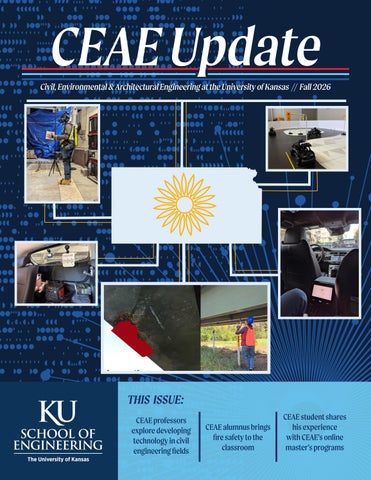
Photos of the developing technology in the Civil Engineering field. Technology includes AI scans of dams, autonomous vehicles, Waymo driverless cars and wearable exoskeletons for construction workers. Photos provided by Jian Li, Amit Ojha and Shi’an Wang.
EDITOR & DESIGNER Emma Herrman Comments, suggestions or address changes may be emailed to ceae@ku.edu or sent to: 2150 Learned Hall 1530 W. 15th St. Lawrence, KS 66045
The University of Kansas prohibits discrimination on the basis of race, color, ethnicity, religion, sex, national origin, age, ancestry, disability, status as a veteran, sexual orientation, marital status, parental status, gender identity, gender expression, and genetic information in the university’s programs and activities. Retaliation is also prohibited by university policy. The following person has been designated to handle inquiries regarding the nondiscrimination policies and procedures and is the Title IX Coordinator for all KU and KUMC campuses: Associate Vice Chancellor for the Office of Civil Rights and Title IX, civilrights@ku.edu, Room 1082, Dole Human Development Center, 1000 Sunnyside Avenue, Lawrence, KS 66045, 785-864-6414, 711 TTY. Reports can be submitted to the Title IX Coordinator by visiting the following website: civilrights.ku.edu/how-report
Fall 2026 |
1
News & Notes FACULTY UPDATES Jie Han was named a distinguished member of ASCE. He was formally inducted at the OPAL Gala in Virginia. He also completed the 2026 Cross Canada Lecture Tour from the Canadian Geotechnical Society.
Jie Han
Will Collins received the ASCE Region 7 Outstanding Faculty Advisor Award for his work as the advisor of the KU ASCE chapter.
Three CEAE faculty members were selected as Chair’s Professors during the fall 2025 semester. They will hold this appointment for three years or until they are promoted to the rank of professor. - Will Collins, Stanley T. and Phyllis W. Rolfe Chair’s Council Associate Professor - Josh Roundy, Harold A. and Donna R. Phelps Chair’s Council Associate Professor - Elaina Sutley, Diane M. Darwin Chair’s Council Associate Professor Amy Hansen received a Fulbright U.S. Scholar Award. She will spend three months in Chile during the Spring 2027 semester studying how water sources of different densities mix in natural environments. Justin Hutchison was chosen to join the Senior Administrative Fellows cohort of 2026-27. Amy Hansen
Alexandra Kondyli was named the Deane E. Ackers Professor by the KU School of Engineering. Andrés Lepage, Rémy Lequesne and Alex Weber-Kamin, Ph.D.’19, received the Mete A. Sozen Award for Excellence in structural research. Their work on high-strength steel bars in reinforced coupling beams led to building code changes that directly affect the earthquake-resistant design of tall reinforced concrete buildings. Rémy Lequesne was honored alongside University of Canterbury’s Santiago Pujol (first author) and Konkuk University’s Chungwook Sim with the American Concrete Institute’s Wason Medal for Most Meritorious Paper. Their article discussed the need for increased robustness in the design of buildings in highly seismic regions.
2
| CEAE Update
Brian Lines was named a Chancellors Club Teaching Fellow this past fall. He also completed his appointment as the David A. Ross Chair’s Council Professorship. Michael Panethiere will retire as professor of practice after 11 years of service to the department at the end of the fall 2026 semester. Josh Roundy presented the keynote address at the 2025 KC Urban Stormwater Conference where he spoke on the challenges of designing resilient stormwater infrastructure to extreme events. Elaina Sutley was selected as the president-elect of the Structural Engineering Institute (SEI). As the largest technical institute within ASCE, Sutley will lead more than 30,000 structural engineers and allied professionals in the U.S. and across the world as president of the organization. She was also named the chair of the Infrastructure Resilience Division of ASCE, co-editor-in-chief of the Natural Hazards Review and Elaina Sutley was selected as an honoree for Faculty Excellence. After being nominated by school and center leaders across KU’s campuses, Sutley was selected for her impact and contributions as KU faculty.
STAFF UPDATES David Woody retired as lab coordinator after 13 years of service to the department.
STUDENT UPDATES Two CEAE students were named Self Memorial Scholars for the 2026-27 school year. The Self Scholarship is given to outstanding graduating seniors continuing to complete their Master’s or Ph.D. at KU. - Dominic Arbini - Alivia Tolbert Tasmin Binty, Ph.D. Candidate in environment & water resources engineering, was awarded the 2025 KWEA Scholarship and was the runner-up in the 2025 KWEA Student Power Competition at the joint annual KWEA & KsAWWA Conference. Ben Dickerson, E’25, received the Professor Thomas Mulinazzi Family Scholarship. This scholarship was established by Professor Emeritus Mulinazzi to provide financial support to students within the CEAE Department.
Sarper Demirdogen, Ph.D. candidate in geotechnical engineering, received the Geosynthetic Institute Fellowship, from the Geosynthetic Institutewhere his proposed research validates the Design Methods in the Guide to the Working Platforms with Geosynthetics. This is KU’s 13th GSI Fellowship. Dee Erb, undergraduate in civil engineering, was selected for the Sharon D. Banks Memorial Undergraduate Scholarship from the Kansas chapter of the Women’s Transportation Seminar (WTS).
Three graduate students from CEAE participated in the poster competition at the 2026 Geotechnical Conference, hosted by the ASCE Kansas City Section and Geo-Institute KC Chapter at the Edwards Campus in Overland Park. Syed Shadman Sakib placed first and Haohua Chen placed second. Both students are studying under Jie Han. The KU chapter of ITE was selected as MOVITE’s 2026 Outstanding Student Chapter for its outstanding work over the 2025-26 academic year. This is the eighth time this chapter has received this award.
Saba Faghirnejad, Ph.D. candidate in civil (structural) engineering, presented her work at the Kansas State Capitol as Dee Erb part of the Capitol Graduate Research Summit. Faghirnejad was awarded second place for the impact of her research on improving tornado shelter access in Kansas. Vahidreza Gharehbaghi, Ph.D. candidate in civil (structural) engineering, won third place in the Student Paper Competition hosted by the ASCE Structural Health Monitoring and Control Committee at the 2026 Engineering Mechanics Conference in Boulder, Colorado. Sian Helfrich, master’s student in architectural engineering, was awarded several distinct Fellowships. She was awarded the ACI Foundation’s Robert F. Mast Memorial Fellowship, which recognizes outstanding graduate students in structural engineering studying reinforced concrete and she was awarded an NSF Graduate Research Fellowship, which recognizes students pursuing graduate research in STEM fields. Nhien Le, Ph.D. candidate in civil (construction) engineering, was awarded the ASSP Foundation Scholarship from the American Society of Safety Professionals (ASSP) Foundation. This scholarship awards students in the environmental health and safety fields who demonstrate leadership, professional excellence and integrity. Mona Shaheen, Ph.D. candidate in civil (structural) engineering, received the WTS Helene M. Overly Memorial Scholarship from the WTS-KS Chapter. This scholarship supports women pursuing graduate studies in transportation or a related field.
Mona Shaheen
Pragun Shrestha, master’s student in civil (structural) engineering, has been selected to receive the SEI Futures Fund Student Scholarship.
Kenneth Chinekwu Ugwuoke, graduate student in environmental and water resources engineering, was awarded first place at the Three Minute Thesis Competition. He received a small cash prize and has the opportunity to participate in the 3MT Midwest competition.
Top: Saba Faghirnejad presents her work at the State Capitol as part of the Capitol Graduate Research Summit. Middle: The KU-ITE Board posing in the Driving Simulator. Bottom: Students from the KU ASHRAE chapter attended the 2026 Winter Conference in Las Vegas alongside Professor Huijeong Kim.
Fall 2026 |
3
ALUMNI UPDATES Mike Welch, E’71, was featured in a recent WIBW news article celebrating Veterans Day. Since retiring from BRB Construction, Welch has been volunteering at the Combat Air Museum in Topeka. Rafael E. Frias III, E’04, was recently named the managing director for Europe, Middle East and Africa for Black & Veatch. He previously served as vice president for Black & Veatch’s government and communities business in the United States. Sean Cameron, E’15, G’16, has been named a principal at Alper Audi. Previously, Cameron served as a senior project manager. Gabriel Ryan, E’25, was awarded the Robert L. & Lucille J. Smith Scholarship. This award is given to undergraduate seniors with a passion for water resources and hydro sciences. Mandy Gibbs, E’26, was selected as the recipient of the ASCE Region 7 Outstanding Student Member Award for 2026. This award recognizes Gibbs’ outstanding contributions, leadership and dedication to the civil engineering profession and ASCE student community. Gibbs served as the KU ASCE chapter president for two terms.
HAVE AN UPDATE YOU WANT TO SHARE? Submit your alumni news to:
ceae@ku.edu 4
| CEAE Update
Left: High school students enrolled in the School of Engineering’s summer camp use the KU-ITE Driving Simulator. Top: Working alongside Water District No. 7 in Johnson County, some of Justin Hutchison’s students worked on water sampling and validating water quality models as part of the KU ARISE project. Middle: Students in ARCE 560 tour the HVAC and mechanical systems of LEEP2, led by Jacob Lee, a university engineer from KU Facilities. Bottom: The combined classes of CE 736 and CE 895 find a turtle during a float trip down the Wakarusa River as a trip in collaboration with the Friends of the Kaw.
Student Achievements KU Engineering student groups continue to excel at annual ASCE championship
The KU-ASCE Chapter attends the 2026 ASCE Symposium.
T
he Civil, Environmental & Architectural Engineering Department student groups took home several awards at the 2026 ASCE Symposium at the beginning of April. The KU ASCE chapter, Concrete Canoe and the Steel Bridge program traveled to Carbondale, Illinois, to take part in their respective competitions. Concrete Canoe took home first place in Technical Proposal and second place overall for the competition, the third year in a row the team has held this position. “I’m so proud of what the younger members have been able to accomplish after stepping into leadership roles,” Dominic Arbini, senior in architectural engineering and Concrete Canoe captain from Fenton, Missouri, said. “They have truly bought into what we do and why we do it. Results aside, we all had fun and are excited about next year, talking about themes and innovations.” This year’s canoe theme, Prairie Fire, went deeper than just its appearance. Since prairie fire itself is important to the Kansas ecosystem, the Concrete Canoe team used this as a theme of regrowth and adaptive reuse goals for this year’s canoe. Restoring a prior mold, the team set ambitious embodied carbon reduction goals for their concrete mix and looked inward to make their club practices sustainable as well.
“Like the phoenix on our canoe,” Arbini said, “our team has truly risen from the ashes to become stronger than before.” Hannah Poe, senior in civil engineering from Overland Park, was awarded third place in the Student Symposium Paper Competition. Her paper, “Ethics and the Responsibility of Engineers to Advance the Public Welfare,” explored the history of the engineering and construction of the Kansas City, Missouri, Downtown Highway Loop, including insights into the damage it caused the city and what engineers are doing today to reverse and mitigate the harm done. “I chose to write this paper because engineers must not overlook the importance of engaging with all communities that our projects impact to fully understand their needs,” Poe said. Finally, KU’s Steel Bridge team also traveled to compete in this year’s competition and, though they didn’t take home any awards, the team is already looking forward to the new year and new challenges. The Steel Bridge program was designed to provide KU engineering students with an opportunity to work on a nationally competitive design team. Students involved in the program are able to develop teamwork and communication skills necessary in the workplace, steel fabrication skills, CAD Design experience and more.
Fall 2026 |
5
KU Steel Bridge President Molly Hageman, from St. Louis, Missouri, is proud of the work she and her team accomplished over this past year and is looking forward to the next year. “Regardless of the results, watching the team bond through the highs and lows of the symposium was by far the highlight of the weekend,” Hageman said. “Seeing how much we learned and grew as a team makes me really excited for next year’s competition.” In this competition, each student team develops a concept for a scale-model steel bridge to span approximately 20 feet and to carry 2,500 pounds. The team must determine how to fabricate their bridge and plan for an efficient assembly under timed construction conditions. Finished bridges are loadtested, weighed and judged on aesthetics. “I am immensely proud of how our KU team competed this year,” Mandy Gibbs, recent grad in civil engineering and former KU ASCE President from Leawood, said. “This is one of the most rewarding weekends of the year and I can’t wait to see how this year’s success translates into hosting the Symposium at KU in 2027.” The ASCE Mid-America Student Symposium is one of 22 ASCE regional student symposia held annually as an opportunity for student chapters to showcase their skills and achievements in various civil engineering activities. The MidAmerica Region includes 17 universities from Kansas, Illinois, Iowa, Missouri, Nebraska and South Dakota. The University of Kansas is scheduled to co-host the ASCE Student Symposium April 22-24, 2027, with Benedictine College. If you are interested in supporting the 2027 Symposium by donating or volunteering, please contact ASCE Faculty Advisor Will Collins at william.collins@ku.edu.
Left: Hannah Poe with her third-place certificate for her paper “Ethics and the Responsibility of Engineers to Advance the Public Welfare.” Top: The Concrete Canoe team with their canoe “Prairie Fire” before the race. Middle: the Steel Bridge Team working to put their steel bridge together during the competition. Bottom: Calvin Kilpatrick (left) and Mandy Gibbs (right) during the Concrete Cornhole competition.
6
| CEAE Update
KU-ITE helps transportation students bridge the gap from campus to career By Wambui Ngunjiri
The KU-ITE chapter during the Transportation Career Panel, featuring panelists from the Kansas City chapter of WTS.
T
here is a lot people don’t tell you about life after graduation. Moving from one world to the next means facing new rules, goals and expectations while learning the landscape of an industry. Part of a college education is making that transition easier. The goal is to build toward the future so the gap becomes a single step instead of a leap. The University of Kansas’ student chapter of the Institute of Transportation Engineers (KU-ITE) helps students close that gap every day. KU-ITE is a student chapter of the Institute of Transportation Engineers, an international organization that includes different people who are active in transportation, including both engineers and planners. KU’s chapter focuses on its members’ educational and professional development. Its goal is to give them a lasting connection to the world of transportation engineering. “KU-ITE brings together all of the students, even professors, to connect them with different industry professionals,” co-president Saurav Shrestha said. Through speaker events, panels, technical tool sessions and conferences offered through the national ITE organization, members see the full picture of the field: the companies, research, projects and day-to-day work. Each event gives students a closer look at professional-level projects and the kind of work that could be in their future. “KU-ITE has been a very good opportunity for me to learn what companies are out there,” co-president Magham Tabatabaei said. “Because as international students, when we come to the U.S., we are not really familiar with the consulting companies, so KU-ITE really helps you to get to know all of them and what they do.”
As students see the industry more clearly, KU-ITE also helps them step into practitioner roles. The chapter puts members and their resumes in front of professionals and introduces them to the network in their own backyard. Most recently, KU-ITE added a career panel to its lineup. It partnered with KU’s chapters of the Kansas Association of Planning Students and the American Society of Civil Engineers. The chapter also invited the Kansas City chapter of WTS, an organization for advancing women who move transportation forward, to take part. Membership also builds a cohort of industry peers. Through social events and conferences, students form a network that grows more valuable over time. “I enjoy working with them and building community,” Tabatabaei said. “Throughout hard times, we can also be there for each other.” KU-ITE has recently grown its membership, its number of undergraduate students and its executive board. That growth means more resources and more opportunities for students. The chapter’s work has also earned national recognition. In 2026, MOVITE named KU-ITE an Outstanding Student Chapter. This is the eighth time the chapter has received the award, a record built by each class of student leaders handing a stronger chapter to the next. “I like providing this opportunity to build connections,” Tabatabaei said. “I obviously want the chapter to keep running so that other students will also have the same opportunities that I had.” Every career has to start somewhere. For transportation engineering students at KU, KU-ITE is the tool, the vehicle and the guide that helps them cross the gap from college to career.
Fall 2026 |
7
Student Profile Thomas Moore
Lifelong Learner Former underwriter turned project engineer completes his third online master’s degree
By Emma Herrman Photos provided by Thomas Moore
I
t was time for a change. One of many who were affected by the economic crash of 2008, Thomas Moore was looking for a career pivot. Originally a surety bond underwriter, Moore had always had an interest in the engineering side of the projects he supported. Which is why he found himself researching online master’s degrees in construction management. The University of Kansas wasn’t on his initial list but while weighing options that didn’t require him to quit his current job working with one of the contractors he had underwritten for or pay $80,000 a year for night classes in Southern California, Moore saw a pop-up ad for KU. “The school wasn’t even on my radar, but it just popped up,” he said. “I looked at the pricing and when the classes were offered and I was like, wow. That really got the ball rolling.” That ad led to a master’s in construction management, which led to another master’s in engineering management, which then led to a final (for now!) master’s in civil engineering, which he will complete in December 2026, all completed from his hometown of Los Angeles.
A CAREER WITH DETOURS Moore’s path into the field was anything but linear. Born and raised in Southern California, Moore earned an undergraduate degree in quantitative economics and spent years as a surety bond underwriter, working with home builders and contractors. Watching the projects come to life, Moore found himself wishing he were building them instead. “At the time, my career was established and I felt like I was stuck,” he said. The 2008 financial crisis made the decision for him. After being laid off, Moore consulted for a contractor he had once helped bond, then joined the crew as a laborer on highway transportation projects. While working on site, Moore took
“The school wasn’t even on my radar, but I looked at the pricing and when classes were offered and was like, wow.” Moore (middle) during a campus visit in spring 2026 where he met with Professors Jian Li (left) and Brian Lines (right).
8
| CEAE Update
The Oxnard Wastewater Treatment Plant, Moore’s current project, located in Oxnard, California.
electrical classes at a local community college before he moved on to his first rail project. “I learned about the various RFIs and submittals and I was interested in it,” he said. After earning his post-baccalaureate certificate in construction management from UCLA, he was hooked. It was time to start looking for master’s degree programs that would work for him and his career. His elective courses in engineering management covered leadership, technical writing and buy-in, and kept bringing him back to the idea of a second master’s degree. He started his engineering management degree in summer 2023 and had the degree in hand by spring 2024. But Moore wasn’t done. “The funny thing is, Professor Lines reached out to me because he got a request to be a reference for my application,” Moore said. “And just like that I was back.”
Moore during graduation where he received his Master’s in Construction Management.
Building on what he had previously learned in his construction management master’s, Moore was eager to learn more in a constantly developing industry. “When I finished my first master’s, some of the courses I was interested in weren’t available yet. They hadn’t even been thought of,” he said. He wanted to learn more about requests for proposals and project delivery methods. “I was like, I have to do this.”
BALANCING WORK AND SCHOOL Moore lives in Los Angeles and works in Oxnard, 70 miles up the California coast. His current project is a wastewater treatment plant for Mass Electric, a Kiewit subsidiary. His days start at 7 a.m., connecting with the crew followed by a review of the day’s plan. After multiple airport and rail projects, it’s his first foray into industrial power, so he does a fair amount of learning on the job. “I have to do a little research on my own, but I wouldn’t change it for anything,” Moore said. “I work with some great people. Working at Kiewit has definitely been the culmination of the work I’ve done, and they’ve been so supportive of my academics.” Juggling coursework is actually pretty easy, according to Moore, thanks to a mindset that many college students probably wish they had. “The more you put on my plate, the better organized I am,” he said with a laugh. “I’m wired weird.”
“Working at Kiewit has definitely been the culmination of the work I’ve done, and they’ve been so supportive.” Fall 2026 |
9
The Oxnard Wastewater Treatment Plant, Moore’s current project, located in Oxnard, California.
He only has one remaining class for his degree in this last semester, so he added a graduate certificate in city and county management just to keep his brain busy. It also satisfies a long-standing curiosity about how cities build budgets and fund capital improvements. “Maybe when I retire, I can work with the city in their planning department or something like that,” he said. “Forty years ago, I probably would have been stressed, thinking I was going to miss out on a party or something. As you get older, you realize something else will come along.” Despite being entirely online, Moore has never felt isolated from his professors or his fellow classmates. “Whether it was Professors Dan Tran, Brian Lines, Michael Panethiere or Alexandra Kondyli, if I was stuck on something, they were always available,” he said. “I don’t think I’ve ever gone more than 24 hours without a response.” Instructors often asked him to share his field experience, which got conversations going and loosened up younger classmates. Some now message Moore directly for advice, including two students who landed job offers with prestigious companies and wanted to learn more about the companies and what their careers might look like there. “They’re new in the industry, so they don’t know who’s who,” he said.
“You get out of it what you put into it. If you do something because you want to, everything else will come.”
10 | CEAE Update
AFTER GRADUATION (AGAIN) Despite being in his 60s, Moore doesn’t plan on leaving the job site anytime soon. His plans include working for another decade, hopefully staying in the job-site trailer in some type of mentoring capacity. “I only want to go as high as what keeps me in the trailer,” he said. Down the road, he could see himself teaching at the community college level or working in a city planning department. In the meantime, he’s continuing his tradition of lifelong learning by pursuing professional certifications, including one as a certified construction manager through the Construction Management Association of America and a construction health and safety technician credential. His advice for prospective students considering an online master’s degree while also being a working professional is to get buy-in from family first, then commit. “You get out of it what you put into it,” he said. “It’s true what they say that if you do something because you want to do it, everything else will come.” For fellow nontraditional students, his advice is simple: “A lot of people think the time has passed them,” he said, “but it hasn’t.” He’s also taken a lot of life lessons from his younger classmates, whether it’s learning the constantly changing technology or taking a step back to see the bigger picture. “As a seasoned professional, I tend to look at things as is, this is the lane that was given to me and that I’m on,” he said. “Younger students look at things in totality. They see the other highways they’re not on.” Though Moore claims this degree really is his last, he’s not willing to close the book on this chapter of his life just yet. There’s always a chance that another course will spark his interest again. No matter what, learning isn’t going anywhere. “I look at how my father aged. He was happy getting older because he kept his mind going,” he said. “I want to make sure I always have a purpose.” Learn more about CEAE’s online master’s degrees by visiting online.ku.edu/graduate-programs.
Building the Future
How CEAE Faculty are redefining the field of civil engineering By Emma Herrman
Photos provided by Jian Li, Brian Lines, Amit Ojha and Shi’an Wang
Fall 2026 | 11
A
sk six civil engineers what’s changing in their corner of the discipline, and you’ll get six different answers – tracking how driverless cars change human driving behavior, asking whether concrete can be printed instead of poured, teaching drones how to spot fine cracks in a steel bridge or a concrete dam. But listen closely, and a single thread runs through all of it: technology is giving engineers more data, more automation and more capability than ever before, but none of it can fully replace the engineer. Across transportation, structural health monitoring and construction management, KU CEAE faculty are working at the edge of what’s possible in civil engineering.
THE ROAD AHEAD For transportation engineers, the last decade has been a lesson in tempered expectations. Deane E. Ackers Professor Alexandra Kondyli can remember when fully autonomous vehicles felt imminent. “In the beginning of my career, it was all about how autonomous vehicles will eliminate crashes and fatalities and improve safety and efficiency,” Kondyli said. “But then the industry realized that it wasn’t as easy as it seemed.” Alexandra Kondyli That hasn’t slowed the research – it’s redirected it. Kondyli’s work now looks less at replacing drivers and more at how autonomous and human-driven vehicles behave around each other, and how connectivity between cars and infrastructure could make the whole system safer. It’s also introduced an interesting aspect to the research that not many people may be thinking of: accessibility.
“How can we use these automation systems to help support older adults who would otherwise have to stop driving? Or how can we support people with disabilities to improve their mobility?” Kondyli said. “That’s an application of automation that I’m excited about.” Assistant Professor Shi’an Wang, whose background is in electrical and computer engineering, is approaching the same questions from the sensor and data side. His lab has assembled a fleet of small-scale fully autonomous test vehicles – outfitted with Nvidia chips, camera and lidar – that can drive themselves and talk to each other on a closed track, giving researchers a testbed for questions too risky to run on public roads. Shi’an Wang “We have a lot of sensors that can help us collect data,” Wang said. “You can put a sensor on an autonomous car and a sensor on a human-driven vehicle, but it’s possible to have a bias – if the driver is aware they’re being watched, they may drive differently.”
“The technology is pretty much the same worldwide — it’s the bureaucracy that’s causing the difference.” Both transportation engineers point to the same bottleneck: infrastructure and policy haven’t yet caught up with the technology. Heavier electric vehicles are straining pavements and barriers designed for combustion engines. Intersections need clearer sightlines for camera-based systems. And in much of the country, autonomous vehicles remain more lab experiment than daily commute. For example, Waymo has expanded to cities like Austin and Washington D.C., but stalled in Minneapolis when winter weather proved too much for the technology. “A car is just a car,” Wang said. “They don’t have any political views. The technology is pretty much the same worldwide – it’s the bureaucracy that’s causing the differences.”
STRONGER, SMARTER STRUCTURES
Rémy Lequesne One of the fully autonomous test vehicles equipped with Nvidia chips located in Wang’s transportation lab.
12
| CEAE Update
If transportation engineering is wrestling with automation, structural engineering is quietly being reshaped by materials science and a new appetite for AI-assisted design – with plenty of caution attached. Black and Veatch Professor Rémy Lequesne studies reinforced concrete mechanics and his research points to a decades-long shift now reaching maturity: the adoption of dramatically higherstrength reinforcing steel, some 30 to 70%
“Ultimately, the output from AI is its best guess, and that’s not good enough...It’s up to humans to make the final call.”
A Waymo navigates the streets in San Francisco.
stronger than the industry standard that held for generations. “That required a lot of research and discussion among researchers and practitioners, and it led to major changes to the building code,” Lequesne said. “KU was heavily involved in those changes.” Stronger materials mean that engineers can use less of them leading to potentially faster and more sustainable construction, but when it comes to letting artificial intelligence into the design process itself, Lequesne is still hesitant. Engineers, after all, are still responsible for the safety and functionality of the buildings they produce. “Ultimately, the output from AI is its best guess, and that’s not good enough for engineers designing buildings that people rely on,” he said. “It’s ultimately up to humans to make the final call.”
That same caution is communicated by Deane E. Ackers Professor Jian Li, whose research sits at the intersection between structural health monitoring and computer vision. “We’re basically serving as doctors for structures,” he said. Li’s team sends drones over concrete dams to capture massive volumes of imagery in a research project that’s been ongoing for the past four years and is Jian Li part of a partnership between KU, the U.S. Army Engineer Research and Development Center, the Department of Homeland Security’s Science and Technology Directorate and the U.S. Army Corps of Engineers. The imagery is used to create detailed 3D digital twins, while AI helps identify and map damage such as cracks and spalling in concrete dams, allowing engineers to document where damage occurs and track how it evolves over time. In a parallel project, his lab is developing augmented-reality headsets that let human inspectors see AI-flagged defects superimposed directly onto the real structure in front of them, replacing hand-drawn sketches with real-time digital records. “We’re not replacing humans entirely,” he said. “We’re augmenting human capability.” Even training the AI requires people. Labeling a photograph of a cat is easy for a crowdsourced workforce; identifying and labeling subtle structural defects, such as small cracks in steel bridges or deterioration on concrete dams, requires engineering expertise.
Digital twin model of a concrete dam developed by Li’s student Vahidreza Gharehbaghi.
Fall 2026 |
13
“The purpose of technology should be to support the worker rather than replace the worker.” “It’s beneficial to still have some humans do some gatekeeping,” Li said, “to make sure the data being fed into the next-generation model is well maintained.” Both structural engineers see the same horizon: a future where design, construction and maintenance stop operating in silos and instead form one continuous, data-driven life cycle for every structure.
THE HUMAN BEHIND THE MACHINE
Amit Ojha
For Assistant Professor Amit Ojha, emerging technology in construction isn’t about removing people from the equation, but rather about protecting them. His research spans wearable robotics, hazard-monitoring drones, physiological sensing and immersive training tools, all built around one idea: giving workers layers of protection technology alone can’t provide.
“The purpose of technology should be to support the worker rather than simply replace the worker,” Ojha said. “A crane allows workers to move loads that would otherwise be impossible to move manually. Emerging technologies are another step in that evolution.” Ojha is especially focused on occupational exoskeletons – wearable robots that reduce the physical toll of repetitive, awkward or heavy labor. The next frontier isn’t just whether an exoskeleton helps; it’s whether it can adapt in real time. “The research question is no longer simply, ‘Does an exoskeleton reduce physical demand?’” Ojha said. “It becomes, ‘Can we develop wearable robots that understand enough about the worker and the task to provide the right assistance at the right time?’” That shift mirrors a broader change Ojha sees across construction safety: a move from reactive to proactive. Traditionally, the industry has investigated accidents after the fact. Wearable sensors, computer vision and AI are starting to offer something closer to an early warning system. “I compare it to the difference between a rearview mirror and a dashboard warning system in a car,” he said. “Traditional safety data tells us what has already happened. Emerging technologies have the potential to give us an earlier warning that something may be going on.” Even so, Ojha is careful to note the limits of what these systems can interpret. A spike in a worker’s physiological signals might mean fatigue, but it could also mean heat, stress or simply a hard task. “The system may detect that something has changed,” he said. “Understanding why it changed is much more difficult.” That same tension between innovation and caution shows up in the research of Associate Professor Brian Lines, whose work on project delivery and organizational change has taken him into dozens of design and construction firms across the country to see how they’re actually adopting new technology. What he’s found is a field moving unevenly – some firms are still doing little more than basic chatbot queries, while some are Brian Lines testing whether AI agents can replicate specialized structural or bridge-design work in real time. “Saying that your company has access to ChatGPT is meaningless now,” Lines said. “It doesn’t mean anything anymore.”
“At its core, engineering is still engineers understanding the needs and constraints and designing something that works.” Lines visits an industrial site where he was performing a productivity analysis of the crews.
14
| CEAE Update
Luke Attard tests his augmented reality and AI-driven bridge inspection tool, which captures an image of the bridge and uses AI to detect corrosion, which is then overlaid onto the real-world view of the bridge as a holographic image.
Lines expects AI to absorb much of the industry’s repetitive, document-heavy work, freeing up senior staff for the parts of the job machines still can’t do. But professional liability keeps the final call in human hands. “A lot of the repetitive and entry-level work is going to get absorbed,” he said, “but that has ramifications for how we lead companies and train the next generation.” Underneath that technology shift, Lines points to a demographic one: much of the industry’s most experienced generation is retiring faster than younger engineers can absorb their knowledge – a combination he believes is turning so-called soft skills into the real differentiator. “We are losing knowledge out of the workforce every day with fewer folks in the ranks behind them,” he said. “The human side of things – trustworthiness and collaboration – become the differentiator, because technology access will become ubiquitous rather than a differentiator among firms.”
“Real human beings are not as collaborative as machines,” Wang said. “We cut people off and road race. That’s something technology may not easily address.” For students entering the field, the message from this generation of researchers isn’t to fear the machines. “AI is already here, and it won’t go away easily,” Wang said. “Instead of being scared of this, why not try to embrace it and take advantage of it?”
WHAT DOESN’T CHANGE Ask our civil engineering faculty members where their field will be in a decade, and the answers converge on something surprisingly unautomated: judgment. “At its core, engineering is still engineers talking with building owners and other project stakeholders to understand the needs and constraints and design something that works,” Lequesne said. This can be seen across many other fields within civil engineering. Li imagines AI will eventually manage entire structural life cycles, but only with humans setting the guardrails. Ojha can see future engineering graduates who are comfortable with data and sensors, but who also know when to trust it, when to question it and how to interpret the information it provides. Kondyli and Wang keep returning to the unpredictable variable no algorithm has fully solved: people.
A member of Ojha’s research team tests a wearable robot exoskeleton. This technology measures localized muscle fatigue, metabolic cost, ergonomic risk and more.
Fall 2026 |
15
CEAE Academy The KU CEAE Academy, founded in 2011, honors our department’s most distinguished alumni and former faculty. Members are chosen by the CEAE Advisory Board in recognition of their outstanding professional achievements, high ethical standards, advocacy and support of KU CEAE.
T
he Civil, Environmental & Architectural Engineering Department has inducted two new alumni into the department’s CEAE Academy. Phil Gibbs Sr., class of 1966 and 1967, and Gerardo Prado, class of 1995, have been selected as this year’s inductees. Members are nominated by the CEAE Advisory Board in recognition of their outstanding professional achievements, civic service and advocacy and support for the department. Phil Gibbs Sr., has had a six-decade career shaping major development across the Kansas City region, from highways and stadium complexes to residential communities, industrial facilities and landmark civic projects. Gibbs earned his bachelor’s and master’s degrees at KU before serving as a commissioned officer in the U.S. Public Health Service, overseeing facility modernization. After returning to Kansas City, he founded Continental Consulting Engineers, which has become known for its broad expertise and enduring client relationships. “I’m honored to be a part of a group that has already recognized other great engineers,” Gibbs said. “My opportunity to work in the whole greater Kansas City area has just been fantastic. It really has.” Gerardo Prado is a nationally recognized sports architect whose 29-year career has shaped major sports and entertainment venues across the country. He graduated from KU in 1995 and 1996 with degrees in architectural engineering and architecture. As a national sports practice leader at HNTB, he led one of the industry’s top-performing sports architecture groups before founding Prado Consulting Group in 2025, where he advises the AEC and sports industries on a wide variety of topics. “It is humbling to be recognized and rewarded for contributions to the industry,” Prado said. “I certainly still have a lot of gas in the tank and I’m hoping to continue to mentor and look for more ways to give back to KU.”
PHIL GIBBS SR., E’66, G’67 B.S. & M.S. Civil Engineering
Raised in Kansas City, Kansas, Phil Gibbs Sr., enrolled at the University of Kansas in the early 1960s after completing pre-engineering coursework at a local junior college. At KU, he gravitated toward structural analysis and research, ultimately earning both his bachelor’s and master’s degrees in civil
16
| CEAE Update
Phil Gibbs Sr. in the lab in 1966. Photo provided by Phil Gibbs Sr.
engineering. His graduate research was groundbreaking at the time as he not only built a scale model of Templin Hall but was one of the first students to use the recycled wind tunnel in Learned Hall to study wind uplift on flat roofs. Following graduation, Gibbs began his career in the U.S. Public Health Service, commissioned during the 1970s and assigned to the Surgeon General’s office in Washington, D.C. There, he worked on hospital modernization projects across the country, gaining hands-on experience in facility upgrades, structural problem-solving and public service under pressure. This experience reinforced a philosophy that would guide his career: engineering as a form of public responsibility. “Civil engineering, whether you like it or not, is law and order,” he said. “Everything we do, we have to follow the law.” In 1976, Gibbs founded Continental Consulting Engineers, launching a firm that would help shape the Kansas City metro area for decades. His portfolio includes landmark projects such as the Truman Sports Complex, Hallbrook Farms, the
Kansas Speedway and numerous regional developments and infrastructure. Under his leadership, Continental became the first firm selected as a special inspector in Kansas City following the Hyatt Regency collapse, an opportunity Gibbs credits with reinforcing the importance of independent oversight and ethical practice. A strong advocate for education, planning and mentorship, Gibbs has remained deeply connected to KU and the civil engineering profession. His firm remains family-run, with his son and daughter actively involved and his granddaughter already gaining hands-on experience through company contracts. “Having a family-run firm is the best,” he said. “The family cares and are involved in the stability of the firm and workability of the people we’ve hired.”
GERARDO PRADO, E’95
B.S. Architectural Engineering
Prado presents at NACADA. Photo provided by Prado.
Born in Rosario, Argentina, Prado moved with his family throughout Central America before eventually settling in the United States. His unique blend of creativity and analysis was rooted early in Prado’s life. A lifelong artist who began drawing in elementary school, Prado found architecture to be the natural intersection of his passions. “I’ve always been very analytical and creative,” he said. “Engineering is the technical side in support of architecture. The two have to work together. They don’t work independently.” His path to the University of Kansas came through early outreach through KU’s Minority Engineering Programs, then known as the Student Council for the Recruiting, Motivating and Educating of Black Engineers. This opportunity proved pivotal, thanks to the support of the program’s director Florence Boldridge, whom Prado regards as both a mentor and a steady source of support during his early years on campus. “She was a second mom to me,” he said. “I was in her office weekly, just checking in.” Thanks in part to Boldridge’s support, Prado earned his architectural engineering degree in 1995 and completed a dual degree in architecture in 1996, building a foundation that combined technical rigor with creative exploration.
Over nearly three decades, Prado built and led a nationally recognized sports architecture practice within HNTB, guiding complex projects that shaped campus identity and community experience. His portfolio includes major professional, collegiate athletic facilities and long-range campus planning efforts, with an emphasis on collaboration and service-oriented leadership. Most notably, Prado returned to his alma mater to lead the design team for the David Booth Kansas Memorial Stadium redevelopment, a defining project that allowed him to give back to the University of Kansas while transforming one of the most iconic parts of the KU campus. “Nobody can achieve great things by themselves,” Prado said. “Everything is a team effort, and that’s what I love about the analogy of sports, business and life.” In 2025, Prado launched Prado Consulting Group, marking a new chapter focused on early visioning, strategic planning and advisory services across the architecture, engineering and construction industries. “I wanted to build my own consulting practice and select clients that align with me culturally and with my values,” he said. Today, he works nationally with universities and firms, helping guide complex projects while continuing to mentor emerging leaders. Learn more about our CEAE Academy members by visiting ceae.ku.edu/academy.
The recipients of the 2026 CEAE Awards Banquet. Prado is on the far left and Gibbs Sr. on the far right.
Fall 2026 |
17
Alumni Spotlight Ben Brooks, E’12
Blaze Your Own Trail
KU Alumnus gets fired up in fire protection engineering
By Nora Colwell Photos provided by Ben Brooks
O
riginally from St. Louis, Ben Brooks knew from a young age that he wanted to be an architect and an engineer. Growing up with strong ties to fire protection, today Brooks is the founder and head of Brooks Fire Protection Engineering and co-founder of Central Plan Review. He is also an adjunct lecturer in KU’s Department of Civil, Environmental & Architectural Engineering (CEAE). Brooks has taught and curated classes at KU in fire protection engineering, plumbing engineering, advanced sprinkler design, structural fire protection engineering and more. Brooks completed his bachelor’s degree in architectural engineering at KU and his master’s degree in fire protection engineering online from the University of Maryland while working for a firm in St. Louis, Ross & Baruzzini, now called Introba. Brooks started as an architectural intern, then a plumbing design intern, eventually leading the plumbing team, starting the fire protection engineering discipline and becoming national director of fire protection engineering, growing a “business within their business.” After 13 years at Introba, Brooks decided to start his own business in 2024 after moving to Kansas City.
to his grandfather, Emil Hrbacek, who worked with the St. Louis fire departments and co-created a program at St. Louis Community College at Forest Park to help firefighters earn their associate degrees to become officers in their respective departments. He would voluntarily respond to five-alarm or greater fires with the St. Louis City Fire Department. Brooks keeps his grandfather’s old firefighter coat, helmet and Fire Line Pass as mementos after Hrbacek’s death in January 2024 at age 95. While discerning his “calling to provide back to the community” and desire to start his own business, Brooks took
“My long-term goal is to have at least one person say I impacted their life.” Working with clients, contractors, fire departments and authorities in Kansas City and St. Louis, Brooks covers a lot of ground literally and figuratively. Brooks strategically juggles performing site surveys, meeting with architects and mechanical, electrical and plumbing engineers for sprinkler or fire alarm design and completing necessary engineering analysis for different hazard commodities. Brooks credits his inspiration to pursue fire protection
18
| CEAE Update
Brooks’ children take part in a firehose demonstration in Lenexa.
Brooks and NFSA presenting a side-by-side burn trailer as part of Brooks’ fire protection engineering class, which has become an annuall event alongside the Lawrence-Douglas County Fire Medical.
his grandfather’s advice into account. “You never regret the things you do in your life,” Brooks said. “No matter how big the mistake, you never regret what you do because you know what happened. You regret what you don’t do.” His grandfather’s advice, paired with the strong support system of his wife and business-owner friends such as Joe Meyer, also a KU architectural engineering alumnus, ultimately pushed Brooks to take the leap of faith to start Brooks Fire Protection Engineering. “I’m most proud of having an impact with the fire departments, in St. Louis in particular, that knew my grandfather. I get to help the people that my grandfather taught, even though those people are retiring now,” Brooks said with a laugh. “I’m touching the same people at the end of their career as my grandfather impacted at the beginning of their career. I’m also helping and providing education as much as I’m learning from them.” When asked about short-term goals, Brooks said, “To have a company that allows me to be the best father that I can be.” “My long-term goal is to have at least one person say that I impacted their life,” he said. “My biggest drive for continuing the business is providing education and a unique approach that is not just focused on productivity goals, profits and spreadsheets. My goal is to help the industry, to bring engineers, contractors and code officials together.” Brooks said his favorite part of his job is “identifying problems and then presenting different options for how a solution could look for the owner or project, because very seldom is there one solution. There are different solutions with different priorities.” Brooks was drawn to the opportunity to simultaneously explore the schools of architecture and engineering, which led him to deviate from his family’s history of attending the University of Missouri-Rolla and forge his own path. Having applied to KU the July before classes started, Brooks remembers being personally interviewed and welcomed to KU by Professor Tom Mulinazzi since it was too late for a typical freshman orientation. Mulinazzi was one of many influences on Brooks during his time at KU.
Under Professor Tom Glavinich, who Brooks said inspired students to follow their passions, Brooks and Joe Meyer took independent study classes in fire protection. Professor Brian Rock, “Doc Rock”, the professor who showed Brooks that plumbing and fire protection were options, also later referred Brooks to the department to be an adjunct lecturer. Caroline Bennett, chair of the CEAE department, stands out as the professor who taught Brooks steel structures. Bob Lyon, with HNTB, came to teach structural engineering and brought a lot of practical experience to Brooks’ schooling. Beyond KU, as a remote master’s student, Brooks said there are many professors who likely don’t realize the impact they had on him, such as James Milke, former chair of the Department of Fire Protection Engineering at the University of Maryland and author of many books in fire protection. Along with fond memories of professors, some of his greatest memories at KU were from architecture studio in Marvin Hall or shutting down Spahr Library and the fishbowl computer lab in Eaton Hall. Brooks said, “It fit my work ethic, which was push, push, push, push, push.” Brooks remembers a time when all the students in his
“It’s good to see KU is still growing and leading the way. It makes me proud to be a Jayhawk.” class gave up on a homework assignment for mechanical engineering Professor Peter TenPas, who said, “Nope, you’re not getting out of it that easy.” TenPas taught Brooks that even a problem that seems too hard can still be solved. A study group formed. “Some of my best friends I still have today came from fluid dynamics with Dr. TenPas,” Brooks said. Brooks recalls a story from his senior year when he was teaching in the Kansas Algebra Program. The fire alarm went off in class around the time Brooks had made a working
Fall 2026 |
19
wall model of a fire alarm, complete with a fire panel, fire pump and sprinkler. When Brooks found his mentor, KU Fire Marshal Bob Rombach, among those responding to the alarm, Brooks helped silence the alarm but also made his grievances known about not being able to give his MATH 101 quiz to his students. “The contractor, or whoever was there, looked at Bob and goes, ‘Who’s this kid? Why is he touching our stuff?’” Brooks said. During undergrad, Brooks also had a passion for acoustics. He had a close relationship with architectural engineering faculty Bob Coffeen, who taught acoustics at the time and owned a well-known Kansas City-based acoustic engineering firm. When Brooks wasn’t in lab or volunteering at engineering expos, he helped Coffeen conduct real-life research and acoustic tests in Topeka and Lawrence.
“You have to have a vision of what you want, and the pathway to get there will make itself clear.”
That versatility is by design. The program equips graduates with working knowledge across mechanical, electrical, plumbing, fire protection, structural and project management — making architectural engineers sought after in virtually every firm they enter. “Every company seeks architectural engineers,” Brooks said, “because they have knowledge of all the other disciplines.” His advice to young engineers centers on a simple but consequential mindset shift: think of yourself as a small business. Certifications, licenses and continuing education aren’t just resume lines — they’re equity that compounds over time. “You’re no longer trading your time for money,” he said. “You’re trading your experience, your value, your relationships. Everything you need to bring to the table.” Brooks is equally direct about the importance of vision. He describes a career without a defined goal as aimless wandering. Keeping a clear peak in view, even when the trail ahead hasn’t been made yet, is integral to success. “You might hit dead ends, but you can still see that goal,” he said. “You have to have a vision of what you want, and the pathway to get there will make itself clear.”
Many of Brooks’ memories of KU are evergreen: “Going to the Underground, getting crunchy chicken cheddar wraps, that’s something I still fantasize about. And getting coffees from the Roasterie. There was never a bad day on campus. My freshman year we won the basketball championship, and I remember being down on Mass Street with a huge mass of people.” Though the two residence halls Brooks lived in, McCollum and Oliver, have been demolished, he is eager to see how the campus continues to evolve for the younger generations. “It’s good to see that KU is still growing and leading the way,” Brooks said. “It makes me proud to be a Jayhawk.” According to Brooks, KU architectural engineers are some of the most versatile professionals in the built environment — a breadth that mirrors his own friend group, whose ARCE cohort scattered across different disciplines after graduation.
Above: A hydrant flow test to determine available water pressure for fire sprinkler systems. Below: Brooks family in front of Strong Hall.
20
| CEAE Update
The Gibbs Family
Built to Last
Three generations of Gibbs engineers are shaping Kansas City and the future of KU CEAE By Molly Shanahan Photos provided by the Gibbs Family
B
elieved to be the first three-generation family in the history of KU’s CEAE department, the Gibbs family’s connection to KU Civil Engineering dates back to the 1960s. With careers in public service and contributions to infrastructure and site development in the Kansas City area, the family has been planning and designing parts of Kansas City for the last 60 years. Following duty in the U.S. Public Health Service, Phil Gibbs Sr. founded Continental Consulting Engineers in 1976, which currently operates offices in Leawood and Kansas City, Kansas. The engineering firm is family-founded and familyoperated. “Having a family business is the American dream and is just the best,” Phil Gibbs Sr. said. “The family deeply cares about the quality of services provided to clients as well as the success of the people we employ.” His son, Phil Gibbs Jr., is an integral part of Continental, as are his daughter, Susan, and his wife, Kathy. Phil Jr.’s early summer internships started with painting of the office walls as the business expanded into additional office space. He later assisted on the land surveying crew, which came in handy when it came time to take the Surveying class at KU and led to him being asked to teach the laboratory portion of that class for five semesters as an undergraduate student. Since joining the company full-time in 1994, Phil Jr. has worked to create iconic landmarks in the Kansas City area, and that work has transformed and created a lasting impact. “We helped the community win the speedway for the state of Kansas when there was a competition for it to perhaps be built in Missouri. We provided the City of Kansas City, Kansas, with support related to existing infrastructure capacities, project siting, and cost estimating assistance to determine the viability of the project. These quick services helped win the project for KCK and Kansas,” said Phil Gibbs Jr. “The Village West tourism district, which we designed as a result of Kansas Speedway coming to the area, now represents over 10% of the property value of Wyandotte County.”
Phil Jr.’s daughter, Mandy Gibbs, is a recent graduate of CEAE currently working on her master’s degree in transportation engineering at Vanderbilt University, and is the latest addition to the Gibbs generations. She has grown up around civil engineering and the projects Continental designed. “I went into civil engineering because of my dad and grandfather,” Mandy Gibbs said. “I grew up watching them work on projects, hearing their discussions about infrastructure design, and visiting sites as they opened. I found it fascinating that they were working on something on paper, and then you could see its impact in real life.” As the immediate past president of the KU American Society of Civil Engineers student chapter, Mandy Gibbs has
Phil Gibbs Jr.
Fall 2026 |
21
Mandy Gibbs
honed her leadership skills, but has taken the most pride in increasing student engagement numbers and mentoring younger members. “The past few years, we’ve seen an increase in membership, interest in attending meetings, and competing at the annual Mid-America ASCE Symposium,” Mandy said. “It’s really been fun to see how everyone enjoys ASCE. Each time I’ve attended the Symposium competition, it’s been wonderful to see how the younger members get excited about Civil Engineering the same way I did as an underclassman. Now, serving as a mentor to some of our younger members has been rewarding and a tribute to those older members who guided me.” For Mandy, civil engineering is a rewarding experience since it shapes the infrastructure people depend upon every day. “As civil engineers, you have a direct impact on citizens
of society and the community around you,” Mandy Gibbs said. “I think it’s really cool that we help design and build infrastructure that the public utilizes daily.” Phil Gibbs Sr. describes civil engineering similarly: “Civil engineering follows orderly design requirements and codified laws for the protection of the public.” Currently working toward earning a master’s in civil engineering and a future in her family’s business, Mandy Gibbs is planning for a career path that blends education, ambition and tradition. “I look forward to working with my dad and grandpa eventually,” Mandy said. “Right now, I’m planning on attending graduate school for the next couple of years to earn a master’s in civil engineering with a transportation emphasis.” This complements well the existing Gibbs family education with Phil Gibbs Sr. earning his Master’s in Civil Engineering with an emphasis in Structures and Phil Jr.’s earning his Master’s in Environmental and Water Resources Engineering. “My proudest accomplishment is that Mandy’s going to follow in my footsteps,” Phil Gibbs Jr. said. “When you have kids, that’s what you dream of. My other objective is to use my talents to do good things for my community, which I feel like I have done.” The lineage of civil engineers in the Gibbs family highlights their dedication to their Kansas City community, and their influence has helped shape infrastructure for the community’s good. And it is a direct result of the CEAE department at the University of Kansas.
Left: Phil Gibbs Sr. (left) and Phil Gibbs Jr. (right) at Gibbs, Jr.’s 1992 graduation. Top: The Gibbs Family at the sign of their family-owned company, Continental Consulting Engineers. Bottom: Gibbs, Sr. hard at work at Continental Consulting in 1978, two years after its founding.
22
| CEAE Update
Department Updates Clearing the Air
From wildfire smoke to hidden mold, CEAE professor is working to make sure the air indoors is safe to breathe. By Wambui Ngunjiri Photo provided by Nishit Shetty
If you’re indoors, take a deep breath, and then think about how you assumed it was safe to do that. There’s science Nishit Shetty behind making the indoor air we breathe safe, and it comes from people like Nishit Shetty who just want to help the industry reach that goal. Shetty, an assistant professor in KU’s Civil, Environmental & Architectural Engineering department, studies aerosol science, air quality, biomass burning emissions and bioaerosols. But the throughline of his work is a desire to help and effect change wherever he can. “What interests me in all of this is having research that impacts people,” Shetty said. “They know getting sick is not good. They know breathing smoke is not good, but they don’t always know what the best way to prevent that is.” Shetty grew up in India, surrounded by pollution and its effects. While he was earning his bachelor’s in chemical engineering from the Indian Institute of Technology in 2016, two professors, Sameer Dalvi and Pratyush Dayal, took a chance on him and led him into research. He came out of the experience immediately interested in seeking a Ph.D. in energy, environmental and chemical engineering at Washington University in St. Louis, where, inspired by his origins, he studied wildfires, beginning his ascent into studying air. When the pandemic hit near the end of his Ph.D., his focus shifted to biological aerosols. As a postdoc, he worked on developing a breathalyzer for COVID before moving to flu research at Virginia Tech. By then, Shetty had established a clear pattern of studying the air in whatever way the world needed most. He joined KU in 2024 to teach and build his Complex Aerosols Systems Lab, which studies indoor air to protect people from disease and smoke. “I think the best amalgamation of everything I’ve done was looking at indoor air,” Shetty said, “where we have both biological contaminants as well as wildfire contaminants. We spend a lot of our time in enclosed spaces, so we should make sure that it’s safe for humans.” His lab is currently working on detecting mold before it’s visible and developing interventions for indoor contaminants, including wildfire smoke. The team uses chemical characterization equipment and culturing materials to examine mold’s genetic material, along with particle sizers and low-cost sensors to measure tiny particles in the air. The mold project looks at which types grow in different
environments and tries to predict when and where they will appear. Recently, the team has been testing whether predictive AI models can help with early detection. According to Shetty, “the jury’s still out.” “AI is one thing that, for better or worse, has come into all of our lives,” he said, “and my philosophy with it has been that if you can’t beat it, you have to make sure you use it properly.” He’s most excited about portable instruments like the AeroTraK, which “measures particle concentrations as a function of their size.” In the field, he gets to see the changes he could make play out in front of him. “Conducting field research is what excites me and what I look forward to,” Shetty said. “Seeing the application of our research is on another level for me.” Shetty hopes to change standards and best practices for indoor air, with his research informing public health and government policy. He also sees a need to protect people from ineffective and potentially harmful devices, having watched a company silence scientists in the past. “We didn’t name the company in our paper,” Shetty said, “but we showed through experiments that their product was not working. That’s what we can do as scientists: make sure a company’s product is actually working.” In the next five to 10 years, Shetty would like to have “a self-sustaining program, which looks at the best interventions for keeping indoor air safe,” and to make progress on the fate and transport of contaminants: where they come from, what they’re doing and how to get them out.
Shetty performs a demonstration of his research at ARISE STEM night.
Fall 2026 |
23
CEAE Chair receives 2026 T.R. Higgins Lectureship Award The American Institute of Steel Construction has awarded Civil, Environmental & Architectural Engineering Chair Caroline Bennett the 2026 T.R. Higgins Lectureship Award. This award recognizes an outstanding lecturer and author whose technical paper or papers are considered an outstanding contribution to the engineering literature on fabricated structural steel. Bennett’s research addresses Caroline Bennett some of the most pressing challenges in structural engineering, including fatigue and fracture performance of steel infrastructure, constraint-induced fracture in steel bridges and liquid metal assisted cracking in galvanized structures. “This is a wonderful opportunity to highlight some truly fascinating research on lesser-known kinds of cracking that can occur in structures. Engaging with designers, fabricators and galvanizers on the topic will help prevent such cracking from ever occurring,” Bennett said. “I think folks are going to be very interested in the experimental testing programs
conducted at KU on this topic, and what we learned from it.” This award, which includes a $15,000 honorarium, was presented at NASCC: The Steel Conference in Atlanta in April 2026. Bennett presented the closing keynote at the conference with her lecture titled “Fracture Beyond Fatigue” and is providing her presentation on request throughout the country, including CEAE’s own Structural Engineering Conference in March 2027. “The jury was very impressed by Dr. Bennett’s accomplishments, particularly her research leading to extending the life span of critical infrastructure,” AISC Vice President of Engineering and Research Christopher Raebel said, in AISC’s official news release. “In particular, her work in improving the quality of galvanized steel has been very impactful. I look forward to hearing her insights.” Bennett has served as the CEAE Chair since 2023 but has made a name for herself within the civil engineering world throughout her entire career. She has led national projects with the Federal Highway Administration, the National Cooperative Highway Research Program, the U.S. Army Corps of Engineers’ Engineer Research and Development Center and numerous state Departments of Transportation.
Amy Hansen receives Fulbright U.S. Scholar Award for water research in Chile Amy Hansen, associate professor, has received a Fulbright U.S. Scholar Award to conduct research in Chile for the 2026-27 academic year from the U.S. Department of State and the Fulbright Foreign Scholarship Board. Hansen will conduct field research investigating how different water sources mix in natural environments, focusing on variations in water density, like saltwater intrusion into estuaries, urban runoff Amy Hansen entering rivers and glacial meltwater combining with nonglaciated runoff. She will measure water velocity and concentration profiles across different sites to understand how the differences in density due to salinity influence the movement and interaction of water systems. At KU, Hansen studies water quality in surface waters, working to understand how factors such as vegetation and watershed structure influence water quality, primarily in streams, wetlands and rivers. By examining the interplay between biological and physical processes, her research investigates how vegetation-induced currents increase local mixing and thereby deliver nutrients and organic carbon to areas where microorganisms can process them. Through the Fulbright Program, Hansen will collaborate with researchers in Chile, including computational fluid dynamics expert Cristian Escauriaza, whose mathematical modeling complements her field-based research. Chile’s diverse geography and ecosystems make it an ideal location
24
| CEAE Update
for this work. “Chile is this really long, skinny country that covers many different climates and ecosystems. So, because it has all that variability, there are a lot of opportunities to find this phenomenon that I’m looking for where we have this shear mixing happening due to density gradients,” Hansen said. In addition to her Fulbright award, Hansen received support from KU’s Latin America Fund to extend her research to Patagonia, where she will study mixing in glacial meltwater systems. Hansen will be in Chile beginning spring 2027 and will be abroad for three months. Fulbright U.S. Scholars are accomplished faculty, researchers, administrators and established professionals in partnership with institutions around the world. Through these affiliations, they expand their professional networks and often seed future research, innovation and institutional partnerships. When they return home to their campuses, Fulbright Scholars share their experiences and insights, becoming champions of international collaboration. Many go on to host visiting scholars and inspire colleagues and students to pursue transformative opportunities abroad. Fulbright is a program of the U.S. Department of State, with funding provided by the U.S. government. Participating governments and host institutions, corporations and foundations around the world also provide direct and indirect support.
Amit Ojha (left) and Dongjun Mah (right).
CEAE welcomes two new faculty members
T
he Civil, Environmental & Architectural Engineering Department welcomed two full-time faculty members for the
fall 2026 semester. Dongjun Mah joins the department as an assistant professor. He currently teaches Building Thermal Science and courses for architectural engineering students pursuing their master’s degree. Mah joins CEAE from Purdue University where he most recently served as a postdoctoral research assistant. Mah holds a doctorate and master’s degree in civil and construction engineering from Purdue University in Indiana and a bachelor’s degree in architectural engineering from Hanyang University in Seoul, South Korea. “I am truly excited to join the department and have been very grateful for the warm welcome from my colleagues and students,” Mah said. “I look forward to growing as a faculty member here, building meaningful collaborations and contributing to the department through research and teaching.”
Amit Ojha joins the department as an assistant professor. He currently teaches Construction Project Management. Ojha joins CEAE from the University of Illinois Urbana-Champaign where he served as a graduate research assistant. Ojha holds a doctorate in civil engineering from the University of Illinois Urbana-Champaign in Illinois, a doctorate in architectural engineering and a master’s degree in architectural engineering from Penn State University in Pennsylvania and a bachelor’s degree in architecture from Tribhuvan University in Kirtipur, Nepal. “I am excited to join the CEAE Department and become part of the KU community,” Ojha said. “I look forward to working with our students and colleagues, building interdisciplinary collaborations and developing research that leverages the emerging technologies to address challenges in the construction sector. Rock Chalk!”
FOLLOW CEAE ON SOCIAL MEDIA facebook.com/kuceae
linkedin.com/company/kuceae
x.com/kuceae
instagram.com/ceae_ku Fall 2026 |
25
CEAE Conferences T
he Civil, Environmental & Architectural Engineering Department within the School of Engineering offers six conferences over the year. The Asphalt Paving Conference and Geotechnical Engineering Conference are held in the fall semester and the Environmental Engineering Conference and Structural Engineering Conference are held in the spring semester. The Construction Safety Conference is organized by the National Center for Construction Safety and is held in the summer and the Midwest Innovation and Development in Transportation Symposium (MIDTRANS) is held in the fall.
Each conference offers the opportunity for industry leaders to showcase their business, learn about new trends in the engineering fields and network with engineers across the country. If you are interested in learning more about the conferences or would like to learn more about becoming a sponsor or exhibitor for one or more of our conferences, please contact ceaeconf@ku.edu or visit our website at ceae.ku.edu/ceae-conferences.
57th Annual Geotechnical Engineering Conference
Top left: Rick Deschamps from Nicholson Construction Company presents on innovative geotechnical solutions. Top right: Two attendees of the Geotechnical Conference. Bottom left: An attendee during one of the networking breaks. Bottom right: John Wolosick from Keller presents about the slope repair at Teton Pass. Photos by Emma Herrman.
26
| CEAE Update
69th Annual Asphalt Paving Conference
Top left: Brandon Hundley from HaulHub presents on safe system approaches through real-time digitized work zone data. Top right: Attendees during the conference. Bottom left: Attendees during one of the networking breaks. Bottom right: Jie Han presents on shoulder stabilization using geosynthetics. Photos by Emma Herrman.
Save the Date | 2027 CEAE Conferences 72nd Annual Structural Engineering Conference
76th Annual Environmental Engineering Conference
Thursday, March 4, 2027
Wednesday, April 14, 2027
59th Annual Geotechnical Engineering Conference
71st Annual Asphalt Paving Conference
Thursday, November 4, 2027
Thursday, December 2, 2027
ceae.ku.edu/ceae-conferences Fall 2026 |
27
Give Back to CEAE S
upporting the CEAE Department through donations helps us sustain the opportunities that define a KU engineering education. Your contributions make a direct impact whether that’s empowering student organizations, funding hands-on projects or enhancing labs and learning spaces. These gifts fuel innovation, collaboration and professional growth, ensuring students have the tools and experiences they need to excel. By giving back, alumni and friends help strengthen the department’s legacy and invest in the future of engineering at KU.
Donations can be made online with links provided in the sections that follow. Additionally, you can send checks directly to the KU Endowment Association. Checks can be made payable to “KU Endowment Association” with one of the account numbers provided in the sections that follow: Gift Processing Department KU Endowment P.O. Box 928 Lawrence, KS 66044-0928
Unrestricted Giving | Memo Line: CE Account #34256 | ARCE Account #36033
U
nrestricted gifts provide the department with the flexibility to address its most pressing needs as they arise. These contributions make a direct impact by supporting student opportunities, advancing faculty development and funding essential updates to facilities and
equipment. By giving without restrictions, donors empower the department to respond quickly and strategically to emerging priorities, ensuring continued excellence in education, research and innovation.
Members of KU-ITE during the Fall 2026 Rock the Block, showcasing all School of Engineering clubs.
Support CEAE Student Groups | Memo Line: Account #41518
S
upporting CEAE student organizations is one of the most meaningful ways to invest in the next generation of engineers. From Concrete Canoe and Steel Bridge to Engineers Without Borders and the Institute of Transportation Engineers, these groups give students the chance to apply classroom knowledge to real-world challenges, develop leadership and teamwork skills and connect with industry professionals. From national competitions and community outreach to professional development events, student organizations shape well-rounded graduates who are ready to
28
| CEAE Update
make an impact. Donations to these groups help cover travel, materials and project costs, ensuring all students, regardless of financial background, can participate fully. By supporting CEAE student organizations, donors help create transformative experiences that prepare students for successful, rewarding careers in civil, environmental and architectural engineering. Visit ceae.ku.edu/student-orgs to learn more about our different groups and visit bit.ly/ceae-giving to make a gift.
Support the Chair’s Council Fund | Memo Line: Account #43226
T
he Chair’s Council Fund plays a vital role in supporting the retention of outstanding CEAE faculty. By providing resources to recognize and reward excellence, this fund helps sustain the department’s tradition of academic and research leadership. Through the Chair’s Council Fund, CEAE awards termlimited professorships to faculty members who are progressing to the next promotional rank. These awards acknowledge their achievements and potential for continued impact in teaching, research and service. This fund has been instrumental in attracting and retaining exceptional faculty, ensuring that CEAE continues to thrive and inspire the next generation of engineers. By recognizing and empowering faculty at pivotal moments in their careers, this fund not only fuels innovation and discovery but also enriches the learning experience for students. Visit bit.ly/ceae-giving to make a gift.
Jie Han lectures at one of his many stops during the 2026 Cross Canada Lecture Tour.
Support the Architectural Engineering Laboratory Construction | Memo Line: Account #43644
B
uildings consume nearly 40% of all energy in the United States and shape the health, comfort and productivity of everyone inside them. The CEAE Department is renovating a space in LEEP2 to transform it into the KU Building Energy & Indoor Environment Laboratory, a fullscale experimental facility with two independently controlled environmental chambers, configurable HVAC and air distribution systems, and advanced building automation. Led by architectural engineering faculty Huijeong Kim and Dongjun
Mah, the lab will enable researchers to study questions that can’t be explored anywhere else at KU, from how people respond to new ventilation strategies to whether AI can cut energy use while improving comfort. Gifts toward creating this transformative laboratory will help complete construction, equip the lab with research-grade instrumentation and provide hands-on research opportunities for students, who will learn on real systems instead of textbook diagrams. Visit bit.ly/ceae-giving to make a gift.
A mock up of controlled environmental chambers with a dedicated HVAC system. Part of the lab design for the reconstruction.
Fall 2026 |
29
Department of Civil, Environmental & Architectural Engineering 2150 Learned Hall 1530 W. 15th St. Lawrence, KS 66045
ceae.ku.edu
Aaron Mann and Katie Schultz visited KU’s campus in March and Oct. 2026, each delivering the J.A. Tiberti Family Lecture. Mann’s lecture was titled “Hard Conversations: An Ethics Case Study in the Destructive Power of Conflict Avoidance and the Redemptive Power of Honesty.” Schultz’s lecture was titled: “From Problem Solver to Impact Builder: The Engineer’s Leadership Journey. Photos by Cody Howard and Emma Herrman.