Passages Volume 31, Winter 2023
Continental Divide Trail Coalition
Also in this issue:
The CDT Holiday Gift Guide! Give a gift with Impact
ACROSS THE DIVIDE
Community, Connectivity, & Landscape Conservation through the CDT
EXTRAORDINARY AFTER FIFTY
How a National Network is Finding Confidence and Community in the Outdoors
TRAIL MAGIC How Mountain Mamas Instill a Love of Nature and Advocate for Its Preservation By Amy Grisak
Wind River Range, Credit Zack Kephart
PAGE 2 BPM full page ad template for final export.indd 1
9/28/2023 9:13:49 AM
Haley Gemertsfelder
PASSAGES | A publication of the Continental Divide Trail Coalition
7
The Camp Hale Legacy
10
Trail Magic
14
CDTC Holiday Gift Guide
16
Extraordinary After Fifty
19
The Shakedown
37
Media Roundup - Featuring
By CDTC Board Member Don Owen
By Amy Grisak - Made possible by Darn Tough Vermont
By Audra Labert
By Danny Knoll
CDTC Trail Tunes staff picks!
CDTC Programs 6
Executive Director’s Letter
8
Trail Tidbits
20 Across the Divide | Land-
scape Conservation, Community, & Connectivity
38
CDT Crossword
Volunteers working on the Neglected Mine Volunteer project in the Carson National Forest, September 2023.
Cover photo by Mtn. Mamas
PAGE 3
CONTINENTAL DIVIDE TRAIL COALITION STAFF Zack Bumgarner (he/him) GIS Specialist Dan Carter (he/him) Trail and Lands Conservation Manager Claire Cutler (she/her) Community Engagement Coordinator L Fisher (they/them) Trail Policy Program Manager Haley Gamertsfelder (she/her) Field Coordinator Danny Knoll (he/him) Administrative Assistant Audra Labert (she/her) Communications Manager Passages Editor Teresa Martinez (she/her/ella) Executive Director Allie McCurry (she/her) Development Specialist Michael McDaniel (he/him) Field Coordinator Lauren Murray (she/her) Director of Development Liz Schmit (she/they) Community and Outreach Program Manager Steven Shattuck (he/him) Director of Operations Cornell “Corey” Torivio (he/him) New Mexico Regional Representative Jordan Williams (he/him) Colorado Regional Representative Jill Yoder (she/her) Development Manager
PAGE 4
CDTC BOARD Greg Pierce, President Kathleen Lynch, Vice President Don Owen, Secretary Dean Myerson, Treasurer Jo Pegrum Hazelett Arthur Foley Nick Martinez
Kevin Webber Amy McCormick Clancy Clark Amiththan Sebarajah Amy Camp Mike Ksenyak Ben Gabriel Sharon Buccino
Liz Schmit
Passages Volume 31, Winter 2023
Editor Audra Labert
Advertising Coordinator Allie McCurry
Continental Divide Trail Coalition
Continental Divide Trail Coalition 710 10th Street, Suite 200 Golden, CO 80401 Tel: (303)996-2759
CONNECTING THE COMMUNITY THAT SUPPORTS THE CONTINENTAL DIVIDE NATIONAL SCENIC TRAIL The Continental Divide Trail Coalition’s mission is to complete, promote, and protect the Continental Divide National Scenic Trail. CDTC is a 501(c)(3) nonprofit organization and donations to CDTC are tax-deductible to the fullest extent allowed by law. To donate, visit our website at www.continentaldividetrail.org. Continental Divide Trail Passages is published three times a year for the members of the Continental Divide Trail Coalition. You can learn more about becoming a member here. Members are encouraged to submit story ideas and photographs for inclusion in Passages to the editor at communications@continentaldividetrail.org. For more information about advertising, please contact development@continentaldividetrail.org. PAGE 5
EXECUTIVE DIRECTOR’S LETTER Greetings CDTC Friends! As always, I hope this edition of Passages finds you healthy and thriving, and enjoying a wonderful Fall and calm Winter. This time of year is always a time for feeling incredibly grateful and humbled by the ongoing support of the work we do to cooperatively steward the CDT. This past few months have been a whirlwind, and it’s a good thing I had a nice long rest in the early summer! Since early August, I have been all across the CDT: All the way up to one of the Northern Terminus of the CDT at Chief Mountain, down south to the Southern Terminus of the CDT, and everywhere in between! It has been wonderful to get out, listen, and learn about the opportunities, challenges, and innovations happening all along the trail and how CDTC can support all the amazing work happening “on the ground”. It was great to meet with small businesses in East Glacier and learn more about the challenges hikers face getting into and out of Glacier National Park. In September, it was wonderful to spend a few days in Leadville to experience the 3rd Annual Trail Daze Celebration and spend a little bit of time with Fritz Howard and his team at Melanzana. While in Leadville, CDTC’s entire staff and Board (virtually and in person) participated in our Strategic Visioning retreat. We began to lay the groundwork for how we will continue to “lean into the magic” around our work! Most fun of all, in mid-September– along with Corey Torivio, CDTC NM Regional Representative– we led a volunteer project with the Carson National Forest, some legacy and newer volunteers at Martinez Canyon. It was great to get my hands in the dirt for a few days! The past few months have also included time traveling across the country helping share the great work CDTC is doing and highlighting the success of our shared stewardship. We want to ensure Federal Agencies, supporters, and decision-makers know that their support and investment in our work is making a real difference. This includes being asked to present at a meeting hosted by the Bureau of Land Management (BLM) to present their Blueprint for 21st Century Outdoor Recreation and highlight our incredible relationship with the BLM. I presented at the CSU Salazar Center for North American Conservation Symposium in Denver with a good friend and partner organization colleague, and the Executive Director of Nuestra Tierra Conservation Project, Angel Pena. We shared our collective work with the America Beautiful for All Coalition and efforts to support the Biden Administration’s goal of protecting 30% of our lands by 2030. (We’re even looking beyond that horizon to what we could accomplish by 2050!) PAGE 6
Most recently, the America the Beautiful for All Coalition visited the White House to share our progress and lessons learned and support the Biden Administration with their ambitious 30 x 30 goal. And finally, in late October, I attended the New Mexico Outdoor Economics Conference where a few CDTC team members served on panels to share our experience and lessons learned in our work. These experiences reminded me of how nothing big ever is accomplished by one entity working alone. Anything that really matters– whether it’s building a community, a coalition, or protecting 30% of our lands– is only going to happen if we all work together putting the community first. CDTC’s work has always been about the “we” and I am proud that our work is being held up as a model for how to not just talk about doing the work, but actually doing the work. At the core of all of our work are humans who are passionate about the places they call home– many of those places host the CDT. These people and places help us think differently and continue to reimagine how to steward this amazing thing called the Continental Divide National Scenic Trail. I want to thank everyone who hosted any of our CDTC team this year, in your community, in your offices, your businesses, and in some cases, your home. It has meant so much to be in relationship with you as we continue to cooperatively steward the CDT and the surrounding communities and landscapes. Thank you for helping make this work fun and innovative. Thank you for giving your time, talent, and knowledge to building this community and this movement in support of the Continental Divide National Scenic Trail. We couldn’t do it without you! I wish all of you a wonderful holiday season and, as always, I look forward to seeing you on the trail in the near future!
Teresa Ana Martinez, (she/hers/ella) Executive Director, Continental Divide Trail Coalition
THE CAMP HALE LEGACY Honoring the Past, Protecting the Future By Don Owen CDTC Board Member
who developed frostbite out of the backcountry. He told stories about teaching others how to ski because he was one of the few people who knew how to ski before signing up for the 10th. It was incredibly fascinating – and then, he never talked about it again. My brother and I would occasionally prod him with questions after that, but no luck. For that one entire day, though, for twelve hours straight, all my dad did was talk. I think it was an amazing, profound experience for him, as it was for so many other soldiers, to be part of one of the storied divisions in World War II. Back East, we don’t have the public land base as in the West. When I took a job on the Appalachian Trail in 1985, I was returning to a very different environment, where public lands were 5% or 10% of the landscape instead of 50% of the landscape. It was a different world.
Charles J. Owen, Jr. 85th Infantry, HQ 2nd Camp Hale
I would like to tell you a story about going to Camp Hale for the first time, with my dad. I am a member of the Board of Directors for the Continental Divide Trail Coalition, and I’m also the son of a 10th Mountain Division soldier in World War II – and proud to be representing both. My dad, like most World War II veterans, never talked about the war. He returned from the war, went to school, married my mom, raised a family, and worked as a civil engineer for a prominent architectural firm in Boston for his entire career. But every weekend, all winter long, he’d load us up in the car – kids would be stacked like cordwood in the back – and we’d be off to the races to yet another ski area in Maine or New Hampshire or Vermont. Our parents loved the outdoors, and it just seemed natural to be in the woods and mountains. Growing up, my brother and sister and I thought that everybody skied. We just thought that was what everybody did in the winter.
I can’t overstate the importance and necessity for people to have access to public lands –- to be able to recreate in an environment where people are a very small part of a much larger landscape. Over time, these special places are going to be essential for our survival as a species. They are our reservoirs of clean air, clean water, and wildlife that help sustain this planet. Without them, I’m not sure where we would end up, but I don’t think it would be a good place.
“Over time, these special places are going to be essential for our survival as a species. They are our reservoirs of clean air, clean water, and wildlife that help sustain this planet.” For my brother, my sister, and myself, the designation of the Camp Hale–Continental Divide National Monument was incredibly and powerfully important. The permanent protection of the 10th Mountain Division’s training grounds and the mountains around them honors the soldiers who gave their lives and soldiers who gave years of their lives as my dad did. The importance of recognizing our armed forces and the sacrifices that they’ve made for our country cannot be underestimated, and it’s a small part of a very large recognition they deserve.
When I was nineteen, I moved out to Colorado and got a job in a ski shop at the base of Vail Ski Area. My dad splurged that winter and brought the whole family out to ski for a week at Vail. And one day, we took a day off, and my brother, my dad, and I went up to Camp Hale, which is on the back side of Vail Mountain. We arrived at Camp Hale around 8:30 in the morning, and my dad started talking. He. Did. Not. Shut Up. All day long. It was crazy, and my brother and I just kind of kept looking at each other going, ‘Who is this guy?’ He told us stories about training, stories about carrying somebody
At the 2022 designation of Camp Hale–Continental Divide National Monument.
PAGE 7
TRAIL TIDBITS
Participants from the Mt. Taylor Campout (NM) shown here feeling on top of the world with one united cause: “Protecting Our Lands”
National Public Lands Day in Grand Lake September 23, 2023: As part of the longest-running celebration of National Public Lands Day in the country, many volunteers turned out for several projects in Grand County, Colorado on September 23 in partnership with Headwaters Trails Alliance and Arapaho Roosevelt National Forest staff. CDTC staff supported local volunteers in branding the boardwalk through Grand Lake, a designated Gateway Community, and one of the few locations where the CDT goes directly through a downtown area. In September, ten community members joined a certified herbalist and the Gateway Community Ambassador from Salida for a plant identification walk around Cottonwood Lake. Participants enjoyed learning which plants can be used for food and first aid, and were full of questions!
PAGE 8
3 2 0 2 Liz Schmit, Community and Outreach Program Manager, and Kathryn Manz, proprietor of Butte KOA Journey, admire the establishment’s “Gateway to the Continental Divide” window wrapping while discussing opportunities for trail users. Liz Schmit, Community and Outreach Program Manager, and Danny Knoll, Administrative Assistant, shared information about the CDT with attendees at the Wyoming Working Together Conference.
CDTC Staff “panned for gold” in South Pass City, part of the joint Gateway Community of Lander/ South Pass City. Historically a gold mining town, the CDT passes directly through South Pass City Historic Site, where thru-hikers can resupply at the Visitors Center.
THE MOST
TRUSTED HIKING SOCK IN THE WORLD
Helena, Montana community members discussing economic development and engagement opportunities at a local small business roundtable focused on the CDT.
THE CDT SOCK
PAGE 9
TRAIL MAGIC
How Mountain Mamas Instill a Love of Nature and Advocate for Its Preservation By Amy Grisak
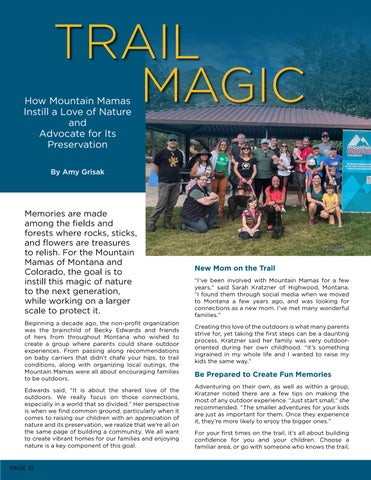
Memories are made among the fields and forests where rocks, sticks, and flowers are treasures to relish. For the Mountain Mamas of Montana and Colorado, the goal is to instill this magic of nature to the next generation, while working on a larger scale to protect it. Beginning a decade ago, the non-profit organization was the brainchild of Becky Edwards and friends of hers from throughout Montana who wished to create a group where parents could share outdoor experiences. From passing along recommendations on baby carriers that didn’t chafe your hips, to trail conditions, along with organizing local outings, the Mountain Mamas were all about encouraging families to be outdoors. Edwards said, “It is about the shared love of the outdoors. We really focus on those connections, especially in a world that so divided.” Her perspective is when we find common ground, particularly when it comes to raising our children with an appreciation of nature and its preservation, we realize that we’re all on the same page of building a community. We all want to create vibrant homes for our families and enjoying nature is a key component of this goal.
PAGE 10
New Mom on the Trail “I’ve been involved with Mountain Mamas for a few years,” said Sarah Kratzner of Highwood, Montana. “I found them through social media when we moved to Montana a few years ago, and was looking for connections as a new mom. I’ve met many wonderful families.” Creating this love of the outdoors is what many parents strive for, yet taking the first steps can be a daunting process. Kratzner said her family was very outdoororiented during her own childhood. “It’s something ingrained in my whole life and I wanted to raise my kids the same way.”
Be Prepared to Create Fun Memories Adventuring on their own, as well as within a group, Kratzner noted there are a few tips on making the most of any outdoor experience. “Just start small,” she recommended. “The smaller adventures for your kids are just as important for them. Once they experience it, they’re more likely to enjoy the bigger ones.” For your first times on the trail, it’s all about building confidence for you and your children. Choose a familiar area, or go with someone who knows the trail,
[Mountain Mamas] is about the shared love of the outdoors. Becky Edwards, Executive Director of Mtn. Mamas
and prepare ahead of time for the highest probability of a successful outing. As with any outdoor adventure, check the weather beforehand and plan accordingly. It’s prudent to have gear with you, such as rain jackets, and not need them, versus having a hike turn into a bone-shivering wash out because they were left behind. The basics of food and water are also a key part of any expedition, no matter how brief. “We can make it through any adventure when we have snacks,” said Kratzner who keeps special treats only for their outings. It also makes a big difference to bring friends. Kids can hike for hours without even realizing it when they’re talking with a buddy and finding all sorts of cool things together. Throw a frog or salamander in the picture, and they’ll talk about it for years. “It’s less intimidating when you have other people there,” said Kratzner. “It also helps the kids because so many times they’ll power through when there’s another adult to encourage them versus mom or dad.” Even with the best preparations and intentions, Kratzner said, ”You’ll have meltdowns, but it’s just
part of it.” The whole point is to spend time outside not only for recreation and learning, but to instill the love of the land into our children.
Reaping the Rewards The end result is a boost of confidence that means more than any gold star. Kratzner said, “The outdoors builds confidence.” For Kratzner and her family, they’re enjoying considerable progress on the local ski hill. She said, “Our whole family was going down the same runs together. Both my kids are better skiers than we are now.” While it’s easier and often more enjoyable to take solo runs, with Kratzner and her husband guiding their children through the learning journey, the entire family benefits.
Advocating for the Future While immersing our children in the wonders of nature is paramount, and is a central focus of Mountain Mamas, an important underlying tenant is public discourse and action. Continued on page 12
PAGE 11
Edwards noted that the largest growing group focusing on conservation issues are women between the ages of 18 to 46 years old. Many of these are mothers who want their children and grandchildren to experience the same joy as we did, and do, during our time in nature. She said that one of the strengths of Mountain Mamas is that, “[The moms] will put their lives aside and fly to Washington DC to tell their stories.” Kratzner said she joined Edwards and a group from Mountain Mamas to meet with legislators in Washington D.C. during a push to bring more awareness to the Blackfoot Clearwater Stewardship Act that will preserve the Blackfoot River by protecting its tributaries. Supported by 83 percent of Montanans, it creates a collaboration between the timber industry, outfitters, and conservation groups adding 80,000 acres within the boundaries of the Bob Marshall, Scapegoat, and Mission Mountain Wilderness Areas. The goal for the Mountain Mamas on this project, and so many more like it, is to present a face and story on the positive impact of this sort of legislation with the hope of support from our elected officials. “We also talked a lot about public lands, and how we’ll protect them with increased usage,” shared Kratzner, which is another piece of the conservation puzzle. We all love our public lands, but the challenge is not to love them to death. By understanding how to be responsible stewards, it’s possible to achieve this balance in order for future generations to enjoy them, as well. Kratzner also said that they met with members from the Colorado Mountain Mamas, and she was delighted to talk with other moms who share the same focus.
“It’s all about building connections. I didn’t know anyone before going on this trip.”
Camp Hale: A Conservation Convergence The designation of the Camp Hale–Continental Divide National Monument is a win for historians and conservationists throughout the nation. “Camp Hale was once used as training and drilling grounds for the United States Army; the outdoor space taught veterans mountain climbing, alpine and Nordic skiing, and survival skills for the cold weather they would experience during World War II,” said Sara Kuntzler, Mountain Mamas Colorado program manager. “The designation provides opportunities for children to learn about our Colorado heritage and history by engaging with our open spaces firsthand.” Long before 15,000 soldiers of the 10th Mountain Division lived and trained in this landscape, it was the home of the Ute People for thousands of years. National recognition for this area helps preserve their history and educate future generations. The realm of mountain goats, bighorn sheep, black bears and a myriad of other wildlife characters, this 53,804-acre monument includes the Tenmile Range that spans a portion of the Continental Divide National Scenic Trail, as well as holds 10 peaks over 13,000 feet in elevation making it a popular area for recreation throughout the year. The Camp Hale– Continental Divide National Monument demonstrates how advocacy preserves these natural places for everyone to enjoy and appreciate.
And the movement is expanding. Edwards shared that they are welcoming the Arizona Mountain Mamas into the fold in 2024. With this addition, they look forward to sharing time on the trail, as well as in front of legislators to create a space where we recognize the importance of nature in our and our children’s lives.
This article was made possible through the support of our partners at Darn Tough Vermont. Darn Tough is proud to support mamas and kids of all ages on the trail and the work to complete and protect the CDT. PAGE 12
PAGE 13
Help keep your friends and family trail-ready, and support the Continental Divide Trail! Shop the CDTC Gift Guide online! Image by zaie on Freepik
CDTC Holiday Gift Guide
Check out these options for holiday shopping for any budget. Your purchase benefits the Continental Divide Trail Coalition’s cooperative stewardship programs and efforts!
CDT Osprey Daylite Cinch Pack 100% of the proceeds from this one-of-a-kind CDT Osprey Daylite pack goes to protecting the CDT! Shop
CDTC Gift Basket
CDT National Geographic Wall Map, CDT Hat of your choice, waterproof phone bag, CDT bandana, CDT Stickers. Only $50! Shop
PAGE 14
National Geographic CDT Wall Map Looking for something to give the gearhead in your life who already has too much gear (if there is such a thing)? Who doesn’t love maps?! Support the CDT with the purchase of this beautiful National Geographic CDT wall map. Shop
Aaron Burden via Unsplash
Farm To Feet CDT Sock Keep your feet nice and toasty this winter with the durable CDT Farm to Feet socks! Farm to Feet is a proud supporter of the CDTC and donates 10% of all proceeds from these socks. Shop Desesh Toothpaste Tablet Pouches Go plastic-free and lightweight with these toothpaste tablets from our partners at Desesh! Desesh will donate between $2-$5 on every purchase between now and the end of the year! Shop
More Great Gift Ideas that Support the CDT Not sure what to get that person who has everything?
Make a donation
CDT Grand County Gateway Community Ambassador Katie Hearsum sporting a CDTC beanie. Choose from 5 styles!
to the CDTC in their honor!
ENO CDT Trail Hammock Relax in style with this CDT ENO Hammock! ENO generously donated $10 from every CDT Hammock purchase to CDTC – what are you waiting for?! Shop The TentLab CDT Trowel Doo doo the right thing this holiday season and give the gift of this lightweight CDT trowel! Not only is it perfect for all your backcountry adventures, it’s an excellent aid to leave no trace, and its purchase also directly supports the CDT! Shop
Darn Tough CDT Sock Keep feet happy with the CDT Darn Tough sock! Darn Tough has partnered with CDTC to make sure you can hike in comfort, represent the trail we all love, and directly support the CDT just by purchasing these awesome socks. A percent of all proceeds are donated to CDTC. Shop
BUFF® CDT Multifunctional Headwear 100% of the proceeds from this beautiful CDT Buff help support our work all year long. Shop
Readywise Homestyle Biscuits & Gravy – Official CDT Meal Have you tried the official meal of the CDT yet? Try our new Homestyle Biscuits and Gravy from Readywise, and a portion of your satisfying meal will be donated directly back to CDTC! Shop PAGE 15
Louise Johns
EXTRAORDINARY AFTER FIFTY How a National Network is Finding Confidence and Community in the Outdoors By Audra Labert (she/her) CDTC Communications Manager
Each year, 150 women from across the United States are invited to join the Over 50 Outside program (O50O). Participants are from various backgrounds, life experiences, interests, and abilities. Still, this program has created a platform for shared experiences and provided a springboard for accessing outdoor activities. Katherine Henckler only applied for the O50O program at the urging of her friend and neighbor. Since moving to Tucson from the East Coast in 2015, she has volunteered as a docent at the Arizona Sonora Desert Museum as well as helping with the summer camps, and she has a background in early childhood education. Getting outside and walking is a habit she brought to the Southwest. Henckler particularly appreciates the accommodating weather of the “most beautiful” Tucson area. She loves the opportunity to get outside most days of the year, especially if she is willing to get up early some days to avoid the heat. After applying to the program in August of 2021, Henckler was selected to participate in the 2022 cohort of O50O. She said, chuckling, that although the friend who initially introduced her to the program was not accepted, they still spoke and hiked together. Over the next year, Henckler would connect with PAGE 16
other women and build a supportive network to explore, be challenged physically and mentally, and have a place to feel like she belonged. Before the program, when she looked around in the outdoor industry, Henckler wasn’t exactly sure where she fit in. She shared, “I look at outdoor ads and see these young gals in short shorts and tank tops, and that’s not me.” Thankfully, Henckler wasn’t alone. Over 50 Outside originates from Teresa Baker of the In Solidarity Project. Baker brought what she thought was a problem to Liz Wilson (formally Outdoor Research) and Amy Beck (Oboz Footwear): Why aren’t women over fifty represented in outdoor brand marketing? In response, the O50O group and idea formed as a partnership between Oboz, Osprey, Outdoor Research, and the 52 Hike Challenge to grow the representation of women over fifty in the outdoor industry. The year-long program begins with a one-year membership for the 52 Hike Challenge, monthly touch-bases over Zoom with the cohort, brand support and product discounts, and communication with the group members through the active Facebook group. The 52 Hike Challenge commitment is to complete fifty-two hikes in a year— one for each week of the year—of a mile or greater in distance. Additionally, the brand partners host a retreat to celebrate a year of hiking each August, where the women can come together in person. During the program, Henckler got outside more and felt more capable with her gear and attitude
and understanding her limits. She also gained the confidence to look forward to solo hiking, when before, she would feel forced to hike alone when no one else was available. After meeting that initial 52 Hike Challenge, she continued with her own versions of the annual challenge, and now– at 66 years old– Henckler feels stronger than ever and relishes the newfound confidence to go out on her own. Over 3,000 applications to O50O were received in the first year, thanks to a growing interest in getting outdoors and the desire to feel supported. However, there’s more to the O50O collective than the confidence-building challenge. The sense of community created in the program has had a powerful impact on these women’s lives. Each participant was paired with an accountability partner. For Rachel Capoccia, that accountability helped provide the motivation to get outside every week. Like Henckler, Capoccia wasn’t seeking out the program. As a self-proclaimed hoarder of Osprey backpacks, she stumbled upon the application through an email sent from Osprey. “I told my husband about it, and the first thing he said was, ‘How does Osprey know you’re over 50?’ And then he’s like, ‘You tell people too much,’” she added with a laugh. If either of the women knew what was in store for them, they weren’t disappointed when the program started. Capoccia had already been an avid hiker and was getting more into backpacking when the program found her. The accountability to her partner
Katherine Henckler enjoying the Southwest landscape.
and the 52 Hike Challenge motivated her out the door, and the community Capoccia found fueled her passion for the program and beyond. “It’s been awesome,” Capoccia said. “I’ve met women from all over the country in my age range who I can go hiking and backpacking with and talk to now.” After her term in the 2021-2022 O50O cohort, Capoccia became a leader and mentor in the program and is helping keep the connection among and between program cohorts alive. She also welcomes new faces to the hiking group near her home in Southern California and connects with other groups. Rather than focus on the speed or the distance, Capoccia reassures new and aspiring hikers that it’s okay to take it easy, with the motto, “We’ll get there when we get there.” Since throwing herself into this new outlet, Capcoccia has gone from local hike leader to planning trips around the country, and she dreams next of Alaskan adventures. Her 2023 summer endeavor—planned to coordinate with the O50O retreat in Montana—was a backpacking trip in Yellowstone National Park with a group of women from O50O. Although she had never been on the planned route, the skills, experience, and confidence she had accumulated were vital in the planning. She also added that, sometimes, “You have to take a leap of faith.” For some, that leap brought them to Camp Hyalite near Bozeman, Montana, in the summer of 2023. The gathering allowed the circle of O50O participants to meet in person, feel a more profound sense of
Rachel Capoccia relaxing in the outdoors.
PAGE 17
“There are people who don’t have a community like this... and when you have one, you need to share it.”
community, and grow their circle of amazing people to call friends. Continental Divide Trail Coalition (CDTC) Executive Director Teresa Martinez attended the Montana retreat at Camp Hyalite. She sees the potential to create more safe and brave spaces for people who don’t often see themselves represented in the outdoors. She described them as “places to not only see themselves represented but to experience them and become the leaders in the spaces they need.” The program partners are also looking ahead to the future of the group and how it can continue to foster a love for hiking in women over 50. There is hope for it to expand and involve more women by adding resources, partners, and additional opportunities to get outside—together. Although Martinez did not participate in the full
Food PAGE 18
Gear
Gifts
program, she believes in supporting programs and initiatives that improve access and equity. Martinez added, “Because of [CDTC’s] unique role, we can create more of these kinds of opportunities and engage our entire team in helping do the work: Whether it’s me showing up here, or leading Pride hikes, or women-focused volunteer projects.” From the participants, there is hope that the program can and will continue. Still, the seed has clearly been planted, and more women are answering the call to become leaders in their communities and families. Most importantly, these women are not creating a one-size-fits-all approach to getting outside but an open space for others to cultivate their own goals and interests and find the support to grow them. “There are people who don’t have a community like this,” Henckler said, “and when you have one, you need to share it.”
The Shakedown | Eating Utensils By Danny Knoll (he/him) CDTC Administrative Assistant
On a recent Shakedown poll on CDTC’s Instagram, followers shared their preferred backcountry eating utensils. Food is a topic highly discussed while on the trail. Perhaps one of the most overlooked items in your pack is what you eat with. All it takes is losing your utensil(s) for any period of time to quickly realize how much you appreciate your backcountry silverware. 88% of our voters agreed that a single titanium utensil is their go-to while in the backcountry, but were split between titanium spoons (48%) and sporks (40%).
Things to consider when selecting utensils: Rigidity | The last thing you want is to break your eating tool and resort to questionable alternatives. One of our pollsters even admitted to eating with a cat hole trowel in a pinch. Lightweight plastic or wood utensils can easily snap, leaving you desperate. Whatever you choose, it should be able to withstand a frozen pint of Ben & Jerry’s while in town, and the heat from your camp stove.
Length | Some hikers prefer a single utensil that fits nicely within their pot; however, I am always surprised how often I use my spoon, and I like to have it easily accessible. I prefer a long-handled spoon that enables me to get to the bottom of freeze-dried food pouches that I occasionally carry. A hole in the handle for a lanyard is an added bonus to help prevent utensil loss.
Cost | Even some of the nicest backpacking sporks and spoons on the market won’t break the bank, ranging between $8 and $12. Sets can cost between $15 and $35 but are seldom used among our pollsters (3%). A free kitchen spoon will also save you a trip to the outfitter which is especially important if you find yourself in a remote town along the CDT.
Weight | It may surprise you but the average,
It may simply come down to, are you willing to spend $10 to save half an ounce?
what you likely have in your kitchen right now, stainless steel teaspoon only weighs around half an ounce more than many popular titanium spoons and sporks. Unsurprisingly, spoon, fork, and knife sets weigh 3 times as much and use 3 times the space. Perhaps the 9% of our respondents that voted for “any cheap/free metal spoon I can find,” are onto something.
Only you can decide but please use this issue’s Shakedown poll as a reminder to never forget your utensil!
FOLLOW US ON INSTAGRAM AND WEIGH IN ON THE NEXT SHAKEDOWN! PAGE 19
ACROSS THE DIVIDE Community, Connectivity, & Conservation through the Continental Divide Trail By CDTC Staff
The Continental Divide is the backbone of the North American continent. It is home to thousands of wildlife species, the backyard for many growing communities in the West, and the watershed for over 180 million people. The Continental Divide Trail Coalition works to complete, promote, and protect the Continental Divide landscape. In addition to being a place for all to explore, learn, and connect, the Divide is home to some of the most vibrant pockets of biodiversity in the U.S, particularly in the Gila Wilderness of New Mexico, the Front Range of Colorado, and the Greater Yellowstone area in Wyoming. The preservation of these important ecosystems is essential to retaining the character and vitality of the Divide. Compared to a traditional “square park” like Yellowstone National Park or the Gunnison National Forest, the Continental Divide National Scenic Trail (CDT) is a “long park,” acting as a greenspace connector between landscapes, communities, and cultures along 3,100 miles of the Divide landscape. The CDT is a pathway to opportunities for more accessible open spaces, strengthening partnerships with community members, land managers, and landowners, and creating greater opportunities for representation in and stewardship of our lands and waters.
In 2023, CDTC hosted 11 volunteer projects, 3 adopter trainings, and around 100 volunteers along the Continental Divide Trail. According to a Headwaters Economics report released in November 2021, the outdoor recreation economy contributed $374 Billion to the GDP in 2020 and provides over 5.2 million jobs nationwide, contributing to employment in the arts, entertainment, hospitality, food service, retail trade, manufacturing, transportation, and other industries. The CDT offers myriad hiking, equestrian, fishing, birdwatching, skiing, and other recreational opportunities along its 3,100 miles. As it runs from the border with Mexico to the border with Canada along the Continental Divide, it traverses through and near mountain communities whose economies are increasingly bolstered by visitors accessing nearby public lands. PAGE 20
Cholla and Big Hatchet Peak near the southern end of the CDT, New Mexico. Photo credit Dan Carter.
CDTC’s 2022 Small Business Survey results demonstrated that business owners in CDT communities have experienced a positive impact from the CDT and support enhancing and protecting the trail and the surrounding landscape.
•
78% of respondents believe protecting, promoting, and enhancing the Continental Divide Trail is important to the well-being of businesses, jobs, and their community’s economy.
•
80% of respondents have seen growth in business in their community at large due to the use of the Continental Divide Trail since 2014.
•
60% of respondents have experienced growth in their business in particular due to the use of the Continental Divide Trail since 2014.
The Continental Divide Trail traverses the Spine of the Rocky Mountains, connecting federal, state, local, Tribal, and private lands. In total, the CDT connects 20 National Forests, 25 Wilderness areas, 3 National Parks, 13 BLM resource areas, and 2 National Monuments, including the first Monument designated by President Biden, Camp Hale - Continental Divide National Monument, which includes the historic site at Camp Hale and over 20 miles of the CDT in the Tenmile Range.
Are you interested in using your voice to support the CDT? Every year, trail organizations like CDTC, American Hiking Society, and other members of the Partnership for the National Trail System attend Hike the Hill in Washington D.C. to advocate for trail priorities like funding and capacity building for partners, pathways to careers, and equity and accessibility in the National Trails System. In 2024, Hike the Hill will take place February 11 - 15. Sign up for Advocacy Alerts to stay informed about the latest issues impacting the trail and how you can use your voice to speak up for the CDT! Sign up for Advocacy Alerts The Continental Divide Trail Completion Act continues to make progress through Congress. The bill, introduced by Congressman Neguse (CO) in the House and by Senators Heinrich (NM) and Daines (MT) in the U.S. Senate, aims to prioritize completion of the CDT by the trail’s 50th anniversary in 2028. 5% of the trail remains incomplete, forcing travelers out of Federal public lands and onto roadways, making for a less scenic and less safe route. You can support the completion of the CDT today by contacting your representatives in Congress and telling them you want to see their support for the CDT Completion Act!
PAGE 21
i
or
M
i
ur
a
bi um
Columbia
so
s
ri
is
kF
u so
ri
M
ar
Missou
is
Col
ur
a athe d
Canadian Rocky Mountains
Cl
So
Fl
Pend Oreille
Fescue-Mixed Grass Prairie
k
Ye
ke
sto
ne
Utah-Wyoming Rocky Mountains
Sn
a
Middle Rockies Blue Mountains
ll
ow
No
Wyoming Basins
rth
Pla
tte
Pla
Bea r
Continental Divide Trail
Priority Landscapes
Southern Rocky Mountains
ra
Northern Rockies Corridor
do
Green
CDT States
lo
S Wyoming/N Colorado
Co
Intermountain Colorado
Arka
nsas
Rio Grande Headwaters/ Greater Chaco Sky Islands/ Gila River Corridor
300
de
225
di
an
Gr
Ri
o
Cana
Gi
Pecos
Sal
t
la Apache Highlands
dia
n
Red Bra zo
Arizona-New Mexico Mountains
PAGE 22
na
an
150
Co
37.5 75
Ca
Colorado Plateau
Colorado
0
lo
ra
do
Distance (Miles)
Chihuahuan Desert
s
tte
Dan Carter, Bootheel
Sky Islands - Gila River Corridor
The boundaries of modern-day southern New Mexico, southern Arizona, and Northern Mexico have long been a convergence point for connectivity, migration, and diffusion for wildlife, water, weather, and humans. The region holds a history of upheaval and transformation from pre-historic flooding, wildfires, and other natural processes, impressing on the landscape the qualities and features that have helped sustain one of the most biodiverse ecoregions in the entire world. The New Mexico Bootheel is home to the southern Sky Islands, pinnacles of biodiversity towering high above the harsher climates of the desert valley below. Ancient seabeds have been pushed up into the limestone sky islands including the impressive Big Hatchet Mountains. These islands are refuges for life within an otherwise vast, austere desert floor. Endemic species, migrating birds, bats, and mammals, including jaguars, call these islands home. The Gila River flows freely in New Mexico, providing a watershed that supports ecosystems for rare and endangered species of wildlife and plants alike, including over 400 species of migratory birds. As the changing climate impacts the winter snowpack and spring melt, these delicate sky islands and unique river systems provide a critical resource for the landscapes and the communities’ resiliency in the future.
Read more about the Bootheel in the Spring 2023 issue of Passages Magazine.
CULTURAL CONNECTIONS TO THE LANDSCAPE The tribes in New Mexico are actively engaged in preserving their indigenous languages, religion, culture, the environment, and in promoting quality education and health care for all members, especially their youth and elders.1 The Warm Springs Apache, Chiricahua Apache, Fort Sill Apache, Tohono O’odham, and other connected tribes– recognized and non-federally-recognized– have connections to the Sky Island peaks and this area. Each Tribe has its own lifeways, traditions, and culture, and they possess a unique relationship with the communities around them. 1 The history of the Apache tribes is complex. From decades of wars, unfair treaties, and the fight to maintain their culture amid repeated assimilation attempts, the Apache honor their ancestors through their strength and devotion.2 The history that has disconnected some of the tribes from these places means that some sacred sites remain unknown. Learn more about the history of the Apache Tribes at NativeHope.com. PAGE 23
LANDSCAPE LIVELIHOOD Ranching and agriculture are a major part of the local economy. Cattle grazing, irrigated crops, and vineyards are found across the Bootheel. Energy development is increasing, including the existing Lordsburg generating station, proposed Sun Zia transmission line, and proposed solar and wind developments. The CDT is the main developed recreation opportunity in the Bootheel, and the trail through this section is mostly line of sight, following markers through the desert or on low-use, rough two-track roads. Trail users cross through active open rangeland where they share the land with cattle, horses, and ranchers.
TRAIL COMMUNITIES Get Outdoors Hidalgo! The town of Lordsburg hosts an annual outdoor recreation-focused event, Get Outside Hidalgo, in April to celebrate the natural beauty of Hidalgo County and the Bootheel. This event brings together residents and visitors alike to enjoy the region’s unique landscapes. With a diverse array of outdoor activities such as CDT-guided hikes, plant identification, family-friendly activities, music, and food, this event encourages everyone to connect with the environment. This event is an opportunity to learn about local conservation efforts, and the Chihuahuan Desert’s ecological features, and foster a sense of stewardship and community.
New gates installed by CDTC, NM Conservation Corps, and fabricated by local ranchers are helping provide better access for hikers and equestrians. Water caches and cattle tanks provide water sources for animals and recreationists. The Great Divide mountain biking route, a bicycle touring route also along the Divide, passes through the Bootheel on highways and backroads making a popular stop at the Hachita Bike Ranch. For long-distance CDT users, the towns of Hachita and Lordsburg are the only towns encountered. The Hachita Community Center, operated by volunteers, and the Hachita Food Mart welcome hikers and bikers as a place to camp, rest, and resupply. PAGE 24
CDTC’s Annual Trail Days & Silver City’s 10 years as a Gateway Community - April 19-21
CDTC hosts the annual Trail Days celebration weekend each April, in partnership with Gila Resource Information Project. It is an event that celebrates the rich history and culture of the Bootheel. The 2024 Trail Days will coincide with Silver City’s 10th anniversary as a CDT Gateway Community.
11/13/23, 8:27 PM
20230726_082415 (1).jpg
Over the years, Trail Days has grown into a vibrant, multi-day celebration offering educational workshops, engaging speakers, and a variety of outdoor activities including community-led hikes along the CDT and the surrounding Gila Wilderness. As a Gateway Community, Silver City has played an essential role in connecting hikers, fostering a sense of community, and providing valuable support to those embarking on their CDT journey.
We look forward to seeing everyone on the trail in Silver City at the 2024 Trail Days, April 19-21! Find out more on the CDTC website.
Volunteer Field Projects
Stewardship of the CDT can range from improvements to the trail tread to implementing infrastructure to facilitate trail use and relationships with local landowners. Here are a few projects coordinated by CDTC and implemented with the help of our partners in the Bootheel: •
A new Gate installation with Conservation Corps New Mexico (CCNM)
•
Signage installation throughout the Bootheel with CCNM and volunteers
•
CDTC, FS, and volunteers installed 6 rollovers through the Burros and Pinos Altos range near Silver City for better user access and to address rancher’s concerns with open gates.
TRAIL POLICY & ADVOCACY CDTC celebrated with Senator Heinrich and Congressman Vasquez early in the summer in Silver City, New Mexico to recognize the progress on the CDT Completion Act and the introduction of the Greater Gila Wild & Scenic River bill! Combined, the goals of both bills would help to preserve, and provide sustainable access to one of the most biodiverse landscapes in the country, the Bootheel of New Mexico. Community members in CDT Gateway Communities like Silver City and Lordsburg have elevated the perspectives of locals who see public land and water protections as essential to the vitality of their community’s health, economy, and connection to the landscape.
Improved CDT Access
CDTC, Rep. Vasquez’ office, and community members in Hachita celebrated the CDT and recent CDT easement from New Mexico State Lands in May 2023. The easement between the State Land Office and the Bureau of Land Management provides permanent access and protection for the Trail where it crosses State land through New Mexico. This allows for easier public access and infrastructure improvements such as gates, signage, and tread work.
https://drive.google.com/file/d/1b2QtcEJDNgkFe2N8wTXyuYDEz639r7Ef/view
Youth Outdoors
CDTC staff hosted an educational workshop and event with Lordsburg’s cohort of Youth Conservation Corps (YCC) members this summer. YCC crew members enjoyed a hike on the CDT to learn about trail building, advocacy efforts such as the CDT Completion Act, recreational etiquette, Leave No Trace principles, and biodiversity in the Bootheel.
PAGE 25
Rio Grande Headwaters Between the high Colorado Plateau and the southern New Mexico desert is a region geographically rich and diverse, with rolling hills, deep canyons, high mesas, and subtle peaks. The Rio Grande watershed originates in south-central Colorado and feeds over 180,000 square miles before reaching the Gulf of Mexico. The San Luis Valley (SLV) is a beautifully diverse region in south-central Colorado that partially spills into New Mexico and covers nearly 8,000 square miles. It hosts a unique landscape, featuring sand dunes, hot springs, and the winding Rio Grande river, all against a backdrop of the epic Sangre de Cristo Mountains.3 Often considered one of Colorado’s hidden treasures, the San Luis Valley is more than meets the eye. Audrey Moreng, a graduate student from Colorado State University, has undertaken a capstone project in collaboration with CDTC to delve into what makes the SLV a priority landscape. In August and September 2023, she conducted a series of interviews with local organizations and residents, uncovering how the area’s rich history shapes its strong connection to the land, emphasizing the inseparable bond between people and nature. Her research has been both meaningful and adventurous, involving activities such as trail maintenance, touring ranches and farms, exploring museum exhibits, and participating in community conservation forums. Audrey hopes her work can help to strengthen the CDTC’s relationships in and understanding of the valley for future work.6 More information about Audrey’s work in the San Luis Valley can be found on the CDTC website! PAGE 26
South of the Rio Grande on the CDT, the Gila, and Aldo Leopold Wilderness areas connect the Pinos Altos Range in the south with the Black Range in the north. Landforms include rolling hills, deep canyons, high mesas in the south, and the lush Mimbres Valley.4 In the north, the CDT traces the crest of the Black Range where the topography is rugged with sharp ridges and broad benches broken by deep canyons. Fire is the major influence affecting the mosaic of vegetation, and the geology is diverse with volcanic, sedimentary, and some intrusive and crystalline rocks.4 More about CDTC’s post-fire recovery work in the Black Range on the CDTC blog
CULTURAL CONNECTIONS TO THE LANDSCAPE For over 2,000 years, the Pueblo peoples occupied a vast region of the southwestern United States. Chaco Canyon, a major center of ancestral Pueblo culture between 850 and 1250, was a focus for ceremonials, trade, and political activity for the prehistoric Four Corners area. Chaco is remarkable for its monumental public and ceremonial buildings and its distinctive architecture – it has an ancient urban ceremonial center that is unlike anything constructed before or since. In addition to the Chaco Culture National Historical Park, the World Heritage property includes the Aztec Ruins National Monument and several smaller Chaco sites managed by the Bureau of Land Management.
The jagged volcanic landscape of what is now El Malpais National Monument has challenged many cultures as they have interacted with it through the years. Native American Cultures have had a long and continuous tradition with this landscape, and continue to call it home thousands of years later. 5 Long before Spanish and European arrival in the Southwest, native peoples traveled across this landscape through interconnected roads and pathways between communities. The center of these interconnecting roads and pathways leads to and from the Greater Chaco Region and beyond. By local tribes, these are considered the pathways to and from their places of emergence, or headwaters, and religious shrines scattered along the Continental Divide and throughout what is now considered the corner states: Arizona, Utah, and the two Continental Divide Trail states of Colorado and New Mexico.
LANDSCAPE LIVELIHOOD The importance of conservation efforts in this landscape are paramount. Most notably, the headwaters of the Rio Grande River and the surrounding riparian areas and wetlands are a focus of conservation attention. Agriculture accounts for roughly one-third of the economy of the SLV, followed by retirement and public assistance, government, and tourism. Tourism varies from county to county though, and makes up about 70 percent of the economy in Mineral County.3 While agriculture and livestock grazing have played an integral role throughout the region, other land uses include wilderness, inventoried roadless areas, wildlife habitat, and recreation. The recreation setting is predominantly primitive and remote, with much solitude and self-reliance. Tourism for outdoor recreation is prominent in the SLV, with the CDT being one of the many attractions. In the SLV specifically, the towns of South Fork and Pagosa Springs are designated CDT Gateway Communities.
TRAIL COMMUNITIES Trail Adopter Story | The Owsley’s As volunteer CDT Trail Adopters, Jeff and Hallie Owsley volunteered over 270.5 hours on their section of the CDT in the Rio Grande National Forest. Since Hallie’s passing, Jeff requested that a memorial fund be created in Hallie’s memory to benefit the CDT. More recently, Jeff opened his home to host CDTC intern Audrey Moreng, a graduate student from Colorado State University who has undertaken a capstone project in collaboration with CDTC to delve into what makes the San Luis Valley a conservation priority. Jeff Owsley’s story is a testament to the impact that even one person can have within an immense landscape.
Pueblos Youth Hikes
The Continental Divide Trail Coalition (CDTC) New Mexico Regional Representative and member of the Pueblo of Acoma, Corey Torivio, created a program to provide new opportunities for youth to engage with and support projects on the Continental Divide Trail. Corey led youth on guided hikes along the CDT in El Malpais National Monument. Youth ages 8-25 are provided with stewardship education, opportunities to learn about the Ancestral significance of the landscape, and a first-time experience on the CDT. More about the NM Pueblos Youth Hikes on the CDTC
CDT Gateway Community | Chama
Chama community-led hikes for Latino Conservation Week and Pride on the Divide demonstrate the community’s dedication to fostering a sense of belonging and environmental stewardship along the CDT and ensuring that all individuals can enjoy and protect the CDT for generations to come.
TRAIL POLICY & ADVOCACY Celebrating Chaco Canyon Protections Over the summer, Secretary Halaand from the Department of Interior announced a mineral withdrawal for the lands surrounding the Chaco Canyon National Historical Park. The protections, which last 20 years from the date of the announcement, will ensure no new oil and gas leases will occur in an area that is an important cultural landscape for Indigenous communities. Support from surrounding communities and the All Pueblo Council of Governors was rooted in concerns for community health, environmental degradation, and protecting cultural sites.
PAGE 27
Ryam Lim
Intermountain Colorado The hallmarks of the Intermountain Region of Colorado are the expansive valleys and dramatic peaks of the Continental Divide, and most famously, the towering 14ers*. Nestled between the bustling Front Range and the slower-paced Western Slope, the Intermountain Region provides a home habitat for a diversity of plants and wildlife, including critical migration corridors for elk, bears, birds, and other species that move through the area. This region has acted as an incubator for many modern-day winter sports. The recently federally protected Camp Hale–Continental Divide National Monument is the historical home of the WWII 10th Mountain Division. This WWII unit specialized in snowy mountainous skills that would transfer to warfare in the Italian Alps and was considered to be a catalyst for the popularity of the skiing industry in the U.S. Learn more about Camp Hale and the surrounding landscape on CDTC’s website!
CULTURAL CONNECTIONS TO THE LANDSCAPE These are the unceded ancestral lands of the Nuche (Ute) and others who have called the landscape of the Continental Divide home for millennia and still call it home today. These Indigenous communities were persecuted and killed through genocide, then forcibly removed from these lands. Referred to as “Yutas” by the Spanish, the Utes or “Nuche” (People of Substance) as they called
themselves, were people of the mountains who made their living hunting and gathering in their home territories. An 1868 treaty set aside the western third of Colorado for the Utes, but when gold was discovered in the San Juan Mountains, many fortune seekers ignored those boundaries. Mining lobbyists convinced the U.S. government to renege on the treaty, pushing the Utes farther away from their original homelands. The Nuche (the Ute people) and other Indigenous peoples still call the Intermountain Colorado landscape home. The three modern Ute Reservations and their Tribal Government Centers include the Ute Mountain Utes (headquarters Towaoc, Colorado); the Ute Indian Tribe of Utah, Uintah & Ouray reservation (headquarters Fort Duchesne, Utah); and the Southern Ute Tribe (Ignacio, Colorado).
LANDSCAPE LIVELIHOOD While the history of many Mountain economies used to rely on mining and other extractive industries, today outdoor recreation is often the driving factor, from the Leadville 100-mile race series to the western entrance of Rocky Mountain National Park just outside Grand Lake, Colorado. Balancing the influx of visitors from the evergrowing Denver-Metro area continues to be a challenge, especially in smaller nearby towns in places like Clear Creek County.
TRAIL COMMUNITIES The Intermountain Region of Colorado is where the Colorado Trail and the CDT overlap, bringing together two of America’s most challenging long-distance treks. The network of trails in this region for foot traffic, mechanized travel, and even motorized sports has made communities like Leadville, Twin Lakes, and Salida *Peaks exceeding 14,000 feet.
PAGE 28
outdoor recreation destinations year-round. Access to world-renowned resources like Rocky Mountain National Park, one of the nation’s most popular national parks, creates unique opportunities and challenges for communities who hope to preserve their culture while sustainably managing their increasing popularity and the resulting influx of visitors.
Leadville locals, and a panel discussion about the future of equitable outdoor recreation. Trail Daze ended the festivities with a movie night, making it a perfect blend of education and entertainment for those who cherish outdoor recreation on the CDT.
New Leadville and Salida Downtown CDT Kiosks
Thanks to a Colorado Housing and Finance Authority Grant, CDTC was able to work with Gateway Community volunteers and other local partners to design community-specific kiosks that will bring awareness to visitors and locals about the CDT landscape. The kiosks will be installed in Leadville and Salida later this year.
TRAIL POLICY & ADVOCACY Camp Hale Continental Divide National Monument Turns 1!
High Lonesome Trail Projects
Two projects in July 2023 brought together CDTC, Headwaters Trail Alliance, and many volunteers in Colorado to build and fix several bridges along the High Lonesome Trail in Grand County. Two wilderness bridges were constructed north of Meadow Creek Reservoir, and just south of Junco Lake Trailhead two bridges were decommissioned while another bridge was constructed.
Grand Lake CDT Ambassador Shines Bright
CDTC aims to increase local access to the CDT by engaging volunteer Gateway Community Ambassadors in each CDT Gateway Community. This program empowers local trail enthusiasts to become outdoor leaders in their communities. Ambassadors are encouraged to familiarize themselves with local segments of the CDT and provide knowledge of the trail to their neighbors and friends. They are supported by CDTC to increase their capacity as outdoor leaders by participating in training opportunities provided by CDTC and others. Katie Hearsum, Grand Lake Ambassador and town Community Engagement Manager responded to this call for volunteers in 2020 and has played a vital role in her community’s engagement with the trail yearround. Read more on the CDTC blog.
Leadville Trail Daze
CDTC partnered with the Gateway Community of Leadville for a SOBO (southbound) “Trail Daze” event in September, which brought together CDT hikers, outdoor adventurers, and community members for three days of trail-related activities. The festivity highlights included trivia night, an evening of speakers at the local Golden Burro, tales and insights from seasoned trail veterans, ultra-marathoners, and
In October of 2022, President Biden designated his first national monument, right on the Continental Divide, protecting over 20 miles of the CDT in perpetuity. The designation will preserve the historic site at Camp Hale and protect the connectivity of the Divide in the Tenmile Range for wildlife and recreationists alike. Voices of support from CDT Gateway Communities were crucial for securing the designation, and CDTC continues to celebrate with all those in the trail community who mobilized for the Divide. To learn more about the stories of the National Monument, CDTC Board Member Don Owen shared why–as a descendant of a 10th Mountain Division veteran–this designation is so important to his family: Find it on page 7 and the CDTC BLOG. The Grand Mesa Uncompahgre and Gunnison (GMUG) National Forests is currently undergoing a Forest Plan Revision. The GMUG National Forest contains approximately 108 miles of the CDT, and the new management plan includes proposals for recreation usage, timber harvest, vegetative management, and other stewardship actions that will impact the trail’s experience. CDTC is working closely with the U.S. Forest Service to optimize the trail experience in central Colorado, and we encourage our trail community in the area to stay informed and participate. Trail connectivity in Central Colorado benefits plants, wildlife, recreationists, and communities. This summer CDTC has worked with the Forest Service on trail relocation efforts near Monarch Crest and has worked with private landowners who provide access to the Divide landscape. By improving the connection of the CDT in central Colorado, the trail can be utilized as an anchor for sustainable recreation that benefits the conservation of the surrounding landscape. PAGE 29
Matt Berger, Great Divide Basin, Wyoming
Northern Colorado Southern Wyoming Steppe The region connecting Northern Colorado and Southern Wyoming contains some of the most remote and isolated portions of the CDT. The Great Basin lies at the northern end of this region, while the rugged, high mountains of the Southern Rockies lie to the south. One of the most interesting geologic features along the entire trail is the Great Divide Basin, which contains 42 miles of the Continental Divide Trail. It is a closed basin, unlike every other area in the Rockies, and water that falls in the basin stays in the basin. Another unique feature of this landscape is the Red Desert, a highaltitude desert and sagebrush steppe located in the south-central portion of the U.S. state of Wyoming, comprising approximately 9,320 square miles.7 As the largest unfenced area in the contiguous U.S., it is home to a variety of desert-adapted animals, including migratory pronghorn, elk, and wild horses. South of the Basin, the Park Range is a glaciated landscape with cirque basins and areas of exposed rock. Snowy mountains, glacial lakes, meadows, and swift-flowing streams form distinctive scenery. From there, The CDT traverses the Rabbit Ears Mountain Range that connects the Park Range in the west to the Never Summer Mountains in the east. The landforms are diverse with rolling uplands, craggy peaks, talus slopes, basalt outcrops, and glacial features.
PAGE 30
CULTURAL CONNECTIONS TO THE LANDSCAPE This landscape contains the ancestral homelands of the Eastern Shoshone, Cheyenne, and Ute, and they are among the many native peoples forcibly displaced during the U.S. westward expansion. Local landmarks attempt to convey this history, like the informational kiosk at Fish Creek Falls in the Rabbit Ears Range of Colorado. The information displayed for visitors reads:
These Rocky Mountains are Ute country. We are Colorado’s oldest continuous residents. For generations, we lived in bands, consisting of family groups, with distinct territories. All the bands were Ute and shared one language and culture. Today we are three Ute tribes. Many of us still retain our band identities. We are called Nuuchuu or Nuu’ciu, “the people.” Our American Indian neighbors called us by different names. Spanish explorers used a version of those names and called us Yutas, Uticas, or Utacas.
LANDSCAPE LIVELIHOOD The landscape in this area is a patchwork of private, local, state, and federal lands, and the local economies largely depend on natural resources. Major land uses include wildlife habitat, inventoried roadless areas, designated wilderness, livestock grazing, logging, recreation, and mineral extraction (copper, silver, and gold mining). A legacy of mining is evident with traces scattered throughout the area. The Wyoming Basin has extensive coal deposits along with areas of trona, bentonite, clay, and uranium mining, and the region also contains major natural gas and petroleum-producing fields.
Encampment/Riverside, Wyoming
Just 30 miles north of the Wyoming-Colorado border sits the towns of Encampment and Riverside. With less than 500 people in total, these small towns are the gateway to the Sierra Madre Mountains and the Medicine-Bow National Forest. The “relatively undisturbed” forest reaches above 10,000 ft. and traverses through “alpine bogs, spruce-fir, lodgepole pine, and aspen forests” (U.S. Forest Service, n.d.). This area is the ancestral homeland of the Cheyenne and Eastern Shoshone people. Fur trappers settled in Encampment in 1838, followed by copper mining and later a ranching hub throughout the late 19th and early 20th centuries (“Encampment/Riverside”, n.d.).
TRAIL COMMUNITIES Community Event in Steamboat Springs CDTC teamed up with the Forest Service and volunteers from the Steamboat Springs area to clear the trails, spruce up the infrastructure, and install several kiosks at Fish Creek Falls, an important connector trail to the CDT in Colorado.
Blazing the Trail in Rawlins
Rawlins community residents are deeply committed to preserving and maintaining the CDT. Their local Community Ambassadors actively participate in clean-ups, maintenance, and educational initiatives such as volunteer days that engage local members to learn about the CDT. This fall, Carbon County hosted its annual volunteer event where community members painted blazes marking the trail’s route directly through downtown Rawlins. The town’s mayor signed a proclamation this year recognizing the city as an official Gateway Community and CDTC staff held a community meeting with local Chamber members, City employees, and trail enthusiasts.
CDTC paid a visit this fall to the EncampmentRiverside Gateway Community to engage with local establishments in the area and encourage community members to participate in the 2023 small business survey. This visit was to demonstrate support for local businesses and better understand the relationship between these businesses and the trail. This community values outdoor recreationists and prides itself on the busy hiker seasons.
TRAIL POLICY & ADVOCACY Decisionmakers Meet on the CDT In late summer 2023, stewards and champions of the CDT met in the Bureau of Land Management office in Kremmling to discuss public lands, benefits of outdoor recreation, career pathways, and challenges and opportunities for land managers. Congressman Neguse was joined by the U.S. Forest Service and BLM staff, as well as CDTC and other members of the community including local leaders from nearby Grand Lake and Jackson County. The meeting demonstrated the model of cooperative stewardship that involves voices at every level.
CDT Completion Act
Congressman Neguse has introduced the CDT Completion Act to the House of Representatives, representing the district that is home to CDT Gateway Communities like Steamboat Springs and also the Muddy Pass Gap, a 14-mile gap of the CDT. PAGE 31
Muddy Pass Trail Gap Between the communities of Kremmling, Walden, and Steamboat Springs lies the Muddy Pass section of the Continental Divide Trail, the last incomplete section of the trail in Colorado. The current Continental Divide Trail route in this area forces users along US HWY 40 and CO HWY 14 for a stretch of about 14 miles. During the summer of 2023, Jake Warnica worked as a CDTC Field Technician Intern based in Granby, CO, and he focused on creating a story map of this “gap” along the CDT.
Learn more about the work to complete the CDT at Muddy Pass in the new story map! The story map combines data from organizations like the Bureau of Land Management, the United States Forest Service, and Colorado Parks and Wildlife. This data highlights factors such as wildlife habitat, environmental sensitivities, and public vs nonpublic lands in the region. Through collaboration with the local communities and land managers alongside these types of initiatives, CDTC hopes to secure a protected and safe route within the North Park region for future generations. Farm to Feet is a proud supporter of the CDTC’s mission of completing, promoting, and protecting the Continental Divide Trail
www.farmtofeet.com
@farmtofeet
Wyoming Voices Speak Up for CDT Completion! As the bipartisan CDT Completion Act makes its way through Congress, Wyoming’s Senator Barrasso is a key decision-maker ensuring the legislation moves forward. Thanks to our trail community in Wyoming, and particularly the CDT Gateway Community of Rawlins, we are closer than ever to seeing the CDT Completion Act move forward. If you’re a Wyoming constituent, reach out to Senator Barrasso’s office and let him know you support the CDT Completion Act! With so much happening across the trail, we are already preparing for next year’s legislative sessions. In Colorado, CDTC continues to monitor and engage in legislation that impacts private landowner liability and public land access. If there’s a bill in your state that you think would impact the CDT and those who enjoy the trail, please reach out and let us know.
To learn more about how you can support the Completion Act, sign up for CDTC Advocacy Alerts.
PAGE 32
Steven Shattuck, Bob Marshall Wilderness, MT.
Northern Rockies Corridor The northern extent of the U.S. Continental Divide from Yellowstone National Park is a wild and scenic corridor through the mountainous regions of Wyoming, Idaho, and Montana Home to some of the most iconic wildlife species in the Rocky Mountain West, the Yellowstone Corridor plays an important role in ecosystem connectivity and wildlife conservation. This enormous section includes 1,012 miles through Montana and Idaho and nearly 300 miles of Wyoming. Starting at the southern end of this ecosystem is the Wind River Range, colloquially known as ‘the Winds.’ Contained within the Winds is a nearly 100-mile-long spine of the tallest mountains in Wyoming. It is home to Gannett Peak, the tallest mountain in the state at an imposing 13,810ft. The major waterways of the Yellowstone Corridor landscape eventually reach the Pacific Ocean and the Gulf of Mexico. Flathead Lake, along the western edge of the Corridor, is the largest freshwater lake west of the Mississippi River, with over 200 square miles of water and 185 miles of shoreline. In addition to the iconic National Parks - Yellowstone and Glacier- the Yellowstone Corridor contains the Chinese Wall, located within the Bob Marshall Wilderness. The Wall is a 1,000-foot tectonic upthrust of limestone that formed a striking rock reef stretching twenty-two miles and bisecting the second-largest Wilderness in the contiguous U.S. The U.S. Continental Divide is crowned by Triple
Divide Peak, a three-faceted jewel that divides Rocky Mountain waters between the Pacific Ocean, the Gulf of Mexico, and the Arctic Ocean. The area from the Bob Marshall Wilderness Complex north to Calgary, Canada is known as “the Crown of the Continent” and “the backbone of the world” to the Blackfeet Nation. The park’s boundary with Waterton National Park in Canada is the Northern Terminus of the CDT, a stone marker that thousands of hopeful thru-hikers seek on their long journeys.
CULTURAL CONNECTIONS TO THE LANDSCAPE People are believed to have been inhabiting the Greater Yellowstone Ecosystem for the last 11,000 to 13,000 years– just after the last ice sheets retreated– revealing the geologically rich area that was once submerged. People who trace ancestral connections to these landscapes include the Apsáalooke (Crow), Tséstho’e (Cheyenne), Oceti Sakowin (Sioux, specifically Lakota), Niitsítpiis-stahkoii (Blackfoot), Michif Piyii (Métis), Flathead Salish, Lemhi-Shoshone, Shoshone Bannock, Eastern Shoshone, Nimiipuu (Nez Perce), Ktunaxa (Kootenai), and Northern Arapaho. The regions known as Yellowstone National Park and the Yellowstone River Valley were of utmost importance to native people. “To the Crow, it was the “land of the burning ground” or “land of vapors”; to the Blackfeet, it was known as “many smoke”; to some tribes in the Flathead it was “smoke from the ground”; to the Kiowa it was called “the place of hot water.”8 PAGE 33
Deeper Read Recommendation Restoring a Presence: American Indians and Yellowstone National Park By Peter Nabokov and Lawrence Loendorf North on the Continental Divide are the Beaverhead Mountains, a subset of the Bitterroot Range. The Lewis and Clark party passed through Lemhi Pass, in the central part of the range, while traveling east. While the explorers were by no means the first people to have used this passage– the Shoshone, Blackfeet, and other American Indians have used it for centuries– they were likely the first Colonists to do so.9
LANDSCAPE LIVELIHOOD Along with the designation of Yellowstone National Park came tourism– and tourist dollars. Railroads were built to bring more people out West and to the park. Before the tourism boom, the economy was largely rooted in natural resource extraction, including mining and logging, and it is more or less what birthed most Montana and Wyoming towns. Within the ecoregion lies one infamous town that was established as a mining camp before becoming the wealthiest town in the nation– for a time. Affectionately known as ‘Butte, America,’ Butte, Montana drew hopeful gold rushers from across the world. Gold, silver, copper, zinc, lead, and manganese were all found within there, lending to its informal claim as ‘the richest hill on earth.’10 This story is not unique to Butte: some favorite resupply towns were founded as mining towns, then had to adapt to the change in economics when the ‘bust’ occurred. Towns and areas with economies connected to unique aspects of the Divide are found throughout these landscapes, and many have reoriented to a services and tourism-based economy. The Winds have been the centerpiece of many modern mountaineers, backpackers, and backcountry skiers, while the community in Anaconda has particularly embraced CDT thru-hiking. The officially designated CDT Gateway Community hosts events and provides services that cater to the unique group of visitors.
TRAIL COMMUNITIES Volunteer Field Projects
Five volunteer events in the Corridor generated 35 volunteers and over 700 hours of volunteer labor. The projects included building a turnpike and Puncheon above beautiful Brooks Lake (Wyoming), rerouting a quarter mile of trail off of Big Hole Pass on the Montana-Idaho
PAGE 34
border, collecting 10,000 lbs of rock in Yellowstone National Park to be used as turnpike material through a sensitive wetland, a community event/adopter training in the highlands of Butte, and a wonderful partner project with Wild Montana east of Helena near Priest Pass. CDTC could only do the work to build and maintain the CDT with the work of members, volunteers, and trail partners! CDTC Northern Road Trip | CDT Gateway Communities and Trail Towns CDTC staff took a road trip to the dual-Gateway Community of Lander/South Pass City, Wyoming this year to celebrate the town’s first year as a designated Gateway Community. As part of the Wyoming Working Together Conference, CDTC hosted an educational presentation on a staff member’s hike along the trail and announced the upcoming installation of a local kiosk. The kiosk was donated by local supporters of the CDT, Rachael Richards and Erik Schultz, in memory of their friend. Read the Spring ‘23 Passages article
Wyoming | Sublette County
The Sublette County Visitor Center, located in Pinedale, WY, plays a vital role in the CDT and its trail users. The Visitor Center is not only a valuable resource for hikers, but also a hub for information and assistance. They host a hiker box, offer loaner clothes while thru-hikers do laundry, and provide free meals for those passing through Pinedale.
Montana Roundtables
CDTC hosted small business roundtables in our Gateway Communities of Helena, Butte, and Anaconda to talk about the economic impacts of the trail. This workshop discussed how local businesses benefit from their proximity to the CDT and how CDTC can provide support through the Gateway Community program. Over 60 community members and business representatives attended these events and shared opportunities to foster support within their communities.
Read more about the Northern Road Trip on the CDTC blog! TRAIL POLICY & ADVOCACY CDT Completion
The bipartisan CDT Completion Act, co-sponsored by Senator Daines in Montana, continues to make its way through Congress. If passed, the legislation would prioritize completion of the CDT by the trail’s 50th anniversary in 2028. Connecting the major gap areas around Butte, Montana would increase connectivity in the Yellowstone Corridor and create a safer, more enjoyable journey for travelers on the CDT.
Celebrating the Mineral Withdraw at Lemhi Pass One year ago, the Department of Interior announced a 20-year mineral withdrawal for the area surrounding Lemhi Pass. As an important natural resource for wildlife, a scenic resource for recreationists, and a historical landmark where the CDT intersects the path of Lewis & Clark, this is a critical connective piece of the Divide landscape. The Custer Gallatin National Forest has released a decision on the South Plateau Landscape Treatment, impacting over 20 miles of the CDT in northern Wyoming and Montana. The plan, which includes increased timber activity and the construction of temporary roads, could impact the CDT Experience, viewshed, and corridor over the next five years. CDTC is collaborating with the U.S. Forest Service to ensure impacts to the CDT experience, remain minimal and are mitigated.
HIKE ALL THE TRAILS.
GO THE DISTANCE, READY FOR EVERYTHING WITH THE JUNCTION. HYPERLITEMOUNTAINGEAR.COM
Glacier National Park Visitation Over the past few years, the dual popularity of Glacier National Park and the CDT has required new strategiesfor managing the trail in the Crown of the Continent. The National Park Service recently solicited feedback on its permitting and reservation system, and CDTC is working with park staff, community members, and recreationists to ensure the CDT Experience in the Park is optimized for the growing trail community on the Divide.
1 New Mexico Indian Affairs Dept. www.iad.state.nm.us/ 2 Native Hope. https://blog.nativehope.org/history-of-the-apache-nation 3 Wikipedia. https://en.wikipedia.org/wiki/San_Luis_Valley 4 CDT Scenic Character Assessment. https://www.fs.usda.gov/sites/default/files/CDT_ScenicCharacterAssessment_Feb2022.pdf 5 National Park Service | El Mapais National Monument. https://www.nps.gov/elma/learn/historyculture/index.htm 6 Moreng, Audrey. 2023. Background and History of the San Luis Valley. https://continentaldividetrail.org/news/the-san-luis-valley-a-priority-landscape-and-community-along-the-continental-divide/ 7 Wikipedia. https://en.wikipedia.org/wiki/Red_Desert_(Wyoming) 8 Yellowstone Volcano Observatory, USGS https://www.usgs.gov/observatories/yvo/news/land-burning-ground-history-and-traditions-indigenous-people-yellowstone 9 USDA Forest Service, Beaverhead-Deerlodge, and Salmon-Challis National Forests, Lemhi Pass National Historic Landmark https://www.fs.usda.gov/ Internet/FSE_DOCUMENTS/stelprdb5052332.pdf 10 Western Mining History: Montana Mining Towns. https://westernmininghistory.com/state/montana/
PAGE 35
PAGE 36
MEDIA ROUNDUP Don’t let the short winter days get you down. Check out the CDTC Staff Picks playlist for some warm fuzzy tunes to get you through the winter. Listen to the full playlist! I Don’t Mind The Tabasco Donkeys
The Walker Fitz and The Tantrums
IV Sweatpants Childish Gambino
Wake Up Arcade Fire
To the Mountains Lizzy McAlpine
Walking Slow Animal Years
Have You Ever Brandy Carlile
Bugs O’Death
Going In Wild Child
The Great Divide National Park Radio & more!
Trail Tunes
Listen on Spotify
PODCAST | Wild Ideas Worth Living Finding Fulfillment in the Outdoor Industry with Gabaccia Moreno: Gabaccia Moreno is an outdoor enthusiast and advocate, whose career centers on encouraging people to rethink how they engage with nature. Over the years, Gabaccia has worked on a variety of projects— from being a member of the conservation corps in Montana to writing for outdoor publications, and creating the online community, The Outdoorist Oath.
BOOKS | THE GRIZZLY IN THE DRIVEWAY Four decades ago, the areas around Yellowstone and Glacier National Parks sheltered the last few hundred surviving grizzlies in the Lower 48 states. Protected by the Endangered Species Act, their population has surged to more than 1,500, and this burgeoning number of grizzlies now collides with the increasingly populated landscape of the twenty-first-century American West.
MOVIES & FILMS | CAPTAIN FANTASTIC Deep in the forests of the Pacific Northwest, a father (Viggo Mortensen) devoted to raising his six kids with a rigorous physical and intellectual education is forced to leave his paradise and enter the world, beginning a journey that challenges his idea of what it means to be a parent.
PAGE 37
Visit the CDTC website for answers to the activity and more!
CDT Crossword
Complete this crossword to learn about the CDT! The puzzle is designed to reach kids of all ages, so an adult may need to assist younger explorers with some squares. PAGE 38
CDT SUPPORTERS Members are the core of our organization and its efforts to protect the Continental Divide Trail. By being a member, you support the protection of the CDT and our work to build a broad-based community of people who love and support the Trail. Thank you!
CHARTER MEMBERS CDTC Charter Members helped build the base of support necessary to help launch CDTC’s efforts in 2012. CDTC owes an incredible debt of gratitude to these important supporters.
2013 FB CDT hikers/Lisa Karst Alex Martinez family Allen Filson Arthur and Denise Foley Avelino Tamayo Barney and Sandy Mann Bernard Wolf Bill and Debra Pollick Bill Youmans Bob and Shell Ellinwood Bob Brewer Brad Pierson Brian Fahlstrom Bruce Prior Bryan and Sally Martin Carlos Schomaker Carolyn Crump Chris and Sanne Bagby Chris Burke Chris McMaster-ULA Equipment Chris Smith Christine and Brad Klafehn Clare Cain Copper Kettle Brewing Dana Foulks Daniel Weber Dave and Sandy Slowey David Dolton David Lattier Deb Hayes Dianne Evans Dick Kozoll Don and Amy Owen Don Thompson Duane Koss Elisabeth Chaplin Erin Saver Frank and Jean Anne Haranzo Gary Monk
PAGE 40
Gary Werner and Melanie Lord Gene Allen George Szeremeta Greg Pierce Jack Haskel James Harrold James Hlavaty James Sippel Janie and Randy Moore Jean Neely Jeremy Burton Jerry and Helga Bell Jerry Brown Jesse Hill Jim Boeck and Vivian Wilson Jim Hansman Jim O’Brien John and Lisa Nelson John Dufour John Rowland Josephine Hazelett Josh and Lisa Shusko Karen Keller Kathy Trotter Kerry Shakarjian Kevin Burns Kevin Linebarger Lawton Grinter and Felicia Hermosilla Lydia Mahan Lyndon Berry Mal Sillars Mark Bankey Mark Flagler Matthew Kaufmann Michael Tam Miguel Quinones Mike Bates Mike Dawson
Mike Wollmer Morgan Sommerville Nancy Huber Nicolas Martinez Olivia Holmes Olli Tam Pat O’Donnell Paul Breed Paul Corbeil Paul Griffith Paul Magnanti Peter Karnowski Peter Necarsulmer Philip Storey Rebecca Louden-Louden Family Foundation Rebecca Sudduth and Daniel Weber Reese Lukei Rex Alford and Alice Pierson Richard Ostheimer Roanoke Appalachian Trail Club Robert Kristoferitsch Robert Sylvester Sara Glasgow Scott Williams Shane O’Donnell Stephen Olson Steve Staley Steven Sheppard Susan Bates Tambi Gustafson Taylor and Nancy Owen Teresa Martinez Thomas Holz Tim Hart Tim Zvada Vince Auriemma Whitney LaRuffa
CDT EXPLORERS We wish to thank the following individuals for their generous donations between August 1 and October 15, 2023.
$10,000+
$1,000-$9,999
$100-$499
Greg and Jan Winchester
Cooper Link Family Fund Doug Rosenow Evan Gartley Fred Arsneault Jean Ella John West Kim Kansas Laura Alpert
Andy & Stephanie Renner Anonymous in honor of Michael Swartz Hike David & Mary Langford David Weiser Elizabeth Morton Eric Payne Fran Knoll James Madden Kenneth Laufer
$500-$999 Martha Williams McClure Family Simon Sotelo Steve Martini
Mary Sealing Michael Elliott Patrick O’Meara Peter Hoskow in honor of Michael Swartz Hike Richard & Deana Pratt Rob Ibison Robert Grey Robert Harborne Wayne Polek
ENDOWMENT CHARTER MEMBERS Amanda Wheelock Amiththan Sebarajah Amy Camp Amy Mccormick Andrew Linger Arthur and Denise Foley Barbara Nash Barney And Sandy Mann
Ben Gabriel Clancy Clark Dean Myerson Don & Amy Owen Emilie Kelly Greg & Jan Winchester Greg Pierce James Hlavaty James York Jena Thompson
Jim Hunter John Mclarty Josephine Hazelett Josh And Lisa Shusko Kathleen Lynch Kerry Shakarjian Linda Spaulding Matthew Lindelow Michael Schechtman Mike Ksenyak
Nicolas Martinez Paul Magnanti Randy Welsh Rich Blitz Rob Hutchinson Robert J. Weggel Steven & Grace Shattuck Teresa Martinez Tom Phillips
BUSINESS MEMBERS 307 Llama Company Backslope Brewing Bighorn Bottle Shop Bosque Brewing Company Brent Umphlett Photography Brent Umplett Photography Cooper Mountain Downtown Helena Dry Point Distillers Fairmont Hot Springs Resort Farm to Summit Gila Hike and Bike Glacier Distilling Company Helena BID HKM Employment Attorneys
Inscription Rock Trading and Coffee Shop Integrity Tattoo and Piercing Kevin League Photography La Cumbre Brewing Lamber Goodnow Local Loft Yoga Morning Star Sports Pintler’s Portal Point S Tires Power and Light Press Salida Mountain Sports Saltwater on the Fly Ten Mile Creek Brewery
The Base Camp The Golden Mill The Murray Hotel The Village at North Fork Trail Magik Trailblend Coffee Triple Crown Coffee Twin Lakes General Store Vapur Woods High Mountain Distillery Yampa Sandwich Company Zapier
PAGE 41
CDT SUSTAINERS
CDT Sustainers help us protect the trail all year long by giving monthly donations. Join them by signing up on our website for as little as $5 per month!
Adrian Harrison Alan Fisk-Williams Aletheia Mccurry Alexander Asai Amy Aloe Amy Buchanan Amy McCormick Andine Gilmore Andrew Poland Anitra Kass Anne Simonsick Annette Sanders Aubrey Renfroe Barbara Harris Barry Reed Ben Sweeney Benjamin Gabriel Brent Lindon Brian Curtin Brian Deames Carol Martin Cassandra Pritchett Cayce Roach Chad Ferguson Christina Osmon claire wilcox Clayton Smith Clifford Savage Cody Miller Cody Spencer Connie Mahan Curtis Savoie Dakota Lindsey Daniel Juba Daniel Stenziano David Fockler David Giese David Nowak David Schlewitz Dayna Fisk Williams Dayna FiskWilliams DC Ward Debra Calhoun Denise Hasskamp Dennis Solo Derek Sherry DiAnna Corden Donna Siefert Edwin Van Nieuwkerk Elaine Geouge Elegant Themes Elizabeth Corliss Erik Schultz Erin Capron Erin Lucero Erin Woodrow Ernesto Fuentes Frances Galvin
PAGE 42
Gabriel Smith Garrett Delmas Gary Van Horn Gerald Nielsen Gerald Retzlaff Gregory Smith Gretchen Walker Hannah Green Harry Bicycle Company LLC Healing Hearts & Horses Heather Farrell heather stabler Heidi Jones James Boeck James Crawford James Fowler James Hunter James Spellman James Swartz James Williams James Wise MD PLLC Jason Harley Jean Ella Jessica Suhowatsky John Kuebler Jon Geilhufe Jonathan Slator Jonathan Smith Joni DuPre Jordan Williams Joseph Bouchey Julia Youngblood Karen Loveless Karen Monsen Karl Schults Katherine Moore Kathleen Johnson Kathy Kessler-York Kathy Whiteman Keith Lippwe Keith Wagner Kelly Flynn Kevin Soderman Kimberly Sweeney Kyle Svoboda Laran Despain Lauren Murray Leslie McCurry Lisa Cook Ludger Bannierink Lynn Andenoro Lynne Krulich Marianna Young Mark Mitford Mark Swanson Martin Smith Marty Leake Mary Kwart
Mary Lopez RN Mary McNeill Mary Stoecker McLean Smith Melinda Bise Melissa “UV” and Jim Prager Merrill Glustrom Michael Lang Michael Livesay Michael Sweitzer Mrs Monsen Nathaniel Shull Patrick A. Madison Patrick Foley Patrick Madison Paul Gronland Paul Tennery Rachel Danczyk Rachel DeHoyos Randy Walker Raymond Brown Renee Patrick Rhonda Ronan Richard Sayre Robert Boulis Robert Flynn Robert Mabry Robert Reeves Robert Romanoff Robin Proffitt Ronald Parry Samuel Waterman Sara Bishop Sara Eder Sarah Estrella Sarah Gude Sarah Wustrack Scott Piddington Sean Kuvin Shaun Bechdol Sheila Cuyk Stephen Dodson Stephen Gates Steve Falconer Steve Moffitt Steven Meyer Tawnee Smith Ted Olsen Teresa Ellis Theresa Kirchner Thomas Bosche Thomas Phillips Tracy Lanktree Troy Lawson Wendel Hann William Welch
LEGACY MEMBERS
Legacy Members make a lasting impact to protect the CDT for future generations by including CDTC in their will or estate plan. Contact CDTC Director of Development Lauren Murray at lmurray@continentaldividetrail.org if you are interested in becoming a Legacy Member.
Barney and Sandy Mann Bart Lami Bill Murphy
Cindy Carpenter Dick Vogel Jean Ella Josephine Hazelett
Roger Carpenter Teresa Martinez Tom Lefferts Trevor Twose
CORPORATE PARTNERS Thank you to the following CDTC sponsors.
TRAILBLAZER
EXPLORER
PATHFINDER
SCOUT
ULA Equipment YETI
Backpacker Pantry Big Agnes Buff Eno Oboz Footwear Osprey Outside Magazine REI Woolrich
AllTrails BearVault Colorado Native Desesh Deuter Farm to Feet FarOut GossamerGear Hyperlite Katabatic LEKI Melanzana Monarch Mountain Montbell Mountainsmith National Geographic Pact Outdoors Readywise Sawyer Six Moon Designs Snowy Mountain Brewery The Tent Lab The Trek TOAKS Zpacks
Access WILD Big Sky Resort Montana Creede Creekside Cabins Enlightened Equipment HomeLight Honey Stinger Laws Whiskey House Michael Underwood Photography One in a Million Point6 Seek Dry Goods Ski Taos Sole Storm Peak Brewing Tierra Wools Town Shirt
PAGE 43
Thank you to the following sponsors who contributed to CDTC between August 2022 and October 2023.
EXPLORER ($5,000-$24,999)
PATHFINDER ($1,500-$4,999)
SCOUT
PAGE 44
THE TERMINUS THE GIFT OF LONGEVITY
By Jordan Williams (he/him) CDTC Colorado Regional Representative The origin stories of many long-distance hikers share common threads: I want a new adventure–I want to find purpose–I love the outdoors. But how many people can say they thru-hiked a 500-mile trail at the age of 80? Karl “Pringles” Riters always loved backpacking, but after hiking the Colorado Trail (CT) in 2014 with a partner, he enjoyed the experience so much that he wanted to do it again by himself seven years later. The Colorado Trail and the Continental Divide Trail (CDT) share a special connection, with over 300 co-located miles between Breckenridge and Silverton across some of the most beautiful landscapes in the state. While a thru-hike of the 3,100-mile CDT may seem inaccessible for many, the 500+ miles along the Colorado Trail can typically be completed in four to six weeks. On his second attempt at the CT, Karl averaged a slightly slower eleven miles per day, due in part to a few more creature comforts in his pack (e.g. long underwear for those cold nights above 10,000 feet). However, with more people out there experiencing the Continental Divide landscape seven years later in 2021, the community became more important than ever. “All the younger people I met along the trail were respectful and friendly,” said Karl. These connections were surprising to him though, as Karl sometimes caught himself thinking: “Who wants to deal with an old fart like me?” Of course, being an 80-year-old solo thru-hiker can raise some concerns for others who are just trying to help. Karl even had a few younger hikers over-eager to offer support in terms of gear and general hiking recommendations. Karl always appreciated their caring, but as a 20-year resident of Colorado and long-time volunteer with Poudre Wilderness Volunteers, Karl had his patterns pretty dialed by his 8th decade. After both of his thru-hikes, Karl went on to give community presentations describing his experiences in the hopes of inspiring others. Long-distance trails like the CT and CDT had a significant impact on Karl’s life, but he didn’t know about them growing up, so he wants to share that awareness with others. According to Karl,
PAGE 45
making these kinds of special Trail experiences more accessible starts with better education for the public. It then becomes easier for individuals to stay connected to organizations like CDTC and the Colorado Trail Foundation as they help care for the landscape and support adjoining communities. When asked if he has more upcoming hiking adventures planned, Karl seems content with his past experiences while looking forward to more golf in town with his wife. He is practical when describing this “gift of longevity”--according to him, staying active and getting regular health checkups are key. But the impacts of the trail community will continue through people like Karl and the future generations he inspires to be stewards of the Continental Divide landscape.
Every Step Counts Osprey is proud to support the Continental Divide Trail Coalition in preserving the wonder of the CDT.
PAGE 46
Maximum Comfort. Minimal Impact.
New gear from The Mother of Comfort made with sustainability in mind. Learn more at bigagnes.com Photo: Noah Wetzel
PAGE 47
Continental Divide Trail Coalition 710 10th Street, Suite 200, Golden, CO 80401 (303) 996-2759 info@continentaldividetrail.org www.continentaldividetrail.org
Over 50 Outside group hike Image by Louise Johns