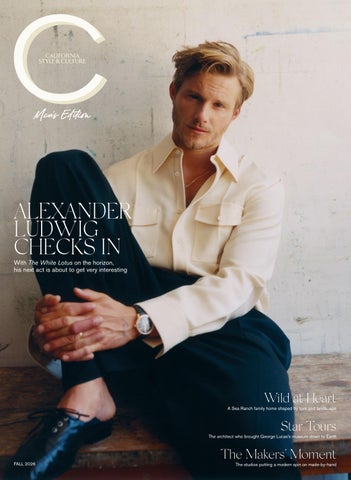
ALEXANDER LUDWIG CHECKS IN With The White Lotus on the horizon, his next act is about to get very interesting
Wild at Heart
A Sea Ranch family home shaped by love and landscape
Star Tours
The architect who brought George Lucas’s museum down to Earth
FALL 2026
The Makers’ Moment The studios putting a modern spin on made-by-hand
T:20.
S:20.
FS:10" F:10.4375"
.875"
.875"
T:14"
S:14"
F:10.4375"
C MAGAZINE / MENS EDITION • OCTOBER 2026 • 2 PAGE SPREAD• Trim: 20.875”x14” • Non-Bleed
© LACMA, gift of Mr. and Mrs. Edward William Carter.
C MEN’S EDITION ’26
CONTENTS FALL 2026
STYLE & CULTURE NEWS The stores, exhibitions, and books you need to know
22
28
30
42
50
54
IS IT A SPACESHIP?
GO NORTH
Meet Ma Yansong, the architect George Lucas chose to bring his museum to life
A bucket-list adventure to the North Pole complete with ‘bergs and bears, oh my
READY FOR HIS CLOSE-UP A reception with Alexander Ludwig, the new star of The White Lotus
Men’s Style
40
THE WAY WE SURFED Jeff Divine reflects on his early days documenting a SoCal movement
HAND MADE IN CALIFORNIA The makers using time-honored techniques in their contemporary crafts
LIVING ON THE EDGE How Commune Design revived a clifftop retreat in Sea Ranch
CALIFORNIA CLASSICS Alisal Ranch celebrates its 80th anniversary as a working cattle ranch and an off-the-grid retreat
The Bangles Jangle a gold bracelet, or maybe try two
1. FOUNDRAE, $7,450, foundrae.com. 2. PASCAL, $195, pascaldesign.com. 3. TIFFANY & CO., $16,200, tiffany.com. 4. CARTIER, $8,150, cartier.com. 5. VAN CLEEF & ARPELS, $2,970, vancleefarpels.com.
12
1
2
3
4
5
ALEXANDER LUDWIG WEARING BRUNELLO CUCINELLI COAT, $14,650, T-SHIRT, $890, AND PANTS, $2,150. IWC WATCH, $11,600.
18
BEVERLY HILLS
MONTECITO
SOUTH COAST PLAZA
WYNN LAS VEGAS
C MEN’S EDITION ’26
CONTENTS FALL 2026
Editor’s Letter
There’s something quite satisfying about watching someone arrive at the moment they’ve been working toward. Our cover star, Alexander Ludwig, is doing just that (“Ready for His Close-Up,” page 30). After The Hunger Games, Vikings, and years of finding his way through film and television, he’s checking into The White Lotus for its fourth season — a role that feels less like a departure than a change of course in a career built on taking chances. The thoroughly charming Canadian is serious about his craft, thoughtful about what comes next, and ready for a very busy fall, with his film Unabomber also on the horizon. That spirit of doing things your own way runs throughout this special Men’s issue. At Sea Ranch, the design gurus at Commune have transformed a pair of modest midcentury homes into homes made for family life while preserving the spirit of the 1960s architecture — all against one of California’s most elemental stretches of coast (“Living on the Edge,” page 50). We meet a new generation of self-taught artisans who have found unexpected routes into glass, metal, and furniture, putting a modern spin on old-school methods (“Hand Made in California,” page 42). And in Exposition Park, architect Ma Yansong has brought George Lucas’s vision for a museum of narrative art down to Earth — or suspended it above, depending on your vantage point (“Is it a spaceship? Is it a cloud?,” page 22). What ties these stories together is an instinct to find your own way, whether building someone else’s dream, rethinking a classic, or simply seeing something familiar through a different lens. What’s more California than that?
Founder, Editorial Director & CEO JENNIFER SMITH Editor & President JENNY MURRAY Style & Content Director ANDREW BARKER Creative & Design Director JAMES TIMMINS Managing Editor SARAH RUTLEDGE Senior Editors GINA TOLLESON ELIZABETH VARNELL Art Director ANDREW WREN Producer PEPPER
JENNIFER SMITH, FOUNDER, EDITORIAL DIRECTOR, AND CEO
Contributors
Contributing Entertainment Director ANNABEL BROG
On the Cover
Publisher & Vice President RENEE MARCELLO Executive Director, West Coast SUE CHRISPELL Director Digital, Sales & Marketing AMY LIPSON Information Technology Executive Director SANDY HUBBARD
Rob Tennent
Stuart Brumfitt Roberto Piu
Kerstin Czarra
The photographer of our Stuart Brumfitt is a The stylist for “Ready for The author of “Living on cover story, “Ready for His London-based writer who’s His Close-Up,” (page 30), the Edge” (page 50), Kerstin Close-Up” (page 30), worked for Fantastic Man, Roberto Piu, was born Czarra, is a culture and Rob Tennent is a GQ, i-D, and The Face. and raised in Sardinia and lifestyle writer and editor photographer living in Paris. He’s also the cofounder moved to Paris at the age who has contributed to In his pictorial universe, of BAGEL, a tennis of 19. He started his career T Magazine, Domino, and subjects are framed through lifestyle magazine. He at Vogue Hommes Paris, 1stDibs. A former editor at the intimate lensing of a has worked with brands where he first assisted Martha Stewart Living, she loved one, which Tennent including Prada, Adidas, fashion director Anastasia has co-authored two design invokes as a signature of his Ralph Lauren, Hugo Boss, Barbieri, and then became and lifestyle books with documentation across all Rapha, Nanushka, and coordinator, followed Nathan Turner. She also genres of his professional COS. Brumfitt penned by fashion editor. He works as a brand consultant work. Inspired by the interview with actor now works with several shaping storytelling for documentary photography, Alexander Ludwig for the publications and for luxury clients including Sakara, he is constantly looking for cover feature, “Ready for brands including Hermès, Vintner’s Daughter, and new stories to tell. His Close-Up” (page 30). Dior, Chanel, and Ami Paris. Parachute Home.
Sales Development Manager ANNE MARIE PROVENZA
ALEXANDER LUDWIG wearing BOTTEGA VENETA shirt, pants, and shoes, prices upon request. OMEGA watch, $16,500.
Photography by ROB TENNENT Styling by ROBERTO PIU Grooming by FABIEN GIAMBONA at Dessange Paris
Controller LEILA ALLEN Contributors STUART BRUMFITT, KERSTIN CZARRA, MARTHA HAYES, CHRISTINE LENNON, DAVID NASH, S. IRENE VIRBILA, CAITLIN WHITE
C PUBLISHING 2064 ALAMEDA PADRE SERRA, SUITE 120, SANTA BARBARA, CA 93103 T: 310-393-3800 SUBSCRIBE@MAGAZINEC.COM MAGAZINEC.COM
Steel Yourself
1. TAG HEUER, $3,700, tagheuer.com. 2. ROLEX, $11,650, rolex.com. 3. BULGARI, $16,600, bulgari.com. 4. JAEGER LECOULTRE, $45,700, jaeger-lecoultre.com. 5. IWC SCHAFFHAUSEN, $12,900, iwc.com.
14
1
2
3
4
5
PIU: LAURENT HUMBERT
Watches’ toughest material has an enduring appeal
NEWS
Peak Lynch All the most Lynchian aspects of the City of Angels, from the darkened corners of urban areas and classic movie theaters to red-lipped women exhaling smoke and baring skin, are on view at PACE GALLERY’s David Lynch: LA, the first posthumous exhibition of the auteur’s photography. The show combines images from five series DAVID LYNCH shot between 1979 and 2008, serving as a window into his creative process. The Blue Velvet and Mulholland Drive director, who fell in love with the Southern California light after arriving in the city at night, lived in L.A. for more than 50 years, honing his vision influenced by the myths, mysteries, and landscapes of the place. The unsettling surrealist elements that caught his eye and became part of his visual language are present here, as is the psychological intensity he cultivated so distinctively in his films. Indeed, his filmmaking and photography developed in tandem and this first look back at Lynch’s artistic vision is a preview of the deep dive LACMA will undertake as it begins to plan a retrospective. 1201 S. La Brea Ave., L.A., 310-586-6886; pacegallery.com. E.V.
1. Clockwise from top left: David Lynch, Smoke on Couch, 1992; Untitled (Nudes and Smoke), c. 1994; Untitled (Los Angeles), 1979; “Couch Series” #13, 2008. 2. JAMIE HALLER has returned to menswear with a new penny loafer. 3. Clockwise from top left: Paul R. Williams, Minimum Cost Dwelling for Excelsonite, Inc., c. 1958; portrait of Paul R. Williams, 1952, by Julius Shulman; Paul R. Williams, Broadway Federal Savings and Loans, c. 1954.
If the Shoe Fits 2
He Built This City If asked to name some of PAUL R. WILLIAMS’ most famous projects, what comes to mind are his contributions to LAX’s Theme Building; the Beverly Hills Hotel, with its cursive logo derived from his handwriting; and the sprawling homes of stars like Frank Sinatra and Lucille Ball. The groundbreaking architect was born in downtown L.A. and orphaned as a child; he graduated from USC and became the first Black member of the American Institute of Architects and a recipient of that organization’s highest honor. He also played a central role in profoundly reshaping the city of his birth. Now three concurrent and coordinated exhibitions are bringing a vast trove of his drawings, photographs, plans, and memorabilia to light this fall. Williams’ archive, jointly acquired by the USC School of Architecture and Getty Research Institute, reveals a career creating major civic projects and glamorous hotels but also multifamily housing and neighborhood designs meant to bring communities together even as exclusionary redlining remained. At the USC Fisher Museum of Art (through March 13), LACMA (Nov. 15, 2026–May 23, 2027), and Getty Research Institute (Dec. 15, 2026–July 18, 2027). fisher.usc.edu; getty.edu; lacma.org. E.V.
3
The loafer that launched JAMIE HALLER’s footwear foray was modeled on a lived-in design inspired by Italian-made men’s styles from the 1970s. But the shoes, inspired by Pasadena swap meet finds and Capezio ballet slippers, were initially created for women. Now the CFDA Fashion Fund finalist, who made her first presentation at New York Fashion Week this fall, is making them for men. Like her borrowed-from-the-boys women’s style, the Men’s Penny Loafer is also handmade in Italy using suede or hand-waxed bufalini leather. The worn-in feel is paramount, as is the glove-like fit. Haller taps a traditional Sacchetto technique for the design for maximum flexibility. The L.A. designer is no stranger to menswear, having spent 20 years creating apparel at various labels, including Guess, before launching her namesake line in 2020. But beware of the oft-attached sold-out moniker beside coveted styles on her website. From $695. 1809 E. Cabrillo Blvd., The Post, Santa Barbara; shop-jamiehaller.com. E.V. 16
LYNCH: © THE DAVID LYNCH ESTATE. COURTESY THE DAVID LYNCH ESTATE AND PACE GALLERY; WILLIAMS: JOINTLY OWNED BY THE GETTY RESEARCH INSTITUTE AND THE UNIVERSITY OF SOUTHERN CALIFORNIA SCHOOL OF ARCHITECTURE, 2020.M.6. © DELLA M. WILLIAMS TRUST DATED DECEMBER 15, 1988 (RENDERINGS), GETTY RESEARCH INSTITUTE, LOS ANGELES (2004.R.10). © J. PAUL GETTY TRUST (PORTRAIT); RM X SFMOMA: ALL COLLECTION OF RM. © THE ESTATE OF PHILIP GUSTON, COURTESY HAUSER & WIRTH (GUSTON); SAN FRANCISCO MUSEUM OF MODERN ART, BEQUEST OF PHYLLIS C. WATTIS; © ARTISTS RIGHTS SOCIETY (ARS), NEW YORK / ADAGP, PARIS (KLEIN); © CHANG UCCHIN FOUNDATION, COURTESY SEOUL AUCTION (UCCHIN); © WONWOO LEE, COURTESY PKM GALLERY (LEE); RC: SAM ZIERING; SAN DAMIÁN: BRYAN RODRIGUEZ
1
C MEN’S EDITION ’26
Korea Reconsidered
Take It Outside 4
RC OUTDOOR SUPPLY, Reese Cooper’s outdoor-focused line of taped-seam shells, insulated jackets, and technical layers, has until now has largely lived online. This summer, the L.A. designer gave RCOS its first permanent home, opening an 806-sq.-ft. store in Silver Lake. Designed with creative studio PLAYLAB as an urban “basecamp,” the space is every bit as functional as the clothes. Natural plywood, steel pipe, and waterproof ripstop stand in for polished retail fixtures, while tentlike fitting rooms are made from ripstop and adjustable bungees. It’s a fitting backdrop for the Sequoia Shell Jacket, Tahoe Anorak, and Griffith Running Jacket. Cooper launched his namesake label RCI as a teenager, taking his mix of Americana, workwear, and outdoor influences to Paris. RCOS, puts the practical side of that mix front and center: clothes made to go from trail to dinner — and look all the better for getting a little dirty. rcoutdoorsupply.com. M.H. 5
The idiosyncrasies and preferences that add unique twists to the process of compiling a collection are on view in San Francisco in a new show built around the works acquired by BTS lead rapper RM. Born in Seoul, the pop performer, songwriter, and producer has assembled RM x SFMOMA: Between You and Me, a show of modern and contemporary works by Korean and international artists in collaboration with SFMOMA cocurators America Castillo and Hyoeun Kim. Over the past eight years, RM chased down work from the 13th century to the present, including oil paintings by Chang Ucchin; work from multidisciplinary artist Kim Yun Shin, who debuted at the Venice Biennale in 2024 at age 89; canvases from abstract and surrealist painter Kwon Okyon; and Yun Hyong-keun’s meditative pieces made with burnt umber after being inspired by a visit to Art Institute Chicago. These selections appear with museum holdings from Donald Judd, Henri Matisse, Georgia O’Keeffe, Yves Klein, Mark Rothko, Korean video artist Nam June Paik, and others. More than 200 works give a window into RM’s curiosity, perspective, and creative vision. Through Feb. 7. 151 3rd St., S.F., 415-357-4000; sfmoma.org. E.V.
4. Clockwise from top left: Philip Guston, Untitled (Red and Black Book), 1969; Yves Klein, Éponge (SE251) (Sponge [SE 251]), 1961; Chang Ucchin, Road, 1986; Wonwoo Lee, Candy, 2023. 5. The first RC OUTDOOR boutique is as rugged as the attire. 6. Heed the siren call of SAN DAMIÁN in Venice. 7. LOUIS VUITTON and SINGER VEHICLE DESIGN have teamed up to create two perfect Porsches (and accessories). 8. Visit the new CHERRY store in Malibu.
8
Porsche Reborn 6
It started with the creation of a dashboard clock inspired by LOUIS VUITTON’s Tambour watch for a Porsche undergoing restoration by California-based SINGER VEHICLE DESIGN. The project quickly expanded into a redesign of the instrument display and became a top-to-bottom overhaul of every functional element of the vehicle. The resulting two sports cars are a master class in detail from the exacting creative teams, and the first co-branding venture for Louis Vuitton. louisvuitton.com; singervehicledesign.com. E.V.
7
Pacific Palates Just at the start of Abbot Kinney in Venice is the new SAN DAMIÁN, coastal seafood sibling of downtown L.A.’s high-end Damián from Mexico City chef Enrique Olvera. Come for the casual and cheerful vibe and the Pacific seafood, like spiky aguachile of shrimp and lemon cucumber, ceviche of rockfish and sea urchin, or a tostada topped with silky tuna, leeks, brown butter, and dashi. Don’t forget chef Chuy Cervantes’ blissfully textured guacamole crowned with ribbons of hijo Santo (“holy leaf”). Garlicky prawns al ajillo are pretty perfect — and heads on. And kanpachi (yellowtail) roasted “al pastor” (just like meat) comes with pineapple butter and grilled pineapple salad. Along with classic Mexican cocktails, Sebastian Tollius (of Eleven Madison Park) curates an excellent Mexican and Spanish wine list and devises sophisticated agave-based cocktails. Tip: It’s quieter in the garden, which also catches a breeze. Open Wed.–Sat., 5–10 p.m. and Sun., 3–8 p.m. 1025 Abbot Kinney Blvd., Venice; damianrestaurants.com/san-damian. S.I.V.
Cherry Picks Malibu L.A. brand CHERRY’s suede trucker jackets, USA knit bombers, double knee canvas pants, plaid shirts, and pocket T-shirts have migrated westward to Malibu. Creative directors Joseph Perez and David Levy’s workwear and moto styles coexist with a capsule of sweats, T-shirts, and trucker hats announcing the store’s arrival. Bottles of a limited-edition body care collaboration with Salt & Stone are here, as is a Grote surfboard custom made in celebration of America’s 250th anniversary. 3835 Cross Creek Rd., Malibu Country Mart, Malibu; cherryla.com. E.V. 17
C MEN’S EDITION ’26
CULTURE
Tearing Up
A new volume of Sam Taylor-Johnson’s intense portraits revisits her Crying Men series
Spanning a career devoted to portraiture, multidisciplinary artist SAM TAYLOR-JOHNSON has taken up cameras to make video installations, shorts, and mainstream feature films, all while shooting boundary-pushing still images of herself and an array of cultural figures. Many are collected in a new monograph, Sam Taylor-Johnson: The Self and the Portrait (Rizzoli, $75), which marks her renewed focus on photography. For Taylor-Johnson, part of the 1990s acclaimed Young British Artists — a movement that includes Tracey Emin and Damien Hirst — the tension between observation and performance is often on view, and never more so than in her early aughts Crying Men series. Comprising intimate moments captured by her Hasselblad and included in the volume, there are more than two dozen subjects — including actors Willem Dafoe, Sam Shepard, Daniel Craig, Laurence Fishburne, and Philip Seymour Hoffman — in unguarded emotional displays. Raw vulnerability emerges and Taylor-Johnson discusses how it played out with Paul Newman. “In that moment, he has given something. I see it, I take it, and it is. That is what it is to take a photograph — a portrait of somebody. It’s knowing and seeing, in the briefest of ethereal moments, something like a secret you have found. There’s the hit of a button and the steal of an eye, and all the history that belongs to it has been passed on. Gifted and taken.” rizzoli.com. E.V.
Clockwise from top: Sam Taylor-Johnson’s emotional portraits of Benicio del Toro, Laurence Fishburne, Robert Downey Jr., and Daniel Craig.
Second Nature
Where Hermès craftsmanship meets imagination, wit, and joyful reinvention At HERMÈS, beauty will always have an afterlife. The house’s unconventional métier, Petit h, begins not with a design brief but with dormant leather, silk, porcelain, crystal, metal, and cashmere from Hermès’ 15 other métiers. “We begin with the material,” says Godefroy de Virieu, creative director of Petit h (pictured at left). “These are not scraps. The materials are extremely precious.” Founded in 2010 by sixth-generation Hermès family member Pascale Mussard, Petit h brings artists together with the house’s craftspeople at its workshop in Pantin, where its materials store provides the starting point for experimentation. “It comes as it comes — like a river,” de Virieu says. “The artists look at the material, and the artist and craftsperson develop something together.” The results range from poetic to improbable: Shards of Hermès porcelain become a mosaic table; a saddle tree becomes a working electric guitar; clay, leather, and crystal meet in unexpected vessels. Petit h has a permanent home at the Hermès store on rue de Sèvres in Paris, emerging twice a year for international stopovers around the world, most recently in Hawaii. For all the formidable craftsmanship, there is an essential lightness to it. “The objects are joyful from the beginning,” de Virieu says. hermes.com. J.M. 18
FERRAGAMO
A. Lange & Söhne · Amiri · Audemars Piguet · Berluti · Brunello Cucinelli · Dior · Eleventy · Ferragamo · Gentle Monster · Giorgio Armani Golden Goose · Gucci · Hermès · Hublot · Jacques Marie Mage · Jaeger-LeCoultre · Louis Vuitton · Moncler · Omega · Panerai Porsche Design · Prada · Roger Dubuis · Saint Laurent · Stone Island · Thom Browne · Tom Ford · Vacheron Constantin · Versace · Zegna
ORANGE COUNTY, CALIFORNIA
59715_27_SCP_CMag_Mens_Fall-REV.indd 1
230 BOUTIQUES · 30 RESTAURANTS
SOUTHCOASTPLAZA.COM
9/9/26 4:01 PM
C MEN’S EDITION ’26
NEWS
Modern Art for the Gilded Age
Sunnylands Branches Out 1
Cult Classics BELLOSGUARDO, the oceanfront retreat in Santa Barbara built with oil and copper fortunes and frozen in Gilded Age glamour for decades, is getting a contemporary intervention via DAVID KORDANSKY GALLERY. A group exhibition, Bellosguardo, created in partnership with the estate’s Foundation, brings works by 25 artists into conversation with the space’s architecture and historic ties to the industrialism of the American West. Artists include Ruby Neri, Jonas Wood, Rashid Johnson, and Lucy Bull, and the works feature striking California scenes, from Mary Weatherford’s abstract impressions of light on the landscapes to Mario Ayala’s look at commercial signs and car culture. Through Nov. 15. 1407 E. Cabrillo Blvd., Santa Barbara, 805-969-3220; bellosguardo.org. E.V.
Boys, Meet Toteme
In the 1960s, founders Walter and Leonore Annenberg and their landscape architects selected species including tamarisk, eucalyptus, and olive to help transform 200 acres of windswept desert into the green oasis SUNNYLANDS. For Curating Canopy: Trees at Sunnylands, a new exhibition at the garden site in Rancho Mirage, British photographer DAVID LOFTUS zooms in on the bark patterns, leaves, and colorful blooms of the historic estate, with some images blown up to dramatic floor-to-ceiling scale. sunnylands.org. M.H. 4
CULT GAIA founder Jasmin Larian Hekmat has debuted a men’s line comprising relaxed shirts, knit tanks, a cotton floral jacquard Rob jacket, and straight-leg Carlo pants, as well as double-breasted suits with tonal embellishments and overcoats, more front-zip jackets (now available in leather), and neutral hued shirts to pair with them. The designs join pieces for women and children at the brand’s new beachy-hued Costa Mesa boutique. 3333 Bristol St., South Coast Plaza, Costa Mesa, 424355-1270; cultgaia.com. E.V.
1. An exterior view of BELLOSGUARDO; Betty Woodman, Botanical Gardens, 2001. 2. TOTEME is launching menswear at NORDSTROM. 3. CULT GAIA has a new store at SCP and a men’s line. 4. Explore DAVID LOFTUS’s photos that capture the beauty of SUNNYLANDS. 5. Montecito fave LUCKY’s has opened in DTLA.
Well-cut cashmere sweaters, rich shearling linings, hand-washed Japanese denim, and a heavyweight wool peacoat with a telltale scarf collar — a TOTEME staple — headline the Stockholm-based ready-to-wear line’s menswear launch. In the hands of Elin Kling and Karl Lindman, these wardrobe standards take on a minimalist edge rooted in Scadinavian design. Debuting at NORDSTROM are cable-knit cardigans that nod to a feminine sensibility. A parka lined in curly shearling takes its shape from Swedish army jackets, and a cropped puffer is lined with an old map of Stockholm. Knitwear is meant to contour the body, fabrics are lush, and cuts are precise. Leather, cotton, wool, cashmere, and cotton-silk are all certified, and low-impact fabrications and recycled fabrics are sought out. There are also leather loafers, suede boots, and shoulder bags as well as a croc-embossed weekender and shield sunglasses. 3333 Bristol St., South Coast Plaza, Costa Mesa, 714-549-8300; 21725 Victory Blvd., Westfield Topanga, Canoga Park, 818-884-7900; nordstrom.com. E.V.
5
2
Just Our Luck The Montecito steakhouse Lucky’s has been drawing a posh, plugged-in crowd for some 25 years because of Lucky Brand Jeans cofounder Gene Montesano’s deep connection with the fashion and art crowd. This summer he and his partners added LUCKY’S DTLA to their portfolio. The new Arts District space is outfitted with a marble and mahogany bar, luxe black leather banquettes, and a sunny patio shaded with olive trees. It’s the same straightforward menu of grilled bone-in prime porterhouse and other cuts, a classic surf and turf, and, for the seafood-inclined, live lobster, giant shrimp cocktail, and Dover sole meunière. Sides stand out from the usual steakhouse fare with oh-so-skinny onion rings and hand-cut chips. Check the plats du jour before you order (Saturday is prime rib), and don’t forget the festive tableside shaken martini service. Open Sun.–Thu., 5–10 p.m., Fri.–Sat., 5–11 p.m. 726 Mateo St., L.A., 213-278-0045; luckys-steakhouse.com. S.I.V. 20
BELLOSGUARDO/KORDANSKY: ESTATE: COURTESY OF THE BELLOSGUARDO FOUNDATION AND DAVID KORDANSKY GALLERY; ARTWORK: COURTESY OF THE ARTIST AND DAVID KORDANSKY GALLERY; TOTEME/NORDSTROM: ETHAN JAMES GREEN FOR NORDSTROM; SUNNYLANDS: DAVID LOFTUS/THE ANNENBERG FOUNDATION TRUST AT SUNNYLANDS; LUCKY'S: WONHO LEE
3
IWC Ingenieur. Form und Technik. Ingenieur Automatic 50th Anniversary In 1976, Gérald Genta created the Ingenieur SL, Reference 1832 – one of the legendary designer’s era-defining stainless-steel luxury sports watches. For its 50th anniversary, IWC Schaffhausen presents a limited edition in both 35 and 40 millimeters, inspired by a rare variant of the celebrated ancestor. A design that, five decades on, has lost none of its progressive edge. IWC. Engineered.
IWC Boutique · South Coast Plaza
7104_E6SE_10x14_C_Magazine_Mens_Fall_usEN_V2.indd 2
08.09.26 18:31
C MEN’S EDITION ’26
DESIGN Clockwise from top: Architect Ma Yonsong with a model of the $1 billion museum; the “oculus” sits outside the entrance; with George Lucas at the gala opening.
““Is it a Spaceship? Is it a cloud?” Architect Ma Yansong’s gravity-defying Lucas Museum was designed to spark curiosity inside and out
The building’s architectural surprises continue inside and out. Two movie theaters with glamorously curvilinear, tiered ceilings will host documentary and experimental cinema throughout the day. On the fourth floor, the north and south ends evoke the bridge of a starship, with long, welcoming benches and horizontal windows that encourage visitors
Yansong is well known in China — where he has created more than 20 major projects, including the sculptural Harbin Opera House — but the Lucas Museum is his first major commission in the U.S.. It’s also his second building in L.A.: In 2020, he completed Gardenhouse, a luxury apartment building in Beverly Hills covered in living green walls. Yansong is not immune to sci-fi inspirations, which helped secure his commission for the Lucas Museum. In 2005 he was chosen to design the podlike Ordos Museum in Inner Mongolia. He used an image of a spacecraft as a reference point, later realizing it was from Lucas’ 1999 film, Star Wars: Episode 1 — The Phantom Menace. In 2014, when Lucas was searching for an architect to design his museum (then slated to be built in Chicago), the Ordos Museum caught his eye. Yansong recalls a letter arriving at his Beijing office from Lucas, inviting him to enter an international design competition. At first, Yansong was incredulous that it was even real. “We had to verify it,” he says. It was real, and Yansong won the competition. When local opposition scuttled the Chicago plans, Lucas stuck with his architect of choice as the project shifted west. The founders’ core vision never wavered. “George started by aspiring to have a building so unique that 8-year-olds and 80-year-olds would equally want to come inside,” Hobson said at the museum’s preview day. Lucas added, “I’m fascinated by doing things people say can’t be done.” The architect drafted an entirely new proposal for the L.A. site — he often sketches designs on his phone on the WeChat app — and embarked on a yearslong undertaking to bring it to fruition. Through it all, Yansong says Lucas gave him an enormous amount of creative
When people look at natural forms, whether a mountain or a cloud, one person might see a face. Another might spy the outline of an animal. The newly opened LUCAS MUSEUM OF NARRATIVE ART has similar powers of evocation. One of the most exceptional arts edifices ever built in California, the 300,000-square-foot building in Exposition Park in L.A. is at once monumental and buoyant, substantial and sinuous. As you walk around the museum, which cantilevers out over its 13-acre site, its biomorphic curves feel like they sideslip and realign according to your perspective. It’s a shape-shifter. And that’s just what its designer, Beijing-based Ma Yansong of MAD Architects, intended. “This building is so open, so abstract. It leaves a lot of imagination for everyone. From any angle, they will imagine different things,” he said at a preview of the museum ahead of its September opening. The Lucas Museum — built at a cost of $1 billion by its cofounders, filmmaker George Lucas and his wife, investor Mellody Hobson — takes inspiration from Yansong’s 2014 book Shanshui City, in which he articulates a futuristic urban design philosophy that “embodies both the convenience of the modern city and the ancient Eastern affinity for the natural world.” For the Lucas Museum design, Yansong looked to clouds “because their forms are always changing and people are curious around clouds. So we wanted to make architecture that makes people curious.” There’s a second inspiration from nature: large trees with spreading canopies that 22
provide generous shade. When six years ago Yansong and Lucas first visited the museum site, which was then a parking lot, the architect noted how people were drawn to the trees at Exposition Park. “We saw the big trees [and] a lot of the kids, they ran around and they gathered around the trees,” he says. The building is also covered in solar panels and vegetated green roofs, and there are 11 acres of multilevel parkland, designed by Mia Lehrer of Studio-MLA. For many, though, it’s impossible to encounter the Lucas Museum and not see it as a spaceship, a celestial visitor that just touched down on Earth, hovering above the ground on four large pads. That seems fitting, given that Lucas is the creator of the $11 billion Star Wars franchise. Yansong says it’s not what he was trying to achieve, but he doesn’t mind if visitors think that. “We’re expecting people to have their own thinking and ideas.” Yansong’s bold design aligns with the mission of the Lucas Museum, built to showcase art forms often ignored by traditional fine-art museums. Driven by the interests of Lucas and Hobson, the collection spans illustration, comic book art, and fantasy and sci-fi world-building along works engaging with the civil rights movement. Star Wars concept art, costumes, and vehicle designs are in a dedicated gallery (about 7 percent of the exhibition space), while other rooms highlight single-artist deep dives into masters of narrative art, like Thomas Hart Benton, N.C. Wyeth, and Norman Rockwell.
“George Lucas said he’s waiting to make the impossible real. With this building, we make it real.” to stop and enjoy sweeping views of the city. “When you tour the museum, you need some moment to relax,” Yansong says. Back at ground level, the massive entry courtyard offers shaded respite and a jaw-dropping central oculus that frames the sky. Wrapping it all together is the building’s otherworldly facade, crafted of ultrathin, lightweight composite panels crafted by Napa County custom fabrication firm Kreysler & Associates.
freedom, an approach that reflects the spirit of the museum itself, to inspire future generations to push their own artistic boundaries. “Architecturally he’s so free. He’s very open,” Yansong says of Lucas. “Every time we presented something, he loved it. He said ‘Let’s do it.’ We start from [a] sketch [and], talk about some crazy ideas. He said he’s waiting to make [the] impossible real. So [with] this building we make it real.” lucasmuseum.org.
ADEK BERRY (YANSONG), STEFANIE KEENAN/GETTY IMAGES FOR LUCAS MUSEUM OF NARRATIVE ART(LUCAS AND YANSONG), ANDREW BARKER (OCULUS)
Words by DEGEN PENER
C MEN’S EDITION ’26
NEWS
Seeing Red, Feeling Blue Vivid crimson and calm cerulean find their perfect counterpoint Edited by REBECCA RUSSELL
TOM FORD polo, $1,590, tomfordfashion.com.
MONCLER beanie, $320, moncler.com.
MAISON MARGIELA sneakers, $940, maisonmargiela.com.
JIL SANDER jacket, $3,790, jilsander.com.
HOTEL ESENCIA X THORSUN COLLECTION swimsuit, $395, thorsun.com.
BALENCIAGA Winter 26
EMPORIO ARMANI bag, $1,095, armani.com.
MARNI sweater, $1,195, marni.com.
LOEWE pants, $1,650, loewe.com.
CELINE scarf, $1,200, celine.com.
Fright at the Museum
1. Bride of Frankenstein, 1935, and Dracula, 1931, are just two cinematic offerings at The Horror Show exhibition at ACADEMY MUSEUM. 2. Don’t miss the new CELINE Beverly Hills flagship.
2
If your usual Halloween plans involve avoiding trick-or-treaters and settling in with a scary movie, the ACADEMY MUSEUM may just lure you off the sofa this year. On October 31, The Horror Show exhibition spills into Halloween night with Museum After Dark, a gothic-themed evening of cocktails, tarot readings, and a screening of 1996 cult favorite The Craft. But don’t skip the main event. Exploring more than a century of horror cinema across six immersive “chambers,” The Horror Show moves from Gothic classics such as Dracula to the psychological terror of Psycho, Get Out, and The Shining, via slashers Halloween and A Nightmare on Elm Street and supernatural favorites The Blair Witch Project and Poltergeist. The scares start before you even enter, with a darkened gallery filled with eerie cinematic soundscapes — and there’s no gentle way out. Every visitor must pass through the Blood Room, devoted to the textures and shades of cinematic gore. Still hungry for horror? A John Carpenter retrospective runs through October 25, while Sissy Spacek returns for a 50th-anniversary screening of Carrie on November 19. academymuseum.org. M.H.
Paris Goes West Bold colors, particularly the vivid red and bright purple hues of the Fall 2026 menswear collections, hang just beyond the glass facade of CELINE’s new Beverly Hills flagship. The 5,500-sq.-ft. two-floor space is filled with Oyster Calacatta marble, vintage furniture, and mirrors reflecting the sculpted silhouettes of hot-right-now designer Michael Rider’s sought-after ready-to-wear in addition to leather Jazz shoes, tall Cabas bags, loose cotton shirts and, naturally, Jazz trousers. Charms to adorn luggage and bags are here, there are all manner of colored leather alphabet letters as well as brass, resin, and leather horns. Upstairs, a mezzanine floor filled with private salons evokes Haussmannian apartments in Paris, complete with aged oak chevron flooring. 309 Rodeo Dr., Beverly Hills, 310-888-0120; celine.com. E.V. 24
ACADEMY MUSEUM: COURTESY OF UNIVERSAL STUDIOS LICENSING LLC; CELINE: COURTESY OF CELINE
1
Cuvée Rosé. Chosen by the Best.
Le Prince de Galles Paris
Cuvée Rosé is crafted from the best Pinot Noir grapes, slowly macerated after the harvest before aging for a minimum of five years in our cellars.
Imported by Laurent-Perrier US - www.laurent-perrier.com
P L E A S E E N J O Y C H A M P A G N E R E S P O N S I B LY
C MEN’S EDITION ’26
NEWS
Vintage Roots, Modern Cuts
3
Pizza Party 1
Imported New York tap water is fueling restaurateurs Kamil Jumale and Miles Robbins’ new spot, MILIO’S PIZZA. The New York–style pies they’ve created for Santa Barbara with chef Anthony Falco combine the imported water and organic flour to create a sourdough crust with a 72-hour fermentation process. On offer are traditional round pizzas, Sicilian square pies, and by-the-slice fare, as well as sandwiches and salads. 801 State St., Santa Barbara; miliospizzasb.com. C.W.
Central Coasting
2
BRUNELLO CUCINELLI has opened a boutique in Carmel-by-the-Sea, known for its art galleries and culture seekers. Understated ready-to-wear hangs in the shop surrounded by herringbone-patterned bamboo walls and travertine flooring, a nod to traditional coastal craftsmanship. Garment-dyed trousers with utility pockets, cozy cardigans, and double-breasted coats headline a fall collection that seeks to bring man closer to nature; wood, rattan, and stone reference the hillside town’s perch above sloping bluffs. Carmel Plaza, Carmel-By-The-Sea, 831-607-8500; brunellocucinelli.com. E.V.
Before PINUP RAGS made clothes, it hunted them down. Founder Nate Forchelli began selling carefully sourced vintage at L.A. flea markets before designer Sean Hayes joined him in 2023 to turn their shared obsession with clothing from the past into something new. Their take on classic Americana borrows from Japanese craftsmanship and is made in L.A.: selvedge denim, beautifully constructed T-shirts, and workwear-inspired pieces intended to be worn hard, repaired, and eventually passed on. Now the brand has brought the whole world together under one roof, taking over West Sunset for a three-month pop-up that feels more like a particularly well-stocked vintage den than a conventional fashion store. New pieces mingle with worn denim, old workwear, books, and collected objects beneath a giant California flag — the source material sitting right alongside what it inspired. Doors close at the end of October. 3116 W. Sunset Blvd., L.A.; pinuprags.com. M.H. 1. The PINUP RAGS pop-up runs through the end of October. 2. Miles Robbins and Kamil Jumale are bringing New York–style pizza to Santa Barbara with MILIO’S. 3. Shop BRUNELLO CUCINELLI in Carmel-by-the-Sea.
Tonal Attraction
Cashmere and chunky knits bring the season’s richest autumnal hues together, proving that shades are better together than apart
26
LORO PIANA socks, $525, loropiana.com.
PRADA cuff links, $975, prada.com.
BRUNELLO CUCNIELLI sweater, $4,500, brunellocucinelli.com.
CANALI tie, $250, canali.com.
ELEVENTY Fall 26
RALPH LAUREN pants, $995, ralphlauren.com.
JIMMY CHOO loafers, $950, jimmychoo.com.
THOM SWEENEY coat, $4,900, thomsweeney.com.
MONTBLANC briefcase, $3,750, montblanc.com.
CARUSO shirt, $640, carusomenswear.com.
MILIO’S: BRIGITTE PAK (PORTRAIT)
Edited by REBECCA RUSSELL
C MEN’S EDITION ’26
TRAVEL
Go With the Floe
Aboard Le Commandant Charcot, 90° North comes with shifting sea ice, absolute isolation, 13,000 feet of Arctic Ocean beneath your feet — and Alain Ducasse fine dining Words by JENNY MURRAY
28
Spend several days here and ice develops a vocabulary of its own: first-year ice, multiyear ice, pressure ridges, leads and floes. Some glows turquoise from within; elsewhere it stretches seemingly endlessly toward the horizon. It is intoxicating. Mesmerizing. “The North Pole is only a point on a chart, but it is also a symbol,” says expedition leader Alexandre Faure. Getting there requires an extraordinary machine. Launched by PONANT in 2021, the 123cabin Le Commandant Charcot is a Polar Class 2 luxury passenger icebreaker capable of breaking through ice up to eight feet thick. “The ice capability is amazing,” says Captain Étienne Garcia, who was involved in the ship’s development. Yet inside, the experience is almost improbably civilized: a sauna overlooking the polar landscape, indoor pool, heated outdoor Blue Lagoon, Biologique Recherche spa, snow room — and multicourse meals conceived by Alain Ducasse. Outside is one of the least forgiving environments on Earth. Inside, everything is impeccable. The 16-day voyage revolves around expedition briefings, science, wildlife, and getting outside. When conditions allow, passengers kayak between floes, snowshoe, cross-country ski, and
PONANT’s Le Commandant Charcot, the only luxury expedition ship capable of reaching the Geographic North Pole, navigates a shifting world of sea ice, polar bears, and near-total isolation at 90° North.
Passengers kayak between floes, snowshoe, cross-country ski, and walk across the moving ice. walk across the moving ice. Then there is the polar plunge: bathing suit, rope, and approximately 30°F Arctic Ocean. Polar bears, seals, and birds appear on the ice; closer to land come walrus, whales, and Arctic foxes. Garcia, despite decades in polar waters, remains enthralled. “Because it’s wild, it’s always a gift,” he says. Eventually, boots come off. Parkas disappear. Champagne appears. For Hotel Director Holger Herten, maintaining this level of
civilization requires meticulous planning. “There is no supermarket,” he says of the preparation required. Beginning in 2027, PONANT will offer shorter 12-night expeditions to 90° North. You travel there expecting the thrill of reaching the tippy top of the map. Standing on moving ice, with the Arctic Ocean beneath your boots and virtually nothing human between you and the horizon, the surprise is discovering how enormous the world still is. us.ponant.com.
JULIEN FABRO (KAYAK); SUE FLOOD (SIGN); BENJAMIN HARDMAN (SHIP, POLAR BEAR)
89.899° N. The numbers on the bridge of Le Commandant Charcot inch upward. 89.921. 89.956. Then, finally, 90.000° N. There is no redand-white pole. No land. No Santa’s Workshop (with the exception of the props we have on board). The Geographic North Pole is simply an invisible coordinate in the middle of the Arctic Ocean — and one of the most improbable places on Earth to reach. Outside, it is –2°C on a September afternoon. Longyearbyen, the tiny settlement on Norway’s Svalbard archipelago from which we departed, is several days behind us. Here, the sun never sets; daylight circles overhead. There are no buildings, roads, other ships, or people. Beneath us lies more than 13,000 feet of Arctic Ocean; around us, a constantly shifting skin of frozen seawater.
GREG BREWER founder & winemaker
Delivering the essence of Santa Barbara’s cool-climate vineyards as clearly and honestly as possible.
DiatomWines.com ©2026 Diatom Winery, Lompoc CA
BOTTEGA VENETA shirt and pants, prices upon request. OMEGA watch, price upon request.
I
t’s the call every actor dreams of: the casting director on the line, confirming you for the new season of The White Lotus — the show that has turned a tropical holiday into television’s most deliciously murderous spectator sport. Across three seasons, Mike White’s sun-soaked satire has brought a new generation of fans to Jennifer Coolidge and Parker Posey, elevated the versatility of Carrie Coon and Walton Goggins, and made stars of Leo Woodall and Sydney Sweeney. So when Canadian actor Alexander Ludwig got that call, he knew it wasn’t just another role. It was the kind of moment that can change a career. “Honestly, you wait 20 years for a call like that. It was really special,” he 30
Ready for His Close-Up
After making his mark in some of Hollywood’s biggest franchises, ALEXANDER LUDWIG steps into The White Lotus for his most talked-about role yet Words by STUART BRUMFITT Photography by ROB TENNENT Styling by ROBERTO PIU
31
PRADA coat, $15,000, and pants, $2,150. Opposite: PRADA sweater, $2,300, and pants, $2,850.
32
says. “It’s a remarkable season, and perhaps the biggest season yet. The cast has been so incredible, and Mike is such a dream to work with.” Ludwig will star alongside an ensemble cast that includes Laura Dern, Ben Kingsley, Vincent Cassel, Steve Coogan, and Rosie Perez. Halfway through the filming of the season 4, we’re meeting in Lutetia, a Mandarin Oriental grand-dame hotel in the posh 6th arrondissement of Paris. Even though most of the season is set in Cannes and Saint Tropez, they’re filming some interior shots, and the cast are staying here too (in a very life-imitates-art way, they stay in the places they film). In the elegant lobby, Ludwig stands out as an imposing, athletic Canadian, his thick blond hair tucked under a Von Dutch hat, delicate
tattoos dotted across his tanned skin, bright blue eyes peeping. Compared with some of the subdued energy on the streets of Paris on a boiling hot summer day, he feels like a burst of North American energy. Ludwig is no stranger to big productions. His breakout role was in The Hunger Games at age 19, playing Jennifer Lawrence’s character’s main rival, followed with a five-season stint in Vikings on Netflix, then a move into the billion-dollar Bad Boys franchise. But White Lotus feels different. “When I was announced, my phone has never blown up that way in my life,” says Ludwig, now 34. “Suddenly you’re turning on the news, and they’re talking about how you were just cast in the show, and you have 200 texts from all your friends. This thing is in a league of its own. There’s
no real way to describe it. It’s just surreal.” The offer came at a fork in the road in his career. The same week Ludwig was asked to audition for White Lotus, he got another of the biggest opportunities of his life. “If I told you what I was up for, your head would explode. You’d be, like, ‘I can’t fucking believe it.’ I didn’t have a term sheet in front of me, but it was very positive,” he says. “I was like, ‘OK, now we got this offer for White Lotus — what do we do?’ My team was like, ‘It’s not even a question.’ ” After Hunger Games, Vikings, and Bad Boys, a major franchise might have been the logical next step. But Ludwig’s nod to White Lotus is the kind of decision that could define the rest of his career, a dream gig doubling up as an audition for future dream gigs.
“I love life. I love people. I’m not the guy who hates being stopped on the street. I love it.”—Alexander Ludwig 33
“You can be part of a massive blockbuster, but you need the right people to see you. The whole industry watches The White Lotus.” —Alexander Ludwig
34
“My team just reminded me how big this show is,” he says. “So many millions of people tune in. The whole business watches the show, and that’s a huge win. You can be a part of a massive blockbuster, but you need the right people to see it so that they want to collaborate with you.” Ludwig is very tight-lipped about both the season and his character, but it’s public knowledge that it’s set in the industry swirl of the Cannes Film Festival. “My first day was shooting along the Croisette while all the parties were happening,” he says. “Random people on the streets become extras, basically. You just have to deal with it. It’s really fun. As well as letting us film at some screenings and premieres, they left the setup for us to use after Cannes.” Besides that, he hints at the overarching themes of the series. “It deals a lot with fame and people’s need for other people’s admiration. People feeling less than, but also, Fuck this shit! Why are we kowtowing to this bullshit? Why do we all have this insane desire to be loved by everyone?” Ludwig almost rubs his hands with glee at the prospect of the industry watching it and guessing whom to attribute the thinly veiled references. “This is going to be some rich pickings because everyone will be like, ‘Who are you seeing?’ This will be mind-blowing to our business. I’ve read these scripts and been like, ‘Oh my God, this hits so close to home; it’s crazy.’ ” Around the time he landed the role, Ludwig was filming for the new Netflix feature Unabomber, about the Harvard-educated mathematician turned domestic terrorist who carried out a 17-year mail-bombing campaign across the United States. It costars Russell Crowe and Shailene Woodley, and Ludwig and
DRIES VAN NOTEN robe, price upon request, and pants, $1,195. Above: POLO RALPH LAUREN jacket, $680, shirt, $200, and pants, $285. TUDOR watch, $5,350.
Woodley spend most of the movie sparring over how to handle America’s notorious serial killer case. “Shailene is basically like a sister to me,” he says. Their scenes together have an irresistible ’90s FBI dynamic. “I love that. I mean, I want to do a full series or a whole movie like that, like Zodiac.” Ludwig was also finishing his first film as a director, Billings, about a former bull rider who robs pharmacies to finance his sister’s medical treatments. He’s hoping to take it to Sundance. Working with Mike White, is he taking notes as a director as well as an actor? “Mike has a very unique vision for scenes, and he’s very focused on performance, and that’s why he constantly gets attention from his actors,” he says. “That’s what this whole show is, right? It’s just acting. It’s not big explosions. He’s a genius. So I’ve definitely learned a lot from watching him and how he gets things out of people. But I’ve met huge directors who work other ways who are also great in their own rights. So for me, it’s taking bits of everything and figuring out your own style.” Filming the show has meant six months living in Europe with his wife, Lauren, and two young kids. “Travel is the greatest education in the world,” Ludwig says. “Life is meant to be lived, and I was very fortunate growing up because my dad is an avid traveler. One of the greatest gifts he gave us was travel. We went all over the world when I was young, so we’d be in Myanmar, then we’d be in Africa. We’d be all over the map.” When filming Vikings, he was on the road for 11 months of the year, including in Ireland and Morocco. “Getting to be in France for six months 35
“If the rest of my family was living in Santa Barbara or San Diego, I’d be there tomorrow.”—Alexander Ludwig
is just amazing,” he adds. “I can’t tell you the amount of people who have called me to say, ‘I fucking hate you!’ ” Born and raised in Vancouver, British Columbia, he now lives in Austin, Texas, but he and his wife haven’t decided if that’s where they want to raise their family. He has a big connection to California. “It’s one of the most gorgeous places,” Ludwig says. “Every year, my family and I would go to San Diego to La Jolla Beach & Tennis Club, Scripps Beach, and Black’s Beach. I would go surfing. Some of the best childhood experiences! If the rest of my family was living in Santa Barbara or San Diego, I’d be there tomorrow. I have so much love for California. And the more I travel, the more I realize how special it is.” Even though Ludwig likes life on the road, he wants Hollywood to hold on to its movie-making mystique. “When I was younger, there was nothing more magical than arriving in the L.A. studio lots, when that’s where Hollywood was. The nostalgia in me really hopes that one day it will come back,” he says. “When I was 13 years old, I got flown out by Fox to go do an
audition and that was my first time there with my mom, and I’ll never forget it. We went to Fred Segal and bought a record player, and we had a white convertible Mustang. We would drive through the palm trees, and stayed at the Hyatt, and played a Cars album. It was one of the most incredible experiences. And then you go into the Fox lot, and beside you are Josh Hutcherson and Taylor Lautner and Logan Lerman, and every kid actor who is so much more famous than you. And you’re going for this role, and you book it. It was wild. It was one of the most magical experiences of my life. I miss that. I want that back.” Ludwig studied at USC and lived in Marina del Rey, mostly for surfing, hitting the dive bars (“even when I got sober, I’d still go and play pool there”), and taking trips to the Redwood forests and Palm Springs. He got his skydiving license in Perris (he’s done more than 100 jumps), and he loves rock climbing in Yosemite. That adventurous spirit comes from Canada, where he was a competitive freestyle and big mountain skier: “Whistler
DIOR shirt, price upon request. POLO RALPH LAUREN jeans, $190. OMEGA watch, $6,200. Opposite, left: PAUL SMITH T-shirt, $150, shirt, $350, and jeans, $395. TUDOR watch, $5,160. Opposite, right: DOLCE & GABBANA cardigan, price upon request.
36
Mountain was my favorite place in the world. Every weekend I would be there in free ride camp.” For such an active man, how does Ludwig stay in shape when he’s on long shoot days? “Right now, I’m not going to the gym. So every morning I do 100 pushups, 50 crunches, 50 squats, and 50 heel touches, and I’ll walk 10,000 steps. And as long as I’m in a calorie deficit, I will look better than I’ve ever looked,” he says. “You don’t need nearly as much as people think you do. You can be jacked just working out in your hotel room.” Looking after himself gives Ludwig a certain self-assurance: “I really believe confidence is having a set of undeniable proof that you are who you say you are and you keep showing up for yourself.” He carries that attitude through into simple style, with classic blue jeans and a white T-shirt given an edge by the tattoos and plenty of silver chains and rings. He usually wears a Saint Christopher (the patron saint of travel) necklace from
Their Jewelry, the sustainable, gender-neutral brand he runs with his wife. “Style is a funny one,” he says. “I’m not the guy who is going to spend $6,000 on a jacket. That’s not to say I won’t buy something nice, but I’m not a guy who wants to be fully dressed up. It’s not who I am.” One of Ludwig’s defining characteristics is that abundant energy. “It’s just natural,” he says. “I love life, man. I love people. I’m not the guy who hates being stopped on the street. I love it. When somebody comes up and says they’re a fan of my work, it’s like, ‘Fuck yes! Thank you, man. I’m so glad to have been a positive experience for you.’ I’m enthusiastic because I’m excited.” When season 4 of The White Lotus airs, he’ll undoubtedly be stopped on the streets much more frequently. He can sense a change coming: “There is such an obvious tectonic shift when you’re on a show like this that I can’t really put into words. But you just feel it. It’s pretty wild.”
Grooming by FABIEN GIAMBONA at Dessange Paris. Entertainment direction by ANNABEL BROG. Shot on location at ARTEFACT PARIS.
37
Clockwise from top left: Scenes from Cottons Point, directly below Richard Nixon’s Western White House, Joel Tudor, 2003: They surfed glassy lefts with a minimal crowd for four hours; David Nuuhiwa (left) and John Gale (center), Laguna Canyon, 1971: Surfer assigned me to shoot David, the biggest surfer at the time. I met him at Johnny’s house. Johnny was a key figure in the Brotherhood of Eternal Love — a notorious drug-smuggling syndicate; the book cover; Peter Townend, Lower Trestles, 1981; Sunset Cliffs entry point, 1972: Definitely no red carpet for visitors. Below: Jeff Divine.
The Way We Surfed
Pentax in hand, Jeff Divine documented the surfers and counterculture that shaped a singularly Californian way of seeing the ocean Words and photography by JEFF DIVINE 40
When I was sixteen, I worked at John Cole’s Book Shop in La Jolla. The store was popular with surfers because it had a room dedicated to Baja California literature and cartography — an invaluable resource for local southbound surfers long before Google Earth. Eventually, I saved up enough money to buy a Pentax H1a camera and a 400-millimeter lens. In 1966, I went right into the whole thing. I’d roam La Jolla Shores, taking pictures of whatever I could line up in the viewfinder. Or I’d walk to Black’s Beach with my camera and an apple in a brown bag, surf, and then shoot. While shooting at Pacific Beach Point, I focused on sun glare reflecting off the ocean’s surface. Smoke began wafting from my camera body. Turns out, focusing on a bead of sunlight will channel its power much like using a magnifying glass to roast ants. My mistake burned a hole in my cloth shutter. I was undeterred and stuck with it. During this time, surfers were considered bums and derelicts on the same level as outlaw bikers. The notorious partying happening at Windansea fueled this stereotype in our close-knit neighborhood. My parents were worried I was headed down that path, until one of my photos landed on the cover of San Diego magazine. That bit of success validated for them my pursuit of photography as a legitimate career. Shortly after that, I started getting photos published in Surfer magazine. By 1970, they’d handed me a Nikon with a motor drive and the photo department’s Century 1000 lens, used by John Severson, Ron Stoner, and Art Brewer. I was doing what I loved. Looking back at my early work, I realize that we were more like athletic ocean explorers than hippies. Our generation abandoned the jock world of organized sports, clubs, and keggers. Our parents were the Frank Sinatra, martini, cigarettes, and dressup-for-every-occasion type. At the same time, our soundtrack was Cream, the Rolling Stones, Donovan, Neil Young, and so on. We were unbranded — no backpacks, sandals, watches, hats, or sunglasses. Come to think of it, we were really dehydrated — no one brought water to the beach. No one brought sunscreen either. I’m still paying the price for that. Excerpted from Divine Surf: Five Decades of Surfing Action and Culture (Rizzoli, $60).
“I’d roam La Jolla Shores, taking pictures of whatever I could line up in the viewfinder.”—Jeff Divine
Above: Surf Shop Challenge paddle race, San Onofre, 1984. Below, clockwise from left: Lower Trestles proof sheet, 1980; Herbie Fletcher, Middle Trestles, 2004; Jim “Burrhead” Drever, 2003; a typical summer day in Huntington Beach, 1989.
41
Hand Made in CALIFORNIA A new generation of self-taught artisans is putting oldschool craftsmanship to work in distinctly modern ways Words by CHRISTINE LENNON Photography by BRAD TORCHIA
In California, most of the Golden State glory is dominated by the weather, the varied topography and natural beauty, and the magnetic pull of the entertainment industry. But we’d like to argue that its vast, vibrant, and extremely talented population of working artists should share some of the spotlight. One of the best perks of living here is that a creative genius is working quietly in every community. The three groups of makers featured in this portfolio are excellent examples of artisans, most of whom are self-taught, who arrived at their current craft and professions via unexpected pathways. Cedric Mitchell was a rapper in Tulsa, Oklahoma, before he arrived in Los Angeles to apprentice at a glass-blowing workshop. The Patterson brothers operate Santa Barbara Forge and are the go-to source for ornamental ironwork there. The three men were confident amateur craftsmen, outdoorsmen, and Carpinteria natives in search of career paths that would allow them to stay local when they decided to tackle the intimidating (hot, exhausting, and noisy) work of metalsmithing. Alejandro DePass was a skateboarder who, like many of his peers, turned the DIY experience of the skate world into a trade and became a master woodworker. His partner, Jonathan Snyder, was a touring musician before he taught himself the art of hand-making furniture with traditional techniques. The three studios are quite different aesthetically and the artists are involved with wildly different mediums. The thread that connects them is that they’ve figured out a way to work — and thrive — in an environment that can be difficult, and expensive, for small-business owners, all the while staying true to the time-honored by-hand processes of yore. No one is claiming that the artist’s path is easy. But the fact that they get to do what they love, in a place they love, and have enough admirers and patrons to keep their operations afloat is a gift. As is the opportunity to tell their stories. 42
43
44
CEDRIC MITCHELL Glass Designer Inspired by playgrounds and graffiti, he counts Pharrell among his fans Listen to multidisciplinary designer Cedric Mitchell tell his story, how he started as a rapper in Tulsa, Oklahoma, and wound up working as a glassblower in south L.A., and his cool confidence will make you think it was the most natural trajectory in the world. “I was looking to venture out of music, and a friend introduced me to glass, pushing me toward the path of discovery,” Mitchell says. He was impressed by the work of an acquaintance in Miami who was making artful bongs and, to his surprise, he was immediately taken with the art form. “It’s hard. It’s hot. And it’s unlike any other material that I’d grown up with.” He enrolled in a glass-blowing course at a Tulsa community college, where he was also studying business, when he was 26. Then he continued his studies at the Tulsa Glassblowing School to further develop his craft. By the time he turned 29, he had talked his way into an apprenticeship at the El Segundo studio of Joe Cariati, who has been a mentor to many young artists throughout the years. “I moved to Culver City with two suitcases and a fixedgear bike, and I would ride the 12 miles to El Segundo every day at 5 a.m.,” he says. Eleven years later, Mitchell has collaborated with global brands like Nike and Lego, and his work continues to sell out, snatched up by collectors nationwide. What sets his creations apart is their geometric precision and bold color combinations inspired by graffiti, playground equipment, and children’s toys. He describes his aesthetic as “modern funk,” working at the intersection of craft, utility, and visual culture. In El Segundo he makes unique glassware and sculptures that can reach three feet in height. He produces his other design work out of his personal studio in Hawthorne. Recently, he’s transitioned into making lighting, which he installed at the Leimert Park artistic hub Harun Coffee, and furniture. He launched a 25-piece collection through Pharrell Williams’s online Joopiter Marketplace in March 2026, some of which is still available. “I think Joopiter started out as a way for Pharrell to unload some things from his closet, and now you can buy a Rolex on it, or a Ferrari, or Cedric Mitchell designs,” he says with a laugh. Part of Mitchell’s charm lies in his notably relaxed approach to material that is quite serious and requires significant discipline. His attitude may be attributed to the fact that he didn’t arrive at the medium through the typical design-school pipeline, and to an innate desire to challenge rules. “I read Robert Greene’s book Mastery,” Mitchell says, referring to the 2012 work that argues true “greatness” comes from not just a calling but also years of disciplined practice. “That’s what I wanted to adopt in my work. I was chasing this idea of mastery, knowing that it doesn’t really exist. But lately, I’ve been moving a little bit more toward being off center, adding a little more funk. Charlie Parker used to say, ‘Master the music and the instrument, then fuck all that shit and play.’ I’ve spent all of these years learning and practicing these basic forms and compositions that later became part of my design language. Now those forms are my alphabet to create my modern funk aesthetic.” Mitchell is working on a mobile materials lab designed to bring glass blowing out into the community, partnering with UCLA and USC to bring the project to life. And he continues to let his work evolve, pushing against expectations. “Part of the challenge of this work is to find and create your own lane, especially now that all of the techniques have been done already,” he says. “I feel like I am still discovering more of myself.” cedricmitchelldesign.com.
“It’s hard. It’s hot. Unlike any material I’d grown up with.”—Cedric Mitchell
Cedric Mitchell’s work is defined by bold geometric shapes and colors inspired by playground equipment. He has expanded his practice to include lighting and furniture.
45
SNYDER DEPASS Furniture Designers How two self-taught friends found their groove making beautiful furniture by hand
“We came from industries where people teach themselves to do something professionally.”—Jonathan Snyder
On the outskirts of the Arts District in downtown L.A., the Snyder DePass workshop is hidden on the fourth floor of an unassuming commercial building, down a long concrete hallway lined with studios populated by photographers and artists. Inside, it’s remarkably quiet, given the number of table saws in the room. Long raw wood planks are standing at attention in the far corner. The walls are lined with various tools of the trade. And a few beautifully made stools and chairs made of smooth walnut punctuate the room. Alejandro, or Ale, DePass, half the Snyder DePass partnership with Jonathan Snyder, thanks the photographer for his time. “Please come by and say hi any time,” he says. “There’s usually a few beers in the fridge if that’s your kind of thing. We’ve got whatever is on sale down at the Japanese market.” DePass has the relaxed demeanor of a former skateboard kid turned furniture maker. He grew up in a military family, living for a time in Okinawa, Japan. Snyder was a touring musician before he cofounded Parkman Woodworks. They met when DePass was one of their first hires and soon realized they had shared ideas about their craft and similar working styles creating hand-crafted, solid-wood furniture. “It’s still around now, but we sold that company about five years ago. And then Ale and I started this studio together to get back into design in a more serious way. We were doing a little bit more commodity furniture, and this was a way for us to get back in the studio and start building things with our hands and start taking design more seriously again,” Snyder says. De Pass adds, “Once we started working together, we just kind of vibed. And we haven’t stopped vibing since.” Neither partner has formal design training. But they are self-taught in the traditional furniture-making methods, paying special attention to joinery inspired by Shaker furniture and Japanese woodworking traditions. “With both of our backgrounds — I played in bands, Ale with skateboarding — we came from industries where people can teach themselves well enough to do something professionally,” Snyder says. “I think that’s why when we first met we were very simpatico. We both make a point to do everything involved in what we do [ourselves], from writing emails to photographing our work. All the things that you need to run a business that aren’t building furniture, we do that too.” They use instinct to choose their materials — mostly walnut, sometimes cherry, oak, or ash — at local lumber yards. “We’ve spent many afternoons sorting through a stack of wood planks one by one, looking at the grain, saying no, not this, not this, yes this,” DePass says. “If we see something that looks interesting and consistent in a beautiful way, or even inconsistent in a cool way, then we take it. We don’t know how we’re going to use it most of the time. It’s just a feeling.” They split the design and building tasks fairly evenly, although DePass tends to lean more into sales and Snyder on the production side. Their Temple coffee table — a solid, almost vintage-looking piece with smooth, live edges that’s sanded and finished to a gorgeous sheen with hard-wax oil — is a bestseller. And they’ve been known to move 12-foot conference tables through the door and down the freight elevator on occasion. “It’s kind of odd to have a wood shop on the fourth floor because we’re always lugging things up and down on the elevator,” DePass says. “But we make it work.” The majority of their commissioned work comes from word of mouth, or designer studios like Breland-Harper that commission pieces for clients. They have shown their work at the Marta gallery in Silver Lake, and GGLA in Glassell Park. The duo is currently preparing for another L.A. Design Weekend pop-up on the sunset deck of the Silver Lake Pool and Inn, which always draws a crowd. “We’re just trying to sell some tables,” DePass says with a shrug. “And we love what we do.” snyderdepass.com.
Jonathan Snyder and Ale DePass work out of a small, utilitarian studio on the fourth floor of a commercial building in DTLA, creating handmade, heirloom-quality furniture with Japanese and Shaker influences for discerning clients.
46
47
48
SANTA BARBARA FORGE Metalsmiths Three brothers, one forge, 20 years of metalwork done the old-fashioned way Anyone who grew up in and around Santa Barbara will admit that it can be challenging to find work that allows them to stay and raise their own families in the community they love. Elements of timing, luck, and ingenuity are involved. Sometimes it’s a combination of all three, as in the case of the Patterson brothers — Andy, Dan, and Joel — who own and operate Santa Barbara Forge, an heirloom metal workshop on Gutierrez. The self-taught metalsmiths and their associates fabricate custom gates, railings, fireplace screens, hardware, and hand-forged carbon steel cookware. “We’ve been doing this for exactly 20 years now,” Andy says. “And we’ve had a pretty crazy run. My oldest brother and I started working together because we both needed jobs and careers and this sounded like a fun one. We grew up making things together, and we just figured it out.” In the beginning, they worked out of a tiny 400-square-foot studio on an avocado farm near Summerland. “Half of the work was done outside, with the forge and an anvil,” he says. “When we didn’t have work, we’d go on hiking trips for a couple of days. We were playing video games at lunch.” The brothers turned to books to teach themselves the craft, and they reached out to successful blacksmiths across the country for advice. Andy found a metalworker in Baltimore and went there as an apprentice, working for no salary, to learn the craft. “We’d say yes to one job, which would lead to another job,” he says. “We made a lot of mistakes. We were nimble and fast. Then when we got our first big installation, we realized that we had to build a proper business with flow and hire some employees. That was around 2008.” Lucky for them, the demand for the kind of ornate classical ironwork they create is high in neighboring Montecito, where grand, romantic, Spanish-style houses are built and remodeled regularly. “Primarily, we make gates, railings, light fixtures, and fire screens, but our stair railings are probably the frequent fliers. Gates are a close second,” Andy says. “Word of mouth in this town goes a long way, and we’ve worked with a lot of contractors, landscape designers, and interior designers. That’s primarily how we get our ornamental work.” The cookware, however, is a more recent endeavor, and a bit of a social media phenomenon. The three pans and a roaster, all hand-forged from carbon steel, are built for use on any heat source, from campfire to gas flame to induction ranges. They also make a spatula and tongs that bear the marks of a blacksmith’s hammer. “We have a couple of vendors where we sell our pans locally, and across California. You’ll find them at the Honor Bar shop in Montecito, the new Coyote’s butcher shop in Carpinteria, and at Rancho Gordo in Napa,” he says. The telegenic brothers are also developing their brand and celebrating their California roots with a YouTube channel featuring short films documenting their journeys to favorite places. A recent video shows the trio flying a small plane to the Richards Regenerative cattle ranch in the Sierras and using their signature pans to sear steaks over a fire. This fall they’re opening their own barn and general store on the road to Ojai from Carpinteria. “It’s still materializing, but we’re excited about it,” Andy says. “First, we’re all from here, and we love it. And we also really enjoy getting people together in a room where food is being made. We’re excited to offer a curated collection of what’s available in the area, from pottery to produce. That’s an emerging story for us. Maybe I’m sentimental, but I still like going to stores.” sbforge.com.
“We grew up making things. We just figured it out.”—Andy Patterson
At Santa Barbara Forge, in an unglamorous corner of downtown Santa Barbara off of Milpas, the Pattersons create ornamental gates, fireplace screens, and hand-forged pans that are equally suited to stovetops and open fires.
49
Clockwise from top left: In the primary bedroom loft, canvas shades balance light and privacy, with bed and side tables by Noah Cohen and carpet by Commune for Christopher Farr; linoleum covers the cabinetry, countertop, and backsplash in one of the kitchens, with Douglas fir millwork offering a quieter counterpoint above; a deep blue, custom-mixed from Lawrence Halprin’s original Sea Ranch landscape plans, defines the central stair volume. Opposite: Condominium 1, the first structure built at Sea Ranch in 1965, sits atop a jagged cliff on a site masterplanned by landscape architect Lawrence Halprin, its stepped form following the natural slope of the hillside down to the Pacific.
T
en miles of raw Sonoma County coastline, hammered by wind and Pacific fog, isn’t where most people would build a utopia. But 61 years ago, developer Al Boeke and landscape architect Lawrence Halprin set out to prove that a community could belong to the landscape rather than impose itself upon it. What emerged was a cluster of weathered structures by architect Charles Moore and his collaborators, still one of America’s most compelling experiments in architecture and landscape. Mike and Sharon Matas had spent a decade returning to Sea Ranch before finally claiming a place of their own. They purchased two adjacent condos in the development’s first building for themselves and their two daughters. Commune Design’s task was to bring the units together without erasing the character that made each worth preserving. Commune began work in September 2021 and completed the project in April 2025. One condo, 900 square feet with a lofted bedroom and one bathroom, had survived largely intact since 1965. The other, a 1,060-square-foot, two-bedroom home, had been renovated in the 1990s in ways that had muted its original character. The goal was to unite their architectural language while allowing each to retain its own entrance, living room, kitchen, and dining area. Because the building steps down the hillside, the units’ floor plates don’t align, so Commune devised an internal connection instead: a catwalk leading to a redwood barn door, nearly invisible but for the oversize maroon arrow painted across it, a cheeky homage to Barbara Stauffacher Solomon’s supergraphics at Sea Ranch’s Moonraker Athletic Center. For Commune, it was more than just another renovation. “As a California firm, we’ve always looked to Sea Ranch as a kind of touchstone,” says the firm’s cofounder, Roman Alonso. “As we spent time in the archives and visited Charles Moore’s own condominium, the mythology around Sea Ranch started to fall away. The architecture was adaptive, economical, often improvisational. Rather than feeling like guests in someone else’s vision, we felt invited to participate in the same process of experimentation and problem-solving.” Continuing the experiment, rather than correcting it, became the guiding principle. There was little appetite for a renovation that strayed far from the original architecture, with a palette that was predominantly redwood with touches of Douglas fir and cedar. Commune stayed within that vocabulary, combining new lumber with reclaimed boards and treating the existing wood as an asset rather than something to replace. “We began to see wood not as a single finish but as a spectrum of species, tones, grain patterns, and patinas, and we saw textures to be leveraged in the design,” Alonso says. Paint became a tool rather than a decoration, its custom colors sampled directly 50
“Inside, you’re sheltered, surrounded by the warmth of the wood, with a front-row seat to it all.”—Roman Alonso
Living on the Edge
ALEXANDER LUDWIG’s eroding At Sea Ranch, a 1965 architectural experiment sculptures areplay, as desirable as the is reworked for warmth, and modern designaicons on which he bases family life against wild coastal backdrop them; next up, he’s launching a Words by KERSTIN CZARRA Photography by STEPHEN KENT JOHNSON fashion collection that follows suit 51
Wegner chairs and a Saarinen table anchor the dining area, lit by a paper-and-bamboo pendant from Kojima Shoten. Opposite, clockwise from top left: The building’s craggy, rough-hewn form takes its cue from the windswept, dramatic stretch of coastline; built-in storage at the entry was designed around the family’s daily rituals; a J.J.M. Hoogervorst wall light illuminates the second unit’s living room, centered on a custom cocktail table and a daybed.
52
“Sea Ranch as a place is austere, but the architecture is dynamic in a way that invites play.”—Roman Alonso from Halprin’s original landscape plans for Sea Ranch. In the kitchens and bathrooms, wood gives way to linoleum countertops, cabinet fronts, and backsplashes; upstairs, cork lines the bathroom floors and closets. Canvas brings another layer of texture. Commune fabricated its own version of the utilitarian roller shades found in Moore’s home from natural canvas ripstop, while also re-creating the canopy he had designed above his sleeping area. “Sea Ranch as a place is austere,” Alonso says. “It’s windy and dramatic, and the architecture responds to that environment in its jagged, rough-hewn forms. But inside, the architecture is dynamic in a way that naturally invites play.” That sense of play was especially fitting for a family with two young daughters. Freestanding lofts, interior towers, and unexpected sightlines left places to climb, hide, and explore, while Moore’s original use of color and supergraphics adds to the sense of discovery. The re-created canopy, Alonso says, turns the bed into “a kind of architectural pillow fort.” The same sensibility informed the practicalities of family life. “Nothing is too precious, but everything has been thought through,” he adds. “We thought carefully about where you walk in, where you take off your shoes, where you stash your muddy boots.” Both homes were upgraded to modern standards, using durable, time-tested materials where possible. Linoleum is perhaps the clearest example of that approach. Although it wasn’t in the 1965 design, “it felt completely at home in the 1960s setting,” Alonso says. “It’s durable and natural, and it has an everyday quality that suits the way the house is meant to be lived in.” The Matases arrived with a clear sense of how they wanted to live, and even how they wanted the interiors to look. Early on, they handed Alonso a self-compiled book that outlined their
philosophy, “spaces that provide the comfort and ease to create and play,” inspired by “the bareness of open spaces and blank canvases.” Instead of fixed built-ins, Commune responded with furniture that could shift with the family: swivel chairs, ottomans, floor cushions, and sheepskin rugs. “The units aren’t overly programmed or predetermined,” Alonso says. The same thinking extends to the connection between the two homes, which can open to let the family spread out or close when the spaces need to function independently. For Alonso, the essence of comfort is “living in an environment that has been considered so thoroughly that it invisibly addresses your needs,” taking “the friction out of daily life.” Even the smallest details were approached with that logic. The chess set is a case in point. A family ritual, the game inspired Commune to commission artist David O’Brien to carve a set from multiple wood species, housed in an oldgrowth redwood crate that doubles as the board. Maple and ebony squares are inlaid into the lid, while the interior is carved to hold each piece in place. But the crate is more than storage. “It is also the platform on which the family plays,” Alonso says, allowing them to set up a game anywhere, from a sheepskin rug in the living room to a sunny window bench. Draped in linen, it becomes a small table where the girls can sit for lunch. If you stand inside the Matas home without knowing anything about Sea Ranch’s history, Alonso says there’s still one thing you would feel. “Safe,” he says. “It’s not an easy journey to Sea Ranch. When you arrive, you really feel like you’ve reached the end of the world... Inside, you’re sheltered, surrounded by the warmth of the wood, with a front-row seat to it all.” 53
C MEN’S EDITION ’26
CALIFORNIA CLASSICS
RANCH FLAVORED ● The land on which the ranch sits was originally home to the Chumash people, who referred to the surrounding valley as the Nojoqui (or “meadow”) and Alisal, which translates to “grove of sycamores.” ● Around 1926, philanthropist and rancher Charles E. Perkins II acquired the property and turned it into a prestigious thoroughbred farm that was home to Flying Ebony, his beloved horse that won the 1925 Kentucky Derby, as well as record-making trotting horse Lou Dillon.
Alisal Ranch at 80 Giddyup and slow down at this historic, family-friendly dude ranch Words by DAVID NASH
After it opened to the public in 1946, many of the biggest stars of the Golden Age of Hollywood — including Doris Day, Kirk Douglas, Ava Gardner, and Gregory Peck — booked stays. Clark Gable married his fourth wife, British socialite Lady Sylvia Ashley, there in 1949. During an early visit, Walt Disney may have even found inspiration for his future family-friendly theme park. Just 36 miles north of Santa Barbara, nestled in the picturesque Santa Ynez Valley, ALISAL RANCH has epitomized the spirit of the American West for generations of visitors since it began welcoming guests 80 years ago. Purchased by Ann and Pete Jackson in 1943, the 10,500-acre property is still owned and operated by the family. Apart from its impressive roster of resort activities, it also continues to function as a working cattle ranch. 54
“Alisal is part of my DNA,” third-generation owner and CEO Jim Jackson says. “It’s where a large part of our family’s history is rooted and where we’ve been lucky enough to welcome generations of other families into our own.” Featuring 73 guest cottages and suites — each outfitted with authentic Western flair and intentionally void of telephones and televisions — the ranch fosters genuine connections to nature and the opportunity to completely unplug. The offthe-grid paradise includes a championship par-72, 18-hole golf course (designed in the early 1950s by architect William F. Bell Jr.); tennis and pickleball courts; a private lake for boating and fly-fishing; and 16 distinctive trails for horseback riding that, cumulatively, span over 50 miles. Commemorating its 80th anniversary — and earlier history stretching back to the mid-19th century — a new coffee-table
book, Alisal Ranch: 175 Years of Ranch History, celebrates the spirit of the historic resort and dude ranch. As part of its 80-year milestone, the ranch has conceived the 1946 Legacy Package, an exclusive, expertly curated two-night stay for six adults at the private Jackson House. Symbolically priced at $19,460, the getaway includes daily meals and libations, a candlelight dinner in the home’s historic library, a Wild at Dusk: Birds & Bourbon event complete with a falconry experience and whiskey tasting, a sunrise hot-air balloon ride over the Santa Ynez Valley, a group horseback ride, and plenty of mementos. “Reaching 80 years is an incredible milestone. But at the end of the day, we’re still just trying to do what my parents wanted: protect this beautiful piece of the West and make sure everyone who visits feels like they’re part of the family,” Jackson says. alisalranch.com.
COURTESY OF ALISAL RANCH
Clockwise from top left: The working cattle ranch began hosting guests in 1946; Western-style accommodations offer a warm welcome; horseback riding along scenic oak-studded trails creates a real connection to the land, the horses, and spirited ranch life; archery is among the favorite activities; every Wednesday evening, from Memorial Day to Labor Day, the ranch puts on a rodeo complete with roping, barrel racing, team sorting, and a Santa Maria–style barbecue.
highcampsupply.com
MARC BERNARDUS PHOTOGRAPHY