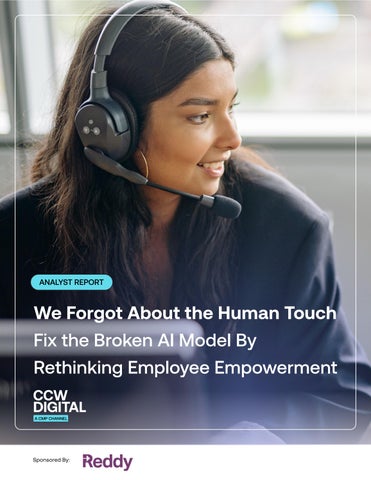
ANALYST REPORT
We Forgot About the Human Touch Fix the Broken AI Model By Rethinking Employee Empowerment
Sponsored By:
WE FORGOT ABOUT THE HUMAN TOUCH: FIX THE BROKEN AI MODEL BY RETHINKING EMPLOYEE EMPOWERMENT
Featuring Insights by Tom Lewis Chief Customer Officer Reddy
Adam Levin Co-Founder and CEO Reddy
Introduction Nearly 97% of customer contact leaders say cost-cutting is a driving force behind their technology investments. These executives identify self-service adoption and leveraging agentic AI as cornerstone strategic priorities for 2026-27, and they view self-service resolution rate as one of their single most important success metrics. These findings confirm a mandate long associated with the AI transformation: deflect customer interactions and reduce the workforce that used to handle them. And today, for the first time, the technology can deliver on it. Self-service platforms are capable of handling a significant number of frontline issues, driving a widespread commitment to an “agentic frontline.” According to research from CMP, 58% of those investing in agentic AI believe most support interactions will be fully automated by 2030. But by fixating on deflection, customer contact leaders are jeopardizing the health of their operations. Notably, they are doing a disservice to their employees: the very people who become immensely more important in a world where “AI will handle simple issues so humans can focus on complex work.” Due to limitations in skills and operational support, only 17% of customer contact leaders believe their teams are ready for this new dichotomy. The prevailing AI model actively widens this talent gap, setting employees up to underperform, grow disengaged, and ultimately exit the business. The result will be weaker customer experiences and greater talent management costs. This report will explore the unanswered questions and hidden costs of today’s broken AI model, before revealing keys to a more successful one. It will close with a blueprint for shifting the narrative from “how few people can we run with” to “how great can the people we keep become.”
Fix the Broken AI Model By Rethinking Employee Empowerment | www.customercontactweekdigital.com
2
WE FORGOT ABOUT THE HUMAN TOUCH: FIX THE BROKEN AI MODEL BY RETHINKING EMPLOYEE EMPOWERMENT
Overlooked Questions and Hidden Costs: Why Deflection-Driven AI Weakens the Human Touch Growing confidence in AI’s ability to resolve frontline inquiries makes human ingenuity more, not less, valuable to the customer contact operation. Organizations will not need employees who merely serve as generic script readers and order takers; instead, they will require people who can think critically, demonstrate empathy, and build relationships. Humans will be the ones handling the edge cases – the unique, unpredictable matters with significant emotional and financial stakes. They will also be the ones tasked with turning customer support interactions into lasting business relationships. Although concepts like “AI for simple and humans for complex” seem to acknowledge this reality, existing AI models directly thwart organizations’ ability to cultivate human ingenuity. They cause existing top-tier talent to disengage, and they inhibit the development of new star performers.
1. Talent gaps question the viability of the “AI for simple, agents for complex” dichotomy The theoretical upside of the AI deflection model is that employees can shift their attention to the complex, emotionally consequential work only humans can handle. The practical reality, however, is that many of today’s human employees cannot handle these issues. New CMP research confirms that only 17% of leaders are fully confident in their teams’ readiness to handle higher-value work. The number, alarmingly, is virtually unchanged from the 16% figure CMP uncovered in 2024. This means that despite two years of inescapable hype about the pivot to complex work, organizations have made virtually no progress in cultivating higher-value skillsets. Consumers share this pessimistic view of today’s frontline representatives. Less than one-third feel the typical human employee demonstrates expertise in the brands and products they are supporting, and the numbers for emotional intelligence and enthusiasm are similarly sobering. The emphasis on deflection-based AI could also cause brands to lose the experienced talent they do have, whether through cost-minded headcount reduction or disengagement from those who feel their customer service job has an expiration date.
2. Simple issues play a critical role in employee development and satisfaction Because employees are not exactly clamoring to spend their days resetting passwords or answering questions about order statuses, automating transactional work is often treated as an employee-centric endeavor. It is presented as a way to enrich their days by helping them focus on more substantive, thought-provoking interactions.
Fix the Broken AI Model By Rethinking Employee Empowerment | www.customercontactweekdigital.com
3
WE FORGOT ABOUT THE HUMAN TOUCH: FIX THE BROKEN AI MODEL BY RETHINKING EMPLOYEE EMPOWERMENT
But eliminating simple issues also comes with a hidden cost: a lost opportunity for talent development. Prior to the emergence of an AI-powered frontline, the contact center adhered to an apprentice model. Employees would learn about the business and its customers precisely by handling simple, repetitive, frontline work. This exposure also served as an impetus for “good attrition.” If an employee proved unwilling or unable to handle core support tasks, they were obviously not suited for a long-term career in the organization. After establishing their comfort and mastering these types of interactions, they would graduate to complex work with more real-world experience, topic mastery, and confidence. By eliminating these issues from the queue, employees have less opportunity to “cut their teeth” on transactional matters. They will be thrown right into the deep end, handling the most challenging interactions from the most demanding customers. This change serves to exacerbate the impact of the aforementioned talent gap. Brands will end up with less capable talent handling more challenging inquiries.
“We are automating away the very calls people used to learn on. The old path to expertise was an apprenticeship: a new hire took a thousand easy calls, then slowly earned the hard ones, and became a veteran over a year or two. Automation just deleted the easy calls. So new agents now face the hardest moments on day one, without the on-ramp their managers had. Skill can no longer be a by-product of volume, because the volume that used to teach it is gone.” - Tom Lewis, Chief Customer Officer, Reddy
Beyond stunting talent development, eliminating simple work could adversely affect employee morale. For as much as employees may not want to exclusively perform repetitive work, they do value this work as a reprieve from the emotional and intellectual strain of challenging tasks. Without this “break,” employees will be highly vulnerable to complexity burnout.
3. Modern training and measurement models do not support continuous, personalized development Most of today’s contact centers suffer from a talent gap, and few offer the training needed to close it. In the typical customer contact operation, “training” is merely another box to check in the onboarding process. At best, this type of “training” provides a superficial knowledge primer on products and processes. It, most assuredly, is not coaching. It does not sufficiently emphasize real-world scenarios, does not account for the ongoing evolution of customer and business needs, and does not adapt to each employee’s individual strengths and weaknesses. These happen to be the most important development areas in the “AI for simple, humans for complex” model. Fact-based inquiries are the ones most suitable for automation; human employees will be stepping in for nuanced matters that cannot be fully predicted, let alone scripted. Not simply a flaw in employee development strategy, this problem is also a consequence of inadequate performance management systems. Today’s performance and quality systems, even advanced, AI-powered ones, often focus on scoring what happened in a given interaction. What they fail to do is pinpoint specific improvement areas for the next interaction. Worse, most programs still grade from a thin sample of calls, often as little as 2%, so the vast majority of interactions, and the patterns hiding inside them, are never seen at all. Measurement that narrow can tell an agent what went wrong on a single call. It can never tell the operation what to fix, or the enterprise why the call had to happen in the first place.
Fix the Broken AI Model By Rethinking Employee Empowerment | www.customercontactweekdigital.com
4
WE FORGOT ABOUT THE HUMAN TOUCH: FIX THE BROKEN AI MODEL BY RETHINKING EMPLOYEE EMPOWERMENT
4. AI frameworks are fragmented, and employees feel the pain The emergence of so many disparate AI technologies and use cases has resurfaced the best-of-breed model, in which buyers pursue a variety of point solutions. Moreover, they often purchase these solutions based on demos or pitches, failing to embark on a meaningful exploration of how well they work with a brand’s actual, existing data, processes, and technology frameworks. The net result is more fragmentation for a business function that has notoriously struggled to unify its tools, systems, and data sources.
This technological chaos amplifies the operational fragmentation typical of the contact center employee experience. Far too many teams approach hiring, onboarding, coaching, and quality management as distinct initiatives rather than phases in a singular, ongoing employee journey.
“Our belief is that these are not separate functions at all. They are one continuous loop that runs the whole life of an employee, from the first interview to the day they become the veteran everyone else learns from: recruit, hire,
“The buyer quietly becomes the systems
onboard, help in the moment, coach,
integrator, maintaining seams that were
measure, retain, and develop, over and
never meant to meet, while the agent
over. What you learn in quality should
lives in the gaps. The market is racing
shape what you coach. What you coach
toward this assembled stack right now.
should shape who you hire and how you
It is the wrong architecture, and it is
ramp them. Who you hire should feed
worth challenging before the contracts
back into what “good” even means. And
are signed.”
the help an agent leans on during a
- Tom Lewis, Chief Customer Officer, Reddy
hard call should become the very thing they practice next. When those live in separate systems, signal leaks out at every handoff: the person who spots the gap in quality is not the person who develops the training or coaches it, who is not the person who hired for it. Three teams, three vocabularies, and the insight evaporates in between.” - Adam Levin, Co-Founder and CEO, Reddy
Fix the Broken AI Model By Rethinking Employee Empowerment | www.customercontactweekdigital.com
5
WE FORGOT ABOUT THE HUMAN TOUCH: FIX THE BROKEN AI MODEL BY RETHINKING EMPLOYEE EMPOWERMENT
Unsurprisingly, the technological and strategic disconnect manifests as additional friction and ineffective talent development. Employees have a harder time accessing what they need in the moment, and they receive less consistent support for growing their capabilities over time. The impact on frontline employees says nothing of the cost friction creates for supervisors. When they lack singular, comprehensive, real-time insight into how their teams are performing, they cannot function as effective managers or trainers. As a result, they cannot do their part to close competency gaps or drive lasting success.
Fix the Broken AI Model By Rethinking Employee Empowerment | www.customercontactweekdigital.com
6
WE FORGOT ABOUT THE HUMAN TOUCH: FIX THE BROKEN AI MODEL BY RETHINKING EMPLOYEE EMPOWERMENT
From Fewer People To Better People: Rethink the AI-Human Model To Create Employee Confidence, Customer Trust Organizations are not wrong to leverage AI for handling certain frontline issues. Many of these inquiries do not require human ingenuity, and modern AI agents can address them quickly, accurately, and conversationally. They are, however, wrong to let their pursuit of automation overshadow their vision for employee development. They are wrong to downplay the human transformation associated with AI investment. In an AI-powered frontline model, humans become even more important for three reasons: 1.
They play a crucial guardian role, ensuring that AIbased experiences progress as expected. Operating as “humans in the loop,” they must be there to intervene when interactions are at risk of going off track.
2.
They contribute more meaningfully to the support ecosystem, with their day-to-day focus shifting to higher-stakes matters.
3.
They help brands establish identities and build relationships, bringing a much-needed “human” voice into an increasingly automated, “templated” customer experience landscape.
“For the moment that actually decides loyalty (the billing shock, the claim, the cancellation, the thing that scares them) a capable human is not the fallback. It is the premium experience. That is the moment your brand is won or lost, and it is exactly the moment the ‘remove humans’ scoreboard tells you to underinvest in.” - Tom Lewis, Chief Customer Officer, Reddy
Fix the Broken AI Model By Rethinking Employee Empowerment | www.customercontactweekdigital.com
7
WE FORGOT ABOUT THE HUMAN TOUCH: FIX THE BROKEN AI MODEL BY RETHINKING EMPLOYEE EMPOWERMENT
Preparedness for this elevated role does not happen automatically; if it did, more than 17% of customer contact leaders would feel their teams were ready for consultative work, and most consumers would not dismiss the typical customer service employee as unfocused and unprepared.
This includes hiring the right people, providing the right onboarding, developing ongoing training that is tied to real-time quality assessments, delivering supportive agent assist prompts, and managing employee sentiment to keep the best performers happy and engaged for the long term.
It can only happen when organizations challenge the broken “AI for deflection” model and refocus their attention on cultivating, developing, and engaging exceptional human talent.
“The fix is one language end to end. You
The following steps will help you pivot from a model that emphasizes reducing employee-led support into one that increases the quality of that support, by virtue of creating more confident, capable, and engaged employees.
1.
Embrace an end-to-end team empowerment strategy
Neither business leaders nor customers feel today’s customer service employees are ready for more complex, consultative work. This pessimism is not, however, exclusively a knock on the employees. It is not a declaration that these representatives are fundamentally incapable of engaging in more dynamic, human-centric interactions. Instead, it is a call for leaders to create empowering environments that better activate their talents’ inherent proclivities for human ingenuity, critical thinking, and empathy. Creating this empowering environment hinges on reframing all aspects of employee development and engagement as a singular, high-priority strategy.
define the traits and moments that matter, you hire against them, you coach against them, and you measure against them, all with the same words and the same standard. A weakness spotted on Monday becomes a practice scenario on Tuesday and a hiring signal by the next class.” - Adam Levin, Co-Founder and CEO, Reddy
2. Leverage a next-generation approach to simulation coaching On the one hand, the idea of employees “learning in a production environment” is untenable in today’s customer contact landscape. The interactions are likely too complex for new talent, and the stakes are too high to allow them to “fail on the job.” On the other hand, classroom training approaches are inadequate for this landscape. Interactions that only require memorization of “facts” can be handled in AI-powered self-service environments. The future of human work lives in edge cases, personal touches, and exceptions, all of which can only be learned in real-world scenarios. Modern simulation solutions open the door to this type of coaching, enabling employees to gain exposure to the nuance and unpredictability of the high-stakes situations they will be handling in the real world. Instead of emphasizing rigid processes and robotic script adherence, this type of coaching prepares employees to inject the human touch into interactions. It empowers them to listen critically to intentions, adapt based on conversation flow and customer sentiment, and tailor resolutions to context.
Fix the Broken AI Model By Rethinking Employee Empowerment | www.customercontactweekdigital.com
8
WE FORGOT ABOUT THE HUMAN TOUCH: FIX THE BROKEN AI MODEL BY RETHINKING EMPLOYEE EMPOWERMENT
Befitting this need, the best simulation solutions do more than simply mimic human conversations. They instead recreate the entire call flow, fully immersing employees in the job they will be performing. This means asking employees to look across multiple screens and leverage the different tools, such as sentiment analytics and real-time agent assist, they will be using on the frontline. It means providing them with the same quality and performance scoring that they will receive when supporting real customers. And it means devising custom lessons and coaching plans based on the strengths and weaknesses they display in the simulated interactions. This is also where leaders should look closely, because not every solution that calls itself simulation clears the bar. The exchange with the synthetic customer should adapt to what the agent actually says, not run down a rigid script. The screens should let the agent manipulate real data the way they would in production, not read fields off a flat form. And the value should not stop at onboarding: the same engine should deliver recursive, remedial reps to experienced agents, built as short modules that drill the difficult middle of a call rather than the greeting and the goodbye. It is not just “practice.” It is persistent, personalized development.
“The proof is in the ramp. One enterprise team that moved from side-by-side shadowing to structured simulation cut the time it took a new agent to reach proficiency by half. Faster ramp is not a training metric. It is a payroll, attrition,
3. Provide roadmaps, not scripts or scorecards Whether working in a simulated environment or on the actual frontline, employees gain confidence when they see the quality and coaching program as a guide: a GPS rather than a police officer. This means that all quality scoring and performance management technology must be rooted in identifying improvement areas and coaching opportunities, not simply flagging a list of what went right and wrong. The strongest quality programs work at two altitudes. The tactical altitude is the feedback an individual agent and their supervisor can act on this week: not a traffic ticket, but a specific skill to build next, and for the supervisor, a clear read on where the floor is drifting. The strategic altitude is what becomes possible when quality covers 100% of interactions instead of a 2% sample: the same signal rolls up into voice-of-thecustomer and operational insight the enterprise can act on. Why are customers calling at all? Which workflow, policy, or product decision upstream is generating the contact? The contact center rarely controls those levers, but it is the sentinel that sees them first. A program that does only the tactical half leaves the largest prize, converting insight into impact across the whole business, on the table. Having both is also what compounds the employee experience the rest of this report calls for. It also means organizations must strategically commit to closing feedback loops, tailoring training, and building improvement pathways. Leading employee-facing AI solutions help organizations achieve this pivot from retroactive scoring to progressive development at scale:
revenue, and cost metric.” - Tom Lewis, Chief Customer Officer, Reddy
Leveraging AI, leading providers empower contact centers to construct this dynamic, immersive, end-toend coaching experience in less than 24 hours. This enables brands to avoid the “ride a bicycle and fix it at the same time” dilemma; organizations can revolutionize their coaching program, cultivate expertise, and unlock unprecedented human ingenuity, all without disrupting live operations. Fix the Broken AI Model By Rethinking Employee Empowerment | www.customercontactweekdigital.com
9
WE FORGOT ABOUT THE HUMAN TOUCH: FIX THE BROKEN AI MODEL BY RETHINKING EMPLOYEE EMPOWERMENT
“Before the call, it is learning and practice: a clear path to build a skill, and a safe place to rehearse the hard moments before they are real. During the call, it is help in the moment: the right answer surfaced without a frantic search, the next step suggested, the policy pulled up before the customer has to wait. After the call, it is coaching: turning what just happened into a specific next rep, not a grade filed away.” - Tom Lewis, Chief Customer Officer, Reddy
Not simply imperative for performance management, the idea of guiding should also be at the root of solutions like realtime agent assist. Tools that simply engineer a “script” for employees may seem like they are saving time and increasing consistency, but they do so at the expense of agent development. Real assistance comes from providing employees with the why behind prompts and recommendations. This insight into the driver behind next-best actions allows employees to internalize the insight, leading to more legitimate topic mastery and comfort applying the principle of the recommendation to future interactions that have a similar underlying intent but flow in a different way.
4. Commit to the Employee Experience as a Measurable Objective When discussing the “AI for simple, humans for complex” model, leaders may think they are communicating something like this: “You will no longer have to deal with boring work. Instead, you will get to focus on the more stimulating interactions that make your job rewarding and exciting.” Employees, however, may be hearing the following: “You are no longer going to have easy days. You are going to be dealing with the most challenging interactions from the rudest, most demanding customers. And that’s if you even get to keep your job – with AI cost-effectively handling so many issues, we may not even need you moving forward.” As a result, they may not be as ecstatic about the AI transformation as thought leaders like to suggest. The cognitive and emotional burden of actually dealing with these interactions will only exacerbate that negative sentiment, hurting employee engagement in an era where their demeanor matters more than ever. After all, for all the talk about “happy agents equaling happy customers,” employees did not actually have to be over-themoon to handle transactional inquiries about payment due dates or passwords. Their positive demeanor will be critical, however, in navigating highly personal, conversational interactions with significant stakes. Happiness, moreover, will keep employees engaged in and loyal to the contact centers they are supporting. This will prompt them to stay for the long haul, developing the seniority and practical experience needed to handle an increasingly complex, unpredictable workload. Ultimately, this establishes the employee experience as a paramount focus for customer contact leaders. It must be a measurable, foundational business standard, not just a hollow concept addressed with superficial gestures. Effectively measuring the employee experience requires metrics that account for a balance of the day-to-day work experience (such as the impact of high-friction systems, AI-enablement tools, and workflow optimization initiatives), lasting support (“return on learning” assessments to grade the impact of ongoing coaching), culture and collaboration (analysis on the “voice of the employee”), and real-world performance (mapping the correlation between the employee’s work and customer satisfaction and loyalty levels). Fix the Broken AI Model By Rethinking Employee Empowerment | www.customercontactweekdigital.com
10
WE FORGOT ABOUT THE HUMAN TOUCH: FIX THE BROKEN AI MODEL BY RETHINKING EMPLOYEE EMPOWERMENT
“Here is the link a leader must not blur: employee experience is the upstream cause of customer experience. You cannot buy great CX while starving EX, because the anxious, unsupported agent is the very person facing your customer at the hardest moment. Treating them as separate line items is how companies spend heavily on customer-facing polish and still lose the calls that decide the relationship. Only then do the business outcomes show up, and they show up precisely because the two experiences improved, not on their own. Better employee experience lands as faster ramp and lower attrition. Better customer experience lands as higher satisfaction on the calls that decide loyalty, stronger first-contact resolution, fewer escalations, and steadier compliance on the moments that carry real regulatory risk. On a sales-touched service call, it is the difference between a save and a cancellation. These are not training metrics. They are line items a CFO already tracks, and they are the receipts for the experience work, not a substitute for talking about it.” - Adam Levin, Co-Founder and CEO, Reddy
Fix the Broken AI Model By Rethinking Employee Empowerment | www.customercontactweekdigital.com
11
WE FORGOT ABOUT THE HUMAN TOUCH: FIX THE BROKEN AI MODEL BY RETHINKING EMPLOYEE EMPOWERMENT
Checklist for Success: Is Your Contact Center Unlocking the Human Touch? The broken AI deflection model underscores the difference between rhetoric and reality. Many leaders say they are using AI to augment employees, but their actions are ultimately reducing the human touch. Fortunately, the four steps provide a blueprint for reversing course and restoring humanity to the customer experience. They do not reject the value of AI; rather, they reframe AI as a way to efficiently eliminate roadblocks to human performance. They reframe AI as a way to help human employees reach their truest potential. The following checklist will help you seize this opportunity. It will ensure your strategic and technological initiatives make good on this promise – and actually fuel a more empathetic, consultative support team – in an era where so many are automating the humanity out of their customer experiences.
Fix the Broken AI Model By Rethinking Employee Empowerment | www.customercontactweekdigital.com
12
WE FORGOT ABOUT THE HUMAN TOUCH: FIX THE BROKEN AI MODEL BY RETHINKING EMPLOYEE EMPOWERMENT
Fix the Broken AI Model By Rethinking Employee Empowerment | www.customercontactweekdigital.com
13