CUSTOMER CONTACT WEEK
DIGITAL
CUSTOMER CONTACT WEEK
DIGITAL

CUSTOMER CONTACT WEEK
DIGITAL
CUSTOMER CONTACT WEEK
DIGITAL
WRITTEN BY: AUDREY STEEVES

SPONSORED BY:


Harry Folloder Chief Commercial Officer Krisp
With so many dimensions of CX changing, the popularity of voice-led experiences demonstrates customers’ most authentic preferences. In an always-on digital ecosystem of touchpoints, customers want, above all, to be heard. Voice communication sits at a unique intersection of inherent understanding and acute fragility: the best voice experiences require the least amount of effort on behalf of the customer of any channel, but the worst experiences are confusing, frustrating, uncanny, or potentially even upsetting. Delivering voice experiences at scale has never been a simple challenge: our global economy means customers call in from anywhere, each with a distinct communication style and set of expectations.
Today, voice shoulders the burden for most customer service operations, wherein the reliability of the voice channel lends credibility to less familiar channels. In our June 2025 market study, CCW Digital found the top differentiator that gives customers confidence in engaging with a chatbot or AI assistant is the ability to escalate to a human agent at any time. Further, the number one driver supporting a preference of human agents over AI-led experiences is the concern that it will be too difficult to explain their issue to AI.
40% of leaders say voice is a top operational priority and they’re actively sourcing solutions to improve voice CX. Another 38.9% say voice is important in existing operations. Only 7.4% are deprioritizing voice.
Source: CCW Digital January 2026 Market Study (“Emerging Contact Center Technology”), page 16
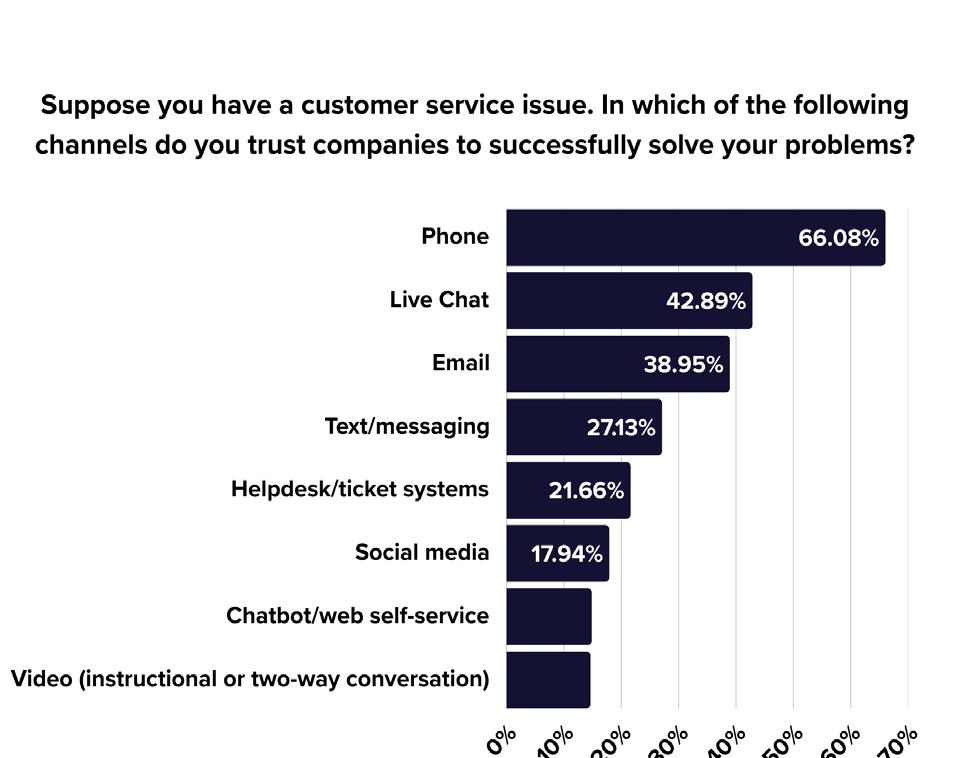
In even plainer terms, 66% of customers simply trust the phone channel most: it is the only channel trusted by a majority of respondents.
Harry Folloder, Chief Commercial Officer at Krisp, breaks down the role of voice in 2026, “For most of the last twenty years, voice was treated as plumbing. The interesting CX work happened everywhere else. You routed a call, recorded it, maybe sampled 2% for QA, and optimized around it. The problem with that model is that voice is still the majority channel, and for issue resolution specifically, the preferred channel. When something actually matters, customers call. Which means voice is sitting in the critical path of every expensive, high-stakes interaction you have.”
Human-to-human conversation is full of nuance and subtleties that go largely unnoticed by our conscious brains, but the mediation of technology can prevent these signals from landing, creating misunderstandings and incongruencies. Future-proofing the voice channel means pursuing perfect comprehension; after all, when the conversation breaks, everything breaks. Improved comprehension means less effort per call on behalf of the customer and the agent, as well as a greater ability to deliver consistent outcomes in real time.
Tolerance for suboptimal voice experiences is diminishing and customer patience has worn thin. Effortless comprehension is becoming the baseline expectation, and by 2030, Harry Folloder anticipates customer expectations will only rise further.
“The idea of repeating yourself because an accent, a language, or background noise got in the way will feel as dated as waiting 40 minutes in a phone queue feels today,” he says.
“Customers won’t notice when it works. They’ll notice immediately when it doesn’t.”
Most of what we call CX problems are conversation problems. To understand what differentiates a conversation from an interface or touchpoint, we analyzed three essential components of conversation:
Pace: Conversations require a rapid back-and-forth that progresses closer to a resolution with each exchange. Moments spent waiting draw the customers’ attention away from their own query towards the overall service process they’re participating in. Harry continues, “Hold times, callbacks, and “let me transfer you” moments are friction the next generation of customers will not tolerate.”
Clarity: Every source of ambiguity extends the interaction, making it feel less like a conversation and more like a chore. Humans are able to communicate remarkably well amidst auditory challenges, confusing processes, and even a lack of shared language, but each adaptation the customer makes requires effort. When these limiting factors are preemptively addressed by the organization, customers get the resolutions they need without ever experiencing frustration, impatience, and disappointment.
Effectiveness: The most seamless interactions still disappoint when the resolution is not there. We often focus too heavily on training agents to perfect a script rather than coach them on more dynamic communication. The amount of energy and critical thinking needed for the dynamism needed to deliver personalized, high quality resolutions draws from the same cognitive well that becomes overburdened with comprehension issues.
When growth outpaces an environment’s ability to adapt, even the most promising opportunities can create problems.
Our globalized economy is still relatively new, and the Internet age is newer still, yet much of our business best practices fail to adequately capture how these aspects impact our customers’ experience. Metrics alone cannot be relied on to capture necessary macro-level context that influences interactions between customers and brands.
Fluctuation of global labor costs have enabled companies to establish their contact center operations in countries across the world. At the same time, widespread migration has distributed workers across all corners of the world, resulting in a truly international workforce. Misunderstandings and miscommunications proliferate in high tension customer service settings. Customers and agents have to work harder to understand each other before they can begin resolving the issue at hand.
“Most of what we call CX problems are conversation problems. Fix the conversation layer and the dashboards take care of themselves.”
Our globalized economy is still relatively new, and the Internet age is newer still, yet much of our business best practices fail to adequately capture how these aspects impact our customers’ experience. Metrics alone cannot be relied on to capture necessary macro-level context that influences interactions between customers and brands.
Fluctuation of global labor costs have enabled companies to establish their contact center operations in countries across the world. At the same time, widespread migration has distributed workers across all corners of the world, resulting in a truly international workforce. Misunderstandings and miscommunications proliferate in high tension customer service settings. Customers and agents have to work harder to understand each other before they can begin resolving the issue at hand.
While customer effort is often the main concern, the effect on agents cannot be understated. Harry Folloder notes how improving communication has an immediate effect on agents, “When the conversation gets easier to parse, the agent stops working in second gear. They sound more confident, they resolve faster, they escalate less. That flows into CSAT and attrition, which is the metric most operators undercount.”
Much of what makes conversation effective and organic takes place beyond human consciousness. When two people are not able to understand each other, whether it be because of a language barrier, comprehension issue, audio quality, or other variable, they must try harder, and more consciously, to reach an understanding. Alternatively, when communication takes place seamlessly, it feels less like a customer service interaction and more like a conversation.
In some ways, the best voice experiences will not feel high-tech at all, rather, they should feel like a return to the organic, subliminal communication that has long allowed in-person interactions to outshine those that take place through a digital partition. Harry builds on his voice metaphor,
“Treating voice as plumbing worked when we didn’t have tools to go inside the signal. We do now. On-device models can clean the audio, adapt accents, translate languages, and feed downstream AI cleaner inputs than the raw line ever carried, all in real time, without adding perceptible latency.”
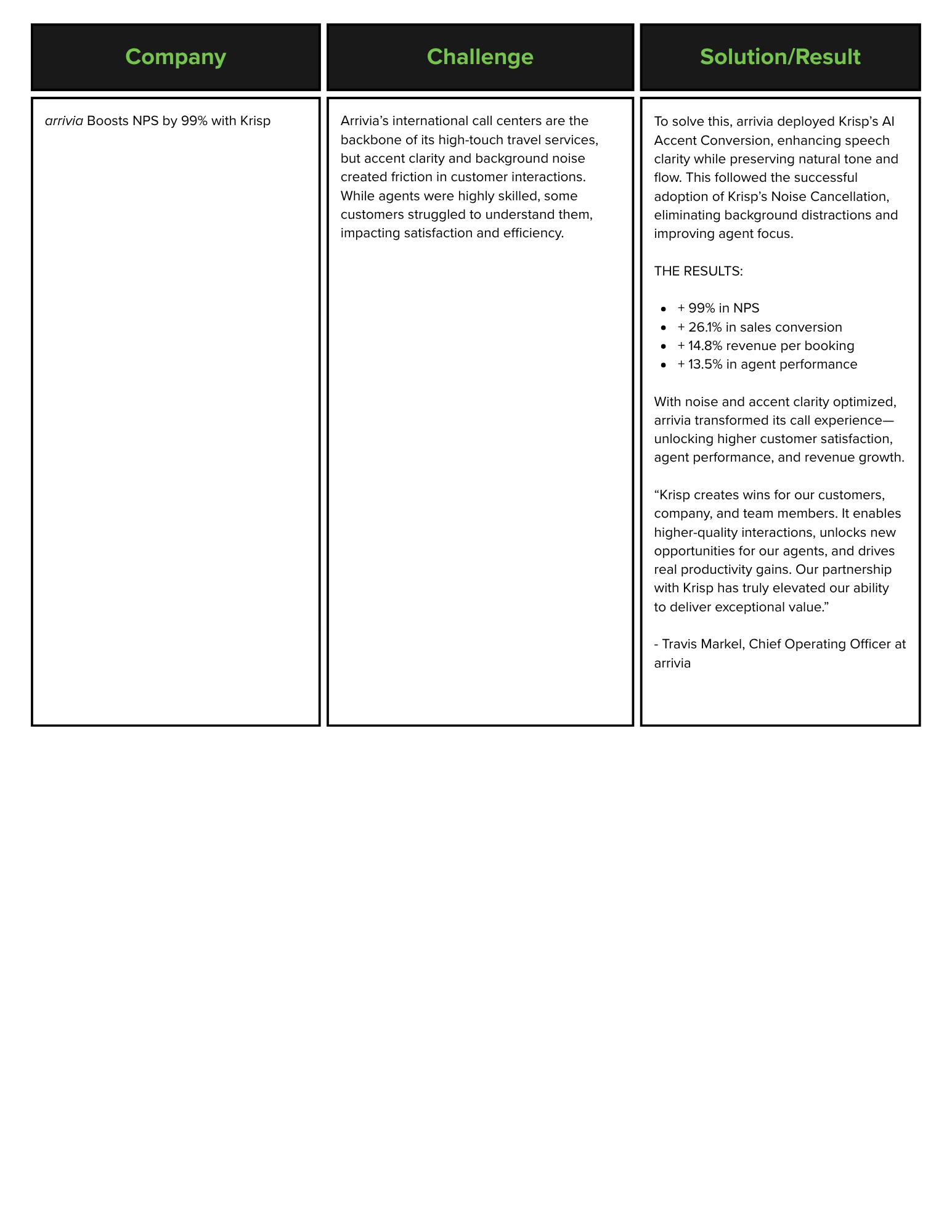
The key to building next-generation experiences is tackling all of these facets of voice within a highly orchestrated, contiguous framework. Noise cancellation and accent conversion have long demonstrated promise in enhancing comprehension, but the most value comes from the coordinated approach.
Traditional accent conversion is one-directional: it may help an offshore agent be better understood by an onshore customer, but it fails to address the friction running both ways. Today, agents working in English as a second language spend real cognitive energy parsing strong US regional accents, Scottish, rural Australian, Nigerian English. Giving the customer a smoother agent voice doesn’t help the agent understand the customer. This is half of the problem.
Krisp built the other half. In March 2026, Krisp launched customer-side accent conversion, which smooths the customer’s voice in real time for the agent’s ear. Paired with agent-side accent conversion, Krisp is the only provider in the market with bidirectional accent conversion on a live call. The impact is immediate: both sides get a smoother counterpart, and cognitive load drops on both ends of the conversation, not just one.
Mechanically, accent conversion operates on the human voice itself. It smooths phonetic edges in real time and preserves tone, emotion, and identity. Nobody gets replaced, synthesized, or flattened. Both sides still sound like themselves. The conversation just gets easier to follow. That is crucial for ensuring the critical buy-in from adoption. Agents resist technology that changes who they are. They embrace technology that helps them do their job.
The compression of customer expectations in tandem with the demonstrable value of seamless conversation points towards real-time translation as a mainstay of CX by the end of the decade.
“Large CX operators run fifteen, twenty, thirty delivery geographies. The variability across those sites is not a training problem. It’s a physics problem.”
Accent Conversion removes accent as a barrier inside a language. Voice Translation removes the language barrier itself. Different technology, different pipeline, different commercial logic, but the direction of travel is the same: reduce every last bit of friction
On March 26, 2026, the FCC adopted a Notice of Proposed Rulemaking (FCC 26-16) by unanimous vote. It proposes a cap on offshore customer service call volumes, mandatory disclosure to consumers that a call is being handled abroad, a right to transfer to a US-based agent, English proficiency standards, and a ban on offshore handling of certain sensitive transactions like password resets and payment data. While this has not yet become policy at the time of publishing, and the final ruling may include fewer or different stipulations, the action represents real consumer interests. Should this become law, the policies that would affect telecommunications organizations under the purview of the FCC would likely become a test for other industries to follow suit. This could have transformative effects on our industry.
In order to prepare for a more ambiguous regulatory future, Krisp outlined three things contact center leaders can start considering today:
• Optionality in your delivery model: If caps land at 30% for covered providers (as was proposed in the initial Notice of Proposed Rulemaking) the ability to rebalance across onshore, nearshore, and offshore inside a single operating framework becomes a hard requirement, not a nice-to-have.
• The cost line: If you’re forced to onshore volume, your per-interaction cost goes up unless you find productivity to offset it. That productivity has to come from inside the conversation, not from more AHT pressure on agents.
• Auditability: The disclosure, transfer, and sensitive-transaction rules will produce reporting obligations whether or not this specific rule passes as drafted. Build the data infrastructure to answer them cleanly now.

Audrey Steeves
Content Analyst
CCW Digital
Audrey Steeves is a content analyst for CCW Digital. Her background spans technology, healthcare, and start-ups for consumer and B2B audiences. Since 2024, she has developed content for CCW Digital on both CX and EX topics, with an interest in the way emergent technology is leveraged to creater better-than-ever experiences on both sides of customer contact.
Audrey studied business administration and management at Northeastern University and has previously held in-house and agency content writer roles.

Brian Cantor
Managing Director & Principal Analyst
CCW Digital

Brooke Lynch
Division DIrector, Principal Analyst
CCW Digital
involved:

Ben McClymont
Divisional Sales Director
E: ben.mcclymont@cmpteam.com

Simon Copcutt
Head of Strategic Accounts
E: simon.copcutt@cmpteam.com