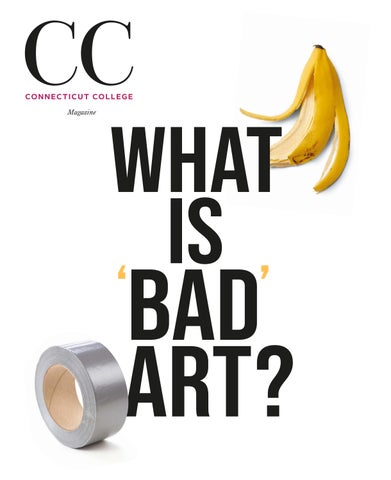
CC Connecticut College Magazine
WHAT IS ‘ ’
Vol. 35 No. 1 ✦ Fall 2026
10/7/26 3:38 PM
Cover TOC.indd 2
BAD ART?
Features 23 Healing at a Distance Telehealth is changing how, when and where Americans access care. 28 New Digs (Coming Soon) Conn is building its first new student housing since the 1960s. 34 Art Rebel Curator Marcia Silverman Tucker ’61 held radical ideas about a conventional subject. Cover TOC.indd 3
10/7/26 2:59 PM
Departments
On the cover: A reference to the famously controversial artwork Comedian by Maurizio Cattelan. Story page 34 On this page: Patrick Gorham ’29 and Milly UrbanowskiWomer ’29 share a dance during the Welcome Back Block Party in August. Photo by Sean D. Elliot
Cover TOC.indd 4
Notebook Dancing to the Polls, In the Round, Sailing Victory, Two Tonys, We Live Here, In the Greenhouse, Supercentenarian, Byline on the Rise, Innovative Instruments, Ink
3
Class Notes
40
Featurette Big V and The Boys
49
Full Stop Where The Streets Had No Name
56
10/13/26 2:03 PM
DF
From the President Sean D. Elliot
E
With gratitude, Andrea E. Chapdelaine, Ph.D.
2-19 Notebook.indd 2
CO N N EC T I C U T CO L L EG E
Magazine
EDITOR: Amy Martin ART DIRECTOR: Benjamin Parent STAFF PHOTOGRAPHER: Sean D. Elliot SENIOR WRITER: Melissa Babcock Johnson CLASS NOTES COMPILED BY: Alumni Relations
very day on our beautiful Connecticut College campus, students learn in ways both planned and unexpected. Some of the most meaningful and memorable parts of a Conn education happen not only in the classrooms and labs, but in the residence and dining halls, on pathways in between classes, in latenight conversations with friends, and in the shared experiences that make Conn feel like home. In this kind of residential learning community, how students live is deeply connected to how they learn, grow and discover who they are becoming. Over the last few years, it has become very clear that our students, especially in their junior and senior years, seek a residential experience that moves beyond the traditional dorm room and gives them the space to practice the life skills and communitybuilding that will allow them to thrive in their lives after graduation. Since my first day on campus, I have made it clear that meeting the needs of our students is a top priority. Our students aren’t just central to our mission—they are the mission. And that is why I’m thrilled to share that Conn is taking a very big step toward transforming our residential experience: We are building the first new student housing on campus in more than 60 years. In May, the Board of Trustees voted unanimously to approve a townhome- or apartment-style independent living community for 240 students. The space will have all the amenities our students are seeking—kitchens, private bathrooms, shared living areas—as well as indoor and outdoor space to gather and host events. It will be a beautiful, bright facility with accessible design and modern climate control. And once it’s completed, it will allow us to begin significant renovations to our existing residence halls. This project represents a historic shift away from a traditional housing model into a purposeful, four-year developmental community. By treating campus living as a vital laboratory for life preparation, the College will cultivate a physical environment that mirrors a student’s personal growth, civic responsibility, and readiness for a productive and meaningful life. I invite you to read much more about our “New Digs” beginning on page 28. There is a great deal of excitement on campus as we begin the planning and design process in consultation with students, faculty and staff. I am so grateful for the vision and support of the Board of Trustees to advance this transformational project for the benefit of our students. We look forward to sharing more as the project moves ahead, and to celebrating together the many ways Connecticut College continues to grow while remaining deeply rooted in the values and relationships that make it extraordinary.
2
CC
CC Magazine is published by the Office of Marketing and Communications. We are committed to covering a diverse group of stories in order to profile the human condition as seen through—and sometimes written by—our alumni, faculty, students and staff; we strive to publish features and photography that illuminate the College’s story. CC Magazine (ISSN 1060-5134) (USPS 129-140) is published in winter, spring and fall, and is mailed free of charge to Connecticut College alumni, parents and friends of the College. Standard rate nonprofit postage paid at New London, CT, and at additional offices. Contributions: CC Magazine will consider, but is not responsible for, unsolicited manuscripts, proposals and photographs. Address correspondence to: Editor, CC Magazine, Becker House, 270 Mohegan Avenue, New London, CT 06320-4196 Phone: 860-439-2526 Email: ccmag@conncoll.edu
Alumni: Send address changes to: Alumni Office Connecticut College 270 Mohegan Ave. New London, CT 06320-4196 or email to alumni@conncoll.edu Postmaster: Send address changes to: CC Magazine, 270 Mohegan Ave., New London, CT 06320-4196 CONNECTICUT COLLEGE BOARD OF TRUSTEES Seth W. Alvord ’93, Chair, Jessica L. Archibald ’95, Vice Chair, Maria Wyckoff Boyce ’85, Ryan J. Casey ’26, Young Alumni Trustee, Bellaluna Castellanos Palacios ’25, Young Alumni Trustee, Andrea E. Chapdelaine, President, Lawrence B. Damon III ’93, Peter Eckel, Marisa G. Fariña ’93, Sydney L. Lamb ’21, John D. Linehan P’18 ’23 ’24, Vice Chair, Erica L. Lovett ’14, Sarah A. Mudho ’98, Devon Danz Preston ’93 P’28, Fletcher F. Previn ’00 P’29, Leslie Rosen ’02, Jonathan S. Stavin ’85, Diane E. Stratton ’91, Randall T. Suffolk ’90, Andrea Braun Tarbox ’72 P’09, Maarten D. Terry ’83, Veronica A. Venture ’86, Anne A. Verplanck ’80, Tamah Nachtman Wiegand ’68, Shawnia A. Yon ’24, Young Alumni Trustee, John S. Zeiler ’74 ALUMNI ASSOCIATION BOARD OF DIRECTORS Selma Goodman Ahmed ’97 P’29, Taylor Austin ’24, Laila Bera ’23, Gil Bianchi ’96 P’22 ’24 ’26 ’29 ’30, Laurie Cameron ’69, Brian Crawford ’85, Alexandra Felfle ’10, Annie Fritschner ’77, Daniel Garcia ’02, Vice President, Erica Goldfarb ’83, Emily Mond Gurry ’09, M. Grant Hogan ’07, Julia Kaback ’18, Secretary, Betty Fluegelman Kahn ’68 P’92, Natalie Fine Margolis ’91, Nicholas McLaughlin ’25, Samantha Capen Muldoon ’88, Matthew Murdock ’13, Steve Owen ’80 P’12, Helen Reynolds ’68, Annie Scott ’84, Tamsen Bales Sharpless ’89, Vice President, Michael Stryker ’86, Aidyn Urena ’10, Richard Vancil ’82 P’13, Veronica Venture ’86, President, Zoe Watts ’26, Yoldas Yildiz ’18 CC Magazine Copyright 2026 by Connecticut College, all rights reserved. Reproduction in whole or in part without written permission is prohibited. Views expressed herein are those of the authors and do not necessarily reflect official policy of the College. For Class Notes submissions: classnotes@conncoll.edu
Visit us online at ccmagazine.conncoll.edu.
CC Magazine is printed on 70# Sustana Opaque, a 30% FSC paper. Printed by Lane Press, a FSC/SFI certified printer in Burlington, Vermont.
FAL L 2 0 2 6 | From the President
10/7/26 11:37 AM
D
avid Dorfman Dance, one of the nation’s leading modern dance companies and Connecticut College’s company in residence, has been awarded a National Dance Project Production Grant from the New England Foundation for the Arts to support The Front Line, a new dancetheater work examining American democracy through the voting process. The piece, developed by DDD’s artistic director, Professor David Dorfman ’81, in collaboration with company members, is set in a middle school gymnasium turned polling site for an imagined Election Day 2040. The movement, song and words of the professional dancers portraying poll workers—aka the front line—interact with those of community cast members playing the roles of voters and campaigners. Together, cast and audience unravel the act of voting amid deep disillusionment, anger and division. By reframing community building, hope and dreaming as vital political acts, The Front Line blends sober reflection with joyous celebration to interrogate what it truly means to participate in America. The initial research and development for the piece took place during a May 2026 residency at Conn. The production grant provides $45,000 for creation and development, $10,000 in unrestricted general operating support and $20,000 to support U.S. touring and sharing of the new work. The Front Line is a Democracy Cycle commission through Perelman Performing Arts Center and the Civis Foundation. The work has received additional support from the Doris Duke Foundation, Mellon Foundation, New England Dance Fund, Aliad Fund at the Boston Foundation, New Music USA, American Dance Festival, Bates Dance Festival, Connecticut College and Yale Schwarzman Center. It is scheduled to premiere at the 2027 American Dance Festival. Dorfman, a professor at Conn since 2004, founded David Dorfman Dance in 1987. As Conn’s company in residence since 2007, DDD spends several weeks each year working with Conn students and developing new works.
Sean D. Elliot
ng i c n a D
to the Polls
FAL L 2 0 2 6 | Notebook
2-19 Notebook.indd 3
3
10/7/26 11:37 AM
Men’s Water Polo captain Jesse Ellis ’27 (right) playfully uses “The Force” on teammate Paul Podrebarac ’28 at Fall Media Day in Luce Field House.
In the Round
OD E TO S IN É AD
90%
of graduating seniors
who completed Connections say they would do a Pathway or Center again if starting over at Conn.
Ma
Forty Conn students traveled to New York to see Professor of Dance Lisa Race perform in The Surge: An Ode to Sinéad O’Connor at The Joyce Theater. The show, which ran Sept. 16-27, draws on O’Connor’s music, memoir and public life and is choreographed and directed by Tony Award-winning choreographer Sonya Ha e nu Tayeh. “It was fun and overwhelming to see all their faces post-show,” Race said. l
rl a
n
PAI NTI NG , F REN CH STY LE Associate Professor of French and Chair of the French Department James Austin brought students in his First-
Year Seminar, “Thinking, French Style,” to the Yale University Art Gallery in September. They viewed several paintings by French artists, including Vincent van Gogh’s Le café du nuit (The Night Café), Claude Monet’s The Artist’s Garden in Giverny, Jean-François Millet’s Starry Night, Paul Cézanne’s House of Dr. Gachet at Auvers, Ary Scheffer’s La Retraite de Russie (Russia’s Retreat) and Edgar Degas’ Ballet. As a bonus, they also saw APB’s (Afro-Parisian Brothers) by the late Professor Emeritus of Studio Art Barkley L. Hendricks. 4
2-19 Notebook b.indd 4
Geoff Bolte
Uplifting Athletes
Embrace the process, embrace the challenge, embrace the mess. — A S S O C I AT E P R O F E S S O R OF SOCIOLOGY AND E N V I R O N M E N TA L STUDIES JULIA FLAGG TO NEW STUDENTS DURING CONN’S 112TH C O N V O C AT I O N
FAL L 2 0 2 6 | Notebook
10/13/26 9:45 AM
College is all about discovery—discovering new places, people, areas of interest, and most importantly, discovering yourself.
C LU B O F TH E Y EA R Conn’s chapter of the National Alliance on Mental Illness (NAMI), which was founded just last year, was named the 2026 On Campus Club of the Year by the NAMI organization. “This award is such an incredible honor because it recognizes not only what our club has accomplished so far, but also the importance of the impact that we are having on the mental health scene on campus,” said club Co-President Sabrina Moore ’27.
WHAT AR E TH EY SI NG I N G?
Se an
Conn’s seven a cappella groups each sang one song
at their fall showcase. Here’s what they chose: Co Co Beaux - Good Old A Cappella (Doomba) by The Nylons ConnArtists - Fix You by Coldplay ConnChords - California Dreaming by The Mamas & The Papas Miss Connduct - Breakaway by Kelly Clarkson Shwiffs - Solar Power by Lorde Vox Cameli - Somebody That I Used to Know by Gotye Williams Street Mix - So Hot You’re Hurting My Feelings by Caroline Polachek
A bald eagle flew over Freeman Field during a Women’s Soccer game in September.
D.
El
$
lio
t
— PRESIDENT ANDREA E. CHAPDELAINE TO THE CLASS OF 2030 DURING WELCOME WEEKEND
562,500
in grants awarded to five Conn professors to research the Ancient Greek poet Callimachus, autonomous robots, a Columbia conference on a classic Chinese chronicle, and the U.S. election system, and to establish a trauma-informed growth institute.
U K RAIN IAN VOIC ES Assistant Professor of Music Shou Ping Liu led the New England
Chamber Orchestra in Music of Resilience: Ukrainian Voices and Beyond, featuring violinist Solomiya Ivakhiv and three world premieres, at the Ukrainian Institute of America in New York City on Sept. 19. The concert celebrated Ivakhiv’s new Naxos album, Music of Resilience, and featured Ukrainian composers alongside works by Mendelssohn and Mahler. The premieres included a new chamber-orchestra arrangement by Professor of Music Dale Wilson, Khortytsia, which was commissioned by NECO and dedicated to Ukraine.
Anthony Rapp and Adam Pascal, two members of the original Broadway cast of RENT, answer questions and tell stories to a small gathering of theater students in the Athey Center at Palmer Auditorium as part of an onStage appearance in September.
FAL L 2 0 2 6 | Notebook
2-19 Notebook b.indd 5
Sean D. Ellio
The Billy Joel Tonight concert film, newly transferred, edited, restored and mixed in HD, features performances filmed at Connecticut College in December 1976. Originally broadcast as a 1977 television special, the film captures Joel and his band just before his mainstream breakthrough. The disc also includes rehearsal footage, production material, rare performances and other archival footage.
t
50 th A NNI VE RSARY O F BI L LY JO E L L I VE AT PAL M ER
5
10/13/26 9:46 AM
M
ichael Guilfoyle, previously the vice president for communications and marketing at Regis College in Weston, Massachusetts, began his tenure as Conn’s new vice president for marketing and communications on July 6. “Michael brings nearly three decades of marketing and communications experience, with a strong record in brand strategy, marketing and crisis communications,” President Andrea E. Chapdelaine wrote in an announcement to the Conn community. “Throughout the search process, he stood out for his thoughtful and mission-driven approach.”
Guilfoyle holds a bachelor’s degree in political science from St. Anselm College and a master’s degree in strategic communications with an emphasis on marketing from Regis College. At Regis, he led the development of a new institutional brand identity grounded in careful market research, unified the college’s communications and marketing efforts, and cultivated strong relationships with elected officials, civic leaders and community partners. Previously, Guilfoyle served as executive director of communications and spokesperson at Assumption University in Worcester, Massachusetts,
Sean D. Elliot
New VP for Marketing and Communications
and earlier in his career as secretary for public affairs and communications for the Diocese of Providence. He also held senior communications and public affairs roles for members of the U.S. Congress.
Sailing Claims Sherman Hoyt Trophy
C
b Ro
onn’s co-ed sailing team claimed victory at the Sherman Hoyt Trophy hosted by Brown University on Sept. 27. The Camels outsailed 16 teams, besting Harvard, Yale, Boston College, the U.S. Coast Guard Academy, NESCAC rivals Bowdoin and Tufts and the hosting team and winning a tiebreaker over the Dartmouth Big Green. The team scored 91 points across two racing divisions. Henry Scholz ’27 and Vivian Smith ’27 finished first in the A division totaling 40 points while picking up victories in the first and ninth races, while William Hurd ’27 and Charlotte McDonald ’29 finished third in the B division on 51 points highlighted by a first-place finish in the fourth race.
M ig io cc lia
Vivian Smith ’27 and Henry Scholz ’27 compete in the A division of the Sherman Hoyt Trophy.
6
2-19 Notebook.indd 6
FAL L 2 0 2 6 | Notebook
10/7/26 11:38 AM
Sean D. Elliot
Schmigadoon! It’s another Tony!
V
isiting Assistant Professor of Theater Sam Biondolillo collected his second Tony at the 79th annual Tony Awards on June 7 at Radio City Music Hall. Biondolillo, who joined Conn’s faculty in 2023, is a co-producer for Schmigadoon!, which won the top distinction of Best Musical. Through their production company, SAMS Entertainment, Biondolillo and his business partner, Sam Houlihan, previously won the 2024 Tony for Best Revival of a Musical for the Broadway production of Merrily We Roll Along. In his role as co-producer, Biondolillo assisted Schmigadoon! lead producers Lorne Michaels and Christine Schwarzman with crucial funding tasks that included finding investors, marketing the show and selling tickets. “The production team is responsible for the financial health of the show,” he explained, adding that many people are involved in its ultimate success. “We have a screen above the marquee
that rotates through every person involved in Schmigadoon!, including the people working the box office, the people sweeping the seats, the cast, the crew, the producers and the marketing people. I think that it’s very easy for the producers to say, ‘Yeah, we did it!’ But what we’ve actually done is create the environment for it to be able to happen.” Biondolillo hardly had time to revel in his big win. His work for CBS as a lighting designer took him to Washington, D.C., to cover Fourth of July festivals on the National Mall. He then headed to London for two theater projects. Allegra, which ran at the Harold Pinter Theatre from July 8 to Aug. 8, marked his West End producing and lighting design debut, and he provided lighting design for the off-West End production of The Jonathan Larson Project. His involvement in the latter show was made possible by an award from Conn’s R.F. Johnson Faculty FAL L 2 0 2 6 | Notebook
2-19 Notebook.indd 7
Development Fund, which supports conference travel, research and supplies for tenured and tenure-track faculty, teaching professors and continuing parttime faculty members. Biondolillo says he’s thrilled to share his experiences with his students. “For me to be able to travel and bring it back here to them is a big win. I really try to integrate students into the work that I’m doing. I’ve brought them to work on offBroadway productions, and I’ve helped get them internships with different general managers. I like the merger between the academic world and the professional world, and how those things can work together.” And Conn is grateful for his talent. Associate Professor of Theater Sabrina Notarfrancisco, who is also the department chair, said, “Sam brings great energy to the theater department as a professor, lighting designer and production manager, and our students are so lucky to have him.” 7
10/7/26 11:39 AM
H
8
Exhibition brings housing history, public art and community dialogue to downtown New London
ow does America’s national housing crisis play out in one small coastal city? To answer that question, Connecticut College and The Housing Collective’s Center for Housing Opportunity Eastern Connecticut launched a three-year research and dialogue project using New London as a case study. The fascinating findings, which include contributions from more than 50 Conn students, are now on display in We Live Here/New London, a free exhibition open through Dec. 18 at The Garde Gallery. “New London is in many ways representative of the nation in the way that it experiences issues with housing security and housing affordability,” said curator and Associate Professor of Art History and Architectural Studies Anna Vallye. “Housing is often discussed through numbers, policies and cost, but it is also
about memory, design, daily life and belonging. This exhibition explores housing as the framework of community life and invites people to look at New London as part of a much larger national story.” Through historical images, photography, architectural designs, resident testimony and interactive displays, We Live Here/New London traces a century of residential life in the region, examining how communities have lived, how housing has shaped daily life and how creative solutions can increase housing access and security. The exhibition includes a detailed visual timeline of the past century of housing in New London and the nation; a resident portrait series; recorded video interviews; data visualizations and infographics; a map display of notable historical and contemporary residential architecture; and architectural proposals
FAL L 2 0 2 6 | Notebook
2-19 Notebook.indd 8
Sean D. Elliot
We Live Here
for future living in the New London area envisioned by graduate students at the Yale School of Architecture. The contributors include Connecticut College faculty, students, staff and alumni as well as experts, researchers and community partners from around the region. “We are so proud to play an important role in these ongoing efforts focused on housing, especially with regard to accessibility and affordability,” President Andrea E. Chapdelaine said at an opening reception on Sept. 24. “At Connecticut College, our mission states that we prepare our students to put the liberal arts into action—and by that, we mean taking scholarship and learning outside of the classroom to contribute to public dialogue and support thoughtful, informed policy and decision-making beyond the campus.” Chapdelaine added, “Ample research has shown that such community
10/7/26 11:39 AM
London Mayor Michael Passero ’79 said he was “absolutely blown away” by the contents and the work that went into it. “This project is going to help inform us and keep us working toward solutions. Everything’s about housing right now and affordability, and trying to give people the support they need, give our families the support they need,” he said. Vallye says finding solutions is at the heart of We Live Here. “It really is in our power to change the way we live if we work together,” she said. “Especially at the local level, we can envision and make possible better, more affordable ways of living.” We Live Here/New London is an initiative of “A Right to Housing: Case Study Connecticut,” funded by The Andrew W. Mellon Foundation and directed by Connecticut College Professor Anna Vallye and CHO-EC Director Beth Sabilia. The exhibition is sponsored by A/Z Corporation. For more information, visit welivehere.site.
Sean D. Elliot
engagement is one of the best ways to perspective on “the web of housing.” deepen students’ understanding. And it “I learned about the intricacies of is an important part of our mission to be community action that have helped a public good to this community that we combat housing inaccessibility and the call our home. This evening’s program many forms that it can take,” she said. represents an incredible example of that.” More than 200 people from Conn and Rae Wartelle ’27, a film studies and French double major and scholar in Housing is often the Creativity Pathway from Tacoma, Washington, was one of the student discussed through numbers, researchers. “I developed a deeper policies and cost, but it is understanding of the housing crisis in New London and forged a profound also about memory, design, connection to the town in which I daily life and belonging. study and live,” Wartelle said. “I hope this project will inspire actionable — A N N A V A L LY E , A S S O C I A T E change in New London so community PROFESSOR OF ART HISTORY AND members of all demographics and ARCHITECTURAL STUDIES economic backgrounds can continue to thrive and invest in the area.” Allie Cook ’28, an architectural studies the local community attended the lively and anthropology double major and opening reception, which also featured Holleran Center for Community Action the Connecticut College student band scholar from Marietta, Georgia, said Brisa Azul. working on the exhibition gave her a fresh After touring the exhibition, New
FAL L 2 0 2 6 | Notebook
2-19 Notebook.indd 9
9
10/7/26 11:39 AM
What’s in the
Greenhouse?
n a humid mid-August morning, Manuel Lizarralde, the Charles and Sarah P. Becker ’27 Professor of Botany and Environmental Studies, explained the stories of several specimens in Connecticut College’s 3,000-square-foot greenhouse (pausing only briefly to take photos of some especially colorful flowers to send to his 96-year-old mother). The collection comprises around 433 individual plants representing 328 unique taxa, 83 families and more than 70 countries. Built in 1935 and extensively renovated in 2012, the greenhouse is used as a teaching and research facility for Conn’s botany and ecology classes. A native of Venezuela, Lizarralde has focused much of his work on the relationship between indigenous Latin Americans and the environment. He specializes in ethnobotany—the study of how people use plants—because the indigenous knowledge of local plants is very rich.
CACTUS SAN PEDRO (Right) “This is a hallucinogenic cactus, which was given to me in Peru by an ethnobotanist. This cactus has been used for more than 7,000 years and is found mentioned on archaeological materials like ceramics and petroglyphs. It is still used by shamans of Indigenous peoples to cure physical and mental illnesses.”
AGAVE (Below) “This is from the Sahara Desert. It’s widely used for medicine all over the world. In fact, the sap is used for sunburn as well as for cough. When you peel the skin, you can get the soft flesh and mix it up with lemon and honey for cough medicine.”
OPUNTIA/PRICKLY PEAR (Above left) “I got this from Peru. They’re edible. There are many different kinds. They’re all over the world; they are the most abundant cactus. There’s native Opuntia even in Connecticut. That one was developed by a German botanist in 1914 so people can eat it without having to deal with the thorns. In the desert, like in Utah, the thorns are much denser and prickly.” 10
2-19 Notebook.indd 10
Photos by Sean D. Elliot
BY MELISSA BABCOCK JOHNSON
BANANA (Top of page) “Bananas were domesticated in Papua New Guinea about 9,000 years ago. These fruits here are still growing. They have to grow to probably eight to 10 inches. The flowers turn into bananas when they’re fertilized by a bat or a hummingbird. This greenhouse banana produces fruit in late fall or early winter.”
FAL L 2 0 2 6 | Notebook
10/7/26 12:59 PM
KLINKI PINE (Top right) “This is from New Guinea. It’s the tallest and the fastest-growing conifer. This tree probably was here when [then-Professor of Botany] Bill Niering got a project in 1999 in his last year of life. He and his students bought several hectares of land to plant 10,000 klinki saplings to offset CO2 produced by Cro. It’s a very ancient plant that existed at the time of dinosaurs.” SAGO PALM (Right) “These grow in Australia and South India. In Australia, it’s an important source of food for the Aborigines. It’s a very primitive plant that existed probably 400 million years ago. The Aborigines manage their semi-arid forests by burning them every year to promote their growth.” CARICA PAPAYA “This is originally from South America. It’s a domesticated plant with several varieties, and they are dioecious, meaning there’s a male plant and female plant. So to produce a fruit, you have to have both of them. They are modified to grow fast and depend on more nutrients and water, and they don’t tolerate competition at all. They can grow about 20-25 feet tall. Some of them produce enormous fruit.” GUAVA (Right) “This is one of my favorite fruits from the American tropics. You can see the fruits here. The wood of this invasive species is very hard and has multiple uses. It grows quite easily in cow pastures because of seed dispersion.” BROMELIA (Below) “These are epiphytes, plants that grow on some trees in the tropics, and they collect a lot of water. The leaves can grow up to three feet tall and two feet wide, but the flowers can grow up to double that size. There are many species. You can see they capture water in the pools. Many frogs breed inside of them, including poison frogs.”
COFFEE (Right) “These plants are all native to Ethiopia, but most coffee today is produced in Latin America, mostly in Brazil and Colombia. Much of the Venezuelan coffee is sold as Colombian. The original blend from Ethiopia is called Moka, and Moka Java is from Indonesia. “The myth is that it was discovered in Neolithic times by a shepherd. He fell asleep, and his goats were eating these red fruits. He woke up and his goats were jumping and running everywhere like crazy, and then he collected a bunch and took it to an imam. The imam consumed it and was able to pray all night long. “It got to Europe around 1400 in Rome, Italy, and then it spread very quickly because people discovered it was a stimulant. But it also became a plant that rulers didn’t like because people began to gather in cafes, and that’s where the rebels and intellectuals were developing their ideas because they were talking on and on, fueled by the coffee.” HIBISCUS (Right) “Hibiscus is a very medicinal plant, also from the Americas. You can make medicinal tea out of the petals. The base of the stigma is very sweet like honey; that’s where the nectar is. As a kid in Venezuela, I used to eat it. Iguanas love the petals, too.” VANILLA ORCHID (Right) “This plant produces the vanilla bean. It looks like a green bean, but it’s dark. It has been pollinized by hand. It grows in Madagascar and the Pacific Islands, and it’s originally from South America and Mexico. It’s the most diverse orchid because the Vanilla genus has about 500 species. Orchids are modern plants that can crossbreed.”
FAL L 2 0 2 6 | Notebook
2-19 Notebook.indd 11
11
10/7/26 11:44 AM
Photo courtesy of the University School of Milwaukee
S U P E RC E N T E NA R I A N Conn’s eldest alumna shares memories of campus, her secret to longevity and advice for current Camels. BY MELISSA BABCOCK JOHNSON
12
2-19 Notebook.indd 12
FAL L 2 0 2 6 | Notebook
10/7/26 11:45 AM
T
he year Joan Roberts Robertson ’38 graduated, the Fair Labor Standards Act took effect, giving workers a federal minimum wage and an official 40-hour workweek; the Hurricane of ’38 struck New England, killing nearly 700 people and destroying thousands of buildings; and Orson Welles broadcast his radio adaptation of H.G. Wells’ The War of the Worlds, causing panic when some listeners thought aliens had really landed in New Jersey. In addition to surviving the fictional alien invasion, Conn’s eldest living alumna—who is 110—has lived through historic change in her 11 decades on Earth. And she stays connected to her alma mater 88 years after her final class. She established (in 1998) and still contributes to the Robertson Endowed International Studies Fund, which supports the Toor Cummings Center for International Studies and the Liberal Arts’ annual budget, a summer internship and visits to the United Nations for CISLA scholars. A lifelong leader in promoting peace and global education, Robertson has dedicated more than 80 years to the Women’s International League for Peace and Freedom and helped establish peace education programs that continue to impact thousands of students in Milwaukee today. In 2024, she was awarded the Rotary Agent of Peace Award for Decades of Peace Advocacy and Education. Still as lively as ever, Robertson recently answered some questions for CC Magazine from her home in Milwaukee, Wisconsin. CC Magazine: What are some favorite memories from your time at Connecticut College? Joan Roberts Robertson: Playing the piano for the tap-dancing classes, under the auspices of the National Youth Administration, which paid me $1.50 an hour by the New Deal Administration. My senior year, I wrote the music for our annual song festival with the words written by Wilhelmina (Billie) Foster
Reynolds ’38. We won first prize. The song leader was Jeanette (Jeddie) Dawless Kinney ’38. CC: Were there any classes and/or professors that made an impact on you? JRR: [Assistant Professor of English] Catherine Oakes. I remember her more as a history instructor. She was completely my top professor and I loved her dearly. She inspired a lifelong curiosity about history. I also remember that Dr. Smyser was an English professor, Dr. Welles was the head of the English department and Dr. Sanchez taught Spanish. I also took Physics with Dr. Daghlian, German with Rosemary Parks, and Continental Literature, Economics and Psychology. CC: What prompted you to attend college during a time when many people, especially women, did not? JRR: At that time, most of my friends went to college if their families could afford the total cost of room, board and tuition. So, I went because it was expected of me. My acceptance into Connecticut College for Women was because one close friend had to refuse her acceptance, so I took her place. CC: You have lived a long and impressive life. What would you say is your greatest accomplishment? JRR: Raising a family of five children and surviving! And, with my daughter Annette, establishing the United Nations Schools of International Learning, a curriculum featuring the United Nations in the Milwaukee public school system. It is taught in grades 4-8 and encourages students to join Model UN upon matriculating to high school. CC: You have witnessed a lot of change in the world, more than most people. What are some of the best? JRR: The advances of film production, air travel and the foresight of Franklin D. FAL L 2 0 2 6 | Notebook
2-19 Notebook.indd 13
Roosevelt to create social and cultural changes that set the standards for other nations through the establishment of the United Nations, Works Progress Administration, Civilian Conservation Corps, National Youth Administration and many more. CC: I’m sure everyone asks you this, but what would you say has enabled you to live so long? What keeps you going? JRR: Family and social relationships and a lively curiosity and hope for the betterment of mankind. CC: If you could live your life over, what would you do differently, if anything? JRR: I would have chosen to mature faster, and to change my major in college from English to music, religion, philosophy, international affairs or history. These were subjects I didn’t realize could be majors. CC: What is something people might be surprised to learn about you? JRR: That I’m very shy. I never could make small talk among people in social gatherings unless they were very close friends. CC: How do you stay connected to the Conn community? JRR: One of the great benefits of my fund in support of CISLA has been association with several interns, most notably Asa Waterworth ’18. Since her first summer internship, we have kept a lively, informative and social relationship that I am most grateful for. CC: What advice do you have for Connecticut College students and other young people? JRR: Remain hopeful. Realize that most people are good and do the best they can according to their abilities. If they’re given the chance through education and security, they will do great things. 13
10/7/26 1:00 PM
Byline on the Rise BY AMY MARTIN
Sean D. Elliot
The Wall Street Journal’s Terell Wright ’25 takes the pulse of American politics.
14
2-19 Notebook.indd 14
FAL L 2 0 2 6 | Notebook
10/7/26 11:45 AM
I’ve been very fortunate—and sometimes unfortunate—to be party to some of the biggest moments here in Washington, and it is so rewarding to find new ways to tell those stories. — TERELL WRIGHT ’25
S
harply dressed in a suit and tie, Terell Wright ’25 appears remarkably calm as he speaks directly into the camera. “I’m inside the Hilton Hotel in Washington, D.C., where there were just shots fired not too far from me,” he explains. He then recounts how he had been exiting the restroom on the mezzanine level when, just behind him, a suspected shooter tried to gain access to the April 25 White House Correspondents’ Association Dinner, with President Donald Trump and First Lady Melania Trump in attendance. “I ducked and I jumped over the staircase trying to make my way down, crawling onto the ballroom floor until I felt like I was in safety,” he reports, as other attendees move cautiously behind him. “I hid underneath a table. There was a woman next to me and we just held each other’s hands. … It was quite an emotional moment,” he continues. “I’m still in the hotel now, and I’m not sure if I’m able to go, but fortunately, I am safe.” It was supposed to be a rare day off from reporting for Wright, a news associate for The Wall Street Journal who has covered some of the biggest stories in American politics over the last year. “I was pretty shaken up at the moment, and I had no desire to write,” he recalled when CC Magazine caught
up with him in August as he crisscrossed the country covering midterm primaries. “But what I did feel comfortable doing in that moment is talking about it.” By that point, Wright had made a series of videos to accompany his print pieces in an effort to reach a younger audience—the TikTok generation, if you will—providing them with vital news and insight. He sent his Correspondents’ Dinner video to his editors in the newsroom and it was quickly released, providing the public with one of the earliest first-person accounts of the event. “It really helped exemplify the power of video journalism. I’ve been very fortunate—and sometimes unfortunate— to be party to some of the biggest moments here in Washington, and it is so rewarding to find new ways to tell those stories.”
J
ournalists are known for having a “front row seat to history,” and Wright isn’t kidding that the old adage has proved quite true in his experience. The young D.C.-based reporter has covered multiple major White House events, including the “Rededicate 250” prayer event on the National Mall, the 250th anniversary celebration on July 4 and the “UFC Freedom 250” cage fight on the South Lawn, each time capturing the dichotomy of the enthusiastic FAL L 2 0 2 6 | Notebook
2-19 Notebook.indd 15
attendees and passionate protesters. He was also in attendance when Trump became the first sitting U.S. president to attend oral arguments at the Supreme Court as the justices considered his executive order to end birthright citizenship. “No one who is 23 years old gets to sit in The Wall Street Journal’s front row seat in the Supreme Court press box when the president of the United States is attending a hearing for the first time in modern history,” he marvels. But Wright has earned his seat at the proverbial table. In a highly divisive political climate, he takes a nuanced approach to understanding national trends and shifting party dynamics, and his work is marked by a genuine curiosity about political motivation. As an on-the-ground reporter, he digs deep into the “what” and the “why” driving voters’ choices to reveal how everyday Americans are interpreting politics through their own experiences, communities and cultures. In June, for example, Wright traveled to Darke County, Ohio, where Trump won approximately 82% of the vote in 2024, to gain crucial insight into why the president still enjoyed significant support from his base despite tanking national approval ratings. He spoke to a 46-yearold mother and teacher’s aide who told 15
10/7/26 11:46 AM
This is so much more than my vocation; it’s my calling. — TERELL WRIGHT ’25
him she was glad Trump had restored Christianity to American politics, and to a 22-year-old college student who was “a little scared” of rising home prices but was happy with Trump’s approach to illegal immigration because he’d “rather have safer streets and maybe a little bit higher prices than the reciprocal.” Wright led the story with a 54-year-old thirdgeneration farmer who said that even though rising fuel and fertilizer prices had hurt his business, Trump still had his full support. “We took it on the chin, but we’re fine,” the farmer told Wright. “He’s restoring pride in America.” “He was telling me, ‘Yes, I lost money, but I trust him. He’s got a plan, and what matters to me more is culture,’” Wright explains. “What I found was that Trump wasn’t maintaining this support because of economic or other quantifiable metrics, but because people felt culturally reinvigorated.” In July, Wright visited Black churches in Mobile and Montgomery, Alabama, to talk to voters after a Supreme Court ruling allowed the state to proceed with a congressional map that eliminated their majorityminority district. “In one of the cradles of the Civil Rights movement, where the Black church has immense power, I wanted to know, ‘What do these voters do now? How do they maintain any semblance of political power?’” Wright explains. In Montgomery, Wright found voters and political organizers had some hope Rep. Shomari C. Figures could hold onto his seat. Figures won by nine percentage points in 2024 under the old map; the new district would have voted for Trump by 14 percentage points. Farther south in Mobile, Democrats were realistic about their slim-to-none chances in a district that would have voted for Trump by 36 16
2-19 Notebook.indd 16
percentage points. But in both cities, Wright found motivated and committed Black voters of all ages. “I’ve seen it all. I’ve been through the Vietnam War, through segregation. I’m used to a fight,” one 81-year-old Montgomery resident told Wright, while a 38-year-old business owner in Mobile said she’s expecting a Republican victory in November and has already spoken with Republican policymakers. “Even though the representatives they want are unlikely to win, they’re talking about mobilizing and strategizing in other ways so that they can preserve political power within the state of Alabama,” Wright says. “It was such a privilege to take this national issue and bring it home to these communities in Alabama. There aren’t many jobs where you get to be out in the world talking to people and do it in a way that has such a large impact.”
W
right’s interest in journalism began early. Originally from Atlanta, he spent five years of his childhood in Abu Dhabi, where he would regularly watch CNN. “It was one of the few American channels, and they would broadcast out of Atlanta, so it was a way to connect with home,” he says. “I started to realize, ‘They are telling people information that changes the world, and I want to do that.’” When Wright’s family returned to the states, his mother enrolled him in what he calls a “two-week journalism bootcamp.” In high school, he began covering student and youth affairs for the Walton Tribune, a local newspaper out of Monroe, Georgia. When it came time for college, Wright knew he wanted to pursue a career in journalism, but he also knew he did not want to go to journalism school.
“I didn’t want my whole scholastic experience to be centered on my vocation—I wanted to get an education that could be supplementary to my career,” he explains. “And I wanted to see a part of the country I hadn’t been to before. Conn was the perfect fit.” At Conn, Wright took full advantage of the liberal arts and the small-college opportunities. In his first year, he took “Capitalism and Slavery” with Associate Professor of Economics Mark Stelzner— “a 400-level econ class I had no business being in,” Wright says with a laugh. “But he took a chance on me and I just had this passion for what he was teaching. I had never studied history like that before. I had never studied economics like that before.” With Stelzner’s encouragement, Wright designed his own political economy major and joined the Media, Rhetoric and Communication Pathway. “I got to tie together economics, history and government, and it really shaped why I love learning. It was challenging, but I was so enthusiastic and passionate and I had the ability to focus on my career at the same time.” Wright spent the summer after his first year researching housing and the impact of urban renewal in New London as part of the Holleran Center for Community Action’s Summer Civic Leaders program. “It was incredible. We were digging deep in the archives, just sitting inside City Hall, going through records, really understanding the history and the stories of the people,” he says. Wright used that experience to land a reporting position with New London’s daily newspaper, The Day, and a congressional internship with Rep. Joe Courtney’s office. During the summer after his sophomore year, Wright completed a Dow Jones News
FAL L 2 0 2 6 | Notebook
10/7/26 11:46 AM
Sean D. Elliot
Fund internship covering housing and Black business for the Atlanta Business Chronicle with career funding support from the Hale Center for Career Development. The following summer, Wright had his eye on a Dow Jones News Fund internship with a different paper: The Wall Street Journal. “I knew I wanted to work at the Journal, because I admire so many of the reporters here, and this is the kind of reporting I want to do,” he says. “They saw my enthusiasm, they saw my passion and my ability to enterprise stories, and they selected me for the 2024 economic summer internship in New York City. I was covering the economy through the 2024 election, at a time when
the economy was the No. 1 issue with voters. It was incredibly rewarding.” After graduation, Wright worked at The Washington Post as a national reporting intern before joining the Journal full time as a news associate in September of 2025. “It’s been such a privilege,” he says. “This is a place where world-class journalism is produced, and your ambition is always rewarded.” Now, Wright has his sights set on the midterms and the looming 2028 presidential election. “The Journal has allowed me to cover the midterms in a way that is more ambitions and exciting than I ever would have thought,” he says. “When everyone’s going one FAL L 2 0 2 6 | Notebook
2-19 Notebook.indd 17
direction, I’m thinking, ‘How do I go in the opposite direction and make sure it’s correct and smart and approachable for a multitude of readers?’” No matter where his career takes him, Wright plans to continue telling stories that make an impact. “This is so much more than my vocation; it’s my calling,” he says. “I want every day to have that feeling of, ‘We don’t know something, or we think we know something, but we need to prove it, and we need to talk to the people, figure out the data, figure out the information, and then deliver it in a way that readers actually want to engage with it.’ Every day I’m chasing that, and when I finally get it, it’s the best feeling ever.” 17
10/7/26 11:46 AM
I
Professional cellist Jessie Reagen Mann poses with her custom Forte3D carbon fiber cello, featuring the artwork “Fascination” by Julie Borden/Juleez Art, at Graffiti Park in Philadelphia, Pennsylvania.
18
2-19 Notebook.indd 18
N N OVAT I V E NSTRUMENTS
Bob Neroni/Neroni Photography, courtesy of Forte3D
I M E LE S S UNES
FAL L 2 0 2 6 | Notebook
10/8/26 10:20 AM
Alfred Goodrich ’98 is remixing the music industry with 3D-printed violins and cellos. BY MELISSA BABCOCK JOHNSON
I
t’s September 2025 and Alfred Goodrich ’98 is due on the set of Shark Tank in five minutes. There’s just one problem: He’s not wearing pants. “I had placed a water bottle on my leg and it leaked a bit on my khakis,” he explained in a recent interview. “They were like, ‘Oh, we can’t air you. This isn’t going to work.’” The professional musician and entrepreneur was visiting Sony Pictures Studios in California with Yale engineering student Elijah Lee and Grammy Award-winning cellist Mike Block. They were there to pitch their start-up, Forte3D, which produces 3D-printed violins and cellos, to the show’s investors, known as sharks, and hope for a bite. Luckily, Goodrich, the company’s co-founder and CEO, had packed a spare pair of khakis. “They had to drive the little golf cart across the Sony lot and get my other pants from the dressing room,” he said, laughing. “I put them on and they pushed me down the hallway.” REMAKING A CLASSIC For centuries, Antonio Stradivari’s violins, crafted between 1666 and 1737 from spruce and maple trees that grew during Europe’s Little Ice Age, were lauded as the world’s finest. The era’s cooler summers caused tighter and more uniform growth rings, and Stradivari shaped this denser wood into instruments that, for reasons science still hasn’t fully explained, played especially crisp,
brilliant and resonant tones. The legendary Italian luthier also made cellos, violas and a handful of other instruments, but violins composed nearly 90% of his oeuvre. Less than 600 of them survive today. They sell for millions of dollars, and many are in museums or private collections. Those considered “concert ready” are occasionally loaned out to only the best virtuosos. No need to “fret”—the 17th century is long gone, and more-recent double-blind tests have shown that even professional musicians often can’t distinguish between the sounds of a Stradivarius and a high-quality modern violin. And after years of experimentation, creativity and work, Goodrich’s carbon-fiber instruments are on the cutting edge—at a fraction of the price of their traditional wooden counterparts. “Forte3D was designed to increase access to a professional-grade instrument that is virtually indestructible, plays wonderfully all the time, is low-maintenance for the life of the instrument, and takes the difficulty out of owning a fine violin or cello that will never hold them back as a player,” Goodrich said. The instruments are printed and assembled at the company’s production facility six miles outside of Philadelphia. While a traditional wooden violin takes 150 to 250 hours to make and a wooden cello can take 200 to 500 hours, Forte3D’s violins are printed and assembled in two to three hours and its FAL L 2 0 2 6 | Notebook
2-19 Notebook.indd 19
cellos in about five. There’s currently about a two-week wait for an instrument to ship, because a lot more are heading out into the world these days. Founded in 2022, Forte3D expanded exponentially after 1.4 million people tuned in to their episode of Shark Tank on ABC the evening of Nov. 12, 2025. But the countdown to Goodrich’s musical journey began in 1981 when his surgeon father, who had begun playing the cello the year his son was born, suffered a massive stroke. Goodrich was 5. “His cello was hanging on the wall in our living room,” Goodrich recalled, apologizing for the background noise as he took a break from building instruments alongside a few of his employees. “When it came time for me to choose an instrument in fourth grade, I thought, ‘I’m sure he’d love to hear his cello being played again.’” HALF ANALYTICAL ARTIST, HALF CREATIVE SCIENTIST Imagining Goodrich’s mind evokes one of those brain hemisphere illustrations in which stark equations dot the logical gray left while vivid colors swirl wildly from the creative right. Goodrich seems to be ruled by both sides in equal measure. From an early age, he has had to find creative ways to succeed. His father’s stroke severely reduced the family’s income, and then his mother died when he was 15 after battling leukemia. He struggled in school. “I went in for lunch and orchestra, and then I went home,” Goodrich admitted. Eventually he found 19
10/7/26 1:01 PM
carbon-fiber sheets, and geared tuning his rhythm again, and Connecticut IDLE BOW LEADS TO pegs keep the strings taut and in tune. College accepted him in 1994. BREAKTHROUGH The instruments do contain some The chemistry major enjoyed a When the pandemic hit, the music fell natural materials—the fingerboards, prolific four years. He founded the silent. “I had to shut down my recording soundposts and bridges are carved from ConnArtists a capella group, served as studio and my band couldn’t tour, so I wood, and the violins have an ebony principal cellist in the College orchestra had nothing but time,” Goodrich said. chin rest. his entire time there, joined the Men’s Neurons fired across the hemispheres of Goodrich isn’t the first to think Rowing team, and graduated with an A his brain. outside the (wooden) box to create a average. His time in New London is the Analytical chemistry is “the science different kind of commercially available soundtrack to his current success, he said. of obtaining … information about the acoustic instrument, but he’s the first “I had [Margaret W. Kelly Professor composition and structure of matter,” to do it this well. “Until now, carbonof Chemistry] Dean Lewis my junior year. according to the American Chemical fiber instruments were very expensive,” He was by far the best mentor I’ve ever Society. With his mind full of science he explained. “They had to make them encountered. There was something about and song, Goodrich set his sights on very thick so that they didn’t collapse him that just made me want to excel; I reinventing the string instrument, starting under the tremendous pressure of the didn’t get anything less than perfect on with the cello. First, he needed to know bridge pushing down on the strings, so every single exam for his class.” exactly how it was built. So, that’s how you ended up with a much more brittle, The hard work paid off. “I won an his father’s cello ended up in the hospital aggressive sound that people tend not analytical chemistry award that year, for a CT scan. to like. But ours have the warmth and which fits because studying chemistry tone that most people associate with taught me to think analytically and wooden instruments.” to persevere,” Goodrich said. “If I Studying chemistry His key invention was to use didn’t have that background from taught me to think analytically flat sheets of carbon fiber for the Conn, I would be toast right now.” After graduation, Goodrich and to persevere. If I didn’t have top and back. The bridge pushes downward on the top of the became his father’s full-time that background from Conn, I instrument, causing it to become caregiver, earned a master’s degree concave rather than convex like the in music theory and composition, would be toast right now. top of a traditional violin or cello. and managed to become a rock star. This puts the carbon fiber primarily The Alfred James Band (AJB)— — ALFRED GOODRICH ’98 in tension, taking advantage of its with Goodrich on vocals and exceptionally high tensile strength, cello, Avery Coffee on electric and rather than relying on its comparatively acoustic guitar, Patrick Brennan “I was looking at carbon-fiber-infused weaker bending stiffness, Goodrich on bass and Valerie Vuolo on violin—has filaments and comparing the flexural explained. “All that reduction in mass played at The White House, the Vatican, modulus and the weight to wood. I was is converted into power and beauty and Carnegie Hall, the United Nations like, ‘This stuff is getting really good, warmth, which nobody’s really heard headquarters, the Kimmel Center for and I think we have a shot here.’ I knew before in a carbon-fiber instrument.” the Performing Arts, and the Academy that with the capabilities of 3D printing, And you don’t need to be a millionaire of Music in New York City, and has I would be able to make many, many to own one. The standard Forte3D violin appeared on The Today Show and Good different iterations and slowly work on retails for $1,495 and the standard cello Morning America. the sound.” for $2,950. “Old Italian Wood” versions In 2005, they released their debut He turns his head and calls out to the with realistic UV-painted wood finishes album, Lucky if Easy. In 2016, they employees building instruments behind run a bit more, and versions featuring fine released their second, Up Up Down him. “Hey guys, what cello rib number art and custom printing are also available. Down, produced by Ian Cross, who has are we on?” Someone responds, “124!” “Our instruments are pennies on the also worked with Janet Jackson, Usher As science demands, Goodrich is patient dollar compared to equivalent wooden and Gwen Stefani. AJB has toured in and precise. Professor Lewis would be instruments,” Goodrich said. Greece, Turkey, Cuba and Italy. They’ve proud. More musicians are getting the performed for two Grammy showcases The ribs, neck and scroll of every message. The day Goodrich spoke to CC and have opened for Rufus Wainwright, one of Forte3D’s carefully designed Magazine, the largest online distributor Bruce Hornsby, The Philadelphia instruments are 3D-printed with a of instruments in the United States, Orchestra, Marc Cohn, They Might Be proprietary, aerospace-grade filament Sweetwater, began releasing Forte3D’s Giants, and Suzanne Vega. But in March of polymer infused with carbon fiber. violins and cellos. 2020, everything came to a full stop. The top and back plates consist of flat 20
2-19 Notebook.indd 20
FAL L 2 0 2 6 | Notebook
10/7/26 1:03 PM
Our instruments are pennies on the dollar compared to equivalent wooden instruments. — ALFRED GOODRICH ’98 Alfred Goodrich ’98 plays one of Forte3D’s standard 3D-printed cellos.
Br
YOU’RE GONNA NEED A BIGGER NOTE At an open casting call in Philadelphia a couple of months before they filmed their life-changing episode of Shark Tank, the Forte3D founders created a captive audience. Goodrich and Lee pitched the producers, and then two professional cellists they had talked into accompanying them balanced their rosined bows on the strings. Music filled the air. “There were like four groups all pitching to different people at the same time,” Goodrich recalled. “We played, and it stopped the room. So we were fasttracked through the casting process, and we didn’t even have the violin released yet! They were playing prototypes.” Their showdown with the sharks arrived quickly. “It was so rushed that we almost didn’t get the instruments out to L.A. in time for filming because they were literally still being made. And then,
we only had half an hour in the hotel room the night before to practice our pitch.” Finally—after Goodrich’s wardrobe malfunction was remedied—it was showtime. “It was terrifying. I didn’t know if one of the violins was going to explode, because they were such early prototypes,” he joked. “We were in there for about 90 minutes, and they grilled us. We had to push back on some answers. We thought we were losing the room halfway through our pitch.” Following a tense negotiation, investor Lori Greiner offered $250,000 in exchange for 16% equity. After a suspenseful pause, Goodrich gleefully exclaimed, “You have a deal!” Shark Tank changed the tune for Forte3D. Daily visits to their website skyrocketed from a couple hundred to 3,000, and their weekly revenue multiplied by 20. The influx of cash allowed them to go from building one instrument at a time to producing them FAL L 2 0 2 6 | Notebook
2-19 Notebook.indd 21
ya
at nL
hr
op
en masse. Orders started rolling in from cellists in The Philadelphia Orchestra. That’s because taking the time to fine-tune Forte3D’s designs has rewarded Goodrich with a sound he says rivals that of a fine wooden instrument. Many professional musicians agree, including world-renowned cellist Yo-Yo Ma, the Grammy Award-winning cellist and educator Mike Block, Boston Symphony Orchestra Concertmaster Nathan Cole, Adam Young of Owl City, and section members of the Los Angeles Philharmonic, Virginia Symphony and Kansas City Symphony orchestras. Philip Sheegog, half of the string duo ARKAI, which won a Grammy this year for Best Contemporary Instrumental Album, plays a cello made by Forte3D. And it all started in a living room nearly 50 years ago. “I like to think there’s a little piece of the soul of my dad’s cello in every instrument we make,” Goodrich said. 21
10/7/26 1:05 PM
Ink Odilon Redon: Otherworldly Visions By Danielle Canter ’10 Enigmatic and haunting, the work of the French Symbolist Odilon Redon (1840–1916) intrigues and entrances all who encounter it. During the first half of his career, Redon created dramatically monochromatic charcoal drawings and lithographs, dreamily dark images that plumbed the depths of his wild imagination. Eventually, he also turned to pastels, adopting a bold, colorful palette in fantastical explorations of the natural world. Published to accompany an exhibition at the J. Paul Getty Museum, this volume features more than 70 illustrations and essays examining Redon’s disparate influences and demonstrating why his mysterious work is an important precursor to Surrealism.
How Could These Lovely People Let It Happen? A Psychologist’s Intimate Journal By Mona Gustafson Affinito ’51 This unabashedly intimate, increasingly challenging, often fun, always homespun jaunt through some eight decades of personal and professional growth is told through what Gustafson Affinito calls her “coming of age” stories. From her first question—“What are we allowing to happen?”—to her last—“Are we there yet?”— the seasoned professor draws on personal tales of the science of psychology, illustrating its essence and applying it to real life without the dreaded demands of academia. Her writing is threaded with clues to the potentially cruel shadow side of human nature—one that can be provoked and exposed in all of us.
Designer’s Pocket Book for Basic Research By Ann Sloan Devlin, May Buckley Sadowski ’19 Professor Emerita of Psychology Designers of the built environment too often complete projects and swiftly shift their attention to the next undertaking, without formally assessing the strengths and shortcomings of their justcompleted design through research. This book provides basic principles of social science research for design and simple tools to execute research projects. Readers will come away from the book familiar with research approaches, simple statistical tests, standard surveys, simple software tools, and what ethical principles should be followed in using human participants.
Second Street: Harbor View Cozy Fantasy By James McGoldrick ’77 and Nikoo McGoldrick When Skye Randall stumbles into Harbor View’s most dangerous secret—stolen art, hidden tunnels and a decades-old trail of missing persons—she discovers that some mysteries run deeper than anyone imagined. Good thing she has backup: three opinionated ghosts, a daughter who refuses to back down and a town that remembers everything.
She’s Taking a Break: A Cannabis Romance By Joyce Gerber ’87 When Annie McGrath decides to stay in Cambridge, Massachusetts, to help her mother and sister care for her dying stepfather, she is forced to confront what happened between her and the boy across the street, now a priest at the local parish. While in Cambridge, Annie also finds purpose through her baking skills, allowing her to reflect on how she ended up fleeing a life she loved with her rock-star husband, Jean-Pierre. She’s Taking a Break is a contemporary romance about what happens when two sisters, one priest and a rock star smoke a joint. 22
2-19 Notebook.indd 22
Tremors of the Past: A Caleb Marlowe Series Western By James McGoldrick ’77 and Nikoo McGoldrick It’s 1882 in Denver when Henry Jordan tracks down the reporter who nearly ruined his name. But then an earthquake traps him in the newspaper cellar archive with Josie Sinclair, a stranger guarding old files at all costs. As the city burns above, her family’s buried story of the Acjachemen people shifts everything Henry thought he knew. Genres Without Borders: The Circulation of Iranian Literary Forms By Marie Ostby, Associate Professor of English Despite censorship and political isolation, Iranian
literature has thrived across borders through strategic transformations in genre and form. Drawing on travelogues, graphic narrative and social media alongside more traditional literary forms, Ostby traces the cross-border circulation that makes Persianate culture legible to global audiences while maintaining a distinctive voice. For the globally oriented Iranian writing she examines, the crossing of cultural boundaries is both mirrored and embodied in the crossing of genre boundaries, connecting these texts to a world literary culture despite accelerating political attempts to isolate them. Growth Machines By Mark Joseph Stelzner, Associate Professor of Economics Growth Machines provides a provocative look at America’s compulsion to consume and our obsession’s surprising—and strange—origins. Revealing the gaps between economic thinking and economic reality, Stelzner argues that American consumption is no longer just a reflection of needs, but rather, it reflects a need for transaction—in many cases, a treat we seek out because it feels good. Yet such consumption doesn’t make us happier. Stelzner traces this strange nature to an environmental source: an economy that demands growth. To keep its economy pumping, the U.S. must keep Americans consuming. Remembered and Living Text: Black Women Living with Endometriosis By Shakita Thomas Kpetay, Assistant Professor of Education and Africana Studies; and Tamien Elder Part memoir and part call to action, this book is a powerful testimony to the strength and wisdom of Black women navigating reproductive health. Shedding light on the historical and present-day injustices that shape Black women’s experiences with endometriosis, Thomas Kpetay and Elder reclaim the narrative around Black women’s bodies—centering them as sites of knowledge, transformation and healing. Publish a book? Send Ink submissions to ccmag@ conncoll.edu.
FAL L 2 0 2 6 | Notebook
10/7/26 11:47 AM
H E A L I NG 100 ft. or 30.5 m
A T
70 ft. or 21.75 m
A
D I S T A N C E 40 ft. or 12.19 m
B Y
A M Y
M A R T I N
20 ft. or 6.1 m
Telehealth3.indd 23
23
10/7/26 3:51 PM
FROM
S
a pandemic necessity to a multibilliondollar industry, telehealth is changing how, when and where Americans access care.
ix months. That’s how long I was going to have to wait for a contact lens exam at my eye care center. An office scheduler had called me to explain that my optometrist had left the practice, and my appointment next week would have to be rescheduled for the next available appointment—26 weeks later. I hung up frustrated. I’d worn the exact same contacts for nearly two decades. Surely there had to be some other option? I quickly googled 1-800 Contacts. I’d seen the company’s advertisements before, but I’d never used their services. Right at the top of the homepage was a link for an online vision exam. “Renew your contact prescription at home,” it offered, and for only $20 (my eye care center charges $80). Sounded good to me. I clicked the link, and after answering a few questions to confirm my eligibility, I was prompted to use my phone camera to take a picture of each eye. Thirty seconds later, I was standing in my kitchen, 10 feet away from my phone as instructed, recording myself as I covered my right eye. “E, J, K, M.” Then left, “Q, P, T, V.” I told the website what brand of contacts I wear and what my prescription is, paid the $20 and hit submit. Could it really be this easy? Six minutes later, I got the email. “Amy, your prescription is on file.” The address on the prescription was in Utah, where 1-800 Contacts is headquartered. It was signed by an optometrist who, according to my Google search, is quite an accomplished practitioner and professor based in Tennessee. My contacts arrived in the mail a few days later.
24
Telehealth3.indd 24
THE COVID CATALYST
The term telemedicine, which combines the Greek prefix tele and the Latin word medicus to mean “healing at a distance,” was coined in the 1970s. But its earliest known examples date back much further. In 1874, a surgeon in South Australia used a telegram to provide wound-care instructions to a patient more than 1,200 miles away. In 1879, three years after Alexander Graham Bell invented the telephone, a letter published in The Lancet medical journal suggested the device “might be of considerable use to doctors to ease their practice,” citing an example of an anxious American mother who called a doctor late at night fearing her baby had croup. “Lift the child to the telephone and let me hear it cough,” the doctor commanded, according to the anonymous letter-writer. After hearing the baby, the doctor determined the child did not have croup, and “all anxiety quieted.” The internet, smartphones and video calling greatly expanded remote care options in the late 20th and early 21st centuries. But even well into the 2010s, the American healthcare system was resistant to widespread implementation for a broad variety of reasons, explains Professor of Economics Mónika LópezAnuarbe, who specializes in health economics. “The U.S. was not using telehealth as much as other countries were,” she says. “And then, boom! COVID hit.” In January of 2020, Colin Gallant ’12, who earned a master’s degree in public health from Boston University after studying philosophy at Conn, had just started working as a health center manager for Planned Parenthood League of Massachusetts. The center where he worked did not provide abortion care
FAL L 2 0 2 6 | Healing at a Distance
10/7/26 3:52 PM
services at the time, so it was deemed non-essential and was South Dakota and Utah—suggest that access to care in rural areas shut down during the early stages of the pandemic just two and “healthcare deserts” may be a key driver. months later. “It’s not necessarily New England or California or the “The big conversation was around continuing to provide stereotypical places we think of being pioneers that are leading services at a time when people felt unsafe leaving their homes,” the charge,” López-Anuarbe says. Gallant explains. “My boss called me and he’s like, ‘Since It was the potential of telehealth to increase access that first you’re not busy, why don’t you start spinning up the telehealth interested Lena Mininberg ’17, a multilingual board-certified program?’ They had been thinking about it, so it wasn’t totally women’s health nurse practitioner and certified nurse midwife. from scratch, but we basically brought it from a high-level She had been working at a federally qualified health center in conceptual conversation among leadership to beginning to provide Omaha, Nebraska, providing in-person care to primarily nontelehealth services within a week.” English-speaking patients, when she decided to join Planned Likewise, Chrissie Brewer ’09, a New York City-based Parenthood as a bilingual telehealth clinician in January of 2025. board-certified psychiatric nurse practitioner who specializes in “Planned Parenthood was really at the forefront of expanding care for children and young adults, was seeing patients in both a access to telehealth and expanding the services of what telehealth private practice and through the New York Foundling, the oldest could provide, because that’s kind of their whole ethos, right? and largest non-profit child welfare agency in the city, when the Making sure that everyone has access to the care that they need,” pandemic hit. she says. “Telehealth was something that we had During her tenure at Planned been talking about, but there were a lot of Parenthood—Mininberg recently began barriers. The regulating bodies wanted to a new position as a community medical require all sorts of things, like the patient liaison for Syneos Health—she provided and the provider would both have to be in basic fertility care services, gender places that would protect their privacy, and affirming care, birth control and STI we were going to have to install a room that testing, as well as treatment for UTIs, was soundproof. All of these barriers were erectile dysfunction and other sexual going to make it difficult to do or almost health concerns. Many of her patients pointless in a lot of ways,” she says. lived in rural areas, did not speak English, “I remember thinking, ‘Well, that’s just worked long hours at factories or on farms, never going to happen.’ And then COVID and had little or no health insurance—all happened, and overnight we were seeing barriers to accessing traditional healthcare. patients virtually.” “A lot of people can’t take the time Making the transition was a bit off of work to drive long distances to an overwhelming—“very much baptism by appointment, or they don’t have childcare, — C H R I S S I E B R E W E R ’ 0 9 , fire,” Brewer recalls—but necessary. so we were able to meet them where they BOARD-CERTIFIED “We had to continue to provide services were. They’d be sitting in the parking lot, P S YC H I AT R I C N U R S E for people. And we had to continue to do or in the bathroom at work, and just fitting PRACTITIONER medication management for people who their healthcare in wherever they could,” were very vulnerable. We worked with a Mininberg says. lot of patients with trauma at the New York Foundling, and these And for some of her patients, remote care was the only option. people needed to be seen. There was just no two ways about it,” “I had a lot of patients in the Twin Cities area during the ICE she says. raids, and telehealth was an incredible boon to people who were “Once you got thrown in the deep end, you just learned not feeling safe or comfortable leaving their homes,” she explains. to figure it out. And then that opened up the floodgates, and “It was very sad that they couldn’t just go out and get care, but everybody was like, ‘Hey, this is pretty great! I can attend this I was glad they were still able to access care in a way that made appointment from my bed!’ It just caught on like gangbusters.” them feel safe and comfortable.”
I remember thinking, ‘Well, that’s just not ever going to happen.’ And then COVID happened, and overnight we were seeing patients virtually.
M E E TI NG PATI E N TS WH E RE THEY ARE Today, more than 140 million Americans use telehealth, and it’s an $80 billion industry in the U.S. with a 19% annual growth rate. Mental healthcare takes up the largest share, with 86% of psychiatrists providing telehealth services weekly. Other top categories include neurology, endocrinology, gastroenterology, family medicine and urology. The states with the most usage—Arizona, Colorado, Delaware, Florida, Hawaii, Idaho, Indiana, New Hampshire,
Telehealth3.indd 25
BROA D APPEAL
While access provided the initial spark, telehealth continues to grow for another key reason: People like it. “When we were first coming out of the pandemic, the general feeling was that patients weren’t going to continue to tolerate things like video appointments. That turned out not to be true at all,” says Gallant, who is now the associate vice president of innovation and transformation at North Shore Community Health in Massachusetts.
FAL L 2 0 2 6 | Healing at a Distance
25
10/7/26 3:52 PM
Studies show high satisfaction rates, even among older specialist. It can be less expensive for the patient, too, depending Americans, and two-thirds of providers have a favorable view of on insurance and billing.” telehealth, as well, López-Anuarbe says. Gallant is also working on a remote monitoring program for “One of the questions, of course, was about quality, and if patients with high blood pressure. Over the course of one to two patients would experience a decrease in quality. And it obviously months, a patient takes and reports their own blood pressure, doesn’t work for everything, like emergencies or complex which is then tracked remotely by a nurse who follows up with physical evaluations, but for mental healthcare, routine needs and instructions based on the trends, he explains. chronic care, it can work very well.” “The total cost of monitoring a patient’s blood pressure this Brewer now sees her patients primarily through telehealth way can be less expensive than even a single visit, and often more via The Midtown Practice for Psychotherapy and Psychiatry impactful because the patient is getting regular access to the and Linden Health Family Psychiatry. “It’s been phenomenal,” provider and the responsive care they need. So it reduces costs she says. “I work from home most days, and I love it. And my and the patient is getting a better outcome.” patients love that they don’t have to make long trips to see me. It’s At Planned Parenthood, Mininberg processed asynchronous much easier for them to find a 30-minute window to connect with patient requests via the organization’s PPDirect app. me from work or home or wherever they are.” “People download the app on their phones, and they make Brewer says she typically won’t take telehealth patients basic requests for things like birth control or treatment for herpes younger than 12—“It can be tough to get younger kids to open if they have a previous diagnosis. They fill out and submit a health up, and the logistical challenges are greater, since they often don’t questionnaire, and then the provider has access to their medical have their own private space at home,” she says—but it’s been an records. If it’s something pretty simple and straightforward, excellent option for teens and young adults. you just go ahead and fill the prescription In addition to New York, she’s licensed in and then it would get mailed out to them Connecticut, New Jersey and Pennsylvania, directly,” she explains. which has allowed her to continuing seeing “It’s super convenient for patients, and patients once they leave for college, and take also a lot cheaper, because they’re not on new patients from other states looking for paying for the provider’s time in a face-toher particular specialty. face visit. Patients could use insurance in “I have patients I’ve never met in person certain states, but for the most part, it was before, and I’ve been treating them for out of pocket for around $30.” years,” she says. “Effective treatment doesn’t have to be limited by geography.” CHALLENG ES North Shore Community Health, where BEYOND T H E SC R EEN Gallant has worked since 2022, offers a wide Even as telehealth continues to grow, variety of telehealth services for patients many of the barriers that prevented older than 18, including annual well visits, widespread adoption before the pandemic endocrinology consultations, contraception remain. Insurance reimbursement can be — L E N A M I N I N B E R G ’ 1 7 , counseling and chronic disease management, complicated, and while Medicare and B O A R D C E R T I F I E D as well as for cold and flu symptoms, sore Medicaid have extended COVID-era W O M E N ’ S H E A LT H N U R S E throat without fever, rash, urinary tract reimbursement policies, they haven’t yet PRACTITIONER AND infection, and non-urgent back, joint and been made permanent. CERTIFIED NURSE abdominal pain. For providers, state-by-state licensing MIDWIFE Gallant says about 30% of the community is a huge obstacle. States can have vastly center’s visits are now done through different requirements and processes, and telehealth, and the program is continuously expanding. applying is both time-consuming and expensive. “There’s a cost savings for us in terms of overhead. I don’t have “I wish it were easier. I have four licenses, but I want more. I to worry about the physical space when scheduling video visits, so want Rhode Island. I want Vermont. I want Maryland,” Brewer we are able to offer more appointments. We can also use more per says. Without them, she can’t continue care for patients who diem providers,” he says. attend college in those states, for example, and she has to cancel But the growing trend is in asynchronous care, or care where sessions for current patients who travel to other states for work or the patient isn’t having a face-to-face interaction with a provider. vacation. “That would include giving yourself an eye exam to be “They come on and are like, ‘Hi from Florida!’ And I have reviewed later, or it can look like an e-consult, where someone to tell them, ‘I’m sorry, I can’t actually treat you if you are in fills out a questionnaire on a patient portal and a provider or a Florida—we need to reschedule.’” specialist will look at it and make some sort of recommendation,” Brenda Coutinho ’86 is a Massachusetts-based board-certified Gallant says. “That’s significantly less expensive for the health OB-GYN with more than 30 years of experience in traditional center than if the patient were to come into the office and see that in-person practice, including labor and delivery, gynecological
It’s super convenient for patients, and also a lot cheaper, because they’re not paying for the provider’s time in a face-toface visit.
26
Telehealth3.indd 26
FAL L 2 0 2 6 | Healing at a Distance
10/7/26 1:37 PM
America now makes up about half of the global telehealth market. — MÓNIKA LÓPEZANUARBE, PROFESSOR OF ECONOMICS
surgery, obstetric care and menopause management. After and it’s $68 a month, the company isn’t going to make a profit decades in the field and with her children now grown, she unless you are paying for prescriptions,” says. “There are very is considering transitioning her career to providing remote good, ethical companies, but there are others that just get my menopause management care—a highly sought-after specialty— spidey senses up.” through telehealth. But to do that fulltime requires multiple López-Anuarbe shares those concerns, particularly with the state licenses. “massification” of healthcare into a volume“Most of the major telehealth companies driven corporate industry. want you to have at least 10,” Coutinho “You end up with these rich people who explains. “I started with Florida and did that know nothing about healthcare buying all one on my own and it is a painful, painful of these companies, through private equity process. Once you do one or two, you’re like, acquisitions and similar alternatives. And ‘I can’t possibly do this myself.’” so it might not be your provider driving the Coutinho eventually turned to a company decisions,” she says. that assists providers with the application “At the same time, because many of these process, and she’s now licensed in nine companies cut out insurance completely states with a 10th pending. But it’s been an in favor of self-pay models, there is some expensive endeavor. healthy competition in terms of pricing, and “I’ve invested more than $15,000 already consumers have greater access to services — B R E N D A C O U T I N H O ’ 8 6 , BOARD-CERTIFIED and I’m really only at the beginning of my and medications that insurance won’t O B G Y N journey,” she says. cover.” She also has some ethical concerns about Even with its challenges, experts agree direct-pay companies that may push providers to offer patients that telehealth will only continue to grow, and the U.S. is now medications or supplements that might not be necessary. leading the charge. “Supplements can go a long way, and there are a lot of “America now makes up about half of the global telehealth things we should be taking, especially as we get older. But market,” López-Anuarbe says. “We were late to the party, but when you have a membership with one of these companies now we are generating the money.”
There are very good, ethical companies, but there are others that just get my spidey senses up.
Telehealth3.indd 27
FAL L 2 0 2 6 | Healing at a Distance
27
10/7/26 3:52 PM
NE W DIG S COMING SOON
28
New Digs.indd 28
S P R I N G 2 0 2 5 | Electric Ingenuity
10/7/26 12:53 PM
Connecticut College is building its first new student housing since the 1960s. BY AMY MARTIn
New Digs.indd 29
n 1915, the very first Connecticut College students moved trunks of belongings into the Blackstone and Plant residence houses, two of a set of three newly constructed stone buildings with ornate curved wooden doors on the brand-new campus. They offered rooms for 78 of the pioneering young women who made up Conn’s very first class, “complete with running water, comfortable wicker furniture, and bright bedspreads and draperies.” There were strict rules about visitors and appropriate dress (bloomers could be worn to and from physical education classes, but were not permitted in New London Hall or the dining hall), and “absolutely nothing” was to be tacked on the walls or woodwork except by special permission from the director of residence or the president. Things were a bit different in the mid-1960s, when Conn opened its most recently constructed student residences—the four buildings that make up “the Plex,” including Lambdin and Hamilton, which welcomed their first residents on a snowy evening in February of 1962, and Lazrus House, which opened in 1964. Those students brought radios and record players to sing along to Shelley Fabares’s Johnny Angel or let loose to Dee Dee Sharp’s Mashed Potato Time, and they were allowed to wear slacks or jeans to dinner—on Fridays. Times were changing, yet humans had yet to land on the moon, there was no such thing as the internet and Conn’s first male students wouldn’t arrive for a few more years. Today’s students arrive on campus looking for a more modern living experience. While much has changed—they wear whatever they want to the dining halls; bring laptops, cell phones, TVs and minifridges; and are welcome to decorate their walls (with removable adhesives)—the residence hall options have remained largely unchanged. Until now. “I am thrilled to announce that Connecticut College will be building its first new student housing in more than six decades,” President Andrea E. Chapdelaine recently announced to the campus community. “This is a very long period of time in which our peers were modernizing their housing and providing options for more independent living for their upper-level students. I am so excited for Conn to do the same.” In May, the Board of Trustees unanimously voted to move forward with a plan to build townhome/apartment-style residences for approximately 240 students. The new housing will provide upper-level students with flexible 29
10/7/26 12:53 PM
Joe Platko
Students play table tennis in Freeman House in 1937. Photo by William M. Rittase. All archival photos courtesy of the Linda Lear Center for Special Collections and Archives.
independent living options and create a cohesive, accessible, long hallway of single, double or triple rooms with a communal neighborhood-style residential environment that fosters bathroom at one end of the hall. Conn has no suite-style housing, community and connection. which usually consists of several individual rooms connected by “As our students enter their junior and a shared bathroom and living space, and senior years, they are ready for greater the only existing apartment and townhome I’m really glad autonomy and the opportunity to create a options are the Winchester Road and River housing cluster with their friend groups,” Ridge apartments and houses, which were the College is thinking Chapdelaine said. built in the 1950s as temporary faculty about this and making housing and haven’t been significantly “By providing that opportunity on campus, our students will be able updated. plans. It’s really to continue to grow in independence “These buildings were meant to house exciting. and self-reliance, while still immersing families. They were not intentionally themselves fully in the Conn community. designed for students,” explained Dean of — K A I T LY N L U B E G A ’ 2 9 This will not only enhance their time at Students Victor Arcelus. Conn and deepen their relationships with A 2024 facilities assessment found their peers, but also better prepare them for life after graduation.” student housing to be the highest area of need, and in 2025, Conn partnered with CREDO, a higher-education consulting EVOLUTION OF CAMPUS LIVING firm that specializes in campus plans to enhance the student With the exception of those studying abroad, 98% of Conn experience, to conduct on-campus focus groups, interviews and students live on campus. And almost all of them (a full 94%) live working sessions with faculty, staff and students and an analysis in traditional dorm-style housing, best described as the classic of qualitative and quantitative institutional data. CREDO found 30
New Digs.indd 30
FAL L 2 0 2 6 | New Digs
10/7/26 12:54 PM
that limitations in housing design and available “organic” social spaces are “constraining the kind of spontaneous community-building that students increasingly seek,” and recommended the College “intentionally reframe the residential experience as a developmental journey that supports students’ social, intellectual and personal growth from the first year through graduation.” The idea, Arcelus explained, is that as students move through their four-year academic career, their residential learning experience evolves with them. First-years and sophomores would still have the traditional dorm experience, but upper-level students would transition to independent living, where they can cook their own meals, are collectively responsible for cleaning and general upkeep, and have the space to host their own gatherings and events.
STUDENT LIFE THROUGH THE YEARS
Students want to curate their own social lives, and we want to give them the space and flexibility to do that. — DEAN OF STUDENTS VICTOR ARCELUS
“Students want to curate their own social lives, and we want to give them the indoor and outdoor space and flexibility to do that,” he said. This shift from traditional housing into a purposeful four-year development model reflects broader trends in the industry, and many of Conn’s peers have been investing heavily in flexible housing options. Since 1995, 66% of the housing built by Conn’s 13 closest peer institutions has been townhouse- or apartment-style. Independent living or suite-style options now make up 83% of total housing at Skidmore, 56% at Franklin & Marshall and 53% at Muhlenberg, for example, compared to just 6% at Conn. And while graduating seniors continuously report high satisfaction with their Conn education and overall experience, housing options and quality consistently rank at the top of students’ concerns. Conn’s planned 240-bed development will bring the percentage of independent living up to 14% of total housing and completely replace existing outdated options. Additionally, once completed, it will provide enough space to allow the College to systematically take other residence houses offline in order to renovate and modernize the remainder of student housing. The potential impact of the new housing on recruitment, retention and student satisfaction made it clear to the Board of Trustees that this is the right investment for Conn’s future, Board of Trustees Chair Seth W. Alvord ’93 said.
New Digs.indd 31
Share your best memories of campus life! Send your favorite photos and stories to ccmag@ conncoll.edu
31
10/7/26 1:41 PM
MEETING STUDENTS WHERE THEY ARE
Today’s students are looking for a different style of living. They want opportunities to live a life that’s closer to what they will experience after they graduate. We are listening to our students, and we are listening to our prospective students. S E T H W. A LVO R D ’ 93 , B OA R D O F T R U S T E E S C H A I R
“Today’s students are looking for a different style of living. They want opportunities to live a life that’s closer to what they will experience after they graduate. We are listening to our students, and we are listening to our prospective students,” he said. “By making this decision to go forward with this project, we’re strengthening Conn’s competitive position at a time when there are fewer students to attract. This is an investment that will benefit all students for generations to come.”
BIG PLANS FOR THE FUTURE
The project is now in the early planning stages. Associate Vice President for Facilities Management and Campus Planning Justin Wolfradt said the College is exploring several potential locations for the new housing and expects to select an architect this winter. “We hope to start construction in early 2028, with a target completion date of Fall 2029,” he said. Key priorities include ensuring full accessibility compliance and inclusive design, meeting sustainability and energy efficiency goals, and integrating indoor and outdoor community spaces that support student engagement and informal interaction. The project is expected to cost $51.5 million and will be paid for using debt financing, which allows the College to align a long-term investment with an increased and continual revenue stream provided by the new facility. As the process unfolds, members of the Conn community will have ample opportunities to participate. “We are now forming a committee, a collaboration of faculty, staff and students, to begin the design work on the new residence hall,” Chapdelaine said. “I’m excited to invite Conn students to participate in designing a residence hall that will meet the needs of today’s and tomorrow’s students.” 32
New Digs.indd 32
Students—even those who will graduate before the project is completed—are equally excited. Tenzin Choedek ’27, a neuroscience and East Asian studies double major and Mellon Mays Undergraduate Fellow from Austin, Texas, serves as the Student Government Association’s Chair of Residential Affairs. He sees the planned new housing development as an extension of the improvements he and his fellow seniors have benefited from during their time at Conn, including upgrades to athletic facilities, the addition of the Cro Promenade and Cro-Plex Connector, and the renovation of the Crozier-Williams student center. “People love the new Oasis. Senior nights are amazing!” he said. “Improvements like this are a universally good thing, and we’ve had a lot of conversation around the importance of third spaces. At a smaller school, we move in smaller circles, and we need more space options to be able to host those kinds of gatherings.” Kitchens are a high priority, he added, as is the ability to live with others in small, chosen groups. “Sports teams will love this. People with food allergies will love this. Clubs and student organizations will love this,” he said. Kaitlyn Lubega ’29, a sociology and Africana studies double major, Davis UWC Scholar, and Media, Rhetoric and Communication Pathway scholar from West Orange, New Jersey, serves as an RA in Larrabee House. She agrees that kitchens, as well as private bathrooms and outdoor spaces, will be greatly appreciated by future Camels. “Especially on those really nice weather days in the beginning of the year, it would be really cool to have a lawn space to host gatherings with friends,” she said. “I’m just really glad the College is thinking about this and making plans. It’s really exciting.”
FAL L 2 0 2 6 | New Digs
10/7/26 12:54 PM
ON THE IMPORTANCE OF STUDENT LIFE
Improvements like this are a universally good thing, and we’ve had a lot of conversation around the importance of third spaces. — TENZIN CHOEDEK ’27
New Digs.indd 33
FAL L 2 0 2 6 | New Digs
33
10/7/26 12:55 PM
All images courtesy of the New Museum
Adam and Eve, Charles Garabedian, 1977, from “Bad” Painting, an exhibit curated byFAL Marcia ’61 at the New Museum in 1978. 34 LSilverman 2 0 2 6 |Tucker Art Rebel
REbel Art.indd 34
10/13/26 11:13 AM
Curator Marcia Silverman Tucke held radical idea r ’61 s about a conve n ti onal subject. Two decades aft er her death, th e definition of art is still up fo r debate. By Melissa
REbel Art.indd 35
Babcock Jo
FAL L 2 0 2 6 | Art Rebel
hnson
35
10/8/26 9:17 AM
ome 73,000 years ago, in what is now South understand who we are, how we see ourselves and how we see Africa, a human held a red ochre crayon to the others. I’m not interested in the rest.” stone wall of a cave and sketched nine lines—some Art sometimes appears in unexpected places. In 1890, an straight and some curved. It is the world’s earliest unknown French artist named Vincent van Gogh sold his known drawing. But what does it mean? Is it art? painting The Red Vineyard for 400 francs or $77, which would “I’m convinced they are more than just random be about $2,800 today. But in 2024, Italian artist Maurizio marks,” archaeologist Christopher Henshilwood told The New Cattelan’s piece Comedian sold for more than $6 million at a York Times in an article announcing the discovery in 2018. “I Sotheby’s auction. It was a banana duct-taped to a wall. The think it’s definitely a symbol and there’s a message there.” sale sparked countless questions, discussions and arguments. The Although the ancient artist’s intention is lost to time, those buyer, cryptocurrency entrepreneur Justin Sun, compared it to lines underscore a fundamental tenet of communication: People digital money. “The real value is the concept itself,” he said at a make art to express an idea or evoke a response. Try to refute press conference days later. Then, he ate the banana. or expand upon that, though, and you’ll find a million different definitions. ‘OT H E R C R I T E R I A T H AN Q UA L ITY ’ The late Marcia Silverman Tucker ’61 had her own ideas. The young Marcia Silverman, who later acquired and kept The art establishment disagreed. She didn’t care. the married name Tucker, spent her years at Connecticut The Brooklyn native who founded the New Museum of College studying art history and theater. She wasn’t a painter Contemporary Art in Manhattan’s or sculptor—her own artistic expression Bowery neighborhood nearly 50 years ago included performing stand-up comedy would—eventually—be recognized as one and writing plays and her memoir, A of the world’s most influential curators Short Life of Trouble: Forty Years in the of modern art. She wasn’t interested in New York Art World. centuries-old paintings by long-dead She also sang. Tucker was one of European men; instead, she traveled the the first curators in the United States to U.S. looking for unknown living artists bring performance art into a museum creating work outside of the art world’s environment. When she was almost — R U B Y T R U O N G , D A U G H T E R traditional boundaries. Many of the artists 40, she started the Art Mob, her own a O F M A R C I A S I LV E R M A N she featured had never been shown in cappella singing group, which still exists, TUCKER ’61 New York before; some hadn’t even been because she wanted to sing with a group to New York. She liked that. “that couldn’t throw her out.” “It takes many generations to find out which artists of today “The Art Mob was a big part of her life,” Tucker’s daughter, made it through. By that time, all of us will be dead,” Tucker Ruby Truong, said from her home in California during a recent told Art Papers reporter Julia A. Fenton in 1982. “The point is to video interview with CC Magazine. “They practiced at my try to grapple with the larger issues—that is, to try to understand house every week, which I found annoying at the time, but I the world we live in and what our position is in it, to try to joined as an adult.” Truong is a textile artist who creates mandala-based compositions exploring structure, time, decoration and escape. Her media are embroidery, beads and sequins, and she shows her work on her website, Ruby Dora Design. She says the New Museum’s 1996 exhibit A Labor of Love especially resonated with her. “It was a whole show focused on the idea that craft can be art, too, which is right up my alley. I love seeing artists obsessed with their unique materials,” she says. “My mom taught me how the things that were intriguing were worthy of attention.” Artist Elizabeth Enders ’62 remembers Tucker well. Enders is a painter whose work has been featured in many galleries and establishments over the past six decades, including the New Museum, which was about half a mile from a studio Enders rented on Mercer Street. “She was creative in an extraordinary way that really is unusual,” Enders says. “To Marcia, art was about behavior and creating lots of different things other than just paintings on the wall or just something to look at.” To supplement her education, Tucker left New London for Staff of the New Museum on the day of its opening, 1977: Marcia Silverman Tucker ’61 (upper left) Paris her junior year to study art history at the prestigious École with (clockwise from top): A.C. Bryson, Allan Schwartzman, Susan Logan and Michiko Miyamoto.
Warren Silverman
My mom taught me how the things that were intriguing were worthy of attention.
36
REbel Art.indd 36
FAL L 2 0 2 6 | Art Rebel
10/7/26 12:41 PM
Courtesy of the New Museum
The Ghostly Lover, Judith Linhares, 1978, from the exhibit “Bad” Painting, 1978.
du Louvre. After returning to Conn for her final undergraduate amount of interest in phenomenology in the art world at that year, she completed her degree in 1961 and found work as a time. Everyone was reading Merleau-Ponty’s Signs, and people secretary at the Museum of Modern Art in New York—a job were very excited by the idea that art didn’t have to be about she abruptly quit when her boss what you perceived but about the told her to sharpen pencils one very act of perception.” too many times. She earned a The Whitney helped Tucker’s master’s degree in art history from career take flight—but not the Institute of Fine Arts at New without some turbulence. Shortly York University in 1969, and after arriving, she co-curated the nearby Whitney Museum of the first large post-minimalist American Art soon hired her as its show ever held in an American first female curator. She was put in museum. The ensuing years saw — CHRISTOPHER STEINER, charge of paintings and sculptures. several successful, if sometimes LUCY C. MCDANNEL ’22 PROFESSOR OF In the October 2003 issue of controversial, exhibits. But her ART HISTORY AND ANTHROPOLOGY Artforum, Tucker reflected on trajectory changed in autumn her evolving view of art during the Whitney era. “I was going to 1975 when she organized a survey of works by the then-up-andas many artists’ studios as possible. I could tell that something coming American post-minimalist artist Richard Tuttle. unusual was in the air, an eccentric view of what art might be,” Tucker and Tuttle may have believed his six dainty pieces she wrote. “It’s important to remember that there was a huge made with basic materials like paper, wire and wood were art,
Marcia wanted to expose museums and collectors as these tastemakers that needed to be challenged.
REbel Art.indd 37
FAL L 2 0 2 6 | Art Rebel
37
10/7/26 12:41 PM
It takes many generations to find out which artists of today made it through. By that time, all of us will be dead.
© Joan Brown, courtesy Matthew Marks Gallery
— M A R C I A S I LV E R M A N TUCKER ’61
The Room Part 1 (The Leg), Joan Brown, 1975, from the exhibit “Bad” Painting, 1978.
but Hilton Kramer, who was then the chief art critic for The New York Times, sure didn’t. “To Mies van der Rohe’s famous dictum that less is more, the art of Richard Tuttle offers definitive refutation,” he wrote. “For in Mr. Tuttle’s work, less is unmistakably less. It is, indeed, remorselessly and irredeemably less. It establishes new standards of lessness, and fairly basks in the void of lessness. One is tempted to say that, so far as art is concerned, less has never been as less as this.” The full extent of the backlash took a little time, but it hit hard. The museum’s director, Tom Armstrong, fired Tucker the following year, but it’s unclear how much, or even if, her dismissal was based on the highly criticized show. The cover story of the April 11, 1999, issue of The 38
REbel Art.indd 38
New York Times Magazine, “The Curse of the Whitney,” includes the incident. In the article, author Arthur Lubow reports that Armstrong, who became director in 1974, claimed he loved the exhibition but fired Tucker because he “didn’t believe in what she believed in, and she was the guiding force of the museum.” He wanted the Whitney to feature work by “important” artists, wrote Lubow, and had said, “Marcia had other criteria than quality.” Indeed, she did. Armstrong may have prioritized prestige, but Tucker sought thought. In the 1982 interview with Art Papers, she said, “The most important and interesting art work, for me, is work that generates ideas.” Whatever art is, Tucker needed the freedom to decide for herself—so, she
started her own contemporary museum. The New Museum opened on New Year’s Day in 1977. Half a century later, more than 400,000 annual visitors experience art as Tucker intended. Lisa Phillips, who succeeded Tucker as director of the New Museum in 1999 and retired earlier this year, was a young intern at the Whitney in 1975. In an Artforum column she wrote shortly after Tucker died from cancer at age 66 in 2006, Phillips recalled the chaos of the Tuttle exhibit and her unwavering admiration for the woman who curated it: “‘Where is the art?’ angry visitors demanded of me ... But to me and to many others, Marcia … was a hero— someone who stuck to her guns, had great integrity, was full of conviction, and feared no one.”
‘BAD’ ART, ‘ BA D’ PA IN TIN G
Christopher Steiner, Conn’s Lucy C. McDannel ’22 Professor of Art History and Anthropology and director of the Museum Studies Certificate Program, knows a thing or two about “bad art.” He offers a class on it, and Tucker is part of his curriculum. “Hilton Kramer’s review of the Tuttle exhibit was just savage,” he marvels during a recent interview. “In the past I’ve assigned it as reading because it’s so nasty. Students immediately understand the legacy of conservatism in art history, and the obstacles Marcia Tucker faced.” Art history majors who enroll in Steiner’s AHI/ANT 450 course, “Bad Art: The Social Construction of Taste” spend a semester exploring the arbitrary boundaries between “good” and “bad”
FAL L 2 0 2 6 | Art Rebel
10/13/26 9:52 AM
REbel Art.indd 39
To Marcia, art was about behavior and creating lots of different things other than just paintings on the wall or just something to look at. — ARTIST ELIZABETH ENDERS ’62
Elizabeth Tashjian—knows that even his expert views on art are subjective. That’s the point Tucker wanted to shout from the rooftops. “In a way, ‘Bad’ Painting was a response to people like Hilton Kramer, to say, ‘Museums should not bow down to the art critics, and we’re going to do what we want,’” Steiner offers. “Marcia allowed incompetent draftsmanship, she allowed kitsch to be part of paintings, and she challenged the art world’s standards of beauty. She wanted to expose museums and collectors as these tastemakers that needed to be challenged.” By dedicating an entire Manhattan building to showing the world creations that smash stale standards and insist that anything goes, Tucker gave artists permission to defy everything they had been taught. “Even though contemporary art at the time appeared to be without
rules, it was in fact governed by strict rules. Namely, you couldn’t exhibit purposely bad painting,” Steiner says. “So I think intentionally ‘bad’ paintings were exactly what she was looking for. Her point was that artists who are trained formally can break free from the weight of conventions, to be more authentic and more expressive.” Tucker wasn’t here to see the New Museum’s recent exhibition New Humans: Memories of the Future, which opened in March and ran until Aug. 30. But Truong believes the show, which the museum said “proposes art as a collective form of creative prognostication,” reflected her mother’s values in a special way. “It looks at the history of thinking about what humans can be. She valued people and their experiences, and she always tried to find artistic inspiration in the most wild of places.”
Fred Scruton
art, the course catalog promises. “Art forms to be examined include kitsch, souvenirs, visionary and self-taught art, fakes, velvet paintings, lawn ornaments and food art.” The duct-taped banana, perhaps? It seems to qualify. “One of the reasons that I teach this course is because I approach art history from an anthropology background, so I see the social construction of value and meaning in art,” Steiner says. The professor met Tucker shortly after he joined Conn’s faculty in 1997. The director of the Lyman Allyn Art Museum at the time, Charles Shepard, was looking to elevate the museum’s reputation and had invited her to visit. Steiner recalls, “There were benches in the gallery, and Marcia was joking about how, at the New Museum, some of the artists that she exhibited asked her to remove the benches because ‘people should not be comfortable while looking at art,’ which she thought was absurd.” Naturally, Steiner brings up “Bad” Painting, one of the New Museum’s first and most influential exhibitions. The 1978 show featured “so-called ‘bad’ paintings and drawings by 14 artists who consciously reject traditional concepts of draftsmanship in favor of personal styles of figuration,” according to a museum press release. “What she meant by ‘bad’ painting and what I mean by ‘bad’ art in my class are pretty different,” Steiner explains. “But she was trying to get at the same thing, to say that, even though it was the 1970s, and we had avant-garde art, minimalism, abstract expressionism and all that, there were still constraints about what is considered to be ‘good.’” Who gets to decide, anyway? “I mean, that’s sort of the million-dollar question,” Steiner muses. “My students are always asking, ‘Is this good?’ ‘Is this bad?’ That’s not the point. The point is that what is good and what is bad is totally arbitrary, and values shift over time.” Steiner, who holds a Ph.D. from Harvard, has been a curator for more than 20 years, served as interim director of the Lyman Allyn Art Museum, and even rescued the entire contents of the Nut Museum—a quirky collection of all things nuts amassed by Old Lyme resident
Objects from A Labor of Love, curated by Marcia Silverman Tucker ’61 at the New Museum, 1996.
FAL L 2 0 2 6 | Art Rebel
39
10/7/26 1:43 PM
has wonderful help, remains in her home and is as lively as ever. In a great chat, Marcia Bernstein Seigel shared that she moved to Rockport, MA, 30 years ago and has been immersed in the land of dance, teaching, writing and observing for years. She owns her own home and still drives. Like all of us, she says she has slowed down; we agree with the adage that “old age is not for sissies.” She goes to a personal trainer twice a week and reads a lot, mostly nonfiction. Talking with old friends like Marcia is really fun, and the Class Notes responsibility is truly a pleasure. Louise Klump Tanner is still in her lovely home in New York state. She denotes a Reunion class year. The next still drives, works out, plays mah-jongg and hosts Reunion is June 4-6, 2027. a group of friends for lunch every other week. She travels with her family every March and is considCorrespondent: Mona Gustafson Affinito, ering going to D.C. this year. We look forward to 723 Water St., Apt. 1001, Excelsior, MN, hearing about her choice; it is certainly an active 55331, forgivenessoptions@earthlink.net, community! Cynthia Linton Fenton had two 612-760-5007 Although fearing a sparse Class daughters visiting when we spoke. She lost her Notes offering, fortunately this column was bolwonderful husband, Bob, just a year ago, and their stered by two generous classmates. Amity Pierce visit is welcome. She is as charming and fun to talk Buxton observed, “Yes, it’s weird seeing our class to as ever, and while we agreed CC memories are as the last class reporting!” Amity has been “busy way in the rearview mirror, friendships persist putting together 80+ poems and 70+ reflections and are precious and we had a lot to laugh about. written over the years, as well as writing an auSally Ashkins Churchill and her husband still tobiography of a 97-year life (fun & surprising).” live in their lovely home on Bass River on Cape Mona Gustafson Affinito’s historian grandCod. They are well daughter would refer to and feel blessed; they these as “primary sourchave one daughter lives” or “the raw materials ing nearby, whom they of history” or “firsthand — MARCIA BERNSTEIN SEIGEL ’54 see regularly, and three published evidence”— great-grandchildren; one son from California the kind of thing only those who’ve been around comes to see them often. Sally has been in touch for almost a century can offer. Mona can hardly with Janet Rowe Dugan. With great sadness I wait to see it in print. Mona’s own book, How share news of the death of Jane Daly Crowley, Could These Lovely People Let It Happen? A Psya treasured friend and classmate. We extend the chologist’s Intimate Journal, was published on Aug. deepest sympathies of our class to her family. We 11 and is available as an ebook and in paperback. also lost Judith Brown Cox in April. She transHer previous book, My Father’s House, focused on ferred from CC and met Bruce Cox at Indiana her family. The new one, also personal (and fun), University; they were married 72 years. We send emphasizes the growth of psychology and its aid our sympathy to her family as well. These notes are in understanding the world as it is today. Arien for you. I call every number that still works, and it Hausknecht Mack is continuing her exciting amounts to perhaps a dozen. If you have moved, and important work, reporting from her summer give a call to the above numbers and leave your new home in Truro, MA, rather than in NYC, which info. I would dearly love to say hi and share your is often “much too hot.” She continues to run the greetings with classmates. We had a great class! New University in Exile Consortium; she cares deeply about the initiative and is grateful she can Correspondent: Elaine Diamond still direct it. It now comprises well over 300 disBerman, 100 Riverside Blvd., Apt. placed scholar members and 71 universities from 20C, New York, NY 10069, elainedall over the world. (Mona suggests you google berman@comcast.net Joan Heller Winokur has the New University in Exile Consortium Annual been making jewelry to sell. She sold a lot at a Report.) Arien feels blessed to be well enough to local craft sale. She also teaches a group of womdo everything she needs and pretty much wants en to write poetry and has started a Poets’ Corto do. She lives alone, takes care of her beloved ner at the senior citizen complex where she lives. kitty, and lives a full life, replete with good friends, Elaine Manasevit Friedman enjoys talking with children and grandchildren. Finally, a last word the many CC alumni at her senior citizen comfrom Mona. We’d love to see you in the next news: plex, although none are from our class. Marilyn nothing fancy or amazing, just you. Benstock Snyder, known as Maggie Burke, an accomplished actress, passed away in New York Correspondent: Joanne Williams Hartlast spring. She transferred to Sarah Lawrence ley, 69 Chesterton Road, Wellesley, MA College after beginning her college career at CC 02481, jodihartley69@icloud.com, 617but is remembered by her many friends in our 620-9385; Sally Ashkins Churchill, sachurchill@ class. June Ippolito Hoye died May 17. She was comcast.net Kathryn Hull Easton was in her Virpredeceased by her husband, John, and is survived ginia Beach home for the summer, anticipating by her brother, Thomas, of Virginia Beach and by with great joy the arrival of her first great-grandtwo daughters and their husbands and by two child in September. Irene Ball Barrack had a fall grandchildren. June taught English at Ledyard in her kitchen last winter, followed by surgery, High School for two years and taught at Waterand along with a few other issues it has cramped ford High School for more than 20 years. She also her activity somewhat—but not her attitude. She
CC Magazine welcomes your Class Notes and submissions. Please contact your class correspondent, email notes to classnotes@conncoll.edu or submit Class Notes online at: conncoll.edu/news/cc-magazine
51
Old age is not for sissies.
57
worked as the Waterford adult education director for countless evenings over several years. Upon retiring in 1997 she found joy in volunteering at Child and Family Services, at Fort Trumbull State Park and with the East Lyme Public Trust Foundation.
59
Correspondents: Carolyn Keefe Oakes, 3333 Warrensville Center Road, Apt. 412, Shaker Heights, OH 44122, carolynoakes07@gmail.com, 216-752-5384 Judy Peknik, art major, married Alex McFarlane on Sept. 4, 2025. Alex is a sculptor and painter, and he teaches at the Silvermine Arts Center in New Canaan, CT.
60
Correspondent: Millie Price Nygren, 1048 Bedford St., Fremont, CA 94539, m.nygren@att.net, 408-464-2907 Patricia Wertheim Abrams, Cynthia Enloe, Anne Sweazey and Gary Griffiths stay in continual email contact as a group who care deeply about each other. “We strive to make our lives and the world more tolerant and respectful of diversity and inclusiveness.” Patricia traveled to Costa Rica in March and to Santa Cruz, CA, in August for a granddaughter’s wedding.
61
Eileen Rem Chalfoun has been a silversmith since retiring from her position of library director at Prescott College in Arizona. She is a member of the Gem & Mineral Society, the Sharlot Hall Museum of History and the Prescott Archaeology Society. Eileen loves the Southwest and its history. Her last travel adventure was a cruise through the fjords of Norway.
63
Correspondent: Bonnie Campbell Billings-Wauters, 1348 Winding Oaks Circle W, Vero Beach, FL 32963, bsq22@ aol.com, 802-734-1876 As a founding member of the Loon Echo Land Trust, Connie Cross has served on its board since 1986, including 13 years as its president. She has found it deeply gratifying to see the organization work to protect roughly 10,000 acres in the Sebago Lake region of southern Maine. This year, at age 85, Connie became an emeritus member of the board at the summertime annual meeting. At last summer’s meeting, she was honored to receive the first-ever Cross Volunteer Service Award, which will be given to other volunteers going forward. She is deeply grateful for the recognition and the opportunity to
54 40
ClassNotesFall2026.indd 40
Linda Osborne ’63 and Carolyn Boyan Raymond ’63 in Palm Coast, FL
FAL L 2 0 2 6 | Class Notes
10/7/26 4:59 PM
participate in the organization’s important work. Sue Kellogg Grigg and her husband spent a week at their New Hampshire lake house, located on an island that presents plenty of footing and balance challenges for them both. They returned there to celebrate daughter Sally’s 60th birthday. As for retirement living, they plan to move into a cottage at Eastview, a residential care community, this fall. It will be a big downsize, but they are excited about the location near Middlebury College, with its many recreational and intellectual opportunities. The move will require plenty of planning, and they intend to keep their larger home nearby in Cornwall, VT, while their family works through “a zillion decisions.” Fortunately they are both still physically active and have come to cherish aging together as a blessing. Exciting family news: They now have a great-grandson, who is, of course, adorable, healthy and intelligent. His parents are happy and, understandably, a bit tired-looking. They also still plan to spend their usual winter season at Sea Oaks in Vero Beach, FL. Sally Hobson informs us that, while her health is not “great,” she still lives near the water on Long Island with her 14-year-old golden retriever, who can still act amazingly boyish at times. Mostly, though, he wants pets and sleeps, giving Sally plenty of time to post on Facebook about how inbred most purebred dogs have become. She hopes others share her interest in the topic. Sally’s mother, a member of the Class of 1932, often talked about Rachel Carson’s books at the dinner table, an experience that made a lasting impression on Sally. She is also one of the few students who ended up in Harkness freshman year because more students were admitted than the Quad had room for. She then spent three years in Larrabee, where a group played plenty of bridge in the room of the only nonsmoker among them. Gail Martin Reed has moved to “a place with no stairs, a walk-in shower and more sociability.” She lives at Rossmoor in Walnut Creek, CA, a large senior community offering a range of recreation, education and entertainment. Gail describes her home as a lovely condominium that provides “congregate” living. While she is not entirely sure what the term means, she explains that residents buy and own their own homes, live independently and enjoy one meal each day in a large dining room operated like a restaurant, with open seating and a menu offering many choices of “really good food.” She does wonder, however, how today’s inflation might affect the quality of that “really good” food! The numerous daily exer-
cise, recreational and entertainment opportunities are designed to encourage healthy longevity. Gail says there are even some residents over 100 who are still going strong. While she has no ambition to live quite that long, she says a healthy 93 would be just fine. Although selling her house, packing and moving involved a fair amount of stress and paperwork, a professional service helped make the process much easier. Although still adjusting emotionally to her new home and way of living, she enjoys exploring all that Rossmoor has to offer. There are units available, and Gail has a playful invitation: “Anyone want to join me?” Jeanette Cannon Ruffle and Bonnie Campbell Billings met for coffee in Burlington, VT, grateful to be in Vermont with friends to share these years. They enjoy walking and going to exercise class, as well as enjoying weekly bocce matches by the lake, a couple of book clubs, volunteering at the Refugee Resettlement Center, keeping in touch with their kids and all seven grandkids, and are happy to be connected to CC friends Gail Martin Reed and Wally Coates Paprocki. Wally’s daughter Anna enjoyed comparing her present-day Peace Corps experience in Sri Lanka with their 1963–’65 experience in the Philippines. “A special shout-out to Bonnie for making sure we all stay connected.” Linda Osborne visited Carolyn Boyan Raymond in the spring in Palm Coast, FL, where Carolyn has moved (from Westport, CT) to be closer to her daughter. Carolyn was diagnosed with Parkinson’s disease a few years ago. She lives in a residential home and copes nicely. She still has her dog, Charlie, and her sense of humor about life and its vagaries. Linda still lives in Santa Fe, NM, and is involved with the local animal shelter, the local hospital foundation activities, and adult literacy volunteers. Although “legally blind” from macular degeneration, she feels lucky to have a nice driver and to live near enough to the Plaza that friends apparently don’t mind picking her up for “dinner dates and stuff.” In May, classmates living in Vero Beach got together for lunch: Aggie Cochran Underwood, Sue Kellogg Grigg, Nancy Feuerstein Milsten, Marcia Mueller Foresman and me, Bonnie Campbell Billings. It’s been an annual tradition for at least five years. Next year we will be missing Nancy, who is moving to a care community in Pound Ridge, NY, to be near her daughter. Marcia continues to play the piano for her own pleasure as well as for community gatherings, plays bridge avidly and hopes to get back to golf. Aggie is involved in various community activities and summers in Middle-
Friends had a wonderful mini-reunion in Peterborough, NH. Front row: Janet Grant ’64, Carolyn Angelo ’64; rear: Judy Sheldon Carberg ’64, Suze Thurston Campbell ’64, Barrie Butler Gleason ’64
Nancy Feuerstein Milsten ’63 , Sue Kellogg Grigg ’63, Bonnie Campbell Billings ’63, Aggie Cochran Underwood ’63 and Marcia Mueller Foresman ’63 at The Moorings in Vero Beach, FL
FAL L 2 0 2 6 | Class Notes
ClassNotesFall2026.indd 41
bury, VT. Elana Brown Anderson paid an early summer visit to Stowe, VT, bringing a delightful houseguest from London to experience the state. She wrote from Deer Isle, ME, where she and Joe were enjoying their annual visit with Lanny and her husband, Bill. Lanny and Bill have been yearround residents of Deer Isle for more than 15 years and are involved in many community activities. Bill is an EMT with the local ambulance corps. Lanny participates in the weekly Deer Isle Writers Group while maintaining an active social and community life and playing plenty of bridge, both online and with Bill in local games. They have also resumed their winter visits to Puerto Vallarta, Mexico. Bonnie Wauters and husband Joe spend more than seven months of the year at Sea Oaks Beach and Tennis Club in Vero Beach and their summers in Stowe, VT. Bonnie plays tennis, and she and Joe enjoy golf, bridge and an active social life in both locations. She even occasionally plays tennis in Stowe with Jane Levy Yusen’s daughter! A number of CC alumni from various classes live at Sea Oaks, including Sue Kellogg Grigg, whom Bonnie sees often. She also stays “kind of regularly” in touch with Roberta Slone Smith, Gale Flannery Tunnell, Linda Osborne and others.
65
Correspondents: Susan Peck Hinkel, 1064 N. Main St, Danby, VT 05739, rerob@mac.com; Pat Antell Andrews, 2800 S. University Blvd., Unit 4, Denver, CO 80210, pandre0615@gmail.com Carole Lebert Taylor: “With great sadness I report that Lenox McClendon Reed, my freshman roommate and dear friend for 65 years, died in mid-June after a long illness. Lenox transferred to the University of Texas after her sophomore year to be nearer to her home in Dallas, but she continued her love for Conn, even attending our 25th Reunion with me. We have remained in close contact all these years and in the last few weeks of her life we emailed or called several times a week, recalling old happenings at Conn and the Texas summer I spent with her and her family in Dallas. Lenox was a community leader, a philanthropist and the founder of the Neuhaus Education Center, recognized as a leader in literacy, teacher training and helping students cope with dyslexia and other learning disabilities.” Jill Andrist Miller continues to take her heart meds “religiously and feels peppier for it.” She is decluttering and preparing for when she and/or her husband, Dick, need to leave their beloved home of 58 years. They often spend af-
Conn alumni in Deer Isle, ME: cousins Patty Gillett Elliott ’85, Allison Hernanson ’23, Avery Halsey Dickenson ’67, Lanny Brown Anderson ’63 and visitor Bonnie Campbell Billings ’63
41
10/7/26 4:59 PM
A FAMILY’S LIFELONG BOND
Professor Willauer in the classroom
“We are grateful for the richness the College has brought to our lives.” —Cynthia Willauer ’72 P’89 and Professor Emeritus George Willauer P’89, who established multiple Charitable Gift Annuities (CGAs) at Connecticut College
George and Cynthia Willauer's strong ties to Connecticut College began when George joined the English Department in 1962. Cynthia completed both her bachelor's and master's degrees at the College while raising two small children.
C H A R I TA B L E G I F T A N N U I T I E S
ternoons (to limit nighttime driving) with old Outing Club friends from college. Jill also spends time on Zoom with knitting friends. Her knitting mainly aims to make good use of her SABLE of yarn (Stash of Acquisitions Beyond Life Expectancy). Much of the product goes to charity. She and Dick enjoy watching the hummingbirds visit the feeder outside their bedroom window. This summer they especially enjoyed the central AC supplied by the minisplit heat pumps installed in their home. Until mid-July they praised the cooling effects the most, but with the summer’s poor air quality, the luxury of keeping their windows closed was most exciting. Finally, there are the lovely afternoon naps that keep her well rested. “Now if we could just turn off the flood of news.” Beth Parsons maintains a part-time psychotherapy practice, clinically supervising psychology interns and serving as an ombudsperson for the psychiatry department of Cambridge Health Alliance, a Harvard teaching hospital. “I love that this work allows me to stay engaged and retire gradually. Working with young people who are full of curiosity and idealism, who want to learn to care for others and make a difference, feels like a way to continue beyond ‘retirement.’” Susan Peck Hinkel says she’s 90% recuperated from her hip replacement in early July. Compared to the replacement of her other hip 30 years ago, “this one was a snap! It sure makes a difference when they don’t have to cut through muscle!” In January, Sue had a reverse shoulder replacement, which required a much longer recovery than the hip. “You can’t miss me at the airport now with all the replacements!” Marty Alter Chen writes, “My husband, Lincoln, and I made the ‘big move’ from our home of 40-plus years to an independent apartment in a luxurious new retirement complex five minutes away (in Brookline, MA) in May 2025 and sold our home in May 2026 (giving us a year to distribute and clear out 59 years of junk, stuff and treasures). We feel fortunate to still be seasonal nomads: spending winters in Goa, India; summers on an island in Lake Winnipesaukee, NH; and spring and fall in Brookline—and making two or three international trips each year (mainly to Asia). Our two children and their families are doing well: Five of our six grandkids have graduated and secured interesting jobs. I’m only semi-retired and keep busy with international development work. I enjoyed meeting many from our class at our 60th Reunion last year.”
66
Correspondents: Carol Chaykin and Bridget Donahue Healy, ccnotes66@ gmail.com Everyone who joined us
are a great giving option, providing income for life while supporting the College you love... with favorable rates from 5.7% to 9.1% depending on your age. For more information on this and other meaningful ways to support Connecticut College, please contact the Office of Gift Planning at:
giftplanning@conncoll.edu or (860) 439-2416 42
ClassNotesFall2026.indd 42
Mardie Walker ’66 and Julia Jacobson ’06 were seated next to each other by coincidence on the train up from Washington, D.C./Baltimore to the 2026 Reunion. They had a wonderful time comparing traditions from their time at Conn!
FAL L 2 0 2 6 | Class Notes
10/7/26 5:00 PM
The Class of ’66 at Saturday night dinner during Reunion Weekend. Front: Debby Nichols Losse, Carol Chaykin, Mardie Walker, Pam Mendelsohn, Kate Curtis Donahue. Back: President Chapdelaine, Kathy Ritchell Sommerkamp, Jill McKelvie Neilsen, Martha Blanchard Twigg, Diana “Pokey” Davis Kornet, Ellen Hofheimer Bettman
Pam Mendelsohn ’66 presenting the Collection of Instructive Books for Women, with ’66 classmates Ellen Hofheimer Bettman, Carol Chaykin, Kate Curtis Donahue and Debby Nichols Losse in the lobby of the Shain Library during Reunion Weekend
for Reunion 2026 had a wonderful time! Some notes we received: From Diana “Pokey” Davis Kornet: “Our 60th Reunion was great fun, even though only 13 of us attended. It was fascinating to witness the changes and learn of planned improvements in process. The only disappointment was standing on the steps of our old library (now the Blaustein Humanities Center) and being unable to see Long Island Sound because of some invasive tree growth! I really enjoyed seeing the development along the river; we only had a sailing club, which was run from the Coast Guard Academy docks, and we didn’t have a crew team at all. Now they have a great boathouse, both women’s and men’s varsity rowing, and coed varsity sailing—with some alums qualifying for the Olympics!” From Ellen Hoffheimer Bettman: “It was wonderful to be at the College for our 60th Reunion. I loved seeing and reconnecting with ’66 classmates in person and on Zoom—and I was truly awed by the women who were there for their 70th! The College looks beautiful. Removing the road that used to run through the middle of campus resulted in lovely new gardens and gathering spaces. It felt good to be back.” From Mary Ellen Hosmer Dinwoodey: “In spite of the cool, rainy, windy weather, I had an enjoyable time at the 60th Reunion with my friend Elizabeth “Liza” Chase Millett. Only a few classmates in attendance but a stalwart group with some interesting conversations. The campus looked good, and lots of wonderful memories came flooding back.” From Debby Nichols Losse: “It was fun talking with classmates over lobster and clams at Friday’s clambake. Seeing Pam’s collection of etiquette books and hearing from the librarians how the faculty and students are using them was so rewarding. We had lots of opportunities to see President Chapdelaine in action: in the parade, at Palmer and at our Saturday dinner.” From Pam Mendelsohn: “Amitié, Amitié, Liberté, Liberté.
Par vous l’avenir sera plus beau. Friendship, friendship, freedom, freedom. To be with you makes the future look brighter. Absolutely. And sharing my donated Collection of Instructive Books for Women.” From Kathy Ritchell Sommerkamp: “It was a great time to renew friendships with Conn classmates and to see new and upgraded buildings on campus. Highlights were looking at Pam’s collection of books at Shain Library and the Zoom call with alums who could not attend!” From Martha Blanchard Twigg: “Pam’s talk was fun and informative, and the book display was impressive. Our group was a bit smaller, but the activities we planned were perfect, and the best part was just being together! The most surprising thing to me was the new pedestrian boulevard replacing the road in front of Crozier and the real feel of a big campus!” From Mardie Walker: “So worth the train ride from Baltimore to reconnect with others who were at our 60th. Campus has been magically transformed by a walkway instead of a road between the Green and the Plex, and after dark, lights were strung the length of it. So much time to visit, the lobster bake was superb and we all loved seeing Pam’s collection of instructional books beautifully displayed in Shain Library. Looking forward to our 65th!” We also received news from some classmates who did not join us at Reunion. Sally Morse Aldrich wrote in for the first time! Summing up 50+ years: After two years at Conn, she entered the working world, and after a brief marriage returned with her daughter to Dartmouth, MA, in 1970. Earning paralegal studies certification from Bentley in 1974 led to a 35-year career at a private law firm, and with part-time studies at UMass Dartmouth she completed a bachelor’s degree in history with honors in 1987. That year she became a real estate broker with her own practice, which she closed in 2020. In 2009 she officially retired after nine years working for a consultant handling circulation for specialty magazines. For sports, there was ice dancing, sailing and racing, mostly on Buzzards Bay. In 1995 she joined her daughter’s synchronized skating team out of Lexington, MA, Esprit de Corps, competing and winning medals at the national level. Since 1987 volunteerism has been devoted to preservation of local history, currently as director and secretary of the Dartmouth Historical and Arts Society. Her daughter graduated from Lafayette and Bentley and is a successful CPA with her own business. Sally’s older granddaughter is at college in Pennsylvania, and the younger one is a junior at Northfield Mount
Self-portrait drawing ofSusan Freiberg ’66 with BettyLou (Belou) and Cleo
FAL L 2 0 2 6 | Class Notes
ClassNotesFall2026.indd 43
Herman School. Sally ends with, “I shall always be grateful to CC.” Julie Baumgold reports quite simply: “Not dead yet.” Lenore Farmer has been busy reviewing physics by watching reruns of “The Big Bang Theory.” Ellen Kagan says she is still fighting for our democracy. She participated in the 250th celebration, a time for reflection for her. She continues to talk about it on her podcast, Movin’ and Groovin’ with Ellen (available on all podcast platforms and YouTube). We send condolences to the family and friends of Anne Barnard, who died on March 9, 2026, and Lynn “Gigi” Goodman Rouse-Zoll, who died on July 15, 2026. Thank you to Marian Ahearn ’76 for sharing the sad news about Gigi with the College. Please continue sending your updates and photos. We want to share your news!
67
Correspondents: Deborah Greenstein, debbyg837@verizon.net; Marcia Hunter Matthews, marciamatthews3@gmail. com Wallis Lindburg Nicita says she hopes all is well. Her son, Jesse Nicita, is getting married next March in Costa Rica to Alicia Yaffe. They are business partners as well as being engaged, so they have a lot in common. “Should be a jolly event. I do love the tropics.” Elayne Zweifler Gardstein and Hank went to Italy, Croatia and Albania in May. Their travels ended in a favorite city, Venice, where they visited the Biennale Arte. They viewed a wonderful exhibition at Peggy Guggenheim’s palazzo and indulged in as much gelato as possible. Anne Moloney Black offered a bit of news: “So far a pleasant and healthy summer. We got a puppy, and we’ve been walking and trying to train her. It’s a full-time occupation! She is a Cavapoo and she came to us weighing five pounds. Can you imagine?” Wendy Casman Doherty is recovering well from hip surgery, thanks to a good surgeon. Jackie King Donnelly wrote, “Guess who just turned 81…what?! Patrick and I have been married 53 years; I remember marveling at being 53. But we are blessed to still be around and kickin’. We divide our time between Sarasota, FL, and San Miguel de Allende, Mexico, with a healthy amount of travel in between. My greatest excitement this past year was a visit to my former French student, Robert Prevost, aka Pope Leo, in May. I taught him French IV at St. Augustine Seminary. Leo was an excellent student and fun to be around. He arranged for us to visit him for 75 minutes inside the Vatican. It was a relaxed, casual visit filled with chatter and laughter. I will never get over it! Since he loves Peeps, I gave him a box—which he assured me, despite the many he
Natalie Low ’30 with Marcia Hunter Matthews ’67. “Natalie is our granddaughter’s best friend and we are thrilled she is going to Conn,” Marcia says.
Bill and Marcia Hunter Matthews ’67 celebrated their 60th wedding anniversary in June with their three sons.
43
10/7/26 5:00 PM
Debby Greenstein ’67 and Margie Lipshutz Simon ’67
Carol Friedman Dressler ’67 P’99 with her family at La Jolla beach
has already received, he will keep for himself and enjoy. Our 60th Reunion approaches! May we all be together for the fun and reminiscences!” Wendy Thompson Noyes and partner Alex went from Toronto to Vancouver via the Canadian Rail, known as the VIA Rail. “It was a four-day trip with only a few stops to let new passengers on and off, and it was fabulous. Canadian scenery is breathtaking, the food was gourmet quality, and the passengers from all over the world interesting. Everyone I’ve talked to since has said the trip is on their bucket list, and if it’s on yours, book early. I followed up with a visit to Los Angeles to see my kids and grandkids, who are growing like weeds and fully engaged in soccer and the World Cup. The oldest, a 13-year-old young man, made the Major League Soccer NEXT 1 team and has aspirations to play soccer in Germany or Austria!” Carol Friedman Dressler: “I am fortunate my life has been filled with travel adventures, good health, caring friends and wonderful family. As a Stanford Travel Study tour leader, I returned to the Galapagos last year and communed with the sea lions, penguins and blue-footed boobies! I am gratified by my volunteer work as a grief counselor and my work with at-risk youth. I was thrilled to spend my 80th birthday at the La Jolla beach, a holiday tradition for our family for 15 years, with daughter Jen and son Adam and his children, ages 3 and 6, who got to ‘do what Daddy did’ for so many years. Jen (Jenny Marchick ’99) continues to love her role at DreamWorks Animation and has been remodeling her “dream house” in Burbank, CA. Daughter Lindsay’s family is still loving Solvang, CA; Logan is a rising college junior and Beau is a high school senior. Daughter Allison and her family are thrilled with their recent move to Bend, OR. I look forward to seeing many of our great classmates at our 60th…WOW, hard to type that number!” Marcia Hunter Matthews and husband Bill celebrated their 60th wedding anniversary in June with their three sons. Debby Greenstein spent the Fourth of July with her cousin in Philadelphia. She was running away from home because the rehearsals for the July 4 celebration in D.C. included multiple flyovers directly above her house. In Philly she saw Margie
Susan Morgan Baker ’68, Karen Dunn Martin ’68, Karen Anderson McConnell ’68 and Dinny Stearns Taylor ’68 at lunch in West Hartford, CT, in June 2026
44
ClassNotesFall2026.indd 44
Lipshutz Simon twice, once for dinner and once for a visit to the Weitzman National Museum of American Jewish History. Margie wrote that she felt fortunate to welcome Debby Greenstein back to the Cradle of Liberty for the July 4 weekend. “During one visit Debby had introduced me to her cousin Judy, a Wellesley graduate living near me, and the three of us became a trio during her visits. The past two years I had been dealing with cancer and its treatment; this year I am much stronger, no longer bald, and able to get around with leg braces and my snazzy Danish walker, despite lingering neuropathy in my feet and legs. Following a morning visit to the newly renovated Weitzman Museum, we took lunch at a charming café on my block, where both Debby and Judy delighted the owner by chatting with her in her native German. I hope the coming year will see me back in my studio.” As a point of privilege, Debby writes of the death of Candy Silva Marshall: We met the first day at Conn in the living room of Plant House and stayed friends until her death on April 12 after 26 years of battling both breast cancer and multiple myeloma. Candy lived life to the fullest, and I fully believe that her indomitable spirit was what kept her alive for so long. We send condolences to her husband, Norman; her children, Kinnon and Jennie; and her grandchildren.
68
Correspondent: Patricia Reinfeld Kolodny, patricia.r.kolodny@gmail.com Dinny Stearns Taylor writes: “I am sorry to report that Karen Dunn Martin died on July 2, 2026. In June, Karen, Susan Morgan Baker, Karen Anderson McConnell and I got together in West Hartford, CT, for a fun and memorable lunch, sharing our times at Conn and beyond. Karen suffered a stroke soon after, which took her life. We will all miss her very much!” Allyson Cook Gall still loves living on a river that leads to the ocean. She kayaks, practices piano, spends time with four grandkids, travels and is chair of social justice for her synagogue—and she takes zero meds! Polly Leonard Keener and Bob are retired—“(yeah, right),” she adds—but he’s busy with the Ohio Genealogical Society and business. Daughter Whitney’s Etsy stationery business, Anchored Mama, is very successful, and son Ted loves his job as a school nurse, where he has a great office and clinic of his own. Their grandchildren—Bridget, 13; Hunter, 8; and Tucker, 5—live nearby, so they do a bit of babysitting. “I’m still drawing, and a new book collection of my cartoon strip, ‘Hamster Alley,’ syndicated to weekly newspapers for 20+ years, just came out. It’s called Hamster Rally. The second volume will be published next year.” Candace Mayeron and Carol Morosky Belli ’67 celebrated Carol Cohen Freifelder ’67’s 80th birthday at Carol F.’s home in Sarasota, FL, in April. This past year, Jane Goodman moved from her cottage on three acres near Monticello to a single-level, three-bedroom condo with a garage—a new home and new neighborhood in Keswick, VA, outside Charlottesville. “I did a solo show in May at a gallery, showing travel watercolors, and a solo show in August of summer flowers and landscapes. Painting around Virginia and showing locally as well. Three grandsons are nearby and I enjoy them. Daisy dog by my side. Heading to Abingdon, VA,
in October for a plein air festival. If you’re nearby, look me up!” Susan Byrnes Wallace celebrated her 80th birthday in September and will travel to Portugal with her son and his family; earlier in 2026 she traveled to Argentina and Chile to explore the glaciers and the fabulous terrain in Patagonia. “A bit too strenuous; should have done this trip a few decades ago!” She has been widowed for 18 years; has lived in the same house for 42 years; and keeps busy playing tennis, volunteering, gardening and being involved in a community aging-in-place village. She has been in the D.C. area since graduating, except for five years in Tunisia and England with her Foreign Service husband, Tony. She worked as a researcher and editor at National Geographic and AARP, earned a master’s degree in counseling, and spent the rest of her work life as a geriatric care manager. Kath Susman Howe, who died more than two years ago, and Diane Horsburg are the only Conn friends Susan kept in touch with, and Diane left Conn after sophomore year! Susan would love to hear from you, especially if you are in the D.C. area. Joan Pekoc Pagano is celebrating her 80th birthday year with husband James, spending September revisiting favorite places in France and Italy while exploring some new ones. Pamela Berky Webb and Peter Webb still live in Hillsborough, CA, with their three children and five grandchildren living nearby. Pamela enjoys oil painting, bridge, reading, walking, friends and family, and church activities. After years of world travel, Pamela and Peter are now exploring all the wonderful natural beauty and charming areas in northern and central California.
69
Correspondent: Susan Cannon, susecannon@icloud.com Candace Lindsay has moved from a 55+ community in Arizona to a senior independent-living apartment in the next town. The facility reminds her of a dormitory for old people, and everyone is nice. “My apartment is a disaster zone; I wish I could snap my fingers and have everything arranged, but alas, it’s up to me.” Stephanie Phillips enjoyed a river cruise in France from Arles to Dijon with her brother and sister. She even spent a day at Pont du Garde with her French friends whom she met in 1964 through the Experiment in International Living. She “reluctantly discovered there’s a gap between my image of what I can do and reality.” Joan Hosmer Smith finds that the doctor’s order to “take it easy” after a tibial stress fracture acquired on a hike in Scotland “seems like indoor recess and detention, all at once.” Joan sat with Cordalie Benoit at the Sykes Society Luncheon last June. She invites other classmates to join them next year. Nancy Payne Alexander is trying out life on the mainland in the winter and living on an island offshore for the summer. She has children and grandchildren on the mainland, which has added “a delightful and eye-opening change” in her life, with all the pleasures of grandmotherhood: swim meets, golf tournaments, dance recitals and “learning the systems for getting kids to whatever happens after school.” Family dinners are a joy, and her Massachusetts family can get to Midcoast Maine in about 2.5 hours. A trip to New Orleans was entertaining and educational. Nancy has served on the island’s Sea-Level Rise Committee for several years, obtaining grants to do the
FAL L 2 0 2 6 | Class Notes
10/7/26 5:01 PM
engineering and planning for a major construction job after the island was cut in half by the storms of January 2023. Anne Bonniol Pringle’s big news is that they are “swapping” their first home (of 51 years) for their son’s condo around the corner. “It’s been emotionally and physically stressful, but the right decision, as his family needs more space and we need to downsize. Our class Zoom on the pros and cons of continuing-care communities was very helpful. The condo is large, with private space for a live-in caregiver if that becomes necessary.” After the earthquake in Venezuela, Amelia Tovar Zarikian wrote, “My family and I are safe. Gracias a Dios.” Kate Saner Pennington and Phil have spent over a year in their new CCRC, near their kids and grandkids outside of Philadelphia, and continue to spend summers aboard their trawler in the Thousand Islands. The transition was a little harder this year, as they had to adjust to cooking, cleaning and doing maintenance again. They realized how spoiled they are at their new community! Diana Robinson Nelson and her husband headed to a 40th reunion of their sailing group in Canada. Dagny Hultgreen Griswold attended the West Point graduation for her granddaughter, Olivia. On April 24 her 14th grandchild was born! She travels to Vermont, Massachusetts, and Darien, CT, to see grandchildren, and the California crew comes east. Dagny has lived in the same house in Simsbury, CT, for 40 years and is adjusting to living alone since her husband, Harry, passed away in April 2025. Her daughter’s cute little dog now lives with her and is a companion. In spite of landscape beds, vegetable gardens, berry bushes and fruit trees to maintain, she is not quite ready to downsize. She keeps busy in Simsbury: 1) on the Zoning Commission, 2) on the Public Building Committee, 3) as liaison to the Economic Development Committee, 4) on the board of directors of the Simsbury Historical Society, 5) singing in the Farmington Valley Chorale and serving on its board of directors, and 6) joining library group discussions on foreign policy. Ellen Lougee Simmons’ youngest daughter was married on the Fourth of July at Ellen’s home in Maine. And she now has nine grandchildren! She spends most of her year in Houston but summers in Maine, with a few weeks in Bermuda. Ellen loves visiting her daughters and their families in San Francisco; Boulder, CO; and Houston. The class extends sympathy to the family of Dilys Blum, who died
in December 2025. Lynne Hugo still lives in southwest Ohio, in Oxford (home of Miami University and a delightful college town), where she and her husband landed after grad school in Chicago. “Our son died five years ago; we’re grateful to have our married daughter’s family (with two teenagers to whom we’re quite attached) reasonably close by, along with our son’s married daughter, who’s like another daughter to us—and her toddler, with another on the way. Husband Alan—we married in Harkness Chapel the Saturday before graduation—has stepped down as university provost here and turned professional photographer but still teaches university courses. I work as a licensed psychotherapist and write literary fiction. Novel #14, Under an Indiana Sky, comes out Oct. 13. All my fiction is traditionally published—generally has some social issue underlying it, often depicting its impact on contemporary lives—but with no polemic! My website is LynneHugo.com. This next one deals with opiate addiction; we all know someone whose life has been touched in some way, I think. I know these years can deal some hard blows, and I hope this finds you doing well. I wish everyone strength for the hard times and joy in the good ones.”
70
Correspondent: Myrna Chandler Goldstein, myrnacgoldstein@gmail.com Martha Sloan Felch and Mary Jane Atwater, our Reunion chairs, co-host a monthly Zoom call with classmates. They started in early 2026 with a list of 22 classmates from our 55th Reunion, and since then have added additional participants. Martha said they usually have at least nine attendees on each Zoom call, held on the second Monday of the month from 3 to 4 p.m. A recent discussion featured senior-living options. Anyone interested in joining should email Martha at msfelch1@gmail.com. She added that participating in the group is a great way to stay in touch. Dale Ross Wang continues to spend winters in the same Florida community as Laurie Schaefer Disick. Along with playing golf and canasta, Dale “tremendously enjoys” painting in acrylics. Last December, Dale and Peter celebrated their 55th anniversary with a trip to Botswana and Cape Town, South Africa. Dale sent a June 2026 photo of herself with Nancy Sisitzky Alderman ’76 taken during an informative and emotional trip to Poland with a group from their synagogue. Nancy Pierce Morgan, a member of the CC Arboretum,
Susan Daniells ’01, Jane Difley ’71 and Ronna Reynolds ’71 celebrated their fundraising efforts in York, ME.
receives regular emails from Maggie Redfern, its director, about ongoing activities and projects. Maggie wrote that there is a project to make the Arboretum more accessible, with new entrances that do not have stairways or steep hills. Nancy added that there are also new programs, music events and art shows. As for the Goldsteins, Mark signed a contract to write a book on the changes in medicine and the practices of medicine during the past half century. Though I am not the co-author, I have been reviewing the chapters and the book is interesting and informative. Also, Bloomsbury Academics has released two of our books in trade paper editions, which are less expensive than hardback: Pain Management: Fact versus Fiction and Treatments for Anxiety: Fact versus Fiction. We are currently researching and writing a book on skin problems. Now please tell me your news!
71
Correspondents: Lisa McDonnell, 79 Audubon Avenue, Binghamton, NY 13903, mcdonnell@denison.edu; Lois Olcott Price, 933A Alto Street, Santa Fe, NM 87501, loprice@yahoo.com Forty-mile-per-hour winds and driving rain forced the cancellation of many of our 55th Reunion activities, notably the Thames River cruise, the tour of the Caroline Black Gardens and the Arboretum nature walk, but we enjoyed the elegant Sykes Society Luncheon, the Parade of Classes in our suffragist white (covered with jackets and raincoats!), the tour of the Lyman Allyn Museum, the lobster dinner and the picnic lunch in the windswept tents—even though our food was flying off our plates! Since we were often driven indoors, we spent a lot of time together in our hospitality suite, and the warm camaraderie made it the best part of the Reunion. The other great part was the Conn students, who drove us
KEEP CONN
ALL IN TO WIN Support your Camels with a gift today! ▶ C A M E L
AT H L E T I C S
F U N D FAL L 2 0 2 6 | Class Notes
ClassNotesFall2026.indd 45
45
10/7/26 5:01 PM
itors hike Cascade Head Preserve. As volunteer in golf carts through freezing rains, pounded tent naturalists, Nancy and Hathaway hike this scenic poles when the tents were taking off and answered trail to answer questions from tourists. Lucy Van our questions about present-day life at Conn, all Voorhees is still getting used to being retired but with a kindness and courtesy remarkable under is happy that her husband is finally healthier. Her the trying conditions. Retiring Class President little farm is doing well, although she’s getting sick Ronna Reynolds sent two announcements conof zucchini! Life these days seems to consist of cerning our Reunion: “Despite torrential rain and mowing, weeding and reading. Carolyn Swartz gale-force winds, our 55th Reunion was a total and husband Wayne took a trip to Athens and the success. Fortunately, many of the activities were gorgeous Cycladic island of Sifnos. Neither Carodocumented. Peerless Koiné Gold editor Linda lyn nor Wayne has any interest in retiring. Wayne Sullivan is preparing a digital photo-book that does historic restoration work—mainly will be distributed to all class members in wooden doors and entrances—in the early fall. In an exciting postPortland, ME, where they live. script to the Reunion, the Class 2027 Along with writing for a NYC of ’71 has once again won period-instrument orchestra the College’s C.B. Rice that performs at Lincoln Award for the class with Center, Carolyn is ghostthe highest percentage writing two books: one of donor participants the memoir of a NYC for the year! Special photographer, the oththanks to our fund er human-centric tales chair, Jane Difley, from 40 years of busiand her hardworkness consulting. She ing lieutenants, Anwrote a funny piece for Ming Sze Truxes the magazine Woman and Linda Sullivan.” To nominate a CC alum for a 2027 Around Town titled Personifying the man“Mother of the Bride, tra that “fundraising is Alumni Association Award: Mother of the Groom: friend-raising,” Ronna Finding the Right Dress,” Reynolds, Jane Difley, about her search for an MoG and Conn’s former director dress for her son’s October of development, Susan Danwedding. Carolyn interviewed iells ’01, recently gathered to celeother women about their experiencbrate in beautiful York, ME. They met es, which ranged from finding the “perfect” and became friends through their fundraising dress at a thrift store ($15), to arriving in India to efforts for the College. Susan Kelley is headed to custom-made garments, to walking into CaroliItaly in September and October. For the first two na Herrera in Manhattan and buying the second weeks she’ll be in an Italian immersion class in a gown she tried on ($5K). Be sure to google the arsmall town completely away from tourist crowds. ticle! The class sends its deepest sympathy to the No English for two weeks! Then she’ll embark on family and friends of Sandra Farnum Francis and a completely different experience—a Road ScholGlenna Mathes Moalli. ar trip to Naples, Pompeii and the Amalfi Coast. Susan loved our 55th Reunion and especially enjoyed reconnecting with Susan Gallagher, who Correspondent: Hester Kinnicutt Jacobs, was a good friend at Conn. They lost touch for djacobs@midrivers.com Maggi Paar years but are now planning to spend time together had a minireunion in June with Cathy in early September with Carol Nordbeck Blazer. Niles Bush, Mary Williams Cleaveland, MagNancy Bowen and husband Hathaway Cornelius gi Elbert Paar and Lynda McCurdy Hotra, were honored this past spring to be chosen as the along with spouses and friends. They enjoyed a Volunteer Naturalists of the Year by The Nature wonderful two-week cruise through the British Conservancy in Oregon. They have been volunIsles together. On May 29 the Sykes Society teering with The Nature Conservancy for over welcomed its newest members, the 50th Re20 years, particularly at the Cascade Head Preunion Class of 1976, at its annual luncheon in the serve, near their coastal home. Cascade Head is Susan E. Lynch 1962 Room, College Center at a haven for native plants, wildlife and grassland Crozier-Williams. The conversation was lively communities that were once abundant along the and the day beautiful, so following the luncheon Oregon Coast. Each year more than 20,000 visthey headed outside to Cro’s front patio. It was
KNOW AN AWARDWORTHY CAMEL?
NOMINATE THEM TODAY!
73
Susan Welshonce Brewer ’72 and Nancy Williams Ward ’73 (wearing her 50th Reunion hat!)
46
ClassNotesFall2026.indd 46
L-R: Jeanne Montague ’73, Diane Capodilupo Taylor ’70, Lucy Weiger ’73, Leroy Meyer and Pamela Wilsey ’72 at a birthday party for Lucy in Sonoma, CA.
a picture-perfect afternoon. Pamela Bakal says the Bakals have seen Melissa DeMarsh and Jim a few times, as well as Bob and Susan Wolff. They also saw Deborah Lahr Lawlor and hubby, whom Pamela hadn’t seen since 1970. Nancy Williams Ward joined friends on a trip down the Canal du Midi this past spring. One boatmate was Susan Welshonce Brewer ’72. “We later learned that the trip had been organized by Doug Renfield-Miller ’75. I didn’t know either of them at school; it was a fun way to meet fellow alums!” Joe Srednicki still plays the organ and studies Classical Greek, and he tried to keep out of the excessive summer heat. He spoke by phone with Susan Cates and Stephanie Oppenheimer. Barbara Chalfant Applegarth still practices tax law in Cincinnati and has no plans to retire. “Can everyone believe that our 50th has come and gone? I am lucky enough to still be in touch with my junior-year roommate, JoAnn Winsten. We have lost so many members of our class over the years, including Dave Clark, who was so active with Conn. It would be great to do something as a class to honor those no longer with us. If anyone is planning anything like that, please let me know. I am at bfa@corsbassett.com. Best to all.” Bonnie Clark Kalter and husband Craig had “a relaxing and rewarding monthlong stay in Crete and Naxos, visiting Minoan archaeological sites, olive oil farms and vineyards.” They symbolically celebrated America’s 250th by reacquainting themselves with the Greek ideas of democracy and exploring the many sites of the Greek struggle for independence over the centuries. “These sites and the heroic stories of the people involved ‘call us to constant awakening and collective vigilance’ (from the brochure from the Holy Monastery of Arkadi).” Afterward, they went to Poland for a month of heritage discovery. Lucy Weiger lives in Sonoma, CA, and celebrated her birthday with a party including Jeanne Montague, Diane Capodilupo Taylor ’70, Lucy Weiger, Leroy Meyer Yale ’72 and Pamela Wilsey ’72. This past summer, Ellen Ficklen turned 75 and husband Paul Zador turned 90. “Adding our ages allowed us to host a festive 165th birthday dinner during a weeklong family reunion in Bonnie Clark ’73 in the old port July at a farm inn in East of Chania, Crete, Greece Lyme, CT. The only missing family member was youngest grandson Bowie Zador (16), who already had a commitment: He was swimming with sharks in Fiji. (No, I am not making that up. I couldn’t possibly.)” Barbara Egnor’s family got together in May. “Our granddaughters got to meet each other for the first time! Elou- Pictured at the Ring of Brodgar, ise (7) and sister Natalie in Orkney, Scotland, are Cathy (3) were in town from Niles Bush ’73, Mary Williams Cleaveland ’73, Maggi Elbert Denver, while Avalin (3) Paar ’73 and Lynda McCurdy
FAL L 2 0 2 6 | Class Notes
10/13/26 11:11 AM
Members of the Class of ’73 Linda Citrano Yohe, Donna Bellantone, Donna Bukholder Potts, Jay Levin, Carol Proctor McCurdy and Maggi Elbert Paar attended the Sykes Society Luncheon.
lives locally, in Roanoke, VA.” Linda Citrano Yohe, Donna Bellantone, Donna Burkholder Potts, Jay Levin, Carol Proctor McCurdy and Maggi Elbert Paar attended the Sykes Society Luncheon during Reunion, reports Donna Potts. “It was a beautiful day to catch up with friends.” As for me, Hester Jacobs, I appreciated the note that David Greenwald ’76 sent to wish me well. He is not a social-media person but does enjoy reading CC Magazine. As I write this, I am still in maintenance treatment with immunotherapy, but it seems they got most of the cancer bugs. It has not been an easy six months. We live 100 miles from the clinic where I receive treatment. That’s why we moved to Billings for nine weeks during daily treatments. The good news is I am healthy and enjoying the summer (but not the heat). I had a wonderful five-day trip with my two Montana grandchildren, visiting sites in eastern Montana. In August, to celebrate turning 75, my daughter and I will travel to Grand Junction, CO, to get matching tattoos. I must be in a late-life crisis. I continue as the financial officer of the local American Legion Post. We have received a donation of land and will start raising money to build a new post building. Thank you for all your pictures and input. I really enjoy doing the Class Notes.
74
Correspondent: Barbara Herbst Tatum, barbara.tatum52@gmail.com Mark Samuels Lasner announced his July
L-R: CC friends since freshman year Amy Cohen ’74, Marion Miller Vokey ’74, Melissa Fleishman Pruitt ’74 and Marcia “Didi” Coyle ’74 enjoyed their regular mini-reunion at Didi’s home on Nantucket, MA.
1 retirement from his position as senior research fellow at the University of Delaware. As emeritus (Mark says that means “old”), he hopes to continue his involvement with the special collections at the UD Library, which includes his 2016 donation of over 9,000 rare books, periodicals, manuscripts, artworks, photographs and ephemera relating to British literature and art from 1850 to 1900. While his interest in the Pre-Raphaelites began during his teenage years, Mark credits the influence of his mentor, Professor of Art History Charles Price, with the development of his extensive collection. Mark and his partner continue to live in Washington, D.C., and Wilmington, DE, “making up for Joe Biden’s absence on Amtrak.” Their projects include an exhibition at the Grolier Club in New York for fall 2027, titled Decadent Partners: The Worlds of Charles Ricketts, Charles Shannon and Oscar Wilde. Since our 2024 reunion, Margaret Hamilton Turkevich and husband Lee have welcomed a second grandson. They enjoyed memorable trips to Croatia, Malta, Sicily, the south of France, and Florence, Italy. Their latest family get-together was in Houston for a World Cup game. Margaret has published 40 mystery short stories, completed the first two books in her Jericho Mysteries series and written a novella set at a thinly disguised CC in 1972. “What a time that was!” Sherry Alpert and her husband, Jay Foley, spent three weeks in London and Ireland, including four days in Belfast, where Jay connected with relatives he had not seen since the 1970s. They spend winters at their home in Vero Beach, FL, and the rest of the year in Canton, MA. Sherry enjoys biweekly Zooms with Hester Kinnicutt Jacobs ’73. In June, Marion Miller Vokey, Melissa Fleishman Pruitt and Amy Cohen visited Marcia “Didi” Coyle at her home on Nantucket for their 2026 reunion. Although recovering from a broken leg, Didi was a gracious host, and they had a wonderful time, talking, sharing and laughing. Marion still lives in Seattle, Melissa now lives in California and Amy enjoys life on Cape Cod. “Even though we met 56 years ago at Conn and are spread across the country, somehow we always find a way to get together.” Although “it’s lovely to experience a snowstorm or two” in Big Horn, WY, Ellen Feldman Thorp is thankful to head south with husband Edd to St. George, UT, for the winter. She still competes in senior-level pickleball and has started Pilates. Elle’s Belles, Ellen’s niche boutique business, has earned her the moniker “the scarf lady.” She sells wild rags, a staple of cowboy clothing. This year she had great fun as an invited vendor at the Cowgirl Cadillacs horse sale. Every week, Ellen also brings her business to customers at the country’s oldest guest ranch. She loves meeting the guests and spending a day each week in the mountains, away from technology. Our class sends condolences to the family and friends of Polly Tompsett Walsh, who passed away May 6 in East Stroudsburg, PA.
Mark Warren ’75 rode in his 32nd Pan-Mass Challenge bike ride on Aug. 1.
Catherine “Cay” Young ’75, her brother Bill, and Grissel BenitezHodge ’86 and husband Vincent thoroughly enjoyed the Greece Island Hopper trip sponsored by CC this past spring.
bonus was getting to know other alumni. It was the trip of a lifetime, including world-renowned locales of Athens and island life on Mykonos and Santorini. Cay’s favorite site was the 15th-century BCE excavation Akrotiri. Mark Warren rode in his 32nd Pan-Mass Challenge bike ride in August. Elizabeth “Nikki” Lloyd-Kimbrel will never be able to retire and devote herself wholly to writing (luckily she likes her frontof-house job at Amherst Cinema, and her intermittent editing projects are interesting), so don’t expect her second poetry chapbook for another 43 years. She has done a few readings from her first book, Matrimonies (Finishing Line Press, 2023), and new and reprinted poems keep appearing sporadically in journals and anthologies or read by proxies at International Hemingway Society conferences. She is deeply sorry she was unable to attend the 50th Reunion—“The Gold Koiné is wonderful! Kudos to the team!”—and she sends everyone virtual hugs. John Lee co-hosts the award-winning Irish Stew podcast, a 175-episode and growing “Conversation for the Global Irish Nation,” and will tour northwest Ireland in late September with wife Loretta. Dick Wechsler reports that year two of his earn-out is going well. His middle son, Sam, was married last February and plans a big celebration this January in Santiago, Chile. Dick’s eldest daughter had a NYC wedding in September. Patty Reilly attended the Sykes Society Luncheon during Reunion Weekend and was happy to see Dena Wolf, Mark Warren, Miriam Whitehouse, Lindsey Miller and a few other alums. “My husband and I traveled to Kangaroo Island, Australia, last winter. We celebrated our 30th anniversary in August on Martha’s Vineyard, where we had gotten married on a beach. We have also been visiting our five kids and seven grandkids, scattered over the two coasts.” Patti was featured in CC Magazine in the article “Down the Rabbit Hole,” which focused on wildlife rehabilitation and efforts to keep the
75 Sherry Alpert ’74 with husband Jay Foley at the Tower of London
Class of ’74 friends (L-R) Charles Morrison, Karen Davidson and George Aelion met in Venice, FL
Correspondents: Miriam Josephson Whitehouse, mirwhitehouse@gmail.com; Estella Johnson, estjohnson1@aol.com Catherine “Cay” Young, her brother Bill, and Grissel Benitez-Hodge ’86 and husband Vincent thoroughly enjoyed the Greece Island Hopper trip sponsored by CC this past spring. An added FAL L 2 0 2 6 | Class Notes
ClassNotesFall2026.indd 47
Marty Peak Helman ’75 in Mongolia with a Bactrian camel
47
10/7/26 5:01 PM
wildlife ecosystem in Massachusetts healthy. “I am president of the Wildlife Rehabilitators’ Association of Massachusetts and love working with rehabbers across New England.” Marty Peak Helman has been elected to a two-year term on Rotary International’s board of directors. In that capacity, Marty speaks frequently about the volunteer service organization and its humanitarian goals, which include the worldwide elimination of polio and the establishment of Rotary Peace Centers offering graduate study to students from across the globe. The territory she represents on Rotary’s board stretches from Alaska to Bermuda, including Canada, New England, Michigan and more. Marty also visited Mongolia and rode a Bactrian camel! With all that travel she’s not spending much time at her home on the working waterfront of Boothbay Harbor, ME. Margie Bassman and husband Mitch thoroughly enjoyed another Viking Cruise in August, this time to Norway, Denmark and the Netherlands.
76
Correspondents: Kenneth Abel, 334 West 19th St., Apt. 2-B, New York, NY 10011, kenn616@aol.com; Susan Hazlehurst Milbrath, P.O. Box 3962, Greenwood Village, CO 80155, shmilbrath@gmail.com It was a wonderful 50th Reunion celebration back on our beautiful campus this past May. We had a great time reconnecting with classmates and catching up on the latest news. For this issue, Susan and Ken asked classmates to submit something about their ordinary day-to-day lives. To get the ball rolling, Ken Abel writes: “An ordinary day for me might consist of getting up and heading to the gym, picking up something to cook for dinner, listening to music at home and prepping for my next show on WCNI, making that dinner to go with a bottle of wine from the wine shop where I work a few days a week, and perhaps going out to the theater here in New York.” John Emerman wrote: “Here’s something ordinary yet miraculous: I was holding my three-week-old grandson in my arms. It was early evening and the sun was giving the trees a golden hue against a beautiful blue sky. Micah was looking so serenely at this beautiful display of nature that I couldn’t help but George Wheeler ’76 on his think he was, like me, in travels total awe.” From Linda Bordonaro Dwyer: “Well, you asked for ordinary life from a fellow ’76 alumna. Here is a bit of mine. I was a Chinese language and literature/ Asian studies double major back at Conn and fell in love with Chinese art. Several of Professor Charles Chu’s paintings hang in my Dale Wang ’70 and Nancy home, and I decided to Sisitzky Alderman ’76 on an informative and emotional learn Chinese painting. voyage to Poland with a group Alas, no face-to-face from their synagogue at the instructors around. So I end of June
48
have taken up beginning drawing, am a klutz— and love it nonetheless. New eyes, new aesthetic sensibilities—a joy. As for family, our daughters are scattered: one in the San Francisco Bay Area, one in Boston and one nearby. We miss them but value text messages and videos. A reunion with the West Coast family for our granddaughter’s first visit to Disneyland overlapped with the CC Reunion. Sorry. What else? I am studying Italian and French and delving into U.S. history from books recommended by scholars for the interested nonspecialist. Jim and I march from time to time to try to reset our nation’s values and priorities. Typical gray-haired stuff. Ever grateful for the liberal arts foundation from CC. Thanks so much for your effort to keep up with classmates over the years.” Charlie Fitzhugh and Nancy Hershatter have a standing tradition of singing in the stairwell at Conn Reunions. This year, there was so much else going on that they never got around to it. So, on the July 4 weekend, when Nancy and husband Gerry were in the Berkshires to hear James Taylor at Tanglewood, they had an impromptu jam session at Charlie’s baby grand piano at the Fitzhughs’ lovely home in Lee, MA. They sang Elton John, Simon and Garfunkel, the Beatles and Carole King. “Probably better than our Reunion jams, since you can’t fit a baby grand into a stairwell.” George Wheeler wrote: “After a brief stint in financial mergers and acquisitions, I spent time learning Chinese business in Chinatown, NY. I used my CC connections to be affiliated with the Williams Club, New York Stock Exchange lunch club, Merchant Club, Harvard Club, Oxford and Cambridge University Club, and more. Moved to Taiwan for six years, where I taught. Did business, traveled and guided tours back to the U.S. Around the turn of the century I transitioned to China to be a cruise director on the Yangtze River. For the past 23 years I’ve had my own company manufacturing in China and selling to the outdoor industry internationally. I live in South Florida and travel extensively; I’ve hiked the Appalachian Trail and the Long Trail, walked across Spain and from coast to coast in England, and more. I keep in touch with John ‘Tripmaster’ Deitch ’77, the ultimate traveler, who just toured Antarctica and beyond. My plans include more time traveling and living overseas.”
77
Correspondent: Stuart Sadick, stuart.sadick@gmail.com In June, Stephen Pitts finished his first year of teaching ecology and sustainability to first through eighth graders at Princeton Montessori School. “It is fun, and the students and faculty are wonderful. Classes are often outside, even in the coldest weather.” This past summer he caught up on all the things he didn’t do during the busy school year. On his way to Martha’s Vineyard in July, he visited CC as he always does—and he hopes to return for our 50th Reunion in June 2027. Annie Fritschner has been nominated and has agreed to serve on the CC board of directors. She continues to serve as a spiritual care provider for the Red Cross during disasters and volunteers at her local food pantry. A new granddaughter adds joy to her life. Sheila Saunders has moved to New London and is happy in her new digs. Benita Goldstein writes for The River Reporter in upstate New York and did a story on the Borscht Belt Museum, in Ellenville, FAL L 2 0 2 6 | Class Notes
where she and four other couples were featured in the exhibit Then and Now. She adds, “We met at the Concord Hotel 45 years ago and still have the photographer’s picture.” Our class president, Lisa Podoloff Boles P’08 ’17, reminds everyone that it’s really not too early to mark your calendars for our 50th (gulp!) Reunion: June 4–6, 2027. Even if you haven’t set foot on campus since graduation, we can’t imagine a better excuse to see all the changes, reconnect with old friends and even make some new ones. Please reach out to Lisa at lpboles1@gmail.com if you want to help with planning or even just learn more about why you should be there. Help make this the Reunion you want it to be! Lastly, I, Stuart Sadick, had a great time at the Class of ’76’s 50th Reunion in late May and saw several of our ’77 classmates as well. I look forward to our own 50th! Please let Lisa Boles or me know if you’re interested in helping to plan. Life in Worcester, MA—three years now—continues to go well. I still chair two nonprofit boards, have recently joined a charitable foundation as trustee and continue to enjoy my advisory role at Heidrick & Struggles in my 28th year with the firm.
78
Correspondent: Laurie Heiss, laurieheiss@gmail.com; Susan Greenberg Gold, sbggold@gmail.com As we write, we are in the thick of summer. Thank you to those who answered the call to send a note and share news! Lyn Tranfield Bennett, writing in July, noted—with some amazement—that she would soon hit “that age milestone,” like most of us. Lyn retired in 2022 from a 35-year career in software education and wonders how she accomplished anything while working. (Don’t we all?) Her husband, David, retired at the same time, and they have traveled in the U.S. and Europe—on one trip they took Lyn’s mum (then 90) back to her home country of England. They often go to Los Angeles to visit with their daughter, son and daughterin-law. They’ve been fortunate to stay with dear friends Jeannie Von Klemperer Makris and Philip Makris ’79. Their next planned trip is a river cruise down the Nile. Lyn returned to her flute after 47 years and now plays with an amateur adult band. “It is a blast, and when I get frustrated I remind myself I’m not trying out for the BSO!” Alva “Vee-Vee” Angle Scott and husband Jon moved to beautiful Wilton, CT, from Virginia Beach Jody Steiner ’78 and sons to be near their older daughter’s family and their two grandsons, ages 5 and 9, who are in Weston. Their younger daughter and wife live in Philly, so they can hop on the train to visit. They look forward to plenty of baseball and soccer games with David Rosenberg ’79 completed grandsons, taking a two-week trip to England and the train into NYC, Scotland with his family.
Big V and The Boys After 50 years, four alumni met up with their favorite former professor during Reunion Weekend.
W
hen Todd Cody ’76 reached out to Emeritus Professor of Economics Gerald Visgilio ahead of his class’s 50th Reunion, he wasn’t sure his favorite former professor would remember him. He needn’t have worried. “I remember you, Commander Cody,” Visgilio quickly replied, recalling Cody’s nickname from five decades earlier. Cody, who majored in economics at Conn and went on to a career in insurance data analytics and information technology, had been making plans for Reunion 2026 with Dana Sochacki ’76, David Alden ’76 and David McLaughlin ’76. The four men met as first-year students in Morrisson House and have remained close for more than 50 years. They stay in near-daily contact, trading jokes and family news, and frequently vacation together. As they perused the full “I literally spent my entire career identifying schedule of campus events, they decided to and mitigating them,” he shared. “I spent almost add one of their own: lunch with their favorite These alumni- 30 years changing the practices and processes of former professor. the company I worked with to deal with those “Professor Visgilio—who we fondly called faculty-College externalities to lessen our negative impacts. It ‘Big V’—was our adviser, teacher, confidante connections go changed my career. Afterward, I left the private and friend,” Cody explained. “He was an sector to work for global conservation NGOs for important academic, personal and professional to the heart of almost two decades, so that I could apply these influence on all of us.” what Reunion learnings globally to other sectors and regions. “Big V,” now in his mid-80s and retired after “You pointed me in the right direction, and a 40-year career at Conn, and his wife, Elaine, is about. I thank you,” he told Visgilio before quipping, met “The Boys,” as Visgilio refers to them, at “Otherwise, I would have just become a Red 36 restaurant in Mystic. Alden brought his — T O D D C O D Y ’ 7 6 banker.” wife, Annie, and McLaughlin brought his wife, Sochacki, who says he has thought of “Big V” Susan “Bunny” Bacon McLaughlin ’77. often over the years, called the lunch gathering “the highlight of The group reminisced about life at Conn in the 1970s my Reunion Weekend.” and told Visgilio about their lives since. Visgilio, who began Cody agreed. “These alumni-faculty-College connections go teaching at Conn in 1973 and was still early in his career to the heart of what Reunion is about,” he said. when “The Boys” took his classes, in turn told them about his The gratitude flowed both ways. In a message afterward, long career researching and teaching with a focus in the area Visgilio thanked “The Boys” for a very enjoyable lunch, writing of environmental and natural resource economics. that their kindness and thoughtfulness had touched him and Cody recalled that Visgilio’s “Environmental Economics” Elaine deeply. course was “particularly memorable and quite forward“After 50 years, it was wonderful to see you, to recall old thinking for the mid-1970s.” McLaughlin said he only took times and hear how your lives have unfolded,” he wrote. “I want four economics classes, but Visgilio’s “Microeconomics and you to know that it is because of students like you that I stayed at Economics” changed the course of his career after he “got CC for so many years.” stuck on ‘environmental externalities.’” FAL L 2 0 2 6 | Class Notes
ClassNotesFall2026.indd 49
49
10/13/26 9:55 AM
Barry Gross ’78 and his wife on the Columbia Icefield in Alberta, Canada, in summer 2025
and reconnecting with classmates nearby. Jody Steiner shared that CC truly shaped her career. Freshman year she saw the National Theatre of the Deaf perform at Cummings and decided then and there that she wanted to join that company … and she did! She toured the world for several years as an actor with NTD, became fluent in American Sign Language, and later became a certified sign-language interpreter. Her journey included acting with Living Stage Theatre Company at Arena Stage in D.C. before moving to Boston. There, she worked as a cultural access coordinator for New England museums, theaters and symphonies while running a theater company for deaf teens with the Wheelock Family Theatre. Jody is concluding her tenure with Boston Public Schools, where she served as the designated interpreter for the principal at the Horace Mann School for the Deaf. Jody has two sons, Julius and Micah Gordon; one is a tattoo artist in Manhattan and the other works with the steelworkers union in Boston. She is one proud mama! She remembers with fondness, silliness and affection her fellow Emily Abbeyites, the blizzard of ’78, Godspell at Harkness Chapel, the Shwiffs, late-night grinders after rehearsals, typing papers at the 24-hour Dunkin’ Donuts in New London on her portable electric typewriter, her challenging professors, the academic rigor and long walks in the Arboretum. In April, freshman roommates Sue Greenberg Gold and Joanne Guth met for brunch in D.C. After 48 years, they picked up right where they left off and are STILL on the same page politically and in terms of lifelong interests. James Diskant gave an update to his note from two years ago: He continues to be involved in politics in Berlin and gives tours of his neighborhood with its interesting Jewish past. Jim also continues to consult for EuroClio, which supports history education. Jim and his husband, Gerd, enjoy theater, music, art and living in Berlin. Travels in the past two years have included trips to Vietnam and Cambodia, as well as Portugal, Spain and southern Italy.
50
Class of ’81 alumni Linda Gurwitz Mogren, Ruth Wagner Earl and Gretchen Griesmer enjoyed a CC mini reunion in Cape May, NJ, in June.
Robert Powell’s photograph “The Arrival of Freya” was one of only 60 entries juried into Arrivals and Departures, the second biennial art show produced and curated by the Chippewa Valley Cultural Association. The art was displayed for six weeks this summer at the Heyde Center for the Arts, in Chippewa Falls, WI. Robert, an award-winning photographer, holds memberships in the Cedarburg Artists Guild and the Wisconsin Visual Artists Association.
81
Correspondent: Brooke Perry Pardue, bppardue@gmail.com Former dance majors Ann Goode Quinn and Ruth Wagner Earl joined faculty member David Dorfman MFA’81 in the Martha Myers Dance Studio in July. David had just returned from the American Dance Festival; he heads the celebrated David Dorfman Dance company and has been Dance majors Ann Goode a professor of dance Former Quinn ’81 and Ruth Wagner Earl at Conn since 2004. ’81 joined faculty member David Though brief, the trio Dorfman MFA’81 in the Martha got a kick out of rem- Myers Dance Studio in July. iniscing “in the room where it happened,” to borrow a line from Hamilton. Unable to join this time was good friend and beautiful dancer Leona Mazzamurro Joseph ’82.
85
The Arrival of Freya was created by artist-photographer Robert Powell ’78 in his studio in Mequon, WI. The image shows a supine infant, supported by the arms of her parents. The image celebrates the birth of a child after years of infertility.
Correspondent: Sue Brandes Hilger; submit info to tinyurl.com/42kw95wf Andrea Tulin Houlihan continues to enjoy retirement adventures, especially when she and husband Dana are joining son Sam. They just returned from London, where Sam had two shows opening on the West End and Off-West End. They enjoyed meandering around the city and a train trip to the sea to check out Brighton. If you’re in London, get tickets for Allegra or The Jonathan Larson Project! “Now it’s time to plan a few more adventures and hope to see some fellow CC alums along the way.” Eric Kaplan and Sue Brandes Hilger, along with their mutual friend Scott, reunited for an afternoon in Baltimore. Eric made the trip from Philadelphia, while Scott drove in between work travels. They shared stories and laughter over lunch and then attended the uncensored, sold-out exhibit by Amy Sherald at the Baltimore Museum of Art; the artist is celebrated for her iconic official portrait of former First Lady Michelle Obama. This was a bit of a full
FAL L 2 0 2 6 | Class Notes
ClassNotesFall2026.indd 50
Class of ’82 friends Caroline Crosson Gilpin, Frances Stranahan Parry and Lisa Rosenstein met in New York City in October 2025 for a weekend of museums, dance performances, walking, talking and eating—sometimes all at the same time! It was great fun to be together again.
Julie van Roden ’82 and Lisa Johnson ’82 enjoyed a fun visit with Linda Thacher ’82 at her home in Stonington, CT, in May.
Eric Kaplan ’85 and Sue Brandes Hilger ’85 met for a Baltimore art exhibit.
Andy Tulin Houlihan ’85, with her husband and son in London
Professor Maria Rosa ran into Leslie Goss ’86 while traveling to Fishers Island for an eelgrass restoration summit. Six Conn students taking part in the Summer Science Research Institute joined the trip.
10/7/26 5:02 PM
circle, since Eric introduced Sue and Scott about 20 years ago, when both were working at Johns Hopkins. They all vowed to repeat this soon.
87
Correspondent: Jenifer Kahn Bakkala, 51 Wesson Terrace, Northborough, MA 01532, jkbblue@gmail.com, 508-523-8930 David “Woody” Wittenberg is in his 33rd year of practicing law in the Atlanta area—25 years as a sole practitioner—with no plans to retire. His two children are making their way in the world, and David loves being a grandfather. He carves out plenty of time for vacations: In 2026 he visited Israel and Tanzania, and he had plans to visit Peru and Armenia/Georgia. He looks forward to our 40th Reunion—he hasn’t missed one yet! On April 20, Joyce Gerber published a contemporary novel called She’s Taking a Break, aimed at cannabis lovers. Joyce gave Priscilla Geigis a signed copy when they had dinner together in June. Joyce hosted a podcast about women in the cannabis industry from 2018 to 2024 called The Canna Mom Show. After more than 35 years of dedicated service, class correspondent Jenifer Bakkala P’15 has shared that she will step down from her role following our 40th Reunion, in June 2027. We extend our sincere gratitude to Jenifer for her many years of commitment to keeping our class connected and informed. Her time, enthusiasm and dedication have been greatly appreciated by both classmates and the College. If you are interested in serving as the next correspondent for the Class of ’87, we’d love to hear from you. Please contact the Office of Advancement Engagement and Communications at alumni@conncoll.edu to learn more about the role and express your interest.
89
Correspondent: Deb Dorman Hay, camel89news@gmail.com In January, James Donahower and Jon Rotman played together for the first time since the spring of 1989. Here’s hoping the reunion was a live workshop in preparation for a big comeback tour! Nell Wood Buhlman saw John Current and Jeff Gallant at Jody Reuler’s 60th birthday bash this past summer. They missed Charlie McIntyre, who ran into last-minute travel issues. They compared notes on being/almost being empty nesters and on retirement. (Nell says that thankfully, they are still too young for talk of medical issues, but yours truly might not agree!) Nell enjoyed her first summer off since 1989, becoming a lady of leisure after her company sold. Taking full advantage of the time, she traveled (including a big trip to Italy with the whole family) and made a long list of house projects (but didn’t do a single one). She is contemplating whether to officially retire or plunge back in, noting that John, Jody and Jeff all strongly favored her retiring. Ken Heard retired from teaching due to medical issues but is getting some relief from an FDA clinical trial. As a result of the trial, he’ll join the patient advisory board for SetPoint Medical and will be featured on their website. He volunteers as the director of core programming for NecronomiCon Providence, a biennial conference on weird fiction, art and scholarship. He’s been writing fiction under the name K.H. Vaughan, with a series of dark high-fantasy stories running in Old Moon Quarterly and a collection of weird fiction coming out in September titled This Is the Table Where We Wash Our Dead. Marie Caines Hague has enjoyed being a professor at various universities and private companies for many years. She is happy to hear that Kieran
Murphy is finishing his Ph.D. in creative writing and looks forward to reading his novel! After 30 years, Stephanie Muller Vanderslice became a professor emeritus of creative writing at the University of Central Arkansas in May. She and husband John have moved permanently to their village home in Quillan, France, in the foothills of the Pyrenees, where she plans to devote more time to her writing projects, including a memoir in progress, and to her occasional substack, “The How and Why Book of Living and Writing in France” (note the Gen X reference). Hannah Treitel Cosdon and husband Mark were among their first visitors. Rev. Pamela Holmes-Saxton has been recognized with the 2026 Alumni Service Award at Princeton Theological Seminary, where she earned her Master of Divinity degree in 2014. Pamela made history in 2024 when she was sworn in as the first Black woman chaplain at the New York City Fire Department.
90
Correspondent: Kristin Lofblad Sullivan, kls.sullivan@gmail.com From the Department of Most Memorable Anniversary Trips, writes: “The husband and I went to Grand Teton National Park to celebrate our 25th. The hotel had just opened for the season, and we were kept awake each night by the thwacking of mousetraps.” Ever industrious, they tried Lucy McDonough ’90, left, and playing loud cat noises Sandy Albrecht Wurzburger walked in Walk MS: from YouTube (did not ’90 Charlotte (NC) in April.
THE
Connecticut College Holiday Parties WASHINGTON, D.C. December 3, 2026
BOSTON, MA December 10, 2026
NEW YORK CITY December 15, 2026
6:30 – 8:30 p.m.
7 – 9 p.m.
7 – 9 p.m.
COLUMBIA COUNTRY CLUB, CHEVY CHASE, MD
BOSTON CHILDREN’S MUSEUM
THE RIBBON
MORE DETAILS TO COME Please contact alumni@conncoll.edu with questions.
FAL L 2 0 2 6 | Class Notes
ClassNotesFall2026.indd 51
51
10/7/26 5:02 PM
ALUMNI INSIGHTS
Ronnie Venture ’86, Trustee; President, Alumni Association Board To our Connecticut College community:
W
elcome to the newest edition of CC Magazine. As the new president of the Alumni Association Board of Directors, I am excited to serve the College in this important capacity. R EUN I ON 2 026 We had a lovely weekend celebrating the 1s and 6s at Reunion this past May. I am a proud graduate of the Class of 1986 and celebrated my 40th class reunion then. As a member of my Reunion Committee, I worked with the other members of that committee to ensure a good time. Over 25% of my class came back, which was a great number. To reach our class (and get those numbers), we flooded Instagram, Facebook and email. We were so happy to see all the classmates who came back, missed the ones who couldn’t come this time and have already started planning for our next one. We shared so many memories, attended some great on-campus events, and I held meaningful conversations with people I’d never talked with in college. The hallmark band of the weekend, Rhythm Method, started on Conn’s campus and was led by several members of the Class of 1986. We “rocked out” for over two straight hours, and our knees felt it the next day! If you have not been back to a Reunion, I would ask that you seriously consider it—not just to reconnect with old friends, but also to make new ones among your classmates and other classes. Alums from class years ending in 2s and 7s are invited to come back to campus for their Reunion Weekend on June 4-6, 2027. FAL L W EE KE N D 2 026 Fall Weekend, Oct. 9-10, 2026, is another opportunity to be back at Conn to see all the wonderful new changes to the physical campus, including the newly renovated College Center at CrozierWilliams and Social House at Harris
Refectory. Even the path connecting these two entities has been redone, and is now called Cro Boulevard. Come back and cheer on Conn student-athletes, connect with current students and faculty—and wear some Conn swag while you’re at it. G E TTING INVO LVED We on the Alumni Board are always looking for ways to connect with those of you who stay involved with the College but are also seeking ways to engage those who have not been back for a while or are keen on not coming back at all. The College will be hosting regional holiday parties in December (NYC, Boston and D.C.) and other regional events throughout the year, so I encourage you to go and see other alums in your area to start making those connections. Alumni Awards are given at Reunion every year, so we encourage you to nominate those in your class who meet the criteria. If you’d like to volunteer to have your company host Conn interns or want to talk with students about career choices and paths, support the Hale Center for Career Development. Finally, as you know, fundraising for the College is always an important part of the College’s existence. If you have already given, I thank you for your support. If you have not yet given, know that even a small amount can help in innumerable ways.
JOIN TH
ClassNotesFall2026.indd 52
91
Matt Young and Elise Allen ’93 got married! It all happened July 25, 2026, in Brooklyn. There to celebrate were Camels Glenn Jacobs ’92, Debbie McMahon ’93, Neil Pergament, Hilary Kolman ’93 and Kenny Hochberg ’79.
96
On May 20, Karen Snyder Phelps visited Conn with her daughter, Clara, on Clara’s college graduation road trip from Maryland to Maine. “Campus looks beautiful!”
Karen Phelps ’96 at her freshman dorm, Katherine Blunt
L-R: Debbie McMahon ’93, Glenn Jacobs ’92, Elise Allen ’93, Matt Young ’91, Kenny Hochberg ’79, Hilary Kolman ’93, Neil Pergament ’91
HOW DO I STAY UP TO DATE? The Connecticut College website, as well as Facebook and Instagram, will let you know of any upcoming events at the College or in the region. Feel free to email me at alumniboard@conncoll.edu if you have any ideas or suggestions on how to make our connections stronger as an alumni body.
? D E R BO E BOARD! 52
scare the mice) and had a cocktail with extra mint, something mice do not like. She reports that the drink did not scare the mice but tasted good. Cheers to silver linings! Frances Griffin Phillips’ third child, Annie, is a freshman at Middlebury, and her nephew, Quintus Simmons, is a freshman at Conn, playing on the soccer team. While Francie hopes to spend more time in the East now that all her children are East Coasters, she is also happy to host fellow CC alumni “in our empty nest” in Oregon. Elizabeth Osgood Mayo checks in from southern Maine, where she and husband Gene are also empty nesters. Her son is married and lives in Fargo, ND. Her daughter recently got married and also lives in southern Maine. Elizabeth’s update is worthy of a holiday movie: “Our time is divided between Maine, where we help on the family Christmas tree farm, and Hawaii, where we enjoy a little piece of paradise on the Big Island.” [#jealous] Big shout-out to Lucy McDonough and Sandy Albrecht Wurzburger, who participated in Walk MS: Charlotte (NC) in April. The walk raises money for multiple sclerosis research, awareness and help for those with special needs from the disease.
alumni@conncoll.edu
to learn more about joining the Alumni Association Board!
A group of 1996 Camels got an early start on their 30th Reunion at their annual gathering on Martha’s Vineyard. They celebrated a new shared venture and 34 years of friendship. L-R: Matt Malone ’96, TJ Sheehy, Alex Seabolt ’96, Andrew Margie ’96, Chris Morris ’96, Jon Comings ’96, Jesse Perkins ’96, Jonathan Jaroch ’96 and Robert Cochran ’96
FAL L 2 0 2 6 | Class Notes
10/7/26 5:02 PM
Camels go coastal! Emily Carroll Rasgo ’04, Mary Bushnell Lynch ’05, Christine Culver Jaider ’04, Elizabeth Schubert Kapoor ’05, Sara MacLeod ’03, Katherine Brodie ’06, Kelly Roman ’04, Kate Osmond ’03, Sara Huntington ’04, Erin Shields ’04 and team captain Laura Rosenshine ’05 reunited in Puerto Rico in November 2025.
Former UN specialist Hermina Johnny ’04, right, founded the Aspire Artemis Foundation, a global nonprofit using STEAM education, mentorship and internship programming to expand access and opportunity for underserved youth and women in the digital economy.
A group of Conn alums joined up to play in a charity soccer tournament in Weymouth, MA. L-R: Nate Appel ’04, Ross Gobeille ’02, Ken Brown, Josh Duclos ’04, Jonathan Sullivan ’08, Jordan Klopf ’04, Matt Frackelton ’04
00
04
07
Correspondent: Katherine Stephenson, kste78@hotmail.com Cynthia Erickson Mahon accepted the position of general counsel to Susan Bysiewicz, lieutenant governor of Connecticut.
02
Claudia BachmannBouchard received an award for Leadership in Hispanic Educational and Community Relationships, sponsored by the Connecticut Education Association’s Human and Civil Rights Commission. The award recogClaudia Bachmann-Bouchard nizes educators who ’02 received an award for have shown exemplary Leadership in Hispanic dedication to advancEducational and Community Relationships, sponsored by ing civil rights, emthe Connecticut Education powering the Hispanic Association’s Human and Civil Rights Commission. community and fostering inclusive educational environments. The award honors individuals who go above and beyond to support Hispanic students, bridge the gap between schools and the broader Hispanic community, and advocate for equitable education.
03
Tim Stevens held a table reading of his new play, Taking Meetings, at CAST Children’s Theatre in Manchester, CT. A fully staged version is in the works. Tim also writes film and TV reviews for The Spool and Movie Jawn, pens essays about comics for Shelfdust, and is an essay coach for students of color who have Ivy League aspirations. Celso M. Villegas was promoted to full professor at Kenyon College, where he’s been teaching in the Department of Sociology since 2011. Last year he started a three-year term as Kenyon’s National Endowment for the Humanities Distinguished Teaching Professor of Sociology. Sara Farrington wrote, “I wanted to share with my beloved Conn—I’m a playwright, and my fifth book is coming out shortly, all plays. This one is called Look Out, published by Broadway Play Publishing, who has published most of my work. For a full list, visit www.ladyfarrington.com. I couldn’t have done it without my CC theater major.”
Correspondent: Nora Mirick Guerrera, noramguerrera@gmail.com Tiana Hercules and her daughter Soleil have recently relocated to Nairobi, Kenya. Sarah Huntington is entering her 19th year as public educator in Connecticut. She is the head varsity basketball coach and an English teacher at Fairfield Ludlowe High School in Fairfield, CT. She was married in 2023 on the Geokaun Mountain, the highest point, on Valentia Island in County Kerry, Ireland, and currently lives with her husband and pitbull, Iggy, in Bridgeport, CT. Ethan Powell and Angela Campbell ’02 recently visited Ben Berge in Exmouth, England. Hermina Johnny, a former U.N. specialist, founded the Aspire Artemis Foundation, a global nonprofit using STEAM education, mentorship and internship programming to expand access and opportunity for underserved youth and women in the digital economy.
06
Correspondent: Julia Jacobson, julia.jacobson@gmail.com Bryanne Robson, Katie Stanne Chin, Alix Werner Kelleher, Merrill Swig Genoa and Laura Deming Galaida reconnected—together and with lots of other friends from the Class of ’06—at this year’s 20th Reunion. Deryl Pace and husband Erik Lavers welcomed their daughter, Meryl Elisabeth “Lisbet” Lavers, on June 22. Julia Jacobson and Mardie Walker ’66 were seated next to each other by coincidence on the train up from Washington, D.C./Baltimore to Reunion. They had a wonderful time comparing traditions from their times at Conn!
08
Ben Fisher writes, “I now work as a screenwriter. I wrote the script for a film released in June, The Passenger, starring Djimon Hounsou and Kodi SmitMcPhee. I will fly to Europe to shoot my second film, Scorpion, which stars Alex Pettyfer and Clive Owen. The Passenger had a small theatrical release but can now be found on Apple, Amazon and other streaming platforms.”
09
Elly Berke writes, “This spring I participated in the Fulbright Teachers for Global Classrooms Program. I was sent to Uruguay to study the education system there and explore English language education.”
Camels of ’09 gathered at the Harpswell Inn for a summer reunion in Maine with inn owner and alumnus Kelsey Robertson ’09. Also included were Emily Taylor ’09 with daughter Alice, Charlotte Allard ’09, Elly Berke ’09, and Sophie Morgenstern Ranta ’09 and friend Clare Van Brunt.
Bryanne Robson ’06, Katie Stanne Chin ’06, Alix Werner Kelleher ’06, Merrill Swig Genoa ’06 and Laura Deming Galaida ’06 reconnected and enjoyed time with lots of friends from the Class of ’06 at this year’s 20th reunion.
FAL L 2 0 2 6 | Class Notes
ClassNotesFall2026.indd 53
Correspondent: Whitney Longworth, whitney.longworth@gmail.com Matt Magida has been with Ernst & Young for seven years. Although he no longer serves clients directly, he actively maintains his CPA license. Since 2023 he has served on the team responsible for the global deployment of data analytics on the firm’s financial statement audits. Recent international work travel includes Toronto, Stockholm, Amsterdam and Zurich. In the past year, Matt has spoken to accounting students about the future of the profession at Penn State and the University of Central Florida.
53
10/7/26 5:03 PM
Weddings
Lang Hoyt ’10 and Seth Williams ’10 are living large in Portland, ME.
Grant Moryan ’10 on graduation day with his wife, Monica Cullen
10
Correspondent: Grace Astrove, gca1223@gmail.com Lang Hoyt and Seth Williams are living large in Portland, ME. Grant Moryan graduated from Seton Hall University School of Law, earning his JD in May 2026. He went to law school part-time over the past four years while working full-time. This is a career change for Grant, and it has been a long road, but he is very excited. Thomas Winstanley was promoted to president of Edibles. com in July 2026.
Elisabeth Smith Mullins ’20 and Bobby Mullins ’18 were married on March 21, 2026. Back, L-R: Jake Varsano ’18, Todd Bates ’18, Teddy Parsons ’18, Nathaniel Wilson ’19, Jack Elsas ’18, Elly Elsas ’20, Brian Maguire ’19, Tucker Mscisz ’18, Johnny Kompson ’18, Matt Andrews ’18, Alex Calabro ’17, Tim Cooney ’18, Joseph Menniti ’18, Ethan Ufland ’17, Lauren Ufland ’18, Maggie Hardcastle ’18, Austin Smith ’19, Phil Leotsakos ’19, Connor Poetzinger ’18. Front: Caitlin Mahoney ’18, Mackenzie Axelson ’18, Max King ’17, Reid Leveille ’18, Maria Strakosha ’20, Bobby Mullins ’18, Elisabeth Mullins ’20, Madeline Rondeau ’20, Erica Hahn ’20, Meghan Corcoran ’20, Julia Dillon ’20.
16
Camels gathered to celebrate the wedding of Matt Dyer ’08 to Sarah Braun on June 6, 2026, in Southport, ME. L-R: Alissa Minot ’07, Dana Hoyt ’07, Matt Dyer ’08, Colleen MacPhee ’10, Meghan Barry ’07 and Kevin Finefrock ’07
L-R: Aunty Annie Higgins ’17 holds her niece Gracie Fox, daughter of Cathy Higgins ’17, and poses with Payton Muscato, daughter of Bianca Muscato ’17; Avery Lynch, daughter of Bryn MacGillivray ’17; and Theo Kurban, son of Lacey Hale ’17.
22
Jordan Westlake graduated from the University of Chicago with an MA in Middle Eastern studies. She is beginning her new position as assistant director of admission at Brandeis University.
L-R: Ava, Elouise and Natalie, three beautiful granddaughters of Barbara Egnor ’73
54
ClassNotesFall2026.indd 54
Meghan Olt writes: “I recently attended Reunion weekend, where I had the opportunity to show someone in alumni engagement a picture of my sapling (now a tree), and I was encouraged to share my story. I attended CC from Iowa, and my grandparents lived in Dartmouth, MA, so after graduation, my Papa Wheat planted and cared for my tree until he passed away in July 2023. After we sold their house in the summer of 2024, we donated my tree to the Westport, MA, conservation land trust, where they have been caring for it. On the Thursday before Reunion I was in Dartmouth to celebrate my grandmother’s life, as she had passed away in February after an eight-year battle with Alzheimer’s, and I was able to stop in and check in on my tree! My tree will likely be moved this fall and planted along the Westport River on conservation land, which is a special place for my family and me and a place to honor my grandparents’ memories. Their New England roots are a major reason I sought out CC and other liberal arts colleges across New England, and what ultimately encouraged me to apply early to CC. Among my 10 closest friends from CC, my tree is the only one still living, and it is thriving! I like to think it is my special connection to CC and my grandparents, as I have moved multiple times since graduating to pursue my doctorate in counseling psychology. I passed my dissertation defense and got to celebrate with all my fellow Camels at Conn during Reunion weekend!”
Above photos: The journey of Meghan Olt ’16 and her graduation sapling (now a tree!)
Stephanie Van Riet ’19 graduated with her MFA in sculpture from the Rhode Island School of Design, and Megan Feragne ’20, Micaela Nee ’18 and Kelsey McGinnis ’17 went to her thesis show! Four years of Conn graduates are still friends after having met on the CC Women’s Cross Country team.
10/7/26 5:03 PM
In Memoriam 1940s Nancy Noyes Thayer ’47 GP’06 died July 22, 2026
Candace Silva Marshall ’67 died April 12, 2026
Pauline Summers LePore ’48 died April 4, 2026
Nancy Dubin ’68 died August 3, 2026
Lydia Mershon Johnson ’49 P’78 ’80 died March 23, 2026
Marian Marrin ’68 died July 1, 2026 Karen Dunn Martin ’68 died July 2, 2026
1950s
Hazel Friedman Brown ’69 died June 26, 2026
Nancy Canova Schlegel ’50 died February 15, 2026 Judith Adaskin Barry ’51 P’77 died June 6, 2026
1970s
Claire Goldschmidt Katz ’51 P’77 died February 14, 2026
Glenna Mathes Moalli ’71 died July 20, 2026
Katharine Miller Jones ’52 died July 31, 2026
Joanne Robinson ’71 died February 2, 2026
Florence Porter Loomis ’52 died April 29, 2026
Gale Colby Mirzayanov ’73 died July 8, 2026
Pauline Grisch Sundt ’52 died July 29, 2026
Marilyn Nelson Sayward ’74 died April 18, 2026
Allis Van Voorhis D’Amanda ’53 GP’15 died July 10, 2026
Polly Tompsett Walsh ’74 died May 6, 2026
Judith Brown Cox ’54 died April 16, 2026
David Robinson ’76 died May 10, 2026
Jane Daly Crowley ’54 died May 3, 2026
Catherine Provo Gilbert ’77 died June 23, 2023
Mary Jane Molloy Cannon ’55 died March 27, 2026
Stephen Matthews MAT ’77 died May 13, 2026
Millie Kavanagh Ruddy ’56 GP’11 ’17 died May 15, 2026
Leah Goessling ’79 died April 2, 2026
June Ippolito Hoye ’57 died May 17, 2026
Karen McWhirter ’79 died March 7, 2026
Marilyn Benstock Snyder ’57 died April 22, 2026 Carolyn Coburn Auman ’58 died February 9, 2026
1980s
Adele Stern Gray ’58 died August 2, 2026
Susan Risk ’80 died May 14, 2026
Marsden Williams ’58 died April 16, 2026
William Tobin ’80 died July 12, 2026
Sara Kellogg Goodrich ’59 died July 16, 2026
Beverly Merritt Wilson ’80 died March 9, 2026
Nancy Desch Lecourt ’59 died March 1, 2026
Susan Potter Wood ’85 died June 12, 2026
Carolyn Graves Mitchell ’59 died February 6, 2026
Jonathan Belcher ’86 died July 30, 2026
Miriam Matthews Munro ’59 died January 16, 2026
Sean Kane ’87 died July 6, 2026 Deedra Benson ’88 died July 2, 2026
1960s Linda Stallman Gibson ’60 P’84 died July 1, 2026
1990s
Alyce Ford Hild ’60 died June 16, 2026
Mary Holman ’91 died April 11, 2026
Mary Blackall McKay ’60 P’06 died January 26, 2026
Cecile Lewis ’92 died January 28, 2026
Marlene Marx Twaddell ’60 died June 6, 2026
Amy McNamee Cote ’95 died July 6, 2026
Nancy Allen ’61 died June 21, 2026 Janet Dolan Wright ’61 died January 13, 2022
2010s
Bridget Caulley Burkhart ’64 died May 3, 2026
John Woodford ’11 died June 4, 2026
Suzanne Silverman Newmark ’64 died November 2, 2010 Brenda Easton Weber ’64 died May 16, 2026 Lenox McClendon Reed ’65 died June 13, 2026 Anne Taylor Wadsack ’65 died March 23, 2026
Faculty
Anne Barnard ’66 died March 9, 2026
Catherine J. Spencer, Elizabeth S. Kruidenier ’48 Professor
Lynn Goodman Rouse-Zoll ’66 died July 15, 2026
Emeritus of French died July 27, 2026
Deaths as reported to CC between 3/3/2026 and 8/17/2026
FAL L 2 0 2 5 | Obituaries
ClassNotesFall2026.indd 55
55
10/7/26 5:03 PM
Where The Streets Had No Name
Sean D. Elliot
After more than a century of anonymity, Connecticut College’s campus roadways officially have names. Street signage installed throughout campus will help with wayfinding, and each building will be assigned an address to assist first responders in the event of emergency. The majority of the streets are named after trees in the Arboretum’s native collection. So, next time you are on campus, take a spin around Elm Loop Road, a stroll down Pine Way or a saunter through Sweetgum Court.
56
ClassNotesFall2026.indd 56
FAL L 2 0 2 6 | Full Stop
10/7/26 5:04 PM
ROOTED IN COMMUNITY...
... BOUNDLESS IN POSSIBILITIES. There are no limits to where a Conn education can take our students. Please give generously to support Connecticut College today. ▶
ClassNotesFall2026.indd 57
10/7/26 5:04 PM
Sean D. Elliot
ccmagazine.conncoll.edu
CC Connecticut College Magazine
Office of Marketing & Communications 270 Mohegan Avenue New London, CT 06320-4196
Members of the Class of 2030 process through the new Cro-Plex Connector as part of the New Camel Walk during Orientation.
Vol. 35 No. 1 ✦ Fall 2026
LIKE CC MAGAZINE? Consider giving to the Connecticut College Annual Fund today ▶
Cover TOC.indd 1
10/7/26 3:38 PM