Summer 2026
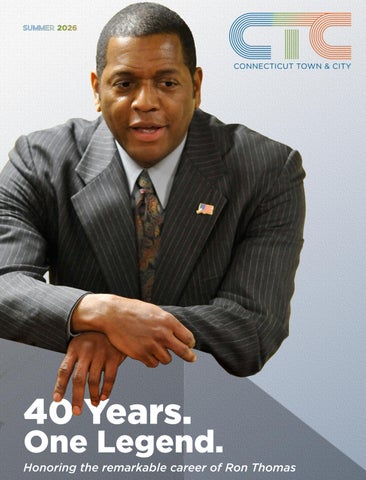
40 Years.
One Legend.
Honoring the remarkable career of Ron Thomas
LEAD WITH INTEGRITY
MASTER OF PUBLIC ADMINISTRATION TRACKS AVAILABLE IN: — Nonprofit Management — Public Healthcare Management — State & Local Government
CCM BOARD OFFICERS • President, Michael Passero Mayor of New London • 1st Vice President, W. Kurt Miller Chief Administrative Officer of Seymour • 2nd Vice President, Carl Fortuna, Jr. First Selectman of Old Saybrook BOARD OF DIRECTORS • Arunan Arulampalam Mayor of Hartford • Jason Bowsza First Selectman of East Windsor • Pete Bass Mayor of New Milford
CONNECTICUT TOWN & CITY
Inside this issue... Executive Director’s Corner
4
• Mary Calorio, Town Manager Canterbury, Chaplin & Pomfret
Interview: Ron Thomas
6
Traffic Safety
8
• Fred Camillo First Selectman of Greenwich
Convention Preview
10
• Justin Elicker Mayor of New Haven
Gubernatorial Debate
12
• Joseph P. Ganim Mayor of Bridgeport
CT Citizens’ Assembly
15
Rosa DeLauro visits CCM
18
CCM Events
20
Town Profile: Deep River
21
• Dorinda Borer Mayor of West Haven
• N. Warren “Pete” Hess III Mayor of Naugatuck • Matthew Hoey First Selectman of Guilford • Matthew S. Knickerbocker Former First Selectman of Bethel
Point / Counterpoint: Data Centers
22
• Rudolph P. Marconi First Selectman of Ridgefield
Member Shout-Outs
26
• Connor Martin Mayor of East Hartford
CIRMA 28
• Maureen Nicholson First Selectman of Pomfret
Partner Articles
31
Innovative Ideas
40
• Brandon Robertson Town Manager of Avon • John L. Salomone City Manager of Norwich • Caroline Simmons Mayor of Stamford • Gerard Smith First Selectman of Beacon Falls • Molly Spino Mayor of Torrington • Steve Stephanou Town Manager of Manchester • Mark B. Walter Town Administrator of Columbia
CCM STAFF • Executive Director & CEO, Joe DeLong • Deputy Director & COO, George Rafael • Managing Editor, Joseph Thornton • Writer, Christopher Gilson • Layout & Design, Matthew Ford Connecticut Town & City © 2026 Connecticut Conference of Municipalities
4 | Connecticut Town & City
Move over, Ron Burgundy. Connecticut Has Its Own Legend Named Ron.
T
he story of Ron Thomas will not be remembered for dramatic entrances, over-the-top declarations, or a mustache that could rival any newsroom in the country. It will be remembered for something much more important: steady leadership, thoughtful advice, and the ability to bring calm to even the most ambitious plans.
Joe DeLong Executive Director & CEO
When I first walked through the doors of CCM some 11 years ago, I came in with what could best be described as an abundance of enthusiasm and perhaps what some might generously call an ‘all gas, no brakes’ approach. I had ideas. Lots of them. New initiatives. New programs. New ways of doing things. If there was a mountain to climb, my first instinct was to sprint toward the summit before anyone had finished unfolding the map. Connecticut, however, proudly wears the nickname “The Land of Steady Habits.” I quickly discovered that the phrase wasn’t just reserved for the state’s history: it was also a pretty good description of how successful organizations create lasting change. Fortunately for me, and for CCM, that’s where Ron came in. If I was the guy stomping on the accelerator, Ron was the steady hand reminding me that steering mattered just as much as speed. To be clear, Ron never challenged the destination; he simply helped ensure we chose the right approach in which to get there. Never once did he tell me to stop thinking bigger. Instead, he asked the questions that mattered. Have we thought this through? Who needs to be involved? Is there a better way to accomplish the same goal? His remarkable ability to remain calm — especially during moments where eagerness outpaced patience — became one of the greatest assets this organization has ever had. Ron always possessed a gift that’s becoming increasingly rare. He didn’t need to
be the loudest voice in the room to have the greatest influence. He led with quiet confidence, thoughtful advice, and a level of institutional knowledge that simply cannot be replicated overnight. Over time, I came to appreciate that many of the best decisions we made weren’t because I had a bold idea, they were because Ron helped shape those ideas into something practical, sustainable, and ultimately successful. That partnership helped CCM evolve while remaining true to who we are. Together with our outstanding staff, Board of Directors, municipal leaders, and members across Connecticut, we’ve expanded services, strengthened advocacy, launched innovative programs, and positioned CCM as an even stronger voice for Connecticut’s towns and cities. The reality is that progress doesn’t happen because one person charges ahead. It happens because someone makes sure everyone arrives together. Ron spent decades doing exactly that. His fingerprints are on countless initiatives, relationships, legislative victories, and organizational improvements that will continue benefiting municipalities long after his retirement. More importantly, he’s mentored colleagues, earned the respect of municipal leaders throughout the state, and built a legacy defined not by titles, but by trust. As we celebrate Ron’s retirement, I hope he knows just how much he has meant, not only to me personally but to everyone fortunate enough to have worked alongside him. Thankfully, the story doesn’t end there. I’m excited to welcome George Rafael into the role of Deputy Director & COO. George has been a trusted member of the CCM family for many years and embodies many of the same qualities that made Ron such an extraordinary leader: professional-
Summer 2026 | 5
ism, steadiness, sound judgment, and an unwavering commitment to serving Connecticut’s municipalities. His experience, leadership, and deep understanding of our mission make him exceptionally well prepared for the next chapter in CCM’s storied history. Organizations thrive when they can honor their past while embracing their future. That’s exactly where CCM finds itself today. To Ron: Thank you for your patience, your wisdom, your friendship and, for more times than either of us can probably count, for gently pulling me back from the proverbial ledge. CCM is stronger because of your leadership. Enjoy retirement. You’ve certainly earned it. Although, when I come up with another “great idea,” don’t be surprised if your phone rings. Sincerely,
Joe DeLong Executive Director & CEO
6 | Connecticut Town & City
INTERVIEW
Ron Thomas A storied career and incredible resource of institutional knowledge, we talk CCM with recently retired Deputy Director
A
fter nearly 40 years at CCM, Ron Thomas was our institutional knowledge. As we gear up to celebrate the 60th anniversary of our organization, we sat down with Ron just before he took the plunge into retirement to talk about just what he thinks CCM is.
Ron Thomas
Chris: We’re going to start off easy. What is CCM? Ron: CCM is Connecticut’s Association of Towns and Cities. We represent municipalities, municipal officials at the state capital through advocacy on the federal level through the National League of Cities.
Chris Gilson Communications Specialist
We perform research on a variety of personalized research on a variety of issues. We put on a convention. Just about anything that that deals with making towns better from a municipal s- perspective, we’re involved in. So, what value then does CCM have first to our members, but also to the general public? To the membership, number one, I might be a little biased because I spent so much time in public policy, but the advocacy that CCM does up at the state capital has not only, in many instances, increased state aid to towns and cities, which means more programs and services for people.
But it has also helped people understand what municipal officials go through to try to make towns better. And in terms of what we’ve done for the public, I believe that CCM is this kind of force that’s under the radar, that’s helping legislators understand what the average taxpayer, property taxpayer goes through. Making that argument and help them understanding it better helps them provide policies that help out the average person on the street. The average person who’s trying to pay their property taxes, who are concerned about the quality of schools, CCM is the primary, and has been throughout my time at CCM, the primary force for increased education funding, ensuring that each child is educated in a way that makes them prepared for the future. And so, with CCM, you mentioned that there’s been a lot of changes over your time here. What are some of those changes you’ve seen? When I first came to CCM, there may have been as I alluded to last week there may have been 30 staffers at the most, including CIRMA. From 30 to 120-something — that’s a big change. But also, from the variety of services that we perform — the much wider variety of services that CCM performs, I think its footprint is larger in terms of the impact that it’s having on state and federal policy. So those are some of the big changes. And the convention, the attendance has gone from, when I started, a considerable size convention, but it’s gotten a lot larger and a lot provides a lot deeper program-
Summer 2026 | 7
I believed this when I first started, I believe this as I leave, that CCM does
“ works behind the scenes that helps municipal officials do their jobs better. extremely important work for towns and cities. We are this force that
ming. What is one of your favorite programs that we offer? I would say, I like the fact that this is not so new — ... but it’s happened along the way during the time that I’ve been here, and that is that we provide free workshops. And no other league does that. ... No other league that I know of does that. And that opens the door to training to any municipal official who is a member. I come from policy, but I do I admire, too, the kinds of programs that we’ve gotten into that aren’t the kinds of initiatives that you expect from CCM, like Sustainable CT, Representation Matters, and this new Citizens’ Assembly. And the opposite — what has remained stubbornly persistent? What hasn’t changed? What hasn’t changed, to be honest, is that if you looked at the legislative program from when I started in 1987 you would see that it looks pretty similar to today; talking about property tax reform mandates, that sort of thing. So that’s pretty stationary. It shows how stubborn and entrenched the issue is. So again,you’ve been here 40 out of the 60 years, you’ve seen a lot of moments at CCM. What is a moment that sticks out to you historically, a big win? I would say personally a big win was in — ‘96, I believe it was, when we were able to sunset a costly unfunded state mandate — the heart disease and hypertension mandate for police officers and firefighters. So we were able to get the law passed that said that anyone hired after July 1st of 1996 would not receive the benefit. The benefit was costing towns and cities upwards of at least 20 million, based on the data that we had. And it wasn’t just the cost. It just that it’s also that it just didn’t make sense. So that was one thing that I think that we did well that brought some reason to the law. I would say one other big thing that happened recent-
ly, and that is that with the federal COVID funds under Biden. Every town and city in the country got funding. Every state got funding to try to make up for what they spent on COVID-related activities. And each county would also get money. But since Connecticut doesn’t have counties, we weren’t going to get that money. And it was CCM that lobbied the Connecticut congressional delegation for towns to receive that money that counties would have gotten. So that’s tens of millions of dollars that towns received for the benefit of their residents that they otherwise wouldn’t have gotten. So those are a couple of the major things. We started out with the question, “what is CCM?” But you’ve been here for almost 40 years now which means that you’ve stuck around for 40 years. So, what is CCM to you? I believed this when I first started, I believe this as I leave, that CCM does extremely important work for towns and cities. We are this force that works behind the scene that helps municipal officials do their jobs better. And when that happens, they’re able to be a better service to people in their communities, and I think that’s very important. I think that the work that’s done here is work that helps municipalities stay up on trends; and we not only tell them what’s going on, but we try to help prepare towns for the future. And we’re trying to provide AI assistance, so we’re trying to look towards the future. But I think it’s for me, one of the reasons that I’ve stayed here, and it is something that has great meaning when you’ve come to the end of your career, and that is you’ve worked for an organization that does important work, that really has an impact, a positive impact on the lives of people. And that I believe CCM does exceedingly well. n
8 | Connecticut Town & City
New Tools, New Rules: CT’s Evolving Traffic Safety Landscape By Felicia Famularo, Research and Events Intern
C
onnecticut’s roads are getting safer through a wave of new legislation that hands municipalities more authority than ever before. CCM Research’s new Traffic Safety Report toolkit breaks down four laws every town official should know.
CCM Reserach Traffic Safety Tool-kit
Protecting Kids at the Bus Stop. Public Act 24-107 modernizes school bus stoparm enforcement. Towns can now adopt local ordinances creating a municipal-level violation with a flat $250 fine, paired with automated camera enforcement. This runs alongside the existing state-level track: violations witnessed directly by a police officer still carry a $450 fine for a first offense (escalating to $500-$1,000 for later ones) plus license points. Older “live-video” monitoring authorizations sunset July 1, 2026, so any town still relying on legacy systems should have transitioned to the new ordinance-based framework. Revenue from camera fines must not go to a municipality’s general fund, but rather toward public safety improvements or vendor cost.
Reclaiming the Streets. Street takeovers and illegal dirt bike/ATV use have a tougher legal responsibility under Public Act 2580. Every municipality, regardless of size, can now seize and even destroy illegally used dirt bikes, ATVs, and mini-motorcycles. This means there is no more population threshold or auction-only requirement. Local ordinance can fine spectators and organizers up to $2,000 for repeat offenses, while the state lawyers on license suspensions and felony charges for repeat racers. Towns must still follow a two-step notice process before any vehicle is permanently forfeited. Speed and Red-Light Cameras. Public Act 23-116 opens the door to Automated Traffic Enforcement Safety Devices (ATESDs) — speed and red-light cameras — but getting there requires significant groundwork. Towns must adopt an ordinance, build a Comprehensive Safety Action Plan, justify each camera location with crash data and an equity review, hold a public hearing, and secure approval from the state’s Office of the State Traffic Administration. Fines are capped at $50 for the first offense/$75 thereafter, with a mandatory 30-day warning period before real citations begin. E-Bikes Get Clearer Rules. As e-bikes surge in popularity, Public Act 25-129 and an October 2025 update (HB 6862) sharpen the rules of the road. Connecticut’s three-class system now comes with universal helmet requirements for all riders,
Summer 2026 | 9
tighter definitions separating true e-bikes from higher-wattage “motor-driven cycles,” and continued local authority over sidewalk access, trail permissions, and licensing. Riders under 16 cannot operate a Class 3 e-bike. Separately, the eBike rebate incentive under the state’s CHEAPR program which offered point of sale vouchers toward a purchase, closed its second funding round in October 2024; DEEP is evaluating whether to open future rounds.
The Common Thread Each legislation enforcement begins with the state setting the framework and the outer boundaries, with municipalities doing on-the-ground work of turning that authority into an actual program. That typically means passing a local ordinance, standing up an administrative process (citation review, tax/police coordination, a hearing officer for appeals), and coordinating across departments (police, IT, tax collectors, public works, legal counsel, etc.). It also means building in the guardrails that state lawmakers expect like transparent fine revenue, privacy protections for data collected by cameras, equity reviews for enforcement locations, and a clear path for residents to contest a citation. This indicates the importance of legislative action first, then operational readiness, then public communications. Getting this sequencing right is what keeps these programs both effective and legally defensible. Town officials looking to act should start with their legal counsel and the sample town ordinances available through CCM’s cloud-share resources referenced in the full toolkit. The complete Traffic Safety Report, including sample ordinances and statutory citations, is available here: https://issuu.com/ccm_ct/docs/ ccm_traffic_safety_2026 CCM Research Library: https://www.ccm-ct.org/ Advocacy/Research/Research-Library n
Representing Municipalities Throughout Connecticut For Over 45 Years Attorneys and Counselors at Law
With more than 30 attorneys in two locations, we assist numerous Connecticut towns and cities with: • Open-door public meetings • Municipal litigation • Ordinance drafting • Employment law • Public purchasing – bidding requirements • Land use and zoning • Referenda • Development • Elections • Affordable housing • Drafting and enforcing regulations • Public utilities • Regulatory compliance • Eminent domain • Urban & Economic Development
www.berchemmoses.com
Milford
75 Broad Street, Milford, CT 06460 Phone: 203-783-1200
Westport
1221 Post Road East, Westport, CT 06880 Phone: 203-227-9545
10 | Connecticut Town & City
Join Us October 27 - 28 at Mohegan Sun
W Montville Mohegan Sun
hether its year twenty-seven or forty-two, CCM is going to pull out all the stops for our annual convention. But this is year 60 for CCM and we want you to celebrate with us at the 2026 CCM Annual Convention taking place on October 27 — 28 at the Mohegan Sun Earth Expo Center. You all know and love the CCM Convention, where more than 1,000 municipal officials and exhibiting companies come together to network and learn through our informative workshops and interactive discussions. Over two days we are going to have an open exhibit hall and a special hot-topic panel, “Turning Up the Heat with AI and Hot Wings.” And also this year, we are once again partnering with WTNH News 8 to host the final gubernatorial debate before the election. This guarantees that the candidates have the time to address the areas of concern for towns and cities on the biggest stage — in front of our audience and all of the viewers at home. Read more on page 12.
Register Now!
Workshops CCM is partnering with many different organizations to deliver fifteen exciting workshops on topics that were chosen by a panel of your peers. These include areas of concern for municipalities, cost-saving measures, and a workshop led by your peers in Plainville called “How to Earn Residents’ Trust in 60 Seconds or Less.”
Sponsors We cannot put on an excellent convention without our sponsors, so we want to thank CCi Voice; Atlantic Computing Technology Corporation; Connecticut Port Authority; GovDeals; HPE; Halloran Sage; UConn School of Public Policy; Citylogix; Bank of America; Connecticut Education Network; GZA GeoEnvironmental; Harris Beach Murtha; Lockton; Updike, Kelly, & Spellacy, P.C.; Verogy; Titan Energy; Civic Calling Corporation (HollyGov); Energia; LPi Communities; and Distinctive Tree Care. And we would like to share that we are once again partnering with the United Way
Summer 2026 | 11
of Southeastern Connecticut’s Gemma E. Moran Food Center. You can help us help those less fortunate by bringing nonperishable food items with you.
#LoCoolGov Youth Scholarship
Municipal Excellence Awards
A $1,000 scholarship will be handed out in two age groups to a Connecticut student in a public middle school or high school.
Each and every day, municipal officials throughout the state of Connecticut do outstanding work that promotes quality of life in our communities. Through individual and team efforts, they make Connecticut towns and cities excellent places to live, work and play.
Participants must create their own original work themselves, but may get help from teachers, parents, or friends in the form of ideas. They may also collaborateon projects in groups of no more than three people. All entries are due to CCM by Friday, Sept. 15, 2026.
There are four categories; three by population and one special “topical award” open to communities of all sizes. This year, that category is “Creative Use of Resources, Partnerships, and Collaborations.”
Help us celebrate our 60th anniversary with your peers at the 2026 Annual Convention and Gubernatorial Debate. Visit our website, www.ccm-ct.org or use the QR code and complete the steps. n
ERP SOLUTIONS
BUILT FOR THE MISSION OF GOVERNMENT Purpose-built and trusted AI solutions you can depend on. Modernize government operations, strengthen oversight, and make confident decisions with trusted data. Purpose-built for government, Tyler helps Connecticut governments streamline processes, improve visibility, and adapt to changing demands while maintaining accountability. Because the mission of government can’t wait.
Scan to learn more tylertech.com/solutions/ public-administration/erp
12 | Connecticut Town & City
An Act of Democracy CCM continues proud tradition of holding the final Guberantorial Debate
A
mericans fought for the right of self-governance through no less than a revolution 250 years ago. With independence came the many facets of democratic rule, and none as important as that of the vote. Our politicians have, over time, come to earn those votes by presenting themselves and their positions to greater and greater portions of the public. CCM is honored to take part in that tradition as Connecticut residents get ready to choose their next governor. On October 27, CCM will once again partner with WTNH News 8 on the 2026 Connecticut Gubernatorial Debate, just one week before Election Day. This event will mark the final opportunity for voters to hear from top gubernatorial candidates together on one stage before ballots are cast. While details surrounding debate format and participant information are being finalized, we know that the forum will offer candidates one final opportunity to outline their vision for Connecticut’s future and to address the challenges confronting families, employers, and communities across the state. They will face several high-profile issues like affordability, education, housing, public safety and more. It is especially likely that candidates will have to speak about the property tax in Connecticut on the heels of the report delivered by the Connecticut Citizens’ Assembly. “The next Governor will step into office at a pivotal moment for Connecticut’s cities and towns,” said Joe DeLong, Executive Director and CEO of CCM. “Our communities are on the front lines of the affordability crisis. Property taxpayers are carrying too much of the load, and towns are being
asked to do more with less. The audience of local leaders will want to hear plans for adequately funding and modernizing public education, delivering meaningful property tax relief, and addressing cost drivers like mandates and pension cost shifts that strain local budgets.” The debate will of course be televised by our partner, WTNH News 8, straight from CCM’s Annual Convention at Mohegan Sun in front of an audience of municipal officials, business leaders, policy makers, and community stakeholders. “News 8 is proud to partner with the Connecticut Conference of Municipalities to bring the people of Connecticut this key gubernatorial debate just one week before Election Day,” said Rich Graziano, Vice President and General Manager of WTNH/ WCTX. “We will provide comprehensive coverage on all platforms so that viewers will be able to watch the debate the way they want. The voters in our great state can trust News 8 as their local election headquarters.” In addition to our nation’s anniversary, it is also CCM’s 60th anniversary. Participating in the civic process has been a highlight of the organization during this time. Our members have seen first-hand their issues being part of this great debate. n
Montville Mohegan Sun
Summer 2026 | 13
14 | Connecticut Town & City
Summer 2026 | 15
Luck of The Draw Choosing lots is one of the most crucial parts of the assembly
F
or the Citizens’ Assembly, one of the primary concerns was making sure that the group fit two dynamics — it should be representative of Connecticut at large, and it should be completely random. Wallingford CT Lottery HQ These two principles might seem at odds with each other, meaning that to accomplish this we needed accuracy and chance. That’s why our partners at Yale University and CT Lottery were second to none. Josh Kalla, the sortition expert at Yale, started by generating thousands and thousands of lots made up of individuals who had responded to the invitation letter to participate. From this pool of randomizations, only 7,000 contained a “valid sample.” That means these samples were found to be strictly adhering to a set of factors such as region, gender, income, and political affiliation. And this is where CT Lottery stepped in. Thanks to Jeevan Vittal, Director of Corporate Communications & Public Affairs, as well as the rest of the staff, a process was followed to draw one of 40 lots in a public drawing at the CT Lottery headquarters in Wallingford. Vittal’s team worked with the Department of Consumer Protection and members of the Citizens’ Assembly team at CCM and Yale to ensure that this drawing was safe, secure, and most importantly random. And going through the same steps as a nightly lotto drawing, right down to the number of seconds the lotto balls would be mixed together, lot number 29 was ultimately selected to be our group. That group is now meeting throughout the summer to learn about property taxes and ultimately deciding whether or not to make recommendations to the state on what they learn during this groundbreaking assembly. Every facet of this project relies on many things going right, and a special thanks must be given to CT Lottery for helping us thread the needle of accuracy and chance without ever once sacrificing security. n
16 | Connecticut Town & City
CT Citizens’ Assembly Marches On Citizens’ Assembly Reaches Midpoint with Thoughtful Engagement and Historic Purpose
T
he Connecticut Citizens’ Assembly on Property Taxes has reached an important milestone, completing its first few rounds of informational sessions with members demonstrating an extraordinary commitment to learning, collaboration, and civic engagement. Since convening at Yale University in early July, the Assembly’s members have embraced the responsibility of examining one of Connecticut’s most complex public
policy issues. Through hours of presentations, discussions, and breakout sessions, participants have immersed themselves in understanding the many factors that shape the state’s property tax system. The Assembly also represents a milestone in Connecticut’s civic history. Among the first statewide Citizens’ Assemblies in the nation dedicated to a deeply complex issue such as property taxes. The initiative — led through a partnership among the Connecticut Conference of Municipalities (CCM), Yale University, the University of Connecticut, and the Office of the Connecticut State Comptroller — is demonstrating how informed citizens can contribute meaningfully to addressing difficult public policy challenges. An early milestone came when members voted to become a self-governing body, empowering participants to help establish and oversee many of the procedures that guide their work. While there were expected learning curves and procedural adjustments, members have embraced the model with patience, respect, and a shared
Summer 2026 | 17
commitment to moving the process forward. A central focus of the first few sessions has been education. Experts in municipal finance, state mandates, K—12 education funding, collective bargaining, and other major property tax drivers have provided balanced information while answering participants’ thoughtful and often probing questions. Their curiosity and willingness to explore differing perspectives have underscored the seriousness with which they are approaching their responsibility. Learning extends well beyond each weekend session. Educational and informational materials, presentations, research papers, videos, and other resources continue to be added to the Citizens’ Assembly website and CCM’s online resource center, giving participants access to credible information as they prepare for future deliberations. The success of the Assembly thus far is measured not by consensus, but by the quality of engagement demonstrated by its members. With the halfway point now complete, the Assembly is beginning its transition from learning to deliberation. Over the coming sessions, members will evaluate ideas, consider tradeoffs, and work toward developing recommendations that reflect careful study and respectful dialogue. While the Assembly’s final recommendations remain weeks away, its early success is already evident. A diverse group of Connecticut residents has demonstrated that when citizens are provided balanced information, the opportunity to ask difficult questions, and the time to engage respectfully with one another, they are more than capable of tackling even the state’s most challenging public policy issues. That, in itself, is a meaningful outcome and one that may shape not only the future of property taxes, but how Connecticut approaches civic engagement for years to come. n
Put your data on the map! Proud partner of CCM ccm-ct.org/Services/GIS-Partnership
fiber optic experts
Connecting Connecticut Communities
Your municipal fiber partner. sertexbroadband.com
860-317-1006
MANAGED SERVICES
Connecticut Conference of Municipalities’ Cybersecurity & Technology Services Need an IT support provider that understands municipalities? We help municipalities get out of the IT trenches and back to working on what matters. VC3, the Connecticut Conference of Municipalities’ partner in IT services, has been making IT personal, making IT easy, and getting IT right for more than 30 years. Serving over 1,100 municipalities nationwide of all sizes, VC3’s Northeast-based engineers are supported by a deep bench of national talent.
READY TO TACKLE YOUR CYBERSECURITY & TECHNOLOGY ISSUES? Contact us today at vc3.com/get-started
VC3.COM | 800-787-1160
18 | Connecticut Town & City
Uniform Guidance Change Alarms I New Haven CCM Headquarters
n late June, CCM hosted a meeting with Congresswoman Rosa DeLauro (CT District 3) who informed us of a troubling proposed rule change offered by the federal Office of Management and Budget (OMB) regarding federal grant applications. Congresswoman DeLauro expressed how detrimental many of the proposed changes would be on municipalities when applying for federal grants, even after successfully being awarded a grant. The collective weight of the proposed revisions to the Uniform Guidance threatens to severely strain local resources, which are already stretched thin. If implemented, these changes will significantly increase administrative burdens, cause uncertainty
around secured grant awards, and introduce subjective criteria that risk politicizing the federal grantmaking process. This rule change will apply to current and future administrations if enacted.
Key Areas of Concern 1. Increased Administrative Burden on Communities Federal grants already demand time consuming management and reporting. The proposed rule would severely constrain municipal capacity further by adding the following unfunded mandates: • Payment Justifications: Requiring written, award-related work justifications for every municipal payment request. • Shifting Performance Conditions: Granting agencies unilateral authority to add or remove specific conditions mid-grant based on vaguely defined “risk factors.” • Mandatory E-Verify Participation: Requiring all recipients, subrecipients, and domestic contractors to use the Department of Homeland Security’s E-Verify program. • Disbursement Delays: Requiring states to run pre-payment checks through the Treasury’s Do Not Pay (DNP) system before releasing pass-through funds, delaying critical local aid.
Summer 2026 | 19
CONNOISSEURS
Congresswoman DeLauro expressed
DINERS
how detrimental many of the proposed
REGULARS
changes would be on municipalities
VISITORS
when applying for federal grants
MENTORS NEIGHBORS
2. Heightened Funding Uncertainty The proposed rules make federal funding uncertain, allowing awards to be modified or terminated mid-stream despite local investments and compliance: • Policy-Based Termination: Permitting agencies to terminate a grant mid-performance if the project no longer aligns with shifting Executive Branch policies or fluid program goals. • Elimination of Fixed-Amount Awards: Erasing fixed-amount awards and subawards, removing a vital tool for predictable budgeting. 3. Risk of Politicizing Grantmaking Several provisions shift federal grantmaking away from objective criteria, creating avenues for subjective or politically influenced decisions such as: • Subjective Eligibility Standards: Allowing agencies to deny funding based on an applicant’s loosely defined “history of questionable practices.”
CPAs | CONSULTANTS | WEALTH ADVISORS | COLLABORATORS COACHES VOLUNTEERS TEACHERS
At CLA, we’re in your corner — and on it. Right there with you. Get started at CLAconnect.com/withyou. ADVOCATES PATRONS FRIENDS ©2026 CliftonLarsonAllen LLP. CLA (CliftonLarsonAllen LLP) is an independent network member of CLA Global. See CLAglobal.com/disclaimer. Securities and investment advisory services are offered through CliftonLarsonAllen Wealth Advisors, LLC, an SEC-registered investment advisor, member FINRA/SIPC.
New London Community Recreation Center
• Private Enforcement Integration: Permitting federal agencies to cooperate with private individuals or organizations pursuing private causes of action regarding grant noncompliance. • Fluid Executive Directives: Expecting local governments to continuously adapt to uncodified Executive Orders that may change mid-grant. • Pre-Issuance Merit Reviews: Introducing reviews to ensure selected proposals align with subjective “Federal agency priorities” and the “national interest.”
Employee Owned • Community Invested
We share Congresswoman DeLauro’s deep concerns and recommend advocating for the rejection or making significant amendments of these rules to protect municipal interests and preserve operational capacity. While the written comment period has ended, it is not too late to make your voice heard. Now is the time to keep up the pressure and reach out to your congressman or -woman and Connecticut’s two senators and express the devastating effects the proposed rule changes will have on your community. Your voice can make a difference in the final outcome. n
Bloomfield Public Library, Prosser Library
New Britain, CT | 860.229.3755 | downesco.com
20 | Connecticut Town & City
CCM Events WIG was big
In July, more than 200 attendees joined CCM at Aria in Prospect, CT for our third annual Women in Government Summit. Attendees got the opportunity to network and connect with other women in government from across the state. The summit featured a Women Who Lead panel moderated by Executive Director of CWCSEO Melvette Hill. The panel included Windsor Board of Education President, Ayana Taylor; Seymour First Selectwoman, Annmarie Drugonis; Middlebury First Selectwoman, Jennifer Mahr; and Hamden Fire Chief, Shelly Carter. The day concluded with a leadership workshop facilitated by Stephanie Tishler, which gave participants the tools to improve communication within their leadership roles. Donna Hamzy Carroccia, CCM consultant and Women in Government advisory board member, explained the importance of this event, “Especially government, it’s very male-driven and has historically been, to find community in this space, I think, is really empowering.” Thank you to all the women in government who help Connecticut thrive and to this year’s attendees who made the summit a success! n
Summer 2026 | 21
TOWN OF
DEEP RIVER Incorporated : 1635 Population: 4,454 COG: RiverCOG
The Deep River Ancient Muster is the world's largest and oldest fife and drum gathering, tracing its local roots back to an 1879 field day and officially starting as a modern muster in 1953. The record was set in 1976 and recorded by the Guinness Book of World Records.
DEEP RIVER HISTORY 1942
1840
During WWII, the Pratt, Read & Co. factory in Deep River shifted from making piano keys and ivory products to producing CG-4A "Waco" troop-carrying gliders.
From 1840 to 1940s, the U.S. was the world's biggest buyer of ivory and most of that ivory went to Deep River. It became known as "the queen of the valley" due to wealth from the ivory industry.
1642
Saybrook Colony becomes part of the Connecticut Colony.
1723 1635
First settlers found the Saybrook Colony
The site of the present village was largely owned by the Kirtland family by 1723.
1933
Saybrook College at Yale University is founded and named for the Saybrook Colony.
1947
The town of Saybrook changed its name to "Deep River"
FUN FACTS The Deep River Town Hall is located at the junction of Routes 80 and 154. It is a three story brick "flatiron" structure, built in 1893. Notable Residents: ★ Gretchen Mol, actress known for Boardwalk Empire. ★ Alpheus S. Williams, Union Army general during the Civil War. The grave of “XYZ” is the mysterious final resting place of an unnamed bank robber who was shot and killed during a failed heist in 1899. His true identity was never discovered.
★ 'Mysterious Dave' Mather, Old West gunfighter, outlaw, and lawman.
22 | Connecticut Town & City
Data Centers The Case for Caution
Point
T Mayor Swarnjit Singh, City of Norwich
he biggest benefit that is appealing is a data center’s potential to strengthen Norwich’s economic base. Data centers represent significant private investment that expands our commercial tax base, which can help support public services, schools, roads, and public safety without placing an additional burden on homeowners who already pay high taxes in Norwich. This could bring an opportunity to lower that burden. Beyond the facility itself, these projects often require major investments in utilities, fiber infrastructure, and power systems that can support future business growth. In the City of Norwich, we are currently developing the Occum Industrial Center, we have our own utility company, and also have some existing data center locations which might become available for future use. Thus, if an existing small data center in Norwich exits our city, I am not opposed to one fulfilling its existing location. People have legitimate concerns about issues like energy use, water consumption, noise, and the impact on their neighborhoods. Those concerns deserve to be taken seriously, and I do not reject them. Our responsibility is not simply to recruit projects — it’s to ensure that any project meets high standards for environmental stewardship, infrastructure planning, and community compatibility. If a proposal doesn’t make sense for Norwich, we shouldn’t pursue it. But if it brings meaningful economic benefits while addressing residents’ concerns through strong agreements and oversight, then it’s worth considering. Economic development works best when it balances growth with quality of life. Saying no to small data centers pushes companies to
instead make large-scale and mega data centers — which again, is not a balanced approach. We all have a duty toward Mother Earth, and parallel to it we have a growing AI industry and defense industry, so we must be realistic and should be open to a balanced approach. Also, it’s true that data centers don’t employ thousands of people once they’re operational, and I think it’s important to be honest about that. The construction phase creates hundreds of skilled trade jobs, and long-term operations that support a smaller but highly skilled workforce. However, the value of a data center shouldn’t be measured only by permanent employment. These facilities generate substantial property tax revenue, often make significant infrastructure investments, and can help attract complementary businesses over time. For Norwich, this isn’t about choosing between jobs and tax revenue — it’s about creating a stronger fiscal foundation that allows us to invest in our community while continuing to pursue industries that create a broader range of employment opportunities. I believe that every economic development project has to be evaluated on its own merits. My goal is to make sure any investment in Norwich creates value for our residents, protects our quality of life, strengthens our tax base, and positions our city for long-term success. If we can achieve all of those objectives together, then it’s a conversation worth having. I am definitely an open-minded person, but I feel like complete access to everything is bad, that is why we must take a balanced approach as a nation on this issue. n
Summer 2026 | 23
Counter-Point
R
ecently, I attended the U.S. Conference of Mayors in D.C. and listened in on one of the sessions focused on data centers. After hearing heavy debate from mayors across the country on the pros and cons, I walked away recognizing there are too many unknowns regarding the environmental, health and infrastructure impacts and as Mayor, I have a responsibility to make sure development decisions are grounded in facts, not just momentum. That is why this past June, I requested, and our City Council unanimously approved, a step to enact a one-year moratorium on data centers. Data centers are often originally presented as a straightforward win for tax revenue but the full picture is more complicated, and due diligence is necessary on the longterm impact. Our moratorium gives us time to evaluate critical aspects such as how much power and water they’d use, whether they fit with our conservation and land use goals, what noise would be generated by the cooling process and what infrastructure capacity is impacted and needed with respect to water, sewer and stormwater systems. Without that groundwork, a town risks approving these projects before it fully understands what it’s signing up for. Additionally while data centers generate strong construction activity, once operational, they typically employ few people relative to their size compared to manufacturing sites or commercial developments that bring daily foot traffic and support
neighboring businesses and jobs. In a community like ours, with fewer remaining sites for growth, every parcel needs to work hard for our residents, and those decisions can’t be taken lightly. Therefore, a moratorium on data centers is simply an opportunity to learn more so that we can better weigh the impact versus opportunity they present. If in the future the open questions are resolved satisfactorily and as modernized mechanisms are potentially put in place that limit the impacts, the pause will provide time for those resolutions and for our planning and zoning to consider appropriate and potentially strict regulations on approvals. I’d rather take the time to get answers to these hard questions now than have the future generation manage the consequences of skipping them. n
Mayor Dorinda Borer, City of West Haven
24 | Connecticut Town & City
Coming Soon A More Complete Employee Compensation Tool
F CCM Research Labor Relations
or years, Connecticut municipalities have relied on CCM’s annual Salary Survey to answer one of the toughest questions in local government management: Are we paying our people fairly? This fall, that survey has a new look — CCM’s new compensation benchmarking platform — and we need every member municipality to be part of it.
Why This Matters Now Municipal HR directors, finance officers, and CEOs are under more pressure than ever to attract and retain qualified staff. Labor markets are tight, bargaining cycles move fast, and elected officials want data-driven answers before they approve a new pay scale or settle a contract. The Salary Survey is built to meet that need — giving your municipality sharper, more comprehensive benchmark data than the old process ever could.
Easier Than Ever to Complete Getting your data into the Salary Survey takes a fraction of the effort the old survey required. Most municipalities can simply export existing compensation data straight from their HRIS (like MUNIS/Tyler Technologies) — little to no manual entry required. Prefer a simpler route? A structured Excel workbook is available, with only two fields
required anywhere in it. You can submit what you have now and add more later.
What You Get in Return The real payoff is the Compare tool. Once the system launches, you will be able to select a peer cohort of similar municipalities — by form of government, population, income, geography, and more — and benchmark your positions directly against them. It’s the kind of precise, credible data you need to justify a pay adjustment, prepare for negotiations, or defend a budget line to your council.
Why Your Participation Counts The survey is only as good as the data behind it. Every municipality that participates makes the Salary Survey more accurate and more useful — for their own HR decisions and for every other member relying on the same data. Please upload your information to your municipality’s folder at https://tinyurl.com/ccm-salary by September 25th. Stay tuned for more information as we finish building this new resource.
Questions? Contact Max Friedman, CCM’s Research Manager, at mfriedman@ccm-ct.org. n
Summer 2026 | 25
Healthier communities lead to healthier people At Anthem, we place an equal focus on physical, behavioral, and social health. We are deeply committed to improving individual health outcomes and strengthening the communities we serve.
Anthem Blue Cross and Blue Shield is the trade name of Anthem Health Plans, Inc. Independent licensee of the Blue Cross and Blue Shield Association. Anthem is a registered trademark of Anthem Insurance Companies, Inc.
Making a Sustainable Impact on Our Communities Now and Into the Future apexcos.com
26 | Connecticut Town & City
Member Shout-Outs O
ur Certified Connecticut Municipal Officials program is among the most popular offerings at CCM — with programs and workshops taught by experts and peers, as well as events like the CCM Convention and Emergency Management Symposium to earn you credits, becoming a CCMO is a no-brainer. Don’t trust us, though, hear from graduates!
“ Sharron Howe Bloomfield
I chose to begin the Certified Connecticut Municipal Official (CCMO) Program because I believe professional development is essential to effective leadership and long-term success in municipal administration. As Deputy Town Manager, I play a key role in supporting day-to-day operations, strategic planning, and interdepartmental coordination. I was especially drawn to the flexibility of the online classes, which allow me to continue learning while meeting the demands of a fast-paced leadership role. The program’s comprehensive curriculum — covering everything from finance and governance to community engagement — ensures that I am gaining practical, relevant knowledge to enhance both policy implementation and organizational efficiency. By participating in the CCMO program, I am investing in my own growth and reinforcing my commitment to delivering high-quality service to our residents. This experience strengthens my ability to lead with confidence, support the Town Manager effectively, and contribute meaningfully to the long-term success of our community. Sharron Howe, Bloomfield, Deputy Town Manager
“ Mike Papa Cheshire Public Schools
I decided to pursue CCMO certification to develop a better understanding of the challenges facing local governments and their influence on daily life. Providing the opportunity to share best practices among municipal leaders was invaluable and helps communities pool resources to negotiate more cost-effective services. The program has made me a more competent and versatile municipal employee with an increased understanding of ethical leadership, workplace issues, and how to plan for realistic, sustainable growth. Mike Papa, Cheshire Public Schools, Director of Technology Services
We’re always looking to elevate the CCMO program to create an even more meaningful and engaging experience for our members to help you advance in your municipal careers. Keep an eye out for future partnerships and email updates over the year. If you have any questions or comments about the CCMO program or to submit a testimonial, please contact Danielle Walker, Training Coordinator at dwalker@ccm-ct.org. n
28 ConnecticutTown Town&&City City 2 | | Connecticut
Managing Risk. Maximizing Impact. Celebrating Connecticut’s leaders in prevention, preparedness, and performance.
E
very Connecticut community shares the same goal: providing safe, reliable public services while making the most of taxpayer dollars. Achieving that balance requires a proactive commitment to identifying risks, preventing losses, and fostering a culture where safety is everyone’s responsibility. For more than four decades, CIRMA’s Excellence in Risk Management Awards program has recognized members who exemplify that commitment. Established in 1982, the program honors municipalities, schools, and local public agencies that have transformed risk management from a compliance function into a long-term strategic investment. These organizations protect employees, residents, property, and public resources by building dynamic teams of risk management champions who deliver notable outcomes.
Ready to showcase your organization’s commitment to risk management? Learn more about the Excellence in Risk Management Awards program, including award categories, eligibility requirements, and nomination deadlines, on CIRMA.org.
The impact extends well beyond recognition. In 2017, CIRMA established the Excellence in Risk Management Grant Fund to help recipients expand and sustain their initiatives. Recognizing the rising costs of implementing meaningful safety programs, CIRMA’s Board of Directors recently approved doubling the annual grant fund, effective with the 2027 awards cycle. Each award recipient will now receive a $5,000 grant to reinvest in risk management initiatives that strengthen their organizations and the communities they serve.
Four Ways to Lead the Way Each year, CIRMA recognizes members across four categories that reflect the many ways organizations can build safer, stronger workplaces and communities: • Substantial Impact on Total Cost of Risk recognizes organizations that have measurably reduced losses and claims through strategic risk management. • Establishing Risk Management as an Organizational Priority honors organizations that have embedded safety into everyday decision-making and operations.
• New and Innovative Risk Management Initiative celebrates creative approaches that address emerging risks with fresh thinking. • Sustained Risk Management Program recognizes organizations that have demonstrated long-term commitment and consistent excellence in risk management.
An Investment That Pays Dividends Effective risk management delivers benefits that extend far beyond reducing claims, including helping employees return home safely every day, protecting property and public assets, minimizing service disruptions, and preserving financial resources for reinvestment in community priorities. Award recipients consistently demonstrate that investing in proactive risk management delivers measurable value for employers, employees, students, volunteers, and residents. By recognizing these accomplishments, CIRMA encourages members to share successful strategies, learn from one another, and elevate risk management best practices across Connecticut. “Our winners represent some of Connecticut’s best, brightest, and most devoted municipal leaders and teams. Risk Management is one of the core pillars of CIRMA’s Mission, and the Excellence in Risk Management Awards program allows us to honor CIRMA members who walk the talk,” said David Demchak, ARM, CIRMA President and CEO. As Connecticut’s municipalities and schools continue to navigate evolving risks and rising demands, robust risk management remains one of the smartest investments they can make. It protects people, strengthens organizations, and builds more resilient communities for generations to come.
Summer2026 2026 | | 29 3 Summer
CIRMA Welcomes New Team Members and Summer Intern Proven Talent. Fresh Perspectives. One Team.
W
e’re proud to welcome the newest additions to the CIRMA team, a group of talented professionals and rising leaders who bring valuable expertise, fresh perspectives, and a shared commitment to excellence. This summer also marks the return of our exceptional interns, who continue to bring curiosity, creativity, and drive to every project they support.
“Our newest employees and returning interns are already making a positive, lasting impact,” said David Demchak, ARM, President and Chief Executive Officer of CIRMA. “Their contributions strengthen our organization as we continue to innovate, evolve, and deliver outstanding service to our members.”
Christian Hakim is the newest addition to CIRMA’s Business Intelligence team in the position of Software Engineer. In his new role, Christian will help design, develop, and maintain high-quality software solutions that support CIRMA’s technology initiatives.
Theresa Greenaway recently joined CIRMA’s Workers’ Compensation Claims team in the role of Senior Workers’ Compensation Claims Representative. In this role, she will be responsible for managing complex and high-exposure Workers’ Compensation claims, bringing advanced Theresa Greenaway expertise and a strong commitment to delivering exceptional claims management.
Christian earned a Master of Science Christian Hakim degree in Software Engineering from Fairfield University. He brings more than five years of previous experience in both cybersecurity and software engineering. Before joining CIRMA, he served as a Software Engineer in the manufacturing and engineering space. Matthew Caro recently joined CIRMA’s Business Intelligence team in the position of summer intern. In this role, Matthew will be assisting with the design and development of software systems and applications, including enhancements and new software components that
Theresa earned her Master’s Degree from Duquesne University and brings more than 20 years of experience managing complex Workers’ Compensation claims.
support his team’s initiatives. Matthew recently earned a Master of Science degree in Computer Science and Engineering from University of Connecticut. Matthew Caro
30 | Connecticut Town & City
work together Bank of America is proud to support the Connecticut Conference of Municipalities.
Charlie Szilagyi
SVP, Senior Client Manager Bank of America, N.A. 185 Asylum Street Hartford, CT 06103 860-952-7429 charles.szilagyi@bofa.com
Bank of America, N.A., Member FDIC. ©2025 Bank of America Corporation. All rights reserved. GBGM-578-AD 8006876
Summer 2026 | 31
A Full-Circle Journey: How the Sustainable CT Fellowship Inspires the Next Generation of Public Servants
W
hen Lilly Adamo returned to Sustainable CT in 2025, she wasn’t just starting a new job—she was coming home to the program that helped shape her future.
Lilly Adamo Sustainable CT
Just a few years earlier, Adamo was a Sustainable CT Fellow, working with municipalities to advance local sustainability initiatives while completing her undergraduate studies at the University of Connecticut. Since then, she has earned a Master’s Degree from the University of Cambridge, London, and now serves as a Program Assistant, helping to lead the Fellowship Program. “I was drawn to Sustainable CT’s comprehensive, interdisciplinary, and multifaceted understanding of sustainability,” Adamo said. “It shaped my career as well as my understanding of communities more broadly.” For Adamo, the Fellowship offered more than a summer internship. It provided firsthand experience working with local governments, regional planners, and community leaders while building practical skills in communication, leadership, and sustainability. Today, she helps create those same opportunities for a new generation of students. Since 2018, the Sustainable CT Fellowship Program has placed more than 100 undergraduate and graduate students with Connecticut’s nine Councils of Governments (COGs). Fellows work alongside municipalities to research and document sustainability initiatives, support Sustainable CT certification efforts, and collaborate on a statewide group project focused on a sustainability topic. The experience often becomes a launching pad for careers in public service.
sustainablect.org
Former Fellows now serve as planners, attorneys, consultants, project managers, department heads, and sustainability professionals in municipal governments, nonprofits, universities, utilities, and state agencies. “We expose young professionals to the processes and functions of municipal government,” said Sustainable CT Executive Director Jessica LeClair. “Our municipalities benefit from the support Fellows bring, but we’re equally grateful to the towns and cities that have welcomed them and helped shape the next generation of public servants.” That partnership benefits employers as well. Robert Phillips, executive director of Northwest Hills COG, said the Fellowship gives students valuable experience while allowing municipalities to identify promising future employees. “The Sustainable CT Fellowship helps bridge the gap by providing meaningful, supervised experience through which participants can build credibility, demonstrate sound judgment, and establish a record of dependable public service,” he said. Laura Francis, executive director of the South Central Regional COG, has watched many Fellows discover that local government is where meaningful change happens. “They experience firsthand how public service offers the opportunity to influence policy, foster innovation, and create more sustainable, resilient communities,” she said. For Adamo, seeing today’s Fellows begin the same journey she once did is especially rewarding. What started as a summer opportunity has become a nascent career dedicated to helping Connecticut communities — and the next generation of leaders — build a more sustainable future. n
32 | Connecticut Town & City
Heat Waves Don’t End When the Temperature Drops How Connecticut municipalities can reduce longterm electricity costs during periods of extreme summer demand
W
hen a heat wave settles over Connecticut, municipal leaders have more to worry about than keeping buildings cool. Rising temperatures place added pressure on public infrastructure, increase operating costs, and challenge local governments to maintain essential services while staying within budget. Town halls, schools, libraries, police and fire stations, senior centers, public works facilities, and water and wastewater treatment plants all depend on reliable electricity to serve their communities. As temperatures climb, air conditioning systems run longer, pumps and motors work harder, refrigeration equipment cycles more frequently, and overall electricity consumption increases across nearly every municipal facility. While higher electric bills during the hottest months of the year are expected, many municipalities don’t realize that the financial effects of a heat wave can extend well beyond the summer season. In many cases, a relatively small number of hours each year can influence electricity costs for months, or even years, to come. Understanding how peak demand works and preparing for those critical periods can help municipalities better manage taxpayer dollars while supporting the reliability of the regional electric grid.
www.ccm-ct.org/Programs/Energy-Programs
Why Heat Waves Increase More Than Just Energy Use During periods of extreme heat, electricity demand rises sharply as homes, businesses, and public facilities throughout the region rely heavily on air conditioning and cooling equipment. Grid operators such as ISO New England are responsible for ensuring there is enough electricity available to meet that demand while maintaining reliable service across the region. When demand approaches its highest levels, additional generation resources are brought online, electricity may be imported from neighboring regions, and reserve power supplies are called upon to maintain system reliability. These resources are often more expensive to operate, increasing the overall cost of delivering electricity during peak conditions. Although these events may last only a few hours or a few days, they play an important role in determining certain future electric costs.
The Hidden Cost of Peak Demand Many municipalities understandably focus on the total amount of electricity they consume each month. Equally important, however, is when that electricity is used. For many commercial, industrial, institutional, and municipal electric accounts, electricity consumption during the grid’s highest-demand hours helps determine future capacity and transmission charges. Those charges are incorporated into future electric bills and can affect municipal operating budgets long after the heat wave has passed. A single afternoon of unusually high electricity demand may not seem significant at the time, but it can influence future costs in ways that are often overlooked. For municipalities responsible for managing taxpayer resources, understanding this relationship creates an opportunity to control expenses without reducing essential public services.
Summer 2026 | 33
Practical Ways Municipalities Can Reduce Peak Demand The good news is that lowering electricity demand during peak periods does not require shutting down municipal operations. Instead, it involves identifying temporary opportunities to reduce non-essential energy use while maintaining the services residents depend on every day. Simple operational adjustments can have a meaningful impact. Administrative buildings may be able to increase thermostat settings by a few degrees without affecting occupant comfort. Lighting in unoccupied offices, conference rooms, and common areas can often be reduced. Energy-intensive maintenance activities may be rescheduled outside anticipated peak periods, while electric vehicle charging can be shifted to evening hours when demand on the grid is lower. Communities that have invested in building automation systems can use those technologies to optimize heating and cooling schedules, and municipalities with on-site solar generation or battery storage may be able to offset a portion of their electricity demand during critical hours. None of these actions alone is likely to transform a municipal energy budget. However, when implemented strategically during the handful of hours each year when the electric grid experiences its highest demand, they can contribute to meaningful long-term savings while helping maintain grid reliability for everyone.
Why Preparation Matters Preparation is equally important. One of the challenges municipalities face is that the year’s highest-demand hours cannot be identified by temperature alone. While extremely hot weather is certainly a contributing factor, humidity, regional electricity consumption, weather forecasts, and overall grid conditions all influence whether a particular day ultimately becomes a system peak. Since these events are difficult to predict far in advance, many municipalities are taking a more proactive approach to energy
management. Establishing response plans before summer begins allows facility managers, school districts, and public works departments to coordinate operational strategies that can be implemented quickly when conditions warrant. Having a plan in place eliminates the need for last-minute decisions and helps ensure essential municipal services continue without interruption.
Building Long-Term Energy Resilience As Connecticut continues to experience more frequent and prolonged periods of extreme heat, energy management is becoming an increasingly important component of municipal financial planning and community resilience. Investments in energy-efficient buildings, modern HVAC equipment, advanced controls, renewable energy systems, battery storage, and ongoing energy monitoring not only reduce day-today operating expenses but also strengthen the reliability of critical public infrastructure during periods of high demand. These investments are not simply about reducing utility bills. They help communities become more resilient, better prepared for increasingly volatile weather, and more effective stewards of public resources. Every dollar saved on unnecessary energy costs is a dollar that can instead support public safety, education, infrastructure improvements, parks, and other essential municipal services.
The Bottom Line Heat waves may last only a few days, but the decisions made during those critical hours can influence municipal energy costs long after temperatures return to normal. By understanding how peak demand affects future electricity costs and developing practical strategies to reduce electricity use when the grid is under the greatest strain, Connecticut municipalities can improve budget predictability, support regional grid reliability, and continue delivering the high-quality services their residents expect. n
titanenergyne.com
34 | Connecticut Town & City
Lights, Camera, aCTion! By Kevin Bielmeier, President, CEDAS & Economic Development Director, Town of Berlin
C
onnecticut has long been a favorite filming destination, offering a diverse mix of picturesque towns, historic properties, and distinctive landscapes that have served as the backdrop for generations of movies. From classic comedies like Bringing Up Baby and Christmas in Connecticut to dramas such as Gentleman’s Agreement and The Ice Storm, and genre films like The Stepford Wives, Mystic Pizza, and Indiana Jones and the Kingdom of the Crystal Skull — all were filmed in Connecticut. Our state’s picturesque towns have so often been the backdrop for popular Hallmark movies that the state created a CT Christmas Movie Trail in 2024 to capitalize on their popularity and promote tourism. Last month, Jason Hayes, First Selectperson of the Town of East Granby, with the Capital Region Council of Governments (CRCOG), held a very well-attended event aimed at exploring the idea of positioning Connecticut as New England’s premier destination for film and television production. Hayes, a 30-year veteran of the film and television industry, joined by Lt. Governor Susan Bysiewicz, detailed his plan, and laid out the economic benefits of developing a film sound stage to support the growing film industry in the Northeast. Follow-up events are already in the works. Learn more: Info@EGTownHall.com. In addition to Connecticut being a stellar setting for films, offering a diversity of landscapes that are easily accessible from New York City and Boston, we have a growing number of successful, homegrown, independent filmmakers. These include Hartford-raised, Rashad Frett, whose award-winning film Ricky won him Best Director at the 2025 Sundance Film Festival. The movie had a national theatrical release in April and is now available for streaming. And, T.J. Noel-Sullivan, founder and producer of The Hartford Film Company. After a brief stint in LA with Mattel Films, where he worked on Barbie, T.J. decided to
Julia Roberts, Lili Taylor, and Annabeth Gish in Mystic Pizza (1988)
put his chips down in his native Hartford, launching a company bearing its name. It’s first feature film, Midas, shot locally, had a theatrical release and now has reached a global audience across multiple platforms. For the second year in a row, his company has doubled its annual revenue, and he was recently named SBA’s Young Entrepreneur of the Year. The challenges to growing the film and television industry here in Connecticut are many, with one being Connecticut’s infrastructure and project-based tax credit. Our incentives are not always as competitive as other states. For example, feature films do not qualify, nor some elements of project development. While the incentives have encouraged long-form production and related benefits, the ineligibility of theatrically
Summer 2026 | 35
distributed feature film has, to a degree, limited our ability to develop a deeper crew base and the wider provision of infrastructure. It is also imperative for us to invest in specific workforce development for this sector and create the infrastructure, or we will continue to lose productions to our neighbors New York and New Jersey, as well as Georgia, California, and international locations which now compete strongly. We will be examining how our state competes in this space next month as CEDAS – Connecticut Economic Development Association moderates a tristate panel on The Film Industry, in collaboration with the New York State Economic Development Council (NYSEDC) and the International Economic Development Council (IEDC) at the 2026 Leadership & Policy Summit. This special regional event will be held in White Plains on Sept. 29-30. n
Indiana Jones and The Kingdom of the Crystal Skull (2008) — Yale University, New Haven
36 | Connecticut Town & City
5 Priorities for Building Main Street Momentum By Kennedy Winslow, Field Services Coordinator, Connecticut Main Street Center
O
ver the past year, Connecticut Main Street Center had lots of time for reflection while on our way to the next café, town hall, or workshop, giving us ample opportunity to consider some of the fundamental priorities of a managed main street approach. At CMSC’s annual State of Main event, I shared five things every managed downtown should be doing to better support businesses, fill vacancies, and identify and activate key partnerships that can uplift local initiatives and programming around a town’s cultural and economic hub.
Your 1 Inventory Main Street
The first priority is building a main street inventory. Knowing it like the back of your hand is one thing, having the information in a spreadsheet or GIS-based software is another. Being able to track every building, business, and vacancy in a district in a format that is shareable and able to be filtered or otherwise analyzed is key to knowing what is on your main street, what is not on your main street, what should be on your main street, and perhaps even what should
not be on your main street. This kind of indepth inventory work gives you an excuse to step outside your office and experience your main street on foot as a pedestrian might, which sets the foundation for priority number two.
Key Stakeholder 2 Outreach and Engagement Being outside and in the community is, in many cases, going to attract attention and disrupt the typical ballet of the street, especially if you have a clipboard or are taking photos of buildings for your inventory. Populating inventories can be a great excuse to act like a tourist, or as a sounding board for the people you run into. Business owners especially are happy to see another face in their store (especially during typical 9-5 working hours), and — along with other key stakeholders — are generally very happy to tell you about their motivations, their history, their plans for the future, and why all of those things led them to your main street. Those little “whys” will inform priority number three.
Summer 2026 | 37 Photos Courtesy of Connecticut Main Street Center
3
Ridgefield
Jennifer Baldyga conducts a Walk Audit in New London
Identify Your Downtown’s Purpose
This list is always growing because data in the main street world can be more than attendance and reinvestment statistics, as important as those are. Take the time—even if it’s on the back of a napkin—to jot down any number related to the work that goes into your main street that you can. Some of these numbers will show you if the work you are doing is generating the desired result or informing you how to pivot to test a different solution. Some of these statistics will contribute to future grant applications to show existing foundations for new work to build on, while others are just fun to share at the end of the year with your fifth and final priority: a network of doers.
Having a purpose to inform your work in a downtown is key. What is your vision for your main street district? Often the easiest way to start thinking about one can be to write a MadLibs-style letter of a review from a visitor to your main street. What adjectives would you want others to use to describe your downtown? What aspects of the experience would you like visitors to emphasize? How long would you like them to stay? How old would you like them to be? Should they be artists and college kids or yachters and big families? Your purpose should draw on the conversations you have with your stakeholders and the results of your inventory to determine what your downtown has, what the key stakeholders of it want, and where it can accommodate new or different features. This is the sentimental but elusive qualitative data that underlies priority number four.
4
Measurement of Quantitative Data
Measurements of success in the main street ecosystem are boundless. To narrow the field, we’ve used our extensive knowledge of Connecticut’s downtowns to come up with a non-exhaustive list of valid quantitative datapoints that we suggest municipalities and main street managers track: number of new jobs, number of new brick and mortar businesses, number of volunteer hours (including planning committees and commissions), a bevy of event attendance statistics (get very granular with it—count how many strollers you see, for example), amount of square footage of newly leased space that year, number of musical artists hosted at farmer’s markets or other downtown events, number of gallons of paint used on a new mural, the number of steps it takes to walk up and down main street, number of pounds of trash picked up during a community cleanup day, and so on.
5
A Network of Doers
Your network of doers is more than just a beloved core group of committed volunteers who happily participate in garden clubs and food pantry events. While those roles are important to uplift and celebrate, CMSC’s work conducting surveys in our member communities has shown us that a strong volunteer community may be waiting in the wings to do more if you give people more spaces where they can jump in, get their hands dirty, and feel good about helping out their downtown. Residents who will type a paragraph in a survey about how much potential they see in their main street, may well show up for a trash pick-up or gardening day. Finding simple ways to activate volunteers without onerous meetings or long orientations builds community. Making it easy to show up and feel good about what they’ve done easily compounds community buy-in via positive word of mouth. These five priorities are easier said than done, but perfect for incremental implementation. Start with what you already have — assessor data, chamber events, initiatives borne out of your most recent POCD. Any effort in a positive direction will help you build momentum and capacity on your main street. n
38 | Connecticut Town & City
Who Owns Your Municipality’s Email? Five Things You Can Do When the Answer Is You
C
hances are good that some of your municipality’s business runs through email accounts your municipality doesn’t own. Maybe a shared Gmail or Yahoo address is still the public contact point, or your officials read meeting packets on personal laptops and answer residents from personal phones. Over time, mail about zoning, budgets, personnel, and contracts piles up in inboxes that belong to individuals rather than to the town. That’s not unusual. Most municipalities grow into their obligations gradually, using whatever tools they have on hand. The mail gets delivered, so nobody revisits it — until something happens that makes ownership matter. Finding, protecting, and retaining the mail your municipality is responsible for gets harder when you don’t own and manage the accounts it flows through. We look at five things you can do once your municipality owns its email — and what it takes to get there.
Five Things Ownership Makes Possible • Search it. When a records request comes in, you can search the accounts yourself. Without administrative access, you’re asking each person to search their own mail and trusting that what comes back is everything. • Secure it. Multi-factor authentication, phishing filters, encryption, and login alerts get configured centrally, and you can confirm they’re on. On a personal ac-
www.vc3.com
count, all of that is set by the individual, and you have no way to check. • Back it up. A municipality-owned platform gets backed up on a schedule, and you can restore a single mailbox or even a single message. A personal inbox has no such safety net, so if that account is compromised or closed, whatever was in it is gone. • Keep it. Retention rules work when someone can apply them across every account at once, which is straightforward on a system you administer and impossible on one you don’t. • Close it. When someone leaves, you can lock, transfer, or preserve their account the same afternoon. An account you don’t own can’t be touched at all.
When the Account Owner Leaves That last one deserves its own conversation, because in municipal government, turnover isn’t the exception — it’s the schedule. When an official moves on, years of correspondence can go with them in an account you never controlled. Once your municipality owns the email system, none of that has to happen. When one official succeeds another, the mailbox and its history transfer over instead of being abandoned. Building addresses around positions rather than people helps too, since an address tied to a role carries forward when the person changes, and you’re not republishing contact information after every election.
Summer 2026 | 39
You also get a choice about what residents see. Each official can have their own public-facing address, or you can keep a single published address, which many municipalities prefer. Residents keep writing to the same place they always have, and behind the scenes a distribution group routes each message to as many people as you need.
What It Takes to Get There Only verified government organizations can register a .gov domain, and that restriction is what makes it worth having. Mail from a .gov address is far less likely to land in a resident’s spam folder than mail from a consumer domain, which matters the day you send a hearing notice or an emergency alert. A .gov address is also hard to impersonate, so residents can tell a real notice from a convincing fake.
Solve better. Go further.
Proudly Supporting the Municipalities of Connecticut for over 100 Years!
800.286.2469
www.fando.com
Connecticut | Massachusetts | Maine | New Hampshire New York | Rhode Island | Vermont
When you make the switch to a municipality-owned platform, expect a one-time project cost and a modest recurring figure for licensing and support. Presenting those two numbers separately gives your council something it can evaluate. You don’t have to solve all of it at once. Applying for a .gov domain through the federal get.gov registrar is free, and it’s a solid first move while the migration gets planned and budgeted. The goal is worth the effort: municipal records that stay with the municipality, residents who can trust what lands in their inbox, and a system that outlasts the person who holds the office today.
40 | Connecticut Town & City
Finding the Middle Ground A closer look at whether “middle housing” is the key to Groton’s housing needs
T Groton
he Connecticut housing market has become fiercely competitive, making it nearly impossible for many residents to find and afford homes. Even rentals can be hard to come by in many areas throughout the state. This leaves people to question how this can change and when. The Town of Groton has begun a study, asking “Could expanding the ‘middle’ be the solution to the housing crisis?” Housing demands in the area are anticipated to reach almost 6,000 units by 2035. This is in part due to a combination of hiring increases by Electric Boat, a submarine manufacturer, and an increasing number of households in town as the average household size continues to decrease.
The cost of housing in Groton has continually outpaced income growth since the pandemic, widening the gap of affordable housing. In response to expected increases in housing demand the Town of Groton study, “Meeting in the Middle,” is looking into hitting the goal of getting recommendations to expand housing in response to community demands. Through a $350,000 grant from the U.S. Department of Defense Office of Local Defense Community Cooperation, the study will address solutions to “missing middle housing,” in between single-family houses and large apartment buildings. It includes housing options like duplexes, townhouses, small walk-up apartments, etc. These types of dwellings are often naturally more affordable, more predisposed to renting, and hit the “sweet spot between more compact, denser development and a scale that fits within existing neighborhoods.” There are already examples of middle-density housing in Groton; the study hopes to propose locations for expanding this type of housing throughout town. “Middle” housing could accommodate up to “65% of future housing demand in Groton.” The public also agrees housing is an issue in town. Public surveys, conducted by the study, show a majority of the community are in support of “middle” housing. The survey results express housing challenges such as the high cost to rent or buy and the lack of housing options in town. Current concepts the study recommends the town to consider are maximizing international residential code, parent/child lot subdivisions, and incentivizing smaller-scale multi-unit dwellings. The final study report and draft regulatory changes are estimated to be completed by winter 2026. The “middle” might just be the responsive approach needed to remedy housing demands in Groton. Expanding the middle could help support economic growth in town and make it easier for residents to afford homes. n
Summer 2026 | 41
Each year, nearly 40 million cars illegally pass stopped school buses Make Connecticut safer for students with the nation's leading stop-arm safety program.
Learn more about the the nation's top school bus stop-arm camera program: buspatrol.com Proud sponsor of
42 | Connecticut Town & City
The Future is Taking Flight With drones overhead, Hartford is using a futuristic approach to keep its streets safe
J Hartford
ust as Back to the Future II imagined flying cars, video calls, and wearable technology, drones once felt like science fiction. Now drones, more and more, are becoming commonly used; they are being utilized for aerial photography, agriculture, mapping, military, search and rescue, and even package delivery services. As drones infiltrate a variety of industries, it is no surprise that local governments like the City of Hartford are finding new ways to utilize this tool. In our capital city, street takeovers, illegal gatherings where ATV and dirt bike riders swarm intersections, block traffic, and perform reckless stunts, have remained a pervasive issue to municipalities throughout the state. These stunts disrupt daily life for communities by being noisy and outright dangerous. To help stop these street takeovers, one city is trying something new. That is why they have begun a new initiative to safely track street takeover riders, confiscate illegal ATVs and dirt bikes, and impose fines on riders. Hartford is utilizing eight state-of-the-art drones to achieve this goal. City officials in partnership with the Hartford Police Department will use the drones to remain undetected by the
riders. The fleet of drones can launch up to 200 feet in the air and zero in on ATVs anywhere in the city. The integration of the eyes in the sky will allow police to track riders much more efficiently. Hartford crime center will monitor the streets, searching for ATVs and dirt bikes. From there the drones will track groups of riders until they eventually pull over, where police can then surround the group and seize the vehicles. Confiscated vehicles can either be destroyed or auctioned off and riders can face fines of up to $2,000 for repeat violations. This initiative has already proved to be successful with city officials having reported “confiscating dozens of ATVs and dirt bikes.” The drone program cost Hartford about $60,000 from the 2026 fiscal year budget and covers the cost of the drone fleet, maintenance, and the program software. Drones, what once seemed like something out of Back to the Future, are now a part of the present. So, the next time you hear a buzz from above, look up and you might find drones completing a new job in your municipality — tracking illegal ATV and dirt bike riders on city roads. n
Summer 2026 | 43
Every day, GZA’s experts build on a legacy of trust through their personal commitment to excellence. In 1964, our founders shaped GZA based on the values of integrity, professionalism and loyalty. Since then, the company has grown from a consulting partnership to a major multidisciplinary, employee-owned firm that focuses on Environmental, Geotechnical, Ecological, Water and Construction Management services.
35 Offices Nationwide For more information about our services: Richard J. Desrosiers, PG, CT-LEP richard.desrosiers@gza.com • 860-286-8900
View some of our projects
www.GZA.com
Find Your Next Municipal Employee Post your open positions on the CCM Municipal Career Center and connect with qualified canidates actively seeking careers in local government. Post Your Job Today!
Visit the CCM Municipal Career Center at ccm-ct.org/Municipal-Career-Center
44 | Connecticut Town & City
“Offering electric scooters is another step toward creating a city where everyone has access to convenient, affordable, and safe transportation options that help them get from point A to point B. Electric scooters will make it easier for residents to get to work, go to an appointment, or connect to another transit hub – and they are also a very fun way to get around and explore the city,” - Mayor Justin Elicker.
Summer 2026 | 45
Hop On, New Haven With more scooters on the way, Elm City is embracing new ways to travel
I
f you have visited a college campus in recent years, you have probably seen students whizzing by on electric scooters. Beyond college campuses, electric scooters have taken cities across the world by storm since 2018. Today scooters provide an affordable, convenient and environmenNew Haven tally friendly path to micromobility. This method of transportation has now expanded to Connecticut cities. In May of 2025 the City of New Haven launched a shared electric scooter program. The initial launch began with a fleet of 300 electric scooters located across 50 stations in the Elm City. Micromobility allows for travel over short distances using lightweight, low-speed vehicles, often electric scooters or bikes, driven by a single person. Electric scooters in cities can help bridge the gap between transit stations and help replace short car trips to reduce traffic congestion. This also provides another reliable transportation method for those without a license or a car. Since the launch Mayor Elicker reports, “over 158,000 rides by 22,500 unique riders.” The City of New Haven worked with the Capitol Region Council of Governments (CRCOG) for its initial launch to learn from the e-scooter program in the City of Hartford. Reports from users in Hartford cited positive experiences, with scooters cutting down on the need for car trips and increasing overall mobility. Now, a year later, New Haven is expanding on the success of the first launch to bring scooters to more neighborhoods, bringing the scooter fleet to a total of 600. The vehicles also include about 150 seated scooters. Riders can access the scooters through a free app, Veo, where individuals 18+ are eligible to ride. The scooters can be used for just $0.40 per minute, plus a $1 fee to unlock the device. Veo also offers weekly and monthly membership options. There is also an application for low-income riders to receive a discounted rate. New Haven residents who qualify for local, state, or federal assistance programs are eligible for the discount program. For many, there is not much variety in deciding how to get from A to B. Now, in New Haven, the choice extends beyond just walking or driving. Residents have the autonomy to choose from even more ways of getting around with the expansion of e-scooters throughout the city. The e-scooter program provides much more freedom and flexibility to residents in how they move and navigate the city. n
46 | Connecticut Town & City
Photo Courtesy of Bloomberg Philanthropies
Safety and Transportation How Public Art Design Regulations Helps Cities Rethink Transportation By: Bella Alvarado, an NLC Menino Fellow and edited by Georgia Gempler, Program Manager, Health & Wellbeing in the Center for Municipal Strategies and Programs
W
hen most people think of public art in transportation, they picture a mural under a highway overpass. Something nice to look at, but ultimately decorative. Across the country, though, cities are proving that public art in and around transportation spaces can do far more than beautify. It can make streets safer (PDF), sustain local economies and change how communities participate in planning. But before embarking on an arts project in a transportation space or in the right of way, it is important for cities and towns to understand the regulatory landscape governing public art near transportation infrastructure. This blog introduces this policy landscape and features examples of city projects.
nlc.org/citiesspeak
To ensure drivers understand all road signs and layouts — no matter what state they are driving or walking through – local and state governments adhere to federal best practice guides and regulations for roads including the Federal Highway Administration’s Manual on Uniform Traffic Control Devices (MUTCD). The MUTCD lays out the standards for traffic control devices, like crossing markings, signs and traffic lights. MUTCD has guidance for some 3D crossing designs, but most aesthetic surface treatments like highway overpass murals or painted crosswalks often cause questions about safety risks and disability access issues, as well as local government liability risks. Local governments should: • Ensure that any public art proposed in transportation spaces follows transportation best practices and appropriate federal and state regulations, including requirements listed in any federal grants that a city may currently be applying for or wish to in the future. • Be aware of restrictions affecting public art and public spaces, as cities increasingly face pushback over local asphalt art and crosswalk art projects, leading to the expensive removal of public art. • Consider the safety risks of placing sculptures or 3D artwork near intersections.
Summer 2026 | 47 Left: Stamford recieved a grant from Bloomberg Philanthropies to use asphalt art to reduce conflicts between drivers and pedestrians along a series of intersections
Accessibility
What Washington D.C. Did:
Public space modifications due to public art may become a legal liability if they affect the accessibility of public infrastructure in violation of the Americans with Disabilities Act (ADA). This is especially pertinent to public art on sidewalks or affecting building entryways. Cities should ensure that their public art approval process includes consideration of ADA compliance.
Murals on sidewalks, streets and crosswalks can make drivers slow down and pay attention. In Washington, D.C., the Color the Curb program brings community-designed murals to school crosswalks where children are most vulnerable. The program coordinates three agencies: DDOT identifies high-traffic crossings through its Safe Routes to School initiative, the Commission on Arts and Humanities manages artist funding and onboarding and DC Public Schools facilitates engagement at the school level, where students and teachers collaborate directly with artists on the design process.
Artistic Rights Artists have rights outlined by the Visual Artists Rights Act (VARA), which protects public artwork from being removed or modified. Cities must account for this when commissioning permanent or temporary public art in any setting. Artists have recommendations for cities on how to do this.
Programs like these are part of a growing national movement. The Bloomberg Philanthropies Asphalt Art Initiative has supported 100 similar projects across North America and Europe, and a Bloomberg-comcontinues on 48
BUILT FOR GOVERNMENT
The Complete AI Platform for Government Services
Personalized solutions start with personal connections. The issues we help you tackle are complex. That’s why Segal brings together diverse health, retirement, insurance and investment expertise to serve you. This offers you, and your people, solutions that are as individual as the lives you touch. Because this is our promise: to bring you trusted advice that improves lives.
Request a Demo polimorphic.com
48 | Connecticut Town & City continued from 47
missioned safety study (PDF) of 17 sites found a 50 percent decrease in crashes involving pedestrians or cyclists, a 37 percent reduction in injury-causing crashes and a 27 percent increase in drivers yielding to pedestrians after asphalt art was installed. Even smaller-scale interventions like micromobility corrals – street murals within protected parking areas for bikes and scooters — are showing promising results by making micromobility infrastructure more visible and prompting drivers to slow down.
Where to Start Assess your city’s transportation safety needs. Work with your Department of Transportation to analyze existing data: crash reports, 311 complaints, construction timelines and engagement gaps. Where are the pain points and where might art offer a creative solution? Involve your city’s ADA Compliance Officer, Grants Manager and Department of Transportation from the start. Ensure any public art in the public way is ADA-compliant and meets federal regulations as outlined in the MUTCD. Involve them before the art design process starts so artists are aware of important limitations. Encourage cross-departmental collaboration. These projects need champions inside government who will navigate permitting and regulations, coordinate across agencies and advocate internally. Find staff who are willing to lead, and think about how partners might assist with project management and artist coordination.
Located in New London, Suisman Shapiro attorneys offer a comprehensive, full-service municipal law practice. We support numerous towns and cities, handling everyday, general government legal matters, as well as the most complex issues involving land use, labor, and litigation. 2 Union Plaza, New London, CT 06320 Phone: 860.442.4416 www.suismanshapiro.com
Connect with your local arts agency. Discuss the kinds of artists, both in skill set and expertise, that you’ll need for these projects. You likely don’t need to start from scratch. Local arts councils, public art commissions and nonprofit intermediaries often have networks of artists ready to collaborate. Attend a local arts event or reach out to an intermediary to start the conversation. Make procurement for artists accessible. Ensure that your city’s existing procurement and contracting processes are easy for artists to navigate, and if they aren’t, make the necessary changes. Outline how you will compensate your artists. Many cities start with external funding while building dedicated budget lines within city agencies. Engage your community. Public art projects cannot be a collaboration between the artist and the city alone. Community members need a voice in the process to increase the likelihood of positive reception and long-term success. n
Summer 2026 | 49
Municipal Banking by an Experienced Municipal Banker
Jen can help provide banking solutions to enhance security, create efficiencies, and make your money work for you.
Plan, budget, report, and engage with confidence.
Jennifer Yergeau, First Vice President, Government & Institutional Banking jyergeau@bankatpeoples.com 860.397.9014
Join the 1700+ local governments and school districts that use ClearGov’s cloud-based software to manage their finance cycle. Learn more today
bankatpeoples.com
Member FDIC
ClearGov.com
We Simplify Benefits So You Can Focus on Your Community Benefits.
Technology.
Heart.
All group benefits, one solution
Making the complex simple
Putting our clients first, always
Carrier partners subsidize our services with no impact to your premium. Medical, dental, vision, life, and more.
Centralized enrollment, eligibility, EDI, COBRA, and real-time reporting on a platform built for your needs.
From implementation to renewal, we deliver personal, dedicated service to every municipality we serve.
Contact Dave Scott, Vice President Group Sales (860) 748-7980 | scott.david@ppibenefits.com | www.ppibenefits.com
50 | Connecticut Town & City
Rooting Out the Problem A West Haven restoration project is taking on plants that threaten native ecosystems
T
he appeal of Connecticut, for many, is the beautiful shoreline and the outdoor spaces the state has to offer. Amongst these spaces is a variety of vegetation, trees and other plants, that are important to many residents across the state. Not all plants are actually “good” plants, at least for specific ecosystems. Plants that are non-native, invasive species to the space can actually be harmful for the rest of the ecosystem. Invasive species are harmful because they can outcompete native species for food, reduce biodiversity, and threaten the balance of coastal habitats. These species are especially stubborn as they lack natural predators, have high reproductive rates, and are extremely adaptable. In West Haven, a five-year restoration project at Eco Park is ongoing. After a particularly strong storm some years ago, native trees fell, obstructing the boardwalk and making space for non-native plants to thrive, catalyzing this restoration project. The city received funding for the project, about $200,000, through the state’s Department of Economic and Community Development and the city’s allocation of federal American Rescue Plan dollars. The project includes the removal of more than 1.5 acres of invasive plants, including tree of heaven, common mugwort, and garlic mustard. These types of species were replaced with more than 16,000 native plants. As a part of the revival, education about the new landscape is also being prioritized. There are now multiple signs throughout Eco Park explaining the revamped landscape and the history of the area.
The restoration project also took into account the opinions of West Haven residents. At an open, in-person community workshop residents were able to vote on various design elements they would like to see come to fruition. There was also an online option to fill out a survey to give community input. The Land Trust of West Haven, a partner on this project, says residents can help to prevent the spread of invasive species. Invasive species can be easily spread by hitching a ride on boats, animals, and even clothing. Residents can help stop the spread by avoiding planting invasive species in gardens and instead planting native alternatives, cleaning equipment like boats and boots, and learning how to spot invasive species. Now, the area in West Haven is not only more ecologically diverse and resilient, it is much more appealing for visitors. With ongoing management Eco Park will remain a natural beauty for visitors to learn from and enjoy. n
Tree of Heaven
(Ailanthus altissima)
West Haven
Summer 2026 | 51