

LIES WHEN THE MIRROR LIES J NAL O R U

Body dysmorphia in fashion, fitness, and everyday life causes obsession and anxiety over perceived flaws, unnoticeable to others, leading to eating disorders and other serious health concerns.


CHAMPS: The varsity boys’ hockey team celebrates their state championship win along the boards with the student section at Magness Arena on March 2. The team took home their first state championship in a decade after a 5-3 win over Poudre, the team that knocked them out of the semifinals in 2025.
PHOTO BY KELLEN RINGLAND
Letter from the Editors

In this final edition of the year, our in-depth discusses body dysmorphia and how it affects people in everyday life. We took a focus on eating disorders and athletics, as they are incredibly prevalent within our generation.
Another must-tell story in our community, the campus rebuild, is the focus of our staff editorial. Recently, crews began the demolition of CCSD buildings on the corner of Yosemite and Union. Soon enough, though, these changes will seem tiny in comparison to what’s to come. As the last class to graduate from the campus as it has been, we know what works about this place. Our outgoing seniors wrote the staff-ed to express our gratitude towards this school.
Our news and features teams did their due diligence to cover Creek: in news, there’s a striking feature on a
teacher who survived the Columbine shooting and a cool story on AI in the classroom. Features spotlighted some retiring teachers and a certain mischievous student who has left a… fascinating mark on Creek this year.
Sports featured some interesting people around campus, including history teacher/sports announcer David Knoeckel and three junior lacrosse players already committed to college. A&E will take you on a nostalgia trip back a decade to the wonderful year of 2016 through TV, movies, music, and video games. Opinions features a diverse set of editorials, including an ode to architecture and a call for a more evolved perspective on gender.
We want to express immense gratitude towards the USJ and the community at Creek. As we close out our final magazine, we reflect on all the stories we’ve told as journalists. It’s a rare privilege to lead a newspaper that reports on such a vibrant and captivating community like this. Thank you for reading our work.
- Editors-in-Chief Izzy Krauss & Peter Philpott
On The Cover
Body dysmorphia, according to the Mayo Clinic, makes one suffer pressure, shame, or embarrassment over perceived flaws in their appearance that are minor or even invisible to others. The mental illness can change one’s perception of themselves, blur their own form, leading to obsession, depression, and eating disorders.
An NIH study reported that approximately 17% of the general population is affected by body image dissatisfaction. And the problem is even more intense in younger people. Another study shows that almost 75% experience moderate to intense discomfort in their own body or features.
To see more about how body dysmorphia arises, as well as its symptoms, go to the in-depth “When the Mirror Lies” on page 10.
Staff
Editors-in-Chief
Izzy Krauss
Peter Philpott
Managing Editor
Sophia Hady
News Editor
Oliver Scala
Features Editor
Berkeley Bowler
Sports Editors
Andrei Machado
Kellen Ringland
A&E Editor
Dhanya Rajendiran
Opinions Editor
IV Collier
Video & TikTok Manager
Ella Fishman
Assistant Editors
Aleena Gopalani
Avery Exley
Clay Biskner
Elise Dougherty
Havana Amanlou
Keagan Hong
Staff Writers
Claire Crawford
Cyprus Jimenez
Ethan Catlow
Hope Porter
Sarmat Saparov
Visakha Dahal
Winslow Davis
Advisors
Seth Fine
Joya Haskin
Purpose:
The Union St. Journal is the official online and print news source for Cherry Creek High School. We are a student-run publication distributed to the students, faculty, and staff of Creek, and serve as an information source and two-way communication forum for both the school and community. We welcome guest opinion writers. Content does not necessarily represent the views of Cherry Creek High School or the Cherry Creek School District. Opinion articles do not necessarily represent the overall views of The Union St. Journal, CCHS, or CCSD.
Letters to the editor are accepted and can be submitted via email to usj.editorinchief@gmail.com Letters may be edited for clarity.
ART BY PETER PHILPOTT
SAVE Act:
What Student Voters Need to Know
news bites
IBY IV COLLIER Opinions Editor
f the SAVE Act passes, it will change how voting opportunities will continue for many young people, women, and minorities, as they will have to gather information that used to be procured simply through showing an ID.
The SAVE act, or the Safeguard American Voter Eligibility Act, requires proof of United States citizenship to register to vote in elections. If this passes, citizens who want to vote have to have proof of citizenship,
either through an enhanced driver’s license (which is not produced in Colorado), a valid passport, or a birth certificate, and bring it to a government official.
Voters who have changed their name need to gather a birth certificate, their current ID, and the papers from court that show the name change. This is especially pertinent to married women or transgender individuals who may have changed their name, and will need to prove such a name change at the ballot box.
This act was a reaction to the idea that non-citizen voting was a problem and that it would reduce non-citizen voting. However, according to Federal
data from the U.S. Citizenship and Immigration Services, “Just 0.04 percent of voter verification cases flag as potential non-citizens, and even within that small group, many had already provided proof of citizenship when they registered.” This casts doubt upon how widespread of an issue non-citizen voting is.
This act was recently passed by the House and is currently being presented by the Senate.
In 2026, one-fourth of Creek will be able to vote on issues in Colorado’s next legislative ballot. But, with new acts being passed by the Senate, this specific topic is prone to change from day to day.
Columbine Survivor: Fletcher Woolsey Tells His Story
BY PETER PHILPOTT Editor-in-Chief
On the morning of April 20, 1999, two gunmen attacked Columbine High School, killing 12 students and a teacher. It was the worst mass shooting in Colorado history. Social studies teacher Fletcher Woolsey, a freshman at the time, was a survivor.
When shots were first heard, Woolsey had to run and take shelter. While Eric Harris and Dylan Klebold terrorized the cafeteria, he was a few rooms over, huddled in the lunch ladies’ bathroom.
“For me, I felt this part of my brain unlock that was very much in survival mode,” Woolsey said. “Most people would be surprised to know that wasn’t a feeling of fear or sadness. It was a very different fear. It was a very real fear, as opposed to just an anxiety.”
After hiding through the length of the shooting, a senior led him and others hiding nearby out of the building. As he escaped the school, he passed by the body of freshman Dan Rohrbough, a good friend of his and the second vic-
WARNING: This article contains graphic description of a school shooting.
tim of the shooting.
All in all, he knew four victims per sonally—junior Rachel Scott and fresh man Steven Curnow from the debate team, and Dan Mauser had been an old friend from elementary school.
Despite the trauma, Woolsey open ly speaks about the tragedy each year around the anniversary. The past few years, he’s worked with Creek Students Demand Action (SDA), a chapter of a nationwide organization fighting gun violence. On April 22, SDA hosted him to tell his story before school.

to mature and grow into adulthood, he felt like he took a jump.
“One thing that I have heard other people, especially military vets, say is that talking about it helps,” Woolsey said.
Senior Bela Hafley was in attendance and she was touched by the story.
“It made me realize how similar he was to me when that happened,” Hafley said. “He was a freshman, he was having lunch with his friends on a normal day, and then was caught up in tragedy.”
For Woolsey, the shooting altered his adolescence. He said that while
“I feel like I [went] from kind of an annoying middle schooler to feeling like an adult in many ways,” he said. Woolsey stayed apolitical during his talk, not arguing for gun legislation, but senior SDA Vice President Adina Becker-Schwartz hopes that stories like him stir the community to action.
“I just hope that people can walk away with a reminder of how gun violence can affect people in areas anywhere, such [as] a suburban neighborhood,” Becker-Schwartz said. “You really do have to speak up.”
ART BY PETER PHILPOTT
“Losing an Opportunity”
What’s Green and What Isn’t
About the Future Campus
ABY OLIVER SCALA News Editor
s the complete reconstruction of Creek’s campus looms nearer and nearer, and with demolition of district administrative buildings already underway, Creek’s EcoAction club is concerned that not enough attention is being paid to the possibility of a greener campus.
“We’re building something that, hopefully, will last 50, 60, 70 years,” senior EcoAction president Sophie Tipper said. “We need to address [sustainability] now while we have the funds for reconstruction. We need to be leaders and build sustainable infrastructure.”

However, finances are a major factor in the design and material selection process.
“On an ongoing basis, the Cherry Creek School District strives to be environmentally friendly in its operations and construction projects as well as good stewards of taxpayer money,” Verville said. “In many cases it makes sense from an operational and fiscal perspective to pursue green initiatives such as using eco-friendly building materials, utilizing energy efficiency measures, and EV school buses.”
This does not mean that all solutions have been integrated into the blueprints.
The Cherry Creek School District strives to be environmentally friendly in its operations and construction projects.”
While it may not meet Tipper’s or EcoAction’s hopes, environmental sustainability has very much been included in the conversation when designing the new
-District Communications Director Ashley Verville
“The project is being designed with a thoughtful focus on sustainability and long term environmental performance including the use of eco-friendly and responsibly sourced construction materials whenever feasible,” district Communications Director Ashley Verville said via email interview. “The project team is prioritizing materials that are durable, energy efficient, and have [smaller] environmental impacts over their life cycle.”


“There’s no regard for solar panels specifically,” Tipper said. “We know that climate change is going to get worse, we know that energy prices are going to get higher.”
AP environmental science teacher Jeff Boyce advocates both a pragmatic financial approach and an ambitious attention to sustainability.
“There’s a concept that is taught in business called the triple bottom line,” Boyce said. “Instead of only looking at money, we need to balance environmental and [monetary] impact. We need to consider these other [options] as part of our decision-making process. It’s at the heart of the question of what do we, as a district, value?”
Practical options do exist that allow the balance of finances and sustainability, Boyce argues.
“If we design a net-zero building that generates its own energy (using geothermal and solar energy), the monthly operating costs can be greatly reduced,” Boyce said. “Gas and electricity [are] going to keep getting more expensive, so if you build a [campus] that generates its own electricity and heats
EXISTING EFFICIENCY: In recent years, campuses across the district have installed new LED lighting, which use up to 85% less energy than incandescent lighting.
and cools itself, then you can minimize the costs.”
While at the moment it is unclear if geothermal energy will be utilized, the district is paying attention to energy efficiency.
“While specific materials have not been fully fleshed out, CCSD has engaged in the Xcel EDA program, which provides energy modeling and incentives that helps identify energy saving strategies,” Verville said. “In recent years, the District has also pursued several energy efficiency upgrades, such as lighting and water use, that have helped to reduce energy costs across the District.”
In all, the district is confident that existing planned efforts (attending to both sustainability and energy efficiency) will not only be a major step up from the current Creek campus, but also attend to environmental concerns.
“The current Cherry Creek High School is more than 70 years old,” Verville said. “The opportunity to build a new school that is compliant with current building codes and incorporates the latest technology and eco-friendly materials will help ensure the new [campus is] more energy efficient.”
GREEN SOLUTIONS: While solar panels are not likely to be used on the new campus, the district actively works with Xcel Energy to ensure greater energy efficiency .
PHOTO BY OLIVER SCALA
PHOTO BY OLIVER SCALA
Teaching & Learning
BY CYPRUS JIMENEZ Staff Writer
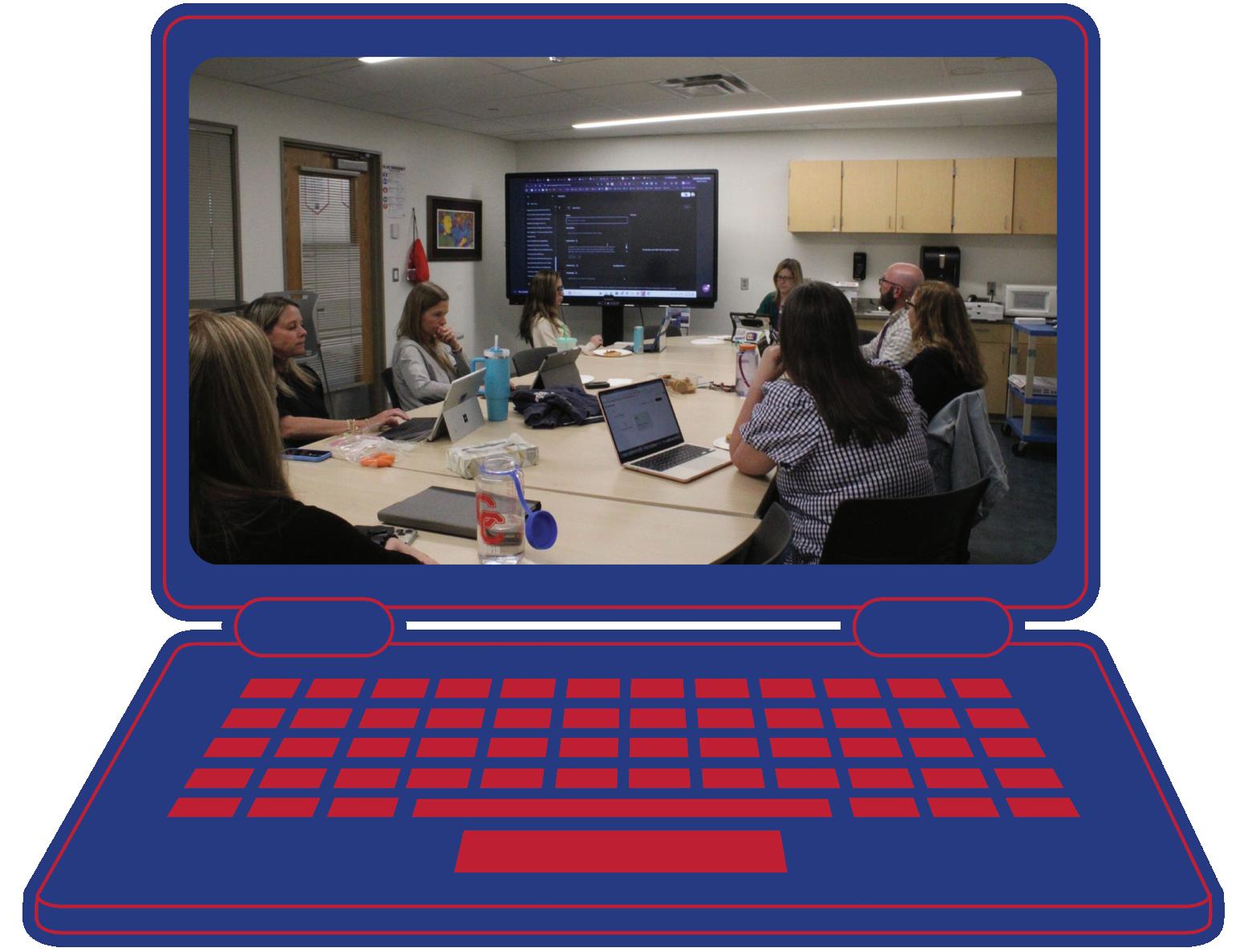
Several AI programs such as Copilot, Gemini and NotebookLM have been approved for all teachers in CCSD. The district plans on approving tools for student use as soon as this upcoming fall semester. These changes cause some students to question generative AI’s role within school both for students and teachers.
Instructional Technology Coordinator Kris Edwards understands and welcomes the future of learning with AI, such as helping teachers with lesson plans, organizing day to day work, and speeding the whole process of teaching along.
“Those are things that we can now do without spending all of our time, and, all of our weekends and our nights working on that,” Edwards said. “It frees up time for teachers to work with students more, get their grading done, to do more for their mental health, and get more time to spend with students.”
Many students and teachers alike already are in large support of the idea of AI being used to elevate learning and production.
“You can take all the things that your teacher gives you to study, or for your materials in class, you can put them into NotebookLM and create study guides, I see students creating [things] in Canva that are amazing,” Edwards said.
English teacher Mhari Doyle attended a lunchtime professional development seminar on April 9, presented by Edwards and English teacher Seth Fine. It helped teachers learn how to use AI in all facets in their teaching.
“I think the idea of AI is really, really, really attractive to a lot of people, and because it saves so much time, right?” Doyle said. “The thing that I hope happens with AI is that we learn to use it to support our critical thinking, but not replace it.”
Along with many other teachers, Doyle already uses AI in many parts of her teaching, such as to change up talking points or
Alongside AI
help develop her teaching towards students who may not completely understand the topics.
“I use it a lot to get fresh ideas for lessons that I've been teaching for 20 years already, using it to generate images, making lessons more engaging, or just to get the ball rolling,” Doyle said.
A lot of students question the open availability of AI for students.
Students at Creek and the greater world are divided and uncertain about AI, whether simply avoiding using it due to avoiding cheating, or environmental issues, it is still something many are just not willing to incorporate into their lives. On the other hand, some already use it in their day to day school, with AI being used as a search engine or essay writer.
“[AI] does benefit most of the things I do, when I need a little help with home-
work or some school stuff, it will help, it's always been a good tool,” sophomore Danny Stamper said.
However, many students do have ethical dilemmas associated with the use of AI.
“I personally avoid as much AI as possible because of the environmental impacts it creates such as wasting water, and it’s forcing its way into so many aspects of my life that I could handle much easier without AI,” junior Drayden Bradshaw said.
Practically, if AI is to be further integrated into education at Creek, education of students on the topic will be considered.
"What I hope is that we start to address the problem that students don't know how to use it,” Doyle said, “We're just going to assume they're going to use it ethically. We need to build that into our instruction, and I don't know where that fits.”
LUNCH & LEARN: Instructional Technology Coordinator Kris Edwards and AP Literature teacher Seth Fine host a seminar teaching staff members from all departments at Creek how to incorporate AI into lessons, slides and class planning.
GRAPHIC
BY OLIVER SCALA
PHOTO BY CYPRUS JIMENEZ


BY ELISE DOUGHERTY Asst. Opinions Editor
Awhite and blue creature with orange paws printed on a bright vinyl sticker is a common sight in the hallways, upon door frames, or on windows. Since the beginning of the school year, these stickers have been plastered around, raising confusion and curiosity among students.
The junior student behind this mini Banksy-esque project has dubbed the creature “Harbor” and he identifies with it as his fursona, asking to be called by this name in the article.
The sticker is a fuzzy area, according to the Bear Facts, where vandalism has to have malicious intent; the sticker is not meant to bring harm, only create community.
The sticker started back in the summer, when Harbor printed a design created by his friend for furry events. He figured giving out stickers would create interest and have stickers become recognizable; he soon opted to print 2,000 stickers to give out for fun.
Harbor tracks the development of the sticker as being for fun at first, be-
coming an inside joke, and then eventually being used to represent self-expression. He has never intended to spread a specific message; he thinks of it as a bonus that people are starting to interact with and form a community around it.
“Now it's a symbol of not changing things about yourself to appease the opinions of others and also emphasize that things aren’t always that deep,” Har bor said.
Many people around the school have begun to recognize these stickers, be lieving that Harbor’s design has created a sense of community at the school.
“Pretty much everyone knows what I'm talking about if I ask them about the sticker,” junior Eamon Holohan said. “I think they’ve become a part of the school’s charm and culture.”
The stickers have also been used to spread awareness about something not commonly talked about outside of so cial media.
“I think it’s helping to break the stig ma around furries,” junior Mari Slater said. “It causes people to ask questions and furries stop being some weird, far away entity.”
Slater admits to not knowing much about furries before becoming friends with Harbor. She has an understanding
of furries as a group of creative people who are looking to express themselves in an artistic way.
Other students also notice these stickers not only around the school, but around the community as well.
“They’re not just at Creek, if you look closely around the area, you might find them on stop signs, fast food places, stuff like that,” Holohan said. “There’s also a whole bunch at Regis and Grandview.”
But not all recognition has been positive.
“There’s also some groups that are not big fans of the stickers,” Harbor said. “I’ll walk around sometimes, and I’ll see Trump stickers over [them].”
Despite small acts of retaliation, most students simply view the stickers as harmless and enjoy recognizing them among the community.
“I think the stickers are mostly harmless, and it’s pretty funny how widespread they’ve become throughout Creek,” senior Daniel Roitman said.

RECOGNIZABLE BUT NOT RECOGNIZED: Many people know his fursona through his eye-catching stickers, but in reality very few know the person behind the artwork.
ART COURTESY OF HARBOR
PHOTO BY BERKELEY BOWLER
Six Teachers Moving on to The Next Stages of Life:
BY IZZY KRAUSS, SOPHIA HADY, & ANDREI MACHADO Editor-in-Chief, Managing Editor, & Sports Editor
David Gamelin: Technology and Technique
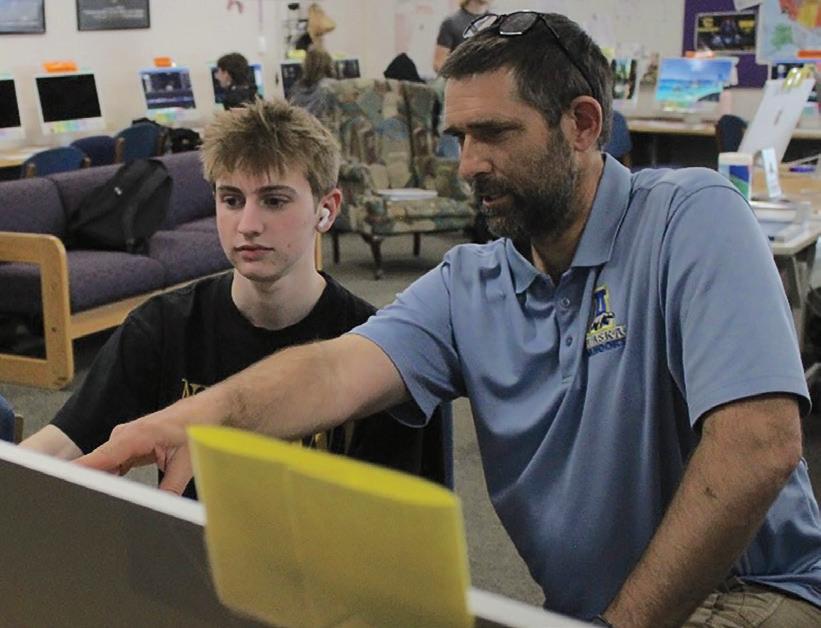
Having taught video production at Creek for 24 of his 27 years in the district, video production teacher, David Gamelin, will be retiring and leaving Creek at the end of this school year.
“There are so many ways that I’m gonna miss Creek,” Gamelin said. “I love the energy that students have in class. You know, kids show up and they’re generally excited to do projects, and they’re creative and fun, I feel like it keeps me young.”
He didn’t just teach video production, he built up the class from a little classroom in the corner of the library. He created a
class with three different levels and its own room with many computers and video equipment to aid students in the creative process. Beyond simply teaching video production for over two decades, Gamelin coached every level of soccer for both the girls and boys team.
“I couldn’t imagine anyone else teach ing the class,” sophomore Sofi Gok said. “Because he made video production so popular and is able to interact closely with students while remain ing professional.”
PASSION:
David Rowe: Mr. Sunshine

After spending his 35 year-long career of teaching English at Creek, David Rowe is retiring from Cherry Creek high school. His impact has been tremendous for all students over multiple decades.

By teaching Bruin Academic Center for freshmen and sophomores, he has inspired students and helped guide their paths for the future.
“Mr. Rowe helped a lot by encouraging me to stay at school and go to college,” freshman Bryan Qiu said. Even after teaching all grades and help-
Ben Singh: Doctor of the DBQ
Best known for teaching AP U.S. & Comparative Government, Ben Singh has been teaching classes at Creek for 22 years. He’s made the decision to retire this year and, hopefully, open a bookstore in his retirement.
“While I love what I do, I don’t have the same energy that I once had,” Singh said.
His work hasn’t just been confined to AP students; he’s also helped with student teachers, acting as a mentor for social studies teacher Timothy Kirkpatrick, and Activities director, Kelly Prevost. Prevost was
a student teacher under him when she was 22 and attributes a lot of her work ethic and how she interacts with students to Singh.
“[I] learned from him, the power of connecting with students and when you’re able to create a rapport in a classroom, in a community, you can teach kids anything,” Prevost said. “I think that’s the strongest foun dation you’re going to have, is your ability to connect with your kids, because then you can challenge them.”
ing create the senior seminar class, Rowe isn’t ready to leave a path in education; but for now, Rowe’s path at Creek is coming to an end.
“[My wife and I] are calling it a sabbatical year, where we just take a year away and we’ll travel and explore some different options, definitely in education,” Rowe said. “I’m not looking for a better school or a better place to teach, but I am excited to see what other angles of education might be open to us in different places.”
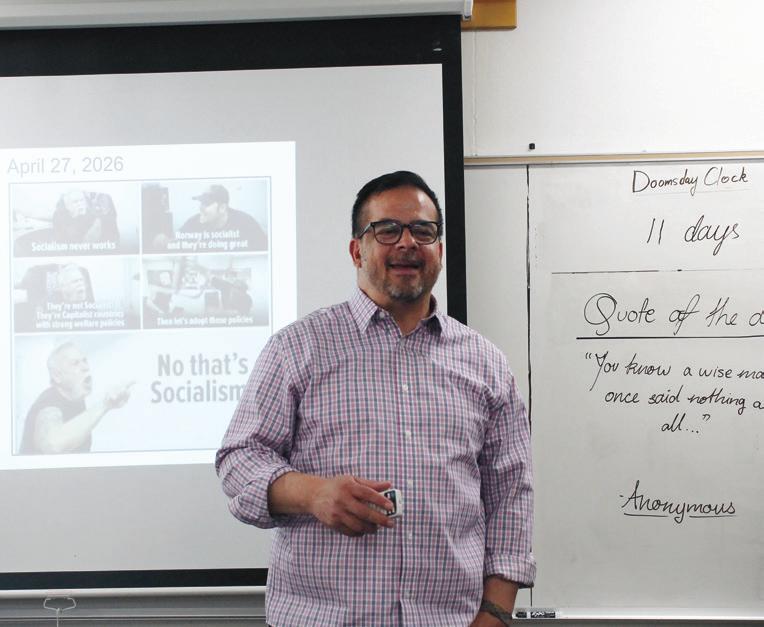

David Rowe teaching his stu dents during senior seminar.
CREATIVE: David Gamelin teaching a student how to do video production.
INTERACTIVE: Ben Singh prepping his AP Comparative Government class for their fi-
PHOTO BY ELLA FISHMAN
PHOTO BY BERKELEY BOWLER
PHOTO BY BERKELEY BOWLER
All Who Worked at Creek for Decades
Tamara Hamill: Marveling in Mathematics
After more than three decades in education, and over 20 years at Creek, Tamara Hamill is retiring, leaving a legacy that goes beyond teaching math.
Hamill began teaching in 1991 and joined Cherry Creek in 2004, consistently working in the math department. This year, she taught CP Algebra 2 and Probability and Statistics.
Over time, Hamill built deeper connections with students by understanding their lives beyond academics and seeing things from their perspective, ultimately shaping her teaching.
“I got to understand more about what

they were going through,” Hamill said. “Not just relating it to what I went through in high school.”
While academics mattered, she also emphasized character and responsibility. “I try to not only teach the kids math, but also to be a good person,” she said.
Students say that the approach made a lasting impact.
“She’s always happy and makes my day,” sophomore Sundand Bhandaram said. “I know I’m going to miss her because I definitely have a connection with her. She’s a great teacher.”

Tim Libby: Creek’s Musical Maestro

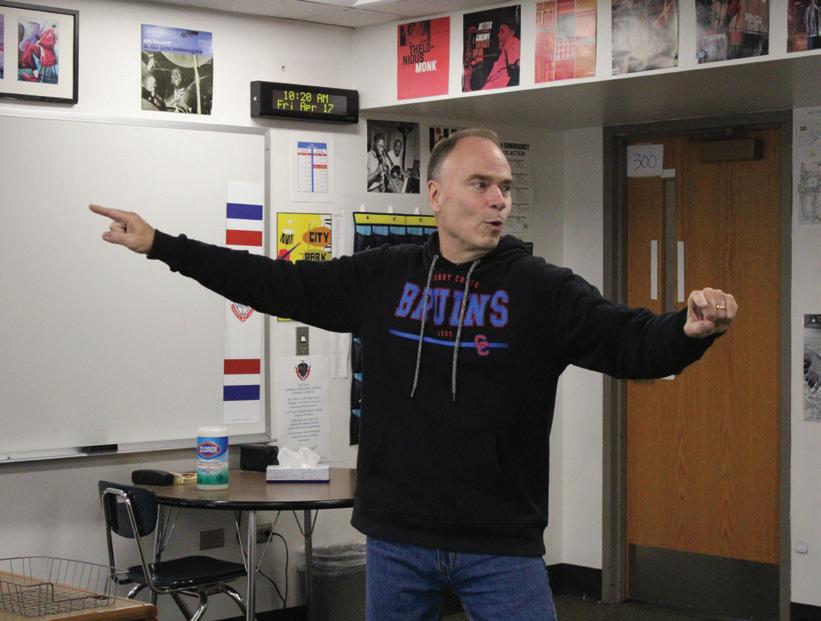
THE CONDUCTOR: Band director Tim Libby announces a Sept. 17, 2025 jazz band concert.
After 26 years at Cherry Creek High School, Timothy Libby is retiring from his role as band director and fine arts coordinator, concluding a tenure that included leading all four band programs, pit orchestra, marching band, jazz bands, and overseeing fine arts for five years.

Libby also served as fine arts coordinator, working with faculty across the Fine Arts department. Students, parents, and many others are grateful for Libby’s willingness to evolve while maintaining continuity within a large department.
“He has been a rock for so long,” Choir director Adam Cave said. “ He has set the precedent for how you respect where you’ve come from, but also just continue to evolve.”
Throughout his career, Libby has spent countless hours working with students to improve their skills, working with faculty to build curriculum, and creating a legacy in music education at Creek.
“It’s been a privilege… and it’s been the greatest thing I could ever think of in my life,” Libby Said.
Kathi Meyer & Kari Peterson: Double Trouble
Identical twins and identical career paths; Kathi Meyer and Kari Peterson have both spent over a decade teaching math at Creek, and have both decided to retire in the same year. They both made this choice partly so they could spend more time with their aging mother and partly because they both felt ready.
“It’s bittersweet to be retiring this year, but I do feel like it’s the right time for me,” Peterson said.
Through their years at Creek, both
twins felt that the culture at Creek was unlike any other. Meyer had pre viously worked at Cherokee Trail before coming to Creek, and claims that Creek’s students were more grate ful and the administration better sup ported teachers.

“Hands down, this is the best place to be; we have amazing kids and just the positivity in the administration,” Meyer said.
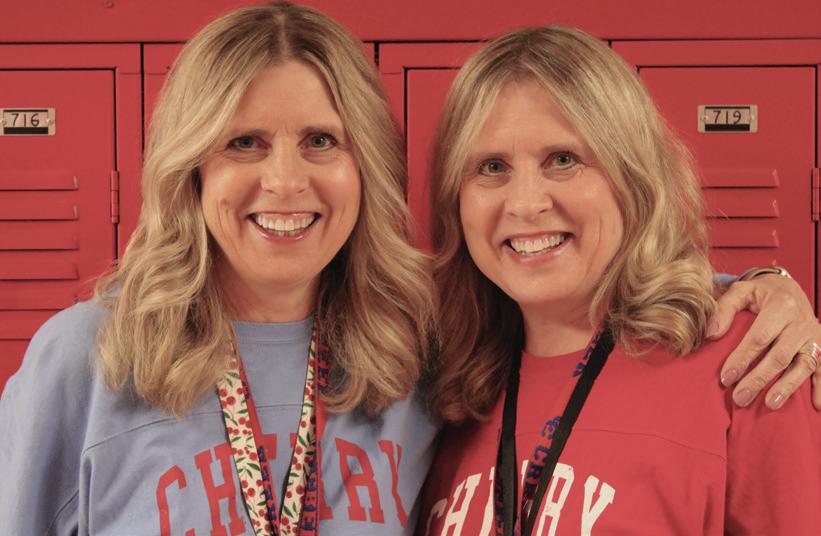

TWINNING: Kathi Meyer (left) and Kari Peterson stay together through their career.
PHOTO BY ELLA FISHMAN
PHOTO BY PETER PHILPOTT
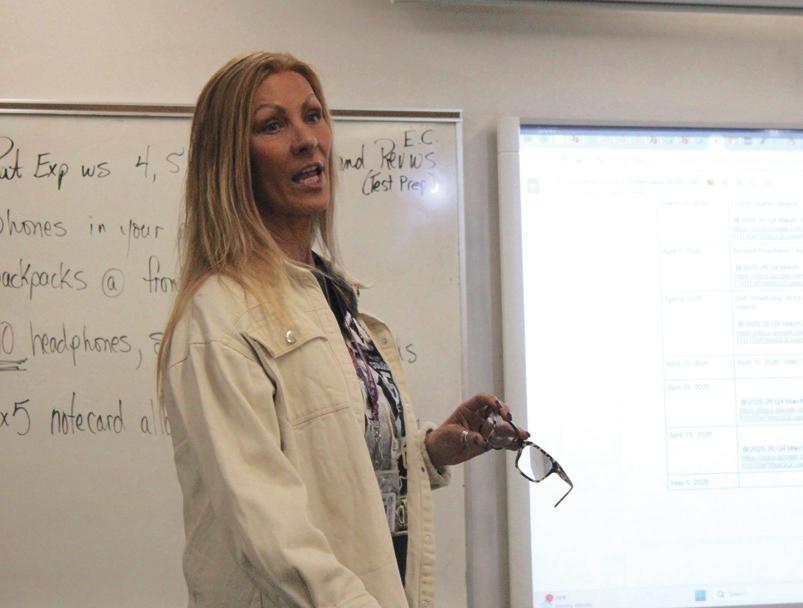
CHARMING: Tamara Hamill explaining self-scheduling during advisory.

WHEN THE MIRROR LIES
Body dysmorphia clouds self-perception versus real appearance, affecting individuals beyond physical health
Topics such as body image issues, eating disorders, and isolation are discussed in this issue; reader discretion is advised. If you or someone you know is struggling with body image image issues, consult these resources:
Colorado Crisis Service: 1-844-493-8255 | Text “talk” to 38255 | Suicide & Crisis Lifeline: 988 National Eating Disorder Association: https://www.nationaleatingdisorders.org/
BY IZZY KRAUSS & PETER PHILPOTT Editors-in-Chief
PHOTO ILLUSTRATION BY PETER PHILPOTT
Partying Through the Years
What is Body Dysmorphia Disorder?
People of all ages can be insecure about something, whether it’s physical or something that is less visible. But at what point does insecurity become something more?
For many students, body image and insecurity in daily life can make the struggles of high school feel significantly harder.
Body dysmorphic disorder (BDD) is a psychiatric disorder that affects nearly one in 50 people worldwide, causing them to obsess over flaws that are minor or not visible to others, that they perceive as major. While BDD is less common, body image dissatisfaction (BID) is extremely common, affecting between 69–84% of women and 10–30% of men.
While millions of Americans feel dissatisfied with their body in some way, many of these ideologies and patterns start in adolescence, causing many of these issues to persist long-term if not treated. According to a study by Michigan Health, 73% of teen girls are self-conscious, and 69% of teen boys are self-conscious.
Throughout adolescence, our bodies change in all sorts of ways. From internal pressures to look a certain way to familial expectations to friends’ and community members’ comments, many find it hard to build their own self-images. Social influences can also play a significant role.
Bullying, teasing, and even subtle com-
ments about appearance can leave lasting effects, particularly during a period when many are already noticing changes.
“It started with a lot of comparison stuff, and then [ I started getting] all sorts of comments about how I looked,” anonymous senior A.A. said. “That kinda influenced me to get into those unhealthy eating habits. I feel like it was kind of a combination of my own mind and people.”
For students and teenagers, this is especially important. Body image struggles often begin during adolescence, a period already filled with physical changes, academic pressure, and social comparison. When appearance-related distress becomes overwhelming, it can affect nearly every aspect of daily life.
From anxiety during presentations to struggles focusing, some students find they are preoccupied with how they look or whether others are judging them. This can cause significant issues moving through daily life, in a time when many are already struggling to align with peers.
so I feel like it can be, like, really hindering,” A.A. said.
Media and cultural beauty standards also play a big role. Constant exposure to edited images and idealized body types can distort how students see themselves. Social media, in particular, makes this worse by encouraging constant comparison.
A.A. explained how complicated social media can be, as many people’s feeds can be very curated and unnatural.
“You definitely are only seeing the best part of people’s experiences [on social media]. I feel like it can be very unhealthy because you’re comparing yourself,” A.A. said.
“There were times, like entire years, where the number one thing on my mind was my body.”
- Senior A.A.
“There were times, like entire years, where the number one thing on my mind was my body and how I look and my weight,
Many teens are seeing images of peers and influencers who look flawless, which can lead to unrealistic expectations. BDD can also overlap with other issues. For some students, dissatisfaction with their appearance connects to disordered eating, as they try to change how their bodies look.
“When I am eating more, it’s like, oh my god, I’m the worst person ever, and then when I’m not eating that much, it’s always this positive reinforcement, like you’re doing so good,” A.A. said. “I feel like it’s really hard, especially as somebody who’s been on both extremes, to balance the pressures either way.”

Symptoms of Body Dysmorphia
SOCIAL ISOLATION
Over time, body image dissatisfaction (BID) and body dysmorphia disorder (BDD) can also lead to isolation. Insecurity caused by BDD can cause people to avoid social events, relationships, or even everyday situations. That isolation can make things worse, leading to more negative thoughts and further lowering self-esteem.
EATING DISORDERS
Conditions such as anorexia nervosa and bulimia nervosa frequently develop during adolescence, setting these conditions up as a long-term struggle for many. The National Eating Disorders Association estimates that approximately 9% of the U.S. population will experience an eating disorder in their lifetime.
Eating disorders can also arise alone, not as a symptom of body dysmorphia. Many who suffer from both disorders experience the same feelings of shame and disgust in their own bodies.

A World Health Organization study found that about one aged 13 to 17 experience high rates of loneliness. Beyond increased rates of loneliness, issues like BID can lead to further issues.
An article from the National Library of Medicine explains that body dissatisfaction can cause individuals to avoid social interactions or situations where their bodies might be scrutinized, leading to further deterioration in mental health.
Eating disorders take a life every
52 MINUTES
COSMETIC CHANGES
Many cope with BDD by using ‘body advoidance,’ including baggy clothing, avoiding mirrors, or refraining from physical contact, according to the Center for Growth.
To cope with other discomforting features, many seek plastic surgery, or for skin conditions, many utilize makeup.
24%
Almost a quarter of patients who underwent plastic surgery suffered from body dysmorphic disorder.


DESIGN BY PETER PHILPOTT
Body Image in Sports, Gym Culture Affects Self-Perception, Performance
Athletes have to maintain physical fitness to better their performance. According to coaches and athletes, the expectations of conditioning can lead to body image dissatisfaction (BID) and consequences like body dysmorphia and eating disorders.
In team sports, according to senior cheerleader Julie Veta, these pressures can come from peers just as much as internal expectations.
“The expectations tend to be created around your teammates,” Veta said. “Your teammates, they voice their opinions.”
According to the NIH, athletes do see physical body image as an important component of their health, but this can lead to negative consequences, especially in female athletes.
“All around us, people hear comments. I certainly have,” Veta said. “It makes you insecure. And so then you start looking at your body differently, and looking in the mirror and comparing yourself to the skinnier girls on the team.”

For Veta, it can be hard to even take the leap and try to make the team, out of fear of not fitting in with teammate expectations. “It makes people who are afraid to try out… because they don’t look exactly like every skinny girl,” she said. “It has nothing to do with your body size. It has to do with how much work you are willing to put in
On the cheer team, Veta has personally seen her coach, Ben Fuller, set a positive environment that prioritizes strength and effort over body shape
or size. But at competitions and when in proximity with other high school teams, she hasn’t seen the same thing elsewhere.
“They can be extremely detrimental to their kids and how they think,” she said. “I think our coach does a really good job of giving everybody a fair chance.”

PE teacher Michael Luhring was the head coach of boys’ wrestling for 20 years. Athletes go through weight cutting processes to get into lower weight classes with smaller opponents.
“Cutting weight in high school wrestling is no longer the horror of 25 years ago,” Luhring said. “When coaches used to go too far in weight cutting, I think it not only hurt the athlete’s health but also hurt their athletic performance. I could always tell when a wrestler was cutting too much weight, they may appear lean and fit, but late in the match, they run out of gas much faster.”
BID is measured in higher numbers among athletes in weight-sensitive sports, like gymnastics, boxing, endurance running, and long/high jump, because gravity and aesthetic have a bigger impact on performance. Also, more athletes report BID at higher levels of their sport, suggesting higher implications for varsity athletes moving onto college competition.
Yet athletes aren’t the only teens that exercise. Gym culture is another world based on athletic performance and, often, physical appearance. Senior Aaron Kutzer, an avid gym-goer, started in 2023 to build up his muscle mass, but has seen a toxic culture towards beginners.
“A positive culture would change the way people think of the gym. It would make going to the gym so much simpler,” Kut zer said. “Stop caring about what other people are doing in the gym. Everyone has their own reason to be there, and you have no idea
Kutzer is appreciative of what the gym has done for him—he described himself as the ‘skinny kid’ when he started—he feels more comfortable in his own body and he’s seen his mental strength improve.
“It’s really shaped how I go through life, because it’s taught me consistency, perseverance, and many more life skills,” he said.
But he thinks the culture could dissuade others from getting that same enrichment.
“If you see a kid doing the wrong form that might impact his health or harm him, go up in a super friendly tone and manner and just show him the way,” he said. “Give him some positive feedback so that he can come back tomorrow or the following day. Improve his technique.”
In his role as PE teacher, Luhring warns of how physical education can go too far.
“PE teachers should focus on introducing students to a variety of sports and instructing them on the basic fundamentals and strategies of the sport. Make the sport fun, low pressure,” he said. “Coaches should condition their athletes to an optimum level, too much of anything is never a good idea.”


DESIGN BY PETER PHILPOTT
p orts s
Winter Guard Up Top: Three Years, Two Trophies
BY IV COLLIER Opinions Editor
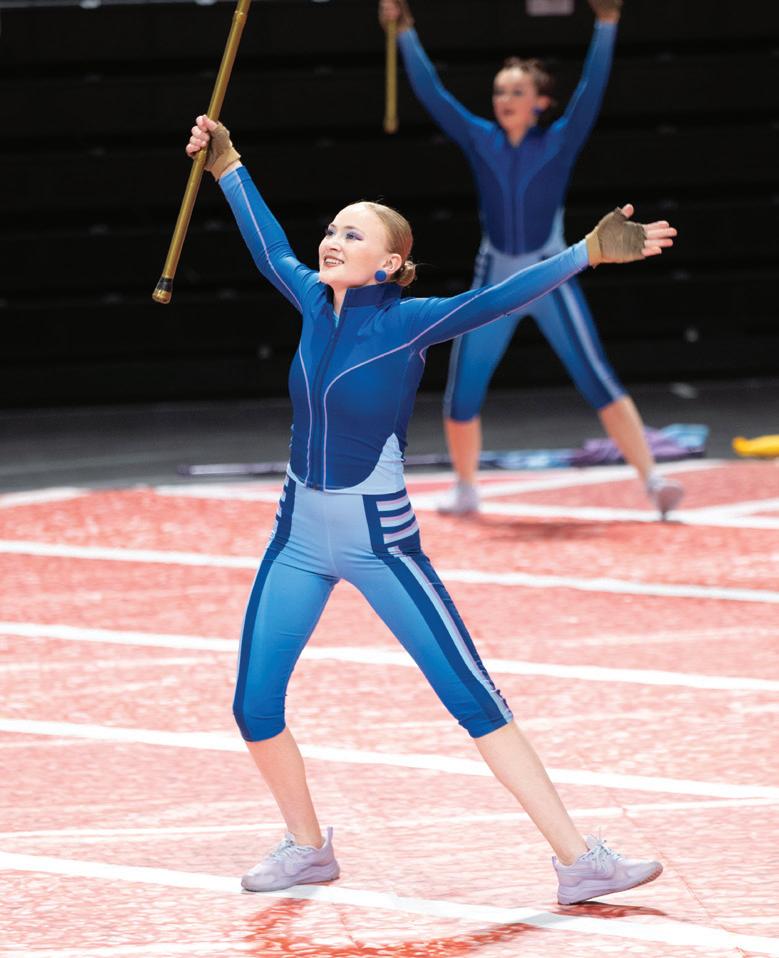
With 12 hours of scheduled practices weekly, four hours of individual work, and sitting in intense anticipation through all-day competitions—they are covered in bruises and shin splints. Motivated by passion and a mutual trust in each other, is the Creek winter guard.
During the marching band season in the fall, color guard spins flags, rifles, and sabers alongside the band. During winter into spring though, they compete independently in the Rocky Mountain Color guard Association as winter guard. In 2024 and 2026, they took home the RMCGA regional championship, first in the Scholastic AA division, then another after moving up to Scholastic A.
perfect their show.
Injuries are also prevalent in Winter guard, often happening while they are learning a new move and a pole or rifle hits their head after being flung feet in t
“A lot of people get shin splints, concussions, and everyone’s ankles hurt right now,” junior captain Sofia Sandvall said.
But even more prevalent than the bruises is the pressure of performing.
“If you have a solo, when you drop, everyone is looking at you, expecting you,” Sandvall said. “And then you drop, it’s in a gym, it’s so loud, and it’s just embarrassing.”
“It takes so much time, skill, and dedication, these students are varsity athletes.”
Working individually allows her to practice on skills and memorize moves, while doing group practices, with coach Kayla Kenyon, cultivates how moves interact with one another.
- Winter Guard Coach Kayla Kenyon
Creek winter guard battled a tough practice schedule on their journey to the championship. For each competition, they perform a 4.5 minute show. This year, their show, “To the Finish Line,” was track and field-themed. During the season, three times a week, athletes have to attend a rigorous practice schedule to
“When we’re with a big group and our practices are three hours, it’s because [Kayla’s] working with different sections,” junior Celia Grant said. “But when you’re working by yourself, you’re doing one skill over and over and over again.”
Kenyon wishes the student body and the community paid more attention to her athletes’ sport and hard work.
“It takes so much time, skill, and ded-
ication, these students are varsity athletes,” Kenyon said by email interview.
“The biggest hill [the guard] has to climb is the stigmatization of their sport and it not being ‘important’ simply because it is not known about.”
Kenyon saw how dedicated and respected every other sport at Creek is, so she wanted to push the rest of her students to the excellence that Creek normalizes. According to her, though, the athletes are pushing that standard.
“The winter guard this year was comprised of 17 students who were consistent in their approach and fully committed to everything asked of them.” Kenyon says.
Yet Kenyon has also been a driving force in guard’s recent surge in success, after becoming full-time guard director in 2022. Previously, she’s worked at Fossil Ridge, a school with longstanding marching band and color guard success in Colorado. Before Kenyon, the last championships winter guard brought home was in 2018 and 2013. Now they have two in three years, and now one in the top Colorado division, Scholastic A.
For winter guard, there is no failing because their teammates depend on each other and hold a massive level of trust for each other.
“Once you get on the floor, it’s just about staying composed and knowing that it’s still you,” Sandvall said.
ABOVE: Junior winter guard captain Jillian Mikleton performs their 2026 show at a regional show in Tulsa, Okla. on March 6.
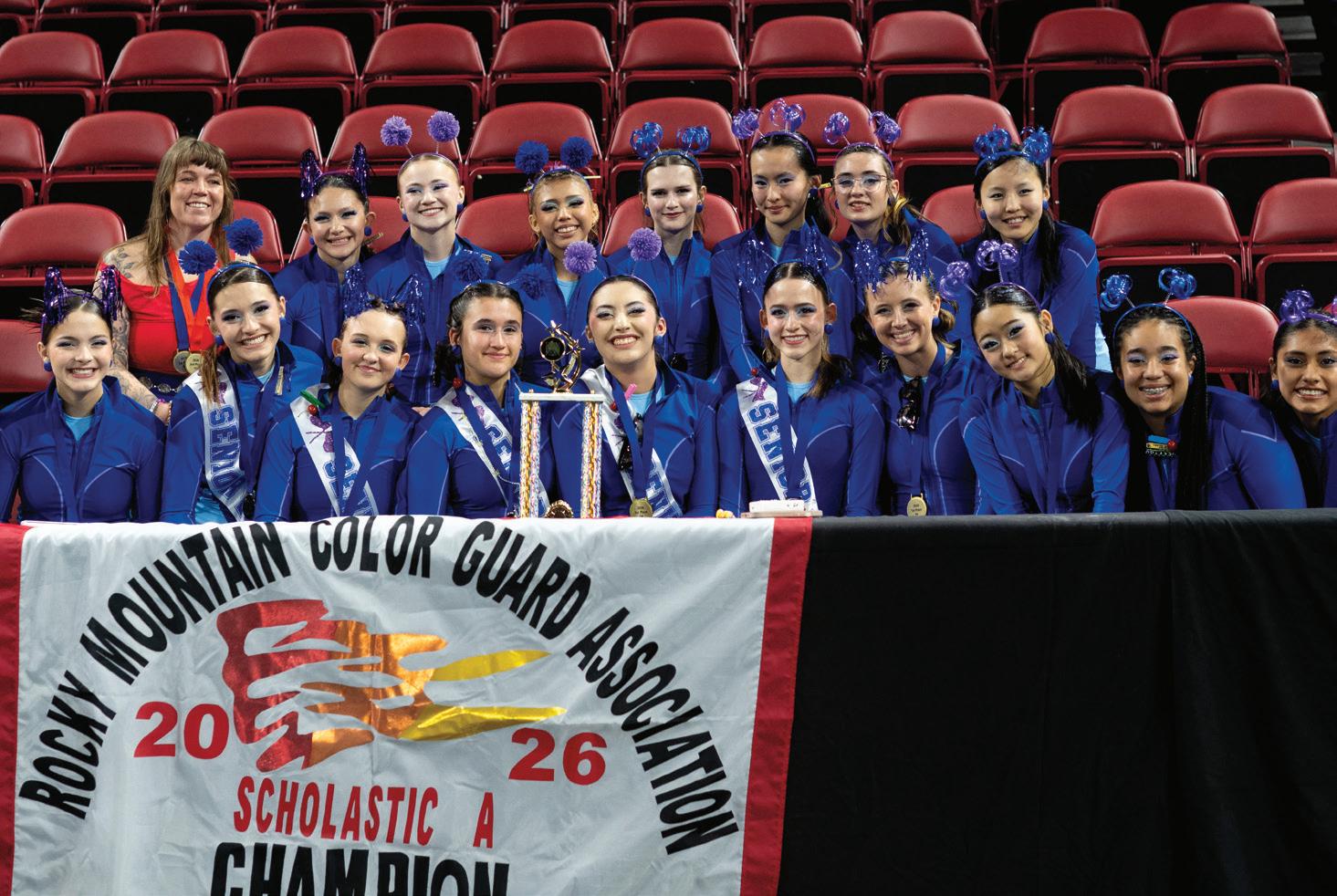
LEFT: Winter guard poses with their championship trophy at Magness Arena on March 27.
Early Decisions: Three Junior Boys’ Lacrosse Athletes Commit to D1 Programs
BY CLAIRE CRAWFORD Staff Writer
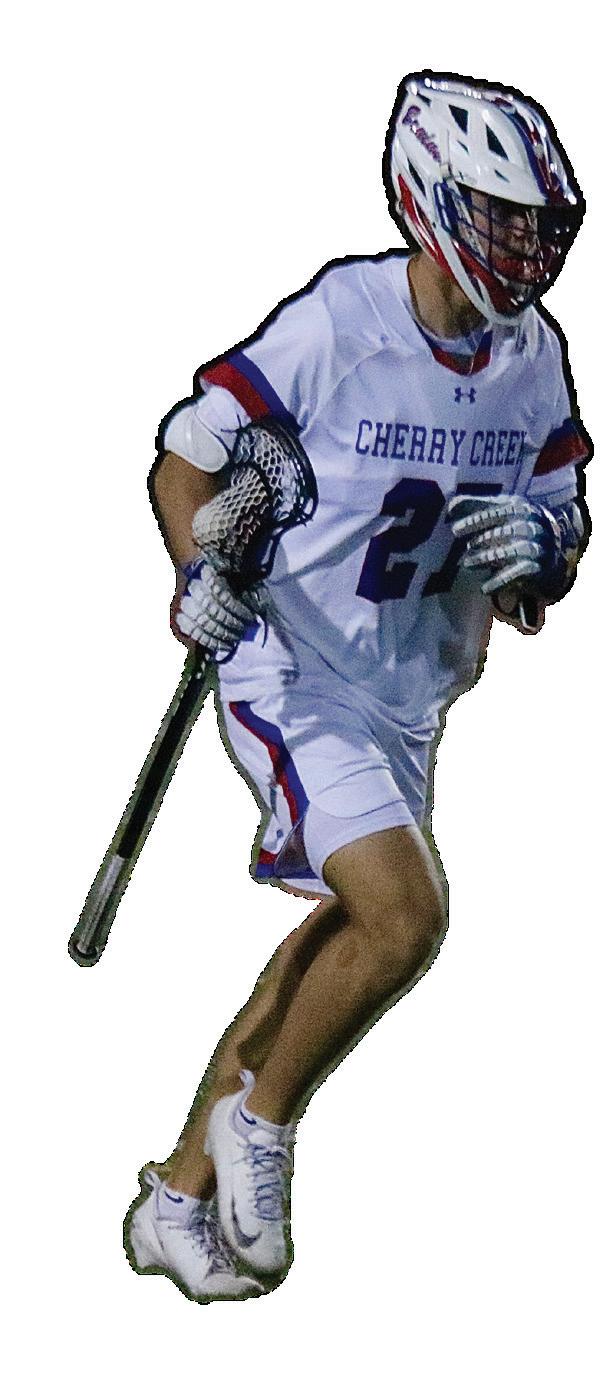
Boys’ lacrosse is ranked #34 in the nation according to MaxPreps—a huge component of their success is three juniors: Wyatt Branish, Sean Kilenny, and Grant Van Wyk, all committed to D1 schools. See how their seasons are going below.
Grant Van Wyk
Committed to play D1 at the University of North Carolina, Junior Grant Van Wyk (#27) has emerged as one of the top players in his class nationwide. He is currently ranked #75 by the National Lacrosse Federation for the class of 2027. As a defensive midfielder, his role is centered on matchups, transitions, and possession rather than scoring. He is a regular part of the defensive rotation and his ability to cover ground, defend in space and move the ball in transition has made him a consistent presence in the lineup.

“A great opportunity was presented to me and I was ready to make my decision of where to spend those four years,” Van Wyk said.
Sean Kilkenny
Junior attacker Sean Kilkenny (#7) put together a strong sophomore season with Cherry Creek Lacrosse and Colorado Kings Lacrosse Club that drew in strong D1 attention. This season, he averaged 1.5 goals per game, 1.2 assists per game, and 2.6 points per game. His performance has led to his commitment at Marquette University, a program that competes in the D1 Big East Conference.
“I really fell in love with the coaches and what they preach,” Kilkenny said “The way that they train and motivate their athletes was a big reason I committed.”





Wyatt Branish
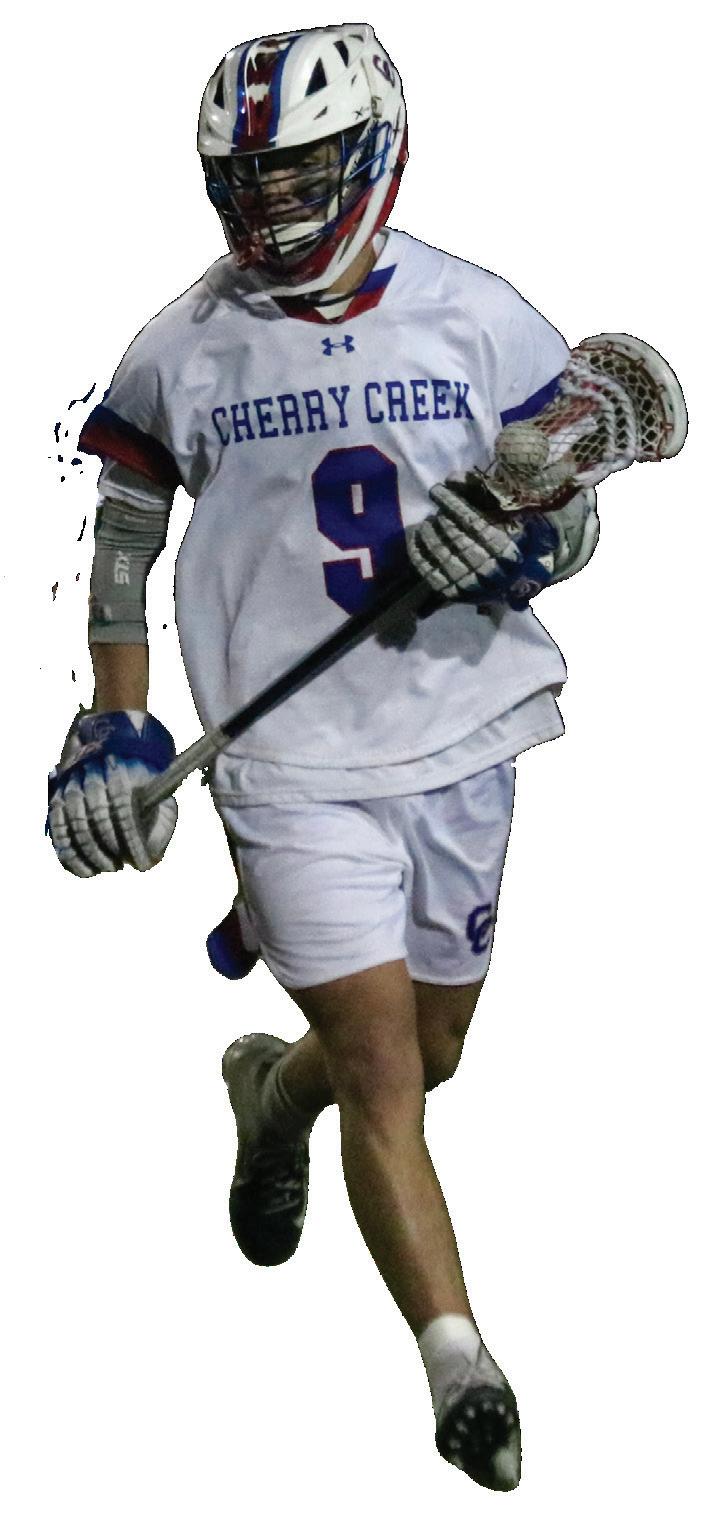
As a junior, Wyatt Branish (#9) has established himself as one of the best players in his class, ranked #50 by the National Lacrosse Federation. He posts an average of 2.3 goals per game, 1.5 assists per game, and 3.8 points per game for Cherry Creek Lacrosse, even through a highly competitive schedule.
Beyond the raw numbers, his strong performances on the field led to his commitment at The University of Michigan early in his junior year, which places him in a Big Ten Conference program that regularly competes against top-ranked teams such as Johns Hopkins University, ranked seventh, and the University of Maryland ranked 11th nationally by ESPN.
PHOTO BY CLAIRE CRAWFORD
PHOTO BY ANDREI MACHADO
PHOTO BY ANDREI MACHADO
David Knoeckel: The Voice of Creek
BY KELLEN RINGLAND Sports Editor
You know the iconic voice. The infamous rumble at each Creek sporting event. Each night, he announces the Bruins’ starting lineup, pumps up the crowd, and brings energy to each event. Social studies teacher, David Knoeckel, is behind the booth.
Knoeckel has been a PA announcer for over a decade now. He was hired at Creek back in 2011, and was offered an opportunity to announce a sporting event in his first couple of years at Creek. He first announced girls’ volleyball, leading into football in the following years, and currently announces for a variety of sports. He doesn’t plan to give it up any time soon.
basketball, and a multitude of other sports, Knoeckel has perfected the common voice heard over the speakers.
“Growing up, I listened to Alan Roach and listened to some of those stadium announcers. And I said ‘I can try that’,” Knoeckel said. “And I remember the first season, I was in the car trying to figure out how I was gonna announce my first [game]. And I was yelling in the car, trying to figure out how to get it down.”
Knoeckel works with the CCSN staff to execute the best possible entertainment at sporting events, including with the social studies teacher and CCSN advisor, Jonathan Johnson.
“I love my academic role that I get to play here, but I love the athletic role that I get to play at Creek.”
- Social Studies Teacher David Knoeckel
“I really do love [announcing], it makes you feel a part of [the game], it brings you into another realm of Cherry Creek. I love my academic role that I get to play here, but I love the athletic role that I get to play at Creek,” Knoeckel said. “It’s fun to see when we have good crowds, see their reactions, and I love the Creek community, and it gives me one more inroad to being a part of that.”
After many years as the voice for football,
“We call him the golden voice. He provides all the entertainment and energy in the booth, and it’s so cool to watch,” Johnson said. “ He’s a walking energizer bunny; he gives it his all, and he never doesn’t give his best effort while announcing.”
It’s hard to quantify how difficult the job can get, according to Knoeckel, especially with the roles of being a teacher full-time, a husband, and a father of two.
“I do want to be with my children, who are six and seven years old right now. And

what’s cool about that part is they’re old enough that they’ll come and they’ll get excited to watch daddy announce,” Knoeckel said. “They want to sit at the table or whatever. That’s what makes Creek awesome, it’s that we have a lot of people who are willing to say this part of my job is really, really, really hard.”
Knoeckel doesn’t plan to end the run of PA announcing, as long as his kids go along with the idea.
“It gets harder and harder to justify missing things that are going on in my kids’ lives. It’s a negotiation between me, my wife, and my children. They get really mad at me when it’s 5:30 p.m. or so, and I say, ‘Now girls, I’m gonna finish dinner, and then I’m going back to Creek,’ and I miss bedtime,” Knoeckel said. “I love it. It is so much fun, and I’ll do it until I don’t enjoy it enough.”
With how difficult announcing can get. The staff he works with find it impressive for the work he does when announcing events.
“[Knoeckel] follows everything so closely, and he can articulate the plays, and he can see who’s doing what, because it takes a special eye,” Dean Jamie Weber said. “He says things or does things that help the crowd get involved. That’s exciting for fans, which is important depending upon what game you’re in, but then he makes it more exciting to be there.”


PHOTO & GRAPHIC BY KELLEN RINGLAND
BY ELLA FISHMAN Video Editor
Being some of the most used apps in the world, WhatsApp and iMessages are two distinct ways of digital communication. This global debate often comes down to connectivity versus simplicity. But, which app is truly more useful and why?

Is WhatsApp used more than iMessages? If so, why?
With over two billion users around the world, yes! It offers security and accessibility, whether you have an iPhone or an Android. It lacks cellular payment plans. People from different places can communicate freely and overcome cross-platform limitations like FaceTime.
Are there places that use WhatsApp more than others?


Just in India, Brazil, and Indonesia, there are over 760 million users. Over 180 countries use WhatsApp, and South Asia itself has over 1 billion users. All of my friends who use WhatsApp are either immigrants or have relationships outside of America.
“It’s the easiest way to text my family members [in Brazil],” sophomore


Why do many Americans only use iMessage?
The Apple brand being based in America makes many perceive it as “American.” Social media labels Apple as “aesthetic” compared to Android; it’s a standard to have an Apple Ecosystem. Having a MacBook, AirPods, and an iPhone, is an achievement that American youth have accepted and strive for.
WHATSAPP MESSAGES VS. Time to Text: WYD?

WhatsApp’s internationality is also used at Creek, seen in the summer trips to foreign countries through Education First. One of the requirements to attend is having WhatsApp. It’s the quickest way for students to communicate with each other, and family back




America is also geographically isolated from Europe and Asia. Alongside the isolation in America’s technology production, it further centers the country into our own monopoly of Apple.


Isn’t it also normalized to only want Apple products? For some, having an Android is a means of judgment.
iMessage can hold 100 people in group chats. WhatsApp can support 1,000. The contrast in American norms and the rest of the world mirrors our weak technological integration with other platforms. With the Apple Ecosystems and social trends, we need to stop pressuring ourselves to stick to isolated communication.

It’s not harmful to download an app just to talk to others. Just like TikTok or Snapchat, worldwide communication is at our fingertips.

MOVIES

2016 was the year of blockbusters and movies that felt like real events. Franchises like Marvel, Star Wars, and Disney all released films that broke the box office.
These films were all perfectly engaging as they followed unpredictable plots, made the audience think, and were charged with political undertones that followed the time period of their release.
“Captain America: Civil War” transformed the idea of superhero movies as fans all over the world watched their favorite heroes split into two teams with varying political and moral views. “Moonlight” won the Oscar for Best Picture as it mapped the life of Chiron (Trevante Rhodes) working through his struggles with identity as he navigated being a queer, young Black man growing up in Miami.
“Moana” dove into Polynesian culture as it told Moana’s (Auli’i Cravalho) story of restoring the soul of her home. These authentic themes of cultural identity and nature preservation demonstrated the beauty of the world.
Despite being a children’s movie, the animal world of “Zootopia” successfully brought the reality of
VIDEO GAMES
MBY HAVANA AMANLOU & CYPRUS JIMENEZ Asst. Opinions Editor & Staff Writer
racism to light presented through a classic mystery.


any 2016 games are still considered revo lutionary due to their never-before-seen mechanics, genre-changing stories, and originality. Now as staples in not only the gaming community, but also social media, these games rewrote the expectations of gamers around the world, even a decade later.
Published as an online first person shooting game by Blizzard, “Overwatch” was a first of its kind. With its ros ter of 21 different characters, specialized abilities, and lore, every character was detailed and had an important role. Its largescale success came from its competitiveness and how it focused on the “hero aspect” of the team shooter genre, which eventually made it win the 20216 Game of the Year. In downloads, revenue, and ac tive users, “Pokemon Go” quite literally broke the internet. Players were able to catch, train, and bond with their own virtual Pokemon, no matter where in the world they were. It encouraged people from all ages to get outside and connect with others and their personal Pokemon, and won the Best Mobile Game in the 2016 Game Awards. In 2026, the gaming space has become set within the ways of mi cro transactions, online play, and many mechanics locked behind industry wide changes.

That It Was


Countless shows were so memorable that they not only became some of the most popular TV shows of all time, but paved the way for pop-culture.
Over 19 million more people signed up for Netflix after the release of the hit show “Strang-
As the show developed in romance, friendships, and plot, each season release became dates of crazed anticipation. is one of the most praised Netflix dramas as it told the complete story of Princess Diana and British royals with realism and impeccable acting. was a refreshing comedy-drama following the life of a woman as she chaotically navigates life, loss, and laughs in her relationships.
TV SHOWS
In the acclaimed third season of “Bojack Horseman,” the tables turn from comedy to darkness as Bojack (Will Arnett) delves into struggles of mental health, grief, and depression in not only Bojack himself, but also in his relationships.
The ever-iconic anime, “My Hero Academia” began as it followed Izuku Midoriya (Daiki Yamashita) maneuvering a world of powers and the morality of a true hero. Ending with eight seasons total, the beloved show continues to have spinoff and movie releases today.
These shows went on to continue their own legacy with following seasons, controversial endings, and fandoms to last a lifetime. They made a lasting impact in TV expectations to influence and define the shows we watch today.
Now in 2026, there are infinite options for people to watch. Everyone is watching something that caters to their interests. The shift from traditional TV channels to streaming services provide people a wider range of media with a scroll of their thumb.
ne thing 2016 got perfect was undeniably Albums expressed themes of pain, love, and perseverance that dove into the experiences of women, people of color, and family, these songs continue to be comforting “LemonBeyonce’s sixth album, was a rollercoaster that covers themes of betrayal and the Black female experience in America. Frank Ocean’s was a soul-filled album that dove into lost love and adulthood with ambient soundscapes and has yet to release another album since. Genres like R&B, hip-

MUSIC
hop, and pop have been defined by these albums and their success and continue to see it decades later. “Blackstar,” David Bowie’s final album was released two days before his death in Jan. 2016. It finalized his legacy and the social revolution he brought to the world.
“Masterpiece” was centered on love and abuse with a grunge overtone to it, leading to breakout and sustained success from Big Thief in the decade following the album’s release.
Music has always been some of the most relevant and original aspects of media, and 2016 only ever added to the magic. Artists in 2016 actually made albums long enough to tell a real story.
But in 2026, music lacks the elements that make it significant. Nowadays, albums are short and songs mostly become super popular through 15-second excerpts on social media. Songs from 2016 have trended on social media for years and continue to be discovered among the growing youth. But now, songs are easily overplayed and fail to reach the level of influence and freshness 2016 had.
GRAPHICS BY DHANYA RAJENDIRAN
opinions
There is Art in Architecture
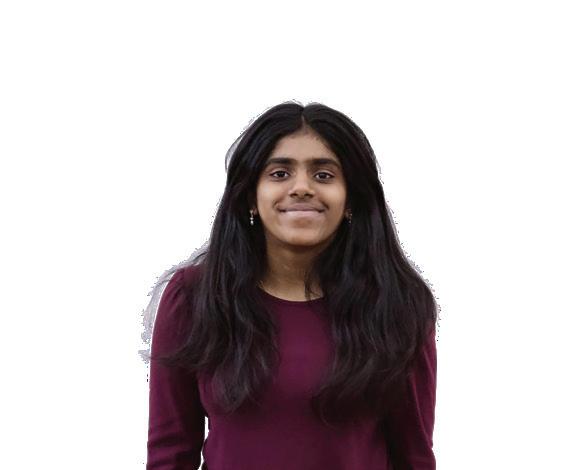
BY DHANYA RAJENDIRAN Managing Editor
BY ELLA FISHMAN
TikTok & Video Editor
Stepping through the threshold of Gangkaikonda Cholapuram in Ariyalur, Tamilnadu when I went to India last summer might’ve been the best part of my 2025.
The large stone temple towered over the entire courtyard with its beautiful brown stone gracing my eyes. Large pillars embellished with carvings of the Hindu gods were scattered around the smaller areas of the temple. It was filled with people in classic,
simple South Asian clothing, and just as the sun set, my family and I sat on the grassy knoll and hung out.
We talked as we watched the sun lower and disappear behind the tall intricate temple. It was truly beautiful. It was also surreal to see something that had been standing since 1035 CE. Temples, mosques, cathedrals, and other buildings are all such a key part of our society. Seeing it so close to me made me feel more connected to my culture in a way. I don’t live in India so
I don’t get to be as close to my culture as I would hope. But seeing this beautiful temple was honestly surreal.
through social media and other aspects of the place that you are traveling to. Architecture is constantly changing, but for those older pieces that contribute to both the history and the culture of a certain place, they stay the same.
I think it is such a great feat that they have even managed to keep all of these beautiful structures standing to this day. Surely that deserves some praise?
Architecture is constantly changing, but for those older pieces that contribute to both the history and the culture of a certain place, they stay the same.
Every single piece of residency, every office building, every monument, and every single store are all designed to make our community unique But in this day and age, they simply don’t receive the credit where it’s due. People travel for so many reasons, whether it’s to explore the history of a place, to take pretty photos, or simply to eat good food.
Personally, I love all of those aspects, but the first thing I notice is almost always the aesthetic and the architecture around me. The architecture of a place is certainly noticed but it gets overlooked
These churches and temples are quite literally crumbling at the edges but stay put due to people who care. These are people all over the world who are trying to keep these structures alive. FOR YOU. FOR US. For the recognition of these amazing architects and engineers who worked so hard to create these structures.
My family and I visited Greece a few years ago and it was one of my favorite trips I have ever taken. Athens is known for the Parthenon and all of its smaller ruins that represent Greek history. Being an avid “Percy Jackson and the Olympians” fan, I was thrilled to see all of the temples of the very gods that I had read about. The city of Athens itself wasn’t very appealing to little 13-year-old me. It was just a city. Markets bustling, crowded streets, humid air, and far too much traffic. However, my trip was instantly better the second that I was on that large mountain staring at those beige Greek ruins. They were beautiful, almost glowing in the sun. I was taking in all of the history that was oozing around me. It uplifted my entire trip and I still think about it to this day.
Another amazing piece of architecture that I was able to see was the Grand-Place de Bruxelles in Belgium. I absolutely adore European architecture and I just loved how intricate it was. I also just really enjoyed that it was just a normal place

You Should be Noticing
in the city. It was a square with a lot of amazing shops but it was just so beautiful to look at.
Every detail of the building was intricate and created with such intense care. Between the hundreds of windows were beautiful statues of two women wearing robes faced away from each other. Making them stand out, the windows are tinted a beautiful blue with iron and gold accents.
Similarly , there are so many pieces of architecture that I was so lucky to be able to witness. However, I do realize that I‘ve talked so much about architecture that’s out of the country. Nonetheless, there are so many pieces of architecture and really interesting buildings all around us. One that I have always loved seeing is the Denver Art Museum. Being an art museum, you would want it to be interesting, but this one immediately catches your eye. It’s inspired by the Rocky Mountains and it is made of 9,000 titanium panels. It looks utterly modern, but that makes it so eye-catching.
We are typically surrounded by more modern architecture with the increased building of repetitive structures like apartments but I assure that taking a closer look can make your mind appreciated more about where you live. Architecture has thousands of years of history.
From the pyramids, such a historical marvel there is an entire community of people that believe that it’s fake, to the record breaking Burj Khalifa standing 2,017 feet high above Dubai. Perhaps the next time you take a trip, whether it be just downtown or to a different country, take a closer look at the structures that surround you.
Taking a closer look can make your mind appreciate more about where you live. Architecture has thousands of years of history.
Roughly 2.75 billion structures grace our Earth, and I guarantee you that most of those are nice to look at and have a story to tell. There is so much you can learn from each curve and corner of a building.
The architecture that engulfs a city can tell you so much about the city itself. Listen to what it’s trying to tell you.
A guide to architecture types, with examples near
us!
Brutalist
- Raw exposed concrete
- Bold geometric shapes
- Blocky appearances
- eg. Denver Art Museum North Building
Spanish Colonial
- Two story rectangular shapes
- Stucco and terracotta materials
- Arched doors
- eg. Malo Mansion on 8th Ave
Gothic:
- Pointed arches
- Detailed stained glass
- Very tall structures
- eg. Cathedral Basilica of the Immaculate Conception

Contemporary
- Large wall-wide windows
- Tech driven
- Asymmetrical geometric forms
- eg. Populus Denver
Neoclassical
- Structural columns
- Clean, simple lines
- Domes and blank walls
- eg. Colorado State Capitol
Art Deco
- Emphasis on vertical lines to accentuate height
- Ornamental accents
- Made to symbolize luxury and modernism
- eg. Paramount Theater
Masculinity Is Power: Until Women Have it

BY ELLA FISHMAN
Editor
What counts as feminine is subjective throughout every culture. Between body size, hair length, and style, the spectrum of what is considered modest and acceptable is not only a woman’s upbringing, but also their downfall. Women in fiction can either give some of the best examples of empowerment or portray pure misogynistic caricatures. It messes with people’s perception of women, but especially men’s. The world’s idea of womanhood is endangered by being in the hands of the male-ran society. Cinephiles, people who love cinema, obsess over watching complex characters. Well, complex male characters. Some will always find a way to somehow defend morally gray men who have committed the most heinous of crimes. And dare I say, it mirrors real life. In the same way people find loopholes to keep men from punishment, they will always find ways to bring women down for any-
In “The Legend of Korra,” the spin-off of “Avatar: the Last Airbender,” female protagonist Korra gets absolutely dragged into the ground by fans any time she’s brought up. I think most, if not all, of the hate is grounded in misogyny and racism. Between her muscular build and darker skin, she doesn’t match the usual
dainty and “gorgeous” heroine. But Korra battles a different main villain each of her four seasons, taking on much more than her male counterparts in ATLA and her own show did.
Even her intelligence isn’t taken seriously. The controversy surrounding her actions deems her the dumbest Avatar ever. Sure, she didn’t always think things all the way through, but she always made the best of her decisions and fixed whatever mistakes she made.
In gaming, it is also normalized to hate. Whether it’s attacking their skills, their gender, or sexualizing them, men hear a feminine voice in the chatroom and immediately pounce. With the creation of “Game talk” or informal, fastpaced language that is often aggressive, players are encouraged to take part in it, learning to hate and shame women too early in development.
Female gamers are forcibly characterized by their in-game appearance. Some are fetishized, while others are victims of threats regarding sexual violence, stalking, and genuine murder. Although the threats don’t always go to that extent, women who game will face some type of discrimination just because of their voice, play style, or even how their avatar looks.
But, masculine women aren’t only demeaned in media, the culture has spiraled into their real lives. Many women athletes will be labeled as “pick-me” and women who are more physically built will be labeled “butch.” Women’s sports are seen as less superior to men’s and same goes with many male dominated hobbies
Male gamers will find anything about another player that seems “feminine” and attack. Between undermining intelligence, insulting beauty, and violent threats, people’s view of masculinity in women goes beyond what’s real and what’s fake. However, a similar denominator of all hate goes back to one single thing I don’t understand: why are men so proud and weird about their masculinity, but see it as a bad thing when it’s in something they love—women.
Video
PHOTO BY HAVANA AMANLOU
A Legacy Worth Preserving
Seniors Want Creek’s Spirit to Endure
With bond construction already creeping onto campus, it’s easy to tell that Creek is about to go through some momentous changes. Within the decade, students just like us will be attending school in brand new, fresh, unfamiliar buildings. The Class of 2026 is the last to graduate from the campus as we’ve come to know it. When Bruins return from summer, things won’t look the same.
Through this period of transition, there are some things about Creek we should never change. They are parts of our campus, our culture, and our purpose that make us, us.
It starts with the simple campus accents: trees. Trees are the unseen heroes that truly make our campus beautiful. When we see pictures of Creek in the 20th century, it looks strange and alien, almost like a campus in Kansas. But the blue spruces, the locusts, and the cherry plums add a whole new dimension and liveliness to our quads and our walkways. No matter how long it takes to grow them back, we need to keep Creek’s campus green.
Another beloved element of our campus is the abundance of meeting spots and social hubs like IC Cafe, the quad, the basketball courts, courtyards. We have places to get work done and make conversation during an off period, and we need to keep those to keep our campus feel.
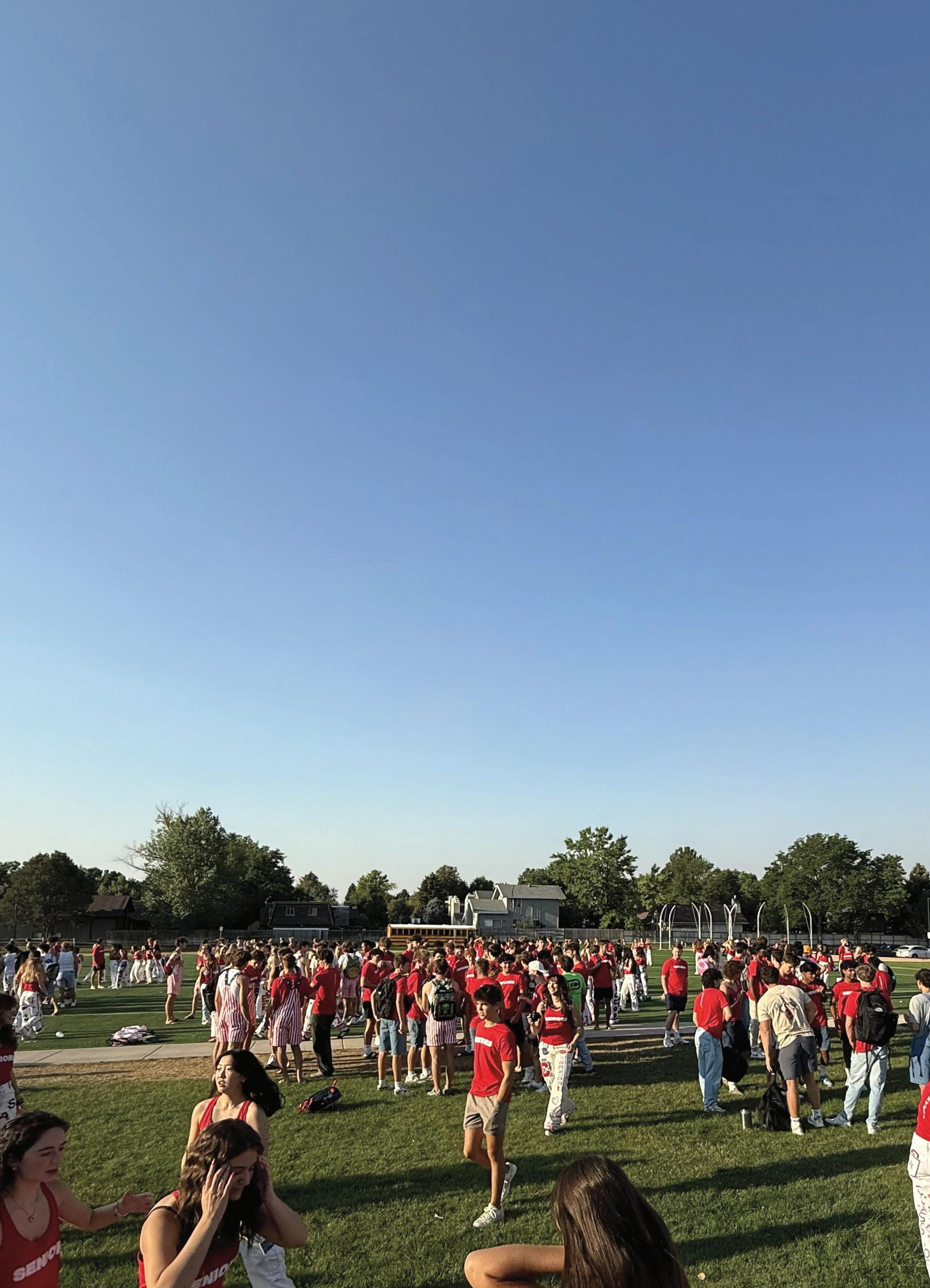
Never change Stutler Bowl. Never change our beloved stadium that has been the place of memories, both treasured and triumphant. From football to soccer, to countless graduations, Stutler Bowl has held thousands of students, all forming new memories with one another. Even if the building goes down, we must keep the same love and energy within the concrete walls.
Always keep the legacy of students of the past. The senior gifts, the IC Cafe mural, the Union Street Gallery, these are handcrafted elements shaped by decades of excellence. Never change the marks of history painted on our walls and etched in our buildings.
It’s not just about the campus. It’s about what they represent. You can design blueprints all you want, but it requires special care to maintain the intangible, yet extraordinary, parts of Creek.
The trees provide shade and cover on hot days for us to gather beneath. The meeting spots build bonds and solidify our relationships. We make our closest friendships here, find our first sparks of young love, we find circles that last beyond graduation. That means something. You can plant trees and create benches all you want. Don’t just manufacture the environment but, help make those connections happen.
Stutler Bowl is home of Friday Night Lights. It’s the cool evenwing breeze. It’s first quarter energy. It’s our electric sports culture. More than half our students are ath-
STAFF EDITORIAL
This is an opinion piece written by the Editorial Staff of the Union St. Journal. Staff editorials serve as a way for members of the magazine to give commentary on a community-wide issue. The views expressed represent the opinions of the editorial staff, not those of CCHS or CCSD.
18 IN FAVOR - 0 OPPOSED
The USJ’s Editorial Board voted on the subject of this staff editorial.
letes. Sports mean so much to this school. It’s easy to build athletics facilities, but it means more to keep our dedicated culture thriving.
Our senior gifts represent our history. Every student can make their own mark in our halls. Architects can plan for places for murals and monuments, but what’s really meaningful is accommodating the years of heritage that previous generations of students have already imprinted.
Creek students can make a wish list pages long, full of items they want in their perfect high school campus. Administrators can plan for natural lighting, sustainability, open spaces, and updated technology. But there are things about Creek that are already perfect, that should never change, even when the campus does.
PHOTO BY PETER PHILPOTT
Acing the Competition
Boys’ volleyball excels
Record: 14-9
CO Rank: 12
National Rank: 317
Hitting Percentage: .24
Solo Blocks: 110
Serving Aces: 122
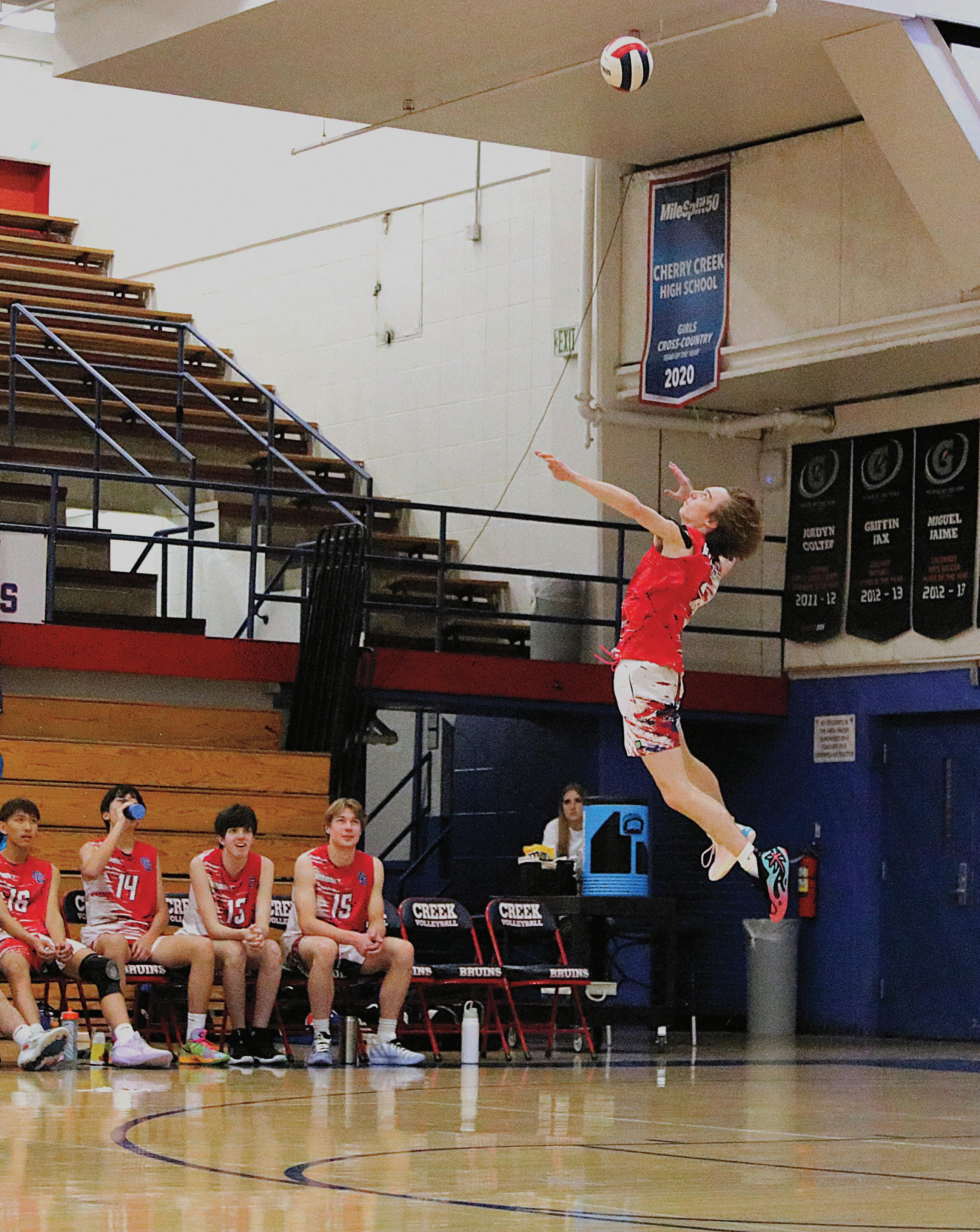
“ We hope to make a push to state, we haven’t made it to state the four years I’ve been here. It’s a goal for this team this year. ”
-Senior outside hitter Noah Reynolds
PHOTO BY KELLEN RINGLAND
FLYING HIGH: Senior defensive specialist Kieran Monroe mid jump serve against Overland High School in a 3-1 set victory on March 31.