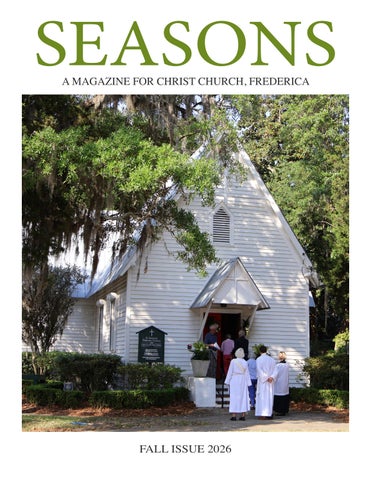
SEASONS A MAGAZINE FOR CHRIST CHURCH, FREDERICA
FALL ISSUE 2026
TIMELESS FAITH FOR TODAY Christ Church, Frederica is a historic Episcopal Congregation that serves the spiritual needs of today. Our congregation is a place of inclusivity, hospitality, community, and discipleship. We have a place for you! Clergy The Right Rev. Frank Logue, Bishop of the Diocese of Georgia The Very Rev. Thomas Purdy, Rector
Lay Staff Harrison Branch, Cemetery Superintendent and Sexton Jim Broussard, Organist and Choirmaster
The Rev. Ethan White, Curate
Emily Mumford, Parish Administrator
The Rev. Bill Barton, Asst. to the Rector for Formation
Lily Packard, Communications Associate
The Rev. Becky Dorrell, Deacon
Brooks Thompson, Bookkeeper
The Rev. Deb Luginbuhl, Deacon Assisting Clergy
Ebonee Moore, Accountant
The Rt. Rev. Charles Bennison The Rev. Bob Brown (UMC Ret.) The Rev. Becky Rowell Volunteer Lay Associates Beryl Blatchford, Pastoral Care Associate
Scan for more information about Christ Church and our ministries, You can also connect with us by texting the word “Connect” to 912-689-3501
IN THIS ISSUE 5
What Would You Have Me Do? The Very Rev. Tom Purdy
8
The Egret Leslie Williams
9
Called, or Not Called: God’s Abiding Presence The Rev. Deacon Ethan White
10 Introducing the Rev. Deacon Ethan White Has a Superpower 12 Music Susan Garrett
Church, and the Art of “One-Anothering” 14 Home, Susan Lawhorne God in the Silence 16 Finding Linda Nelms New Old-School Gift at Burroughs-Molette 17 ASusie Hodges Henning Buddies Preparing for its 16th School Year 18 Backpack Susan Shipman
19 Stained Glass Stories: The Live Oak Window at St. Ignatius 20 Upcoming Events 22 Life at Christ Church, Frederica
FROM THE RECTOR
What Would You Have Me Do? The Very Rev. Tom Purdy In some versions of the Bible, when Saul falls to the ground in the face of blazing light on his way to Damascus, asking who it is that has come to him, upon learning that it is Jesus, he asks, “And what would you have me do?” Jesus tells him, “Go into the city, and you will be told what you must do.” At that point, Saul realizes he’s blind, but he is obedient, and the story continues with his introduction to Ananias, who baptizes him, starting his new vocation as a disciple of Jesus. It’s one of the most vivid and memorable call stories in all of the New Testament. It’s also unlike the experience of Jesus most of us have. As I have journeyed through a season of discernment this year, Saul’s question has been on the lips of my own prayer life: “What would you have me do?” Unfortunately, Jesus isn’t as clear in responding to me as he was with Saul, so I’ve had to work a bit harder and wait a bit longer to hear a response. Discernment is
5 SEASON’S MAGAZINE | FALL 2026
ongoing; if we’re prayerfully connecting with God on a regular basis, however, not every decision we make requires a response from Jesus. As I waffle between the pizza and the salad at Tramici, I rarely stop to pray about it. Maybe I’m worried Jesus might point me to the salad—I don’t know—but it never feels important enough for “discernment.” Discernment doesn’t have to be (and shouldn’t be) reserved for monumental decisions, but those are the decisions that often lead to prolonged periods of questioning and listening. Sometimes the stakes are high, and sometimes we just don’t know what to do in a given situation. In those moments, we turn to God and essentially ask for guidance, a form of heavenly advice. Many of us have mentors and trusted friends we can turn to, and we can hear their voices and choose to take or leave their advice. That’s not always enough, though, and we seek God’s blessing, or at least a sense
of God’s pleasure, as we choose how to respond to a situation we find ourselves in. Saul was fortunate; Jesus told him what to do in order to get even more direct feedback from another person who was receiving instruction from God. How nice it would be to have such clear instructions, even if they were only instructions to point us to where the next instruction would come from! For the rest of us, we must often settle for urgings, inklings, and sensations that are not nearly as clear as a booming voice. That’s how internal discernment often takes shape. There is also external discernment, however, when someone who knows us, or perhaps someone who doesn’t, shares information with us. Sometimes it’s unsolicited, and sometimes it is unwelcome, but those moments of external discernment matter, especially when they come from different places and build up over time. But how do we know what is from God in these moments? Both Paul and the author of 1 John encourage “testing the spirits” to see if they are from God. I’m not sure Paul (when he was still known as Saul) did much testing in that first moment in the presence of Jesus, but clearly, he learned the importance of that practice as he matured in his life in Christ. Testing the spirits means trying to see whether what we’re hearing aligns with what we would expect from God or is contrary to what the faith anticipates. Is what we’re hearing in keeping with a life based in love? Does it relate to gifts, even gifts we don’t like to acknowledge? Is it
something that will build God’s kingdom, or make the world a better place, as opposed to just being good for us? Does Scripture have anything to add? We may tend to underestimate the myriad and unceasing ways in which the Holy Spirit is at work in us. While God may not show up with signs in flashing neon on Sunday mornings, a lifetime of meeting God in communal worship has taught me that it’s a place I’m more likely to meet God than a lot of other options I have in my regular routine. There are always subtle directions and encouragements anytime we listen to Scripture, read the poetry of hymns, pray a particular collect, or, dare I say it, hear something in a sermon. Many of us have had those moments when God seems close, the “thin places” Celtic Christians have spoken of for centuries. We can’t and shouldn’t discount the simple sources of discernment that are readily available. A recent Wall Street Journal article took up the Jewish Sabbath as a chance to highlight how increasingly countercultural it is to set technology aside, read, spend uninterrupted time with family, and, for many people, meet God. A day later, The Washington Post reported on the rise of AI as a source of moral authority, as people turn to a different voice from the “cloud” in order to find support for whatever problem they face. The author acknowledges that AI chatbots are notoriously good at praising their conversation partners, which everyone prefers to a partner who challenges us. God is a
SEASON’S MAGAZINE | FALL 2026
6
God who comforts, but also a God who challenges us. Sometimes we don’t want to prayerfully discern anything. God may have something more consequential to say than, “Skip the pepperoni; go for the salad!” We don’t actually want to know what God thinks, and most of humanity never has. The external discernment that came through prophets was rarely welcome. There is a long history that tells us what often comes to those sorts of discerning messengers. Saul was blinded by the bright light of Jesus’ presence in order to see. Sometimes we keep our eyes clamped shut so that we don’t have to be blinded by the light of Jesus, content to be blind so long as we don’t need to do anything we’d rather not do. As a parent, I laugh to myself at the rare moment when my children ask for advice and then don’t like what they hear. My reflex is to say, “Then why bother asking at all?” Normally, I manage to keep that response to myself. I’m glad they ask, even if they don’t take my advice. I didn’t always take my parents’ advice either. But in asking and in hearing, there is learning and growth. Over time, they may even be able to come up with the question they want to ask, not ask it, but hear the answer I would likely give anyway. Our attempts to discern in our lives by asking God are a similar process. The most important part of discernment is continuing to ask the questions. The truth is that most of us will never have an encounter like Saul’s, where we get a clear voice from heaven telling us what we should do. When we’re praying regularly, reading Scripture, worshipping, speaking with trusted and wise confidants, and making time for God, we’re likely already getting almost everything we need to discern what God intends for us. That’s true of the big things and the small things. When we find that we are still yearning for answers and feeling as though we’ve been knocked to the ground, wondering where to go, we must get up again, ask the question again, and then continue the faithful process of listening. The answers will come. They may be surprising, challenging, bring us great joy, add to our consternation, or be exactly what we hoped for, but whatever they are, they will come.
7 SEASON’S MAGAZINE | FALL 2026
The Egret Leslie Williams Once a child in the back seat waiting for an old swing bridge to close spied a snowy egret on the other side in fractal reeds, kept it forty years a secret whose wings she unfolds sometimes— Reader, I hold it out to you, white heron, yellow feet, and penetrating eye. Maybe you have another amulet, carried in estuary stillness till more room could be made coming down the years of self interrupting self and all the marshes waded through, the soul a barrier island wetland where
Leslie Williams is a seasonal parishioner who also lives in Newton, MA. She is a poet and a trained spiritual director. Her third collection, Matters for You Alone, was longlisted for the 2025 Massachusetts Book Award. She is grateful for the warm welcome of Christ Church!
the water’s almost always brackish and unclear. first appeared in Southern Poetry Review
SEASON’S MAGAZINE | FALL 2026
8
FROM THE CURATE
Called, or not Called: God’s Abiding Presence The Rev. Ethan White There is a bronze plaque that sits on my desk containing the following Latin inscription (in all capital letters): “VOCATUS ATQUE NON VOCATUS, DEUS ADERIT.” Translated into English, it means, “Summoned or not summoned, God will be present,” or, more simply, “Called or not called, God will be there.” The plaque was handed down to me by one of my mentors following his retirement. He proudly kept it on his desk throughout his entire career and found the message to be a grounding source of wisdom as he faced the ups and downs of each day. Although there are varying accounts of the phrase’s true origin, Carl Jung, the Swiss psychiatrist and founder of analytic psychology, is often credited with bringing the phrase back into visibility in the twentieth century. The story goes that when Jung was 19 years old, he was flipping through a rare collection of ancient expressions that had been compiled several hundred years earlier. When he encountered this particular phrase, it struck him immediately. The expression had such an impact on the young Jung that he had the words carved in stone above the entrance to his home so that they would greet all who entered. He later
9 SEASON’S MAGAZINE | FALL 2026
wrote, “I have put the inscription there to remind my patients and myself that ‘the fear of the Lord is the beginning of wisdom’ (Proverbs 9:10).” At the end of his life, Jung even requested to have the phrase inscribed on his tombstone. At first glance, this saying seems almost counterintuitive to much of what we do and proclaim as the Church. We are a people who continually invoke the presence of God through prayer, worship, and our lives. We also hear on numerous occasions throughout Scripture that “everyone who calls on the name of the Lord shall be saved” (Joel 2:32; Romans 10:13). Much of our prayer and liturgical expression seems to be centered around invoking God’s presence. Some of our psalms and hymns even cry out to a God who, at times, appears to be distant or even uninvested in our lives. For instance, Psalm 22 plays a central role in both our Maundy Thursday and Good Friday liturgies each year, in which the psalmist cries, “My God, my God, why have you forsaken me? Why are you so far from helping me, from the words of my groaning?” Yet the ancient phrase inscribed on Jung’s entryway is not necessarily a contradiction of our patterns of
prayer and worship, but rather an affirmation of them. Our prayers, liturgy, and singing are not attempts to persuade a distant God to draw near. Instead, they help us to open our hearts to the God who is already here with us. They awaken us to the work of the Spirit that is already unfolding in our midst while inviting us to participate more fully in what God is doing. This truth is beautifully illustrated in the story of Jacob at Bethel found in Genesis 28. After tricking his father, Isaac, into giving the blessing that was intended for Jacob’s brother, Esau, Jacob runs away to escape his brother’s anger. When Jacob reaches a quiet spot, he lays his head on a stone and has a well-known dream of a ladder with “the angels of God ascending and descending on it.” When he awakens, he exclaims, “Surely the LORD is in this place—and I did not know it!” (Genesis 28:16). For some of you, this passage may ring a bell. This is because, in 1977, the songwriter Lanny Wolfe heard this passage, and it immediately inspired him to pen his most well-known song, “Surely the Presence,” the chorus of which declares, “Surely the presence of the Lord is in this place, I can feel his mighty power and his grace. I can hear the brush of angels’ wings; I see glory on each face; Surely the pres-
ence of the Lord is in this place.” This song, together with the passage on which it is based, serves as an important reminder. Jacob’s dream is not what brought God to the place where Jacob was resting, because God was already there. The dream instead opened Jacob’s eyes to the reality that was already around him. God had been at work in Jacob’s life in a special way long before Jacob himself was fully aware of it. That is what this inscription reminds us here at Christ Church today. Whether we recognize it or not in a given moment, whether we call upon God with confidence and ease, or whether we struggle to find the right words, God’s presence is not dependent upon our decision. Even when we feel farther from God during a given week, God promises to meet us at the altar just the same as in the weeks when we are at our best. We do not have to call God into our lives from far away; instead, we awaken ourselves to the God who is already present. For this, we offer our praise and thanksgiving.
SEASON’S MAGAZINE | FALL 2026
10
Introducing the Rev. Deacon Ethan White We are delighted to welcome the Rev. Deacon Ethan White to Christ Church as our new curate. A recent graduate of Virginia Theological Seminary in Alexandria, Virginia, Ethan was ordained to the transitional diaconate in April by the Rt. Rev. Frank Logue. Born and raised primarily in Savannah, Georgia, Ethan’s faith was deeply shaped by the Episcopal Church through both his parish and the Diocese of Georgia. He earned a Bachelor of Arts in Music and History from Sewanee: The University of the South before serving as Assistant for Family Ministry at St. Stephen’s Episcopal Church in Richmond, Virginia. There, he helped rebuild and strengthen ministry for middle and high school students and their families in the wake of the pandemic. During seminary, Ethan served at St. George’s Episcopal Church in Washington, D.C., a historic African American parish near Howard University, where he further developed his passion for parish ministry. Since arriving at Christ Church, Deacon Ethan has jumped right into ministry, quickly becoming a familiar and welcoming presence in our parish community. Whether preaching, assisting in worship, building relationships, or sharing in the daily life of the parish, he has embraced this new chapter with enthusiasm, humility, and a servant’s heart.
11 SEASON’S MAGAZINE | FALL 2026
As a curate, Ethan will continue to grow in his vocation while serving alongside our clergy and parish family. His love for the Church, thoughtful leadership, and genuine care for others are already evident, and we are excited to witness the many ways God will work through his ministry in the years ahead. Please join us in welcoming Deacon Ethan and keeping him in your prayers as he begins this important season of ordained ministry. We are grateful that God has led him to Christ Church and look forward with great anticipation to all that lies ahead.
Music Has a Superpower Susan Garrett It has been said that music has no boundaries. It does not recognize political divisions, religious differences, or language barriers. In short, its superpower is to unify. Whether listening to a Mozart symphony, a favorite country song, or a popular standard, music brings its audience together in a very special way. Nowhere is that more true than on Sunday mornings when the Christ Church Adult Choir leads the congregation in liturgical and sacred music. No matter our concerns before or after church, we come together to worship as one through words and music. And that is what I love most about being a part of the Music Ministry. The choir is a family. Over the years, we have been blessed with professional singers, young and old singers, those who read music and those who do not, and always with those who simply like to raise a joyful noise to the Lord. We come together on Wednesday nights not only to practice Sunday’s songs, but also to catch up and learn who among us or in the parish might need a little tender loving care. While our summer rehearsal break is nice, we are always eager to return in August to reconnect with one another!
hymns, anthems, and special liturgical expressions— touch our hearts. We hope those in the congregation are touched as well. There were times when our choir family was much larger than it is now, and we hope that time will come again. We often hear an excellent voice singing from the pews and hope that person will come check us out and give the choir a try. While we come from different musical backgrounds, the basic unifying factor is that we all simply love to sing. And we are blessed with an accomplished and acclaimed choirmaster to instruct us, share stories from his worldwide experiences, and encourage a joyful time together. Music has been a part of my life ever since I was a small child. Recognizing its importance and its unifying superpower keeps me a fan today amidst a troubled world. Please join us for the songs, programs, and fun of the Adult Choir!
Another aspect of the ministry is our Choirmaster Jim Broussard’s ability to bring the parish and the community together through special musical offerings— Phantom of the Organ, Opera Amore, The Seven Last Words of Christ, and more. Growing in popularity, these unique events carry our sense of unity out into the community and draw people together for the sheer enjoyment of a musical production. The choir is always thrilled to be able to sing with the amazing professional voices Jim brings to these events. Of course, Advent and Christmas, Holy Week and Easter, and Pentecost are true high points of the year for the choir. During these seasons, we are reminded that choral music is poetry first, with its beautiful, compelling lyrics. And the feelings it can evoke as we sing some of the most beautiful music ever written— SEASON’S MAGAZINE | FALL 2026
12
HOME, CHURCH AND THE ART OF “ONE-ANOTHERING”
Home, Church and the Art of “One- Anothering” Susan Lawhorne Last summer, I attended an exhibit at the Tate Modern in London featuring works created by the renowned Korean artist Do Ho Suh. Many of his drawings, installations, sculptures, and videos are rooted in the concept of home. Suh has been exploring the idea of home for over thirty years in his artistic work. Spending a few hours with his work caused me to reflect on notions of belonging, identity, and home as well. I thought about all the places I have called “home” throughout my life. I thought about the question of what would be the perfect home. What would be the characteristics that we would use to define the perfect home? Would we use size, location, climate, views, neighbors, proximity to family and friends, or the strength of the Wi-Fi signal? What would it feel like to be homeless? Most of us know what it feels like to have been homesick at some point in our lives. The more I thought about it, the more I realized how elemental and universal the idea of “home” is to each of us. When we affiliate with a church, we often refer to the place where we worship regularly, either as a member or a frequent visitor, as our “church home.” Just as a family home provides a place of comfort, identity, and belonging, a church home provides those same foundations for members of a faith community. Faith is nurtured, and lives are connected through shared values and a sense of purpose in one’s church home. We are also aware that the earliest Christians in the first century or so following the death and resurrection of Jesus gathered in homes, known as house churches. It was a time of the persecution of Christians by Roman authorities and reported hostility from Jewish leaders, so issues of privacy and safety would have made meeting privately in homes desirable. Furthermore, there would have been scant resources for constructing church buildings during those first few centuries as the infant church movement evolved and expanded. Meeting in homes provided those early Christians
with a safe place for worship, teaching, fellowship, and celebration of the Eucharist. In addition, houses provided meal preparation facilities and a comfortable environment for building relationships. Yale scholar Wayne Meeks, in his book The First Urban Christians: The Social World of the Apostle Paul, describes the house church as the “basic cell” of the early Christian movement. Many New Testament verses refer to these early Christians “one-anothering” one another, as seen in The New Testament when it calls us to live in Christian community by welcoming, encouraging, teaching, correcting, comforting, and caring for one another. The Greek word for “church,” ekklesia, did not originally refer to a building but to an assembly, congregation, or community. In the first century, the church was understood as a gathering of believers united not only by their shared faith and worship but also by their commitment to one another. The church was defined by its people, not by the place where they met. In our twenty-first-century world, the idea of a church home remains as meaningful as it was for the early Christians. Though we no longer gather in house churches, Christ Church, Frederica, is where we greet, encourage, teach, comfort, and love one another. It is a family of faith that walks alongside us through every stage of life. For many, this church has been the setting for baptisms, weddings, and funerals. Others have found their way here from church homes across the country and around the world, while some have discovered a church home here after years away from church altogether. Whenever we gather to learn, worship, and share in the Eucharist, we experience what it means to be the Church. Just as our homes teach us what it means to be human, our church home is where we learn and practice the art of “one-anothering.”
SEASON’S MAGAZINE | FALL 2026
14
FINDING GOD IN THE SILENCE
Finding God in the Silence Linda Nelms The Contemplative Well at Christ Church is made up of three components: the Labyrinth, Contemplative Worship, and Centering Prayer. All three combine to form a strong foundation for contemplative life. This article focuses on Centering Prayer. I was introduced to Centering Prayer in the late 1990s. I was enrolled in a spirituality program at Columbia Theological Seminary in Atlanta, Georgia. During this time, I heard some fellow classmates and instructors talk about “sitting in silence.” I had never heard of this spiritual practice and was intrigued. This practice is called Centering Prayer. About this time, a friend told me about an ecumenical retreat center in South Georgia that offered training in Centering Prayer. I signed up! Participants came one weekend a month for nine months, and training was held from late Friday afternoon through mid-afternoon on Saturday. Time spent together each weekend consisted of viewing videos on Centering Prayer, group discussions, and three to four 20-minute periods of Centering Prayer. By the end of the nine months, the group had a basic understanding of Centering Prayer. Now came the hard part—creating a regular spiritual practice of Centering Prayer. At this point, I had a regular devotional time each morning when I first got up and before anyone else in my household was awake. I decided to incorporate a 20-minute period of Centering Prayer into this early morning time. Over the next several years, as I continued my early morning devotional and Centering Prayer time, I realized that I was becoming more grounded during the day, even if the circumstances around me were chaotic. My Centering Prayer time became a very high priority, and I did not want to miss it. Once, when I was going through a particularly stressful time—one of those times when it’s hard to get your mind off the cause of the stress—I found that I was able to experience a period of calm during my Centering Prayer. This helped
me get through that period of stress. Centering Prayer, however, is not a panacea for life’s hurts and pains. These are a part of life as human beings and will always be with us. Often, the greatest benefits of Centering Prayer aren’t realized during the period of silence. They are often realized when we’re engaging with others, especially when we encounter people who are frustrating, trying, or difficult. Our world is chaotic, stressful, and nonstop. When we quiet ourselves and engage in Centering Prayer, we develop a foundation of calmness from which we can live our daily lives. In the book Open Mind, Open Heart, Father Thomas Keating writes: “[Centering Prayer] is a process of interior transformation, a conversation initiated by God and leading, if we consent, to divine union. One’s way of seeing reality changes in this process. A restructuring of consciousness takes place which empowers one to perceive, relate, and respond with increasing sensitivity to the divine presence in, through, and beyond everything that exists.” (p. 4) At this point, you might be asking, “How do I go about practicing Centering Prayer?” In Centering Prayer, one attempts to quiet the mind from ordinary thoughts and sit in silence in the presence of God. Guidelines for practicing Centering Prayer are: 1. Choose a sacred word—a word that seems to appeal to you: Abba, Father, Mother, God, love, mercy, grace, etc. 2. Sit comfortably, with your feet on the floor and your eyes closed. 3. When thoughts come into your mind, use the sacred word to gently let the thoughts go. 4. At the end of the prayer period, sit quietly for a few minutes. Those seeking a quiet space to rest in God’s presence are invited to join us for Centering Prayer each Wednesday at noon in St. Ignatius Chapel. This is facilitated by Deacon Deb Luginbuhl, Margaret Bosbyshell, and me. We welcome you to share in this peaceful rhythm of prayer. SEASON’S MAGAZINE | FALL 2026
16
Together in Community: Burroughs-Molette Updates Susie Hodges Henning
Burroughs-Molette to Celebrate New Old-Style Gift In August, when Burroughs-Molette students return to school, they won’t find cellphones, tablets, or smartwatches. Rather, among the new ventures and experiences, there will be an old-school vending machine. And it dispenses books. The machine, provided by Glynn Episcopal Ministries, was on Principal Patricia Brooks’ wish list, with hopes that such a novelty might incentivize children to do more reading. It can be used, Brooks said, by way of tokens given to hard-working students. Books appealing to students in kindergarten through fifth grade have been purchased with funds secured by GEM. CCF, GEM, and Burroughs-Molette Partnership Begins New Year Relationships are built for any number of reasons. CCF, GEM, and Burroughs-Molette became partners in what seems today to be an obvious match. Ninety percent of the enrollment did not have access to resources. Thus, student and staff needs typically handled by parent-teacher associations were not being met. Burroughs-Molette had no partners. Today, however, the Rotary Club has joined GEM as one of its partners. Glynn Episcopal Ministries was formed by the five area Episcopal churches. It established, as one of its missions, a focus on children and education. Father Tom was then serving on the School Council. Burroughs-Molette is located near two of the five Episcopal churches that comprise GEM: St. Mark’s and St. Athanasius. Initially, volunteers came weekly to support teachers during reading time. The program expanded to help with Field Day, fund a STEM assembly and fifthgrade graduation, as well as support student test
17 SEASON’S MAGAZINE | FALL 2026
incentives and coordinate teacher appreciation activities. A group organized by T. Boles established a special tutoring program for students with dyslexia for several years, although the program ended when Georgia laws changed and shifted such programs to the school district. A reward program for milestone testing was also established and funded with partners at Zion Baptist Church in Brunswick. Students who qualified received passes to Wild Adventures, Summer Waves, and Disney World. “In the first year, one student received a pass. A few years later, nine passes were distributed,” recalls Father Tom. During the past 13 years, Burroughs-Molette teachers and staff have been supported with Christmas gift cards, notes and prayers of appreciation, and the Woot Woot Wagon. Donna Purdy saw the success of the teacher appreciation idea at Oglethorpe Point Elementary School and helped make it a reality for Burroughs-Molette faculty and staff with the help of Nancy Butler. Filled with snacks and drinks, the Wagon roams the halls, stopping at each door and giving individual “Woot! Woot!”s and treats to teachers and staff. “They were always so appreciative and happy to be thought of,” said long-time Woot Woot volunteer Sarah Kriemborg, who “loved doing something special to make them feel special.” Burroughs-Molette Volunteer Program Needs You This Fall If you’d care to volunteer as a reading mentor, help with the Woot Woot Wagon, or assist with another school activity or program, we can help connect you. Please contact Deacon Becky or Father Tom. If you are interested in supporting any of these ministries, you may also make a donation through Christ Church. Please write Burroughs-Molette or GEM on the memo line.
Backpack Buddies Preparing for Its 16th School Year Susan Shipman Backpack Buddies will soon launch its 16th school year of providing weekend food bags for children who need extra nourishment when school is not in session. As we prepare for another year of serving local students, we have just wrapped up our summer distribution program. By the end of the summer, we will have distributed an incredible 3,445 weekend food bags, totaling more than 15,500 pounds of food to children and families in our community. For those who would like to help support a Backpack Buddy student during the 2026–2027 school year, sponsorship opportunities are now available. You can sponsor a child for $75 per semester (fall or spring) or $150 for the full school year. A full-year sponsorship helps provide food for 37 weekends throughout the school year, excluding holiday weeks. We also want to extend a special thank you to everyone who donated jars of peanut butter this summer. Your generosity made a tremendous difference! We will have another peanut butter collection this fall so that we can provide every Backpack Buddy with a jar to take home for the Thanksgiving holiday week. We know many of you remember when sponsorships were $100 per year or $50 per semester, and we
understand that this increase is significant. The change in sponsorship costs is due to two primary factors: Inflationary increases in retail food prices have significantly raised the cost of purchasing food for each weekend bag. Second Harvest, which provides our program with food at considerably discounted rates, has not yet received any indication from the state as to when SNAP contracts will be renewed. SNAP funding supports food banks and food pantries across Georgia and throughout the nation, and the continued uncertainty has impacted organizations like ours. As always, we are deeply grateful to the many parishioners and friends who have faithfully supported Backpack Buddies for so many years. Your compassion and generosity make this ministry possible. Because of your continued support, hundreds of local children have reliable access to nutritious food on the weekends when school meals are unavailable. Thank you for helping us care for our youngest neighbors. We know our Backpack Buddies, their families, and their teachers are incredibly grateful for your kindness and unwavering support. SEASON’S MAGAZINE | FALL 2026
18
Stained Glass Stories: The Live Oak Window at St. Ignatius The story of St. Ignatius Episcopal Church began in 1888, when the Rev. Anson G. Phelps Dodge Jr., Rector of Christ Church, Frederica, established a mission to serve formerly enslaved people and their families. The following historical details are drawn from the records and archives of Christ Church, Frederica, which preserve the story of St. Ignatius and its enduring ministry. For more than a century, St. Ignatius has been a place of worship, community, and spiritual growth, touching the lives of generations throughout the Golden Isles and beyond. In November 2000, nine stained glass windows were installed in the church, each reflecting the faith, history, and ministry of the St. Ignatius community. Designed by Christ Church parishioner and artist Mary Beth Keys, the windows were given as memorials and thanksgiving offerings. The Rev. Joel Keys, who served as an assisting priest at St. Ignatius, later provided reflections on the symbolism and spiritual meaning of each design.
Their roots are planted deep to receive nourishment from God, who is the Ground of Being. Anyone who walks these islands is extravagantly blessed. God’s gift of the “sacrament” of a tree, teeming with meaning, is never more than a few yards from us.” — The Rev. Joel Keys May we all be as grounded, with roots of faith planted as deeply as the live oak depicted in this stained glass window that we see each week. May we remain steadfast through the winds of change, even when those winds become hurricane-force gales. When our roots are firmly planted in God, we can continue to receive God’s nourishment and strength. He will keep us standing tall, even when our branches are weighed down by the burdens we carry. Historical information adapted from the archives of Christ Church, Frederica.
In this issue, we begin exploring these remarkable works of art with the Live Oak Window, whose imagery reminds us of the strength, resilience, and steadfast faith that have long defined the life of St. Ignatius Episcopal Church. “And out of the ground the Lord God made to grow every tree that is pleasant to the sight and good for food, the tree of life also in the midst of the garden, and the tree of the knowledge of good and evil.” — Genesis 2:9 “From the first chapter of Genesis to the last chapter of Revelation to John, God graces His people with the gift of trees. Their leaves cool the fevers of our lives, their branches reach out to a world in need of God’s love, their fruit offers life, and, unfortunately, as in that case, their trunks stand tall and strong in the winds of change.
19 SEASON’S MAGAZINE | FALL 2026
Given to the Glory of God and in loving memory of Clara Marie Gould July 12, 1924 - January 10, 2000
UPCOMING EVENTS Dessert & Learn
August 26 | 6 PM | Parish Hall Join Father Tom on Wednesday, August 26, at 6 PM for a Dessert & Learn evening! Father Tom will share insights into the Episcopal Church’s structure, and the bishop election process in the Diocese of Florida. He will also be available to answer questions. Come for the conversation and enjoy a delicious sweet treat!
Fall Icon Retreat
September 13 - 18 | 12 - 3:30 PM | Parish Hall We are excited to welcome back renowned iconographer Kara Nelson Gillette for our annual Icon Writing Retreat at Christ Church. This year’s retreat will focus on writing the icon of St. George. Whether you are an experienced iconographer or have never written an icon before, this retreat provides a welcoming and supportive environment for all skill levels. Registration is available on our website.
Pig Pickin’ & Bishop’s Visit October 18 | 12:30 PM | Parish Hall
We’re especially excited for this year’s Pig Pickin’! Not only will we kick off our Annual Campaign, but we’ll also dedicate our new Dodge Society Wall in celebration of the generosity that makes our ministry possible. We’re also honored to welcome Bishop Frank Logue as he joins us for this special occasion. We hope you’ll be there to celebrate with us! SEASON’S MAGAZINE | FALL 2026
20
Blessing of the Animals
October 4 | 2 - 4 PM | Outside Christ Church Join us for one of our most cherished annual traditions: the Blessing of the Animals! Whether your companion is furry, feathered, scaly, or hooved, dog, cat, hamster, ferret, lizard, horse, you name it, we’ve probably blessed it.
All Hallows’ Eve & Phantom of the Organ October 25 | 4 - 7 PM | Parish Hall Celebrate All Hallows’ Eve with an evening of family-friendly Halloween fun! Enjoy games, activities, costumes, and our beloved Phantom of the Organ Spectacular, a thrilling musical performance by the Christ Church Choir. Come dressed in your favorite costume and join the festivities!
All Saints Walk & Potluck November 1 | 5:30 - 9 PM | Parish Hall Join us for our All Saints Walk as we honor All Saints’ Day and remember those who have gone before us. The evening begins with a potluck at 5:30 p.m.—please bring a favorite dish that reminds you of a loved one—followed by the walk at 6:00 p.m.
21 SEASON’S MAGAZINE | FALL 2026
LIFE AT CHRIST CHURCH, FREDERICA Recent Events and Happenings! Celebrating Our ECW Scholarship Recipients Congratulations to this year’s recipients of the Christ Church, Frederica Episcopal Church Women (ECW) Scholarship! We are proud to support these outstanding students as they begin their college journeys. Ayana (center left) is attending the University of Georgia, where she will study Pre-Law. Elizabeth (center right) is attending Washington and Lee University and will be studying Psychology. We wish them both blessings and success in the exciting years ahead!
We were honored to welcome our Presiding Bishop, Sean W. Rowe, for a special visit. We made wonderful memories at Rainforest Falls VBS and Camp CCF!
We had a beautiful Easter weekend filled with joy, worship, and our annual Easter Egg Hunt!
We also let our creativity shine at Creative Arts Camp!
SEASON’S MAGAZINE | FALL 2026
22