THE
under
micr scope SPRING 2026
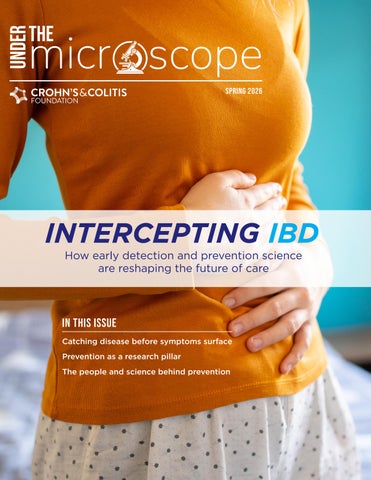
INTERCEPTING IBD How early detection and prevention science are reshaping the future of care
IN THIS ISSUE Catching disease before symptoms surface Prevention as a research pillar The people and science behind prevention
RE
ENGINEERING
IBD
How Prevention Research Accelerates Discovery
BD often begins early—sometimes in childhood—and can unfold over years marked by uncertainty, complex care decisions, and, for some, multiple surgeries. The physical toll is significant, and the emotional toll can be just as heavy. People living with IBD are far more likely to experience anxiety or depression, often while managing a condition that remains largely invisible to others.
I
Advances in genetics, biomarker research, and data science are revealing that subtle signs of inflammation and immune activity can appear long before symptoms. Studying these early signals helps researchers uncover more about what is happening inside the body, insights that can lead to more precise treatments, fewer
its impact is already shaping how the disease is understood, monitored, and treated, helping ensure a healthier future for the next generation.
complications, and, ultimately, stronger paths toward remission and cures. Prevention research doesn’t replace the search for better treatments. It builds on decades of discovery, expanding what’s possible by helping researchers understand IBD across its full course, from the earliest changes in the body to long-term disease management. For people living with IBD today, prevention research may feel future-facing, but
Explore the IBD research breakthroughs transforming lives today—from biomarkers and genes to cutting-edge technologies—and see what your support has made possible.
VOICES OF IBD
Prevention as the Next Chapter of Our Mission By Alan Moss, MD Chief Scientific Officer
For decades, progress in inflammatory bowel disease (IBD) has meant better treatments, more precise therapies, deeper remissions, and longer stretches of stability. That work has changed lives, allowing kids to grow up, adults to build careers, and families to reclaim moments once threatened by disease.
Hope Through Prevention
But today, the Foundation is facing a different question: What if we could act earlier?
Dr. Greg Cammell spent nearly three
Rates of Crohn’s disease and ulcerative colitis continue to rise, particularly among children and young adults. Families with a first-degree relative affected by IBD live with a quiet awareness that the disease can run in families and what that possibility may mean for the next generation.
gastroenterologist, never thinking that
“
“
...By adding this forward-looking perspective, we gain a more complete understanding of IBD biology.
decades caring for patients as a one day he would become one himself. Diagnosed with Crohn’s disease in 2016 during a routine colonoscopy, he was surprised to recognize the telltale signs of inflammation on the screen. Living with Crohn’s has reshaped the way Dr. Cammell connects with patients. He understands the uncertainty, the fatigue, the emotional weight of navigating treatment decisions, and wondering what tomorrow will bring. His experience has also sharpened his interest in seeing earlier intervention for
As science reveals earlier biological signals of IBD, we are no longer simply aware of vulnerability; we are accountable for what we do with that knowledge. With IBD affecting nearly 1 in 100 Americans and more than 10 million people worldwide, prevention has become a critical pillar of the Foundation’s research agenda because it strengthens progress on every front.
patients: the exploration of genetic risk,
Historically, we’ve worked to understand IBD by studying disease after it develops. Now, we’re also looking earlier, studying what’s happening as the disease first begins to take shape. By adding this forward-looking perspective, we gain a more complete understanding of IBD biology.
only for himself and his patients, but for
Prevention in IBD means identifying those most likely to develop disease and stopping progression or recurrence before complications take hold, deepening care for today’s patients while defining the future of our mission.
research. “So much has changed in
identifying disease long before symptoms appear, and a future where patients can be treated sooner and more effectively. Dr. Cammell feels deeply connected to prevention science…not his own children who may share his risk. He is inspired by the breakthroughs he has witnessed and by the Foundation’s commitment to advancing prevention twenty years,” he reflects. “I think about where we’ll be twenty years from now.”
The People and Science Behind Prevention At a recent Foundation research symposium, Foundation-funded scientists shared work that reflects this momentum. Their research spans environmental exposures, biological markers, nutrition, and family risk, illustrating how decades of Foundation-supported discovery have laid the groundwork for a new era of IBD research.
Advancing prevention in IBD doesn’t happen overnight, and it doesn’t happen in isolation. It depends on sustained investment, collaboration, and being willing to ask new questions about risk, early signals, and how care can be personalized long before disease progresses.
Together, their efforts show why prevention has emerged as a new focus of the Foundation’s research agenda: The science and the tools are advancing; and their insights have the potential to improve care for people living with IBD today, while helping prevent disease onset, progression, and recurrence in the future. The researchers highlighted in this issue offer a window into that work, and into how prevention research is already reshaping how IBD is understood, monitored, and treated.
Manasi Agrawal, MD, MS Assistant Professor & Director of Environmental Gastroenterology, Icahn School of Medicine at Mount Sinai
How the Environment Shapes IBD Risk Dr. Manasi Agrawal’s research helps answer one of the most intuitive questions people living with IBD often ask: What around me matters? Her work explores how early-life exposures—from the air we breathe to the foods we eat—may quietly shape the risk of developing IBD years later. By examining how pollutants, ultra-processed diets, early antibiotic use, and reduced microbial diversity influence immune system development, Dr. Agrawal connects environmental conditions to biological changes in the body. In doing so, her research helps move prevention beyond the clinic and into everyday life. “Preventing IBD can remove the impact of the disease not just on the individual, but on families and communities,” she says, emphasizing how awareness and early choices may help shape healthier futures.
Lauren Collen, MD Assistant Professor of Pediatrics, Harvard Medical School
Managing Risk in Families Living With IBD For families affected by IBD, risk does not begin—or end—with a single diagnosis. Dr. Lauren Collen is a pediatric gastroenterologist whose Foundation-supported research focuses on children and young adults at higher genetic and clinical risk, including those from families with strong histories of IBD and those diagnosed with very-early-onset disease. Her work seeks to understand why some children in high-risk families develop more severe disease while others do not, and how earlier identification, closer monitoring, and tailored therapies can help reduce complications over time. By integrating prevention research into pediatric care, Dr. Collen aims to support families long before symptoms escalate, while ensuring that children who do develop IBD receive the right care at the right moment.
Ashwin Ananthakrishnan, MD, MPH Associate Professor of Medicine, Massachusetts General Hospital and Harvard Medical School
How Early Nutrition May Help Lower IBD Risk For many families, prevention may begin at the table. Dr. Ashwin Ananthakrishnan studies how early nutrition shapes long-term gut health, using large international birth cohorts to understand how dietary patterns in infancy may influence IBD risk. His research links diets rich in vegetables, fiber, and fish to lower risk, while frequent consumption of sugar-sweetened beverages may increase it. From Mediterranean-style eating patterns to limiting highly processed foods, his findings translate prevention science into practical, family-centered guidance. “Patients and families want to feel in control,” he says. “They want to know what they can do to help keep the people they love healthy.” His work underscores how small, daily choices can support healthier futures.
Ryan Ungaro, MD, MS Associate Professor of Medicine, Icahn School of Medicine at Mount Sinai
Blood Markers and the Future of Early Detection By narrowing the research lens from environment to biology, Dr. Ryan Ungaro focuses on what the body can reveal before Crohn’s disease becomes symptomatic. His work has helped identify blood-based markers that may signal increased risk up to two years before diagnosis, opening the door to earlier recognition and more personalized care. Dr. Ungaro has also shown that milder forms of Crohn’s disease can follow distinct biological patterns. These findings support approaches that tailor monitoring and treatment to an individual’s risk profile, rather than relying on a one-size-fits-all model.
Our Next Breakthrough Is In Your Hands The game-changing research featured in this edition of Under the Microscope represents just a few of the many ways we play a critical role in major breakthroughs in IBD. Every day, we’re working to redefine how IBD is studied and to accelerate the discovery of new, innovative therapies—offering real hope to those suffering with IBD. While our ultimate vision is a world without IBD, we’re equally committed to supporting patients who are coping with the physical and emotional toll of living with IBD right now. But we can’t do it without you. Your gift today to the Crohn’s & Colitis Foundation will help us change the lives of those with IBD. To make a contribution, please visit: crohnscolitisfoundation.org/microscope.
Create a Legacy of Hope Nothing says more about your commitment to supporting and strengthening the Crohn’s & Colitis Foundation’s vision than including us in your estate planning. As a member of the Founders Society, you will be listed in our Impact Report and receive exclusive information and updates on our mission advancement and research progress.
Create a legacy of hope. Scan here to donate.
To make a planned gift or learn more, contact Susan Carriker at scarriker@crohnscolitisfoundation.org Or visit crohnscolitisfoundation.org/freewill to access a free tool to help you plan your legacy gift to the Foundation.
Discover More at crohnscolitisfoundation.org The Crohn’s & Colitis Foundation is the leading nonprofit organization focused on research, education, and support for the millions of Americans affected by inflammatory bowel disease (IBD). We have played a role in every major research breakthrough in IBD and are the trusted source for IBD patients and caregivers, educating, guiding, and supporting them every step of the way.